



Abstract
The physical appearance of Ati, the co-ruling woman of Punt, often referred to as “the Queen of Punt,” as depicted in the pharaoh Hatshepsut’s “Voyage to Punt” has been subject to scholarly attention in the European academy. However, in this scholarship her appearance is disparaged as humorous or pathological which is reminiscent of the racist characterizations of Ssehura of the Khoi-Khoi people as the “Hottentot Venus.” This problem is termed as the “European Hottentot Complex” in this study. Recovering Ati from the European Hottentot Complex, this study provides an Afronography on the Kemetiu (ancient Egyptian) aesthetic perspective by examining the primary sources from a Jamaican cultural perspective through language. Subsequently, this study shows the transgenerational dimension of the Afrikan aesthetic norm that is expressed in the Jamaican notion of tiknis. Ultimately, this study locates the Kemetiu perspective on Ati of Punt within the context of tiknis.
 Nsw.t bity Hatshepsut (r. 1479–1458 BCE) of Kemet (e.k.a. ancient Egypt) sponsored an expedition to the land of
 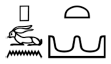 Pwnt Punt.
1
Punt was located within the horn of Afrika around within the vicinity of what is now known today as Somalia and Eretria.
2
Hatshepsut’s “Voyage to Punt” is depicted in her temple at
Pwnt Punt.
1
Punt was located within the horn of Afrika around within the vicinity of what is now known today as Somalia and Eretria.
2
Hatshepsut’s “Voyage to Punt” is depicted in her temple at 
 Ati (Figure 1), often referred to as “the queen of Punt,” is the focus of this study.
3
Ati has drawn scholarly attention in the European academy because of her physical appearance which has been discussed in pejorative terms. This essay addresses the problems within the European literature on Ati and provides a nuanced and culturally grounded approach to the aesthetic sensibilities of the
Ati (Figure 1), often referred to as “the queen of Punt,” is the focus of this study.
3
Ati has drawn scholarly attention in the European academy because of her physical appearance which has been discussed in pejorative terms. This essay addresses the problems within the European literature on Ati and provides a nuanced and culturally grounded approach to the aesthetic sensibilities of the 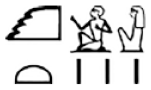 Kmt(.yw) Kemetiu.
4
Kmt(.yw) Kemetiu.
4
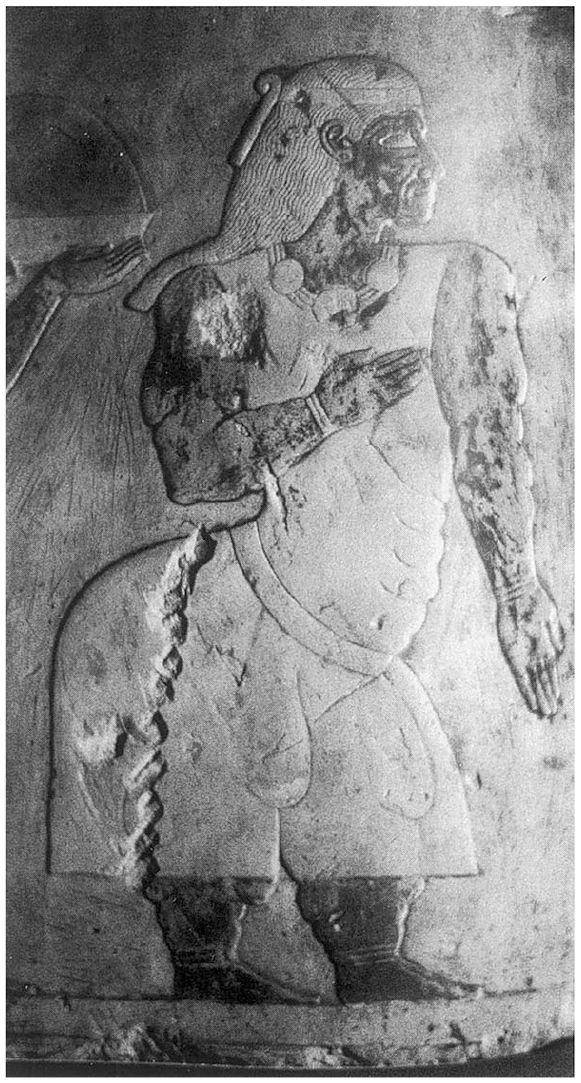
Ati of Punt (Photo credit: Sall, 1994: Planche III).
This study is divided into four sections. The first section discusses the historical connection between the European academic discourse on Ati of Punt and that of Ssehura of the Khoi-Khoi people (e.k.a Saartjie Baartman). 5 The second section is an Afronography of the Kemetiu aesthetic of the female body. Afronography is a method of recording and writing the Afrikan experience from an Afrocentric perspective (Asante, 2005: 76). Afrocentricity is a paradigmatic intellectual perspective on Afrikan phenomena that is grounded in Afrikan historical experience and cultural context, transcontinentally and trans-generationally. In this way, Afrocentricity provides epistemological centeredness for Afrikan people in order to understand Afrikan phenomena on Afrikan terms (Asante, 2007: 2; Mazama, 2003: 5–7). Thus, an Afronographic analysis of Kemetiu material provides an Afrocentric perspective on Kemetiu aesthetics of the female body which serves as a corrective to the European Hottentot Complex. This Afronographic study uses the Jamaican language to contextualize the Kemetiu aesthetic. 6 Jamaican translations of Kemetiu literature show that the Jamaican notion of tiknis provides an accurate interpretation of literary descriptions of female beauty in Kemet. Moreover, the aesthetic of tiknis is located within a larger Afrikan historical and cultural context that connects the phenomena on the continent to its diaspora in Jamaica.
The third section is a review of the scholarly literature on Ati in Egyptology and other Eurocentric disciplines. There is clear consensus view in both genres of European academic literature that Ati’s appearance is distasteful or, worse, pathological. The Eurocentric scholarship is a clear contrast from the Afrikan aesthetic perspective and, instead, speaks to a European Hottentot complex. The fourth section is an Afronography of the Kemetiu portraiture of Ati. It is demonstrated that the depiction of Ati is not derogatory, rather it is reflective of an aesthetic perspective within Afrikan culture.
The Hottentoting of Ati
Saartjie epitomized ways in which black women’s buttocks, in particular, were constructed as ‘sexually grotesque’ and compels a discussion about the ongoing role of racism in creating an aesthetic that depicts black bodies as diseased, animalistic, deviant, and hypersexual. (McKay & Johnson, 2008: 493, emphasis added)
In 1810, Ssehura of the Khoi-Khoi was taken from South Afrika and exhibited in London and Paris by several abductors as “The Hottentot Venus” (Hobson, 2003: 89). The term “Hottentot” is a Dutch term that mocked the language of KhoiKhoi people as “stutters” (Willis, 2010: 5). In other words, the name “Hottentot Venus” is racist comedy for Europeans. After her death in 1816, Ssehura’s body was examined by biologist Georges Cuvier who presented the results to the French Museum of Natural History (Fausto-Sterling, 1995: 20). In his commentary, Cuvier ridiculed Ssehura through the racist logics of the European academy. As the introductory quote explains, Ssehura of the Khoi-Khoi is the example of the historical European disparagement of Afrikan womens’ bodies. This European Hottentot complex informs the European discourse on Ati.
The degradation of Ssehura has clear connections to Egyptological discourse on Ati. Cuvier used Ssehura’s skull to argue that the Kemetiu could not have been a Black race based on his racist comparison with skeletal remains from Kemet (Ibid: 27, 38–
Undoing the Hottentot
Because of this perceived difference, which as we have seen, has historical and cultural associations with grotesque and deviant sexuality, black women who have attempted an aesthetic of the body still struggle to articulate an affirming discourse of black female beauty. This struggle involves not only recovering the “unmirrored” body but also reclaiming agency and subjectivity. (Hobson, 2003: 98, emphasis added)
The above discussion shows the need for an Afrocentric perspective on Ati outlined in the introduction. This section examines the Kemetiu portrayal of the Ati from an Afrocentric perspective. As such, an Afronographic analysis is necessary for Un-Hottentoting Ati. This section demonstrates the relationship between Afrocentric historiography and translation in Afronographic research.
One of the fundamental characteristics of the Afrocentric project is lexical refinement because our language must position Afrikans as subjects. In the case of Ati, we must dispose of the disparaging language that is used to describe her physique. Terms such as Hottentot, bushwoman/bushman, and steatopygia are all derogatory descriptions of Afrikan people, especially Afrikan women. For example, Steatopygia translates to “fat rump” in classical Greek and was created to describe “Hottentot” women. The opposite term is callipygous which translates to “beautiful backside.” Janelle Hobson observes that the term callipygous has been used to describe non-Afrikan women (Hobson, 2003: 97), but not Afrikan women such as Afrikan American tennis star Serena Williams (
It is imperative to consider the general artistic conventions of Kemet. In Kemetiu artistic convention, women are not shown in the same physique as Ati, but they are not slender body types. However, there is no literature where feminine beauty is narrowed to a specific physical type nor is a body type pathologized. Moreover, it is important to contextualize the meaning of The concept of beauty from an Afrocentric point of view has been holistic, i.e. it has embraced all levels of Kemetic society, i.e. the cosmic level (creation of the universe); the macro-level (Kemetic society), the meso level (nomes) and the micro level (individual). (Ibid: 40, emphasis added) nfr (nefer), an aesthetic concept in
  Medew Netcher, translates to both “beauty” and “good.” In other words, beauty and goodness are synonymous in Medew Netcher which is a common trait in Afrikan languages, such as Nzuri in Ki-Swahili and Iwa in Yoruba (Cannon-Brown, 2006: 7). Willie Cannon-Brown explains the implications of this perspective:
In context of the holistic ethos in the Kemetiu perspective, beauty is seen in everything that exists. In context of the physical body, Cannon-Brown explains that the aesthetic ideals for men and women mentioned in literary evidence centered primarily on personal adornment which used to express the divinity within them.
The Kemetiu perspective of  nfr corresponds to the general Afrikan notion of beautiful in which communal purpose and functionality is central, while physical attributes are secondary (Onyewuenyi, 1984: 242–243). This why, in Afrikan culture, a person with a pleasant physical appearance could not be referred to as “beautiful” if their seen by their community as lacking in character (Cannon-Brown, 2006: 7–8). Consequently, visual depictions of men and women in Kemetiu are not based a singular type of physical beauty, rather they speak to a holistic view of the beauty. This multidimensional notion of beauty is reflected in the aesthetic of tiknis as discussed below.
Tiknis iina Kemet
The source material for the physical aesthetic of the female body in Kemet is limited in number, but it is revealing when translation is done in Afrikan languages as the Afrikan aesthetic disposition informs the basis of inquiry. There are two texts discussed below that specifically address the issue of physique as it pertains to women. However, it is important to emphasize that the literary evidence discussed is based on the literature from Kemet, not the people of Punt, because there is no available evidence for the latter. Limitations notwithstanding, it does not mean that the aesthetic perspective of the Kemetiu could not be applicable to the Afrikans in Punt as both are Afrikan people within an interconnected Nile Valley context.
There is a discussion of a woman’s physique in Maxim 37 of The Instruction of Ptah-hotep, which dates to the Old Kingdom period in Kemet (ca. 2686–2181 BCE).
8
The description has been difficult for European translators. Observe the difference in the English translation and the Jamaican translation. There are two Jamaican translations given in two different orthographies. The top translation uses the Jamaican Language Unit (JLU) orthography and the bottom is in an English-approximate orthography: Instructions of Ptahhotep, P. Prisse 15.6-15.8
9
If you take to wife a
Who is joyful and known by her town If she is fickle and likes the moment Do not reject her, let her eat Joyfulness brings happiness (Lichtheim Translation)
10
Ef yu tek a waif wid a tik badi
uu aat api an ar tong piipl dem ehn nuo ar
Shi kaina somtaimish, bot api fi ar taim
Duohn dash ar we, mek ar nyam fram yu!
Di api aat uman shi bring-op di kaam waata
If you tek a wife wid a tick baaddy Oo art ‘appy an ‘ar town people en know ar She kinda sometimish but ‘appy fe ‘ar time Don’ dash ‘ar ‘way, make ‘ar nyam fram yuh De appy art ooman she bring up di calm water
Mariam Lichtheim does not translate  Špn.t into English due to the difficulty that it has caused for Egyptologists. She observes that translations have ranged from “fat woman to dancer” (1973: 98, n. 61). C. Cannuyer argues that Špn.t refers to “obesity” and, consequently, he translates line 15.6 ir ir.k Hmt m Špn.t as “If you marry an obese woman” <<Si tu épouses une femme obèse>> (1986: 95–
The love poem “The Great Song for Soothing the Heart” (e.k.a The Song of Seven), written during the New Kingdom era (ca. 1189–1077 BCE) provides further confirmation of the tik aesthetic. The first Papyrus Chester Beatty (pCB) 1C, 1V1-V8.
11
 ḥwt (stanza) is a male persona describing his beloved. The text is translated below in Jamaican. The left version is in JLU orthography, the text on the right is English approximate orthography:

The Jamaican translation of 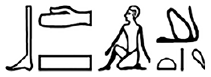 bdŠ pḥt as “bati tik” is entirely different from the English translations done by Egyptologists. The critical difference is in the way that
  bdŠ is interpreted. Alan Gardiner’s interpretation of bdŠ as “drooping” is one of the suggested English translations listed (Gardiner, 1931: 30; Lesko, 2002: 143). The problem is that Gardiner’s translation of bdŠ is awkward. Subsequent translations, as seen above, have differed drastically. Mariam Lichtheim translates bdŠ pḥt as “heavy thighs” (1976: 182) when the translation of
  pḥt is “buttocks” (Lesko, 2002: 153) and, in addition, the word for thighs is mnty (Lesko, 2002: 185). John Foster’s translation, “curving hips,” is equally puzzling (1995:
Carolyn Cooper explains that the notion of vulgarity is often associated with Afrikan culture in contrast to “refined” European culture which, turn renders Jamaican language as “vulgar” and English “refined” (1993: 8–
The cultural nuances of the tik aesthetic is evident in Jamaican Music. For example, in his single “Punany A Mi Best Friend”, Vybz Kartel (2013) says in the chorus “tok a tik, bobbl fi mi kwik// Go de gyal—wat a badi tik” (tock a tick, bubble for me quick/ Go on and dance, damn—your body’s thick). In her verse on Stylo G’s “Dumpling” remix (2019), Spice boasts “mi tais dem tik laik pompkin/ luk pon mi big bati jompin.” (My thighs are tik like pumpkins, watch my big bati jumping). Also, fat and big can be used synonyms for tik (Shaw, 2012: 141–143
The culture of ancient Nubia yields further evidence of this aesthetic disposition. Ancient Nubian dancers, for example, are shown with tik badi types in Nubian art (Ashby, 2018: Figures 2 and 3). Moreover, The Kendakes (queen mothers) of Meroitic Nubia (ca. 300 BCE–400 CE) are depicted with tiknis. Most notable is the depiction of Kendake Amanishekete (see Figure 2). Babacar Sall suggests that it is likely that their physique reflects her status and wealth (1994: 78–
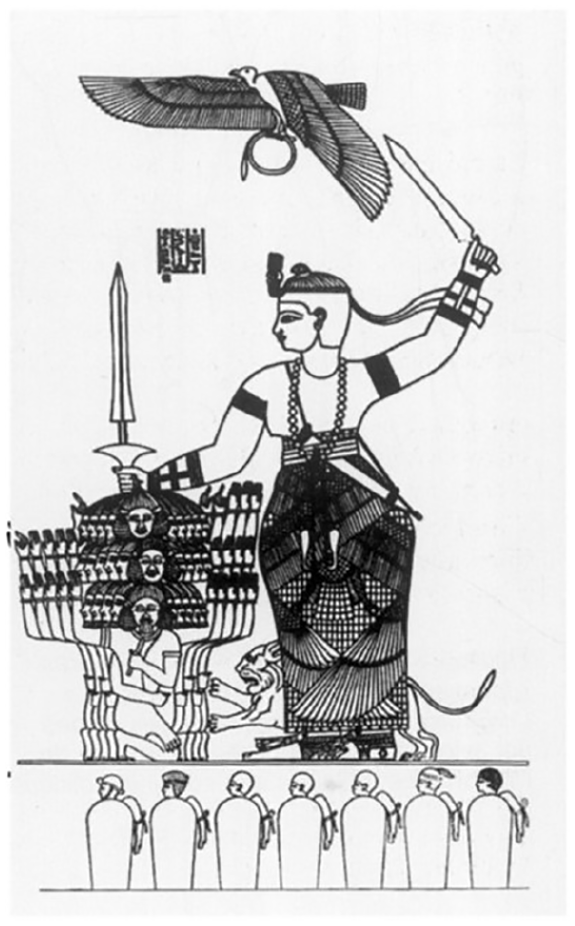
Illustration of Queen Amanishekete from a relief in her pyramid (Photo Credit: Sall, 1994, Planche I, Figure 2).
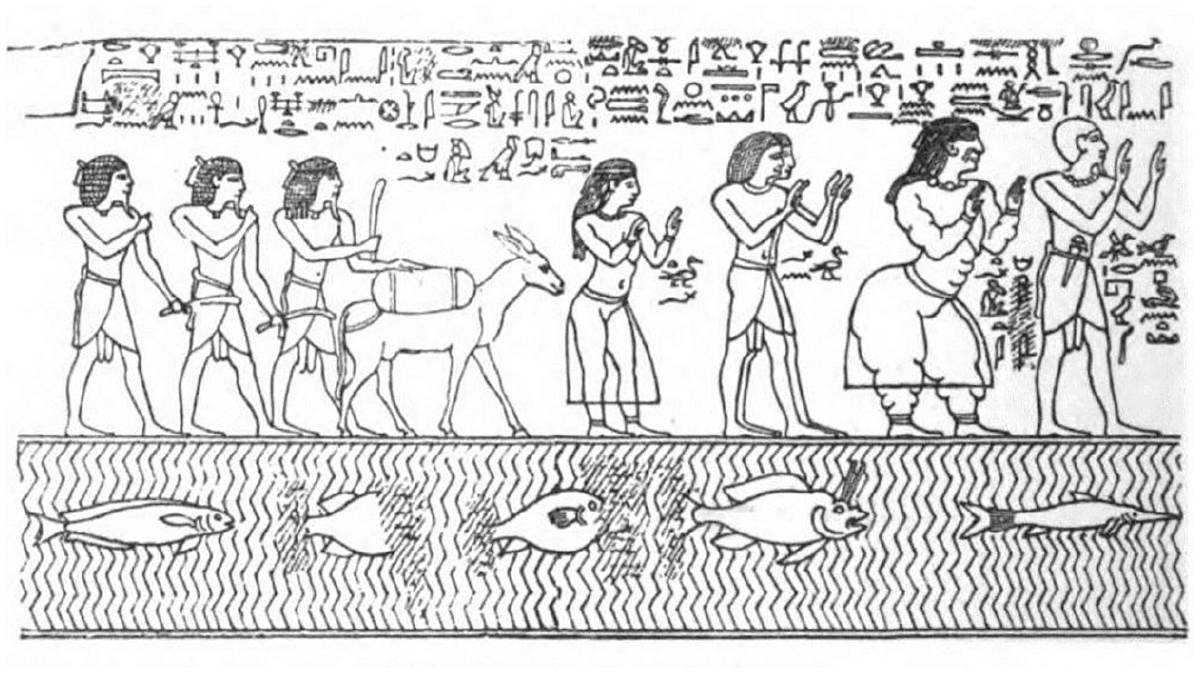
Illustration of the procession of the Puntite royal family (Photo Credit: Edwards, 1981: 284).

Illustration of the royal family of Punt bringing goods (Photo Credit: Edwards, 1981: 289).
Tiknis iina Afrika
The continuity of this aesthetic of tiknis, is evident among Afrikan people in the continent. A prime example is the fertility rooms (e.k.a “fattening rooms”) of the Anang people of Nigeria. There is a cultural association between a woman’s weight and fertility. Tiknis is also a marker of physical beauty for women in Anang society (Brink, 1989). In fact, as discussed earlier, there is evidence of a similar practice possibly among the ancient Nubians in the Meroitic period who celebrated the tiknis of their Kendakes in their visual motifs. This practice of the Anang, evidently, reflects the value of functional dimension of beauty in Afrikan aesthetics in terms of practicality and meaningfulness as fertility is a critical determinant in physical beauty.
The concept fertility and beauty in Afrikan culture is present in Jamaica. Studies in rural Jamaica showed that thinness is perceived as infertile, while tik women are seen in a positive context (Barned, 2017: 15–16). This centrality around fertility from rural Jamaica is not different from the Anang perspective. Moreover, within that positivity, tiknis is associated with kindness, vitality, and body health. There are also the similar and related notions of slim-tik “slim-thick,” flofi “fluffy,” mampi “mampy,” and plomp “plump” that Jamaicans use to describe beautiful women (Ibid: 130). It is important to note that these terms exist within a spectrum of tiknis. This spectrum is demonstrated in the Dancehall artist Pamputtae’s “Slim versus Fluffy” (2013) in which Spice is featured as the two women engage in friendly boasting about their respective physiques. Comparatively, Ati’s physique would be understood within this same spectrum of tiknis in Kemet.
There is a dimension of resistance in the aesthetic of the tik bati in Jamaican culture. According to Jamaican legend, Queen Nanny of the Maroons defeated the English armies by catching their bullets in her buttocks and farting them back at the soldiers (Brathwaite, 1994: 120–122). From this context, Janelle Hobson argues that “the batty” functions as a site of resistance and decolonization in which Black women assert their agency within a larger Afrikan diasporic discourse. As such, the movements of the bati in dancehall and carnival music challenge colonial constructs of “decency” (Hobson, 2003: 101–103). However, the resistance in the Afrikan diaspora must be contextualized within an Afrikan cultural context. Concerning Nanny, Kamau Braithwaite cautions: But we must remember that the buttocks is a source and symbol of power – what the Kikongo call mgara – fulfillment – And in the case of Nanny we see the buttocks, then, only as a (?negative) symbol of derision & abuse but also (more positively) as an expression of military power (she displayed her buttocks during battle) as an xpression of para-military power – since she was guerilla too. . .a symbolization of her ritual power. (Brathwaite, 1994: 126, second to fourth emphasis added)
In addition, Braithwaite notes the role of concealing and revealing the bati in Kumina and carnival as an expression of fertility (Ibid) which corresponds with the earlier discussion of the functionality that gives value to tiknis in Afrikan culture. As such, it is evident that the aesthetic of tiknis is not rooted in resistance as much as it is a continuity of an Afrikan aesthetic.
European Literature on Ati of Punt
The scholarly literature on Ati assumes that her physique is a problem. The difference among scholars can be divided into two perspectives. One is the Egyptological perspective. In Egyptological scholarship, the tendency is to assume that Ati looked grotesque to the Kemetiu. The second perspective is based on health sciences. These scholars insist that Ati must have had a pathological condition. Before proceeding with the literature review below, it should be noted that Ati’s body was not discovered. In other words, the arguments discussed below are all based on the pictorial representation of Ati in Nsw.t bity Hatshepsut’s voyage to Punt.
Egyptology
As discussed earlier, Eduoard Naville was the first European academic to analyze the depiction of Ati and described her as a “barbarous beauty standard” of “inner Africa.” This perspective has been foundational to contemporary Egyptological discourse on Ati. Referring to her as “the fat queen of Punt,” Kenneth Kitchen suggests that Ati is Khoisian or “Bushmen” solely based on her physique (1971: 188). Ssehura was a Khoisian and eventually this group became synonymous with the racist nomenclature of “Hottentot” and “Bushwoman” (Fausto-Sterling, 1995: 21–23). Kitchen’s commentary echoes the sentiments of Naville, but it also Ati further demonstrates the influence of European Hottentot Complex in contemporary Egyptological discourse.
Joyce Tyldesley’s commentary also echoes Naville’s sentiment. Like Naville, she distances Kemet from Afrika. Her description of Nswt bity Hatshepsut’s physical appearance, based solely on conjecture, shows her racial positioning of Kemet: we can assume that, in common with most upper-class Egyptian women of her time, she was relatively petite with a light brown skin, a relatively narrow skull, dark brown eyes and wavy dark brown or black hair. (Tyldesley, 1996: 129, Emphasis added)
This faulty assumption is furthered in her comparison between the physical appearance of Kemetiu and Puntites as depicted in Nswt bity Hatshepsut’s voyage to Punt. She contrasts the Puntites as “a curiously mixed bunch” of black and brown Afrikans, while noting that some look like Kemetiu—as if they too are not the same people (Ibid: 149). The subconscious racial contrast is clear in Tyldesley’s description of Ati’s physical appearance: [Neshi’s] grotesquely fat wife, with her wobbling, blancmange-like folds of flab and enormous thighs emphasized by her see-through costume, presents a marked contrast to the stereotyped image of the upper-class Egyptian woman as a slender and serene beauty. (Ibid: Emphasis added)
The fact that Tyldesley introduces Ati with a negative physical descriptor, as oppose to her name or royal title, is derogatory. She even asserts that Ati is “too fat to walk” and continues with unwarranted derogatory remarks about her weight (Ibid: 150). Tyldesley has not established, conclusively, that Ati’s body would have been disparaged of the Afrikan people themselves. Although Naville was an overt white supremacist, even he acknowledged the difference in beauty standard in “inner Africa.” Tyldesley directly quotes Naville’s commentary (Ibid: 148, n. 32), but she does not acknowledge the Afrikan context of Kemet or Punt. Thus, there is a clear Eurocentric subtext in Joyce Tyldesley’s commentary on Ati.
Robert Bianchi follows the same pattern. He divorces Kemet from Afrika explicitly when discussing its relationship to ancient Nubia and Punt (Bianchi, 2004: xiv, 1–5). He observes that some of the Puntites have similar physiognomy with Kemetiu, but singles out Ati: The only anomalously designed figure in this entire suite of decoration is [Ati], the Queen of Punt, but here again the imperatives of the design tenets governing all ancient Egyptian art precludes a precise pathological identification of her physical condition. (Ibid: 124, emphasis added)
Bianchi further explains that the portrayal of Ati is an ideological depiction meant to contrast and emphasize the “exotic” and “foreign” (Ibid: 124–1
Even Egyptological books focused on visual arts in Kemet do not provide any nuance or improved discussion on Ati. For example, Gay Robins uses hyperbolic language to describe Ati as a racial contrast: His enormously fat wife, the [opposite] of the Egyptian notion of female beauty, is also perhaps to stress the otherness of these people. (Robins, 2008: 126)
However, there are no Kemetiu women depicted in the visual scenes to contrast with Ati which makes Robins’ comment on “otherness” perplexing. Consequently, it is evident that Robins’ interpretation is based on her views of Ati, not the perspective of the Kemetiu.
In his discussion of connoisseurship in Kemet, Jack A. Josephson thinks that there is something remarkable about the artisans’ ability to depict a woman with Ati’s physique: [T]he famous depiction of the queen of Punt, depicted as hugely obese and covered with rolls of fat, is an excellent example of the skills of the artisans who drew, carved, and painted these scenes. (Josephson, 2014: 69, emphasis added)
The hyperbolic language clearly reflects his personal disposition, rather than a serious intellectual inquiry. Josephson further adds that Ati’s presence is “a humorous depiction” (Ibid, emphasis added). This “humor,” however, is not based on the primary sources. Josephson does not attempt to deconstruct the perspective of beauty in Kemet, rather he assumes that his perspective, which is Eurocentric, to be normative.
The discussion reveals two underlying problems in the European discourse on Ati. First, Kemet is dislocated from Afrika and, in turn, it is subconsciously read as a European/white culture. This is evident by the treatment of Punt as an Afrikan contrast to Kemet. The racial undertone of this contrast is evident by the perplexing comparisons between Ati and conventional visual representations of women. Second, there is no consideration given to other interpretations. The scholarship assumes that the Kemetiu were concerned with her physical appearance in the same manner as Eurocentric observers. Moreover, the scholars do not provide any evidence which suggests that the Kemetiu would have pathologized her physique or found it distasteful. Furthermore, the fact that both white men and white women disparage Ati speaks to the shared cultural and historical context of both groups. Their aesthetic perspective is a stark contrast from the Afrikan aesthetic of tiknis. Consequently, it is inevitable that Ati would be subject to anti-Afrikan commentary from both white men and women. Thus, the Egyptological discourse projects the European Hottentot Complex onto the Kemetiu.
From Elephantiasis to the “Queen of Punt Syndrome”
In European scientific literature, Ati’s appearance is not only deemed unappealing, but she is assumed to have a medical condition. B.R Laurence pondered the possibility of Ati having filarial elephantiasis. He argued that the only reason for objection is “the rare involvement of all the limbs and the absence of swelling in the feet of the queen” (Laurence, 1967: 613). Yet, he does not outright dismiss elephantiasis diagnosis. Comparing Ati to her daughter, Laurence describes her appearance as pathological. He argues that the daughter has the same “symptoms,” but not “the disfigurement of her mother” (
Véronique Dasen considers pathological dwarfism as a diagnosis for Ati. Dasen describes other Puntites as “slim and well proportioned” and contrasts Ati as “very fat with dwarfish proportions” (Dasen, 1993: 37). She characterizes Ati’s physical characteristics as “body malformations.” However, she notes that Ati does not have features of “ethnic or pathological dwarfism” (Ibid: 38, emphasis added). It is rather revealing that Dasen sees the following characteristics as features of “ethnic or pathological dwarfism”: [Ati] has no frizzy hair or flat nose, her arms are of normal length, with well-formed hands. It seems more likely that the queen of Punt had some disease which Egyptian artists tried to render as realistically as possible. (Ibid, emphasis added)
It is not coincidental that Afrikan phenotypic features are considered pathological conditions. Dasen acknowledges that Afrikan societies see a woman’s weight as a symbol of wealth and power, but she still maintains that it is “more likely” that Ati’s body is pathological. In other words, for Dasen, Eurocentric beauty norms are ideal/standard, while the Afrikan body is inferior.
Bernard Christenson and Comillo O. Di Cicco go a step further. They suggest that Ati has a new dermatological pathology—the “Queen of Punt Syndrome” as coined by the latter (Christenson, 2006; Di Cicco, 2005). However, Di Cicco acknowledges that: Bioanthropological and medical geneticist has a lot studied the Queen of Punt. . .in order to place a precise diagnosis, but with many difficulties not having a mummy for such disposition. (2005: 7)
Christenson also agrees that: in the absence of any genetic or bioanthropological evidence of a mummy, the clinical diagnosis that should be ascribed to the Queen of Punt still remains elusive. (2006: 1345, emphasis added)
However, in spite of this insufficient evidence, neither Di Cicco nor Christenson consider it a possibility that Ati’s body is not a pathological condition.
There are two main problems in the anthropological literature. First, there is the obvious assumption that the Afrikan female body is pathological. Secondly, there is no physical body available for diagnosis. It is perplexing that the absence of evidence does not prevent scholars from diagnosing Ati’s body or even questioning the basis for diagnosis. Evidently, the discussion of pathological conditions is based on a Eurocentric and racist pretense. Even when there is still no agreement or clear evidence on the alleged pathological condition, there is still an insistence on giving a diagnosis. This insistence can only be explained by the historical degradation of Afrikan people. Furthermore, there is no critical discussion of cultural subjectivity, rather there is a false of assumption of European objectivity. Ultimately, the academic literature shows a sciencing of anti-Afrikan racism.
Ati Scenes
The two scenes from “The Voyage to Punt,” the lone primary sources, have no explicit commentary on Ati’s physical appearance. There is a caption that reads
ʿȝ ʿȝ fȝ(.w) ḥmt=f
great donkey carry(.3MS stative) wife=3MS
Di big daangki kyaari im waif ting
The great donkey had carried his wife’s stuff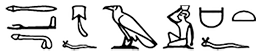 ʿȝ ʿȝ fȝ(.w) ḥmt.f which is above the donkey (Figure 3).
12
Early Egyptologist James Henry Breasted translates the caption as “the ass which bears his wife” (1906: 108). Likewise, Egyptologist Amelia Edwards translates the caption as “the great ass that carries his wife.” Edwards assumes that the donkey was carrying Ati which, in turn, was meant to be a joke on the Ati’s size (1891: 285). This translation seems to be an additional reason that Ati has been misinterpreted as a joke in Egyptology (Josephson, 2014: 69; Meltzer 1992: 326).
13
This translation correctly identifies
ʿȝ ʿȝ fȝ(.w) ḥmt.f which is above the donkey (Figure 3).
12
Early Egyptologist James Henry Breasted translates the caption as “the ass which bears his wife” (1906: 108). Likewise, Egyptologist Amelia Edwards translates the caption as “the great ass that carries his wife.” Edwards assumes that the donkey was carrying Ati which, in turn, was meant to be a joke on the Ati’s size (1891: 285). This translation seems to be an additional reason that Ati has been misinterpreted as a joke in Egyptology (Josephson, 2014: 69; Meltzer 1992: 326).
13
This translation correctly identifies  ḥmt=f, ‘his wife’, that is, Ati, is the direct object of the verb
 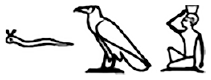 fȝ(.w), the stative form of the verb fȝi meaning “to carry.”
14
However, this interpretation does not correspond with the visual images in the scenes. The donkey is never shown carrying Ati, but it is carrying an object which is unloaded in the next scene (Figure 4). This object must have some connection to Ati as implied by the reference to her, that is, “his wife,” in the caption text. Consequently, the caption can be translated as follows:
fȝ(.w), the stative form of the verb fȝi meaning “to carry.”
14
However, this interpretation does not correspond with the visual images in the scenes. The donkey is never shown carrying Ati, but it is carrying an object which is unloaded in the next scene (Figure 4). This object must have some connection to Ati as implied by the reference to her, that is, “his wife,” in the caption text. Consequently, the caption can be translated as follows:
The Jamaican translations show two important grammatical characteristics evident in the language. The stative 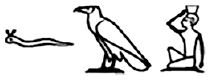 fȝ(.w) is not tensed as is the case with the stative construction in Medew Netcher (Allen, 2013: 120). The stative verb form is an example of the aspect-centric disposition of the verbal system in Afrikan languages that continues in diasporic Afrikan languages (Kifano & Smith, 2005: 78–79). Jamaican speakers can simply say “kyaari,” whereas English needs tense marking to articulate a stative expression. Though an item of possession, that is, ting, is not explicitly mentioned in the caption text, it is clearly implied when looking at the visual scene. This can be done because of the direct genitive construction in Afrikan languages (Kambon, 2015: 195; Nehusi, 2001: 92). In other words, there is an interplay between the text and the visuals. Thus, there is no philological evidence that supports the idea that the Kemetiu would find humor or distaste in Ati’s appearance.
The Eurocentric academic discourse on Ati is clearly rooted in historical anti-Afrikan racism that is directly connected to the European exploitation of
Footnotes
Acknowledgements
The author thanks Septembre Anderson, Solange Ashby, Dr. Kimani Nehusi, Okunini Ọbádélé Kambon, for providing constructive feedback and suggestions on previous drafts of this paper. The author also thanks to Shyrel-Ann Dean for helping him with the JLU Orthography and looking over a draft. Lastly, an JBS anonymous reviewer gave great revision suggestions which helped enhance this paper greatly. However, the author takes sole responsibility for any errors or limitiations found in this essay. The author would like to acknowledge and give thanks to Sage and Sage’s editing team’s patience and efforts with the editing process for this manuscript.
Declaration of Conflicting Interests
The author declared no potential conflicts of interest with respect to the research, authorship, and/or publication of this article.
Funding
The author received no financial support for the research, authorship, and/or publication of this article.
