



Abstract
Disability studies globally is concerned, in various ways, with questions of systemic injustices and inequities that persons with disabilities are subjected to. Persons with disabilities are often positioned as the objects of research rather than equal thinkers and knowledge bearers in their own right. These issues are amplified in the context of African societies, where access is even more challenging than in wealthier countries, and many persons with disabilities are excluded from education altogether. This situation reinforces their epistemic vulnerability. As such, there is limited work on doing disability research from the frame of reference of those in these African societies. This article operates at the nexus of two scholarly traditions. The first of these is the field of disability studies, which is generally dominated by Global North thinking than ideas and experiences from the Global South, and which has addressed questions of knowledge and participation quite extensively, but most commonly in high-income countries. The second is the long-standing political and epistemological African Renaissance lens for understanding and rebelling against imperialism and neo-colonial advances in formerly colonized African societies. I integrate and engage these two scholarly traditions to contribute to charting possibilities of what critical disability studies might look like and mean, from the premise of an African Renaissance. Central to this discussion is building on African theorization while also challenging the dominating and hegemonic white-centric theorization that dominates the field and epistemology in general.
Introduction
Globally, disability studies is concerned in various ways with questions of epistemic access. In disability studies, multiple layers of asymmetrical power relationships have reinforced limited participation of African disability researchers to the global academic discourse and knowledge creation in their own account. South Africa is an especially interesting country where disability research and provision have historically been intertwined with the racialized power hierarchy. As a result, the current process of attempting to redress power imbalances regarding disability knowledges in South Africa inevitably requires and involves engagement with historical and ongoing questions of exclusion and power. I take the methodology of a rapid review supported by my own professional experience critical reflexivity to engage the disability scholarship. This article focuses on reimagining disability in Africa, anchored on two scholarly traditions—disability studies and the African Renaissance. Specifically, I use the African Renaissance as a premise for reimagining disability studies in Africa. The central argument is that if disability is not centered in the reawakening of Africa, we run the risk of translating the existing epistemic violence into other forms of structural and systemic violence.
Currently, disability studies, which is generally dominated by Global North thinking than ideas and experiences from the Global South, remains far stronger in the Global North and has addressed questions of knowledge and participation quite extensively, but most commonly in high-income countries (Bezzina, 2018; Dirth & Adams, 2019). This situation reinforces Africa’s epistemic vulnerability. Some of the known consequences of the dominance of the Northern thinking, as outlined by Connell (2000) include;
The claim of universality which ignores the harsh realities of persons with disabilities in Africa and the extrapolation of Northern discourse to explain the realities of African people;
A reading from the center which makes some key debates about disability irrelevant to those whose major interest is on issues of survival and thus inadequate to explain the complex African experiences;
Gestures of exclusion where African thinkers are either never cited in disability studies and that theorization never builds on theories formulated in Africa as a site with valid knowledge systems.
In the mainstream discussion on understanding disability, there remains a gap of thinking differently about disability in Africa. Even those who venture into conducting African research or generally doing research in the periphery locations, data from the periphery is framed largely by concepts, debates, and research strategies from the North (e.g., see Watermeyer et al., 2019). While critical disability theory locates disability as an issue of politics and power which serve to marginalize and oppress persons with disabilities, the colonial nature of disability relations in critical disability studies and critical activism remains largely unaddressed (Hutcheon & Lashewicz, 2020). For instance, Hutcheon and Lashewicz (2020) noted that only a handful of scholars have highlighted the white-centric theorizing and a need to thus decolonize our theories and practices. Additionally, Indigenous people are often ignored in critical disability studies’ theorizing and critiques (Driskill, 2010). As such, only recently, critical disability and decoloniality scholars started posing pertinent questions around whether and how coloniality and the colonial/modern system not only reinforces ableism but also creates disability and disabled bodies (Grech, 2012; Grech & Soldatic, 2015; Hutcheon & Lashewicz, 2020; Meekosha, 2011). These questions are crucial for the way in which they challenge ableist ideals of body normativity under on-going coloniality (Reed-Sandovala & Sirvent, 2019). Similarly, as we think about an African Renaissance, this African lens may be useful in charting possibilities of what African disability studies might look like and mean. Central to both disability studies and the African Renaissance, with its emphasis on former colonies in Africa, are questions not only of epistemic access, but, more broadly, issues concerning the politics of voice and alternative ways of understanding the plight of persons with disabilities.
The African Renaissance is a long-standing political and epistemological lens for understanding and rebelling against imperialism and neo-colonial advances in formerly colonized African societies (Sesanti, 2016). The African Renaissance has, for many years, mobilized both political and cultural debates in South Africa, and was central to the former South African president Thabo Mbeki’s vision for Africa as articulated in the New Partnership for Africa’s Development (NEPAD) among other programs and policy frameworks. Cheikh Anta Diop was very influential in shaping and pioneering the concept of African Renaissance in a series of essays that sought to theorize how the fashioning of a higher civilization on the continent depends on the quest for a cultural, political, economic and epistemic rebirth (Diop, 1996). Recognizing the concrete ways in which of colonization and colonialism has disenfranchised and dehumanized African people, Diop was advocating for the reawakening of Africans’ lost identity, dignity and self-determination (Diop, 1996). According to Marumo and Chakale (2018:184), this epistemological lens recognizes Africa “as the cradle for humanity while providing a framework for modern Africa to re-emerge as a significant partner in the New World order.” As Cossa (2009) posits, the concept was about defining who we are and where we are headed in the global community as well to formulate actions that center Africa and its people.
Mbeki (1998) followed Diop’s footsteps and first reiterated the idea of the African Renaissance in his inaugural address as a Chancellor of the (then known as) University of Transkei in Umtata in 1995, positing that the university must own the responsibility of upholding an accelerated and sustainable social, economic and cultural renaissance. This characterization of universities as a site of struggle in the quest for the realization of an African Renaissance had been articulated by Robert Sobukwe who, in 1949, contended that universities on the African continent “must become the centre of African Studies to which students in African Studies must come from all over Africa,” and that this demanded a vision of “a new Africa, an Africa reborn” (Pogrund, 1990, pp. 34–38). In 1997, Thabo Mbeki also formally discussed African Renaissance in an address to the Corporate Council on Africa in Chantily, Virginia, United States of America (USA) (Cossa, 2009). In a meeting which was held in September 1998 in Johannesburg, South Africa, he further introduced this term in his address (Cossa, 2009). For Mbeki (1999), this was a call to work toward the reawakening of Africa, economically, socially, politically, and spiritually in ways that would benefit Africans. This outlook was informed by his concerns for the effects of globalization as well as the need for Africa to rebel against colonialism, imperialism, and neo-colonial advances in formerly colonized African societies (Bongmba, 2004; Lorenzo, 2003; Makgoba, 1999). From an Africanism perspective, which seeks the unity of all those of African origin, on the African continent and the African diaspora, as the basis for advancement and liberation (Adi, 2018), these advances were, and continue to be seen as enemies of development and reinforce Africa’s epistemic vulnerability and marginalization of indigenous knowledge systems in various aspects of African life. This implies that, central to the question of rebelling is the notion of epistemic freedom. This article focuses on the issue of epistemic vulnerability amongst African scholars within the field of disability studies to argue that the call for the African Renaissance is a significant counter-hegemonic vehicle against epistemic struggles and subjugation.
The Status Quo of Knowing Disability in African Societies
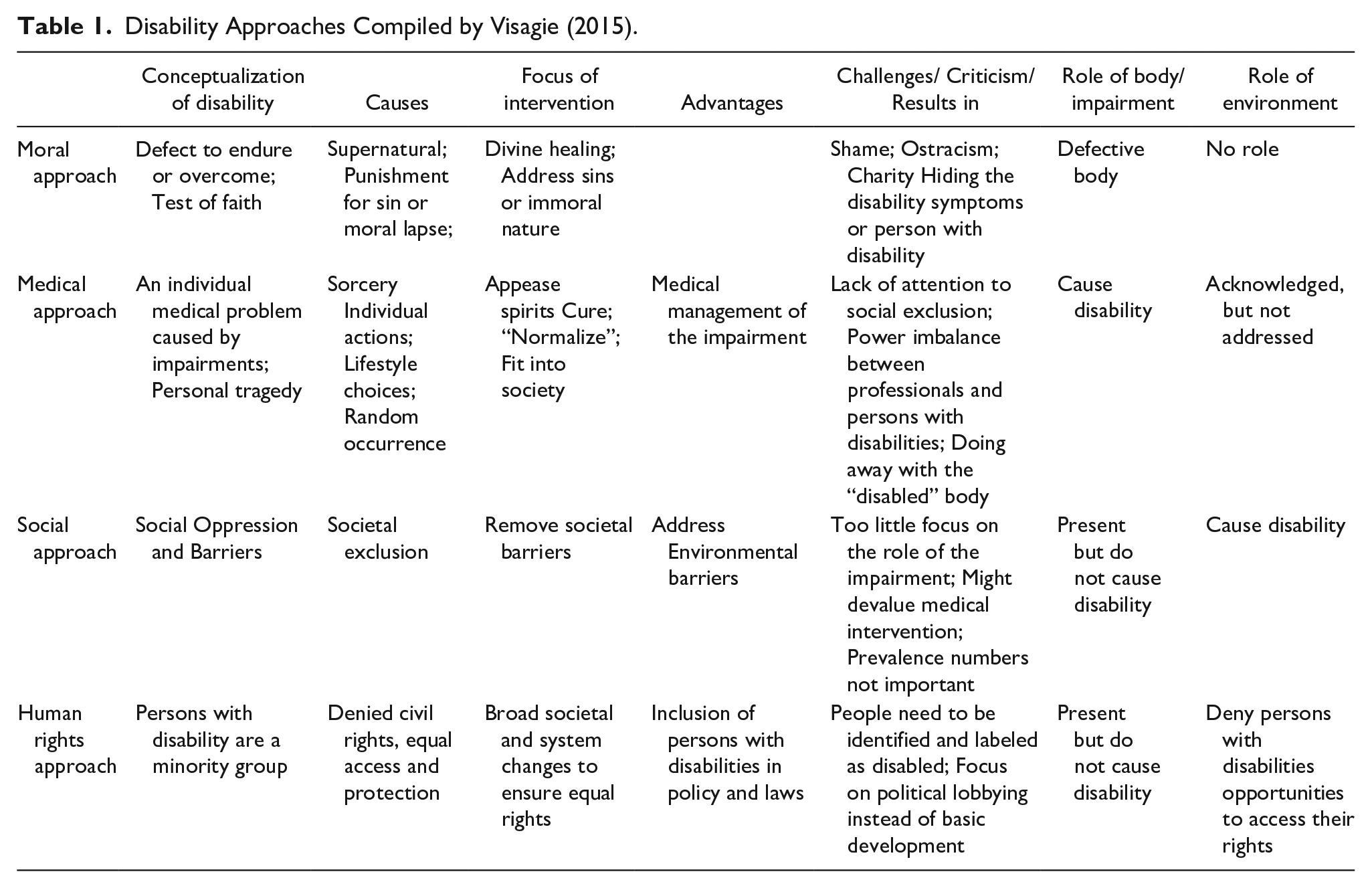
Historically, disability has been perceived as a matter of bodily impairments (Mji et al., 2013; Ned, 2013). All contemporary models agree to this and the medical model has seen only defects or sickness that must be cured using medical interventions (Mji et al., 2013). This categorization has often created class systems which see some humans as less human than others (Mji et al., 2013). It has also shaped the relationship that health professionals have with persons with disabilities (Shakespeare, 2008; Visagie, 2015). A consistent challenge with adhering to this approach of intervention is the embedded medical ableist values which shape service access and delivery (Goggin & Ellis, 2021). For example, only those with better prognosis tend to be prioritized or preferred for access to already scarce resources such as assistive devices or professionals even decide on life and death for persons with disabilities (Visagie et al., 2013). The social model attributes disability to environmental barriers and societal exclusion (Visagie, 2015). Nonetheless, disability studies continues to explain disability in ways fitting contemporary conceptions of human identity (Swartz, 2014). However, Western lenses are often used to study persons with disabilities in African societies, with focus being on the individual and the impairment which takes people out of a particular communal context (Grech, 2012). Owing to coloniality, ways of knowing about disability are mainly produced, often without recognition of epistemologies and methodologies that center Africa (Bezzina, 2018; Meekosha, 2011). Theory is often credited to the North while subjects studied include those located in Africa (Meekosha, 2011). This privileges Eurocentric and Western thinkers as central to knowledge production (Grosfoguel, 2011), while positioning African thinkers as objects of this knowledge. As such, epistemic and methodological lenses from Africa and the rest of the Global South on disability research remain scarce (Grech, 2015), despite the fact that the majority of persons with disabilities worldwide are located in the Global South (Greening, 2015), with 40% of Africa’s population living with disabilities (Nyangweso, 2018). This situation demonstrates the intentional negation of how colonial and neo-colonial power relations and processes of development are a key factor to conditions such as poverty and underdevelopment, which contribute to disability (Chouinard, 2014).
Within disability studies, much has been documented about the complexity of disability, diversity of contexts and cultures and how this shapes conceptualizations of and approaches to disability (Bezzina, 2018; Grech, 2011; Grech & Soldatic, 2016; Leshota & Sefotho, 2020; Meekosha & Soldatic, 2011; Sefotho, 2021). However, Western ways of thinking, knowing and being still dominate and are often used to understand African contexts with little to no attention paid to African indigenous conceptualizations (Bezzina, 2018; Parsloe, 2015). Often, when reference is made to indigenous communities (commonly referred to as traditional/moral model of understanding disability), a single decontextualized deficit-focused narrative prevails. In contrast, Ojok and Musenze (2019) argue that persons with disabilities were accepted and included in ancient Africa, and disability was not always seen as a “handicap.” This is corroborated by Ndlovu (2016) who argues that some African beliefs depict persons with disabilities as full human beings with the same rights, responsibilities and obligations as the rest of the society. This may be due in part to an argument posed by Sefotho (2021) as well as Scheer and Groce (1988) who contend that positive languages were used in traditional societies to describe disabilities and individuals with disabilities, which in turn made them integrate well into the society.
Seen as the most oppressive and prevalent approach throughout the world is what is known as the traditional or moral approach (see Table 1 below) (Goodley, 2011; Visagie, 2015) and which is commonly attributed to African societies. For example, various studies show features of this moral approach from Tanzania (Masanja, 2015), Zimbabwe (Mpofu & Harley, 2002; Munsaka & Charnley, 2013; Peta, 2017); and Uganda (Mulumba et al., 2014) with impairments attributed to misfortune, karma, ancestral and God’s punishment, witchcraft or bad luck and describe being ostracized from society. While African spiritualism inherently glorified disabilities, other scholars dismiss African spirituality as superstition (see e.g., Lamptey, 2019) on issues of mental health and intellectual disability. But, ancient African beliefs and cultures about disability have not always been (and only) negative. It is for these reasons that Ojok and Musenze (2019) posit that these conclusions cannot only be attributed to African cultures and ways of being because African societies are deeply rooted in spirituality, not religion. Though the terms religious and spiritual are sometimes used interchangeably, the differences between them are significant. Religion is, by definition, an institutionalized system of religious beliefs and attitudes, as well as practices, in worship of God or a deity; spirituality on the other hand is grounded in the internalization of one’s awareness of their soul, and is more about inner experiences and understanding than outer worship (Brady, 2020; Sango & Forrester-Jones, 2018). Specifically, religion is centered on organization and structure that governs belief and behaviors, while spirituality rejects rigid structure and the restrictions it imposes. Part of the problem is that most Western-educated African scholars confuse religion with spiritualism, thereby misinterpreting traditional Africans as religious (Ojok & Musenze, 2019).
Disability Approaches Compiled by Visagie (2015).
Though these other negative attributions may be existing, as Grech (2012) emphasizes, disability in the Global South, in which Africa is part of, is met with various attitudes ranging from positive to negative, and is highly influenced by socio-economic, cultural, political, personal and contextual variables. These variables are also entangled within a colonial history which is a darker side of a civilization (modernity) deposited and as experienced in the Global South. For instance, we are often silent on disability relationships emerging from colonialism and coloniality experiences in disability studies when explaining disability in formerly colonized African societies. We are also silent on knowledge born out of these coloniality struggles. It may, therefore, be the case that this silence contributes to the reproduction of imperialistic practices which render epistemic vulnerability in former colonized African societies. As de Sousa Santos (2018) put it, whenever we perpetuate the dominance of one knowledge, we are equally guilty of perpetuating ignorance about other knowledges and subjectivities. This practice contradicts the inclusion and participation principles that disability studies promotes and stands for.
It is without doubt, therefore, that in today’s contemporary Africa, persons with disabilities are increasingly facing multiple levels of victimization from being hunted for magic portions and denied access (Tanner, 2010); subjected to being objects of pity and abuse due to harsh economic conditions (Ojok & Musenze, 2019); used for the performance of miraculous healing by pastors in churches (Boaz, 2015); persons with albinism particularly killed for false beliefs related to quick-rich schemes (Ojok & Musenze, 2019) as well as a result of stigmatization of mothers who gave birth to children with disabilities (Gerald & Luk, 2018). What is worth noting is that these contemporary mistreatments and problematic understandings of disability are not necessarily a reflection of African cultures, rather, they are symptoms of colonial encounters and the resultant material conditions and injustices.
African beliefs and cultures about disability have never been limited to these negative narratives, as dominant literature portrays. For example, Livingston’s (2005) account of encounters with indigenous Batswana elders revealed that, in their communities, disability was never thought of as a category, and as such, did not have an indigenous collective term in their indigenous language which is equivalent to the word “disability.” The case is similar in other indigenous communities such as Australia and New Whales (Ravindran et al., 2017). This same belief, of persons with disabilities as fully human, has been traced in other African countries like Nigeria as well (Eskay et al., 2012) and South Africa (Ngoetjana, 2007). Ojok and Musenze (2019) argue that African cultures revered the disability identity and persons with disabilities were given visible roles in society and integrated into activities of daily living while their disability was seen as God’s blessing. It is clear that many indigenous people do not identify with the concept of disability because indigenous communities focus on strengths and abilities in relation to communal responsibility, with impairment seen as a part of the individual (Kisanji, 1996; Livingston, 2005; Ngoetjana, 2007; Ramugondo, 2018). This is reflective of the communal living characteristic in African societies.
This focus on communal responsibility is embedded in the African concept of Ubuntu philosophy where everyone is seen as carrying responsibility for each other’s growth (Ramugondo, 2018). Speaking within the context of disability, Berghs (2017) notes that Ubuntu philosophy is demonstrative of how Africans have always enacted a social ethics of a common humanity in their grassroots struggles against oppression and disablement. This is because of two reasons. The first is raised by Berghs (2017) when she argues that Ubuntu locates disability politically within the wider environment and sustainability practices which are integral to participation and inclusion of persons with disabilities. The second is by decolonial scholar Ramugondo (2018) who posits that the notion of Ubuntu is relevant in pitching a socialized sense of being that is self-located in, and continually produced through relations with others. This shows that through Ubuntu indigenous communities in Africa have shaped conceptualizations of disability before the existence of the social model which comes from the North. Ubuntu encompassed a way of knowing with ethics (spirituality), before coloniality imposed a way of knowing without ethics and degraded Africans’ forms of spirituality. This is clearly expressed in the phrase “umntu ngumntu ngabantu/motho ke motho ka batho” (“a person is a person through other people”).
Ngoetjana (2007) further provides examples of African models of caring for vulnerable children in a series of conversations with elder—Mama Masuku, to demonstrate how communities have always fore-fronted a sense of caring in South African indigenous communities. The consequences of denigration of these African ways of caring by “modernization” and departmentalization of life continues to deprive modern humanity with models of care in Africa. Rather, Africa has been subjected to the vulnerability of waiting for Northern thinking.
Demonstrating this, is “the notion of the entire community (or village) as family” before family notions were anthropologically reduced to only extended family (Ngoetjana, 2007). This African thought centered communal responsibility in raising children and our proverbs, such as “It takes a village to raise a child” reflect this way of doing. With this provided sense of shelter and belonging, victimization and alienation of those with disabilities and their parents was improbable. Being aware of how vulnerable children with disabilities could be exposed to manipulation by others, the African thought was such that these children had a special place in the heart of African communities, as reflected and insulated in various African proverbs, customs, and wisdom texts (Ngoetjana, 2007).
Other models included the mother model (no African child was considered motherless and so, no child was to live without food and shelter because everyone who is of the same age as your parents is your parent); unity and sharing (characterized by the sanctity of humanity, unity and sharing, humans and nature are one and in harmony within African cosmology (Ngoetjana, 2007). This is similar to the Basotho ontology of mother-child connectedness referred to as “Motlopotlo” within the Sesotho context (Sefotho, 2021). These expressions involved understanding that persons with disabilities are human too who are to be protected. Participation in communal life such as in African initiation institutions was also upheld, that is, children with disabilities were not exempted from participating in these rites of passage and while there was some negligence of some, it was not the norm (Ngoetjana, 2007). These notions equally promoted the idea of communal responsibility which was providing a sense of belonging and support base for all children, especially those with disabilities. Mama Masuku in Ngoetjana’s interviews (2007) narrated how, while there was existence of some of the known derogatory terms, these were used not in a diminutive and patronizing sense, but, rather, in a caring manner. She makes examples of words which were used within this context of caring including; “Segole” (loosely known as cripple) to politely refer to persons needing to be cared for and was not necessarily limited to people with physical impairments) and “Motho wa Modimo/Kgobe” (a person of God) to refer to all children with some form of vulnerability (Ngoetjana, 2007). Sefotho (2021) further shows an example of using this proverb from the Basotho ontology in a saying: “Sehole ho ‘Ma-sona ha se lahloe.” While Leshota and Sefotho (2020) note elsewhere that “Sehole” is a derogatory negative term, Sefotho also argue that the proverb itself communicates a sense of protection toward the child and is used to describe “Basotho parents of children with disabilities as having great love for them” (Sefotho, 2021, p. 2). He concludes that it signifies a way in which Basotho positively affirm persons with disabilities within their communities. Supporting this, Ngoetjana (2007) claims that the only attitude that dominated African societies was that they would be duly protected. Eskay et al. (2012) note the same about the Nigerian communities’ precolonial ways.
Supporting the above arguments, Connell (2000) and Bezzina (2018) both note that persons with disabilities were valued and taken care of by extended family in Burkina Faso. However, because of the current material conditions of the historically oppressed, the capitalist mode of production that defines the modern system and its migrant labor and slavery did not only disintegrate these communal livings and disrupted structures of caring for one another, but these systems equally created poverty conditions which have rendered many parents and communities unworthy and incapable of parenting their own children and even worse, children with disabilities. This has cast doubt on many African families’ own sense of citizenship and the consequences are felt most by vulnerable groups, that is, children with disabilities.
The one difficult exercise, in contemporary Africa now, is the application and implementation of such remains of indigenous communities on caring for the vulnerable in modern societies. Seen as not valid knowledge systems, modern societies are continuously seeking for and re-inventing caring models to vulnerable children.
Why the Status quo has Been Problematic for Africans: Why the African Renaissance Must be Central the Reimagined Approach
The critical questions then become: Why is the traditional/moral model narrative consisting mostly of only negative attitudes and understandings? Why are these only attributed as African problems and as part of African cultures? Why are the positive narratives so heavily silenced in mainstream literature?
What we see here is what Adichie (2009), in her TED talk, refers to as “the danger of a single story” because it contributes to shaping the exclusion of epistemologies from outside the metropole. It also serves to create and manifest ignorance about African societies while maintaining Northern thinking as progressive. I argue that this issue is a consequence of Western dominance in researching, documenting and interpreting the world. The African Renaissance, therefore, plays a significant role in equipping us with the necessary tools to resist this dominance and develop African thought. This is an important step because, as Western dominance claims universality and absolutism, it equally promotes ignorance of other knowledges and African epistemologies (de Sousa Santos, 2018). This, in turn, facilitates an internalization of the oppression of African disabled subjectivities. Furthermore, it positions African writers and scholarship in an inferior footing and exclusion. Such gestures are evident in the notion of citations. As Connell (2000) and Meekosha (2011) observe, African indigenous scholars remain less cited in disability studies, and mainstream theorization fails to build on theory formulated in former colonized African societies.
The alienation of former colonized people usually goes together with the denigration of their knowledges as valid knowledge systems. This status quo is an attribute of Western knowledge which, the decolonial scholar, de Sousa Santos (2018) refers to as the tendency to only distribute knowledge of the winners of history (our education system is guilty of this), not the knowledges of the wretched who have been resisting against colonialism. Dos Santos refers to this as committing epistemicide (the killing of knowledge) because the wretched are seen as without knowledge and, therefore, with nothing to contribute in understanding the world and humanity. Within such a context, de Sousa Santos (2018) argues that there can never be social justice without cognitive justice. How is this reflected in disability studies?
The Western ideologies in disability studies are seen as normative while indigenous knowledges continue to be disregarded (Bezzina, 2018; Hollinsworth, 2013; Meekosha, 2011). In this knowledge order, the intersection of colonial experiences in the creation of disabilities is neglected and less engaged with. The neglect is two-pronged. Firstly, we are silent about how this colonial knowledge order is in itself disabling and perpetuating exclusion. Secondly, we pay less attention to how this hierarchy shapes how indigenous people now identify with disability through modernity’s toxic paradigm of difference. The African Renaissance therefore helps us shape critical thought about the impact of colonialism and imperialism in depositing structural violence, disablement, poverty and inequality within former colonized African people in general and persons with disabilities in particular, in contemporary societies. To-date, our scholarship has not sufficiently addressed the disability–poverty relationship in relation to imperial capitalism.
The call for an African Renaissance is significant because it reawakens thought which, in the context of Africa, is about decolonizing the mind and building a new Africa, as stated by Wa Thiong’o’ (1986). This dynamic process is critical because the consequences of colonized minds are such that even scholars who are geographically located in the South heavily rely on, and extrapolate Northern approaches to understand the disability experiences of the South. A clear example here is that of the social model of disability. Grech (2009, 2012), Heap et al. (2009), Ingstad (2007) and Meekosha (2011) note that the social approach was to a large extent developed in Global North countries and “exported” to Global South settings and, thus, it may also not fully encompass the experience. While its key debates may be around disability and impairment, independent living, care and human rights, persons with disabilities in Africa may be mainly concerned about survival. This is reflected in how social security like disability grants is managed as a household income, instead of covering impairment specific needs. It is well known that many remote African indigenous communities have overpopulated houses which lack sanitation and water, are limited in food security, education and employment, while alcoholism, and chronic diseases of lifestyle are rife (Ned, 2019). In such cases, even social protection measures such as a disability grant cannot cover impairment needs but serve as a source of income to put food on the table. And where social grants specifically intended for persons with disabilities are available, there are challenges of access due to the stringent requirements for accessing the grant, which include extensive medical records. Furthermore, even when permanent disability is ascertained, the grant is not permanently guaranteed as, according to the South African Social Security Agency (SASSA) being approved for the permanent disability grant only means one will receive it for longer than 12 months. What I am trying to demonstrate here is that a critical understanding of disability experiences in former colonized African societies, by far exceeds the western understanding of disability, and it is unjust to take this one knowledge as the only knowledge for understanding disability experiences.
What Would Rebelling, as an African Renaissance Call, Entail in Disability Studies?
Rebelling would be about exposing colonial practices for what they offer and how they have polarized many African societies. Writing about Batswana, Livingston (2005) argues that the rise of labor migration and colonial medicine created and prevailed a divide between those with disabilities and those without. She points out how these moves not only lead to issues of pathologisation of difference in line with this colonial paradigm of difference, but also to African societies hiding their children with disabilities for fear of victimization. This pathologisation also influenced women as the diagnosis of children with disabilities was linked to women’s birthing processes, pathologisation of the womb, and caregiving approaches (Livingston, 2005). This may have led to practices such as that of blaming women (by men) for birthing children with disabilities as many studies find (see e.g., Gerald & Luk, 2018; Peta, 2015). These effects are responsible for the promotion of individualization which makes humans a commodity. This is in contradiction with the African cosmology of communal living. We ought to produce knowledge that does not view people as a problem because this directly questions persons with disabilities’ humanity and existence. This shifting will facilitate a reawakening of living together in an inclusive society.
The rise of migrant labor must also be exposed for practices of othering persons with disabilities, as they could not participate in building capital and thus seen as less able (Livingston, 2005). With this exposure, we begin to understand the genesis of the internalized oppression and subjugation amongst many persons with disabilities who view themselves from the lens of productivity in a capitalistic economy, even when they can participate in communal responsibilities. Viewed as lacking and unable to do—this description is now internalized by many persons with disabilities and their families (see e.g., Ned, 2013). Such findings sketch how understandings of disability are intertwined and marked by deep historical changes in communal living and personhood (Ramugondo, 2018).
Colonization and coloniality 1 are also experienced as disabling and debilitating to ex-colonized indigenous people (Livingston, 2005; Ned, 2019; Ramugondo, 2018; Reed-Sandovala & Sirvent, 2019). For instance, the rise of mining and other related slavery work has created persisting inequities and injustices which in turn create debility and disability. In South Africa, Scott et al. (2017) documented how stark social inequities translate to a high burden of premature mortality and marked health inequities as a result of the burden of disease. The underdeveloped rural contexts suffer the most with higher rates of infant and maternal mortality (Massyn et al., 2015). Additionally, the quadruple burden of disease in South Africa, blighting the majority who live the core effects of enslavement and capitalism, renders people to higher risk for impairment and disability (Sherry, 2014). These patterns are similar in other settler colonies. Worldwide, in high, middle and low-income countries, indigenous people remain on the margins of society bearing a disproportionate burden of poverty, disease, disability, and mortality, in comparison to the general population (Anderson et al., 2016; King et al., 2009; Mitrou et al., 2014; Valeggia & Snodgrass, 2015). Through the African Renaissance, we need to produce knowledge that addresses this status quo and mobilize for systemic and structural changes.
Conclusion
It is clear that it may impossible to fully promote societies that are centered on participation and inclusion when we operate and feed within an asymmetrical knowledge system that thrives on exclusion and marginality of other knowledge systems. Through an African Renaissance lens, disability studies in Africa needs to build robust African theorization which exposes and challenges the dominating and hegemonic Eurocentric theorization that dominates the disability field and epistemology in general.
Footnotes
Acknowledgements
I am thankful to the anonymous reviewers of this article for helping in refining and clarifying my thoughts. I wish to thank Yamkela Spengane, for the encouragement and the invaluable assistance in reading earlier drafts. Grateful thanks to Malaika Mahlatsi for always providing invaluable editing services. Thank you to the Special issue editor, Prof Simphiwe Sesanti, for his ongoing support.
Declaration of Conflicting Interests
The author declared no potential conflicts of interest with respect to the research, authorship, and/or publication of this article.
Funding
The author disclosed receipt of the following financial support for the research, authorship, and/or publication of this article: This research publication is currently supported by the NRF Black Advancement Academic Programme (Post-Doc Track). I acknowledge that opinions expressed in this publication are that of the authors, and that the NRF accepts no liability whatsoever in this regard.
