



Abstract
This article discusses the potential contributions of African American migrants to the economic and cultural development of destination countries in Africa. The study explores the contributions of migrants to the gross domestic product (GDP), labor market, and fiscal impact—measures used by the International Labor Organization (ILO) to assess the impacts of migrants on the economy of a destination country. Migrants may share their own life experiences in community citizenship with traditional authorities when dealing with community issues. For example, land use-planning, allocation of urban-rural land, siting of sanitation facilities, health and safety of community, and community economic planning are within the competence of migrants given their education backgrounds and their decision to follow a traditional style of governance. African-American migrants present an opportunity to form backward linkages to sources of finance and investment capital in the country of origin. Our study found no existing institutional mechanism to grow these backward linkages, and there is no recognized privateprivate partnership between migrants and U.S. financial sources. The study recommends increased theoretical and empirical studies in support of the economic and cultural contributions of African American migrants in Africa.
Introduction
African countries have the opportunity to take advantage of the human capital endowment of migrants in development policy planning and implementation. In fact, the popular press has actively reported on migrants’ potential contributions to achieve Africa’s development goals but very little theoretical and empirical evidence exist in support of such claims (Brown, 2013; Paquette, 2020). However, very little is known about who is considered a migrant, the socio-economic characteristics of migrants, their interactions in the economic, political, and social markets at the destination countries, their contributions to achieving the country’s development goals, and how the mixture of western-style governance and African cultural traditional practices have influenced migrants. This paper focuses on the contributions of African-American migrants to economic development in Sub-Saharan Africa (SSA) with particular emphasis on Ghana and reports the results of a likert-scale survey of African American migrants residing in Ghana. For the purposes of this study, African American or Black American migrants can be defined as Black people born in the US without immediate biological familial connections to Africa. Specifically, this paper addresses the following questions:
How do the development goals of Ghana and the U.S align with one another?
What are the characteristics of and economic contributions made by African American migrants in Ghana, and how do they fit into the development goals of Ghana?
What are the social and governance characteristics of African American migrants in Ghana, the nature of the mixture of western-style and cultural/traditional styles of governance?
What policy and research needs are revealed in this survey?
The paper is organized as follows. Section I explains how the developmental goals of Ghana fit into a global development agenda and the strategic role of migrants in the agenda. The focus is on the Sustainable Development Goals (SDGs) and Africa’s Agenda 2063 to identify the critical development goals, targets, and priority sectors for migrant participation. Section II discusses the characteristics of migrants in Ghana. Section III discusses using an internet-based survey conducted in collaboration with the African American Association of Ghana (AAAG). Three measures of impact were used to guide the study: the labor market, economic growth, and public finance suggested by The Organization for Economic Cooperation and Development & International Labour Organization (OECD/ILO), to analyze the specific contribution of AA migrants in Ghana. The challenges encountered in conducting the survey, opportunities for deeper inquiry by researchers are the subjects of discussion. When available the researchers compared the data collected in our survey to data from the U.S. government, for example, Censuses, and data from international agencies such as the World Bank and affiliated agencies were used in gathering information. Section IV will close with conclusions and recommendations.
Alignment of Ghana’s Economic Development Goals and Global and U.S. Development Objectives
The contribution of African Americans in Ghana must be understood in the broader context of Ghana’s development goals, Africa’s Agenda 2063, and the global Sustainable Development Goals (SDGs). Development goals pursued by Ghana and supported by the U.S. fit into the broader all Africa agenda and ultimately the global Sustainable Development Goals (SDGs). The Africa Union’s Agenda 2063 “is Africa’s blueprint and master plan for transforming Africa into the global powerhouse of the future” (Africa Union, n.d.). It is the continent’s strategic framework that aims to deliver on its goal for inclusive and sustainable development and is a concrete manifestation of the pan-African drive for unity, self-determination, freedom, progress and collective prosperity pursued under “Pan-Africanism and African Renaissance.” (Africa Union, n.d.). The priorities pursued under Agenda 2063 are based on national priorities whereby “Agenda 2063 not only considers Africa’s continental growth aspirations but acknowledges that for the whole continent to develop the premise of Agenda 2063 must be adopted at regional and country level” (Africa Union, n.d.).
Africa 2063 is a strategic framework that was developed by African leaders to focus on both social and economic development in addition to supporting democratic governance (Africa Union, n.d.). In addition, Ghana is currently pursuing a “Ghana Beyond Aid” strategy to achieve its development goals. There are five broad goals—building a: Wealthy, Inclusive, Sustainable, Empowered, and Resilient (WISER) Society (Government of Ghana, 2019). The Charter refers to the need for collaboration, and partnerships with the private sector and among strategic partnerships in the society (Government of Ghana, 2019, p. 16). The goals of the Charter “are consistent with those in: the President’s Coordinated Programme of Economic and Social Development Policies (2017-2024), the African Union’s (AU) Agenda 2063, and the United Nations’ (UN) Sustainable Development Goals (Agenda 2030)” (p. 15).
USAID Ghana has emphasized that the objective of U.S. policy is to assist Ghana to achieve her development goals stating:
“Africa remains the continent of promise and enduring challenges. . . . We will encourage reform, working with promising nations to promote effective governance, improve rule of law, and develop institutions accountable and responsive to citizens. . . . We will work with reform-oriented governments to help establish conditions that can transform them into trading partners and improve their business environment. . . . We will work with nations that seek to move beyond assistance to partnerships that promote prosperity.” (USAID Ghana, 2020).
Ghana’s development goals align well with U.S. development goals. The U.S. is the largest bilateral donor to Ghana, and a principal trading partner, with bilateral trade reaching $1.4 billion in 2018. U.S. exports to Ghana in 2018 totaled $793 million, up 30.3% from a decade earlier (USAID Ghana, 2020).
The Africa Union Secretariat has conveniently mapped the goals of Africa’s Agenda 2063 and those of the global Sustainable Development Goals (SDGs). Agenda Goal 19, which projects “Africa as a major partner in global affairs and peaceful co-existence”, and its priority focus to enhance “Africa’s place in global affairs and Partnerships,” map to the SDG Goal 17 to “strengthen the means of implementation and revitalize the global partnership for sustainable development.” Goal 20 of Agenda 2063 is to push “Africa takes full responsibility for financing her development goals” the goals and places priority on developing “African capital markets, Fiscal systems and public sector revenue”. Development assistance maps well to the SDG Goal 17 to “strengthen the means of implementation and revitalize the global partnership for sustainable development” (Africa Union, n.d.).
Africa’s Agenda 2063 goes farther than the SDGs to recognize and signal the historical imperative and expectation of the contribution of African Americans to the development of Africa. Goal 16 pursues a goal of “African cultural renaissance is pre-eminent” (Africa Union, n.d.). The priority areas to achieve these goals include, “Values and ideals of Pan Africanism, Cultural values and African Renaissance, Cultural heritage, creative arts and businesses” (Africa Union, n.d.). The importance of concepts such as Pan Africanism, Cultural Heritage, and African Renaissance are not captured in the neat metrics, such as gross domestic product, savings rate. However, it would be a grave error to assume that the lack of empirical metrics for ideas such as Pan Africanism, Cultural Heritage, and African Renaissance make them less valuable in the development of Africa, the opposite is the case. It is trite knowledge that the idea for an African Union and its evolution are the direct outcomes of the relentless effort and sacrifices by African American scholars, leaders, and activists working in collaboration with progressive African leaders.
The Africa Union deepened its relationship with the diaspora with adoption of the African diaspora as its sixth region under Article 3 (q) of the Constitutive Act on February 3, 2003. Under the provision, the African Union shall “invite and encourage the full participation of the African diaspora as an important part of our continent, in the building of the African Union.” Bolaji (2015) has exhaustively discussed the history and evolution of institutions that have supported the diasporans provisions under the AU Charter and the challenges facing countries in implementing the goals and vision. Citizenship status of diasporans in Ghana has been a central questioned that has not been addressed. The legislation on citizenship status is unclear and there are concerns that diasporans may suffer discrimination in both economic and political markets. There are also concerns about how the fusion of cultures—primarily western and traditional would influence the development objectives of Ghana and other destinations for diasporans. Bolaji’s (2015) study is based on an extensive review of public records and documents, particularly AU documents, scholarly sources, and personal communication with individuals who played a role in some way during the formative years of the creation of the sixth region. Section II below discusses a framework to solicit information from diasporans themselves regarding their experience in the migration process and the many roles they play in Ghana’s society. The section also explores sectors of the Ghanaian economy most amenable to diasporan participation.
The Characteristics of African-American Diasporans in Ghana
In the U.S., the “Great Migration” saw large movements of blacks to industrial cities in the North from the early 1900s to the 1970s. This movement has been attributed to job and higher income opportunities that acted as “pull” factors, and low wages and racial discrimination that existed in the South that acted as “push” factors (Marullo, 1985; Tolnay, 2003). There has been a reverse migration phenomenon since 1970 to the present, whereby Blacks from Northern cities moved back to the South (Fuguitt et al., 2001). The reverse migration is also influenced by both economic and social factors. The effects of the economic and noneconomic “push” and “pull” factors influencing reverse migration are mirror images of the factors that influenced the Great Migration. As pointed out by Fuguitt et al. (2001):
The same economic development also made the South more attractive to potential migrants from other regions. This was a major factor leading to the region’s transition in net migration from loss to gain, first for the White population in the 1960s and then for the Black population in the 1970s. A major noneconomic factor often cited as a reason for the Black migration turnaround is the decline of overt racial discrimination in the South, following the extension of voting rights to Blacks and the ending of legally sanctioned segregation.
The migration of African Americans to Africa falls within the broader literature on the “push-pull” migration theory. According to Kunz (1973), there are conditions and factors at a migrant’s current location that act to “push” them out to seek a new location where the conditions and factors act to “pull” them to settle (Kunz, 1973). The identification of “pull” and “push” factors is complicated because it is largely determined by an individual’s decision based on their motivations and risk assessment.
The extensive literature on Africa American migration has focused on migration within the U.S. To our knowledge, no systematic baseline information exists on the migration of African Americans to African countries even though their impacts on the economic, political, and social life in host countries could be quite significant. The focus of current literature uses the “push-pull” theory to explain the migration from developing countries to developed countries. The same “push-pull” theory applies only to African Americans who migrate from a developed country to a developing country. OECD/ILO (2018) put it in the context of African migration:
Despite the significant rise in the number of migrants in Africa, the focus of much migration research has been by and large on emigration from the continent to high income countries. Thus, the potential impact of migration to developing countries as countries of destination has remained largely overlooked (OECD/ILO, 2018).
The OECD/ILO study focused on “low and middle-income countries where labour immigrants represent a substantial share of the population and where, preferably, the annual number of immigrant inflows exceeds the number of emigrant outflows” (Fuguitt et al., 2001). Ghana qualified as a study site but the criteria used by the OECD/ILO excluded the African American migrant population, which the popular press has estimated to be about 3,000 (Brown, 2013). The largest immigrant groups in Ghana are from the Economic Community for West African States (ECOWAS) region, particularly from Nigeria, Togo, and Burkina Faso.
Application of the OECD/ILO measures of economic impact
The (OECD/ILO) measures of economic impact which include: (1) labor market, (2) the public purse, and (3) economic growth (OECD, 2014) to assess the contribution of African Americans to Ghana. Merler (2017) summarized the literature on the economic effects of migration with some of the findings relevant in the context of Ghana. This research (OECD, 2014) found that migration has a net economic benefit to receiving countries. A study using U.S. data (Burchardi et al., 2016) found foreign direct investment to follow the paths of historical migrants given differences in productivity, fiscal and tax policies, and education levels. The study identified the role of migrants in facilitating information flow between origin and destination countries as the primary mechanism for the contribution, and also found “the effect of ancestry on foreign direct investment is very long-lasting” (Burchardi et al., 2016). There has been an identified need to examine the specific skills introduced by immigrants in assessing the economic benefits from migration. An example is the technological skills introduced by immigrants (Burchardi et al., 2016). One may find extensive discussion of the contributions of various immigrant groups in the development of their countries of origin in a recent paper by Artuc et al. (2015). The contribution of African Americans to the development of Sub-Saharan Africa is rooted in well-established precedent set by such by groups from Asia, the Americas, and Europe. The African American migrants are, however, a strategic group who hold the key to backward linkages to technology, innovation, management, cultural enrichment, financial and capital markets that African countries have identified as key to accomplishing the development goals under Africa’s Agenda 2063.
Methodology, Use of Internet-Based Survey, and Role of Informants
The study participants consists of individuals who are members of the AAAG organization. This population is part of the diaspora defined as “peoples of African descent and heritage living outside the continent, irrespective of their citizenship and who remain committed to contribute to the development of the continent and the building of the African Union” (African Union, 2005, p. 6 cited in Ankomah et al., 2012). A random sample was conducted to the identified population. A likert-scaled internet-based survey developed by the researchers in collaboration with the AAAG leadership team. The AAAG leadership team was used as informants in the development process. The use of informants in social science research is well recognized in the literature (Campbell, 1955). Key Informant has been described as “the person with whom an interview about a particular organization, social program, problem, or interest group is conducted. In a sense, the key informant is a proxy for her or his associates at the organization or group” (Parsons, 2008). Informant information is especially valuable, whereas in the case of our study; there is no reliable information on the numbers and activities of African American migrants in Ghana. One informant said, “we are scattered all over the place; no one has an idea where African American migrants live, work, or stay.” The primary limitation in our study is the statistical/data collection component. We used an internet-based survey and it is necessary to apply additional rigorous statistical tools and tests to strengthen the credibility of the survey results. This is important in a situation where the researcher does not have the luxury of a population or sampling frame. The next phase of our effort will include a statistician to the team to strengthen the survey results.
The format and content of the questionnaire was based on a review of literature of the various theories on migration and information gathered from informants. The questionnaire included the following sections: demographics (gender, age, education, household size, etc., migration decision, immigration status, leadership and governance) (interaction with local authorities, government, technology use, and land allocation), economic activity (local business, import-export, investments, and home ownership), income (range), engagement (cultural participation, education on local and migrant culture, government support, and acceptance). The questionnaire was posted by the AAAG on social media platforms that are known to focus on diaspora issue and where most migrants are suspected of visiting. There were 25 responses over a 14-day period. The responses and data analysis were electronically processed in Qualtrics. We assessed the usefulness of the responses by comparing the information collected in the survey to several published public information on U.S. households’ characteristics, such as, income, employment, education, and non-economic factors.
Findings
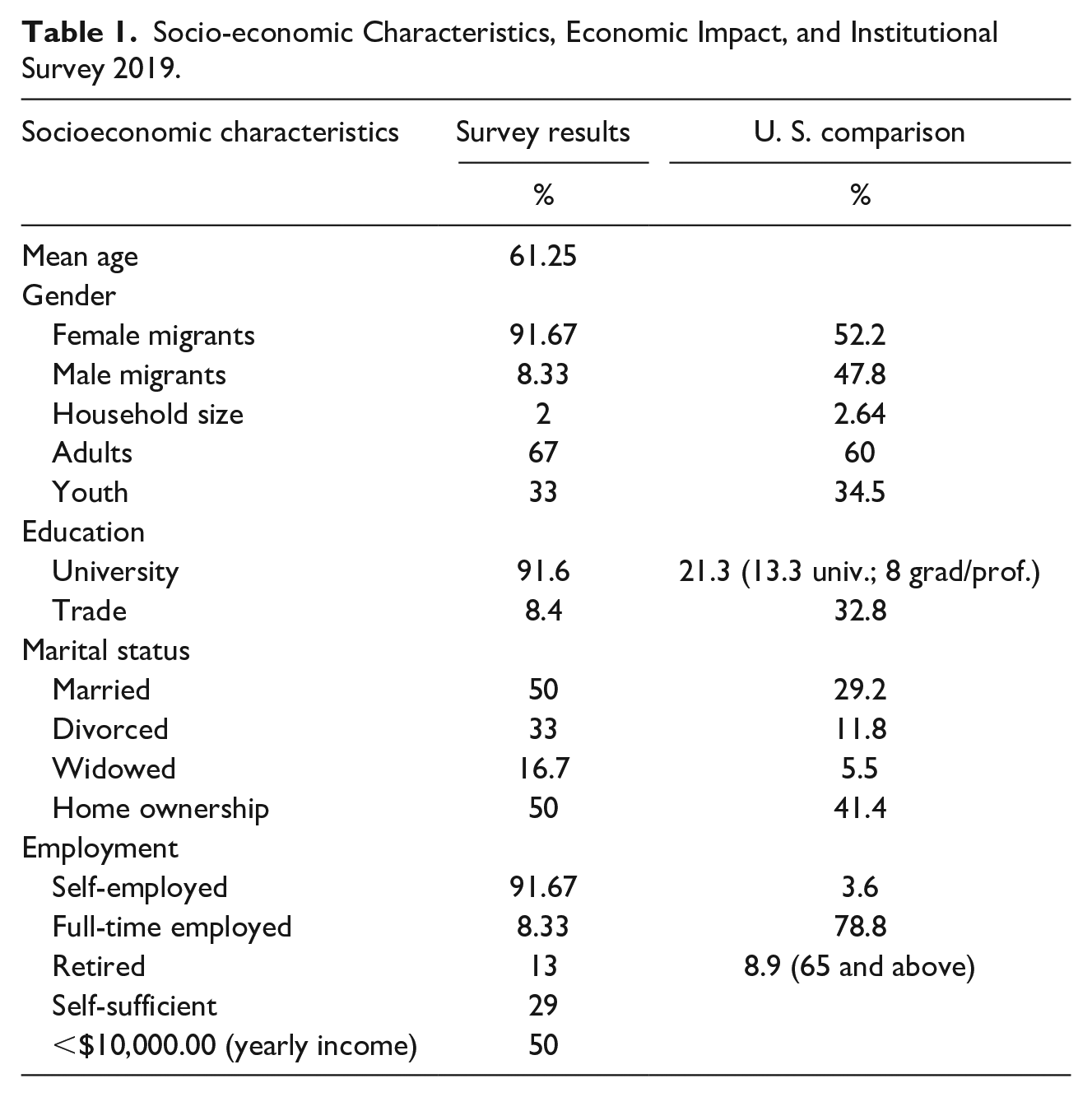
Table 1 presents the survey results. The numbers in the second column are the results from the survey, and the numbers in the third column are collected from various U.S. Government public documents, particularly, the U.S. Census of the population. The results reveal several research and policy questions that may serve as foundation for an expanded study of this migrant group. For example, over 90% of respondents were women, a much higher percentage than the AA gender distribution in the U.S. which shows about 50.8% of females. Could the large number of female migrants be due to marriage since about 50% of respondents are married compared to the U.S. average of about 29.2%? The average age of a migrant is 62.5 years. The retirement age in the U.S. varies across states but generally, age 63 is common even though for purposes of social security and Medicare, the retirement age would be 65 (Anspach, 2019). However, only 13% reported being retired prior to migration to Ghana. This suggests that the majority of AA migrants still have productive life ahead of them. The results also show that 91.6% of AAs in Ghana had a university education. This is much higher than the 30.9% of U.S. population with a Bachelor’s degree or higher (United States Census Bureau, n.d.). These initial results show that the experience and education of AA migrants provide an opportunity to explore options for building linkages to U.S. markets to attract FDI flow to Ghana. The migrants may also contribute to growing Ghana’s economy, including the introduction of new technologies given the high level of education.
Socio-economic Characteristics, Economic Impact, and Institutional Survey 2019.
Impact on labor market
AA migrants in Ghana have a net positive impact on the labor market in Ghana. Migrants participate in the labor market from the demand side, that is, they are employers not employees and do not compete with locals for jobs. Migrants influence the labor market as employees of a company, or as employers of labor. 91.67% of migrants are self-employed, with only 8.33% reporting as employees. The high percentage of self-employed is explainable by the fact that the majority of migrants are retirees or near retirement with an average age of 62.5 years. The proposition that AA migrants have a positive impact on employment is reinforced by the fact that only 3.6% of AAs are self-employed in the U.S., and 78.8% are employed (Anspach, 2019). The numbers are reversed for AAs in Ghana with a high percentage of U.S. AAs employed and a few retired. Over 75% of migrants employed at least one person but fewer than five persons. The average monthly wage is GH¢ 1,427.08, (~ USD 260) with a minimum payment of GH¢ 275 (~ USD 50) and a maximum of GH¢ 6,000 (~ USD 1090) (Bank of Ghana, n.d.). The reported wage numbers fall within the band of average monthly wages in Ghana with low-skilled workers (drivers, general housework) earning about GH¢ 400 (~ USD 73), and skilled workers earning between GH¢ 1400 (~ USD 255) to GH¢ 1800 (~ USD 327). What emerges is that AA migrants have a positive impact on the job market in Ghana, and such impact will increase with more migration.
Impact on public purse
The term public purse has been defined as “the funds raised by a government by taxation or other means” (Lexico, 2019). We do not have direct tax payments by AA migrants and can only assess the impact on the public purse by inference. 66.7% of respondents indicated that they received no financial support from the government and 33% were not sure whether they received any support from the government. We suspect the no support response may be due to poor question specification. We are unable to identify any government financial support schemes in support of the AA community. We infer the tax impact of AAs using the structure of business registrations. If a business is registered, it must have a “Tax Identification Number (TIN)” that allows the government to collect taxes (Ghana Revenue Authority, 2019). 83.33% of AA businesses are registered, with 58.3% as limited liability companies (LLC). There are no AA/Ghanaian partnerships or AA/AA partnerships reported. What emerges is that AAs make valuable contributions in growing the national purse through tax contributions.
Economic growth
The contribution of AAs to overall economic growth is positive and originates from several sources. The economic growth of a country depends on the expenditures or incomes from households, businesses through investments, government expenditures, and net exports. Government expenditures and net exports are not relevant in our survey. AA contributions come from their involvement in farming and aquaculture (5.88%), retail (11.76%), skilled trade (5.88%), transportation (5.88%), service (travel and tours) (11.76%), education (17.65%), and consultancy (17.65%). There is room to increase the economic contribution of AA migrants in Ghana. Half of the respondents in our survey reported a yearly income of less than $10,000.00. Only one respondent reported an income of over $100,000.00. The distribution of yearly income is consistent with the expectations from economic activities engaged in by AAs. 91.67% of respondents are self-employed, and only 8.3% are full-time employees. One surprising result is the low participation rate in skilled trades. Informal conversations with some AA (not in informant group) revealed an identifiable group- move from the U.S. Midwest (specifically the Detroit area) at the height of the auto crisis. This led us to predict high participation in skilled trades but this was not the case. Only 5.88% reported skilled trade as their primary economic activity. The majority are engaged in education and Consulting (17.65%), followed by Service and Retail business. The pattern of economic activities is consistent with the high educational levels of AA migrants to Ghana.
The survey responses show that about 33% of migrants’ initial investment of funds used to start a business in SSA is less than $5,000; and an equal percentage of migrants invested between $20,000 and $100,000. A few (8.3%) had initial investments exceeding $1 million. The majority of respondents (42%) reported business growth of between 6% and 10%, and about 25% of respondents experienced a doubling of their businesses. Migrants also contribute to economic growth through their participation in the housing market. 50% of respondents owned their homes in Ghana. Even given inefficiencies, and market failures, the contribution of the real estate sector (home production and home services) in Ghana could be quit significant if one uses the experiences in the United States as motivation (National Association of Home Builders, n.d).
What are the social and governance characteristics of African American migrants in Ghana?
The contributions of African Americans in Ghana go beyond the economic impact. A deep historical foundation motivates some to migrate to Africa, and Africa’s Agenda 2063 explicitly recognizes the value and importance of the cultural bonds between the diaspora and Africa. Migrants brought with them a western culture in leadership, community engagement, and social interaction. Now they are operating in a primarily traditional system driven in part by informality, customary practices, and norms in both contract and property markets. Migrants’ experiences in community and local government institutions, citizen participation in decision-making, use of technology in local government systems, land use planning, especially preventing blight, etc. are untapped opportunities of African American migrants talents. The emphasis on cultural engagement is not just impressionistic but translates into real value that contributes to the development resources available to African countries. For example, according to the Ministry of Tourism, Arts and Culture in Ghana, activities related to the “Year of Return” contributed about $1.9 billion to Ghana’s economy. Airport arrivals increased by 45% during the period, and estimated spending by tourists increased 39% (Ahiable, 2019).
The survey also included questions to explore the governance and leadership practices by African American migrants. We did not explore the application of the many personal leadership characteristic theories to the AA community because we did not have any information on the population. Instead, we used basic findings from the GLOBE study to explore possible universally accepted and culturally-dependent leadership patterns in Ghana. In the context of our study, there is interest in knowing whether AA migrants adopted the cultural leadership system in Ghana or followed leadership practices brought with them from the U.S. The finding is important because they point to the choice between whether researchers will devote more attention to finding the synergies and economies that arise from commonalities in leadership patterns or whether research will focus on the myriad of conflicts that arise when one cultural leadership pattern is introduced to another culture.
In Table 2 respondents were first asked whether they recognized an existing AA living community located in Ghana, to which 91.6% responded in the affirmative. 75% of respondents also recognized more than one AA community, and 66.7% indicated that they belonged to an identifiable community. Regarding the origin of the communities, 50% indicated that the community emerged from a group that moved, and another 50% indicated that the origin of the community is of a spontaneous origin. Our informants confirmed the emergence of communities driven by groups moving to Ghana. Respondents were asked the following question: “Who is considered a leader in the AA community”? 66.7% of respondents indicated that leaders were elected, and 25% indicated that the leader is the first AA to start a community. Other respondents (12.5%), and another 12.5% indicated that leaders emerged from the group leader and first settlers. 8.3% indicated that the AA community had a traditional-style leader (a traditional Chief), and 58.33% identified the leader of an organized association (e.g., the African American Association of Ghana (AAAG)). We will discuss the significance of the two polar cases—elected representation versus the traditional leadership approach.
Leadership Survey Results.
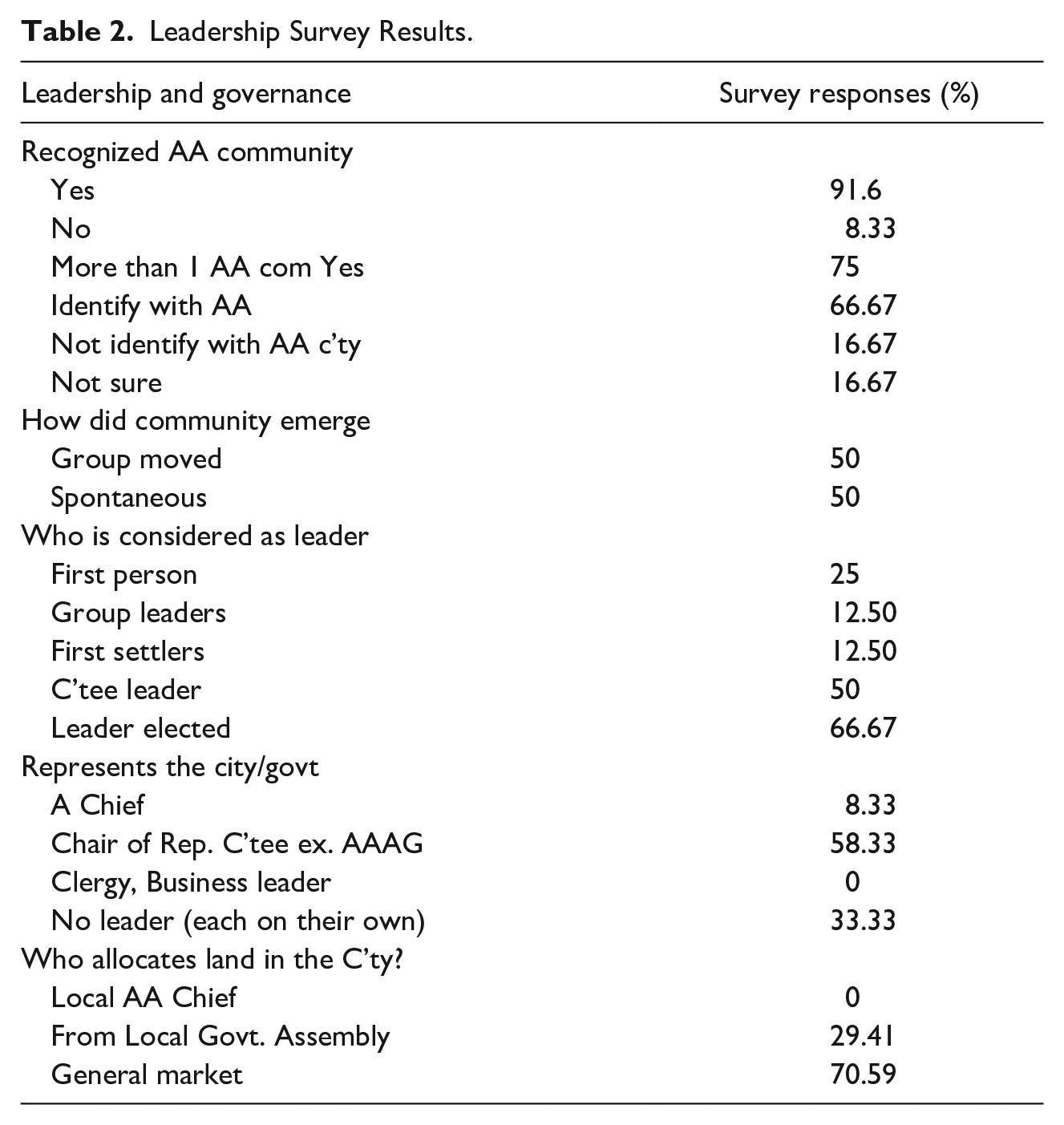
There are commonalities in the governance system practiced by migrants and systems in Ghana. Governance based on elected representatives is a direct transplant from the country of origin, primarily, the United States to Ghana. This same governance system has always been practiced in Ghana having been introduced by the British many years ago under its colonial policy. A threshold question is whether the AA chiefs exercise the same powers as the traditional local chiefs. 58.3% of respondents indicated that their elected representative represents the community in their dealings with government. Only 8.33% identified a Chief as the representative when dealing with government. A large number of respondents (33%) indicated that each individual interacts with government on their own. The survey results show that AA Chiefs do not exercise extensive powers as the local traditional Chiefs. AA Chiefs do not allocate land. 29.1% of respondents indicated that they acquire land from the local government assembly, and 70.59% acquired land on the general land market. The land market in urban and peri-urban areas is fairly developed. In rural areas, and especially for farming purposes, a Chief may allocate land to family to live on. AA Chiefs do not have land to allocate at their discretion. The practice of traditional Chieftaincy governance system may be more an affirmation of the desire to belong and uphold the culture of the local people they identify with.
African American migrants who follow customary practices and those following the universalist principle of elected representation have important roles to play in Ghana’s economic development. Migrants practicing the traditional system may be agents in the use of technology to improve decision-making at the local level opens the door to explore how local groups may interact with the AA migrant community to exploit technological and information knowledge to benefit local development. The transformative potential of the culture-based leadership practiced by some AA migrants could improve decision-making at the local level to a remarkable degree. Since some of the migrants live in local communities their participation in discussion on land use, public safety and health such as siting of waste facilities, and improved ambience. Migrants following western-style governance may lead the effort at forming backward linkages to sources of investments and finance since they are operating in an environment based on formal rules. Migrants practicing the traditional governance system are aware of the western-style governance system but have made a conscious decision to operate under the traditional system. “Through policies, special invitations, conferring of traditional titles, free land offers, and advocacy of pan-Africanism, the government and people of Ghana have been able to transform diasporans from passive visitors to the country into active cultural brokers, marketers, willing ambassadors abroad, and active participants in the country’s economic development efforts” (Ankomah et al., 2012, pp. 387–388).
Conclusions and Recommendations for Future Research
This study found that Ghana’s economic development goals align well with U.S. and global SDG development goals. To benefit from this alignment, Ghana could exploit the fusion of cultural leadership experiences of AAs and Ghanaian traditional societies to improve local governance and attract foreign direct investment. One way to improve local governance is to evolve the institutional mechanisms that allow AA migrants to serve on local government committees and other community institutions. AA migrants are mostly retired, have advanced college degrees and work experience, have been homeowners both in the U.S. and in Ghana so they could make useful contributions to the discussion on such issues as, land use planning, zoning, waste disposal, water use, schools, and general infrastructure development. Migrants may also take advantage of U.S. BUILD Act that specifically encourages the participation of minority groups and women in attracting investments to developing countries. The Government of Ghana is actively planning ways of greater involvement of the African-American community in Ghana with the establishment of a diasporan affairs office in the Office of the President. Our paper seeks to create awareness of a huge potential to tap into the expertise of African Americans in areas of governance, technology, and leadership development, in addition to the economic impacts described in our paper.
Footnotes
Declaration of Conflicting Interests
The authors declared no potential conflicts of interest with respect to the research, authorship, and/or publication of this article.
Funding
The authors received no financial support for the research, authorship, and/or publication of this article.
