



Abstract
The purpose of this investigation is to frame Global North colonialism in southern and eastern Africa as ontological appropriation. In the article’s conceptual framework, ontological appropriation is colonial claims to aspects of African realities without acknowledgment of their original sources and creators. In the case of southern Africa, Global North appropriation of Khoi and San agriculturalist ontologies is illustrated. Additionally, attempts by the Global North to claim origination of Ethiopia’s ancient ontologies are cited as evidence of colonial appropriation. In accordance, the methods of the investigation involved a review of scholarship related to indigenous ontologies in South and East Africa. Moreover, scholarly voices speaking to epistemic encounters between the Global North with Africans are observed. Thus, a thesis of ontological appropriation is generated. Results of the investigation indicate sustained Global North warfare, and epistemic assaults led to the fall of Khoi, San, hunter-gather, and pastoral ontologies in the South. In contrast, in the East Ethiopia’s ancient theocracy, and monarchies prevented Global North acquisition of land, and ontic dominance. The article concludes colonialism was a deliberate attempt to modify, and control African ontologies. As a result, in southern Africa Khoi San ontologies transformed from hunter-gatherers, and pastoralists to colonial servitude. In Ethiopia, however, monarchical, and theocratic ontologies are vibrant to the present age. Hence, this article’s contribution to new knowledge is its accentuation of divergent hunter-gatherer, pastoralist, and monarchical responses to colonialism in ways that enabled, and resisted colonial appropriation of indigenous ontologies.
Introduction
The colonization of Africa by European nations was a multi-pronged process which had distinct aims. Ocheni and Nkwanko (2012) declare that the primary colonial objective was political dominance while the second objective was, “to make possible the exploitation of the colonised” (p. 47). To achieve political dominance and exploitation, colonists employed physical and epistemic violence against indigenous communities. While acknowledging enslavement and attempts of genocide against Africans, the concerns of this article surround epistemic violence. The article’s stance is that in South Africa, Global North settlers appropriated Khoi Khoi agricultural and pastoralist ontologies. For example, when the first members of the Dutch East India Company settled in what is now called the Western Cape, epistemic violence was introduced to disrupt Khoi Khoi 1 herders’ seasonal migration. Nevertheless, Mellet (2020) notes that for most of the 16th century, “local [Khoi Khoi] resistance [ . . . ] impeded the onward march and impositions of European colonization” (p. 103). However, from the 17th century, Jan van Riebeeck, a leading Dutch colonial administrator, “. . . was bent on conquest and dislodging any form of intermediary trading by indigenes” (Mellet 2020, p. 115). Evidently, Dutch objectives of settler expansion necessitated dismantling Khoi Khoi epistemic relations with the natural environment and the imposition of alien and servile epistemes on them. East Africa’s 15th and 16th century histories, specifically Ethiopian chronologies, diverge from the Southern African experience. Ethiopia carries the status as Africa’s only nation to not have been completely colonized by a European state. Across centuries Italy made attempts to conquer Ethiopia but only succeeded in occupying Addis Ababa between 1936 and 1941 (Trento, 2012). Given East Africa and South Africa’s shared and diverging colonial histories, this study contributes to existing knowledge by framing Africa’s interactions with the Global North as resistance of ontological appropriation.
Theorizing Ontological Appropriation
To theorize the concept of ontic appropriation in colonial Africa, it is necessary to clarify this study’s construct of the concept “ontology.” Philosophical ontology is the study of human conceptions of reality, existence, and structures that encapsulate experiences. Metaphorically, a social ontology is a blueprint of human realities. Gruber (1995) reasons that discipline-based ontologies require concept specifications that scientists employ in developing knowledge. In other words, human ontologies include theories and concepts that scholars and cultural communities agree upon (Gruber, 1995). Agreement among scientists around conceptualization is vital according to Gruber’s (1995) theory. Furthermore, ontologies are composed of epistemologies. Epistemology is the analysis of communities’ conceptualizations, knowledge validation, and development traditions. In summation, an ontology (see Figure 1) is a representation of reality according to the conceptualizations and epistemologies of cultural communities.
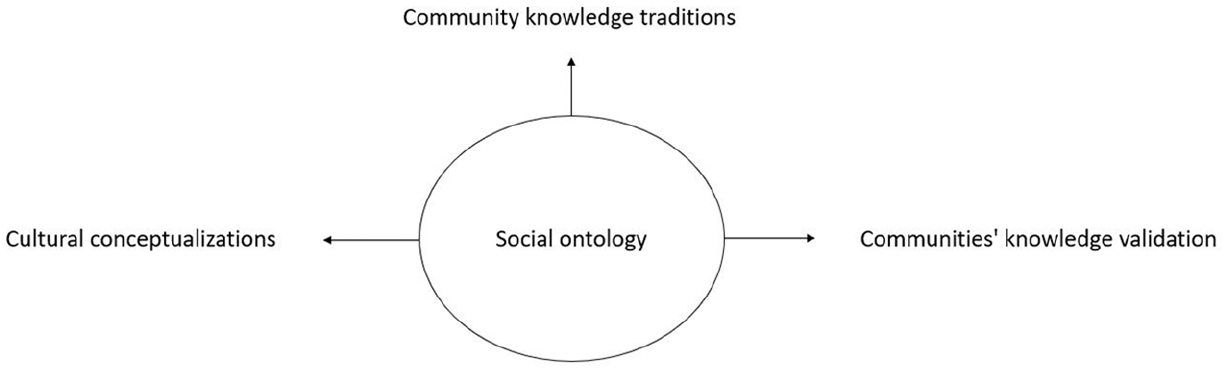
Components of a social ontology.
Social ontologies are vital for analyses of colonial interactions. When indigenous Africans, including Khoi Khoi and Ethiopian communities, initially encountered European explorers, missionaries, and traders, a meeting of ontological orientations occurred. History confirms the aims of the colonialists were to attain political and economic control of Africa. Indeed, Africans experienced epistemic contempt, attempts at modification, and disruption by European agents. Kaya and Seleti (2013) argue that a core colonial aim was the destruction of Africans’ intellectual, cultural, and spiritual heritages.
The construct of ontic appropriation is employed in multiple scholarly fields. Notably, during the research process of this article, no analyses was encountered which explicitly frames colonialism in Africa as involving ontological appropriation. Rather, studies around ontological appropriation emerged in musicological and literary criticism (Hick, 2013), analysis of diasporic aesthetics (Williams-Jones, 1975), and theology. Appropriation in the literary and diasporic domains are considered in the current study. In research conducted by Hick’s (2013), appropriation of creative aesthetics taken from Kerouac’s (1957) seminal novel, On the Road, in blogger Morris’s (2009) online platform, Getting Inside Jack Kerouac’s Head, is critiqued. While claiming that “appropriation of art by other artists is nothing particularly new” (p. 155), Hick’s (2013) analysis bemoans the reality of artists reproducing previous works in ways that extract from their core aesthetics. Hick (2013) cites literary features as evidence of a writer’s aesthetic strategies which include individualized styles of weaving themes and subjects through the structures and heuristics of art. In this vein, Hick (2013) declares that Morris’s (2009) borrowing of phrases, words, and sentence structures from Kerouac’s (1957) novel constitutes heuristic appropriation. Werbner and Fumanti (2013) dissect ontic appropriation in the context of diasporic communities’ aesthetics. Where Hick (2013) critiques invasive appropriation in the literary field, Werbner and Fumanti (2013) analyze diasporic appropriation as aesthetic extraction from displaced, formerly enslaved communities’ performative practices. Diasporic aesthetics embody what is valued as, “beauty, distinction, and sensual pleasure” (Werbner & Fumanti, 2013, p. 149). As carriers of diasporic aesthetics, Reggae music, the Kumina dance of Jamaica, Gospel music by African Americans, and the Bata dance practiced among African Cuban communities, constitute aesthetic African expressions (Egharevba & Egharevba, 2021; Igweonu, 2008). Williams-Jones (1975) claims that, “black Gospel music [embodies] the most noticeable African-derived aesthetics features” (p. 373) among black arts in North America. Possibly more so than other genres, Gospel music in North America is rooted in “cultural traditions and ideals of West Africa [which] are the ultimate source from which [ . . . ] the basic concept of a black aesthetic” (Williams-Jones, 1975, p. 373) is derived. Admittedly, African American cultural communities are diverse and draw on epistemes from all corners and the center of the African continent. To summarize, appropriation of cultural aesthetics occurs in a derivative manner as highlighted in the study by Hick (2013). On the contrary, aesthetic appropriation in the Pan-African community elaborates knowledge systems by connecting formerly-enslaved, diasporic communities and Africans in the continent through cultural, participative performances.
Epistemic and Ontic Intersections
The philosophical branch of epistemology is central to conceptualizing ontological appropriation in colonial contexts. In the Afrocentric paradigm, epistemology is: The African conception of the nature of knowledge, the means used to gain knowledge, [ . . . ] criteria for the assessment of the validity of knowledge, the purpose of the pursuit of knowledge, and the role that knowledge plays in human existence. (Nkulu-N’Sengha, 2005, emphasis added)
Nkulu-N’Sengha’s (2005) epistemology is relevant to the analysis of ontological appropriation during colonialism. Firstly, this theory suggests that when a community appropriates knowledge from another, it validates the functionality of their cultural, agential, and modes of social organization. Secondly, Nkulu-N’Sengha’s (2005) epistemic construct acknowledges the functions of indigenous African aesthetics in facilitating cultural elaboration and cohesion in African communities. In summary, African epistemologies shape, as Nkulu-N’Sengha (2005) suggests, African ontologies. Therefore, when colonial missionaries, businesspeople, and politicians initially encountered Africans, they were exposed to ancient epistemologies which generated indigenous, scientific, economic, and agricultural ontologies. Nonetheless, the outcomes of violent colonial interpretations of- and the responses to indigenous African epistemologies, are the concern of this study.
Before considering possibilities of analyzing Global North appropriation of African aesthetics as acts of ontic appropriation, it is necessary to consider the theory of cultural appropriation. Cultural appropriation theory receives attention in disciplinary and rhetorical discourses, For example, in both domains attention is given to Africans’ experiences and perceptions of cultural appropriation. In this context, Arya (2021) observes that cultural appropriation in commercial sectors often leads to the exploitation of indigenous and marginalized peoples’ aesthetic modes of expression. Cooperate appropriation includes the exploitation of indigenous, participatory arts which connects indigenous communities to their ancestral roots. As evidence of aesthetic exploitation, Rodriguez (2006) argues that some white youth who appropriate the black Hip Hop genre remove “racially coded meanings in the music and replac[e] them with color-blind ones” (p. 645). In doing so, the said white youth’s appropriation of Hip-Hop aesthetics elaborates powerful ideologies of racialized societies, including color-blindness, by obscuring structural racism and societal inequalities which are common themes in Hip Hop (Rodriguez, 2006). Abu-Rabia-Queder (2022) suggests that cultural appropriation is a method of epistemological surveillance of marginalized communities by the powers that be. In the context of Palestine, Abu-Rabia-Queder (2022) reasons that indigenous academics’ epistemologies are culturally appropriated in Zionist ideologies. According to Abu-Rabia-Queder (2022), the concern raised is that as Palestinian researchers attempt to challenge oppressive ideologies, their work is constrained by academic “gatekeepers” (p. 1) who employ inhibiting mechanisms toward their research. In summary, cultural appropriation constitutes the silencing of indigenous epistemic codes by way of surveillance, marginalization, and selective duplication.
South African Epistemes and the Colonial Response
The first Africans whom colonizers encountered at the southernmost tip of the continent were the Khoi Khoi people. Epistemologies surrounding Khoi Khoi communities living around Hoerikwaggo 2 , presently called Table Mountain, were pastoralist. In Barnard’s (1992) study, pastoralist ontologies frame knowledge systems of communities who migrate seasonally according to the needs of humans and livestock. Seasonal migration between designated geographical domains is a key feature of pastoral epistemology. Boonzaier (1996) notes that “the nomadic herders [Khoi Khoi] at the Cape were some of the first Africans practicing this [pastoralist] type of economy” (p. 2-3). Historians emphasize that Khoi communities, namely the Goringhaikhona, Goringqua, “had already been established at the southern tip of the continent for over a thousand years when Bartolomeu Dias rounded the Cape” (Boonzaier, 1996, p. 3). Although seasonal migration was essential in Khoi epistemologies, especially in interactions with land and cattle, it is not the only variable that sustained their pastoral ontology. In addition, Khoi kinship structures and familial relationships determined the ecologies which they herded in, methods and technologies utilized for migration, grazing, hunting, and foraging as seasonal patterns morphed (Barnard, 1992). As evidence, Khoi communities were characterized by clusters of families led by a leader. Usually, these groups were named after a male leader. Examples of names of Khoi communities included, but were not restricted to, the Goringhaikhona, Hessequa, Attaqua, Outeniqua, Chainouqua, and Gouriqua (Mellet, 2020). The suffix “qua” in Khoi communities’ names indicates the preposition “of.” Hence, the names of communities translate to “people of Hesse,” “of Atta,” “of Outeniqua,” and so forth. The African episteme of naming communities after leaders transcends cultures. For example, dialects of isiXhosa, a Southern African tongue, use the preposition “kwa” to indicate belonging. In this context, KwaZulu means “of the Zulu monarch.” Dialects of Lingala, one of the Democratic Republic of Congo’s official languages, use the preposition “wa” for the same purpose. To conclude this point, kinship, familial, and Khoi etymologic features constituted an indigenous ontology that bonded members. Proceeding, consideration is given to the nature of colonists’ responses to ancient, indigenous Khoi Khoi epistemologies.
When Khoi knowledge systems are viewed as the nexus of agricultural, economic, and social epistemes, it is reasonable to claim that the colonial response, particularly that of Dutch administrators, included epistemic contempt, competition, and disruption. With respect to epistemic contempt, the history of Southern Africa shows evidence of Dutch disdain towards indigenous people. In a historical anecdote by Marks (1972), it is recorded that a Shortened Oxford Dictionary describes the Khoi Khoi as, “of inferior intellect and culture” (p. 55). Bluntly put, migration and kinship epistemologies around Camissa, the river which runs from Hoerikwaggo, were looked down on (Ernsten & Shepherd, 2020). Jan van Riebeeck, the founder of Dutch imperialism in Southern Africa, referred to the Khoi Khoi as, “a dull, stupid, lazy, stinking nation” (Marks, 1972, p. 55). Van Riebeeck’s contempt for Khoi knowledge systems was reflected in Dutch statutes. To illustrate, Roman law shaped Dutch, and other settler economies’ treatment of conquered people and their epistemologies. Roman statutes justified unequal and harsher punishments for enslaved individuals in contrast with penalties meted against the free. Harper (1996) remarks that, “the Roman empire was home to the most extensive and enduring slave system in pre-modern history” (p. 3). Consequently, the Dutch East India Company warranted Roman law by forcing Khoi communities into servile relationships while expropriating local land. As unearthed, the rejection of Khoi epistemologies through physical violence and legal subjugation were key methods employed by the Dutch to compete for land. For example, ancient seasonal migration routes which the Goringhaikhona, and other Khoi communities routed around Hoerikwaggo constrained total Dutch claims to land around their emerging town. Mellet (2020) details legal mechanisms that were specifically activated to disrupt Khoi, pastoral epistemologies. Dutch East India Company administrators introduced a “leasehold system” which imposed the episteme of private property on Khoi people (Mellet, 2020, p. 161). The notion of land ownership was antithetical to pastoral, hunter-gather epistemologies which included seasonal migration. To further disrupt and compete with Khoi epistemologies, colonial laws instituted “grazing licenses” (Mellet, 2020, p. 161). These legal tools constrained Khoi herders from feeding their cattle around the Camissa River and Hoerikwaggo (Mellet, 2020). In effect, stunted access to farming grounds and monetary restrictions around grazing signaled the seeds of epistemicide against the Khoi by Dutch settlers. It is vital to mention “religion” introduced by members of the Dutch, and other Global North nations as strategies which effected Khoi San linguicide, and epistemicide, in conjunction with loss of access to land. Epistemicide is the imposition of a group’s ontology on another to achieve “near total destruction of the [target’s] epistemology” (Masaka, 2018, p. 287). For example, Global North missionaries aimed to replace Khoi San hunter, gatherer, and pastoral ontologies with a European version of “Christianity.” Thus, Hattersley (1952) centralizes Protestant missionaries as “primary media” for disseminating Global North epistemologies among conquered communities (p. 87). To illustrate structural instruments of ontological appropriation, settlers engaged in the establishment of “mission schools, the study of [indigenous] languages, and their reduction to writing” (Hattersley, 1952, p. 87, emphasis added). Moreover, colonial religion in southern Africa generated “Afrikaner” identity (Vanderhaeghen, 2018). Despite the presence of “Old Testament” epistemes in southern Africa since the arrival of the ancestors of the Khoi and San, missionaries were dedicated to the broader colonial project. Thus, Global North settlers who eventually identified as “Afrikaners” claimed to be real Africans, divinely ordained to claim indigenous ontologies. In the encounter between Afrikaners and Khoi and San communities of present-day Cape Town, linguicide among the latter communities actualized (Sehume, 2019).
East African Epistemes and the Colonial Response
East Africa’s historical interactions with Europe, specifically those of Ethiopia, share traits and diverge characteristically from Southern Africa’s colonial trajectory. Similarities include European attempts to expropriate land and acquire cheap labor. As in Southern Africa, Ethiopia’s indigenous epistemologies were subjected to attempted modification, disruption, and competition by colonial projects. However, unlike the Southern African experience, Europe failed in penetrating Ethiopia, notwithstanding occupation by Italy from 1936 to 1941 (Trento, 2012). To develop understanding of near total colonial domination in South Africa and the maintenance of political independence in Ethiopia, consideration of the latter nation-state’s epistemologies is required, as was applied in the Khoi case. The land masses of Ethiopia and South Africa are almost the same size. Where Ethiopian land mass totals 1,100 km²,
3
South Africa totals 1,200 km² (World Bank, 2022). Though the two nations possess territory of roughly the same size, Ethiopia’s population of 114,963,583 inhabitants are nearly twice the size of South Africa’s 59,308,690 inhabitants (World Bank, 2022). Analytically, it is reasonable to deduce that during the 15th and 16th centuries, Europeans encountered a larger African population in the geography surrounding the present-day Ethiopian state than they did in the southernmost point of the continent. Some of East Africa’s earliest encounters with Europeans were recorded by Portuguese missionaries and explorers. The translated diaries of adventurer João Bermudez, who served the Solomonic King David Lebna Dengel for 5 years, introduces 16th century Ethiopia to the reader as follows: These highlands [ . . . ] are inhabited by followers of alien creeds [ . . . ] and by their situation [are] fitted to be the refuge of an isolated faith; they have, in fact, become the refuge of two faiths: the earlier is that of the Falashas, or Jews; the later [ . . . ] is a primitive, and perhaps debased, form of Christianity. (Whiteway et al., 2010, p. xxi)
Indeed, indigenous modes of organization that Bermudez encountered in Ethiopia were shaped by epistemologies whose origins precede the Kingdom of Axum (Phillipson, 2017). The first king of Axum, one of Ethiopia’s earliest capitals, was named Bazen. Bazen ruled during the 10th century Before Christ. Axum under King Bazen and 14th century Shewa under King David II were governed by integrated social structures (Phillipson, 2017). At a meta-level, monarchies were Ethiopia’s apex authority. In the traditions of Ethiopia’s Solomonic history, the monarchy’s lineage descends from the union of Queen Sheba of Axum and King Solomon of ancient Israel (Adamo & Eghubare, 2010). The history of the royal union between Queen Sheba and King Solomon is recorded in the revered Ethiopian text, The Kebra Negast (Fellman & Brooks, 1999). In addition, Islamic, biblical, Arabian texts as well as West African epistemes including Yoruba culture, celebrate the birth of the Queen and King’s son, Menelik (Adamo & Eghubare, 2010; Rukuni, 2021).
Beneath the Ethiopian kings’ authority, networks of village heads who acknowledged the throne regulated the affairs of the rest of the nation. Fourteenth century Ethiopian villages possessed internal governance systems—structured according to kinship and familial lines. Village councils were comprised of elders, priests, and landowners. The oldest Ethiopian mode of social organization belongs to pastoral groups. As in Southern Africa, these communities migrated between geographical regions according to seasons. Pastoral communities emerged in East Africa before Axum’s rising and early settlement farmers. Kardulias (2015) reasons that pastoralism is an adaptive epistemology and warrants this claim by highlighting pastoral communities’ integration of cultural practices, animal husbandry, and agricultural techniques across diverse environmental ecologies. To summarize, it is this ancient integration of monarchy, villages, and pastoralists that European colonizers came across while surveying Ethiopia for potential land and labor acquisition.
As is the pattern of many colonizing nations, European explorers and missionaries were the first to interact with indigenous African communities in Ethiopia during the 1400s. The goals of missionaries and explorers were to observe, interpret, and report their findings of indigenous societies to European monarchs and commercial entities who were planning to subjugate Africa. Unlike parts of the continent where missionaries sought to convert Africans to a western-styled Christianity due to the lack of familiarity with indigenous knowledge systems; in Ethiopia, Europeans encountered a national epistemology that was structured in the same ways as the monarchies of King David and King Solomon of ancient Israel. As Bermudez observed, Ethiopian epistemologies resembled modes of life described in the Old and New Testaments of The Bible (Martínez d’Alòs-Moner, 2015). Regardless, the European response to Ethiopia’s biblical epistemes was contemptuous. In a book titled Pedro Páez’s History of Ethiopia, 1622 by Paez et al. (2011), two waves of Jesuit priests were sent to Ethiopia in an attempt to modify the national epistemology. The first Portuguese evangelists to enter Ethiopia occurred between 1603 and 1622 (Paez et al., 2011). Missionaries of the Society of Jesus were frustrated with their failure in converting the Ethiopians to Catholicism. Converting Ethiopians was, “a desire [ . . . ] voiced by the Society’s founder, Ignatius of Loyola, as well as by the pope and the Portuguese crown” (Paez et al., 2011, p. 5) which sponsored Paez’s expedition to East Africa. Paez succeeded in influencing the Ethiopian monarch, King Susneyos, who declared obedience to the Pope. Furthermore, Paez persuaded King Susneyos to declare as heretical the indigenous, epistemic practices of his followers (Paez et al., 2011). Even though Ethiopia’s indigenous Old Testament and Christian epistemes were rooted in ancient traditions, the Portuguese were able to disrupt, even if only temporarily, the Ethiopian indigenous knowledge systems. Regardless, 15th century Portuguese missionaries, traders, and politicians never succeeded in fully annihilating Ethiopian epistemic networks.
Two centuries later, Europe was still trying to conquer Ethiopia. At the Berlin Conference of 1884, European nations as well as the United States planned to partition Africa into colonial territories. Italy was a participating attendee (Press, 2017). Italy’s presence at this event is significant since the conference attendees agreed that Ethiopia would fall under Italian control. Like the Portuguese during the 1600s, Italy failed in fully colonizing Ethiopia; however, they were persistent in attempting to do so. Mackenzie (2005) records how in 1885 the Italians claimed Eritrea and significant portions of Somali land next to Ethiopia. In contrast, when Italy attempted to claim Ethiopian land, they were defeated by the forces of Emperor Menelik at the Battle of Adowa in 1886. Italy resumed military aggression against the Ethiopians between 1935 and 1941 but could not subdue the East Africans who were led by Emperor Haile Selassie, son of Emperor Menelik. To summarize, Ethiopia constrained epistemic contempt, disruptions, and modifications while responding to centuries of colonial strategizing by missionaries, explorers, politicians, and traders.
Findings
Epistemic contempt, disruption, and competition from European colonialists toward Africans in the southern and eastern parts of the continent resulted in indigenous, ontic transformation. History confirms colonial administrators had no value for the cohesion of cultural, linguistic communities while partitioning the continent at the 1884 Berlin Conference. Moyo (2018, p. 30) claims division of African land disrupted indigenous communities “economically, socially, and politically”. Furthermore, Europeans’ creation of artificial political borders between Africans intruded indigenous epistemologies (Moyo, 2018). In concordance with Moyo’s (2018) outlook, Idejiora-Kalu (2019) asserts: The re-definition of Africa’s sovereignty, its borders, and cultures by the resolutions of the Berlin Conference [ . . . ] had violent ripple effects in [ . . . ] African society. These ripple effects [continue] to be felt today [ . . . ] as a militating factor in the ability of cultures to blend together [ . . . ] and in the tampering with [ . . . ] indigenous economic systems. (p. 100)
Colonial economics, including land expropriation, was never divorced from competition with indigenous African epistemologies. This is because pre-colonial knowledge systems facilitated indigenous communities’ interactions with land, the environment, and each other. Hence, ancient African epistemes were constraints to colonial expansionism. In Southern Africa, Khoi Khoi pastoralist knowledge systems were targeted since they were in conflict with the establishment of settler farms and a capitalist economy. In response, European settlers formulated the Caledon Code of 1809, also known as the Hottentot Proclamation. The Caledon Code is described as, “the final seal in a long process of the ‘enslavement’ of the [Cape] Colony’s indigenous population” (Dooling, 2005, p. 50). The law prevented Khoi and San people from commuting without a “pass” (Dooling, 2005, p. 50). The Caledon Code was the predecessor to South Africa’s Apartheid pass laws of the 1950s which constrained indigenous peoples’ freedom of movement. During the 1800s, the Caledon Code required Khoi and San people to have “a fixed place of abode” (Dooling, 2005, p. 50). In passing this decree, the Khoi Khoi’s ancient pastoralist epistemes of seasonal migration were destroyed. Khoi and San people were prevented from travelling freely and settlers could stop them at any time to request a pass. Finally, disruption of Khoi ontologies achieved through preventing freedom of movement and the grazing of cattle, enabled settlers to reach their apex goal of land expropriation.
In East Africa, Europeans failed to completely dismantle indigenous Ethiopian epistemologies as they did among Khoi communities close to Hoerikwaggo. However, since their arrival in Africa during the 1400s through to the 20th century, Europeans targeted Ethiopian epistemologies for purposes of land and labor expropriation. To penetrate Ethiopians’ indigenous modes of social organization, European missionaries, traders, and explorers recognized that epistemic modification was required. In the example of interactions with King David Lebna Dengel, overt European attempts were made to shift authority from Ethiopia’s kings, priests, and elders to the pontiff in Rome. From an Afrocentric perspective, the European pope’s claim to authority was preposterous. This is due to the Ethiopians’ possession of the oldest versions of The Bible and embodied epistemes from the Old and New Testaments which manifest in participatory rituals. Europe was predominantly pagan in the third century after Christ’s birth while ancient Ethiopians articulated cultural epistemes that preceded Sheba and Solomon (Dowden, 2000). Furthermore, Ethiopia and Ethiopians are mentioned no less than 33 times in biblical texts. In essence, Ethiopian history includes biblical chronologies. While there are historical instantiations of Ethiopians acquiescing to European theological and political epistemes, indigenous Ethiopian knowledge systems and modes of social organization withstood colonialism’s aim of expropriating all land and human bodies to develop the Global North.
Discussion
Scholars of Africology, diasporic, African American, and African studies approach non-physical affliction toward indigenous people under colonialism as epistemicide or the attempt thereof (Masaka, 2018). Masaka (2018) conceptualizes epistemicide as, “the foisting of one group’s knowledge on another group leading to the near total destruction of the latter’s epistemology” (p. 287). Given the Dutch contempt for Khoi pastoral epistemes and explicit efforts to modify Khoi ontologies through the imposition of private property and pass laws, it is not far-fetched to claim that epistemicide was a goal. Similarly, Ethiopia was subjected to centuries of European pressure to modify and align Coptic epistemologies with ideologies centering the authority of the European Pope and Catholic Church. Despite sustained epistemic assaults against Ethiopian priests, and unlike successful Dutch marginalization of Khoi epistemes, Coptic knowledge systems remain vibrant in North-eastern Africa. Factors underpinning Ethiopia’s maintenance of political and theological independence, in contrast to variables of destruction in the Khoi experience, are of importance to the current study. Yet, it is impossible to dissect all the variables in the current analysis. However, the researcher intends to probe these variables in new studies. For now, structural, cultural, and agential characteristics which distinguished Khoi communities from Ethiopia’s larger epistemic clusters enabled diverging colonial successes in Southern and Eastern Africa (See Table 1). Firstly and in terms of structure, Khoi communities constituted small, splintered herder groups who migrated around Hoerikwaggo as the seasons changed. Therefore, it was easier for the colonialists to expropriate land since in Khoi epistemology, land does not belong to anyone. Secondly and in contrast to the splintered Khoi clusters, Ethiopia’s pastoralists were protected by settled agricultural communities with whom they interacted and the kingship. The latter social structures enabled the elaboration of the pastoral epistemology. Thirdly, while Khoi communities shared agricultural epistemes, theologies across communities were not always coherent. For example, once a male broke away from a community to start his own, epistemic modifications which included the ethereal domain were articulated to solidify his authority. Hence, the names of Khoi communities derive from multiple leaders. In contrast, Ethiopia’s Old and New Testament epistemes continuously permeated pastoral, village, and state-level structures. Moreover, it was the king’s responsibility to maintain the cultural unity of the Ethiopian people. As a result, when epistemic and physical assaults were initiated against Ethiopians by colonial forces, the kings rallied and received support from pastoralists and village networks. In facilitating unity against colonial aggression, in contrast to agentic fractures among Khoi leaders, the royal agency of Ethiopia’s kings is a significant feature of Ethiopian epistemology that contributed to the maintenance of independence. On the other hand, without a strong unified leader across communities, Khoi pastoralists were epistemically annihilated and lost land. Nevertheless, acknowledgement is due to the Khoi herders and San hunter-gatherers who sustained some of Africa’s longest wars against land expropriation and epistemicide by colonizing states (Marks, 1972).
Social Structures of Pre-Colonial Southern and Eastern Africa.

Conclusion
Southern and Eastern African communities’ epistemologies shape their ontologies, meaning that: a community’s knowledge systems give form to their lived experiences, realities, and ways of life. Since epistemologies shape communities’ ontologies, this study concludes that attempted and successful colonial acts of land and labor expropriation, as illustrated by the researchers referenced in this study, constitute ontological appropriation. By expropriating Khoi peoples’ land, bodies, and labor, and by imposing the epistemes of slaves and servants on them, Dutch and other European settlers appropriated Khoi ontologies as free agriculturalists. Ontological appropriation includes epistemic contempt toward, attempted modification, and disruption of indigenous knowledge. In these ways and in Ethiopia, Portuguese, and Italian agents failed in their attempts to modify and disrupt Ethiopia’s Solomonic epistemes by subsuming them beneath the authority of the European Pope, monarchies, and western governments. In contrast, the project of ontological appropriation was successful in the region around Hoerikwaggo of South Africa. After centuries of resistance, Khoi members became servants and slaves, and lost their right of freedom of movement. Thereafter, Dutch settlers named themselves “Boers,” meaning farmers. Moreover, Khoi Khoi were named Hottentots, which in Dutch denotes speakers of gibberish. As is apparent, the Dutch appropriated the agricultural ontologies of the indigenous Khoi people. Inversely, the Portuguese and Italians were unsuccessful in appropriating Ethiopian ontologies. Unlike Khoi herder and pastoralist social structures that were crushed by Dutch laws and physical violence, Ethiopia’s Solomonic monarchs, village confederacies, and pastoralists united to defeat ontological appropriation. Ethiopia maintained her independence and the nation’s Abrahamic traditions endure to the present day. In contrast, only pockets of Khoi communities who maintained their ancient languages and epistemologies survive throughout Southern Africa.
This study further concludes that autonomous, social structures in pre-colonial Africa, including hunters, gatherers, and herders were more susceptible to ontological appropriation by European colonizers than monarchies and settled, agricultural communities. It must be acknowledged, however, that in a continent of Africa’s vastness, there is history of large and small communities uniting to resist land and bodily expropriation. For example, Khoi communities joined isiXhosa speakers to resist ontological appropriation (Mellet, 2020). Due to Africa’s enormous size, innumerable languages, and cultural diversity, generalizations around histories of ontic appropriation are cautioned against. Finally, where this study considered agricultural and theological appropriation under colonialism, it is recommended that future studies around colonial, ontological appropriation focus on gender relationships, pedagogic, medicinal, architectural, and commercial practices in indigenous communities.
Footnotes
Declaration of Conflicting Interests
The author declared no potential conflicts of interest with respect to the research, authorship, and/or publication of this article.
Funding
The author received no financial support for the research, authorship, and/or publication of this article.
