




Abstract
This paper examined the recent immortalization project of Hon. Dr. Nnamdi Azikiwe at Enugu. Historicizing his achievements and legacies, the paper studied the roles he played in ensuring that independent Africa is attained and why he continues to be remembered even after his death. The research method is qualitative and descriptive. Secondary data such as newspapers, books, journals and online materials are used to enrich the work. The result shows that the inauguration of the Nnamdi Azikiwe Centre and other previous projects that immortalized him were as a result of his outstanding and selfless services to Africa and Nigeria in particular. The paper discovered that the new Nnamdi Azikiwe Centre was his renovated residential lodge which richly embodies his political history and career years, thoughts, ideology, and philosophy. The findings of this research will help government officials, historians, tourists, and students in making decisions on good governance, consulting material in education, and tourism development.
Introduction
Colonization and decolonization process are two major events that took place in Africa and which changed the continent. Faringer (1991) writes that at the Berlin Conference in 1885, the European colonial powers formalized their control of Africa, which dated back centuries, and drew borders to divide the continent among themselves (p. 1). Majority of Africans have continued to believe that colonization of Africa by the West is the bedrock of the challenges the countries within the continent are going through. Meanwhile, Mawere and Mubaya (2016, p. 1) observed that the continent of Africa is judiciously and richly endowed with diverse resources: natural, human, religious, and cultural. Thus, with colonization and its foreign policies in Africa, decolonization was urgently desired by the indigenes and they made every effort to have freedom from the colonial government. This led to the emergence of Pan-Africanists and nationalists whose fame, struggles, inputs, sacrifices and charismatic devotion to duty has stood the test of time. Pan-Africanism is the idea that “people of African descent share similar histories and struggles, a common destiny, and processes for forming cross-cultural unity in areas of history, politics, and economics—has a striking resemblance to the concept of the African Diaspora and reverse migrations” (Falola & Paddock, 2009, p. 1).
Falola and Paddock (2009, p. 2) affirm that the post-World War II era in Africa witnessed dramatic changes not only in political, social, and economic developments but also in the intellectual arena. This means that many African intellectuals and Pan-Africanists emerged to challenge colonial rule and embarked on activities of decolonizing Africa. Amongst them are Kwame Nkrumah of Ghana, Jomo Kenyatta of Kenya, Leopold Senghor of Senegal, and Nnamdi Azikiwe of Nigeria. These men engaged their strength and resources into negotiating, dialoguing and discussing ways of peaceful estrangement from foreign rule. Through Azikiwe’s newspaper The West African Pilot (1937), he sensitized the minds of the people and emphasized on the importance of African independence and total liberation from colonial rule. In fact, various resistance movements cropped up across many African regions in the years prior to the 1960s when most African nations started gaining their independence. Ghana was first to gain her independence in 1957 and Nigeria and many other African nations in 1960.
Coleman (1958, p. 2) note that the peoples of tropical Africa, in particular, have been regarded as a part of humanity which might escape the scourge or the blessings of Western modes of human organization and Western patterns of political behavior. In South African region, Mandela fought colonial rule’s marginalization in the area of apartheid and is widely recognized today - for his role in making South Africa an apartheid-free region. After all, the African Charter on Human and People’s Rights contains civil and political rights similar to those in the European Conservation on Human Rights of 1950 and the ICCPR (Wright, 2001).
The active years of decolonization process in Africa was between 1950s to 1975s and the story is incomplete without the achievements of Hon. Dr. Nnamdi Azikiwe. Unfortunately, across many African nations, the transformative governance aimed at liberating the people’s minds and thoughts toward true economic and social freedom as shown by these selfless African leaders such as Julius Nyerere, Nnamdi Azikiwe, Nelson Mandela, and others is fast eluding African politics of today as many politicians of the 21st century Africa lacks the true patriotic conscience needed for good governance. Many of these contemporary leaders are grossly corrupt, embezzles national funds, and are selfish in the honest handling of state affairs. According to Young (2012, p. 8), from the independence moment until the early 1990s the similarities in the trajectories are particularly striking. With these examples, it shows that the continued immortalization projects of Nnamdi Azikiwe across Nigeria and Africa speaks volume of the difference he had made in politics, nation building and good governance in Africa. Clarifying the reasons for immortalization projects, Gray (2012) emphasized that humans could cease to exist but their memory and belongings immortalizes them on earth.
This paper is motivated by the recent inauguration project aimed at immortalizing the late Honorable Dr. Nnamdi Azikiwe on December 2022 in Enugu, the famous Coal City of Nigeria. The Zik’s lodge where he lived when he was alive was renovated, refurbished, furnished and magnificently turned into a “museum-like” or “archival-like” center. The Governor of the State, Dr. Ifeanyi Ugwuanyi, who started and finished this project within a short period of time named the renovated lodge the Nnamdi Azikwe Centre. This paper highlights the reasons behind the project and discusses the historical and tourism value of this newly inaugurated center which will aid researchers, enhance African/Nigerian history and illustrate in physical form the life and journey of the Great Zik of Africa. The justification for the paper lies in the following explanations for the immortalization projects especially the turning of his living lodge to a public visiting center with an array of display of his personal belongings which are well preserved to benefit the general public in the 21st century is to enhance political and social history as well as use the personal but deeply historical materials of the Pan-Africanist to relate with the new generation through tourism and exhibition. Though a lot has been written and said about Zik of Africa, however, the project especially the changing of his living lodge/residence in Enugu is to expand the much written and talked about Zik to physical reality. The ideology behind making this a point of meeting for visitors, researchers and tourists is to give the story about Zik a new perspective by physically showcasing his ideology in his displayed memoirs, books, letters, correspondences, and other personal items. Sharing these items with the public in the 21st century will enhance education, boost tourism and good governance. Note that in streamlining the major achievements of Azikiwe for his incessant immortalization projects are his astute fight for independent Africa, founding of political parties that operated without violence and creating of awareness for the black race, his ability to work in unity with other African leaders, his books and speeches that inspired the youths, freedom fighters, and political leaders. The immortalization is an acknowledgment of his positive existence and contribution to Africa and the world. Thus, both his ideologies and tangible erection of projects like founding the first indigenous University of Nigeria at Nsukka. Thus, among his peers he stood out by his actions, intellect, and ideology.
Literature Review
Nnamdi Benjamin Azikiwe, the first Nigerian President and a renowned nationalist whose image was also in the nation’s currency as a mark of respect and recognition. Since his death on 11th May, 1996, many projects have been instituted to honor him for his astute achievements, legacies and selfless service to Africa and Nigeria in particular. To immortalize Zik, many organizations, government officials and people have overtime, erected and named many projects in his name. Some of the works that informed us of his personality, career journey, thoughts, ideology, journey and achievements abound. Immortalization projects are pertinent and according to Stockwell in the evolution of immortality, 2016, pp. 14, 12), it would seem apparent that our life history affords a reasonable premise upon which to postulate future states; it is not enough to say that we were born of this or that parentage, or at a certain time or place. Nnamdi Azikiwe personally authoured many books that captured his life and career. Thus, as a writer, a journalist, a politician, an orator, Zik’s life was fully occupied with activities. For instance, his book, My Odyssey: an autobiography, he talked about his life and narrated how he played a major role toward the restoration of the black man’s dignity. In the same vein, his popular work Renascent Africa captured the ability of a youth to make a change. The book displayed Zik as the principal person with many youthful experiences, ideologies and motives for a better society. In 1961, Nnamdi Azikiwe co-authored with Chigozie Ogbalu (1961) to write “Dr. Zik of Africa: Biography and speeches.” They discussed his life and important speeches of Zik while on active service. Expanding on his philosophy and thoughts, Agbafor Igwe (1992) carried out a study as seen in “Nnamdi Azikiwe: the philosopher of our time” in 1992. Igwe pointed out the value and potentials of human and mineral resources in Africa and further discussed Nnamdi Azikiwe’s philosophical side as an African leader of repute. Similarly, Jones-Quarterly concentrated his research on “A life of Azikiwe” published in 1965 which was all about Zik, his life and activities. Purely qualitative, Jones recognized Nnamdi Azikiwe as one of the earliest nationalists during the era of colonial rule that truly fought for Africa’s freedom. Mbanefo Ogene (1996) gave detailed information of the legacies left by Zik. Ogene pointed out his various achievements especially when the continent was struggling for freedom under the colonial rule. Diverting a bit to discuss why the Nnamdi Azikiwe Centre was established with his personal belonging carefully displayed within the building, the book Death, Memory and Material Culture by Hallam and Hockey (2001) discussed how material objects can be used to remember the dead. They spoke of the importance of preserving personal materials belongings of the loved ones for the sake of his or her remembrance. Karp and Lawine (1991) in Exhibiting museum cultures: the poetics and politics of museum display commented that every museum exhibition, whatever its overt subject, inevitably draws on the cultural assumptions and resources of the people who make it. Similarly, Lumley (2016) emphasized that museum has advantages over printed forms like encyclopedia because it has another dimension it brings. On tourism potential of the lodge, Smith and Robinson (2006, p. 1) emphasized that tourism is an expression and experience of culture, fits within this form of historical contextualization and also assists in generating nuanced forms of culture as well as new cultural forms. Gibson (2008) studied the connection between objects and memory. In her discourse she mentioned the various reasons why it is necessary to keep the things that belonged to the dead person when he or she was alive. A Quote in the book Social memory and heritage tourism methodologies by Hanna et al. (2015, p. 1) clarified that “methodological innovation and reflection have accompanied theoretical advances as researchers strive to understand representations, experiences, thoughts, emotions, and identities of various actors involved in the reproduction of social memory and heritage landscapes. Aitchison et al. (2000, p. 11) in Lesure and tourism landscapes informed that the use of monuments and the spectacle as tourists attraction has traditionally served to maintain or replicate cultural symbols of colonial domination or to represent other through the deployment of the tourist gate. They further informed that ‘Africans’ encounter with European modernity led to the transformation of existing leadership groups in African societies as well as the emergence of new groups.” In general, concerning ideologies, philosophies of leaders in Africa, the “Times and thoughts of African political thinkers” by Ozumba and John (2017) concentrated their research in talking about the theories that shaped the thoughts of Africa’s past leaders. It was Nkrumah and Azikiwe’s thoughts and ideologies that drove them to participate in independence movements for the sake of the people. Nevertheless, it is recognized that it is Zik’s personal will and determination to involve himself in selfless service to Africa and Nigeria that drove him to gain more knowledge from outstanding characters in history who were selfless and rich in knowledge in other to accelerate his speed and encourage him to be the best. Hence, his journey, thoughts and speeches is today a good lay down guide for upcoming African leaders who may wish to serve the people selflessly or give exemplary service for the sake of Africa and humanity.
Nnamdi Azikiwe: The Man, His Life and Career
Nnamdi Benjamin Azikiwe was a native of Onitsha in the present Anambra State of Nigeria. He was born in Zungeru, Northern part of Nigeria on the 16th of November, 1904, where he lived with his parents as a child before his sojourn to education and politics. He spoke the three basic Nigerian languages smoothly. He got his first sets of primary and secondary education at Onitsha, Calabar, and Lagos. The schools he attended include Holy Trinity School at Onitsha in 1912, Hope Waddell Training Institute, Calabar, Wesleyan Boys’ High School, Lagos.
Nevertheless, he wanted to study abroad because it would give him the leverage, ability and exposure he needed to excel in his career in life. After some challenges his dream came through and he went to America to further his education. It was unfortunate that the colonial government focused on the elementary learning and education that would enable them to associate better with the natives. Nwauwa (1996, p. xi) observed that the British establishment of universities in tropical Africa is a recent phenomenon, first occurring in 1948 soon after Second World War and just before Decolonization; for almost a century—1860 to 1948—the British had systematically ignored the demands of educated Africans for the provision of facilities for university education.
Azikiwe received his university education in the United States, attending Columbia, Lincoln, and Pennsylvania Universities, where he studied for a brief period (1925–1934) and later became an instructor in political science at Lincoln University before returning to Africa (Aguolu and Aguolu, 1997). Lawuyi and Ukpokolo (2012, p. 25) emphasized that as knowledge becomes crucial for societies and economies, universities are expected to play a key role in knowledge creation and innovation and are expected to contribute significantly to knowledge transfer. Zik was an orator who engaged in many dialogs with his peers in politics in Africa and the colonial government.
He was many things in one personality—lawyer, political scientist, journalist, political activist and elder statesman. Thus, in 1944, he co-founded the famous political party—the National Council of Nigeria and Cameroons (NCNC). It was from Nnamdi Azikiwe’s NCNC that the Zikist Movement was formed and it flourished for years until the colonial masters began to see the movement as illegal, called it off and gave job opportunities to some of the youths in this wing. Azikiwe was greatly inspired by Du Bois, Marcus Garvey, James Aggrey and Gandhi whom he loved. According to Agunbiade (2021), “of all Nigeria’s most prominent pro-independence political leaders, Nnamdi Azikiwe, fondly called ‘Zik’, was the first to support and adopt the Marxist socialist platform.” Zik once believed in Marxist ideology and Mahatma Gandhi inspired him to a large extent. He loved the writings and thoughts of Ghandi especially the violence-free approach to politics. According to Robert (2004) in his article Zikism and the Nigerian adoption of Gandhi’s discourse of colonial resistance, “a remarkable thing is that following in the footsteps of Gandhi, the Zikist movement attempted to achieve independence through the use of non-violent civil disobedience, boycotts and politicized strikes.” Falola and Heaton (2008, p. 67) observed that the legendary “Zik of Africa,” the late Dr. Nnamdi Azikiwe, Nigeria’s first President hinged his policies on the mantra: “show the light, and the people will find the way.”
The Federal Government conferred on him the national honor of GCFR—Grand Commander of the Federal Republic (GCFR) in 1980. Traditionally, he was recognized in his hometown Onitsha and a traditional chieftaincy title of Owelle of Onitsha was conferred on him by the king of his town, the Obi. Azikiwe’s (1961) book Zik: a selection from the speeches of Nnamdi Azikiwe gave insight into his political journey because it includes the statements that clearly depict his service to his nation: From 1954-59, I was premier of the Eastern Region of Nigeria in December 1959 I resigned from that office and was in January 1960 elected President of the Senate. From November 16, 1960 I shall continue to serve my people in the post of Governor-General of the Federation of Nigeria.
And a speech that showed his wish for his country Nigeria: As a young man, I saw visions: visions of Nigeria becoming a great country in the emerging continent of Africa; visions of Nigeria offering freedom to those who had been lulled into an illusion of security under colonial rule.
Throwing more light on the personality and character of the late Hon. Dr. Nnamdi Azikiwe, Ozumba and John (2017, p. 16) informed that: The human subject of this study is no other person than the revered Benjamin Nnamdi Azikiwe, commonly called Zik. He was a man of many parts, a man of incalculable achievements, first rate stimulator of the Pan-African, and Pan-Nigerian vision.
He worked alongside President Nyerere of Ghana president and with other prominent African leaders for the liberation of Africa. Falola and Heaton (2008, pp. 86, 97) observed, the British interests in the greatest Nigerian area took different forms in the second half of the 19th century and the colonization of Nigeria took over 40 years to complete and was accomplished in a series of British maneuvers emanating from Lagos in the West. During the Nigeria-Biafra war of 1967 to 1970, Azikiwe helped advised Chukwuemeka Odumegwu Ojukwu, the Biafra hero.
Though Onitsha was his hometown, he lived most of his active and retirement days in Nsukka, the cool mountainous city where the University of Nigeria Nsukka was located. This is the indigenous university he founded in 1955. Nevertheless, Zik and other nationalists did not achieve this desired freedom for Africa and Nigeria in particular on a platter of gold. There were meetings, conferences, dialogs and travels to negotiate for better ways for decolonization. His active personality is reflected in politics, and journalism and some of his leadership positions include being the President of the Eastern Nigeria in 1950s and First President of Nigeria from 1963 to 1966. In sum, the paper highlights the true devotion of an African leader by his contributions in the politics of his continent and nation. It demonstrates that the continued remembrance of Dr. Nnamdi Azikiwe, one of the foremost Pan-Africanists in the form of erecting structures, writings, lectures, and monumental sculptures is because of selfless contribution to the development of Africa and Nigeria his nation. Uzoatu (2019) in Guardian Newspaper, reported that “Nigerians across all the divides cannot forget in a hurry that the country could not have become independent on October 1, 1960 if not for the resolve of one iconic nationalist; as a result of his unparallel efforts, Dr. Nnamdi Azikiwe would in the course of time become the only black Governor-General of Nigeria, the first President and Commander-of-Chief of the Armed Forces, the only Nigerian whose name appeared in a Constitution of Nigeria, the first Senate President, among other sterling firsts.” Nnamdi Azikiwe was widely traveled within Nigeria and was very diplomatic in his political ambition. Offodile (2016) informed that “Dr. Nnamdi Azikiwe, an Igbo and Nigeria’s First President was the first leader of government business in the Eastern Region; Azikiwe, popularly known as Zik, installed Professor Eyo Ita, from Ibeno in present-day Akwa Ibom State, as his successor when he moved to the Western region to broaden his political base.” His death on 11th of May 1996 touched Nigeria and Africa as a whole but his legacies continued to live on (Figures 1 and 2).
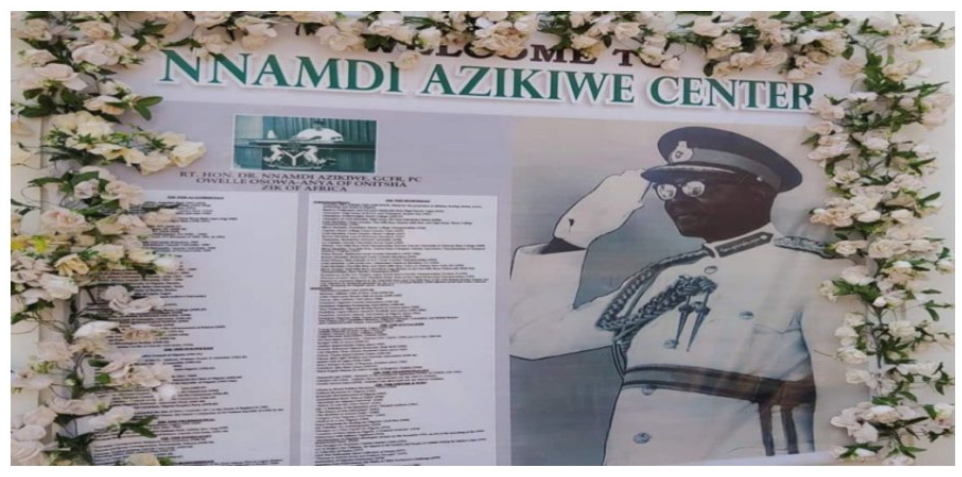
The New Nnamdi Azkiwe Centre, Enugu.

Displayed pictures inside the Center.
Nnamdi Azikiwe Center: Essence, History and Tourism Potentials
The achievements of Dr. Nnamdi Azikiwe popularly referred to as the Great Zik of Africa are numerous in the continent and in Nigeria his country. Azikiwe was a fundamental Nigerian politician, nationalist and Pan-Africanist. His legacies live on hence the unending national and state projects that honors him. The recently inaugurated Nnamdi Azikiwe Centre was formerly the old Premier Lodge of the Eastern region Nigeria where he once lived. Renovated, painted, furnished and improved to become a befitting modern facility which serves as a historical and archival center, the inside bears the orderly exhibited personal materials of Azikiwe interviews, awards, documentaries, personal clothes, pictures, poems, quotes, letters, articles, tributes, and speeches. These objects and important materials were part of his active life and they reflected his thoughts, taste, ideology, lifestyle and activities while he was alive. Attendance at the inauguration ceremony include professor Uche Azikiwe, the wife of late Dr. Nnamdi Azikiwe; the Former Governor of old Anambra State Dr. Jim Ifeanyichukwu Nwobodo; the Obi of Onitsha, Igwe Alfred Nnaemeka Achebe; and Governor Ifeanyi Ugwuanyi of Enugu State whose vision brought to fulfilment this project, among other dignitaries. At the opening ceremony, Ugwuanyi was applauded in many congratulatory words for his vision and doggedness in ensuring that this project was completed. On the 3rd of December 2022, many national newspapers and online media platforms carried the news of this latest immotalization project of Dr. Nnamdi Azikiwe at Enugu. The essence for initiating this historical project is to preserve history and legacies of Dr. Nnamdi Azikiwe for the present generation and the next. And as Durrani (2018, p. 7) pointed out, “people need to know their history in order to understand their past and present and chart out the desired outcomes for the future—in the tradition of ‘looking back to fight forward.”
Among some of the captions that made headlines include on the 3rd of December 2022 following th opening ceremony of the Center include: This Day Newspaper of 3rd December 2022 caption “The Great Zik Was Here - Welcome To The Revampoed Premier’s Lodge reported by Lawrence Ani.” Another report from the Government House which includes pictures on the December 3rd 2022 by Chinedu (2022) captioned “Obi of Onitsha, Zik’s family, Nwobodo, Eze, others pour encomiums on Gov. Ugwuanyi for immortalizing Nigeria’s first President.” Then the Sun Newspaper, 3rd December 2022, captioned “Obi of Onitsha, others hail Ugwuanyi for immortalizing Azikiwe as Governor inaugurates Nnamdi Azikiwe Centre in Enugu.” Already, there had been a similar project at Onitsha when he died in 1996. A Mausoleum project was commissioned as reported by Ben Agande in the Vanguard Newspaper of October 3rd 2012 under this caption—“FG to immortalize Azikiwe: approves N1.5BN for Mausoleum.”
Some of the previous national projects named after Nnamdi Azikiwe to immortalize him include Nnamdi Azikiwe International Airport located at Abuja; the Nnamdi Azikiwe University in Awka, Anambra State and the Nnamdi Azikiwe Stadium in Enugu. There is literally no major city or town across Nigeria that does not have at least one road or street with the name Nnamdi Azikiwe. For instance, in Enugu is the Zik’s Avenue at Uwani, at Onitsha is the Ziks roundabout. Azikiwe is also immortalized in the Nigerian currency—The Five Hundred Naira Currency note which has his picture on it. At Nsukka, where the first indigenous University of Nigeria is located are a set of blocks of flats called Zik’s Flats located very close to the University’s second gate.
Within the famous Princess Alexandra Auditorium in U.N.N. where important meetings, conferences and Founders Day celebration are held is hung Zik’s large portrait picture. Also, near the historical Freedom Square of the same University is his sculptured image. In Anambra state, there is the famous teaching hospital—the Nnamdi Azikiwe University Teaching Hospital, Nnewi and within the University of Ibadan, is the Azikiwe Hall. The list is endless but the viral report of 3rd of December 2022 prompted this research because it was the day that the /Nnamdi Azikiwe Center was inaugurated. Apart from its value as an archival and historical research center, The Center has tourist potentials and values as well as educational and historical values. More so, the center will be beneficial to historians, African Studies students, international students, and tourism students. OECD (2008) emphasized that culture and tourism are related because they are combined to bring elements of beauty and attraction to the people. Similarly, according to Raj et al. (2013, p. 4), cultural products such as museums, which are the epitome of institutionalized Western society, provide representations of the past and are engaged in collectively remembering the past through promoting their specific theater of memory. The Obi of Onitsha, Igwe Nnaemeka Achebe had illustrated the value of the Center when he commended Governor Ugwuanyi for his vision and actualization of the Center and said that the Center is an, “historical, educational and tourist monument to remember the Great Zik of Africa. . .young people could come here and appreciate the efforts of our leaders past, their philosophies, their leadership principles, their sense of humility so that we can emulate them.” Affirming the personality and contributions of Zik, This day Newspaper of Friday 9th December 2022 discussed Zik’s various value in Nigeria under the caption “Zik as National Symbol.” In sum, the tourism potential of the center is numerous. First, it will boost the economy of the state and encourage educative and research interactions for foreign and indigenous visitors. Historically, the center has become a physical tool that interprets the events of the past as it now solidifies and physically interprets the Pan-Africanist history taught in schools. Students, researchers and, visitors can now visit, see and feel Zik’s writings, letters, articles, pictures, personal belongings and more. It is indeed commendable that the family preserved these items and supported their public presentation.
Historical Centers and National Development
The beautiful, charming, and even poetic re-uses of old buildings, are part of what makes the economic transformation viable; the economic impact of historic and cultural preservation has been the subject of multiple studies (Morris, 2012). Museums, cultural centers, and monuments serve as important learning centers across many nations. They are usually made and preserved for use by the general public. House of Commons Culture, Media and Sport Committee (2008, p. 369) notes that historic houses attract people from abroad. As educational institutions, they offer unparalleled opportunities for self-directed learning and exploration by people of diverse ages, interests, backgrounds, and abilities (Onyejegbu, 2014). Thus, Zik’s renovated lodge has become a classic repository of history in the 21st century Nigeria. Amongst national artifacts and relics which are found in such places are national flags, used war implements, stamps and coats of arms, figures of important persons and pictures, emblems, in some cases personal effects like clothes, wrist watches, caps and hand fans as is the case with the Zik of Africa. With these exhibited objects the center solidifies the written facts on Zik’s epic political activity. He was a continental and national figure who inspired many other nationalists by his personality and the roles he played over time.
Objects, statues and buildings that immortalize African heroes and heroines have a host of beneficial values for the present leaders, the youths and those aspiring to join politics. Such historical buildings like this one under study will stand out as a lesson and reminder that good things are emulated and appreciated by the public. Boniface (1995) believes that heritage tourism is a three-way relationship between a site, its presenter and its audience. This project came at a time when most African leaders have lost priority for good governance and misunderstood the essence of joining politics. From the news, we learn that many African leaders and politicians are embezelling public funds, impoverishing the masses, engaging in massive corrupt practices. The opposite of this is selfless service and true leadership as displayed by African foremost nationalists like Kwame Nkrumah, Jomo Kenyatta, Nnamdi Azikiwe, and others. Educationally the Center has educational value and links to both the young and the old. It is a positive addition to national development and history. Its service to the community within and beyond will expand knowledge and improve on nation building. This is a practical center that showcases culture, history, tradition and thoughts of Pan-African leaders of the 1960s and 1970s. Nnamdi Azikiwe Center can be likened to a museum and as a result is a viable tourist avenue for both local and foreign visitors. According to Pitman (1999), “museums are more than the repositories of the past, with memories and objects both rare and beautiful.”
With the creation of the center comes employment of staff who maintain security of the place, receive visitors, catalogue and document the objects [preserve and conserve the displayed materials]. As the staff receive visitors daily, income comes into the state and the nation is improved. Zik was a known personality beyond Africa hence, when the news of this historical Center is known round the world, more foreigners will come to sightsee the venue. The richness of the Center as a living center of history and culture is enticing to both the indigenes and foreigners. More so, the Center will be an inspirational center for leaders who aspire to be different both within and outside Nigeria. As Levan and Ukata (2018, p. 1) observed, the construction of the Nigerian nation, its resilience in the face of historical and geographical adversity, and its progress following the unexpected traumas of the post-independence era, are enduring testaments to its people and proof of its promise (Figure 3).
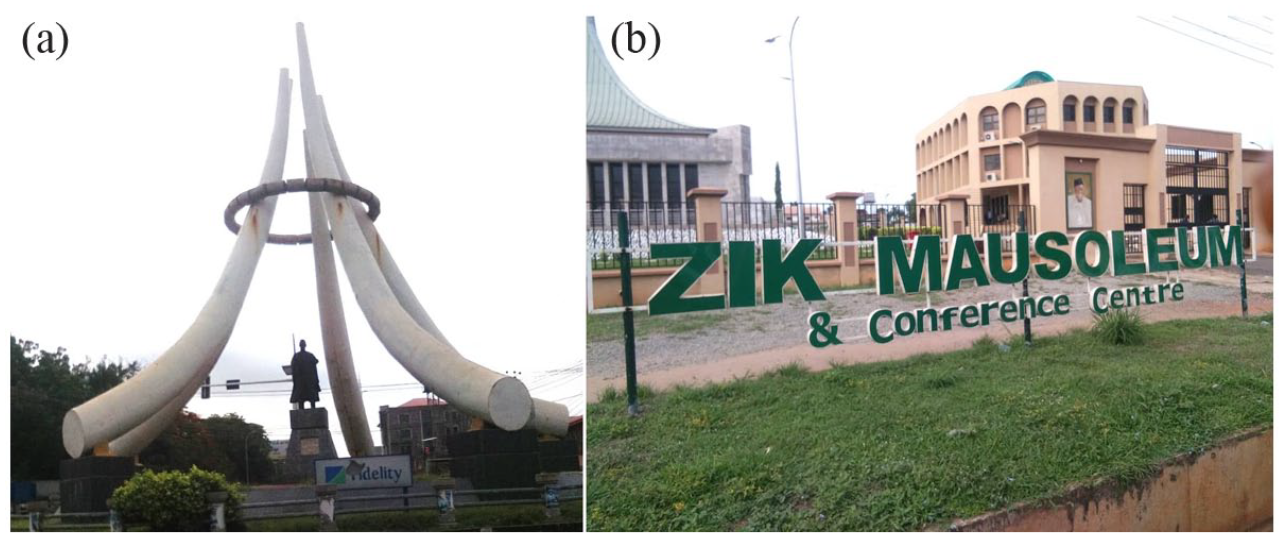
Nnamdi Azikiwe is also immotalized in his home town Onitsha-Ado: (a) the ivory-shaped Zik’s Roundabout at Awka road and (b) Zik Mausoluem at Onitsha-Ado (photos taken by the author).
Conclusion
The various immortalization projects in honor and remembrance of late Hon. Dr. Nnamdi Azikiwe are made to reinvigorate in our memories his legacies and contributions to both continental and national development. The inauguration of the Nnamdi Azikiwe Center is just one out of the numerous physical structures already instituted across Nigeria to immortalize him. Nevertheless, this Center is special because it was the former living Lodge of the late First President of Nigeria. The paper discussed the value of this new Center and the ideology and aims behind renovating the Old Premier Lodge of the Eastern region. The building demonstrates chronological political history of Nigeria. It also gave insight of Zik’s thoughts, ideologies, and activities. His legacies will continue to live on to guide the younger generations who wish to work hard for their nations. The Center is also a viable place for research consultations, educational development, sightseeing, inspiration and rejuvenation of African thoughts and culture. It is also a museum-like center for tourists and foreign visitors. Thus, as an addition to the already archival center and the National Museum in Enugu, the tourism potential of the state and the country is boosted.
Footnotes
Declaration of Conflicting Interests
The authors declared no potential conflicts of interest with respect to the research, authorship, and/or publication of this article.
Funding
The authors received no financial support for the research, authorship, and/or publication of this article.
