




Abstract
This article presents the findings of a large-scale, multifaceted investigation into the use of English as a business lingua franca in Hong Kong’s key service industries. The findings were derived from four sources: semistructured interviews with 28 Chinese professionals; four “week-in-the-life” case studies, which include an all-day office observation; analyses of telephone conference recordings and email chains; and a questionnaire survey involving more than 2,000 respondents. The evidence suggests that English, particularly its written form, plays a crucial role in business communication, although the nature and extent of its use vary according to an array of institutional and individual factors, such as a company’s ownership and a professional’s duties. The qualitative data illustrate the interplay between the two written (English, Chinese) and three spoken codes (English, Cantonese, Putonghua) in workplace communication, and particularly the symbiotic relationship between written English and Cantonese.
Introduction
The emergence of English as the leading lingua franca of international business in the past two decades has been accompanied by a significant upsurge of scholarly interest in a range of issues relating to language choice and use in the rapidly globalizing business and professional worlds. As might be expected, much of the research in this diffuse and diverse area has been conducted in a constellation of interlocking disciplines whose principal foci of inquiry are questions of language and communication, namely, business communication (Charles, 2007; Kankaanranta & Planken, 2010), English for specific purposes (Kankaanranta & Louhiala-Salminen, 2010; Nickerson, 2005), business discourse (Bargiela-Chiappini, 2009; Koester, 2010), and world Englishes (Deneire, 2008; Grin, 2001). What is striking, however, about current research trends in this area is that scholars working in fields with traditionally quite different preoccupations have begun to explore issues that until recently were largely the concern of language and communication specialists. These include the interconnected fields of business studies (Crick, 1999; Janssens, Lambert, & Steyaert, 2004; Luo & Shenkar, 2006), economics (Ku & Zussman, 2010; Lysandrou & Lysandrou, 2003), and particularly management, in which problems associated with the formulation and implementation of English-oriented language policies in multinational corporations have been the subject of steadily intensifying scrutiny and debate since the mid-1990s (Dhir, 2005; Fredriksson, Barner-Rasmussen, & Piekkari, 2006; Harzing & Feely, 2008; Maclean, 2006; Marschan, Welch, & Welch, 1997; Marschan-Piekkari, Welch, & Welch, 1999; Vaara, Tienari, Piekkari, & Säntti, 2005; Welch, Welch, & Piekkari, 2005). The florescence of these parallel streams of research into English as a business lingua franca is one manifestation of the current “world flattening” phase of economic globalization (Friedman, 2006), a process that has propelled the language into parts of the world where its societal presence had hitherto been rather muted, thus posing considerable challenges for individuals and institutions in the crucial matter of language learning and use.
This process has been especially conspicuous in continental Europe, and it is therefore no coincidence that this region has been a fertile site for investigations into various facets of business communication in recent years (Ehrenreich, 2010; Erling & Walton, 2007; Nickerson, 1998; Rogerson-Revell, 2008; Vandermeeren, 1999). A significant segment of this research has been conducted in corporate settings in the Nordic countries (Anderson & Rasmussen, 2004; Jensen, 2009), with scholars in Finland being particularly productive and inventive (Charles & Marschan-Piekkari, 2002; Lehtonen & Karjalainen, 2008; Leppänen & Nikula, 2007; Louhiala-Salminen, Charles, & Kankaanranta, 2005; Virkkula-Räisänen, 2010). English has traditionally played a limited role in these societies, being for the most part acquired as a “foreign” language in the education system and used as a medium of international rather than intranational communication in the business world. In Kachruvian (1985) terms, the countries of continental Europe may be categorized as Expanding Circle territories, and thus stand in contrast to postcolonial Outer Circle societies such as India (Graddol, 2010) and the Philippines (Bautista & Bolton, 2008), where, as a result of the British or American presence before World War II, English often functions as an official language in government, a medium of instruction in education, and a lingua franca in society at large.
The increasing use of English in internal communication in European corporations, either through deliberate policy or ad hoc practice, is an inevitable consequence of the tightening and thickening web of economic globalization since the early 1990s, and particularly of the prevalence of cross-border mergers, acquisitions, and strategic alliances, the ubiquity of mobile communication devices, and the application of work flow software. These trends have inspired researchers to devise innovative approaches to investigating the roles of English and other languages as business media, such as Louhiala-Salminen’s (2002) groundbreaking daylong observational study of a manager’s discourse activities. Recognizing the complex, dynamic, and multidimensional nature of workplace language use, Louhiala-Salminen and colleagues have highlighted the importance of employing a multimethod approach to data collection in order to identify and understand the communication challenges posed by life an increasingly interconnected business world. The collection of quantitative and qualitative data via (inter alia) surveys, interviews, case studies, and textual analyses allows researchers to view such challenges from different perspectives, including the broad-brush landscape provided by a large-scale questionnaire survey and the portrait in miniature offered by a “fly-on-the-wall” office observation.
To date, studies incorporating such methods have tended to be confined to corporate contexts in northern Europe where the use of English in internal and external communication is a relatively recent phenomenon. In contrast, business settings in Outer Circle societies in Asia and Africa have received less attention of this kind, even though the use of English is often firmly entrenched in consequence of their colonial heritage. The multifaceted investigation reported in the present article, which was conducted in Hong Kong, represented an attempt to apply some of the research methods pioneered in Europe to a pulsating business metropolis which for more than 150 years has been entangled in the successive processes of colonialism and globalization that have been the principal drivers of the spread of English. These methods, which include “week-in-the-life” case studies and office observations of Cantonese-speaking professionals, were designed to offer macro- and micro-perspectives on the role of English as a business lingua franca in the Special Administrative Region’s (SAR) vibrant service sector more than a decade after its return to economically ascendant China. Hong Kong’s political and economic reintegration with the mainland is perceived to have stimulated the use of Putonghua (also known as Mandarin, China’s national language) and written Chinese as business media, although the precise role these codes play (vis-à-vis English) in the SAR’s business world has been the subject of surprisingly little empirical research. An important objective of the study reported below was to determine the impact of Hong Kong’s retrocession on language use in the city’s four “key” industries, namely financial services, tourism, trading and logistics, and professional and business services. The next section sets the scene for the study by tracing the development of Hong Kong’s economy during the colonial era (1842-1997) and outlining the characteristics of its current business environment.
Hong Kong as a Global Business City
Since the annexation of Hong Kong Island by Britain in 1842 after the first Opium War and the accompanying declaration of its status as a free port, the economy has been regarded as the city’s raison d’être and the key to its transformation from a “barren rock,” as one disaffected official described it (Montgomery Martin, 1844/1996, p. 13), to “Asia’s World City,” as the postcolonial regime currently brands it. Despite predictions to the contrary—Montgomery Martin, for example, claimed that “talk of Hong Kong becoming a commercial emporium” was “a delusion” (p. 13)—the colony’s entrepôt-based economy began to flourish during the 1850s as the city became a bustling staging post for the dispatch of Chinese laborers to the “gold rush” states of California and New South Wales, and a safe haven for Chinese merchants and professionals seeking sanctuary from social and political turbulence on the mainland (Tsang, 2004). The emergence of a Chinese business elite was crucial to Hong Kong’s development during the Victorian era of globalization (Carroll, 2005), as their entrepreneurial flair and bilingual communication skills facilitated the city’s entry into preexisting regional networks of trade, commerce, and finance (Chiu & Lui, 2009). Such was its progress that by the 1920s Hong Kong had emerged at the apex of a hierarchical network of maritime business hubs, which included (on the second rung) its present-day rivals, Singapore and Shanghai, and (further down) major seaports such as Manila, Saigon, and Yokohama (Meyer, 2000). Thus, from its unpromising beginnings in the 1840s, Hong Kong evolved over the next 100 years into a dynamic nexus of economic activity in East and Southeast Asia, a role that inevitably stimulated the use of English as a lingua franca, although the precise nature of its role during this period has yet to be explored.
Although Hong Kong’s growth before World War II was largely dependent on the enterprise and endeavor of its numerically dominant Chinese community, its role as a British trading post and its status as a Crown Colony meant that its economy always had an international rather than a purely regional dimension and that its administration was conducted in English, the city’s sole official language between 1842 and 1974. The presence of firms from Britain and other parts of the world, including the United States, France, and Germany, ensured that Hong Kong was connected to global networks and flows of economic activity (Chiu & Lui, 2009), whose density and velocity increased significantly with the opening of the Suez Canal and the advent of the globe-girdling telegraph system in the 1860s (Meyer, 2000). Hong Kong’s integration into what Darwin (2009) terms the British world-system, an intricate web of political, commercial, and cultural connections that radiated from London, guaranteed a pivotal role for English as the standard working language of the city’s small but influential foreign business community and the usual medium of communication with their Chinese counterparts (Evans, 2009). As in other colonial contexts, the status of English as a business language was reinforced by its use in government administration and the legal system and by its role in professional training and accreditation. Thus, long before its transformation into the “last lingua franca” (Ostler, 2010), or “globish” (McCrum, 2010), English was well established in white-collar workplaces in Hong Kong and consequently perceived as a desirable language to learn by those who aspired to socioeconomic mobility in the colonial milieu (Evans, 2011).
The character of this milieu altered significantly in the second half of the 20th century in consequence of two major transformations in the colony’s economy, both of which were stimulated by political and economic developments across the border (Faure & Lee, 2004). The first was prompted by the imposition of trade embargoes on China during the Korean War in the early 1950s, which crippled Hong Kong’s entrepôt trade and compelled the local business community to restructure the economy in favor of export-led manufacturing industries, notably textiles, clothing, electronics, plastics, and toys (Liu, 1997). By the early 1970s, the manufacturing sector accounted for 28.2% of GDP and 47% of total employment, and was largely responsible, through the ubiquitous “Made in Hong Kong” label, for the city’s growing reputation as an economic powerhouse (Chiu & Lui, 2009). The second transformation was triggered by the reform and reopening of China’s economy in the late 1970s, which resulted in the relocation of Hong Kong’s manufacturing industries to southern China and a shift toward a service-based economy during the 1980s (Li, 2006). Such has been the scale of this restructuring in the past 30 years that manufacturing now accounts for only 1.8% of GDP and 3.5% of total employment, whereas the service sector contributes 92.6% to GDP and employs some 88.3% of Hong Kong’s workforce (Hong Kong Government, 2011). The four “key” industries within the service sector are the focus of the present study, since these have been the major motors of the city’s growth in recent years (Figure 1) and thus the subject of considerable government attention (Sung, 2008).
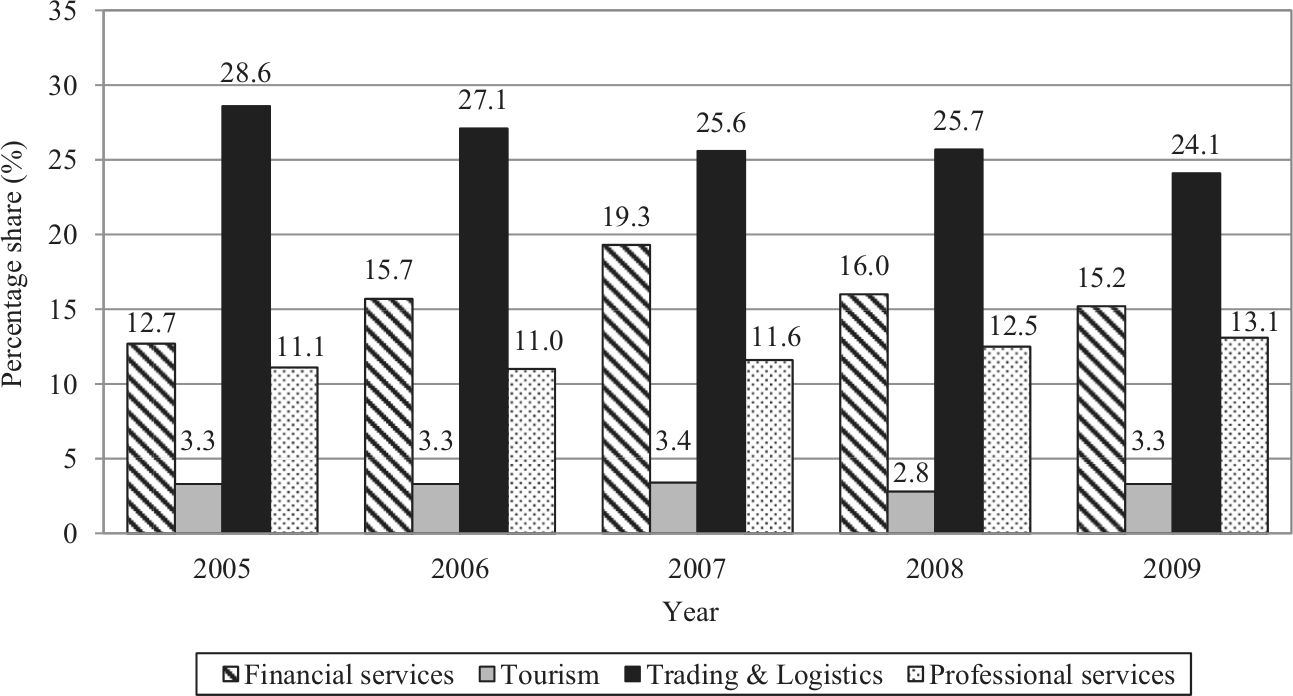
Percentage share of Hong Kong’s GDP contributed by the four key industries (2005-2009).
Although the study focuses on the role of English in these industries, as we shall see, this role is best appreciated if it is viewed in relation to other languages in Hong Kong’s multilingual business world, notably written Chinese, Cantonese (the first language of most local professionals), and Putonghua. In the past three decades, the relative status and use of these languages have been influenced by three powerful processes: national reunification, regional integration, and economic globalization (Qin, 2007). The first process, which was initiated by the Sino-British Joint Declaration in 1984 and formalized by the handover in 1997, has resulted in a gradual diminution of the institutional role of English, although under the “one country, two systems” principle it remains the primary language of the legal system and higher education. The maintenance of the English-based legal system is attractive to international investors, who seek an effective mechanism for protecting property rights, enforcing contracts, and resolving disputes (Arner & Hsu, 2008). The retention of English as the medium of higher education also influences workplace language use as it predisposes Chinese-literate professionals to write in English, although, as we shall see, this is not the only factor.
The second process, whose pace quickened after the handover and whose linguistic impact the present study sought to gauge, has involved the city’s economic integration with mainland China, particularly the neighboring Pearl River Delta, one of the world’s major manufacturing centers. As a result of this process, Hong Kong has assumed a crucial intermediary role, facilitating links between its industrial hinterland and overseas markets through the provision of an array of professional and producer services, including business management and consultancy, market research, accounting, law, insurance, and advertising (Meyer, 2000). However, the SAR’s relationship with the mainland is not simply a matter of “front shop, back factory,” for, as Qin (2007) notes, recent years have witnessed significant flows of people and investment into the city from China, with mainland companies now accounting for a substantial proportion of the Hong Kong stock market’s capitalization and daily trading volume. These flows, as well as those moving in the opposite direction, have undoubtedly stimulated the use of Putonghua and written Chinese, although whether this trend has eroded the status of written and spoken English, particularly in Hong Kong–owned companies, was a key question guiding the present study.
The third process—economic globalization—has broadly coincided with Hong Kong’s shift from labor-intensive manufacturing industries to knowledge-driven (and therefore intrinsically “language rich”) service industries. If the experience of continental Europe is any guide, this process is likely to have greatly increased the use of English as a business lingua franca. As we have seen, the city’s open economy has always had a marked international orientation; and during the contemporary phase of globalization this orientation has inevitably been reinforced. This is reflected in the city’s position as one of the leading destinations for global foreign direct investment (FDI) inflows. In its most recent report, the United Nations Conference on Trade and Development (2010) places Hong Kong fourth—after the United States, China, and France—with FDI inflows of US$48 billion. The SAR is also a major source of FDI outflows, the greater part of its US$52 billion investment going to the Pearl River Delta.
The impact of globalization is also reflected in the growing presence of foreign companies in the SAR (Figure 2). Hong Kong’s attractiveness as a location for regional headquarters and offices can be attributed (inter alia) to its advanced transport and communications infrastructure, independent judiciary, low and simple tax regime, fully convertible and stable currency, and quality professional services. The tradition of English use also sharpens Hong Kong’s “competitive edge,” particularly over rival cities such as fast-emerging Shanghai, although the precise nature of its role in economic activities has yet to be fully described. One reason for this is that, as in Europe, business-related research conducted in Hong Kong has focused on particular professions or companies, such as land surveying (Cheng & Mok, 2008) and banking (Chew, 2005), or particular discourses, such as meetings (Bilbow, 2002) and reports (Flowerdew & Wan, 2010). The study reported in this article sought to offer a broader perspective on the role of English in Hong Kong’s business world than has hitherto been presented. As described below, this wider view emerged from the synthesis of a range of qualitative and quantitative data collected between mid-2008 and late 2010.

Number of foreign regional headquarters and offices in Hong Kong (1991-2010).
The Study
The study employed four main methods of data collection: semistructured interviews, case studies, analyses of spoken and written discourses, and a questionnaire survey. The data elicited by these methods offer multiple, yet complementary perspectives on issues relating to language choice and use in Hong Kong’s service industries.
Semistructured Interviews
The views and experiences of Hong Kong Chinese professionals working in these industries were elicited in 28 semistructured interviews, each lasting 60 to 80 minutes. The interviews, which were conducted in late 2010, were based on an interview guide that outlined the nature and order of the topics to be discussed, but within this predetermined structure the interviewer was able to ask open or probing questions to explore interesting issues as they arose and to clarify the participants’ opinions or perceptions (Gillham, 2005). The audio-recorded interviews were conducted in Cantonese, the participants having been given the choice of Cantonese, their first language, or English, in which they were all highly proficient. The interviews were subsequently translated into English for detailed analysis, which was essentially inductive and comparative. The first stage of the analysis involved reading and annotating the translations with comments and observations. After considerable revision and refinement, these “open codes” (Merriam, 2009) were grouped into various categories and subcategories that captured recurring patterns in the data. This “manual” analysis was complemented by the data coding and analysis software NVivo (Version 9), which facilitated the quantification and cross-referencing of the participants’ responses in each category/subcategory.
The participants (15 males, 13 females) were selected on the basis of a “purposeful sampling” strategy (Patton, 2002). As with the case-study participants, the interviewees were identified through contacts established over a number of years by the host university’s Research Centre for Professional Communication in English, one of whose aims is “to facilitate joint research and related activities between academics and practitioners in professional communities.” The interviewees were employed at different levels and in a range of capacities in the service sector. Fourteen of the interviewees worked for large Hong Kong–owned companies (i.e., with more than 100 employees), while the remainder were employed by foreign firms—American (5), Japanese (2), Singaporean (2), Australian (1), British (1), German (1)—or mainland concerns (2). Most of the participants possessed bachelor’s (16) or master’s degrees (9) and were generally fairly experienced in that they occupied senior (10) or middle-ranking (13) positions in their companies. The sample included professionals in their 20s (10), 30s (9), and 40s (8). The oldest participant, a bank manager, was in his early 50s. The participants signed a consent form explaining the purpose of the investigation and assuring them of confidentiality if their experiences were reported in subsequent publications. Accordingly, the interviewees, like the case study participants, are given pseudonyms in the “Findings and Discussion” section.
Case Studies
The case studies were designed to form an intimate and finely detailed picture of professional practice in the city’s service sector. These studies involved professionals engaged in each of the four “key” industries: the assistant general manager, finance/group chief accountant of an international hotel group (Alan), an operation officer of a Hong Kong–owned travel agency (Belinda), the regional account manager of a Japanese logistics company (Cathy), and the compliance manager of a Chinese bank (Don). Each participant completed a professional discourse checklist to record in half-hourly segments the pattern and flow of his or her internal and external communication activities for five consecutive working days. The checklists (about which the participants were subsequently interviewed) provide information about the nature, medium, and duration of their communication activities and the interplay between the main spoken and written codes used in Hong Kong workplaces. Data from Don’s checklist are presented in Figure 5. In one case, a member of the research team shadowed a participant (Belinda) and took field notes about all the communication activities she was engaged in over the course of an entire working day.
Analyses of Workplace Discourses
Two types of workplace discourse were collected and analyzed: telephone conferences and emails. Ten English-mediated telephone conferences involving logistics professionals based in Hong Kong, Britain, and continental Europe were recorded and transcribed. These conferences lasted on average 24 minutes, the longest taking 58 minutes, the shortest 4 minutes. An excerpt from the second conference is presented in the section on “text and talk” to illustrate the use of Cantonese within a predominantly English-based speech event. The article also draws on two sets of email chains (i.e., series of messages on a particular issue), one provided by a merchandiser (Katie) working for a Hong Kong–owned company that manufactures handbags in China for overseas customers, the other collected by an IT manager (Anthony) with a multinational bank. Each set (coincidentally) consists of 25 chains, Katie’s containing a total of 135 separate messages, Anthony’s 271. The email chains and telephone conferences provide evidence of actual English use and thus complement the self-reported and observational data generated by the interviews, case studies, and survey.
Questionnaire Survey
While the qualitative data described above offer rich micro-perspectives on the role of English in Hong Kong’s business world, like any data gathered by such methods, their value is inevitably limited by doubts about their representativeness and therefore generalizability. These concerns can partly be assuaged by collecting quantitative data via a large-scale questionnaire survey, a strategy that was adopted in the present study. The questionnaire, an updated version of the instrument used by Evans and Green (2003), asked the participants to report on the nature and extent of English use at work and to express their views on the importance of written and spoken English vis-à-vis Cantonese, written Chinese, and Putonghua as business media. The questionnaire’s reliability was determined by Cronbach’s alpha tests. The results for the various sections of the questionnaire ranged from .819 to .911, indicating a “good” degree of reliability.
The questionnaire, which came in hard and soft forms, was completed by 2,030 professionals working in Hong Kong’s service industries. The paper-based version was distributed to 4,148 professionals, who included past and present part-time students at the Hong Kong Polytechnic University, and completed by 1,009 of them (a response rate of 24.3%). The online version was sent by email to 19,061 University alumni from relevant disciplines (e.g., accountancy, logistics, tourism) and 322 service-related professional associations. This version was completed by 1,021 participants (a return rate of around 3.6%). The survey data were analyzed using SPSS (Version 15). The results of analysis of variance are reported in Figures 3 and 4.
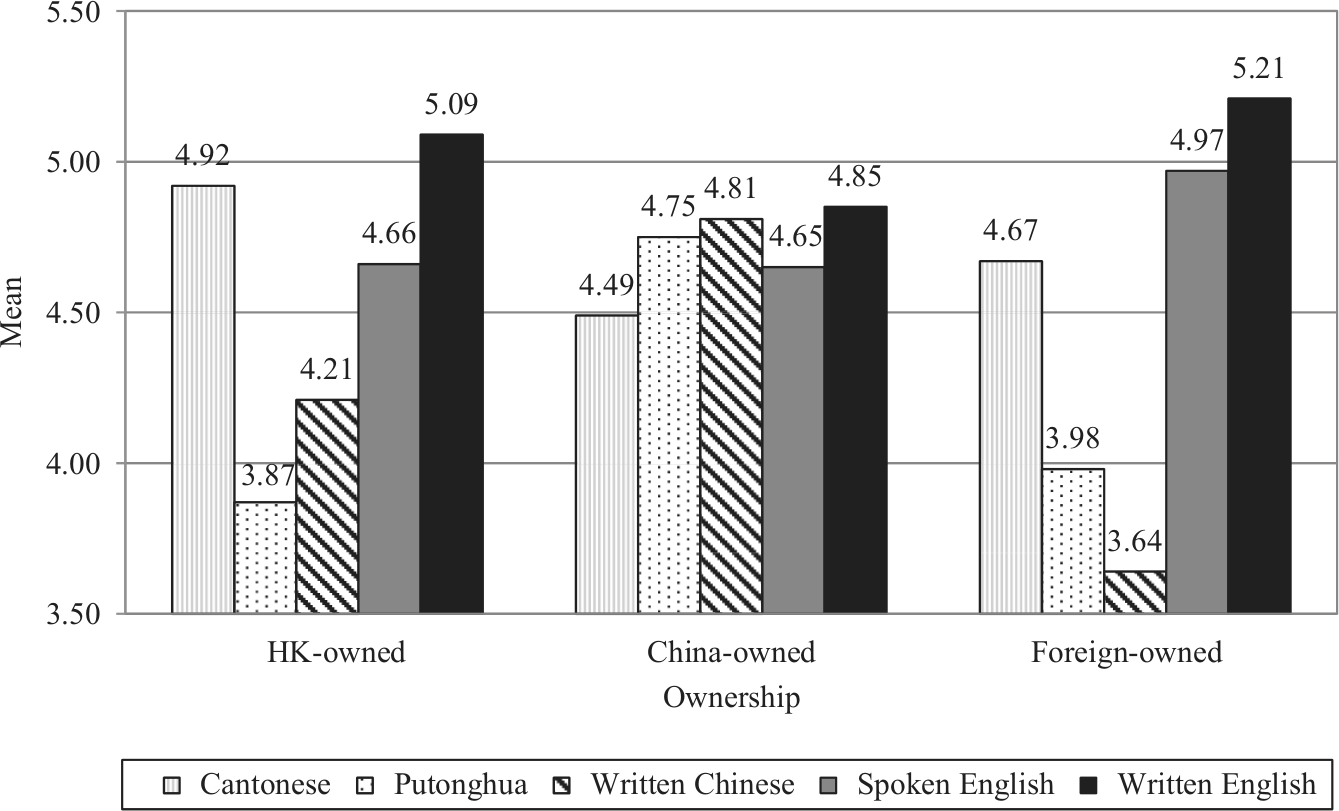
Perceived importance of languages by company ownership.

Frequency of English use by company ownership.
Just under half of the respondents (47%) were employed in the professional and business services industry, while the remainder worked in the three other “key” industries (trading and logistics, 15%; financial services, 10%; tourism, 6%) or in service-related professions that do not fall within the ambit of the four key industries (16.6%). Around a quarter of the respondents worked as civil servants (9%) or for government-related organizations (16%). Since this article focuses on the private sector, and particularly patterns of language use in Hong Kong, foreign and mainland companies, the responses of the public-sector respondents have been excluded from the analysis. The findings reported in Figures 3 and 4 are therefore based on the responses of 1,478 professionals, of whom 60% worked for Hong Kong–owned companies, 36% were employed by foreign firms, and 4% worked for Chinese enterprises. A comprehensive account of the administration and findings of the survey is presented in Evans (2010).
Findings and Discussion
This section commences by painting a broad-brush linguistic landscape of Hong Kong’s service sector using ownership-based findings from the survey and then proceeds to examine the nature of and relationship between written and spoken business communication using the qualitative findings.
The Linguistic Landscape in Hong Kong’s Service Sector
One of the items in the questionnaire asked the participants to indicate the importance of written and spoken English relative to Cantonese, written Chinese, and Putonghua on a Likert-type scale ranging from 1 (completely unimportant) to 6 (extremely important). The participants’ responses were subsequently categorized on the basis of company ownership. As can be seen in Figure 3, the mean responses, which are generally well over 4.00, indicate that each code was perceived to have some degree of importance irrespective of company background. As might be expected, respondents employed by foreign firms reported that written and spoken English were especially crucial in their professional lives. These codes were also perceived to be important by participants working for Hong Kong–owned companies, but since such organizations tend to employ a greater proportion of local staff and are perhaps less entwined in global networks than their foreign counterparts, it is not surprising that they exhibit a greater orientation toward Cantonese and written Chinese. Whereas English and Cantonese are evidently the principal working languages in foreign and Hong Kong companies, all five codes appear to play important complementary roles in Chinese firms, with English and Chinese enjoying virtually equal status as written media and Putonghua playing a significant role in spoken communication alongside English and Cantonese.
Although Figure 3 provides some indication of the relative importance of written and spoken English as business media, it offers few clues as to the frequency with which professionals in Hong Kong’s service industries need to read, write, speak, and listen in English. The questionnaire sought to elicit such information by asking the participants to indicate how often they were required to read and write certain text types (e.g., emails, reports, letters) and to speak and/or listen in particular situations (e.g., meetings, presentations, seminars) on a scale ranging from 1 (never) to 6 (almost every day). To identify English-using trends in the three categories of company, a composite mean (i.e., a mean of means) was generated from the participants’ responses to the items relating to writing (7 text types), reading (12 text types), and listening/speaking (8 situations; Figure 4).
The findings in Figure 4 reveal three key tendencies. First, professionals employed by foreign firms evidently need to use English more frequently than their counterparts in Hong Kong and Chinese concerns, a trend which flows naturally from the patterns presented in Figure 3. Second, reading and writing in English occupy a greater proportion of professionals’ working lives than speaking/listening in English. Indeed, the findings in Figures 3 and 4 provide a clear indication of the centrality of English in written communication in Hong Kong’s service sector. English is understandably the default medium of communication with overseas customers and clients, but the evidence suggests that it is also the usual language of written communication among Chinese-literate professionals within Hong Kong. Factors stimulating the use of English are discussed in the section on “written communication.” Third, opportunities to speak/listen in English appear to be much more limited in Hong Kong and Chinese companies than in foreign firms. As discussed in the section on “spoken communication,” the need to speak English is generally determined by contextual factors, chief among which is the presence or otherwise of non-Cantonese speakers.
The linguistic landscape depicted in Figures 3 and 4 generally cohered with the picture that emerged from the interviews and case studies. One of the interviewees—Steve (operational manager of a China-owned logistics company)—contrasted language use in foreign and Chinese organizations: The biggest difference is that in foreign-owned companies, more than half the employees are non-local. If I only chatted with Hong Kong colleagues, of course we used Cantonese. If I had a meeting, English was definitely chosen. Even in small-group discussions, we used English if there were English speakers present. This is not the case in Chinese companies. Take my one as an example. About half the employees are Hong Kong people, the rest from the mainland. Now I use Putonghua more.
Several other interviewees noted the increasing importance of Putonghua and a corresponding diminution in the role of spoken English. Graham, a seasoned finance manager with a large local company, observed that “Putonghua and simplified Chinese [cf. the traditional Chinese characters that have generally been used in Hong Kong] have taken over the leading roles. English is used less frequently.” This trend was also noted by a senior employee of a large American company, who claimed that “Chinese has become even more significant than English in my field” (Jim, technical support officer). Graham’s and Jim’s experiences were not, however, shared by the majority of the interviewees, who reported that English, particularly its written form, had retained or enlarged its role in workplace communication in the past decade. This is a significant finding because it contradicts the widespread perception that the extent and quality of English use have declined since the handover (Poon, 2010). What also emerged from these conversations is that language choice in business communication is not only determined by a company’s ownership but also by an array of institutional and individual factors, including a corporation’s size and field of operations and an employee’s duties and seniority.
One consequence of scholars’ present preoccupation with English as a business lingua franca is that the roles of other languages are often downplayed or even overlooked. Research conducted in Europe, however, has underscored the importance of regarding English as one (admittedly prominent) element in the linguistic ecology of the contemporary workplace (Ehrenreich, 2010; Louhiala-Salminen, 2002; Vandermeeren, 1999). The findings of the present study also highlight the multilingual character of modern business communication, but although they provide some evidence of the relative importance of the five codes and the extent of English use, the survey results offer few insights into precisely how and why these codes are used, and particularly how they are interwoven into the fabric of Hong Kong professionals’ working lives. Such insights are best derived from qualitative research and thus we now turn to the case studies, interviews, and telephone conferences in order to paint portraits of professionals at work.
The Interplay of Text and Talk in Business Communication
The interplay of text and talk was especially apparent in the working week of Don, a senior executive with a Chinese bank. Like the other case-study participants, Don recorded his communication activities every 30 minutes on a specially designed professional discourse checklist. Don’s checklist was characterized by rapid shifts between reading and writing in Chinese and English and speaking and listening in Cantonese (apart from one 10-minute telephone call in English). This is illustrated by the following sequence of work-related activities (with duration in brackets) between 9.00 a.m. and 10.30 a.m. on September 21, 2009: read Chinese email (2 minutes), read English email (4 minutes), read Chinese email (3 minutes), wrote English email (10 seconds), made Cantonese call (10 minutes), held Cantonese discussion (3 minutes), read English email (1 minute), read two Chinese emails (3 minutes), wrote English email (5 minutes), made Cantonese call (7 minutes), read Chinese report (20 minutes). As we shall see, a significant portion of Don’s week was occupied by reading internal emails in Chinese. The prominence of Chinese in internal email communication in Don’s organization contrasted sharply with the experiences of the other case-study participants, who recorded little or no use of written Chinese, and with the interviewees, who reported that English would be chosen even if there was no corporate policy dictating its use and every addressee was literate in Chinese.
English played a more prominent role in Alan’s week, an inevitable consequence of the nature (hotels) and scope (international) of his company’s business and the standard practice in his own profession (accountancy). According to his checklist (about which he was subsequently interviewed), Alan participated in 19 formal meetings (including telephone conferences) over the 5 days, of which only 2 were conducted in Cantonese (because, he noted, every attendee was conversant in the language). It is interesting, however, that both Cantonese-mediated meetings had English elements: the discussion in the first, a biweekly department meeting lasting 45 minutes, was documented in English minutes, while the interaction in the second, a 30-minute session with a real estate professional, centered on the draft of an English property valuation report. Cantonese played a more important role in informal discussions, with four of the eight such interactions being conducted in the language, although it is worth noting that the input to and outcomes of these meetings were English texts of various kinds. The interplay of (English) text and (English and Cantonese) talk is evident in Alan’s activities on the morning of July 13, 2009, which commenced with the department meeting noted above (9.00 a.m.-9.45 a.m.) and then involved reading English emails (9.45 a.m.-10.00 a.m.), participating in a formal English meeting about a project in Shanghai (10.00 a.m.-11.30 a.m.), and reviewing English-based financial statements and commentaries with two colleagues in Cantonese (11.30 a.m.-12.30 p.m.).
The “fly’s perspective” on Belinda’s working day at her travel company provided further evidence of the functional separation of Cantonese and English noted in other studies of white-collar workplaces in Hong Kong (Cheng & Mok, 2008; Chew, 2005; Lundelius, 1997). Belinda spent the entire day (September 17, 2009) speaking and listening in Cantonese but reading and writing in English. Her activities between 10.00 and 10.30 a.m. illustrate the demands which Hong Kong’s business world places on professionals’ language skills, particularly their ability to make rapid switches between Cantonese and written English and to use the two codes simultaneously. Belinda commenced this period by reading English emails, and then engaged in the following sequence of activities: casual chat with a colleague (Cantonese), reading booking confirmation document (English), informal discussion with three colleagues about the issuing of e-tickets (Cantonese), writing an email (English), printing and checking the booking confirmation document (English), answering the telephone (Cantonese), writing an email (English), and answering a customer’s call about changing a booking (Cantonese) while checking the relevant information online (English). Belinda made or received 44 telephone calls during the day (totaling around 136 minutes); all but 2 of these conversations were in Cantonese, but most involved simultaneously making handwritten notes, writing emails (to her interlocutor), or reading travel-related information (e.g., brochures, websites) in English. The distinct, yet complementary roles that English and Cantonese play in Belinda’s professional life stem largely from the nature of her position, which requires considerable interaction with mainly Cantonese-speaking colleagues and customers, and the centrality of English-oriented computer-mediated communication in her company’s line of business.
The intimate relationship between Cantonese and written English was also revealed by the interviews, in which a number of the participants pointed to the crucial role played by Cantonese in confirming or clarifying the content of English texts. This typically involves telephone communication in Cantonese prior or subsequent to the transmission of English emails. “Usually much of the content of emails has been discussed over the phone already,” observed Ken (manager of a Hong Kong engineering company): “Emails just serve as a summary.” English is also the usual medium of email communication with factories in China, even though in some cases the Hong Kong–based senders know that the recipients are unable to understand them. In such cases, as Henry (merchandiser) pointed out, the incomprehensible email is followed by a telephone call in Putonghua to explain its contents: “We usually give them a call to ask if they really understand what we are talking about. But they usually say they understand even if they don’t.” According to Freda, regional store development buyer with an American multinational, the use of English in such communication is dictated by legal considerations: “Sometimes if they don’t understand, we discuss things on the phone in Putonghua. But I mainly use English to reply to emails because every email may be used as a legal document in the future.”
The interplay of Cantonese and English is also evident in meetings and negotiations. Victor, principal consultant with an Australian business consultancy, noted the key role that Cantonese plays in “humanizing” such interactions: “Cantonese is used in small talk. As most of the presentations are in English, it’s natural to use English in the discussion, but we chat in Cantonese afterwards.” When meetings are conducted in Cantonese or Putonghua, the slides used in the presentations are generally in English: “Many attendees are from the mainland, such as Shanghai, so the presentations are delivered in Putonghua. But the slides are all in English” (Steve). The use of English written materials (e.g., forms, handouts, reports) to accompany Cantonese-mediated speech events (e.g., appraisal interviews, staff development sessions, briefings) was noted by a number of the study’s informants.
Whereas English is the default medium of written business communication, its use in spoken communication tends to be limited to situations involving non-Cantonese–speaking participants. One such situation is the video or telephone conference. Since the participants in such conferences are generally globally dispersed and linguistically diverse, English is understandably the usual medium of interaction, as indeed was the case in the 10 telephone conferences examined in the present study. Although these discussions were conducted in English, the recordings reveal a number of instances of the Hong Kong participants whispering in Cantonese while their overseas partners are talking. In the extract below, one of the Hong Kong professionals (Bobby) is berating a colleague, who is sheepishly edging away from the speaker, for failing to follow his instructions, while their British partners (Keith and Felicity) are alluding (in English) to the Hong Kong office’s failure to provide the information they require.
. . . I am quite surprised that there is there is no record of you know of their suppliers. I mean sure with er with regard to purchasing and sourcing in the UK they must have a system of income database.
Because of um the version of SAP that they have got . . . [Bobby in Cantonese: Last time we talked, I told you to send an email to clarify things, but it seems you didn’t do it, did you? So, why are you sitting so far away? Sit closer! You don’t believe I’ll beat you up, do you?].
Having examined the interdependence of the five codes in business communication, we now focus more sharply on the role of English as a lingua franca, both in terms of the factors that stimulate its use and the characteristics of the language that is written and spoken.
The Use of English in Written Communication
The use of English in written business communication in Hong Kong is well established in consequence of the city’s colonial history and the traditionally international orientation of its economy. Hong Kong thus stands in contrast to Expanding Circle territories, such as those in northern Europe, where the use of English as a business lingua franca is a relatively recent phenomenon (Louhiala-Salminen et al., 2005), an inevitable manifestation of the current, Internet-driven era of globalization. This process, together with the concomitant shift toward a service-based economy in recent decades, has added a fresh constellation of factors prompting Chinese-literate professionals to communicate internally and externally in written English.
The present study clearly indicates that the dominant mode of English-based written communication is email. The survey revealed that reading and writing emails occupied more of the respondents’ time than any of the other English-mediated activities itemized in the questionnaire, the overall means for reading external (4.94) and internal emails (4.92) being marginally higher than those for writing external (4.87) and internal messages (4.86; see scale below Figure 4). The interviews provide evidence of the huge volume of emails that appear daily in the participants’ inboxes. Owen (group costing manager), for example, claimed that he receives “about 400 to 500 emails every day,” while Henry reported that “we have maybe 300 to 400 emails every day and we have to read them all.” Three of the case-study participants (Alan, Belinda, Cathy) also spent much of their time reading and writing emails in English. The exception was Don, who evidently had to read a sizeable number (89) of Chinese emails during his working week. As Figure 5 indicates, these emails were all internal messages, as indeed were the modest number (17) of Chinese messages he sent during this period. Don’s use of Chinese in internal email communication (which, the present study suggests, is most unusual) can be attributed in part to his company’s Chinese ownership, although this is evidently not a stringent corporate policy since he was also required to read and write internal emails in English. It is significant that all external email communication was in English.

Number of emails written and read by a bank executive during a working week.
Although several interviewees felt that it would be more effective to use Chinese when every recipient is literate in the language, the participants generally prefer to write emails in English, even if on some occasions it is likely to confuse rather than clarify. While the use of English is understandable in email communication with non–Chinese-literate addressees, the reasons for its use in intraethnic communication with local and mainland colleagues and clients are perhaps less obvious. Four interrelated factors—historical, educational, institutional, practical—were cited in the interviews.
First, given the long-standing practice in Hong Kong of writing business correspondence in English, it is understandable that this tradition continues in the modern era, when email (as this study suggests) has largely supplanted letters, memoranda, and faxes in internal and external communication. This tradition stems in part from the language’s preeminent status in the English-based common law system. The retention of the colonial legal system after 1997 is a significant influence on language choice in email communication because, as Freda noted, an email message, like other records of business agreements, decisions, obligations, and so on, may have legal consequences.
Second, as in many other Outer Circle societies, English is the official language of higher education and the usual medium of professional training and accreditation in Hong Kong. Since professionals acquire their disciplinary knowledge and skills in English (either locally or overseas), they are predisposed to write in English at work, particularly when the subject matter is of a highly technical nature. Ben, a branch manager with a local bank, noted the difficulty that he and his English-educated colleagues experience when using Chinese for professional purposes: “Sometimes we find it hard to write in Chinese. It’s more convenient to write in English. As we are familiar with banking vocabulary and technical terms, it’s natural and efficient for us to use English.” In a similar vein, Debbie (divisional merchandise manager) observed that “we don’t use Chinese in our correspondence with factories in China that much” because “we would have to translate technical terms into Chinese.”
Third, in some cases the use of English in email and other forms of written communication is dictated by corporate language policy. In keeping with recent trends, multinational companies from Expanding Circle states reportedly insist that their staff use English. Bonnie (administrative executive), for example, reported that English is the working language of her import-export firm: “As we are a German company, the documents for internal use or the German headquarters are all in English.” Bonnie acknowledged that “it would be more effective to use Chinese for internal documents as it is the first language of all the staff,” but, notwithstanding the “minor problems” the English-only policy creates, the company’s management “do not encourage the use of Chinese.” Another factor stimulating the use of English in email communication is a company’s wish to project a “professional” image. This was the reason Belinda gave when asked why she invariably replied to Chinese emails from mainland clients in English. While few of the interviewees would have assented to Jane’s (secretary) controversial view that “writing in Chinese seems to imply low standards,” none would have denied the association of English use with professionalism, prestige, and quality.
Finally, many of the participants stated that the use of English in email communication was motivated by the practical need for prompt and efficient communication, a factor that has also been noted by European researchers (Leppänen & Nikula, 2007; Louhiala-Salminen et al., 2005; Rogerson-Revell, 2007), and one that is understandable in a quintessential business city like Hong Kong. Emailing in English is apparently more convenient than in Chinese because “many people don’t know how to type Chinese,” and even if they do, “it takes too much time” (Chris, assistant manager of a local hotel). Debbie pointed to another practical factor that prompts the use of English, which also echoes recent research in Europe (Kankaanranta & Planken, 2010): “The main reason why communication has to be in English is that emails will often be routed to overseas clients as well.”
The volume and velocity of email communication in Hong Kong workplaces necessarily raises a key question (cf. Kankaanranta & Planken, 2010) concerning the kind of English that is used in such texts. Evidence from the qualitative data points to a noticeable gulf between the carefully crafted models typically presented in business communication textbooks (e.g., Guffey & Loewy, 2011; Locker & Kyo Kaczmarek, 2009) and the short, straightforward messages routinely written in the real world. As in Europe (Ehrenreich, 2010; Kankaanranta & Louhiala-Salminen, 2010), many Hong Kong professionals regard English as a “tool” to expedite business. “They just use English to communicate,” observed Owen. “They don’t view English as a real language.” Jim (technical support officer) expressed a similar view: “English just plays a supporting role. You can use simple and direct English to get things done. Your English can be seriously wrong, but as long as the purpose of your writing is accomplished, few will care.”
This entirely pragmatic objective was not, however, always achieved in the email chains, which contain messages that even insiders would find impenetrable (e.g., “It carried away fax about Rooms some time ago, but does arrive? We have the explanation such as rental household articles in the beginning of December”) as well as numerous instances of nonstandard but comprehensible English (e.g., “Sorry for making you confusing. His English is not enough to explain you”). Even emails that are essentially clear and correct may be so lacking in stylistic finesse that their senders appear discourteous. When reading such messages, Steve wonders “if the writer is really rude or just doesn’t know how to write,” while Tanya (senior buyer) finds emails from some continental Europeans somewhat distasteful as “they sometimes ignore tone and write in a very blunt way.”
One possible explanation for this reaction is European and Hong Kong writers’ failure to appreciate differences in communication styles. The potential pitfalls associated with intercultural communication are outlined in many business communication textbooks (e.g., Guffey & Loewy, 2011; Locker & Kyo Kaczmarek, 2009). One of the issues these materials discuss is the difference between “low-context” cultures (e.g., German, North American) and “high-context” cultures (e.g., Chinese, Japanese), the former supposedly favoring directness, the latter apparently preferring indirectness (Ding, 2006). Evidence from the email chains and interviews, however, suggests that Chinese professionals in Hong Kong generally identify the purpose of their messages immediately. Jim, for example, observed that “we pinpoint the key issues and present them directly,” while Clara (quality analyst) emphasized that “we have to get to the point.”
The unfortunate (though probably unintended) impression created by “blunt” emails may stem from the need for speed and brevity in the business world. This indeed is suggested by an analysis of one of Katie’s email chains, which contained 31 distinct messages on a particular theme. The average number of words in each message is 55 (excluding the salutation and closing phrase). It is also suggested by an analysis of Don’s checklist, which reveals that he spent an average of 3.56 minutes writing internal emails (longest, 30 minutes; shortest, 5 seconds) and 4.02 minutes composing external messages (longest, 10 minutes; shortest, 5 seconds). Emails written in haste can often overlook the human dimension of business communication.
When asked to describe communication practices in his company (a British multinational), Ian (senior resident engineer) simply stated “we speak in Cantonese, but we write in English.” Although this is clearly an oversimplification, it does nevertheless reflect the essence of the language-related experiences of Chinese professionals in Hong Kong (and, in fact, perfectly captures the linguistic bifurcation that characterized Belinda’s working day). This section has discussed the factors that encourage local professionals to write in English. The next section examines the participants’ experiences of using English in spoken communication.
The Use of English in Spoken Communication
Whereas language use in written communication is influenced by a range of historical, educational, institutional, and practical factors, code choice in spoken communication is generally determined by the language background of the participants in a speech event. As Ursula (financial analyst) pointed out, “it depends on the clients. If they are Hong Kongers, we speak Cantonese; if they are foreigners, we speak English.” Given the ubiquity and vibrancy of Cantonese in Hong Kong, it is hardly surprising that many participants have little need or desire to speak English at work. “We seldom need to speak English,” reported Nick (relationship manager with an American bank). “Most of our colleagues and clients are Chinese, so there’s no need to use English.” When asked how often she speaks English at work, Jane replied, “very few chances, almost none.” This does not mean, however, that spoken English is of little importance in Hong Kong’s service sector (a point that is confirmed by Figure 3).
As we have seen, the principal contextual factor prompting the use of English is the likelihood of non-Cantonese speakers being present in a particular speech event. This is more likely to occur in foreign-owned companies (cf. Figure 4), especially those with a dense network of offices worldwide. Gary, a business development manager with a Singaporean company, reported that meetings are invariably conducted in English “because there are many foreigners in the Singapore office. If it’s a business development meeting, there will be people from more than ten countries.” Jim also noted the large number of participants in his (American) company’s meetings and the impact this has on language choice: “In global conferences, we have to speak English. Global conferences take place regularly. There will be members from around 20 countries sitting by their phones.”
A number of interviewees, particularly those employed by foreign firms, reported that they regularly participate in English-mediated video or telephone conferences. The presence of colleagues and clients in different time zones means that, as in Freda’s case, their working days tend to be elongated: “We usually have a meeting with the U.S. headquarters in the morning and internal meetings in the afternoon. In the evening, we have meetings with people from Europe.” The development of conferencing technology appears to have intensified the use of spoken English in Hong Kong’s business world, thereby placing increasingly sophisticated demands on local professionals’ speaking and listening skills. The evidence suggests, however, that they are generally able to rise to these new challenges. The four hours of conference-call recordings reveal few obvious instances of miscommunication or insuperable impediments to the smooth conduct of business. This impression largely accords with the experiences of the interviewees. Freda, for example, noted that thorough preparation was an important means of obviating problems that inevitably occur when English is used as a lingua franca: “Although the English spoken in each country may be a bit unusual, our meetings are still conducted very smoothly. This has to do with preparation. We send out all the information before the meeting, including the agenda.” One of the issues that is sometimes said to encumber transnational communication—cultural differences—was not perceived to be a major problem, mainly because business practices worldwide have become increasingly standardized. “Cultural difference is no longer a barrier in modern business dealings,” claimed Debbie. “What we focus on now is the exchange of information. This enables us to conduct business meetings in an objective and target-oriented manner.”
While cultural differences were not seen as an insurmountable barrier, three particular problems were noted by the interviewees when questioned about their experiences of meetings conducted via telephone or video. The first issue, which has been reported in previous studies (Charles & Marschan-Piekkari, 2002; Ehrenreich, 2010; Kankaanranta & Planken, 2010), concerns the speed and clarity of participants’ speech. Elizabeth (assistant corporate communications manager), for example, recounted her experiences of interacting with professionals from the Philippines, Singapore, and Thailand: “I don’t know whether they understood Hong Kongers’ accents, but my impression is that they spoke too fast and with a strong accent. When I tried to take minutes, I just couldn’t jot anything down because I couldn’t understand them.” The second issue—technical problems—compounds the difficulties comprehending accents. “I think the technical problem of receiving the signals is very annoying,” complained Steve. “If it’s in Cantonese, I can catch what they’re saying. But if neither of us is a native English speaker, I can only understand 80% or 90%.” Communication with native speakers, however, raises another concern: the advantages that native speakers and other highly proficient professionals enjoy in meetings and negotiations, a source of power, as Ehrenreich (2010) notes, that such speakers are apt to exploit. Paul (IT project leader) highlighted the difficulties that many nonnative English users experience when participating in rapidly flowing, unpredictable discussions: If you speak good English, you can answer quickly and appropriately, giving your boss the impression that you are conscientious and have helped to resolve the problem. But if your English is weak, you’ll be tongue-tied, you just won’t be able to contribute, and people will wonder what you’re doing there.
Conclusion
This article has offered multiple perspectives on the use of written and spoken English vis-à-vis Cantonese, Putonghua, and written Chinese in Hong Kong’s flourishing service sector using a substantial and varied set of qualitative and quantitative data. The evidence suggests that English, particularly its written form, continues to play a crucial role in the post-handover workplace, although the nature and extent of its use vary according to a multiplicity of institutional and individual factors, chief among which are a corporation’s ownership and a professional’s duties. This is a significant finding given the widespread perception in the SAR that English has diminished in importance vis-à-vis Putonghua since 1997 and may therefore indicate that of the three business-shaping forces discussed in the “Introduction” section economic globalization has been more influential than national reunification and regional integration in determining language use during this period.
Notwithstanding scholarly fascination with English as a business lingua franca, the study underlines the need to view English as one element in the linguistic ecology of the contemporary workplace. The case study data in particular illustrate the interplay among the five codes in the lives of Hong Kong professionals, the symbiotic relationship between English, the default language of written communication, and Cantonese, the unmarked medium of spoken interaction, being an especially conspicuous feature of the findings. The use of English in written communication is motivated by a mixture of historical, educational, institutional, and practical factors, but the kind of language that is actually used in workplace writing, especially email, is often far removed from the grammatically correct, stylistically appropriate variety presented in business communication textbooks. English is evidently viewed as a tool to expedite business rather than as a language whose conventions need to be observed. This raises an important pedagogical issue: As the fundamental objective of business communication courses is to prepare students for real-world workplaces, should they be asked to study texts that are inaccurately and/or inappropriately written but nevertheless strategically effective?
The use of English is considerably more circumscribed in oral communication, especially in local and China-owned companies, in which Cantonese and Putonghua, respectively, are the usual media unless non–Chinese-speaking foreigners are physically or virtually present in a speech event. Spoken English does, however, play a key role in foreign firms; and indeed it is possible that the increasing prevalence of video and telephone conferencing has extended the use of English in Hong Kong’s business world, posing a further linguistic challenge for local professionals, and one that, on the evidence of the present study, they are more than able to meet.
Footnotes
Acknowledgements
I would like to thank the other members of the project team for their assistance: Professor Winnie Cheng, Dr Gail Forey, Dr Chris Green, Dr Li Lan, Professor David Qian, Professor Martin Warren.
Declaration of Conflicting Interests
The author(s) declared no potential conflicts of interest with respect to the research, authorship, and/or publication of this article.
Funding
The author(s) disclosed receipt of the following financial support for the research, authorship, and/or publication of this article:
The work described in this article was substantially supported by a grant from the Research Grants Council of the Hong Kong Special Administrative Region, China (Project No. PolyU 541808).