




Abstract
A dynamic model of a terrorist organization is presented with the defining feature being that a succession of operatives is recruited at different points in time. Consequently, a government’s counterterror policy must be tailored according to the vintage structure of the terrorist group that it faces. This implies that past history of counterterror policy and attacks matter for the formulation of current and future policy. The authors present the necessary steps to formulate and solve a vintage model, and to deal with the delay differential equations that naturally arise from the vintage structure. The resulting analysis captures the implications of a diverse set of phenomena such as Internet recruiting, training delays for logistically complex plots, age distribution of operatives, and the sensitivity of government impatience/cabinet composition to terrorist events for the inner dynamics of terrorist organizations and counterterror policy. Directions for future research are also suggested.
In a classic study, Rapoport (1992) examines the role of economic and political factors in the survivorship of terrorist groups and finds that perhaps 90 percent of all terror groups last for less than a year. 1 Yet, the most notorious terrorist groups have staying power beyond the norm and are termed as successor groups. Successor groups have intermediate process goals involving fundraising and the recruitment of operatives in addition to the outcome goals that define their political demands. More recently, Blomberg, Engel, and Sawyer (2010) empirically investigate the life cycle dynamics of terrorist groups and estimate survivorship patterns. 2 From this they identify recidivist (repeat offender) organizations, labeling the most “successful” of these the (Mis) Fortune 30, and confirm the explanatory power of economic and political factors for explaining the behavior and survivability of successor groups.
In addition, both the inner dynamics of a terror organization and counterterror policy matter for the efficacy of a successor group. In particular, a successor group’s tactics, objectives, and behavior evolve with the composition of its membership over time. The Red Brigade in Italy, Red Army Faction (RAF) in Germany, and the al Qaida network are well-known examples of changes in a terrorist group’s behavior due to new generations of recruits. In the case of Red Brigades, there was a clear change in their tactics after two of their founders, husband-and-wife Renato Curcio and Margherita Cagol, were put out of action. In 1975, Cagol was killed, and some months later, Curcio was arrested. Under their leadership, the most violent acts of Red Brigades consisted of “gambizzazioni” or kneecappings. After their fall, infused by new members and under new leadership, the group evolved toward political assassination (Burleigh 2009, 203-4); former Italian Prime Minister Aldo Moro’s kidnapping and death being the most infamous case.
The history of Baader–Meinhoff, also known as RAF (Rote Armee Fraktion), quintessentially illustrates the role of new terror generations in the changes of tactics and lethality of terrorist organizations. RAF had three generations; the first generation under the leadership of Baader, Ensslin, and Meinhof is best characterized by its association with Palestinian terrorist networks and amateurism. 3 The only “merit” of the first generation was the recruitment of the hard core of the second generation from radicalized socialist students with mental disturbances, such as mild schizophrenia, paranoia, and depression. After the first generation committed collective suicide on October 18, 1977, in Stammhein prison, the second generation rose to prominence. The second generation of RAF—also called Crazies to Arms under the leadership of Mohnhaupt, Hofmann, and Klar—decided to focus their attacks on the US military presence in Europe and to close ties with the Stasi, the security and intelligence organization of East Germany (Schmeidel 1993). 4 On November 11, 1982, Mohnhaupt and Schulz were arrested, and five days later, Klar was captured. This effectively ended the second generation. The third generation of RAF, formed by the recruits trained by the Stasi, under the leadership of Grams, Hogefeld, Meyer, and Klump, established a terrorist campaign characterized by less lethality as compared to the second generation. They would continue until 1999, when Meyer was shot dead and Klump was arrested in Vienna.
More recently, al Qaida has shifted its focus and level of decentralization. Much of the al Qaida cadre that shared the joint experience of fighting the Russians with the Taliban and planning the attacks of 9/11 ended up being captured or perishing during operation enduring freedom in Afghanistan. 5 Newer membership has been recruited under a much looser structure that often involves the Internet. Neither the 3/11 train station bombings in Madrid during 2004 nor the 2007 car bomb attempts in Piccadilly Circus and Trafalgar Square involved suicide operatives. Moreover, the majority of al Qaida activity now takes place in East Asia. Part of the reason for this is al Qaida’s loss of safe havens for training recruits, particularly in Afghanistan.
These and other histories of successor groups show that different generations of terrorists change the behavior of their organizations over time. This indicates that it is important to study the composition of a terror organization’s membership, its history, and the evolution of its pattern of recruitment. This article assumes that changes in a terrorist organization’s behavior over time are related to changes in the group’s membership, particularly the addition of new members. If the membership of a terror group is heavily dependent on new recruits, their contribution to the organization in terms of ideas and influence may change the group’s behavior, targets, tactics, and political objectives.
This article makes a contribution to the literature by providing a novel framework—a vintage terror model—to study the impact of different generations of a terrorist group’s membership on that group’s use of terror and political violence. Rapoport’s (1992) concept of a successor group is distinct from his concept of terror waves. Specifically, the term “vintage” refers to the phenomenon that terrorist operatives who are recruited at different points of time coexist with each other within a successor terrorist organization. The operation of the successor organization is therefore a function of its intergenerational composition. The framework involves delay differential equations (DDE), a relatively new tool in terrorism studies.
The article is organized as follows. The next section presents the vintage model, and its related DDEs. An explicitly dynamic approach with DDEs has an advantage over two-period game theoretic models in that DDE solutions can easily lay the foundations for more complex dynamic behavior, such as oscillatory or cyclical behavior. Moreover, two-period models implicitly assume that terrorist organizations are short-lived, whereas in our model, the life of an organization is an endogenous variable. In addition, we need not appeal to imperfect monitoring, irrational behavior/types, or strategic trembles as would be the case in a repeated game framework with cycles of conflict. Further justification of this approach is provided below. The following section embeds the DDE in a simple dynamic optimization framework, presenting a methodology to solve this new type of model which simultaneously addresses counterterrorism strategy and the intergenerational workings of a terror organization. We then address variations of the model in terms of alternative vintage properties. The final section presents directions for future research and concludes.
Terror Membership: Stock and Flow
This section presents the construction of an aggregate stock to represent the terrorist organization’s membership as a function of diverse layers of generations of members. It also derives terror membership flows, which generally involve a DDE. We begin by briefly discussing the relation between our model and that of existing models that address optimal capital stock within firms. Just as a firm’s production is a function of the vintage of its capital stock, a terrorist organization’s ability to conduct attacks is a function of the vintage of its operatives. This is merely a point of departure; however, as target governments actively engage against terrorist organizations. This facet is missing in vintage models of capital structure but is critical for addressing counterterror policy.
Vintage capital models involve machines produced at time v that belong to the same cohort, known as its vintage (e.g., Benhabib and Rustichini 1991). The amount of capital of vintage v is denoted by k(v). The total active capital stock at date t, K(t), is


Consider a scrapping age, τ, for old machines. Then, the interval of integration starts from the oldest vintage, which is the earliest available capital, given that anything older than t − τ has been scrapped, up to the capital accumulated in current period t. Equation (1) becomes

Differentiation of equation (1′) yields

The advantages of the DDE approach over two-period or repeated games were discussed in the introduction. To this we add that DDEs and, in particular, those with creation–destruction motions, often produce richer dynamics than models without a vintage structure (e.g., systems of differential equations). Simple DDEs are able to mimic and generalize other dynamic models with a more economical mathematical framework and simplifying structure (Occam’s razor at work). For instance, Erneux (2009) shows that the simplest DDE can generate oscillations or cycles, and Faria (2011) shows that a simple DDE can capture all dynamic properties of a Liénard-type second-order differential equation, and a second-order linear differential equation with constant coefficients and constant term.
For the present study, the most direct advantages of the DDE approach are (1) the DDE for terrorist membership arises naturally once it is assumed that a terrorist organization’s membership has different vintages; (2) this DDE possesses creation–destruction motions, which both enriches the dynamics and captures the essentials of conflict in counterterrorism studies; and consequently (3) not only do current and future terrorist activity and counterterror policy affect each other, but they are also functions of prior events. To wit, the vast majority of dynamic approaches to terrorism are ahistorical, whereas our DDE approach must take history into account by definition.
To see this, an analogy can be made with a terrorist organization’s membership, denoted by M, that evolves over time as a function of two main forces. The first is recruitment of new terrorists, R, which increases membership in the organization. The second force is death/imprisonment/retirement (death, for short) of active members (operatives), which reduces membership. The time evolution of terror membership is written as follows:

The integration of equation (3) yields

The interpretation of equations (3) and (4) is analogous to the interpretation of equations (2) and (1).
Members recruited by the terrorist organization at time v belong to the same vintage or generation, v, of terrorists. We denote by R(v) the amount of recruits R of generation v at t. Therefore, at any date t, there exists a distribution of the number of recruits of generation v. The aggregate stock of terrorists, M (the membership of the terrorist organization), at t is not merely a function of the current level of recruits nor is it the simple addition of its operatives over past generations. One needs to take into account the survival probability of each generation,
The term hR(t) in equation (3) reflects two crucial dimensions of the existence of any terrorist group: the abilities to survive into the next period and to reproduce itself via recruitment; otherwise, the organization cannot be sustained and will vanish. As θ is the rate at which members of a given generation of terrorists die, the term
Making these substitutions in equation (4) yields

Differentiating equation (4′) with respect to time yields

From equation, the instantaneous growth rate of the membership of the terrorist group is

From equation (6), the terrorist organization grows in size over time if and only if x is greater than 1. Notice that the growth rate of the membership of the terrorist group is negative if x < 1. Hence, we provide the novel observation that recruitment effort, as captured by x, must be very high that is, greater than actual membership; otherwise, the terrorist organization will vanish over time. As most terrorist groups will not meet this requirement, equation (6) is consistent with Rapoport’s (1992) finding on the short-term nature of most (but not all) terrorist groups. In the post-9/11 world, the Internet serves as a means of economies of scale in recruitment such that the x > 1 criterion may be met and organizations such as al Qaida can have longer lives than is usual. This criterion also explains the recent manifestation of female suicide bombers as a means to establish organizational longevity.
In the vintage terrorist model (equation [7]), τ is the maximal age attainable by a terrorist. Thus, t − τ denotes the last (oldest) generation of terrorists still effectively engaged in terrorist operations. Typically, the delay τ is an outcome of a survival process, which may depend on how the government counteracts the terror organization. In this article, we consider τ given, known, and constant. 7 This is for both practical and technical reasons. From a practical perspective, the control variable M is given within the integrand of the government’s loss function and is itself a measure of the terrorist organization’s ability to survive. If M = 0, the organization is clearly not surviving. On the technical side, adding a control variable to one or both of the bounds of the integral to further account for vintage-specific effects would leave us unable to analytically derive a closed-form solution.
The aggregate membership of the terrorist organization at time t is

Differentiating equation (7) with respect to time yields

Equation (8) is a DDE with time delay τ corresponding to the length of a vintage’s terror activity, analogous to equation (2′). That is, membership of the terror group increases with new recruits and decreases with the elimination of old members,
As the explanation of equation (8) is similar to that of equation (2′), the analogy between our vintage terror model and the vintage capital model works well. This suggests that the time-to-build vintage capital model, due to Kalecki (1935; see also Asea and Zak 1999), is a natural extension to our model. In the time-to-build model, at time t it takes T units of time for any vintage capital to be productive, and this subtracts from the time that the capital can be used. Formally, if it takes T units of time to for capital of vintage v to be productive then vintages from t − T to t cannot yet be used and only vintages from t − τ to t − T can be used. Under time-to-build, the stock of active capital at date t is

In terms of the successor organization, the term t − T denotes the most recent vintage that can be active at time t after training for T periods. Thus, a natural explanation for T is as the time spent in training to become a conventional operative or perhaps the amount of indoctrination necessary to produce a suicide operative. Given the loss of T periods of activity the time evolution of terror membership in equation (4), equation (4′) now becomes

Differentiation of equation (10) with respect to t yields

The Government’s Role
This section provides a framework to analyze the role of the target government’s fight against successor terrorist groups. We focus on the process goals of terrorists rather than their stated outcome goals because our purpose is to study how periods of violence can ultimately end through successful government intervention, rather than compromise. Within this context, a proper dynamic framework is necessary to capture the interaction between government and terrorists. 9 To date, prior analyses of the inner dynamics of organizations (e.g., Faria and Arce 2005) do so by passively accounting for the influence of target governments, whereas in this section, the government seeks to minimize a loss function subject to the inner dynamics of the terrorist organization. To our knowledge, this is the first analysis to recognize that the inner dynamics of a successor group reflect a vintage structure. Furthermore, the previous section establishes that the evolution of membership of a terrorist organization involves a DDE. The result is a target government seeking to minimize its losses over time subject to a DDE. As Boucekkine, De la Croix, and Licandro (2004) note, a dynamic optimization framework with a DDE is a tricky and difficult object to deal with. In this section, we put forward the dynamic optimization problem for the government and present a method to deal with the DDE, thereby characterizing counterterror solutions within this dynamic framework.
The government wants to minimize a loss function related to terrorism over time. The government’s loss function captures the economic costs of terrorist attacks, as well as law enforcement, and other security costs that can encompass active and defensive counterterrorism actions (e.g., Abadie and Gardezabal 2003; Blomberg, Hess, and Orphanides 2004; Sandler, Arce, and Enders 2009). As a consequence, it is assumed that all these costs ultimately depend on terrorist organization membership, M, and recruitment, R. We assume the government wants to minimize the following loss function:

In what follows, we minimize loss function in equation (12) taking into consideration different recruitment paths derived in the previous section from the membership stock described by equations (4′), (7), and (10).
Benchmark Model
We begin with the benchmark model given by equation (4′). The evolution of membership in the terrorist organization derived from equation (4′) is as follows:

As recruitment is given by R(t) = xM(t), it follows from equation (5) that we can write terrorist recruitment as a function of the stock, M(t), and flow,

Inserting equation (13) into equation (12) yields

In order to solve this minimization problem note that

Introducing equation (14) into equation (12′) shows that the loss function L ends up being only a function of membership, M, for

The first-order condition to minimize L with respect to control variable M is as follows:

As
The following multipliers derived from the comparative statics of equation (16) identify how the parameters of the model affect equilibrium membership, M*. The multipliers help guide strategies for government intervention so as to reduce M*.

That is, the target government should increase its effort, ξ, against terror recruitment. The government should also balance its impatience r with terrorist death rate θ, so as to increase
Terrorism with Vintage Age Limits
We now turn to the vintage model with τ < ∞ as a vintage’s oldest useful age. In this case, t − τ is the last vintage of terrorists still active; the membership stock is given by equation (7) and membership flow by equation (8). As equation (8) is a DDE, the solution process consists of a series of repeated steps. First, note that R(t) = xM(t) implies R(t−τ) = xM(t−τ). Consequently, equation (8) is rewritten as follows:

The expression for R(t)
becomes

Inserting equation (18) into the government’s problem given by equation (12) yields

In equation (19), the loss function is a function of


Taking into account equations (20) and (21) in equation (19) yields
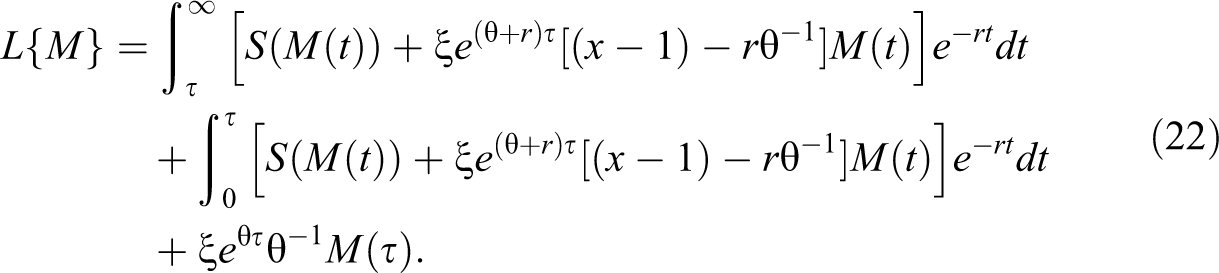
The methodology of stepwise transforming the original DDE in equation (8′) into equation (18) and solving the integrals in equations (20) and (21) is a simple way to deal with the complicated structure of the problem. 13 This methodology will be used to derive further solutions for alternative scenarios.
Notice that in equation (22) only the first integral is considered for

In contrast to the model without age limits or training delays, the equilibrium membership with maximal age, denoted by
The comparative statics analysis of equation (23) yields



From equations (24) and (25), the impact of counterterror efforts, ξ, and death rate, θ, on
When comparing terrorist membership in the finite versus infinitely lived cases

From equation (27), the younger a terrorist group becomes, the more likely it is to die in the next period. One possible explanation for this result lies in the fact that when the proportion of the recent generation of terrorists in total membership increases, on average the group becomes less experienced. The lack of experience of new recruits makes the group’s attacks less successful, decreasing the support for the terrorist organization, hindering its capacity to recruit new members. Lack of experience can also lead to a critical error in which an escalated level of violence isolates the terrorists from their base of support. Another explanation is provided by DeGhetto (1994), who observes that successor groups must have experienced members apart from the violent core who can see to the achievement of process goals that contribute to organizational survival. He finds that anarchic-ideologue terrorists have an average membership age of seventeen to twenty-five and have little use for members outside of the violent core. Such groups do not, on average, survive for very long. By contrast, national-separatist groups have an average membership age of twenty to fifty, some of whom are part of the “infrastructure,” and these groups survive for much longer.
Another issue of interest is the role of a limit on vintage age, τ. An increase in τ leads to a fall in the equilibrium membership:
One explanation for equation (28) is that if differences regarding the terrorist groups’ objectives and tactics produce conflict among the various vintages (e.g., a generation gap), fewer recruits will be attracted, thereby decreasing total membership. Another related factor is that if the group’s leadership ages, the original raison d’être may be less appealing to a younger generation, thereby reducing its ability to recruit new members.
Terrorism with Vintage Age Limits and Training Delays
It is well known that certain terrorist groups rely on indoctrination and training of recruits in safe havens prior to using them as operatives. Past al Qaida activities in Afghanistan, Pakistan, and Somalia are examples. Extending the finite vintage model to the case in which recruits of a given vintage spend T units of time in training and/or indoctrination, terrorist membership stock is now described by equation (10):
Membership flow is given by equation (11). Recalling that
Taking equation (11) into account, the loss function becomes
The loss function in equation (30) depends on
The loss function for this problem is as follows:
The first-order condition is as follows:
It is instructive to observe that the only difference between equations (34) and (16) is the presence of the term
The impact of T on
In view of our analysis of equations (22) and (33), we can return to the loss function in equation (30), which is the general vintage model that encompasses the case of the old generation with maximal active lifespan τ and the new generation being trained for time T. Taking similar steps along the lines of equations (20) and (21), the loss function in equation (28) can be written as follows:
In equation (22), the loss function depends on the recruitment at
Equation (40) admits equilibrium membership
The comparative statics analysis does shed light on how the government can behave to decrease equilibrium membership in the terrorist group
From equations (24) through (28), the impact of x, ξ, τ, and θ on equilibrium membership
Terror Group Size
We can compare the size of the terrorist group under different vintage structures by assuming a specific functional form for the term S in the integrand of the government’s loss function. For the sake of simplicity, let us assume that S is defined as follows:
Substituting equation (41) into the first-order conditions (16), (23), and (34), noticing that 0 < T < τ, and assuming
The inequalities in equation (42) say that the size of the terrorist group without maximal age and training delay, M*, is the biggest of all. When vintage structures such as training time for the new generations or maximum age for the old generations are imposed, the size of the terrorist organization decreases and the model with maximum age attainable produces the smallest membership of all.
Discussion and Conclusion
Terrorist groups survive and thrive based on their ability to recruit and train operatives. Target governments recognize this and seek to circumvent a terrorist group’s ability to wage a sustained campaign. Consequently, both terrorist organizations and target government must initially focus on the procedural aspects of recruitment and training if either is to be successful in a prolonged campaign. Once attention is focused on a terrorist group’s ability to organize through successor generations of members, the vintage of operatives—defined in terms of their recruitment dates and training/indoctrination delays—become a primary determinant of counter-terror policy. In this article, we show how vintage characteristics imply that the stock of operatives in a terrorist organization can naturally be described as a delayed differential equation. The vintage terror model is then embedded in a simple dynamic optimization model for a target government that desires to minimize losses as a function of terrorist membership. Consequently, effective counterterror policy must recognize the vintage structure of the organization prior to considering counterterror policy.
In the models examined, the government achieves its objective by being impatient with the terrorist organization, increasing its efforts to reduce terror recruitment, and finding ways to increase terrorists’ death rate. Moreover, the vintage structure of the model also yields interesting results, since membership in the terrorist organization decreases if there is an increase in the time spent on training, or if the useful life span of a vintage increases, or if the proportion of younger generations in total membership increases. This shows that vintage structures reduce the size of the terrorist organization, and the model with limits on the length of a vintage’s activity produces the smallest membership of all.
The framework proposed here can be adapted and extended to a number of issues, topics, and methodologies. A direct follow-up of this article is to introduce more structure into the analysis. For example, by refining the government’s loss function, or by examining other forms of terror recruitment. One can also relate vintage life expectancy with recruitment, or examine how terrorist campaigns and attacks vary with training, given that it may decrease terror membership. In terms of government tactics, introducing concessions would add an additional term to the membership evolution equation (6), thereby complicating the creation–destruction motion of recruitment. Whether or not concessions increase recruitment is not a priori obvious. Our results are therefore indicative of the insight that the success of terrorist organizations in achieving their outcome goals through concessions is in part determined by the vintage structure of the organization in question. Consequently, the empirical debate over the efficacy of terrorism (e.g., Dershowitz 2002; Abrahms 2006) should include vintage structure measures to the degree they are available. An intriguing issue that can be addressed by our model is the study of terrorist organizations that evolve and/or merger into other organizations, such as the merger of two left-wing Brazilian terrorist organizations Vanguardia Popular Revolucionaria (VPR) and Comando da Libertacao Nacional (COLINA) that formed the VAR-Palmares, in which the actual Brazilian President, Dilma Rousseff, was an active militant (Azevedo 2010).
A more sophisticated way to study the interaction between terror membership and recruitment and the government is through an optimal control framework. It is notoriously difficult to deal with DDEs in an optimal control setup. However, there are advances in the literature that reduce the difficulties. Kamien and Schwartz (1991) present a methodology based on delayed state variables. Boucekkine et al. (2005) identify transversality conditions to study the stability of optimal paths. Boucekkine, Licandro, and Paul (1997) propose some useful numerical methods that make it easier to examine such models.
One of the main characteristics of DDEs is that its solutions can be oscillatory (Erneux 2009). In a seminal article, Enders, Parise, and Sandler (1992) find that the time series of terrorism involving all incidents, hostage takings, bombings, assassinations, and threats and hoaxes are characterized by cycles (see also Enders and Sandler 2000). A promising research path is to examine theoretical models of terror cycles with DDEs, since existing models (e.g., Feichtinger et al. 2001; Faria 2003; Das 2008) have used complex bifurcation methods to generate cycles whereas DDEs can produce cycles in a straightforward manner.
Footnotes
Declaration of Conflicting Interests
The authors declared no potential conflicts of interest with respect to the research, authorship, and/or publication of this article.
Funding
The authors received no financial support for the research, authorship, and/or publication of this article.