



Abstract
Many scholars assume that nationalism is inherently aggressive without systematically exploring the relationship between nationalism and interstate war initiation. Thus, many questions are unanswered. Does nationalism increase the risk of war and if so, how? Which types of nationalism are most likely to trigger warfare? The author argues that nationalist persuasion campaigns produce several mechanisms that encourage conflict. Nationalism provokes “national enemies” and their foreign allies, generates biased strategic assumptions, creates domestic interest groups that favor war, permits the suppression of opposition groups, and promotes “nationalist bidding wars.” When these processes exist, nationalism should increase the probability of war initiation. But, different forms of nationalism may not have similar effects. Using original data on the existence and type of state-level nationalism from 1816 to 1997, the author finds that nationalism significantly increases the probability of interstate war initiation. However, not all forms of nationalism are created equal in this regard.
The wars following Nazi Germany’s quest for lebensraum, the Vietnamese independence movement, and communism’s collapse in Yugoslavia suggest that nationalism plays a role in the instigation of international conflict. Many scholars and laypeople alike believe that nationalism can potentially promote aggression (Kedourie 1971, 1993). Yet, there has been little systematic exploration of the relationship between nationalism and interstate war initiation (Cederman 2002; Van Evera 1994). Consequently, many questions are left unanswered. Does nationalism generally increase the risk of war? If so, which types of nationalism are most likely to affect warfare and how? Which domestic and international processes lead to belligerent nationalism? Under what conditions is nationalism the most dangerous? This study considers the first two questions because answers to them will address the international conflict literature’s limitations and suggest answers to the latter ones.
Expanding upon J. Snyder’s (2000) theory of nationalist conflict under democratization, I argue that political elites use nationalism to obtain mass cooperation for the achievement of their goals. But, the construction and diffusion of nationalism has serious consequences. Successful nationalist persuasion campaigns can produce several mechanisms that encourage international conflict. Nationalism can provoke the wrath of “national enemies” and their foreign allies, lead to biased strategic assumptions, create domestic interest groups that favor aggressive foreign policies, permit the suppression of domestic opposition groups, and provide the necessary conditions for “nationalist bidding wars.” When one or more of these processes exist, nationalism should increase the probability that a state will initiate an interstate war. But, different forms of nationalism may not similarly affect the propensity for international conflict.
This study has three objectives. First, I seek to build upon the rich qualitative literature on nationalism and construct a theoretical framework that explains how nationalism increases the probability of international conflict. Second, I want to determine whether the popular belief that nationalism and warfare go hand in hand is accurate. Third, I propose to move beyond the nonrandom sample of case studies that has characterized hypothesis testing in regard to nationalism and war initiation and onset. I test my expectations using data I collected on the existence and type of state-level nationalism from 1816 to 1997.
I find that nationalism significantly increases the probability that a state will initiate an interstate war. This relationship occurs among democratizing and nondemocratizing regimes. But, its consistency across time remains ambiguous. I also find that all forms of nationalism are not created equal. Ethnic nationalism significantly and substantially increases the probability of war, while civic, revolutionary, and counterrevolutionary nationalism do not. Ethnic nationalism even promotes war to a greater extent than more traditional correlates of war, justifying its stigmatization as a destructive ideology. This unexpected result leads to some conceptual and theoretical questions, which I attempt to answer. Yet, I conclude that, following conventional wisdom, nationalism breeds international conflict.
These findings are noteworthy for two reasons. First, they indicate the theoretical and empirical importance of nationalism in understanding interstate war initiation. Researchers must not ignore nationalism’s role when constructing their models of international conflict behavior. Second, these results suggest that scholars should think further about whether and how other cultural and ideological variables influence international conflict’s dynamics as they constitute the social and political context in which other correlates of war operate.
This article is organized as follows. The first section describes the state of the literature pertaining to nationalism and international conflict. The second section uses this knowledge to develop a more complete model of nationalist conflict. The third section disaggregates nationalism into its permutations and explains why the probability of war depends on the form of nationalism articulated by the state. The fourth section describes the data set, the variables’ operationalization, and the statistical models. The fifth section presents the results of the statistical analyses and discusses the findings.
The State of the Literature
The literature on nationalism and violent conflict concludes that nationalism leads to a greater incidence of interstate war. Unfortunately, this conclusion is based on a nonrandom sample of case studies. For example, Gagnon (1994) focuses on ethnic nationalism’s destructive consequences in post–World War II Serbia, while Pavković (2000) considers the role of competing nationalisms in Yugoslavia’s brutal fragmentation. Fousek (2000), Hixson (2008), and Lieven (2004) outline how nationalism has increased the US propensity to engage in international conflict. Considering only one form of interstate conflict, Saideman and Ayres (2008) look at nationalism’s role in the prevalence of irredentism in five formerly communist countries in Eastern Europe and the former Soviet Union. J. Snyder (2000) carries out a broader assessment by briefly examining the relationship between nationalism and conflict in twelve democratizing states. Woodwell (2007) provides a quantitative analysis of nationalism’s violent consequences and three case studies, but he only considers nationalism among transborder nationalities. Despite these studies’ theoretical insights, they beg the question of generalizability. Does nationalism generally increase the probability of interstate war? To answer this question, a large-N quantitative analysis of nationalism is necessary.
Yet, the literature provides some theories as to why nationalism might provoke international conflict. For Hixson (2008), violence against external enemies may be integral to the myths and ideologies of many nationalisms, not just that of the United States. Nationalism’s content is also important for Saideman and Ayres (2008), because it shapes attitudes toward kin in neighboring countries and influences the elites’ propensity to engage in irredentist behavior. Taking an instrumentalist approach, Gagnon (1994) contends that ethnic nationalism is associated with international conflict because it provides a means through which endangered elites can deter domestic challengers in a shifting political and economic structure. A limitation of Gagnon’s argument is that it is confined to conflict along ethnic cleavages. “Enemy-others” can be juxtaposed to the “national family” not just in terms of culture and language but also in terms of political ideology or traditional institutions. Mansfield and Snyder (2005) and J. Snyder (2000) develop a more generalizable theory than Gagnon, as they apply it to many forms of nationalist conflict (e.g., wars between a revolutionary nationalist state and its enemies). However, they restrict their argument to democratizing states.
A thorough reading of history, in contrast, implies that all regime types have the potential for violent nationalist conflict at home and abroad. Hixson (2008) demonstrates this point by showing how Americans have engaged in militant foreign policies from the founding of the colonies to the war on terrorism as a means of reaffirming and renewing their national identity during periods of psychic crisis. The mechanisms through which nationalism causes war could theoretically operate in most political systems, not just democratizing ones. I gauge this theoretical extension’s appropriateness in the empirical analysis by demonstrating that the relationship connecting nationalism and interstate war initiation is the same in terms of coefficient direction and statistical significance in the sample of democratizing states, the sample of nondemocratizing states, and the full sample of states. Therefore, I can broaden J. Snyder’s (2000) theory of violent nationalist conflict and the hypotheses derived from it to explain how nationalism generally increases the probability of interstate war.
Theory of Nationalist Conflict
Political elites are often in need of mass cooperation to achieve their goals. For example, they may want to acquire neighboring territory, control a natural resource’s supply, or protect domestic companies from globalization’s pressures. To obtain such support, they may embed these goals and their related policies in nationalist rhetoric and images. They portray these objectives as essential to the nation’s continued existence and power and as reflective of the “national character.” The interpretation of these objectives must, however, be consistent with the nation’s traditions, myths, history, memories, symbols, beliefs, or its “usable past” to gain acceptance. Therefore, my theory fits within the modernist paradigm of nationalism because it views nationalism as instrumental for elites in their pursuit of self-interest (see Anderson [1983], Breuilly[1993], Gellner [1983], Hobsbawm [1990], and Nairn [1981] for classic modernist accounts). 1
When political elites successfully spread nationalism among the masses in this way, the domestic population will eventually acquire the common desire to protect its state through whatever policies and actions are deemed necessary. This desire is predicated on the notion that, in theory, all nations have the right to territorial self-determination, and due to this right, the state should express and ensure the nation’s unique cultural, historical, institutional, and/or ideological characteristics. If it does so, defending the nation means defending the state. 2
In addition to influencing mass aspirations, nationalism gives the populace a sense of shared beliefs and attitudes regarding the processes and outcomes of international relations. The need to protect national sovereignty, for instance, may entail a realist view of global politics and skepticism of international cooperation.
This conformity of ideas and interests and the mobilization of popular energies to the state’s nationalist projects are attractive to political elites. If they can effectively construct and diffuse an amenable form of nationalism, they may be more likely to achieve their objectives. However, nationalism’s creation and dissemination is not without serious consequences. Even though these “nationalist persuasion campaigns” can result in a greater sense of national unity (a potentially positive development), they can also produce several mechanisms that promote interstate war (J. Snyder 2000, 66–69).
First, nationalism’s propagation can only succeed if there is a clear delineation of the “other,” that is, those who are excluded from national membership. The nation cannot be constructed and maintained without a sense of who does not belong. According to Smith (2004, 221), “‘who we are’ is determined by our relations with the ‘outsider,’ the other who is marked off from ‘us’ by not sharing in our distinctive character, our individuality.”
But, the identification of certain groups as “enemies of the nation” can easily lead to their discrimination, disarmament, powerlessness, and/or expulsion. If these “national enemies” and/or their foreign allies can resist the nationalist state’s demands, the likelihood of war should increase (J. Snyder 2000, 66–67). The Palestinians are considered a constant threat to the integrity of the Israeli nation-state and therefore are politically marginalized. Unfortunately for Israel, the Palestinians have some means of resistance and relatively powerful regional allies, and thus, the conflict continues.
Second, nationalism promotes the portrayal of other nations as more threatening, more obstinate, and more liable for historical transgressions, but more easily defeated than they really are (J. Snyder 2000, 67). Nationalist leaders tend to construct a dichotomy between the weak and evil “them” and the strong and inherently good “us.” Even when the nation’s enemies are objectively strong in military and economic terms and nationalist leaders recognize this fact, the latter emphasize that their material capabilities are superior in some way to those of their enemies, which, along with their greater moral virtues, predispose them toward victory. The combination of distrust, insecurity, and increased optimism about victory inclines nationalist states to provoke conflict. Though one may contend that this argument about biased strategic assumptions can be generalized beyond the context of nationalist conflict, the myths and prejudices inherent in nationalism render its components more persuasive. Political elites can reinforce the image of the enemy as extremely threatening by claiming that it will undermine the state’s physical integrity and sovereignty and destroy their unique national identity.
American nationalism’s role in war initiation is instructive in this regard. American national identity is predicated, in part, upon the myth of Americans’ manliness, innate innocence, and providential destiny compared to the weakness, culpability, and decadence of “enemy-others” (e.g., the Native Americans and communists). Therefore, Americans view their political values and institutions as inherently superior (Lieven 2004; Pei 2003). This conviction imbues Americans with a widespread missionary spirit. They believe that their exceptional qualities imply their right to exert their power in the world, so as to spread the “universal values” of democracy and capitalism (McCartney 2002). This conception of American national identity drives a continuous militant foreign policy (Hixson 2008).
Third, nationalism creates interests inside and outside the government that wish to maintain the belligerent nationalist rhetoric and its attendant foreign policies for their own benefit. The military–industrial complex is a notable example. It, like many other nationalist groups, may wield so much political influence that war becomes likely. If defense contractors convince the government that “national security” can be achieved through elaborate weapons systems, not only do they increase their revenue, but other states may feel threatened and adopt a more militaristic posture. If two or more nationalist groups join together in a political coalition and logrolling occurs, the combination of policies may render war even more likely. The German “iron and rye” coalition prior to World War I embroiled the state in conflict by giving a fleet-building program to the industrialists, high agricultural tariffs to the aristocratic landowners, and an offensive war plan to the army. The first policy alienated Britain, the second angered grain-exporting Russia, and the last threatened all of Germany’s neighbors (Feuchtwanger 2001; J. Snyder 2000, 67–68).
Fourth, nationalism allows elites to undermine any opposition to their foreign policies by depicting it as a national threat. Characterizing the opposition as outside the realm of the “nation” and thus untrustworthy renders it less attractive to the public as participants or leaders in the government. The opposition becomes a smaller menace to the integrity of the state’s nationalist projects and its military agenda, as it cannot credibly question the nation’s construction and the wisdom of particular policies. The state obtains a greater freedom of action internationally, especially given the appearance of overwhelming public support for any state aggressiveness. Adolf Hitler was able to initiate and continue his military policies, in part, because he used nationalism to justify the silencing of liberals, Jews, and socialists, whom he portrayed as against the German volk (Benz 2006, 113; Mansfield and Snyder 2005, 26).
Finally, nationalism creates the conditions for “nationalist bidding wars” among elites and/or between elites and the masses (J. Snyder 2000, 68–69). Competing elites try to outbid each other to gain greater nationalist prestige, more popular support, and further political power, leading to more belligerent policies than any of them initially desired. The masses may internalize the nationalist rhetoric, believing that their national identity, reputation, and self-rule are endangered by “others” and can only survive through military action. They push their leaders to initiate or continue aggressive foreign policies so as to achieve the “national objectives.” In this process of internalization and lobbying, the populace becomes desensitized to the costs of war, allowing leaders to pursue more risk-acceptant military strategies. During and after the collapse of Soviet authority, Armenian politicians engaged in nationalistic outbidding over the issue of Nagorno Karabakh in response to mass nationalist sentiment (Melander 2001; Saideman and Ayres 2008, 97). Communist Party officials in Armenia had to increasingly respond to the strident nationalism of the Karabakh Committee (later the Armenian Nationalist Movement), the Krunk pressure group, and the Dashnak party in Nagorno Karabakh. “The fate of Nagorno Karabakh and the ensuing confrontation with Azerbaijan was the dominant factor determining the behaviour of all social groups and political activists in Armenia,” despite the costs of the escalating violence (Rutland 1994, 839).
Due to increased public support, the provocation of “national enemies” and their foreign allies, biased strategic assumptions, nationalist interest groups, marginalized political opponents, and “nationalist bidding wars,” nationalist states should be more likely to initiate interstate wars than nonnationalist states. Not only does nationalism convince the population that their state, the nation’s guardian, must be defended against external threats. It also generates several processes that further promote war. This expectation leads me to the following hypothesis:
Hypothesis 1: Nationalism increases the probability that a state will initiate an interstate war.
The Differentiation of Nationalism and Violent Conflict
Nationalism is neither homogenous nor unchanging. It has assumed many forms since its birth, as political elites in different national contexts have altered it to promote their particular interests. 3 Different nationalisms have defined the “nation,” its goals, and its enemies differently, producing different nationalist dynamics. Recognizing that various forms of nationalism exist and may diversely affect domestic political interactions, I expect them to have different implications for the elite’s ability to mobilize popular energies, identify “national enemies,” propagate biased strategic assumptions, satisfy nationalist interest groups, repress dissent, control “nationalist bidding wars,” and initiate international conflict.
One methodological problem in examining the effect of different types of nationalism on interstate war initiation is the array of classification schemes (see Breuilly 1993; Gellner 1983; Smith 2001; J. Smith 2000; L. Smith 1976 ). The chosen categorization must fairly test the relationship between nationalism and interstate war initiation. While each classification scheme has its merits and scholars will disagree about their comparative usefulness, I follow J. Snyder’s (2000, chap. 2) categories of nationalism for two reasons. First, he explicitly hypothesizes about the relationship between different types of nationalism and war initiation, though in the context of democratizing states. Since his theory and hypotheses inform my conceptualization of the relationship between nationalism and war and I want to be consistent with his expectations, I employ his classification scheme. Second, he includes civic and ethnic nationalism, which are often used in case studies to explain the incidence of violent conflict.
J. Snyder (2000, 69) divides nationalism into four categories on the basis of its collective appeals and criteria for inclusion in the nation. The categories are civic, ethnic, revolutionary, and counterrevolutionary nationalism. Table 1 lists their main characteristics. According to Snyder, each type of nationalism influences warfare in a distinct manner by producing different types of violent conflict and different degrees and patterns of violence, which would affect when wars occur.
Relationship of the Different Types of Nationalism to Interstate War Initiation

Note: The descriptions of the variants of nationalisms and the proposed consequences for conflict are from J. Snyder (2000).
According to J. Snyder (2000, 80), civic nationalism leads to more prudent policies abroad. Civic nationalist states tend to be more sensitive to war’s potential costs. They should only initiate those interstate wars that they believe they can win quickly with minimal loss of life and materiel. The reasoning is that most mature democracies either have civic nationalism (e.g., the United States) or have had their historic nationalism tempered by civic features (e.g., post–WWII Germany). Since mature democracies permit open criticism of government policies and politicians are concerned about reelection, costly wars are likely to be avoided. Mature democracies are often associated with civic nationalism because it is inclusive within the state boundaries and “seeks to accommodate all citizens within a nondiscrimatory legal and institutional framework” (J. Snyder 2000, 80). These features inform the perception that civic nationalism is “rational,” “benign,” and “desirable” (Brown 1999). I expect that civic nationalist states are less likely to initiate wars than other kinds of nationalist states. However, civic nationalism still provides elites with the opportunity to elicit public cooperation, identify “national enemies,” propagate biased strategic assumptions, satisfy nationalist interest groups, suppress the opposition, and engage in “nationalist bidding wars.” It would lead to a higher probability of war than if there were no nationalism. The following hypothesis derives from these expectations:
Hypothesis 2: Civic nationalism increases the probability of interstate war initiation relative to no nationalism, but less than other forms of nationalism.
Ethnic nationalism should render a state more war-prone than civic nationalism because the ethnic nationalist state is less cost-conscious. War’s potential benefits are seen to be greater than its potential costs. If the ethnic nationalist state is victorious, it may preserve its independence and distinctive national identity or acquire control and possibly sovereignty over territories inhabited by ethnic kin (J. Snyder 2000, 82). In addition, ethnic nationalist states’ motivations for fighting often preclude the consideration of costs. Ethnic nationalism tends to entail issues of culture, language, and religion, which are frequently seen as zero-sum issues and less amenable to compromise. For example, it would be difficult for ethnic nationalists in a homeland state to accept their ethnic kin’s assimilation to the dominant culture in a neighboring state. To do so would mean the gradual erosion of their unique identity and sense of belonging. Diplomacy and peaceful negotiation may become unacceptable. The only option is warfare, despite its costs.
However, ethnic nationalist states’ expansionism has natural limits. An ethnic nationalist state should be less inclined to war once its goal of a homogenized state, a sustainable pattern of domination, or security from “others” is achieved (J. Snyder 2000, 82). It should have little desire to conquer and rule over a large number of “foreigners” since their presence may threaten “the national family.” These assertions suggest the following hypothesis:
Hypothesis 3: Ethnic nationalism increases the probability of interstate war initiation relative to no nationalism and more so than civic nationalism.
In contrast to ethnic nationalism, revolutionary and counterrevolutionary nationalism’s military expansionism does not have natural limits, and states with these types of nationalism should have the highest probability of interstate war initiation. Revolutionary nationalism has two characteristics that differentiate it from other forms of nationalism and render the relevant states some of the most likely to initiate wars. First, it seeks to protect the political revolution from its domestic and foreign enemies. Second, it is preoccupied with “the possibility of spreading the benefits of political transformation to potential revolutionists abroad” (J. Snyder 2000, 82).
In the eyes of revolutionary nationalists, the revolution is precarious. The popular energy that it unleashes creates a long-term threat to neighboring states. The latter may try to kill the revolution, especially in its infancy, through preventive aggression to shield themselves from domestic revolution. Due to this potential military intervention, revolutionary nationalists believe that spreading the revolution to other countries, as in the military campaigns of Napoleonic France, will obtain the security necessary for a successful revolution. “The revolutionary state’s goals for conquest are not necessarily limited to a finite set of historic or cultural objectives but are spurred by a more open-ended competition for security” (J. Snyder 2000, 82). The tense relations between revolutionary nationalist states and their enemies supply the context in which the likelihood of conflict increases.
Unlike the politically transformative basis of revolutionary nationalism, counterrevolutionary nationalism arises when threatened elites attempt to fend off internal change by unifying the nation against its external foes. These elites may also try to preserve traditional institutions and their place in them through the exclusion of the nation’s putative class, ideological, religious, and cultural enemies (J. Snyder 2000, 83). In the 1870s, German chancellor Otto von Bismarck and his fellow ruling elites feared a working-class revolution and demands for a full-fledged democracy. Therefore, they appealed to the Protestant middle classes, while labeling the working class, the socialists, the Catholics, and the Poles as the “true” German nation’s enemies (Blackbourn 2003, 195–203; Lerman 2008; J. Snyder 2000, 93–94).
This strategy may not only prevent or reverse any domestic change by silencing revolutionary voices but also enhance the state’s ability to foster national unification. The marginalization of menacing groups would decrease the amount of opposition to the elite conceptualization of the nation and the resulting policies, providing the semblance of unanimity. In such a context, aggressive foreign policies are more likely to be formulated and implemented.
Furthermore, like revolutionary nationalism, counterrevolutionary nationalism perpetually needs external enemies to serve as internal unifiers. Since counterrevolutionary nationalism is defined by its opposition to any group that wants to undermine the nation’s traditional institutions, its impetus for internal unification comes from the desire to preserve the status quo. In contrast, revolutionary nationalism seeks internal unification through the political revolution’s preservation. Yet, the constant construction of threatening “others” in both forms of nationalism provides leaders with more opportunities to bring the people together through war.
Due to these dynamics, states with these types of nationalism lack inherent limits on the number and extent of rivalries they provoke with other states. Both forms of nationalism are likely to produce higher levels of open-ended conflict than other types of nationalism. These features of revolutionary and counterrevolutionary nationalism suggest the following hypothesis:
Hypothesis 4: Revolutionary and counterrevolutionary nationalism increases the probability of interstate war relative to no nationalism and more so than civic and ethnic nationalism.
I have no a priori expectation of a substantial difference between revolutionary and counterrevolutionary nationalism’s effects. Both depend on the continuous identification of external enemies for the maintenance of internal cohesion, which precludes them from having inherent constraints on their expansionism. The primary difference between revolutionary and counterrevolutionary nationalism is their bases for national unification. I perceive no theoretical reason why this distinction should cause either nationalism to have a greater impact on interstate war initiation than the other, especially given their similarities.
The theory of nationalist conflict outlined above suggests that nationalism should increase the probability of interstate war initiation through a series of mechanisms. However, some forms of nationalism should have a higher likelihood of causing war than others. If my hypotheses receive empirical support, it will indicate the theoretical importance of nationalism in understanding interstate war initiation. It would also suggest that the potential influence of other cultural and ideological variables should be considered.
Data and Methods
Dependent Variable
The dependent variable
I am analyzing rare events because there are much fewer initiations than noninitiations. Because rare events are often difficult to explain and predict, I follow King and Zeng’s (2001a, 2001b) and Lemke and Reed’s (2001) advice and eschew commonly used, though grossly inefficient, data collection strategies in favor of retrospective sampling. By doing so, it is easier to understand the relationship between nationalism and interstate war initiation.
The primary benefit of retrospective sampling is that I avoid spending precious data collection resources by forgoing a very large number of observations and focus on the inclusion of more informative and meaningful variables of nationalism. If I had aimed to gather the thousands of observations commonly found in quantitative international conflict studies, I would have had to use possibly inaccurate proxy variables for nationalism. Instead, I collected data on the nationalism of all the initiators the year prior to their wars and a small random sample of noninitiators. This strategy does not cause a loss of consistency or much efficiency relative to the full sample (King and Zeng 2001a, 694). Many of the “zeros” may contain little substantive information regarding conflict initiation. States like Palau or Andorra most likely will not provide much insight into the relationship under study.
Based upon this logic, I collected data on nationalism and other variables for 164 noninitiator years and all 85 initiator years, for a total of 249 country-year observations. The noninitiator years were randomly drawn from all country years in which the country in question had participated in at least one interstate war between 1816 and 1997, according to the Correlates of War (COW) Project, minus those country years in which the country initiated an interstate war (Sarkees 2000). The data on war initiation are from the COW Project, though with World War II, the Vietnam War, and the Persian Gulf War disaggregated, following Slantchev (2004).
Independent Variables
General Nationalism Variable
As there is no preexisting data set on the incidence of nationalism or its permutations, I constructed my own variables and collected my own data. I consulted national histories and reference works on nationalism, governments, and political parties that addressed in detail the country and temporal period in question.
But, before operationalization and quantification can begin, nationalism must be defined. Unfortunately, the term nationalism has acquired a range of meanings, rendering it difficult to explain the nationalist phenomenon’s exact nature. The most important usages are (1) a process of national formation, (2) a sentiment or consciousness of belonging to the nation, (3) a language and symbolism of the nation, (4) a social and political movement on behalf of the nation, and (5) a doctrine and/or ideology of the nation (Smith 2001, 5–6). However, an adequate description of nationalism must refer to the quest for political autonomy or independence to differentiate it from ethnic politics. Combining this component with the elements of sentiment and ideology in the above definitions, I characterize nationalism, following J. Snyder (2000, 23), as the doctrine that a people who see themselves as distinct in their origins, culture, history, institutions, or principles should rule themselves in a political system that expresses and protects those distinctive characteristics.
The benefit of this definition is that it expands Gellner’s (1983) standard conceptualization of nationalism as the doctrine that the state and the nation should be congruent, as well as Hechter’s (2000, 7) definition of nationalism as “collective action designed to render the boundaries of the nation congruent with those of its governance unit.” It allows nations to be organized around characteristics other than ethnicity and culture, and, like Harri’s (2009, 5) description, it does not confine nationalism’s goal to political independence.
Nationalism exists in a state in year t – 1 if there is evidence that the government attempted to demonstrate and/or protect the nation’s distinctive characteristics in that year. Such evidence may be one or more of the following events. First, a politically relevant nationalist party is present. A party is politically relevant if it achieves a victory in a presidential election, a majority of seats in the national legislature, control of the most prominent cabinet positions, or the ability to affect coalition building. Second, the state has laws limiting the rights, freedoms, and activities of groups not considered part of the “nation.” Such laws could be restrictions on citizenship rights, use of a native language, membership in cultural or religious organizations, and/or political participation. Third, the government engages in behaviors that disproportionately benefit the national group with an eye toward defending and reinforcing national distinctiveness. Fourth, there is significant internal or external conflict short of war which the state justifies by arguing that the nation’s existence, identity, and/or traditions are threatened. Fifth, the state takes other military actions that it contends will protect the “nation” and its interests (e.g., the militarization of disputed territory).
Specific Nationalism Variables
Since nationalisms differ in their myths, symbols, memories, values, rhetoric, rituals, traditions, and politics, I disaggregate the general nationalism variable into separate variables representing civic, ethnic, revolutionary, and counterrevolutionary nationalism. Definitions for these nationalisms are derived from J. Snyder (2000, 70) and are based on the criteria for national membership and the nature of collective appeals.
Civic nationalism emphasizes loyalty to a set of political ideas and institutions that promotes justice, tolerance, and the rule of law and includes in the nation anyone born or who has lived for a long time within the national territory (J. Snyder 2000, 70). It is the most inclusive nationalism as its requirements for national membership are easily fulfilled. Civic nationalism often occurs in democracies and might be a proxy for democracy. I coded a state as civic nationalist if citizenship was based on birth or a process of naturalization, if the rule of law and fair political institutions were prominent in national life, and if there was a national desire to ensure liberty, tolerance, individual rights, and equal justice under the law.
Ethnic nationalism stresses the importance of common culture, language, religion, historical memory, and/or kinship in constructing and maintaining the nation. It excludes anyone who does not have the necessary cultural, linguistic, religious, and/or ethnic attributes (Smith 2004, 41–42; J. Snyder 2000, 70). If the government favored one culture, language, religion, and/or ethnicity through laws, educational opportunities, business contracts, patronage, and/or other means, that country may be ethnic nationalist. However, the historical record must also indicate that national membership depended on cultural, linguistic, religious, and/or ethnic criteria and the political elite emphasized the associated group’s superiority and uniqueness.
Revolutionary nationalism frames national defense and self-rule in terms of protecting a revolutionary political regime. To be a member of the national family and obtain the resulting rights and privileges, one must support the regime’s ideology, objectives, methods, and organization. Anyone who threatens the regime’s stability is excluded from national membership (J. Snyder 2000, 70). I coded a state as revolutionary nationalist if it denied national membership to any group that it believed was trying to undermine the revolution and if it implemented discriminatory laws or instigated violence against these groups to preserve the regime. A state resulting from a revolutionary victory is more likely to be revolutionary nationalist than other states.
Counterrevolutionary nationalism perceives national well-being as primarily served by resistance to internal factions and external foes seeking to weaken traditional political, social, and/or economic institutions. It excludes from national membership any social classes, religions, cultural groups, and adherents to “alternative” political ideologies that might change the status quo (J. Snyder 2000, 70). I coded a state as counterrevolutionary nationalist if the political elites described the nation with reference to the past, traditional institutions, the status quo, and/or social convention and formulated their policies with this conceptualization of the nation in mind. But, for a state to be counterrevolutionary nationalist, the elite had to employ nationalism in an attempt to maintain their dominant positions, forestall change, and/or protect the nation from “revolutionary” ideologies. The exclusion from the nation of anyone who opposed the establishment also indicated counterrevolutionary nationalism.
A “no nationalism” variable is the base category in the empirical analysis. 5 The four variables of nationalism and the categories of nationalism they represent are exhaustive. However, I must emphasize that their coding is not always unambiguous, and many cases required a judgment call. A cross-tabulation shows that, while most country-years do not possess nationalism (118 observations), ethnic nationalism is the most frequent type of nationalism (45 observations) and revolutionary nationalism is the least frequent one (12 observations).
If the historical record indicated a state evinced multiple types of nationalism, I used the most prominent and influential one in coding that state’s nationalism. If more references were made to the characteristics of one type of nationalism than to those of another and/or one type was reinforced with claims from another, the country was coded as having the former nationalism. 6
After the Russian Revolution, the Soviet Union possessed revolutionary nationalism, as it eliminated from the “pays legal” the propertied classes and the clergy. In the 1922 constitution, it disenfranchised propertied society, people who hired labor, kulaks, priests, and WHITE ARMY officers (Suny 1997, 146). The emphasis on the communist revolution’s protection from the capitalist powers as the Soviet people’s primary goal continued throughout the first half of the twentieth century. However, Soviet leaders sometimes employed ethnic nationalist rhetoric and imagery to mobilize the citizens to communism’s defense. From 1936 to 1938, Josef Stalin purged the minority nationalities because he saw the Russian people as the true guardians of Marxism (L. Snyder 1976, 216). Because Soviet leaders inconsistently used Russian ethnic nationalism as a means of securing communism, I coded the Soviet Union as revolutionary nationalist, not ethnic nationalist.
Control Variables
To estimate accurately the effect of nationalism and its variants on interstate war initiation, I include five control variables in the analyses, all measured at t – 1.
Statistical Models
One would normally use a logit regression model when the dependent variable is dichotomous. However, I employ a rare-events logit regression model to avoid biased coefficients and estimates of event probabilities that are too small, as often happen in finite samples of rare-events data (King and Zeng 2001a, 2001b; Tomz et al. 1999). Because my research design is choice based, I use the prior correction method to ensure that my estimates, especially that of β0, are consistent and efficient. Without a good estimate of β0, I would likely have biased estimates of event probabilities. This procedure corrects the logit coefficients based on external information about the fraction of events in the population, τ, and the observed fraction of events in the sample,
First, I estimate a rare-events logit regression model with the general nationalism variable. Second, to determine whether particular forms of nationalism increase the probability of interstate war more than others, I estimate a model with the variables
Results
A cross-tabulation (not shown) indicates that nationalism and interstate war initiation are significantly associated (p = .000). Approximately 48 percent of nationalist states in the sample initiated wars, compared with roughly 19 percent of nonnationalist states. This difference in percentages is substantial, suggesting that nationalist states are more likely to instigate international conflict. However, these results do not tell us anything definitive about the relationship’s direction.
The rare-events logit regression model in Table 2 provides such information. It indicates that nationalist states have a higher probability of interstate war initiation than nonnationalist states, holding all other variables constant. This finding is significant at the .01 level in a one-tailed test and confirms Hypothesis 1. 7 It is plausible that the mechanisms leading from nationalism to international conflict that my theory outlines are operative. That is, nationalism galvanizes public support for state policies, provokes “national enemies” and their foreign allies, fosters biased strategic assumptions, encourages nationalist interest groups, marginalizes political opponents, and promotes “nationalist bidding wars.”
The Effect of Nationalism on Interstate War Initiation, Model 1
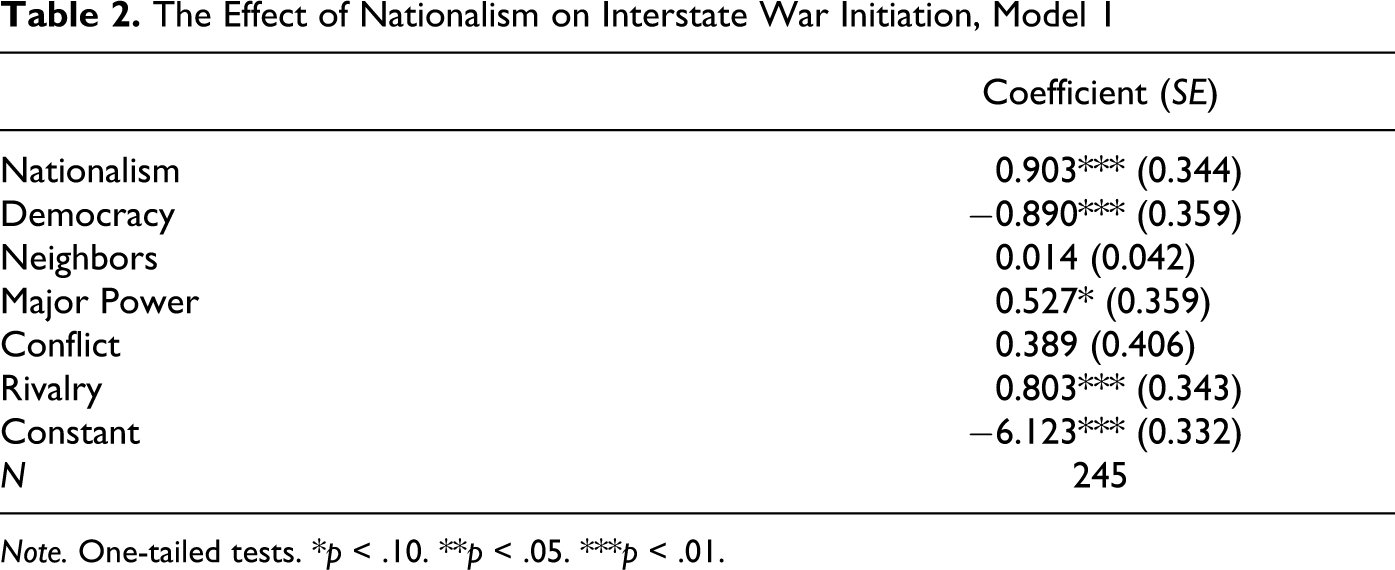
Note. One-tailed tests. *p < .10. **p < .05. ***p < .01.
Three control variables behave as expected. Democracies are significantly less inclined to initiate interstate wars than are autocracies. Major powers are more disposed to initiate international conflict, compared to minor powers. But, this finding barely obtains significance. States embroiled in a rivalry are significantly more likely to initiate interstate wars than those that are not. However, the number of immediate neighbors and current involvement in another conflict have no relationship to interstate war initiation.
Table 3 shows the relative magnitude of the significant variables’ effects on the predicted probability of interstate war initiation. The change from a nonnationalist state to a nationalist one increases the predicted probability of international conflict by 0.00335. This increase is larger than the absolute changes in the predicted probability caused by changes in democracy, major power status, and rivalry. It can be argued that nationalism more greatly affects the instigation of interstate war than more traditional correlates of war, especially given the insignificance of the number of immediate neighbors.
The Change in the Probability of Interstate War Initiation Given Changes in the Explanatory Variables, Model 1

Note. The baseline probability is 0.00237 when
When the sample is restricted to democratizing or nondemocratizing states to account for J. Snyder’s (2000) argument that belligerent nationalism occurs primarily in democratizing states, the positive relationship between nationalism and interstate war initiation remains. A state is democratizing if its political regime demonstrated any movement in a more democratic direction on Polity IV’s “institutionalized democracy” scale from t – 10 to t – 1. Thirty-two percent of nationalist democratizing states initiated wars, compared with nine percent of nonnationalist democratizing states. Forty-nine percent of nationalist nondemocratizing states initiated wars, compared with 23 percent of nonnationalist nondemocratizing states. However, these relationships are weaker in significance terms after accounting for the control variables (results not shown). Their significance is also smaller than that of the nationalism–war initiation relationship using the full sample of country years. Nevertheless, I conclude that, despite regime type, nationalist states are more prone to international conflict than nonnationalist states and that my extension of Snyder’s theory to include all regime types is appropriate.
It may also be questioned whether the assumption of case homogeneity can be upheld for almost two centuries. While the French Revolution and the Napoleonic Wars introduced nationalism into international relations with the establishment of the mass army (Posen 1993), it may not be safely assumed that the mechanisms triggering warfare immediately changed and remained stable. Nationalism may not consistently increase the probability of international conflict throughout the sample period, especially given that the potential for elite nationalism did not reach most areas of the world until after decolonization. Therefore, nationalism could exert its greatest influence upon interstate war initiation during the twentieth century, and this temporally limited relationship could be driving the previous findings.
Accounting for temporal effects leads to mixed results and tentative conclusions. First, in the nineteenth century, 48 percent of nationalist states initiated wars, compared with 21 percent of nonnationalist states, a significant association (p = .003). In the twentieth century, 48 percent of nationalist states initiated wars, compared with 16 percent of nonnationalist states, a significant association (p = .000). It appears that nationalism and interstate war initiation are positively associated in both periods. However, when the sample is partitioned and separate regressions are estimated, nationalism significantly increases the probability of interstate war initiation only in the twentieth century (results not shown). I would be hesitant though to conclude that nationalism’s effect is temporally limited. When I include an interaction between
Disaggregating nationalism into its variants indicates that some forms of nationalism increase the probability of interstate war initiation, while others do not. In a cross-tabulation not shown, only ethnic and counterrevolutionary nationalist states are more likely to initiate war than not, although the percentage of nonnationalist states initiating a war is significantly smaller than the percentage of states with any form of nationalism initiating a war. Approximately 56 percent of ethnic nationalist states and 56 percent of counterrevolutionary nationalist states initiated wars, while 37 percent of civic nationalist states and 50 percent of revolutionary nationalist states did. Ethnic and counterrevolutionary nationalism may drive the positive relationship between nationalism and interstate war initiation found earlier.
A rare-events logit regression supports this assertion. Table 4 shows that ethnic and counterrevolutionary nationalism increase interstate war’s likelihood. Hypothesis 3 and part of Hypothesis 4 find some support. However, the significance of counterrevolutionary nationalism’s effect is weak so any conclusions made in that regard are tentative.
The Effect of Nationalism on Interstate War Initiation, Model 2

Note. One-tailed tests. *p < .10. **p < .05. ***p < .01.
Contrary to my expectations, neither civic nor revolutionary nationalism is significantly related to interstate war initiation, though their coefficients have the predicted direction. Hypothesis 2 is not supported at all, while Hypothesis 4 is somewhat undermined. This latter finding may be due to the few cases of revolutionary nationalism in the data set (n = 12), which may make it difficult to estimate any significant results. Nevertheless, revolutionary and counterrevolutionary nationalism do not have similar international political dynamics and their effects on interstate conflict are different.
Table 5 shows the relative magnitude of the effects of the significant variables in model 2 on the predicted probability of interstate war initiation. The change from a nonnationalist state to an ethnic nationalist state increases the predicted probability by .0058. This value is almost twice the size of the change in the predicted probability when a state becomes counterrevolutionary nationalist. This result suggests that another component of Hypothesis 4 is inaccurate; that is, counterrevolutionary nationalism does not increase the probability of interstate war initiation more than ethnic nationalism. In fact, ethnic nationalism most greatly affects interstate war initiation. Democracy, major power status, and rivalry have an absolute impact smaller than ethnic nationalism.
The Change in the Probability of Interstate War Initiation Given Changes in the Explanatory Variables, Model 2

Note. The baseline probability is 0.0023 when
Given ethnic nationalism’s strong effect on interstate war initiation and the relative unimportance of nationalism’s other forms, the question arises as to whether nationalism as a whole matters or just ethnic nationalism. While counterrevolutionary nationalism’s significance is borderline, it is still difficult to completely dismiss other variants of nationalism as inconsequential. However, the statistical analysis indicates that ethnic nationalism is the most important form of nationalism. Ethnic nationalism’s effects may then be driving the results of model 1.
If so, the consequences for violent conflict of the various forms of nationalism and their hypothesized effects on interstate war initiation need to be modified. First, civic nationalist states’ cost-consciousness and prudence in foreign relations may override any desire by their leaders to elicit public cooperation through belligerent nationalism, given its potentially violent consequences. Civic nationalism should have little, if any, impact on war initiation. Smith (2004, 243) also argues that “‘civic’ and ‘ethnic’ elements are closely intertwined in most nations and nationalisms, and that the confidence and tolerance of certain national communities rests as much on the sense of common origins, history, and distinct culture of the dominant ethnic community … as of any civic institutions and inclinations.” What matters for international conflict behavior, given civic nationalism’s statistical insignificance and cost-consciousness, is the effect of these “ethnic elements.”
Second, since revolutionary nationalism does not lead to ubiquitous external conflict, this form of nationalism could be discarded in the empirical study of international conflict. Furthermore, revolutionary nationalism’s ideology could be more about the revolutionary regime’s protection than about the nation’s protection. If so, revolutionary nationalism’s effects would be more fruitfully studied in the context of major political and social transformations.
Third, the counterrevolutionary nationalism category could be removed. Its statistical influence on international conflict is meager, and its emphasis on the nation’s traditional institutions is reminiscent of ethnic nationalism’s emphasis on shared memories, myths, customs, and religious practices. Ethnic and counterrevolutionary nationalism could be combined by reconceptualizing the latter with an emphasis on its connections to ethnicity. We might think of counterrevolutionary nationalism as a form of ethnic nationalism, one that seeks to protect the ethnic nation, especially its elites, from internal and external groups that wish to undermine its traditional institutions. So, only ethnic nationalism should have a large positive effect on interstate war initiation.
Should the concept of nationalism then be defined in purely ethnic terms in conflict research? It might be appealing to describe nationalism this way, given the empirical results and the arguments for ethnic nationalism’s inherent violence. One could also claim that all nationalisms are predicated on some preexisting ethnic community (Yack 1999). If so, defining nationalism solely on the basis of these ethnic foundations might not be controversial. Yet, there are cases, like the United States, in which civic nationalism is quite influential in foreign policy.
It might behoove us to conceive of nationalism as a “hybrid” phenomenon. It combines sometimes conflicting elements into a constantly evolving national narrative. Particular elements may become more prominent than others during periods of crisis and may affect conflict more than others. We do not need to define nationalism in purely ethnic terms; we must simply recognize that its ethnic elements are the likely provocateurs of conflict.
Conclusion
This study’s theoretical argument, which extends J. Snyder’s (2000) theory of nationalist conflict under democratization, begins with the assumption that nationalism is useful for political elites. When nationalist persuasion campaigns are successful, elites can more readily obtain mass cooperation for the realization of their goals. However, the construction and dissemination of nationalism has domestic and international repercussions. Several mechanisms can arise that encourage the initiation of international conflict. First, nationalism entails the identification and vilification of “others,” which can provoke violent responses if these “national enemies” and their foreign allies can resist. Second, nationalism promotes the use of biased strategic assumptions. Third, certain domestic interest groups may benefit from belligerent nationalist foreign policies and lobby for their continuation and possible escalation. Fourth, elites can more easily marginalize opposition groups by depicting them as national threats. Finally, nationalism provides a favorable setting for “nationalist bidding wars” among the elites and between them and the masses. When these processes are operative, nationalism should increase the probability of interstate war initiation.
The results of the statistical analysis support this hypothesis, demonstrating that the conventional wisdom about nationalism’s violent consequences is accurate. Nationalism significantly increases the probability of interstate war initiation and has a larger effect on the predicted probability of interstate war initiation than democracy, major power status, and rivalry. This relationship occurs among both democratizing and nondemocratizing states. However, its temporal consistency remains unclear.
When nationalism is disaggregated into its variants, only ethnic and counterrevolutionary nationalism significantly increase the probability of interstate war initiation, though the latter is barely significant and has half the former’s impact on the predicted probability of interstate war initiation. Therefore, ethnic nationalism is the most important form of nationalism in the study of international conflict. This fact raises a host of issues, including the advisability of ignoring other types of nationalism and the conceptualization of nationalism in purely ethnic terms. I have provided some initial thoughts, but the possible arguments and evidence must be more thoroughly investigated. Regardless, it is clear that nationalism is theoretically and empirically important to understanding interstate war initiation. Researchers should allow for nationalism’s influence when developing their models of international conflict.
These findings also suggest that scholars should further consider whether and how other cultural and ideological variables affect international conflict’s dynamics, especially given the relative scarcity of such studies in international relations. If nationalism is central to a comprehensive understanding of interstate war’s causes, then it is possible that other cultural characteristics and political ideologies are important as well. They provide part of the social and political context in which other correlates of interstate war are embedded.
This study is the first that quantitatively measures nationalism and examines its statistical relationship to a facet of interstate war. Future research may reveal a different relationship between nationalism and interstate war initiation since this analysis can be improved. One means of improvement would be the collection of more data on the existence of nationalism across state years to assess more accurately the relationship between nationalism and war initiation. It might also be useful to expand the purview of the analysis to include civil wars to ascertain whether nationalism’s impact on conflict initiation is limited to the international realm.
Investigating nationalism’s effects on military conflict is a research agenda that merits further attention. The popular belief that nationalism is inherently aggressive and a major cause of war will be scrutinized and a better understanding of why wars occur in the first place will be obtained. The international community may then be able to develop more effective policies that avoid war’s destructiveness.
Footnotes
Author’s Note
The author would like to thank Doug Lemke, Scott Bennett, Burt Monroe, the anonymous reviewers, and the editor for their valuable comments. An earlier version of this article was presented at the annual meeting of the International Studies Association in Montreal, Canada (2011). Replication data and instructions and analyses discussed but not presented can be found at http://jcr.sagepub.com.
Declaration of Conflicting Interests
The author declared no potential conflicts of interest with respect to the research, authorship, and/or publication of this article.
Funding
The author received no financial support for the research, authorship, and/or publication of this article.
Notes
References
Supplementary Material
Please find the following supplemental material available below.
For Open Access articles published under a Creative Commons License, all supplemental material carries the same license as the article it is associated with.
For non-Open Access articles published, all supplemental material carries a non-exclusive license, and permission requests for re-use of supplemental material or any part of supplemental material shall be sent directly to the copyright owner as specified in the copyright notice associated with the article.
