



Abstract
The article investigates how rebel interdependencies shape civil war outcomes. The author argues that alliances between rebel groups will have serious repercussions on the management of conflict. By examining civil war outcomes between 1946 and 2008, the author shows that the presence of multiple groups, alliances among rebels, the cumulative capabilities of one’s allies as well as the credibility and the durability of alliances shape war outcomes. Rebels have the means to avoid government defeat and continue conflict when the number of rebel groups the government has to confront simultaneously is high or when these groups cooperate against their common enemy. Findings show that while termination by peace agreement is unlikely for allied rebels, specifically for those that have enduring relationships, rebels with access to high levels of ally capabilities along with those who have credible alliance ties are likely to be the victors of war.
When Tigray Liberation Front (TPLF) overthrew the Mengistu government and defeated the Ethiopian army ten times the size of its own rebel force in 1991, it did not do so on its own. Behind TPLF’s success lied years of clever political and military alliances it forged with other opposition groups, some of which held completely different territorial and ideological aspirations. In this war where multiple groups fought against the government simultaneously for two decades, none was offered an olive branch. How did the associations among rebel groups in this conflict affect the survival of different actors, including that of the government? More broadly, how do rebel interdependencies shape conflict 1 outcomes?
The recent trend toward dyadic studies in civil wars is a welcome development. Existence of multiple rebel groups means we can no longer understand civil wars with a sole focus on state attributes (D.Cunningham, Gleditsch, and Salehyan 2009). In fact, the government’s strategies leading to victory, defeat, or continuation of war can only be understood in relation to the rebel group/groups it is fighting. The failure to examine relative power of combatants in a dyadic way makes it impossible to understand why the government defeats one group but not the other, or why one gets an olive branch from the government while another is forced to retrieve, being worn out and unable to inflict any visible damage on its foe. Dyadic perspective in recent studies thus refines the concept of relative power by incorporating attributes of both combatants in a dyadic framework. The assumption of independence between dyads, however, is still retained. This article’s main contribution to the general study of civil wars is to relax this assumption by examining how relationships among rebel groups affect war dynamics.
Rebel groups in general start the conflict weak; thus, the probability of their defeat remains a serious possibility at the initial stages of the conflict. While civil war studies have thoroughly investigated how external intervention can reduce the vulnerability of rebels at early stages (Regan 2000, 2002), none of the studies have delved into how interrebel cooperation may be an alternative strategy to increase the rebels’ material and military capabilities. Thus, I argue that the outcomes of dyadic conflict between the government and each rebel group cannot be understood without examining the intricate relations among rebel groups. What makes one rebel group more powerful than another and thus a potential foe for the government is not merely a function of its absolute power but also of the power it derives from its networks with other rebels. This study claims that positive affiliations between rebels will have important repercussions on how the government manages each conflict, making the study of interconnectedness an important area of interest for future civil war research.
The findings in this article offer novel and promising avenues for conflict management, especially with regard to recent wars where the government often is pitted against several rebel groups. Wars with multiple rebel groups may easily become unmanageable, leading to collapsed and dysfunctional states as in Somalia or the Democratic Republic of Congo and inflict immense suffering on innocent people who may be torn apart by the demands of multiple warring factions, each with their own agendas. Oftentimes, external states or international institutions make attempts to mediate the conflict, however, ripe moments for such steps are often miscalculated as they are based on the premise that rebel groups operate independently from each other. This article shows that understanding rebel alliances can affect the nature of demands the groups make, in turn, the prospects for conflict resolution. Understanding how rebel interdependencies affect war outcomes can thus shed light on the most effective ways to manage and terminate conflicts; the failure to heed importance to networks among groups may lead domestic and international policy makers to make misjudged calculations on ending the war.
I begin by reviewing the relevant literature by discussing existing research on dyadic studies on civil wars. Next, I develop hypotheses on the presence of multiple rebel groups, the interdependencies among them and civil war outcomes. I conclude with a discussion of results and the study’s implications for advancing our understanding of civil war outcomes.
Dyadic Studies on Civil War: A Review
The literature on civil war dynamics has focused extensively on relations between a government and a major rebel group. Concentrating on one major rebel group at the expense of others, however, misses important dynamics that might be important in understanding rebel strategies in conflict. The single-rebel-group focus is surprising, given that nearly a third of all intrastate conflicts between 1989 and 2003 have been fought with multiple warring parties (UCDP/PRIO 2007). For example, in the first civil war in Liberia between 1989 and 1996, seven warlord factions, including Charles Taylor’s National Patriotic Front, were fighting to bring down the government of Samuel Doe. In Uganda, on average between one and three rebel groups have been fighting actively since 1970 (Harbom, Meander, and Wallensteen 2008).
The emphasis on dyadic dimensions of war (Harbom, Högbladh, and Wallensteen 2006; Harbom, Meander, and Wallensteen 2008) has recently increased especially with the contributions from Uppsala conflict data program, which has provided a dyadic conflict dataset, UCDP/PRIO. This data set captures some rebel attributes and allows us to explore a range of issues that were not possible with previous data sets. A few studies have ventured into understanding dyadic interactions between the government and the rebels in the context of peace agreements using this data set (Nilsson 2008a, 2008b, 2010; Svensson 2007a, 2007b). These studies, for example, examine the target of peace agreements in the face of multiple groups and the return to violence following the signing of such agreements, but they do not shed light on war outcomes.
Recently, D.Cunningham, Gleditsch, and Salehyan (2009) have delved into how additional rebel attributes such as territorial control, existence of political wing, centralized command structure, or rebel strength affect civil war duration and other war outcomes. While tremendously improving upon previous work, this dyadic study treats each rebel group independently, ignoring alignment or competition patterns among groups. Therefore, each rebel group’s strength is treated relative to that of the government with no attention paid to how the interdependencies among rebels may contribute to that strength. D.Cunningham (2006) briefly mentions the existence of temporary alliances between rebel groups as a factor negatively affecting bargaining outcomes but overall, rebel-to-rebel alliances remains a very understudied topic in the literature. While such relationships have been thoroughly examined in the context of interstate conflicts (Walt 1985; Morrow 1991; Leeds and Savun 2007), to the best of my knowledge, this article is the first systematic study that examines the dyadic interdependence of rebel groups in the context of civil wars. The assumption of independence, accepted in earlier works but relaxed here, misses how cooperative relations between rebel groups in a network of dyads may shape the capabilities and bargaining power within each dyad, factors that are vital to understanding civil war outcomes.
D.Cunningham’s (2006) work comes closest to refining the concept of power each rebel group holds over the government by applying the veto player framework in his analysis of civil war durations. He measures the number, strength and preferences of veto players, those groups whose consent is necessary to terminate the conflict. Veto players are those groups that are cohesive, viable, and autonomous. However, his approach also does not touch upon the implications of interrebel relations such as the dense alliance between two ideologically different groups and its impact on war outcomes as was the case in Ethiopia’s internal conflict where Eritrean Liberation Front and TPLF worked together to bring about the government’s fall. The former was a rebel group intent on achieving secession while the latter was fighting against the authoritarian policies of Derg regime. Oftentimes, however, these two groups with seemingly different agendas behaved as equal partners in weakening the government (Young 1998). These groups may act as two separate veto players in Cunningham’s framework but their alliance has consequences on state decisions that go beyond their distinct preferences.
Recently, there is an increasing interest in the civil war literature in studying rebel fragmentation and how such divisions affect conflict dynamics. Using agent-based modeling some scholars have modeled heterogeneity in multi-actor settings (Findley and Rudloff 2012), others have used game theory and/or large = N analysis to understand the causes of intergroup fighting (Fjelde and Nilsson 2011; Christia 2008), the relationship between fragmentation and violence (K. G. Cunningham, Bakke, and Seymour 2011), state concessions to fragmented groups (K. G. Cunningham 2011), and rebel incentives for cooptation in the face of competition (Driscoll 2012). These studies, however, have all investigated negative associations among rebel groups, and as much as intergroup divisions are of paramount importance in understanding conflict dynamics, they do not present a complete picture of capabilities and incentives of warring groups. Intergroup alliances may strengthen capabilities of groups that are highly divided and weakened by factional fighting. For example, while Hamas in Israel was fighting with rebel groups like Fatah and Palestinian National Authority in the 1990s, it had the benefit of simultaneously enjoying cooperative relations with two other groups, Hezbollah and Palestinian Islamic Jihad. In Burundi, however, intergroup hostilities between Palipehutu-FNL and CNDD-FDD (National Council for the Defence of Democracy - Forces for the Defence of Democracy) in 2003 took place without the cushioning of an alliance. While intergroup fighting is likely to be important in both contexts, rebel fragmentation in the former and the latter is likely to have a different impact on conflict dynamics.
The article contributes to civil war literature by focusing on the positive interdependency among rebel groups and analyzing the impact of such connections on the outcomes of civil war. I explore how rebel groups can shape their balance of power against the government dependent on the existence and nature of their affiliations with each other. Even the weakest groups can increase their chances of survival if they can rely on the military capabilities of their allies. Examining rebel strength based on individual attributes without heeding how the associations among groups may contribute positively to that absolute power will fail to explain why weak groups may sometimes survive against extremely low odds, or why a strong government like the one Ethiopia may be defeated against less capable enemies.
Theoretical Foundation: Civil Wars and Conflict Outcomes
Most research on civil war dynamics, specifically on termination of war, shows that once the government is unable to swiftly defeat the rebels during the early stages of war, the prognosis for conflict resolution is grim. Not only do the government’s initial struggles signal that the window of opportunity for government victory has been reduced (Bapat 2005; Regan 2002), but the losses create an opportunity for rebel groups to replenish depleted resources via the assistance of external actors who may be strategically interested in prolonging the conflict (Balch-Lindsay and Enterline 2000; Akcinaroglu and Radziszewski 2005). The outcome, most argue, is a prolonged conflict. I argue that to understand outcomes of war, not only do we need to move toward dyadic studies in which the government is pitted against each rebel group but we also need to refine our understanding of the concept of relative power within each dyad by showing that it is not just shaped by individual attributes but also by interdependencies among the rebels. The number of rebel groups as well as their relations with each other matter. In the following I examine the impact of the presence of multiple rebel groups on civil war outcomes. Some of these groups will be independent, and they will utilize the advantage of being one of the many that the government has to confront simultaneously. Others, however, will go one step further and combat their enemy with the benefits of interdependency thereby uniting a fragmented rebel market for a common goal.
The task of ending the war, once it has started, becomes more difficult for the government when it faces multiple rebel groups simultaneously. In such a situation, the government is militarily divided combating multiple groups on several fronts. These groups can automatically wear down their enemy when the government finds itself engaged in sequential battles that maximize its economic and military loss. Moreover, battles with different factions can take place in diverse territories based on rebel location, forcing the government to make war preparations on several grounds and in the process diffuse its forces thinly across the country. The Armed Conflict Location and Events data set (Raleigh et al. 2010) lists the battle dates and locations of different rebel groups from 1997 to 2010. Analyzing the data reveals interesting patterns. For example, the battle between a rebel group and the government occurs within a very short time span after the government’s battle with another rebel group. This number remains very low for governments confronting multiple rebel factions; it is on average nine days for Sudan, five days for Democratic Republic of Congo and Algeria, three days for Somalia, and only one day for Liberia. For the whole year of 2003, for example, the two rebel groups MODEL and LURD engaged in clashes with the Liberian government almost within a day of the other’s battle and these attacks were highly dispersed to cover a range of locations including Monrovia, Buchanan, Klay, and Grand Bassa. Even weak groups will have the opportunity to survive in an environment where the government does not have the means to devote all of its resources to eliminate one specific group. When faced with severe losses, the groups can hide and recuperate while their enemy, the government, is subjected to a constant war of attrition by others. The number of rebel groups can be considered as a depreciation factor for government forces; existing military personnel will incur additional costs for every battle it has to fight with a different faction. Thus, the relative capabilities of rebel groups are expected to be enhanced in the presence of multiple factions even if there is no absolute increase in rebel sizes. For example, while the relative capability of rebel group of size, R1, against the government forces G will be R1/G when it is the only group the government fights with, it will increase to R1/(G−λ(n)) when other groups coexist. That is, government forces will be depleted as a function of n, the number of rebel groups. 2 The government fighting with multiple groups thus finds it harder to defeat rebel groups as decisive victory in war dependents on relative capabilities. While absolute military capabilities remain the same, the government’s relative capabilities become depleted when the government engages multiple groups.
Even rebels facing a strong government, a high G, may benefit from the collective good that is generated automatically just by the mere fact that a rebel group exists simultaneously with others. Depreciation factor, λ may be lower when multiple rebels are pitted against a strong government but will still exceed 0. In India, for example, twenty-two rebel groups have fought with the government since the 1950s, and this has probably been a positive factor, allowing much weaker groups like Kashmir insurgents to survive against a very strong foe for at least two decades. Coexistence thus decreases the odds of defeat by giving each group a breathing space from government attacks that are often dispersed to deal with multiple rebel groups.
Thus,
Hypothesis 1: The higher the number of rebel groups fighting against the government in a given year, the less likely that government will defeat any rebel group.
Existence of multiple rebel groups can give rebels the edge they need to prolong their survival. The misfortune of combating several rebel groups simultaneously, however, is amplified when such groups take additional steps to “be friends in combat” or engage in a tactical alliance, share information, and scarce resources or coordinate joint military attacks against a common foe. From unity comes strength—by pooling resources, whether they are arms, recruits, resources, or intelligence, allied rebels will not easily be defeated and will have the means to drag the war for longer periods. For example, for over fifteen years Abu Sayyaf (ASG), a very weak Filipino rebel group of 200 to 400 militants, was able to survive in large part thanks to its close relations with The Moro Liberation front (MILF) which enabled the ASG to find money, shelter, and recruits in MILF areas (Abuza 2005). Alliances produce synergistic benefits that accrue to all members. For example, two rebel groups with forces, R1 and R2, will have relative capabilities R1/(G−λ(n)) and R2/(G−λ(n)) with n = 2 when they confront the government forces as two independent groups. When the two rebel groups form an alliance, their relative capabilities will be enhanced by an absolute increase in their individual capabilities and will become [R1+ α(R1 + R2)]/(G−λ(n)) and [R2+ α (R1 + R2)]/(G−λ(n)), where 0 < α ≤ 1 and α, the alliance ratio, will be determined by the closeness of alliance relations. Where groups cooperate at the lowest level, α may come close to 0 minimizing the synergistic effect, α (R1 + R2) and conversely at higher levels of cooperation, it may be as high as 1 maximizing the benefits of an alliance.
In general, alliances will permit rebels to continue their existence even at lower values of cooperation and avoid defeat by the government. Even the weaker group in the alliance, one with a small R that might otherwise have been eliminated at the initial stages of the war will be able to sustain the conflict even more so than in the case of multiple but independent groups where survival to a great extent depends on how well the government can stretch its forces across several fronts. The empowerment of allied groups is not dependent solely on their numbers (λ(n)) but also on their association (α); these groups will have access to interrebel group training, better information and potentially enhanced resources, all of which will increase their relative capabilities against their common enemy, making it less likely that the government will defeat them. Thus,
Hypothesis 2: Government victory is less likely against rebel groups that have alliances.
The work of a series of scholars (D.Cunningham 2006) furthermore suggests that peace negotiations are likely to be less effective in the presence of multiple parties due to informational problems that exist in the bargaining stage. The ability of the government to acquire information on the tactics, strategies, and resources of each rebel group diminishes dramatically in the face of multiple parties, for example, acquiring intelligence on rebel capabilities becomes harder as the number of rebel factions increases. Thus, bargaining failures in this context will occur frequently, contributing to civil war duration when the government lacks information on the relative capabilities and hence the credibility of demands. Informational problems on multiple rebel groups however are likely to be even higher when these groups have positive associations. Information on alliances between rebel groups is often scarce. Most alliances are informal, that is, they are not publicly declared and associations between groups often miss the scrutiny of government’s intelligence units (United India Periodicals, 1986). Even when the presence of alliances is revealed, the government has incomplete information on the level of cooperation and how it affects relative capabilities. Additionally, associations between rebels are often temporary, making it harder for governments to trace changes in the relative capabilities of rebels from one year to another. The number of unknown parameters are amplified in this context, the government not only has to gather information on relative capabilities of each group, R
i
for i = 1, 2, . . . , n which becomes a difficult task as n increases but also on the alliance factor, α
ij
for each rebel dyad i−j. Not surprisingly then, bargaining failures are expected to be acute when rebels have positive associations making peace agreements less likely.
Furthermore, findings from recent studies (K. G.Cunningham 2011; Driscoll 2012; Johnston 2007) have shown that existence of multiple rebel factions provides the government with the means to employ selective accommodation, a strategy effective when rebel groups are divided by intergroup fighting (K. G.Cunningham 2011). Accommodating some factions over others allows governments to weaken rebel groups by thinning their numbers and diminishing their cohesiveness. Thus, these findings indicate that the presence of negative associations between groups may lead to more peace agreements, as groups are easily bought off with cheap accommodations when their relative capabilities are depleted by factional infighting. Positive associations in the form of alliances, however, are expected to provide the reverse incentive to governments. Alliances reinforce the relative capabilities and hence the bargaining power of allied rebels; this in return renders them expensive targets for accommodation. Reverting to status quo for allied rebels is less costly compared to independent groups or groups that are weakened by intergroup fighting. Cooperation among rebels, even if conducted at low levels, provides the means to avoid defeat and continue conflict. Thus, allied groups will have more power to dictate terms at the bargaining stage. Agreeing to expensive demands however is an outcome governments would like to avoid especially when they are confronted with multiple groups. Thus, overall,
Hypothesis 3: Termination of conflict by a peace agreement is less likely when rebel groups have alliances.
Going one step further, the government may find it even less possible to divide and conquer certain types of alliances. Specifically, those allied groups which have cemented their relationship over the years may be even less open to divide-and-rule tactics than are independent or divided groups. The variance of α in these cases remains low. When allied groups have continuous interactions that extend into the future, defections to the government are less likely to be fruitful (Axelrod 1984). Governments will find that selective accommodation may not work when the benefits of long-term cooperative relations between groups outweigh the cheap concessions offered by a government intent on breaking rebel-to-rebel bonds. Where alliances are fleeting, rebels will be in and out of alliances from one year to the next, signaling a high level of unpredictability in rebel-to-rebel relations. In such situations, each rebel group is more likely to act independently of its allies as no group can rely on interdependency to bolster its capabilities; in this situation reaping the short-term benefits of accommodation at the expense of others may become a dominant strategy for all groups. Durable alliances thus will decrease the utility of using government strategies that aim at dividing the rebel groups; on the contrary, these ties will generate long-term synergic capabilities that will increase the relative bargaining powers of rebels and their demands from the government.
While the government may have fewer incentives to accommodate the expensive demands of such groups, at the same time it is also more likely to gather information on relative capabilities of rebel groups when alliances are durable, much more so than when they are not. As groups continue their relationship, the government will have more opportunity to learn about the presence and extent of associations between groups and bargaining problems are less likely to be an issue when warring parties know about each others’ relative forces. However, while agreements are less likely to be broken due to informational asymmetries, granting concessions in accordance with the relative capabilities of durable allies will present a precedent which other groups might want to emulate. Governments that want to set a reputation for being tough, especially in the presence of multiple rebel factions (Walter 2006), will find it less advantageous to accommodate such groups even if the informational advantages in this context may facilitate the bargaining process. I thus pose that
Hypothesis 4: Termination of conflict by a peace agreement is less likely when rebel groups have durable alliances.
Hypothesis 5: As the cumulative military capabilities of one’s allies increase, it becomes more likely for allied rebels to terminate civil war by rebel victory.
I have argued so far that alliances will prolong the survival of groups by reinforcing relative capabilities and preventing defeat, and that allied groups, especially those in enduring relationships, are less likely to be the signatories of a peace agreement that terminates conflict. How do alliances affect other outcomes such as rebel victory, that is, do alliances lead to a sufficient increase in capabilities to merit a rebel victory? The mere presence of alliances is not a short route to victory, an outcome that remains quite rare in civil wars. Governments, in general, are much better organized than the rebel groups they face. Furthermore their juridical sovereignty and legitimacy allows the acquisition of external and internal resources that may be beyond the reach of rebel groups. As such, forming an alliance may not always offer better prospects for overwhelming the government. The extent to which such alliances will work toward a possible rebel victory will depend on two conditions. First, the extent to which alliances contribute to the military capabilities of the rebel group matters. Capabilities are an important determinant of the balance of power between combatants and an important predictor of conflict outcomes (D.Cunningham, Gleditsch, and Salehyan 2009; Mason and Fett 1996). Interdependencies imply that rebel groups will have access to the resources of their allies, a privilege that is denied to independent groups which must rely solely on their own capabilities in their fight against the government. The strength of rebel groups matters, but so does the cumulative strength of their allies. Rebel groups with access to higher military resources via their alliance/alliances may be more dangerous for the government than groups embedded in alliances with few cumulative capabilities. These groups will have a larger resource base to challenge the government, and the strength of their joint resources will be vital in fatiguing the government and bringing its downfall. Shortly, the higher the cumulative rebel strength of group i = 1 allies,
Second, commitment within the alliance and the extent to which allied rebels act as a coordinated group matters in scoring a victory against a well organized and capable foe. While all alliances may be good enough to prevent the defeat of rebels, the degree of commitment, a crucial asset for rebel victory, is highly diverse among existent alliances. While the literature on alliance reliability in the context of interstate relations generally supports the notion that such arrangements are credible (Leeds, Long, and Mitchell 2000), the behavior of affiliated rebel groups in civil wars may highly diverge from that pattern. The extent of ally aid among rebel groups remains modest because alliance stipulations are usually more ambiguous and informal. Rebel groups may also not share concerns about their reputation as presence of alliances among groups often escapes public scrutiny (United India Periodicals 1986, 106). Furthermore, while states may face severe domestic costs for breaking alliance commitments, the costs of reneging on commitments is much smaller for rebel groups. It is not uncommon, for example, for previously allied rebel groups to suddenly become bitter enemies due to ideological or leadership quarrels. Rebel victory requires a commitment and a shared vision of a new order that is devoid of such intraalliance divisions.
I argue that it is the credibility of alliances between rebel groups that poses a severe challenge to the survival of the government. This is equivalent to the alliance ratio, α reaching the maximum value, the value of 1 where all groups enjoy a very high synergistic impact, 1(R1 + R2 + . . .) on relative capabilities. Groups with credible ties coordinate at the highest possible level—they form a unified command and/or carry out joint military attacks—and publicly acknowledge the formation of their formal alliance, thereby credibly signaling the strength of their commitment and their enhanced capacity against their foe. For example, Patriotic Front that brought down the white minority regime in Zimbabwe was formed with the encouragement of Frontline states in 1976. The merger of two groups, ZAPU and ZANU, which made up the Patriotic Front, was announced in a joint statement where the co-leaders vowed to intensify armed liberation until victory. There was a joint Executive Committee as well as a defense committee responsible for coordinating joint operations and simultaneous attacks (BBC Summary of World Broadcasts 1979). By 1979, the PF was in control of three-fourths of the country. When groups take credible steps toward unifying their resources and leadership, their perseverance as a coordinated group may pay off. These groups will be able to form an organized and effective military structure equivalent to or exceeding that of their enemy that, a phenomenon that will increase the odds of victory in their favor. Therefore,
Hypothesis 6: Credibly committed allies—those in formal alliances—are more likely to terminate conflict by rebel victory.
Data
I constructed a novel data on alliances using Keesing World Events Archive, Lexis and Nexis, ProQuest, Google online book excerpts, various articles, and books on civil wars. Besides reading thorough case studies on rebel groups and civil war countries, I used search engines using the names of rebel groups in the UCDP data set as well as keywords such as “cooperation,” “coordination,” “collaboration,” “joint,” “meeting,” “ally,” “alliance,” “share,” “merge,” and “agreement” that would indicate positive associations among groups. The existence of positive interdependencies among rebel groups is very hard to establish, not only because information is in general rare in civil war countries but also because the relations among groups are often informal and temporary. Relations between two groups may also change quite often, allied groups may end up fighting or hostile groups may suddenly find it beneficial to establish cooperative relations. For example, the two rival Kurdish groups, Patriotic Union of Kurdistan (PUK), and Kurdistan Democratic Party (KDPI) started coordinating their activities in mid-1980s against the Ba’ath regime in Iraq, conversely the brief alliance between two Chadian groups, Forces of the North (FAN) and Popular Armed Forces (FAP) broke down in 1979 turning the two groups into bitter enemies. Establishing association between groups on a yearly basis was thus crucial. Furthermore, even if information on formal alliances, those that are publicly announced as a merger was easy to find in newspapers and books, such could not be said of informal alliances, which often included cooperation on a low scale such as joint training exercises, or the simple sharing of information on tactics and strategies in secret meetings. Oftentimes, I confronted contradictory statements from book excerpts on whether the two groups I was interested in really had any cooperation or not, it was not rare for one author to claim so while the other one referred to such information as unfound rumors. This is not surprising given that in some cases information with such low visibility also escaped the attention of government intelligence units, or came to their attention with a considerable time delay. In India, for example, I came across a text showing a new and unexpected discovery by the intelligence agencies about the retrieval of certain documents which proved the existence of affiliation between two rebels groups, People’s Liberation Army and Tripura National Volunteers (United India Periodicals 1986). I mainly used two methods to minimize potential measurement error: I backtracked from future sources whenever new information was discovered on any past rebel association and I checked several different sources to decide about contradictory statements.
The data on rebel groups span 1946–2008 in all civil war countries, this constitutes 2,359 dyad-conflict yearly observations, 1,669 (71 percent) of which include more than one dyad in a civil war. Figure 1 shows the maximum number of overlapping factions civil war states have faced during war periods. This figure clearly shows that fighting with multiple rebel factions is becoming a reality for many civil war states.
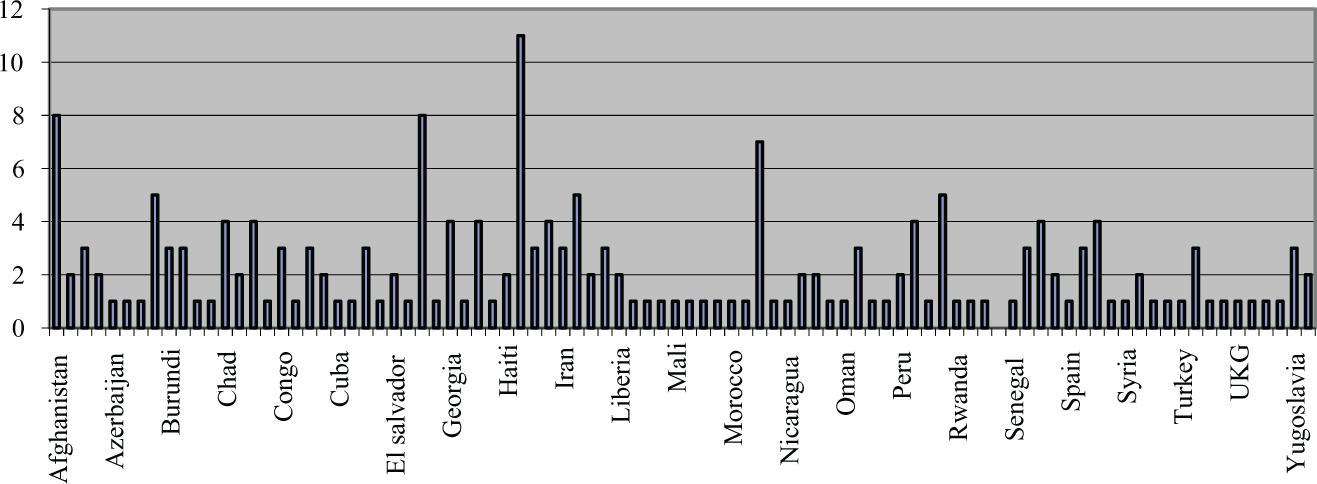
Maximum number of overlapping rebel factions
Forming an alliance is a frequently adopted strategy in civil wars, 181 of the 345 rebels have initiated positive associations with each other while fighting with the government. Almost 50 percent of all dyad year observations report the presence of a cooperative relationship between rebels. Only 17.6 percent of the alliances are made formal with a public declaration, whereby groups declare their intention to work together as a merger, at times uniting military command or coordinating military attacks.
Research Design
To test my arguments, I use Uppsala Dyadic data set v.1-2009 and include all the rebel dyads that are active in the civil war country between 1946 and 2008. Conflict outcomes are not aggregated at the level of the entire conflict, but examined at the level of individual groups. Almost half of all civil war governments in the data set had to confront more than one dyad at one point in the conflict. Given that the number of dyads exceeding one has increased tremendously in the post–Cold War period and the project’s focus is on interrebel relationships and their impact on war outcomes, it is imperative to use a data set that disaggregates all conflicts into dyadic level. 3 There are overall ninety-two civil war countries and 348 relevant dyads in the data.
Coding war outcomes, the dependent variable, is often a contentious issue in the civil war literature (Sambanis 2004). While decisive outcomes and peace agreements create clear-cut endpoints for terminating conflict, it is harder to decide whether a rebel group whose activities oscillate between low and high activity should be coded as continuing the war or engaging in multiple conflicts. I adopt the commonly used criteria in the literature and code such cases as termination of conflict if the rebel group is inactive—unable to satisfy the minimum threshold of battle deaths, for two successive years (D.Cunningham, Gleditsch, and Salehyan 2009; Sambanis 2004). I refer to UCDP Conflict Termination data set v.2.1, 1946–2007 (Kreutz, 2010) and D.Cunningham, Gleditsch, and Salehyan. dyadic data set (2009) to code civil war outcomes. The coding yields termination by peace agreements in 106 cases, decisive outcomes (sixty-nine in favor of government, forty-one in favor of rebels) in 110 cases, and attrition in 123 cases. Most civil wars linger; in 85 percent of all dyad-war observations, rebels keep on fighting.
Independent Variables
Alliance
Alliances are coded as a dummy variable for each rebel group over the years. Two groups are said to be allied if they have a cooperative relationship in their quest to defeat the government, for example, allied groups may help train each other’s recruits, engage in tactical support, share information, receive material, or military support from each other, or carry out coordinated military operations against the government.
Alliance duration
This indicates the duration of each alliance and ranges from a minimum of 0 to a maximum of forty-one years. Most alliances are temporarily formed, out of the 1,166 dyad year observations, 21 percent of alliances have a life span of only one year while 44 percent of them have a survival period of maximum three years. In the presence of multiple alliances, the highest duration for each year is recorded.
Formal alliances
Existence of a credible commitment among groups is operationalized by the presence of a formal alliance, which is taken from UCDP Actor data set v. 2.2010. These alliances are (1) mergers of several rebel groups, (2) publicly acknowledged, and (3) often rely on extensive levels of cooperation such as joint command and/or coordinated military attacks. Only one-fifth (200 of the 967 dyad-conflict yearly observations) of alliances are formed with such credible ties.
Allies’ cumulative capabilities
This is coded for each rebel group. Independent rebel groups can only utilize their own military resources while connected groups may also have access to the military resources of their allies. If A is allied with B and C at t, then this variable codes B + C and is expressed in thousands of men.
Number of rebel groups
This is the number of overlapping rebel groups in the civil war country for every year and ranges between 1 and 11. Thirty percent of all dyad-conflict years have only one rebel group, while 31 percent have four or more.
Control Variables
I used commonly adopted control variables in the literature on conflict outcomes. They include the following.
Gross domestic product (GDP) per capita
This is one of the most robust variables associated with duration in civil wars. Higher GDP levels not only indicate a larger state capacity but also lower opportunity costs for rebellion (Fearon and Laitin 2003; Collier and Hoeffler 2004), two factors which might prevent longer wars. This variable is at 2005 constant prices and is taken from Penn World Table v. 6.3 (Alan et al., 2009) for the years between 1957 and 2007. Missing values are interpolated by using energy per consumption, and the data are updated for 2008 taking as reference the GDP growth rates from World Bank Data. This variable is then divided over 1,000.
Rebel support, government support
These two variables show intervention on behalf of rebels and the government, respectively. They are taken from Cunningham, Gleditsch, and Salehyan (2009) and updated for recent years. Findings show that external intervention on behalf of warring parties prolongs conflict (Regan 2000, 2002).
Polity
Polity scores are taken from Polity IV Project, 1800-2009. Democratic governments may be more accommodating as “peace” is a positive dividend with ample domestic and international yields in the political and economic sphere. Rebel groups also face more incentives to return to civilian life in a politically free atmosphere.
Rebel capabilities
Individual rebel strength is taken from D.Cunningham, Gleditsch, and Salehyan (2009) and updated for recent years and missing values. This is expressed in thousands of men. Higher rebel capabilities are expected to increase decisive victory.
Military size
Strength of warring parties is likely to affect civil war outcomes (Mason and Fett 1996; D.Cunningham, Gleditsch, and Salehyan 2009). Governments with a large military capacity may easily defeat the rebels. The data on government’s Military Personnel come from two sources: the data until 2001 are taken from Correlates of War Data set on Material Capabilities (Singer, 1972) and that between 2001 and 2008 are reported from World Bank Development Indicators Database. The correlation between the two data sets is 0.91, and thus, any potential bias from merging them is expected to be random. This is expressed in thousands of men.
Intensity
This variable is taken from UCDP Dyadic data set and records the level of intensity in the dyad per calendar year. It is coded as 1 for minor armed conflicts (25–999 battle deaths) and 2 for war (1,000 or more). Intense conflicts inflict heavy losses on both sides and may push both combatants to a mutually hurting stalemate.
Empirical Findings
I used competing risks regression for the analysis as recommended by Fine and Gray (1999). Occurrence of a peace agreement, government victory, rebel victory, and attrition in this project present competing events for the termination of conflict; that is, every rebel group–government dyad is at a risk of experiencing multiple ways of ending conflict. If the event of interest is the incidence of termination by a peace agreement, then the term competing risks refers to the chance that instead of for a peace agreement, we will observe rebel victory, government victory, or attrition. The competing events in this model prevent the occurrence of the event of interest from happening. When competing events exist, hazards are computed for the event of interest as well as for competing events, h1t , h2t , h3t , h4t , where the cumulative incidence function (CIF), the probability that the event of interest occurs before t, will depend on the hazard of the main event as well as the hazards of competing events. Thus, interpreting covariate effects on CIF is likely to be very hard when covariates affect these cause-specific hazards differently. Fine and Gray (1999) in their method specify the hazards of the subdistribution, the subhazards which are directly associated with CIF’s of respective event types thus making interpretation of covariate effect straightforward (Gutierrez 2010). Estimated subhazards can then be interpreted similar to the hazard ratios in a standard Cox model, where values greater than one are associated with higher cumulative incidence rates.
War Outcomes
Termination of Conflict by a Peace Agreement
I argued that terminating conflict with a peace agreement was a beneficial strategy when the government could divide existing rebels; specifically, absence of positive linkages among groups provided the government with a perfect opportunity to accommodate some rebels at the expense of others. The presence of alliances was expected to lead to higher rebel demands and also act as an impediment (Hypothesis 3) to government strategy of dividing rebels. I have also argued that specifically those groups which have cemented enduring positive interdependencies were even less vulnerable to government’s divide- and- rule tactics; continuous interactions between allied groups prevented a finite-period Prisoner's dilemma kind of situation where each group had incentives to defect in the short term (Hypothesis 4). The findings in Table 1 provide support for my expectations; the results in models 1 through 3 clearly demonstrate that initiatives of dividing rebels are likely to be unfruitful if such groups are allied and also have enduring relationships. While alliances decrease the possibility of termination by a peace agreement by 43 to 44 percent, a noteworthy decrease, the relationship is much stronger and more robust when it comes to durable alliances. Given that the two variables alliance and allianceduration are highly correlated (0.56), they are integrated separately in all models in Tables 1 and 2. Alliance is also highly correlated with the number of rebel groups (0.55); model 3 thus reports the results on alliances in the absence of multicollinearity. Figure 2 shows the CIFs for the variable of interest, for example at t = 5000 days, the CIF values for the alliances of low duration are almost twenty-five times the CIF value of those with high duration. While termination of conflict in the presence of alliances are in general less likely (models 2 and 3), it is even less so if these alliances are enduring (model 1).
War Outcomes-Competing Risks Model
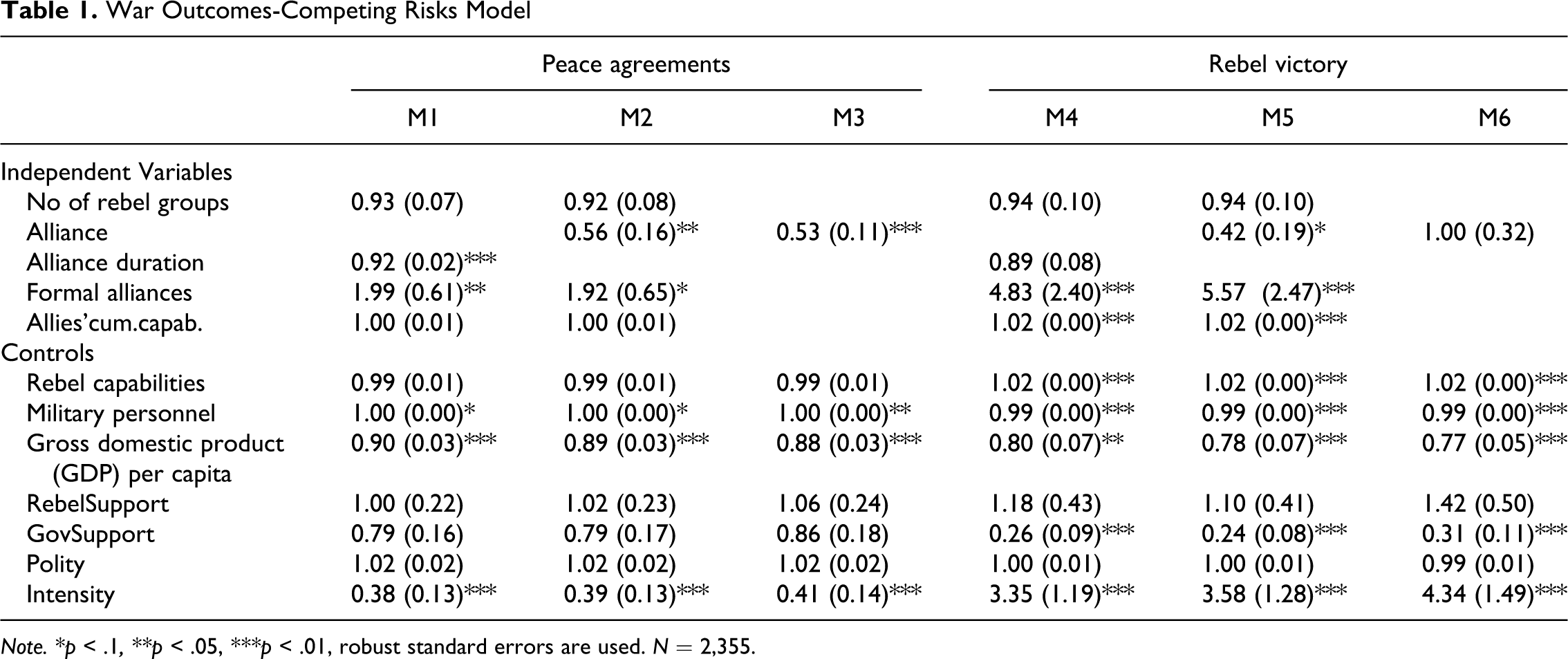
Note. *p < .1, **p < .05, ***p < .01, robust standard errors are used. N = 2,355.
War Outcomes-Competing Risks Model continued
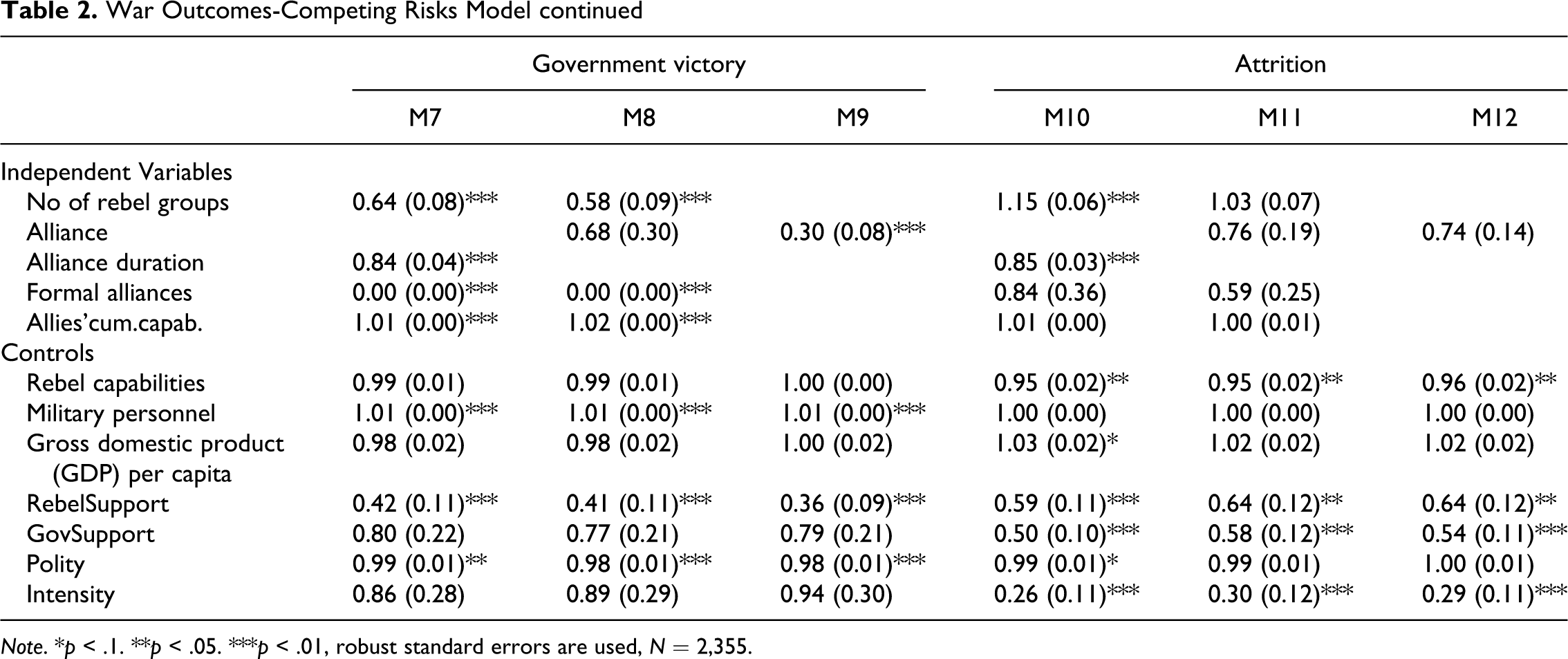
Note. *p < .1. **p < .05. ***p < .01, robust standard errors are used, N = 2,355.
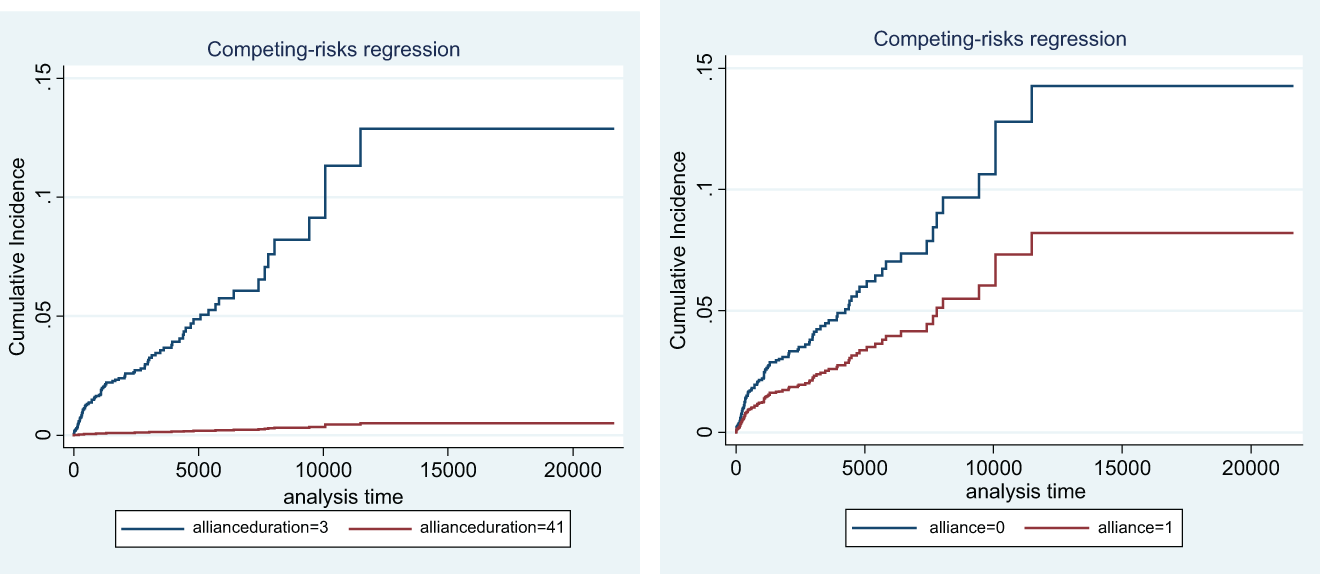
Cumulative incidence function (CIF) for peace agreement Note. Mean and max numbers have been selected for continuous variables. Models 1 and 2 are used to generate the CIFs.
Finally, models 1 and 2 yield an interesting finding that is, while rebels with durable alliances are less likely to be the targets of a peace agreement, those with formal alliances are more likely to be so. It is true that formal alliances are expected to resolve informational asymmetries in the bargaining stage more so than durable alliances since they are openly declared. Thus, information on the commitment between allies and the extent of their associational ties are far more transparent. However, formal alliances also indicate more credible ties among rebels, more relative capabilities, and hence more expensive demands. Given the commitment level in formal alliances, they are also the least likely groups to be divided by cheap accommodations. If governments shy away from making concessions to rebels in durable alliances, they should be even more wary of accommodating those in formal ones. Hypothesis 6 provides the answer to this counterintuitive finding, formal alliances are the means through which rebels achieve victory. Indeed, findings on models 4 and 5 confirm that rebels with credible commitments are likely to be the victors of war. Governments thus have more incentives to accommodate such groups even at the expense of higher concessions; the failure to do so may very well result in their own defeat. Granted durable alliances do not threaten a governments’ survival, governments face fewer incentives for signing peace agreements with those groups.
Rebel Victory
I argued that the mere presence of alliances would not be enough to bring forth a rebel victory against a capable and better organized government, only those alliances which had access to strong cumulative resources of its allies (Hypothesis 5) were expected to defeat the government. Furthermore, those rebels that used these resources effectively by being in a credible alliance (Hypothesis 6) had higher chances of scoring a victory. Indeed, the two variables that are strongly and consistently correlated with rebel victory in models 4 and 5 are the existence of formal alliances and capabilities of each rebel group’s allies. Findings show that a strong military force provides rebels with their most preferred outcome as victory becomes almost a sure thing when groups increase their alliance fighting capacity to hundreds of thousands, but even weak groups can share the spoils of victory if they manage to find strong allies. The CIFs in Figure 3 clearly show how rebels can also benefit from higher capabilities due to the resources of their allies. Neither presence of multiple groups, nor the existence of an alliance between them, no matter how durable it may be, can guarantee a rebel victory; interdependence of groups has to be made credible by a formal alliance. This is because durable alliances do not necessarily imply higher levels of commitment or resources, a durable alliance may very well be sustained at low levels of cooperation and may fall short of providing the necessary ingredients for victory. Surprisingly, the mere presence of an alliance actually decreases the possibility of termination by rebel victory, but the relationship is weak and not robust. This variable is highly correlated with the number of rebel groups, and when it enters the analysis without multicollinearity in model 6, it loses its statistical significance. Overall, one can safely conclude that only two types of alliances seem to matter in rebel victory, formal alliances and capable alliances. The high subhazard ratios in models 4 and 6 indicate that groups in formal alliances are much more likely to defeat the government compared to all other groups. Governments and policy makers have to be wary when public declarations of such alliances take place.

Cumulative incidence functions (CIFs) for rebel victory Note. Mean and max numbers have been selected for continuous variables. Model 4 is used to generate the CIFs.
Government Victory
Models 7 and 9 show the analysis results for government victory. Results are in harmony with all the findings from models 1 through 6. Existence of multiple groups allows each group to survive longer by avoiding government victory thus confirming Hypothesis 1. In such cases, rebels will survive by wearing down the government through sequential attacks and by limiting the resources it can devote to defeating any specific rebel group. In Hypothesis 2, I claimed allied groups were less likely to be defeated. In model 8, alliance is statistically insignificant but one should again approach this result with caution since there is a high multicollinearity between the number of rebel groups and alliance. Indeed, alliance becomes statistically significant in model 9 when it enters the equation alone. This means not only numbers but association may matter when it comes to government victory.
Furthermore, existence of credible ties definitely turn the tide in favor of rebels, governments facing rebels bonded by a formal alliance cannot expect to win the war. Rebels in durable alliances may not be the victors of war (model 4) and they may not be the recipients of peace concessions (model 1), but enduring ties between these combatants seem to provide the means to avoid a government victory (model 7). Long-term relationships among rebels even if they do not guarantee the levels of cooperation and commitment that exist in formal alliances make it hard for the government to defeat rebels given that rebel capabilities are enhanced by continuous cooperation. Surprisingly, cumulative alliance capabilities not only make rebel victory (models 4 and 5) more likely but also government victory. It is likely that as capabilities of the alliance increase groups might fight more conventional wars which provide the government with a clear target for attack. This is in line with D.Cunningham, Gleditsch, and Salehyan (2009), who make a similar claim for strong rebel groups.
Control Variables
Among the control variables in Tables 1 and 2, external intervention on behalf of rebels lowers the probability of government victory while that on behalf of government makes rebel victory less likely. The results in models 1 through 3 indicate that economically strong governments will have the means but not the incentives to accommodate rebel groups, and models 4 through 6 demonstrate that where governments have larger resources, either through their own capabilities (both economic and military) or due to the support of external parties, they will be less at risk of being defeated by rebels. Finally, intense conflicts are likely to be terminated by a rebel victory. While intense conflicts may push combatants toward a mutually hurting stalemate thereby prolonging wars, it is surprising that such conflicts also result in rebel victory. It is likely that rebel groups that are very strong are more likely to fight intense wars, inflicting heavy casualties on the enemy, and forcing its defeat.
Robustness Checks
An alternative model that can be used is the Cox survival model in the presence of competing risks. This model censors competing events which is appropriate when the focus is rather to understand, for example, how alliances affect termination by a peace agreement in general terms, competing terminations withstanding. I redid all the models with this alternative specification, all independent variables remained statistically significant.
Given that interdependencies can only occur in the presence of multiple groups, I also ran all the models with a constrained data set where those observations with only one rebel group were deleted. The results remained robust with respect to the variables of interest; interestingly, however, one of the control variables, rebel strength lost its statistical significance. It was the capabilities of the alliance partners but not of the rebel group itself that determined rebel victory when the data set was restricted only to conflicts with multiple groups. One explanation is that rebel size is likely to be restrained and contribute little to victory when rebels face intense competition from other rival groups for recruitment, a situation that arises only in multiple group contexts. Rebel capabilities may in general remain low and victory in that case may be highly dependent on alliance capabilities, a result supported by the findings in models 4 and 5.
Conclusion
The study of civil wars has recently moved toward dyadic studies; the sole emphasis on state attributes has shifted to incorporate rebel characteristics. Dyadic studies not only address the reality of many contemporary civil wars where the government is pitted against multiple rebel groups but also bring into the picture the rebel side of the story. Concepts of relative power or bargaining leverage between combatants, factors highly salient in understanding civil war outcomes, can only be meaningful if we analyze rebel attributes along with that of their foe, the government. From a theoretical perspective, the article contributes to this line of work by not only looking at the original dyads (government-rebel) but also exploring how rebel-to-rebel relations affect the relative power in the former. Capturing interdependencies among rebel actors in civil wars is a novel approach, one that will be especially relevant for future studies of civil wars with multiple actors. The current trend in civil wars certainly moves in this direction.
Findings indicate that the existence of multiple groups in civil wars has important implications for war outcomes, both the number of groups and their relations matter. Being one of the many groups fighting the government increases the relative strength of each rebel group, including that of the weakest. Fighting with several groups simultaneously reduces the resources the government can allocate for defeating each group. As such, each rebel group enjoys the privilege of avoiding its worst possible fate while extending its survival by having the means to continue the war. Interdependent rebels can do even better; those that have forged alliances can share scarce resources, intelligence and tactical support against their common enemy. Forming alliances might be an optimal strategy to unite a relatively weak and divided rebel market against a well- organized and capable government. Positive connections to other groups increase relative capabilities and provide each with the means to avoid defeat. Enduring alliances among rebels imply, however, that these associations will not be carried to the negotiation table making it unlikely that the government will be able to divide such groups for cheap concessions. Finally, as useful as they are for the rebels, the formation of alliances does not increase the odds of victory. I find that only those that have access to higher capabilities either through one’s own resources or those of its allies, and formal alliances, those with more credible ties, make it likely that rebels will dismantle the government.
This study showed how interdependencies among rebels shape civil war outcomes. The findings of this article indicate that the possibility to contain civil wars remains remote when governments face multiple or allied rebel groups. Not only does the government lose the opportunity to defeat these groups, but also the success of a peace agreement in terminating conflict is made difficult by the high costs likely to be incurred in the accommodation of such groups. On the other hand, external states who are trying to bring down unfriendly governments should find ways to unite rebel groups; such initiatives are likely to bear fruit especially if they manage to build dense commitment ties among groups.
Future research should delve further into understanding how and why positive affiliations emerge among rebel groups in the first place and thus treat alliances and interrebel divisions as dependent variables. Understanding when and with which groups interrebel alliances form, the conditions under which alliances are durable and the context that makes it necessary to establish formal alliances might shed important light on some of the dynamics highlighted in this article. Second, intervention literature has not delved into the relations between external patrons and multiple rebel groups in the face of rebel interdependencies. What is the relationship between existence of interdependent multiple rebel groups and external patrons? Can external patrons play a role in forging rebel to rebel alliances? At times, external actors helped form positive interdependencies between rebels, for example, the formation of Northern Alliance in Afghanistan was a deliberate construction of the Western governments in their fight against the Taliban regime. Similarly, the two fighting parties Barzani’s KDP and Talabani’s PUK in Iraq were getting external aid from Iran concurrently in 1986, which helped them coordinate efforts against the Iraqi regime for the first time in the last six years (Bengio, 1986). Alternatively, one might switch the question and explore how existing rebel interdependencies affect the strategies of external parties when they decide on the recipients of their patronage. Investigating these linkages might yield an interesting research agenda for the future.
Footnotes
Declaration of Conflicting Interests
The author declared no potential conflicts of interest with respect to the research, authorship, and/or publication of this article.
Funding
The authors received no financial support for the research, authorship, and/or publication of this article.
Notes
References
Supplementary Material
Please find the following supplemental material available below.
For Open Access articles published under a Creative Commons License, all supplemental material carries the same license as the article it is associated with.
For non-Open Access articles published, all supplemental material carries a non-exclusive license, and permission requests for re-use of supplemental material or any part of supplemental material shall be sent directly to the copyright owner as specified in the copyright notice associated with the article.
