




Abstract
This study examined the contribution of verbal behavior to the creation of rapport in negotiation, while methodologically addressing the issue of dependence between dyadic measures, which is inherent to the concept of rapport, with the Actor-Partner Interdependence model. The approach adopted is substantially different from that of past research, which emphasized the contribution of nonverbal behavior to rapport and used averaged rapport to asses it. Drawing both from the theoretical concept of rapport and from Politeness theory, the authors developed the Verbal Rapport Assessment scale. The authors found that rapport is indeed encoded in the verbal behavior and that various verbal behaviors contribute to negotiators’ sense of rapport, as well as to the judgment of negotiators’ rapport behaviors. Likewise, the authors found that a negotiator’s sense of rapport was primarily affected by his partners’ verbal behavior and by the interaction between behaviors of both sides. These findings emphasize the importance of the verbal channel and the dyad in creating rapport in negotiation. Negotiation in the twenty-first century is often characterized by exclusively verbal interactions (via telephone, chat, and e-mails); negotiators from many different fields can benefit from these findings.
The Nature of Rapport
In its dictionary definition, the term rapport designates “a close and harmonious relationship in which there is common understanding” (Oxford English Dictionary 2005). In the day-to-day sense, rapport is related to “chemistry” and to a positive connection between people. It exists at the heart of social situations and has great importance in all areas of our social lives: “clinicians try to develop it with patients, sales personnel try to use it to make a deal, and new acquaintances try to predict from it the future of a relationship with one another” (Tickle-Degnen and Rosenthal 1990, 285). Likewise, “Hypnotists work to invoke it, teachers and trainers strive to maintain it, politicians and public speakers have the knack for creating it” (LaFrance 1990, 318).
From an empirical perspective, rapport contributes to the quality of relationships in a variety of contexts: education (among students and between students and teachers; Perkins et al. 1995; Saidia 1990), psychotherapy (between therapists and clients; Gfeller, Lynn, and Pribble 1987; Harrigan and Rosenthal 1983), and business (between buyers and sellers and between service providers and customers; Gremler and Gwinner 2000; LaBahn 1996). Rapport is critical in the context of negotiations, since it provides a basis for creating trust (Drolet and Morris 1995) and influences both the objective and subjective outcomes of negotiation (Curhan, Elfenbein, and Xu 2006; Drolet and Morris 2000; Moore et al. 1999; Morris et al. 2002). Thus, as Cappella (1990, 303) concluded, “The construct of rapport is arguably one of the central, if not the central, construct necessary to understanding successful helping relationships and to explaining the development of personal relationships.”
In light of the centrality of rapport as a theoretical concept, various studies have sought to isolate those variables that contribute to its emergence in interactions. Early studies examined a range of variables including: compatibility between interactants’ peak alert times (Carey, Stanley, and Biggers 1998); the personal characteristics of interactants (such as gender and age; Goudy and Potter 1976); provision of positive reinforcement and feedback during the interaction (Gfeller, Lynn, and Pribble 1987); degree of correspondence between interactants’ behaviors (Bernieri 1988; Bernieri et al. 1994); and qualities of the interactants’ relationship, such as the extent of personal disclosure (Morris et al. 2002).
Tickle-Degnen and Rosenthal (1990) defined two characteristics of rapport that provide a theoretical basis for studying its antecedents and for distinguishing rapport from other constructs relevant to interpersonal interactions (Drolet and Morris 2000). First, rapport is defined as a variable that characterizes a pair or group and not as a personal quality that is situated in the individual. Second, rapport is created via the expressed behaviors of participants in an interaction (Bernieri et al. 1994, 1996; Grahe and Bernieri 1999; Grahe and Sherman 2007; Tickle-Degnen and Rosenthal 1987).
The aims of the present study draw directly from these two characteristics. The first aim is to employ a newer methodological approach that addresses the pair of interactants as the unit of analysis. The second aim is to isolate the expressed verbal behaviors that contribute to the creation of rapport, in contrast to past studies that have focused primarily on nonverbal behaviors.
Rapport as a Variable Characterized at the Dyadic or Group Level
According to the first characteristic of rapport, the interaction that takes place between two people is an entity unto itself and cannot be disassembled to its component parts (DePaulo and Bell 1990; Drolet and Morris 2000; Tickle-Degnen and Rosenthal 1990). Merleau-Ponty observed that
In the experience of a conversation, a common ground constitutes itself between the other one and myself, my thought and his make up a single tissue, my words and his are called out by the phase of the discussion, they insert themselves in a common operation of which neither one of us is the sole creator. (Merleau-Ponty 1945, cited in Bernieri et al. 1996, 114)
Moreover, averaging the scores makes it impossible to test how the behavior of one party affects the feelings of rapport of the other party, because the rapport score is a common one, and it does not allow for testing rapport effects in the appropriate degrees of freedom, because it superficially reduces the sample size.
To address the dependence between measures of dyads, we used the Actor-Partner Interdependence Model (APIM), which makes it possible to address the pair as a unit of analysis and to examine the effects of each of the sides at appropriate degrees of freedom (for further information, see Campbell and Kashy 2002; Cook and Kenny 2005; Kashy and Kenny 2000; Kenny 1996). This is the first study to apply APIM, which was created to account for interactants’ dependence, to the measure of rapport, which is a variable defined by this dependence. The APIM estimates two kinds of effects: actor effects and partner effects. Actor effects are within-person effects: they represent the contribution of an individual’s level of a predictor variable to that individual’s level of an outcome variable. Partner effects are between-person effects: they represent the contribution of a partner’s level of a predictor to an individual’s level of the outcome variable. In this way, the APIM provides separate, statistically independent tests of actor and partner paths, in which the effects of actor’s independent variable on actor’s dependent measure were estimated while controlling for the contribution of partner’s independent variable. Similarly, the effects of partner’s independent variable on actor’s dependent measure were estimated while controlling for the contribution of actor’s independent variable. With this approach, the dyad is treated as the unit of analysis, and actor and partner effects are tested with the proper degrees of freedom.
Rapport as a Variable Produced via Expressed Behaviors
Although expressed behavior includes both verbal behaviors and nonverbal behaviors, until now most research has focused on the influence of the nonverbal channel in creating rapport.
Nonverbal behavior
In their descriptions of the components and characteristics of rapport, Tickle-Degnen and Rosenthal (1987, 1990) claimed that rapport is created and perceived primarily on the basis of nonverbal behaviors in interactions: “non-verbal behavior, as a particularly powerful medium of affective communication, would be a key element in the mediation and emergence of feeling of rapport between participants” (Tickle-Degnen and Rosenthal 1990, 288).The primacy of nonverbal behavior in fostering rapport was corroborated by Grahe and Bernieri (1999), who found that external judges assessed rapport more accurately (i.e., their assessments matched those of the actual interactants more closely) when they merely watched an interaction than when they either read a transcript of the interaction, listened to it, or both watched and listened. Since judges’ assessments of rapport were more accurate when exposed to the nonverbal channel than to the nonverbal and verbal channels together, Grahe and Bernieri conjectured that exposure to the verbal channel can actually impair the accuracy of assessments of rapport.
Other studies have found that the degree of rapport in an interaction can be assessed following exposure to a “thin slice” of the interaction (segments lasting from 30s to 50 s; Bernieri and Gillis 1995; Bernieri et al. 1996; Gillis, Bernieri, and Wooten 1995). While little meaning can be gleaned from the verbal content of such short segments, nonverbal content can be expressed and perceived quickly (DePaulo 1992). Thus, these findings demonstrate the importance of nonverbal cues in fostering rapport. Moore et al. (1999) also demonstrated the importance of nonverbal cues, in the context of a negotiation in which the two sides could not see each other: the researchers found that pairs of negotiators who were shown photographs of each other before the negotiation began reported greater rapport than those who were not shown photographs. Hence, they concluded that exposure to the photograph of the other party (a nonverbal clue) encouraged the emergence of rapport.
These findings, in addition to the trend toward research of nonverbal behavior in the 1990s (Jones and LeBaron 2002), brought researchers to try to identify which particular nonverbal behaviors influence the emergence of rapport and its assessment by external observers. Bernieri et al. (1996) found significant relationships between eight nonverbal behaviors (such as nodding, smiling, and leaning forward) and the degree of rapport reported by participants having an argument, which explained 56 percent of the variance in rapport. In an interaction that involved planning a trip on a map, on the other hand, they found significant relationships only between two behaviors and reported rapport, which together explained 26 percent of the variance. Grahe and Sherman (2007) examined the relationship between eight nonverbal behaviors and the rapport felt by participants who had to assemble a puzzle while one participant gave instructions and the other, the assembler, was blindfolded. They found that reported rapport was related only to one behavior by the instructor (gesturing) and one behavior by the assembler (nodding).
Researchers suggest that these discrepancies in explained variance are due to the shifting focus of rapport across different interaction contexts: when an interaction is internally focused (such as when the two sides sit facing one another and their primary stimulus is themselves, as during an argument), rapport draws heavily from cues in the nonverbal channel. On the other hand, when an interaction is externally focused (such as when the sides are not required or able to see one another, as during the construction of the puzzle), the nonverbal channel plays only a minimal role (Bernieri et al. 1996; Puccinelli, Tickle-Degnen, and Rosenthal 2003).
This distinction raises the question of how rapport is produced when participants to an interaction are not required, nor able to see one another. We suggest, in a manner increasingly relevant to the technology of interpersonal communication today, that when the means of communication prohibit exposure to nonverbal behavior (such as telephone and computer-mediated communication; Croson 1999), rapport will draw more heavily from behaviors in the verbal channel.
Verbal behavior
Although comparatively sidelined in past research, verbal behavior can significantly contribute to the emergence of rapport, particularly in negotiation. Archer and Akert (1977) found that when interactants could hear one another, correlations between the coding of the message by the sender and the decoding of the message by the recipient was significantly greater than when participants saw one another but could not hear one another. Berry et al. (1997) found that first impressions are meaningfully influenced by verbal content, above and beyond the variance explained by nonverbal clues. Although these two studies did not assess rapport, they illustrate that the verbal channel has a meaningful role in the perception and interpretation of interpersonal information. Likewise, Whichman (1970) found that negotiators who were exposed to the verbal channel (could only hear, but not see, each other) cooperated to a greater degree than negotiators who were exposed to the nonverbal channel (could only see, but not hear, each other). Although rapport was not directly examined in this study, the degree of cooperation in negotiations has been found to correlate with rapport (Drolet and Morris 1995, 2000).
The few studies that have sought to isolate the contribution of specific verbal behaviors to rapport have been carried out in the psychotherapeutic context. These studies found that the more therapists expressed reflections of emotions, restatements, verbal reinforcements, and silences (of up to 33 s), the greater the rapport felt by their clients (Gfeller, Lynn, and Pribble 1987; Sharpley 1997; Sharpley et al. 2000). As the psychotherapeutic context is highly verbal, this points to a possible connection between the verbal channel and rapport in other contexts as well.
Other studies have examined the influence of verbal behaviors on the quality of interactions. Clark, Drew, and Pinch (2003), for example, identified a number of verbal behaviors by sales agents (such as agreement and reinforcement) that brought about greater expressions of affiliation and of commitment to purchase a product by their customers. Although rapport was not directly measured by the researchers, they related these verbal behaviors to the sense of rapport that customers felt. Similarly, Planken (2005) found that expert negotiators made greater use of “safe talk” (talk that is not directly directed at or relevant to the content of the negotiation) and pronoun use (such as we and us) than nonexpert negotiators, two verbal measures that are positively correlated with relationship quality, and hence possibly to rapport.
The Present Study
The primary purpose of the present study was to examine the role of the verbal channel in the production of rapport in negotiation interactions. Rapport was methodologically treated as a dyadic variable. The research hypotheses suggest that verbal behaviors by both negotiators (the Actor and Partner) contribute to the sense of rapport felt by both negotiators; thus, rapport is addressed as a dyadic/interactive variable.
The research model was examined in two stages. First, we investigated the degree to which rapport drew from the verbal behaviors of interactants. This was assessed by comparing the degree of rapport experienced by negotiators and the assessment of rapport by an external judge who read a transcription of the negotiation. We hypothesized that (a) participants’ rapport would positively correlate with the assessments of the external judge and (b) the judges’ assessment of whether one side’s verbal behavior contributed to rapport would positively correlate with the degree of rapport reported by the other party.
Second, we identified specific verbal behaviors that contributed to the negotiators’ sense of rapport and to the assessment of rapport by external observers. We hypothesized that as interactants used more verbal behaviors that contributed to rapport and fewer verbal behaviors that impaired rapport: (a) the greater rapport they would experience, (b) the greater rapport would be experienced by the negotiating partner, and (c) the greater the external judge’s assessment of the contribution of that interactant’s behaviors to fostering rapport. To examine these hypotheses, we constructed a tool measuring diverse verbal behaviors and their contributions to rapport in negotiation.
Method
Participants
Participants were 292 undergraduate students at an Israeli liberal arts university, who took part in the study in exchange for payment of 25 New Israeli Shekels (NIS, the Israeli currency. 1$ = 3.7 NIS) (about $6). Six pairs were eliminated from the sample due to insufficient data (questionnaires or negotiation simulations that were not completed or recorded well), leaving 280 participants in the study (140 pairs), of which 58 percent were women. Participants ranged in age from eighteen to fifty-nine years (M = 23.5, SD = 4). Participants signed their agreement to participate in the study and to have segments of the simulation recorded.
Tools and Procedure
Stage 1: Negotiation Simulation
To prevent gender bias, participants were matched to achieve thirty-one male–male pairs, fifty-four female–female pairs, and fifty-five mixed-sex pairs (of which in twenty-seven the interviewer was male and in twenty-eight female). Aside from this restriction, pair and role assignment was random.
Participants pairs were invited to the lab at staggered intervals so they would not see each other. The first participant was seated behind a screen, which separated the participants throughout the experiment. This arrangement isolated the verbal channel by averting exposure to nonverbal clues such as body language, physical appearance, and the like. Further, this arrangement made possible a natural, free, and continuous flow of conversation (in contrast to computer-mediated communication, in which nonverbal clues such as intonation and vocal intensity are completely neutralized but the flow of utterances is disrupted and artificial).
Once the two participants were seated, they were told that they would be taking part in a negotiation simulation regarding the employment conditions of a candidate for a sales position (the interviewee) and a chief financial officer (the interviewer) at an office supplies company. Each participant received written instructions in accordance with his or her role: the interviewee was informed that his target salary was 5,000 NIS, whereas the interviewer was told that she wished to pay no more than 3,500 NIS. Neither side knew the other’s interest in advance, and neither were given instructions as to how to bridge the gap or by what parameters they should try to do so (e.g., insurance, vacation time), as this was thought to potentially narrow the verbal content of the negotiation. Thus, aside from the structured gap in interests, negotiators were free to bridge the disparity as they saw fit. This method was meant to enable rich, creative, and personal verbal expression by the negotiators.
Following these instructions, the interviewer and interviewee began the simulation, which was recorded. For the sake of consistency, a set amount of time (15 minutes) was allotted for each negotiation. Following the simulation, the participants were asked to complete two self-report measures on rapport—one reflecting their assessment of the quality of the negotiation, and the other their feelings during the interaction—and a questionnaire on background data. Once they completed the questionnaires the experimenter reimbursed participants and allowed them to meet, verifying that they had never met previously.
Rapport questionnaire 1: Characteristics of the interaction
The 18-item Rapport Questionnaire (Bernieri et al. 1994; Bernieri 2005) is a self-report measure that includes 18 items characterizing an interaction as “boring,” “satisfying,” “intense,” and the like. The questionnaire was translated for the purpose of this study by a doctor in psychology, a doctor in linguistics, and two graduate students in psychology, all bilingual. Back-translation verified the accuracy of the translation. Responses were rated by each party to the interaction on a scale ranging from 0 (not at all) to 8 (very much). Scores were averaged, with higher scores indicating that the participant perceived greater rapport. Factor analysis revealed only one factor for the 18 questionnaire items, which showed high internal consistency (Cronbach’s α = .88).
Rapport questionnaire 2: Feelings during the interaction
This questionnaire is based on items used by LaBahn (1996) and Curhan, Elfenbein, and Xu (2006), which were amended and translated for the purpose of this study by two bilingual doctoral students in psychology and back-translated for accuracy. The questionnaire contained three items assessing parties’ feelings about the interaction: the first item, taken from LaBahn (1996), assesses participants’ sense of chemistry; items 2 and 3, taken from Curhan, Elfenbein, and Xu (2006), assess participants’ satisfaction with the negotiation process and willingness to negotiation again with the other person. Participants responded on a scale ranging from 0 (not at all) to 8 (very much). Rapport for each participant was calculated as the average of the three items, such that higher scores represented a greater sense of rapport. The three items showed high internal consistency (Cronbach’s α = .87).
The rationale for using two questionnaires was to compare measures of rapport based on interaction characteristics with those based on the feelings experienced by interactants. However, since Pearson correlations showed that correspondence between the two questionnaires was very high (r = .78, p < .001), since the results using the two questionnaires were similar and for sake of efficiency, we employed only the shorter questionnaire in the data analysis.
Background data
On this questionnaire, participants recorded their sex, age, family status, and other questions.
Stage 2: Evaluation of Rapport Characteristics Expressed in Verbal Behavior
The recorded simulations were transcribed by eight psychology students, who were trained in transcription by a doctor in linguistics. These transcriptions were then assessed by thirteen judges, also psychology students, who were each provided a random selection of ten to twelve transcriptions for evaluation. Judges were asked to read and score the transcribed simulations on to two scales: one assessing the rapport characteristics evident in the interaction, and the other the rapport characteristics expressed by individual negotiators. Both scales were constructed for the purpose of the present study by a professor and two graduate students in psychology.
Interaction Rapport scale
Following Tickle-Degnen and Rosenthal (1990), this 11-item scale was constructed to represented the three dimensions of rapport in interaction: positivity (pleasant atmosphere, absence of aggression, positivity, negativity), coordination (cooperation, like-mindedness among participants, synchrony, flexibility), and mutual attention (listening, tolerance, attentiveness). Judges rated the interaction per each item on a scale ranging from 1 (not at all) to 7 (very much). Factor analysis revealed that all items loaded on a single factor having high internal consistency (Cronbach’s α = .96). Accordingly, a single average score was calculated per interaction, with higher scores indicating the interaction was judged to express more rapport.
Negotiators’ Rapport scale
This scale was identical to the Interaction Rapport scale described above, except that items were worded to address the rapport characteristics expressed by each individual negotiator, interviewer and interviewee, rather than the interaction as a whole. Factor analysis per each negotiator produced a single factor having high internal consistency (Cronbach’s α = .93). Scores were thus averaged, with higher scores indicating that the negotiator was judged to more strongly express rapport characteristics.
Stage 3: Evaluation of the Contributions of Specific Verbal Behaviors to Rapport
Identification of verbal behaviors
In order to assess the contributions of specific verbal behaviors to rapport, we constructed the Verbal Rapport Assessment scale (VeRAS), a tool for analyzing the verbal content in negotiation that may be related to rapport. To construct the tool, we first mapped a broad range of verbal behaviors culled from the literature on pragmatic linguistics, which addresses how speakers use verbal expression to bring across meaningful messages. We focused on politeness theory (Brown and Levinson 1987), which is particularly relevant to the concept of rapport because it describes how interactions between individuals can improve or harm impressions and feelings. We reduced the amassed range of possible verbal behaviors to forty of the most frequent behaviors in politeness theory literature, and sorted them according to the three verbal domains set out in politeness theory and its elaborations (Matsumoto 1989; Spencer-Oatey 2000): speech acts, discourse, and participation (see Table 1).
Verbal Variables According to Domains of Verbal Behavior

The speech acts domain is the domain that most greatly influences the preservation or injury of face (Brown and Levinson 1987), and includes two kinds of utterances: head acts and supportive moves. A head act is an utterance via which the speaker carries out an act of some kind using language (e.g., I pronounce you man and wife; Austin 1962; Searle 1969). Other examples of speech acts include requests, promises, commands, threats, criticisms, compliments, agreements, disagreements, apologies, and expressions of thanks (Blum-Kulka, House, and Kasper 1989). Supportive moves are words or utterances adjacent to the head act that change its force, either by softening (e.g., I somewhat agree) or intensifying (I totally agree).
The discourse domain addresses the personal and pragmatic content of the interaction, such as speakers’ choice of topics (e.g., whether they will speak strictly about negotiated issues or whether they will also engage in person conversation and small talk) and the valence of the discussion (e.g., whether interactants will express positive or negative emotion toward each other, and whether they will evaluate the interaction content in a positive or negative manner via such words as great, terrible, and the like).
Participation domain includes the procedural aspects of the interaction, such as coordination of turn-taking in conversation and demonstrations of attentiveness (by means of such interjections as uh-huh, yes, and the like).
Scoring frequency of verbal behaviors
Once verbal behaviors were identified, we scored their frequency in the simulation transcriptions. Scoring was carried out by eleven psychology students who evaluated twelve to fourteen randomly selected transcripts each, and who were specially trained for the task by a graduate student in psychology and a doctor in linguistics. In order to examine interjudge reliability, eighteen random simulations were coded by all judges, without their knowledge. Internal consistency analyses made on these simulations revealed high interjudge reliability (Cronbach’s αs > .97). Scores were divided by the number of words spoken during the negotiation in order to reduce possible effects for text length, and were multiplied by 100 to achieve numbers greater than one. Three scores were reached for each simulation, reflecting the frequency of verbal behaviors expressed by the interviewer, the interviewee, and both together (divided, respectively, by the total number of words spoken by interviewer, interviewee, or both).
Clustering verbal behaviors
We sought to reduce the number of verbal variables by clustering them into factors, on the basis of their content, and by reaching an agreement between fourteen judges (a psychology professor, a doctor in linguistics, two graduate students in psychology, and ten undergraduate psychology students). This process produced thirteen verbal variables, including each of the verbal behaviors presented in Table 1, excluding two (explanation and apology), for which agreement was not reached as to which factor they belong to. Intercorrelations between these variables, as well as correlations between them and dependent variables (negotiators’ felt rapport and rapport characteristics as evaluated by external judges), are presented in the appendix.
We tried to sort the thirteen verbal variables into each of the three domains that make up rapport (positivity, coordination, and attentiveness); however, interjudge agreement regarding which domain each variable belonged to was low. Thus, verbal variables were sorted into two agreed domains: variables related to the discourse process and those related to the discourse content.
The content domain addresses the personal and pragmatic content of the interaction, such as speakers’ choice of topics (e.g., whether they will speak strictly about negotiated issues or whether they will also engage in person conversation and small talk) and the valence of the discussion (e.g., whether interactants will express positive or negative content toward each other and whether they will evaluate the interaction content in a positive or negative manner via such words as great, terrible, and the like).
The process domain includes the procedural aspects of the interaction, such as coordination of turn-taking in conversation and demonstrations of attentiveness (by means of such interjections as uh-huh, yes, and the like).
In each of these domains, a further distinction was made between variables related to discourse generally and those related to the negotiation in particular. In addition, we distinguished between verbal variables making a positive versus negative contribution to rapport. The final outcome, which embodies the VeRAS tool, is presented in Table 2.
Verbal Rapport Assessment Scale (VeRAS)—Verbal Behaviors and Their Expected Contribution to the Creation of Rapport, by Domains and Content
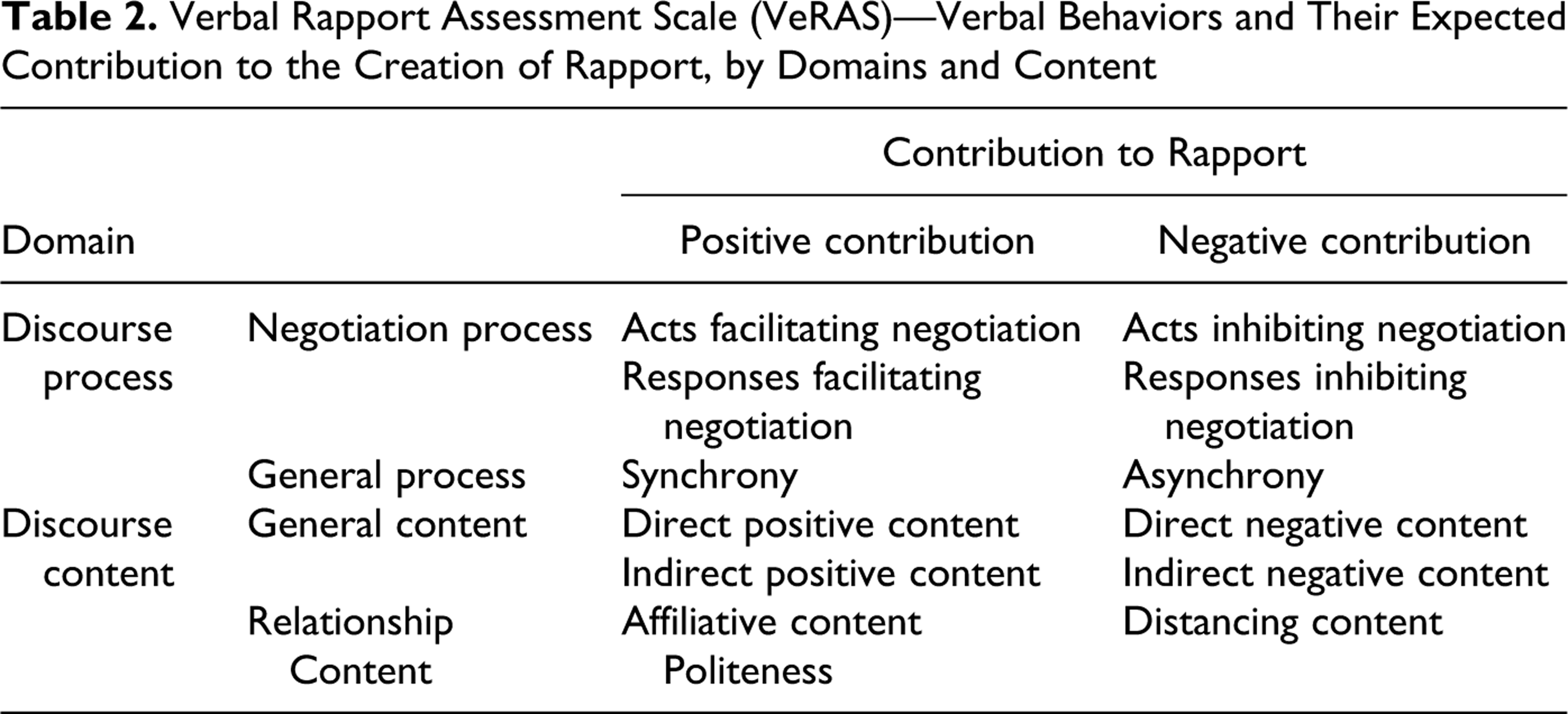
As can be seen in Table 2, we predicted that seven verbal behaviors would positively contribute to rapport and six would hinder rapport. Of behaviors that are directly related to the negotiation process, acts facilitating negotiation include recommendations, requests, and promises; responses facilitating negotiation include acceptance, agreement, and willingness for flexibility; acts inhibiting negotiation include requests and setting conditions or ultimatums; and responses inhibiting negotiation include nonacceptance, disagreement, and insistence. We predicted that acts and responses advancing negotiation would contribute to the creation of rapport in negotiation, since these point to positivity and attentiveness to the desires and interests of the other. Acts and responses that hinder negotiation, as mirror images of the former, will retard the emergence of rapport.
In the domain of behaviors related specifically to the interaction process, those expressing synchrony verify that the sides are on the same “wavelength” and that they understand each other correctly (signaling attentiveness, asking questions, requesting confirmation, and providing confirmation), while asynchronous acts impair coordination between the sides at the procedural level (interrupting or repeating what has been said). Accordingly, synchrony is hypothesized to contribute to rapport and asynchrony to retard rapport. Behaviors related to the interaction content may be positively or negatively valenced. These include direct positive content (expressing positive emotions and transmitting positive messages), indirect positive content (softening a negative message or intensifying a positive message), direct negative content (expressing negative emotions and transmitting negative messages), and indirect negative content (intensifying a negative message or softening a positive message). We predict that positive content categories will bolster rapport, while negative content categories will hinder the emergence of rapport.
The domain of behaviors related to the relationship includes affiliative content (personal interest, compliments, personal exposure, and use of first name), distancing content (criticism, disparagement, threat, and minimization of the importance of what the other has said), and politeness (greetings, departing wishes, and conventionally polite words such as those expressing thanks). We predict that affiliative content will encourage rapport since it expresses positive attention toward the other, and that expressions of politeness will also contribute to the creation of rapport, since politeness is a convention in interaction management that expresses basic concern for the relationship. In contrast, distancing content, which expresses negatively toward the other, will retard the emergence of rapport.
Results
The Encoding of Rapport in the Verbal Channel
To assess whether negotiators’ sense of rapport was encoded in expressed verbal behavior, we calculated correlations between negotiators’ self-reported sense of rapport and the evaluations of rapport characteristics by external judges, where both negotiators and judges had been exposed only to the verbal channel. In accordance with Hypothesis 1, judges’ rapport scores were positively correlated with the averaged rapport scores of interviewer/interviewee pairs, r = .36, p < .001. That is, judges who merely read transcripts of negotiations were able to accurately assess the sense of rapport felt by negotiators.
With respect to the second hypothesis, we found, as hypothesized, that judges’ ratings of the rapport characteristics exhibited by one partner were positively correlated with the sense of rapport experienced by the other partner, r = .32, p < .001. In other words, the more one side was externally judged to exhibit characteristics of rapport (flexibility, attentiveness, and the like), the more that person’s negotiating partner felt a sense of rapport. These findings affirm that rapport is encoded in expressed behaviors.
It is worth noting that the correlation between interacting negotiators’ levels of rapport was r = .20 (p < .05), lower than the correlation between negotiators and judges. We address this point in the Discussion section.
Contributions of Verbal Behaviors to Negotiators’ Sense of Rapport
In order to examine the contributions of verbal behaviors to negotiators’ sense of rapport while addressing the interdependence between interactants’ measures of rapport, and in order to distinguish the unique contributions of each behavior to rapport, we carried out data analyses according to the APIM using Hierarchical Linear Modeling (HLM; Bryk and Raudenbush 1992). This method enables examination of within- and between-subject effects for rapport and combined effects (between and within subjects) at the dyadic level.
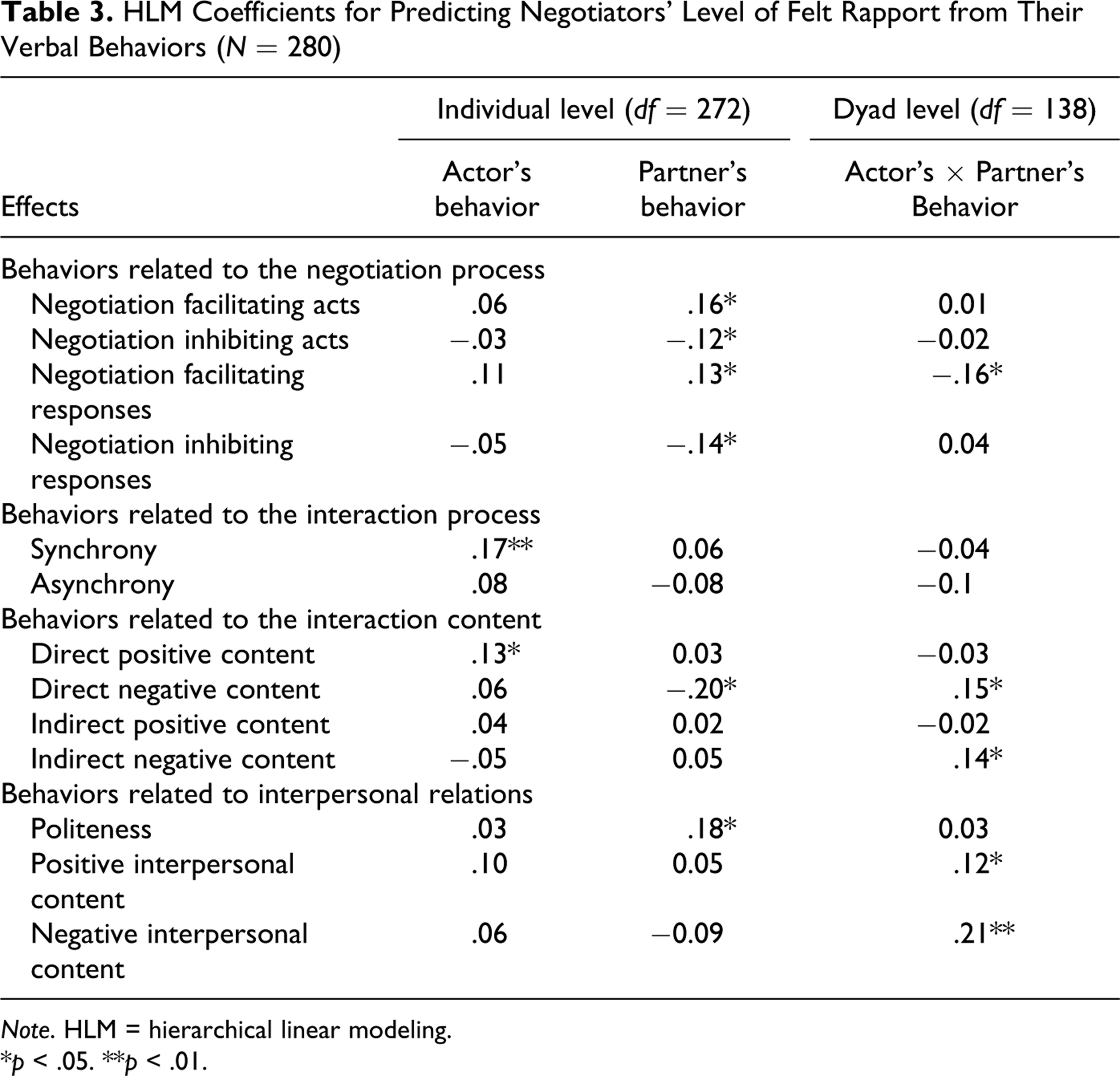
At the individual level, we examined the unique contributions of the behaviors of actors and partners to actors’ sense of rapport. At the dyadic level, we examined the unique contribution of the interaction between the behaviors of actors and partners to actors’ sense of rapport. HLM coefficients for predicting degree of rapport as an outcome of the verbal behaviors of negotiators are presented in Table 3.
HLM Coefficients for Predicting Negotiators' Level of Felt Rapport from Their Verbal Behaviors (N = 280)
Note. HLM = hierarchical linear modeling. *p < .05. **p < .01.
Behaviors related to the negotiation process
Partners’ negotiation-facilitating acts and responses contributed to actors’ sense of rapport (β = .16 and 13, respectively; ps < .05), while those inhibiting negotiation curtailed actors’ sense of rapport (β = −.12 and −.14, respectively; ps < .05). That is, as partners exhibited more acts and responses that facilitated negotiation, and fewer acts and reactions that inhibited negotiation, actors reported feeling greater rapport.
Likewise, we found that the main effect of partners’ negotiation-facilitating responses on actors’ sense of rapport was moderated by the interaction between the behaviors of the actor and partner (β = −.16, p < .05). Probing the interaction using Aiken and West’s (1991) simple slope test and Preacher, Curran, and Bauer’s (2006) computational tool revealed that partners’ negotiation facilitating responses had an effect on actors who expressed few negotiation facilitating reactions (β =.28, p < .01), but not on actors who were high in those behaviors. In other words, among actors who expressed few negotiation-facilitating reactions, the more the partner used such reaction, the greater the actor’s level of rapport.
Behaviors related to the discourse process
Actors’ synchrony positively contributed to their feelings of rapport (β = .17, p < .01). That is, actors who express more synchrony also reported feeling greater rapport.
Behaviors related to discourse content
Actors’ direct expressions of positive content positively contributed to their sense of rapport (β = .13, p < .05), and partners’ direct expression of negative content curtailed actors’ sense of rapport (β = −.20, p < .05). That is, as actors expressed more direct positive content, and as partners expressed less direct negative content, actors felt greater rapport. Likewise, the contribution of partners’ direct negative content to actors’ sense of rapport was moderated by the interaction between the behavior of the actor and partner (β = .15, p < .05). Probing the interaction showed that among actors expressing little direct negative content, the more partners expressed direct negative content, the less rapport those actors felt (β = −.35, p < .001). A similar interaction was found between expressions of indirect negative content by actors and partners (β = .14, p < .05); further investigation of the interaction indicated that among actors who expressed little indirect negative content, the more partners expressed indirect negative content, the less rapport those actors felt (β = −.23, p < .01).
Behaviors related to the relationship
Partners’ demonstrations of politeness positively contributed to actors’ sense of rapport (β = .18, p < .05). That is, the more partners demonstrated politeness, the greater actors’ reported feelings of rapport. The interaction between actors’ and partners’ expressions of positive (i.e., affiliative) interpersonal content was significant (β =.12, p < .05). Analyses probing the interaction indicated that among actors who expressed more affiliative content, the more the partner expressed affiliative content, the greater rapport actors felt (β =.19, p < .01). Likewise, an interaction was found between actors’ and partners’ expressions of distancing content (β = .21, p < .01). Elaboration showed that among actors who expressed little distancing content, the more partners expressed distancing content, the less rapport actors felt (β = −.30, p < .001). Figure 1 summarizes all findings graphically.
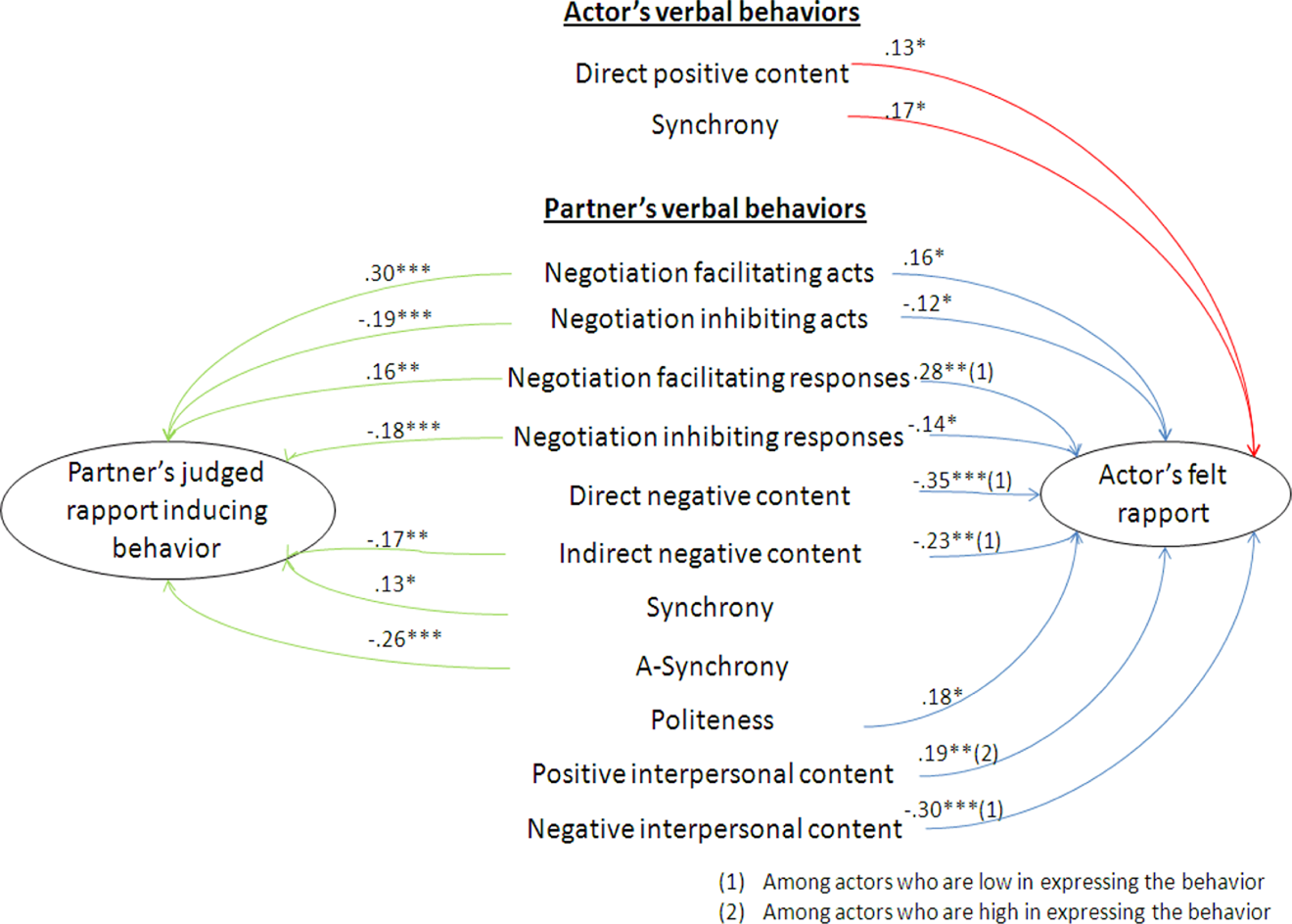
The contribution of actor’s and partner’s verbal behaviors to felt rapport and judged rapport
Contributions of Verbal Behaviors to External Judgment of Rapport Characteristics
We carried out hierarchical regression analyses to assess the unique contributions of verbal behaviors to predicting external judges’ evaluations of negotiators’ rapport characteristics. Regression analysis was used in place of the APIM model because judges’ evaluations, in contrast to negotiators’ self-reports, comprise a single score and hence are not dependent on another measure.
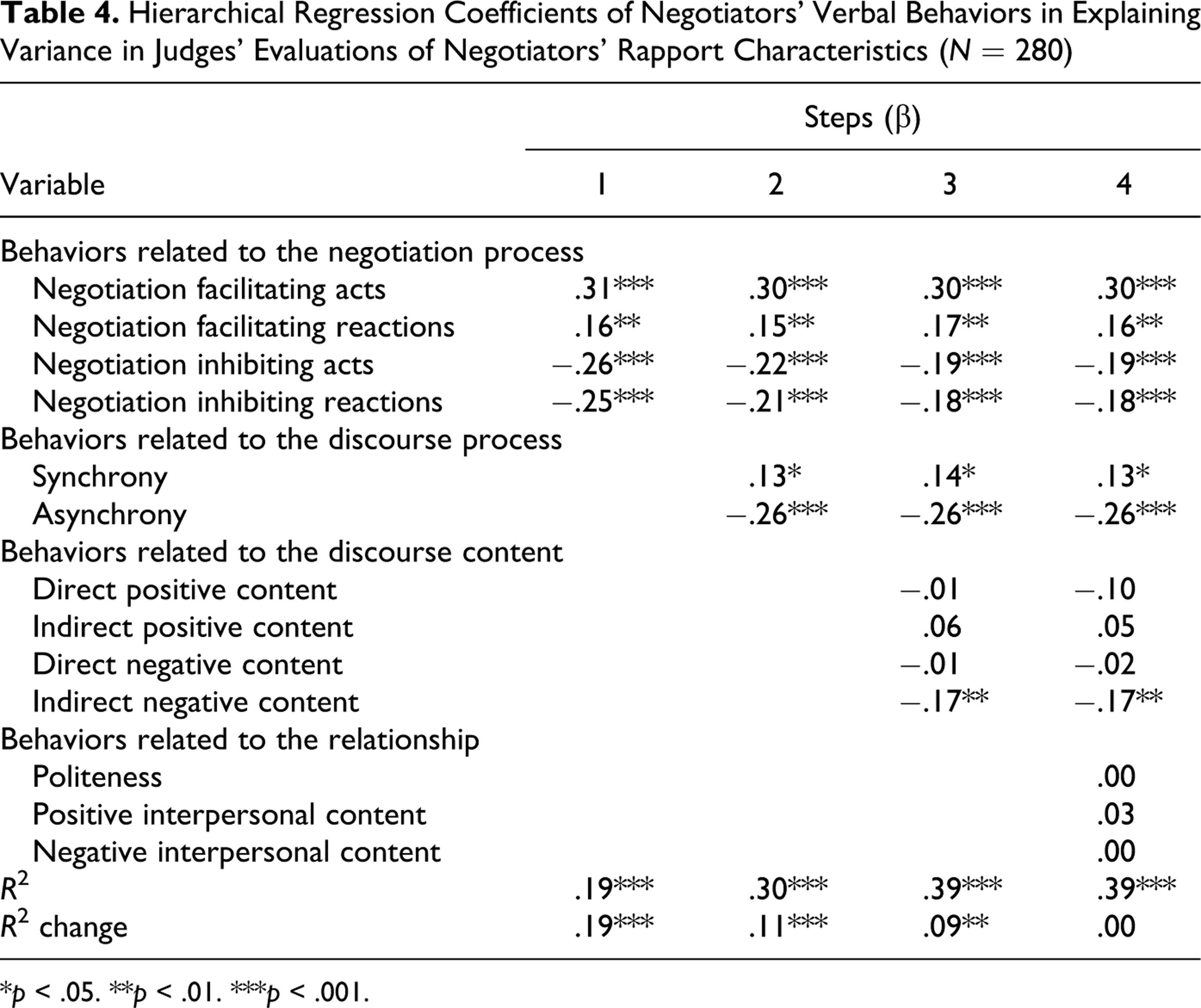
Variables were entered on the basis of the four domains by which the thirteen verbal behaviors were categorized: in the first step, verbal behaviors related to the negotiation process were entered; second, behaviors related to the interaction process; third, behaviors related to the content of the interaction; and fourth, behaviors related to the relationship. Negotiators’ verbal behaviors explained 39 percent of the variance in external judges’ scores of negotiators’ rapport characteristics. Data are presented in Table 4.
Hierarchical Regression Coefficients of Negotiators’ Verbal Behaviors in Explaining Variance in Judges’ Evaluations of Negotiators’ Rapport Characteristics (N = 280)
*p < .05. **p < .01. ***p < .001.
As can be seen in Table 4, behaviors related to the negotiation process explained 19 percent of the variance in judges’ scores. Each of the variables entered in this step made significant contributions, and these remained stable throughout subsequent steps of the regression. In the second step, verbal behaviors related to the discourse process contributed a further 11 percent to the explained variance. Both variables (synchrony and asynchrony) were significant and contributions remained stable in all subsequent steps. In the third step, behaviors related to discourse content contributed a further 9 percent to the explained variance; however, of four variables, only indirect negative content was significant. Verbal behaviors related to the relationship, which were entered in the fourth step, made no contribution. These findings indicate that the more negotiators expressed facilitative acts/reactions and synchrony, and the less they expressed hindering acts/reactions, asynchrony, and indirect negative content, the higher external judges’ evaluations of their exhibited rapport characteristics.
Discussion
The purpose of the present study was to examine the role of the verbal channel in fostering rapport in negotiation, while methodologically treating rapport as a dyad-level variable. To examine the role of the verbal channel, we pursued three primary research questions: (a) whether rapport is encoded in the verbal behavior of negotiators, (b) which particular verbal behaviors contribute to negotiators’ sense of rapport, and (c) which particular verbal behaviors contribute to external judges’ evaluations of negotiators’ rapport.
The Encoding of Rapport in Negotiators’ Verbal Behavior
Judges in this study were able to identify negotiators’ levels of rapport even though they were exposed only to the transcribed verbal behaviors of participants.
The significant correlation we found between negotiators’ rapport levels and rapport judgment supported the argument that rapport is, indeed, encoded in the verbal channel. Moreover, we found this correlation to be higher than the correlation of the rapport levels of the interacting negotiators themselves. This is in line with previous findings, where rapport feelings of interacting participants were not highly correlated (e.g., Bernieri et al. 1996). However, the finding that rapport is encoded in the verbal channel opposes previous studies that found that rapport is encoded only in nonverbal behavior (Bernieri et al. 1996; Grahe and Bernieri 1999).
We believe that the difference is due to the fact that in the past, there was a discrepancy between the interaction as experienced by the participants and content that the judges were exposed to. The discrepancy was in two dimensions. The first is interaction length—many past studies exposed judges to very short (30s to 50s) segments of the interaction (thin slices), while the participants were exposed to its entirety. Beyond the discrepancy, short segments do not allow for real exposure to the verbal channel (DePaulo 1992). The second dimension is exposure to nonverbal information. Previous studies compared participants engaged in face-to-face communication with the evaluations of judges who were exposed only to the verbal channel. In contrast, the present study compared participants and judges exposed to more similar verbal clues—participants to each others’ spoken behavior, and judges to written transcriptions of the interactions thereof. While not identical—participants were exposed to each other’s voices, including intonations and vocal intensities, which judges were not—it is likely that the behavioral clues to which both sides were exposed were more comparable, bringing about more similar evaluations of rapport in the interaction. Futures studies may more accurately assess the encoding of rapport in the verbal channel by modulating similarity of exposure to verbal clues by judges and participants (e.g., participants may carry out interactions in writing or judges may hear audio recordings of spoken interactions).
This finding accords with research showing that relationship content can be encoded even in means of communication that prohibit visual exposure, and that personal, emotional involvement is possible across a variety of different types of communication (for an overview, see Derks, Fischer, and Bos 2008).
Contributions of Verbal Behaviors to Negotiators’ Sense of Rapport
Verbal behaviors differentially contributed to negotiators’ sense of rapport and to external judges’ evaluations of negotiators’ rapport characteristics. The VeRAS tool created for this study is the first tool to make such evaluations possible. Twelve of the thirteen VeRAS behaviors contributed either to the sense of rapport felt by the negotiator expressing that verbal behavior, the sense of rapport felt by the negotiator’s partner, or to external evaluation of the negotiator’s rapport characteristics. In each case, the contribution was in the hypothesized direction. Nine of the twelve verbal behaviors contributed to the negotiating partner’s sense of rapport, and these nine included all verbal behaviors related to the relationship domain. These findings support the definition of rapport as a variable related to the quality of relationships. Indeed, as demonstrated in this study, even in brief (15 minute), onetime, instrumental interactions between strangers having no prior acquaintance with one another or expectations for future relationship continuity, behaviors related to the relationship carry great weight.
Likewise, each of the behaviors related to the negotiation process domain (agreement/disagreement, acceptance/nonacceptance, and the like) contributed to rapport. This may be fixed in the character of the negotiation interaction employed in the study: a focused interaction in which both sides had interests, agendas, and desired outcomes. Possibly, participants’ feelings about the quality of the interaction were strongly influenced by the extent to which they felt their partner understood their interests and responded to them. In a more open, disinterested interaction such as a friendly conversation, it is likely that behaviors related to the interaction context would receive less emphasis.
In the content domain, we found that negotiators’ sense of rapport was strongly diminished when partners express negative content, whether directly or indirectly, but that positive content seemed to have little influence on rapport. A possible explanation may be found in Kanouse and Hanson’s (1971) “negativity effect”, according to which negative stimuli bear a stronger influence on appraisals than do positive or neutral stimuli having similar intensity (Peeters and Czapinski 1990), including in the case of verbal stimuli (Peeters 1989).
Nor, in the interaction process domain, did negotiators’ synchrony or asynchrony contribute to partners’ feelings of rapport. This may reflect the normativity of “dugri” (straightforward), informal speech in Israeli culture, according to which interactants may be less sensitive to interruption and inattentiveness than participants in North America, where most studies have been conducted (Katriel 1986). Alternatively, according to Tickle-Degnen and Rosenthal (1990), the kinds of behaviors that foster rapport change throughout the stages of a relationship. In the early stages of a relationship, before sides know each other well, partners expect little coordination and synchrony of each other. Thus, this domain may carry less weight in determining participants’ sense of rapport. However, as acquaintanceship continues, coordination increases in importance. It is possible that in longer negotiations than those allowed for in this study, the interaction process domain would more greatly contribute to sense of rapport. An additional explanation to this domain’s minor contribution may be that we have tested it only in the verbal channel. It may naturally be more difficult to define and test synchrony and asynchrony verbally, compared with nonverbally. Further research is needed to clarify whether the construction of these variables in the present study reduced their measured contribution to verbal rapport.
In addition to the abovementioned findings, we found that some verbal behaviors contribute to rapport via the principle of reciprocity: behaviors that foster rapport, such as affiliative content, are effective when expressed by both sides, but fall short of nourishing rapport when expressed by one side alone. The reverse effect was seen in behaviors that inhibit rapport: when both sides behaved negatively, rapport was not effected, but when only one side expressed a negative behavior, the other party’s sense of rapport was diminished. Several studies have shown that reciprocity significantly influences interactants’ behaviors and feelings (see, e.g., Falk and Fischbacher 2006; Kahneman, Knetsch, and Thaler 1986), even when the reciprocated behavior makes no pragmatic contribution to participants’ goals. Thus, participants who feel slighted—their goodwill insufficiently reciprocated by the other side—may impose sanctions on their partner, even if those sanctions hurt themselves (Carpenter and Matthews 2004; Fehr and Gächter 2000), while those who are reciprocated will prefer to cooperate, even when competition would better serve their interests (Hoffman, McCabe, and Smith 1998). Findings of this study suggest that reciprocity in positive behaviors contributes to negotiators’ sense of rapport, while nonreciprocity in negative behaviors hinders rapport.
Contributions of Verbal Behaviors to External Judges’ Evaluations of Rapport
All behaviors related to the negotiation process domain contributed to judges’ evaluations of negotiators’ expressed rapport characteristics. Thus, these behaviors influenced the evaluations of both negotiators and external judges. However, judges who evaluated negotiators’ expressed rapport characteristics, unlike those negotiators’ partners, (1) were influenced by negotiators’ synchrony and (2) were not influenced by negotiators’ expressions of behaviors in the relationship domain. Possibly judges, being external to the interaction, were less attuned to the intersubjective feelings experienced in the course of negotiation and placed greater emphasis on the more pragmatic aspects of the negotiation and interaction process.
Importance of the Dyad
A significant theoretical characteristic of rapport is its definition as a dyadic variable, produced by synergy between participants in interaction. However, the vast majority of studies of rapport have operationally measured this variable on one side of an interaction alone, or as the average reported by both sides, without attending to the interdependence of partners’ rapport. The findings of this study, based on a model of dependence between actors and partners, showed that behaviors and characteristics of the negotiators make the strongest contribution to rapport at the level of the pair and not of the individual: most of the verbal behaviors were found to contribute to sense of rapport were behaviors expressed by negotiation partners and not by the actors themselves; and of these behaviors, most contributions were seen in the interaction between the behaviors of the two negotiators. That is, the level of the pair and the unique combination of the two negotiators are more significant to their verbal behavior and sense of rapport than the personal qualities and verbal behavior of each of the sides singly.
The importance of the dyad in negotiation contexts was emphasized by Elfenbein et al. (2008), who examined the contributions of personal characteristics to the process and outcomes of negotiation in successive interactions:
The largest share of variance in SV [Subjective Value of the interaction] appeared at the dyad level, representing the subjective experience resulting from the unique pairing of negotiators. Thus, it appears that negotiators did not merely repeat the same interaction over and over with new partners on the basis of their stable traits alone but that each interaction actually stands on its own. (p. 1472)
Application, Limitations, and Directions for Future Research
The findings of the present study, which highlight the contributions of different verbal behaviors to feelings and evaluations of rapport, can practically contribute to negotiators’ effectiveness, particularly in the verbal channel, leading to better objective and subjective outcomes. These may be uniquely relevant to organizations whose operations rely heavily on verbal interaction, such as call centers and online service providers, which invest great sums in training their employees to manage customers and in systems to monitor customer communications. Likewise, quality control mechanisms require supervisors—external judges—to evaluate the contributions of employees and customers to the quality of interaction outcomes. This study may help judges determine the verbal behaviors relevant to rapport, and to recognize that the behaviors that influence their evaluations may differ from those most influencing interactants.
The present study is explorative in that it is the first to broadly examine the contributions of verbal behaviors to sense of rapport in the context of negotiation. Being so, and due to its engagement with one of the richest and most complex of human behaviors—language—it would be appropriate for future studies to assess diversified contexts such as social conversation, employment interviews, and the like. Such studies would enable the identification of verbal behaviors and their differential contributions to rapport in varied contexts. The VeRAS tool can be employed as a generic instrument for assessing verbal rapport, since its development was based on politeness theory, which addresses interactions in varied contexts and not only negotiation.
Regarding rapport judgment—in this research, the same judges were employed for both the interaction rapport judgments and the individual negotiators’ rapport scale judgments. This might have caused redundancy, which created a dependency. In future experiments, we suggest that different judges will rate interaction rapport and individual rapport.
We also suggest that further studies address variables that might affect negotiators’ verbal behavior and feelings of rapport. For example, negotiator position (powerful vs. powerless) may affect the way people talk and create rapport, gender may affect verbal behavior and rapport, and so on.
Likewise, continuing studies should integrate between the verbal and nonverbal channels, aiming for a more complex reflection of the behavioral factors that influence rapport. In most interactions, verbal and nonverbal behaviors are interwoven: when people speak they also change their posture, express different gestures, move their hands and eyes, and so on. This would accord with an emerging research direction that emphasizes integration of the verbal and nonverbal channels in understanding the transmission of messages between interactants (Jones and LaBaron 2002; Walther, Loh, and Granka 2005).
The present study integrated between different fields of social behavior, negotiation, and pragmatics, employing one knowledge field in order to shed light on others (Mikulincer and Shaver 2001; Smith, Murphy, and Coats 1999). This approach enabled us to better understand the dynamics at play in the verbal channel. Studies show that as communications media operating only on verbal channels have become more widespread, the capability of integrating emotional and personal involvement during an interaction, including in negotiation, has increased (Derks, Fischer, and Bos 2008; Drolet and Morris 2000). The findings of the present study support this potential. While communications media exhibit rapid generational changeover, and although transmissions of verbal-only messages like twitters and instant messages become ever faster, shorter, and denser in pace, rapport is likely to persist as an enduring ideal for communication between human beings.
Footnotes
Appendix
Declaration of Conflicting Interests
The authors declared no potential conflicts of interest with respect to the research, authorship, and/or publication of this article.
Funding
The authors received no financial support for the research, authorship, and/or publication of this article.
References
Supplementary Material
Please find the following supplemental material available below.
For Open Access articles published under a Creative Commons License, all supplemental material carries the same license as the article it is associated with.
For non-Open Access articles published, all supplemental material carries a non-exclusive license, and permission requests for re-use of supplemental material or any part of supplemental material shall be sent directly to the copyright owner as specified in the copyright notice associated with the article.
