



Abstract
Although they are arguably the worst violators of human rights, dictators sometimes commit to international human rights treaties like the United Nations Convention Against Torture (CAT) to appease their domestic opposition. Importantly, however, executives facing effective judiciaries must anticipate ex post costs that can arise when international treaties are likely to be enforced domestically. This suggests that one domestic institution—a political opposition party—may provide a dictator with incentives to commit to international human rights treaties and violate human rights, while another—an effective domestic judiciary—may constrain the dictator’s ability to violate human rights and incentivize him to avoid international commitment. How do dictators make choices about commitment to human rights law and respect for human rights when they face conflicting domestic incentives? Furthermore, how do these divergent incentives affect compliance when dictators do commit to international treaties? In this article, I argue that the domestic incentives dictators face to support the CAT and engage in torture are moderated in countries with effective domestic judiciaries.
Dictators are the most egregious abusers of human rights, 1 often supporting international efforts to eliminate violations while continuing to abuse their citizens (Hathaway 2002). Because international human rights treaties are limited in their ability to monitor and punish violators (Donnelly 1989; Ramcharan 1989; Forsythe 1991), dictators rarely intend to improve respect for human rights when they commit to the terms of a treaty. But support of human rights treaties can benefit dictators domestically: the domestic opposition, who may pressure for international commitment, may be temporarily appeased when dictators commit to international human rights treaties (Moustafa 2003; Vreeland 2008). Legalized opposition parties are not the only domestic political institutions that affect decisions to support international human rights law; dictators must also consider costs and benefits stemming from other domestic institutions when deciding whether to commit to international treaties and respect human rights. In countries with effective domestic judiciaries, 2 for example, executives must anticipate costs that can arise when international human rights treaties are likely to be enforced domestically. Not only are these ex post costs likely to decrease violations of human rights, they also make dictators less likely to sign human rights treaties in the first place (von Stein 2005; Hathaway 2007; Powell and Staton 2009). The presence of potentially divergent incentives to commit to international treaties and respect human rights domestically leads to a puzzle: what if one domestic institution—a political opposition party—incentivizes an executive to commit human rights treaties and violate human rights, while another—an effective domestic judiciary—constrains the dictator’s ability to violate human rights and yet encourages him to avoid international commitment?
There are few international costs associated with ratifying human rights treaties and failing to abide by their terms (Hathaway 2002; von Stein 2005; Simmons 2009). As a result, a considerable amount of recent literature on this topic focuses on the domestic costs and benefits associated with commitment to international human rights law and domestic respect for human rights (Moravcsik 2003; Hafner-Burton and Tsutsui 2005; von Stein 2005; Vreeland 2008; Powell and Staton 2009; Simmons 2009). Powell and Staton (2009), for example, examine the impact of domestic judicial effectiveness on treaty ratification and respect for human rights and find that states with effective domestic judiciaries are less likely to commit to the United Nations Convention Against Torture and Other Cruel, Inhuman or Degrading Treatment or Punishment (CAT), 3 but more likely to refrain from torture than states without effective domestic judiciaries. Focusing only on dictatorships, Vreeland (2008) argues that dictators facing political opposition parties are more likely than their one-party counterparts to commit to the CAT. Because they also face the stronger political opposition that is associated with legalized opposition, 4 however, dictators who allow their opposition to form into political parties are also more likely to engage in torture. Each argument focuses on how one domestic institution affects human rights; neither considers the potential costs and benefits associated with domestic institutions in combination with one another. This study is the first to explore how divergent domestic incentives affect state commitment to international treaties (specifically, the CAT) and respect for human rights (specifically, torture).
Consider an example. Both Cambodia and Fiji permit the formation of political opposition parties. Based on Vreeland’s (2008) argument, we would expect the leaders of both countries to commit to the CAT in order to appease their domestic political opposition. Although Cambodia acceded to the CAT in 1992, a year in which the government also engaged in high levels of torture (Cingranelli and Richards 2004), Fiji has yet to sign the Convention. We cannot account for this difference by looking only at variance in power sharing: Cambodia and Fiji both allow their opposition to form into legal political parties and meet in the domestic legislature. But the two countries vary remarkably in the effectiveness of their domestic judicial institutions. Cambodia’s judicial system has been criticized for its lack of effectiveness, 5 whereas Fiji provides persons claiming state violations of human and civil rights with access to the High Court (Ntumy 1993). 6 Neither can domestic judicial effectiveness alone fully predict commitment to the CAT: Powell and Staton (2009) would expect Vietnam to commit to the CAT because of the country’s low levels of domestic judicial effectiveness and high levels of human rights violations. 7 But Vietnam has not signed the CAT, potentially because the one-party dictatorship does not face legalized opposition to its rule.
In this article, I argue that looking at the average effect of one domestic institution across all dictatorships can lead to incorrect inferences about the conditions under which dictators commit to international human rights law and engage in human rights violations. In the following section, I discuss how power sharing and domestic judiciaries individually affect dictatorial decisions to commit to international human rights law and engage in torture. I maintain that viewing arguments about power sharing and domestic judicial institutions in isolation prohibits researchers from seeing an intriguing puzzle that is only illuminated when these institutions are considered in conjunction: a dictator faced with both institutions that foster opposition and an effective judiciary must confront conflicting incentives generated by these domestic institutions. The primary contribution of this study is in recognizing the pressure of these conflicting incentives as they affect human rights, and more importantly, theoretically establishing how dictators respond under these conditions. Specifically, I argue that while power-sharing opposition provides dictators with incentives to sign treaties but violate their stipulations, effective domestic judiciaries limit the ability of executives to engage in this type of cheap talk.
Incentives to Commit and Violate Rights
Both early structuralist explanations for repression (Walter 1969; Dallin and Breslauer 1970; Arendt 1973) and later work taking into consideration rationalist expectations (Gurr 1986b; Lichbach 1987; Gartner and Regan 1996) claim that democratic institutions decrease state violations of human rights. 8 Recently, however, there has been a general movement in the literature on government coercion and repression both to disaggregate the institutions of democracy believed to influence state repression (Davenport and Armstrong 2004; Bueno de Mesquita et al. 2005; Davenport 2007b) and to disaggregate repression itself into different types of human rights violations (Fein 1995; Hathaway 2002; Davenport 2007c). I follow suit in this article, distinguishing among dictatorships based on two domestic political institutions—political opposition parties and domestic judiciaries. Although an important strand of literature on government repression distinguishes between different types of dictatorships (Dallin and Breslauer 1970; Linz 1988; Davenport 2007c), I instead follow Vreeland (2008) and Powell and Staton (2009) and focus on the effect of individual political institutions on domestic respect for human rights. Rather than use a broad conceptualization of human rights abuses, however, I focus exclusively on a subset of government repression: state torture. My focus on torture is appropriate because I am interested in both government respect for human rights and commitment to human rights treaties. Accordingly, torture is the only individual human rights violation with a corresponding international treaty—the CAT—prohibiting its domestic use. 9
A dictator’s primary goal is to remain in power (Bueno de Mesquita et al. 2003). 10 Threats to dictatorial rule are frequent and can come from within the ruling elite or from opposition movements within broader society (Gandhi 2008). 11 As a result, dictators create institutions like political opposition parties and legislatures to divide their domestic political opposition and better consolidate their hold on power (Geddes 2005; Gandhi and Przeworski 2006; Magaloni 2006; Gandhi 2008), distribute spoils to ruling party politicians (Magaloni 2006), and feign democratic legitimacy (Bratton and Van de Walle 1997; Bates 2001). These institutions do not provide the same constraints on the incumbent regime that they would provide in a democracy. Incumbent authoritarian regimes often allow the creation of political parties and elections in order to quell intraregime conflict and “counterbalance” a powerful domestic military (Geddes 2005). Similarly, legislatures are created to bring the demands of domestic political opposition groups into the political process, where they can be better controlled (Gandhi and Przeworski 2006; Gandhi 2008). Gandhi (2008, 46) argues that soon after Morocco’s independence from France, the King allowed his political opposition to meet in a legislature because “opposition demands could not otherwise be contained.” Other dictatorial regimes allow the creation of political parties, elections, and legislatures not to co-opt the opposition, but to better distribute spoils to party politicians. Magaloni (2006, 8) argues that the Mexican Institutional Revolutionary Party (PRI) was a “collusive agreement that allowed ruling-party politicians to divide the rents of power among themselves while preventing any single individual from grabbing it all.” 12
Aside from rarely leading to true democratization, institutionalized co-optation in the form of political opposition parties and legislatures often results in increased human rights violations being perpetrated by a dictator. State torture, 13 for example, is higher in dictatorships where power is shared by legalized domestic political parties (Vreeland 2008). 14 In countries where dictators do not allow the formation of domestic political opposition parties, few people are willing to speak out against the regime for fear of repression. 15 These dictatorships are not antitorture regimes; they just rarely resort to torture because they are rarely challenged by their domestic political opposition. In dictatorships where multiple political parties are permitted to form and share even minimal power in the regime, however, the domestic opposition is arguably strong enough to challenge the incumbent dictatorship because the regime at one point extended concessions to the opposition. As a result, dictatorships that allow multiple political parties are expected to engage in torture more often than their seemingly less democratic counterparts, dictators who rule with an iron fist and forbid political opposition groups to form in the first place (Vreeland 2008).
Not only do dictatorships that allow the formation of opposition parties torture more frequently, they also announce more readily in an international forum their commitment to the protection of human rights. Vreeland (2008) shows that power-sharing dictatorships that engage in torture the most frequently are actually more likely to sign the CAT than their counterparts that forbid the formation of political parties! The logic behind this seemingly counterintuitive phenomenon is simple: In dictatorships where power is shared, dictators are forced to make some concessions to their opposition. 16 One concession that dictators often provide to their opposition is accession to the CAT. When deciding whether or not to grant concessions to their opposition, dictators consider ex ante costs associated with failing to commit to a human rights treaty. Since dictators rarely plan to conform to the letter of the treaty, there is little cost associated with treaty commitment. As a result, the potential cost of not signing leads dictators to sign onto treaties they do not actually support. In some cases, commitment to the CAT may even result in increased opposition support. Vreeland (2008, 70) argues that “Under pressure from political parties, signing and ratifying the CAT is a small concession the regime can make to co-opt and win the support of various political groups. Signing the CAT may win only a small degree of support, but the costs are low, and there may also be benefits at the international level as some Western powers and nongovernmental organizations (NGOs) support the CAT.” 17 Commitment to the treaty does not decrease violations, however, because dictatorships still torture to keep their opposition in check. In sum, dictators sign onto human rights treaties like the CAT to quiet power-sharing opposition; since signing is “cheap talk,” however, they do not decrease state torture.
Why does the opposition want the dictator to commit to the CAT when torture is frequent and international commitment is unlikely to immediately change the status quo? Vreeland’s (2008) argument fails to answer this question. Hollyer (2008, 4) argues that one of two things has to be true: “Either (the opposition) are systematically fooled about the CAT’s relevance—and thus exhibit out of equilibrium behavior when pushing for CAT accession—or the CAT has an effect on government behavior.” Rather than assume the domestic opposition can be systematically fooled, I assume that the opposition values two things: no human rights violations and the expectation of lessened human rights violations in the future. 18 If a power-sharing opposition only valued freedom from human rights violations today, there is no reason for the opposition to push for CAT accession if they do not expect it to improve human rights immediately. But if the opposition also values something else—the expectation of lessened violations in the future—then accession to the CAT today is important even if it does not immediately result in better human rights practices. Because what little enforcement power international treaties have is likely to come from their implementation into domestic law (von Stein 2005; Neumayer 2005; Hathaway 2007; Powell and Staton 2009), opposition in dictatorships with effective judiciaries are smart to campaign for commitment to the CAT; once the CAT is ratified, it can be used to hold violators accountable. 19
Why does the domestic opposition support accession to the CAT in countries where domestic judicial effectiveness is minimal? There are two potential reasons. First, as noted above, the opposition values the expectation of lessened torture in the future, even if immediate improvements in respect for human rights are unlikely. A forward-looking opposition knows that domestic institutions can change over time. 20 If domestic judicial effectiveness increases after a dictator has committed to the CAT, the stipulations of the treaty will be binding at that time. Second, recent literature on the CAT focuses on the treaty’s uniqueness in first applying the concept of “universal jurisdiction” to human rights law. Articles 5 through 8 of the CAT allow for violators of human rights to be held accountable by states other than the one in which the violation occurred (Goodliffe and Hawkins 2006; Goodliffe, Hawkins, and Vreeland 2009; Hollyer and Rosendorff 2011). In effect, “this principle allows Nigeria, for example, to prosecute a crime committed in Germany by an American against an Indonesian” (Goodliffe, Hawkins, and Vreeland 2009, 6). As a result, the domestic opposition may campaign for CAT commitment even in states with low judicial effectiveness because of the potential for adjudication of human rights violations under the principle of universal jurisdiction. For example, facing pressure from domestic groups, former Chilean dictator Augusto Pinochet signed the CAT in September 1987, the same year domestic political opposition parties were legalized. Although domestic judicial effectiveness was low at the time of the treaty commitment, Pinochet was eventually held accountable for violations of human rights under the rules of the CAT (Goodliffe and Hawkins 2006). 21
Incentives to Avoid Commitment and Respect Rights
Power-sharing opposition parties are not the only domestic political institutions in dictatorships that can enact costs and benefits on dictators. When deciding whether to commit to international human rights treaties, dictators must also consider additional domestic institutional actors. If the domestic opposition considers the potential for human rights adjudication in a domestic judiciary, why should dictators not also consider this potential cost? Dictators must anticipate ex post costs that may occur if they sign an international treaty, violate its terms, and are held accountable by the domestic judiciary. Because judiciaries in dictatorships vary in the extent to which they are able to rule against the dictatorship, some dictatorships will face higher ex post costs than will others. Although the variation in judicial effectiveness in dictatorships is limited compared to that of democracies, dictatorships display surprising heterogeneity in their judicial effectiveness. Many states that do not provide their citizens with representation or participation in the form of elections have reasonably effective domestic judiciaries. In Egypt, for example, the Supreme Constitutional Court has put down electoral laws, called for new elections of parliament, and prevented the president from issuing emergency decrees (Brown 2002).
In the following, I discuss how judicial effectiveness can change dictators’ decisions to commit to international human rights law, I must elaborate on my definition of judicial effectiveness. 22 Following Reenock, Staton, and Radean (2012) and Powell and Staton (2009), I define a domestic judiciary as being “effective” if citizens believe that it is able to constrain the behavior of other domestic institutional actors. This is similar to Helfer and Slaughter’s (1997, 283) definition of effective adjudication, which they argue, “rests on [a court’s] power to compel a party to a dispute to defend against a plaintiff’s complaint and to comply with the resulting judgment.” It is also in line with Cameron’s (2002) definition, in which judicial effectiveness is seen as synonymous with judicial power; he argues that judicial institutions are “effective” when they are able to exercise power over judicial outcomes. In order to be truly effective, domestic courts must be able to make decisions without the influence of other domestic actors and have those decisions translated into policy. 23 Domestic court rulings do not automatically constitute a check on other domestic institutional actors as soon as a ruling is issued; instead, courts gain effectiveness endogenously as they interact with other domestic institutional actors and the general public (Weingast 1997; Ginsburg 2003; Vanberg 2005; Staton 2006). Without the ability to have its decisions translated into policy, a domestic court is unable to convince its citizens that the state protects respect for rights—including respect for property rights (North and Weingast 1989) and for more general physical integrity and civil rights (Moustafa 2007).
All executives pondering international commitment (including those in dictatorships) consider the potential costs of committing to an international human rights treaty and then being held accountable for their actions. Because international human rights treaties are not binding internationally, Hathaway (2007, 593) argues that their (lack of) enforceability often comes from the domestic judiciary. 24 Powell and Staton (2009), for example, argue that state executives are likely to adopt human rights treaties and violate human rights when they do not have effective domestic judiciaries because individuals will refrain from bringing claims of violations in expectation of being ignored by the judiciary. 25 Here the dictator’s anticipated ex post costs of ratifying a treaty and violating human rights are low. In dictatorships where the domestic judiciary is not effective, executives are unlikely to see the institution as constraining them from sanctioning human rights violations for two reasons. First, citizens and pro-rights coalitions are less likely to bring forward for adjudication cases against the state when they know the likelihood of a positive outcome is low. Adjudicating cases is expensive and often requires professional knowledge; citizens are less likely to incur the cost of finding representation, and lawyers are less likely to take on cases against the state, when the likelihood of success is low. When cases are brought for adjudication against the state, they are less likely to be ruled in favor of the petitioners than in states where the domestic judiciary is effective. Why would potential petitioners endure the time and financial commitment under a system that favors the state ex ante? Second, in dictatorships where the domestic judiciary is under the thumb of the executive, the potential for punishment for bringing cases against the state is high. When the probability of success is low and the potential for punishment is high, citizens are unlikely to seek adjudication against the state in a domestic court. In sum, when dictators face ineffective domestic courts, the anticipated ex post costs to the state provided by the domestic judiciary are low—there is little cost to adopting a human rights treaty and violating its terms. 26
Conversely, in states where the domestic judiciary is effective, state leaders are unlikely to sign international human rights treaties because the potential for domestic adjudication increases. When citizens have the opportunity to bring claims against the state to an effective domestic court, they are more likely to incur the costs of adjudication in hope of a favorable outcome. From the point of view of the executive, the anticipated ex post costs of committing to a human rights treaty and violating its terms are high in the presence of an effective domestic judiciary. Importantly, however, an effective judiciary simultaneously makes the cost of violating human rights in the absence of a treaty higher, so fewer violations occur even without the presence of a treaty commitment (Powell and Staton 2009). 27 As a dictatorship’s domestic judicial effectiveness increases, the dictator’s ability to engage in torture to quell his opposition decreases because he expects to be held increasingly accountable for his actions. Here, the anticipated ex post costs to the dictator provided by a domestic judiciary are high; few such states adopt human rights treaties like the CAT, but few violations occur because of the effectiveness of the judiciary even absent international commitment.
Conflicting Institutional Incentives
The primary contribution of this study is recognizing that domestic institutions like power sharing and judiciaries sometimes provide dictators with conflicting incentives regarding human rights. The aforementioned discussion of political opposition and domestic judiciaries yields two expectations with regard to commitment to international human rights law and respect for human rights. In dictatorships with power-sharing political opposition and low levels of domestic judicial effectiveness, dictators will commit to international human rights law and nonetheless engage in torture. This is because the ex ante legislative costs associated with failing to sign the CAT are high, and the ex post costs associated with signing the CAT and failing to abide by its terms are low. In dictatorships that do not face power-sharing opposition but do have a high level of domestic judicial effectiveness, dictators will not commit to the CAT, but will nonetheless show greater domestic respect for human rights than similar regimes that lack judicial effectiveness. This is because the ex ante costs associated with failing to sign the CAT are low, and the ex post costs associated with signing the CAT and continuing to engage in torture are high. Even if they generally respect human rights, these dictators are unlikely to commit to international treaties either because they are redundant or because dictators want to avoid additional constraints.
But how do dictators make decisions about commitment to international law and respect for human rights when they face conflicting incentives arising from domestic political institutions? Consider first dictators’ decisions to commit to international human rights law. When dictators face power-sharing political opposition, they are likely pressured to commit to international human rights treaties like the CAT. But when these dictators also face effective judiciaries, they know there is a higher likelihood that they will be held domestically accountable if they commit internationally and fail to abide by the terms of the treaty. Conversely, when dictators do not face power-sharing opposition, they face fewer incentives to commit to international human rights treaties. But these dictators also face few ex post costs associated with treaty commitment because they are unlikely to be held accountable for their actions in a domestic court, even if they do make an international commitment. It is not clear what the net impact of these divergent incentives will be.
The most bothersome type of dictatorship from a pro-human rights standpoint is one with power-sharing opposition and a low level of domestic judicial effectiveness. More importantly, these dictatorships face conflicting domestic incentives regarding commitment to (and compliance with) international human rights law. Dictatorships where the opposition engages in power sharing are more likely to commit to international human rights treaties to appease their opposition, but typically engage in more torture than their single-party counterparts (Vreeland 2008). More troubling, when domestic judicial effectiveness is low, dictators are unlikely to be held accountable for their violations. As the effectiveness of the domestic judiciary increases, dictators are less likely to engage in the cheap talk of signing international treaties to appease a power-sharing opposition because they are increasingly likely to be held accountable in a domestic court. Put another way, the anticipation of ex post costs—or the likelihood of being held accountable for human rights violations in a domestic court—becomes more salient as judicial effectiveness increases.
Regardless of domestic judicial effectiveness, dictators that do not face power-sharing opposition are less likely to commit to the CAT. But domestic political institutions (and their combinations) do not only affect dictators’ decisions to commit to international human rights law. They also affect dictators’ decisions to respect the human rights (i.e., refrain from the torture) of their citizens. In the absence of an effective domestic judiciary, dictators facing power-sharing opposition engage in more torture than their counterparts who do not share power with the opposition. Because these dictators feel more threatened by their opposition, they provide them with the opportunity to form into legal political parties while simultaneously engaging in torture (Vreeland 2008).
In countries with effective domestic judiciaries, however, perpetrators of human rights violations are more likely to be held accountable domestically absent commitment to international treaties (Keith 2002b; Apodaca 2004; Hathaway 2005; von Stein 2005; Powell and Staton 2009). Consequently, as the effectiveness of the domestic judiciary increases in dictatorships where executives face power-sharing opposition, dictators must weigh the incentives to torture against the higher probability of being held accountable for their actions in effective domestic courts. In other words, effective domestic judiciaries decrease the net benefit that dictators expect to receive from torturing their political opposition; the more they expect to be held accountable for their actions, the less likely dictators are to engage in torture. This discussion leads to a hypothesis about the conditions under which dictators will violate human rights with torture:
The aforementioned hypotheses regard the effect of domestic political institutions on commitment to the CAT and domestic respect for human rights. Regardless of domestic judicial effectiveness, dictators that do not face power-sharing opposition parties are less likely to commit to the CAT and less likely to engage in torture than dictators facing power-sharing opposition. In countries where dictators face power-sharing opposition and ineffective domestic judiciaries, dictators are expected to commit to the CAT but face few incentives to decrease torture thereafter. Would we expect any dictator facing power-sharing opposition and an effective judiciary to commit to the CAT? Existing theory cannot answer this question. Powell and Staton (2009) do not distinguish between parties in dictatorships and suggest that we would not expect dictatorships with effective judiciaries to commit to the international human rights regime. Vreeland (2008) fails to consider the domestic judiciary and suggests that all power-sharing dictatorships are likely to commit to the CAT, regardless of their domestic judicial institutions. If one queries the data, however, one finds that this is not an empty set: sixteen states committed to the CAT in a year in which they faced effective domestic judiciaries and power-sharing opposition. 28
Given that some such states exist, what effect does commitment to the CAT have on their respect for human rights? At first glance, it seems that commitment to the CAT should be associated with decreased torture in countries where dictators face power-sharing opposition and effective domestic judiciaries. These are the countries in which dictators likely engage in torture because they face power-sharing opposition. But they are also the countries where commitment to the CAT has more “teeth” because dictators are forced to operate under the constraints of effective domestic judiciaries. As a result, it seems reasonable that commitment to the CAT—which can be used as leverage in effective domestic courts—should be associated with decreased torture in dictatorships with power-sharing opposition and effective domestic judicial institutions:
Alternatively, why would dictators facing power-sharing opposition and effective domestic judiciaries ever commit to the CAT in the first place? Dictators who face power-sharing opposition and effective domestic judiciaries know they may be held domestically accountable if they ratify the CAT and then engage in torture. If dictators facing power-sharing opposition and effective domestic judiciaries commit to the CAT, they must believe that the net ex ante costs associated with failing to ratify are higher than the net ex post costs associated with ratification—potential adjudication by an effective domestic judiciary. In short, this is an argument for a selection effect that countries ratifying the CAT with opposition parties and an independent judiciary do so only under the worse of circumstances: Only dictators who feel extremely threatened by the political opposition in the short run may commit to the CAT in the first place. Dictators who feel threatened in the short run do consider costs that they may face if they are held accountable domestically under the CAT. But because they are forced to deal with a threatening power-sharing opposition today, they are more likely to commit to the CAT and engage in torture than to consider ex post costs that may accrue tomorrow if they are held accountable in a domestic court. CAT commitment in the face of an effective judiciary indicates that the domestic opposition—the causal factor—is so strong that dictators heavily discount future ex post costs that can occur vis-à-vis effective domestic courts. As a result (and contrary to Hypothesis 3a), CAT may be more likely associated with torture in countries where dictators face power-sharing opposition and relatively effective domestic courts:
Data and Empirics
My analyses are based on binary time-series cross-sectional data on 116 dictatorships from 1984, the year the CAT was opened for signatories, to 1996. Following Gandhi (2008) and Vreeland (2008), my sample of dictatorships comes from Alvarez et al.’s (1996), Przeworski et al.’s (2000), and Cheibub, Gandhi, and Vreeland’s (2010) minimalist dichotomous classification of regime type. The binary measure classifies countries as democracies or dictatorships based primarily on whether or not they hold free executive and legislative elections.
29
Countries that transition to democracy fall out of my sample of dictatorships; democracies that fail to hold competitive elections reenter the data set. The unit-of-analysis is the country-year. Since my hypotheses regard both state commitment to international human rights treaties and torture, I require two dependent variables. My first dependent variable, CAT Commitment, is first coded a “1” in the year in which a dictatorship ratifies or accedes to the Convention Against Torture.
30
It is also coded “1” every year thereafter.
31
Models in which the dependent variable is dichotomous produce inefficient estimates if there is temporal dependence within the units (Beck, Katz, and Tucker 1998). Consequently, I control for temporal dependence of the strings of 0s (i.e., no CAT commitment) and the strings of 1s (i.e., CAT commitment since the initial ratification) in my models using a third-order polynomial time counter, t,
My second dependent variable, Systemic Torture, comes from Cingranelli and Richards (2004). 33 Their trichotomous measure of torture incidence ranges from zero (widespread torture) to two (no torture). 34 By collapsing Cingranelli-Richards Human Rights Dataset (CIRI; Cingranelli and Richards 2004) ordinal measure of Torture, I created Systemic Torture, a dichotomous measure of the incidence of torture, coded “1” if a government is reported to have engaged in more than fifty acts of torture in a given year and “0” otherwise. I use this dichotomous measure for several reasons. First, CIRI’s (Cingranelli and Richards 2004) trichotomous variable is coded a “1” if there is even a single incident of abuse in a given country-year. In this article, I am not interested in occasional torture in dictatorships. Instead, I wish to draw inferences about regular torture in nondemocratic regimes. 35 Second, dichotomizing the dependent variable allows me to run analyses using a seemingly unrelated bivariate probit model (BVP), which assumes the errors in my models of CAT Commitment and Systemic Torture are correlated, as well as separate probit models, which assume that the errors in my models are uncorrelated. 36 Although I test for the empirical correlation below, analyzing both of these models is important for substantive reasons because there is controversy in the literature as to whether the decisions to commit to human rights treaties and engage in torture are related (as argued by Powell and Staton [2009] or independent as modeled by Vreeland [2008]).
There are two main concepts included in my empirical model of state commitment to the CAT: political opposition and judicial effectiveness. Following Vreeland (2008), I measure the concept of political opposition using Party from Gandhi (2008), which codes a dichotomous variable as “1” if more than one legal political party exists and “0” otherwise. Because Gandhi’s measure of political parties captures whether dictators have legalized political parties other than their own, it is an appropriate measure of my concept.
Choosing a measure of judicial effectiveness is less straightforward. Although there are several measures of judicial independence from which to choose (Keith 2002b; Apodaca 2004; Howard and Carey 2004; Tate and Keith 2007), I am interested not only in whether judges are allowed to issue rulings that are free from influence but also in whether or not judicial outcomes are translated into policy. 37 Because judicial decision making is strategic and ineffective courts may fail to rule on cases they are likely to lose (Ginsburg 2003; Helmke 2005; Vanberg 2005), a typical de jure or de facto measure of judicial independence in inappropriate. Instead, I need a measure of judicial effectiveness that shows the extent to which people believe that the domestic judiciary can constrain state behavior. As a result, I follow Reenock, Staton, and Radean (2012); Rios-Figueroa and Staton (2012); and Powell and Staton (2009) and use a measure of Contract Intensive Money (CIM) from Clague et al. (1999). CIM ranges from 0 to 1 and reports the “ratio of non-currency money to the total money supply” (Clague et al. 1999, 188). There are several reasons that it is an appropriate measure of the concept of judicial effectiveness.
Moustafa (2007) argues that one reason authoritarian regimes create courts is to signal respect for property rights to potential investors. 38 CIM was originally created as a measure of how much trust people have in the domestic judiciary to protect banking investments. The assumption is that people with very little confidence in the domestic judiciary prefer currency for monetary transactions, whereas people with more trust in domestic courts will be more willing to invest their money in banks and other like institutions. Higher values of CIM indicate that people are keeping more of their money in banks and other like institutions, which demonstrates their trust in the domestic judiciary to protect their investments from state encroachment or seizure. 39 Unlike other measures of judicial independence that focus on de jure and/or de facto judicial independence, the CIM measure provides information on the behavioral consequences of judicial effectiveness. As a result, Rios-Figueroa and Staton (2012) argue that CIM “should not be sensitive to . . . strategic judicial decision-making. . . it does not directly reflect case decisions or compliance, but rather picks up the behavior we should observe from individuals if courts constitute constraints on the state.”
Although CIM is typically used as a measure of respect for property rights and by extension the ability of courts to enforce property rights, Rios-Figueroa and Staton (2012) note that CIM can also be used as a measure of protection for more general rights if we assume that, on average, “States that possess judicial institutions that protect property rights are likely to have judicial institutions that protect rights generally.” This can be true even dictators did not create courts with the purpose of protecting individual rights. 40 Why? Moustafa (2008, 132) provides a compelling example in the case of Egypt: “Judicial institutions (under Sadat) were rehabilitated in an effort to attract investment, to provide the regime with new tools to monitor and discipline the state’s own bureaucratic machinery, and to shape a new legitimizing ideology around the ‘rule of law.’ But while judicial institutions helped ameliorate some state functions, they simultaneously opened avenues through which activists could challenge state policy. The result was a new field of political contention within the authoritarian state.” Furthermore, foreign direct investment is positively associated with domestic respect for human rights (Richards, Gelleny, and Sacko 2001; Blanton and Blanton 2008), indicating that courts protecting investments also likely to protect human rights more broadly.
CIM is also negatively related to a wide variety of human rights abuses and positively correlated with alternative measures of the rule of law and judicial independence (Reenock, Staton, and Radean 2012; Powell and Staton 2009). These correlations between CIM and measures of judicial independence are perhaps unsurprising in democracies, but may seem less tenable in dictatorships, especially military regimes. Recent literature on domestic courts in authoritarian states provides several examples of military regimes that empower the judiciary either for the purposes of social control or as check against the popular will. For example, Shambayati (2008, 285) argues that military regimes are likely held less accountable in the face of a judiciary than their civilian counterparts: “The military does not face the same dilemmas faced by civilian political institutions when empowering the courts. When civilian executives and legislatures create constitutional tribunals, they are creating organizations that limit their own powers. When the military empowers the judiciary it creates an institution that limits the powers of civilian institutions without necessarily affecting the position of the armed forces.” Furthermore, courts may be hesitant to rule against the military. Although Brazilian judges did arguably undermine military rule in their rulings (Osiel 1995), Argentine and Chilean courts were often deferential in order to remain in (Barros 2008, 177). I am sensitive to this possibility. As a result, I have conducted robustness checks on my results by dropping military regimes entirely in several auxiliary models. 41 As I would expect, the exclusion of military regimes from the analyses strengthens my main results.
Although many measures of judicial independence are available only cross-sectionally or have limited temporal domains, CIM is available over a large temporal range. Finally, I use CIM in order to assure comparability with Powell and Staton (2009). Because of the use of CIM as a measure of judicial effectiveness is relatively new, however, I also conduct robustness checks using a measure of de facto judicial independence from Tate and Keith (2007). The ordinal measure is coded annually from 1990 to 2004 using US State Department country reports. Country-years are coded “2” if the judiciary is generally independent, “1” if the judiciary is somewhat independent, and “0” if the judiciary is not independent of the executive. Use of this measure limits my temporal domain compared to CIM. In order to determine whether the effect of Party on the probability of CAT commitment and state respect for human rights varies at different levels of judicial effectiveness, I include an interaction term of Party and CIM/Tate & Keith in each of my models. Testing my third hypothesis about the effect of the CAT on Systemic Torture requires additional covariates. Because I argue that CAT commitment will be associated with torture in dictatorships with high levels of judicial effectiveness and power-sharing parties, I use a three-way interaction between Party, CIM, and CAT Commitment, including the relevant constituent terms (Brambor, Clark, and Golder 2006), to test my third hypotheses.
I include a battery of control variables in my models of CAT Commitment and Systemic Torture. In both models, I include several additional control variables that Abouharb and Cingranelli (2006) find to affect torture: gross domestic product (GDP)/Capita, which is expected to have a negative effect on torture, Population, which is expected to have a positive effect on torture, and Trade/GDP, which is expected to have a negative effect on torture. I also include Communist, coded “1” if a country has a communist regime; because most communist countries do not allow multiple parties, Communist is likely negatively correlated with Legislative Party. Several additional control variables are included in my model of CAT Commitment. Wotipka and Ramirez (2008) argue that Islamic countries may be unlikely to support international commitments that focus on Western values. The expectation here is that Muslim countries will be less likely to commit to the CAT than their non-Muslim counterparts. The variable, Muslim, comes from Vreeland (2008) and measures the percentage of the population in a country that is Muslim. I also include a lagged measure of Systemic Torture in my model of CAT Commitment to determine whether states that engage in torture are less likely to commit to the CAT. In my model of Systemic Torture, I follow Vreeland (2008) and include measures of Civil War, which is expected to positively affect torture, and Economic Growth, which is expected to negatively affect torture levels. Finally, I also include a lagged measure of CAT Commitment in my model of Systemic Torture to determine whether international treaty commitment affects human rights violations.
Results and Discussion
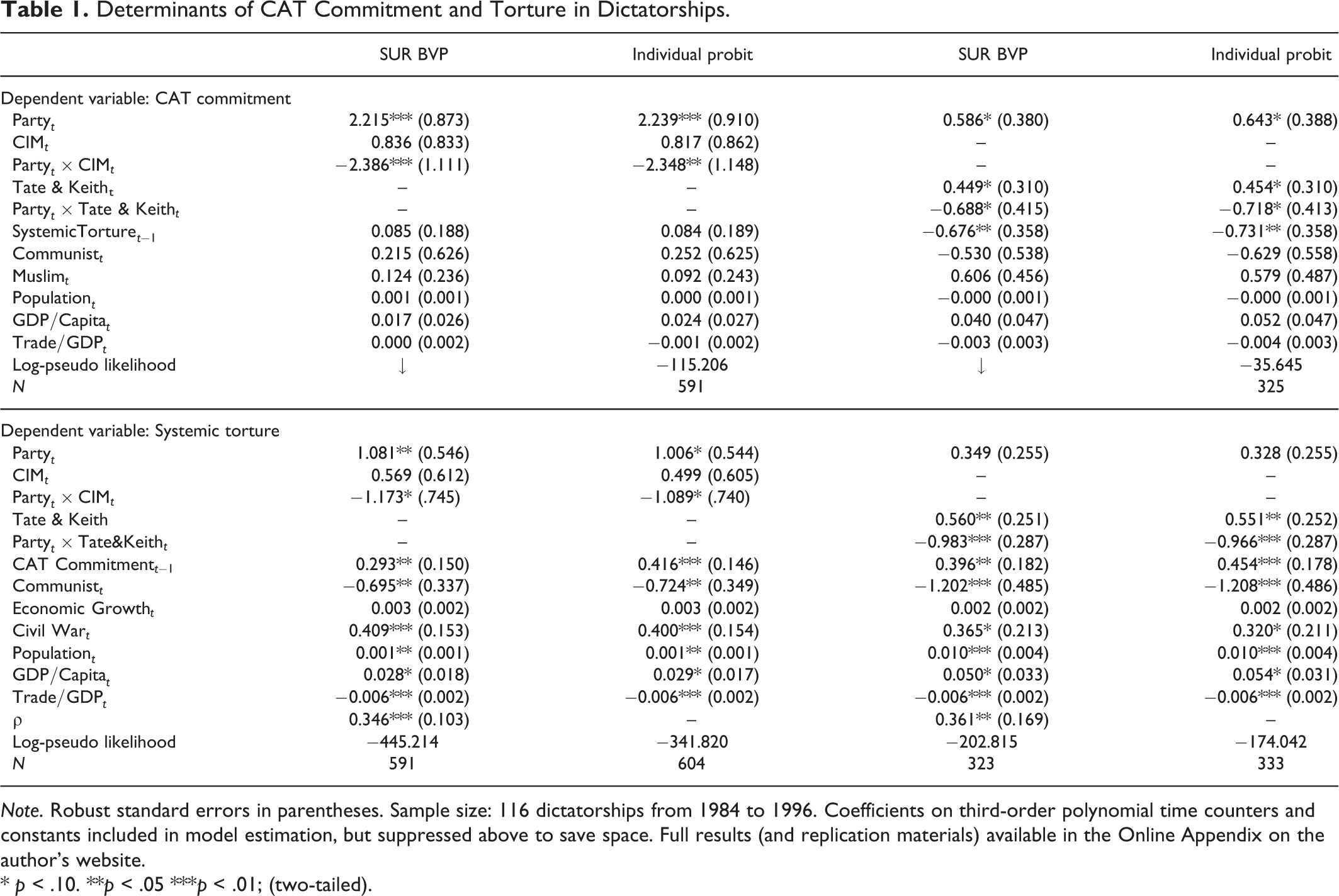
To test my first and second hypotheses, Table 1 presents estimates of the effect of my independent variables on CAT commitment and systemic torture. The first and third columns show the results of the seemingly unrelated bivariate probit (SUR BVP) on CAT Commitment (upper half of table) and Systematic Torture (lower half of table) using CIM and Tate & Keith as the measure of judicial effectiveness, respectively. 42 The first and third columns in Table 1 consider the effect of domestic institutions (and control variables) using individual probit models and the two different measures of judicial effectiveness. The upper half of the table shows the effect of the covariates on CAT Commitment, while the bottom half shows their effect on Systemic Torture.
Determinants of CAT Commitment and Torture in Dictatorships.
Note. Robust standard errors in parentheses. Sample size: 116 dictatorships from 1984 to 1996. Coefficients on third-order polynomial time counters and constants included in model estimation, but suppressed above to save space. Full results (and replication materials) available in the Online Appendix on the author’s website.
* p < .10. **p < .05 ***p < .01; (two-tailed).
In my first hypothesis, I predicted that the positive relationship between power sharing and the likelihood of international treaty commitment would be negatively associated with domestic judicial effectiveness. The positive and significant signs on the coefficients on Party in each of the models indicate that power-sharing opposition parties have a positive effect on CAT ratification when a dictatorship does not have an effective domestic judiciary.
43
These results are supportive of Vreeland’s (2008) hypothesis that dictatorships with multiple political parties are more likely to commit to the CAT. The coefficients on CIM in columns 1 and 2 indicate that domestic judicial effectiveness does not have a significant effect on CAT ratification when political parties are prohibited. When Tate & Keith is used as the measure of judicial effectiveness, however, increases in domestic judicial effectiveness positively affect CAT commitment in dictatorships when there is little opposition campaigning for accession to human rights treaties. This result is not robust across my measures of judicial effectiveness and is only slightly significant as shown in columns 3 and 4 of Table 1. Furthermore, the finding is contrary to the results on the universe of countries reported in Powell and Staton (2009), who do not limit their focus to dictatorships. The negative and significant coefficients on the interaction term across all columns in Table 1 indicate that the positive effect of Party decreases over the range of CIM and Tate & Keith. Finally,
In order to better evaluate my hypotheses about the mediating effects of domestic judicial effectiveness on CAT Commitment, I plot the marginal effect of Party on the probability of CAT commitment at different levels of CIM in Figure 1. 44 Note that the gray histograms on Figures 1 through 3 indicate where the CIM data used in my analysis fall between 0 and 1. The “percent” label on the left y axis in each of these figures corresponds with these gray histograms. The solid line in Figure 1 shows how moving from a country with no political opposition parties to a country where political opposition parties are permitted affects the probability of a state ratifying the CAT across the observed range of judicial effectiveness. The effect decreases at higher levels of domestic judicial effectiveness. The effect of Party is only statistically significant when the upper and lower bounds of the 95 percent confidence interval in Figure 1 do not encompass the zero line. As predicted, although the effect of political opposition parties is positive and significant when domestic judicial institutions are not effective, increases in the effectiveness of the domestic judiciary eventually result in an insignificant effect of Party. This is an important finding in support of my first hypothesis about the mediating effect of judicial institutions on legislative incentives for dictators to commit to international human rights law: although dictators are more likely to commit to the CAT when they face institutionalized opposition and ineffective judicial institutions, increases in domestic judicial institutions dissuade dictators from this course of action.
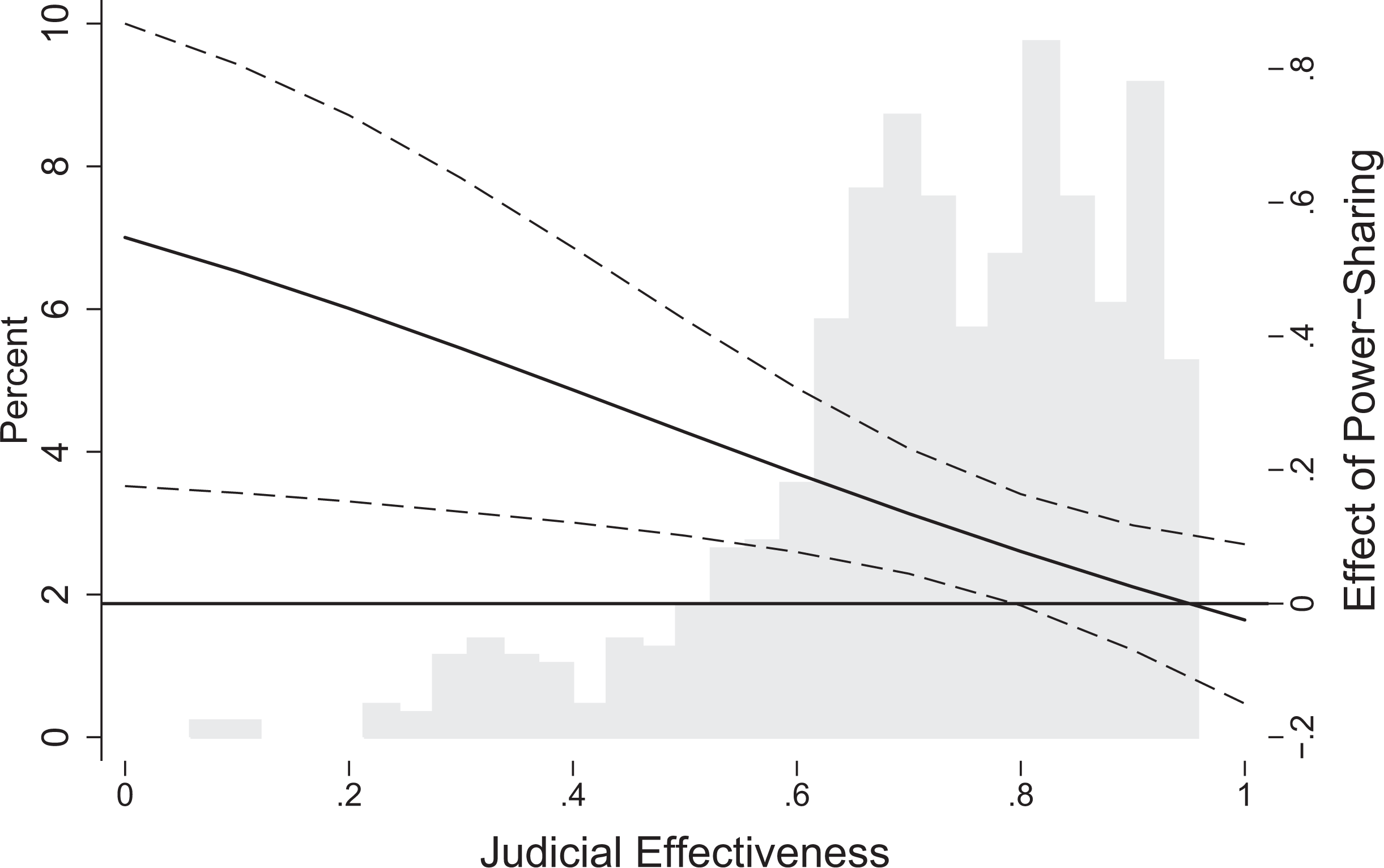
Effect of power sharing on Pr(CAT commitment) as judicial effectiveness increases.
In my second hypothesis, I predicted that the positive relationship between power-sharing opposition and torture would weaken with increases in domestic judicial effectiveness. Results from the seemingly unrelated bivariate probit (SUR BVP) are shown in the first and third columns of Table 1. Columns 2 and 4 of the bottom half of the table show results on Systemic Torture using individual probit models. The positive and significant sign on each of the coefficients on Party indicates that power-sharing opposition has a positive effect on torture in dictatorships without effective domestic judiciaries. The insignificant coefficients on CIM indicate that domestic judicial effectiveness has little effect on the likelihood that a state engages in systemic torture when power-sharing political parties are not permitted. This makes intuitive sense: when dictators face little opposition, they face few incentives to engage in high levels of torture because few individuals challenge the regime, regardless of the level of judicial effectiveness. Although this result on the constituent term does not hold for Tate & Keith, the interaction term is negative and significant in all models, indicating that the positive effect of Party on torture decreases across the range of CIM and Tate & Keith. The results on my control variables are consistent with the literature and relatively robust results across all three model specifications. Communist countries are significantly less likely than noncommunist countries to engage in torture. Increases in Trade/GDP decrease the probability that a country engages in torture, while increases in both Civil War and Population significantly increase the probability that a state engages in torture.
In Figure 2, I plot the effect of Party on systemic torture at different levels of CIM. 45 When judicial effectiveness is held at zero in Figure 2, the marginal effect of power sharing on the probability of systemic torture is positive and significant. But this result does not hold across the range of CIM. The solid line indicates the effect of Party, showing that the effect decreases as Judicial Effectiveness increases. The effect is only significant where the 95 percent confidence intervals shown as dotted lines do not encompass the zero line. Thus, the significant positive effect of Party when CIM is equal to zero quickly becomes insignificant at higher levels of CIM, regardless of whether a dictatorship has committed to the CAT. Consequently, increases in domestic judicial effectiveness weaken the problematic relationship between domestic parties and the increased likelihood of torture. This is an important result for advocates of human rights, indicating increased judicial effectiveness—or ex post costs—may discourage dictators from engaging in torture, even when they would otherwise be likely to violate human rights.
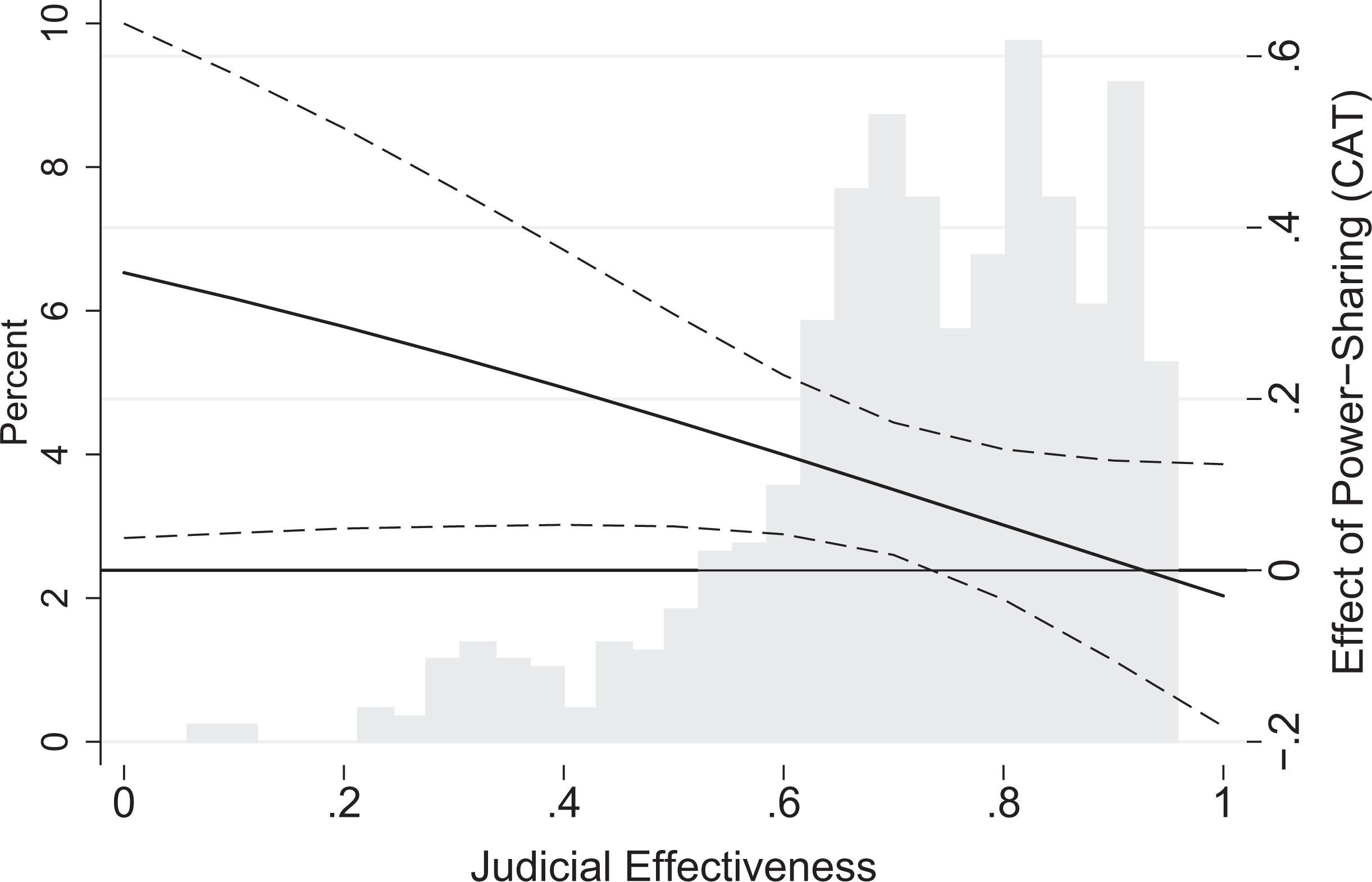
Effect of power sharing on Pr(Systemic Torture) as judicial effectiveness increases.
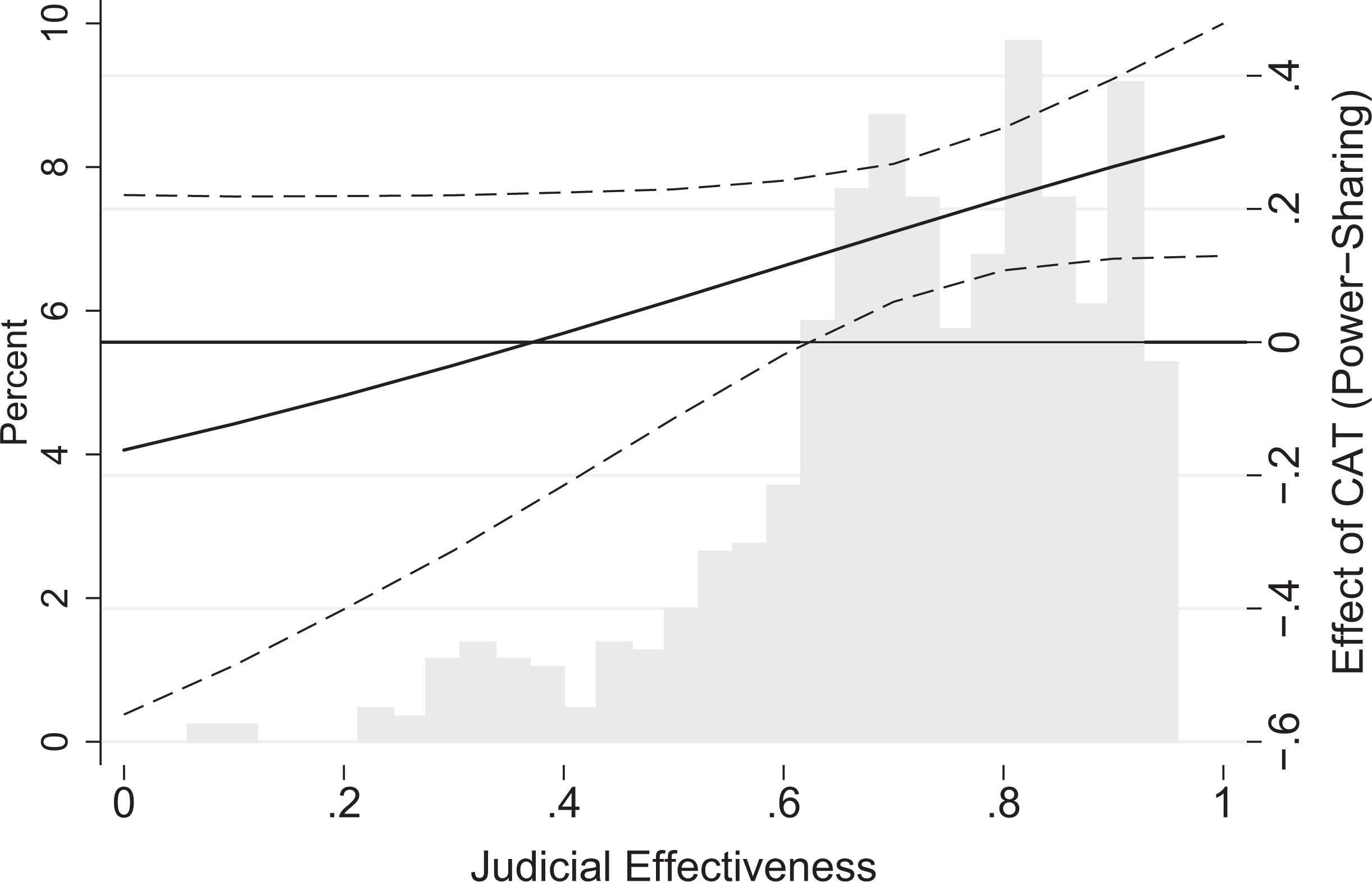
Effect of CAT commitment on Pr(Systemic Torture) as judicial effectiveness increases in dictatorships that face power-sharing opposition.
In Hypotheses 3a and 3b, I made two conflicting predictions—that commitment to the CAT would be associated with both a decreased and an increased probability of systemic torture in countries where dictators face power-sharing opposition and effective domestic judiciaries—and decided to let the data adjudicate between them. Table 2 presents estimates of the effect of my independent variables on systemic torture. Unlike Table 1, Table 2 includes a three-way interaction between Party, CIM, and CAT Commitment to test my hypotheses about the conditions under which CAT will be associated with torture. The first column reports results using a BVP, while the second column in Table 2 presents results using an individual probit model. The positive and highly significant sign on Party in both models indicates that power-sharing opposition parties have a positive effect on torture in dictatorships without effective domestic judiciaries that have not ratified the CAT. The insignificant coefficients on CIM in both models indicate that domestic judicial effectiveness has little to no significant effect on the likelihood that a state engages in systemic torture when power-sharing political parties are not permitted and a state has not ratified the CAT. When dictators face little opposition, they face few incentives to engage in high levels of torture. Finally, CAT Commitment is positive and highly significant in both models. This indicates that commitment to the CAT is positively related to torture in dictatorships that have neither power-sharing parties and without or an effective judiciary. The results on the control variables are similar to those above.
Determinants of CAT Commitment and Torture in Dictatorships.
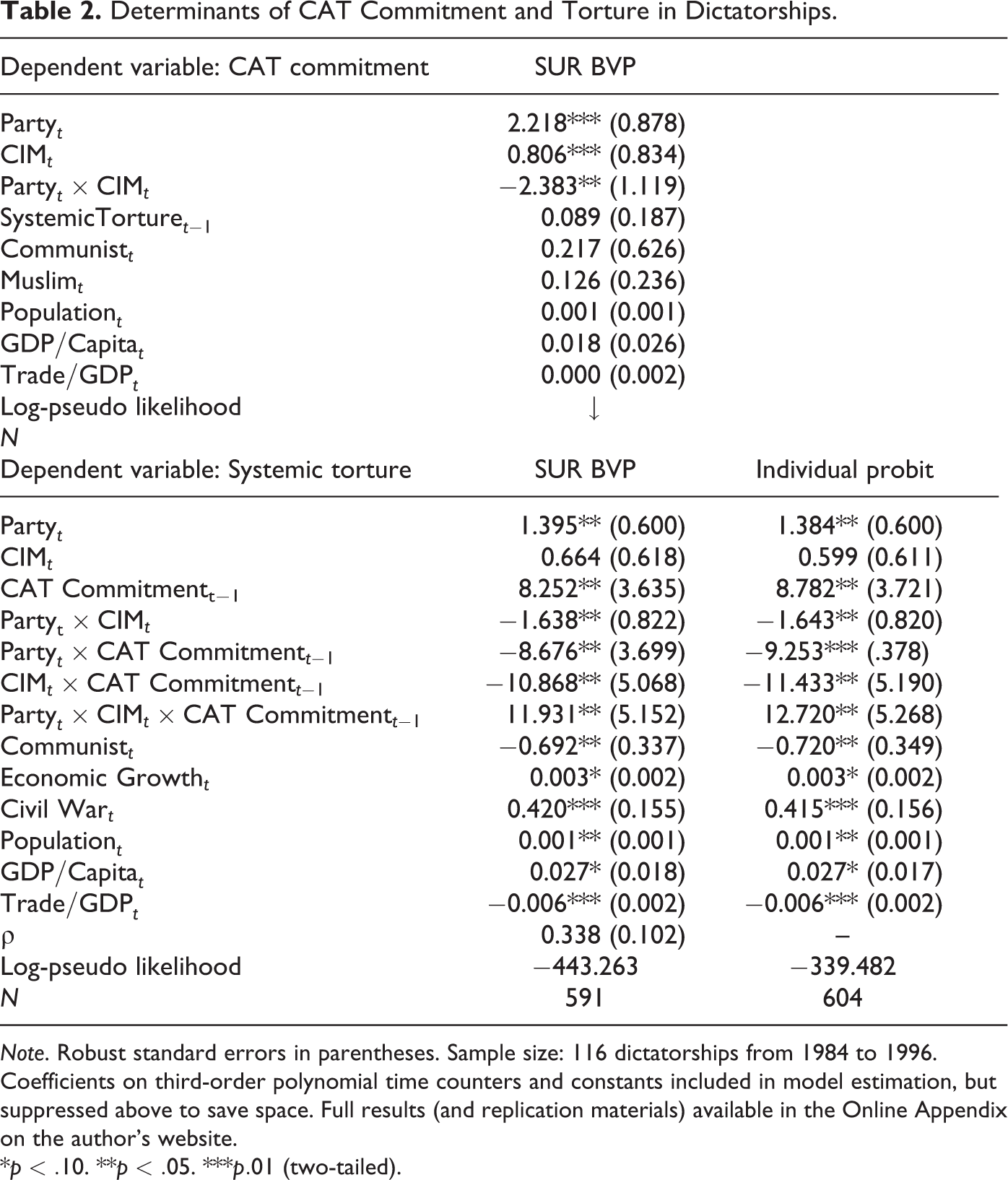
Note. Robust standard errors in parentheses. Sample size: 116 dictatorships from 1984 to 1996. Coefficients on third-order polynomial time counters and constants included in model estimation, but suppressed above to save space. Full results (and replication materials) available in the Online Appendix on the author’s website.
*
Based on these results, I need to determine how CAT commitment affects the likelihood of a state with power-sharing parties engaging in systemic torture at different levels of judicial effectiveness (Brambor, Clark, and Golder 2006). In Figure 3, I plot the effect of CAT Commitment on systemic torture at different levels of CIM in states that have power-sharing parties. 46 Figure 3 shows that when judicial effectiveness is held at zero in states that have power-sharing parties, CAT commitment does not influence systemic torture. But this result does not hold across the range of CIM. The solid line indicates change in the effect of CAT Commitment, showing that the effect increases as CIM increases, becoming positive and significant only at high levels of judicial effectiveness. In dictatorships that have power-sharing parties, CAT commitment appears to be associated with an increased likelihood of torture at high levels of domestic judicial effectiveness. This result supports Hypothesis 3b and provides evidence for a selection effect that dictators facing power-sharing parties and effective judicial institutions only commit to the CAT when they are face the most dire of domestic circumstances.
Conclusion
International organization scholars are increasingly synthesizing their finding with the literature on political violence and institutions (Huntington 1968; Gurr 1986a; Lichbach 1987; Linz 1988; Davenport 1996, 1997, 2007c; Gartner and Regan 1996; Davenport and Armstrong 2004) and arguing that commitment to and compliance with international human rights treaties are conditional upon domestic political institutions (Poe and Tate 1994; Poe, Tate, and Keith 1999; Hathaway 2003; von Stein 2005; Davenport and Armstrong 2004; Bueno de Mesquita et al. 2005; Davenport 2007b; Powell and Staton 2009; Vreeland 2008; Simmons 2009; Conrad and Moore 2010). This article adds to this literature by looking not only at how domestic political institutions incentivize executive actions but also at how domestic political institutions interact with one another to produce political outcomes. The literature on human rights tends to focus on the effect of one institution in isolation from a larger institutional context. But multiple institutions influence political decision making. Scholars need to begin asking whether different institutions produce contrary incentives, and if they do, construct theories to explain how politicians are expected to act under these circumstances. Here, without looking at domestic institutions in isolation, Vreeland (2008) expected parties to have a positive effect on CAT commitment and torture regardless of domestic judicial effectiveness. The call to focus on multiple institutions in combination with one another is an important lesson applicable beyond the field of human rights: the effect of one political institution on executive preferences is likely often dependent on other political institutions. Consequently, the results presented here should be of broad interest to scholars generally interested in the effect of institutions on political outcomes.
Furthermore, there has long been contention among international relations scholars about whether international treaties change political outcomes (Hathaway 2002; Neumayer 2005; Hafner-Burton and Tsutsui 2005) and among comparativist scholars about whether domestic political institutions in dictatorships are only window-dressing (Magaloni 2006; Gandhi 2008; Vreeland 2008). This article contributes to both debates, suggesting that international treaties and domestic political institutions affect respect for human rights. Domestic institutions in dictatorships—both political parties and judiciaries—affect both commitment to international human rights treaties like the CAT and domestic human rights violations like torture. My results also suggest that international treaties may only have appreciable effects on political outcomes when they are ratified by countries with certain combinations of domestic institutions. If international treaties and domestic institutions were mere window-dressing, I would not have found CAT commitment to be associated with torture in only in dictatorships with seemingly more “democratic” political institutions.
Perhaps most importantly, this article has direct policy implications. Human rights advocates spend a great deal of time and money promoting international human rights. In the last half-decade, much of their effort has been aimed at encouraging states to commit to international human rights treaties aimed at preventing violations. From a policy standpoint, the results of this article suggest that one way in which human rights advocates can potentially deter states from violating the rights of their citizens is to support (monetarily or theoretically) the creation of effective domestic judiciaries. Effective judiciaries can improve the human rights situation in dictatorships in two ways. First, domestic judiciaries may have an effect on respect for human rights, decreasing state violations when dictators face institutionalized domestic opposition. Second, judiciaries increase the cost to states of signing international commitments and failing to abide by their stipulations. When states with effective domestic judiciaries do commit to international treaties, they are more likely to keep their promises. Unfortunately, however, the news is not all positive for human rights advocates: dictators in countries with effective domestic judiciaries do sometimes commit to international law to appease their opposition. When they ignore ex post costs associated with adjudication, it is likely because the domestic opposition is extremely threatening in the short run. In these instances, human rights violations may actually seem to increase in number as dictators struggle to maintain power.
Footnotes
Acknowledgments
I am grateful to William D. Berry, Justin Conrad, Sona N. Golder, Matt Golder, Emilie M. Hafner-Burton, David A. Lake, Will H. Moore, Christopher Reenock, David L. Richards, Emily Hencken Ritter, Beth A. Simmons, Georg Vanberg, Joseph K. Young, and audiences at Florida State University and the University of California, Merced for helpful comments and discussions on earlier drafts and to Jennifer Gandhi, Jeffrey K. Staton, and James Raymond Vreeland for sharing their data.
Author’s Note
Previous versions of this article were presented at the 2009 Annual Meeting of the Peace Science Society and the 2010 Annual Meetings of the International Studies Association and the Southern Political Science Association.
Declaration of Conflicting Interests
The author declared no potential conflicts of interest with respect to the research, authorship, and/or publication of this article.
Funding
The author received no financial support for the research, authorship, and/or publication of this article.
Notes
References
Supplementary Material
Please find the following supplemental material available below.
For Open Access articles published under a Creative Commons License, all supplemental material carries the same license as the article it is associated with.
For non-Open Access articles published, all supplemental material carries a non-exclusive license, and permission requests for re-use of supplemental material or any part of supplemental material shall be sent directly to the copyright owner as specified in the copyright notice associated with the article.
