




Abstract
Previous scholarship has largely failed to address the effect of economic interdependence on issue areas other than interstate conflict. This study seeks to redress this lacuna by focusing on states’ visa policies and examining the impact of trade and capital interdependence in the context of transnational terrorism. The article argues that economic ties affect visa policies through a reconfiguration of preferences and the opportunity costs of economic loss and by tempering the impact of terrorism. To support this claim, the study conducts statistical analysis using directed dyad data on the visa policies of 207 states and independent political units. The article shows that the impact of economic interdependence is contingent on whether states are directly targeted in attacks of terrorism or face indirect threats from global terror. The study finds that economic incentives overwhelm security concerns when threats are indirect but have relatively limited influence, given threats against a state’s own citizens or territory.
Keywords
In this article, I ask to what extent do security imperatives influence states’ visa policies and do economic aspirations temper or override the influence of security factors? I attempt to answer this question by concentrating on trade and financial ties to tap into material incentives and transnational terrorism to capture the security dimension. Building on the theoretical literature on interdependence and conflict, I posit that capital and trade interdependence mitigate the impact of security imperatives in pushing states’ policies of control in a more liberal direction. More specifically, fears over backlash by economic partners make for more permissive policies of control over migration. Additionally, commercial ties downplay perceptions of security threat from migrants of economic partners. Second, I contend that the relative impact of economic incentives will depend on whether states are directly targeted by transnational terrorists. Material ambitions are shown to effectively modulate security fears if states face indirect threats from transnational terrorism. These findings debunk the conventional understanding that either security interests or economic concerns shape state behavior; they also challenge the proposition that economic interdependence invariably weakens the effect of security factors.
An extensive body of literature in international relations examines the impact of economic interdependence on states’ conflict behavior (Polachek 1980; Oneal and Russett 1997, 1999; Barbieri and Schneider 1999; Russett and Oneal 2001; Mansfield and Pollins 2003). Rather than looking at conflict behavior, I argue that economic ties influence states’ pursuit of security in the face of nonstate threats, specifically, transnational terrorism. I accomplish this by focusing on an issue area largely ignored by political science: states’ visa policies. 1 Visa controls enable states to screen threats arising from nonstate actors: potential terrorists, illegal migrants, smugglers, and traffickers (Andreas 2000; Andreas and Richard 2001; Koslowski 2001). Because visa restrictions are an important way in which states exert authority at borders, states are expected to capitalize on the screening and preselection functions of visa controls to counter nonstate threats (Torpey 2000a, 2000b). Importantly, in embodying both material ambitions and security concerns, visa policies emerge as a critical case for analyzing the relative influence of material and security objectives in state decision making (Rudolph 2003, 2006). More generally, migration policy is an important testing ground for understanding how states cope with the costs and benefits of globalization. On one hand, migration flows underscore the benefits to be gained from globalization, but on the other hand they point to the negative externalities that may result from unrestricted territorial access (Adamson 2006). As such, states’ policy responses illuminate the kinds of trade-offs states make in a globalizing environment.
A major innovative contribution of this article lies in applying the theoretical tools of international relations to migration policy, an issue area that has largely remained under the purview of policy-oriented case studies and comparative literature (Rudolph 2003, 2006). Furthermore, whereas extant literature has approached the debate by evaluating how states cope with threats from other states, I tackle the debate by shifting attention to threats from nonstate actors. Moreover, the policy implications of visa controls for international security become evident when we consider the events of September 11: the perpetrators of the terrorist attacks took advantage of loopholes in the United States’ border and migration control policies. In fact, all nineteen of the terrorists entered on visas, underscoring the importance of control over legal migration for national security (State Department, United States, The 9/11 Commission 2004). By conducting rigorous large-n analysis, I engage in systematic inquiry into the determinants of visa policies, thereby filling a methodological gap in scholarship on migration policy.
The rest of the article is laid out as follows; the subsequent sections provide a review of literature focusing on the security and economic underpinnings of migration policy. The third section develops the theoretical framework. The aggregate analysis of visas illustrates the differential impact of security factors, given direct versus indirect threats from transnational terrorism. Finally, I discuss the substantive significance of these findings and conclude with suggestions for future research.
Security and Migration Control
Before proceeding to the theoretical framework, it merits noting that the analytical focus of the article is on the geopolitical pillar of security. As Rudolph (2003) points out, security has both external (geopolitical) and internal orientations. The geopolitical dimension is rooted in Realpolitik, whereby “security is defined in political/military terms as the protection of the boundaries and integrity of the state” (Doty 1998, 73). The theoretical mechanisms seek to ferret out how states balance protection against terrorism against commercial interests when designing migration control policies. In that sense, the article addresses the overlap between the material and external dimensions of state grand strategy (Rudolph 2003, 2006).
Admittedly, the migration–security nexus is not limited to a geopolitical conception of security: in fact, linkages to security have been explored widely by scholars of migration through the prism of internal security. Although it is beyond the scope of this article to fully appraise this literature, it is noteworthy to acknowledge that migration poses a challenge to societal security by threatening national identity, social cohesion, and traditional patterns of language, culture, or religion (Rudolph 2003; Waever 1993; Zolberg 1987). Thus, on one level human migration constitutes a cultural threat, especially if newcomers are culturally different from the resident populace (Waever et al. 1993). On another level, migration challenges internal security from an economic perspective insofar as large influxes overwhelm the state’s absorptive capacity. In sum, cultural and economic aspects of security enjoy a deeper tradition in securitization of migration scholarship (Buzan 1991; Buzan, Ole, and de Jaap Wilde 1998)
Whereas 9/11 reinforced the security linkages to migration, it did not create it from scratch (Faist 2005). Instead, 9/11 augmented attention to the external (geopolitical) dimension of security. As Rudolph (2003) surmises, security is a fluid concept to the extent that new threats supplant old ones in a dynamic international environment. Paramount to the new environment in the post-9/11 world is recognizing that private actors can also wreak damage previously reserved for militaries of other states (Salehyan 2008). Acknowledging this paradigmatic shift has bearing on the generalizability of this article. Given the increasing significance of terror on the international agenda, the article’s findings are most informative for the post-9/11 world. Nonetheless, concerns over terrorism predate 9/11 and may be tied to the increasing salience of nonstate threats in world politics with the end of the cold war (Buzan, Ole, and de Jaap Wilde 1998; Caldwell and Williams 2006). In fact, “while 9/11 may mark a turning point in the history of non-state terrorism, it is part of the politics of terrorism and reflects the changing trench lines and clashes in world politics, in this case the world after the Cold War” (Faist 2005, 2). Ostensibly, the definition of “terror” has changed in the post-9/11 context, but it remains to be seen that this represents a complete break with the past (Boswell 2007). With that in mind, the article’s findings are relevant insofar as terrorism influences policy making.
Transnational Terrorism and Visa Policies
Why would visa restrictions prove instrumental to countering threats from transnational terrorism? I argue that by granting states control over the actors that cross their borders, visa restrictions serve as an important first line of defense against intrusion by nonstate threats. Monitoring human mobility across borders is all the more significant, given the asymmetric vulnerability states confront vis-à-vis transnational terrorists (Juergensmeyer 1997; Keohane 2002). States’ vulnerability is a function of two attributes of transnational terrorism: nonhierarchical organization and informational advantage over states. Terrorists mobilize and operate across interstate borders, at the same time benefiting from the communication and transportation technologies of globalization (Enders and Su 2007). The ability to network transnationally renders terrorists difficult to detect and identify, in turn facilitating clandestine entry into states’ territories. Wielders of informal violence take advantage of secrecy and surprise to inflict harm with small military capabilities (Keohane 2002; Enders and Sandler 2005; Salehyan 2008; Sandler, Arce, and Enders 2009). Surreptitious access to states’ territories further imperils state security, given sleeper cells of terrorist networks that might be activated by foreign terrorists crossing borders. Put differently, states face vulnerability due to the unconventional tactical nature of terrorism, regardless of the amount of damage caused by attacks (Gearson 2002).
Second and related, terrorist organizations possess a degree of informational advantage over states, in being able to communicate informally through face-to-face contact (Enders and Sandler 2005, 2006b; Sandler, Arce, and Enders 2009). The information disparity states encounter is starkly illustrated by the September 11 attacks. Despite being an information society, the United States had limited information about the identity and location of terrorist networks prior to the attacks, in sharp contrast to the perpetrators with detailed knowledge of their targets.
If states are limited in their ability to locate and identify stateless and transnational actors, it is logical to expect them to utilize instruments to prevent territorial access to potential threats. Additionally, given the economic and societal repercussions of terrorism (Enders and Sandler 2006a; Conrad 2011), we would expect states to design policies minimizing the probability of harm to their territories and citizens. Visa restrictions raise the cost of entry into states’ territories by requiring additional documentation, a wait period, and the possibility of denial of access. They also serve a preselection function whereby those who are exempt from visa requirements are deemed nonthreatening and those facing restrictions undergo additional scrutiny and background checks (Neumayer 2006).
2
I anticipate states to adjust their visa policies in response to the threat of infiltration by terrorists through two pathways. First, the most straightforward way in which state behavior is altered is in response to directed threats to security from origin countries’ nationals. An attack targeting the state’s own nationals or taking place within its territory is also likely to galvanize the public. To the extent that migration policies reflect symbolic attempts to subdue public fears (Andreas 2000), such incidents are likely to generate pressure toward restrictive visa policies. Thus, regardless of the objective efficacy of policies, restricting territorial access to outsiders also fulfills domestic demand. This mechanism is further strengthened by the process of “securitization,” whereby the perception of objective threats is compounded by an environment of fear (Buzan, Ole, and de Jaap Wilde 1998; Lavenex 2001). In sum, directed incidents of terrorism against states will push policies in a stringent direction to the degree that these incidents underscore the dangers of uncontrolled human mobility across borders (Rudolph 2006).
3
Hypothesis 1: Past incidents of targeted attacks against the nationals of host states will prompt restrictive visa policies against the nationals of origin states associated with these attacks.
Second, states will factor in origin country nationals’ involvement in global attacks of transnational terrorism. Importantly, transnational terrorism—as opposed to domestic terror—involves incidents in which the perpetrators, victims, or audience are from two or more countries (Mickolus et al. 2007; Sandler, Arce, and Enders 2009). More specifically, transnational terrorism is distinct from its home-grown variants in embodying the possibility of contagion where grievances in one country can lead to attacks in other parts of the world. Tight security measures implemented by some countries might in turn alter the geographical distribution of terrorist attacks, channeling flows of informal violence from harder to softer targets (Enders and Sandlers 2006b). Thus, even if states’ own citizens are not targeted in incidents of terrorism by a particular country’s citizens, transborder flows of terror make future attacks probable. The contention that states pay attention to origin states’ involvement in attacks globally is further buttressed by the “rogue state framework” which gained eminence in the post-9/11 context (Caprioli and Trumbore 2005, 773–75). The rogue or pariah state framework casts certain countries as threatening by highlighting not only their military aggressiveness but also their support of transnational terrorism. The global nature of transnational terrorism necessitates that in addition to reacting to directed threats from terrorism, states harness information about the ties of origins’ nationals in attacks worldwide.
Hypothesis 2: States will pursue restrictive visa policies against the nationals of origin states that have been involved in incidents of global terrorism.
A few anecdotal examples will illustrate the distinction between global and targeted attacks of terror. Although the September 11 attacks starkly illustrated that a few individuals could imperil state security, other incidents with worldwide visibility such as the Madrid train bombings in 2004 and July 7 London bombings in 2005 drew attention to the terrorists carrying out these attacks. The Madrid bombing, dubbed 3/11 to signify its status as Europe’s 9/11, “killed 191 people and wounded more than 1,800 in Europe’s worst terror attack since the bombing of a Pan Am flight over Lockerbie, Scotland, in 1988” (Hamilos 2007). The London attacks, although engineered by Muslim extremists of British citizenship, are included in International Terrorism: Attributes of Terrorist Events (ITERATE) and considered transnational because they involved victims from other nationalities (Campbell, and Laville 2005). 4 These attacks are global conceptually in having repercussions internationally and generating an outcry across countries, for example by engendering solidarity networks against terrorism, who protested the violence. 5 They are also global empirically in bringing the terrorist organizations involved and the affiliated nationalities of perpetrators into the international limelight. Whereas the Madrid attacks involved several organizations, the terrorists shared a jihadist ideology (Reinares 2009). In contrast, the 2008 Mumbai attacks by Lashkar-e-Taiba in Pakistan and series of attacks against the bank branch of HSBC Holdings Incorporated (HSBC), synagogues, and the British consulate in Istanbul in 2003 by Al-Qaeda-affiliated organizations embody the targeted component of transnational terrorism. Although citizens of foreign countries were killed or harmed in the Mumbai incidents, the event is more likely to figure as a significant attack against Indian nationals orchestrated within India’s territory by Pakistani perpetrators (ABC News 2009).
Interdependence, Security, and Visa Policies
At the core of my argument is the notion that whereas security externalities of human mobility drive policies in a restrictive direction, economic interdependence will counter this trend and make for more liberal policies. This argument draws upon insights from the literature on conflict and interdependence; this body of work, while not directly related to migration policies provides a handle on how economic ties influence states’ security seeking. The contention that trade shapes states’ security behavior is rooted in the liberal belief that trading states are more reluctant to engage in conflict (Angell 1912; Viner 1951; Domke 1988; Doyle 1997). Central to the pacifying effects of trade is the proposition that military conquest and economic expansion fulfill the same objectives (Staley 1939, cited in Mansfield and Pollins 2003). Rosecrance’s (1986) theory of the trading state further develops this idea by arguing that material incentives eclipse military conquest and territorial aggrandizement as grand strategy is increasingly dominated by the logic of the market and driven by the accumulation of wealth. In sum, neoclassical economics would predict borders open to human mobility; nonetheless, empirical reality does not corroborate this expectation. Instead, as Hollifield (1998) elucidates, “if the logic of trade and finance is one of openness, the logic of migration is one of closure” (p. 516).
If a state’s openness to commercial flows falls short of explaining its migration policies, we might look to dyadic theories of interdependence to tackle the disjuncture between human mobility and mobility in goods and capital. Scholarship has posited that economic interdependence between pairs of states shapes state behavior through the logic of opportunity costs. States refrain from conflict for fear of welfare losses from the diminution or cessation of trade (Polachek 1980; Polachek and Seiglie 2006). Another angle on how rupturing economic relations may be constraining on state behavior is provided by “complex interdependence” (Keohane and Nye 1977). According to this perspective, states bear short-term (sensitivity) and long-term costs (vulnerability) as a result of changes in their economic partners’ policies. If we apply the logic of opportunity costs to migration policies, restrictions on human mobility constitute potentially hostile signals and “place governments on a collision course with easy trade” (Flynn 2003, 58). On a parallel note, visa restrictions run counter to the idea of a liberal society and preclude integration of foreign labor into the host country’s socioeconomic structure (Neumayer 2006, 2009). Stringent policies and closed borders may also be perceived as a noncooperative act (Donaldson 2005), leading to the possibility of retaliation by the state’s dyadic counterpart. In theory, economic interdependence should compel states to be less likely to impose restrictions on migration from commercial partners. The logic of opportunity costs, however, does not complete the puzzle. Because migration policy does not constitute high politics in the same way that conflict behavior does, insights from literature on interdependence and conflict only take as so far (Hollifield 1998). In fact, economically interdependence dyads such as US–Mexico, US–China, and China–Japan do not necessarily have liberal migration policies vis-à-vis each other’s citizens. 6 In order to complete the puzzle of how economic interdependence conditions states’ migration responses, we must turn to the domestic mechanisms, whereby economic ties shape migration policies.
I contend that the domestic level is integral to tying together economic interdependence and migration outcomes. More specifically, I posit three mechanisms of impact. First, economic ties create and sustain vested interests in favor of liberal migration policies; Hollifield and Zuk (1998) contend that such support for liberal migration in general comes from staunch advocates of commercial liberalization. This notion is intuitive as restrictions on labor mobility have detrimental effects on profits akin to tariffs on raw materials for firms that rely heavily on foreign labor (Hollifield 1998). As such, businesses that employ foreign labor form pro-migration lobbies (Freeman 1995). 7 Furthermore, because migration imposes diffuse costs upon society while bringing concentrated benefits, organized interests in favor of fewer restrictions have greater voice in policy making (ibid.).
An ancillary argument is that pro-migration forces coalesce around open border policies because they fear the negative effect of stringent migration policies on economic exchange. For one, local trade between contiguous states is vulnerable to small costs on exchange as evidenced by the dampening impact of visa restrictions on bilateral trade and foreign direct investment (FDI; Neumayer 2009). The deleterious effect of visa controls on cross-border exchange is compounded by the fact that commerce and FDI depends to some extent on personal contact and exchange (ibid.). To the extent that border controls constitute noncooperative signals, domestic constituents fearing retaliation by commercial partners would oppose restrictions on labor mobility. Finally, to the degree that factors of production are complementary, liberalization in trade should produce domestic coalitions trumpeting fewer restrictions on labor mobility (Collins, O’Rourke, and Williamson 1999).
Hypothesis 3: Economically interdependent states should be less likely to pursue restrictive visa policies with respect to their economic partners’ citizens.
The preceding hypothesis posits that trade and capital interdependence will exert a direct effect on states’ visa policies, ceteris paribus. We might also imagine, however, that economic interdependence imposes an indirect impact on policy by conditioning the impact of security concerns. Trading states’ policies are governed more by material incentives and less by geopolitical and military interests; this implies a reconfiguration of preferences such that increasing salience of economic goals detract from security concerns.
8
Concomitantly, sociological liberalism suggests that, given enhanced trust, states are less likely to respond to trade partners’ citizens as potential security threats, diminishing the effect of security concerns (Andreas 2000; Fordham and Kleinberg 2009).
Hypothesis 4: Transnational terrorism will exert a positive effect on visa restrictions given low levels of interdependence, but this effect will decline with increasing levels of interdependence.
Research Design
The unit of analysis is the directed dyad; this design enables me to analyze policies of recipient states against the nationals of origin states, which might not necessarily be symmetric. 9 In other words, each state A in this data is treated one time as the origin state and one time as the recipient state. To illustrate, Germany’s visa policy vis-à-vis Turkey constitutes a separate observation from Turkey’s policy toward Germany; there is limited reciprocity within dyads entails that the A-B dyad and B-A dyad can be analyzed as separate observations. 10
The hypotheses outlined earlier are tested with the following model:

The dependent variable in this article is the imposition of visa restrictions. The measure of visa restrictions employs a dichotomous variable coded 1 for the existence of visa controls by a recipient state on the citizens of an origin state and 0 otherwise. Although this measure does not distinguish between types of visas, the need for documentation to obtain (short-term) access to a state’s territory captures how open or closed a state’s borders are with respect to its dyadic counterpart’s citizens (Boehmer and Peña, 2012). Data for visa restrictions use Neumayer’s measure coded from the 2004 version of the International Aviation Association’s Travel Manual (IATA; 2004). Bilateral visa controls cover 189 member states of the United Nations and eighteen nonmember political territories, totaling to 36,300 directed dyads. 11 The dichotomous nature of the dependent variable necessitates the use of a nonlinear estimator, such as logit or probit (Long 1997). Because the statistical analysis employs data that are cross sectional in nature, robust standard errors are presented to account for the possibility of heteroskedastic error variances (Greene 1997).
Arguably, a binary indicator for visa restrictions falls short of capturing how stringent a country’s visa policies are. Ideally, we would like a measure depicting the difficulty of obtaining a visa by accounting for procedural limitations in filing for one. In the absence of such a generalizable measure, I rely on three types of robustness checks to complement the results with the binary indicator. First, I differentiate between types of visas required according to the location of application. The first category, which I label upstream, is the more common one that demands travelers to apply for a visa at embassies and consulates abroad. The second, less common one is granted at the border ports and in general represents a less restrictive control on human mobility in that it omits the prescreening demanded of migrants (Neumayer 2010). By distinguishing between these two categories, I seek to test whether the hypothesized patterns differ across types of visa controls. As a second way to transcend the limitations of the binary visas indicator, I replicate the models with an ordinal categorization of entry requirements. Boehmer and Peña (2012) have compiled an indicator that ranks borders from most open to closed. Their measure codes 1 for border controls that require both a visa and a passport, 2 for just a passport, and 3 for no documentation required. 12 This measure is limited to geographically contiguous dyads, resulting in 816 observations; the data reflect visa policies as of 2005. I reverse this measure so that higher scores correspond to a greater degree of closure and employ ordinal logit in models using this indicator.
As a third robustness check, I include a percentage-based measure of visa policies. I coded this measure from annual reports spanning the years 2003 through 2007 published by the Council of the European Union for member states of the European Union and/or Schengen area. 13 Members of the EU and/or Schengen area report statistics on visas under the December 22, 1994, Decision of the Executive Committee on the issuance and exchange of information on the EU’s uniform visa policy. Visa rejection rates are expressed as a percentage and vary from 0 to 100 and represent the ratio of total number of visas denied by the recipient state against the total number of yearly applicants. 14
Due to the pooled nature of the data on visa rejection rates, ordinary least squares, while producing consistent estimates, might lead to incorrect standard errors (Greene 1997). Given a wide data structure where the time component is short and the number of cross-section units is relatively large, panel-corrected standard errors (PCSEs) are an appropriate method of controlling for panel-level heteroskedasticity and serial correlation (Beck and Katz 1995). Because the panel is unbalanced, we might be concerned that the results give more importance to some states than others. Nevertheless, as Franzese (1996) has shown, PCSE is able to accommodate unbalanced panels. 15
The measures of transnational terrorism are obtained from the ITERATE database. The ITERATE data covers the years 1968–2007 and provides time series data for key attributes of terrorist incidents (Mickolus et al. 2007). ITERATE offers an advantage over other event-count databases on terrorism because data entries are based on both international and domestic data sources; this yields a more accurate measure of terrorist incidents in countries with state-controlled media (Mickolus et al. 2007).
First, to assess Hypothesis 1 on targeted (directed) terrorism, I include a variable that counts the number of yearly targeted attacks against citizens of the home state undertaken by the nationals of origin state; this indicator varies from 0 to 76. 16 The final table I present utilizes an alternate operationalization of targeted terror, counting attacks by origin’s citizens within the targeted country’s territory, summed over the past five years; this indicator varies from 0 to 234. Second, to test Hypothesis 2 on global terrorism, I employ a variable that measures the number of yearly terrorism incidents the nationals of origin states have undertaken anywhere around the world; this variable ranges from 0 to 245. All indicators count the number of incidents summed over 1990 until 2004. 17 As robustness checks, I employ models with global and targeted terrorism terms that sum incidents since 2000; these vary from 0 to 89 and 0 to 35, respectively.
Turning to trade interdependence, the main indicator I use is the value of bilateral trade—imports and exports—for the recipient country, divided by the total trade value of the recipient country, averaged across 1998 to 2002 (Rose 2005). This measure might also be seen as tapping into the salience of dyadic trade for the recipient state’s economic portfolio (Mansfield and Pollins 2003). Second, an alternate indicator reflects the total bilateral exports and imports as percentage of recipient state’s total gross domestic product (GDP) and is obtained from correlates of war trade data. 18 It captures Russett and Oneal’s (2001) intuition that the impact of trade is contingent on the size of states’ economies and allows cross-country comparability. A final note concerns the possibility of endogeneity: all indicators are lagged or averaged across the most recent five years for which data were available to account for the possibility that already extant visa restrictions adversely affect levels of trade. 19
To capture capital interdependence, I rely on two indicators. 20 The first measure of capital flows is intended to assess recipient country’s exposure to FDI. This variable is the net total inflows logged of FDI in investment dollars of purchasing power parity to the recipient state rescaled to have minimum zero averaged across the most recently available years 1998–2002. 21 Yearly data on FDI inflows were obtained from the World Development Indicators, a database maintained by the World Bank. FDI flows are expressed as a proportion of recipient’s GDP (in millions of US dollars) in order to normalize them across countries. 22 Second, to capture states’ exposure and openness to capital markets, I employ Simmons’s data for governmental restrictions on foreign exchange, capital, and current account transactions (Simmons and Elkins 2004). The indicator is a composite score for the degree of capital liberalization which is reversed to vary from most restrictive (0) to least restrictive (3). As with measures for trade, to account for potential reverse causality, both indicators are lagged and the past five years’ average values are employed. Finally, to test Hypothesis 4, interaction terms with indicators for trade interdependence are included.
In brief, the models also include a set of controls that may be categorized into two sets. The first set capture “push and pull factors” that motivate or compel individuals to migrate (Cornelius et al. 2004; Neumayer 2005, 2006). These are indicators for economic, social, and political attributes of origin and recipient countries. The second set taps into dyadic characteristics that may have an impact on states’ migration policies vis-à-vis their dyadic counterparts. On one hand, distance between states and differences in income may carry a role similar to the gravity model of trade by facilitating migration (Leblang, Fitzgerald, and Teets 2009). I include a dummy for contiguity from the Correlates of War Direct Contiguity Data (version 3.1; Stinnett et al. 2002). On the other hand, states’ visa policies may reflect the degree of cooperation or conflict within the dyad, which merits the inclusion of alliance ties and past conflict (Boehmer and Peña 2012). Dummies for alliance ties and past militarized interstate disputes (MIDs) comes from the correlates of war project (version 3.03) Alliance Data (Gibler and Sarkees 2004). Finally, within the context of the EU visa free travel has been integral to deeper integration and the EU’s evolution into a security community (Huysmans 2006). Thus, EU membership may drive economic interdependence and visa policies at the same time across a considerable number of dyads. To account for this, I include a dummy for joint EU membership with models employing the categorical and ordinal visa indicators as well as the visa rejection rate and separate dummies for whether destination and origin states are members of the EU in logistic regression results. 23 The full list of variables and descriptions are presented in the online Appendix A.
Results
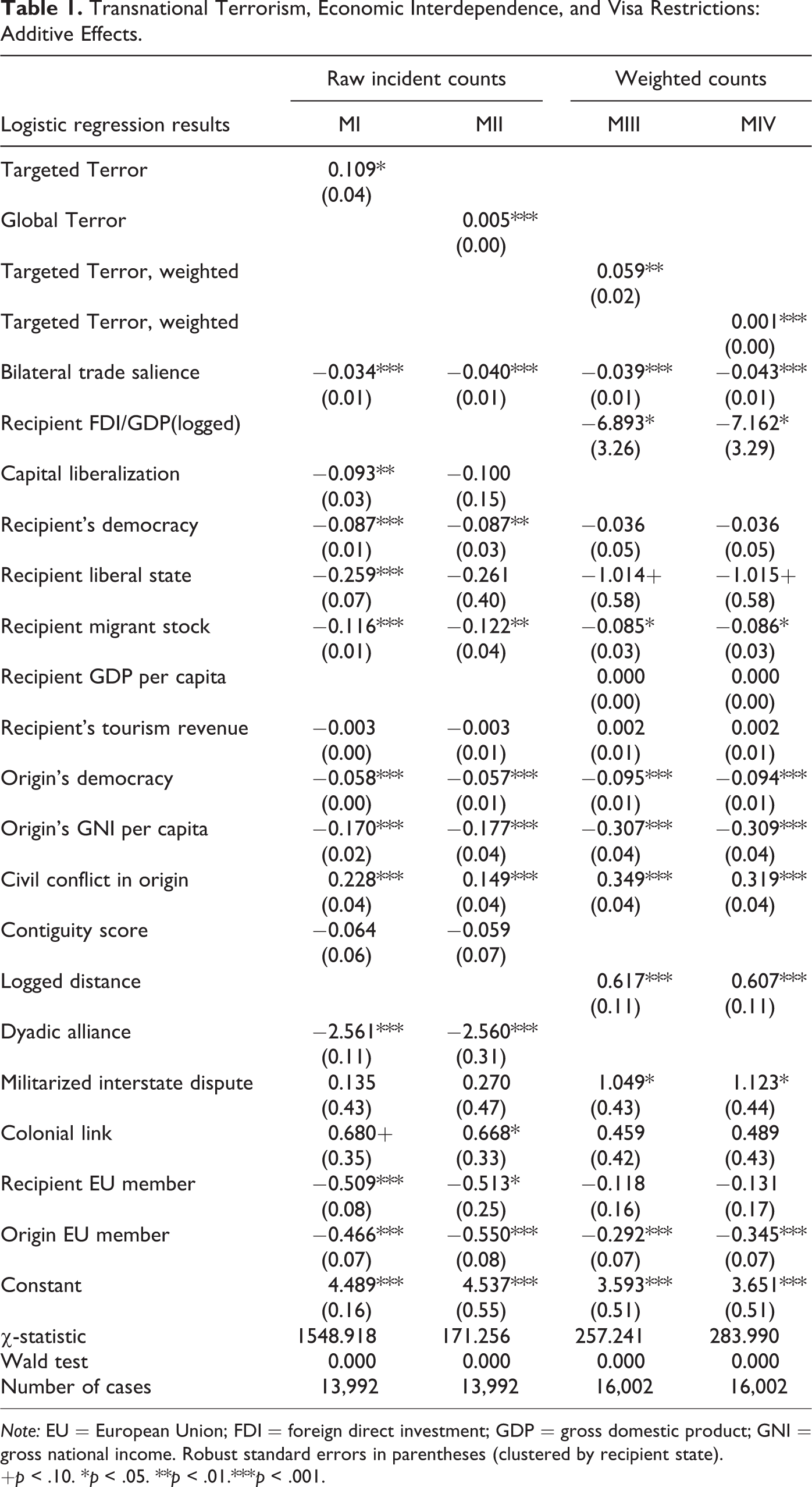
Table 1 aims to test the additive hypotheses on the impact of terrorism and interdependence. The first two models portray the effects of targeted and global terrorism, respectively, by employing raw incident counts post-1990. The final two models include terms for targeted and global terrorism weighted by the maximal damage caused by terrorists, in incidents since 1990. The weight used is an ordinal score recorded by ITERATE, measuring the degree of financial damage wreaked by the terrorist attack. Thus, models III and IV provide a slightly different operationalization of terrorism that takes into account not just the sum of incidents but the severity of terror. 24
Transnational Terrorism, Economic Interdependence, and Visa Restrictions: Additive Effects.
Note: EU = European Union; FDI = foreign direct investment; GDP = gross domestic product; GNI = gross national income. Robust standard errors in parentheses (clustered by recipient state).
+p < .10. *p < .05. **p < .01.***p < .001.
What do the results in Table 1 show? First, as expected, across all four models, the coefficients on terrorism terms are positive and statistically significant, indicating that holding the controls and terms for economic interdependence constant, terrorism increases the probability of visa restrictions. Additionally, the coefficient on targeted terrorism emerges as substantively larger than global terrorism. Specifically, increasing targeted terrorism from its minimum value to its maximum value produces a 14 percent increase in the predicted probability of visa controls; in comparison, the corresponding change in predicted probability for global terrorism is approximately 11 percent. 25 This result makes intuitive sense insofar as directed attacks which target a state’s own citizens hold more purchase than attacks perpetrated by origin’s citizens involving other states. Regardless, the positive and significant coefficients on global terrorism terms are congruent with the expectations of Hypothesis 2: visa policies also respond to origin citizens’ involvement in terrorism. Comparing the first two models with the final two, we observe that weighting the raw incident sums by amount of damage does not alter the significance or direction of the findings but slightly decreases the substantive effects. These findings imply that occurrence of terrorism—rather than the degree of damage per se—goes a long way in shaping states’ visa policies.
Second, as predicted by Hypothesis 3, in all models presented, bilateral trade salience imposes a significant and negative effect on visa controls, suggesting that trade ties render recipient states less likely to impose visa restrictions on their economic partners. If other covariates are held at their means, increasing bilateral trade to its maximum results in an average (across all models) decline of 63 percent in the predicted probability of visa controls. Similarly, the negative coefficient on capital liberalization shows that openness to capital markets renders states more likely to be permissive in their visa policies. While consistently negative across all models, however, this term is significant in only one model. Models III and IV also include a measure for FDI flows proportional to the GDP of the recipient country as another measure of capital liberalization. The negative sign of the coefficient is in line with predictions and significant at the .05 level. Taken together, these results indicate that economic interdependence exerts a liberalization effect on visa policies but that the results are stronger when trade rather than capital interdependence is considered.
Turning to the controls, we observe that most are in the hypothesized direction and statistically significant. More precisely, civil conflict in origin countries acts as a push factor in motivating emigration from these countries. Consistent with the migration literature, democratic regimes and economic prosperity entail that origin states are less likely to face visa controls. Furthermore, democratic recipients and/or recipients scoring high on civil liberties are less inclined to pursue stringent visa policies. Moreover, in line with intuition, as illustrated by the negative sign on logged migrant stock, the existence of migrant networks in destination states makes it less likely that citizens of origin states will face visa restrictions.
The dyadic controls portray that visa policies are also influenced by interstate relations: past disputes make it more likely that recipients will impose visas against their dyadic counterparts whereas alliances have the opposite effect. 26 Interestingly, the propensity to impose visas increases with distance, which might be in line with the notion that proximity or contiguity enhances cooperation and exchange (Deutsch et al. 1957), in turn, making stringent policies less likely. Finally, in line with expectations, EU membership imposes a negative effect on visa restrictions.
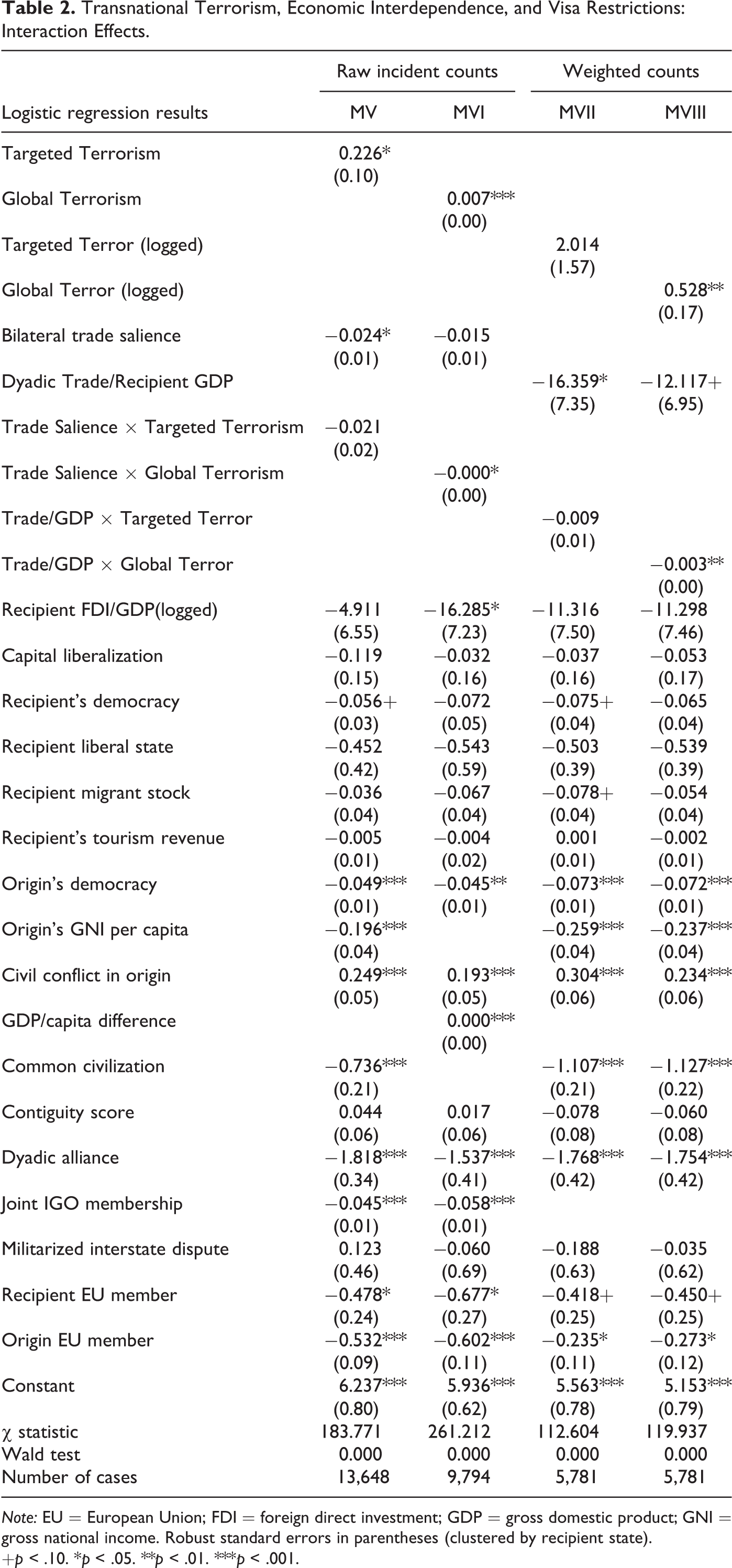
Table 2 directs our attention to the interaction effect posited in Hypothesis 4. 27 It also introduces two other specifications that serve as robustness checks. The final two models employ logged counts of terrorism to guard against the possibility that the results are driven by extreme values on terrorism. Additionally, these models include the second operationalization for trade interdependence, the value of dyadic total trade as ratio of recipient GDP to compare against models using the trade salience indicator (value of dyadic total trade as ratio of recipient trade). The inclusion of joint intergovernmental organization membership serves as a further robustness check against the possibility that visa policies are not influenced directly by terrorism or trade but rather by states’ degree of cooperation with one another. Both alliance ties and international governmental organization (IGO) membership function as proxies for levels of cooperation and in addition, a dummy for civilization ties controls for dyadic affinity. As in Table 1, dummies for destination and origin EU membership account for the possibility that results are driven by inclusion in the EU.
Transnational Terrorism, Economic Interdependence, and Visa Restrictions: Interaction Effects.
Note: EU = European Union; FDI = foreign direct investment; GDP = gross domestic product; GNI = gross national income. Robust standard errors in parentheses (clustered by recipient state).
+p < .10. *p < .05. **p < .01. ***p < .001.
The coefficients on terrorism show first that in the absence of trade ties, transnational terrorism significantly increases the probability of visa restrictions; this effect is more pronounced for targeted terrorism. To illustrate, in the worst-case scenario setting bilateral trade to zero and targeted terror to its maximum of 76, the probability of visa controls is over 99 percent. In fact, even with just ten incidents directed against the destination nationals, the probability jumps to 98 percent. In contrast, again setting trade to zero and global terror to its maximum, the same probability is 96 percent. Turning to the coefficients on trade, the negative coefficient portrays the reductive effect of trade on propensity to impose visas in the absence of terrorism. Parallel to the findings in Table 1, recipient’s FDI/GDP and capital liberalization both impose negative effects on visa controls but the coefficients fail to reach significance in all models. As hypothesized, the positive impact of terrorism declines with increasing levels of trade interdependence, as illustrated by the negative coefficient on the Trade × Terrorism interaction terms. However, this result is significant in only two of the models. The Wald test of joint significance indicates however that trade has a negative and significant (p < .001) impact across all four models. 28
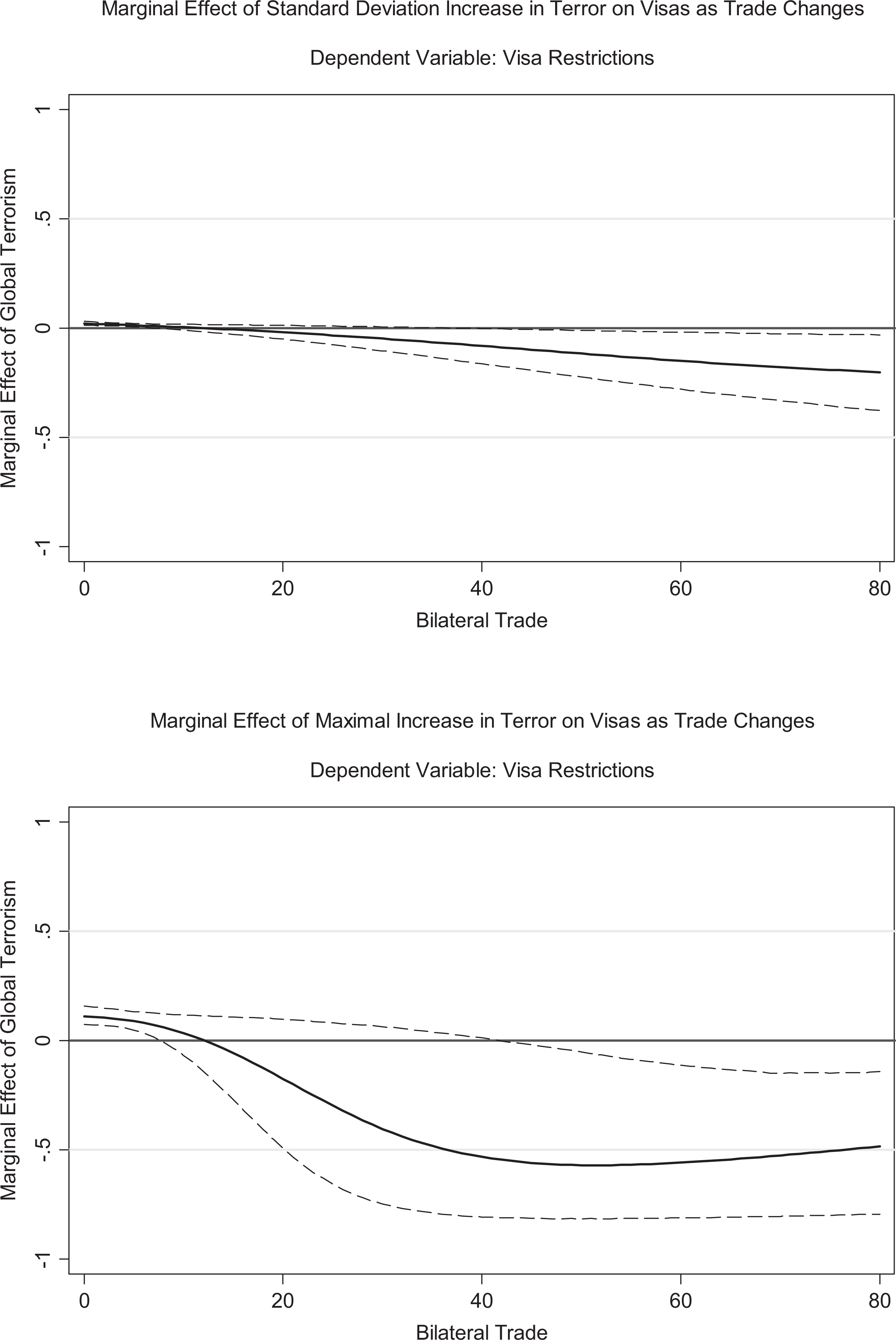
Although the findings in Table 2 are informative, they remain limited in that it is not possible to glean from the results whether transnational terror has a significant positive impact on the probability of visa restrictions when trade is not zero (Brambor, Clark, and Golder 2006; Kam and Franzese 2007). Consequently, I graphically sketch the marginal effects of targeted and global terrorism—from models V and VI—on the probability of visa restrictions across the range of values of bilateral trade salience in Figures 1 and 2, respectively. 29 In each figure, a graph portraying the marginal effect as terrorism is increased by a standard deviation is juxtaposed to a graph showing the marginal effect as terrorism is increased across its full range. The solid line in each figure depicts how the marginal effect of transnational terror changes as interdependence increases. The dashed lines show the 95 percent confidence interval around the marginal effect; the marginal effect of terror is significant if the lower and upper bounds of the confidence interval are both above (or below) zero.

Marginal effect of targeted terror on visa restrictions.
Marginal effect of global terrorism on visa restrictions.
As predicted by Hypothesis 4, in both figures, bilateral trade has a countervailing effect on the impact of transnational terror. In Figure 1, the solid line is not significantly different from zero; given a standard deviation increase in directed terror, interdependence successfully counters concerns over terrorism. Now consider Figure 2, at low levels of bilateral trade, a modest increase of one standard deviation from zero exerts a negligible marginal effect on the probability of visa restrictions. Additionally, the solid line dips below zero once trade salience reaches about 20 percent. This pattern showcases that given global terror, interdependence quickly overwhelms the impact of security concerns at low levels of terror.
Where the graphs differ, however, is when the marginal effect of increasing terrorism across its full range is considered. Figure 1 indicates that the marginal effect of a maximal increase in directed terror remains positive, regardless of levels of bilateral trade; nevertheless, as trade reaches approximately 27 percent of the recipient’s total trade value, the marginal effect ceases to increase, and finally starts decreasing once bilateral trade reaches 40 percent. In stark contrast, in Figure 2, bilateral trade successfully overwhelms the marginal effect of a maximal increase in global terror: at about 17 percent on bilateral trade, the solid line falls below zero. The confidence intervals also tell us that for the midrange values of bilateral trade, the marginal effect of global terror is not statistically different from zero but that once bilateral trade exceeds 40 percent, the effect becomes significantly negative.
In a nutshell, the figures tell us that when states’ own citizens have been targeted in incidents of terror, security concerns continue to dominate policy whereas material interests are predominant when faced with nondirected global terror. This pattern is consistent with the theoretical model of trade interdependence outlined: for highly interdependent dyads in which vested interests in maintaining open borders have become entrenched, economic ties successfully dampen security concerns. It is plausible to imagine that the effect of economic ties grows stronger as commercial interests become deeply embedded domestically.
Robustness Checks
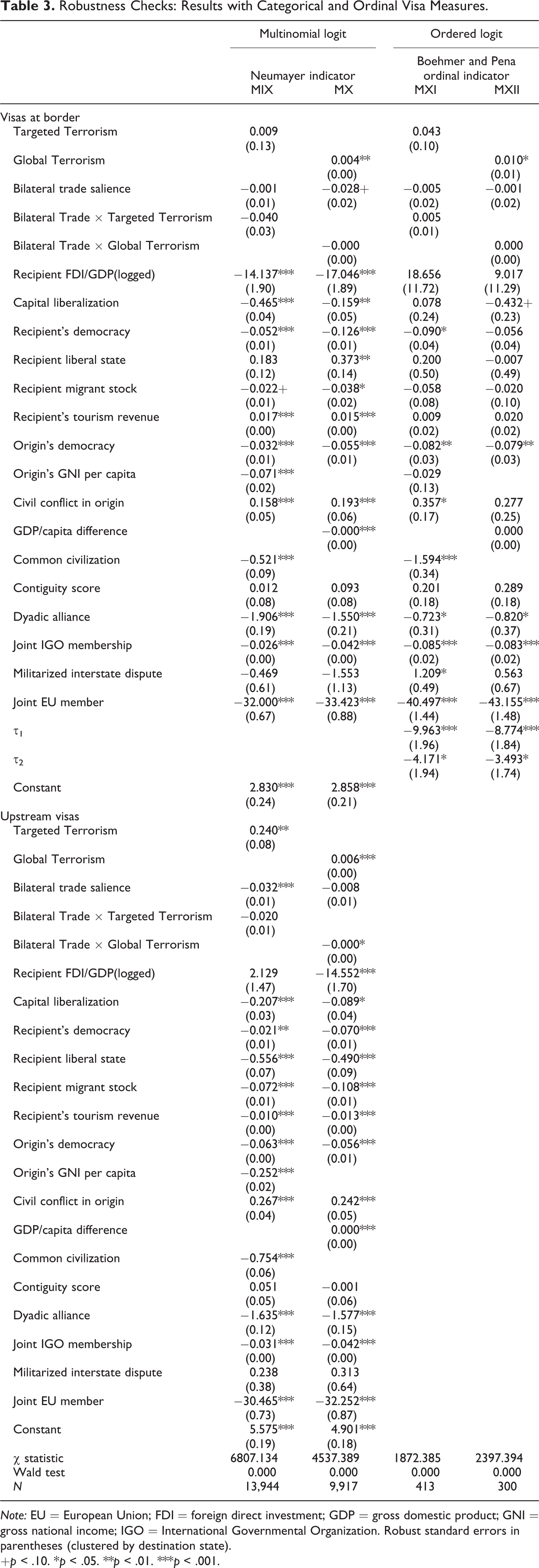
Next, I present results employing the categorical and ordinal indicators for visa restrictions. Models IX and X display multinomial logit results so that we may compare the impact of global and targeted terrorism for visas at borders and upstream visas. Models XI and XII show ordinal logit results with the Boehmer and Peña indicator. Several interesting patterns emerge from these set of results. Looking at the first two models, we note that both global and targeted terror have the proposed positive effect on visas at borders; however, the effect is significant only with global terrorism. Perhaps more interestingly, this pattern reverses when the more conventional form of visa controls, upstream visas, are considered and both terms are positive and significant. That security concerns have a stronger impact on upstream policies is unsurprising if we consider the difference between the two visa categories as a policy tool. Whereas visas demanded upstream serve a screening and selection function, those imposed at the borders do not impose significant costs on travelers; instead they are designed to generate revenue from border crossings (Neumayer 2006, 2010). As such, we would expect transnational terrorism to wield a stronger influence on upstream measures. This insight is supported by the findings in Table 3. Nevertheless, the results also demonstrate that security concerns do have moderate influence on visas at borders; even though the procedure of obtaining permission to entry at the border is not as restrictive as upstream controls, states are more likely to impose a visa at borders rather than grant visa-free entry, given concerns over terrorism.
Robustness Checks: Results with Categorical and Ordinal Visa Measures.
Note: EU = European Union; FDI = foreign direct investment; GDP = gross domestic product; GNI = gross national income; IGO = International Governmental Organization. Robust standard errors in parentheses (clustered by destination state).
+p < .10. *p < .05. **p < .01. ***p < .001.
Next, directing our attention to the performance of the terrorism terms in the final two models, we find moderate support for Hypotheses 1 and 2. Substantively, a maximal increase in targeted terror produces an increase in the probability of passport and visa controls by .33 and decreases the probability of passport-only travel by .32, holding all other variables at their means. The corresponding value for a maximal increase in global terrorism is a .56 increase in the probability of passport and visa controls and a .55 decline in the probability of passport only as the requirement of territorial access. In sum, while Tables 1 and 2 portrayed the effect of terror on the probability of observing visa restrictions, these findings are informative in illustrating that security concerns influence the degree of restrictions placed on human mobility. Specifically, the predicted probabilities show that terrorism increases the probability of observing borders with both passport and visa controls in place but does not have significant impact on producing borders that require just a passport for entry. In a nutshell, the pattern sketched by the models using the ordinal border controls measure is consistent with the multinomial logit models: states capitalize on the requirement of a visa in order to screen and deter individuals they deem threatening.
Addressing the impact of economic interdependence, the takeaway point from Table 3 is that a similar pattern holds with respect to the direct and indirect influence of economic interdependence. As evidenced by the negative coefficients on bilateral trade, trade negatively affects visa controls and mitigates the effect of terrorism. Furthermore, the positive impact of terrorism declines as bilateral trade increases, as captured by the negative sign on the interaction terms. This effect is stronger when upstream visas are considered: this resonates well with the claim that visas function as transaction costs on business and highly interdependent dyads are wary of imposing tough measures that might drive business away. Because visas at borders do not impose similar costs, the effect is not as pronounced. In models XI and XII, the coefficient for bilateral trade is not significantly different from zero.
Furthermore, another striking finding relates to the impact of capital liberalization. In the first two models, the Simmons indicator for capital liberalization and FDI/GDP significantly depress the probability of visa controls across both categories of visas. This pattern does not hold with the final models employing the Boehmer and Peña indicator. It is plausible that the lack of significance on trade and capital interdependence in the final two models is partially attributable to the fact that the Boehmer and Peña measure is limited only to contiguous states. Finally, the controls emerge consistent with previous results and expectations: democracy in the origin and recipient, recipient’s tourism revenue, joint EU membership, joint IGO membership, dyadic alliances, and logged migrant stock make for more permissive border policies. Conversely, conflict in the origin and MID within the dyad corresponds to greater degree of restrictions on mobility.
Table 4 displays the results with visa rejection rate as the dependent variable. The first column provides the results with targeted terrorism as the previous year’s attacks against recipient’s nationals. The second column employs a different specification for directed attacks as the sum of the past five years’ attacks within recipient territory. This grants a further robustness check in allowing us to examine whether a territorial conceptualization of directed terror has a different impact from the measure used in former models. The final model employs global terror, lagged by one year. 30 As measures of economic interdependence, Table 4 includes trade interdependence as ratio to total recipient GDP and total FDI proportional to GDP. In addition to dyadic and push-and-pull controls for migration, all models control for the imposition of short-term visas. This is included because the rejection rate is averaged across all visa types, as a result, recipients report rejection rates for origins whose nationals are not required to apply for short-term visas. Finally, I include a control for joint EU membership.
Visa Rejection Rate, Transnational Terrorism, and Economic Interdependence.

Note: FDI = foreign direct investment; GDP = gross domestic product. Panel corrected standard errors in parentheses.
+p < .10. *p < .05. **p < .01. ***p < .001.
The results in Table 4 are congruent with those presented in previous tables, increasing our confidence in the article’s hypotheses. Targeted terror in model XIII in the absence of interdependence increases the visa rejection rate by approximately 4.5 percent points. The territorial measure of targeted terror in model XIV has a less powerful impact at less than 1 percent increase in the rejection rate. Neither term, however, attains statistical significance. Global terror, on the other hand, is positive and statistically significant where each additional attack by origin country nationals increases the visa rejection rate by almost 0.8 percent points.
Trade interdependence, when terrorism is set to zero, exerts a negative effect across all the models presented and is marginally significant (p < .10) or falls short of conventional levels of significance. The negative sign on the Interdependence × Terror interaction terms in all three models lends further evidence that interdependence weakens the impact of terror. When the joint effect of terror and interdependence is considered, however, the Wald test shows that when targeted terror is nonzero, interdependence is no longer statistically significant. In comparison, in the presence of global terror, interdependence does exert a somewhat significant effect (p < .056). Moreover, the linear combination of coefficients reveals that with less than two standard deviations increase in average dyadic interdependence, the marginal effect of global terror becomes insignificant. In sum, interdependence overshadows security concerns when modulating global terrorism; in contrast, terrorism emerges as the predominant factor when states encounter targeted terrorism, whether these attacks take place within the recipient’s territory or transpire against the recipient’s nationals.
As further robustness checks, I performed the analysis on subsets of data to test for influential outliers and for parameter constancy across time periods. I reevaluated the effects by using the aggregate number of targeted and global terrorism incidents in the post-2000 rather than post-1990 period, and in a separate model, by limiting the cases to Organisation for Economic Co-operation and Development (OECD) countries. While space does not permit a full discussion of these results, a key finding is that the impact of transnational terrorism is substantially greater if the sums since 2000 are considered; this makes sense insofar as the migration–security nexus gained currency after 9/11. Regardless, consistent with Hypothesis 3, economic interdependence decreases the probability of visa controls. These results are provided in the online Appendix Table B.
Conclusion
With the rise of nonstate threats, borders have been recast as perimeters of defense not just against the militaries of other states but also as barriers against intrusion by individuals who can imperil state security (Adamson 2006; Donaldson 2005; Rudolph 2005). Yet at the same time, the exigencies of interdependence oblige states to pursue a balancing act of satisfying material objectives and maintaining security (Rudolph 2003, 2006).
This article also enhances our understanding of globalization in several ways. First, it offers a way to study the ways in which different types of flows across borders—capital, goods, and labor—interact. Second, it aspires to transcend the divide between literature on international political economy and security studies and brings into sharper focus the noneconomic facet of globalization. In doing so, it highlights the dilemmas states face in pursuing economic objectives while responding to security challenges. Third, the article offers a way to rethink the relationship between labor mobility and other facets of globalization by shifting the focus from flow to state policy. By doing so, the article asks us to reevaluate the relationship between different types of flows by demonstrating that within the issue area of migration policy, economic and security interests are influential to varying degrees. Whereas previous literature has assumed that the linkage between migration and terrorism unconditionally alerts states to the security implications of human mobility, the findings show that securitization is dependent on how close to home threats strike.
Finally, theoretical framework accommodates the possibility that the technologies, information, communication, and transportation that facilitate globalization may be exploited by flows of violence (Kellner 2007). The possibility of informal violence demonstrates most clearly that globalization has narrowly been defined simply as “economic integration on a global scale” (Keohane 2002, 31). By concentrating on the geopolitical aspect of security, the article seeks to move beyond the narrow perspective of globalization as purely economic or benign to develop a theory that views flows of terrorism as a dimension of globalization. The article thus also represents a call for scholars to gain a broader understanding of how globalization influences state decisions.
Footnotes
Acknowledgments
I would like to thank Christopher F. Gelpi for suggestions and comments, Eric Neumayer for help with the use of his measures and data, and Boehmer and Peña for providing access to their indicators.
Declaration of Conflicting Interests
The author(s) declared no potential conflicts of interest with respect to the research, authorship, and/or publication of this article.
Funding
The author(s) received no financial support for the research, authorship, and/or publication of this article.