



Abstract
This note uses a new data set on international territorial disputes and boundary agreements to explore whether and how legal commitments affect state behavior. Do border treaties reduce subsequent conflict simply through their effect on the distribution of the disputed good, or do treaties have legal and political implications such that a given distribution of territory has different effects depending on whether it is de facto or de jure? There are three main results. First, among states that have homeland territory disputes, the adoption of a legally binding border is associated with a significant reduction in the likelihood of future militarized conflict over the territory. Second, this effect is the same regardless of whether the treaty transfers territory or converts a de facto or contested border into a de jure border without changing the status quo distribution. Third, there is no equivalent reduction in conflict when states create explicitly provisional borders that allow them to retain their claims to areas that they do not possess. These findings suggest that border treaties do more than simply specify the distribution of territory and provide for transfers. By requiring states to renounce claims to territories that they do not receive, treaties generate ex ante costs of signing and/or ex post costs for reneging that explain their association with subsequent peace.
Consider the following thought experiment. Since 1949, Indian- and Pakistani-controlled regions of Kashmir have been separated by a “line of control” (LOC), an explicitly provisional border originally drawn along the armistice line from the first Kashmir War. Modified slightly in 1972, the LOC has served as a de facto boundary between the two countries for over six decades. Sometimes called “the world’s most dangerous border,” it has been the scene of several wars, extended periods of low-level conflict, and a transborder insurgency that has also given rise to terrorist attacks in other regions of India. If the governments of India and Pakistan were to sign a treaty making the LOC the de jure border between the two states in Kashmir, what would happen? Would we expect the risk of future violence to go down, up, or remain unchanged?
This possibility is not purely hypothetical. In a number of interstate territorial conflicts, adversaries converted de facto or contested borders into de jure borders without any territory changing hands. In 1975, for example, Italy and Yugoslavia signed the Treaty of Osimo, which gave definitive legal status to an administrative boundary in Trieste that had been in existence for two decades. In 1997, Russia and Lithuania signed a treaty recognizing as their common border the line that had served as an internal Soviet boundary since 1963. And, in 1998, Ecuador and Peru reaffirmed the boundary set in the 1942 Rio Protocol, a boundary that Ecuador had renounced and that had subsequently been the subject of militarized disputes, including a brief war in 1995. In all three of these cases, there was no further militarized conflict over the territories in question. Does conferring legal status to a de facto or contested border, without changing the distribution of territory, have any implications for the likelihood of future conflict? Given that the states were subsequently willing to live with the distribution of territory as it was, would they have experienced peace even without having signed those treaties?
These questions are interesting not only because of their relevance to conflict resolution but also because they engage the fundamental question of what states are doing when they undertake legal commitments. A border treaty has at least two major functions. The first is to specify where the line between two states is to be drawn, including in some cases providing for the transfer of territory from one state to another. In this narrow sense, an agreement specifies how the disputed “pie” is to be divided, and bargaining models show that the distribution of a valued object plays an important role in determining whether states will find it profitable to threaten or use force to get a better deal (e.g., Fearon 1995; Powell 1999). At the same time, treaties and related legal instruments dispose of claims to territory. Signatories get clear title to the territory on their side of the border in exchange for renouncing any claim they had on the territory allocated to the other state. This disposition of claims is what separates a de jure border from other kinds of arrangements. The LOC between India and Pakistan is a line that divides territory, but its provisional nature has allowed both sides to retain their claims to the whole of Kashmir. The once contested border between Ecuador and Peru also divided the territory, but Ecuador refused until 1998 to renounce its claims on the other side. Hence, whether converting a de facto or contested border into a de jure border matters gets to the heart of whether the legal aspect of treaties has any impact above and beyond their distributional role.
This note uses a new data set on territorial conflict and border treaties to develop two sets of empirical results that speak to these issues and raise questions that are ripe for additional research. First, among states that have homeland territorial disputes, acceptance of a legally binding border is associated with a substantively and statistically significant reduction in the likelihood of a subsequent militarized interstate dispute (MID) over the contested territory. This effect is strong and robust to the inclusion of control variables that are generally included in canonical models of militarized disputes. Second, the effect of border treaties cannot be fully explained by their distributional function. This result is established by examining the subset of treaties that legalize the status quo (SQ) that holds at the time of signing. The empirical model shows that these treaties are associated with a reduction in future conflict that is indistinguishable from the reduction associated with treaties that transfer territory. In addition, the effect of such treaties is different from explicitly provisional arrangements, such as the LOC, that distribute territory but do so in a way that allows states to retain their claims.
Collectively, these results suggest that a minimalist view of treaties as mechanisms for “dividing a pie” is insufficient and that the question of what these instruments actually do is a pressing matter for scholars of international relations and conflict resolution. Thus, the results complement a number of recent studies attesting to the importance of treaty commitments in a variety of contexts. They also raise a number of questions. If border treaties do not work primarily through their distributional mechanism, why are they associated with a significant reduction in violence? What are the international and domestic effects of undertaking a legal commitment to a particular border? Although this note cannot fully elaborate and test alternative explanations, the data and results lay the groundwork for further research.
Related Literature and Theory
There has been a good deal of scholarly interest in recent years about whether and how international law matters. Much of this work has been in the area of international trade and finance (e.g., Goldstein, Rivers, and Tomz 2007; Simmons 2000; von Stein 2005), human rights (e.g., Hathaway 2002; Simmons 2009), and the environment (e.g., von Stein 2008). There is also a growing body of literature examining the effect of international agreements on the likelihood of militarized conflict (e.g., Fortna 2004; Mattes 2008; Mitchell and Hensel 2007). A central question in all of this literature is whether behavior that appears to be in compliance with legal obligations indicates a causal effect of law and, if so, by what mechanism. Because states can generally choose which agreements they will sign, legal commitments may appear to work simply because they ratify what the signatories would have done anyway (Downes, Rocke, and Barsoom 1996). As a result, increased attention has been paid to methods for isolating the causal effect, if any, associated with treaty signing or ratification (e.g., von Stein 2005; Hill 2010).
This note offers an approach to this problem in the context of territorial disputes. In this context, a central challenge is that territorial agreements might “work” simply by creating stable distributions of the disputed good. Standard bargaining models show that there will be no conflict when a good is allocated in such a way that each side gets at least as much from the SQ as it expects to get by using force (Powell 1999). As a result, compliant behavior—that is, an absence of future conflict—may simply be a function of the “facts on the ground”: how the territory is distributed and the material factors that determine the states’ expected values for militarized conflict. For example, peace between Lithuania and Russia after their 1997 treaty might have had nothing to do with the treaty but rather the condition of mutual deterrence arising from the latter’s military power and the former’s ties with the West (which culminated in North Atlantic Treaty Organization membership in 2004). Indeed, canonical empirical models of militarized conflict (e.g., Russett and Oneal 2001; Bennett and Stam 2004) do not control for whether or not the states signed an agreement over some issue of contention, focusing instead of variables that are thought to increase or decrease the states’ values for conflict, such as their relative power, regime type, alliances, and so on. Holding such factors constant, a treaty could reduce the likelihood of subsequent conflict by changing the way the good is allocated. In particular, the risk of conflict would go down if the distribution specified in the treaty fell in the bargaining range created by the costs of war (Fearon 1995). When this is the case, both states are satisfied, in the sense that neither can profitably threaten force to change the SQ, and the fact that the distribution takes a de jure form makes no difference.
Set against this view is the possibility that the disposition of legal claims matters, so that distributions created by legally binding instruments are different from those that are not. The literature on international law suggests two mechanisms. First, legal commitments might create ex post constraints for violating them, either because of reputational concerns (Guzmán 2008) or because of third-party efforts (e.g., Simmons 2000). The peace between Ecuador and Peru after 1998, for example, was bolstered by the active involvement of four guarantor countries (Argentina, Brazil, Chile, and the United States) as well as by the prospects of regional economic integration, which were thought to be conditional on stable relations (Simmons 1999). A second mechanism suggested by the literature is that the renunciation of claims is an ex ante costly act due to the domestic political repercussions. The Treaty of Osimo was unpopular in Italian Trieste, where many inhabitants had held onto the dream of reclaiming lands lost in the post–World War II settlement. Indeed, the fear of a domestic backlash explains why the original Trieste settlement in 1954 was framed as a provisional settlement, allowing the Italian government to suggest that it might someday be revised (Novak 1970, 462–63). By 1975, the decision to sign these hopes away was politically less risky, and any negative effects were ultimately localized and short lived (Ballinger 2003, 93–96). By contrast, a border treaty between India and Pakistan at the LOC would likely generate domestic political opposition that would jeopardize the tenure, and possibly the lives, of leaders in both countries; these risks help explain why such a treaty remains hypothetical. In this view, the ex ante costs associated with the renunciation of claims makes treaties a screening mechanism, whereby states are most likely renounce the claims that are (or have become) least worth fighting for (von Stein 2005). This mechanism implies that the legal aspects of treaties matter, not through a direct impact on future behavior, but through a domestic political mechanism that forces states to be selective about signing them. Although the question of whether treaties constrain or screen (or both) is a debate within the literature on compliance (e.g., Simmons and Hopkins 2005), both mechanisms share the view that legal commitments matter in the sense that actors respond differently to same distribution of territory depending on whether it is de facto or de jure.
The strategy adopted here differentiates the distributional and legal arguments in three ways. The first is to show that the signing of a border treaty is associated with a reduction in the likelihood of future conflict even when controlling for the factors that are thought to influence the states’ expected values for war. Hence, we cannot dismiss the effects of treaties as epiphenomenal to the other variables that appear in canonical models of conflict. Second, I compare the effects of treaties that change the distribution of territory to those that simply enshrine the SQ at the time of signing. 1 If the distributional mechanism does all the work, then legalizing a border without changing its location should make no difference to subsequent outcomes (assuming we control for factors that determine the states’ expected values of war). If, on the other hand, the renunciation of claims creates ex post constraints or ex ante costs, even when no territory changes hands, then we would expect little or no difference between treaties that transfer territory and those that do not. Finally, I compare the effects of treaties to agreements that are explicitly provisional, and therefore distribute territory without requiring states to renounce their claims to the regions they do not possess. If the disposition of claims is an important component of how treaties work, then these kinds of arrangements should be associated with different outcomes than should border treaties.
In addition to contributing to the literature on international law, this article relates to a literature on how agreements influence the likelihood of militarized conflict. Fortna (2004) shows that the terms of ceasefires in interstate wars affect the risk of subsequent wars. In a finding that is most similar to the one presented here, she shows that the probability of renewed warfare is lower when a ceasefire includes some settlement of the underlying issue in contention rather than leaving the dispute unresolved. Senese and Quackenbush (2003) show that MIDs that end in imposed settlements are less likely to recur than MIDs that end in negotiated or no settlements (see also Quackenbush 2010). Although these studies suggest that the nature of settlements matter, they do not isolate the distinction between de jure and de facto or provisional agreements.
There is also an extensive literature specifically on territorial conflict, including studies examining the effects of legal commitments on conflict. Huth (1996, 72) finds that dyads that signed a border agreement prior to World War II were significantly less likely to experience a new dispute in the postwar period, but he does not test whether treaties are effective at ending ongoing disputes. Gibler (1997) shows that alliances that include territorial settlements are associated with a reduction in violence among interstate rivals. Mattes (2008) finds that provisions accompanying territorial settlements affect the likelihood that the settlement will subsequently be challenged or renegotiated. Mitchell and Hensel (2007) compare territorial settlements reached via binding third-party ruling with those reached through bilateral or mediated negotiations and find that the former are associated with a higher level of compliance (see also Gent and Shannon 2010). The importance of legal commitments is also suggested by Mitchell and Powell (2011, chap. 7), who show that territorial disputants who have accepted the jurisdiction of the International Court of Justice (ICJ) are less likely to experience militarized conflict, more likely to reach some settlement of the dispute, and more likely to comply with those settlements. This note builds on these by explicitly differentiating the distributional and legal aspects of territorial agreements.
In a set of studies that most closely resemble the present one, Tir (2003, 2006), Gibler and Tir (2010), and Huth and Prorok (2012) examine the effects of territorial transfers on subsequent conflict. Tir (2003) reports that territorial transfers decrease the likelihood of subsequent militarized conflict in the dyad relative to the pre-transfer period. Gibler and Tir (2010) show that peaceful transfers in particular reduce the likelihood that a country will be targeted by militarized action over territory. Huth and Prorok (2012) show that the stability of peace after territorial changes depends on the legal norms underpinning the deal, including whether or not the change was effected by bilateral treaty. These studies, however, do not specifically estimate the impact of treaties that simply enshrine the SQ at signing. Since most peaceful transfers of territory are enacted through treaty, it is difficult to disentangle the effect of the transfer from the effect, if any, of the legal commitment. To identify the latter effect, we have to look at treaties that do not change the way territory is allocated.
Description of the Data Set
The tests performed in this article rely on a new data set on interstate territorial conflict. This section provides a brief description of the data. Additional details can be found in the Supplementary Appendix.
Sample Criteria
The sample consists of all pairs of states that had a least one militarized conflict over homeland territory in the period 1816–2001. Several aspects of this definition are worth emphasizing. First, the sample only includes conflicts between sovereign states, as identified by the Correlates of War (COW; 2008) project. Second, entrance into the sample requires at least one militarized conflict over the territory. Dyads enter the sample after the conclusion of this first militarized event. This criterion, which differentiates the present data set from those of Huth and Allee (2002) and Hensel et al. (2008), is appropriate for estimating the effect of legal commitments in disputes that have been the subject of militarized action. If states never fought over a piece of territory, signed a treaty, and continued not to fight over the piece of territory, it would be difficult to know how much of the subsequent peace was due to the treaty and how much was due to other factors that made the territory not worth fighting over. Finally, all cases involve conflicts over territory that both states consider part of their homeland, thus excluding cases involving colonies or dependencies.
The resulting sample consists of 127 dyads. Some dyads, however, experience conflict over more than one territorial issue. Issues were separated if it was possible for the territories to be allocated independently and the territories were, in practice, subject to militarization and settlement at different times. There are a total of 153 issues in the sample. Most remain under observation until the end of the data set in 2001. An issue may end sooner if one or both states exit the state system, either through conquest, unification with another state, or disintegration.
Measuring Militarized Conflict
To identify militarized actions over territory, we use the MID data (see Jones, Bremer, and Singer 1996). 2 MIDs are events between two or more states in which at least one state directs a militarized action at another. Militarized actions can range from a threat to use military force, a display of military force, a limited use of military force, up to full-scale war. Other studies have used the MID data set to identify militarized action over territory, but they rely on that data set’s Revision Type variable to identify MIDs involving demands for territorial revision (e.g., Tir 2006). Although useful as a starting point, a systematic analysis reveals that not all MIDs so coded were actually about homeland territory, and some MIDs coded as not being about territory actually were.
Thus, we researched and coded MIDs using a procedure, described more fully in the Supplementary Appendix, that started with Revision Type, but then expanded the search to additional cases. A MID was considered to be “about” territory if the militarized action was accompanied by specific demands to change the distribution of territory, was used to seize or assert control over a disputed piece of territory, was directed against inhabitants of disputed territories (e.g., attacks on people farming disputed land), arose because of a militarized presence in disputed regions (e.g., if patrols in disputed areas led to minor skirmishes), or was used to stop a state from exploiting or consolidating control over a disputed territory (e.g., a seizure of an oil rig or fishing vessels in waters around a disputed island). In all, 613 territorial MID dyads were identified. Since some MIDs are relevant to more than one issue in a dyad, there are 629 MIDs when counted by dyad-issue. 3
Identifying Border Treaties
Finally, the data set identifies whether and when states made legal agreements over the distribution of disputed territory. Three criteria guided this coding. First, agreements had to take a form that would be recognized as legally binding. Formal treaties are by far the most common mechanism, together with other formal documents, such as conventions, protocols, or exchanges of notes. The second most common legal mechanism is acceptance of a ruling from a court or arbitrator or the results of a plebiscite. For example, a number of territorial disputes have been resolved by rulings of the ICJ or other third parties (Allee and Huth 2006; Mitchell and Hensel 2007). While recognizing that there may be differences between these legal instruments, I use the term border treaty as shorthand for any legally binding commitment that delineates a boundary between two states.
The second criterion is that both sides had to participate in the agreement and recognize the border being agreed to. In most cases, this participation is indicated through the signatures of authorized state representatives on a document; however, signed treaties that failed to meet ratification requirements (if specified) are excluded. In the case of arbitral or judicial awards, rulings are sometimes incorporated into subsequent agreements, but acceptance may also be indicated less formally. For a third-party ruling to be considered a border treaty, the states had to consent ex post to division of territory specified by the ruling; an ex ante commitment to abide by a ruling is not sufficient, though in practice few rulings are explicitly rejected after they are handed down. This participation condition does not exclude agreements that are acquired by coercion or dictated by third parties, but it does rule out cases in which third parties recognize a border that one or both disputants do not. There are also a small number of indirect agreements in which a disputant indicated its acceptance of treaty to which it was not a formal signatory.
The final criterion is that the agreement had to determine how sovereignty over the contested territory was to be allocated. This is done either by specifying the coordinates or physical features that make up the border (generally called delimitation) or by acknowledging ownership of disputed regions by name (allocation). The determination of sovereignty is important here, since treaties that dealt only with administrative or military control, without explicitly allocating sovereignty, were identified separately, as discussed below.
To identify all border treaties in the sample, the history of every conflict was researched. A variety of sources were consulted, including the League of Nations and United Nations Treaty Series, the British and Foreign State Papers, the International Boundary Studies series produced by the US Department of State, newspaper reports and new broadcasts available through ProQuest and LexisNexis, news archives such as Keesings’ Record of World Events and Facts on File, as well as secondary sources on the disputes and dyads in our sample.
This process led to the identification of 150 border treaties between states in the sample period. Because some agreements were relevant to more than one issue, there are 152 treaties by issue. The vast majority (117 or 77 percent) were formal agreements to which the disputants were signatories, 29 (19 percent) were the product of third-party arbitration or adjudication or a plebiscite, 4 and 6 (4 percent) were formal agreements to which one of the parties was not a signatory but nonetheless indicated that it would abide by the terms.
The Effect of Treaties on Subsequent MIDs
Any given treaty can have three possible fates: it can fail in the sense of being followed by a new MID over the territory in question, it can be replaced by another treaty without an intervening MID, or it can survive until the end of the period of observation. Of the 152 treaties in the data set, 60 (39.5 percent) failed, 18 (11.8 percent) were replaced by a subsequent treaty, and 74 (48.7 percent) neither failed nor were replaced. This pattern suggests that it is plausible that treaties are followed by a reduction in subsequent violence because a plurality succeeded in ending militarized conflict over the issue. At the same time, the considerable number of failed treaties suggests that we cannot generally assume that the signing of a treaty indicates the end of a dispute.
To estimate the effect of treaties on subsequent MIDs, the data are rendered so that the unit of observation is the dyad-issue-year: every issue in every dyad has one entry for every year after the end of the first militarized dispute until the issue exits the sample. 5 The dependent variable is a dichotomous variable indicating, for each dyad-issue-year, whether or not a territorial MID started in that year. 6 This design allows us to model the probability that a territorial MID will begin in any given year over a particular issue. It is also useful to think of this exercise as modeling the duration of peace following a MID: Does the existence of a prior treaty influence the probability that a spell of peace will break down?
The main independent variable in this analysis, Border treaty since last MID, indicates whether a border treaty was signed since the last MID over the issue. If the states sign a treaty in year t, Border treaty since last MID equals one in all years t + 1 and higher until the states experience a new MID over the issue in question. 7 This variable continues to equal one in the year of the MID onset, but it is reset to zero afterward and stays at zero unless and until a new treaty is signed. The estimated effect of this variable measures how much the probability that a spell of peace will end depends on whether a treaty was signed during that spell. 8
A bivariate analysis shows a dramatic reduction in the frequency of MID onsets after the signing of a treaty. When there had been no border treaty since the last MID, new MID onsets occurred in 10.9 percent of issue-year observations; by contrast, when there had been a border treaty since the last MID, new onsets occurred in only 1.5 percent of observations. This effect is significant at any confidence level (χ2 = 308.7).
Though suggestive, a simple bivariate test fails to account for other variables that might influence both the risk of a MID onset and the likelihood of having a border treaty. To deal with this, I turn to multiple regression analysis and introduce a number of control variables that prior research has identified as affecting MID risk. In particular, all models include controls for a prior military victory in the dyad, the relative military capabilities of the disputants, the change in military capabilities since the last MID, alliance relations (including a separate indicator for European dyads in the Cold War period), joint democracy, and the age of the dyad at the time of the first territorial MID, which is a plausible proxy for the stakes of the dispute. A full discussion of these variables, and how they were coded, is presented in the Supplementary Appendix. All models also contain a control for the number of years that have passed since the last territorial MID, which is introduced as a third-order polynomial (Carter and Signorino 2010). In some tests, these polynomial terms are interacted with the treaty indicator in order to allow the effect of treaties to vary over time. The time variables can be interpreted as capturing the baseline hazard function (i.e., the probability that a spell with end given that it has lasted to this point), and including the interaction terms is equivalent to stratifying this hazard function by the presence or absence of a treaty.
All of the estimations are performed using logit models with and without issue-specific fixed effects. The fixed effects models, implemented using Chamberlain’s conditional logit, are particularly useful for focusing on intertemporal variation within each issue: Does a change in some variable, including agreement status, coincide with a change in the likelihood of conflict over that issue, holding constant any fixed attributes of the issue? The cost of fixed effects is that issues that did not experience any MIDs after the first one (or, less commonly, experienced a MID onset every year it was in the sample) are dropped from the sample since they exhibit no variation on the dependent variable. As a result, fifty issues, comprising 2,091 observations, are excluded from tests using this estimator.
Table 1 presents the basic results. Columns 1 and 2 present models in which Border treaty since last MID is included only in additive form, so the coefficient reflects the average effect of a treaty over the course of the subsequent spell. Columns 3 and 4 report models in which the treaty indicator is interacted with the Time since last MID polynomial terms, so the coefficient gives the immediate effect of a treaty in the year after a MID, with subsequent effects calculated from the interaction terms (not reported, but depicted in Figure 1). In all models, the conclusion of a treaty since the last MID is strongly negatively correlated with the risk of a subsequent MID, even when controlling for potential confounding factors. This effect holds when the model is estimated with issue-specific fixed effects (columns 2 and 4) and whether the effect of the treaty is assumed to be constant over time (columns 1 and 2) or varying over time (columns 3 and 4). Exclusion restriction tests show that the interactions with the time variables are collectively significant, suggesting that the effect is time varying.
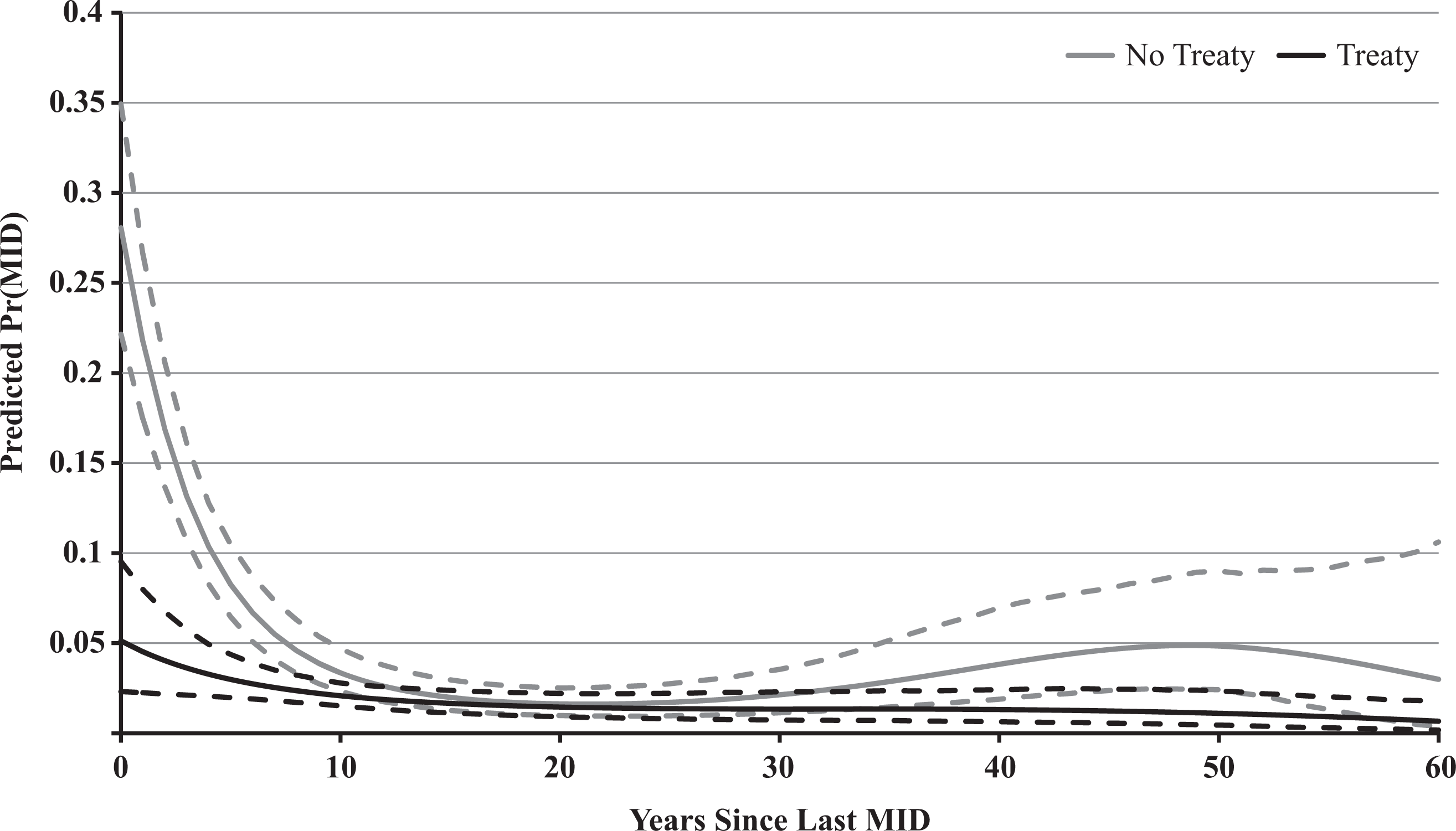
Border treaties and MID risk over time. MID = militarized interstate dispute.
The Effect of Treaties on Territorial MIDs.
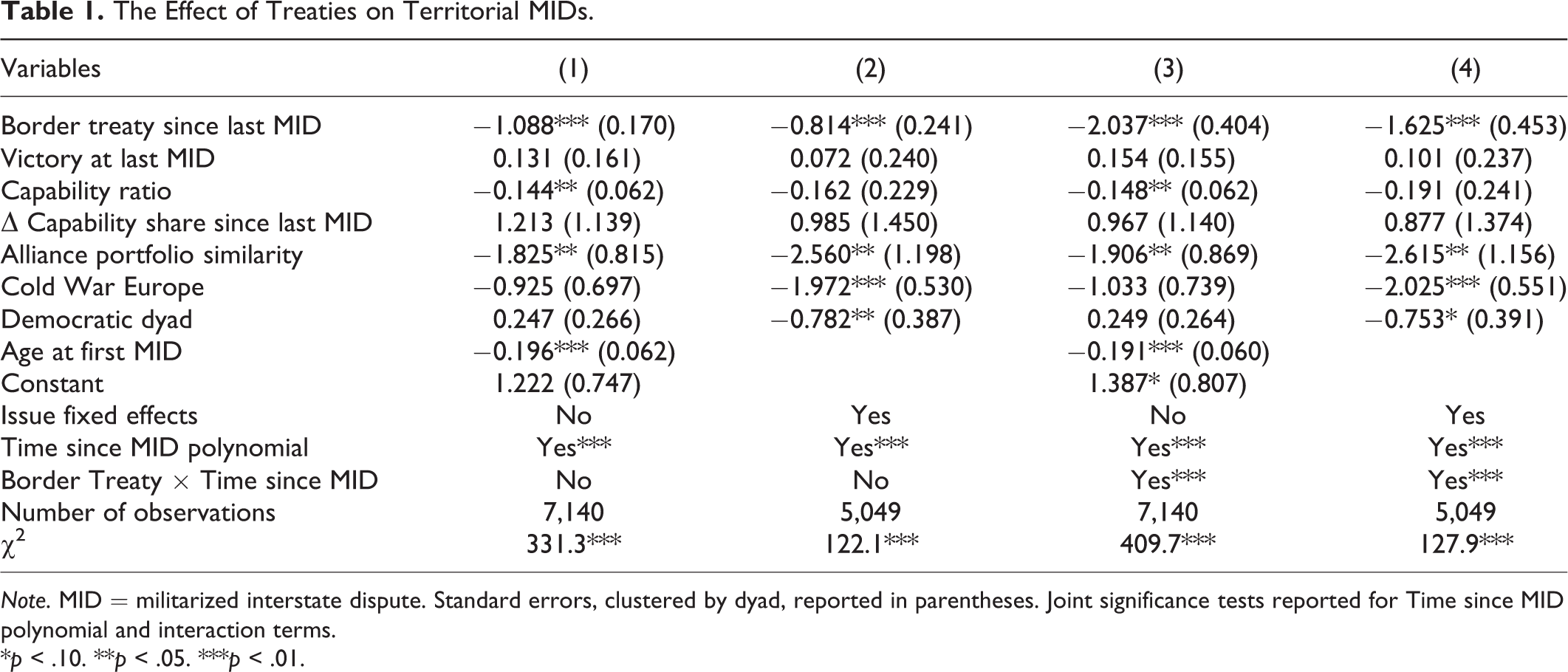
Note. MID = militarized interstate dispute. Standard errors, clustered by dyad, reported in parentheses. Joint significance tests reported for Time since MID polynomial and interaction terms.
*p < .10. **p < .05. ***p < .01.
Figure 1 depicts the predicted probability of a MID as function of time since last MID and whether or not there was a border treaty since last MID, based on the estimates in column 3. The 95 percent confidence intervals are indicated by dashed lines. The figure shows that the reduction in conflict due to a treaty is most pronounced in the first decade after the most recent MID. Since the predicted MID risk drops quickly with time even in the absence of a treaty, the additional pacifying effect associated with a treaty gets smaller, and the difference is vanishingly small and not statistically significant in the second and third decade after the last MID. However, starting around twenty years since last MID, the risk of a MID in the absence of a treaty starts to climb again, while there is no corresponding increase among dyads with a treaty. While the reduction in MID probability associated with a treaty is not large in absolute terms at this point, it is statistically significant (at the 5 percent level) from thirty-nine to fifty-six years since last MID and large in relative terms: four decades after the last MID, the predicted MID risk is three times higher if a treaty is absent. As even more time passes, the risk of renewed conflict asymptotes to zero, and there is again no discernible difference. Thus, on average, treaties have their most pronounced effects in the first decade after the most recent MID and three to four decades thereafter, when there is a higher risk of relapse in the absence of a treaty.
Most of the control variables have the expected effects, with the exception of Military victory at last MID, whose coefficient is positive but never significant. Thus, even though military victories are correlated with peace in a bivariate test, this effect goes away when we control for treaties. Substantively, this suggests that any pacifying effect of military victories may work through the fact that victories are often followed by treaties. The effect of the capability ratio is negative, as expected, meaning that larger power imbalances are correlated with a lower likelihood of MIDs. The effect of a change in the distribution of potential capabilities is positive, but the coefficient is not significant at conventional levels. The coefficients on Alliance portfolio similarity and Cold War Europe have the expected (negative) sign in all models. The Age at 1st MID variable also performs as intended: the younger the states were when they experienced their first militarized conflict over the territory in question, the higher was the risk of subsequent MIDs.
The estimated effect of joint democracy—which is negative and significant only in the models with fixed effects—deserves some elaboration. These estimates imply that, whereas democratic dyads are no less conflict-prone in general, a transition to joint democracy is associated with a decrease in the risk of MIDs, all other things equal. Although space does not permit a full exploration of the relationship between territorial MIDs and democracy, several observations are possible. First, the absence of a general “democratic peace” effect is partly due to the sample selection criterion, which conditions on the existence of a first MID over territory. Relatively few jointly democratic dyads meet this criterion. Only 8 of the 153 disputed issues (5.2 percent) started when the adversaries were both democracies; by comparison, jointly democratic dyads make up 12.1 percent of bordering dyad-years. If the democratic peace means that jointly democratic dyads are unlikely to enter the sample in the first place, those that do are not necessarily representative of the entire population. The fixed effects specifications can help correct for this heterogeneity.
More importantly, the effect of joint democracy on MID risk depends on the treaty status. Whereas there is no difference in MID rates between jointly democratic and other kinds of dyads in the absence of a border treaty, joint democracy is associated with a significant reduction in the risk of a subsequent MID after a border treaty has been signed. In fact, there is not a single treaty failure among jointly democratic dyads. One interpretation of these results is that the democratic peace works in this context by improving compliance with territorial agreements (e.g., Leeds 1999). An alternative interpretation, suggested by Gibler (2007), is that democracy itself is a product of territorial peace, so that treaties that are successful in resolving conflict create conditions for democracy to emerge. Additional work on the determinants of border treaties is needed to sort out these competing explanations.
Robustness Checks
Before moving on, it is worth addressing a few possible concerns about these results. First, the data span almost two centuries, a period that saw important changes in the nature of territorial conflict and norms governing their resolution. In particular, the post–World War II era witnessed a significant reduction in territorial conflict among major powers, the articulation of strong territorial integrity norms (Zacher 2001), and the strengthening of international organizations, particularly the ICJ, that have played an important role in settling territorial disputes (Mitchell and Powell 2011). Might the correlation between border treaties and subsequent peace be a product of the post–World War II international system? Second, the coding of border treaties intentionally conflates different legal instruments, including treaties and judicial rulings, whose effects might not be identical. Mitchell and Hensel (2007) and Gent and Shannon (2010) have shown that agreements that arise due to binding third-party rulings are more effective than those that arise from bilateral talks or nonbinding third-party mediation. Could the overall effect attributed to “treaties” be a function of a particular dispute resolution mechanism?
The Supplementary Appendix reports several tests designed to assess these questions. Table A1 contains estimates obtained when the specifications reported in Table 1, columns 1 and 2, are applied separately to pre- and post-1945 observations. Although the coefficients on some covariates are sensitive to the time period, those on Border treaty since last MID are consistently negative and significant, and the implied substantive effects are similar across periods. Table A2 reports the estimates of models in which border treaties are disaggregated into the three types identified above: formal agreements; arbitral, judicial, or plebiscitary outcomes; and indirect agreements. Although there is some evidence that binding third-party mechanisms are associated with a greater reduction in subsequent MID risk than are formal treaties, we cannot reject the null hypothesis that the effects of these two mechanisms are identical. This does not necessarily imply that negotiated treaties and third-party rulings have identical effects, since they are likely selected under different conditions (e.g., Simmons 2002; Allee and Huth 2006; Wiegand and Powell 2011). Nonetheless, there is no reason to believe that the overall effect of border treaties identified here is an artifact of a particular period or dispute resolution process.
Do Treaties Simply Distribute?
We have seen that border treaties are strongly associated with a reduction in subsequent violence and that this effect is robust to the inclusion of other variables typically included in models of militarized conflict. We now consider whether the effect of treaties is due to their distributional function. If treaties only affect the likelihood of subsequent conflict through their effect on the distribution of territory, then this effect should be limited to those that provide for a transfer of territory. Treaties that simply enshrine the SQ, by this logic, should have no effect on the likelihood of subsequent conflict. Furthermore, there should, in principle, be no difference between a border treaty and an explicitly provisional arrangement, such as an agreement to observe an LOC.
We test the proposition that treaties only affect the likelihood of conflict when they transfer territory by coding each treaty according to how the specified boundary compared to the SQ at the time of signing. A treaty could preserve the SQ, shift the boundary in favor of one state or the other, or make changes in both directions. 9 For this coding, the SQ allocation reflected the actual control and administration at the time of signing. Borderline cases arose when, for example, one country defeated another in war and then received an occupied territory in a treaty. In such cases, military occupation was considered to constitute effective administration only if it persisted for at least two years before the treaty was signed.
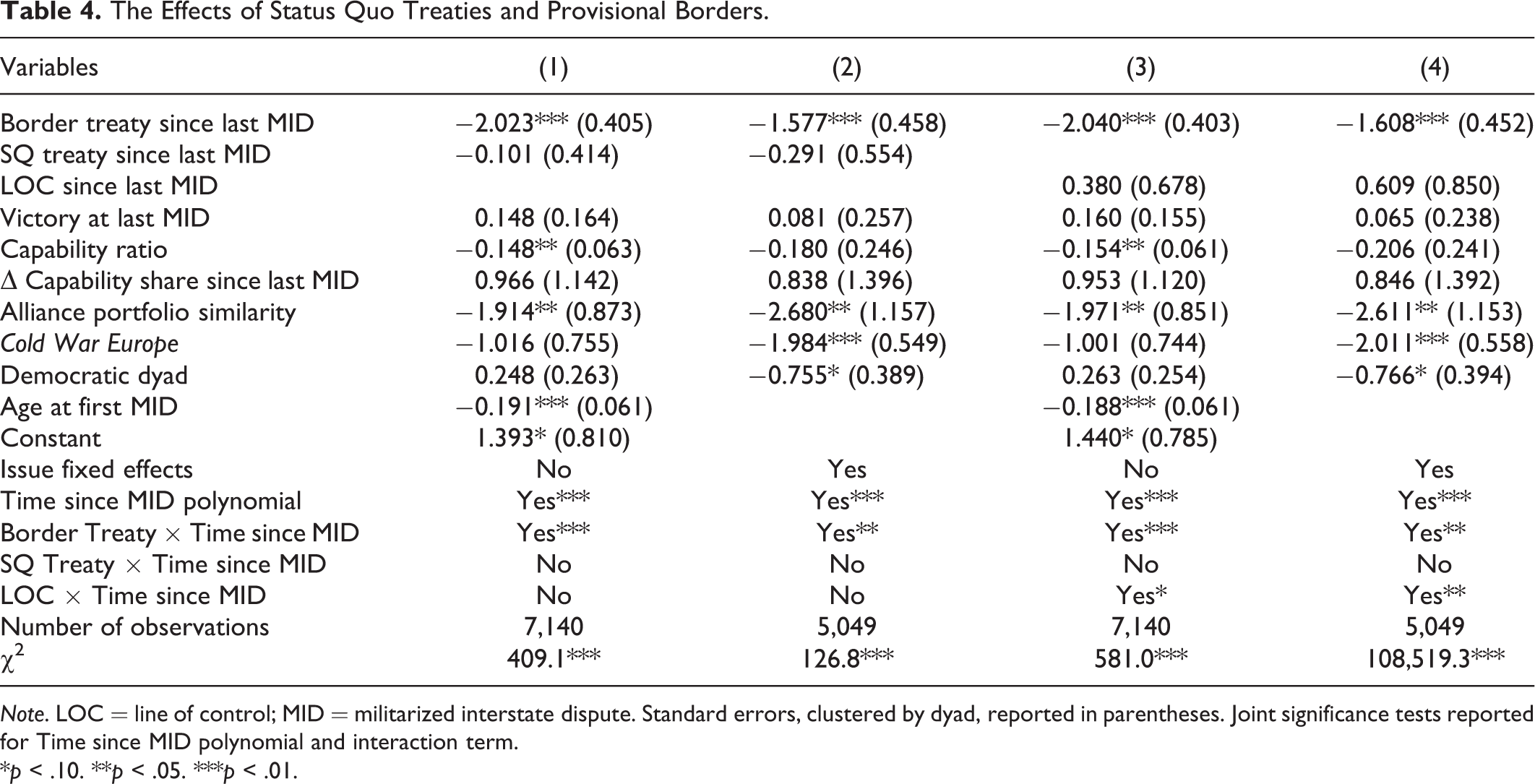
Using these rules, twenty-eight border treaties in the sample were coded as SQ treaties. They are listed in Table 2, along with a brief description of their terms and fates. In order to test for the effect of these treaties on MID risk, the variable SQ treaty since last MID was created to indicate whether a border treaty affirming the SQ had been signed during the current spell of peace.
Status Quo Treaties and Their Fates.
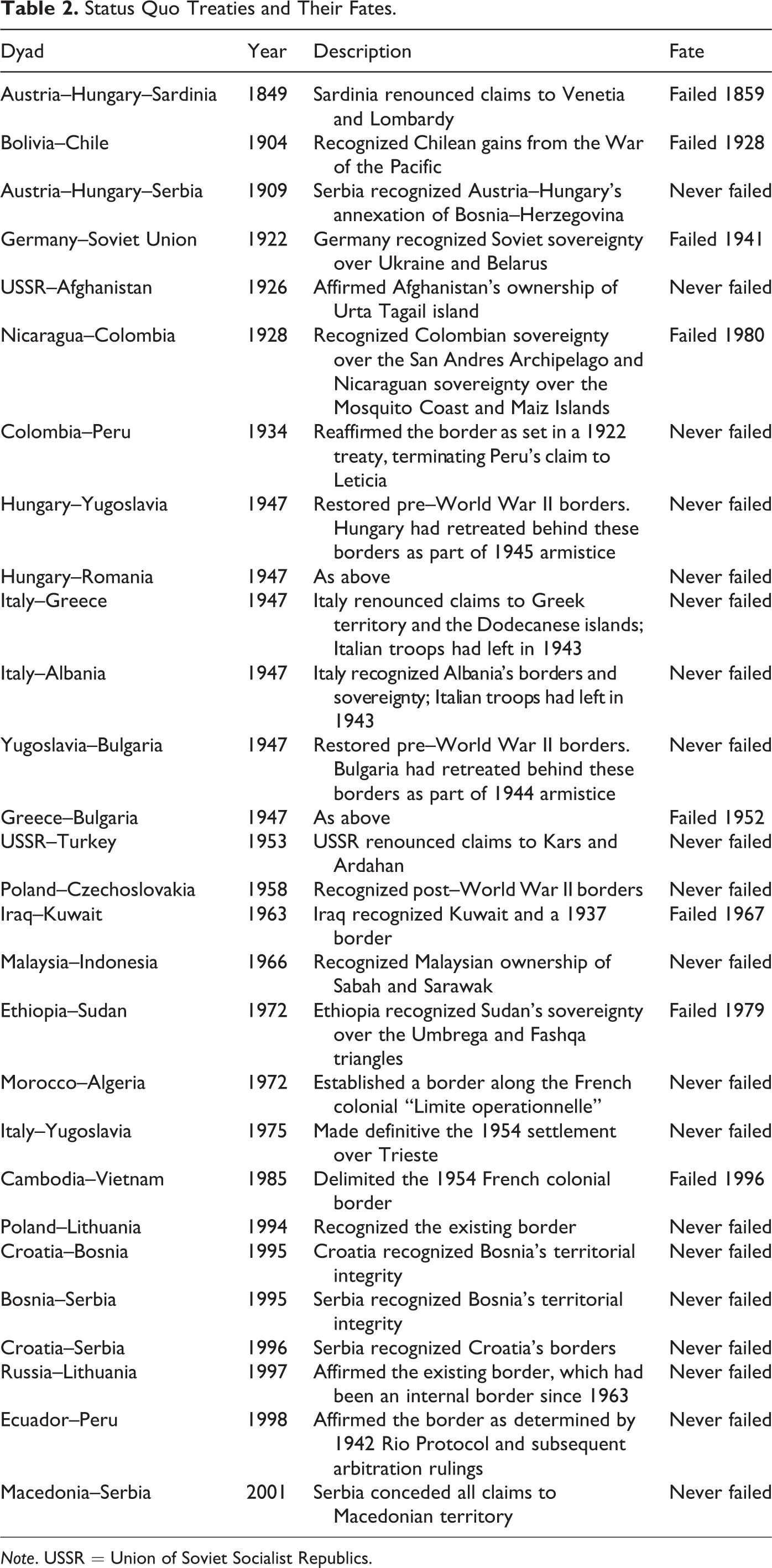
Note. USSR = Union of Soviet Socialist Republics.
A second test exploits the fact that states have, at times, created lines that serve as temporary or provisional borders, such as the LOC between India and Pakistan. Such lines usually arise in conjunction with ceasefires, when the drawing of an armistice line is necessary for a clear separation of hostile forces (Fortna 2004). They also serve the purpose of creating a modus vivendi until a final settlement of the border can be determined. These agreements specify the temporary nature of the boundary, pending a final settlement, and make it clear that, in agreeing to this line, the states do not relinquish their legal claims to portions of the territory that they do not control. In some cases, these agreements served their intended purpose and were replaced in short order by a border treaty providing a definitive settlement. In other cases, these provisional boundaries have persisted as de facto borders for decades—for example, between India and Pakistan in Kashmir, between Israel and its Arab neighbors, and between the two Koreas.
Full details on the coding rules are provided in the Supplementary Appendix. Briefly, the rules seek to identify agreements that fully or mostly allocated control over the disputed area, so that they are functionally equivalent to legal borders, excepting their temporary nature. Using these criteria, we identified seventeen provisional boundary agreements, or LOCs, in the sample, listed in Table 3 along with their fates. Excluded from this list are a small number of short-lived agreements that were replaced within the same year by a definitive treaty. Given the annual nature of the data, these LOCs did not exist long enough to observe any subsequent effects. 10 As is immediately evident, the failure rate among these agreements (ten of the seventeen) is higher than that of border treaties. Moreover, LOCs tend to fail very quickly: most failures occur in the year after the agreement was signed. To assess the effect of LOCs on MID risk, we create a variable LOC since last MID, constructed analogously to Border treaty since last MID. This indicator resets to zero if there is a new MID over the issue or if the LOC is replaced by a treaty.
Provisional Border Agreements and Their Fates.
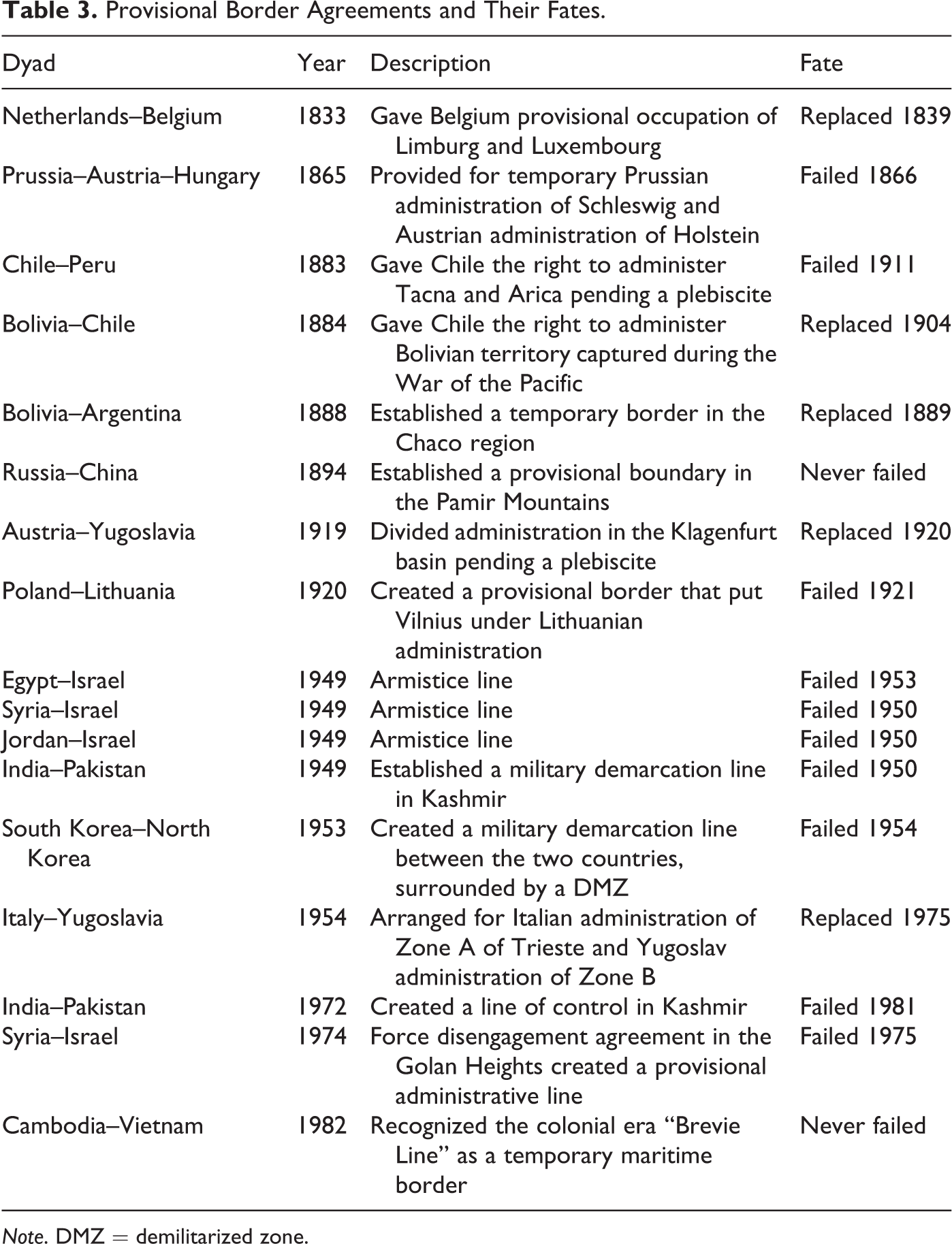
Note. DMZ = demilitarized zone.
Table 4 displays estimates for regression models with these new variables. As before, all specifications were estimated using logit models with and without issue-specific fixed effects. To simplify the presentation, interactions between agreement indicators and time since last MID polynomial terms are included only if those interactions are jointly significant, indicating that the agreements have time-varying effects.
The Effects of Status Quo Treaties and Provisional Borders.
Note. LOC = line of control; MID = militarized interstate dispute. Standard errors, clustered by dyad, reported in parentheses. Joint significance tests reported for Time since MID polynomial and interaction term.
*p < .10. **p < .05. ***p < .01.
Two results stand out. First, there is no statistically discernible difference between border treaties that involve a transfer of territory and those that enshrine the SQ at the time of their signing. The coefficient on SQ treaty since last MID is not statistically significant, nor is there evidence that the effects of these treaties vary over time in a way that is different from other border treaties. The second main result is that there is a statistically significant difference between border treaties and LOCs. Since the effects of both kinds of agreement vary with time, the coefficients on Border treaty since last MID and LOC since last MID in columns 3 and 4 measure the immediate impact of these agreements, and they are statistically different. Figure 2 compares the predicted probability of MID following a border treaty and an LOC, as a function of time since the last MID, using the estimates from column 3. The figure shows that LOCs are associated with a significantly higher MID risk in the year or two after the last MID. If a provisional border survives beyond this initial danger period, then the MID risks under the two kinds of agreements are indistinguishable, though, as we saw in Table 3, only a small number of LOCs survive this long. (The bump in MID risk at twenty-eight years is an artifact of a single case.)
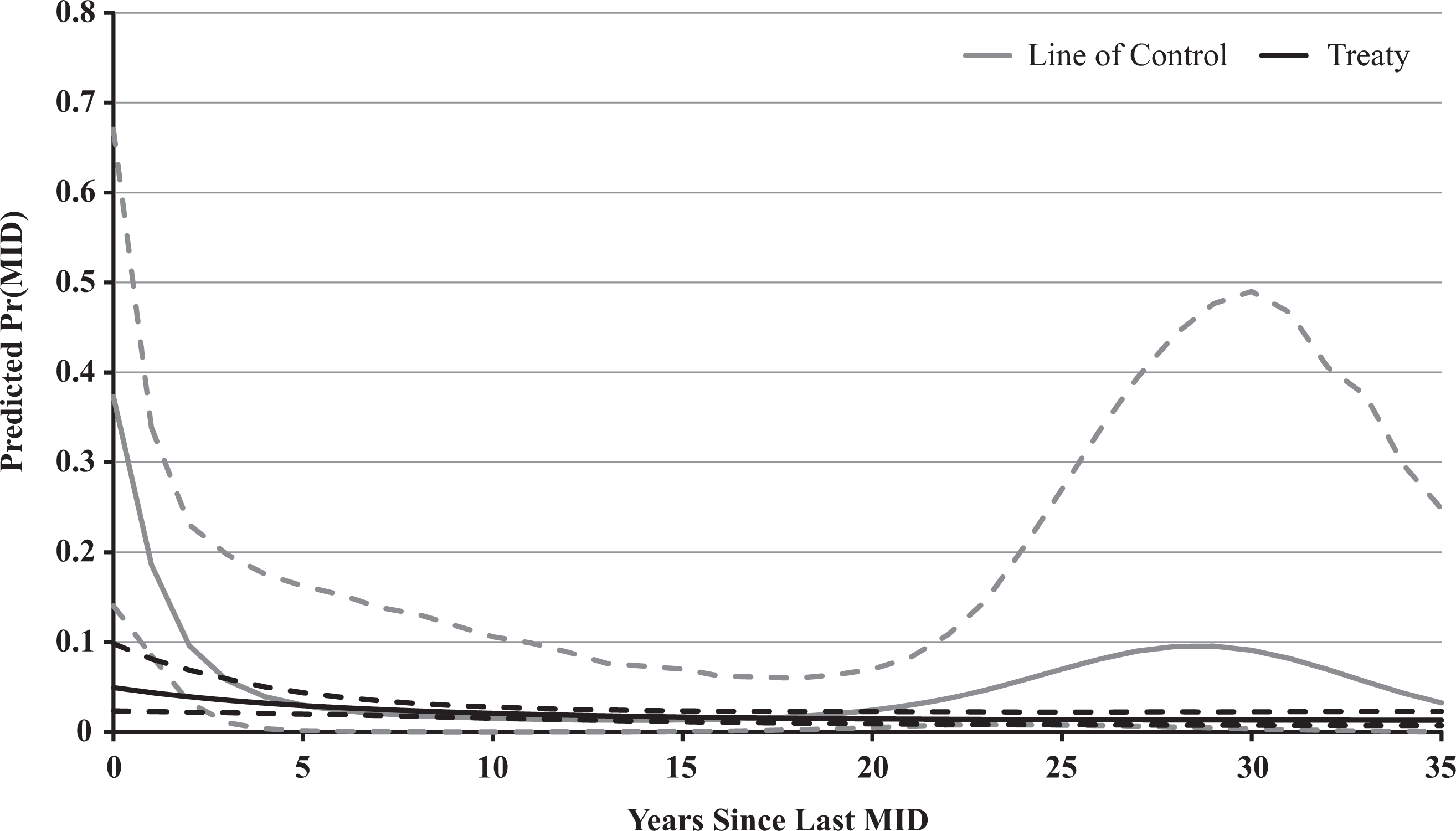
Border treaties, provisional borders, and MID risk over time. MID = militarized interstate dispute.
With respect to this last result, it should be recalled that all of the tests reported here assess the effect of an agreement on the likelihood of (at least) one subsequent MID. Once an agreement has failed, the agreement indicators reset to zero, as if no agreement were in place. Thus, all subsequent MIDs after the first failure of an agreement do not count against it. This matters in the case of LOCs because these agreements tend to fail not only quickly but repeatedly. To see this, the variable LOC in Effect indicates every year after the signing of an LOC agreement until either (a) the adversaries replaced the LOC with a border treaty or (b) the distribution of territory specified by the LOC was changed due to a MID. While disputants have an LOC in place, a territorial MID onset occurs in 17.3 percent of dyad years; this compares to 2.4 percent of dyad years with a border treaty in effect and 10.6 percent of dyad years when neither is in effect. 11 Clearly, while provisional boundary agreements can divide territory, they tend to be used in highly contentious cases, where the likelihood of future conflict is high.
Alternative Interpretations
I have suggested that SQ treaties are consequential because they require states to renounce claims to territory that may be legally or politically salient. A perusal of Table 2 may suggest alternative mechanisms that I briefly address here. The first is that a treaty to the SQ might reduce subsequent conflict by defining a previously undermarcated boundary. If prior administrative lines were vague or imprecise, the act of creating a treaty might clear up any misunderstandings that might have fueled prior conflict (Carter and Goemans 2010). In fact, however, only two of the treaties on this list (Morocco–Algeria and Cambodia–Vietnam) represent the first delimitation of the contested boundary, and their exclusion has no effect on the results.
A second possible concern is that SQ treaties often involve only one side renouncing its claims, without any reciprocal territorial concession by the adversary. Indeed, twenty-five of the twenty-eight treaties are one sided in this way. Perhaps, these treaties reflect some unmeasured victory or power asymmetry favoring the gaining state? This is particularly possible if one participant was effectively defeated or coerced by a third party, so that this outcome does not get flagged by the military victory coding. Similarly, it is possible that LOC agreements are less stable than the average border treaty because they often arise when neither side has been able to impose its most preferred outcome. LOCs may create lines that are unsatisfactory to both sides, even if they are acceptable as a temporary arrangement. Perhaps mutual dissatisfaction, rather than their provisional nature, explains the fragility of these agreements? To test this possibility, every border treaty was examined to determine what, if any, concessions either side made with respect to the territorial division. 12 Concessions of both territory and claims were considered. Using this coding, a variable was created indicating treaties in which both sides made some territorial concession and those in which the concessions were only made by one side. About half (eighty-one) were coded as involving concessions by one side only, meaning that SQ treaties are indeed unusual in this respect. Nonetheless, Table A3 shows that this variable is not systematically correlated with the risk of a new MID, and its inclusion does not affect the basic results.
Finally, a number of SQ treaties contain non-territorial provisions, such as those dealing with navigation or transit rights, protections for minority populations, or the settlement of non-territorial claims. In the 1995 Dayton Accords, for example, Serbia recognized Bosnia’s territorial integrity in return for the creation of a Bosnia Serb entity, the Republic of Srpska, covering 49 percent of that territory. Perhaps, the absence of subsequent territorial conflict was due to changes that occurred along other dimensions of the relationship? The first point to make about this concern is that non-territorial clauses appear in a large number of treaties in the sample, even those that transfer territory. Thus, if these provisions help reduce subsequent territorial conflict, we would still have to explain why the reduction in subsequent territorial MID risk is equivalent, on average, regardless of the territorial terms. More importantly, if affirming the existing border were a meaningless act, there would be no reason why these non-territorial concessions had to happen in the same document. For each SQ treaty with non-territorial provisions, we could imagine an alternative treaty with the articles relating to the border excised. To claim that the effect of SQ treaties is due to their non-territorial provisions, we would have to assume that the actual and alternative treaties are indistinguishable in their effects. While possible, this assumption is not particularly plausible. In most of these cases, non-territorial concessions were included to compensate a state for renouncing its claims to territory and were seen by the giving state as a price worth paying for that act. This observation reinforces the idea that there are costs, ex ante and/or ex post, to renouncing territorial claims, even when no territory changes hands.
Conclusion
This note opened by asking the hypothetical question of what we would expect to happen if Indian and Pakistan were to sign a treaty recognizing the LOC as their legal boundary. Though the results in this article do not speak directly to this case, they show that, on average, the signing of such a treaty has historically been associated with a very large reduction in the probability of future conflict. Not only do treaties that enshrine the SQ distribution of territory mark an immediate and pronounced change in the likelihood of a subsequent MID, but LOCs are clearly not equivalent in their effects from definitive boundary settlements.
The observed impact of treaties cannot be derived from a theory in which treaties serve only to specify the distribution of a disputed good and provide for mutually beneficial transfers. If that were the case, then it would be hard to explain why treaties that do not change the distribution of the territory are associated with a change in subsequent behavior, nor why explicitly provisional boundaries are different from de jure ones. The evidence suggests that treaties do more than simply distribute territory; they also distribute legal rights and claims. When states sign a treaty at the SQ, they do not change the territorial allocation, but they do renounce their claims to the portions of the territory they do not control. And when states sign a provisional boundary agreement, or simply live with a de facto border, they divide territory in a way that permits them to retain contradictory claims.
Why would the disposition of claims matter for the likelihood of renewed conflict? As suggested earlier, there are at least two broad mechanisms. The first might be called a legal mechanism: the idea that the renunciation of a claim constrains future behavior by raising the ex post costs of reneging. The signing of a treaty might engage states’ reputation in a way that makes it costly to later renege and renew the claim. The reputational costs associated with breaking a treaty might entail international (Simmons 2000; Guzmán 2008) or domestic repercussions (McGillivray and Smith 2008). The signing of a treaty may also weaken a state’s ability to persuade other states or international bodies to support their quest for more territory.
A second possible mechanism hinges on the ex ante costs associated with signing away claims. The claim to piece of territory may be part of a state’s national or religious identity; or, equivalently, the claims may have been advanced in such a way that they are intertwined with principles that would be difficult to renounce (Goddard 2006; Hassner 2003). In this view, treaties impose ex ante costs on their signatories by forcing them to take what can be a politically costly step. If so, then treaties can serve as a screening mechanism (von Stein 2005). States are more likely to agree to legalize a border—thereby giving up legal claim to any territories not obtained—when the value of their claim is low, relative to the costs of continued conflict. When the value of the claim is high, they will prefer an unlegalized SQ which, even if conflict-prone, allows them to continue enjoying the claim. If so, then treaties do not cause a reduction in violence; rather, they signal that states’ preferences are such that they do not want to keep fighting.
Clearly, further work has to be done to disentangle and elaborate these mechanisms, something which is beyond the scope of this note. Even so, the results presented here suggest that existing empirical models of international conflict must do more to incorporate not only the issues that create conflicts between states (e.g., Diehl 1992) but also efforts at their resolution. The substantively and statistically significant effects of the border treaty indicator means that either these agreements have an independent causal effect on subsequent MIDs—as the legal mechanism implies—or they are correlated with omitted variables that have an independent causal effect—as the political screening mechanism implies—or both. From a theoretical perspective, the results suggest that models of bargaining could fruitfully be extended to understand the difference between a de facto and de jure allocation over some good, something which no model currently considers. Empirically, we have seen that this distinction is meaningful; our theoretical models need to be revised accordingly.
Footnotes
Acknowledgments
I would like to thank David Carter, James Fearon, Hein Goemans, Ron Hassner, Karen Jusko, David Laitin, Phillip Lipscy, Pavel Lutomski, Michaela Mattes, Lee Ross, Allen Weiner, and the anonymous reviewers for comments on earlier drafts of this article. The data collection could not have happened without the invaluable assistance of Jennifer Jones. Research assistance was provided by Anstes Agnew, Katelyn Baldwin, Catherine Baylin, Cyrus Chee, Jane Esberg, Tim Ford, Derek Frome, Amer Handan, Cammie Lee, Kai Lukoff, Stephanie Majerowicz, Chloe Nicolaisen, Lauren Peate, Fadi Quran, Megumi Tsutsui, Catherine Yoon, and Yujing Yue.

Declaration of Conflicting Interests
The author(s) declared no potential conflicts of interest with respect to the research, authorship, and/or publication of this article.
Funding
The author(s) received no financial support for the research, authorship, and/or publication of this article.
Notes
References
Supplementary Material
Please find the following supplemental material available below.
For Open Access articles published under a Creative Commons License, all supplemental material carries the same license as the article it is associated with.
For non-Open Access articles published, all supplemental material carries a non-exclusive license, and permission requests for re-use of supplemental material or any part of supplemental material shall be sent directly to the copyright owner as specified in the copyright notice associated with the article.
