




Abstract
The research on the influence of democracy on terrorism renders support for two causal mechanisms. One is that democracy reduces terrorism because it creates an environment in which dissenters can pursue their interests through peaceful means. The other argument states that democracy encourages terrorism due to the intrinsic liberties and freedoms that provide an opportunity for terrorists to easily organize, recruit, and mount operations. This article contributes to this second line of thought by framing support for rebel groups as one of the contexts in which democracy’s influence on terrorism is examined. I identify a theoretical mechanism about how democratic states unknowingly facilitate terrorism by letting terrorists freely stay within their borders, raise funds, smuggle arms, and operate offices. The empirical findings provide support for the hypothesis that democracies are vulnerable and can easily be exploited by terrorists since they have an environment conducive to terrorist activities.
In October 2008, Tengku Muhammad Hasan di Tiro, the leader of the Free Aceh Movement (Gerakan Aceh Merdeka) that carried on an insurgency against the Indonesian government between 1976 and 2005, returned to his country from exile in Sweden. Di Tiro had fled to Sweden in 1979 after he started the insurgency against the Indonesian government for the independence of the Islamic Aceh region. In March 2001, the Liberation Tigers of Tamil Eelam (LTTE) closed its London office that had been used as headquarters for fund-raising activities since the beginning of its insurgency against the Sri Lankan government in the early 1970s. The closure came after the British government’s ban on twenty-one newly declared terrorist organizations following the enforcement of the new antiterrorism law in early March 2001.
These examples serve to point out two unexplored areas concerning the relationship between terrorism and democracy. First, both of these organizations committed acts of terrorism over the years in pursuit of their objectives despite the fact that neither was acknowledged as a terrorist organization in their early years. This was mostly due to the confusion over defining a terrorist organization or the parameters of terrorist activity, as well as some states’ willingness to call such groups “freedom fighters,” “revolutionaries,” and/or “holy warriors” due to their own political and ideological reasons. Thus, the relations between states and such domestic rebel groups have been studied under various research fields, including intervention, mediation, ethnic strife, insurgency, and civil war, but not terrorism (Wilkinson 2011, 4). 1 Second, these examples demonstrate that democracies are not only easy targets for terrorism as is conventionally believed, but they also facilitate or contribute to terrorist activities that occur within the borders of other states. Yet, this does not mean that democracies intentionally create channels to help terrorists. Democratic values, such as individual freedoms and liberties, and institutional constraints on government, make them vulnerable to the exploitation by terrorists within their borders that can raise funds, organize freely, and send support to terrorists back home.
The research on the relationship between democracy and terrorism has so far focused on examining whether democracies attract more transnational terrorist attacks or if they increase or reduce terrorism originating within their borders (Eubank and Weinberg 1994, 1998, 2001; Sandler 1995; Eyerman 1998; Li and Schaub 2004; Li 2005; Piazza 2008; Chenoweth 2010; Young and Dugan 2011). While some scholars argue that democracy reduces terrorism since democratic states provide peaceful channels through which nonstate armed groups can pursue their objectives, others argue that democracy increases terrorism since democratic freedoms and liberties enable terrorists to organize easily. 2 However, no attention is given to whether and how democracies encourage or discourage terrorism that occurs within other countries’ borders. The extant research on democracy and terrorism has focused on transnational terrorism relying on a single data set. International Terrorism: Attributes of Terrorist Events (ITERATE) data 3 have been commonly used to study the influence of democracy on terrorism. Yet, it is time that we test the propositions related to the relationship between terrorism and democracy in a different context, namely, that of domestic terrorism that is carried out by a rebel group against a single government (Mickolus 2007). 4 Do democracies contribute to terrorism in other states? Do the same mechanisms put forth by the democratic peace argument hold true when it comes to democracy’s influence on terrorism?
One may argue that support in itself implies “intentionality.” Occasionally, though, a state ends up supporting a terrorist group because it falls short of taking precautions to prevent such groups to come into their borders and act freely. Byman (2005a) refers to this kind of support as “passive support.” Following Byman’s precedent, I argue that democracies provide “passive support” to terrorists fighting other states due to institutional and political constraints that are intrinsic in democratic systems. Democracies make great fund-raising hubs, transportation points for arms and military equipment, and safe havens. Besides democracies failing to take precautions to control such groups’ activities within their borders due to many constraints against limiting individual freedoms and liberties, they also face the problem of entering into a tacit agreement with terrorists. 5 The high value attributed to human life in democracies forces them to turn a blind eye to terrorists’ activities within their borders as long as they do not hurt their citizens.
Using new data on external support and domestic terrorism, that is, terrorism targeting a single government, state, or society, I show that after controlling for various significant variables explaining state support for terrorism, democracy is still one of the qualities of a state positively related to whether terrorist groups manage to acquire funds and weapons, organize freely and recruit people into their ranks. The rest of the article is organized into three parts. Next part covers the relevant literature and introduces the theoretical framework and hypotheses. The second part talks about the research design and data. And, the third part discusses the findings of the empirical analysis.
A Theory about Democracy and External Support of Terrorism
The theoretical framework is driven by the question that how democracies end up being exploited by terrorists. In this analysis, terrorism is perceived as one tool or tactic among many others, such as guerilla warfare, sabotage, and peaceful propaganda, aimed at achieving some political and/or territorial concessions from a government. Many scholars agree that terrorism has two major attributes: (1) the victims are not only the individuals subject to an attack at a given time but also the wider audience who is destined to live with a fear that it might well one day happen to them and (2) civilians are deliberately targeted (Schmid and Longman 1983; Gibbs 1989, 330; Wilkinson 2011, 4–5). As such, this article focuses on terrorism employed by internal armed groups, rebels, or militants to achieve some political and territorial objectives. 6
The expansion of the theoretical debate on democracy and terrorism to the domestic terrorism setting is thus necessary to start a new debate about the influence of democracy not only on interstate relations but also on the relations between states and nonstate armed groups. Although there is ample amount of work on third parties and their involvement in intrastate conflict in general (Regan 1996, 1998, 2000, 2002; Cunningham 2011), there is still not much work on how regime type influences the involvement of third-party states in internal conflict. Furthermore, this research field has hardly, if ever, examined external support for rebel groups as a form of intervention in internal conflict.
A recent body of research has examined the causes behind states’ support of rebel groups (Saideman 2002; Salehyan 2008; San-Akca 2009; Cunningham 2010; Maoz and San-Akca 2012). Salehyan (2008, 2009) examines the role of external intervention in the transformation of an internal conflict into an international one. Bapat (2011) develops a formal model to show that only major powers and moderately weak states benefit from supporting a militant group against their rivals. Cunningham (2010) shows that external support is more likely to occur for relatively strong rebel groups and when the government targeted by the rebel group also receives external support. Though these works address significant questions, such as why some rebel groups are more likely to receive support from other states and why some states support some rebel groups but not others, there is still more work to be done to fully capture the nature of interactions between external supporters and rebel groups. More specifically, despite that there is work exploring the causal mechanisms through which external support for terrorism emerges (Byman et al. 2001; Byman 2005b; Bapat 2011), the question of whether democracies turn out to be convenient grounds for terrorist groups remains unanswered.
One argument in the democracy–terrorism literature states that certain aspects of democracy reduce terrorism. Nondemocratic societies’ lack of peaceful means for political participation leads to dissatisfaction and political grievances among dissenters who become motivated to join terrorist organizations (Crenshaw 1981). Free and fair elections in democracies guarantee that unwanted rulers can be thrown out, and desired social changes can be achieved through voting, thus reducing the need to resort to violence (Ross 1993; Eubank and Weinberg 1994, 2001). In a recent work, Li (2005) argues that democratic participation reduces transnational terrorism incidents, both those originating within a country and those aimed at targets within or outside the country.
A second line of argument on the democracy–terrorism nexus finds that democracy does indeed encourage terrorism. Since democracies provide greater civil liberties, they allow terrorists to easily organize, thereby reduce the cost of conducting terrorist activities (Eyerman 1998). Chenoweth (2010) has a similar argument about the incentives democracies create for intergroup competition, thus making terrorist activity more likely in democracies. Li (2005) argues that the expansive constraints on governments in democracies make them unlikely to reach decisions on counterterrorism measures to prevent future attacks. Since there are too many veto players in an institutionalized democracy, it is difficult to make decisions that would curtail civil liberties, which are often required to restrict the freedom of terrorists. It was very difficult for American government to pass laws to restrict the movement of Irish Republican Army’s (IRA) partisans within their borders. Democratic freedoms have also been the subject of the recent debate in the United States over expanding the government’s power at the expense of individual civil liberties after 9/11 attacks (Ackerman 2006; Posner 2006).
The theory of terrorist exploitation of democracies builds on this second line of research by identifying another causal mechanism through which democracy encourages terrorism. I argue that the civil liberties embedded in democratic systems influence support for terrorism in a similar fashion to their influence on the emergence of terrorist organizations within their borders. This is mostly because democracy has a liberal attitude toward the activities of nongovernmental organizations, diasporas, and charity groups. These organizations do not necessarily have a formal affiliation with the states within which they function, yet in some cases strive to provide funds, weapons, and various other forms of support for the violent activities of terrorist groups they are affiliated with (Byman et al. 2001). Various Islamic charity organizations in the Balkans work to provide funds for Islamic fundamentalist groups and insurgents without facing any repercussions from the democratic states within which they function (Byman 2005a).
Historically, various democratic states have supported and funded rebel groups and insurgencies (Bapat 2011). 7 The United States supported the Contras against the Sandinista regime in 1985 in Nicaragua. Greece provided training camps for the Kurdish Workers’ Party (PKK), which has been fighting the Turkish government since 1983. These examples illustrate what Byman (2005a) calls active support, that is, the government or leaders create channels to intentionally support the members of an insurgent organization. Another channel through which democracies end up helping or facilitating terrorism, if not supporting or sponsoring it, is through passive support (Byman 2005a). Passive support means that a government does not directly provide assistance, but knowingly allows other actors in the society, such as wealthy merchants and political parties that do not have formal connection to the government, to aid a rebel group. This definition implies that the government in question has the capacity to stop the assistance but does not do so (Byman 2005a, 118). Byman gives two examples: Islamic fundamentalist groups raising funds in Saudi Arabia and the Irish diaspora’s, which lived in the United States, contribution of weapons and funds to the Irish Republican Army during the 1970s.
I argue that the majority of the incidents of state support by democracies belong to this latter form of support—namely, passive support, which emerges due to the intrinsic liberal values built in democratic systems. These values make democratic systems vulnerable to terrorists who end up raising funds, recruiting and organizing freely, and acquiring weapons. Abdullah Ocalan's, PKK's head, eighteen-year stint in Syria between 1980 and 1998 was facilitated by an intentional act of support on the part of Syria, which was trying to get concessions from Turkey on the issue of water flow of Euphrates and Tigris rivers. On the other hand, Hasan di Tiro, who lived in Britain for many years, was taking advantage of the right of asylum often granted by democracies to individuals facing social, economic, or political discrimination. The leaders and members of nonstate armed groups exploit individual freedoms and liberties inherent in democracies to freely organize, seek asylum, raise funds, and even transport arms to support the group that they are affiliated with. Specifically, institutional constraints embodied in democratic systems make it hard to pass laws to limit the activities of such groups within their borders. This is slightly different from what Byman states as “knowingly allowing” terrorists to freely move within a state’s borders. Rather, democracies do not take any action to limit such movements due to the reasons stated earlier.
Furthermore, a similar logic applies to the target governments of rebel groups. Since democracy is negatively affiliated with repression (Davenport 1995; Davenport and Armstrong 2004; Davenport 2007a, 2007b),
8
rebels who live in democracies are less likely to seek external supporters. Furthermore, since decision making in democracies engages multiple veto players, it takes time to adopt counterterrorism measures that might curtail support-generating activities. Therefore, rebels who resort to terrorism against democratic governments within which they live are less likely to seek external support.
In line with the democratic peace argument, democracies are also expected to be more hesitant when it comes to supporting terrorist groups targeting other democracies. If democracies do not fight each other, are they also more hesitant in supporting violence committed by nonstate actors against their democratic counterparts? The democratic peace argument states that democracies do not fight each other because they share similar norms and values. It is difficult for a democratic regime to justify fighting with another democracy (Maoz and Russett 1993; Bueno de Mesquita et al. 1999).
9
Since supporting a rebel group is an aggressive foreign policy behavior that might result in public denouncement and/or retaliation by the target state, democracies are less likely to support rebels that target other democracies.
Furthermore, it is possible to talk about the role of democracy when it comes to specific forms of support, such as leaders’ seeking safe havens or members of a rebel group seeking safe havens. The members of the Babbar Khalsa International (BKI) enjoyed safe havens in countries including Canada, the United States, and the United Kingdom. BKI is a group of ethnic Sikh insurgents that strived for an independent state called Khalistan between 1978 and 1993 and is also responsible for the assassination of Indira Gandhi. Its members abroad were able to raise funds to support the militants back in India. In the early 1980s, some members received training in guerilla tactics from a former Vietnam commando in Alabama.
10
The US government did not outright provide any of this support, although one can argue that it turned a blind eye to their activities. The leaders of such groups prefer to operate in democratic states, figuring that there is a better chance of fair treatment in case of arrest. In addition, since providing safe havens to a rebel group resorting to terrorism is a major act of aggression that is highly criticized by the international community, one may expect that democracies are more likely to deny such form of support to rebels.
In other words, terrorist leaders are more likely to find safe havens in democracies than are members of a terrorist organization as a large group.
Research Design
The unit of analysis is a triad year. A triad includes (1) a rebel group that resorted to terrorism at any time during their violent engagement against a state, (2) a target state that has been the object of a group’s violence, and (3) a potential supporter with the opportunity to support a rebel group. The opportunity to support a rebel group rises with its formation and continues as long as it is active (i.e., engages in violent conduct against its target). In order to build the population of triads, I started with the Uppsala Conflict Data Program/Peace Research Institute Oslo (UCDP/PRIO) Armed Conflict Dataset’s (ACD) list of rebel groups (Gleditsch et al. 2002). 11 The ACD lists the rebel groups that have been in conflict with a state in the post-1945 period. It defines a group as “any non-governmental group of people having announced a name for their group and using armed force to influence the outcome of an incompatibility.” 12 The subject of an incompatibility between a government and a group could be over a piece of territory, the government, or both territory and government. Next, I determined the groups that resorted to terrorism at any time during the course of their violence using the Global Terrorism Database. 13 From the list of rebel groups and their target states, I then generated a list of target–terrorist dyads and converted them into cross-sectional time series data.
The potential supporters for rebel groups are determined by using Maoz’s definition of the politically relevant group (PRG) of a state—target state for the purposes of this article. The PRG of a target state includes geographically contiguous states, regional powers, and global powers whose influence extends far beyond their regions (LaFree and Dugan 2012). 14 In the end, each state that has been the target of domestic terrorism is paired with each state in its PRG. There are some disadvantages to using politically relevant dyads (Maoz and Russett 1993; Maoz 1996; Lemke and Reed 2001). For instance, Saudi Arabia has supported various rebel groups within Afghanistan. In the data set, this information is not included, as Saudi Arabia is not a member of Afghanistan’s PRG. There are also instances in which a sponsor assists a rebel group financially or diplomatically, despite its distance from the target. For example, Cuba provided assistance to the leftist rebels in Angola prior to 1975 when the leftist People’s Movement for the Liberation of Angola gained power in Angola. Cuba is not included among the potential supporters of National Union for the Total Independence of Angola, regrettably leading to some missing observations. In theory, there is justification for treating every state in the world as a potential supporter for each group. Yet, while building support data for rebel groups the benefit of limiting the number of potential supporters to be examined for each target exceeds the benefit of including every state.
Why a New Data Set on External Support?
This article is interested in the influence of regime type on the transformation of a state into an external supporter for a rebel group resorting to terrorism at least occasionally. No existing data set contains the necessary information on state supporters and rebel groups, especially when it comes to distinguishing cases of passive support from active support, a designation of great importance for understanding the influence of regime type on terrorism. Previous efforts to collect data on rebel groups and their state supporters have mostly been concerned with addressing the root causes of the formation of rebel groups and the level of violence associated with various nonstate actors, such as ethnic and religious insurgencies, revolutionary movements, and terrorist organizations (Minorities at Risk Project [2009], Terrorism Knowledge Base [TKB], 15 and ITERATE, 16 respectively). These data sets are designed to address different theoretical questions, and as a result, focused data collection efforts on either the main attributes of groups (such as the size, objectives, and fatalities) or on individual attacks. They did not clarify the type of support provided to a rebel group. Although ITERATE data have some information on state supporters, it lacks enough observations for a meaningful empirical analysis on state support. This is understandable, given the fact that it is difficult to collect data on external supporters per terrorist attack since ITERATE is an incident-based data set. In addition, it is not necessary to have individual incident-level support data in order to conduct a meaningful empirical test examining external support. For example, we know that the Syrian government has been supporting Hamas over the years. Of course, it would be ideal to individually trace which attacks of Hamas have been supported by Syria, yet I doubt a lifetime would be sufficient to collect such data. Therefore, including Syria as a Hamas supporter does not bias the empirical analysis as long as we are able to determine the approximate period during which Syrian support continued.
Although some scholars who study civil war and intervention have generated data on the type of support provided to the conflicting parties (Regan 2000; Saideman 2001, 2002), they have some defaults. For example, Regan identifies whether a foreign state provided military or economic aid to one side or the other in an intrastate war, yet he does not specify the identity of the opposition group. This is not an issue when there is a single group targeting a state. Yet, when there are multiple groups the names of the groups and the type of support they receive needs to be specified. Saideman (2001, 2002) distinguishes between states that support the government in a conflict and those that support opposition groups, yet he does not specify the type of support provided.
Recently, a few efforts have been undertaken to collect data on nonstate armed groups and their supporters. One of them is a project under the umbrella of the UCDP conflict database. 17 It codes whether an external actor supports a group in any form. Although the database provides useful narratives for states that support rebel groups, it is only limited to the post-Cold War period. The other is Byman et al.'s (2001) data on insurgency in the post-Cold War period. These data have also been improved by Bapat (2006, 2011) to cover the post-Cold War period. Although it provides a list of the state supporters for various insurgency groups in the post-Cold War period, it does not specify the type or period of support. A newer data set, Non-state Actor Data (NSA) builds on the ACD and presents group-level data indicating the size and strength of a group and whether an external state provides implicit or explicit support to a rebel group (Cunningham, Gleditsch, and Salehyan 2009). 18 Although this data set is a valuable endeavor toward the construction of data on external supporters, it falls short of specifying the type of support.
Determining the type of support is a challenging task as the states that provide assistance to rebels rarely admit it. The external support data set introduced here uses various secondary sources to determine the type of support besides credible international and domestic media sources. Mere allegations by the target states are insufficient to determine whether a potential supporter provides the alleged assistance. The external support data set codes seven types of external support for rebel groups; (1) safe havens for rebel group members; (2) safe havens for groups’ leaders; (3) training camps; (4) arms and logistics; (5) funds; (6) transport of arms, military equipment, and supplies; and (7) troops. It also codes whether the external support is active or passive.
In total, the external support data set has information on 229 supporters and 127 rebel groups that resorted to terrorism from time to time to pursue their objectives in the post-1945 period. 19 Of the 127 groups, 80 percent received some type of external support. Only 20 percent of the groups had no external supporters at all. Moreover, 21 percent of binary support belongs to the passive support category, meaning that 79 percent of binary support years occurred as a result of states intentionally creating channels to assist rebel groups.
Four dependent variables have been coded to capture different types of external support. Active support is coded as a binary variable taking a value of “1” whenever a government intentionally created channels to assist a rebel group by providing any type of support and “0” otherwise. Passive support is coded as a binary variable taking a value of “1” when a government does not take any precautions to terminate a group’s activity within its borders and “0” otherwise. Leaders’ safe haven is coded as a binary variable taking a value of “1” if the leadership of a group seeks asylum in other states, escapes into the borders of another state, or maintains headquarters in another state, and “0” otherwise. Members’ safe haven is coded as a binary variable taking a value of “1” when the members of a group move into the borders of another state or seek refuge within the borders of another state. 20
Using Polity IV data set, four variables have been included in the analysis to determine the influence of democracy on external support. Potential supporter democracy is the regime score of the potential supporter in a given year from the Polity IV data set (Marshall and Jaggers 2004). Target democracy is similarly adopted from Polity IV data set for each target that has been in conflict with a group in the post-1945 period. Joint democracy is a variable that codes each dyad democratic if both the target state and potential supporter have an individual polity score of 5 or more. Likewise, joint dutocracy codes each dyad autocratic if the two countries are both below −5 on the Polity score.
The scholarly work on insurgencies has shown that states support rebels in pursuit of various objectives, among which dealing with external adversaries takes place commonly (Byman et al. 2001; Bapat 2007; Salehyan 2008). This is also in line with the findings of the scholarly research on the formation of interstate alliances. In line with the “enemy of my enemy” argument (Maoz et al. 2007), one might expect a state to be more likely to support a rebel group that targets its external adversary. In order to have robust estimates for the influence of democracy on external support, one needs to control for whether support is provided to those rebels that target the adversaries of potential supporters. External adversary variable takes a value of “1” if a potential sponsor and a target engaged in either a militarized dispute with each other in the last five years or a war in the last ten years and a “0” if there is no conflict history between a potential sponsor and a target during these periods. 21 This variable is adopted from Maoz (2007) and based on “Strategic Reference Group (SRG),” which includes those states that are perceived to pose a security challenge to focal state—potential supporter in this case. This variable is indeed more encompassing than the rivalry variable (Diehl and Goertz 2000; Rasler and Thompon 2000, 2006; Diehl and Goertz 2006). 22
Extant work has found that rebel groups are more likely to receive support from states where their ethnic kin lives (Saideman 2001, 2002; Cederman, Girardin, and Gleditsch 2009). In order to determine the ideational affinity between a rebel group and its supporter, one needs to specify the identity of each group. The external support data set has information on ethnic, religious, or ideological attributes of each group. In order to code the ideational affinity between ethnonationalist and religious groups and the potential supporters, I use three variables. One is Fearon’s ethnolinguistic data set, an inclusive list of ethnic groups in each state and their proportion to the entire population (Fearon 2003). 23 The data also identifies the religion of these groups if religion is the determinant of ethnic cleavages. If, within a potential supporter the majority group has the same ideational affinity as the rebel group, the commonid variable takes a value of “1” (and “0” otherwise). In the interest of having a more nuanced control for the ideational affinity between a rebel group and a potential supporter, I also use a data set on the ethnic identity of world leaders developed by Heger and Salehyan (2007). 24 Commonleader provides a direct measure of the ethnic ties between leaders of potential supporters and rebel groups.
Especially in the post -Cold War period, weak states have been designated as the major cause of terrorism (Campbell and Floumoy 2001; Rotberg 2003; Piazza 2007). As mentioned earlier, the September 11 attacks reinforced the idea that the gravest threat to the United States and world security was no longer to be expected from rival great powers but from poorly governed states, such as Pakistan and Afghanistan, which provide safe havens to terrorists. 25 The observations that weak states are hospitable to and harbor nonstate armed groups and that terrorism is the weapon of the weak have been commonly accepted among both political scientists and policy makers (Lesser 1999; Rotberg 2002; Patrick 2006; Rice 2008). US secretary of state Condoleezza Rice argued in an interview that nations that are incapable of fulfilling their responsibilities as sovereign entities both within and across their borders are significant sources of international instability (Garfinkle 2005). Braithwaite and Li (2007) and Piazza (2007) argue that weak states are most likely to be safe havens for terrorists. In order to capture the effect of state weakness on the ability of terrorists to garner external support, I use an instability indicator developed by the Political Instability Task Force (Bates et al. 2003). 26 They define an instability event using four categories: revolutionary wars, ethnic wars, adverse regime changes, and genocides and politicides. 27 Domestic weakness is a binary variable taking the value of “1” for the presence of an instability event.
Furthermore, the research on democracy and terrorism has been criticized for “underreporting bias” (Drakos and Gofas 2006). 28 The transparency of democracies leads them to report more terrorism incidents than autocracies, thus making them seem as more frequent targets of terrorism than autocracies. The bias toward democracies occurs due to overreporting of terrorism incidents in democracies by media organs. Drakos and Gofas (2006) suggest that an econometric model distinguishing the effect of regime type from the effect of press freedom is necessary to achieve a more robust understanding of the effect of democracy on terrorism. In light of the arguments of Drakos and Gofas (2006), one can argue that data on external support could be biased toward democracies, that is, the regimes with highest level of press freedom. In other words, democracies seem to provide support to terrorists since it is easier to trace the activities of such groups within democracies. To be on the safe side, I include a control variable for press freedom in a country. This provides a useful check for the robustness of findings with respect to democracy’s role in external support. I use the press freedom variable developed by Li (2005). Although the period for that variable is between 1967 and 1998, it still provides a useful tool to check the robustness of the findings about the larger population using a sample. It was not possible to use the Freedom House Index as is suggested by Drakos and Gofas (2006) since the period for the measure of freedom is fairly limited; that is, it does not go beyond 1985. The number of observations in the current data set is cut to around 2,000 observations from almost 20,500 observations. This prevents any meaningful comparison between the sample and the larger population.
Since supporting a rebel group can invite retaliation, one may expect that states, if they decide to do so, are more likely to support rebels that target relatively weak states. Externally, the relative capacity of a state determines the expectation for war onset against a particular adversary (Morrow 1985, 1989). The relative strength of each potential supporter vis-à-vis a target is measured by the ratio of each potential supporter’s Composite Index of National Capability (CINC) to the cumulative CINC of a target and a supporter in a given triad using the Correlates of War database’s National Capabilities data set (Singer 1990). Furthermore, one more variable, minority leader, is added to capture whether a leader is from a minority ethnic group within his or her state and if he or her can afford supporting a rebel group resorting to terrorism (Fearon 2003).
The mountainous terrain variable is adopted from Fearon and Laitin (2003). Mountainous terrain provides an escape for rebels that are looking for safe havens abroad (Braithwaite and Li 2007). The duration of a rebel group, continuous years of activity, is controlled since the groups that are able to remain active for a certain time period are more likely to acquire state supporters. Another variable to be controlled for is the distance between the capitals of a potential supporter and a target. Since I employ direct geographic contiguity as a way of identifying the potential supporters, I use the Gleditsch and Ward’s (2001) measure of distance between capitals.
Empirical Analysis
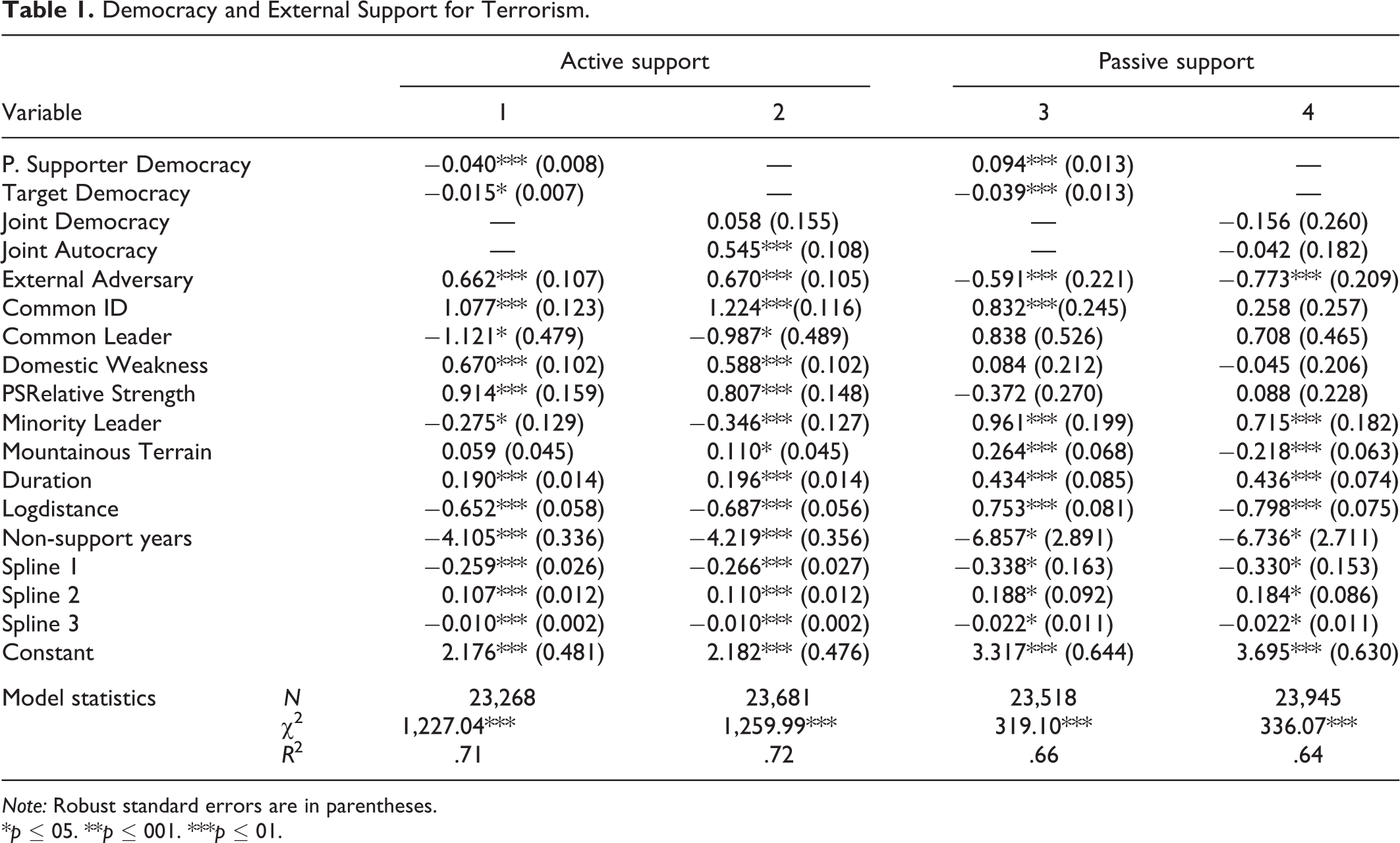
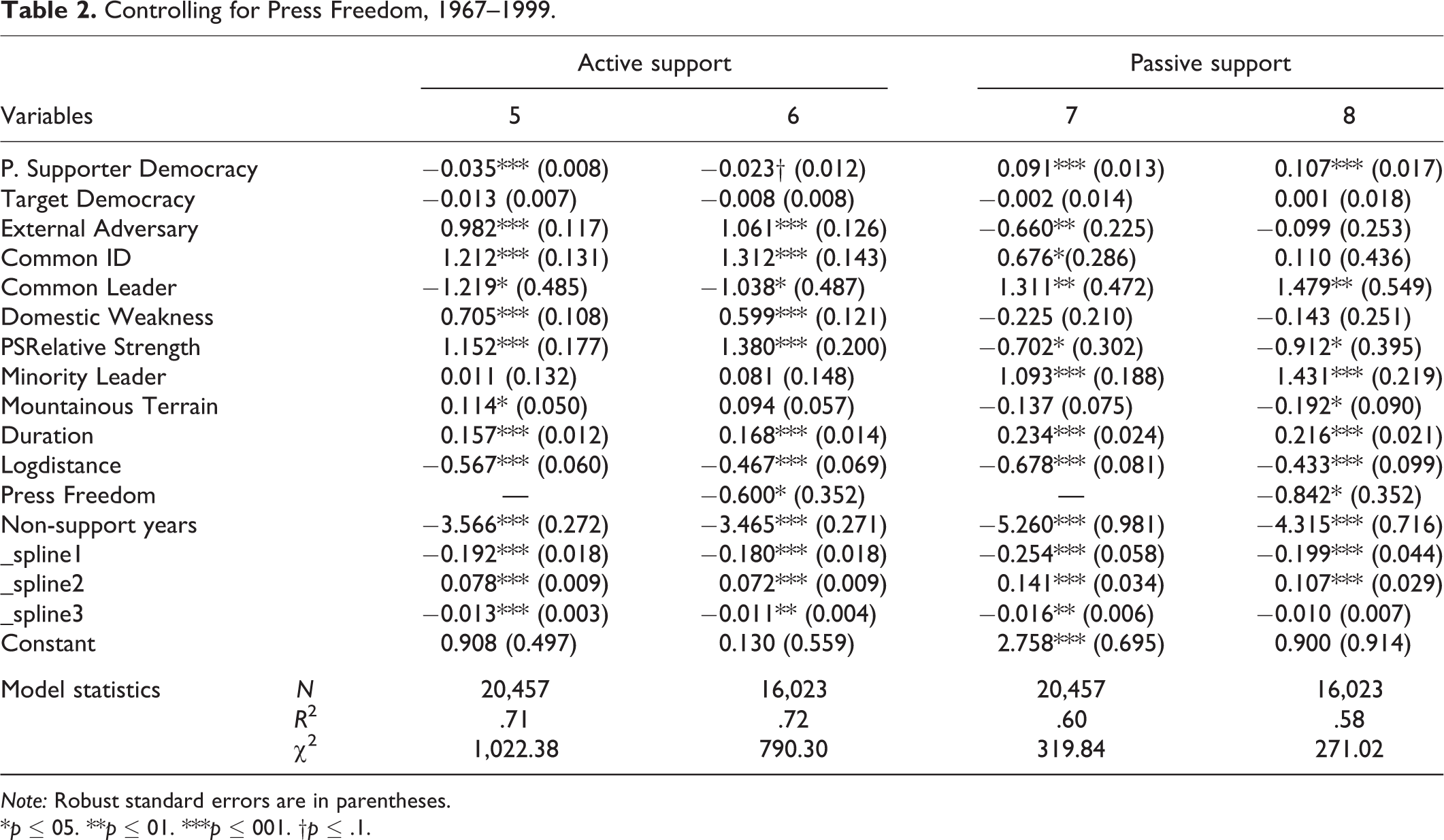
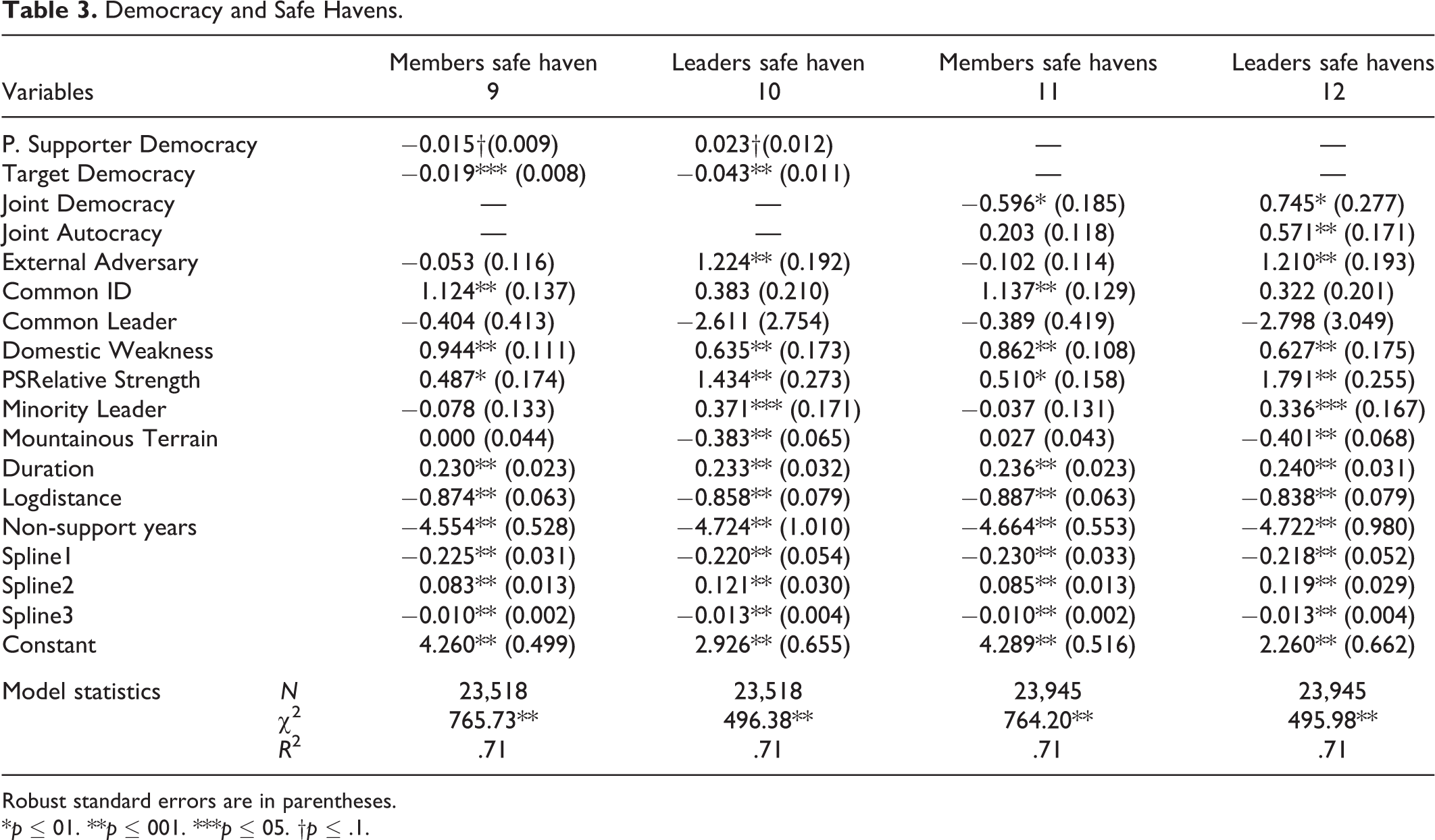
Although the external support data set codes support for the rebel groups that have been active between 1946 and 2008, the empirical analysis is limited to the period between 1955 and 2001 due to the absence of measures for some independent variables in some years. Several models have been estimated using logit analysis in conjunction with Beck, Katz, and Tucker’s (1998) correction of time dependence. Table 1 presents the estimates for the influence of potential supporter’s and target’s individual as well as joint regime scores on active and passive support. Table 2 adds the press freedom variable and presents findings both without and with the press freedom measure. Though the press freedom measure does not go beyond 1967, it is still possible to compare the findings on a subsample to the findings on the larger population presented on Table 1. Table 3 presents the findings related to the factors that drive rebels and their leaders to seek safe havens abroad.
Democracy and External Support for Terrorism.
Note: Robust standard errors are in parentheses.
*p ≤ 05. **p ≤ 001. ***p ≤ 01.
Controlling for Press Freedom, 1967–1999.
Note: Robust standard errors are in parentheses.
*p ≤ 05. **p ≤ 01. ***p ≤ 001. †p ≤ .1.
Democracy and Safe Havens.
Robust standard errors are in parentheses.
*p ≤ 01. **p ≤ 001. ***p ≤ 05. †p ≤ .1.
The findings on Table 1 confirm Hypotheses 1 and 2. As the level of democracy in a potential supporter increases, the likelihood of providing active support decreases (model 1) and that of passive support increases (model 3). Higher levels of democracy make it hard for a government to constrain the acts of rebel groups within their borders. Democracies are ultimately exploited by these groups due to the freedoms intrinsic to them and the constraints on decision making that prevent them from taking measures to terminate the activities of these groups within their borders. This finding is in line with the previous work on the influence of democratic liberties and freedoms on terrorism (Eubank and Weinberg 1994, 1998, 2001). There is no support for the democratic peace argument, Hypothesis 4 (models 2 and 4), though an autocracy is more likely to support a rebel group resorting to terrorism against another autocracy than a democracy doing the same against another democracy. The finding with respect to the target state’s democracy seems to confirm Hypothesis 3. Groups are less likely to seek active or passive support as long as they reside in democracies.
When it comes to other key variables, states are more likely to provide active support and less likely to provide passive support to terrorists fighting their adversaries. It has now been empirically shown that states occasionally confront their enemies by supporting the rebels targeting them (Gleditsch, Salehyan, and Schultz 2008; Salehyan 2009; Maoz and San-Akca 2012). The support of Kurdish insurgents in Northern Iraq by Iran’s Shah Regime from 1965 to 1975 is an example in this matter. The Shah was dealing with the Soviet-backed Ba’ath regime in Iraq and domestic disturbances in the form of student and urban petit bourgeoisie demands for regime change (Moran 1978-1979; Karsh 1987-1988). The rise of Kurdish insurgents fighting against the Iraqi regime turned into an opportunity for the Shah, who was already in conflict with the Iraqi regime over the passage of Iranian ships through the Shatt al-Arab waterway. He was able to divert Saddam’s attention away from the conflict with Iran and secure concessions on the waterway in return for ceasing his support to the Kurdish insurgents in Northern Iraq.
The results with respect to the effect of shared ethnic and/or religious identity with a rebel group on support are not surprising. The extant work had already demonstrated that ethnic and religious kin living within the borders of neighboring states are the most significant source of support for rebels (Cederman, Girardin, and Gleditsch 2009; Saideman 2001, 2002). Domestic weakness or instability has a significant and positive effect on the likelihood of active support. This might be explained by the diversionary theory, which argues that a state experiencing domestic turmoil tries to direct public anger against an external adversary to encourage domestic support for the existing regime (Levy 1988, 1989; Starr 1994). Supporting a rebel group and being blamed for it may help states increase domestic support by playing the victim to the domestic audiences (Nincic 2005).
Table 2 presents the findings after controlling for press freedom. Models 5 and 7 introduce the results for the entire population of triads before controlling for press freedom for active and passive support, respectively. Models 6 and 8 do the same after controlling for press freedom.
Although the significance level is lower, democracy still has a discouraging effect on active support for terrorism. As the level of democracy increases in a potential supporter, the odds that it provides active support to terrorists decrease in comparison to autocracies. After controlling for press freedom, we do not see much change for the influence of democracy on passive support. Democracy is still positively and significantly related to passive support. Press freedom seems to have a dampening effect on both active and passive support. This could be attributed to the fact that states with high levels of press freedom are also the states with higher levels of democracy. Since democracies care about their reputation, they are more hesitant about providing any kind of support to terrorists. The findings related to other variables remain the same after including press freedom into the models. This further indicates the robustness of the findings related to democracy’s effect on external support for terrorists.
Table 3 presents the results for members’ safe haven and leaders’ safe haven variables, including all cases of active and passive support.
When it comes to safe havens, democratic states are less likely to provide them to members (those not in leadership roles) of a rebel group (Hypothesis 6), although the effect is slightly significant at the .10 level. Democratic potential supporters, however, are more likely to provide safe havens for the leadership of a group. This further confirms Hypothesis 1 that democratic states are more likely to be passive rather than active supporters of terrorism, and confirms Hypothesis 5 about the choice of democracies by rebel group leaders who believe that there are good prospects for fair treatment in democratic states. This does not mean that democracies never pass antiterrorism laws. A recent study shows that immigration law in democracies reflects the recent international upsurge to fight against terrorism (Epifanio 2011). Yet, democracies are more hesitant passing these laws. For example, it took British government almost three decades to close down the headquarters of the Tamil Tigers in London. 29 Despite the pressure from the Sri Lankan government to control the fund-raising activities of the group and to return its leaders to Sri Lanka, it took some time for countries in Western Europe, such as Switzerland, France, and the United Kingdom, as well as the United States and Canada, where Tamil Tigers had offices, to take action. The United States banned the group and its fund-raising activities in 1997 after passing an antiterrorism law and declaring the LTTE a terrorist organization. 30 The United Kingdom and Canada did not ban the LTTE’s fund-raising activities until 2001 (Jayamaha 2001).
Domestic weakness seems to be a significant predictor of safe havens. Domestically unstable states both create intentional channels to help the rebels and fail to take measures to prevent rebels and their leaders from finding safe havens within their borders. This is in line with the post-September 11 view that domestically troubled states are also the most attractive grounds for rebels who seek safe havens abroad. Models 11 and 12 present further findings on the influence of joint democracy and autocracy on support for terrorism. Although democratic potential supporters are less likely to provide support to rebel groups committing terrorism against other democracies, they seem to be more flexible when it comes to accommodating rebel leaders. This finding partially confirms Hypothesis 3 that democracies are less likely to support terrorism targeting other democracies and provides further support for Hypothesis 6 that democracies are less likely to provide safe havens to members of terrorist organizations.
Conclusion
The empirical analysis reveals that democracy influences terrorism through a channel that is yet to be explored. Democracies often find themselves to be “passive supporters” of rebel groups committing acts of terrorism because the liberties and freedoms inherent in democracies create a convenient environment for opportunistic actors to exploit. The empirical findings provide further support for the facilitating effect of democracy on terrorism, yet in a different context and through a previously unexplored causal mechanism. Terrorism is just one of the many tactics employed by rebels that try to achieve concessions from a government; it is most definitely not a tool reserved for only the use of broad transnational networks, such as Al-Qaeda. Examining the interaction between states that are potential supporters and those that are targeted by terrorism improves our understanding of the role of interstate relations in terrorism. The preceding findings reveal the conditions under which potential supporters transform into actual supporters for terrorism and suggest the following: Democracies are less likely to create direct channels of support for terrorism. This has implications for promoting democracy as a means to fight terrorism in the long run and compliments the work of Abrahms (2007) and Piazza (2007). Democratic states cannot avoid exploitation by rebel groups because of inherent freedoms and liberties existing in democracies. This holds true even after we control for various other significant factors, such as press freedom, whether a rebel group fights an external adversary and shares some ethnic and religious ties with the majority group in the potential supporter state that may motivate states to support a rebel group. Autocratic states have more flexibility in supporting rebels that use terrorism to fight their target states. There is some evidence that democratic states are less likely to become a safe haven for the members of a rebel group, yet more likely to be preferred by the rebels’ leaders.
Further research could break democracy into its various components, such as participation, veto players, and executive constraints, to look for further evidence for the existence of a “democratic peace restraint” against the exploitation of democracies by terrorists.
Footnotes
Acknowledgments
The author thanks Zeev Maoz, Miroslav Nincic, Navin Bapat, Victor Asal, and the anonymous reviewers from the Journal of Conflict Resolution for their invaluable comments, Ozlem Akkurt, Kris Inman, and Ayse Sogutlugil for their assistance with data collection and coding for the first phase of the project and Michael Mousseau, Ali Carkoglu, and the other participants of the International Relations Seminar Series at Koç University.
Declaration of Conflicting Interests
The author(s) declared no potential conflicts of interest with respect to the research, authorship, and/or publication of this article.
Funding
The author disclosed receipt of the following financial support for the research, authorship, and/or publication of this article: This research is funded by generous grants from the Institute of Governmental Affairs, University of California, and Marie Curie International Reintegration Grant (Proposal Ref. No. FP7-268486 and Grant ID No. REA.P3(2010)D/3202).