




Abstract
Donors often condition foreign aid to recipients on policy adjustments. How do domestic interest groups influence a donor’s ability to credibly commit to implementing threats and promises? In our model, domestic interest groups in the donor country can mobilize to support the donor’s implementation of punishments and rewards. The expectation of such mobilization influences the credibility of threats and promises at the prior contracting stage. The analysis produces three central findings. First, the donor chooses to rely on a single instrument when the domestic interest group exhibits a strong preference for that instrument, even if the cost of using that instrument is relatively high. Second, for credibility reasons the donor often promises generous rewards or threatens ruthless sanctions that seem out of proportion. Finally, the donor cannot simultaneously make credible threats and promises unless domestic interest groups mobilize to support both instruments. We examine the case of US foreign aid to Israel and Palestine to illustrate these theoretical propositions.
Donors often give foreign aid to recipients conditional on policy adjustments, such as compliance with human rights treaties. Conditionality cannot be effective unless the donor can credibly commit to rewarding recipient’s compliant behavior and punishing defiance. Donor credibility is particularly important for aid allocation schemes based on rewarding performance or punishing lack thereof, such as a recent proposal for Cash on Delivery (COD) that would reward aid recipients for good ex post outcomes (Center for Global Development 2010). Unfortunately, previous research focuses almost exclusively on the recipient’s incentives. Without a model of donor credibility, it remains unclear whether COD and similar proposals could improve the effectiveness and credibility of foreign aid.
To fill this research gap, we analyze the incentives of domestic groups in donor countries to mobilize in support of rewards and/or punishments. We argue that donor credibility depends on the willingness of domestic interest groups to mobilize in support of (1) rewarding recipients for cooperation and (2) punishing them for defection. In our formal model, a donor government proposes a foreign aid contract to a recipient government. If the recipient signs the contract, it is legally obliged to adjust a policy. The donor can promise to reward the policy adjustment and threaten a punishment upon defection. But the donor’s promises and rewards to the recipient may not be ex ante credible unless said donor can expect domestic political benefits from fulfilling the promise and/or implementing the punishment ex post. These benefits, in turn, depend on the mobilization of domestic interest groups. And if the donor’s threats and promises are not credible, they cannot induce the recipient to comply.
We show that if domestic interest groups are very supportive of rewarding cooperative recipients, the donor can credibly commit to generous rewards. But if the domestic interest groups are hawkish, and thus support punishments for defection, the donor can only rely on threatening punitive consequences. Importantly, the need to create a domestic commitment mechanism may induce the donor to promise overly generous rewards or threaten excessively ruthless sanctions. At least since Thomas (1966) analysis of the “art of commitment,” scholars of international politics have argued that credible commitment requires threats and promises that are proportionate to the disputed asset. Contravening the conventional wisdom, though, we find that threats and promises that seem “out of proportion” may be necessary to create donor credibility, and therefore fully rational. Another interesting finding pertains to the problematic nature of simultaneous threats and promises. Only a very severe incentive problem on the recipient’s side would induce the donor to make both threats and promises, and this requires that the donor ascribes a high value to successful project implementation by the recipient. This finding indicates that donors often have rational reasons for using rewards or punishments, but not both.
Our broader contributions to the study of international relations are fourfold. First, we offer a new perspective to credibility problems in international politics. Many scholars have emphasized the importance of domestic political institutions, but this literature usually focuses on generic cooperation problems (Martin 2000; Svolik 2006). Second, we provide new insights into the choice of in foreign policy. While previous scholarship has recognized the use of economic instruments in foreign policy, including foreign aid conditionality, few scholars have managed to characterize the strategic trade-offs between various instruments. Third, our findings promise policy relevance. We show how domestic interest groups sometimes can, and in other times cannot, mitigate donor credibility problems. Finally, our theoretical analysis contributes to the study of nongovernmental organizations (NGOs) in world politics (Keck and Sikkink 1998). While the literature has argued that activists can influence the foreign policy of powerful states, it suffers from a dearth of detailed strategic models of how such influence is exerted.
Foreign Aid, Donor Credibility, and Domestic Politics
We begin by defining key concepts and summarizing the extant literature. While previous research has recognized the importance of donor credibility, it does not examine the relationship between domestic interest groups and the donor government’s credibility.
By foreign aid, we refer to official resource transfers from a donor country to a recipient country. This broad definition covers both direct budgetary support and project funding. We require that the donor offers foreign aid conditional on project implementation, policy concessions, or other services provided by the recipient (Bueno de Mesquita and Smith 2009; Dollar and Svensson 2000). The donor pays the recipient for doing something the recipient would not otherwise do. We refer to the recipient’s service as project implementation.
By donor credibility, we refer to the donor’s ability to credibly commit to carrying out threats and promises. This definition is twofold. On one hand, it refers to credibly promising a reward to a compliant recipient. On the other hand, it also refers to credibly committing to punishing a defecting recipient. Donors always have incentives to threaten defecting recipients with ruthless punishments, and to promise lucrative rewards to compliant recipients. But when it is time to give the reward or impose the punishment, the donor may no longer prefer to do so because both rewards and punishments are costly. In turn, the donor credibility problem implies that the recipient may (1) worry that it will not be reward for policy adjustments and (2) discount the threat of sanctions for implementation failure.
The literature on donor credibility has largely focused on international politics. The most important finding from this literature is that donors face difficulties in credibly committing to punishing strategically important countries for noncompliance. For example, Thacker (1999) found that International Monetary Fund (IMF) conditionality is often compromised by “high politics” or the security concerns of the major powers that are supposed to enforce loan conditions. Similarly, Stone (2004) has shown that major powers selectively enforce IMF conditions: they often overlook violations by strategic allies. Dunning (2004) argues that the ability of the United States to enforce foreign aid conditionality was particularly limited during the cold war due to competition with the Soviet Union. While these arguments are insightful, they overlook the role of domestic politics in donor credibility.
Another relevant body of literature focuses on aid volatility, an issue that may compromise donor credibility. Empirically, foreign aid flows fluctuate over time (Bulir and Hamann 2008). This literature ascribes the problem to domestic politics in donor countries, especially in regard to economic performance. Since donors reduce foreign aid in bad economic times, foreign aid is procyclical. Such fluctuations reduce the effectiveness of foreign aid because the recipients cannot predict their future resources. However, this literature does not provide a strategic analysis of when and how donors can credibly commit to stable foreign aid flows.
Building on two-level games (Milner 1997; Putnam 1988), some scholars have explored the politics of foreign aid from a bargaining perspective. Bueno de Mesquita and Smith (2009) argue that optimal foreign aid allocation depends on the domestic political institutions in the donor country. However, their argument focuses on bargaining and downplays the problem of credible commitment. Thérien and Noel (2000) emphasize the role of political partisanship as an influence on foreign aid allocation, but they ignore the strategic nature of foreign aid cooperation. Lancaster (2007) provides a thorough review of the domestic political–economic rationale for foreign aid in a number of important donor countries, but she does not develop a strategic theory of donor credibility.
Perhaps the closest to our model comes Bueno de Mesquita and Smith (2007). In their model, political decisions within both the donor and the recipient country depend on the size of the selectorate and the winning coalition needed to keep a leader in power. They find that donors are likely to give aid when they depend on a large coalition in a small selectorate. Recipients are likely to obtain aid if they depend on a small coalition in a large selectorate, but the amount of aid they obtain increases (decreases) with the size of the coalition (selectorate). While our model does not endogenize domestic politics in the recipient country, it has two features that are missing from Bueno de Mesquita and Smith (2007). First, we characterize the choice between threats and promises. Second, we examine the endogenous credibility of the donor’s promises.
The literature on domestic interest groups and foreign aid is also relevant to our study because the literature sheds light on the incentives of domestic groups. For example, Keck and Sikkink (1998) argue that NGOs in industrialized countries are able to affect their governments’ foreign policies through “naming and shaming” and other political channels. Bob (2005) argues that major transnational NGOs selectively cooperate with grassroots movements in developing countries. These studies establish the importance of domestic and transnational groups in foreign aid cooperation, but they offer few insights into the strategy dimensions of donor credibility.
In the study of international conflict, the effect of domestic audiences on the credibility of a leader’s threats has been a major theme. The two studies that are most directly relevant to our analysis are by Smith (1996, 1998). In these articles, domestic audiences reward a democratic leader with reelection if they believe the leader is competent and successful in crisis bargaining. While we focus on interest groups and we examine multiple policy instruments, our donor government’s behavior is also motivated by endogenous domestic political support. Therefore, our model ties not only to the foreign aid literature but also to the study of international conflict.
Finally, our theory relates to the literature on economic sanctions. Such sanctions are generally costly for the sender country, so the target country may defy sanctions in expectation of imperfect implementation. To overcome this problem, some scholars have argued that effective sanctioning requires a combination of threats and promises (Haass and O’Sullivan 2000). By contrast, Verdier and Woo (2011) write that rewards are generally more efficient from an international perspective. While some scholars have analyzed domestic politics in the target country (Allen 2005; McGillivray and Stam 2004), the literature does not incorporate domestic politics in the sender country into their theoretical models (Verdier and Woo 2011, 14). Our model helps fill this gap.
Formal Analysis
In the formal analysis, a donor considers rewarding and/or punishing a recipient for project implementation. The donor begins by designing a “foreign aid contract” for the recipient. The contract contains threats and promises, and the recipient either complies with or violates the contract. Compliance is interpreted as an effort to implement the provisions of the contract, such as enacting policies that allow health policy reform in rural areas, in good faith. The compliance decision depends not only on how lucrative the promises and how severe the punishments are but also on whether they are credible: Would the donor actually carry them out if the contract so dictated? The donor next observes the implementation outcome, though not the actual intent of the recipient. Depending on success or failure, the donor must decide on carrying out a threat or promise. At this stage, domestic groups in the donor country can mobilize to enact pressure on the donor government to implement the threat or promise.
In reality, domestic groups can also lobby at the contracting stage to influence the content of the foreign aid contract. Given that we are interested in donor credibility, we do not endogenize ex ante lobbying in our main model. However, the donor’s equilibrium rewards and promises are credible.
The donor’s credibility ex ante depends on whether the recipient believes that the domestic groups would mobilize in support of rewards and/or punishments ex post. If the recipient expects such mobilization, perhaps based on information regarding the preferences and capabilities of interest groups in the donor country, it has good reasons to believe that threats and promises are credible. But if the recipient believes no mobilization would occur, the donor’s credibility is compromised because the threats and promises are empty. Donor credibility is thus not defined as the actual use of rewards versus punishments but as their credibility in the relevant contingency.
Model
The game has three players: a donor, a recipient, and a domestic group (in the donor country). It is played under imperfect information: the recipient’s behavior is not perfectly observable. To capture the intuition discussed above, the sequence of moves is the following:
The donor promises a reward
The recipient decides on compliance,
Nature determines whether the project succeeds. The probability of success is
The domestic group observes success or failure and decides on mobilization,
If the project succeeded, the donor decides on giving the reward
This sequence of moves captures the following idea: the donor first offers a contract to the recipient, and the recipient then decides on compliance. We assume the recipient has access to information concerning domestic politics in the donor country, and thus, the recipient’s decision is based on rational expectations regarding the domestic group’s ability to induce the donor to implement threats and promises in equilibrium. Consequently, implementation of the promised reward or threatened punishment depends on interest groups in the donor country.
To enforce the foreign aid contract, the donor can use rewards and/or punishments. A reward is a resource transfer conditioned on successful project implementation. It may comprise additional foreign aid, trade policy concessions, and so on. A punishment is a costly sanction conditional on failed project implementation. The donor could reduce foreign aid, remove trade policy concessions, or reduce cooperation in some issue areas. While donors often have to provide some resources up front for project implementation, we abstract away from the dynamics of such “advance payments” here. If the donor had to pay a cost to enter the game, then the probability of successful foreign aid cooperation would decrease but the main insights from the formal analysis would remain intact.
In the model, the outcome of project implementation is probabilistic (Urpelainen 2009). We assume for generality that the recipient may sometimes “get away” with compliance failure, so that
Consider next the payoffs. First, the recipient is only interested in the reward, the punishment, and the cost of compliance. If the donor gives the recipient a reward R, the recipient’s payoff increases by R. Plainly, the reward is useful for the recipient as it can use it to implement other projects. Increased government revenue allows the leader to implement policies that help it build support among influential domestic constituencies. If the donor imposes a punishment P, the recipient’s payoff decreases by P.
The recipient’s cost of compliance,
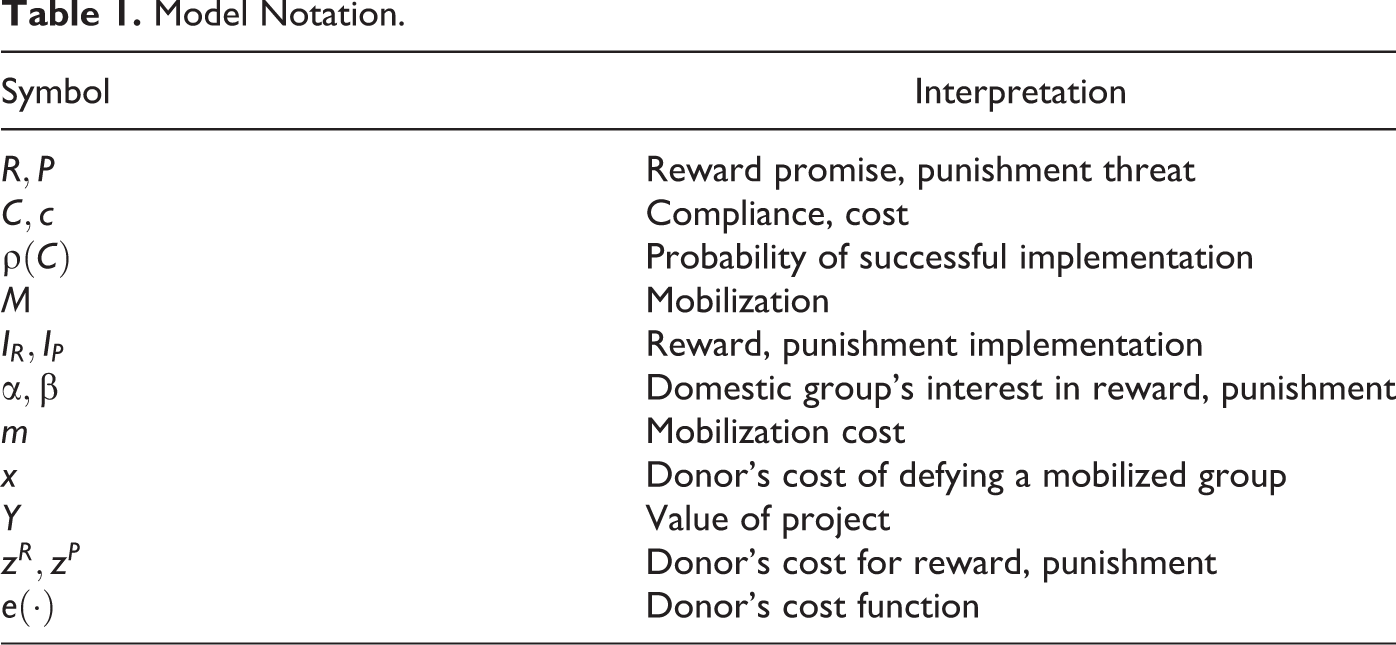
Next, the domestic group is interested in rewarding (punishing) compliant (defecting) recipients. When the donor gives a reward R to a compliant recipient, the payoff to the domestic group is
The group prefers a reward (punishment) for successful (failed) project implementation. This formulation is based on the idea that the domestic group has a direct and intrinsic interest in compliance: unlike the donor government, the domestic group wants to reward and punish behavior as appropriate. For example, a development NGO could have a high α because they strongly prefer that diligent recipients be rewarded for their efforts. Similarly, an environmental NGO could have a high β because it has a strong preference for punishing a recipient who fails to implement environmental projects. We allow α and β to vary, so that our model allows us to examine the effects of changing preference intensities for punishments and rewards on behavior.
Consider now the donor’s payoff. We assume successful implementation yields a payoff bonus of
If the donor gives a reward R, so that
The donor also responds to mobilization. Specifically, if it fails to reward (punish) a compliant (defecting) recipient, it pays a cost
Model Notation.
Donor’s Payoff Matrix in Different Contingencies.
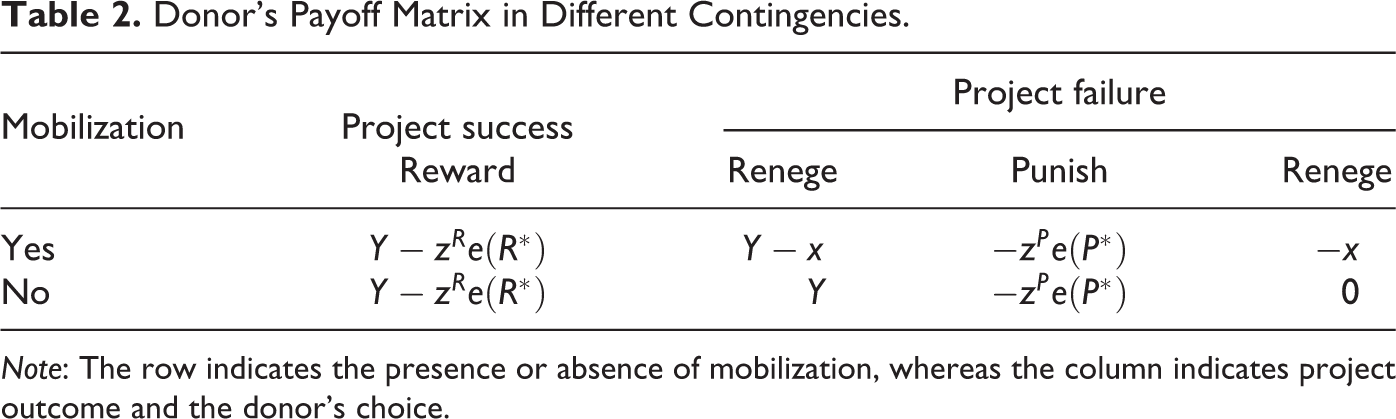
Note: The row indicates the presence or absence of mobilization, whereas the column indicates project outcome and the donor’s choice.
Equilibrium
The donor’s strategy comprises a prior promise of rewards
Donor’s Constraint
Consider the donor’s decision to implement a previously promised reward or punishment. Without mobilization,
Suppose now that mobilization has occurred,
Mobilization Constraint
What about the domestic group’s strategically prior mobilization decision? If the project succeeded, the group mobilizes whenever
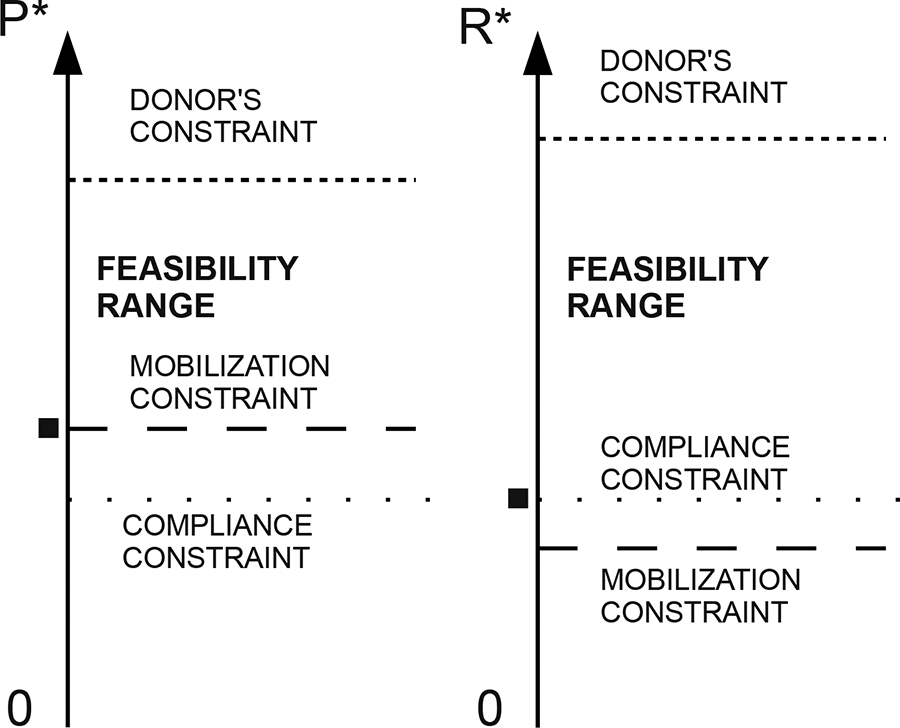
The importance of these constraints for each policy instrument is shown in Figure 1. Consider a promise of rewards, for example. If the mobilization constraint falls below the donor’s constraint, a range of rewards (feasibility range) exists such that (1) the donor can credibly commit to implementing them conditional on mobilization while (2) the domestic group is willing to mobilize. But if the mobilization constraint is higher than the donor’s constraint, any conceivable reward either fails to mobilize the group (too low) or is too costly to the donor in spite of mobilization (too high).

Feasibility of rewards and punishments. Note: The mobilization constraint must be below the donor’s constraint for a feasibility range to exist. In the figure, threatening punishments would be credible, whereas promising rewards would not be credible. For some other parameter values, exactly the opposite could hold.
We now have a full characterization of donor credibility for each policy instrument: the mobilization constraint must fall below the donor’s constraint, and the promised reward or punishment must fall between the two constraints. The model thus shows how donor credibility depends on the expectation that interest groups would exact costs on the donor government should it make empty threats and promises.
Compliance Constraint
Given the promised rewards or punishments, should the recipient comply or not? Only credible policy instruments are relevant here, so suppose without loss of generality that the value of a policy instrument is zero unless it falls between the mobilization and donor’s constraints. Given this, the expected payoff to the recipient from compliance is
With probability 
The recipient avoids the compliance cost, but the probability of success, and thus the reward, also decreases. Given that the recipient is strategic, compliance requires that
In other words, the effect of compliance on the expected payoff from the reward or punishment must exceed the cost of compliance. Notably, this implies that the sum of the reward and the punishment,
The donor’s ability to meet the compliance constraint depends on the credibility of threats and promises. If domestic groups are willing to support rewards only, for example, threats are not credible. Before discussing the donor’s strategy, we summarize the three constraints in Table 3.
The Three Constraints that Must Be Met for a Policy Instrument to Be Credible and Effective.
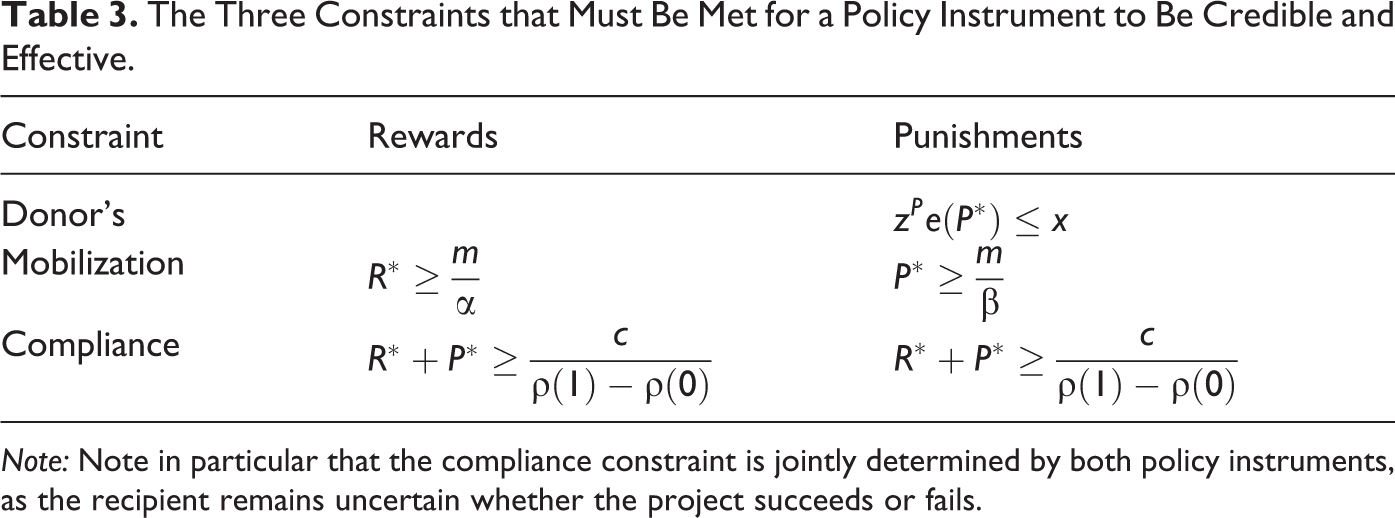
Note: Note in particular that the compliance constraint is jointly determined by both policy instruments, as the recipient remains uncertain whether the project succeeds or fails.
Finally, what about the donor’s strategy? Four possible cases can be considered:
Do nothing. The recipient does not comply and the donor obtains an expected payoff of
Rewards only. This strategy is only available if promises are credible. The donor sets
Punishments only. This strategy is only available if threats are credible. The donor sets
Rewards and punishments. This strategy is only available if both threats and promises are credible. The donor sets
The donor’s decision must be optimal, so the equilibrium is generically unique. In what follows, we characterize the empirical implications of this equilibrium.
Empirical Implications
The model not only highlights the strategic implications of interest group activity for donor credibility but also generates a number of useful empirical implications. We summarize and discuss the most important ones in this section. All proofs can be found in the Mathematical Appendix.
Donor Strategy
We have already shown that an instrument cannot be used without a feasibility range. Thus, if the feasibility range does not exist for rewards (punishments), promises (threats) are not credible. This case is relatively uninteresting, so we assume in this section that a feasibility range exists for both instruments. If both instruments are available, will the donor use both of them, or is a single instrument optimal? It turns out that if the mobilization constraint exceeds the compliance constraint for at least one of the instruments, then simultaneous threats and promises are not possible in equilibrium.
For concreteness, suppose the compliance constraint falls below the mobilization constraint for punishments. Any threatened punishment
Similarly, at most one instrument is used when the compliance constraint is only slightly above the mobilization constraint for one of the instruments. The reason, again, is strategic: a slight increase in the level of the first instrument is enough to induce compliance, so introducing a second instrument would be too costly. Seemingly irrational threats and promises that are somewhat out of proportion may be necessary to ensure donor credibility.
How does the government use the single instrument?
If the donor makes only threats or promises, but not both, it does so in view of inducing mobilization (credible commitment) and compliance (effectiveness). Recall from the previous section that if noncompliance ensues, the donor always obtains a higher payoff from doing nothing than from implementing rewards and/or punishments on the recipient. Hence, the compliance constraint must be satisfied for threats or promises to be effective. Without mobilization, the donor’s promises or threats are not credible, so the recipient will not comply. These possibilities are illustrated in Figure 2. The figure shows that if the donor relies on a single instrument, it selects the lowest level of punishments or rewards that meets both the mobilization and the compliance constraints.
Choice of policy instruments. Note: In each case, the donor uses threats or promises but not both. The black squares on the y-axes indicate the equilibrium level of his policy. On the left, the donor selects the minimal level to meet the mobilization constraint because it is higher than the compliance constraint. On the right, the donor selects the level to barely meet the compliance constraint because it is higher than the mobilization constraint.
What about the possibility of using both?
Suppose the compliance constraint is difficult to meet. One policy instrument (threats or promises) would not be optimal, and this can be for two reasons. First, the cost of the requisite reward or punishment may be so high that credible commitment is impossible: extremely generous rewards or ruthless sanctions cannot be credible, because the donor would be unwilling to implement them despite domestic mobilization. Second, the cost of meeting the compliance constraint with a single instrument can be prohibitive. In either case, the donor’s optimal strategy is to make both threats and promises. In the first case, this is the only possibility. In the second case, a single instrument would be possible but too costly due to increasing marginal costs. This possibility is illustrated in Figure 3. In the upper panel, punishments are optimal but rewards must be promised because a threat of more stringent punishment would be incredible due to a high cost. In the lower panel, both instruments are adopted due to increasing marginal costs. While neither threats nor promises alone meet the compliance constraint, together they do.

Use of threats and promises. Note: In both panels (upper and lower), the black squares on the y-axes indicate the equilibrium level of each policy. In the upper panel, rewards
Threats, Promises, or Both?
The previous section uncovered the logic of policy instrument choice. We now examine how changes in the exogenous parameters of the model influence the outcome of the game. To begin with, note that when the payoff Y is low, the donor has no incentive to promise rewards or threaten punishments. This is unsurprising, and the most interesting predictions of the model pertain to the adoption of policy instruments when Y is so high that the donor is willing to invest in securing compliance. Thus, throughout this section, we adopt the premise that Y obtains a sufficiently high value so that at least one policy instrument is used. The requisite value of Y depends, of course, also on c and
We have not specified exact functional forms, so we cannot present our comparative statics in closed form. We instead establish that, if the value of a given independent variable exceeds some threshold, our model predicts a certain equilibrium outcome. Thus, we formulate propositions such as “if the value of independent variable
Consider first the possibility that a single instrument is used.
If α is high enough while
If β is high enough while
Whenever one instrument can induce mobilization and carries a relatively low cost, the donor relies on that instrument only. In this case, a decrease in the mobilization efficacy forces an increase in the generosity (severity) of the promised reward (threatened punishment). By relying on an increasingly potent instrument, the donor credibly commits to using such an instrument because domestic groups are more willing to mobilize to support the reward or punishment in case the recipient fails or succeeds, respectively.
Previous research on conditionality emphasizes that threats and promises should be chosen so as to induce the recipient to comply at the lowest possible cost (Bueno de Mesquita and Smith 2007). This is true, but our model adds another condition: threats and promises need to be such that the donor has an incentive to implement them ex post. The need for donor credibility influences both the choice among different policy instruments and the size of the reward or punishment.
What about the possibility of using both instruments?
Suppose
Suppose
If mobilization is easy to attain, with
Alternatively, the donor may choose to threaten or promise the use of an “additional instrument” that is quite costly, if only because the donor cannot induce compliance with one policy instrument. In this case, one of the instruments is preferred but the donor is unable to credibly commit to using it to the maximum extent possible. This hypothesis can be tested by examining situations in which domestic groups in the donor country have an interest in both rewards and punishments. In such circumstances, a combination of threats and promises can be expected, especially if the cost of inducing compliance is high.
Extension: Ex Ante Mobilization
In the preceding model, the domestic interest group cannot mobilize ex ante to influence the donor government’s decision to offer foreign aid. In the Mathematical Appendix, we examine a simple extension of the model that allows the domestic interest group to increase the donor government’s valuation of project implementation, Y, so as to increase foreign aid to the recipient.
The main insights from our model remain intact: donor credibility depends on ex post mobilization. Indeed, the problem of donor credibility is aggravated in this model. If the domestic interest group understands that it must mobilize to induce the government to enforce conditionality, it considers the cost of doing so. Even if the interest group can induce the donor government to implement rewards and punishments, it may choose not to lobby for a foreign aid deal because it worries that the combined cost of ex ante and ex post postmobilization is too high. The extension also shows that if the donor needs both punishments and rewards, the expected mobilization cost is higher than otherwise because ex post mobilization is required regardless of the outcome of the project.
Case Illustrations
We illustrate equilibrium behavior in comparative case studies of US foreign aid to Israel and Palestine. Recall the following three expectations. First, the donor’s ability and willingness to credibly threaten punishments should be positively associated with domestic interest groups’ willingness to support the administration of a punishment. Second, a negative association is expected with domestic interest groups’ willingness to support promised rewards. Finally, the donor prefers to use both threats and promises if compliance is very hard to attain otherwise.
We focus on US foreign aid to Israel and Palestine. The Israeli–Palestinian conflict is illuminative for several reasons. First, the conflict is of strategic importance and involves large flows of external assistance. Second, this case study showcases how a single donor (the United States) has chosen different instruments in its aid programs to two recipients (Israel and the Palestinians). Whereas the US aid program in Israel emphasizes rewards, US strategy toward the Palestinians is inclined toward punishments but also involves both rewards and punishments at times.
Israel: Rewards
In the case of Israel, the United States has adopted a rewards-only strategy: “the US has been profoundly unwilling to exert any sort of pressure [i.e., punishments]” on Israel despite numerous accounts of “project failure” where Israel did not negotiate with the Palestinians (Brynen 2008, 76). Using our model, the choice of rewards as the only conditionality instrument toward Israel can be explained by the high value of α and the lower value of
In the model, α measures the domestic group’s preference intensity toward a reward scheme. The pro-Israel lobby in the United States is most certainly predisposed toward using rewards and vehemently against the use of any punishments against Israel. Although the financial cost
Under the 1993 and 1995 Oslo Accords, Israel and the Palestine Liberation Organization agreed to recognize each other officially, to renounce the use of violence, and to grant the Palestinians greater autonomy while ensuring Israel’s security at the same time. The Interim Agreement of 1995 “designates some areas of the West Bank and Gaza under full Palestinian civil and security control, some under Israeli civil and security control, and some under Palestinian civil control with Israeli security.” However, the peace process stalled and it was “under intense pressure from US President Bill Clinton [that] Israeli Prime Minister Benjamin Netanyanhu and Palestinian President Yasir Arafat [sought] to revive the stalled Oslo peace process with the Wye River Memorandum” in 1998. This memorandum details measures that the Palestinians ought to take to secure Israel’s security while requiring Israel to transfer a specified percentage of land to the Palestinians in exchange (Kaplan 2008).
During this period, the United States provided aid, that is, rewards, to Israel to support the peace process. In particular, “in late 1998, Israel requested US1.2 billion in additional US aid to fund the movement of troops and military installations out of areas of the West Bank as called for…in the Wye Agreement. The Clinton Administration requested US$1.2 billion in military aid for Israel to implement the Wye Agreement despite the fact that the implementation had stalled” (Sharp 2010, 23). Recently, press reports have also suggested that Israel is set to make a “daring” peace offer toward the Palestinians in order to request for an additional US$20 billion in military aid from the United States, beyond the annual US$3 billion of military aid that it now receives (Teibel 2011).
These examples illustrate a forthcoming stance toward giving rewards to Israel. Our model suggests that this is due to the political clout of the pro-Israel lobby. Indeed, not only has the pro-Israel lobby provided a strong domestic impetus for the United States to deliver its promises of rewards to Israel, the lobby has also been instrumental in justifying and thus in securing these promises of aid to Israel.
By contrast, the United States has been reluctant to exact punishments on Israel. For instance, one condition of the US aid program to Israel states that “US loan guarantees cannot be used to finance Israeli settlement building in areas occupied after the 1967 War,” such as the West Bank and the Gaza Strip (Sharp 2010, 15). Although in 2003, the United States reduced its loan guarantees to Israel by US$289.5 million (of the US$3 billion) in response to Israel’s violation of this condition through continued settlement building, the United States did not reduce its military assistance and direct foreign aid to Israel, which constitute the bulk of the total US aid package to Israel. “Reducing the loan guarantees by roughly 10 percent simply meant that Israel had to pay a higher interest rate on a small portion of the overall amount it intended to borrow. The former director general of Israel’s finance ministry estimated that it would cost Israel about US4 million a year in higher interest costs, which is not a lot of money for a prosperous state like Israel.” The punishment—if one would even consider this as a punishment—was “effectively a weak slap on the wrist” (Mearsheimer and Walt 2007, 216). Moreover, deductions to loan guarantees were not even made in some years. Indeed, this was all the punishment that the Bush administration could mete out to Israel without incurring the anger of the pro-Israel lobby in the United States. Even at the first hint of such a weak punishment, “Israel’s supporters in Congress mobilized and emphasized to the White House, as Senator Charles Schumer put it, that if the president ‘flouts the will of Congress and tries to penalize Israel for defending itself, Congress will do everything in its power to ensure that these loan guarantees are not held up’” (Mearsheimer and Walt 2007, 216).
Recent events also illustrate the strong domestic support for Israel within the United States. Back in early 2010, US Middle East peace envoy George Mitchell remarked that the United States could consider punishing Israel to push it toward a negotiated settlement with the Palestinians. Not only was Mitchell’s remark met with discontent in Israel, it also drew disapproval within the United States. Senator Joe Lieberman told reporters in Jerusalem that “[a]ny attempt to pressure Israel, to force Israel, to the negotiating table by denying Israel support will not pass the Congress of the United States.” Senator John McCain added that Mitchell’s remarks were not representative of the Obama administration’s policy toward Israel (Heller 2010).
Alternative interpretations of United States–Israeli interactions exist. Instances of Israeli compliance could also result from a credible US threat “off the equilibrium path.” In a game of perfect information, Israel would comply with US demands and thus avoid punishments, exactly because such punishments were credible. While this alternative model cannot shed light on instances of Israeli noncompliance, it illuminates cases such as the 1956 Suez crisis. After a successful military operation against Egypt, Israel refused to comply with repeated calls by the United Nations for it to fully withdraw its forces. While promising continued assistance “after Israel’s withdrawal” (Eisenhower 1957), the United States successfully threatened to discontinue all assistance to Israel and to impose sanctions on Israel. In this and other similar cases, the absence of punishments is not evidence of their incredibility.
Palestine: Punishments
Whereas Israel is entitled to special benefits unavailable to other countries, “much of [US] aid [to the Palestinians] is subject to a host of vetting and oversight requirements and legislative restrictions” due to “congressional concerns that, among other things, US funds might be diverted to Palestinian terrorist groups” such as Hamas (Zanotti 2010). “These conditions include a restriction on aid to Hamas (including Hamas affiliates and any government of which Hamas is a member) or to a Palestinian state unless commitments towards peaceful coexistence with Israel are made and other requirements met by certain Palestinian parties,” that is, punishment in the form of aid suspension or reduction will be imposed should the Palestinians fail to satisfy US conditions (Zanotti 2010, 1).
In our model, US preference for a punishment can be attributed to the high value of β and the lower relative value of
The domestic pressure on US policy makers to implement and enforce aid conditionality has had powerful effects. After Hamas won the Palestinian Legislative Council Elections in 2006, the United States suspended all direct foreign aid to the Palestinian Authority, and this punishment was sustained throughout the brief tenure of the Hamas-led unity government from February to June 2007. “In June 2007, Hamas forcibly took control of the Gaza Strip. [Palestinian Authority] President Mahmoud Abbas (head of Fateh), calling the move a ‘coup,’ dissolved the unity government and tasked the politically independent technocrat Salam Fayyad to serve as prime minister and organize a new [Palestinian Authority] ‘caretaker’ government in the West Bank” (Zanotti 2010, 2). The United States only resumed aid to the Palestinian Authority following the dissolution of the Hamas-led unity government in June 2007.
Hamas’s control of Gaza since June 2007 presents new challenges. While there is a strong impetus for the United States to punish Hamas by suspending all aid to Palestinians in Gaza, this is unfavorable due to the unfolding humanitarian crisis in Gaza. Given the limitations of a punishment-only strategy at achieving compliance and conflict resolution since the rise of Hamas, the United States has adopted a two-pronged approach by simultaneously bolstering the Fateh-led government in the West Bank with additional aid aimed at facilitating institution and capacity building. By propping up the Fateh-led government, it is hoped that Hamas will gradually lose its support from Palestinians and thus its control over Gaza. For instance, in late 2010, US Secretary of State Hilary Clinton announced that the United States would reward the Fateh-led Palestinian Authority with an additional US$150 million in aid for progress that the Palestinian Authority has made toward good governance (Birnbaum 2010). This illustrates our model: the donor uses both instruments even if one of them is costly, because compliance cannot be achieved with only one instrument. If the United States were to punish Hamas without rewarding and bolstering Fateh, it might inadvertently push Palestinians to support Hamas and thus prolong and magnify the crisis.
Conclusion
Donors often impose conditions on foreign aid, and the effectiveness of such conditions is a central determinant of the effectiveness of foreign aid as an instrument of statecraft. In this article, we have examined the domestic determinants of donor credibility. When and how can domestic political mechanisms allow donors to credibly commit to conditions on foreign aid? Do such commitment mechanisms influence the choice between punishment and rewards? In our model, domestic interest groups can mobilize to support the administration of punishments and rewards, and such mobilization is critical for donor credibility. If such mobilization is difficult to attain for punishments (rewards), then the donor only promises rewards (threatens punishments). But if mobilization is easy, the donor prefers to use both policy instruments to induce compliance with conditions imposed on foreign aid. Interest groups are not only an important determinant of donor credibility but it also influences the choice of policy instruments.
Our research also has policy implications. The COD approach, already discussed in the introduction, mirrors the reward scheme conceptualized in our model. Other programs correspond to punishment schemes in our model, as the recipient incurs the cost of suspended or reduced aid in the event of project failure. Which approach is more credible and effective? Our model draws attention to domestic politics. If donor countries can mobilize domestic support for rewards, the COD scheme will work. But if donor countries find it easier to mobilize domestic support for punishments, “sticks” will dominate “carrots.” Some donors may benefit from the COD approach, especially if they are populated by powerful NGO constituencies that would punish governments for failing to implement the reward schemes, while others may only be able to commit to negative conditionality.
Our study can also help evaluate the future of Chinese foreign aid. As China’s economic and political clout grows, Beijing’s interest in giving foreign may increase. So far, China’s foreign aid programs have had few strings attached to them. This forms the key concern of major aid donors regarding Chinese aid, particularly since there has been no systematic sharing of information by the Chinese with other international aid donors. Our model provides a counterintuitive but logical explanation for the absence of conditionality. Chinese civil society is generally less independent than Western civil society. Therefore, China faces a severe donor credibility problem. Even if China were to explicitly demand policy adjustments from aid recipients, the conditions might fail to induce compliance.
Mathematical Appendix
This mathematical appendix provides the proofs for all claims and propositions in the main text.
Proof of Claim 1
Assume the compliance constraint (equation 3) falls below the mobilization constraint for at least one instrument. Without loss of generality, let this instrument be promised rewards,
Proof of Claim 2
If the donor uses only threats or promises, whichever constraint is more difficult to achieve determines the equilibrium level. If rewards are used, this implies that
Let
Proof of Claim 3
Suppose the compliance constraint (equation 3) is only met for sufficiently high values on the left side. Now suppose toward a contradiction that the donor uses only threats or promises. Without loss of generality, let this instrument be promised rewards. With the function
Proof of Proposition 1
Consider the first part. Suppose α is high while
Consider now the second part. The proof is identical to the first part, except that threatened punishments instead of promised rewards are considered.
Proof of Proposition 2
Consider the first part. With
Consider the second part. With
Model Extension
Consider the model introduced in the main text, but suppose that before the game is played, the interest group can engage in ex ante lobbying of the government. Suppose that such lobbying, denoted by
For any given level of L, the following subgame is fully characterized in the main text. All that remains is the choice of L. The only effect of Y on equilibrium behavior is the following:
If Y falls below some threshold
If Y equals or exceeds this threshold
The optimal choice of threats and promises does not depend on Y, except that if
Suppose that from an ex ante perspective, the donor is only interested in the success of the project and the expected cost of ex post mobilization. The group has no intrinsic interest in punishments or rewards ex ante. These incentives are created ex post, after the donor has issued punishments and rewards. Let
Given that lobbying is costly, and the effect of Y is to enable or disable foreign aid, the group must select between
If it selects
If the donor threatens punishments and promises rewards, then this expected payoff is
The incentive to mobilize is always minimized if both policy instruments are needed because the mobilization cost m has to be paid regardless of the success or failure of the project.
Footnotes
Acknowledgment
We thank Chris Pallas, Paul Huth, and the anonymous reviewers for useful comments.
Declaration of Conflicting Interests
The author(s) declared no potential conflicts of interest with respect to the research, authorship, and/or publication of this article.
Funding
The author(s) received no financial support for the research, authorship, and/or publication of this article.