




Abstract
This article seeks to understand the impact of religious diversity on religious tolerance in developing countries and draws lessons from the case of Nigeria. Religious diversity has appeared to prompt religious intolerance in Nigeria when we view the country from a distance. However, this article reveals important subnational variation. Using original survey data collected in 2006, I compare the impact of religious observance on respect for religious freedom across four settings within Nigeria and find religious observance was having, at the time of the survey, a more positive impact on respect for religious freedom in the most religiously diverse and integrated of the four settings. In-depth interviews indicate that Christian and Muslim religious leaders more openly encouraged religious tolerance in religiously diverse and integrated settings than in religiously homogenous settings. Substantively, this study suggests that religious segregation rather than religious diversity has inhibited religious tolerance in Nigeria and provides a baseline for assessing how changes in religious diversity and sociopolitical conditions across time affect the likelihood that Christianity and Islam are applied in ways that promote or impede tolerance. Methodologically, it reveals the importance of examining individual-level data and subnational variation when attempting to understand the political impact of religion in any country.
Where there is a culture of religious tolerance, most people respect the freedom of faith communities other than their own to function, seek converts, and attempt to influence societal norms and values. Religious institutions are uniquely capable of effectively encouraging a culture of religious tolerance. With the possible exception of the family, religious institutions are the most powerful purveyors of religious tolerance in any society. 1 However, we know that religious leaders do not always encourage such tolerance. Christian and Islamic communities have at times persecuted and sought to outlaw the existence of rival religious communities or at least greatly limit their ability to attract converts and influence the wider society.
While there is variation in the extent to which religious communities have promoted tolerance of other religious communities, we have yet to understand and explain this variation well (Fish 2011; Sisk 2011). Some theorists focus on religious ideas and suggest that some religious traditions, particularly those of Western Christianity, are simply more tolerant of religious differences than others, such as those of Islam (Kedourie 1994; Huntington 1996 ). 2 While there is good reason to think religious ideas are important and that some religious traditions have more ideological resources to support religious tolerance than others, the religious traditions and scriptures of both Western Christianity and Islam have been applied in ways that encourage and discourage respect for religious freedom (Stepan 2000; Hefner 2005). Theories that focus on inherent differences between religious traditions and denominations to explain variation in religious-based support for religious tolerance leave a great deal of variation unexplained. 3 Therefore, those interested in explaining religious-based support for religious tolerance would do well to focus on conditions that vary across time and place.
Of the conditions that do vary across time and place that may affect whether religious ideas are applied in ways that encourage or discourage religious tolerance, particularly in the developing world, religious diversity has received considerable attention. Many observers have suggested that religious diversity makes societies less tolerant and more prone to destabilizing violent conflict (Lipset 1959; Easterly and Levine 1997; Karatnicky 2002; Montalvo and Reynal-Querol 2003; Quinn and Quinn 2003; Esteban and Mayoral 2011). Other scholars have found evidence to indicate that religious diversity has no systematic relationship with tolerance and the prevalence of violent conflict (Fearon and Laitin 2003; Fish and Brooks 2004). Still others have found evidence of a positive relationship between religious diversity and indicators associated with greater tolerance (Alesina et al. 2003). 4 However, these same scholars find it difficult to believe that greater religious diversity may result in more tolerance and suggest that the causal arrow runs from tolerance to greater religious diversity and that some societies are more religiously diverse precisely because they were/are more tolerant societies to begin with (ibid.).
In this article, I point to evidence from Nigeria, a survey of Christians and Muslims conducted in 2006, that shows a positive relationship between religious diversity and religious-based support for religious tolerance. Furthermore, I suggest that the evidence indicates that the causal arrow runs from religious diversity to religious-based support for such tolerance. With a population that is nearly half Christian and half Muslim and decades of interreligious violence, Nigeria might be considered the “poster child” for the argument that religious diversity, in developing countries, tends to prompt religious intolerance and trigger violent conflict. 5 However, when we look within Nigeria, we find subnational variation that does not support this argument. In comparing the impact of Christian and Islamic religious communities on respect for religious freedom across four settings in Nigeria, predominantly Muslim Kano, predominantly Christian Enugu, moderately diverse Jos, and highly diverse Ibadan, I find that Christian and Islamic communities had, at the time of the survey, the most positive impact on respect for religious freedom in Ibadan, the most religiously diverse of the four settings.
Although a snapshot in time, this study suggests that religious segregation rather than religious diversity has inhibited religious tolerance in Nigeria and provides a baseline for assessing how changes in religious diversity and other sociopolitical conditions across time affect the likelihood that Christianity and Islam are applied in ways that promote or impede tolerance. Furthermore, while focused on the case of Nigeria, the results have implications that transcend Nigeria in that they reveal how analysis pitched at the national level can be very misleading. There is good reason to expect that an examination of subnational and individual-level data in other religiously diverse societies would also call into question conclusions based on national-level data alone.
The remainder of the article is divided into five sections. The following section discusses the meaning and measures of religious diversity and briefly summarizes the previous literature on the relationship between religious diversity and violent conflict/tolerance. The second section examines the religiopolitical context in Nigeria. In the third section, I describe the survey I conducted in Nigeria and present the results of statistical analysis. In the fourth section, I consider the results of statistical analysis in light of in-depth interviews with religious leaders. In the fifth section, I discuss theoretical implications and conclude with directions for further research.
Religious Diversity
Religious diversity may be conceptualized and measured in different ways. However, the two measures that have received the most attention in recent years have been the religious fractionalization index (RFI) and, to a lesser degree, the religious polarization index (RPI). The RFI was developed by Alberto Alesina and colleagues (2003) and is a variant of the standard Herfindahl index.
6
This measure of religious diversity is defined as follows:

With regard to the RFI formula, let j be the index country and i be the index religious groups. Let pij be the share of people in the country that self-identify with religious group i, and suppose that in county j there are nj different religious groups. The RFI is bounded below at 0 if there is one religious group and approaches 1 with many religious groups, so increasing values mean more religious diversity. The authors of this measure demonstrate that the RFI is an estimate of the probability that two randomly selected individuals within a society would be of different religious groups.
The other estimate of religious diversity that we find in the literature is that developed by Jose Montalvo and Marta Reynal-Querol (2003). They call this measure the RPI.
7
Montalvo and Reynal-Querol argue that the relative size of religious groups is extremely important if we are interested in the impact of religious diversity on economic and political outcomes. This is because religious communities that are nearly equal in terms of size are more likely to view each other as competitors for adherents and social influence than are religious communities that are very different from each other in terms of size. Intense religious competition can mean growth-inhibiting and democracy-impeding religious conflict. These characteristics are present in the index that is defined as follows:
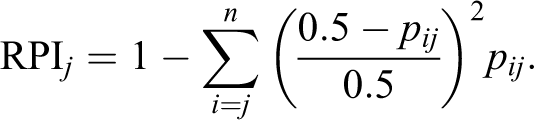
Again, let j be the index country and i be the index religious groups. Let pij be the share of people in the country that self-identify with religious group i and suppose that in county j there are nj different religious groups. In essence, the RPI considers the deviation of the proportion of each religious group from the maximum, 0.5. Therefore, in order to weight equally positive and negative differences from 0.5, the measure takes the square of the difference. Like the RFI, higher values mean more religious diversity. The RPI reaches a maximum of 1 where there are two religious groups that are of equal size and a minimum of zero when there is one religion.
The RFI and the RPI will produce identical values when there are equally sized religious groups in a country. The two indexes do however produce different values when the relative sizes of religious groups differ. For example, consider two countries with four religious groups. Let us call them countries A and B. In country B, there are four equally sized groups while in country A there is a dominant religious group with 80 percent of the population and four smaller religious groups with 5 percent of the population each. The RPI will produce values of 0.35 and 0.75 in countries A and B, respectively, while the same values for the RFI are 0.59 and 0.75. Notice that RPI increases considerably moving from country A to B indicating there has been a rapid increase in religious diversity as religious group size becomes equalized. In contrast, the movement from a dominant religious group to equally sized religious groups does not produce nearly the same change in the RFI.
Esteban and Mayoral (2011) propose a variant of the RPI that emphasizes the distances or antagonisms between religious groups rather than merely the number and/or the relative sizes of religious groups. We might call this measure the religious distances index . Building on the work by Fearon (2003) that shows distance similarities between languages play a role in ethnic conflict, Esteban and Mayoral argue that some religious groups are more similar to or different from each other than others. Those that are more distant from each other are expected to produce greater conflict. Esteban and Mayoral aggregate answers to a set of questions related to religious attitudes that are included in the World Values Survey to estimate distances between religious groups. The measure of RDI they use is defined as follows, where n indexes size of religious group and dij
denotes the perceived distance between groups i and j:

Based on the analysis of aggregated national level data, Alesina et al. (2003) find that the RFI has a slightly positive association with indicators associated with greater tolerance while Montalvo and Reynal-Querol (2003) and Esteban and Mayoral (2011) find just the opposite with respect to the RPI and the RDI. Despite their findings that link RFI and greater tolerance, Alesina et al. (2003) do not suggest that religious diversity leads to greater tolerance. Instead, they argue that tolerance leads to religious diversity. Montalvo and Reynal-Querol (2003) find that the RPI increases the probability of civil wars. In other words, as the two largest religious groups come closer to representing equal percentages of the population, they find that the likelihood of violent conflict within a country becomes greater. Montalvo and Reynal-Querol argue that, all else being equal, religious tolerance is diminished wherever and whenever two religious groups are nearly equal in terms of their relative size. They find that violent conflict becomes increasingly likely at higher levels of religious polarization. Esteban and Mayoral (2011) find that when distance is included in the measure, as it is in the RDI, religious polarization increases the likelihood of social conflict to an even greater degree.
Religious Diversity and Conflict in Nigeria
One would be hard pressed to find many countries as religiously diverse and polarized as Nigeria. As of the mid-1990s, Barrett, Kurian, and Johnson (2001) estimate that approximately 45 percent of Nigeria’s population professed Christianity and 43 percent professed Islam. Although some sources estimate the percentage of Muslims to be between five and ten percentage points greater than the Christian percentage of the population, the point is that Nigeria is almost evenly divided between Christians and Muslims. 8
While Nigeria is roughly half Muslim and half Christian, there is a significant degree of pluralism within the country’s Christian and Islamic communities. While the Roman Catholic and Anglican churches are the largest Christian denominations in Nigeria, when combined most Christians are members of other churches and sects. Barrett, Kurian, and Johnson (2001) estimate that 18 percent of Nigeria’s Christian population identified as Anglicans and 12 percent as Roman Catholics in 2000. By almost all accounts, Evangelical Christianity and, more specifically, Pentecostalism have been growing dramatically in Nigeria. There is good reason to believe that approximately half of all Christians in Nigeria considered themselves Evangelicals or Pentecostals by the year 2000 and that there were seven Christian denominations or sects that included 10 percent or more of the Christian population as of 2000 (ibid.). 9
Nigeria’s Muslim population, like the country’s Christian population, is diverse. Over the years, intra-Islamic tensions have mounted, pitting those whom Paden (2005, 2008) calls the anti-innovation reformists against the two major Sufi brotherhoods (i.e., the Qadiriyya and the Tijaniyya) and northern Nigeria’s religious establishment. Reformists have focused on ridding Islam of what they consider to be errors and innovations associated with Sufism. They have also devoted themselves to promoting a greater role for Islam in Nigeria’s politics, making the religious law, Shari’ah, the law of the land and integrating religious and state authority. 10 One such anti-innovation reform movement is the Jama’at Izalat al-Bida wa Iqamat al Sunnah (Society for the Eradication of Evil Innovations and the Reestablishment of the Sunnah), better known as Izala (Paden 2008, 29). The Izala has contributed to a religious revival among northern Muslims, as it has accused Nigeria’s Muslim elites, including the emirs of northern Nigeria, of selling out to secularists and Christians (Paden 2012, 79). The Izala has accused the Islamic religious establishment of failing to promote the integration of religious and state authority that they believe Islam requires. The Izala is no longer one unified revival movement as it has split and splintered into a variety of groups over time (ibid.).
The growing strength of anti-innovation reform movements, and a widespread loss of confidence in the secular state’s ability to tackle corruption and uphold law and order, prompted northern politicians to enshrine the Shari’ah in the constitutions of northern states. Efforts to constitutionally enshrine the Shari’ah began to meet with success in 1999, when Zamfara State became the first to officially adopt the Shari’ah. By the year 2003, the Shari’ah had been constitutionally privileged in Nigeria’s twelve most northern states. Although the Shari’ah applies to Muslims only, many Christians in the twelve Shari’ah states claim that they have been relegated to second-class citizens in their own country since the privileged place that the Shari’ah enjoys indicates that Islam is the established religion of the state (Falola 1998). 11
Although ethnic divisions appeared to be more politically salient for at least the first three decades of Nigeria’s independence (Laitin 1986), since the late 1970s and early 1980s, religious identities have become more politically important and competition between religious groups has become increasingly intense (Kukah 1993; Kukah and Falola 1996; Falola 1998). Falola (1998, 167) notes that underlying the tension between Christians and Muslims is the issue of religious dominance, who should control the state, the secular or religious character of the state, and the nature of the legal system. He even goes so far as to argue that the bitter conflicts and rivalries between Christians and Muslims have become an “open, common and permanent feature of [Nigeria’s] politics” (Falola 1998, 5). As Marshall (2009, 214) puts it, in Nigeria there are two “competing theocratic projects” that are mutually exclusive.
The competition for influence between Christians and Muslims has exacerbated intra-Christian and intra-Islamic conflict. Christian and Muslim religious leaders have sought to gain followers and influence among their coreligionists by claiming to be better at checking the social and political influence of the rival religion than their fellow religious leaders. 12 There has been a concurrent revivalism within Islam and Christianity, with fundamentalism in one seeming to feed off and stoke fundamentalism in the other (Campbell and Harwood 2011).
For example, the Christian Association of Nigeria (CAN), an interdenominational umbrella organization founded in 1976 to promote Christian values in society, has experienced divisions that are related to disagreements over how best to deal with Islam. CAN is arguably the most socially and politically important Christian organization in the country. Originally founded by Roman Catholics and Anglicans, the association has come to include Evangelical and Pentecostal Christians, and leaders from these churches have become increasingly influential (Loimeier 2007; Marshall 2009). As their percentage of the Christian population increases, Pentecostals have grown powerful in CAN. Pentecostal leaders have tended to be less compromising in their efforts to Christianize Nigeria than mainline Christian leaders and this has created tension within CAN (Loimeier 2007). For example, one of the complaints lodged by some members of CAN against Archbishop (now Cardinal) John Onaiyekan, Catholic archbishop of Abuja and president of CAN from 2007 to 2010, was that he was too soft on Islam. The CAN membership elected Pentecostal Pastor Ayo Oritsejafor to replace Archbishop Onaiyekan as president of CAN in 2010. According to many observers, Oritsejafor took control of CAN in large part by appealing to the large numbers of Pentecostal Christians who thought Onaiyekan was overly compromising in his approach to Muslims and not dedicated enough to making Nigeria a Christian country. 13
Given the conflict between and within Christian and Muslim communities, it should come as no surprise that Nigeria is often considered the “poster child” for the argument that religious diversity hinders religious tolerance and is politically destabilizing in the “developing world.” Since the 1980s, there have been numerous episodes of deadly interreligious violence. Churches and mosques have been desecrated and/or destroyed. The Christian versus Muslim violence of the 1980s and 1990s claimed several thousands of lives (Quinn and Quinn 2003; Paden 2005). Human Rights Watch estimates that more than 11,000 people were killed in religious and/or ethnic violence between 1999 and 2006. 14 Christian and Islamic groups have taken mutually exclusive stances on the role of religion in public life. Through converting people to Christianity and adding to those who believe in Christ, some Christians, especially the growing number of Pentecostal Christians, seek to make Nigeria a Christian country (Marshall 2009, 214-15). These efforts to evangelize do not sit well with Muslims, whether they are anti-innovation reformists who promote a Shari’ah-based state, members of the more moderate Sufi brotherhoods, or the many unaffiliated Nigerian Muslims.
More recently, deadly attacks and kidnappings by amā`at Ahl as-Sunnah lid-da`wa wal-Jihād (i.e., the Congregation of the People of Tradition for Proselytism and Jihad), better known as Boko Haram, have increased fears and suspicions within the Islamic community and between Christians and Muslims (International Crisis Group 2014). Founded in 2002, in predominantly Muslim Borno state of northeastern Nigeria by Salafi teacher Mohammed Yusuf, Boko Haram began by seeking to make Borno a Shari’ah state and has since adopted a more ambitious and violent agenda. 15 Even if the vast majority of Nigerians, Christians and Muslims, are not religious extremists and are unsympathetic to groups that call for violence in defense of their own religions, it would appear that religious diversity has prompted religious extremism that threatens the integrity of the Nigerian state.
Subnational Variation to Explain
Although there has been a great deal of interreligious violence in Nigeria over the past thirty years, when we look within Nigeria we find that such violence is not equally distributed across the country. The most deadly and protracted episodes of interreligious violence have taken place in the cities and towns of northern Nigeria and the Middle Belt. Interreligious riots have been either less common or less deadly in southwestern and southeastern states. While there have been religious leaders who have tried to promote tolerance and accommodation in the north and the Middle Belt, all too often their voices have not been heard over those who preach an illiberal brand of Islam or Christianity. 16 Imo (2008) observes that more than a few prominent Christian leaders in northern Nigeria and Nigeria’s Middle Belt have interpreted scripture in ways that condone violence in defense of one’s faith. 17
Where religious differences overlap with “settler” and “native” or “indigene” distinctions, as is the case in much of the Middle Belt, episodes of deadly violence have been particularly frequent. The cities of Jos and Kaduna are cases in point. In these two cities and their environs, most Christians and Muslims are divided not only by religion but also by ethnicity and indigene/settler status. According to Nigerian law, those who are classified as indigenes are to enjoy more rights than settlers (e.g., the right to own land). In Jos, the vast majority of Christians are considered indigenes while many Muslims are classified as settlers. It is just the opposite in Kaduna, with Muslims making up the majority of indigenes and Christians making up the vast majority of settlers. In both cities, we find religiously homogeneous blocs and fault lines along which there have been repeated episodes of deadly violence (International Crisis Group 2012; Paden 2012; Human Rights Watch 2013).
Where religious identities do not overlap with ethnic identities and indigene-settler status, we find interreligious violence much less frequent and deadly. For example, in the city of Ibadan and much of southwestern Nigeria, the population is largely made up of members of the Yoruba ethnic group and, among the Yoruba, we find an almost equal percentage of Christians and Muslims. While there have been episodes of interreligious tensions and even violence on occasion, it is widely recognized that there has prevailed a culture of interreligious tolerance in Ibadan and much of the southwest dating back to at least as far back as the middle of the twentieth century (Laitin 1986; Falola 1998; Paden 2005).
Laitin (1986) and Paden (2005) have suggested that the culture of tolerance that has characterized Ibadan and much of southwestern Nigeria is largely the result of the religious diversity and integration that has gradually developed there. Laitin (1986, 9) argues that “the Christian-Muslim divide in Yorubaland of southwestern Nigeria, far from fanning the flames of religious conflict, actually built the foundation for compromise.” 18 Although religious diversity in Yorubaland might seem likely to generate high levels of conflict, Paden (2005, 109) argues that the situation is closer to a “pax Yoruba” that promotes accommodation between Christian and Muslim groups. Falola (1998, 171) notes that the competition between Christians and Muslims for converts in the southwest has been intense, but “it is unlikely that violence of the scale seen in the north will occur in the southwest…leaders of both religions always emphasize accommodation.”
According to Paden (2005, 100), Yoruba Muslim and Christian leaders have worked to moderate both religious and political matters. These leaders refer to themselves as “fathers of all” and often play a key role in conflict mediation and resolution. In Ibadan, the capital of Oyo state, in the heart of Yorubaland, Muslim and Christian leaders have stressed the need for tolerance, peace, and patience (Paden 2005, 102). Christian leaders are as likely to quote the Koran as the Bible and Muslim leaders are as likely to quote the Bible as the Koran, notes Paden (2005, 102). At times, they have even attempted to play a role in Christian–Muslim reconciliation in other parts of the country. The place of the Shari’ah religious law has not been the major issue in southwestern states as it has been in the northern states and Middle Belt states.
While there is evidence of subnational variation that suggests religious diversity may actually increase rather than decrease religious-based support for religious freedom and the separation of religious and state authority, such evidence is largely anecdotal in nature. In order to discern whether Christian and Islamic religious communities are more or less encouraging of respect for freedom of religion in religiously diverse settings as compared to religiously homogeneous settings, we need to measure the impact of religious observance on respect for freedom of religion across settings. If we find there are differences in the impact of religious observance across the settings, we then need some way of discerning whether and to what extent such differences are attributable to variation in religious diversity rather than other factors that distinguish one setting from another, such as the degree of ethnic homogeneity.
Survey, Methodology, and Results
In order to discern whether and how religious diversity affects the likelihood that Christian and Islamic religious communities in Nigeria encourage or discourage respect for religious freedom, I begin by analyzing survey data I collected in 2006. The survey included 1,200 individuals among whom there were mainline Christians (i.e., Roman Catholics, Anglicans, Methodists, and Presbyterians), Pentecostal Christians (i.e., Assemblies of God and other independent churches associated with the “born-again” and “saved” movements), and Muslims. The survey was conducted in four locations that vary greatly in terms of their religious diversity: a predominantly Muslim location (Kano), a predominantly Christian area (Enugu), one moderately diverse location (Jos), and one location that is almost evenly split between Christians and Muslims (Ibadan).
Precisely because religion is such a divisive issue, questions concerning religious identity have not been included in Nigeria’s census for decades. Among the most reliable of these surveys is the Nigeria Demographic and Health Survey (NDHS). According to the NDHS of 2003, Christians made up 95 percent of the population in Enugu and Muslims made up less than 1 percent of the city’s population. Kano was a reverse image of Enugu that year according to the NDHS, with Muslims making up 98 percent of the population and Christians making up less than 1 percent. According to the same survey, Christians made up 49 percent of the population of Ibadan and Muslims made up 50 percent of that city’s population. Jos was at an intermediate level of religious diversity as of 2003, not as diverse as Ibadan and more diverse than Kano and Enugu. It was estimated that Christians made up 61 percent of Jos’ population and Muslims made up 37 percent. 19
In each of the four locations, we interviewed an equal number (i.e., 100) of Muslims, mainline Christians, and Pentecostal Christians. Within each religious group (i.e., mainline Christian, Pentecostal, and Islamic), respondents were selected randomly. 20 Because we want a measure of religiosity, not merely religious attendance, I developed a measure of religious observance that combines indicators of communal engagement and personal devotion. 21 The indicators used to build our measure of religious observance include (1) how frequently a person attends religious services, (2) how involved a person is in religious-based associations, (3) how frequently the individual contacts religious leaders, (4) how much an individual respects religious leaders, (5) how frequently a person prays, and (6) how important religion is in one’s life. Each of these variables are summed, so that each respondent was assigned a religious observance score that ranged between a score of 22, indicating the most religiously involved, and a score of 0, indicating the least religiously involved.
We are interested in explaining variation in Respect for freedom of religion. The actual question that Christian and Muslim respondents were asked in the survey is worded as follows: “Please tell me whether you strongly disapprove, disapprove, neither approve nor disapprove, approve or strongly approve of the following statement: Every religion should be allowed to promote its beliefs and values.” I used a five-point scale for the variable, where strongly approve = 5 and strongly disapprove = 0.
Before controlling for religious observance, we look at sample means and find that there were, at the time of the survey, minimal differences across the four settings with respect to support for religious freedom. As shown in Table 1, the means from all four settings were close to four. In other words, the average respondent approved though not strongly approved of the following statement: “Every religion should be allowed to promote its beliefs and values.” However, it is worth noting that support for religious freedom was on average highest in the predominantly Muslim location (4.24) and lowest in the predominantly Christian setting (3.88). When it comes to the mean level of support for religious freedom, the highly diverse and moderately diverse locations fell in between the two more homogeneous locations. Because we surveyed an equal number of Muslims, mainline Christians, and Pentecostal Christians in each setting, these sample means hold constant the mix of religions across areas and only reflect differences in the intensity of preferences across settings.
Sample Means (SD) by Location.

In Table 2, I report the estimates from probit and ordered-probit regressions. It shows the marginal effect of a ten-unit change in the religious observance index on the probability that a respondent would have expressed the highest possible support for respect, religious liberty, and particular religious group in each of the four locations. In each location, we control for factors other than religious affiliation, such as age, gender, years of formal education, and annual household income that might affect respect for religious freedom. 22
Religious Observance and Respect for Religious Liberty (Probit and Ordered-Probit Analysis).

Note: M-Christian = mainline Christian; P-Christian = Pentecostal Christian.
Among Muslims, mainline Christians, and Pentecostal Christians, religious observance had a much more positive effect on support for religious liberty in the most religiously diverse setting, Ibadan, than in any of the other three locations. In the most religiously diverse setting, every ten-unit increase in the religious observance index resulted in 28 percent increase in the likelihood that a Muslim expressed the highest possible level of support for religious liberty. Religious observance is shown to have had no effect on support for religious liberty among Muslims in the predominantly Christian location, Enugu, and the predominantly Muslim setting, Kano. In the moderately diverse setting, Jos, religious observance is shown to have had a slightly negative impact on support for religious liberty among Muslims.
As in the case of Muslims, religious observance among mainline Christians had the most positive effect on support for religious liberty in Ibadan, the most religiously diverse of the four settings. Every ten-unit increase in religious observance resulted in a 40 percent increase in the likelihood that a mainline Christian expressed the highest possible level of support for religious liberty in Ibadan. Results indicate that religious observance had no effect on support for religious liberty among mainline Christians in predominantly Muslim setting of Kano, or Jos, the moderately diverse location. Religious observance had a slightly positive effect on support for religious liberty in predominantly Christian Enugu, but not nearly the kind of positive effect we see in Ibadan.
Among Pentecostal Christians, we also find that religious observance had the most profoundly positive effect on support for religious liberty in Ibadan. While results indicate that religious observance had a positive effect on support for religious liberty in predominantly Christian Enugu, the effect was twice as large and much more significant in Ibadan. For every ten-unit increase in religious observance, the likelihood that a Pentecostal Christian expressed the highest level of support for religious liberty increased by 43 percent. Religious observance is shown to have had no effect on support for religious liberty in predominantly Muslim Kano and moderately diverse Jos. Taken together with the findings for Muslims and mainline Christians, these results show that the impact of religious observance on support for religious freedom varied greatly by location, with religious observance having the most profoundly positive effect on support for religious freedom in the most religiously diverse location. This we found to be consistently true among Muslims, mainline Christians, and Pentecostals.
Although the results show that religious observance had a much more positive effect on respect for religious freedom in the most religiously diverse of the four settings, they do not by themselves allow us to conclude that religious diversity explains the variation. We really do not know whether the differences observed across the settings were due to religious diversity and, if so, what the causal mechanism might have been. There are certainly other factors, besides religious diversity, that distinguished and continue to distinguish these four settings from each other. There may have been a correlation between religious diversity and religious-based support for religious freedom, but little in the way of a causal relationship. Furthermore, it could be that religious observance was more positively associated with respect for religious freedom in the most religiously diverse location because there was more tolerance there in the first place.
If religious diversity affects the impact of religious observance on support for religious liberty, I propose that there is good reason to suspect that religious leaders play an important role. In other words, the religious diversity of a setting may affect whether religious leaders choose to encourage respect for religious liberty in the religious communities they lead. In-depth interviews with religious leaders across the four settings help us to discern the variation in the degree to which religious leaders promoted respect for religious freedom and whether differences in religious diversity explain this variation. Although the number of interviews conducted is not sufficient to allow us to draw hard conclusions, those we did conduct suggest that religious diversity affected the decisions that Nigeria’s Christian and Muslim religious leaders made to actively encourage respect for religious liberty and separation of religious and state authority.
There is evidence to suggest that Pentecostal Christian religious leaders were more encouraging of respect for religious liberty in Ibadan because of Ibadan’s religious diversity. For example, Thomas, an elder in a Pentecostal church in religiously diverse Ibadan, stated that Jesus calls Christians to spread the faith, but not by seeking state-granted privileges for Christianity at the expense of Islam. “I think we must be smart about how we spread the faith,” he added. He went on to say he thought that, given the high degree of religious diversity, it would be foolish to employ more aggressive approaches and try to get the state to favor Christianity over Islam: We should not try [to spread the faith] through laws and government. This could really backfire on us. Muslims will try to spread their religion in the same way, as they have in the north. There are many Muslims here and they are often more willing to fight for their religion than Christians. We may lose and this would be very bad. Instead of trying to use government, we should just make sure government allows us to worship in freedom.
23
Muslims are Nigerians too and they deserve to live anywhere they want in this country. However, if they want to live under their laws, they should move somewhere else. This area is a Christian area.
24
However, there is anecdotal evidence to suggest that several Christian and Muslim religious leaders in moderately diverse Jos were discouraging respect for religious freedom. A number of Christian and Muslim religious leaders in Jos were discouraging their followers from associating with those who belonged to the other religious group. Christians, who once formed a clear majority in Jos, feared that Muslims sought to take over Jos and turn it into a “northern city” where Islam would enjoy cultural and political supremacy. John, a Pentecostal pastor in Jos, believed in mobilizing his flock for political action to, in his view, ensure that Christianity maintains its supremacy in the area. According to John, Christians must protect their influence over the culture and politics of Jos: If we do not keep reminding politicians that we still form the majority of the population, we will lose our rights. Muslims here in Jos have become a big problem and I think they need to know that this is Christian territory. We need to prevent Muslims from taking over. We cannot let the Muslims take over this place. They will if we let them.
25
We must make sure that Muslims make their voices heard. Otherwise, I know the politicians, many [of whom] are Christians, will forget us. The politicians have got to know that we Muslims form the majority. This is not a Christian city. By Allah, this is a city where Islam will prevail. More Muslims move in and more Christians move out. This is a good thing. Most Christians do not live morally upright lives.
26
Interviews with religious leaders who have moved from place to place to take on new assignments also suggest that differences in religious diversity prompted different strategies for promoting the growth and influence of religious communities. A Nigerian Catholic priest, who served in Jos when interviewed but had previously worked in predominantly Christian Enugu, noted how the difference in settings affects the work required of church leaders: Yes, we have to work harder here [in Jos]. In Enugu, there was a much stronger Christian and Catholic culture. We could take that for granted. Here, we cannot take anything for granted and we need to make sure our people are not shy about letting the politicians know that the Catholic Church is here. There are Catholic politicians here [in Jos], but they get pulled in many directions by different groups and often lose their way. We need to remind them of who they are. We also need to promote efforts to secure the Catholic Church’s place here. We must defend our faith and encourage others to defend it against those who are seeking to impose their religion on us.
27
Apart from the interviews reported previously, there is evidence to suggest that Christian and Muslim religious leaders in religiously diverse Ibadan felt relatively secure when it came to the place of religion in society, at least more secure than religious leaders in Jos. This appears to have been true for some time. For example, the campaign to constitutionally enshrine the Shari’ah during the late 1970s and 1980s failed to gain much support in Ibadan and most parts of Nigeria’s southwest. Paden (2005, 107) notes that Muslim religious leaders in the southwest “encouraged a separation of church or mosque and state and a religious pluralism.” Laitin (1986, 9) notes that members of the Constituent Assembly (MCA) from the southwest who were charged with drawing up a new constitution for Nigeria during the 1970s were the least extreme on the issue of the place of the Shari’ah. In a survey of MCAs he conducted, Laitin found that 76 percent of them took moderate positions on the Shari’ah issue whereas 80 percent of northerners and 77 percent of those from the Middle Belt took extreme positions (ibid.). Furthermore, he found more renegade MCAs were from the southwest than from any other region of the country. Laitin defines a renegade as a Christian who did not unconditionally oppose a place for the Shari’ah in the public realm or a Muslim who did not insist on enshrining the Shari’ah. Twenty percent of MCA’s from the southwest were renegades (ibid.). In predominantly Muslim Kano and other northern cities, Falola (1998) notes that Muslim leaders tended to do just the opposite. In the near northern city of Kaduna, one such leader was the Abubakar Gumi. “Gumi was relentless in his attempt to promote an Islamic regime in Nigeria. He did not think any Christian should be allowed to preside over Nigeria” (Falola 1998, 80). Falola (1998, 83) notes that these “pro-Shari’ah groups found themselves attacked by both Christians and fellow Muslims [in Ibadan and other areas of Yorubaland].”
Religious leaders who have sought to marginalize other religious communities have tended to receive little or no support from believers who lived in the same neighborhoods, attended the same schools, worked side by side, and even shared biological family ties with members of those religious communities. Chief Olabode, retired navy commodore and military governor of Ondo, made the following statement in a Nigerian publication: Let me tell you what we have in the South-West. My immediate elder sister is a Muslim. She was born a Christian, she married a Muslim from Lagos State. I gave her money to go to Mecca. I have another younger brother who married a Muslim from Lagos State. She is now so converted that she preaches the Bible. But all her family in the area are still Muslims. So, to us, it’s nothing. There is hardly any Yoruba family where you won’t find a Muslim or a Christian in the South-West. There is hardly anyone. (Nigeria Breaks Everyone, August 2, 2003)
31
If the relatively high level of religious tolerance that has prevailed in Ibadan were due mostly or solely to shared Yoruba identity, we would expect to find the mean level of support for religious freedom to have been higher in predominantly Yoruba Ibadan than in ethnically mixed Jos. However, this was not the case. As Table 1 shows, the mean level of support for religious liberty was lower in Ibadan than in Jos. If ethnic identity were determinative of religious freedom, we would expect to find that religious observance had no effect on support for religious freedom. However, as indicated in Table 2, religious observance increased support for religious freedom among respondents in Ibadan, of whom the Yoruba made up the largest group. In other words, what determines whether a respondent expressed the highest level of support for religious freedom was neither Yoruba ethnic identity nor religious affiliation, but religious observance. When taken together with the results of in-depth interviews reported previously, the evidence suggests that Ibadan’s religious diversity and integration, rather than its ethnic homogeneity, explains why religious observance had a more positive effect on religious tolerance in Ibadan than in Jos.
Nonetheless, there is still the nagging question as to the origins of religious diversity. We cannot help but wonder whether religious-based support for tolerance preceded and “caused” religious diversity in Ibadan or whether diversity preceded and prompted tolerance there. It would seem that a certain degree of tolerance is needed in the first place if a society is to grow in religious diversity (Alesina et al. 2003). On the other hand, how can there be tolerance of other religious groups in the absence of other religious groups? There is evidence to suggest that religious diversity came first in Ibadan and that it was the experience of religious diversity that eventually prompted religious tolerance. Paden (2005, 113) notes that interreligious mixing among members of the Yoruba ethnic group, who form the vast majority of the population in Ibadan, has largely depoliticized religion. 28 In other words, religious diversity is not the result of depoliticized religion. Paden implies that depoliticized religion is the result of religious diversity.
There is evidence that the culture of religious tolerance that has prevailed in southwestern Nigeria did not always exist and did not develop suddenly. The culture of tolerance among Christians and Muslims evolved over time through repeated interaction and a process of learning. Religious diversity preceded the culture of religious tolerance in Ibadan (Laitin 1986; Paden 2008). Islam predated Christianity in Ibadan, arriving in the early nineteenth century. Peel (2003, 192) notes that, during the mid-nineteenth century, Muslim preachers in Ibadan warned Ibadan’s rulers that “their lives would be cut short” if they allowed Christian missionaries into the area. Christianity collided with Islam in the beginning. Though not as violent as the collision between Christianity and Islam that we have seen in northern Nigeria and the Middle Belt over the last decades, there is evidence to indicate that there was a contest for cultural hegemony between Christians and Muslims in Ibadan between the mid-nineteenth century and the early to mid-twentieth century (Adelowo 1978; Kukah and Falola 1996). Christians and Muslims tried to establish superiority in terms of numbers and influence (Peel 1967; 2003, 208-11). Muslims portrayed members of the Church Missionary Society (CMS) as “enemies of the truth” and the CMS countered by calling Islam “the greatest obstacle to progress and civilization” (Laitin 1986, 129). Laitin (1986, 129) notes that Muslims complained that their children were under pressure to convert to Christianity as they sought to improve themselves through government-supported Christian schools. By the late nineteenth century, a modus operandi of compromise and accommodation between Christians and Muslims began to develop in Ibadan (Peel 2003, 208-9). Eventually, during the mid- to late twentieth century, religious tolerance began to be taught in both Christian and Islamic religious communities (Kukah and Falola 1996). It appears that Christian and Muslim religious leaders gradually calculated that each of their religious communities would be better off if they agreed to respect each religious community’s right to function and that no one religion should enjoy greater state support than the other (Peel 2003, 209).
Discussion
The results reported in this essay demonstrate the importance of analyzing subnational and individual-level data when attempting to understand whether and how religious diversity affects tolerance and the likelihood of politically destabilizing conflict. While we have focused on the case of Nigeria, the methodological and theoretical implications transcend Nigeria. An analysis of subnational variation and individual-level data gathered from other countries might very well call into question conclusions based on national level data alone. Although analysis presented in this essay is of data collected at a particular point in time, it can be used as a baseline to assess whether and how changes in religious diversity and other sociopolitical changes affect the effects of religious observance on religious tolerance.
In order to determine the impact of religious diversity on the choices that Christians and Muslims make to be religiously tolerant (or not), it is necessary to connect variation in religious diversity to the impact that religious observance has on the choices that Christians and Muslims make to be tolerant (or intolerant). If there is a great deal of interreligious violence in a religiously diverse country, but we find that religious observance has a positive association with decisions to be tolerant toward people of other religious groups in the most religiously diverse settings within that country, as we have found in Nigeria, we cannot very well conclude that religious diversity discourages religious tolerance. Furthermore, if we find evidence that religious leaders are basing their decisions to openly encourage respect religious freedom on the level of religious diversity in their society, as we have in Nigeria (with greater diversity prompting more open support for religious tolerance), then we have come close to establishing a causal relationship between the variation in religious diversity and religious-based support for religious tolerance.
Although it is important not to generalize too much based on a study of one country at one point in time, I propose that this study has potentially important theoretical implications and that the findings reported in this essay help us to understand how religious diversity affects the ways religious leaders decide to achieve their goals. I assume that, for most Christian and Muslim religious leaders, these goals are two: (1) they want to grow their religious communities as large as they can, and (2) they want to influence the norms and values of the wider society. In settings that have been religiously diverse for a long time, there is good reason to expect religious leaders to have learned (from their own experience or their predecessors) that the best way to achieve their goals of expansion and influence is to promote state neutrality on religious affairs and respect for religious freedom. In localities that are religiously homogeneous or newly diverse and highly segregated, there is reason to expect religious leaders to be less openly supportive of religious freedom. Leaders of a long-dominant religious majority are more likely to seek to realize their goals (i.e., growth and influence) by securing advantages for their own religious groups at the expense of others.
The logic that undergirds this theorizing is similar to that employed by Olson (2000), who argues that when and where those interested in power consider complete social dominance too costly to achieve they will put their energy into ensuring that others are never able to achieve it. In the same way, when religious leaders decide that it is too costly to achieve special advantages vis-à-vis the state that help them to grow their religious communities and influence the wider society, I propose that they will work toward ensuring that no religious leader will ever achieve such special advantages. In religiously diverse settings, religious leaders are likely to find the cost of achieving their goals by securing special privileges for their religious communities too high. They are likely to decide that it is less costly to work hard to ensure that no religious community ever enjoys such special advantages vis-à-vis the state. There is good reason to think that the preferred course of action for religious leaders in religiously diverse settings is to promote state neutrality in religious affairs and respect for religious liberty.
The reasoning put forward in this article builds on the work of Gill (2008) who proposes that in the most religiously diverse settings, every religious institution behaves like a minority institution. Where all religious institutions are minority institutions, “all religious firms [institutions] will prefer a minimum level of religious liberty that allows all existing faiths to practice freely within reason. [This is because] imposing restrictions on one faith could potentially lead to religious conflict wherein one’s own religious institution finds itself under repressive legislation” (Gill 2008, 46).
Of course, this study focuses on one point in time and we cannot help but wonder whether we would find evidence of a positive relationship between religious diversity and religious-based support for religious freedom in Nigeria today. A great deal has happened in since 2006, and there is reason to think that, if we were to conduct today the survey we conducted then, we may find that the results do not hold up so well. Interreligious tensions in Nigeria have appeared to become more intense during recent years. Although we know that tensions existed before 2006 and there has been religious violence in the north and Middle Belt of Nigeria since the early 1980s, matters seem to have become worse. The April 2011 presidential election was followed by interreligious violence, as some Muslims felt they were cheated out of the presidency. The Islamist group Boko Haram has grown more aggressive and effective in recent years, attacking government and United Nations installations, churches, and schools. More religious violence has occurred in religiously diverse but highly segregated cities like Jos and Kaduna, heightening tensions between Christians and Muslims and segregating cities that were already highly segregated along religious and ethnic lines (“Jos Riots,” 2011; “Post Election Riots,” 2011). Violence has also occurred in predominantly Muslims cities with significant Christian populations, like Kano (“Post-election Riots,” 2011; Human Rights Watch 2011). The Council on Foreign Relations Security Tracker estimates that there have been 785 deaths due to sectarian violence in the city of Jos between 2011 and 2013. A state of emergency has been declared in several states in the north and the Middle Belt of Nigeria in 2012 and 2013. Perhaps the results reported earlier in this article, showing religious observance having a largely positive effect on religious tolerance in the most religiously diverse parts of the country, are artifacts of the timing of the 2006 survey, a sweet but fleeting moment in history that has been soured by recent events.
Those promoting less tolerant brands of their religions have attempted to spread their ideology to parts of the country where Christians and Muslims have enjoyed good relations, including Ibadan and Lagos. 29 If we were to conduct a study today, we may find that poor relations between Christians and Muslims in Nigeria have become contagious and have spread from areas of the north and Middle Belt to other parts of the country. We may find that less tolerant applications of Christianity and Islam have become more popular even in settings that have been religiously diverse for long periods of time and where there has been a great deal of interreligious mixing and mingling. In fact, we might find less religious-based support for religious tolerance in religiously diverse settings than in religiously homogeneous settings.
While some Christians and Muslims have attempted to spread a less tolerant interpretations of their respective religions among their coreligionists in religiously diverse settings that have a long history of interreligious tolerance since 2006, there is anecdotal evidence to suggest that they have been less successful there than in parts of the country that are predominantly Muslim or settings that have rather recently and rapidly become religiously diverse (Adesina 2010a, 2010b). Religious social networks have been more effective at fighting off attempts to spread illiberal religious agendas in settings that have long been religiously diverse than in those that are religiously homogeneous or have only recently become religiously diverse. For example, in Ibadan, Christian and Muslim leaders have repeatedly issued joint statements and collaborated to sponsor events designed to prevent episodes of interreligious violence and heightened rhetoric from raising fears and acts of reprisal (“Christian, Muslim Clerics Admonish Nigerians,” 2012). One Nigerian Catholic priest who had worked in Kaduna for many years before being assigned to Ibadan told me, “Christian and Muslim leaders are pro-active here [in Ibadan]. They work together more easily and they do so quickly to squash rumors that can spread and cause uneducated people to attack one another. There are people who love spreading rumors that Christians are attacking Muslims or Muslims are attacking Christians. In Kaduna, we [religious leaders] always seemed to be too slow. Rumors fly there and the next thing you know, people are fighting each other.” 30 Although tensions between Christians and Muslims have appeared to increase in recent years even in settings that have for long been religiously diverse and integrated, it seems that Christian and Muslims leaders in such settings find it easier to work together and to effectively promote support for the tolerance and accommodation that are necessary for liberal democracy.
Although we lack the kind of data that would allow us to assert more conclusively that religious observance has had a more positive effect on religious tolerance in Nigeria’s more diverse and integrated settings than in its more homogeneous or segregated settings since 2006, the evidence presented here represents a baseline that can be used to assess how changes in religious demographics and sociopolitical developments affect whether Christianity and Islam are applied in ways that promote respect for religious freedom and tolerance. Over time, we are likely to find variation in the extent to which Christian and Islamic communities affect the degree to which Christians and Muslims are tolerant of each other. It is quite possible that we would find religious observance having a less positive effect, even a negative impact, on religious tolerance in Nigeria’s most religiously diverse and integrated settings today than in 2006. However, as long as religious observance has a more positive effect or a less negative effect on religious tolerance in religiously diverse and integrated settings than in religiously homogeneous or segregated settings, we would be able to say that the results have held up over time. Time will tell, and, over time, there is need to regularly collect quantitative and qualitative data in order to discern more fully the effects of religious diversity on the extent to which Christian and Islamic communities promote tolerance of religious differences.
Conclusion
While it is true that Nigeria is a religiously diverse country where there has been a great deal of violent interreligious conflict, the examination of subnational and individual-level data presented in this article suggests that religious segregation rather than religious diversity has inhibited religious-based support for religious tolerance in Nigeria. It is in the most religiously diverse and integrated of the four settings included in this study, Ibadan, that we find religious communities having, at the time of the survey, the most profoundly positive impact on support for religious freedom. Although Jos too was (and still is) religiously diverse, it was (and still is) highly segregated with large sections of the city being exclusively or predominantly Christian or Muslim. In Jos, religious observance had no discernible impact on support for religious freedom and in-depth interviews suggest that several of Jos’ Christian and Muslim religious leaders were seeking to attain cultural or political hegemony for their religious traditions. In the most religiously homogeneous settings, whether predominantly Christian Enugu or Islamic Kano, we find religious observance had no discernible impact on support for religious freedom.
The findings presented in this essay imply that attempts to promote religious-based support for religious tolerance and peaceful relations between religious groups would be enhanced by promoting religiously diverse and integrated societies. While religious diversity cannot be manufactured per se, I propose that there are important roles for state and civil-society actors to play in carefully fostering religious diversity and promoting religiously integrated societies. For example, state actors can pass and enforce laws that open the way for geographic territories to become more religiously diverse. They can ensure that public schools and other institutions, such as the military, are religiously integrated. If there are interreligious tensions within a state, policy makers may develop political institutions that incentivize moderation and accommodation between religious groups. Besides the state, civil society also has a crucially important role to play in promoting religiously integrated communities. Interreligious voluntary associations tend to promote mutual understanding and tolerance, increasing the likelihood that geographic areas become religiously diverse and integrated (Varshney 2002). Such associations deserve greater attention and support than they typically receive.
Nonetheless, future research is needed to develop a better understanding of how religious diversity affects religious-based support for freedom of religion. It is important to note that this study analyzes data collected at a particular point in time (2006) and from four specific locations at that point in time (Ibadan, Jos, Enugu, and Kano). At that point in time, religious observance had a more positive effect on respect for religious freedom and tolerance in the most religiously diverse of the four settings. However, the social, economic, political, and religious conditions of Nigeria have changed and are likely to change over time. The question is, How, if at all, will changes in these conditions affect the impact of Christian and Islamic religious communities on intercommunal tolerance? The data analyzed in this article represent a baseline for answering such a question with respect to Nigeria.
Longitudinal studies are needed to assess whether and how changes in the religious diversity of settings affect the tolerance content preached by the same religious leader across time. Following religious leaders across time for many years would allow us to estimate the effects of changes in religious demography (or the lack of change in religious demography) on the tolerance content of preaching. However, rather than simply focus on the preaching, such longitudinal studies should also focus on the impact of such preaching.
While there have been some studies on the content of preaching, they have been often limited to one country or one religious tradition and have not attempted to systematically relate the changes in local environment to differences in preaching content (Nelson and Blizzard 1975; Beatty and Walter 1989; Reeber 1993). The most promising studies intended to promote understanding of the variation in the “tolerance content” of preaching across the world would integrate qualitative and quantitative methods. Careful content analysis is essential if we are to tease out causal mechanisms. It is also important to have a large enough sample of preachers and locations, so that trends and patterns become apparent. Ideally, the sample of preachers would span many countries, several regions of the world, various socioeconomic conditions, and different religious traditions. This would allow us to arrive at a more complete explanation for the variation in the impact of religious communities on respect for religious freedom.
Footnotes
Acknowledgments
The author would like to thank William Evans, Scott Mainwaring, Dan Philpott, Guillermo Trejo, Jaimie Bleck, Sean McGraw, Sarah Daly, and Monika Nalepa for reading drafts of this article and for providing helpful comments and suggestions.
Author’s Note
Data and methods used to analyze the data in this article are available and may be obtained by contacting the author at
Declaration of Conflicting Interests
The author(s) declared no potential conflicts of interest with respect to the research, authorship, and/or publication of this article.
Funding
The author(s) disclosed receipt of the following financial support for the research, authorship, and/or publication of this article: The research reported in this essay was made possible, thanks to a generous grant from the Metanexus Institute’s Spiritual Capital research initiative, which was supported by a grant from the John Templeton Foundation. This research was also made possible by grants from the Kellogg Institute for International Studies and the Kroc Institute for International Peace Studies at the University of Notre Dame.
Notes
References
Supplementary Material
Please find the following supplemental material available below.
For Open Access articles published under a Creative Commons License, all supplemental material carries the same license as the article it is associated with.
For non-Open Access articles published, all supplemental material carries a non-exclusive license, and permission requests for re-use of supplemental material or any part of supplemental material shall be sent directly to the copyright owner as specified in the copyright notice associated with the article.
