



Abstract
This article considers how international criminal justice administered by the International Criminal Court (ICC) affects the possibility of negotiated, peaceful transitions of power in autocracies. We argue that a strong international criminal tribunal can deter dictators’ decisions to peacefully relinquish their power. It does so when the dictator in question has faced a relatively violent opposition, one that was ready to strike a deal with the dictator promising him amnesty in exchange for stepping down. Facing an opposition that “has skeletons in its closet,” the dictator will peacefully exit his office only under a weak ICC regime. We use a cross-national time-series data set spanning 1998 to 2007 to test our theory and find that under a weak ICC regime, the more skeletons the opposition has in its own closet, the more likely is the dictator to peacefully step down from office. Interestingly, this relationship holds, to a large extent, across various levels of dictator’s culpability. If the ICC is strong, the number of skeletons the opposition has in its closet has, for the most part, no effect on the dictator’s likelihood of stepping down.
Recent decades have witnessed an explosion of transitional justice initiatives around the world, followed closely by a burgeoning transitional justice literature in the social sciences and humanities (Aukermann 2002; De Brito and Barahoma 2001; Elster 2004, 2006; Kaminski, Nalepa, and O’Neill 2006; Kritz 1995; McEvoy 2007; McEvoy and McGregor 2008; Olsen, Payne, and Reiter 2010; Posner and Vermeule 2004; Stan 2009; Van Zyl 1999; Subotic 2011; Van Zyl 1999). However, for more than a decade, we have seen signs that justice and transitions are uneasy bedfellows. On June 4, 2003, almost a year after the Rome Statute became effective, the international community witnessed how the existence of the International Criminal Court (ICC) could affect peace negotiations. David Crane, chief prosecutor of the Special Court for Sierra Leone (SCSL)—the United Nations tribunal established to investigate and prosecute the atrocities committed during Sierra Leone’s brutal ten-year civil war—unsealed an indictment against Liberia’s President, Charles Taylor, a sitting head of state at the time. The indictment collided with pending diplomatic efforts to coax Taylor into retirement, for which he was to be granted safe haven in Nigeria. The indictment was unsealed while Taylor was attending a peace conference in Ghana. Although Ghana’s government refused to seize Taylor and even facilitated his evacuation to Monrovia, once the indictment was unsealed, civil war resumed in Liberia.
The critics of courts such as the ICC and the SCSL argued that Taylor’s arrest showed that such courts might actually deter autocrats from resigning power. No guarantees of amnesty offered by the autocrat’s domestic constituencies would protect him from internationally administered transitional justice. Indeed, Omar Al Bashir’s arrest warrant issued by the ICC in 2009 fit this prognosis squarely. According to the New York Times, the three-judge ICC panel made this divisive decision despite pleas from diplomats for more time to conduct peace talks and amidst fear that the arrest warrant would trigger a violent backlash. In response, the Government expelled two charity organizations that were providing aid to over 600,000 people, under the pretext that the organizations were helping the ICC build cases against Sudanese officials. 1 Another consequence of the fallout was the suspension of negotiations between Al Bashir and the Justice and Equality Movement, a rebel group in Darfur.
The unsealing of arrest warrants for many of the thirty accused by the ICC brought similar eruptions of violence. Few question the normative value of bringing to justice perpetrators of crimes against humanity, war crimes, or genocide. Skeptics of a permanent international criminal tribunal point instead to the unintended consequences of the ICC: inciting more violence, blocking aid to those who need it most, and upsetting peace agreements that were being brokered. It is cliché to say that not all good things go together, but peaceful transitions and justice are no exception to this rule. Ultimately, it could be simply a question of values: if peaceful democratization does not always go hand in hand with justice, perhaps the supporters of transitional justice value justice above democratization, while its critics value democratization above justice? Or perhaps, as we suggest subsequently, international criminal regimes affect different dictatorships differently.
We begin with the premise that there is a spectrum of nondemocratic regimes ranging from stable and long-lived dictatorships that face mild domestic resistance to unstable, usually short-lived, autocracies that engage in violent confrontations with the opposition. It is not surprising if an ICC engagement has a different effect on terminating these divergent types of dictatorships. Indeed, even a bird’s-eye view comparison of the dictatorships that have attracted ICC interventions with those that have not suggests such a distinction is warranted. The average state that has been under the investigation of the ICC has a dictator who has committed 923 counts of violence against his citizens, which is not statistically different from the dictatorships that have not drawn ICC attention. 2 However, there is a significant difference between the number of violent acts committed by the opposition forces in autocracies that have been (or are currently) under the investigation of the ICC and those that have not been investigated. The ICC is more likely to intervene in dictatorships where the opposition has engaged in violent acts. The mean number of violent acts conducted by the opposition is 1,002 in autocracies under ICC investigation compared to 237 in autocracies not investigated by the ICC. 3 In light of these patterns, this article asks: what kind of dictatorships, if any, is the ICC likely to permanently and peacefully end?
The theory we propose distinguishes between two ideal types of dissidence that a dictator faces at home: (1) an opposition that engaged in violent resistance and (2) a nonviolent opposition. We argue that absent an international criminal justice regime, a dictator facing a peaceful domestic opposition is unlikely to cede power regardless of how many human rights violations he is responsible for. This is because any promises of amnesty offered to him by the opposition, lack credibility—once the dictator has resigned power, the innocent opposition has incentives to prosecute the dictator with transitional justice. The dictator knows this and will refrain from stepping down. But an ICC can bring him to justice, effectively terminating the dictatorship without preventing a deal that would have otherwise been reached. Contrast this with the case of a dictator facing an opposition that has also committed documented human rights violations. Such a dictator is more likely to strike a step-down-in-exchange-for-amnesty deal with the opposition, because his opposition stands to benefit from amnesty itself. In this scenario, the ICC can stop the dictator from leaving office, because it undermines any amnesty agreements.
Recall from the above discussion that the ICC has been involved in dictatorships where both the dictator and the opposition have engaged in violent acts. The reasoning mentioned earlier suggests that in doing so, it may have undermined amnesty for step-down exchanges that would have taken place in its absence. As a result, the ICC has been focusing on situations that are likely to bring on even more domestic violence, as the Charles Taylor anecdote from the introduction, suggests. The theory we present here proposes that the ICC might be more successful in promoting peaceful step-downs if instead of two-sided violence, that is, situations where both the government and the opposition perpetrated war crimes, crimes against humanity, or crimes of genocide, it investigated situations of one-sided violence.
We begin our study with a theoretical discussion of the kinds of dictatorships that can be effectively terminated by the ICC. Next, we test our argument on a time-series cross-sectional data set of peaceful and violent autocratic step-downs from office (1998–2007). Our final section concludes with a summary and some policy recommendations.
ICC and Peaceful Step-downs
Will international justice regimes interfere with peacemaking and autocrats’ decisions to peacefully step down from office? Legal theorists who defend the ICC purport it to end human rights violations and help democratization. They argue that since justice is a precondition of sustainable peace, international criminal tribunals are the only judicial bodies that can try heads of states for officially sanctioned acts and thus are the only transitional justice mechanisms appropriate for dealing with war crimes (Bassiouni 1995, 1999; Simpson 2004). Recent empirical research by Sikkink (2011) and Kim and Sikkink (2010) has found that prosecuting human rights violations does have a deterrent effect on potential atrocity committers in the future. This research focuses, however, on domestic, rather than international trials. Those supporting international over domestic tribunals point to the fact that countries emerging from civil strife or authoritarian rule typically lack robust, capable independent judiciaries and stress the former’s expertise and legitimacy (Roth 2001; Simpson 2004; Wippman 2004). The international community’s professional resources can make up for this deficiency. The same holds true for financial resources. Consider, for instance, the former Yugoslav republics’ recovery from ethnic strife. Had it not been for funds provided to the International Criminal Tribunal for the Former Yugoslavia from international organizations and transnational donors, it is unlikely these countries would have been able to prosecute their war criminals. 4
Supporters the ICC also argue that international tribunals guarantee the defendants due process (Rotberg and Thomson 2002; Simpson 2004; Takemura 2007). International courts can protect judges and prosecutors from violence and help avoid show trials, in part, because of their extraterritorial location. Supranational adjudicators are also better equipped to access international jurisprudence. 5 Finally, advocates of such tribunals maintain that international criminal regimes will end the practice of negotiating with war criminals (Simpson 2004). In such negotiations, autocrats and former dictators strike deals: in exchange for peace or free elections and relinquishing power, the dictators are granted amnesty for even the most atrocious crimes against humanity (Gilligan 2006; Hampson 1996). 6
This last argument, suggesting that international tribunals undermine the prospects for peaceful transition of power, particularly when the dictator has violated human rights, is the point of departure for research into the effects of international justice on democratic transitions. Schiff (2008) has argued that dictators and warlords need a “retaliation-free exit” (35). States with poorly developed legal infrastructures or inadequate enforcement capacity may have no choice but to bargain with perpetrators to establish peace within their turbulent societies. The government may even need to “gain spoilers’ acquiescence to institutional reforms, such as the professionalization of police and military bureaucracies and the development of an impartial legal system” (Snyder and Vinjamuri 2003-2004, 14). Mallinder (2008) has analyzed the potential for amnesties’ contribution to durable peace. She argues and demonstrates empirically that amnesty agreements decrease violent backlash following transitions because of the insulation offered to autocrats by the amnesty agreement.
Charles Taylor’s and Omar Al Bashir’s encounters with international transitional justice, discussed in the introduction, capture the intuition advanced by this literature that international interventions can thwart peace deals, particularly those sealed by political accommodation. We build on this research, but in addition to accounting for international transitional justice, we consider how the nature of domestic opposition movements modifies the incentives of autocrats to step down.
Consider pacts exchanging amnesty for democratization, such as the ones between the African National Congress and the Apartheid regime in South Africa, Uruguay’s Naval Pact, or the Roundtable Talks in East Central Europe, all of which preceded the signing of the Rome Statute. The fact that such pacts take place at all clearly illustrates that both the dictators and their oppositions prefer a democratic transition to the continuation of the dictatorship. However, the two sides differ in that the dictator always prefers a transition with amnesty, while the opposition may be better off with a transition accompanied by transitional justice. We say “may be better off,” because under some circumstances, the domestic opposition prefers to honor amnesty promises given to outgoing dictators. Nalepa (2010) argues that it is in the opposition’s interest to honor an amnesty agreement if the domestic opposition had engaged in criminal forms of dissidence. It prefers to honor such agreements, because pursuing a transitional justice campaign would expose the “skeletons in the opposition’s own closet.”
Given these preferences of the dictator and opposition, respectively, how would the presence of an international tribunal, which always wants to implement transitional justice, affect the possibility of striking a deal exchanging amnesty for democratization? The presence of such an international actor, when it is commonly known, undermines the credibility of any amnesty agreements. However, when the opposition is innocent of violent acts of dissidence (has no “skeletons in its closet”), such agreements were not credible to begin with. In dictatorships with one-sided violence, an international criminal tribunal should not reduce the chances for peaceful democratization. It will only reduce the chances of democratization in dictatorships that witnessed two-sided violence, that is, dictatorships in which the opposition’s “skeletons in the closet” would have shielded the dictator from criminal prosecutions. While outgoing autocrats may feel protected from transitional justice mechanisms when such mechanisms can implicate members of the opposition, the presence of an international tribunal can undo the credibility of peace—agreements that opposition’s skeletons in the closet bring about.
This dynamic is illustrated in the cases of Taylor and Al Bashir from the introduction, but also particularly well by the events that unfolded in Libya, after Colonel Gadhafi took to extreme violent measures against his own citizens. A lawyer who has practiced at the court and whom we interviewed for this project commented on this case as follows: “The UN security council referred the situation in Libya to the ICC and the Office of the Prosecutor, having looked into the matter felt there was sufficient evidence to seek warrants of arrest against three persons: Muammar Gaddafi; his son, Saif Al Islam; and his Chief of Security, Abdullah al Senussi. In my view, one direct consequence of this was that all three ‘dug in their heels’ and showed no intentions of leaving Libya. They were determined to fight until the bitter end and it was not until the North Atlantic Treaty Organization forces started bombing Libya and great military pressure was brought to bear on them that Colonel Gaddafi’s regime was toppled and the subsequent capture of him, Saif Al Islam and, ultimately, Al Senussi was possible.” In our interviewee’s opinion, the arrest warrants only made Gaddafi and his son more entrenched and determined to cling on to power (Morris Anyah, interview, 2014).
The story from Libya quoted by our elite respondent illustrates the mechanism at work: the ICC presence changes the autocrat’s decision calculus. According to the principle of complementarity, the ICC is obligated to intervene if justice is not delivered domestically. 7 Thus, the dictator knows that even when skeletons in the opposition’s closet would shield him from domestic accountability, he may fail to escape international prosecution. Yet the ICC weakens the credibility of amnesty promises only if the opposition has also committed human rights violations. In contrast, when an opposition is innocent, its promise of amnesty was not credible to begin with.
It is useful to explain what “skeletons in the opposition’s closet” are exactly. For the purpose of our argument, they must involve brutal crimes committed by the dictator’s opposition at home, such as the Syrian opposition’s use of torture and summary executions, reported by the Human Rights Watch (HRW) organization. 8 Following a visit to Aleppo in September 2012, the HRW Middle East Director warned the opposition leaders that torture and extrajudicial or summary executions of detainees, when conducted systematically, constituted crimes against humanity and, as such, fell directly under the ICC jurisdiction: “Six detainees in opposition custody out of the 12 interviewed told HRW in private interviews that they had suffered abuse that would amount to torture or other unlawful ill-treatment by armed opposition forces during the initial stages of their detention in temporary holding facilities. The torture included beatings, some on the soles of the feet or with cables, and kicking.” 9 In addition, the Free Syrian Army (FSA) leaders themselves admitted to engaging in acts that are unlawful according to international law standards: “The head of the Aleppo Governorate Revolutionary Council told Human Rights Watch that the authorities do not execute or torture detainees, but that beating detainees on the soles of their feet was ‘permissible’ because it did not cause injuries.” 10 The HRW director was forced to provide new instructions to FSA fighters and those in charge of detention facilities informing them that the beatings do in fact constitute acts of torture, for which FSA may be prosecuted. 11
The predictions from our theory are summarized in Table 1. The cells contain the predicted values for our dependent variable, peaceful step-downs from office, as a function of the main independent variables of interest—the strength of the ICC and the extent to which the opposition has “skeletons” in its closet.
Theoretical Predictions about the Effect of International Criminal Regimes.

Starting from the top left corner, if the ICC is weak, but the opposition does not have skeletons in the closet, the dictator stays in office, because no promises of amnesty made to him are credible, given the innocence of the opposition and the fact that transitional justice always advances the interests of an innocent opposition. If the ICC is weak, but the opposition has skeletons in its closet, as illustrated in the top right corner of Table 1, the dictator will step down because amnesty promises are made credible by the fact that the opposition itself would be implicated by transitional justice, should it break its promise. In the two lower cells of the table, the ICC regime is strong. In the left cell, if the opposition does not have skeletons in the closet, our theory here predicts that the dictator will stay in office. Although one could suggest that the dictator should step down in hopes that the ICC then will prosecute him more leniently than a domestic opposition, the ICC is very selective in its choice of cases. There is no guarantee that it will take a case of a dictator who has peacefully stepped down. 12 Hence, for the same reason as in the case of a weak ICC, we predict that the dictator will continue in office. Finally, in a strong ICC regime, if the opposition does have skeletons in the closet to solidify the amnesty deal, as illustrated in the lower right cell of Table 2, the dictator will still not step down. Although domestic transitional justice would implicate a guilty opposition, providing it with incentives to keep the terms of the amnesty agreement, the strong ICC presence renders any promises of amnesty incredible. Thus, based on our theory, we propose the following hypotheses:
Logit Model, Dictator’s Peaceful Stepping Down from Office, 1998 to 2007.

Note: Standard errors in parentheses. ICC = International Criminal Court; GDP = gross domestic product.
† p < .10. *p < .05.
Before turning to the data analysis, we make note of two caveats. First, the logic we have laid out previously assumes that all actors hold the same beliefs about the violence committed by the opposition and the strength of the ICC. In doing so, it departs from Nalepa’s work (2010), where the concept of “skeletons in closet” originated. Her work, however, dealt with a very particular type of transitional justice specific to Eastern Europe: lustration, a procedure aimed at uncovering spying by members of the opposition. Given the clandestine nature of the anticommunist opposition’s offense, the assumption of asymmetric information warranted a sophisticated signaling model and the derivation of predictions for an exhaustive combination of parameter values. In our context, the way in which an international criminal regime modifies incentives of amnesty seeking dictators is simple enough to explain in a 2 × 2 table. That is why we omitted the complicated game theory apparatus we could have used to make our point.
Second, our theory also assumes that the culpability of the dictator exceeds the threshold necessary for ICC intervention. 13 Obviously, the dictator’s culpability is a very important factor that affects his decision to peacefully step down from office. However, its role in our theory is somewhat different because the dictator’s culpability constitutes a precondition for the threat of transitional justice to be present and for the ICC to get involved in the first place. The concept of a threshold appears in substantive international criminal law, but the “gravity threshold” as established in Article 17(1) (d) of the Rome Statute has been subject to widespread debate. Intuitively, one would hope that the more culpable dictators would indeed be the ones given priority in investigations by the ICC Office of the Prosecutor. In practice, however, there is a host of factors that may sway the prosecutor’s decision regarding what cases he or she wishes to pursue. In the words of an ICC practitioner interviewed for this project, “It is not by accident that we see that all of the cases that have made it to court thus far involve Africa and Africans. Many other considerations have a direct impact on why we see the court exercising jurisdiction virtually exclusively in Africa. Those considerations are often of practical, rather than of normative nature, and they include issues about the prosecutor’s accessibility to evidence, having the support of executives of the countries in conducting its investigations, whether or not the country in question is a signator to the Rome Statute, whether the country has effective domestic institutions for national prosecutions, and whether the Office of the Prosecutor has the personnel and technical capabilities to effectively investigate and prosecute in the that particular locale. All of these practical considerations have a direct bearing on why we see the current types of cases before the court; the bottom line is, countries with weak institutions, countries with ongoing conflicts, countries with no effective judiciary to deal with such conflicts, countries in which the capabilities of the Office of the Prosecutor (language skills, forensic skills and technical expertise) are amenable to, and particularly countries who are signators to the Rome Statute, are invariably those that will end up before the court. Assuming that the gravity principle of the Rome Statue can be satisfied, then all things being equal, the level of atrocity is really a secondary consideration in determining in which countries the court will intervene. In that sense, the level of atrocity verges on being irrelevant. All those factors are why we see the court engaged in the countries in question, which is really a small slice of all the geopolitical areas where the Court could have intervened up until now” (Morris Anyah, interview 2014). Thus, in reality, de jure factors such as the gravity threshold—closely linked to our concept of dictator’s culpability—do not constitute a sole or even the most important reason for instituting a prosecution. Many other considerations, especially de facto features of a potential situation, shape the prosecutor’s ultimate decision to undertake the fight against impunity in a particular country.
Data
The temporal domain of this study is 1998 to 2007, since the Rome Statute was opened for signature and ratification in 1998. The end year reflects restrictions on our dependent variable as well as some of the control variables. Autocratic leader-year constitutes the basic unit of analysis in our empirical model. The data set incorporates all states that scored −2 or less on the Polity IV polity score (Marshall and Jaggers 2003). 14 Our dependent variable is Dictator’s Peaceful Exit from Office. This binary variable, constructed using ARCHIGOS (Goemans, Gleditsch, and Chiozza 2009), equals 1 if a leader lost power through regular means or retired due to ill health. The currently available version of ARCHIGOS provides data through 2004. We have updated these data to include autocrats who have stepped down from office in 2005, 2006, and 2007. 15 ARCHIGOS codes removal from office as regular when the leader is removed “in accordance with explicit rules or established conventions” of a state in question (Goemans, Gleditsch, and Chiozza 2009, 2). It is important to note that ARCHIGOS contains information concerning leaders of all states, whether autocratic or democratic. Our data set includes only autocracies, because we are interested in when peaceful departures from authoritarian office take place. Our dependent variable is coded 0 when an autocratic leader was removed from office in any extrajudicial way that violates the rules of the state (the ARCHIGOS authors call these “irregular” removals from office). Most autocrats removed “irregularly” from office are victims of coups, revolts, and assassinations (Goemans 2008; Goemans, Gleditsch, and Chiozza 2009, 3). 16 We follow Debs and Goemans (2010), and in cases with more than one transfer of power between rulers within one year, code each transfer as a separate data entry. Because of the binary nature of our dependent variable, we estimate a logit model.
To test our theoretical expectations regarding the dictator’s decision to step down, we include three key explanatory variables: opposition skeletons, ICC involvement, and dictator culpability. We construct the opposition skeletons variable using the Uppsala Conflict Data Program (UCDP) One-sided Violence Data (Eck and Hultman 2007; http://www.pcr.uu.se/research/ucdp/datasets/ucdp_one-sided_violence_dataset/). For a given autocratic leader-year, opposition skeletons is a yearly count of civilian deaths resulting from the use of armed force by a formally organized group within a state that results in at least twenty-five deaths. In the data, a formally organized group is defined as “any non-governmental group of people having announced a name for their group and using armed force” (UCDP One-sided Violence Codebook 2012). 17 In order to account for the fact that atrocities committed over time by the opposition may cumulate over the life span of a group, the opposition skeletons variable used in our data updates cumulatively and separately for each leader, every year. In our data, this variable ranges from 0 to 12,623 instances of violence. Our statistical model takes the natural log of this variable.
Since our theoretical expectations focus on the interaction between the type of domestic opposition and the strength of the ICC regime, we created an ICC involvement variable that captures jointly the influence of a state’s ratification of the Rome Statute and the ratification by states in its region. 18 For the purpose of our analysis, a weak ICC can be interpreted as a situation where the state in question and most of the states in the region have not ratified the Rome Statute. Such a weak ICC offers a safe haven for both—a dictator and his opposition if they engaged in human rights violations. The ICC involvement variable is calculated as the sum of the mean ratification rate in the region (excluding the state in question) and the ratification status of the state in question (0–1). 19 It ranges from .05 (lowest ICC involvement) to 1.59 (highest ICC involvement). 20
As our theory suggests, the dictator’s levels of culpability constitute an important condition for our predictions expressed in Hypotheses 1 and 2. Thus, to gauge the effects of human rights violations committed by the authoritarian government, we include the variable dictator culpability constructed from the UCDP One-sided Violence Data (Eck and Hultman 2007). This variable, similar to opposition skeletons, is a yearly count of deaths resulting from the government’s use of armed force against civilians resulting in at least twenty-five casualties. As in the case of opposition skeletons, the dictator culpability variable updates separately and cumulatively for each leader, every year. To match the structure of our hypotheses, our goal is to capture the interactive effect between the opposition’s skeletons and ICC involvement. However, because to warrant ICC intervention, the dictator’s culpability must exceed a theoretical threshold, we include a triple interaction term in our model: dictator culpability × opposition skeletons × ICC involvement. Our expectation is that the extent to which the local opposition has engaged in violence affects the relationship between the ICC involvement and the autocrat’s peaceful exit from office. Levels of a dictator’s culpability provide, of course, an important backdrop for this relationship.
In addition to the variables of interest specified previously, we consider several other factors that may affect dictator’s decisions to peacefully exit from the office. We incorporate state-level variables as well as leader-level variables. Our first state-level control variable, military expenditures, accounts for the role and strength of the military. We employ the Correlates of War data on military expenditures in thousands of current year US dollars (logged). 21 Not only is the military typically present at authoritarian regimes’ inception, it also most frequently accompanies their breakdown (Geddes 2003). Indeed, military regimes are considerably less likely to survive than personalistic dictatorships or single party regimes (Geddes 2003, 82). In her more recent work, Geddes (2009) has started to disaggregate components of military rule to uncover what specifically affects authoritarian regime survival. Her research shows that the more professional the military, the more likely it is to engage in institution building. Authoritarian institutions by inducing power sharing and/or rotation among military rivals can extend the life of authoritarian regimes. Although we do not have access to data on military professionalization, we look at the size of military expenditures relative to other government expenditures to gauge the extent to which it professionalized.
Recent years have brought a slew of contributions to the field of authoritarian institutions (Blaydes 2011; Brownlee 2007; Gandhi 2008; Gandhi and Przeworski 2007; Magaloni 2006). These authors have been challenging the conventional wisdom that authoritarian regimes maintain legislatures, courts, and hold regular democratic elections merely as a smokescreen to mislead outside observers (Friedrich and Brzezinski 1965). Brownlee (2007) argues that autocrats can maintain stability if they liberalize but do not follow through with democratization. He suggests that when autocrats concede to elections, their intention is to signal their strength and resilience rather than weakness. However, even when ruling elites use multiparty elections to project their own consolidation and expose how marginalized and isolated the opposition is, it is possible that they may lose these elections. 22 Indeed, this is Brownlee’s interpretation of the fate of countries such as Iran or the Philippines, where multiparty elections have paved the way to further democratization by revealing autocrats’ vulnerability. Blaydes (2011) presents a different argument about autocratic institutions, according to which dictators employ elections as efficient distributive mechanisms to rent-seeking elites. Although the mechanism proposed by Blaydes is different, the outcome of the dictators’ strategy is consistent with Brownlee’s. Following this genre of the literature, we want to gauge the impact of authoritarian liberalization on democratization. Thus, we use party legitimacy in order to account for the inclusiveness of electoral institutions. This variable, obtained from the Cross-National Time-Series Data Archive (Banks 2008), constitutes a scaled variable (0–3), where 3 indicates that no parties are excluded from the legislature, 2 indicates that one or more minor or extremist parties are excluded, 1 denotes legislatures where there is a significant exclusion of parties (or groups), and 0 represents situations where there are no parties or all but the dominant parties and their satellites are excluded.
The “resource curse,” or “resource trap” concept refers to the observation that countries rich in natural resources are slower to democratize (Boix 2003; Ross 2001, 2006). In most general terms, the presence of natural resources raises the stakes in the struggle for political power. Because control over natural resources generates both power and revenue, the struggle over this control leads to civil war (Ross 2006) and depresses democratic survival (Ross 2001). Of all natural resources, scholarship singles out oil as exceptionally harmful for democracy. 23 In order to account for this argument, we include in our models a dummy variable titled oil producing country that is coded 1 if the average ratio of fuel exports to total exports exceeds 50 percent. We obtained this variable from Przeworski and Gandhi (2007).
Existing scholarship demonstrates that dictators who rule over more populous countries are less likely to peacefully step down from office (Boix and Svolik 2013). 24 Leaders of more economically developed states, on the other hand, may enjoy longer and more secure tenures (Chiozza and Goemans 2004). 25 Following this literature, we also control for Population size (logged) from the Correlates of War Project and GDP per capita (logged) from the World Bank. 26 In addition, we use a measure of authoritarian consolidation—the number of authoritarian reversals that the country has experienced in the past to account for volatility of the authoritarian regime (Svolik 2008). The expectation flowing from the literature is that more consolidated autocratic regimes are less likely to transition to democracy (Gandhi and Przeworski 2007; Gandhi 2008). The variable previous authoritarian reversals, obtained from Svolik (2008), is coded as the number of regime changes that a country has experienced so far. In our data, this variable ranges from 0 to 3.
Lijphart’s (2008) research on consociationalism leads to the conclusion that societies in which no one ethnic group constitutes an ethnic majority are better suited for democratic constitutions. By itself, this claim does not immediately imply that ethnically diverse societies are more likely to experience democratic transition. However, Gandhi (2008) posits that ethnic fragmentation might inhibit dictators’ ability to extend concessions to ethnic groups other than their own; consequently, making the consolidation of authoritarian institutions less likely and democratic transitions more likely. Accounting for ethnic and religious fractionalization is particularly justified in the context of international tribunals. For example, Meernik, King, and Dancy (2005) addressed the impact of sentencing decisions of the International Tribunal for Former Yugoslavia on societal peace, which they interpret as conflict and cooperation between members of ethnic groups that were previously in conflict in Bosnia. Thus, we include in our model a control variable: Ethnic and Religious Fractionalization using Fearon’s (2003) measures of this concept (Fearon and Laitin 2003; Keefer 2008; Boix and Svolik 2013).
Finally, the literature demonstrates that older and more experienced leaders are less prone to office removal (Boix and Svolik 2013; Chiozza and Goemans 2004). We include two leader-level variables, the leader’s Age and previous experience in office (Previous times in office), both obtained from ARCHIGOS (Goemans, Gleditsch, and Chiozza 2009). 27
Empirical Analysis
Table 2 presents logit results from the model, with dictators’ peaceful departures from office as our dependent variable. We cluster on countries, because state-specific factors are likely to influence the likelihood of peaceful departures for leaders ruling in the same state (Debs and Goemans 2010).
Since our argument and empirical tests inherently rest on an interactive effect of dictator culpability, opposition skeletons, and the ICC involvement, and since the logit coefficients cannot be interpreted as marginal effects, we turn to the discussion of substantive effects. Figures 1 to 3 present graphical representation of the conditional effects between the three key variables, holding all other variables at their mean or mode.
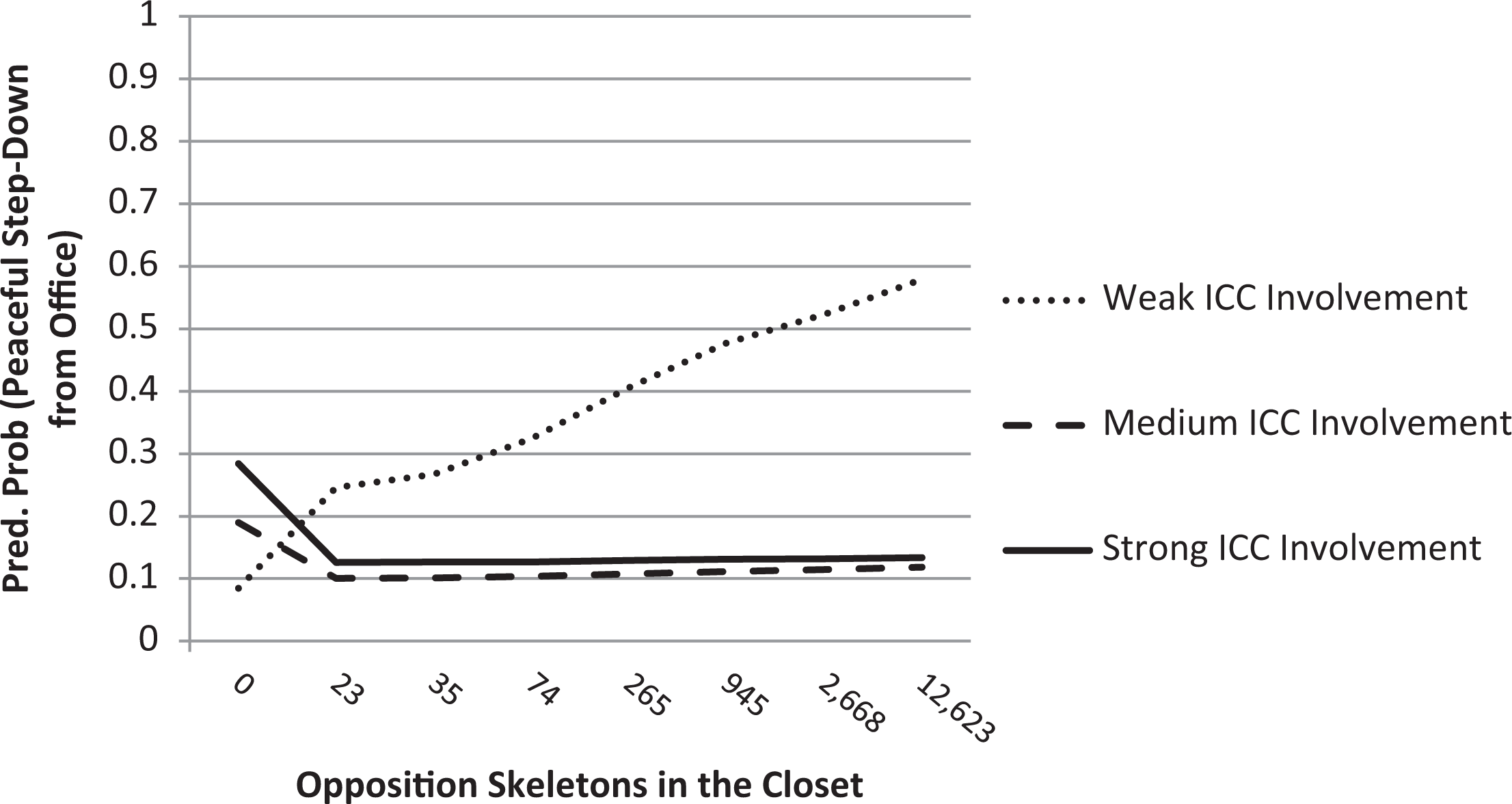
Opposition skeletons and levels of the International Criminal Courtinvolvement, dictator not culpable.

Opposition skeletons and levels of the International Criminal Court involvement, dictator culpable.
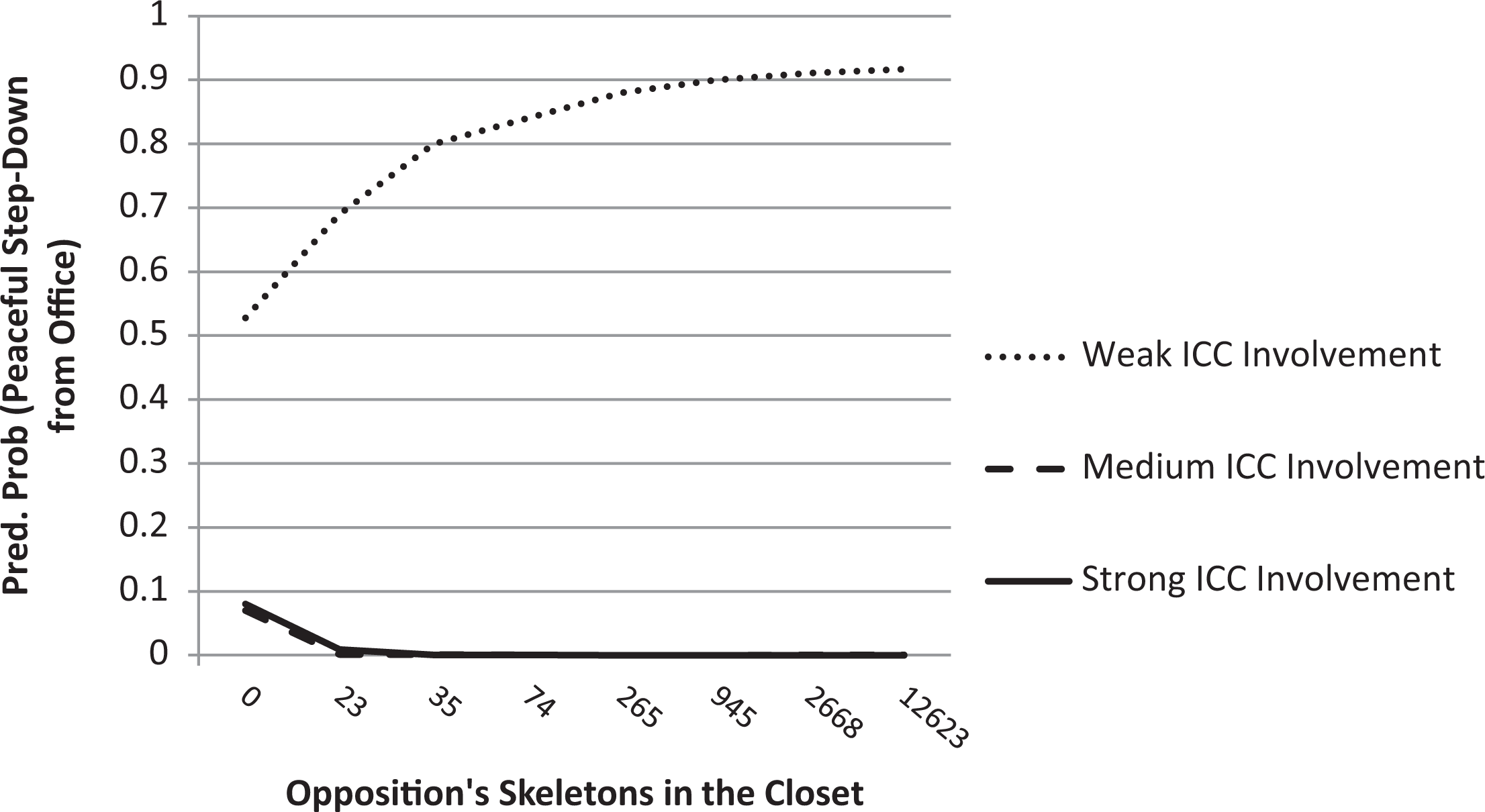
Opposition skeletons and levels of the International Criminal Court involvement, dictator very culpable.
Each figure plots predicted probabilities of dictators’ peaceful exit from office under weak, medium, and strong ICC involvement, as a function of the opposition’s skeletons in the closet under a specific level of dictator’s culpability: dictator not culpable (Figure 1), dictator culpable (Figure 2), and dictator very culpable (Figure 3). 28
In support of Hypothesis 1, under a weak ICC regime, the more skeletons the opposition has in its own closet, the more likely is the dictator to peacefully step down from office. Interestingly, this relationship holds across all three levels of dictator’s culpability. Note that across all three figures, with a small exception noticeable in Figure 1 under relatively innocent opposition, the dotted line representing “Weak ICC Involvement” marks considerably higher predicted probabilities of peaceful autocratic step downs than the lines representing “Medium” or “Strong ICC Involvement.” Additionally, as the number of the opposition’s skeletons increases, the weak ICC involvement line continues to increase, while the two remaining lines hover around predicted probability of 0 (Figures 2 and 3) or .01 (Figure 1). How guilty a dictator is affects the probability of peaceful step downs. Under a weak ICC, when the dictator is culpable, there is a far higher probability of a peaceful transition out of office. As illustrated in Figures 2 and 3, this probability continues to increase from about .5 to over .9 as the number of opposition’s skeletons rises. As mentioned previously, we notice an interesting pattern in the lower left corner of Figure 1, which captures behavior of an innocent dictator facing a relatively guiltless opposition. In this situation, the strength of the ICC does not matter much, as all lines designating different levels of ICC involvement cluster closely together between .1 and .3. This, however, is completely unsurprising since the very point of the ICC is intervening in situations where human rights are violated by at least one side of the conflict. This situation changes dramatically, as we increase either the dictator’s culpability or the opposition skeletons—even if slightly. Under either circumstance, lines representing different magnitudes of ICC involvement separate from one another.
In support of Hypothesis 2, if the ICC is strong, the number of skeletons the opposition has in its closet has, for the most part, no effect on the dictator’s likelihood of stepping down. Across the three figures, after a small downward movement of lines representing medium ICC involvement and strong ICC involvement, as the number of skeletons in the opposition’s closet increases, the probability of the dictator stepping down rapidly drops to miniscule levels. There is no noticeable movement either up or down in predicted probabilities of peaceful autocratic step downs. We can also conclude that these patterns are almost identical for any meaningful level of the ICC involvement. In fact, especially when a dictator is culpable, as portrayed in Figures 2 and 3, the medium ICC involvement line indicates almost identical levels of probabilities as the strong ICC involvement line. Importantly, across these two cases, a culpable dictator has almost no chance of a peaceful step-down as we increase the number of skeletons.
Comparison across the three figures reveals an interesting pattern. The gap between the line representing weak ICC involvement and the remaining two predicted probabilities is the largest in Figures 2 and 3 that pertain to culpable dictators. Thus, we can safely conclude that the magnitude of the ICC strength matters most to culpable dictators as they consider peacefully stepping down from office. In Figures 2 and 3, the distance between the weak ICC involvement line and the other two lines is relatively substantial even if the opposition has no skeletons in the closet. As we increase the opposition skeletons, the distance reaches .9 in Figures 2 and 3. The distance does not reach such levels if the dictator is not culpable, as portrayed in Figure 1. We draw special attention to the exact level of a dictator’s culpability at which weak ICC involvement predicts a higher probability of dictator stepping down than medium or strong ICC involvement. It is as little as two civilian deaths. At this relatively minimal level of dictator-led violence, the autocrat will be likely to peacefully transition out of his office only under a weak ICC regime. 29 Additionally, if the dictator is not culpable, the overall predicted probabilities of a peaceful step-down if the opposition does not have skeletons in the closet are very low, regardless of levels of the ICC involvement. Consider that under such circumstances, predicted probabilities of a dictator’s peaceful step-down do not exceed .3 for any level of the ICC involvement.
As our theory suggests, if the opposition has few skeletons in its closet, the dictator knows that in a world with a strong ICC he, and not the opposition, may be prosecuted with transitional justice. As a result, he does not want to relinquish his authority, but to stay in office as long as possible, since stepping down is likely to bring about transitional justice whether administered domestically or by the ICC. 30
These results are corroborated by a plethora of anecdotal evidence similar to the vivid examples of Charles Taylor and Omar Al Bashir cited in the introduction. This evidence suggests that strong ICC involvement does not encourage peaceful resignations of dictators when the opposition has enough skeletons in its closet to seal the amnesty deal with an outgoing dictator. These results are hardly surprising; the ICC can potentially upset the prospects of peaceful transfers of power in such autocracies. Whether strong international justice regimes interfere with autocratic dictators’ willingness to peacefully step-down from office depends on whether the domestic resistance to dictatorships took on violent forms. In particular, the effects of international criminal regimes are contingent on the level of human rights violations that the domestic opposition has engaged in. In general, the ICC—an institution created to punish offenders of democracy itself: those who dictate viciously and who violently oppress the freedom of their people (Kelly 2007, 577) can discourage peaceful departures of some autocratic leaders.
Finally, in light of our results, we revisit to the concept of dictator’s culpability. We theorize that the dictator’s level of guilt constitutes, theoretically and empirically, an important precondition for the threat of transitional justice to be present and for the ICC to get involved in the first place. We uncover very interesting patterns that capture nicely the relationship between the “law on the books”—the Rome Statute—and the ICC practice. Substantive international criminal law allows for considerable flexibility in the initiation of ICC proceedings, which is captured in the concept of the “culpability threshold.” For example, in the case of genocide, which falls within the ICC jurisdiction, even a small number of victims “is enough to establish the material element” (Schabas 2009, 276). It is true that the greater number of genocide victims, the easier it is to establish that genocide in fact took place. But, as long as prosecutors can demonstrate that the accused intended to destroy the group, either in whole or in part, the ICC has a potential case to investigate (Schabas 2009, 277). In light of the “gravity threshold” as defined in Article 17(1) (d) of the Rome Statute, the ICC ought to be initiating proceedings against individuals who bear the greatest individual responsibility for the alleged crimes, such as leaders of states or organizations. Thus, a case can pass the threshold of gravity despite a small number of victims, if the perpetrator is, for example, a major political figure within a country. 31 In reality, as corroborated by our interview with ICC staff cited earlier, this implies that the ICC prosecutor has wide discretion in selecting cases, since multiple situations can easily satisfy the gravity principle of the Rome Statute. We demonstrate that, for the most part, the relationship between the opposition’s skeletons and the ICC strength in the context of autocratic peaceful step-downs is similar across different levels of dictator’s culpability.
One potential criticism of our results is that of endogeneity. Suppose a dictator’s use of atrocities were a response to the opposition’s threat of ouster. If it indeed were the case that dictators used atrocities to restrain their domestic opposition and to stay in power longer we should observe an increase in the levels of government-led atrocities as the probability of a dictator’s losing power increases. Interestingly, however, as our data demonstrate, as autocrats approach the end of their tenure, the number of government-led atrocities does not increase at all. Rather, autocrats tend to commit most atrocities in the middle of their tenure. 32
Many control variables are correctly signed and in most cases pick up meaningful variation. As Table 3 demonstrates, one state-level variable—Population—has a negative and statistically significant effect on the likelihood of a dictator’s peaceful step-down from office. Chiozza and Goemans (2004) have shown that after about two years of tenure, leaders of populous states are less likely to lose power. Boix and Svolik (2013), on the other hand, have demonstrated that larger populations are associated with a higher risk of a dictator being deposed via a revolt. We find support for this latter argument, because our data show that dictators who rule over more populous countries are less likely to peacefully step-down from office (Boix and Svolik 2013). The impact of population size on out-of-office transitions is quite substantial. For instance, leaders of countries with populations in the 90th percentile are 4.3 times less likely to peacefully step-down from office than leaders of countries with populations in the 25th percentile of our data set.
Predicted Probabilities, Control Variables.

Note: Only statistically significant control variables are included in this table. Perc. = percentile.
Next, both of the two variables measuring personal attributes of dictators, Age and Previous times in office are statistically significant. According to Table 3, a fifty-one-year-old dictator is three times less likely to step-down than is a seventy-four-year-old autocrat. Chiozza and Goemans (2004) find that older leaders are less prone to office removal. But, once more, it is important to note that our dependent variable—peaceful step-down from office—captures a very specific type of ending a leader’s tenure. Leaders who have repeatedly served in their offices are less likely to peacefully transition out of their posts. Substantive effects of this variable are not as large as in the case of a leader’s age. For instance, the predicted probability of a second-term leader peacefully stepping down is .04 lower than the probability of a first-term leader peacefully exiting office (and we see further reduction in predicted probabilities for autocratic leaders that are serving their third term). We do not find statistically significant relationships between the likelihood of a peaceful step-down from office and the remaining control variables. 33
Conclusion
The proliferation of international courts and adjudicatory mechanisms is increasingly shaping interstate interactions, and blurring the lines between international and domestic law (Mitchell and Powell 2011, Powell, 2015). This process has been documented clearly in the case of the ICC, which goes well beyond the positivist tradition of giving standing to states only in international courts (Powell 2013). The ICC, created by the Rome Statute in 1998, not only exemplifies the process of global legalization but also posits a puzzle that transitional justice scholars have pondered for quite some time: does the court hinder or promote dictator’s decisions to peacefully relinquish power? Although journalists and pundits have been quick to produce anecdotal evidence that dictators will not step-down once the ICC has established its global presence, the theory we present in this article allows us to see whether collisions between peacemaking diplomacy and international criminal justice regimes are isolated incidents or the start of an impending pattern.
We propose that a strong ICC regime can actually deter an autocrat’s decision to peacefully step down from office. It does so when the dictator in question has faced a relatively violent domestic opposition, one that was willing to strike a step-down in exchange for amnesty deal with the dictator. In short, the extent to which the former opposition used violence in dealing with authoritarian rule modifies the effect that transitional justice has on dictators’ decisions to relinquish power. Our theory argues and empirical models demonstrate that whether the ICC facilitates or impedes peaceful autocratic departures from office depends on how violent are the domestic dissident groups the dictator faces as he is considering his peaceful resignation. If our theory is indeed correct, then resolving the normative dilemma between domestic and international criminal justice is not straightforward.
We conclude by returning briefly to the fate of the Liberian dictator Charles Taylor. Following Taylor’s indictment, the international community pressured the Nigerian government to refuse Charles Taylor protection. He attempted to escape but was arrested while crossing over to Nigeria. Because of the controversy surrounding his initial indictment, the Tribunal for Sierra Leone transferred his case to a court in The Hague. The trial did not start until 2008 and took nearly three years to complete as the court heard testimony from 115 witnesses on the civil war in Sierra Leone, describing slave labor in captured diamond mines, rape, mutilation, and cannibalism. The trial lasted more than twice as long as was originally anticipated. Over the years, donor countries supporting the UN-created tribunal paid over 100,000 USD per month to support his defense and research team. Closing arguments were presented in March 2011. At the time of writing this article, Taylor’s appeal of the fifty-year sentence handed down to him by the panel of three international justices had just been denied. He will serve his sentence in a British prison (Simons 2011). Over the course of ten years since his indictment, Liberia and its neighboring states have been far from peaceful. The “Failed State Index” lists Liberia’s condition as “in danger of failing” and several of the West African states, where Taylor left his politically violent footprints, are listed as being in “critical” condition. 34 Even if Taylor has not personally been involved in political violence, it is hard to imagine that in the eight years leading up to the verdict, he has stayed completely on the sidelines of conflict in West Africa. Prior to his indictment, the level of “skeletons” in the closet of rebel forces opposing Taylor had been steadily rising, reaching 538 civilian deaths at the time of his arrest. As a point of reference, in our data set, this number is in the 90th percentile of opposition skeletons. According to a simulation based on results from our statistical model, 538 exceeds the threshold at which dictators peacefully step down. Although we will never know the counterfactual of this real-world case, our theory in combination with results from this simulation suggest that although in a world without the ICC, Taylor would escape transitional justice, he would have stepped down peacefully.
In the introduction to our article, we suggested that the choice between a regime with and without the ICC might be a question of values: does one favor peace over justice or vice versa? If justice and holding dictators accountable for the human rights violations they committed trumps as a value that of peaceful transitions, supporters of the ICC may still be justified in arguing we ought to have such a court. For those who believe that peaceful transitions have a normative advantage over holding wrongdoers accountable, our theory suggests that the ICC should shift its attention to stable dictatorships where the opposition has been relatively peaceful, because those are the cases where the ICC at least cannot harm the prospects of peaceful step-downs.
Footnotes
Acknowledgments
The authors wish to thank Morris Anyah, Lisa Blaydes, David Backer, Doug Cassel, Nahomi Ichino, Cliff Morgan, David Nickerson, Thania Sanchez, Milan Svolik, Georg Vanberg, Ernesto Verdeja, Greg Vonnahme, participants of the workshop on nondemocratic regimes at Yale University, participants of the Fellows’ seminar at the Kellogg Institute, the Kroc Institutes Peace and Conflict Workshop at the University of Notre Dame, and two anonymous reviewers.
Authors’ Note
Milan Svolik and Darren Hawkins shared their data sets. Liz Donnenberg, Liz Stack, and Sarah Yunjung Jung provided excellent research assistance. The authors take full responsibility for any problems and mistakes.
Declaration of Conflicting Interests
The authors declared no potential conflicts of interest with respect to the research, authorship, and/or publication of this article.
Funding
The authors received no financial support for the research, authorship, and/or publication of this article.

Notes
References
Supplementary Material
Please find the following supplemental material available below.
For Open Access articles published under a Creative Commons License, all supplemental material carries the same license as the article it is associated with.
For non-Open Access articles published, all supplemental material carries a non-exclusive license, and permission requests for re-use of supplemental material or any part of supplemental material shall be sent directly to the copyright owner as specified in the copyright notice associated with the article.
