



Abstract
The scientific study of war has largely ignored necessary conditions for war onset. Conflict scholars have previously identified alliances as a mechanism that brings about the initial expansion of war but have not examined whether it is a prerequisite for large wars. We argue that wars diffuse into multiparty wars only in the presence of alliances. In other words, in the absence of any alliance ties, war would not include more than two parties. We put forth a theoretical rationale for this relationship and conduct a series of tests on both dyadic and multiparty wars between 1816 and 2007. These tests provide support for our hypothesis, suggesting that alliances are a virtual necessary condition for multiparty wars: the larger the war, the more likely alliances are a necessary condition.
Keywords
The literature in political science is often riddled with references to sufficient and necessary conditions, yet necessary conditions have been understudied, especially with regard to their role in the onset of war. The most prominent work has been that of Bueno de Mesquita (1981b), who argues that a state will not initiate a war that it does not expect to win. He maintains that a necessary condition of war (and even militarized conflict) is that a state has a positive expected utility, which he operationalizes as a state having greater capability than its opponent, discounted by possible intervention of allies. In a similar vein, Organski and Kugler (1980) assume (at least on the basis of their research design) that a power transition is a prerequisite for major power war. 1 Goertz (2003a, 2003b) has analyzed the conceptual underpinnings of necessary conditions and the various claims in the international relations literature that conform to the logic of necessary conditions (see also Goertz and Starr 2003; Goertz and Levy 2007a, 2007b; Levy 2007). In this article, we examine the role of alliances as a necessary condition of multiparty wars. We distinguish dyadic (two party) wars from multiparty wars (those with three or more participants). 2 We begin by giving an overview of the literature and explaining in basic terms what is meant by necessary conditions. We then provide a theoretical explanation of why alliances are a necessary condition of multiparty wars. Next, we provide a more formal presentation of necessary conditions and describe how necessary conditions can best be analyzed. Finally, we present the research design, findings, and a brief conclusion.
Literature Review
Braumoeller and Goertz (2000) rightly note that necessary conditions have theoretical properties that are infrequently discussed and often misunderstood. The concept of “lifting a barrier” is a useful way to conceptualize necessary conditions; without the necessary condition present, the outcome cannot occur. In other words, the absence of a necessary condition can be seen as a barrier or obstacle that prevents a phenomenon from taking place. Therefore, necessary conditions are not motivating factors for the outcome. They are not something that when present make multiparty wars occur, which is what a true sufficient condition does. Instead, they are something that permits multiparty war to occur. Even when a necessary condition is in place, multiparty war would require other sufficient conditions—grievances, and so forth to take place.
The literature on the effect of alliances on war onset is extensive, but it does not treat the presence of alliances as a possible necessary condition for larger multiparty wars. Leeds’ and Leeds et al’s analyses (Leeds 2003, 2005, and Leeds, Long and Mitchell 2000) provide some evidence that alliances are associated with the expansion of war. Leeds, Long, and Mitchell (2000) find, contrary to Sabrosky (1980) that allies are reliable partners, in that if they formally commit to defend a state from a specific threat, they will live up to that commitment. In a subsequent analysis, Leeds (2003) shows that defensive alliances significantly attenuate the onset of militarized interstate disputes (MIDs) in that countries with defensive alliances have fewer MIDs than those without defensive alliances. However, she also shows that allies are reliable and will tend to intervene in a MID making it a multiparty MID, which are generally more war prone. This finding implies that if a defensive alliance fails to prevent a war, the war is likely to expand (Leeds 2005). These findings, however, deal with sufficient conditions not necessary conditions.
Leeds (2005) evidence is consistent with the early findings of Siverson and King (1979) that show that when there are many alliances in the system, larger wars (with more participants) can be expected. It is also consistent with Siverson and Starr (1991) who show that states allied to a belligerent are more apt to intervene in a war than other states. Finally, it is consistent with the early finding of Levy (1981) who shows that alliances of great powers are followed in most centuries since 1495 by great power wars (which tend to be multiparty wars).
Levy (1981) is the only study in the literature that examines alliances as necessary condition of certain wars. He does this primarily because his approach, which was typical at the time, is to empirically examine the extent to which an independent variable is a sufficient or necessary condition of a given set of dependent variables (in this case, different types of war; see Wallensteen 1981 for a similar research design on a different set of variables). He finds that, except for the twentieth century, most wars are not preceded by alliances. Even in the twentieth century, 40 percent of wars are not preceded by an alliance. Levy then specifically looks at Great Power wars, a category much different from our focus on multiparty wars, and once again, contrary to our hypothesis, concludes that alliances are not a necessary condition. As we will demonstrate subsequently, the reason Levy draws different conclusions about alliances as necessary conditions for war is that he confines his sample to Great Power wars and does not separately analyze wars with greater than two participants. We, on the other hand, look at all multiparty wars, including those that are only among minor states.
The only other study that examines whether alliance precede certain types of wars is Valeriano and Vasquez (2010) and they do so only as an aside in their discussion of how to classify complex (i.e., multiparty) wars. They argue that complex wars are more apt to be preceded by the use of power politics practices, including the making of alliances, than dyadic wars. They also argue that the larger the war, the more likely that an alliance will have preceded the war. They do not conceptualize this as a necessary condition, nor do they explicitly test necessity or have a theoretical explanation as to why alliances might be a necessary condition. They also do not discuss how the absence of a prior alliance would prevent multiparty wars from occurring. Their main point and findings are to delineate some general patterns that separate dyadic wars from multiparty wars and they then call for more research on these patterns. This study delineates patterns, but approaches the question from a very different philosophical and theoretical perspective (i.e., necessary conditions and the role of uncertainty). Valeriano and Vasquez’s basic finding that alliances are more prevalent before multiparty wars than dyadic wars is reconfirmed in this study on updated data. However, we show that alliances are not simply more prevalent; they are necessary conditions for multiparty wars to occur. Without them, the probability of a multiparty war is extremely low to nonexistent. 3 As a result, we provide a different understanding of alliances and expand our theoretical knowledge about the connection between alliances and war diffusion.
Theoretical Expectations
Why something would be a necessary condition is a difficult question, in part because we are so accustomed to thinking in terms of sufficient conditions (see also Goertz and Mahoney 2012, 200-1, 209, on the nature of necessary conditions). We therefore begin by framing our theory in terms of distinguishing the logic of necessary conditions from sufficient conditions. What is necessary for a multiparty war? By definition, a multiparty war must have more than two states. Why are some wars multiparty and others are not? A war becomes multiparty when a state feels it cannot win alone.
Why is the presence of some sort of preceding alliance required for a war to have more than two states? Multiparty wars contain risks and uncertainties not present in bilateral wars. We define uncertainty in the conventional way in which it is used in decision theory as being unsure (having limited to no knowledge) of the distribution over possible outcomes (see also (Knight [1921] 2009). 4 For our purposes, we are concerned with uncertainty over who might win the war. We assume that in a bilateral war, uncertainty is low because at least the initiator has some knowledge of the probability of winning. The prospect of a multiparty war reduces that certainty because future third-party interventions could change the capability of one or both sides and thus change the probability of winning. The greater the number of possible interveners, the greater the uncertainty. Thus, whereas before an outcome was more assured, now it is more uncertain.
Because the probability of winning is not known once a multiparty war is a serious possibility, a leader may perceive that there is greater risk of losing. We define risk as the hazard of a negative outcome; in this context, it is the probability of losing the war. We assume that risk is calculated in dyadic wars by decision makers on the basis of their relative capability. The risk of losing increases with the greater the capability of one’s opponent ceteris paribus. Thus, the greatest risk involves a possible sudden reduction in relative power if an outside third party should intervene. This risk is best diminished by getting an ally to commit if a multiparty war is expected to break out. Since war is generally a costly adventure, states are hesitant to join without some assurances that reduce the uncertainty associated with multiparty wars or wars that are apt to diffuse into multiparty wars.
Alliances are an institution that reduces that uncertainty. Without some reduction in uncertainty, multiparty wars will not occur because actors do not know what the outcome will be. Uncertainty can be seen a barrier to multiparty war, and commitments from allies lift that barrier to make a multiparty war possible. Put another way, the prospect of a war expanding disrupts strategic assessments with regard to bilateral capabilities and the likely prospect of who will win at what costs. Once a war has the possibility of involving more than two states uncertainty increases and so does the risk of losing the war by suddenly being overwhelmed by the addition of the new ally’s resources or the prospect of a two-front war. This uncertainty prevents a war from expanding from a dyadic conflict to a multiparty one. Once the scenario of who will intervene is clarified then uncertainty is reduced and a multiparty war becomes possible. States that have been hesitant to intervene now have a better understanding of the future power situation because of alliance commitments.
It should be noted that decision makers have different risk propensities such that when faced with the same situation and knowledge (level of uncertainty) they may take different actions. Blainey (1973), for instance, hypothesizes that a relative balance or equality of power will increase the probability of war because neither side knows the outcome. In reality, the outcome is 50-50 under these conditions. As Bueno de Mesquita (1981a) points out in his criticism of dyadic balance of power logic, relative equality encourages war for the risk acceptant but discourages it for the risk averse. Real security from attack, as Organski (1958) maintains, lies not in a balance of power but in a preponderance of power. Our point is that alliance commitments can reduce uncertainty by making an outcome known and can at the same time aggregate power to reduce the risk of losing. In this way, uncertainty and risk are empirically connected although conceptually distinct.
Multiparty wars are a product of a strategic calculation dealing with rapid and unanticipated shifts in power. In this regard, certain alliances are made in anticipation of a larger war and of protecting oneself if the war spreads. Only alliances and their commitments can deal with that strategic problem and thus only they as an institution are a necessary condition for multiparty war. If there is already a preexisting alliance, then this condition is already satisfied and the party is not so concerned with uncertainty and, depending on the aggregation of power, decision makers can become less risk averse.
The network of alliances can be viewed as a powder keg, but not a match. In other words, it is not sufficient to bring about war, but needs some sort of grievance to spark a war. Having a powder keg is a necessary condition for a match to cause a large explosion. Similarly, we argue that alliances must precede wars that become multiparty; otherwise, they will not enlarge. They will remain two-party or dyadic wars because decision makers will not initiate wars that they think will spread without the insurance of an outside ally because they fear they might lose it. The uncertainty of a multiparty war makes them risk averse. Having an outside ally reduces that uncertainty and lifts the barrier to a multiparty war thereby permitting it to be fought. In short, if this logic is true, alliances are a necessary condition of war, and all multiparty wars should be preceded by alliances. 5
Other diffusion mechanisms that make war spread do not have this characteristic. What makes the relationship between necessary and sufficient conditions 6 complicated is that alliances are also a diffusion mechanism that makes wars spread once they break out. Vasquez (1993, chap. 7) argues that alliances are one of three basic diffusion mechanisms—the others being contiguity and rivalry. A diffusion mechanism identifies the path by which something spreads. 7 However, we argue that unlike alliances, rivalry, and contiguity are not necessary conditions for multiparty wars because there is nothing inherent in multiparty wars that require its participants to have a rivalry or be contiguous with each other. We argue that the presence of a preceding alliance is required for a war to have more than two states. You need to have an ally to have a three-party war, but you do not have to have a rival to have a multiparty war. Rivals are more apt to enter a war, but one could have a three-party war without any of the intervening parties being rivals of the original belligerents. Rivals are the product of hostility and repeated grievances, not a product of a strategic calculation intended to deal with the uncertainty of power in an expanded war. Put another way, three-party wars do not have to be confined to rivals, but they must have an intervener that is an ally of one of the original belligerents. This is seen even more clearly with contiguous neighbors. Multiparty wars are apt to have spread by bringing in contiguous states, but they need not be confined to contiguous states. The first third party to join could have been a noncontiguous major state, for example.
We assume, as do many analysts, that there are different types of war where the processes that bring them about are different depending on the type. For example, some scholars assume that causal dynamics of wars between neighbors is different from causal dynamics between noncontiguous states and that wars among major powers are different from asymmetric wars between major powers and minor powers (see Vasquez 1993, chap. 2, for instance). We argue that one theoretically significant type of war is based on the difference between dyadic and multiparty wars. Diffusion processes are seen as playing a large role in bringing about the latter, whereas they are not in the former (see Bremer, 1995). In this analysis, we seek to delineate one of the processes that distinguish multiparty wars from dyadic. We hypothesize that multiparty wars have alliances as a necessary condition, but dyadic wars do not.
Once we claim that a necessary condition for multiparty wars exists, other theoretical and empirical questions arise about what additional processes bring about such wars and how these should be conceived. Specifically, there are two questions. First, are multiparty wars better conceived as a set of events that spiral out of control (e.g., Jervis’ [1976] spiral model) or an intentional act brought about by a strategic calculation? Second, are multiparty wars brought about because certain actors make alliances or because actors without alliances select out?
Although our theoretical analysis gives rise to such questions, giving a complete answer to them is beyond the scope of this study and requires a separate study of its own. Our main purpose here is to focus on what we think is new in the literature on war; namely, that alliances are a necessary condition of multiparty wars because they lift a barrier that prevents them from occurring. Suffice it to say here that we agree with earlier analyses that see multiparty wars as “complex” wars with multiple complicated processes underlying them (see, for instance, Vasquez 1993, chap. 2). In terms of whether multiparty wars should be seen as result of crises the spiral out of control or as intentional we do not see these two things as mutually exclusive. We suspect that large multiparty wars will have different dyads embodying different dynamics and not just one pattern. For example, in 1914, Austria-Hungary’s declaration of war on Serbia was intentional and only done once it had a firm German commitment that it would provide military support if Russia intervened. In contrast, the July crisis between Russia and Germany spiraled out of control once the Tsar reordered mobilization. This had a tremendous impact on the internal domestic interactions of the Kaiser, Chancellor Bethmann Hollweg, and Moltke leading to the scuttling of the Kaiser’s Halt-in-Belgrade peace plan (see Vasquez 2014). Nonetheless, even when a prewar crisis is spiraling out of control actors do make deliberate decisions for war in such a context, as in the Israeli decision to preempt in the 1967 war. We would conclude that intention and strategic calculation play an important role even when the spiral model is present.
Theoretically, the above-mentioned analysis leads to the expectation that large wars are apt to be preceded by one or more states having an alliance with one of the initial belligerents. Following from this logic, it would be expected that the larger the war, the more likely that an alliance tie would be present. This leads to the following hypothesis:
Because only alliances can reduce uncertainty, a second hypothesis can be derived:
We turn now to how these hypotheses relate to other diffusion mechanisms that spread war, but do not act as necessary conditions.
Necessary Conditions and Diffusion
How are necessary conditions related to previous conceptions of diffusion and war? Vasquez (1993, chap. 7) posits six diffusion mechanisms that spread war. Of the six diffusion processes that Vasquez (1993, 241-42) posited, he saw three as the basic diffusion mechanism as bringing about the initial expansion and the second three as resulting in further diffusion. Only when one or more of these bring about an initial intervention will the others come into play; that is, one or more are prerequisites to any war spreading. The three basic diffusion mechanisms are alliances, contiguity, and rivalry. The initial specification of these three as basic meant that one or more are prerequisites to any war spreading. However, of these three, alliances were seen as the most important. In that way, Vasquez (1993, chap. 7) had thought of some of the diffusion mechanisms as necessary conditions even though he did not specifically express it in this manner. 8 This article now asks, whether the last two—contiguity and rivalry—are true necessary conditions. The analysis suggests that only in the context of alliance bonds will a diffusion process begin.
Alliances could be seen as a necessary condition of multiparty complex wars if other diffusion mechanisms that are thought to spread war do not function that way in the absence of alliance ties. Are states that are thought to be brought in by other diffusion mechanisms also affected by alliance ties? In other words, only when states can be brought together so they jointly enter a war would large wars be expected. We posit that of the major diffusion mechanisms only alliances can bring states together to reduce uncertainty so joining is permitted.
We began our study of trying to figure out why multiparty wars occur by thinking about diffusion and whether there is some obstacle that must be overcome for multiparty wars to occur. We asked ourselves what, by definition, is necessary for a multiparty war to occur. We seek to explain what mechanism or condition exists in multiparty wars that do not exist in dyadic wars, whose absence acts as a barrier to multiparty wars. As noted in the previous section, our explanation focuses on the potential uncertainty of multiparty wars and the impact this has on strategic thinking before the war. Possible intervention by a third party increases uncertainty about the outcome because it changes the distribution of capability of the war fighting coalition as well as the geographic context of the battlefield (e.g., by raising the prospect of a two-front war or a naval war).
As Vasquez and Valeriano (2010) illustrate, multiparty wars are relatively rare, especially those with more than three parties, and are therefore likely to have different causal processes. Since state leaders are aware that multiparty wars lead to more casualties and economic damages and because it is more difficult to negotiate with more than one other state to avoid war, these leaders will not join or initiate a multiparty war without first decreasing the risk that they might lose the war. Outside alliances provide safety nets for state leaders lest costs exceed their initial expectations and more importantly their prospects of winning. In other words, alliances are made, in part, as an insurance policy against losing a war if it should break out. Therefore, it makes sense that multiparty wars should not occur without at least one state having a prior alliance, and the larger and more severe a war is anticipated to become, the greater the uncertainty and hence the more likely it is to have a prior alliance. Anticipation of a multiparty war leads states to seek allies.
Once someone has an alliance, this breaks the ice and creates a powder keg. Of course, the more (as-of-yet-uninvolved) parties that have allies, the larger the powder keg. However, we argue that only one powerful state is required for the necessary condition to be fulfilled. The reason for this is that a powerful state, like a major state, can pretty much make the future scenario shift enough to reduce uncertainty and thus lift the barrier.
Alliances unlike other diffusion mechanisms—namely, contiguity and rivalry—are more likely to reduce uncertainty because in order for a war to diffuse, some states must decide to intervene in an ongoing war. Unlike rivalry and contiguity, alliances have the effect of committing one or more states to enter. Only the institution of alliances makes for this interdependent kind of decision making and interlocking. The absence of formal alliances acts as an obstacle to multiparty wars, because there is no commitment to enter the war and without that, the future power arrangements are not clear and joining a war is too risky. If this rationale is correct, then it follows that formal alliances should precede multiparty wars much more frequently than rivalry or contiguity.
What, then, is the key difference between alliances and other mechanisms of war diffusion? Institutions. Alliance making is a practice that has a long history and embodies a formal institution created by treaties. Institutions can create a stability of expectations and commitments that produce behavior that would not occur in the absence of the institution; in other words, membership in certain institutions creates a web of incentives and punishments that make an actor do things that it might not do if it were not enmeshed in this web produced by the institution. Contrary to Mearshemier (1994/1995), formal institutions do matter. Without the institution of alliances, including the long history of its practice and precedent, large wars would not occur. And they would not occur because the absence of formal alliances fails to reduce the uncertainty that is an obstacle to war joining.
One can see how this process would work in very large wars, like the world wars. In these wars, there has to be a mechanism that permits a large number of states to join an ongoing war. This is precisely what alliances do, and they do it by interlocking and committing several states to each other. Once states are committed in writing, the formal institution provides a set of internal and external networks (i.e., separate audiences with explicit interests) in favor of intervention. Each of these two networks put pressures on decisions to intervene when the casus foederis come into play.
Theoretically, why isn’t rivalry a necessary condition? The short answer is that rivalry cannot reduce uncertainty because rivalry itself makes no commitments that bind one state to another. Without a binding commitment that is believed there is no reduction in uncertainty. This is even more true of contiguity, which is a material condition, obviously unable to make a commitment. Rivalry and contiguity, therefore, are not necessary conditions of war. If this rationale is correct, neither rivalry nor will precede all multiparty wars.
Conversely, alliances will have an impact on how contiguity helps diffuse wars. Once alliances are made in peaceful conditions. Balancing power and alliance making often take a checkerboard pattern. Making a state fight a two or multiple front war is a way of gaining an advantage in an anticipated war, a way of deterring such a war, or simply a way of increasing one’s bargaining advantage. The attempt to get a two-front war encourages large wars, but do they also act as a necessary condition? To certain extent, this is almost true by definition. One cannot have a two-front war without a third-party ally. At any rate, the checkerboard pattern tells us how alliances harness contiguity to make it subservient to the alliance diffusion process. In other words, without alliances, contiguity is less likely to make wars diffuse spatially. Belgium in 1914 provides a theoretically interesting example of how this process works. Germany only goes through Belgium to attack France, and it only attacks France in 1914 because France is allied to Russia.
Research Design
Having explained our theoretical expectations, we now turn to our dependent variable, multiparty war, and how that is related to our necessary condition: prior alliances. In line with Braumoeller and Goertz (2000), we choose to conceptualize wars as dichotomous variable Y, with multiparty wars = 1, and dyadic wars = 0, and alliances as dichotomous variable X, with the existence of a prior alliance = 1, and the absence of a prior alliance = 0. The necessity of prior alliances (X) for multiparty wars (Y) can be conceptualized in two propositions: first, prior alliances must always be present when a multiparty war occurs (P(X|Y) = 1) and second, multiparty wars cannot occur in the absence of prior alliances (P(Y|∼X) = 0). In the first proposition, dyadic wars (Y = 0) are irrelevant for ascertaining the necessity of alliances for multiparty wars. Proposition 2, on the other hand, focuses on cases in which alliances do not occur (X = 0), rendering cases without prior alliances irrelevant. The first proposition would require that we collect a sample of multiparty wars and demonstrate that alliances are present in all of them. The second proposition would require that we collect all wars without prior alliances, and note that none of the sample contains multiparty wars (only dyadic).
For these reasons, we focus on multiparty wars and only examine dyadic wars for purposes of satisfying Proposition 2. Note that we are not claiming that alliances are necessary for dyadic wars. Including dyadic wars is an essential component of our analysis because they can occur either with or without prior alliances, thereby demonstrating that alliances are a necessary condition only for multiparty wars. Dyadic wars are not relevant to our claims so long as there are numerous dyadic wars that occur in the absence of alliances.
To test for the necessary conditions, we examine each interstate war that has more than two parties to see whether they are preceded by alliances. We do not first examine all alliances and see whether they are followed by war (dyadic or multiparty), as that would be the procedure for testing sufficient conditions. Rather, we look first at multiparty wars and see if they all share a common characteristic not shared by all dyadic wars. In order to conduct the analysis, we need data on every interstate war in the system since 1816 and data on whether it was preceded by alliances. Fortunately, such data have been compiled by Valeriano and Vasquez (2010) who used it to classify wars. Their data employ the standard Correlates of War (COW) project list of interstate wars fought from 1816 through 1997 (Sarkees 2000). Valeriano and Vasquez collect data on each war according to whether the war is fought over territory and is preceded by alliances, rivalries, or arms races. In addition, the data list each dyad in the war, their date of entry, and whether one or more members of a dyad had an outside ally before the outbreak of the war. 9 This data set is also useful for the analysis because it groups wars according to whether they are dyadic or multiparty. We update the war and alliance data to 2007 based on the Sarkees and Wayman (2009) list of interstate wars and our own research on the alliances preceding these new wars. All the multiparty wars and the alliance data are listed in the online Appendix III. 10
One of the design problems that these data solve is how to determine whether a given war is or is not preceded by an alliance. Must all entering dyads have an outside alliance, only some percentage, or just the key dyads? Two tests will be employed here based on the available data. The first, as employed by Valeriano and Vasquez, treats each war as an aggregate and compares the thirty-three multiparty wars with the fifty-five dyadic wars (including the update) to see if alliances are unusually associated with multiparty wars. In this design, each multiparty war is treated as a whole to see if it is preceded by alliances.
To measure the latter, it is essential to see if the dyads that brought about the war—that is, those that are responsible for the multiparty character of the war—had prior alliances. Valeriano and Vasquez (2010, 572-73) treat this issue in detail and settle on the following coding rules: they assume that the key dyads that determine the character of a multiparty war are the strongest militarily, which for them means the major–major dyads. If the major–major dyads are originators in a multiparty war, we examine them to see if they have any outside politically relevant allies. If there are no major–major originators, we examine the major–major joiners (up to two years after the start of the war). If there are no major–major dyads in the war, we then use the major–minor dyads to determine the aggregate code, and if none of these are present, we examine then minor–minor dyads. 11 In classifying wars, Valeriano and Vasquez (2010) code prior behavior as a factor, like prior alliances or prior rivalry, as “ever present.” This makes sense for this analysis too, because it distinguishes wars that have prior alliances from those that never have.
It might be argued, that this sort of measurement overlooks the fact that many dyads might be brought into a war without having any outside alliance. While this is a possibility (e.g., as in the Korean War), we must remember that the theoretical expectations of the analysis do not maintain that other diffusion factors do not play a role in diffusing the war; they only maintain that these other diffusion factors need to work in the context of alliances diffusing a conflict. Once the barrier has been removed by one dyad, that is satisfactory; the barrier does not reassert itself for subsequent entrants.
At the dyadic participant unit of analysis, things are a little different in that any given state might be hesitant to join if uncertainty is too great. Therefore, from this perspective, an alliance may be necessary for that particular dyad to enter the war. This, however, is not the same question of whether a multiparty war with at least three parties will occur. 12 Very large wars, then, may have numerous dyads with prior alliances. Early entrants are more likely to have prior alliances since someone has to remove the initial barrier. Subsequently, entrants may be brought in by sufficient conditions for diffusion and may or may not have a prior alliance.
Examining individual dyads also has the advantage of providing more precise measures. Instead of looking at whether a dyad ever had a prior alliance, data can be marshaled to see if the specific joining dyad had an alliance in the five years immediately before the war. We adopt the standard COW three-month rule—that only alliances made three months before a war are relevant—so that an alliance made just before three months of a war is not counted. 13
Given these points, this study utilizes the aggregate war codes as the basic test. Nonetheless, we also conduct robustness tests that examine all dyad entrants as a way of assessing what is happening at the underlying participant level. In the end, Hypothesis A is tested by seeing if (a) each multiparty war (treated as an aggregate) is preceded by prior alliance ties and (b) if most of the individual dyad entrants to a multiparty war had prior alliance ties.
Hypothesis B goes a step further and says that the two other main competing diffusion mechanisms—rivalry and contiguity are not necessary conditions. Therefore, they should not be present before multiparty wars. The Valeriano and Vasquez data have measures of rivalry based on recurring MIDs and that will be used in this study, updated through 2007. Their measure of rivalry is derived from that of Diehl and Goertz (2000; see also Klein, Goertz, and Diehl 2006) but is simplified to include any dyad that has at least three MIDs in its history as a proto rivalry and any that has had at least six MIDs as having an enduring rivalry. They then create a dichotomous variable that counts any proto or enduring rivalry as having a rivalry. The contiguity data have been complied specifically for this study based on the updated Stinnett et al. (2002) data set. We use land contiguity as the indicator, such that all states separated by bodies of water (other than rivers) are treated as noncontiguous.
The measurement rules on key dyads employed for prior alliances are also employed for both rivalry and contiguity. Likewise, the dyadic analysis provides more precise measurement of whether a dyad was contiguous or in a rivalry just prior to the war. As with the test for Hypothesis A and the aggregate study, we count any positive contiguity score or any rivalry in existence five years before the outbreak of a war as satisfying the necessary condition in that war.
The only way in which we depart from the Valeriano and Vasquez (2010, 300) coding is in terms of contiguity. In their coding, they only look at the initial dyad because they are concerned with how many wars begin with neighbors. This does not make sense for our analysis, however, because we are concerned with diffusion and the character of the entire war, not how the war started. They also include water contiguity of up to 150 miles because territorial disputes often include maritime borders. Since we are more interested in diffusion, we code any war containing a land-contiguous dyad as fulfilling the requirements for contiguity. 14
Many assume that one counterexample is enough to falsify a hypothesis of necessity. We distinguish between universal and probabilistic necessary conditions. We call the latter virtual necessary conditions. The few exceptions embodied in virtual necessary conditions are a result of two things—probabilistic tendencies, as Ragin (2000) argues, and measurement error as Braumoeller and Goertz (2000) argue. Philosophically, just as sufficient conditions can be probabilistic (and not universal) so too can necessary conditions.
We do not expect it to hold 100 percent of the time, simply because the world does not work in such a rigid fashion, but we do expect it to hold a very high percentage of the time. We can even go further and add that exceptions to the universal condition are likely to occur not with the largest wars, but with small wars involving three or four parties. It is more likely that in a small multiparty war measurement error, the second source of exceptions, might occur.
Methodologically, as Braumoeller and Goertz (2000) point out, one counter-case need not refute a claim about necessary conditions, because measurement error can be introduced in collecting and coding data. Alliances, like Braumoeller and Goertz’ example of democracy, are susceptible to measurement error. Since states during times of conflict and war are prone to secretive and strategic foreign relations, some alliances may remain informal or improperly documented. In this instance, an alliance that precedes a multiparty war would not be coded as such, and would indicate measurement error. Our three exceptions (see subsequently) seem to fit this claim.
It is important that research designs are constructed to deal with probabilistic necessary conditions in a rigorous fashion. First, we conduct a significance test to see if prior alliances are more associated with multiparty wars than dyadic wars. If alliance ties are necessary conditions for multiparty wars and not general necessary conditions for all interstate wars, then we will find a significant relationship. We do this by conducting a simple 2 × 2 table with a χ2. Second and more importantly, we use Ragin’s (2000) criteria for determining when a certain percentage of cases constitute a virtual (or probabilistic) necessary condition. Ragin gives three cutoff points: 50 percent, 65 percent, and 80 percent (2000, 212). The last cutoff he labels as “almost always necessary”; we will use this as a minimal cutoff to establish a virtual necessary condition. In other words, if 80 percent of the cases are preceded by a factor, this will be treated as evidence of a necessary condition and used as a criterion to test our hypothesis.
Third, we use Braumoeller and Goertz’s (2000) procedure for testing for necessary conditions (see also Braumoeller and Goertz 2003). Their p
1 test will be used to estimate the lower bound of the confidence interval around our proportion of counterexamples (
Fourth, to see if alliance ties account for most of the dyad entrants into multiparty wars, each multiparty war will be broken down into its dyad participants. The number of dyad participants that have outside alliances will be counted and subjected to the three aforementioned tests as well. The same will be done for contiguity and rivalry; that is, each dyad entrant into a multiparty war will be coded in terms of whether they are land contiguous with the original target or have a rivalry with that target.
The latter ensures that many of the dyadic entrants to a multiparty war indeed do have prior alliances. The dyadic entrants that have prior alliances can be seen as engaging in the process that removed the barrier to a multiparty war occurring. Finally, to compare the three diffusion mechanisms systematically we examine the odds ratios of each in terms of the likelihood of them being present prior to a multiparty war compared to a dyadic war. The full tables are reported in the online Appendix II.
Findings
Table 1 reports the main results. First, it is important to note that multiparty wars are significantly different from dyadic wars in terms of the impact of alliances based on the χ2 test. 16 Prior alliances are clearly related to the type of war (dyadic vs. multiparty) at less than the .01 significance level, which is a very high level of significance given an N of 88. As expected theoretically, the presence of alliance ties is also associated with larger wars, suggesting that having preexisting alliances makes for situations that are more primed for larger wars than situations in which alliance ties are absent.
Number of Prior Alliances before Wars.
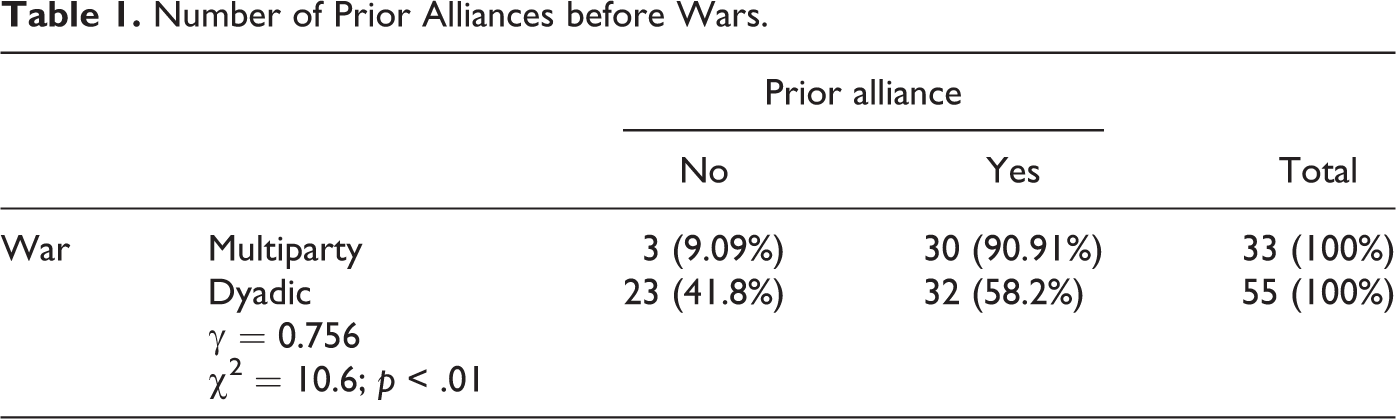
Table 1 also provides the critical test on necessary conditions by showing that only three of the thirty-three multiparty wars are preceded by alliances. In other words, 90.91 percent of the multiparty wars are not preceded by alliances, a rate far above the stated 80 percent criterion specified in the research design. On the basis of this test, we fail to falsify the hypothesis on alliances as a necessary condition of multiparty wars.
The three exceptions that are not preceded by alliances are as follows: the Third and Fourth Central American wars of 1906 and 1907, respectively, and the 1919 Hungarian War. The Third and Fourth Central American wars are closely connected and related to a series of attempts to integrate the Central American countries in one Federation (previously the Central American Confederation). For the beginning of the Third Central American War, Sarkees and Wayman (2009, 115) even state that Honduras was allied with El Salvador and Costa Rica—but not through a formal alliance—and that this informal alliance brought Honduras into the war when Guatemala invaded El Salvador. The Hungarian Adversaries War of 1919 centered on the formation of Czechoslovakia and related territorial disputes. The earlier COW data set actually labeled this war as the Hungarian Allies War because it was thought that the war of two against one was a product of an alliance. This is a clear example of measurement error in that it seems as if there is an alliance but there is no formal one signed. In all three exceptions, the multiparty wars that lack a formal alliance are the smallest (including only three belligerents) and among the least severe. This is consistent with our hypothesis that the larger and more severe a multiparty war is, the more likely it is to have a prior alliance.
The cross tabulation in Table 1 also shows that prior alliances frequently precede dyadic wars—58.2 percent of these wars have prior alliance ties, but these are far from constituting a necessary condition of war.
The p
1 test reported in Table 2 further strengthens our evidence in that it provides a significance test specifically constructed to evaluate claims of necessity (Braumoeller and Goertz 2000). Since we witness three counterexamples out of thirty-three multiparty wars,
With the Two p 1 tests.
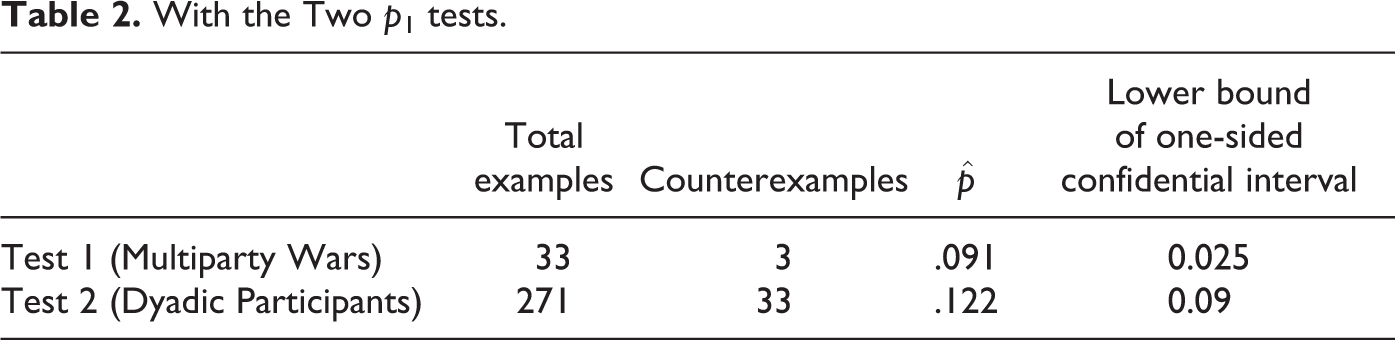
This means that we know with 95 percent certainty that the population proportion is greater than 2.5 percent. Therefore, if we were able to measure our error rate using other measures of alliances, it would have to be less than 2.5 percent in order to reject our hypothesis of necessity. An error rate this low is highly unlikely. To demonstrate just how unlikely this is, we refer to Braumoeller and Goertz’s (2000) cutoff of a 5 percent error rate, which they argue is “reasonable based … on prior expectations of measurement error …” (p. 852). With this standard, our necessary condition hypothesis is not rejected.
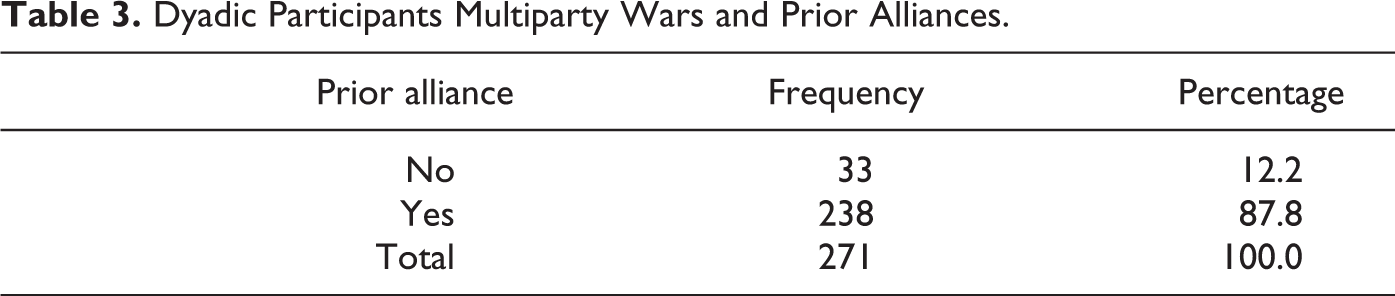
Although the above-mentioned test shows that prior alliance ties are present in 90.9 percent of the multiparty interstate wars fought from 1816 on, it is still unclear how many of the specific dyads that enter a war do so in the context of an outside alliance. Table 3 addresses this concern. All the dyad entrants for all the wars are examined in terms of whether any state had an active alliance before the MID that escalated to war. This makes for a total of 271 observations, 238 (87.8 percent) of which had prior alliances. This is well over our 80 percent criterion, and we once again fail to falsify the hypothesis on alliances as a necessary condition of dyads in multiparty wars.
Dyadic Participants Multiparty Wars and Prior Alliances.
Since the world wars have a large number of joiner dyad entrants, they were separated out. Table 4 analyzes the two world wars. World War I has thirty-seven dyad entrants (that meet the standard COW troop threshold for participation, of these, all but one, 97 percent, had prior alliances. World War II had seventy-nine dyad entrants and remarkably all dyads had at least one member with a prior outside alliance.
World War I and II: Dyadic Participants and Prior Alliances.
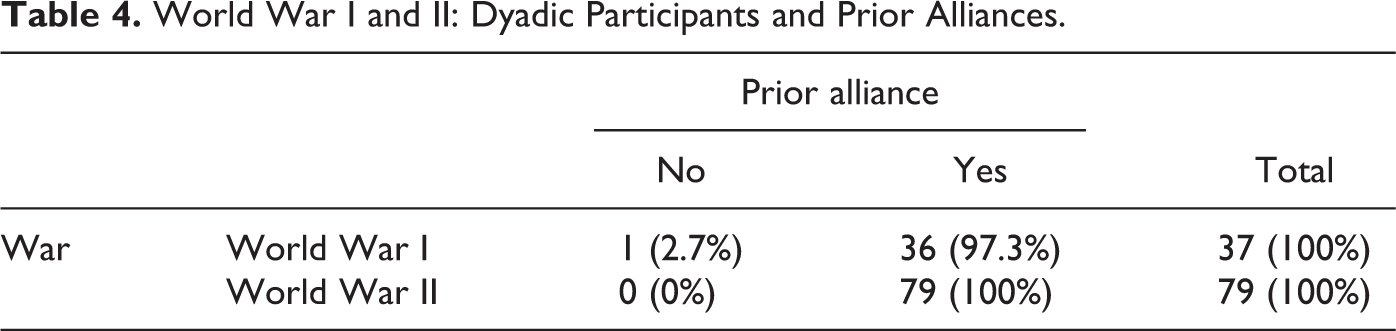
These two test results are consistent with the hypothesis and also show that the largest wars in the system conform highly to the theoretical expectations of the analysis. 17 The latter finding is very consistent with our claim that the larger the war, the more likely the necessary condition will be present.
We also use the Braumoeller and Goertz (2000) p
1 test to test our hypothesis for all dyad entrants. As we saw earlier in Table 2, dyadic participants have a
If we look at the dyadic cases that enter a multiparty war without prior alliances, we find that they consist of cases that are surrounded by joiners who do have alliances. If we look at who these dyads with allies are, they seem to be the ones responsible for the war expanding. Thus, the two major wars with dyads without alliances are the Korean War and the Seven Weeks’ War (1866). In the Korean War, there are eighteen dyads that have at least one side with an alliance. These are North Atlantic Treaty Organization (NATO) allies and these cases are consistent with the hypothesis. It is the United States that brings its allies to the war. However, there are nine dyads (excluding the originator dyad) where neither side has an alliance. These dyads include countries like the Philippines, Thailand, and Greece—that is, pro-Western countries not yet in an alliance (albeit two will eventually be in an alliance). Another case of a different sort is Ethiopia, which intervenes not because it is pro-Western but because the war is a UN police action. Ethiopia’s commitment to the United Nations is obviously related to its earlier experience with the League of Nations. In short, the countries that intervene in Korea that do not have prior alliance do so because of their interests; that is, they are pro-Western or have a commitment to an international order, but without the intervention of states with allies, especially the United States, Britain, France, and other NATO allies they would not have intervened. Once the war spreads because the necessary condition has been met, these other dyads get caught up in the diffusion. In that sense, these cases do not undercut the logic of the necessity hypothesis, but reflect a secondary path to diffusion.
The other major case with many exceptions is the Seven Weeks’ War. Here a number of small states such as Saxony, Baden, Hanover, Wuerttemburg, and Bavaria do not have alliances when they fight Mecklenburg Schwerin which also does not have an alliance. We assume that the major dyads with alliances are those who start the war and are responsible for making it spread to these smaller dyads. That seems to be the case since the war is essentially between Prussia and Austria, both of whom have outside alliances.
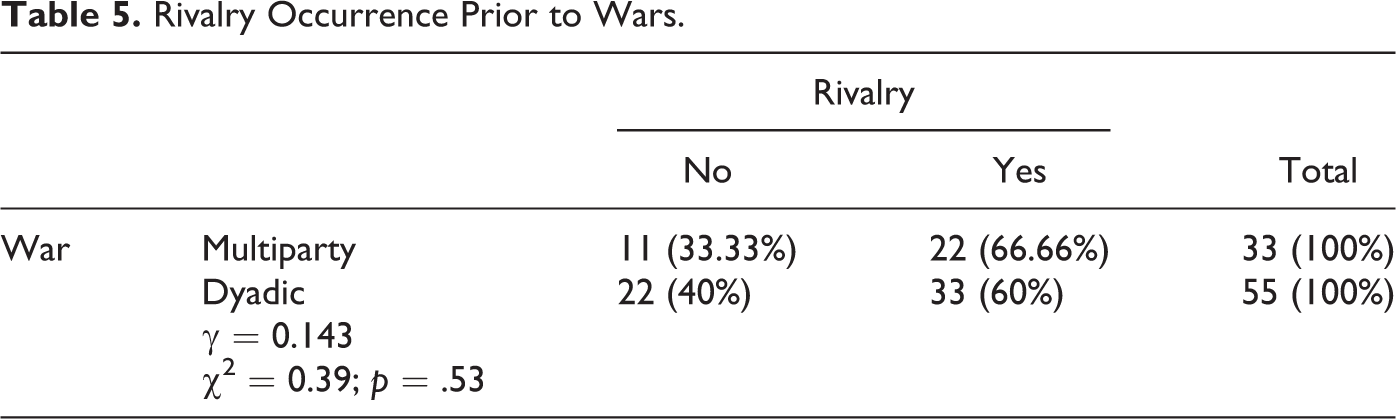
We now turn to the findings on rivalry and on contiguity. In Table 5, we see that the 2 × 2 comparison with dyadic wars produce statistically insignificant results for rivalry. We also see that 66.6 percent of multiparty wars are preceded by rivalry that is well below our 80 percent criterion. All of this demonstrates that rivalry is not a necessary condition of multiparty war. The analysis of dyad entrants reconfirms this. We see in Table 6 that only 20 percent of the joiners are rivals.
Rivalry Occurrence Prior to Wars.
Dyadic Participants Multiparty Wars: Rivalry and Contiguity.

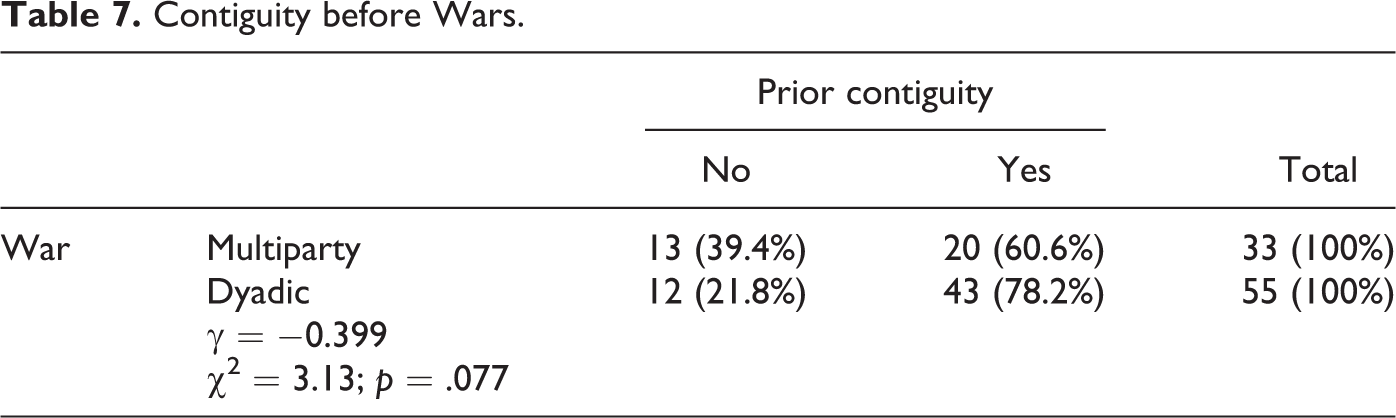
Our last tests examine whether contiguity is a necessary condition of multiparty wars. Table 7 demonstrates that contiguity is not a necessary condition of multiparty wars. We see that only 60 percent of multiparty wars have contiguous dyads, well below our threshold of 80 percent. In addition, the analysis shows that contiguity is not significantly associated with multiparty wars at the .05 level. The test consisting of the individual dyadic participants in Table 6 also produces the same results in that only 27 percent of dyadic participants are contiguous in multiparty wars.
Contiguity before Wars.
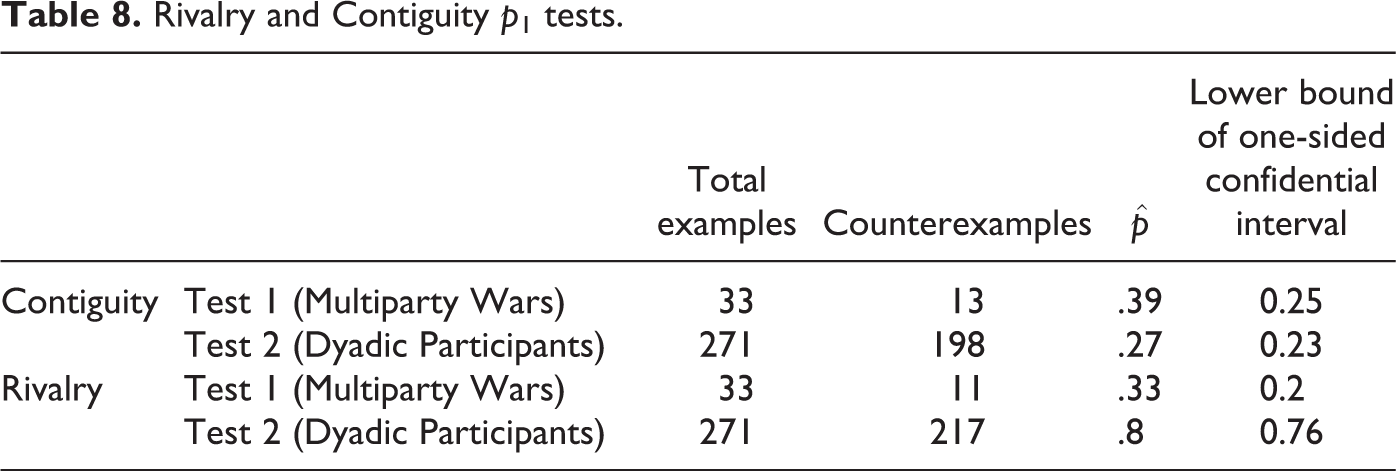
Finally, we use the Braumoeller and Goertz (2000) p 1 test to test both our rivalry and contiguity hypotheses for all dyad entrants. This further confirms our suspicions as neither the war-level nor dyad-level analysis reaches the .1 level of significance as suggested by Braumoeller and Goertz (see Table 8). These findings demonstrate that, unlike alliances, neither rivalry nor contiguity is a necessary condition of multiparty war.
Rivalry and Contiguity p 1 tests.
As with the tests of prior alliances, the tests for prior rivalry and contiguity were also run separately for the dyadic participants in World War I and World War II. These are reported in the online Appendix I. For rivalry, we find that approximately 35 percent are in a rivalry when they enter World War I and 37 percent when they enter World War II. For contiguity, the numbers are 19 percent for World War I and 21.5 percent for World War II. This breakdown again shows that neither rivalry nor contiguity operated as necessary conditions for the two world wars.
Finally, to compare the relative strength of preceding multiparty wars to that of rivalry and contiguity, we calculated the odds ratios for each. The full tests, all of which support Hypothesis B, are also reported in the online Appendix II.
Conclusion
All tests provide evidence consistent with our hypothesis that alliances are a necessary condition for multiparty wars. In terms of Popper (1959), the evidence fails to falsify the hypotheses. About 90 percent of the multiparty wars are preceded by alliances, and most of the individual dyad participants in multiparty wars also have prior alliances. For the largest wars in the system, this relationship is extremely strong—about 95 percent of the dyad entrants of World War I have prior alliances and all of the dyad entrants of World War II have prior alliances. The findings on dyad participants show that the larger the war, the more likely alliances are a necessary condition. These are all new findings that provide an important contribution to the literature on conflict, war, and alliances.
Although this is the main contribution of the study, its findings also have theoretical import that aids us in terms of how we think about conflict processes. The findings suggest that the study of war diffusion may be more complicated than first thought. The theoretical approach also suggests a number of additional hypotheses. If alliances are truly a necessary condition of multiparty wars, as the evidence indicates, this implies that other diffusion mechanisms—like arms races and rivalry—only become operative in the context of alliances binding states to each other.
It appears that wars spread to contiguous states in part because they are in the way, that is, they are between two belligerents. And, as when Germany attacks France through Belgium, these two belligerents are members of rival alliances. This seems to be another instance in which having an outside alliance encourages war. In this case, the outside alliance that a weaker contiguous state has either emboldens it to resist or encourages the belligerent to attack in order to get at its main enemy, especially if the weaker contiguous state could be used as a staging area. Whether such claims are true and consistent with historical cases deserves further investigation. With regard to rivalry, the analysis raises the question of how alliances are related to rivalry and how each are related to diffusion. If the claim made here that alliances are more important is true, then fewer wars should be preceded by rivalries than they are preceded by alliances, as shown. Again, this is a possible hypothesis worthy of further research, but the tests here are consistent with the claim.
Finally, an important contribution of the analysis is to show that it is possible by grouping wars to uncover necessary conditions. The general study of necessary conditions, which has received conceptual attention (see Braumoeller and Goertz 2000; Goertz and Starr 2003; Goertz and Levy 2007b), also deserves increased empirical attention.
Footnotes

Acknowledgment
Our thanks to Stephen Chaudoin, Jack S. Levy, Ashly Townsen, three anonymous reviewers, and Paul Huth for valuable comments. Of course, any remaining errors are our sole responsibility.
Declaration of Conflicting Interests
The author(s) declared no potential conflicts of interest with respect to the research, authorship, and/or publication of this article.
Funding
The author(s) received no financial support for the research, authorship, and/or publication of this article.
Notes
References
Supplementary Material
Please find the following supplemental material available below.
For Open Access articles published under a Creative Commons License, all supplemental material carries the same license as the article it is associated with.
For non-Open Access articles published, all supplemental material carries a non-exclusive license, and permission requests for re-use of supplemental material or any part of supplemental material shall be sent directly to the copyright owner as specified in the copyright notice associated with the article.
