



Abstract
From Syria to Sudan, governments have informal ties with militias that use violence against opposition groups and civilians. Building on research that suggests these groups offer governments logistical benefits in civil wars as well as political benefits in the form of reduced liability for violence, we provide the first systematic global analysis of the scale and patterns of these informal linkages. We find over 200 informal state–militia relationships across the globe, within but also outside of civil wars. We illustrate how informal delegation of violence to these groups can help some governments avoid accountability for violence and repression. Our empirical analysis finds that weak democracies as well as recipients of financial aid from democracies are particularly likely to form informal ties with militias. This relationship is strengthened as the monitoring costs of democratic donors increase. Out-of-sample predictions illustrate the usefulness of our approach that views informal ties to militias as deliberate government strategy to avoid accountability.
During the Sudan civil war, reports alleged that government helicopter gunships dropped supplies in remote locations, not to supply uniformed government military personnel but rather the armed gangs of the Janjaweed militia (Vasagar 2004). Subsequent testimony from Janjaweed commanders explained the Sudanese government’s role in sponsoring and working with the militia in unofficial capacities, despite government denials (Meo 2008). In this article, we examine the enduring attraction of armed non-state actors for governments.
A government clandestinely delivering weapons to groups outside the state security apparatus is at odds with the idea of consolidating a monopoly on violence. Despite the conventional view, there is no necessary process of monopolization (Staniland 2015). Evidence suggests that armed groups, like the Janjaweed, often operate in vague and informal concert with the state. Yet, with the exception of Ahram’s (2011a) analysis of data from the 1970s and Bates’ (2008) work on state failure in Africa, there is a lack of quantitative research in this area, while there is a rich case study literature for Latin America (Mazzei 2009; Stanley 1996), Indonesia (Cribb 2001), Africa (Alvarez 2006; Kirschke 2000; Roessler 2005), and elsewhere (Campbell and Brenner 2000; Kalyvas 2008; Mitchell 2004).
A new database includes global information from 1981 to 2007 on pro-government militias (PGMs) and defines informal relations between the government and a militia as those “not officially or formally acknowledged” by the government (Mitchell and Carey 2013, 11). There are 218 of these relationships in over sixty countries (Carey, Mitchell, and Lowe 2013). 1 Militia–government cooperation is most likely in but not limited to episodes of armed conflict, as 42 percent of our country-year observations with informal PGMs occur outside of armed conflict, using the threshold of twenty-five battle-related deaths (Gleditsch et al. 2002). These informal links can be found in a heterogeneous group of countries around the globe. They are present in poor states, such as Sudan and Haiti, and in more developed states, such as South Africa and Chile, as well as in autocracies such as Zimbabwe and Burma, and in more democratic India, Spain, and Turkey.
Why delegate violence to armed groups instead of using the official security apparatus? Why supply the Janjaweed when the Sudanese military itself lacked supplies (“Country Profile: Sudan” 2004)? We identify logistical and political incentives for governments to informally collaborate with militias despite—and because of—the limited control they have over them (see also Jentzsch, Kalyvas, and Schubiger 2015). As a means to increase force numbers, to lower deployment costs with likely information advantages in insurgencies, there are logistical incentives to use these groups. Eck (2015), using a fine-grained subnational analysis, explains delegation to militias as compensation for intelligence disruptions conditional on military purges and civil war threat. In addition, such delegation carries the political benefit of shifting responsibility (Fiorina 1985). Building on research on the influence of accountability on government repression (e.g., Landman 2005; Simmons 2009) and the case literature (e.g., Alvarez 2006; Kirschke 2000; Roessler 2005), we explain militias as an option for evading the accountability costs facing governments that are clearly responsible for official violence. If governments are sensitive to accountability costs attached to repression, unofficial links to militias offer a means to shift responsibility for violence, “these forces tend to be more ‘deniable’ and opaque than formal government security forces, allowing the state to avoid accountability” (Staniland 2012, 17). Beyond providing force, informational and deployment advantages to governments under the threat of civil violence, militias mitigate the risk of domestic and international liability for repression. 2 After presenting the argument and some case examples, we move on to empirical analysis. Our results are consistent with the expectation that these linkages are a response to armed conflict and disorder. But beyond this disorder explanation, the results also support the argument that unofficial government–militia cooperation reflects strategic choices to reduce governments’ liability for repression.
Militias and Accountability
We assume governments may see important strategic benefits in the use of violence, if they can lower the perceived costs associated with its use. We know that even democratic governments are willing to violate human rights for strategic benefits, such as shifting unwanted civilian populations or ending a costly war and violent dissent (Downes 2006; Conrad and Moore 2010). Rather than forego repression, governments may instead seek to evade accountability for it.
We argue that governments perceive ties to militias as a mechanism to evade accountability and muddy the flow of information about who is responsible for violence. Recent work has shown that militias increase the risk of state-sponsored repression (Mitchell, Carey, and Butler 2014). Accountability has two major components, namely information and conditional sanctions (Grant and Keohane 2005, 30). First, accountability requires information on policies, such as repression, being available to citizens and the international community. Second, if there is evidence of wrongdoing, some punishment is expected to follow. These conditions, joint information and conditional punishment, help identify which countries are most likely to be held to account for violence as well as which states might be best situated to use informal militias to reduce their liability.
Accountability, both domestic and international, is central to understanding governments’ use of repression (Bueno de Mesquita et al. 2005). We argue that governments seek to lower accountability for violence using the militia’s organizational separation from regular security forces. This separation increases the problems of delegation. It worsens the information asymmetries concerning the implementation of repression, enabling the government (as principal) to claim it cannot control the militias (as agent). The separation makes it more difficult for accountability holders to trace the responsibility for violence back to the government. This process is similar to what Fiorina (1985) described as delegation to “disguise.” Without being able to clearly establish responsibility for the violence, holding leaders to account, either by citizens or by the international community, is more difficult. This political incentive to use informal militias depends on the presence of domestic or international accountability mechanisms.
If our understanding of the incentives for government repression and the perceived usefulness of militias in avoiding accountability is correct, then we should see informal links between governments and militias not just in isolated cases where governments have yet to achieve sovereignty, but in many places around the world where governments fear negative sanctions for the use of violence.
One might question the likely success of this form of avoiding accountability, particularly when open source and media accounts reveal these ties. Yet, governments often operate with a minimal view of what is required for denials. “The point is not to persuade audiences to agree with the account—that is, to support the action—but to make it sound credible and reasonable” (Cohen 2001, 62). With regular forces on the border and available to invade or to interdict pro-Russian militias, such as the Vostok Battalion operating in the Ukraine, and despite evidence in the worldwide media of their supply of these forces, the Russian government persisted in denying control over the Vostok Battalion: “He [Putin] was trying to maintain an element of deniability, which he would be unable to do if he had sent regular Russian troops” (Judah 2014, 77). Grant and Keohane make this point: “in world politics, accountability for most power-wielders is likely to be less constraining than is optimal” (2005, 40). Even flimsy denials of responsibility for the activities of “rogue elements” in these groups may prove sufficient to create some reasonable doubt about the government’s accountability.
Information, Government Sensitivity, and Reduced Liability
Leaders’ sensitivity to accountability for using militias varies with the government’s ability to suppress information on links to militias, and with the conditional costs incurred if their responsibility were revealed. Governments may face domestic and international accountability mechanisms.
Domestically, democratic leaders may expect to be punished for using violence since democratic institutions enable voters to sanction the government’s behavior with loss of public support or office. For example, Prime Minister Recep Tayyip Erdogan’s approval rating dropped ten points within months of cracking down on protesters in Istanbul in late May 2013 (Peter 2013). Leaders in democracies may align with informal armed groups if they expect to shift responsibility for their actions. Informal linkages to militias might be quite easy for all governments to keep secret, since even full democracies have the power to keep official secrets (Colaresi 2014). However, in a full democracy with free speech and open information, secrecy is more difficult to maintain compared to incomplete democracies. This argument is in line with the finding that “full democracy” (Davenport and Armstrong 2004), reduces violations of human rights due to mechanisms of domestic accountability (Cingranelli and Filippov 2010). Bueno de Mesquita et al. (2005, 439) argue “limited accountability generally retards improvements in human rights.” Governments in weak democracies are more likely to expect to be able to reduce pressure to adhere to human rights standards by using militias to limit accountability.
Leaders in strong autocracies have less fear of the domestic costs of official repression. Information asymmetries in autocracies are more severe than in other regime types. They are unlikely to have interest groups and “fire alarm” monitoring (Banks and Weingast 1992). Repression, even by the state security apparatus, may go unreported. If reported, it is usually very costly for citizens to sanction leaders. Where accountability mechanisms are absent, there is less incentive to use informal PGMs.
Research by Landman (2005) and others (e.g., Simmons 2009; Levitsky and Way 2010) extends the domestic logic of accountability to the international community. Leaders fear financial or even legal sanctions from external actors, whether other governments, international organizations, or courts. Democratic donor states and international organizations may punish leaders breaking human rights commitments (Landman 2005; Risse, Ropp, and Sikkink 1999; Simmons 2009; Kirschke 2000; Roessler 2005; Levitsky and Way 2010). Leaders may fear the threat of legal action through international tribunals and financial sanctions from democratic donors (Simmons 2009; Kirschke 2000; Roessler 2005). Since the 1970s, the United States is required by law to consider the human rights performance of recipient states in aid decisions and the European Union’s commitment to human rights is considered fundamental to its external relations. 3 For example, European Foreign Ministers threatened to delay talks about Turkey joining the European Union after the May 2013 crackdown on protesters (“EU Delays Turkey Membership Talks After German Pressure” 2013).
While Grant and Keohane (2005) caution that international monitoring is more difficult than domestic monitoring, developed democracies have used their financial leverage in an effort to protect human rights (Kirschke 2000; Roessler 2005; Levitsky and Way 2010). Research is mixed on the consistency with which aid sanctions are applied (Carey 2007; Nielsen 2013), yet it is unnecessary to assume democratic aid donors are consistent or sincere in their commitments to human rights. If leaders aid human rights violating regimes, or even visit them (e.g., Prime Minister Cameron’s visit to Sri Lanka in 2013), they risk political or reputational costs. Aid sanctions and even selective application leave repressive regimes uncertain about the prospect of accountability, providing an incentive to seek to avoid accountability for repression.
Leaders in partial democracies and dependent on support from democracies have an incentive to outsource the use of violence to avoid reputational and tangible consequences for using repression.
4
Consistent with case research (Kirschke 2000; Roessler 2005), we argue that governments dependent on aid from democracies are more likely to make use of militias to reduce liability for repression. An autocracy not reliant on support from democracies or fearful of other forms of intervention by the international community, such as the Soviet Union during the Cold War or North Korea today, has less fear of the costs of official repression.
Aid from democratic countries makes leaders vulnerable to conditional sanctions, providing the motivation to seek ties to informal armed groups. But only countries that expect to get away with this strategy will take this risk. In countries that are difficult for the international community to monitor, informal ties might escape notice. Since accountability relies on the joint combination of potential sanctions and information, we explore the possibility that the use of unofficial militias increases for recipients of democratic aid as the monitoring costs of the donors and the remoteness from donor democracies increase.
Before testing these hypotheses on a global sample, some examples help illustrate the argument.
Case Examples of Informal Ties to Militias and Avoiding Accountability
The examples of Sudan and Bosnia illustrate the use of militias to avoid international sanctions for violence. The International Criminal Court (ICC) sought the arrest of the president of Sudan for the atrocities in Darfur carried out by armed militias. According to the ICC prosecutor, the president, although denying control over the militias, was criminally responsible for their acts: “They all report to him, they all obey him. His control is absolute” (ICC Press Release 2008). In December 2014, the ICC prosecutor suspended the investigation (“Sudan President Hails ‘Victory’ over ICC Charges 2014”), but if the president is ever arrested, he may take encouragement from the acquittal of Serbian officials for war crimes committed by Arkan’s Tigers.
Serbian officials denied responsibility for this militia, but The Washington Post noted that “Milošević’s control is tight enough over Arkan’s units that they would not be operating on a free-lance basis” (Pomfret 1994, A37). Despite the flimsy basis for denial, Serbian Security Service officials avoided accountability. The International Tribunal for the Former Yugoslavia found that Serbian officials had aided the groups. But “it was not proven beyond reasonable doubt that Stanišić or Simatović planned or ordered the crimes” (UN ICTY 2013). With a “credible if not persuasive” defense they were acquitted on all charges.
In addition to legal liability for repression, militias may limit financial liability for aid-dependent countries. In Cameroon, Rwanda, and Kenya, pressure from international aid donors to democratize, combined with pressure from internal opposition groups, led states to use informal repression “to avoid criticism by donors for human rights violations, but also to regain control over the transition process by covertly suppressing political conflicts” (Kirschke 2000, 385). In 1991, the United States and other donor countries pressured President Moi into legalizing opposition parties, and elections were held in 1992. But as in Rwanda and Cameroon, the government shifted to “informal repression, violations by surrogate bodies such as hit squads, party youth wings and traditional leaders, against perceived and real government critics” (Kirschke 2000, 397). Donor-induced democratization saw violence “carried out by nonstate actors, such as vigilantes, paramilitaries, and militias, who are directly or indirectly supported by the government” (Roessler 2005, 209).
Governments collaborate with militias to shift blame and redirect the flow of information about responsibility for violations from regular to irregular forces. This is a joint or “collusive” relationship (Staniland 2015), not a “substitute” relationship where regular forces then “refrain” from violations (Cohen and Nordas 2015; Stanton 2015). The logic of delegation predicts increased violations and more agent-centered violations (e.g., sexual violence) where militias are present, and commensurate opportunities shift blame to these groups, but not that regular forces desist from violations (Mitchell 2004). 5 The logic also predicts high levels of agent-centered violations with similarly ill-disciplined or ill-motivated regular forces (e.g., Bohara et al. 2008). Examining sexual violence, Brysk (2014, 6) says “the Congolese state … assert the problem is centered in militias rather than national forces,” but she highlights the responsibility of national forces as well as militias for these crimes. The Syrian government recruited the Shabiha militia from its prisons in 2011 to take the blame for atrocities (Amor and Sherlock 2014). But both regular forces and militias continued to commit violations according to the United Nations (2013). Publicity about government violations may bring tangible costs for countries in receipt of aid (Nielsen 2013), or it may make it easier to support the government’s opponents—a plausible concern of the Assad government and an incentive to outsource.
These examples highlight the use of militias to reduce accountability. Across the cases, governments complicit in militia violence were at least partially successful in reducing the costs of being associated with excessive violence. The cases illustrate the complexity of accountability processes and the moral hazard of international aid or legal interventions, which might inadvertently create an incentive to use militias.
Before we empirically test our argument, we analyze the claim that militias offer logistical benefits to governments facing civil violence and disorder. Under such conditions, governments might use irregular armed groups as a quick and cost-effective way of deploying forces or gaining information advantages (Alvarez 2006; Jentzsch, Kalyvas, and Schubiger 2015). In this “disorder model,” we analyze the impact of civil war and dissent on the existence of informal government–militias links, controlling for level of development and population size. This model provides a benchmark to gauge the explanatory power of our accountability-avoidance mechanisms.
Measuring Informal Government–Militia Ties
We test our arguments using the Pro-government Militias Data Set (PGMD), containing information on whether an unofficial government–militia tie existed in a given country-year (Carey, Mitchell, and Lowe 2013). We focus on informal groups, which do not have an officially recognized or legal relationship with the government. 6 The presence of informal government–militia ties is captured with a dummy variable with any informal government–militia tie coded one and zero otherwise. Where there is no clear end date for this relationship, we use the last date of militia activity as proxy.
Global data require concepts that travel cross-nationally and over time. Names of groups are culture-bound, vary regionally and over time, and are not a reliable indicator of a group’s properties. Campbell and Brenner (2000) include within the same analytical framework groups labeled death squads in Central America, vigilantes in the Philippines, paramilitaries in Serbia and Weimar Germany, and militias and secret armies in India. An issue for future research raised by Jentzsch, Kalyvas, and Schubiger (2015) is how to classify subtypes of militias that hinge on theoretically important distinctions. 7
Measuring the Incentives to Avoid Accountability
We measure the incentive and ability to avoid domestic accountability with political institutions. Strong autocracies are coded as countries that score −7 or lower on the Polity2 scale (Marshall, Jaggers, and Gurr 2010). Weak democracies are coded as countries that score between 1 and 6 on that scale. Strong democracies are coded as countries with the score 7 or above on the Polity2 scale. The omitted category is weak autocracies. We also include the underlying Polity2 index, which ranges from −10 to 10 as a nonlinear term in a generalized additive model (GAM) to check whether a more flexible functional form provides evidence consistent with our hypotheses. 8
We measure international sensitivity with aid dependence, utilizing the AID 2.0 database to measure aid transactions. We code the purchasing-price parity adjusted value of aid sent from democracies (at least 7 on the Polity2 scale) to any recipient. We compute democratic aid dependency as the natural log of the sum total of aid received from democracies as a proportion of the recipient’s gross domestic product (GDP). 9 To capture monitoring costs for the international community, we measure the distance (in kilometers) between each country and the nearest democracy. We follow Tobler’s law, which suggests “near things are more related than distant things,” and assume that informal government–militia partnerships that are distant from democracies will be more difficult to detect due to greater inattention or fewer resources. As human rights monitors specify, distance inhibits monitoring due to less dense informational ties that can reliably collect information (Norwegian Resource Bank for Democracy and Human Rights (NORDEM 2008) and Norwegian Centre for Human Rights at the University of Oslo). Distance to democracy is coded zero if the state is a democracy or a neighbor is a democracy, using the C-shapes data (Weidmann and Gleditsch 2010; Weidmann, Kuse, and Gleditsch 2010), and then logged. 10 We also explore whether proximity to a democracy and democratic aid interact to jointly make informal government–militia ties more likely, given that if a regime does not depend on foreign aid from democracies, then the international community has less leverage, regardless of the distance to the nearest democracy. As distance may be an imperfect measure of monitoring costs, we use absence of media access (Norris 2008) as an alternative. 11 This indicator is only available for a subset of our observations but provides a useful validation of our inferences using distance to the nearest democracy. The results are presented in the online appendix.
The Empirical Leverage of Autocratic Aid
Autocratic states are unlikely to be concerned about repression abroad. Therefore, aid from this source is unlikely to encourage recipient countries to outsource violence to militias. If democratic aid makes informal government–militia ties more likely, as expected, but autocratic aid does as well, then this would suggest that it is aid and not international monitoring by democracies that explains the use of PGMs. If, however, aid from democracies increases the presence of informal government–militia linkages, but not aid from autocracies, then this supports our conditional punishment argument. We therefore include autocratic aid dependency in our specification. 12
Analyzing the Disorder Model
We first analyze the impact of domestic disorder on the probability of government–militia linkages. Then we compare whether our accountability model improves our understanding of the use of militias. We measure disorder with current domestic unrest using the Cross-national Times Series (CNTS) data (Banks 2008) and code Strikes, Riots, Demonstrations, and Guerrilla attacks into a set of dichotomous variables. We measure civil violence and war with the Uppsala Conflict Data Programme (UCDP)/Peace Research Institute Oslo (PRIO) Armed Conflict Data (ACD; Gleditsch et al. 2002), using Civil violence to measure armed conflict above the threshold of twenty-five battle-related deaths within one year and Civil war capturing civil wars that have crossed the 1,000 battle-related deaths threshold. Including both Civil violence and Civil war allows us to capture the effects of varying levels of violence within the disorder framework. Excluding one of these variables treats all non-civil war years as equal and assumes that civil violence and civil war have the same effect on government–militia linkages. 13 We control for Economic development with the log of real GDP per capita from the Penn World Tables and for Population, which is logged and coded using the Correlates of War data, version 4.0 (Singer 1987). We also measure Ethnic fractionalization (Fearon and Laitin 2003) to evaluate whether an ethnically more heterogeneous society increases the likelihood of government–militia collaboration.
When comparing our hypotheses with the disorder model, we rely on GAMs to allow for flexible functional forms where appropriate, as well as a flexible interaction between aid from democracies and the distance to the nearest democracy. However, increasingly complicated specifications with greater flexibility are more likely to overfit the idiosyncrasies of the data. Therefore, we compare fits using Akaike Information Criterion (AIC), which penalizes models with more parameters. To have a lower (thus better) AIC score, the added explanatory payoff must be greater than the added complexity. Additionally, we investigate out-of-sample fits between the disorder model and the accountability avoidance model. A specification that is fitting idiosyncrasies in the sample data, rather than systematic patterns, will fit well in sample but not out of sample. We use separation plots (Greenhill, Ward, and Sacks 2011) to present the out-of-sample results and report Brier scores. 14
Results
The first column in Table 1 presents the results of the baseline disorder model. Strikes, riots, demonstrations, guerrilla attacks, civil violence, and civil war increase the probability of an informal government–militia relationship within a country. However, only demonstrations, guerrilla attacks, and civil violence have substantially larger point estimates compared to their associated standard errors.
A Logit Analysis of Informal Government–Militia Linkages.

Note: Standard errors in parentheses. AIC = Akaike Information Criterion.
*p < .1.
**p < .01.
***p < .001 (two-tailed test).
Although strikes, riots, and civil wars have smaller coefficients relative to their uncertainty estimates, this appears to be due to the covariance between these measures, as there is a similar bivariate relationship between these variables and informal government–militia ties compared to the bivariate relationship between riots and these unofficial ties. In addition, civil violence is present in all cases of civil war, so that the civil war parameter is measuring the difference between civil violence and war. These six variables are jointly statistically significant using a Wald test. 15 We can reject the null hypothesis that the effect of strikes, demonstrations, and riots on PGM presences is jointly zero at the .01 level. 16 Decreasing GDP also increases the probability of an informal government–militia tie, as does increasing the population size, likely reflecting deployment efficiencies gained from militia ties. Our estimate for ethnic fractionalization is negative, with a standard error over three times the size of the point estimate.
Substantively, the disorder model estimates how increasing the risk of disorder is likely to impact the probability of informal government–militia ties, irrespective of the incentive to avoid accountability. Moving from a low-risk scenario where a country has a population and GDP per capita at the sample median and no riots, demonstrations, or other forms of civil violence, to a higher risk country with a population at the third quartile without increasing GDP per capita proportionally, 17 and is suffering from civil violence, increases the probability of an informal government–militia from 2 percent (90 percent confidence interval [CI]: .01 to .04) to 14 percent (90 percent CI: .08 to .22). These results support the argument that government–militia ties are more likely in situations of domestic disorder. As we show subsequently, accounting for the risk of being held accountable for violence substantially improves the predictive power of our models.
Avoiding Accountability
To explore our argument that militias are more attractive in circumstance where leaders have incentives and opportunities to avoid accountability, the second and third set of columns in Table 1 show the results from our accountability avoidance model, with measures of regime type, the amount of aid from democracies, the distance to the nearest democracy, and aid from autocracies, alone (Model 2 in Table 1) and in combination with the disorder measures (Model 3 in Table 1), since we view these incentives as complementary.
Domestic Accountability
In each specification, we find support for the argument that governments use militias when they jointly have the incentive and ability to avoid accountability for violence. The results show that the probability of informal militia ties varies with regime type (see Table 1, columns 2 and 3, and Figure 1). A test that all of the regime categories have the same probability of informal militias is rejected at the .05 level for both models. Further, with both specifications, weak democracies have the highest probability of informal militia presence and autocracy (including the excluded weak autocracy category) lowers the probability of having an informal militia. 18 These results provide evidence that weak democracies have a significantly higher probability of having informal militias and that it is more difficult to differentiate the categories of strong autocracies, weak autocracies, and strong democracies.
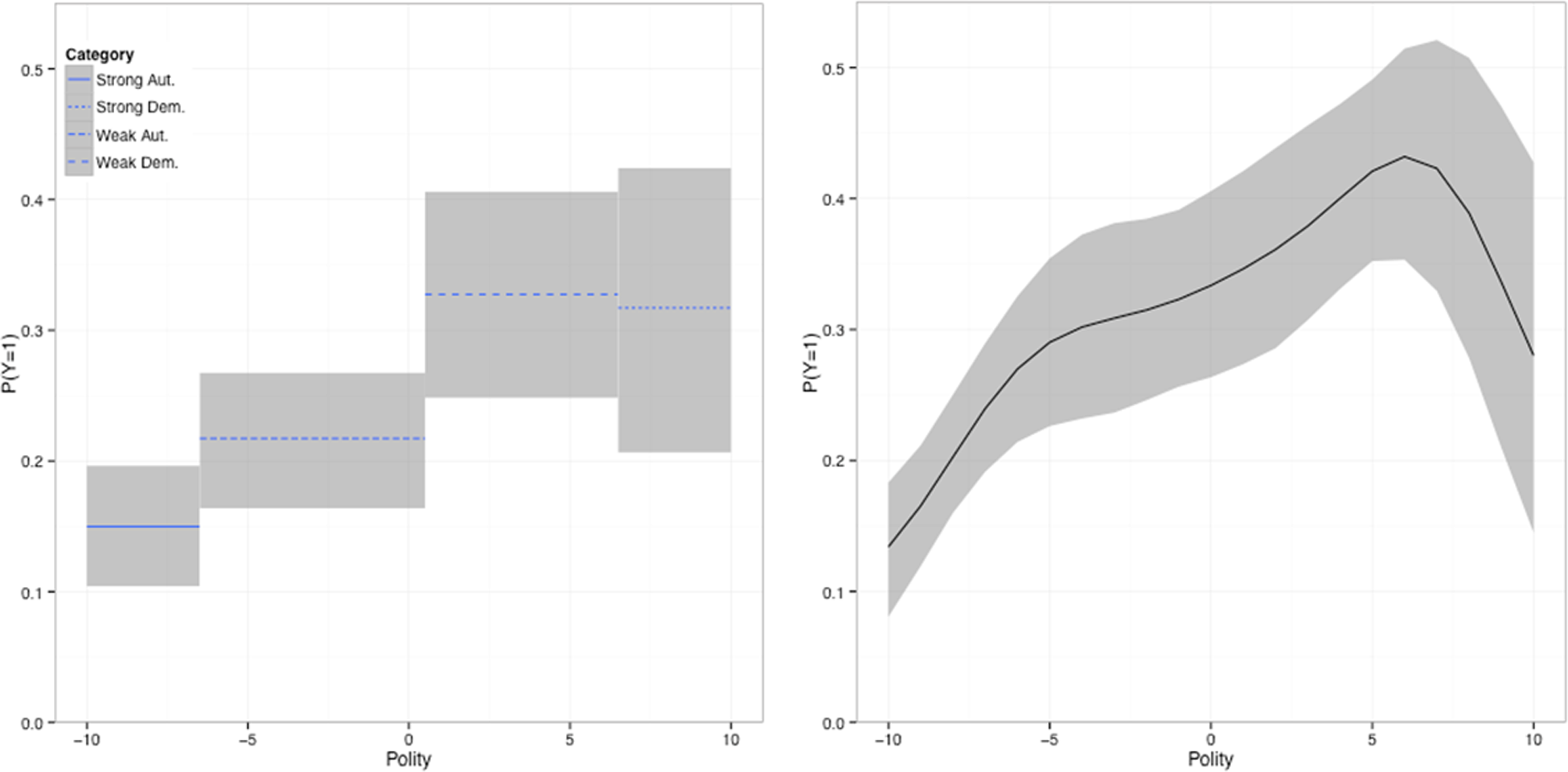
Probability of unofficial government–militia ties in different regime types.
The analyses in Table 1 assume that the probability of informal government–militia relationships jumps across categories instead of smoothly varying with the underlying democracy index and that we have a priori specified the jump locations correctly. This can be seen in the first panel of Figure 1, which plots the estimated probability of an informal militia and the 90 percent CI from model 2 in Table 1 for the four categories (strong autocracy, weak autocracy, weak democracy, and strong democracies) by the Polity2 scale that was used to create the categories. Each category is assumed to have a constant probability of a militia, while changes can only occur across categories.
Table 2 estimates three GAMs that allow for flexible splines to fit the data to relax the assumption of linearity on the log odds scale for democracy and other variables of interest. We include the underlying Polity2 index as a continuous covariate without assuming a specific functional form for the relationship between regime types and the probability of informal government–militia ties. 19 Because these models no longer have only one parameter describing the change in the dependent variable, Table 2 presents the joint significance tests and estimated degrees of freedom for these nonlinear relationships (smooth terms) and the AIC for each model, along with any linear terms that were included. The nonlinear relationships are best presented graphically.
Generalized Additive Analysis of Informal Government–Militia Linkages.

Note: Standard errors in parentheses. Smooth estimates are nonlinear relationships examined with a χ2 test. AIC = Akaike Information Criterion; 1-D = one dimensional; 2-D = two dimensional; EDF = estimated degrees of freedom for the smooth term.
*p < .1.
**p < .01.
***p < .001 (two-tailed test).
The second graph in Figure 1 plots the estimated relationship and standard error from the GAM in the second model in Table 2. The probability of an informal government–militia relationship rises steadily as autocracy decreases, peaking rather sharply between the weak democracy and strong democracy categories (near six and seven on the Polity2 scale), before dropping again as a state reaches full democracy. The AIC statistics across Table 2 suggest that the GAM specification is a better fit to the data even after penalizing the model for adding parameters. Only replacing the categorical regime variables in model 3, Table 1 with the spline results in a reduction (improvement) of the AIC from 1002.6 to 995.1.
In this model, weak democracies have three times the relative risk of informal government–militia ties compared to strong autocracies and 1.4 times the relative risk compared to strong democracies, consistent with Hypotheses 1 and 2. As expected, states that are most likely to be held accountable for official repression, but might get away with using informal militias due to incomplete freedoms of speech and the press, are the most likely to have these ties. This nonlinear relationship is consistent across all three models in Table 2.
International Accountability
Our results support the argument that international accountability motivates the use of militias. Aid from democracies should increase the likelihood of ties to militias and the distance from the nearest democracy should increase the perceived ability to hide ties to militias. Aid from autocracies should decrease the likelihood of these ties since autocracies are unlikely to hold aid recipients responsible for repression. Comparing the results from the linear 20 specifications in Table 1 to the GAM results in Table 2 suggests that aid from democracies increases and aid from autocracies decreases the probability of government–militia ties. 21 Thus, across different specifications Hypothesis 3 is supported. Figure 2 presents the differing slopes depending on whether the donor was a democracy or an autocracy, using the coefficients from model 3, Table 2. 22 The dotted white line with the accompanying darker CI maps the nonlinear but largely increasing relationship between democratic aid and informal militia ties for a state that is very distant from a democracy. The black line with lighter shaded CIs maps the negative relationship between autocratic aid and the predicted probability of informal militia linkages.

Predicted probability of unofficial government–militia linkages depending on aid dependency by donor’s regime type. Democratic aid is represented with a dotted white, autocratic aid with a solid black, with 90 percent confidence intervals. These results are for a country that is at the 75th percentile of distance.
Across the models, distance to the nearest democracy is estimated to increase the probability of informal ties, but the variability around this estimate suggests greater uncertainty about its additive effect. However, the best fitting model (model 3, Table 2), by AIC, includes the nonlinear interaction for aid from democracies and distance to the nearest democracy (Hypothesis 4), measuring cases that have both the incentive (keeping aid from democracies) and the opportunity (less precise monitoring due to distance from a democracy) to use a militia without suffering international accountability costs. The shape and significance of this interaction supports Hypothesis 4. Model 3 in Table 2 includes a two-dimensional tensor product smooth of distance and aid from democracies. The model can be thought of as suspending a flexible sheet, rather than a flat plane, through the data.
The estimated relationship between democratic aid conditional on distance and the probability of an informal government–militia relationship is shown in Figure 3 in a wireframe and a contour plot. Both present the predicted probability for unofficial government–militia ties for a weak democracy with civil violence, median GDP, and population, based on model 3 in Table 2. States that receive large amounts of aid from democracies and are far away from the nearest democracy are most likely to have informal government–militia ties. The estimated probability of such a tie increases from .2 (90 percent CI: .1 to .3) for a state that receives no aid from a democracy and shares a border with a democracy to over .8 (90 percent CI: .5 to .9) for a state that is over 1,500 kilometers from the nearest democracy and receives aid from democracies at the 75th percentile. 23

Incentives and opportunities for unofficial government–militia ties. Distance to democracy is measured in log kilometers, and democratic aid as logged proportion of gross domestic product, and response as the predicted probability of a pro-government militia being present. The z-axis on the wireframe is scaled from 0 to 1. The other two axes are scaled from minimum to maximum.
This plot also shows that the relationship between democratic aid and informal government–militia collaboration depends on the monitoring costs. Along the bottom edge of the contour plot, the probability of informal militia–government rises only gently from .2 to .4 as aid increases. At the upper edge of the plot, for states that are distant from democracies, the probability increases from .3 to over .8.
The lower AIC value for the combined models (third set of columns in Tables 1 and 2), compared to either the disorder or the accountability avoidance model, suggests that the disorder and accountability mechanisms are complementary; they are both useful for predicting informal militia relationships. The lower AIC value for the combined model that includes nonlinear terms (model 3 in Table 2) compared to the linear model (model 3 in Table 1) shows that the flexibility of the GAM framework is helpful in predicting informal militia ties.
Combining accountability avoidance with disorder measures substantively increases the probability of unofficial government–militia relationships. An autocracy with civil violence, but aid from other autocracies and not democracies, has only an expected 1 percent probability (90 percent CI: .01, .03) of having an informal militia relationship. However, a weak democracy, with the same degree of civil violence, getting aid from a distant democracy, has over an 80 percent risk (90 percent CI: .5, .9) of having such a relationship.
Out-of-sample Predictions
Despite the support for the accountability avoidance model in combination with civil violence, our flexible model might be overfitting idiosyncrasies in the sample data. Therefore, we use out-of-sample validation to further support our argument that it is not only domestic disorder and logistical concerns that motivate governments to use informal armed groups but also a logic of avoiding accountability. We first refit each model to the sample from 1981 to 2001. Then we take the estimated coefficients and calculate predicted probabilities for the data from 2002 to 2005. If we are overfitting the sample data, the out-of-sample fit should be relatively poor. Figure 4 presents out-of-sample separation plots (Greenhill, Ward, and Sacks 2011), which order the predicted probabilities from low to high values as one moves from left to right. For each prediction, a vertical red line is drawn if government–militia ties were present in the observed out-of-sample data and a white line if not. If the model separated the observations of these ties perfectly, then the right-hand side of the plot would be red and the left-hand side would be white. A poor fitting model would have red lines toward the left of the panel, which represent observations with very low predicted probabilities from the model (since they are sorted on the left) but actual observed values where ties were in fact present (hence the red vertical line).
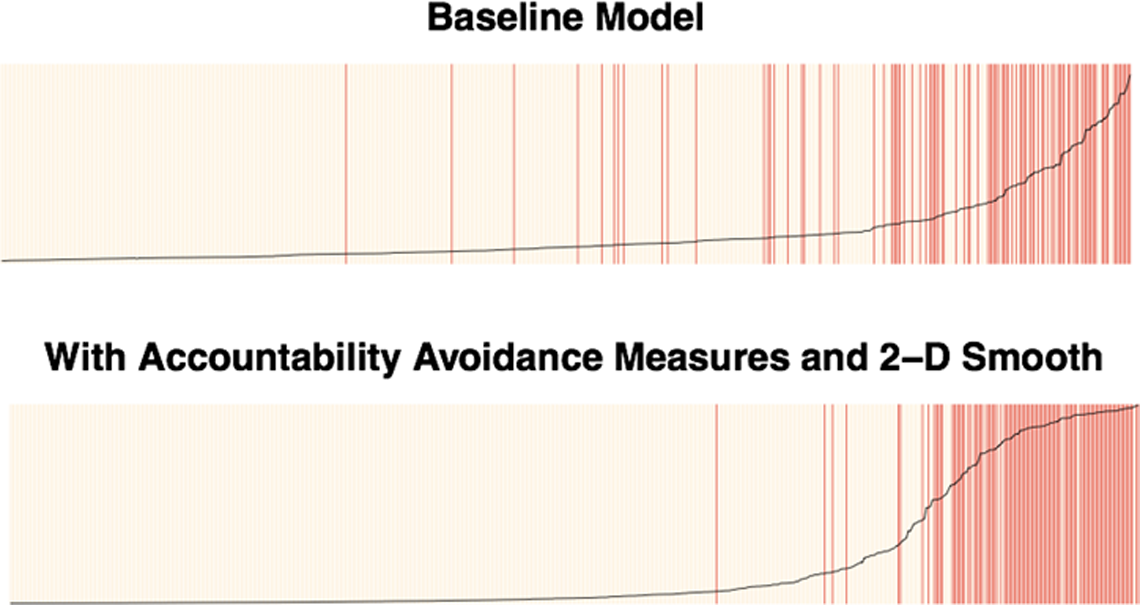
Separation plots comparing the predicted probability of informal government–militia ties with out-of-sample observations across two models. The baseline model includes only the disorder variables, population, and gross domestic product. The added model includes the variables in model 3 of Table 2. The models are fitted to data from 1981 to 2001 and validated on data after 2001.
The out-of-sample separation plot for the disorder model is relatively poor. It predicts informal government–militias linkages where none are observed in the data, indicated by the red lines toward the left of the plot area, although there is an increasing pattern of observed linkages as one moves toward the higher predicted probabilities on the right. In comparison, the out-of-sample separation plot for model 3 from Table 2, which includes the accountability avoidance variables and models the potential nonlinear relationships, is visibly improved. There is considerable white space on the left, representing no informal government–militia relationships where the model does not expect them to be and an increasing density of red observed relationships on the right, where the model predicts a higher density of informal militia ties. The Brier scores for each model confirm the visual impression. The disorder model has a Brier score of .10, the model adding our measures and nonlinearities has a Brier score of .03, where smaller scores imply a better fit between the predictions and the data. The Brier score for the combined accountability avoidance model is akin to predicting an informal government relationship with a militia with a probability of .82 and it then occurring. 24 This is helpful evidence that our inclusion of additional variables and flexible functional forms did not overfit the sample and forecasts well out of sample.
We also conducted several robustness tests that are detailed in the online supporting information. To exclude the possibility that armed conflict drives our results, we excluded all countries from our sample with a civil war at any point during our observed time period. This did not alter our inferences, as there continued to be support for the hypothesized relationship between aid from democracies and informal government–militia ties, as well as between these links and weak democracy. Next, we included fixed effects for region, year, and then both region and year to the specification in model 2 in Table 1 as unobserved heterogeneity that might be correlated with our independent variables might drive our results. Again our inferences across the models remain robust. We also reran each model using only lagged independent variables and arrived at the same inference with slightly larger coefficients in absolute value. 25 This leaves us with a picture of where governments are likely to collaborate with informal armed groups. It is not simply that governments use militias during civil disorder, but unofficial ties to militias appear in places where governments have some chance of avoiding accountability for their actions and an incentive to do so.
Conclusion
We have argued that there are political as well as logistical incentives to delegate violence to informal armed groups. Our theoretical framework specifies the conditions under which governments are most likely to try to avoid accountability by collaborating with militias. Although research has shown that governments avoid using repression when they expect to be punished for the violence, we argue that governments not only decide between using or not using violence. Governments can also choose to shift responsibility for repression. Having ties to informal militias provides governments with plausible deniability for the violence they might commit.
Clearly, not all governments use militias. Loss of control or “shirking” in this policy area has risks. Countries that expect to be punished for using violence and that are better placed to hide their ties with militias are most likely to use these groups. We measure the chance of getting away with delegating to militias with distance from the nearest democracy, as well as the absence of media access. The accountability cost for repression is operationalized with dependence on foreign aid from democracies. Our results show that governments that receive most aid from democratic donors and are also furthest away from democracies are most likely to have ties with militias. Using out-of-sample predictions further supports our finding that domestic disorder and civil war are only part of the reason for government–militias ties. Although governments are more likely to establish links with informal armed groups during times of domestic conflict, governments’ incentives to avoid accountability for violence also play a crucial role.
The policy implications for the international community are twofold. First, this study highlights the need to anticipate unintended consequences of threatening to punish states for repression. Weak democracies appear to be using informal militias to avoid accountability for repression. Other work suggests that these informal ties to militias may make violence and human rights abuses worse (Mitchell, Carey, and Butler 2014). Second, to prevent government officials sheltering behind deniability claims, the government should be reminded of the responsibility to ensure compliance with international standards. Responsibility should be placed on the donor community to adopt as an explicit criterion in aid decisions a thorough assessment of the recipient’s security sector and the use or past use of militias.
More broadly, our study contributes a theoretically motivated global analysis of a neglected element of the security sector. As others have suggested, the monopoly of violence within a state is not a given (Ahram 2011a, 2011b; Staniland 2015). Under some circumstances, states may prefer a majority position.
This perspective raises questions for future research. What accounts for the supply of personnel for these groups and what role do different actors, such as parties, unions, and regional power bases, play in inducing or encouraging the formation of informal militias? What effect do these groups have on the outcome of conflicts and on civilian welfare? What theoretically meaningful distinctions should be used to further disaggregate these groups? Finally, it is possible that further work on the incentives for informal militias can help solve remaining puzzles in understanding the contribution of militias to civilian welfare and regime security, as brought to the forefront in several contributions to this special issue (Cohen and Nordas 2015; Stanton 2015; Ahram 2011b).
Footnotes

Declaration of Conflicting Interests
The authors declared no potential conflicts of interest with respect to the research, authorship, and/or publication of this article.
Funding
The authors disclosed receipt of the following financial support for the research, authorship, and/or publication of this article: Neil Mitchell and Sabine Carey received funding from the Economic and Social Research Council (ESRC), UK, RES-062-23-0363; Sabine Carey received funding from the FP7 Programme, ERC-StG-2013 no. 336019.
Notes
References
Supplementary Material
Please find the following supplemental material available below.
For Open Access articles published under a Creative Commons License, all supplemental material carries the same license as the article it is associated with.
For non-Open Access articles published, all supplemental material carries a non-exclusive license, and permission requests for re-use of supplemental material or any part of supplemental material shall be sent directly to the copyright owner as specified in the copyright notice associated with the article.
