




Abstract
Gender differences regarding support for the use of force average around 8 percent and are twice the size of differences on non-force issues. This article investigates a related gender gap in support for the use of torture. I investigate threat perceptions as a possible explanation for the gap and find strong support for this hypothesis. Specifically, increased threat perceptions lead men but not women to be more likely to support the use of torture. In addition to providing an explanation for the gender gap in support for torture, this extends prior work that finds increased threat perceptions with respect to terrorism lead to greater support for aggressive policies.
Gender is a significant source of influence on foreign policy attitudes but has not been sufficiently explored with respect to support for the use of torture. The reliance on various “interrogation techniques” has resulted in much controversy, international scrutiny, public discussion, and media attention. Given this new foreign policy strategy of using interrogation techniques that blur the line with torture, it is important to investigate whether a gender gap emerges and its origins. Other foreign policy gender gaps average around 8 percent, with women less likely than men to support military interventions (Shapiro and Mahajan 1986). Prior work has found a consistent gender gap in attitudes toward the use of torture with women less likely than men to support its use. My analysis focuses on the origins of this gap. Specifically, I hypothesize that gender differences in the effect of threat perceptions elucidate why this gap exists.
The factors that influence foreign policy attitudes, including gender, are of considerable interest to researchers of political behavior. Changes in public opinion influence policy makers’ decisions on foreign policy issues (Baum 2004; Burstein 2003; Hill 1993; Holsti 1992, 2004; Jacobs and Page 2005; Powlick 1991, 1995; Zaller 1992, 1994). A gender gap in foreign policy opinions may contribute to the gender gap in voting via support for candidates who emphasize military issues. Previous non-gender work on foreign policy attitudes supports the notion that such attitudes can influence presidential approval (Hurwitz and Peffley 1987; Krosnick and Brannon 1993) and vote choice (Aldrich, Sullivan, and Borgida 1989).
Thus, understanding the causes of the gender gap in foreign policy attitudes, including toward torture, is important. Presidential administrations must garner public support for their foreign policy agendas. Public officials take into consideration public opinion and venture to change public opinion opposed to their policy pursuits (Foyle 2004; Powlick 1991; Western 2005). Understanding why more women than men are anti-torture will add to our understanding of how different military strategies may impact public support for governmental use of force.
The sections that follow discuss the extant literature on gender differences in support for the use of force in foreign policy. I also review the recent and still developing literature on torture attitudes. Finally, I discuss the threat perception literature. Then in the analysis, I examine the extent to which gender differences in threat perceptions moderate and mediate the gap. The results indicate the importance of perceived threat to understanding the gender gap in support for the use of torture. As perceptions of threat increase, men are more likely than women to support the use of torture.
Gender Gap on Foreign Policy: Use of Force and Military Strategies
Gender gaps have often emerged in response to governmental use of force and military strategies. The gender gap on the use of military force is sizable and consistently surfaces. Gaps materialized in response to World War II, the Korean War, and the Vietnam War (Brandes 1992; Shapiro and Mahajan 1986). Similar findings emerged for more recent conflicts such as the Gulf War (Bendyna et al. 1996; Conover and Sapiro 1993) and the military campaign in Afghanistan (Huddy et al. 2005). Substantial gender differences also exist with respect to the Iraq War and the War on Terrorism (Eichenberg 2003).
Gender differences in foreign policy attitudes go beyond support for impending or ongoing military intervention extending to strategy preferences. Women are more likely to prefer air strikes to strategies that require large numbers of ground troops (Eichenberg 2003). Women are less likely than men to favor the use of force to solve international problems (Norrander 2008). Generally, women are more likely to favor military actions to peacefully resolve conflict while men are more likely to support strategies that escalate the conflict. Such differences with respect to resolution versus escalation emerged in response to the Korean War, the Vietnam War, Operation Desert Shield, and Operation Desert Storm (Nincic and Nincic 2002). These findings on gender differences in support for military strategies are pertinent, because the media and politicians have framed the use of torture and other “interrogation techniques” as strategies for extracting information with the potential to stop future terrorist attacks.
Research after 9/11 demonstrates that women respond differently to terrorist attacks resulting in different policy preferences. Women state greater levels of anxiety concerning terrorist retaliation and the possibility of escalation in response to the use of force (Huddy et al. 2005). Anxiety results in less aggressive foreign policy preferences, because anxious individuals have a propensity to be risk averse (Huddy et al. 2005). Huddy, Feldman, and Cassese (2009) also find that women are more anxious about terrorism leading to less support for retaliatory and/or aggressive foreign policy. These gender differences may also extend to differential support for torture.
Torture Attitudes
Recent research explores American’s attitudes toward the use of interrogation techniques or torture. Using various polling data, Gronke and colleagues (2010) consistently found a majority of Americans, as well as a majority of Marines and Army soldiers serving in Iraq, did not support the use of torture or enhanced interrogation techniques during the Bush Administration. This was true for a diverse set of question wording and polling outlets. Gronke et al. (2010), however, did not look at explanatory factors for this steady opposition. Ramos and Nincic (2011) find a plurality of Americans agree that torture is morally wrong and disagree with the use of torture for revenge and for instrumental purposes. According to the Pew Data they utilize, Mayer and Armor (2012) find that support for torture has increased over time from 42 percent in 2004 to 54 percent in 2009. Interestingly, they find less support for most specific interrogation techniques measured by the Program on International Policy Attitudes. Using data from different sources with different question wording, Nincic and Ramos (2011) find opposition to torture declined over time from 56 percent in 2006 to 48 percent in 2009.
Findings to date provide several explanations for individual differences in support for the use of torture. Individual-level factors such as contempt for others and need for social order predict disagreeing that torture is morally wrong, as well as support for torture (Ramos and Nincic 2011). Other researchers find that a desire for retribution (Liberman 2013) and political perspectives such as partisanship and ideology (Eichenberg 2010; Mayer and Armor 2012) partially explain individual differences in support for torture. Nincic and Ramos (2011) provide evidence that overall Americans’ attitudes toward the use of torture are better understood as related to abstract moral values rather than to more specific contexts under which torture could be justified.
Little prior research investigates gender differences in support for torture. Nincic and Ramos (2011) do not control for sex in their analysis. The gender gap remains significant with the inclusion of partisanship along with various demographic and religious controls (Hetherington and Suhay 2011; Mayer and Armor 2012). Men are more likely to support the use of torture controlling for various justifications for the use of torture, such as to save lives, as well as retribution and a number of Schwartz values (Liberman 2013). The inclusion of Feminism and motherhood also fails to mediate the gender gap (Wemlinger 2014). Ramos and Nincic (2011) do not mediate the gender gap finding that men are more likely to support torture for instrumental or retributive reasons and are more likely to disagree that torture is morally wrong.
Two pieces more thoroughly investigate the gender gap in support for torture. Eichenberg (2010) does not mediate the gap finding that regardless of partisanship or question wording, women are consistently more anti-torture than men. Haider-Markel and Vieux (2008) use an experiment of four different scenarios, varying the likelihood of a prisoner having information and whether the information is about a member of a terrorist group or a possible attack, to investigate support for various interrogation techniques. They find gender is a significant predictor of opposition for twelve of fifteen interrogation techniques controlling for partisanship and demographic indicators. They fail to fully mediate the gender gap in support for torture. Eichenberg (2010) as well as Haider-Markel and Vieux (2008) notes that partisanship is one of the most important predictors of support for torture. Although the prior research has not been able to explain the emergence of the gender gap on torture, I provide strong evidence of the origins of this gap.
Explaining Gender Differences
Research on gender gaps explores how gender matters in two different ways: positional gender differences and structural gender differences (see Sapiro with Conover 1997 for a lengthy discussion). Positional differences exist when men and women have different positions on the same attitudes. The gender gap in torture attitudes is an example of a positional difference in which men are more likely than women to support the use of the torture. The emphasis in research on positional gender differences is on finding a variable that explains the difference. This is known as mediational analysis. Structural differences occur when men and women rely on different considerations in their political decision making. Men rely on their threat perceptions when evaluating the use of torture while women do not is an example of a structural difference. This is known as moderation analysis. My approach includes both types of gender differences and a combination of these analyses known as moderated mediation. A more detailed discussion of moderation and mediation is included in the Data, Measures, and Analytic Strategy section that follows.
Recent work on reactions to terrorism finds that increased threat perceptions lead to greater support for aggressive policy responses and increased animosity toward the enemy post September 11 (Huddy et al. 2005; Huddy, Feldman, and Weber 2007). Both of these pieces utilize the same rolling cross-section telephone survey data of 1,549 adults collected from October 2001 to March 2002. Specifically, perceived threat predicts support for US military action, being active in world affairs, taking a leading role in the world, surveillance of Arabs, security checks for Arabs, restrictions on visas, and a prioritizing of security over civil liberties. Although these findings appear to point toward support for retaliation or possibly retribution among those with higher levels of perceived threat, an alternative explanation exists for their support of aggressive policies.
When individuals feel threatened, they feel vulnerable, which in turn makes them seek out ways of reducing their personal risk (Ferraro 1996; Sattler, Kaiser, and Hittner 2000). Presumably, to decrease their personal risk, Huddy and colleagues (2002) find that individuals living close to the site of the World Trade Center utilized public transportation less frequently and avoided air travel for months after September 11th. Moreover, threat leads to increased support for government policies that will promote security including support for monitoring of e-mail, visa restrictions, and a national identification card (Huddy et al. 2005; Huddy, Feldman, and Weber 2007). Acknowledging the uncertainty as to why increased perceptions of threat lead to support for aggressive policies, Huddy, Feldman, and Weber (2007) state the lack of a clear mechanism: “Threat clearly increases support for aggressive foreign policy. It is less clear, however, whether this reaction serves a retaliatory function or is seen as a form of personal protection” (p. 132).
Similarly, my analysis is not able to provide more clarity on this issue. Given Huddy and colleagues’ (2005; 2007) work on threat perceptions and terrorism, I expect to find similar results for attitudes toward torture. I predict, however, that gender moderates the effect of increased threat perceptions. It is possible that men and women think about torture differently and that is why moderation would occur. Men may see torture as retributive while women are more hesitant to engage in retribution. Thus, gender differences in support for torture would arise because of men’s increased threat perceptions leading to men’s increased support for aggressive policies such as torture of suspected terrorists. Another possibility is that men may think about torture as a means of gathering information to reduce the future risk of attacks while women may not view it as instrumental. Consequently, gender differences in support for torture would be the result of men with higher perceptions of threat viewing torture as a means of reducing terrorist attacks. I am not able to test and disentangle these two possible explanations.
My analysis directly compares men and women at each level of perceived threat allowing for a greater understanding of the consequences of gender differences in threat perceptions. This study of torture attitudes and threat perceptions is important. Investigating how threat perceptions influence support for torture differently for men and women could help to further our understanding of gender differences in support for other policies. Moreover, it is important for our understanding of prior research if men and women at similar levels of perceived threat have different policy preferences. Just as Huddy and colleagues (2005) find that anxiety and threat perceptions lead to different policy preferences, it is possible that threat has differential effects on the policy preferences of men and women. In other words, this analysis extends earlier work done by Huddy and colleagues (2005; 2007; 2009) on threat and terrorism attitudes to support for torture while providing insight into how men and women respond differently to threat. Finally, my study shows that the relationship present in existing research, threat perceptions and attitudes toward terrorism, is likely moderated by gender. In my analysis, only men become more supportive of torture as threat perceptions increase.
Hypothesis
The literature on the link between threat perceptions and support for aggressive foreign policies (Huddy et al. 2005) leads me to my Threat Perceptions Hypothesis. Specifically, I hypothesize that threat perceptions mediate and moderate the gap, with men’s threat perceptions leading to greater support for the use of torture in comparison to women. I investigate how differences in threat perceptions between men and women mediate the gender gap as well as how men and women differentially rely on perceptions of threat, moderating the gap.
Data, Measures, and Analytic Strategy
In order to test my hypothesis about the gap’s origins, I use the 2008 American National Election Study (ANES). The data include a single item on favorability toward the use of torture. The question asks, “do you favor, oppose, or neither favor nor oppose the US government torturing people, who are suspected of being terrorists, to try to get information?” Through follow-up questions asking degrees of favorability and opposition, the respondents were placed on a seven-point scale ranging from “Favor a great deal” to “Oppose a great deal.” I have recoded the item to be dichotomous and use logistic regression. Given that the endpoints are the only ones that are verbally labeled, it is unclear to what extent a response of 5 differs from a response of 6; in addition, numerical only labels lead to lower longitudinal reliability and validity (Krosnick and Fabrigar 1997). Therefore, I chose to collapse the response options so that favorable responses above the midpoint equal 1 and responses including the midpoint of 4 and below equal 0. 1 The question assessing threat perceptions asks respondents: “Compared to one year ago, are the chances that there will be a terrorist attack in the United States now more, less, or about the same?” The response options range from 1 to 7 with 1 equal to “a great deal less chance” and 7 equal to “a great deal more chance.”
Throughout the analyses, I test moderational and mediational hypotheses. I test moderation with an interaction between gender and perceived threat. For the mediational analysis, I expect that the inclusion of the gender × perceived threat interaction will eliminate the gender gap. According to Baron and Kenny (1986), there are four parts of mediational analyses. First, the independent variable, gender, must be a significant predictor of the dependent variable. Second, the independent variable must be a predictor of the mediational variable. Third, the mediational variable must be predictive of the dependent variable without the independent variable, gender, in the model. Finally, for mediation to exist the effect of the independent variable, gender, on the dependent variable should reduce to zero with the inclusion of the meditational variable. I report the results of the Sobel–Goodman mediation test in STATA 11 SE 64-bit, which performs each of these steps and provides an overall percent mediation.
My analysis, however, goes beyond simple mediational analyses (Baron and Kenny 1986) and rather is an example of moderated mediation (for more information about moderated mediation, see James and Brett 1984; Preacher, Rucker, and Hayes 2007). In this analysis, the effect of the mediator, threat perceptions, on the dependent variable, torture attitudes, is moderated by the independent variable, gender. Therefore, the conditional indirect effect of threat perceptions on support for the use of torture is dependent on the value of the gender variable. In other words, gender differences in support for torture can be further understood by investigating the differential reliance on and differing effect of threat perceptions between men and women. Again, I hypothesize that for men increased threat perceptions predict increased support for the use of torture and that among women there is no clear positive relationship between threat perceptions and torture attitudes.
Results
The results provide strong support for my Threat Perceptions Hypothesis, that this gap is the result of gender differences in the effect of threat perceptions. Specifically, I find evidence of moderated mediation where the effect of threat perceptions on torture attitudes differs for men and women.
First, there is not a significant (t = 0.63, p = .26) mean difference in threat perceptions between men and women. The question asks respondents their perception of the chances of a terrorist attack in the United States compared to one year ago; they are asked to place themselves on a continuum ranging from 1 = great deal less of a chance to 7 = great deal more of a chance. The mean for men is 3.98 and standard deviation (SD) is 1.42, and for women the mean is 3.94 and SD is 1.41. This is interesting because the expectation is that women would report higher levels of threat perceptions. The distribution of threat perceptions by sex is displayed in Figure 1. The distributions appear very similar with a substantial number of both men and women choosing the middle option of “about the same chance.”
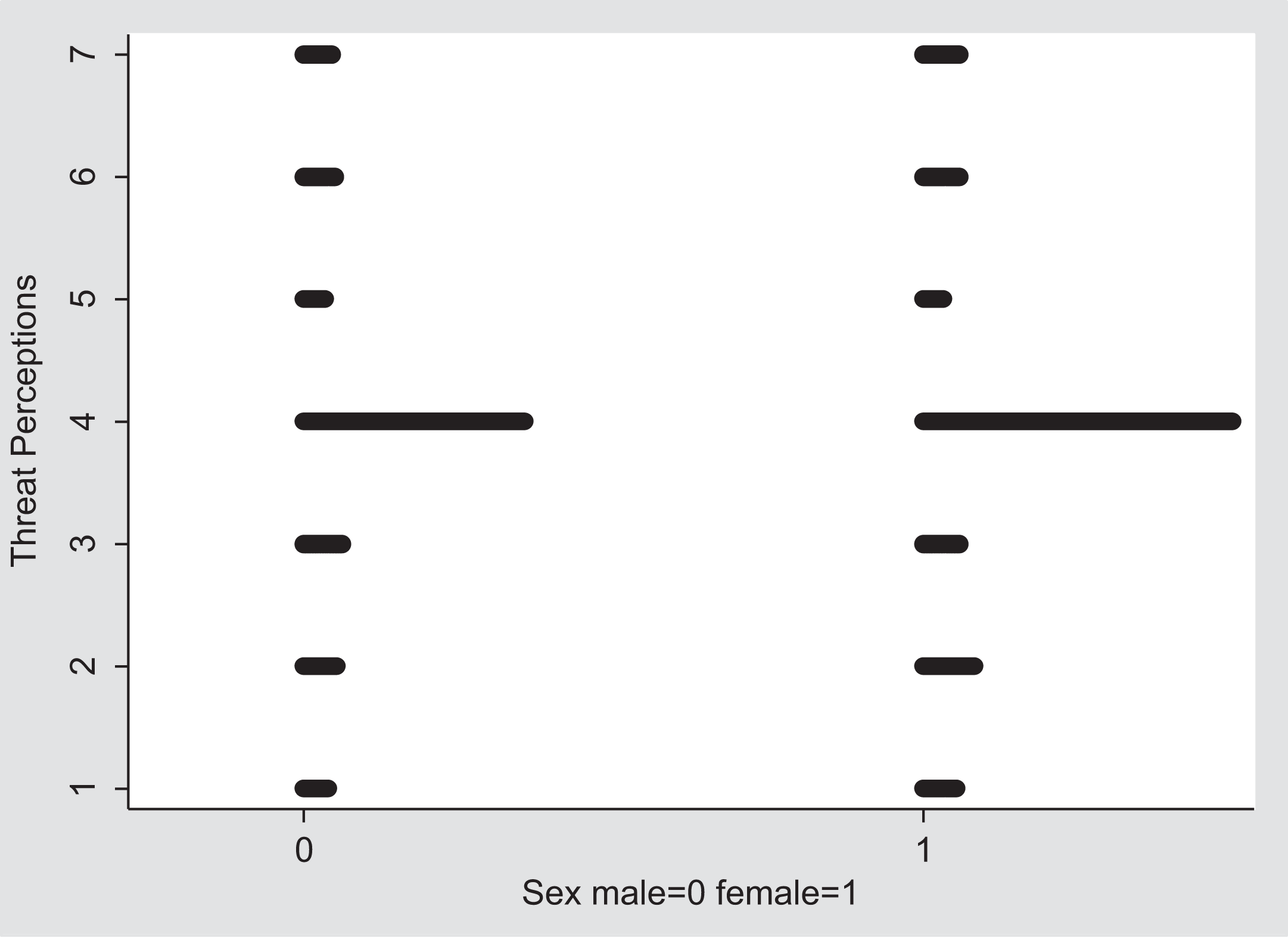
Distribution of threat perceptions by sex.
The gender gap on support for the use of torture is significant in the 2008 ANES with 40.3 percent of men supporting the use of torture compared to 35.2 percent of women. As displayed in model 1 of Table 1, women are less likely than men to support the use of torture (B = −0.40, standard error [SE] = 0.10, and p = .000). The gender gap in support for torture is not the result of gender differences in partisanship, ideology, or demographic factors. In model 2, women are still significantly less likely to support the use of torture with the inclusion of controls (B = −0.35, SE = 0.11, and p = .001). In model 3, I test the Threat Perceptions Hypothesis. As shown in models 3 and 4, the coefficient for female is no longer significant with the inclusion of threat perceptions and an interaction between female and threat perceptions without and with controls. The Sobel–Goodman mediation test in STATA shows a 60.2 percent reduction in the gender gap with the inclusion of the interaction between gender and threat perceptions. This is strong support for my hypothesis.
Torture Attitudes, Gender Differences, Mediation, and Moderation.

Note: Dependent variable measures support for the use of torture to extract information from suspected terrorists with 1 equaling support and 0 otherwise; therefore, logit is used. Variables for the missing data on ideology, religious identification, and income were included in models but not shown so as to retain more of the sample. Edu = education; Repub = Republicans; Cons = Conservatives.
+p < .10. *p < .05. **p < .01.
With respect to the control variables, race and income are not significant while age, years of education, religion, authoritarianism, partisanship, and ideology are significant predictors of torture attitudes. Older individuals are slightly less likely to support torture. The more years of education one has, the less likely he or she is to support the use of torture. Being a Protestant rather than Catholic, Jewish, or other religious identification, leads to decreased support for torture. The more authoritarian one is the more likely he or she is to support the use of torture. Republicans and Conservatives are more likely to support the use of torture.
In order to show the differential reliance on threat perceptions, I separately analyzed men and women’s support for torture. This analysis is included in model 5 of Table 1. Perceived threat is not a significant predictor of women’s attitudes toward the use of torture while it is a positive and significant predictor of men’s torture support. For the most part, these are the only substantial differences in the determinants of men’s and women’s attitudes. This provides additional evidence that men’s attitudes toward the use of torture are the result of their perceived threat while women’s attitudes are not. Greater levels of threat perceptions lead men to be more likely to support the use of torture.
Figure 2 shows the differential effect of threat perceptions for men and women. I calculated the margins using the equation from model 4 in Table 1. Marginal effects, also known as partial effects, provide the effect on the conditional mean of Y of a one-unit change in X while all other variables are held constant. 2 Simply put the marginal effect gives the probability that Y equals 1 for each level of X, which in this case is the probability of support for the use of torture for each level of threat perceptions for men and women separately. The effect of threat perceptions for men is an increase in support for torture as threat perceptions increase. Among men, believing there is an increased chance that there will be another terrorist attack leads to more support for torture. For women, the effect of threat perceptions is less clear; the probability of support for torture among women is for the most part unchanged over the span of threat perceptions. If anything, the probability of female support for the use of torture slightly decreases as threat increases, except for an increase in support only at the highest level of threat perceptions.
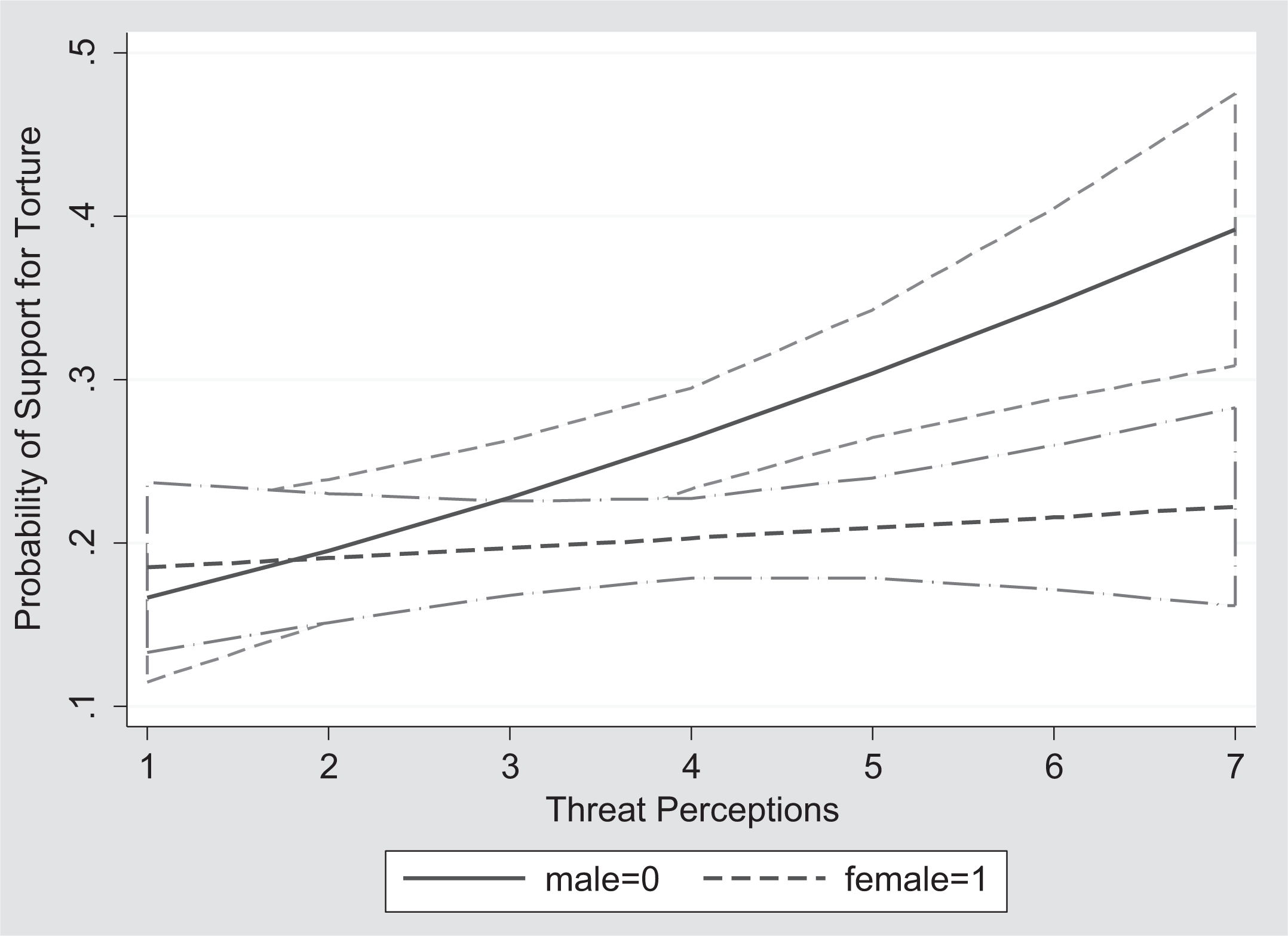
Probability of support for torture: perceived threat × gender interaction.
Figure 2 indicates that holding control variables at their means, there is a large difference between men and women in the probability of supporting the use of torture because of the differential effect of threat perceptions, particularly at higher levels of threat. The perceived threat variable ranges from 1 to 7 and higher values indicate higher levels of perceived threat. At a perceived threat level of 5, the probability of torture support for men is .30 compared to only .21 for women. At a score of 6 on the perceived threat measure, men’s probability of support for torture is .35 and for women it is only .22. Finally, at 7 on the perceived threat measure men have a probability of .39 of supporting the use of torture compared to .22 for women. These are sizable and substantively important differences in support for the use of torture with controls included in the model.
As Figure 2 shows, the differences between men and women are significant, the 95 percent confidence intervals do not overlap, at perceived threat levels of 5, 6, and 7. Again, Figure 2 shows that at the highest levels of perceived threat, gender moderates the effect of threat perceptions on support for torture. Men reporting high levels of perceived threat are significantly more likely than women reporting high levels of perceived threat to support the use of torture.
In summary, this analysis supports my hypothesis regarding threat perceptions. Men and not women appear to rely on threat perceptions. Moreover, increased threat perceptions lead men to be more likely to support the use of torture. The marginal effects indicate that the effect of threat perceptions on men and women’s torture attitudes significantly differs. For men, an increase in threat perceptions leads to a clear increase in support for the use of torture. For women, threat perceptions have much less of a clear, positive relationship with their torture attitudes. The relationship appears to be one of moderated mediation, in which the effect of perceived threat, the mediator, on support for the use of torture is moderated by gender. In other words, increased threat perceptions lead to increased support for the use of torture among men but do not have the same effect for women.
Discussion and Conclusion
Overall, the existing literature provides strong evidence for a consistent gender gap on torture attitudes. Women are less likely than men to support the use of torture. This issue gap between men and women has recently been prominent in political discussions and the media. Prior research has not provided an explanation for the origins of this gender gap.
My analysis provides strong evidence that threat perceptions clarify the origins of this gender gap. I find evidence of moderated mediation where gender moderates the effect of threat perceptions on torture attitudes. My results strongly suggest that gender differences in support for torture can be further understood by investigating the differential reliance on and differing effect of threat perceptions between men and women. Men more consistently rely on threat perceptions than women when evaluating the use of the torture. Increased threat perceptions result in greater male support but not greater female support for the use of torture.
The evidence of moderation suggests that men and women think about torture differently. My analysis cannot provide definitive evidence that men think about torture as instrumental, a means to reduce the risk of future terrorist attacks. It might be the case that men with high levels of perceived threat may see torture as a means of retribution. Theoretically, it makes more sense to think of how threat perceptions make individuals feel vulnerable and desire a way to lessen future risk. Moreover, the measure of perceived threat specifically references the threat of a future terrorist attack. Therefore, it seems more likely that these differences in support for the use of torture arise because men view it as instrumental and women do not. Men may think about torture as a means of gathering information and reducing the possibility of future terrorist attacks. Women, however, may view the use of torture very differently. Perhaps they are more likely to believe that the use of torture will lead to retaliatory terrorist attacks or that it is morally wrong. Ramos and Nincic (2011) do not mediate the gender gap finding that men are more likely to support the use of torture for retribution and to prevent future attacks while women are more likely to believe torture is morally wrong.
More work is needed to refine our understanding of why men and women at the same level of threat perception differ in their propensity to support torture. Is men’s greater support because they view it as an aggressive, retaliatory measure or as a preventive, information gathering tactic? Including measures of emotions may help to further disentangle this gender difference. Specifically, measuring anxiety may provide some insight into these gender differences in support for torture and the differential effects of threat perceptions. Anxiety results in less support for aggressive policies (Huddy et al. 2005). Perhaps, while men are more likely to rely on perceived threat, women are relying on fear when thinking about terrorism and using torture on suspected terrorists.
These findings should be used to inform future work on the gender gap in support for military interventions. Have differences in threat perceptions contributed to the gender gap in support for the Iraq and Afghanistan War? Are men’s threat perceptions leading to greater support for tougher strategies to deal with North Korea, Iran, or Syria? What about support for U.S. involvement and aid with respect to the Arab Spring, is there a gender gap in support and do differences in threat perceptions explain this gap?
Future research should explore the political implications of the gender gap on the use of torture. For instance, given the issue’s recent prominence, what is the influence of attitudes toward torture on vote choice? Were torture attitudes influential for voters in the 2008 Presidential election, the 2010 midterm election, or the 2012 Presidential election? Have these differences contributed to a gender gap in favorability toward President George W. Bush or to differences in retrospective evaluations of the Bush presidency? Will these differences influence evaluations of President Obama with respect to terrorism and Guantanamo Bay detainees? Will attitudes toward torture affect public opinion toward diplomatic relations with certain countries known to use torture?
Footnotes
Declaration of Conflicting Interests
The author declared no potential conflicts of interest with respect to the research, authorship, and/or publication of this article.
Funding
The author received no financial support for the research, authorship, and/or publication of this article.

Notes
References
Supplementary Material
Please find the following supplemental material available below.
For Open Access articles published under a Creative Commons License, all supplemental material carries the same license as the article it is associated with.
For non-Open Access articles published, all supplemental material carries a non-exclusive license, and permission requests for re-use of supplemental material or any part of supplemental material shall be sent directly to the copyright owner as specified in the copyright notice associated with the article.
