



Abstract
How do the distributional consequences of economic sanctions impact future trade policy? Regardless of whether sanctions are effective in achieving concessions, sanctions restrict international trade flows, creating rents for import-competing producers, who are protected from international competition. These rents can then be used to pressure the government to implement protectionist policies. Thus, while the lifting of sanctions directly facilitates some international transactions, sanctions also have an indirect effect. They create powerful domestic interest groups in the sanctioned country who seek market protection. I use multiple estimators to evaluate the effect of trade sanctions on tariff rates. The evidence is consistent with the argument that sanctions increase market protection in both the short and long run.
On March 18, 2014, Russian President Vladimir Putin annexed the Crimean Peninsula from Ukraine. The United States and European Union immediately condemned the annexation arguing that Russia violated Ukraine’s territorial sovereignty. They then instituted sanctions against Russia and more particularly against Russians who are part of Putin’s “inner circle.” According to the US Department of the Treasury (2014), “Yuri Kovalchuk (one of the sanction targets) is the largest single shareholder of Bank Rossiya and is also the personal banker for senior officials of the Russian Federation including Putin.” The sanctions targeted at Kovalchuk prevent Visa and MasterCard from processing payments to Rossiya Bank, Russia’s fifteenth largest bank, which controls an estimated $12 billion dollars in assets. In response to the sanctions, Putin announced that Russia will develop its own credit card system and cut foreign competitors out of the market (Anishchuk 2014).
Putin’s decision to respond to the sanctions by building up domestic substitutes for international services points to an often overlooked consequence of international economic sanctions. Because economic sanctions restrict access to foreign products in the sanctioned country, sanctions increase domestic demand for domestic products. In limiting foreign access to the market and thereby removing foreign competition, sanctions encourage the domestic provision of goods and services in which the sanctioned country lacks comparative advantage. In fact, domestic industrial products emerged to replace imports, and industrial production actually increased under sanctions in countries as diverse as South Africa, Iraq, and Yugoslavia (Selden 1999). The intuition behind the effect of sanctions is similar to the logic often applied to tariffs: they raise domestic prices and protect domestic producers who would otherwise be unable to compete with foreign producers.
This article integrates research on economic sanctions and trade policy to assess the impact of sanctions on tariff rates. By fostering domestic production of comparatively disadvantaged goods, sanctions create and empower a group of producers who seek market protection through tariffs. It is only through protection that uncompetitive firms maintain their market share. Furthermore, because sanctions often target politically important actors, sanction targets have the disproportionate ability to influence political leaders and obtain market protection. The Russian example provides a timely illustration. If Putin and his financiers plan to create a domestic credit card system, will it be competitive with global providers? The long record of import substitution industrialization demonstrates that industries created under stringent market protection are seldom competitive (e.g., Panagariya 2004). If they are uncompetitive, what will happen to the operators of the Russian credit card system once the sanctions are lifted? Will they lose market share or stop providing credit card services? Their loss of market share is unlikely. It is more likely that they will successfully pressure the Russian government for privileged access to the Russian market. After all, the United States and European Union targeted them precisely because of their political importance to the Russian regime.
I argue that sanctions directly impact markets in the short term and thereby influence economic policies long after the sanctions are lifted. Sanctions immediately limit trade flows into and out of the target country. This cessation of trade is thought to be extremely costly in its own right, enabling the government to crack down on the political opposition, undermining economic stability, particularly for women and children, and harming the environment (Lopez and Cortright 1995; Weiss et al. 1997; Allen 2008; Peksen and Drury 2010; Drury and Peksen 2012). While the immediate impact of sanctions is clearly important, existing literature neglects the long-term economic effects of sanctions. When trade flows are restricted by sanctions, exporters in the sanctioned country are no longer able to reach foreign markets and import-competing firms no longer compete with foreign firms. Sanctions have effects analogous to domestic trade barriers in the sanctioned country: they benefit import-competing firms at the expense of export firms and consumers. Consequently, sanctions redirect production away from the global market and toward meeting the demands of the domestic market. These changes increase production in comparatively disadvantaged sectors.
This distortion of production toward internationally uncompetitive industries enables producers to charge more for their products, creating rents for certain producers, who are protected from foreign competition. Protected producers may then use their rents to pressure the government to implement market restrictions, thereby protecting and perhaps even furthering their market rents in the future. In particular, import-competing firms and the owners of scarce factors seek to substitute the protection afforded by sanctions with protective policies. Furthermore, these firms demonstrate their importance during the sanction period, and they provide employment and growth during a time when many export firms are floundering. Thus, while the removal of sanctions directly facilitates cross-border trade, sanctions also have an indirect effect that may undermine these flows. Sanctions create a powerful domestic interest group in the target country who benefits from market protection and has the economic resources and political clout to secure that protection.
This article first develops a theory of how sanctions impact market restrictions. A decision-theoretic model shows how sanctions lead to market distortions that increase the production of import-competing goods and decrease the production of export goods. A game-theoretic model then illustrates how import-competing firms pressure the government for market protection. The theory is evaluated using an autoregressive distributed lag (ADL) model. The model provides estimates of the short- and long-term effects of sanctions, which is particularly important here because it is unclear precisely when the market protection will be implemented. The empirical section provides evidence consistent with the protection-inducing power of sanctions in a time-series, cross-sectional sample. The results are robust to the use of a weighted, time-series model. This article concludes with implications for future research.
Economic Sanctions and Market Protection
Economic sanctions are threats that entail economic costs, often by limiting trade or financial flows, if the sanctioned country does not concede to some demand by the sanctioning country. Based on standard economic theories, countries should export goods that they produce more efficiently than other countries and import goods that are more efficiently produced elsewhere. In other words, countries export comparatively advantaged goods. Accordingly, sanctions, which restrict the flow of goods and services across borders, reduce the production of comparatively advantaged products and increase the production of comparatively disadvantaged products in the sanctioned country. Restrictions, therefore, prevent countries from reaping the benefits of specialization. More specifically then, trade sanctions reduce competition for import-competing producers. Import-competing producers often lack comparative advantage in production, either because they lack technology or the production of their products intensively uses scarce factors of production, 1 and they have higher production costs than foreign producers. Sanctions, particularly those that provide protection from imports, benefit those producers who lack comparative advantage. Economic sanctions have an effect similar to the effect of tariffs: they reduce competition and increase prices.
In addition, economic sanctions limit the external market for export-oriented producers. Export-oriented producers often have a comparative advantage in their production, and they are able to compete with foreign producers. They are often large firms that sell their products in domestic and foreign markets (Melitz 2003). Trade sanctions restrict exports from the sanctioned country. When the sanctions are effective in limiting trade flows, export-oriented producers lose access to foreign markets. They may go out of business or substitute their normally competitive production for the production of a high-priced, protected good in which the country lacks comparative advantage. In sum, producers who compete with imports will benefit, as sanctions increase domestic prices and their profits, while exporters and consumers will be harmed, as sanctions decrease or even eliminate access to export markets and increase prices. Thus, the market distortions produced by sanctions are remarkably similar to distortions produced by tariffs (Selden 1999; Kaempfer and Lowenberg 1999). The following decision-theoretic model illustrates the impact of sanctions on export and import-competing sectors.
Market Distortions
In the model, there is one domestic producer of two goods. The goods are either import-competing or export goods.
2
For simplicity, the two goods and their production processes are unrelated. The firm’s profits are determined by quantity competition.
3
The firm determines the optimal quantity of each good to maximize its profit. The firm is a price-taker, and sanctions affect the quantities produced in the model. The firm’s profit function is
The firm chooses the quantities of import-competing and export goods to maximize the profit function:
Proposition 1 shows how sanctions distort the market. A sanctioned country will produce more products for consumption by the domestic market and fewer products for consumption abroad. This often means that they will produce more goods in which the country does not have a comparative advantage. The model provides a micro-foundation for the work by Selden (1999), which shows that sanctions stimulate the production of manufactured products. Many developing countries, who are often targeted by economic sanctions, do not have a comparative advantage in the production of manufactured goods, which may rely on advanced technology and intensive capital investment. Because the sanctions restrict the import of manufactured goods from other countries, the sanctioned country begins to produce them, albeit in an often less-efficient way than the foreign source. Sanctions are not the only kind of market protection that benefits import-competing producers. Tariffs are also an important source of market protection. The next section turns to the interaction between producers and policy makers under sanctions.
Lobbying for Protection
A second model explores the relationship between import-competing producers and policy makers. Import-competing producers are generally assumed to pressure the government for market protection, as they are less efficient than foreign producers. Sanctions increase the profits of import-competing producers, who may then use their profits to lobby for market protection. Producers in uncompetitive industries seek to replace the market protection afforded by sanctions with market protection provided by their own government. The game has two actors, the government and an import-competing firm. The market determines the amount of resources firms have for consumption, as well as for lobbying the government. The firm selects political donations, and the government selects protectionist policies. The sequence of play is as follows:
Period I
Nature determines the level of sanctions:
Firm maximizes its first period profit by selecting quantity:
Firm selects political donations,
Firm consumes all profit that was earned in Period I less political donations.
Period II
Sanctions are no longer in place in the second period,
Government determines tariff level,
Firm maximizes second period profit by selecting quantity:
Firm consumes all profit that was earned in Period II.
Note that the structure of the game enables firms to substitute tariffs for sanctions. In the first period, the firm benefits from the imposition of sanctions and can use its increased profit to lobby the government for tariffs. In the second period, the sanctions are lifted and the firm’s profits are increased by the tariffs it purchased in the first period. Although the sequencing of the model provides theoretical clarity, in reality firms may be uncertain about when sanctions will be lifted. Therefore, they are likely to lobby for protection while sanctions are in place and after they are lifted. Because the sanctions have an effect over time, the empirical specifications will make few assumptions about timing and will instead isolate short-term, long-term, and cumulative effects of sanctions.
In the first model, only sanctions increased profits; and in the second model, profits are increased by both sanctions and tariffs, as we focus exclusively on an import-competing firm. The profit of the firm in both periods is denoted by
The firm maximizes the profit function with respect to quantity:
The government derives utility from political donations, d, which it receives in exchange for implementing tariffs, t. One need not think that d always takes the form of money. d may also represent political support, in which case, the cost should be thought of in terms of effort and the expenses associated with effort, including opportunity cost or even functional costs like transportation and materials. Tariffs are also costly for the domestic population, as they raise prices for consumers. The government’s utility function takes the following form:
Model Solution
The solution concept is subgame perfect Nash equilibrium, which is appropriate when the game is sequential, as it ensures that individually rational strategies are played at every node. To solve the game, I proceed by backward induction. In the second period, the firm selects q to maximize profits:
The government selects the tariff rate to maximize his utility function:
There is no commitment problem in the model. I assume that the firm takes the government price for tariffs (in terms of campaign donations) and maximizes its utility. The firm maximizes:
Proof. Recall that
Proposition 2 provides a ceteris paribus result: given an existing balance of bargaining power between the import-competing firms, who prefer increased protection, and the country’s citizens, who prefer less protection, sanctions increase the bargaining power of the import-competing firms through their impact on profits. Import-competing firms increase their profits under sanctions, because they no longer have to compete with foreign producers, and they use these excess profits to lobby the government for more protection. The model provides an estimate of baseline protection without sanctions,
Like most trade policy research, the model presented here focuses on the unilateral selection of trade policy, where governments set trade policy in response to pressure from import-competing, domestic interest groups and consumers. Researchers have begun to evaluate the impact of multilateral institutions, which make exporters relevant to trade policy (Betz 2015; Gilligan 1997). If trade policy is set through reciprocity in multilateral negotiations, then exporters may pressure the government to concede to foreign demands for market liberalization in exchange for reciprocal liberalization elsewhere that enables the exporters to more easily serve the foreign market. Proposition 1 shows that sanctions increase the returns to production for the domestic market and decrease returns to production for foreign markets. This means that import-competing firms gain resources, while exporters lose resources under sanctions. If exporters are integral to trade liberalization as Betz (2014) and Gilligan (1997) argue, then sanctions produce market protection through yet another channel: exporters, who are relatively less powerful than before the sanctions were implemented, will have less influence to counter the protectionist pressure from the import-competing firms.
Perhaps one of the clearest examples of the protection-producing effect of sanctions comes from the Corn Laws in the United Kingdom. Although most seminal work (e.g., Schonhardt-Bailey 2006) addresses the repeal of the Corn Laws in 1846, an equally important question is how the Corn Laws became so severe in the first place. The intensification of agricultural protection in the United Kingdom was at least partially driven by American trade sanctions. The United States attempted to remain neutral during the Napoleonic Wars, reaping the gains from trade with both the United Kingdom and France. However, British forces seized American merchant ships and forced the seamen into the armed services. The violations of neutrality led to the implementation of the US Embargo Act of 1807. The embargo is an example of a sanction that forbade trade between the United States and the United Kingdom. It therefore provided protection for Britain’s landed elite, who could not compete with American wheat (which is called “corn” in the United Kingdom). Because of the protection “furnished by war” and particularly by the American embargo, corn prices in the United Kingdom mounted: from an average of 83 shillings from 1794 to 1813 to 92 shillings from 1804 to 1813 and finally to 108 shillings from 1809 to 1813 (Schonhardt-Bailey 1997, 69). The price jump was largely due to the break in trade between the United States and the United Kingdom.
When the boycott was lifted in 1809 and the war over in 1815, the British agriculturalists sought trade protection. The Corn Law of 1815 significantly deepened agricultural protection. The law prevented trade whenever the price of corn dropped below eighty shillings. The initial law solely prevented trade and it did not garner any government revenue. In 1828, the Corn Laws were amended again, providing for tariffs on imports, which produced both protection and revenue (Schonhardt-Bailey 1997, 5-6). In short, the American boycott protected British agricultural producers, driving up the cost of wheat in the United Kingdom. Once the boycott was lifted, the producers sought trade restrictions to protect their market position. The boycott strengthened the landed elite in Britain, particularly relative to the industrialists who suffered from their inability to export to the American market. The enhanced power of the landed elite helped them obtain more stringent protection in 1815.
Many scholars have identified a selection problem inherent in the implementation of sanctions: when sanctions are effective, the target country backs down before the sanctions are put in place and the sanctions are not actually observed (e.g., Smith 1996; Nooruddin 2002; Lacy and Niou 2004; Kaempfer and Lowenberg 2007). When sanctions are actually implemented, we know that the threatened sanctions were not costly enough or the interest groups that are negatively affected by the sanctions were not important enough, to force the target to back down. 8
The fact that observed sanctions have already failed to elicit concessions likely strengthens the impact of sanctions on market protection. There are two possibilities: the sanction may target (1) politically important actors or (2) politically unimportant actors. If the sanction targets politically important actors, as most sanctioners claim they do, and the consequences are sufficiently dire, then the sanctioned country will make the demanded concession and the sanction will never actually be implemented. This case does not show up in the data and has led scholars to conclude that sanctions, which are realized, are likely to target politically unimportant actors (Becker 1995; Kaempfer and Lowenberg 2007). However, sanctions may still target politically important actors, as most sanctioning countries claim, and fail to elicit concessions. If policy makers in the sanctioned country are able to compensate the politically important actors, who bear the brunt of the sanctions, then the sanctioned country may not concede even when their political supporters are hurt by the sanctions. Sanctions themselves provide policy makers with a unique opportunity: they can compensate their supporters with preferential access to the domestic market, and, particularly when targeted actors are politically important, market protection is likely to endure long after the sanctions are lifted.
When the actors who bear the cost of sanctions are not politically important, policy makers in the target country are unlikely to concede to the demands of the sanctioning country. Because competitive sectors are disproportionately hurt by sanctions, their lack of political influence also means that they will not be able to obtain their preferred trade and financial policy, which is likely more liberal than the policies preferred by their uncompetitive counterparts. In the case of the Corn Laws, the landed elite in the United Kingdom was more politically powerful than the industrialists at the end of the eighteenth century. 9 If “protection [is] for sale” (Grossman and Helpman 1994), sanctions create a potent buyer: sanctions increase the profit of uncompetitive, politically important firms.
Evidence for Sanctions and Market Protection
This section provides an empirical assessment of the hypothesis that trade sanctions are associated with higher trade protection. Trade sanction is the independent variable of interest. The Threat and Imposition of Sanctions Version 4.0 (TIES) database details every sanction implemented between 1945 and 2010 (Morgan, Bapat, and Kobayashi 2013). 10 TIES extends the prominent study conducted by Hufbauer, Schott, and Elliott (2007) and provides extensive information on the sanction type. I code new trade sanction variables for those sanctions that include a total economic embargo, a partial economic embargo, an import restriction, an export restriction, or a blockade. The variables identify those sanctions that restrict the flow of goods between countries. I code two sanction variables: Trade Sanction Count, which sums up the number of trade sanctions in place in a given target-country year, and Trade Sanction Binary, which is zero in country years without sanctions and one in country years with sanctions. The tariff rate is the dependent variable. Tariff data come from the World Bank World Development Indicators and include data from 1988 to 2012 (World Bank 2013). They are the average mean tariffs weighted by the product import shares. Table 1 provides a summary of the data. 11
Summary Statistics.

Note: MID = militarized international dispute; GDP = gross domestic product; WTO = World Trade Organization.
ADL Model
The model and preceding discussion raise important questions regarding the impact of sanctions: when are the effects of sanctions realized and how long do the effects endure? Recall that the US embargo of the United Kingdom did not immediately increase protection, but it eventually led to an intensification of the Corn Laws, increasing the equilibrium amount of agricultural protection. The ADL model is particularly attractive for answering duration questions. The ADL provides an estimate of the impact of sanctions in both the short term and the long term. The ADL is a general version of a static model: by including a lag structure for both the independent and dependent variables, it imposes fewer restrictions on the relationship between them (N. Beck and Katz 2011, 346). I estimate the model:

where
I control for the regime type of the country from the Polity index (Marshall, Jaggers, and Gurr 2013), 13 because sanctions and tariffs could be associated with regime type. 14 I also control for the number of checks (and balances) in the political system and for government turnover (T. Beck et al. 2001). 15 Checks help capture veto player arguments about policy stasis. The inclusion of government turnover in the model provides a particularly hard test for the theory, because sanctions could affect economic policy by undermining political support for economically liberal leaders. I control for gross domestic product (GDP) per capita (purchasing power parity converted to GDP per capita in thousands of dollars, derived from growth rates, at 2005 constant prices) from the Penn World Tables (Heston, Summers, and Aten 2012), as wealthy countries might be particularly costly sanction targets. I also control for membership in the World Trade Organization (WTO website).
Table 2 reports the results from numerous specifications. Column (1) reports the results from a simple dynamic model, which includes the lagged dependent variable but only includes the sanctions variable from the present period and, thus, does not facilitate the estimation of the impact of sanctions over time. Column (2) reports the simple dynamic model with a number of controls. Columns (3) and (4) report the results from feasible generalized least squares models, which account for heteroscedasticity and autocorrelation. Columns (5) and (6) report the results of the ADL model (minimalist and with controls, respectively), and the LRM is included at the bottom of the table. In all models, trade sanctions are positively correlated with tariff rates, and the correlation holds in the ADL models both in the short and long run. The LRM of trade sanctions is significant at the 5 percent level in the model with controls. We can think of the LRM as the total effect that sanctions have on tariff rates. Here the total effect is significant and not insubstantial. An increase in one trade sanction is correlated with an increase in the tariff level by over 0.5 percentage points in the model with controls. The average tariff level in the sample is 7.6 percent. Thus, a one-unit increase in trade sanctions increases average tariff rates by almost 7 percent. The within-country standard deviation in the tariff rate is 7.14 percent. One sanction is correlated with an increase in the tariff rate in the long run by one-fourteenth of a standard deviation. Figure 1 provides a graphic representation of the effects of sanctions over time. The graph shows that the estimated effect of trade sanctions is quite rapid: most of the increase in tariffs associated with trade sanctions is felt in the first period. The consequences of trade sanctions may be particularly prompt, because governments can quickly manipulate tariff rates.
Trade Sanctions and Tariff Rates.

Note: t statistics in parentheses; OLS and ADL analyses include robust standard errors, clustered by country, and country fixed effects. FGLS specifies a heteroscedastic error structure and panel specific AR(1) autocorrelation. LRM = long-run multiplier; GDP = gross domestic product; WTO = World Trade Organization; LS = least squares; OLS = ordinary least squares; ADL = autoregressive distributed lag; FGLS = feasible generalized least squares; AR = autoregressive.
*p = .10. **p = .05. ***p = .01 (two-tailed test).
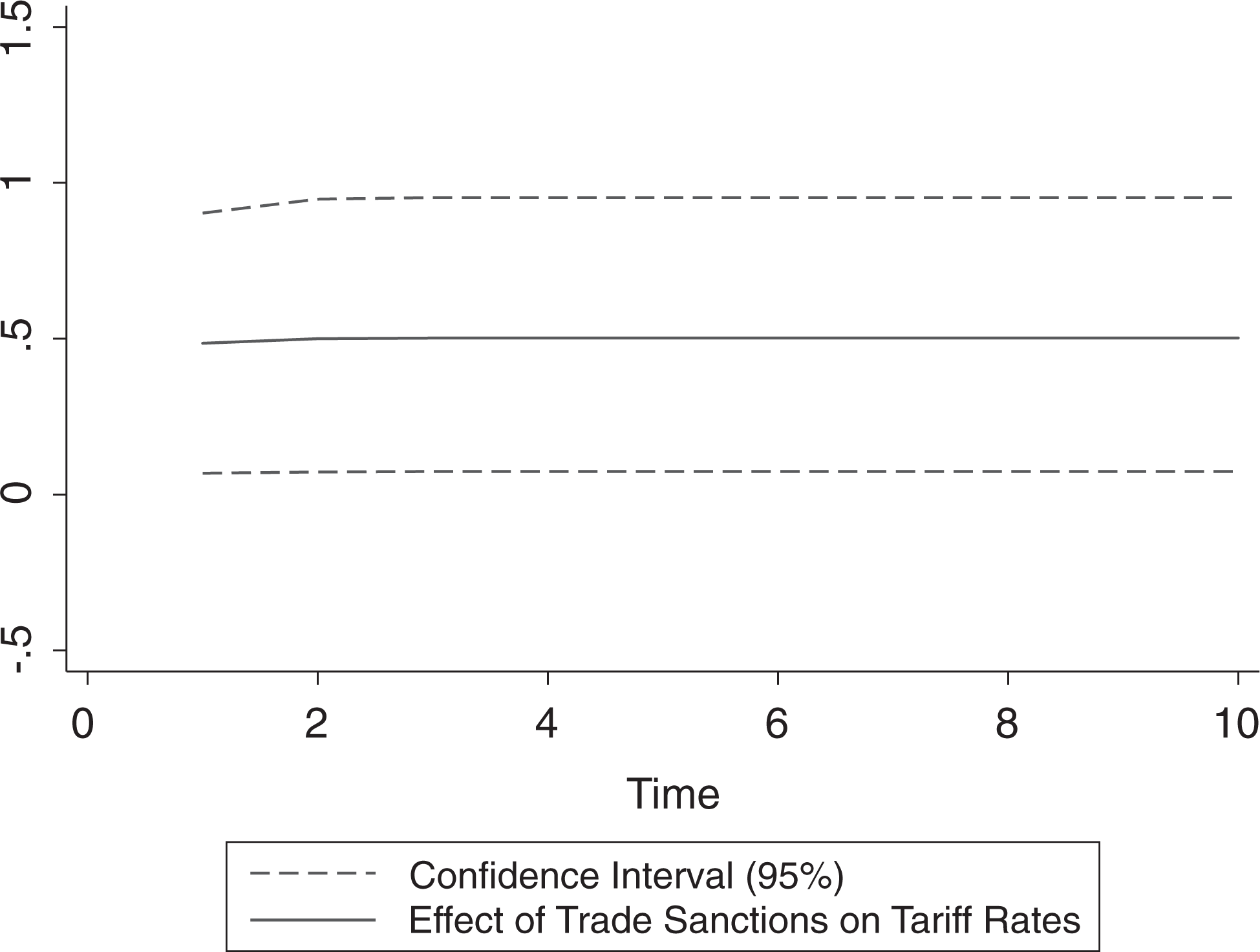
Effect of trade sanctions over time.
Weighted, Time-series Model
This section assesses the robustness of the ADL results using an alternative specification suggested by Blackwell and Glynn (2013) and Robins, Hernán, and Brumback (2000). The discussion of the method will adhere to the experimental terminology used by the authors, where treatment is the presence of a trade sanction, and control is the absence of a sanction. First, the authors recommend weighing the treatment variable by the inverse probability of treatment, which transforms the sample population to replicate the actual population and helps account for confounding variables. Second, they recommend calculating two treatment variables: a “blip” variable that captures the effect of one treatment period and a “cumulative” variable that captures the effect of a treatment that is in place for an extended period. The coefficient on the cumulative variable captures the effect of one more year of sanctions, given that sanctions have already been in place for a number of years. These estimates are particularly useful, because they have similar substantive interpretations to the short- and long-run effects from the ADL but are computed differently.
The inverse probability of treatment is used to weigh the treatment in the estimate of the treatment’s impact on the dependent variable. In the analysis here, the dependent variable is the tariff rate in the sanctioned country.

The numerator in equation (2) gives the probability of treatment, sanctions here, conditional on a treatment history for the estimator (
I use a logistic regression model to estimate the binary probability of treatment:

I include the following controls,
I then use the weighted regression to estimate the impact of sanctions on market protection:

Like Blackwell and Glynn (2013), I am interested in both the immediate and cumulative effects of sanctions, and I retain the individual sanctions variable,
The results of the weighted, time-series model are displayed in Table 3. Column (1) reports the findings from the logistic regression model used to compute the denominator of the weights. Column (2) reports the weighted regression of trade sanctions on tariff rates. The immediate or blip effect of trade sanctions on tariffs is positive, but the effect is insignificant by conventional standards. The cumulative effect of trade sanctions is also positive and is significant at the 5 percent level. In order to estimate the total effect of sanctions, one would need to sum up the blip (2.50) and cumulative effect (0.32) for each year sanctions are in place (on average, they are in place for 5.3 years). The total effect of trade sanctions based on the weighted model is to increase the tariff rate by 3.88 percent, 18 which is a 50 percent increase in the average tariff rate (7.64 percent is the average tariff in the sample). Thus, using two distinct empirical specifications, sanctions are correlated with higher tariff rates. Although the estimated impact of trade sanctions is about seven times larger in the weighted model than the LRM in the error correction model, both findings are consistent with the hypothesis that trade sanctions produce greater market protection.
Weighted, Time-series Model.

Note: t statistics in parentheses; models include linear and quadratic time trends and use robust standard errors, clustered by country. MID = militarized international dispute; GDP = gross domestic product; WTO = World Trade Organization; OLS = ordinary least squares.
*p = .10. **p = .05. ***p = .01.
Conclusion
This article identifies several negative consequences of sanctions. Sanctions directly limit trade flows with targeted countries, which reduce competition and access to the global market. The reduction in foreign competition in the targeted country results in economic distortions that are similar to those induced by tariffs: producers shift production to comparatively disadvantaged sectors, and profits accrue to uncompetitive producers, who are no longer forced to compete with international producers. At the same time, the reduction in access to the global market harms exporters and consumers. The distributional consequences of sanctions impact the relative bargaining power of interest groups within the sanctioned country, creating new and empowering existing special interest groups that seek market protection. Empirical models provide evidence that is consistent with the theory. Trade sanctions are correlated with higher tariff rates.
The protection-inducing effect of sanctions is particularly problematic in light of overwhelming evidence that international trade provides economic benefits to countries as a whole. David Ricardo laid the theoretical foundation for the benefits of free trade centuries ago: “Under a system of perfectly free commerce, each country naturally devotes its capital and labor to such employments as are most beneficial to each. This pursuit of individual advantage is admirably connected with the universal good of the whole” (1817, 133-34). More recently, scholars have tried to quantify the size of these benefits. Using geography as an instrument for trade flows to exclude confounding variables and isolate the direct effect of trade, Frankel and Romer find that a one percentage point increase in trade raises per person income by 2 percent (1999, 387). The benefits of trade are now widely accepted, 19 and increasing international trade liberalization has become an important foreign policy goal in its own right. This article provides evidence that sanctions undermine liberalization, as they create political incentives for increased market protection in sanctioned countries.
In addition to the negative effects of trade restrictions associated with economic sanctions, political scientists have reached a consensus that observed economic sanctions are unlikely to succeed. In fact, sanctions fail to elicit concessions between 65 and 95 percent of the time (Hufbauer, Schott, and Elliott 2007; Pape 1997). Sanctions are successful, when the sanctioned country concedes to the demands of the sanctioning country. These sanctions are often unobservable, because the concession is made before the sanction is actually implemented. Few policy makers expect observed sanctions, particularly those that endure for many years, to succeed in achieving concessions. Instead, these sanctions are implemented, because the leaders of the sanctioning country benefit politically from the sanctions (Smith 1996). Unsuccessful sanctions are implemented for largely “symbolic” reasons (Lindsay 1986), particularly when the media publicize human rights abuses (Peksen, Peterson, and Drury 2014) and citizens demand action but are unwilling to pay the cost of military intervention.
Economic sanctions are often thought to be attractive policy tools, because they are perceived as less costly than other alternatives for the sanctioning country (Lopez and Cortright 1995). However, it is likely that policy makers have underestimated the cost of sanctions. Economic sanctions are not only costly due to their immediate restriction of trade flows, they also lead to long-term restrictions in international economic relations. According to most modern economic theories, increased market protection is detrimental to competition, efficiency, and growth. In deciding whether to implement sanctions, policy makers must consider how effective the sanctions are likely to be in achieving policy concessions, as well as the costs of the sanctions for producers and consumers, not only while the sanctions are in place but long after the sanctions are lifted. These costs may outweigh the benefits of the sanction, particularly in those cases where the sanctions are largely symbolic and carry little hope of success.
Footnotes
Acknowledgments
I would like to thank Timm Betz, William Clark, Robert Franzese, James Morrow, and Irfan Nooruddin for their invaluable comments and suggestions.
Declaration of Conflicting Interests
The author declared no potential conflicts of interest with respect to the research, authorship, and/or publication of this article.
Funding
The author received no financial support for the research, authorship, and/or publication of this article.

Notes
References
Supplementary Material
Please find the following supplemental material available below.
For Open Access articles published under a Creative Commons License, all supplemental material carries the same license as the article it is associated with.
For non-Open Access articles published, all supplemental material carries a non-exclusive license, and permission requests for re-use of supplemental material or any part of supplemental material shall be sent directly to the copyright owner as specified in the copyright notice associated with the article.
