




Abstract
The level of female representation has been found to lead to lower military spending and a lower level of state aggression. However, I argue that previous work has largely overlooked the impact of the international system on these three domestic characteristics. Specifically, the presence of an external threat from an interstate rival increases military spending, increases state aggression, and lowers female representation. Tests of this theory on democratic states from the years 1981 to 2007 find that the level of female representation decreases in states involved in an interstate rivalry and has a greater effect on female representation than factors routinely found to influence female representation. This article brings the international system into the discussion of factors that influence female representation while adding to previous literature on how the international system influences domestic politics.
The assumption of men as warriors and women as pacifists is long standing and extends across states. States where women have greater access to political power have been found to spend less on their military (Koch and Fulton 2011), are less likely to use violence to handle international disputes (Caprioli and Boyer 2001; Regan and Paskeviciute 2003), and have a more humanitarian and less militarized foreign policy (Brysk and Mehta 2014). In addition, the gender gap in support for the use of military force to handle international issues lends support to the idea that women are more pacific than men (see Nincic and Nincic 2002; Burris 2008). These findings indicate that increased female political power arguably leads to a more pacific foreign policy. These studies treat a state’s foreign policy as largely a domestic decision, focusing on the gender composition of the state’s political leaders as the primary determinants of its international actions. However, the amount a state spends on its military and how it interacts with other states are not only exclusively driven by domestic politics but also a response to the international security environment. Specifically, being in an interstate rivalry influences a state’s level of military spending and its level of conflict behavior.
The presence of an interstate rival creates a hostile and conflictual environment in which the state must operate within. Crises within a rivalry are likely to involve higher stakes and are more prone to conflict due to lack of trust between the two states. (Richardson 1939; Goertz and Diehl 1993; Thompson 2001). In response to the constant threat of conflict, the state allocates more of its resources to the military causing military spending to increase (Nordhaus, Oneal, and Russett 2011; Hensel 1999). As a state places greater emphasis on maintaining its security and diverting more resources toward its defense, it becomes increasingly militarized. Militarization of the state impacts the gendered roles men and women are expected to play, subsequently leading to women having less political power (Enloe 1983; Tickner 1992; Reardon 1996). Women’s exclusion from political power is a repercussion of increasing militarization to maintain security. Thus, a state’s level of military spending, level of conflict behavior, and level of female representation are all effects of the presence of an ongoing security threat from an interstate rival. Subsequently, these three state characteristics are all partially consequences of the international system.
This article argues that female representation is not simply a product of domestic characteristics but a result of the international security environment a state operates within, specifically the influence of a rivalry on the election of women. By focusing on the influence of the rivalry on female representation, this article adds to previous work that contends that domestic politics are influenced by the international system (see Gourevitch 1978). The fear of war leads to the socialization of men and women to play different roles to combat the threat, perpetuating the stereotypical beliefs of men and women’s ability to maintain security. When security dominates, the agenda voters are likely to prefer male candidates due to the perception that men are more capable of maintaining security (Tickner 1992; Reardon 1996). Political parties respond to voter preferences for male leaders by running fewer female candidates, subsequently leading to a lower level of female representation compared with states lacking an ongoing security threat from an interstate rival.
This article begins with a discussion of the steps by which a national security threat of an interstate rival leads to a lower level of female representation. From this discussion, a hypothesis is derived concerning the relationship between involvement in an interstate rivalry female representation in a state, which is then tested against alternative explanations among ninety-eight states from 1981 to 2007. Important implications of the finding that security threats influence female representation are discussed in the conclusion.
Rivalry and Salience of National Security
Previous scholars have asserted the importance of the international system on shaping domestics politics. Gourevitch (1978) argued that states transform their internal structures in a way that allows them to meet any external threat. Tilly (1985) later emphasized the importance of war on the creation of the state. In order to effectively fight wars, states must create domestic institutions that can extract resources from their citizens. The state must be able to raise funds to support the military through the collection of taxes and have the power to compel citizens to serve in the military. In order to accomplish these tasks, the state must strengthen and centralize (Tilly 1985). The threat of war stems from the international system; ergo, the international system helps shape domestic structures.
However, it is not the war fighting per se that prompts the state to reorganize; the threat of war alone can alter domestic structures, so the state can thwart the external threat (Centeno 2002; Thies 2005). Within a rivalry, based on past experiences, there is the anticipation of future relations between the two states being hostile. Even benign actions can be perceived as aggressive due to the high levels of mistrust. Subsequently, the threat of conflict is high, leading the state in a rivalry to allocate more of its resources to the military (Hensel 1999; Gibler 2010). The hostile environment created by the rivalry also makes national security a primary state concern resulting in national security becoming a salient issue within domestic politics (Hensel 1999). The persistent threat of conflict compels the state to alter its institutions and internal structures so that it can deter or quickly end any armed conflict that may occur. Consequently, being in a rivalry influences a state’s domestic institutions and can influence the organization of society more generally.
National Security and Gender Roles
The threat of conflict increases group cohesion, pulling group members together in order to meet the threat from the out-group (Coser 1956; Simmel 1955). In addition to increasing group cohesion, a threat to national security requires members of society to play their part and fulfill their civic duty to ensure security of the state (Simmel 1955; Hutchison 2011). The assigned roles for members of society during times of security threat traditionally fall down gendered lines. For men, this means being prepared to fight their countries’ war (Tickner 1992; Elshtain 1995; Goldstein 2001). For women, fulfilling their civic duty means supporting the war effort as wives, mothers, and nurses (Enloe 1983; Tickner 1992; Elshtain 1995; Klein 1998; Mathers 2013). Mothers are expected to raise sons and willingly send them off to war (Ruddick 1989; Elshtain 1995; Kwon 2001). Wives are expected to take care of the domestic affairs so that their husbands can focus on war fighting (Enloe 1983). Nurses are expected to not only care for the wounded but also look feminine and attractive while in the midst of war (Enloe 1983; Norman 1990). Women support the war fighting in various ways while men are expected to carry out the actual combat. This idea was articulated well by Judge Dudley of the US District Court for the Southern District of New York in the debate on drafting women when he stated, “The teachings of history show that if the nation is to survive, men must provide the first line of defense while women keep the home fires burning” (Kerber 1993, 99). The gender roles of warfare have remained relatively consistent over time and have been found across states (Goldstein 2001).
Due to the different roles men and women are expected to fulfill, preparing for war solidifies the differences of the two genders (Tickner 1992; Goldstein 2001). The military is overwhelming a male domain, and military training helps socialize recruits to view men and women as different. Drill sergeants call the new recruits “woman” and “pussies” to try and humiliate the man and draw a clear distinction between the two genders (Enloe 1983; Goldstein 2001; Rashid 2009; Tickner 1992). Once the possibility of war casts a shadow over everyday life, men and women are forced into their roles (Goldstein 2001). A state in an interstate rivalry is under constant threat of militarized conflict and must be prepared to respond quickly creating concrete expectations for the two genders. The distinct roles men and women are expected to fulfill in preparing and engaging in warfare subsequently impacts the perceived suitability of men and women to handle various issues within society.
Since the military and national defense is predominately a male domain, men are commonly perceived as more competent in running the military and attending to national security (Lawless 2004; Falk and Kenski 2006). Women are expected to play supporting roles, such as mothers, wives, and nurses, as the state prepares and engages in conflict. Subsequently, women are viewed as better suited to handle compassion issues such as child and elder care, education, and ensuring the rights of minorities (Sapiro 1981–1982; Rosenwasser et al. 1987; Huddy and Terkildsen 1993). Thus, the gendered nature of national security not only impacts the roles men and women are expected to play but also the issue areas the two genders are believed to be innately better at handling.
The gender roles of national security influence the belief that men are better at handling military and national security affairs; however, differences in support for the use of military force may help maintain this stereotype. Women tend to be less supportive of using military force when compared to men. The gender gap in support for military force has been routinely present in the United States (Smith 1984; Nincic and Nincic 2002; Burris 2008) and cross-nationally (Wilcox, Hewitt, and Allsop 1996; Tessler and Warriner 1997). In addition, women are more likely to support cutting military spending (Togeby 1994; Clark and Clark 2008). 1 Due to the great importance of security, to both the state and the individual, when national security is a pressing concern voters are going to support candidates and leaders they view as most able to maintain their security. Women are seen as less capable than men to maintain security due to close association of men with the military and national defense and the belief that they will cut military spending and weaken the state’s defenses. These beliefs about women can impede women winning elections in states with a salient national security threat, such as states involved in an interstate rivalry.
Rivalries, Voting, and Female Candidates
When running for political office, candidates must convince the voters that they can handle the most pressing issues facing the state. Consequently, candidates in states involved in an interstate rivalry must convince voters that they can maintain national security. Candidates unable to indicate this ability will have difficulty winning the election. For instance, incumbents viewed as overly cooperative with an interstate rival or that do not adequately respond with force to increased rival hostility are more likely to be voted out of office (Colaresi 2004). These office holders were viewed as putting the national security at risk and lost voter support.
Female candidates will have greater difficulty convincing voters they can maintain security because of the widely held stereotypes about women’s innate abilities. The ability to handle security and military affairs has been found to influence voter support for candidates running for the national legislature. Survey research in the United States found that Congressional candidates seen as competent in handling military affairs were more likely to gain voter support (Huddy and Terkildsen 1993). Female candidates for the national legislature are aware that a portion of the public perceives them as deficient in military and security affairs and subsequently ill-suited to hold political office. Recently, a US Senate staffer stated, “Women want to get on defense and foreign policy committees to establish their credibility on the issue” (Swers 2007, 581). On the campaign trail when national security is a salient concern, female candidates will emphasis that they are supportive of the military in an attempt to overcome their perceived deficit. For example, Senator Mary Landrieu’s campaign used camouflage “Military Mary” bumper stickers to signify Senator Landrieu’s continued support for the military (Swers 2007). However, the committees, bill sponsorship, and campaign strategies of female candidates are unlikely to completely remove the perception that they are less capable than male candidates to handle military and security affairs. Even if female candidates act tough, talk in manly speech, and are described as possessing masculine qualities, they are still unlikely to be viewed as capable of handling military and national security affairs (Rosenwasser et al., 1987; Gedalya, Herzog, and Shamir 2011).
Due to the high saliency of national security, the perception that women are unsuitable to handle military and security affairs will make it difficult for female candidates to win voter support in states involved in a rivalry. If political parties are concerned that female candidates will be unable to garner much voter support, they will be hesitant to run female candidates in the first place. Combined with a state’s domestic institutions and voter support, the number of female candidates political parties run dictates a state’s level of female representation.
Parties, Voters, Institutions, and Female Representation
Political parties typically want more power, which means they want to maximize their seat share in the national legislature. Political parties must run candidates that the voters will support in order to win more seats and maximize their power. To win voters, the candidate must be seen as qualified to hold political office. Typically, this means the candidate must have a certain level of education and professional experience. Possessing the education and work experience to be seen as qualified to hold office is one factor that influences the differences in female representation seen cross-nationally. This is particularly problematic for women in less developed states since they often do not receive the same level of education as men and are commonly excluded from the paid workforce (Inglehart and Norris 2003). Therefore, women in these states typically lack the necessary qualifications to hold political office creating a smaller pool of qualified female candidates for parties to select from. This leads to lower level of female representation in less developed states compared to developed states (Michael 1985; Ross 2008). However, even if women and men are educated and in the paid workforce at equal rates, a state’s level of female representation can be lower due to its institutional design.
Politics has traditionally been a male domain with male party leaders largely determining who becomes a candidate. Running more women means that the party has to run fewer men, which they are often reluctant to do. Maria Antonieta Saa, a Chilean legislator, articulated this well when she stated, “Parties have no interest in having more women: to have more women would mean losing men” (Hinojosa 2012, 1). This mind-set is particularly problematic in single member districts (SMD) since it is a winner-take all system. However, proportional representational (PR) systems allow for multiple winners, which mean running a woman does not exclude male candidates from also running and parties are less hesitant to run female candidates. Consequently, female representation has been found to be higher in states that use PR systems compared to SMD (Rule 1987; Matland and Brown 1992; Kittilson 2006). Thus, a state’s level of development and electoral system influence political parties’ decision to run female candidates; however, pressure from voters for greater female representation also impacts the candidate selection.
Typically, party leaders do not run more female candidates on their own volition since running more women means unseating men. Therefore, parties run more female candidates when there is an incentive, such as capturing a larger voting block, to do so. Traditionally, women are the ones pushing for greater female representation and are more likely to vote for female candidates (Dolan 2008). However, being in a rivalry alters the willingness of female voters to support female candidates. Due to the heightened fear of conflict in states in a rivalry, voters want leaders that can maintain security and handle military affairs, which mean male candidates will be preferred over female candidates. While this is true for both male and female voters, women appear to be most affected by security threats. Women have been found to be more fearful of the possibility of future conflict (Carroll 2008; Merolla and Zechmeister 2009). Therefore, when security dominates the agenda, female voters are likely to prefer male candidates and shy away from voting for female candidates.
This shift can have a large impact on the ability of women to win election since traditionally female voters are more supportive of female candidates than male voters (Brians 2005; Dolan 2008; Hinojosa 2012). Part of the explanation for why women are typically more supportive of female candidates is due to women, both voters and candidate, being more concerned with issues such as welfare, child care, and women’s health. However, these issue areas are all domestic, issues that are lower priority in the presence of a national security threat from a rival. Security trumps all other concerns including the level of female representation. For this reason, male candidates are likely to receive a large share of voter support, from both male and female voters. The shift in support of female candidates influences the willingness of political parties to run female candidates.
The process in which being in a rivalry influences female representation is summarized in Figure 1. Each state has a pool of qualified candidates from which political parties select whom to run for office. Once candidates are chosen, a state’s electoral system translates vote share into seat share and candidates into representatives. This in turn determines the level of female representation. Being in a rivalry influences female representation in two interrelated ways. First, voters are less supportive of female candidates. Second, the decreased support for female candidates leads political parties to select male candidates. These two factors combine to lead to a lower level of female representation in states with an ongoing security threat. Because of the female candidate reduction, even if a voter wanted to vote for a female candidate they often will not have the opportunity. Therefore, it is hypothesized that states involved in an interstate rivalry will have a lower level of female representation compared to states not involved in an interstate rivalry.
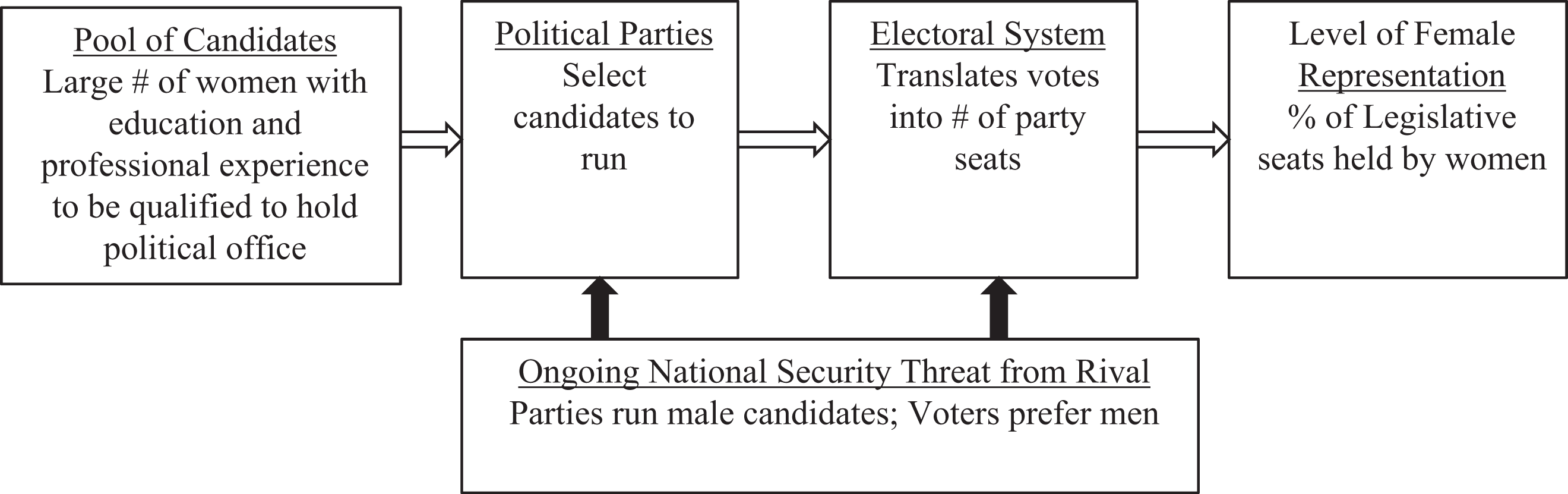
The influence of rivalry involvement on the political process.
Data and Methods
Sample
The theory put forth argues that female representation will be lower in states involved in a rivalry compared to states not involved in a rivalry through two interrelated mechanism: less demand for female political leaders and the subsequent running of fewer female candidates. It is not uncommon for less democratic states to have women in the legislature; however, representatives are unlikely to gain office through free and fair elections. Legislators in less democratic states may obtain their seats through elections, but the candidates may have to be approved by a central government body or the political parties may have to join a regime-supportive front in order to submit a list (Gandhi 2008). In these systems, the parties are not able to operate freely and select any individual as a candidate. This implies that the state is democratic and has free and fair elections, and women have the right to fully participate in the democratic process. Therefore, the hypothesis is tested using twenty-one consolidated democracies. A list of these states is included in the Online Appendix. These states all have a long history of free and fair elections, and the influence of involvement in a rivalry on female representation is expected to manifest in these states. In addition, these are the same states used in Koch and Fulton’s (2011) study allowing the results in this article to more fully engage with their findings. However, Koch and Fulton include Israel in their sample, which is excluded in this study. In terms of rivalries, Israel is an outlier having as many as five rivals in the sample while the most any other state in the sample has is two. It is excluded in this study to help ensure that the findings are driven purely from the influence of Israel. 2
Arguably, however, the influence of rivalry on the election of women is likely to appear in democratic states more broadly defined. As a robustness check, the hypothesis is tested on a broader sample of democratic states. In order to be included in the broader sample, a state must score six or greater on the polity scale and score two or greater on women’s political rights scale (Cingranelli and Richards 2008). A score of two indicates that women are guaranteed by law the right to vote, run for office, hold government positions, join political parties, and petition government officials, but they may be moderately prohibited from exercising those rights in practice. Using these criteria creates a sample of 105 democratic states.
Dependent Variable
To test the influence of being in a rivalry on the election of women, the percentage of seats of the national parliament held by women is used as the dependent variable. 3 The rational for using this measure as opposed to directly testing the number of female candidates in each state in the sample is twofold. First, reliable data on candidates for the states in the sample across the time frame are largely unavailable. Second, the percentage of female-held seats in the national legislature is the outcome of the two mechanisms previously discussed. Without a high number of female candidates, there cannot be a high level of female representations. In addition, less voter support for the female candidates that parties do run will result in the female candidates largely being unsuccessful in the election, creating a low level of female representation. These two mechanisms combined result in lower levels of female representation in states involved in a rivalry compared to states not involved in a rivalry.
Independent Variables
The primary explanatory variable is whether a state is involved in an interstate rivalry. Unlike interstate wars or militarized interstate disputes (MIDs), rivalries produce long-standing national security threats. An MID, no matter how hostile the action, can subside within a matter of days. Fifty percent of MIDs end in a week and 90 percent terminate within a year (Ghosn, Palmer, and Bremer 2004). Interstate wars, while typically longer than MIDs, often conclude within a few years after the start of hostilities. Seventy-five percent end within two years and only 5 percent lasting past five years (Bennett and Stam 1996). The duration and conflict-prone environment created by an interstate rivalry alters domestic structures and influences domestic politics having a larger impact on the state. While involvement in an interstate war can influence elections (Grose and Oppenheimer 2007; Kriner and Shen 2007), the war is unlikely to be ongoing through multiple elections. Once the war has ended, national security is no longer a salient domestic issue and thus will not influence the selection and support for female candidates. A national security threat that is present for a long period of time is expected to decrease female representation due to the mechanical effect of stereotypical attitudes of men’s and women’s ability on voter preferences. An interstate rivalry brings national security to the forefront of the public mind for an extended period and has been found to influence voting behavior (Colaresi 2004, 2014). Subsequently, interstate rivalry is utilized to capture an ongoing national security threat.
Koch and Fulton (2011) include a measure of conflict behavior in their article on the link between women’s political power, military spending, and conflict. They use Goldstein’s (1992) measure of opposing conflict behavior, which is the average weighted conflict score directed at the state. Their findings indicate that a state’s opposing conflict behavior does not influence female representation. However, a state’s conflict behavior fluctuates greatly over a matter of years and consequently is unlikely to have a continuing influence on elections, particularly the election of women. In addition, the measure of conflict behavior ends in 1992. Koch and Fulton (2011) recognize this limitation and run a separate model without the conflict behavior measure and include a dichotomous variable indicating the post–Cold War period. They find that female representation increases in the post–Cold War period, indicating that women are more likely to gain access to the legislature as the security threat from the Cold War declines. This finding lends support to the proposed theory in this article that women have difficulty winning elections when security dominates the agenda as well as the influence of interstate rivalry on female representation.
I employ the conceptualization of rivalry as presented by Thompson (2001). In order to be in a rivalry, the actors must regard the other state as a competitor, an enemy, and an explicit threat with each side having the expectation that future interactions may become militarized (Thompson 2001; Colaresi, Rasler, and Thompson 2007; Colaresi 2004, 2014). The actions of the rival are looked upon with suspicion, inferring that all actions taken by the other are inherently hostile and directed toward them. Within the rivalry, some level of distrust or conflict between the two states becomes a norm. This often leads to relatively benign events, such as military maneuvers by a rival, to escalate to interstate violence (Colaresi and Thompson 2002).
The measure of rivalry created by Thompson (2001) was chosen over Klein, Goertz, and Diehl (2006) due to the lower severity threshold to be considered a rivalry in Klein, Goertz, and Diehl’s measure. For instance, multiple skirmishes over fishing rights can be considered a rivalry in Klein, Goertz, and Diehl’s data set. The theory put forth argues that an ongoing security threat from a rival influences voter preferences for male candidates and political leaders. It is unlikely that the lower severity issues, such as fishing rights, will elicit a severe enough security threat to shift vote choice away from female candidates. For this reason, the rivalry measure in Thompson and Dreyer (2011) is utilized.
To first test the influence of rivalries on female representation, a dichotomous Rivalry variable is used. This variable signifies if the state is involved in a rivalry for each year. Rivalry does not account for the number of rivalries a state is involved in. All states in rivalry, regardless of the amount of rivalries, are coded as 1. However, the number of rivalries can also influence female representation. For instance, the election of women in the United States with tow rivals may be altered more than in South Korea, which only has one rival. For this reason, a second measure of rivalry is used, Total Rivalry. The Total Rivalry measure is the number of rivalries a state is involved in each year. In the sample, the maximum number of rivals a state has in a given year is two. In the sample of twenty-one consolidated states, there are 64 observations of two rivals, 104 observations with a single rival, and 888 without any rivals.
Control Variables
Past research has found multiple factors that help explain the variation seen in female representation cross-nationally and will be included in the model. The use of gender quotas has been shown to increase the level of female representation, specifically when national level quotas such as reserved seats or a legislated quota, as opposed to voluntary party quotas, are used (Jones 1998, 2009; Schwindt-Bayer 2009). 4 Reserved seats and legislated quotas are commonly referred to as constitutional or legal quotas since they are created when a new constitution is established or with the passage of a national law (Krook 2014). Data for the Constitutional/Legal Quota measure are from the Global Database of Quotas for women. 5 The variable corresponds to the percentage of seats reserved for women if reserved seats are in place. If legislated candidate quotas are used, the variable corresponds to the percentage of candidates that must be women. For example, the Constitutional/Legal Quota measure for Argentina beginning in 1991 when the legislated candidate quota was adopted equals thirty, the percentage of all party lists that must be comprised of women. Beginning in 1997, 3 percent of Kenya’s legislative seats are reserved for women, thus from 1997, the Constitutional/Legal Quota variable for Kenya is three.
Different electoral systems have been found to influence female representation. PR systems allow for multiple candidates to run for office, making running a woman less of a risk. Thus, states using a PR system have been found to have higher levels of female representation compared to SMD (Rule 1987; Kittilson 2006). In addition, PR systems with closed-list candidate selection are largely controlled by the party and have been found conducive to higher levels of female representation (Rule 1987; Matland and Brown 1992). For this reason, a dichotomous variable, PR, is coded as 1 for a state that uses a PR system, and a dichotomous variable, Closed List, is coded as 1 for states that use closed-list proportional systems are included in the model. 6 Political ideology of parties has been found to influence the selection of female candidates and the subsequent level of female representation. Parties with a leftist ideology typically have a higher number of female candidates and female representation (Caul 1999; Kenworthy and Malami 1999). Therefore, a measure of Leftist Government is also included in the model. 7
Along with institutional factors, the supply of potential female candidates with the education and professional experience to be seen as qualified to hold political office also influences female representation. A measure of women of the percentage of the labor force comprised of women, Female Labor Force, is included in the model along with the percentage of higher education students, Female Education, to control for the supply of qualified female candidates. 8 Women’s involvement in the paid workforce and their ability to obtain higher education not only gauges the supply of qualified female candidates but also captures gender equality within the state. Women are unlikely to engage in the paid workforce or be able to obtain high levels of education in states where women are not viewed as equal to men. Consequently, women in the workforce and in higher education have been utilized as measures of state gender equality (see Caprioli 2005; Melander 2005). Thus, the inclusion of these variables helps measure the overall gender equality of the state. However, data for these variables for the broader democratic of 105 states contain many missing values. Therefore, level of development as measured by logged gross domestic product (GDP) per capita is used in the place of female education and female labor force participation in the broader democratic sample of 105 states. Level of development is highly correlated with women’s access to higher education and the paid workforce and has been utilized in previous work as a proxy for the women in higher education and the paid workforce (e.g., Bush 2011).
An additional domestic factor that influences female representation is the predominant religion of the state’s population. The paternalistic nature of Islam and Catholicism has been shown to have a negative impact on female representation (Kenworthy and Malami 1999). Variables indicating the percentage of the population that is Catholic or Muslim are included as control variables. 9 The creation of the Convention to Eliminate all Forms of Discrimination Against Women (CEDAW) has placed increased female representation on the international agenda and created an international goal of equality of genders including equal representation. Women’s status in states that have ratified CEDAW has been found to improve (Cole 2013). Since the improvement of women’s rights does occur immediately but gradually increases in these states, a measure of years since a state has ratified CEDAW, Years since CEDAW Ratification, is included in the model.
The ratification of CEDAW can influence women’s status and female representation domestically, but the creation of CEDAW has had a broader impact on women’s status globally. CEDAW helped bring women’s rights and female underrepresentation into the spotlight, placing it on the international agenda. Consequently, we might expect female representation to increase following the creation of CEDAW in 1980 even if a state did not ratify CEDAW due to changes in international norms. To help control for the influence of the creation of CEDAW on female representation globally, a variable Years since CEDAW Creation is included that measures the years since CEDAW was created. The level of female power and societal standing may influence women’s ability to win elections; therefore, as a robustness check, additional measures of women’s status are included. The variables include political characteristics such as if the state has a Female Chief Executive and the number of Years since the First Women MP was elected and measures of women’s societal standing, including Women’s Economic Rights, Women’s Political Rights, and Women’s Societal Rights. 10 The results for the models with additional measures of women’s status are included in the Online Appendix.
Table 1 presents the descriptive statistics of the nondichotomous variables. In addition, Table 1 also compares female representation between states involved in rivalry and states not involved in a rivalry. On average, female representation is lower in states in a rivalry. More specifically, the average female representation in states in a rivalry is statistically different than the average female representation in states not involved in a rivalry. 11
Descriptive Statistics.
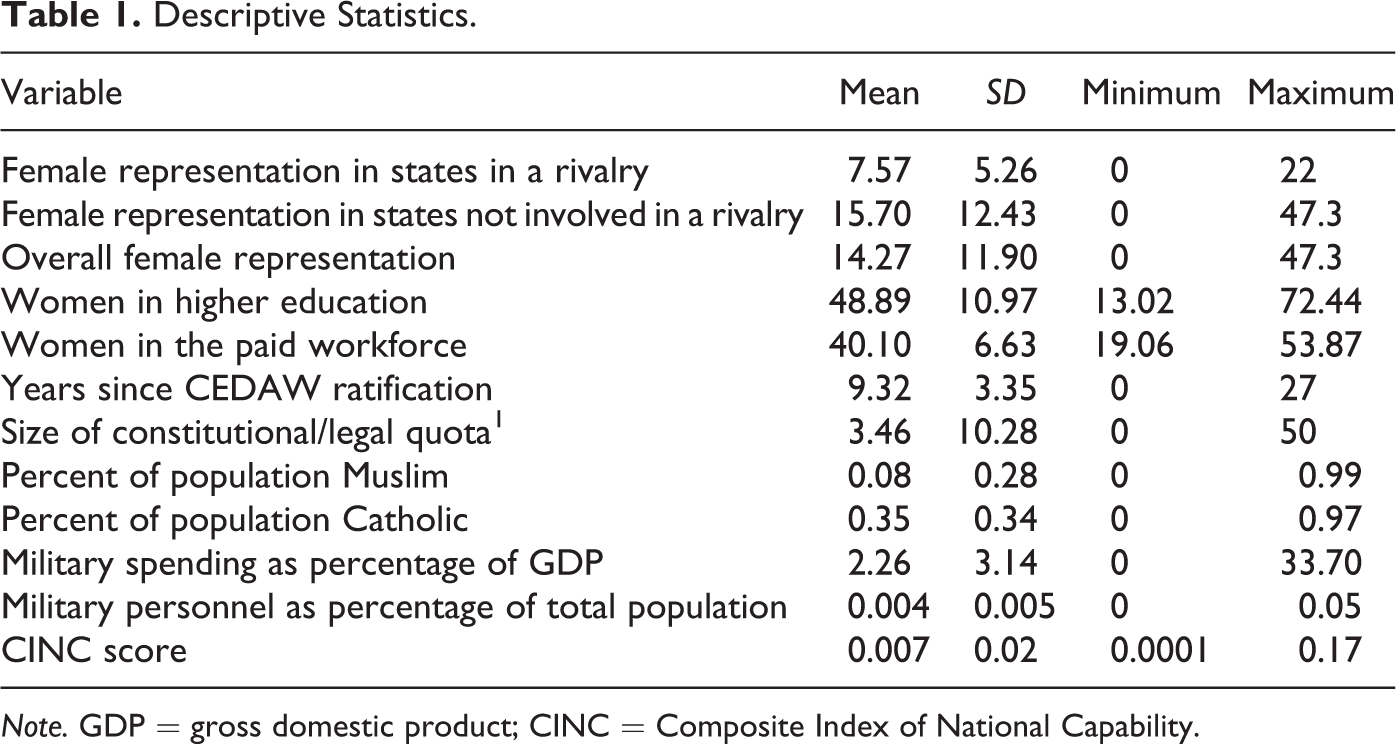
Note. GDP = gross domestic product; CINC = Composite Index of National Capability.
Method
This article argues that the ongoing security threat from a rival influences the selection and voter support of female candidates resulting in lower levels of female representation. However, previous research has found that as female representation increases in a state, its foreign policy preferences change (Brysk and Mehta 2014), and its interactions with other states become less hostile and conflictual (Caprioli and Boyer 2001; Koch and Fulton 2011). While the previous studies do not measure the influence of female representation on involvement in an interstate rivalry, it can easily be argued that the level of women’s political power in a state also influences the likelihood that the state will be involved in an interstate rivalry. Therefore, involvement in an interstate rivalry and the level of female representation are likely endogenous, and they are necessary to purge the endogenous components to more accurately access the influence of rivalry on female representation. I address the issue of endogeneity by adopting an instrumental variable (IV) approach, utilizing a two-stage least square estimation with IV-2SLS. The IV-2SLS model statistically addresses the issue of reverse causality by purging the endogenous components. This leads to unbiased estimators and a more assessment of the relationship between variables (Baum, Schaffer, and Stillman 2007). While the adoption of the IV-2SLS is rather straightforward, the difficulty is finding valid IVs. A valid IV is one that is correlated with the endogenous variable of interstate rivalry but is uncorrelated with female representation in general.
To identify valid instruments, I draw on the literature on the influence of rivalry on militarization of the state. Wallace (1979, 5) first identified a link between rivalry and the collection of arms, arguing that arms race “result from the competitive pressure of the military rivalry itself, and not from domestic forces exogenous to this rivalry.” Others have argued that the interactive competition between rivals leads to higher levels of military spending and enlarging of military forces (Diehl and Crescenzi 1998; Hensel 1999; Gibler, Rider, and Hutchison 2005). In their work on what influences military spending, Nordhaus, Oneal, and Russett (2011) found that the spending of an adversary greatly influences a state’s level of military spending. From these studies, it is apparent that military spending, size of the military, and a state’s national capability to fight wars are strongly linked to the involvement in an interstate rivalry. Therefore, I use measures of a state’s Military Spending, Military Personnel, and national capacity (CINC) as IVs. 12 Military Spending is the percentage of a state’s GDP that goes toward its military, and Military Personnel is the percentage of the total population in the military. The CINC variable is a state’s Composite Index of National Capability score. The validity of these instruments is assessed through multiple diagnostic tests, which are further discussed in the results section.
Results
In the first-stage models, estimation of the endogenous variables is conducted using the previously discussed instruments. I report the first-stage diagnostics tests that assess the validity of the instruments in Table 2. The first diagnostic test of the instruments I use is the Stock–Yogo weak identification test (Stock and Yogo 2005). Since I specify clustering in my models, a Wald F statistic derived from the Kleibergen–Paap rk statistic is used to test for weak instruments. 13 The Kleibergen–Paap F statistic must exceed the Stock–Yogo critical value of 6.46, which is used for cases of three IVs and one endogenous regressor (Stock and Yogo 2005). As the first-stage diagnostics show in Table 2, the Kleibergen–Paap F statistic exceeds the critical value for each endogenous regressor, rejecting the null hypothesis that the instruments are weak. The second diagnostic test uses the Hansen’s J statistic. This statistic indicates whether the instruments independently predict the second-stage models’ error (see Baum, Schaffer, and Stillman 2007). In Table 2, I report the p values of the Hansen’s J statistic for each model. None of these statistics near statistical significance giving further confirmation that the instruments are valid.
Influence of Rivalry on Female Representation.

Note. GDP = gross domestic product; PR = proportional representational; CEDAW = Convention to Eliminate all Forms of Discrimination Against Women.
**P < .01.
*P < .05.
Table 2 also displays the second-stage results of the IV estimation. Female representation is expected to be lower in states involved in a rivalry compared to states not involved in a rivalry. Models 1 and 3 report the influence of involvement in a rivalry, regardless of the number of rivalries, on female representation. As expected, the Rivalry variable is negative and statistically significant (.05 level). This result indicates that female representation is lower, on average, in states involved in an interstate rivalry compared to states not involved in a rivalry, supporting the hypothesis. This result holds for both samples. Models 2 and 4 further test the influence of rivalry on female representation using the total number of rivalries a state is involved in. Across both samples, Total Rivalry has a negative and statistically significant (.05) influence on female representation. This means that as the number of rivalries a state is involved in increases female representation decreases on average. This finding further supports the hypothesis that female representation will be lower in states involved in a rivalry compared to states not involved in a rivalry. 14
In terms of the control variables, the models are relatively consistent with previous research. Institutional characteristics of the state behave somewhat as expected. For instance, PR is positive and statistically significant (.05) across all four models, indicating that female representation is higher in states using a PR system. Likewise, Leftist Government is positive and statistically significant in models 3 and 4, supporting the claim that leftist governments are more conducive to women in politics. 15 The influence of the creation of CEDAW is expected to have a positive influence on female representation due to changing international norms regarding women in politics. The variable Years since CEDAW Creation is positive and statistically significant indicating that female representation has increased over the years since CEDAW was created. While the creation of CEDAW has a positive influence on female representation, the actual ratification of the convention does not appear to have an independent influence on female representation as expected.
As expected, the supply of qualified female candidates, as indicated by Level of Development, influences female representation. On average, as development increases, female representation also increases. This finding is consistent with previous findings. Looking at more specific indicators of the pool of qualified candidates, Women in the Paid Labor Force and Women in Higher Education, we see mixed results. Women in Higher Education is positive and statistically significant, whereas Women in the Paid Labor Force fails to reach significance. Workforce experience is often a prerequisite to holding political office, but it likely depends on the type of experience. What type of professional experience is relevant for holding office is likely to vary across states, which may explain the lack of relationship between women in the labor force and female representation. As expected, the percentage of Catholics in the population is negative and statistically significant. However, there is no relationship between Muslims in the population and female representation. This result is likely due to the sample. As Fish (2002) notes, Islam and authoritarian states are closely associated with one another, and this is evident within the sample of democracies used in this study. For the 105 states included in the sample, the average percentage of the population that is Muslim is 8 percent compared to 40 percent in the less democratic states excluded in the sample and 25 percent cross-nationally. Thus, the lack of a relationship between the percentage of Muslims in the population is likely a result that the democratic states in the sample have low level of Muslims in their population.
Returning to the result that involvement in a rivalry leads to lower levels of female representation, to further illustrate the influence of rivalry involvement on the election of women I generate and compare the marginal effects of Total Rivalries on female representation in consolidated democracies. 16 The predicted margins are displayed in Table 3 and are plotted in Figure 2. With all variables held at their mean, the average expected female representation in a state not involved in a rivalry is 19 percent. However, the expected percentage of the legislature comprised of women drops by 9 percent for a state involved in a single rivalry, and female representation is expected to decline even more to 6 percent for a state involved in two rivalries. While more rivals arguably make national security an even greater priority than one rival, involvement even in a single rivalry has notable consequents for female representation. Studies have found that as women hold 20 to 40 percent of legislative seats, legislative behavior is altered and policy outcomes change with more women’s issues legislation being passed (see Kanter 1977; Dahlerup 1988; O’Regan 2000). Female representation, on average, is predicted to be 10 percent for states involved in a rivalry, much lower than the level many have found to make substantive changes to policy outcomes. Subsequently, when security dominates the agenda not only is female representation lower, but this can also influence women’s lives more broadly.
Marginal Effects of Total Rivalries on Female Representation.
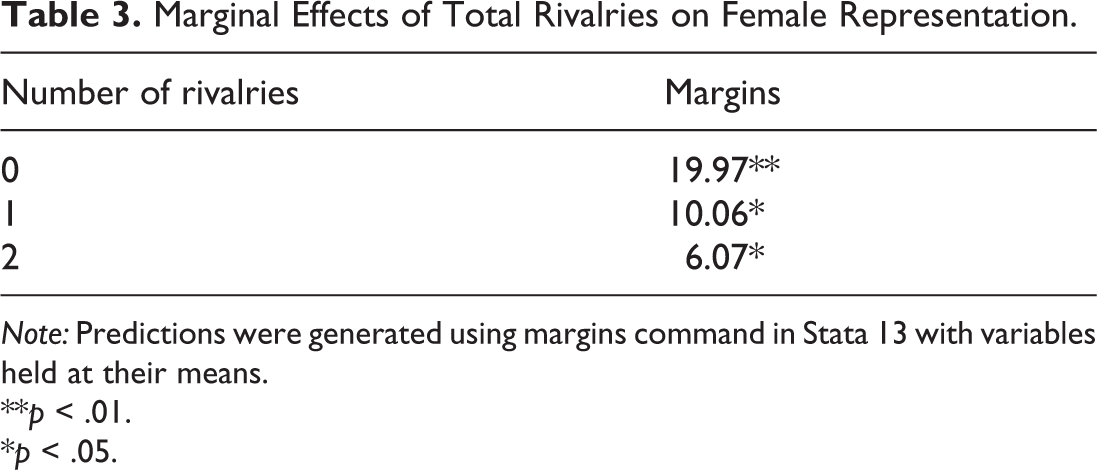
Note: Predictions were generated using margins command in Stata 13 with variables held at their means.
**p < .01.
*p < .05.
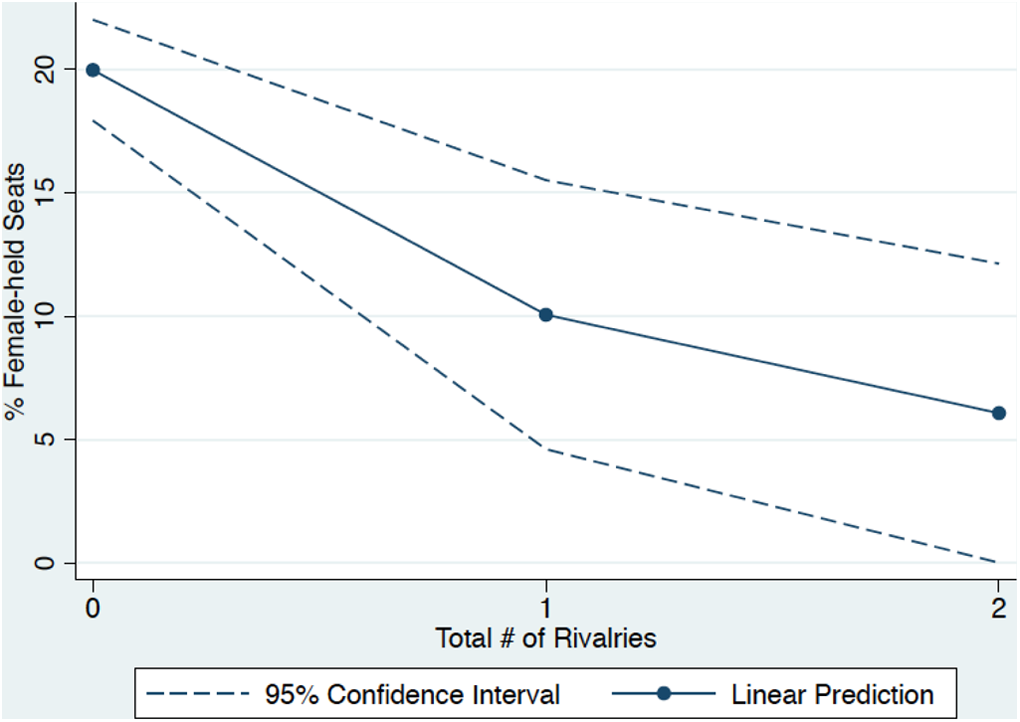
Influence of total rivalries on female representation.
Discussion
The findings help us better understand the variation of female representation seen cross-nationally as well as further demonstrate the influence of international system on domestic politics. The findings from this article indicate that the level of female representation in a state is not purely a product of domestic characteristics. In states involved in a rivalry, women remain disadvantaged in winning elections even when the domestic environment would suggest otherwise. The rational for the ability of men to rise to the top of the political hierarchy hinges on the perception of innate abilities of both men and women. Men are perceived as being better able to handle military affairs due to the close association of military experience, particularly combat experience, with men. The association of men with combat experience makes it difficult for women to win elections in states involved in a rivalry.
In these states, the threat to security is unlikely to diminish quickly, if at all, and women’s representation is expected to remain low. However, the impact of the national security threat from the rival does not end at impeding women to win seats in the national legislature. Women running for chief executive are likely to be affected as well. As the number of female chief executives increases cross-nationally, women living in states involved in a rivalry may have difficulty breaking the glass ceiling. Women have led a state involved in a rivalry, such as Indira Gandhi (India), Benazir Bhutto (Pakistan), Golda Meir (Israel), and Park Geun-hye (South Korea), but of the twenty-two current female executives, Park is the only one to head a state involved in a rivalry. 17
Women running for the position of chief executive in states involved in a rivalry may face an even larger challenge than women running for the legislature due to the nature of the office. As chief executive, you are also typically commander-in-chief, a position many may feel a woman is unqualified to hold. Tzipi Livni, the leader of the Kadima party, experienced this in the 2009 Israeli elections, often having her ability to handle Israel’s security questioned. Her opponent stated she did not have the experience to handle the national security issues Israel faced (Gedalya, Herzog, and Shamir 2011). The Israeli media stated, “This is war lady, not a time for learning” (Gedalya, Herzog, and Shamir 2011, 170), implying that Livni lacked the experience needed to maintain Israeli security. Thus, national security threats emanating from a rival are likely to influence women in politics at all levels.
Conclusion
The finding that involvement in a rivalry negatively impacts the election of women means that female representation is not simply a product of domestic characteristics such as religion, level of development, or electoral system but is influenced by the international system. In addition, the implications of an ongoing security threat for women are likely to reach further than the degree to which they have descriptive representation. As previously noted, women are more likely to initiate and support legislation such as paid maternity leave, access to contraceptives, and equal pay that can give women the same prospects as men for obtaining higher education and meaningful employment (Swers 1998; Bratton and Haynie 1999; Schwindt-Bayer 2006). These policies or lack of these policies influence the level of gender equality of the state. With a smaller portion of the legislature comprised of women in states involved in a rivalry, legislation that can improve women’s lives and decrease gender inequality is less likely to be passed.
Rivalry involvement can impact gender inequality through the election of fewer female political leaders, but a rivalry can also have a less discernable influence of the level of gender inequality in society. In states where the chance of interstate conflict is high, the citizens are called upon to do their part to ensure security. For men, this means serving in the military. With military service comes rewards, including greater societal standing, respect, as well as access to better jobs and high political office, subsequently leading to greater gender inequality (Moon 1998). Gender inequality, to varying degrees, is seen in all states. Traditionally, the level of gender inequality has been attributed to a state’s domestic characteristics such as its religiosity and level of development (Inglehart and Norris 2003). However, it can be argued an inherent state characteristics, gender inequality, has its roots in the international system. Gender inequality is a by-product of the threat of conflict.
In order to more fully test this claim, more research on the relationship between national security threats and female representation as well as gender equality is needed. For instance, looking in depth at states involved in a rivalry can allow for a more thorough examination of the mechanisms of how an ongoing security threat leads to lower levels of female representation. Do women have lower rates of electoral success when security dominates the agenda and do we see fewer female candidates in these states? Subnational research can help test these questions and further refine our theoretical understanding of this process.
The research in this article is but one way to investigate the relationship between security threats and female representation. Further research is needed in order to understand how security threats impact women including conditional effects of different types of security threats. For instance, should we expect an external security threat, such as a rivalry, to have the same effect on female representation and gender equality more broadly as an internal security threat? Within internal security threats, there is a great deal of variation, which could have different effects on women. For instance, does a civil war effect female representation and gender equality in the same way as high levels of violent crime? These questions all relate back to the initial question asked in this article: when security dominates the agenda, do women have difficulty winning elections? There is a great deal more to be learned in order to fully answer this question.
Footnotes
Acknowledgments
The author would like to thank Daniel Morey, Clayton Thyne, Tiffany Barnes, Mark Peffley, Caroline Hartzell, Marc Hutchison, and the participants of the 2013 Journeys in World Politics Workshop for comments on earlier drafts.
Declaration of Conflicting Interests
The author declared no potential conflicts of interest with respect to the research, authorship, and/or publication of this article.
Funding
The author received no financial support for the research, authorship, and/or publication of this article.

Notes
References
Supplementary Material
Please find the following supplemental material available below.
For Open Access articles published under a Creative Commons License, all supplemental material carries the same license as the article it is associated with.
For non-Open Access articles published, all supplemental material carries a non-exclusive license, and permission requests for re-use of supplemental material or any part of supplemental material shall be sent directly to the copyright owner as specified in the copyright notice associated with the article.
