



Abstract
This study aims to explain the pattern of contributions to NATO’s military campaign in Libya. It combines collective action theory with hypotheses on balance of threat, alliance politics, and domestic constraints in a multicausal framework, which is tested with qualitative comparative analysis. The results suggest novel inferences on the interactions between partisan politics, and the benefits states wish to secure by contributing to a multilateral operation. Contrary to conventional wisdom, parties situated at the left of the ideological spectrum were more inclined to support Operation Unified Protector than parties situated at the right. Whereas left-wing governments participated if they had the resources to contribute significantly to the fulfillment of the protection mandate and either highly valued their alliance with the United States or were not facing imminent elections, right-wing governments only contributed if their countries’ interests were threatened by the crisis in Libya or their participation was critical for the operation’s success.
While every alliance member voted for the Libya mission, less than half have participated at all, and fewer than a third have been willing to participate in the strike mission. (Robert Gates 2011)
This study provides a comprehensive analysis of the distribution of the burden of Operation Unified Protector. This is accomplished by combining collective action theory with hypotheses on balance of threats, alliance politics, and domestic constraints in a multicausal framework, which is tested with fuzzy set qualitative comparative analysis (fsQCA) (Thiem and Haesebrouck 2015 and Haesebrouck 2015 for a similar research design). The results of the analysis suggest novel inferences on the specific interactions between partisan politics and the benefits states wish to secure by contributing to a multilateral operation. Contrary to conventional wisdom, parties situated at the left of the ideological spectrum were more inclined to support unified protector than parties situated at the right. Whereas left-wing governments participated if they had the resources to contribute significantly to the fulfillment of the protection mandate and either highly valued their alliance with the United States or were not facing imminent elections, right-wing governments only contributed if their countries’ interests were threatened by the crisis in Libya or their participation was critical for the operation’s success.
The structure of this article is as follows. The first section describes how the division of the burden of the Libya campaign deviates from NATO’s previous out-of-area missions. The second section builds on the comprehensive body of literature on military burden sharing to develop an integrated model for explaining the diverging levels of support to the operation. The third section introduces QCA as an appropriate method to test this model and discusses the measurement of the variables. The fourth section presents the results of the analysis, which are interpreted against the backdrop of the theoretical model in the fourth section.
NATO Burden Sharing and Operation Unified Protector
In many respects, the Libya campaign deviates from NATO’s previous out-of-area operations. Up till Unified Protector, the United States had taken the lead and carried the brunt of the burden of all the alliance’s major combat operations (Michaels 2011, 57). It contributed the bulk of the necessary capabilities and flew over 65 percent of the strike operations during NATO’s first major combat operations: Operation Deliberate Force in Bosnia and Operation Allied Force in Kosovo (Forster and Cimbala 2005, 135). The operation in Afghanistan did not suggest a more equitable burden sharing relationship. Not only did the United States contribute 60 percent of the deployed units, many of the allies placed significant caveats on the use of their armed forces (Saideman and Auerswald 2012). The United States carried an even larger share of the burden when it took the lead of a coalition of the willing. For example, it contributed around 70 percent of the military resources of the 1991 Desert Storm coalition and conducted 90 percent of air strikes during the first three months of the 2014 operation against Islamic state (Cohen and Scheinmann 2014). 2
The disproportionately large contributions of the United States to NATO’s out-of-area operations is in line with collective action theory, which has been dominating research on military burden sharing ever since the seminal article of Olson and Zeckhauser (1966). The latter introduced the “exploitation hypothesis,” which expects “the ‘larger’ members […] to bear a disproportionate share of the burden” (Olson and Zeckhauser 1966, 268). The underlying assumption is that military operations produce public benefits from which noncontributors cannot be excluded. Given the United States’ overwhelming military power, it is generally capable of achieving the goals of an operation without the help of the other allies (Bennett, Lepgold, and Unger 1994, 72). Since the latter cannot be denied the benefits of a successful operation, they have an opportunity to ride free on the United States’ efforts. While the exploitation hypothesis accounts for the disproportionally large contributions of the United States, previous studies concluded that it cannot explain why “America’s allies make rather costly contributions when they could have taken a free ride off American military might” (Davidson 2011, 5; Bennett, Lepgold, and Unger 1994, 72). Such anomalous lack of free riding is generally explained by the alliance-dependence hypothesis, which contends that states contribute to US-led operations because they are dependent on the United States’ security guarantee and fear abandonment from Washington if they do not contribute.
The burden sharing dynamics of the Libya operation can be expected to deviate from this general pattern. Although the United States dominated the first ten days of the operation, it withdrew its fighter aircraft after barely two weeks (Chivviss 2014, 65). The United States kept providing critical military capabilities to the operation, but the other allies had to shoulder a far larger share of its burden compared to previous NATO operations (Hallams and Schreer 2012, 321; Chivviss 2014, 89, 190-91). Furthermore, Washington did not take the lead of the operation. In consequence, the other NATO allies were less likely to assume that the United States’ security guarantee depended on participation in the operation. Moreover, the Libya operation ran parallel with NATO’s International Security Assistance Force (ISAF) operation in Afghanistan. Therefore, the allies that are most dependent on the United States’ security guarantee had already fulfilled their alliance obligations as well as stretched their military resources. In consequence, the Libya operation constitutes a least-likely case for the alliance-dependence hypothesis.
While deviating from previous cases of NATO burden sharing, the Libya campaign might constitute a more representative case of future operations. Given the United States’ intention to “rebalance” Asia, it will be increasingly reluctant to assume a leading role in operations in and around Europe (Biscop 2015, 170). 3 In consequence, the operation constitutes a valuable case for arriving at a more comprehensive understanding of alliance burden sharing. Unfortunately, previous research on the Libya campaign has mostly been limited to atheoretical case studies of a small number of NATO allies, which do not systematically relate back to the rich theoretical literature on military burden sharing.
Integrated Model NATO Burden Sharing
This section introduces the study’s theoretical framework, which builds on the sizable academic literature on military burden sharing. The latter has been dominated by quantitative studies that assess the explanatory value of two competing collective action based theories: the pure public goods model and the joint product model (e.g., Sandler 1993; Sandler and Shimizu 2014). Following the research of Bennett, Lepgold, and Unger (1994), an increasing number of case-oriented studies developed integrated decision models to explain contributions to specific out-of-area operations (e.g., Auerswald 2004; Baltrusaitis 2010; Davidson 2011). Although these studies relate back to collective action theory, they consistently conclude that contributions result from a complex interplay between domestic and international variables.
Collective Action
The first theoretical accounts of military burden sharing characterized defense as a public good and, therefore, expected “the ‘larger’ members […] to bear a disproportionate share of the burden” of collective defense efforts (cf. supra; Olson and Zeckhauser 1966, 268). Public good explanations are expected to be applicable to the Libya operation (Sandler and Shimizu 2014, 48). One of the issues that pushed NATO to intervene was Qaddafi’s atrocious repression of the popular uprising (Davidson 2013, 311-12). All countries with an interest in enforcing the responsibility to protect (R2P) can be expected to benefit from stopping such mass atrocities, regardless of whether they participated in the operation (Shimizu and Sandler 2002, 655). Since the R2P doctrine enjoys widespread support among the NATO members, the protection of the Libyan population represents an alliance-wide public benefit. 4
The majority of the studies that focus on specific operations refer back to the exploitation hypothesis, although they commonly refer to it as the “collective action hypothesis” (Oma 2012, 563). However, these studies generally conclude that collective action theory only explains the disproportionately large contribution of the United States (Lepgold, Unger, and Bennett 1997, 349; Davidson 2011, 2; Baltrusaitis 2010, 21). Since the latter is generally capable of successfully conducting an operation by itself, the efforts of the other allies are not expected to produce more collective benefits. Hereby, these studies imply a “threshold effect,” which suggests that military operations are lumpy goods (Jones and Thompson 1990, 463). In the case of lumpy goods, “a target or threshold (K) must be achieved for any member of a group to benefit from a collective effort, beyond that threshold, no member benefits from additional effort” (Thompson 1987, 436).
Out-of-area operations indeed resemble lumpy goods: states only benefit if enough resources are applied to allow an operation to achieve its goals, additional contributions will not produce more benefits once the required resources are available. An actor is expected to contribute to the production of a lumpy good if the aggregation of the contributions of other actors does not make his or her donation unnecessary. Once Washington commits to an operation, other states have no incentive to contribute to secure public benefits because they can expect the United States to be able to achieve the operation’s goals without their help (Bennett, Lepgold, and Unger 1994, 72). However, if the United States limits its military role, as it did during the Libya operation, the lumpy goods condition predicts that other allies will increase their contribution to compensate for this reduction (Thompson 1987, 442). An actor is expected to contribute to the production of a lumpy good if it is capable of making a contribution that increases the probability that the good will be produced, at a cost that does not exceed the good’s expected benefits (Thompson 1987, 436; Jones and Thompson 1990, 475). In line with the exploitation hypothesis, allies with sufficient resources to contribute significantly to the fulfillment of the operation’s mandate can thus be expected to compensate for the United States’ reduced commitment by carrying a larger share of its burden. Smaller allies are still expected to take a free ride, since they can only have a modest impact on the probability that the operation will be successful.
Two general approaches have been used to define a country’s ability to contribute. The first takes into account the total amount of material resources from which a country can potentially draw, generally equated with its economic size or gross domestic product (GDP); the second more narrowly focuses on military capabilities (Shimizu and Sandler 2002, 661; Baltrusaitis 2010). Although both measures are interrelated, they have different empirical implications and are therefore not fully interchangeable. Evidently, a country’s military resources are a priori limited by its material resources. However, military capabilities also depend on the share of these resources devoted to defense. Many large NATO allies only spend a relatively small portion of their GDP on defense, whereas military expenditures amount to a considerable share of the GDP of some smaller member states (Sandler and Shimizu 2014, 50). This study therefore considers economic size and military spending to be two distinct conditions, which allow to distinguish between their causal effects and determine the actual source of alliance free riding.
The collective action hypothesis expects countries with a high GDP and significant military spending to carry a high share of the burden of the Libya operation.
Balance of Threat
The “balance of threat hypothesis” offers a second plausible explanation for the division of the burden of out-of-area operations. Building on Stephen Walt’s (1987) neorealist theory of alliance formation, several studies expect contributions to correlate with the extent to which the target of an operation poses a threat to the states’ interests (Bennett, Lepgold, and Unger 1994, 42; Baltrusaitis 2010, 18-19). Walt (1987, 21-27) argues that states enter alliances to balance against threat, which is determined by a threatening state’s aggregate power, geographic proximity, offensive power, and aggressive intentions. However, the Qaddafi regime neither had the offensive military capabilities, nor had the intention, to directly threaten the NATO allies. In consequence, the balance of threat hypothesis, as originally formulated by Walt, does not provide a plausible explanation for the division of the burden of the Libya operation.
A more comprehensive definition of “threat” is provided by Davidson (2011, 16-17) who focuses on threats to “the state’s territorial integrity or its citizens, the state’s economy (including significant economic interests abroad), or a natural resource of economic or security significance.” In the context of the Libya conflict, Davidson (2013, 312) argues that a state “considering intervention will perceive refugee evasion of its border controls as a threat to its territorial integrity.” The lack of interest of the Northern European Union members in formulating a common response to the potential refugee crisis indicates that the perception of this threat depends on the geographical distance to Libya (Lombardi 2011, 40). In this connection, several studies suggest that the size of benefits received from out-of-area operations is related to spatial proximity (Shimizu and Sandler 2002; Khanna, Sandler, and Shimizu 1998). 5
Balancing against threats produces country-specific benefits, which are taken into account in an alternative to the pure public goods model: the joint products model. This assumes that military operations produce multiple goods, varying from purely public to country specific and private benefits. States that were threatened by the crisis in Libya had some excludable benefits at stake in the operation. First, they had a strong incentive to participate in order to build good relations with the rebel’s national committee, in order to protect their interests after the fall of Qaddafi (Lombardi 2011, 36; Anrig 2011, 93). Furthermore, countries with specific interests in the crisis had an incentive to participate to gain some control over the operation, in order to ensure it was conducted in line with their interests (Chivviss 2014, 73-74).
The balance of threat hypothesis expects NATO allies that are geographically close to Libya to carry a high share of the burden of the operation.
Alliance Politics
Theories of alliance politics offer a third explanation for burden sharing decisions. Studies building on integrated models generally draw on Glenn Snyder’s secondary “Alliance Security Dilemma” (1984, 466-68), and expect states that are dependent on a powerful ally to carry a high share of an operation’s burden (Bennett, Lepgold, and Unger 1994, 72; Baltrusaitis 2010, 205). In the case of NATO and US-led operations, states are expected to contribute if they are dependent on the US’ security guarantee and fear abandonment from Washington. More recently, scholars have argued that alliance dependence does not constitute the only reason for states to value their relationship with the United States. Davidson (2011, 15), for example, contends that states “may value an ally for myriad reasons and value does not necessarily entail dependence.” Therefore, he prefers the term “alliance value” over “alliance dependence.” Similarly, Ringsmose (2010, 330-31) demonstrates that both allies “whose security comes in the shape of American security garantees” as allies that consider their special relationship with Washington “an important key to their security and their political clout on the international scene” shouldered a disproportionate burden of NATO’s ISAF operation. Alliance value produces excludable benefits: allies are expected to contribute to a mission, regardless of the direct incentives presented to them, if they believe the benefits produced by NATO or their relationship with the United States would otherwise be withheld (Ringsmose 2010).
The Libya operation constitutes a least-likely case for hypotheses on alliance politics (cf. supra). According to Marton and Eichler (2013, 10), the NATO allies did not perceive the United States to attach “great importance to significant contributions” to the Libya campaign because Washington did not take the lead of the operation. However, Jakobsen and Møller (2012, 109, 112) argue that Denmark considered the war in Libya as an opportunity to demonstrate its “relevance and trustworthiness to its great power allies in NATO, especially the United States.” Dicke et al. (2013, 52-53), in turn, found mixed support for the relevance of the NATO-allies political culture with regard to NATO, which provided a good indicator for the eventual contributions of Spain and Norway but failed to explain Poland’s unwillingness to participate. By including a hypothesis on alliance politics, the analysis aims to reveal whether and under what conditions alliance value spurred contributions to the Libya operation.
The alliance politics hypothesis expects states that highly value their alliance with the United States to carry a high share of the burden of the operation.
Domestic Constraints
Studies building on integrated models indicate that external benefits “fare pretty well in explaining political leaders’ incentives to contribute” (Oma 2012, 565). However, they argue that domestic constraints need to be incorporated to account for a state’s ability to contribute. First, previous research suggests that the ideological orientation of the executive affects decisions on the use of force. Building on evidence that the electorate of rightist parties is generally more promilitary than the electoral platforms of left parties, Palmer, London, and Regan (2004) demonstrate that governments of right parties are more likely to resort to military means. Likewise, Schuster and Maier (2006) conclude that rightist parties were more inclined to support the 2003 Iraq war. Auerswald and Saideman (2014) draw similar conclusions with respect to the contributions to the ISAF operation. Strikingly however, their analysis of the Libya intervention did not consistently demonstrate that right-leaning parties were more eager to participate.
A possible explanation for the seeming instability in the effect of partisanship is that executives only become responsive to their constituencies toward the end of an electoral cycle. Since governing parties might fear suffering at the polls for resorting to the use of force, studies building on democratic peace theory expect governments to be more constrained in their foreign policy behavior if elections are imminent (Gaubatz 1991; Williams 2013, 459). In contrast, diversionary theories of war expect national leaders to be more likely to resort to the use of force at the end of an electoral cycle. The results of Kisangani and Pickering (2007, 290), however, show that democratic leaders are less likely to deploy armed force over low-politics issues like humanitarian suffering if elections are less than one year in the future. All else being equal, political leaders should thus be less likely to carry a high share of the burden of the Libya operation at the end of an electoral cycle. However, since the electoral platforms of right-leaning parties are more promilitary, the electoral risks of going to war are lower for right-wing leaders.
The domestic constraints hypothesis expects right governments and governments that are not facing imminent elections to contribute to the operation.
Integrated Model for NATO Burden Sharing
The pattern of contributions to the Libya operation is expected to result from a complex interplay between the aforementioned determinants, which is summarized in Figure 1. Nations with sizable capabilities, produced by a combination of economic size and military spending, are expected to contribute because their contribution will strongly affect the probability that the operation achieves its goals. Allies that are geographically close to the area of operations or highly value their alliance with the United States, in turn, are expected to participate to secure excludable benefits. However, only countries governed by right-leaning executives or where elections are not imminent are expected to contribute.

Integrated model.
Rather than constituting mutually exclusive explanations, the model thus assumes that sizable military capabilities and country-specific benefits, like alliance value and threats, are alternative paths to carrying a high burden. This corresponds to the conclusions of several studies that test collective-action-based models in the context of peacekeeping operations (Shimizu and Sandler 2002, 665; Khanna, Sandler, and Shimizu 1998, 188). The latter found evidence that supported the exploitation hypothesis, which indicates that peacekeeping had a relatively large share of public benefits but conclude that nation-specific benefits explain why some smaller states did carry a high burden. However, this is only the case if the share of country-specific benefits is relatively low (Shimizu and Sandler 2002, 656). By expecting both the most capable allies as the allies that experience the highest level of threat to carry a high share of the operation’s burden, the model thus assumes that the operation produces joint products, but that the ratio of country specific to total benefits is relatively low.
Research Design
The theoretical framework is tested with fsQCA. QCA is generally used to establish set-theoretic connections between one case property, defined as the outcome, and other properties, defined as the causal conditions. Such set relations are generally interpreted in terms of sufficient and necessary conditions. The latter entail a complex conception of causality generally captured under the expression “multiple conjunctural causation” (Schneider and Wagemann 2012, 77). Conjunctural causation implies that phenomena are often produced by a combination of conditions, multiple causation that several of such combinations can be sufficient for the same outcome. QCA’s ability to capture this complex form of causality in the presence of a relatively small number of cases makes it particularly apt for testing the model’s ability to explain the diverging contributions to the Libya operation. In line with the notion of conjunctural causation, external pressures are only expected to spur sizable contributions in combination with the absence of domestic constraints. In line with multiple causation, the model implies several pathways toward carrying a high share of the operation’s burden.
This study applies the fuzzy set variant of QCA, which allows to take into account the degree to which a variable is present in a case. Membership scores in a fuzzy set can vary between full membership (value of 1) and full nonmembership (value of 0; Schneider and Wagemann 2012, 28). A score of 0.5 indicates the point of maximum ambiguity. Defining the location of this 0.5 anchor is crucial, since this determines whether a concept is either more present or absent in a given case. The assignment of fuzzy membership scores, or calibration, is described in the following subsections. Membership scores in the outcome and the condition alliance value are based on categorical differences between the cases. The calibration of the other conditions builds on the method of transformational assignment which uses a continuous function to fit the raw data between three qualitative anchors: 1, 0.5, and 0 (Thiem and Duşa 2013, 55). 6 The calibration of the variables is described in the following subsections. The base variables and fuzzy membership scores are presented in Online Appendix 1.
High Burden
Although the debate on NATO burden sharing has been focused on expeditionary operations for over two decades, many studies continue to operationalize military burdens with indicators from the “outdated Cold War environment” (Forster and Cimbala 2005, 8). In line with the standard burden sharing indicator of the Cold War period—percentage of GDP spent on defense—military burdens are generally measured by relativizing a country’s share of the deployed troops to its GDP (see, e.g., Shimizu and Sandler 2010, 1482). 7 However, as NATO became involved in out-of-area operations, the risk of military casualties increasingly out-staged the relative size of contributions in NATO burden sharing debates (Ringsmose 2010, 328). The potential image costs of causing collateral damage constitute another burden of military intervention. The continuous efforts to avoid civilian casualties throughout the air campaign demonstrate that contributing states were attentive to these costs during unified protector (Chivviss 2014).
This study develops a coding scheme that emphasizes the division of risks. The allies that carried out strike operations are assigned a score above 0.5 in the set “High Burden”, since these faced a higher risk of military casualties and the potential ramifications of causing civilian casualties. France, the United Kingdom, and the United States faced the highest risk at military casualties. They flew the highest number of sorties and conducted the first air strikes, when Libya’s air defenses were still intact. Moreover, France and the United Kingdom deployed attack helicopters, which significantly increased the risk of civilian and military casualties (Chivviss 2014, 126; Anrig 2011, 104). Belgium, Canada, Denmark, and Norway also carried out strike missions but flew a smaller number of sorties, only joined operations after a few days and did not deploy helicopters (Chivviss 2014, 80-90). However, the number of air sorties and strike missions flown by these allies is at least proportional to their size. 8 In consequence, they are also assigned a score of 1. Italy, in turn, is assigned a score of 0.8. Although it flew around 10 percent of the strike operations (while only accounting for 6 percent of NATO’s GDP), Italy only started attacking ground targets over one month after the beginning of the operation.
The Netherlands and Spain participated in the no-fly zone but refrained from attacking ground targets. In consequence, their units were only exposed to a limited risk of getting targeted and no risk of causing collateral damage. Therefore, they are assigned a score of 0.4, just below the crucial 0.5 anchor. Four states did not participate in the no-fly zone but contributed in other ways to the operation. Bulgaria and Romania each contributed a frigate to enforce the naval embargo. Greece contributed a frigate, an early warning and control aircraft and provided military bases. Turkey contributed four frigates, a logistics support ship, a submarine, and six F-16s in support of the naval operations (Müge and Aylin 2013, 601-02). Further, the air base in Izmir was provided as one of the operational centers for the NATO mission. Although Bulgaria, Greece, Romania, and Turkey, thus, made sizable contributions, the risk of getting involved in combat was practically nonexisting. Therefore, they are assigned a score of 0.2. The remaining NATO countries did not contribute to the operation and are assigned a score of 0.
Large Economy
Data on GDP in billion US dollar, obtained from the IMF (2013), is used as the base variable for calibrating Large Economy. The threshold for full inclusion is fixed at US$1,000. This qualitative anchor is located between Spain and the Netherlands, which is traditionally considered the biggest of the middle-sized European states. The crossover threshold is fixed at US$312. This value corresponds to the median and is located in the middle of a notable gap in the raw data between Denmark (US$334) and Greece (US$290) (Rihoux and De Meur 2009, 42). The anchor for full exclusion is fixed at US$210.
High Military Spending
Military capabilities are a function of past and current Military spending (Fordham 2004, 637). Therefore, the average share of GDP devoted to defense in the ten years preceding the Libya campaign is used as the base variable for high military spending. 9 The crucial 0.5 anchor is located at 1.99 percent. Hereby, countries that meet the NATO target of spending 2 percent of their GDP on defense are situated more in than out of the set. Allies that exceed this target by 0.5 percent are situated fully in the set. Countries whose military spending falls 0.5 percent below the 2 percent target are considered to be fully out of the set.
Spatially Proximate
Spatial proximity is operationalized with the minimum distance measure, which calculates the distance between the two closest physical locations of a pair of countries (Gleditsch and Ward 2001; Weidmann, Kuse, and Gleditsch 2010). The threshold for full inclusion is fixed at 650 kilometer, in line with the fifth continuity category of the “Correlates of War Direct Contiguity data” (Stinnett et al. 2002, 62). The crossover threshold is located at 1,000 kilometer, corresponding to Gleditsch and Ward’s assertion that states “that are more than 1,000 km apart can hardly be considered geographically close” (2001, 745). The anchor for full exclusion is fixed at 1,500 kilometer.
Alliance Value
The coding of alliance value builds on the scholarly literature, which is very consistent on the NATO allies that show a particularly strong interest in a good relationship with the United States. 10 The East European states and Norway are assigned a score of 1, since they perceive a resurging Russian threat and are dependent on NATO’s collective defense provision to balance it (Menon and Lipkin 2003; Noetzel and Schreer 2009; Ringsmose 2010; Græger 2005). Canada, Denmark, Portugal, the Netherlands, and the United Kingdom are also assigned a score of 1. Although they are not particularly dependent on the United States’ security guarantee, these allies perceive themselves as particularly strong Atlanticists (Massie 2016; Græger and Haugevik 2009; Howorth 2007; Biehl, Giegerich, and Jonas 2013; Ringsmose 2010).
Electoral Distance
The base variable for electoral distance estimates the time left in the constitutional interelection period on March 17, 2011, when the UN Security Council passed the resolution (1973) that authorized the use of force in Libya (Williams 2013). To account for early elections, which could not have been anticipated at the time contribution decisions were made, the actual date of the next general election was only used if it was less than one year away. Otherwise, the length of an electoral cycle was added to the date of the last election. 11 The crucial 0.5 anchor is located at one year (365 days) till the next election (in line with inter alia Kisangani and Pickering 2007, 287; Gaubatz 1991). The thresholds for full exclusion and inclusions are fixed at, respectively, 180 days and 730 days.
Right Executive
In line with previous research that examines the link between partisan politics and military interventions (e.g., Mello 2012, 436-37; Arena and Palmer 2009, 936; Koch 2009, 806), the assessment of the executive’s ideological orientations draws on the right–left (RILE) indicator of the Comparative Manifesto Project (CMP; Volkens et al. 2013). The CMP data are based on quantitative content analysis of parties’ election programs. The RILE scale is constructed by subtracting the percentage of the total statements of an election program that are grouped in the left categories from the percentage grouped in the right category. Party positions (n) are aggregated into an overall measure of executive ideological orientation by summing up each government party’s (i) ideological position on the RILE scale (rl), weighted by its proportion of the total number of government seats (s), as specified in the following equation:
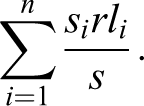
The crossover threshold is located at 0, since this corresponds to parties that make an equal amount of right and left statements in their manifestos. The threshold for full inclusion is fixed at 5, the anchor for full exclusion at −5.
Analytical Results
The fsQCA procedure involves several stages, which were carried out with the QCA package for R, version 1.1-4 (R Development Core Team 2014; Thiem and Duşa 2013). Necessary and sufficient conditions were assessed separately, with the analysis of the former preceding the analysis of the latter (Schneider and Wagemann 2012, 278). Two descriptive measures are used to evaluate both types of causal relations: consistency and coverage (Ragin 2008, 44-68). The former provides a descriptive measure of the extent to which the empirical data confirm sufficiency or necessity, the latter reflects the relevance of a sufficient or necessary condition. Consistency approaches unity as the data provides stronger support for sufficiency or necessity, coverage as a condition becomes more relevant. 12
The analysis of sufficiency is based on the “Truth Table Algorithm” (Ragin 2008, 124-44; Schneider and Wagemann 2012, 178-195). A truth table contains a row for every possible combination of conditions. At the first stage of the analytical procedure, each case’s membership score in these rows is calculated with fuzzy multiplication. Rows without membership scores above 0.5 are considered logical remainders, combinations of conditions that lack good empirical instances. The other rows are assigned an outcome value based on their consistency as a sufficient condition for outcome (Schneider and Wagemann 2012, 279). Subsequently, Boolean algebra is used to minimize the truth table (Ragin 2008, 145-77). Depending on the remainders included in the process, minimization results in different solution types. We focus on the intermediate formula, in line with Schneider and Wagemann’s (2012, 279) recommendation that this solution “should be at the center of the substantive discussion.” The intermediate solution results when only the remainders that correspond to theoretical expectations are incorporated in the minimization process. 13 The following subsections present the results of the analyses of high burden and absence of high burden.
High Burden
The analysis of necessity reveals that none of the consistency values of the conditions exceed the recommended 0.9 threshold, indicating that none of them are necessary for the outcome. 14 Table 1 represents the truth table for high burden, with the cases presented in the rows where their membership score exceeds 0.5. The consistency cutoff point, which separates truth table rows that pass as sufficient from those that do not, is fixed at 0.77, well above the minimal advisable threshold of 0.75 (Ragin 2009, 118; Schneider and Wagemann 2012, 279). The rows above this threshold only contain cases that carried a high burden in the operation, providing additional evidence for the sufficiency of the corresponding combinations (Schneider and Wagemann 2012, 185). However, Canada, which is a high contributor, is a member of a row with a consistency below the threshold (row 10). This row is not coded as sufficient for the outcome because its consistency of 0.610 is much lower than the minimum advisable threshold. Moreover, it also contains a case that did not carry a high share of the operations burden: Poland. In consequence, Canada will not be covered by the resulting solution.
Truth Table “High Burden.”
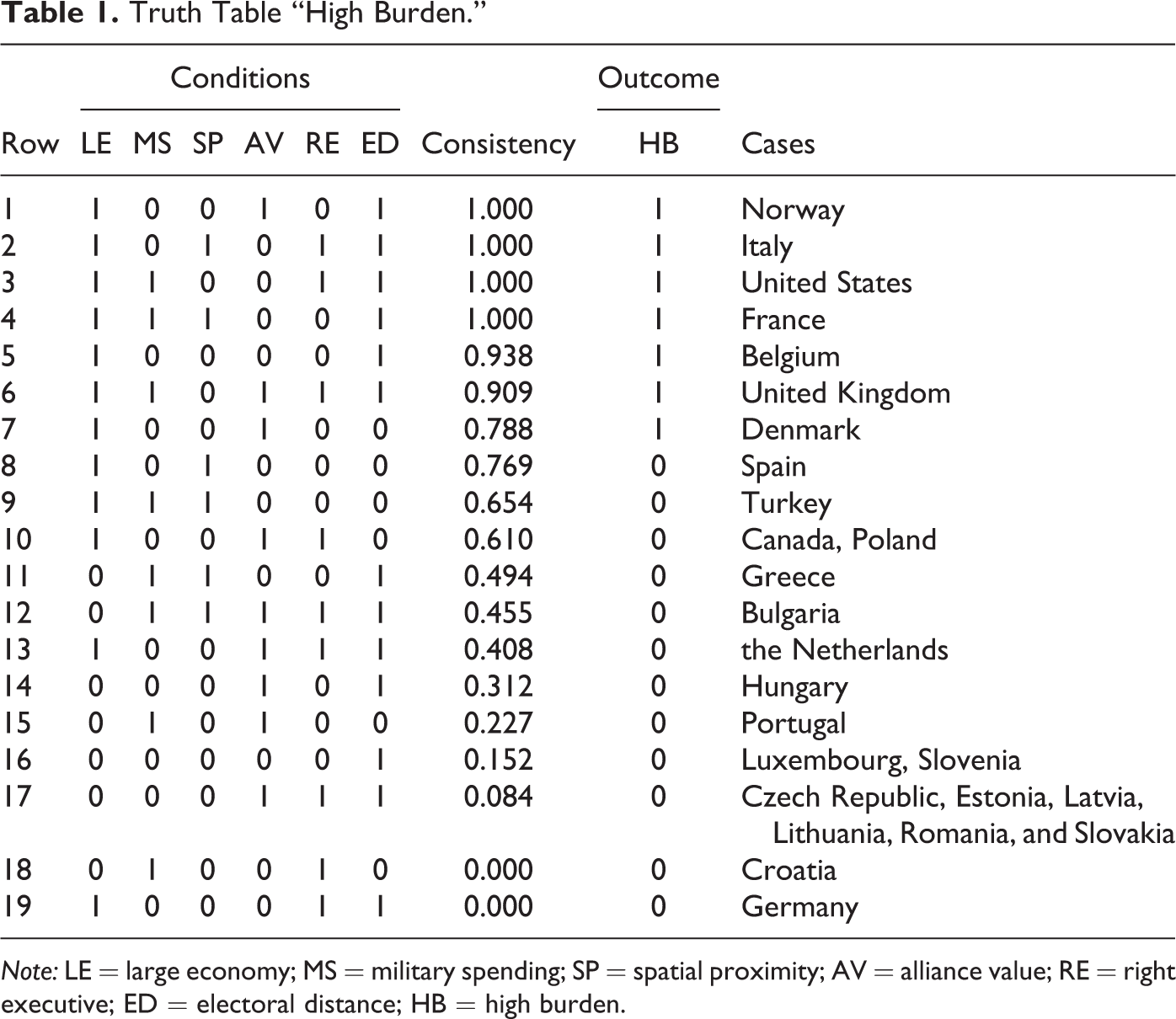
Note: LE = large economy; MS = military spending; SP = spatial proximity; AV = alliance value; RE = right executive; ED = electoral distance; HB = high burden.
The intermediate solution is presented in Table 2. 15 Its high consistency of 0.917 confirms that it indeed corresponds to sufficient combinations. The solution’s relatively low coverage of 0.59 is mainly caused by the fact that it does not cover the large contribution of Canada. The solution shows that four combinations of conditions consistently lead to contributing. The first combines large economy with high military spending and distant elections. This combination covers France, the United Kingdom, and the United States. The second path combines large economy, spatial proximity, and electoral distance and covers Italy and France. The third combination shows that states with a large economy and distant elections carried a high share of the burden of the Libya operation, but only if they were governed by a left-leaning government. This path covers Belgium and Norway. The fourth path combines large economy, alliance value, and a left-leaning government and covers Denmark and Norway.
Intermediate Solution.
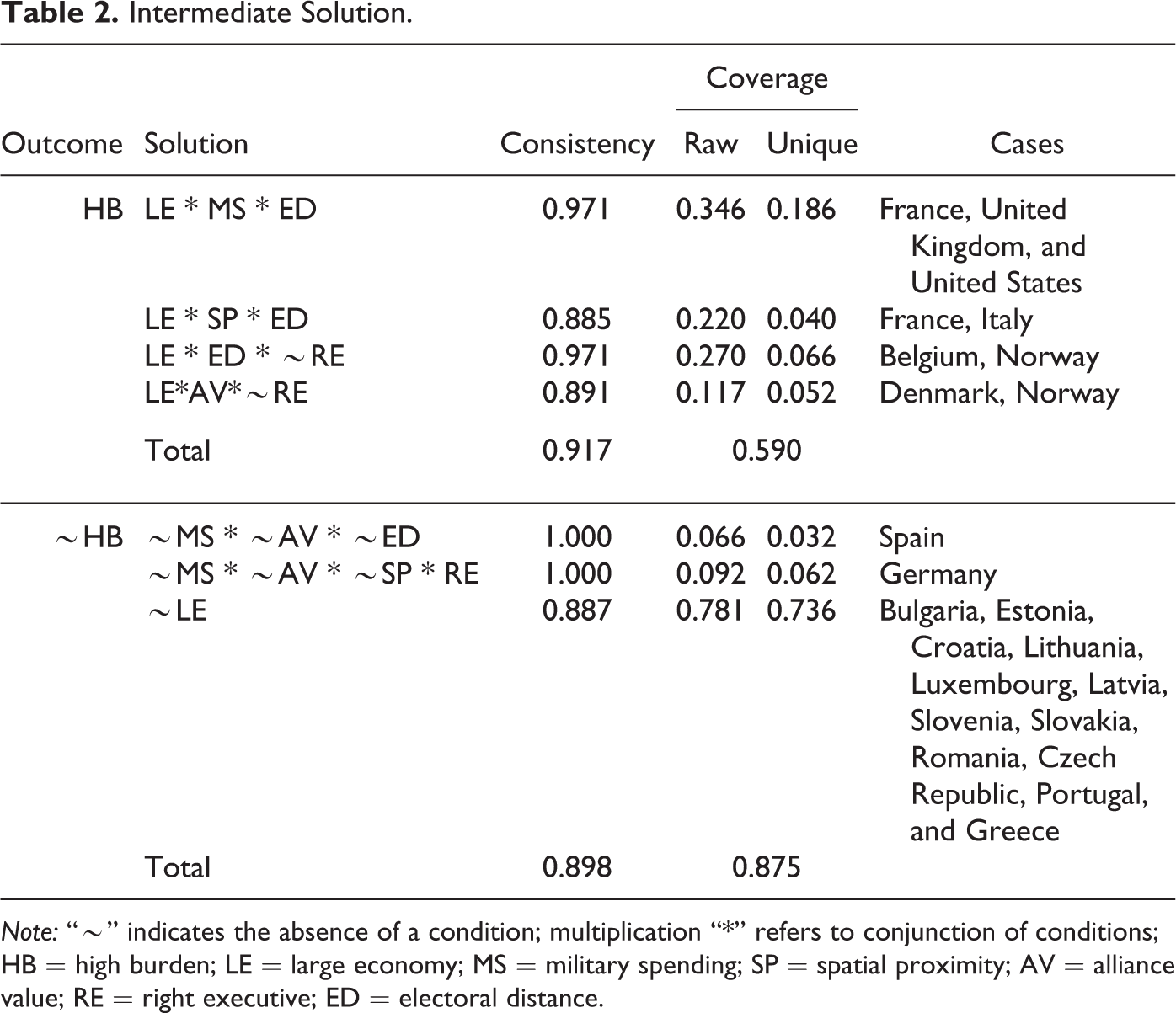
Note: “∼” indicates the absence of a condition; multiplication “*” refers to conjunction of conditions; HB = high burden; LE = large economy; MS = military spending; SP = spatial proximity; AV = alliance value; RE = right executive; ED = electoral distance.
Absence of High Burden
The analysis of necessity reveals that none of the consistency values exceed the 0.9 threshold, indicating that there are no necessary conditions for the outcome’s absence. Table 3 presents the truth table for “absence high burden.” The consistency cutoff point is fixed at 0.75. The rows above this threshold only contain cases that did not carry a high burden, providing additional evidence for the sufficiency of the corresponding combinations (Schneider and Wagemann 2012, 185). Three rows with a consistency below this threshold (row 10, 11, and 14) contain cases which did not carry a high burden in the operation: the Netherlands, Turkey, and Poland. However, these rows are not coded as sufficient for absence high burden because their consistency is far below the minimum advisable threshold of 0.75. In consequence, these cases will not be covered by the solution for the outcome’s absence.
Truth Table “Absence High Burden.”
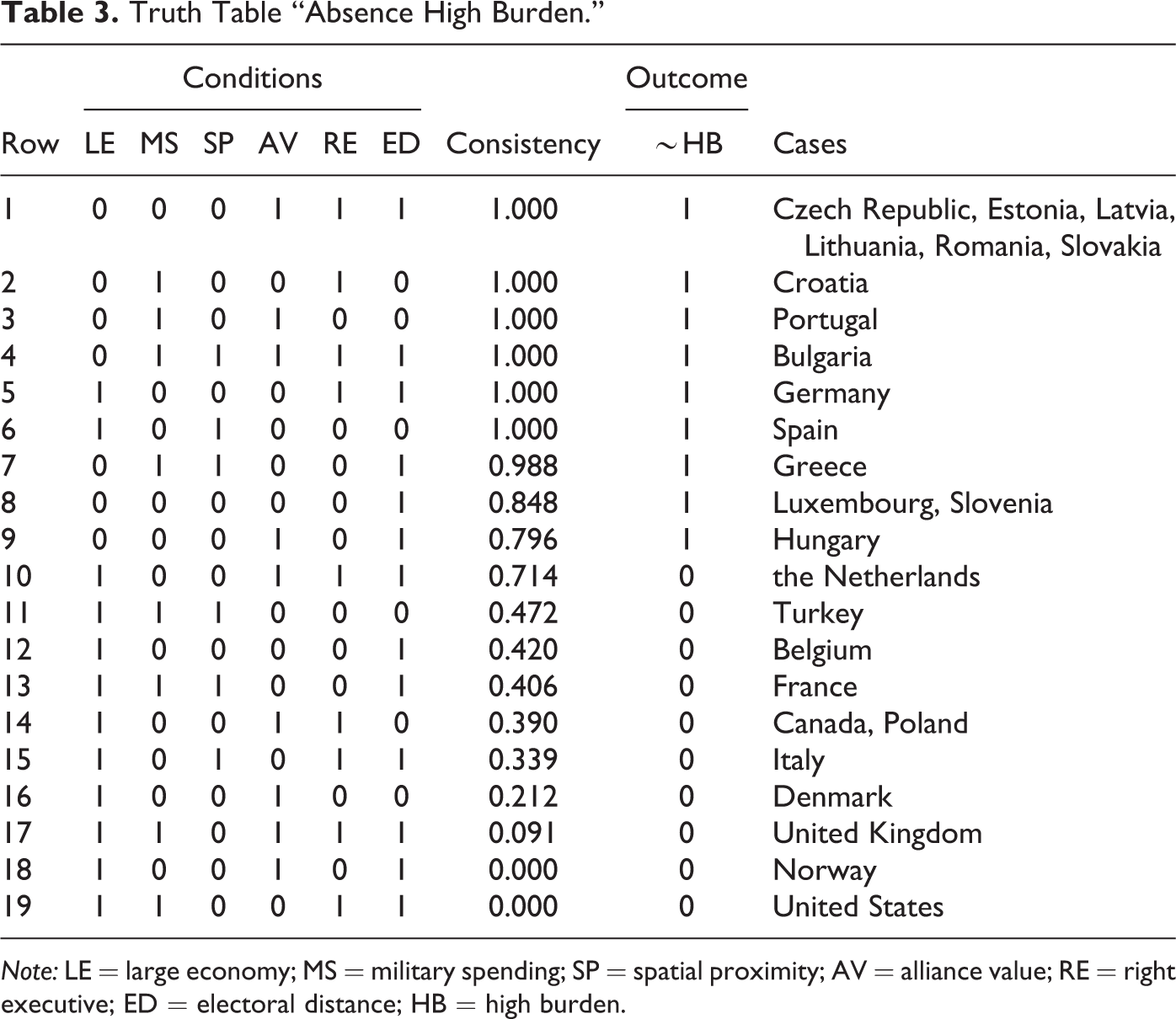
Note: LE = large economy; MS = military spending; SP = spatial proximity; AV = alliance value; RE = right executive; ED = electoral distance; HB = high burden.
Minimization of the truth table results in the intermediate solution presented in Table 2. 16 The consistency of the solution almost equals 0.9, strongly confirming that it indeed corresponds to a sufficient combination. Its coverage is well above 0.85. This indicates that the solution explains a large share of the outcome’s absence, in spite of the noncovered cases. Three causal paths result from the analysis. The first two show that the absence of military spending and alliance value is sufficient in combination with either the absence of distant elections or the presence of a right-leaning executive and the absence of spatial proximity. These paths, respectively, cover Spain and Germany. The third path shows that the absence of a large economy is sufficient for not contributing, strongly confirming expectations from collective action theory.
Interpretation
Arriving at minimal formulas and optimal parameters of fit are not the ultimate goals of QCA (Schneider and Wagemann 2012, 280). Instead, solutions must be related back to the cases and theoretical expectations (Rihoux and De Meur 2009, 65). The results largely confirm the collective action, balance of threat, and alliance politics hypotheses. In contrast, the formulas contradict theoretical expectations on domestic constraints.
First, the results provide strong support for the collective action hypothesis. The presence of an large economy is part of every solution for the outcome’s presence, while its absence is sufficient for the outcome’s absence. Moreover, the first sufficient combination for high burden shows that, if elections were not imminent, nations with a large economy and sizable military spending carried a large share of the burden of the Libya operation. This corresponds to collective action expectations for lumpy goods: the contributions of France, the United Kingdom, and the United States were critical for the operation’s success, which denied them the opportunity to ride free if they wanted to gain the benefits of the operation. 17 Neither France nor the United Kingdom “was capable of executing the military campaign without the other” (Davidson 2013, 317). Similarly, not contributing was not a viable option for Washington, since “approximately 90 percent of the military actions against the Libyan regime would not have been possible without the support of the US” (Koenig 2012, 3).
Moreover, in line with the exploitation hypothesis, France and the United Kingdom carried a disproportionate share of the operation’s burden. While only accounting for 8 percent and 7 percent of NATO’s GDP, France, and the United Kingdom, respectively, conducted one-third and one-fifth of the strike operations. The United States, on its part, flew more sorties, and nearly as many strike missions, than the combined totals of the other members during the first ten days of the operation (Chivviss 2014, 89). However, the exploitation hypothesis would have expected the United States to keep carrying a disproportionate share of the costs and risks, instead of reducing its role after barely two weeks. The latter reflected the United States’ changed grand strategy, which aimed to force the other allies to contribute more to “achieving joint transatlantic security goals” (Hallams and Schreer 2012, 321; Chivviss 2014, 199). Moreover, US restraint was possible because France and the United Kingdom had taken a more forward-leaning stance in the run-up to the operation, and the operation’s difficulty was relatively low (Chivviss 2014, 200). 18 Nevertheless, the United States was still to a large extent “prisoner to its size” (Ringsmose 2010, 326). Even after limiting its role, it kept providing essential capabilities, flew the highest number of sorties, and contributed more aircraft than any other ally.
The balance of threat hypothesis is confirmed by the second path toward high burden, which combines a large economy and electoral distance with spatial proximity. This combination covers two cases: France and Italy. Case-based evidence suggests that the threat caused by geographical proximity was indeed important in both cases. Davidson (2013, 316), for example, argues that the “threat to France’s borders posed by refugees fleeing violence in Libya” is an important factor to explain France’s reaction to the crisis. Italy’s contribution to the operation also seems grounded in narrow interests (Ceccorulli and Coticchia 2015, 15). According to Lombardi (2011, 33, 42), Italy’s main goals during the Libyan crisis were avoiding a large refugee influx and preserving its economic interests in the country. For this reason, it only decided to support the operation once it became clear Qaddafi’s days were numbered and joining the coalition was the best way to preserve these interests. The hesitance of Italy suggests that the threats linked to geographic proximity do not always push governments toward intervention but rather incite contributions after it becomes clear that the intervention is inevitable and participating is the best way to preserve their interests.
Turkey’s policy toward the intervention corresponds to the latter conjecture. Like Italy, Turkey is one of the NATO allies that was vulnerable to a potential regional blowback of the intervention (Chivviss 2014, 75). Turkey was initially against the intervention and, eventually, only contributed noncombat assets. The Turkish reluctance to contribute can partially be explained by domestic political concerns and the approaching general elections (Müge and Aylin 2013, 603). However, the inconsistency of Turkey’s truth table row in the analysis of the outcome’s absence suggests that electoral calculations are not sufficient for explaining its reluctance to contribute. The analysis, thus, confirms that spatial proximity has an impact on contributions to the Libya operation. However, the causal path that includes this condition covers the contribution of Italy, which was first very hesitant to participate in the operation. Together with the Turkish reluctance to contribute, this suggests that countries that face a threat from the target of the operation face countervailing pressures, which only incite contributions once states perceive participation as the best strategy to preserve their interests.
Third, although the United States did not take the lead of the operation, alliance value had a positive impact on contributions. While the first and second combination for the outcome’s absence link the absence of alliance value to the absence of high burden, the third path to high burden suggests that alliance value spurred contributions to the operation. This path covers Denmark and Norway, whose contributions have been attributed to a desire to demonstrate their reliability and dedication to NATO (Jakobsen and Møller 2012, 112; Dicke et al. 2013, 41). However, multiple sources also argue that the contribution of these countries was at least partially motivated by humanitarian concerns (Dicke et al. 2013, 40; Jakobsen and Møller 2012, 115; Auerswald and Saideman 2014, 211). Moreover, contrary to theoretical expectations, the solution suggests that alliance value only leads to contributions from countries that were governed by a non-right executive.
In contrast to the collective action, balance of threat and alliance politics hypotheses, the solutions do not confirm expectations on domestic politics. There is evidence that electoral distance had an impact on the outcome: its presence is part of three paths for the presence of high burden, while its absence is included in one sufficient combination for its absence. The results, however, clearly contradict the expectations on government ideology. Strikingly, the absence of a right executive is a causal condition in the third and fourth path toward high burden, whereas its presence is an ingredient of the second path toward its absence.
A very plausible explanation for these unexpected causal combinations is related to the nature of the Libya operation, which differs from the cases that are generally included in studies that link military deployment to government ideology. The latter generally focuses on militarized interstate disputes or on the operations in Iraq and Afghanistan. Contrary to these operations, NATO pursued a humanitarian goal in Libya. Therefore, inferences based on the propeace attitude of leftist parties and promilitary attitude of rightist parties are less applicable. In a comprehensive study on the link between partisan politics and participation in peace enforcement operations, Rathbun (2004) argues that leftist parties are actually more likely to support humanitarian interventions, since they consider the promotion of welfare of other countries part of their national interest. Right-leaning parties, on the other hand, have a more exclusive conception of their national interest and, therefore, only support crisis management operations if they believe these enhance more narrow national interests.
The third and fourth pathways toward high burden indicate that the pattern of contributions to the Libya operation confirms Rathbun’s hypotheses. Auerswald and Saideman (2014, 211), for example, argue that the contributions of the left-leaning governments of Belgium, Denmark, and Norway were at least partially motivated by humanitarian concerns. In contrast, Italy’s right-wing Berlusconi government, covered by the second sufficient combination, only participated to secure narrow national interests, not to enforce the R2P doctrine. Similarly, the second sufficient combination toward the absence of high burden combines the absence of spatial proximity with the presence of right executive. This path covers Germany, which was governed by a conservative-liberal government under the leadership of Merkel. According to Hansel and Oppermann (2016, 14), “the Merkel government has put a strong emphasis on the German national interest in explaining its nonparticipation in Libya” (see also Oppermann 2012, 514), while Miskimmon (2012, 402) contends that “Germany saw no clear interest in becoming involved in the NATO-operation.”
However, case-based evidence suggests important exceptions to the cross-case pattern that emerges on the link between executive ideology and contributions. First of all, there is no conclusive evidence that Germany’s decision not to contribute is best explained by the combination of a right-leaning government and the absence of clear interests. No clear party lines were drawn in the debate on the Libya intervention and critique on the government’s policy toward the crisis was not confined to left-leaning opposition parties (Miskimmon 2012, 398-99). In fact, several members of parliament of Merkel’s Christlich Demokratische Union-party were critical of the government’s policy and implied they might have supported limited military involvement (Brockmeier 2013, 82). Furthermore, Canada and Poland also combine a right-wing government with the absence of spatial proximity but are not covered by the solution for the outcome’s absence. The nonparticipation of Poland confirms that right-wing executives are less likely to participate in humanitarian operations. Polish Prime Minister Tusk, furthermore, explained the decision not to participate by arguing that “the situation in Libya poses no threat to Poland’s interests and Poland’s security” (Dicke et al. 2013, 51). However, Canada was also governed by a right-wing government but nevertheless carried a high share of the operation’s burden. Moreover, although the conservative Harper government did not refer to the R2P to justify its participation, it did package “the intervention on normatively oriented and value-based arguments in favor of democracy, freedom and human rights” (Cooper and Momani 2014, 186). In sum, although left-leaning governments were generally more likely to participate, the lack of clear party lines in Germany in the debate on the intervention and the large contribution of Canada’s right-wing government, which was almost exclusively sold on value-based grounds (Cooper and Momani 2014, 177), show that there are important exceptions to the general pattern of contributions.
Conclusion
Why did some NATO members carry a large share of the burden of the Libya operation while others hardly contributed at all? This study combined collective action theory with hypotheses on balance of threat, alliance politics, and domestic constraints into a multicausal model to explain the division of the operation’s burden. Its results suggest innovative inferences on the interactions between partisan politics and the reasons states contribute to operations. While left-wing governments carried a high share of the burden if they had the capabilities to increase the probability that the goals of the operation would be achieved and either highly valued their alliance with the United States or were not facing imminent elections, right-wing governments only contributed if their country’s interests were threatened by the crisis in Libya. NATO members whose military capabilities were critical for the operation’s success constitute an important exception to these inferences. These participated irrespective of the ideological composition of their governments, indicating that partisan politics only matter for nonessential contributors.
These conclusions have significant implications for the division of the burden of future NATO operations. The Libya campaign suggests that the other capable allies can be expected to compensate if the United States reduces its role in an operation. However, this will only be the case if Washington makes clear from the outset that it is not willing to move forward without significant support. Furthermore, US restraint in the Libya operation was only possible because France and the United Kingdom had taken a more forward-leaning stance in the run-up to the operation and the operation’s difficulty was relatively low. During the 2014 intervention against the Islamic state in Iraq and Syria (ISIS), the United States only started mobilizing its allies a few weeks after it started offensive operations and was left carrying the brunt of the operation’s burden. Although their “security interests should dictate an even more robust effort against ISIS than against the Qaddafi regime,” France and the United Kingdom provided far less support to the operation against ISIS (Cohen and Scheinmann 2014, 2).
The results furthermore indicate that contributions to out-of-area operations depend on the interaction between domestic politics and the goals of an operation. The greater inclination of left-leaning executives to participate in humanitarian operations should apply beyond the scope of the Libya campaign. Preliminary evidence from NATO’s previous humanitarian intervention in Kosovo supports this inference. Rathbun (2004), for instance, concludes that the leftist parties of Germany, France, and the United Kingdom eventually supported the use of force in Kosovo. Moreover, most of the smaller allies that contributed to the air operations, such as the Netherlands, Belgium, Norway, and Portugal, were governed by a left-leaning government (Mello 2014, 73-74). Prospective research could examine the interaction between the international incentives that spur contributions and party politics more systematically, to assess whether these inferences are generalizable beyond the Libya operation.
This study furthermore showed that QCA is a powerful tool for research on military burden sharing. Building on QCA allowed to establish innovative inferences on the specific interactions that determine the level of contributions to NATO’s Libya operation. Employing this approach in future research would indubitably lead to a more holistic understanding of the burden sharing dynamics in multilateral operations.
Footnotes
Acknowledgements
The author thanks the anonymous reviewers, Thijs Van de Graaf, Melanie Van Meirvenne and Emma Didier for their helpful comments and suggestions.
Declaration of Conflicting Interests
The author declared no potential conflicts of interest with respect to the research, authorship, and/or publication of this article.
Funding
The author received no financial support for the research, authorship, and/or publication of this article.
Supplementary Material
Supplementary material for this article is available online.
Notes
References
Supplementary Material
Please find the following supplemental material available below.
For Open Access articles published under a Creative Commons License, all supplemental material carries the same license as the article it is associated with.
For non-Open Access articles published, all supplemental material carries a non-exclusive license, and permission requests for re-use of supplemental material or any part of supplemental material shall be sent directly to the copyright owner as specified in the copyright notice associated with the article.
