



Abstract
Disputants might resolve their disagreements in a piecemeal fashion, addressing a subset of the issues at a time. How viable is such a strategy? I argue that partial settlements signal the desire to resolve disagreements and can lay the foundation for additional cooperation by building trust and/or demonstrating the benefits of dispute resolution. As a result, partial settlements should be associated with the resolution of remaining disagreements. Yet, scholars have questioned whether pursuing a piecemeal approach may be more harmful than helpful, and a systematic empirical test of these competing predictions is necessary. Using data from worldwide territorial claims between 1919 and 2001, I find a strong positive correlation between partial settlements and comprehensive dispute resolution. In the shorter run, partial settlements are also associated with an increased likelihood for peaceful negotiations, but there is only limited evidence that they reduce conflict before all aspects of the claim are resolved.
Keywords
Introduction
In all but the simplest disputes, parties might choose to pursue a piecemeal approach whereby they address individual aspects of the dispute in successive partial agreements. An example of such an approach is the territorial dispute settlement process between Russia and China. Starting in the 1960s, the relationship between the two countries was plagued by open territorial conflict along the entirety of their boundary. Their dispute was resolved in the 1990s and 2000s in three separate agreements that settled different parts of their territorial claim. This piecemeal settlement strategy gradually chipped away at China and Russia’s territorial disagreements, decreased tensions between them, and culminated in the resolution of their last remaining border dispute in 2004.
The goal of this article is to examine how representative the case of Russia and China is: can partial settlements pave the way for comprehensive dispute resolution? To answer this question, I start from the premise that partial settlements are concluded when parties desire to make progress on resolving their dispute, but a full resolution is not (yet) possible. Building on the framework of two-level games (Putnam 1988), I argue that obstacles for dispute resolution may exist at the international level, as a result of a lack of trust between the parties, and/or at the domestic level, as a result of the public’s or elite’s unwillingness to grant concessions. Under either scenario, a piecemeal approach can prove useful: partial settlements signal a commitment to resolve aspects of the territorial dispute and may build trust between the adversaries and/or foster domestic support for compromise. We should thus expect partial settlements to be associated with the full resolution of the territorial dispute.
My theoretical argument conceptualizes partial settlements both as a signal of states’ willingness to make progress on settling their disputes and as a tool to shape the prospects for dispute resolution. Two logics might thus link partial settlements and comprehensive dispute resolution: (1) partial settlements may be a screening device for the political will to settle and (2) partial settlements might have an independent causal effect by changing international perceptions and domestic preferences regarding the desirability of further cooperation. Differentiating empirically between these two mechanisms is difficult with observational data, but it is at least possible to uncover evidence of whether the positive correlation between partial settlements and peaceful conflict resolution proposed by both mechanisms exists at all. Such a test is important in light of the broad-based skepticism about whether we should expect partial settlements to be associated with beneficial outcomes. Skeptics have raised a variety of concerns about the consequences of partial settlements. Some arguments suggest that partial settlements should not lead to any change in the parties’ relations (e.g., Iklé 1964; Morgan 1990) and others imply that partial settlements might actually be detrimental for further settlement efforts (e.g., Bose 2007; Blum 2007; Weiss 2003).
Given competing arguments about the consequences of piecemeal dispute resolution, a systematic assessment of this strategy is called for. In my empirical test, I rely on newly compiled data on partial settlements of worldwide territorial claims between 1919 and 2001. Partial settlements are peaceful and mutual attempts to substantively resolve a subset of the issues under contention while leaving other elements of the dispute for future consideration. Using these data, I find that partial settlements are associated with the peaceful settlement of remaining territorial disputes between claimants. In the short run, before the claim is fully resolved, partial settlements also correlate with a higher probability of peaceful talks and concessions between the parties, but there is only limited evidence that partial settlements reduce the incidence of militarized disputes. Overall, these findings provide support for the notion that, on average, partial settlements are connected to beneficial outcomes for the parties, especially in the long run. As we know from existing work, once all outstanding claims are settled, the parties can partake in all the benefits of regulated borders, including the lower risk for conflict and the greater potential for economic gains (Owsiak 2012; Schultz 2014; Simmons 2002).
The question of whether a stepwise dispute settlement procedure is associated with the ultimate resolution of remaining disagreements is important for both scholars and policy makers. Opinions on the benefits of such a strategy diverge significantly and are often based on generalizations from individual high-profile cases. Given persistent uncertainty about what to expect from piecemeal approaches, it is useful to investigate the consequences of partial settlements in a systematic fashion. This article formulates clear theoretical expectations and provides empirical evidence on partial settlements in the context of territorial claims. It thus provides the starting point of what can be a very useful line of inquiry for scholars and policy makers interested in understanding the ways the parties may design their settlement agenda to bring about the resolution of their dispute.
Resolving Territorial Conflict
Many of the ongoing international disputes with the greatest potential for escalation involve territorial issues, such as the South China Sea, the Senkaku/Diaoyu Islands, Kashmir, and Russia’s European borders. The dangers to international peace posed by territorial conflicts are well established in the international relations (IR) literature. Scholars have shown that states with territorial claims are more likely to initiate militarized interstate disputes (MIDs), see these disputes escalate to war, and develop rivalries (e.g., Hensel 2000; Kocs 1995; Leskiw and Vasquez 2001; Vasquez 1993). Even without active military conflict, territorial disputes take a toll on the involved states by depressing economic exchange and other mutually beneficial cooperation (Simmons 2005). Given the detrimental effects of persistent territorial conflict, it is useful to examine how and when these disputes can be settled.
There have been numerous studies investigating factors that facilitate or inhibit the peaceful management of territorial claims, including studies emphasizing issue salience (e.g., Hensel 2001), history of conflict (e.g., Hensel 2001; Hensel et al. 2008), regime type (e.g., Huth and Allee 2002), and the domestic and international legal environment (e.g., Huth, Croco, and Appel 2011; Powell and Wiegand 2010). A particular focus has been on the role of third parties in facilitating peaceful deals. Several scholars show binding third-party conflict management to be especially successful at bringing about a lasting settlement (Allee and Huth 2006; Gent and Shannon 2010; Mitchell and Hensel 2007; Simmons 2002). Yet, as promising as it is, binding third-party conflict management is also quite rare. Only about 4 percent of territorial claim settlement attempts are the product of binding efforts, 24 percent result from nonbinding techniques, and more than 70 percent are bilateral. 1 Given the frequency of bilateral efforts, it seems particularly important to examine how the claimants themselves can peacefully resolve their disputes.
One option the parties may choose is to fractionate their disagreements and deal with them in successive partial settlements. In territorial disputes, parties might start by assigning sovereignty over individual disputed areas, while leaving other claims initially unresolved, and then later moving on toward settling additional territories. Such sequential partial settlements occur in territorial claims with some frequency. Among the 236 dyadic territorial claims considered here, in 58 (25 percent) the parties opted for a piecemeal approach. In 85 cases (36 percent), the parties exclusively attempted to resolve their dispute in a single comprehensive settlement, and in 93 (39 percent) no peaceful settlement was reached.
While there is a large and sophisticated literature on conflict management, there are only few studies that consider piecemeal dispute resolution (Fisher 1964; Fisher and Ury 2011; Kratochwil, Rohrlich, and Mahajan 1985; Miall 1992; Gartner and Bercovitch 2006; Bose 2007). Unfortunately, even in these studies, references to the benefits and risks of this approach are mostly in passing and the focus typically lies elsewhere. The literature on issue linkage and gradualism in international cooperation provides a more focused discussion of the pros and cons of limited agreements (e.g., Abbott and Snidal 2002). However, these studies are often oriented toward international cooperation broadly and do not address incremental cooperation in the context of entrenched conflict. To my knowledge, there is no work that provides an in-depth theoretical treatment and empirical test of piecemeal approaches to conflict resolution. Yet, the question of whether proceeding in a piecemeal fashion leads to dispute resolution is clearly important in light of persistent territorial and other interstate disputes. Below I formulate a theoretical argument for why we should expect partial settlements to be associated with the resolution of outstanding disagreements.
The Promise of a Piecemeal Approach
At its most basic level, the conclusion of a partial settlement signifies that at least one of the countries is ready to make concessions on at least part of the territorial claim, and the other side is willing to accept the terms proposed. The fact that a settlement is concluded thus indicates that political will to make progress on resolving the territorial claim is present. At the same time, the negotiation of a more limited partial deal suggests that the complete resolution of the claim may not (yet) be possible. What obstacles might complicate the resolution of the territorial dispute, and how can partial settlements help the parties overcome these obstacles?
Building on the literature on international cooperation, I argue that, like other international negotiations, attempts to conclude territorial settlements are best conceptualized as two-level games (Putnam 1988). Agreements regarding the distribution of territory require approval both at the international level (level 1) by the countries’ representatives and at the domestic level (level 2) by the countries’ publics and elites. Because territorial settlements require approval at both levels, obstacles at either level can undermine a comprehensive deal.
At the international level, that is, level 1, the resolution of a territorial dispute may be complicated by a lack of trust between the parties. Leaders might be hesitant to conclude a comprehensive settlement that resolves the entirety of the dispute because they fear that (1) the adversary will fail to implement the agreement and thus the time and effort invested in negotiations will be wasted and domestic political punishment for policy failure may result, (2) the adversary will perceive concessions as weakness and will become emboldened to demand additional territory not previously disputed, and/or (3) the adversary will leverage its territorial gains to stage a military attack. Territory contains economic resources, individuals who can be recruited into the military and might even provide a strategic advantage in a military campaign. Territory thus serves as a source of bargaining power and a peaceful settlement might prove particularly difficult as a result of commitment problems (Fearon 1996).
When concerns about defection prevent a comprehensive settlement, the parties might opt for a partial deal: even if such a deal fails, negotiation costs and domestic punishment for policy failure should be more moderate; limited concessions are less likely to embolden the adversary; and territorial transfers tend to be smaller and thus minimize the potential for significant shifts in power. 2 Furthermore, partial settlements can build trust between the parties and pave the way for more extensive cooperation.
The idea that smaller cooperative steps can foster deeper cooperation is well established in the literature (e.g., Axelrod 1984) and has also been applied to the emergence of cooperation among distrusted adversaries. Particularly useful in this context is Kydd’s (2007) model, which formalizes Osgood’s (1962) foundational insights on the graduated reciprocation in tension-reduction (GRIT) strategy. According to Kydd, cooperative gestures such as troop withdrawals can function as costly signals of a state’s trustworthiness. The key to the effectiveness of such gestures is that they be costly enough that a state with no real interest in rapprochement would not undertake them. If only states that want to improve their relationship with the adversary are willing to pay the costs associated with such gestures, then these gestures can reassure the opponent of the state’s intentions and illicit a cooperative response. Once the two states are confident that predatory behavior is unlikely, they can transform their antagonistic relationship into a more cooperative one.
Partial territorial settlements fit the parameters for effective costly signals well: surrendering control over a piece of territory or recognizing the adversary’s sovereignty over a disputed area undoubtedly entails costs (e.g., loss of resources, domestic criticism). The willingness to make such concessions thus signals to the opponent that the desire to improve the relationship is sincere. Furthermore, because partial settlements are bilateral they provide both sides the opportunity to signal their trustworthiness in the context of a single cooperative step. If concessions are mutual, both sides are sending a costly signal of their willingness to improve the relationship. If only one side makes concessions, the other side can still demonstrate its trustworthiness by following through on the agreement. The on-the-ground demarcation process that follows formal delimitation agreements often unearths additional quarrels about the exact location of a boundary, and if these are resolved in an amicable fashion the parties can move their relationship toward increasingly greater cooperation.
Besides a lack of trust between the adversaries, that is, enforcement concerns, territorial dispute settlement might also be hindered by disagreements on the terms of the deal, that is, bargaining problems (Fearon 1997). In the case of territorial conflict, the unwillingness to make concessions often derives from domestic political (level 2) dynamics. Broader public sentiment and elite opposition can pose significant obstacles to territorial settlements in both democracies and nondemocracies.
The benefits of settling territorial disputes are often substantial: increased trade, investment, and tourism; entry into international governmental organizations (IGOs) that mandate settled borders; and improved relations with third states previously aligned with the opponent (e.g., Simmons 2002). Yet, despite these benefits to settling territorial disputes, domestic publics and elites may be resistant to making the required concessions. Territory, irrespective of whether it is materially valuable or not, is often perceived to be a central component of the identity of the state and its citizens. Territorial claims thus inspire nationalism to an extent few other issues do (Vasquez 1993). While the willingness to grant territorial concessions might vary across different segments of the population, as long as there are influential actors that oppose a settlement, leaders will be hesitant to strike a deal. At minimum, detractors might impede the implementation of the agreement. At maximum, agitation over what is considered the selling out of national interests might put leaders’ ability to gain support for other policy initiatives and possibly their larger political fate at risk (Allee and Huth 2006).
Existing scholarship argues that one way to reduce the fallout from unpopular territorial concessions is by taking advantage of legal dispute resolution (e.g., Simmons 2002; Allee and Huth 2006). Another option is a piecemeal settlement procedure. 3 Partial settlements only address a subset of the disputed territory and often initially focus on less contentious claims. While such agreements might spawn resistance by some domestic actors, the lower stakes of partial settlements reduce the likelihood of large-scale mobilization. Furthermore, once a partial settlement is in place, the benefits generated by the agreement, such as increased economic activity in the settled territory and surrounding areas, can extol the virtue of territorial claim resolution to domestic skeptics. Partial settlements might not only soften up public and elite resistance to territorial concessions, they can also empower domestic actors who stand to gain from increased cooperation with the adversary. Like international cooperation more broadly, partial settlements generate “winners” that see their political power increased as a result of gains they have made. These winners—businesses and firms that profit from increased economic exchange in the wake of a partial settlement—might advocate that the government negotiate additional agreements (Blum 2007). Partial settlements thus create a domestic political environment that is favorable for further dispute resolution.
In some cases, territorial settlements may be complicated by both a lack of trust at the international level (level 1) and an unwillingness to make concessions at the domestic level (level 2), while in other cases the obstacle may lie mainly at one level or the other. In any of these scenarios, piecemeal dispute resolution might be a promising strategy: partial settlements can help build trust and goodwill with the other side and/or foster domestic support for compromise. In the parlance of policy makers, partial settlements can create “momentum” toward peaceful dispute resolution. A high-profile example is the case of the Israeli–Egyptian interim agreements that built confidence between the two sides and convinced domestic audiences of the viability and desirability of a peace accord. In former Israeli Prime Minister Rabin’s (1979, 275) own words, “the subsequent moves towards achieving a peace treaty […] could never have come about were it not for the course my government adopted in signing the 1975 interim agreement” and “the 1975 agreement with Egypt […] was designed to advance the ‘momentum’ toward peace, and in that sense it has achieved its objective—no minor accomplishment in Middle Eastern Politics.”
As the case of Israel and Egypt demonstrates, limited agreements can pave the way for further cooperation between the parties and thus lead to the settlement of remaining disagreements. It is important to note that the Israeli–Egyptian example as well as my broader theoretical argument suggests two basic logics by which partial settlements may be connected to beneficial outcomes: (1) partial settlements may function as screening devices that identify situations where political will for peaceful dispute resolution exists or (2) they might also have an independent causal effect by changing perceptions and preferences of international and domestic actors. While these are two distinct logics, both imply that partial settlements should generally be associated with peaceful dispute resolution. Interestingly, however, the view that partial settlements lead to conflict resolution is contested by scholars and policy makers.
Counterarguments: The False Promise of a Piecemeal Approach
Looking at entrenched territorial conflicts, Bose (2007, 202), for example, cautions that “the incremental approach to making peace has its limitations, even perils.” Several scholars have raised quite diverse concerns about proceeding in a piecemeal fashion. Many of these arguments take for granted that the disputants want to make progress on resolving their conflict, but these arguments suggest that partial settlements may lack efficacy or may even be detrimental for this goal.
The first set of criticisms builds on the idea that partial settlements typically address minor disagreements, while sweeping more contentious issues “under the carpet” (Iklé 1964). If partial settlements focus on the “easy” part of a territorial claim, they should not generate enough trust and produce sufficient benefits to lead to the resolution of more complex elements of the underlying dispute. According to Morgan (1990, 318), “it is unlikely that settling minor issues will greatly reduce the impression of a large-scale conflict or make the parties more willing to make concessions on remaining issues just to preserve agreements already reached.” Thus, this line of argument implies that partial settlements should not be associated with the resolution of remaining disputes.
Other scholars go further and propose varied reasons for why a stepwise approach may actually be harmful. First, Blum (2007, 47) points to the possibility that limited agreements increase conflict as a result of a “pressed balloon effect”: the resolution of individual aspects of the dispute may lead opponents to shift their focus to other disputed areas, exacerbating tensions on these unresolved issues. Second, reaching a limited deal might make the “hurting stalemate” go away and thus remove pressures for a more comprehensive agreement (Blum 2007; Telhami 1990). Third, because a piecemeal approach unfolds over time, spoilers have ample opportunity to mobilize and undermine further steps in the settlement process (Weiss 2003; Abbott and Snidal 2002; Bose 2007). Fourth, if parties decide to move ahead on some disputed issues but leave other aspects of the dispute for future consideration, this might entrench the narrative that some issues are intractable. As a result, the parties may refrain from any serious attempt to negotiate for fear that failure is all but guaranteed (Blum 2007; Weiss 2003).
In summary, there are compelling reasons why a piecemeal approach should be associated with comprehensive dispute resolution, but there are similarly compelling arguments why partial settlements might not be a good idea. To adjudicate between these two conflicting views, a systematic empirical test is called for. I evaluate partial settlements on their own merits rather than comparing them to the alternative strategy of comprehensive deals that settle the entire dispute in one step. The studies reviewed above raise fundamental objections to piecemeal approaches rather than questioning their virtue compared to pursuing one-step comprehensive dispute resolution. My goal is to assess whether these objections are warranted. Sometimes states are unable to reach a comprehensive settlement immediately, and the question then becomes whether they are better off holding out for a comprehensive deal in the future or concluding a partial agreement now. My analysis provides insight into the consequences of partial settlements and thus speaks to the question of whether parties may be better off waiting for a one-step comprehensive settlement.
Research Design
For the empirical test, I build on territorial claims data by Huth and Allee (2002) and Huth, Croco, and Appel (2011). I modify their data in two ways. First, I combine multiple claims over different territories disputed between the same pair of states into one overarching dyadic territorial claims case whenever the claims either overlapped in time and thus could have been dealt with together or concerned the same piece of territory at different points in time, and the reemergence of the claim thus speaks to the effectiveness of the initial settlement attempt. 4 Second, I split claims that involve colonies that later gain independence into distinct dyadic claims. These two modifications produce 236 worldwide dyadic territorial claims and 5,260 dyadic territorial claim years (without missing data) between 1919 and 2001.
Dependent Variables: Complete Peaceful Claim Resolution, MIDs, and Talks
The key dependent variable of interest is the peaceful resolution of all outstanding territorial claims in the dyad. My theoretical argument suggests that partial settlements should be associated with comprehensive dispute resolution, but there are also compelling arguments that partial settlements might be unrelated to, or even negatively correlated with, claim resolution. To determine whether and when the parties are able to settle the last of their territorial disputes, I take advantage of Huth and Allee’s (2002) and Huth, Croco, and Appel’s (2011) dating of the end of territorial claims. I code a complete peaceful claim resolution as occurring when the end date for the last remaining territorial claim in the dyad coincides with a peaceful bilateral agreement, an arbitration/adjudication award, or a plebiscite. A peaceful final claim resolution is reached in 106 territorial claims.
Because my theoretical argument suggests that partial settlements build momentum toward conflict resolution, I also examine the shorter-term aftermath of partial settlements: are they associated with an immediate reduction in military conflict in the claim dyad? Are they associated with an increased likelihood of peaceful negotiations? For data on military conflict, I rely on Maoz’s (2005) dyadic MID data v. 2.0 for 1919–1992 and the Correlates of War dyadic MID data v. 3.1 (Ghosn, Palmer, and Bremer 2004) for 1993–2001. I create two binary variables: the first codes whether the claimants engaged in a MID of any level of hostility and the second codes whether they fought a violent MID (i.e., a levels 4 or 5 MID). 675 (12.8 percent) dyadic territorial claim years experienced at least one MID and 498 (9.5 percent) had a violent MID. To measure the occurrence of peaceful negotiations, I rely on data from Huth and Allee (2002) for the 1919–1944 period and from Huth, Croco, and Appel (2011) for the 1945–2000 period. There were negotiations in 1,371 (26.3 percent) dyadic territorial claim years.
Key Independent Variable: Partial Territorial Settlement
For each dyadic territorial claim, I collected information on the date and scope of territorial settlements using a variety of sources, including reference compendia (e.g., Biger 1995; Calvert 2004), region-specific sources (e.g., Brownlie 1979), and existing data sets (e.g., Hensel and Mitchell 2007; Huth and Allee 2002; Huth and Prorok 2015). 5 Conceptually, to qualify as a settlement, the parties had to have intended a substantive resolution of the claim by assigning sovereignty over the disputed territory. 6 Since my goal is to evaluate a peaceful dispute resolution strategy that should be generally available, I also exclude any settlements that were the result of the threat or use of force or unilateral renunciation. 7 Operationally, territorial settlements thus take the form of agreements between states, arbitration/adjudication awards, or, much more rarely, plebiscites.
Whenever settlements assign sovereignty only to a subset of disputed territories, but leave other elements of the claim unresolved, I code them as partial settlements. An example is the case of Argentina and Uruguay who, in 1961, decided to first determine ownership over the islands in the Uruguay River and then settled the remaining disagreement over their river boundary in a 1973 treaty. The data contain 123 partial settlements that were pursued in 58 different dyadic territorial claims involving 56 unique dyads and 59 different countries. Of the fifty-eight claims in which the parties concluded at least one partial settlement, twenty-four (41 percent) made two partial settlements, nine (16 percent) adopted three, four (7 percent) made four, one dyad negotiated six (2 percent), and one dyad concluded seven (2 percent). Overall, the most active decades for partial settlements were the 1990s with 19 percent of settlements, the 1920s with 18 percent, the 1970s with 15 percent, the 1930s with 13 percent, and the 1950s with 12 percent. Partial settlements have been most popular in the Middle East (32 percent), followed by Asia (25 percent), the Americas (20 percent), Africa (15 percent), and Europe (8 percent).
While a full analysis of the correlates of partial settlements is beyond the scope of this article, I perform simple bivariate tests to identify underlying patterns in states’ decisions to pursue piecemeal dispute resolution. 8 Parties tend to opt for a piecemeal approach when the dispute involves economically salient territory (p = .023) and possibly when territory has ethnic (p = .101) or strategic (p = .139) value. This suggests that partial settlements might be chosen when the prospects for economic gains are significant. Piecemeal dispute settlement is not more likely between strategic rivals (p = .619) or between states with a history of territorial MIDs (p = .895). Lack of trust may thus not be a dominant motivation, although some disputants might well pursue partial settlements for this reason. Finally, piecemeal dispute resolution is more likely when at least one of the countries experiences an economic decline (p = .017) and possibly when a new leader comes to office in either country (p = .102), that is, when there may be political will for conflict resolution.
Using these newly collected data on partial settlements, I code a dummy variable for whether a partial settlement is in effect in a given dyadic territorial claim year. 9 There are 892 (17 percent) dyadic territorial claim years in which the parties have at least one ongoing partial settlement. My focus is on partial settlements that are in force, since both the expectations formulated in my theoretical argument and the expectations of those skeptical of piecemeal approaches concern the longer-term consequences of partial settlements that enter and remain in effect. 10
Control Variables
In the analyses, I control for a series of factors that reflect how difficult it should be to settle the claim peacefully and that have been included in previous studies on similar dependent variables (e.g., Hensel 2001; Huth, Croco, and Appel 2011; Gent and Shannon 2010; Mitchell and Hensel 2007). First, I control for issue salience. The parties might be hesitant to surrender territory that is economically or strategically valuable and that can thus shift future bargaining power. Concessions on economically, strategically, or ethnically important territory might also prompt significant domestic opposition. Using data from Huth and Allee (2002) and Huth, Croco, and Appel (2011), I create three dummy variables that are coded 1 if at least some of the disputed territory was ethnically, economically, or strategically valuable. Additionally, I include a measure of the number of disputed areas based on the territorial dispute summaries provided by Huth and Allee (2002). 11 The more areas are disputed, the more difficult and time-consuming it should be to reach a compromise on all of them. Second, I include two measures of the level of hostility in the dyad. Greater hostility might be tied to mistrust and might thus complicate peaceful settlements. Strategic rivalry identifies pairs of states that are locked in tense competition and perceive each other as hostile (Thompson 2001). History of territorial conflict codes the number of territorial MIDs in the preceding ten years of the claim. Third, since democracies are known to be more adapt at resolving their disputes peacefully, I include a variable that is coded 1 if both states have polity2 scores of six or higher, or, when polity data (Marshall, Gurr, and Jaggers 2013) is missing, if Cheibub, Gandhi, and Vreeland (2010) code the regime types of both countries to be democratic. Fourth, based on the idea that parties with asymmetric capabilities find it easier to agree on a peaceful deal, because the weaker side should give in to the stronger state, I control for relative capabilities. This variable is operationalized as the natural log of the ratio of the stronger state’s Composite Index of National Capabilities (CINC) score to the weaker side’s CINC score (Singer 1987). Fifth, I include measures of economic turmoil and leadership change to identify circumstances that might induce the claimants to be more willing to resolve their territorial claims. I build on Chiozza and Goemans’ (2004) economic development measure, which captures the year-to-year change in logged per capita energy consumption (multiplied by 100) and include the lower of the two countries’ economic development scores. The lower this value, the more economic difficulties the country is experiencing. I use Archigos (Goemans, Gleditsch, and Chiozza 2009) to create a variable that is coded 1 if at least one of the countries had a leader transition in the current year or the previous year. Leadership change might bring to power a new leader with an increased willingness to settle the dispute. Finally, for the MID models, I include two additional variables that are standard in models of conflict: alliance ties (Leeds and Mattes 2007) and land contiguity (Bennett and Stam 2000). 12
Statistical Method
To assess the relationship between partial settlements and the main dependent variable of interest, the complete peaceful resolution of the territorial claim, I rely on event history analysis. 13 The event of interest is the peaceful settlement of the final territorial claim(s) in the dyad, and I treat claim terminations that were the result of force or unilateral renunciations as censored. 14 I thus employ a latent survivor time approach (Box-Steffensmeier and Jones 2004). 15 Within this framework, I estimate the effect of partial settlements on the “risk” that the parties terminate their territorial claim peacefully using a Cox proportional hazards model. The semiparametric Cox avoids making potentially incorrect assumptions about the baseline hazard that might lead to misleading inferences (Box-Steffensmeier and Jones 2004). This approach is preferred whenever no strong theoretical expectation about the baseline hazard for the event exists, as is the case here. Additional advantages of the Cox model are that it allows researchers (1) to deal with “ties”, that is, coterminous events (here, claim endings) and (2) to examine whether the underlying proportional hazards assumption is met. 16
For my secondary dependent variables, the probability of (violent) MIDs and the likelihood of peaceful talks, I use a binary time series cross-section approach. Following the recommendation by Carter and Signorino (2010), I estimate logit models with cubic polynomials to correct for temporal dependence. In the Cox model as well as the logit models, standard errors are clustered on the dyadic territorial claim.
Empirical Analysis
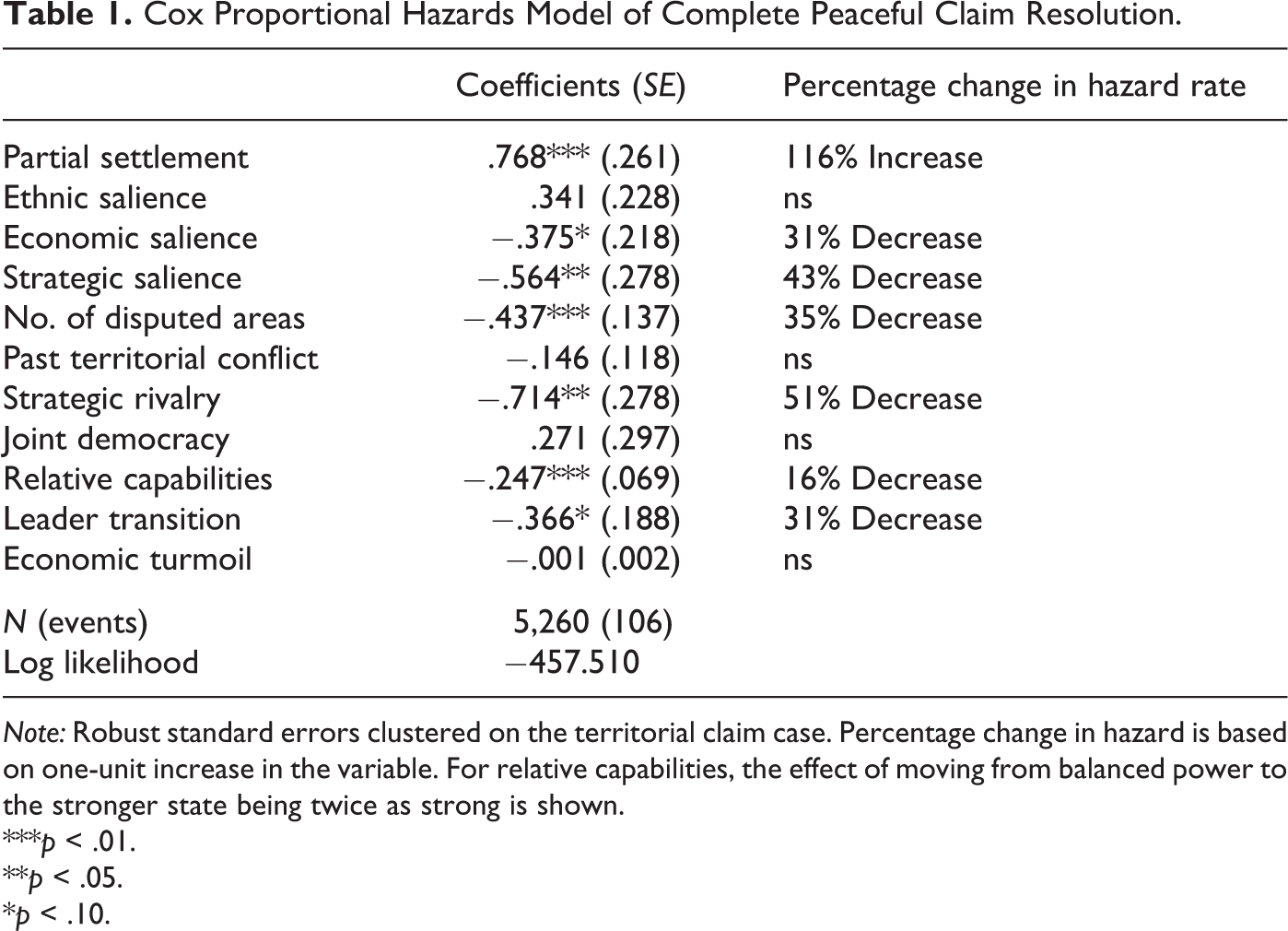
Table 1 displays results from a Cox proportional hazards model of complete peaceful claim resolution. 17 Positive coefficients indicate that a variable is associated with an increased risk of peaceful claim resolution, while negative coefficients suggest the hazard of claim resolution is reduced. The coefficient for partial settlement is positive and statistically significant, indicating that partial settlements are correlated with a heightened risk of peaceful comprehensive claim resolution. Compared to territorial claim dyads without a partial settlement, the hazard of full peaceful claim resolution is 116 percent higher for claim dyads with a partial settlement in place. The fact that the estimated effect of partial settlements is not only statistically but also substantively significant provides support for my theoretical argument that partial settlements are associated with comprehensive dispute resolution. Concerns by skeptics that partial settlement might impede dispute resolution are not supported.
Cox Proportional Hazards Model of Complete Peaceful Claim Resolution.
Note: Robust standard errors clustered on the territorial claim case. Percentage change in hazard is based on one-unit increase in the variable. For relative capabilities, the effect of moving from balanced power to the stronger state being twice as strong is shown.
***p < .01.
**p < .05.
*p < .10.
With regard to the control variables, I find that territories with strategic value and possibly with economic importance experience a lower risk of peaceful comprehensive claim resolution, while ethnic salience is not a significant predictor of claim duration. Claimants also find it more difficult to resolve territorial disputes that encompass a greater number of disputed areas. In terms of the relationship between the claimants, unsurprisingly, strategic rivals have difficulty resolving their claims peacefully. However, the number of territorial MIDs in the last ten years does not appear to affect peaceful claim resolution nor does joint democracy. Contrary to the expectations, the findings suggest that a greater asymmetry in power reduces rather than increases the risk of peaceful claim resolution. I also find that economic turmoil does not affect peaceful comprehensive claim resolution and that recent leader transitions decrease rather than increase the risk of claim resolution.
Next I examine whether claimants are less likely to experience military conflict and/or more likely to hold peaceful talks after a partial settlement has been concluded but before the territorial claim is fully settled. This analysis thus sheds light on whether partial settlements might lead to an improvement of the parties’ relationship in the shorter run and also provides evidence as to whether partial settlements generate momentum toward peaceful conflict resolution.
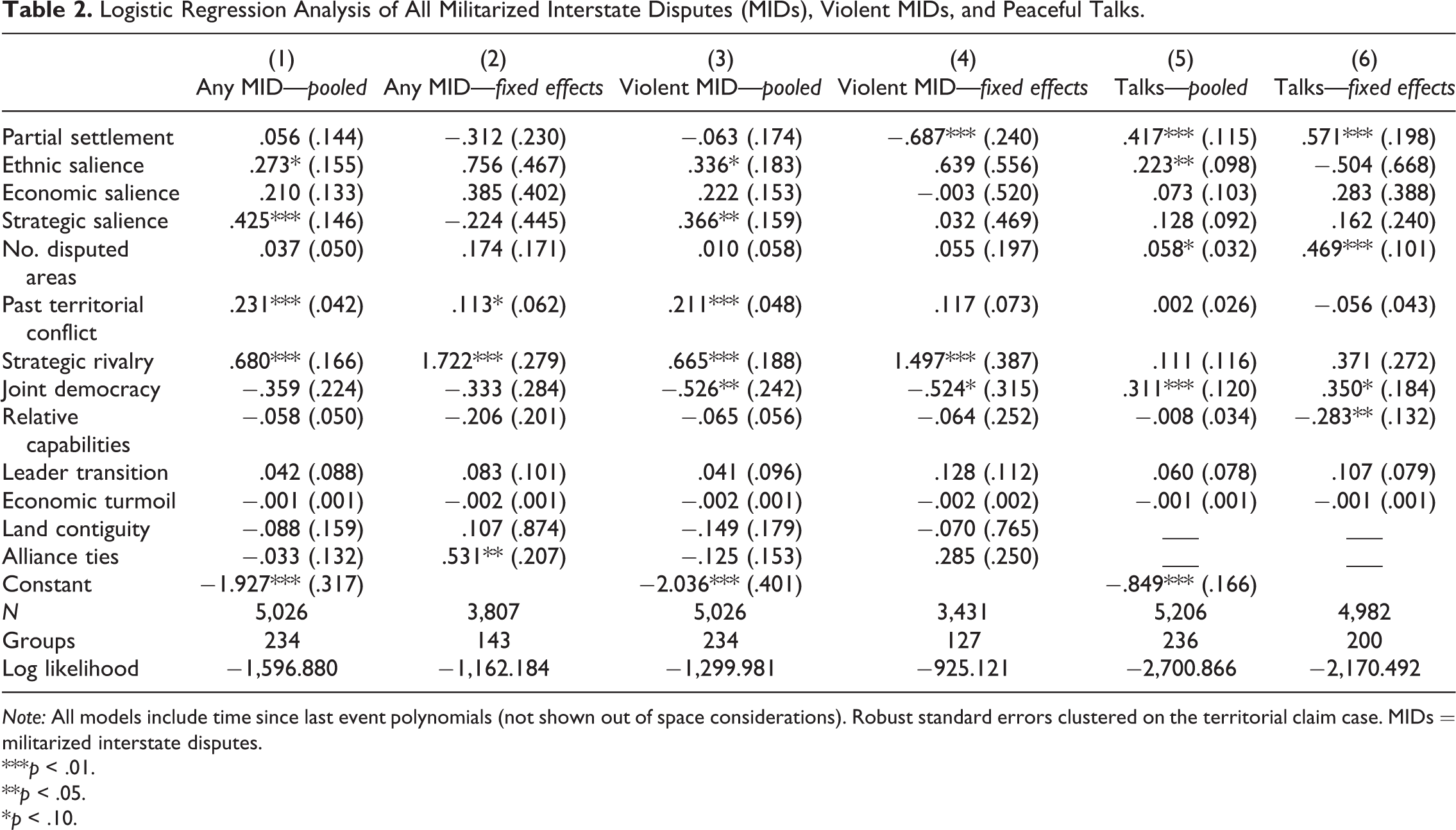
Columns 1–4 in Table 2 display the results for the analysis of the effect of partial settlements on the likelihood of any MID or a violent MID. 18 In addition to pooled analysis, I also estimate conditional logit fixed-effects models to correct for potential heterogeneity in the propensity for militarized conflict among different claim dyads. The coefficients in the fixed-effects models capture the average within-unit variation. Note that including claim-specific fixed effects leads territorial claim cases that never experienced a (violent) MID to be dropped from the analyses—91 claims and 1,219 (24 percent) dyad years are dropped in the general MIDs model and 107 claims and 1,595 (32 percent) dyad years in the violent MIDs model.
Logistic Regression Analysis of All Militarized Interstate Disputes (MIDs), Violent MIDs, and Peaceful Talks.
Note: All models include time since last event polynomials (not shown out of space considerations). Robust standard errors clustered on the territorial claim case. MIDs = militarized interstate disputes.
***p < .01.
**p < .05.
*p < .10.
The coefficient for partial settlement is not statistically significant in the pooled and fixed-effects models for all MIDs (i.e., models 1 and 2) and also not in the pooled model for violent MIDs (i.e., model 3). Only in model 4, the violent MIDs fixed-effects model is the coefficient for partial settlement statistically significant and negative. These findings thus suggest that partial settlements do not reduce the likelihood of all MIDs between the claimants and that claimants with a partial settlement are also no less likely to have violent conflict than claimants without such a settlement. However, it appears that claimants that experience violent MIDs may be less likely to have such MIDs after they conclude a partial settlement compared to before they reach the agreement—the probability of a violent MID decreases by 8 percent. While any short-term conflict-reducing effect of partial settlements would thus appear to be quite limited, we know from existing work that once all outstanding claims are settled, militarized disputes become much less likely (Owsiak 2012; Schultz 2014).
Columns 5 and 6 in Table 2 display results for the effect of partial settlements on peaceful territorial negotiations. Both the pooled model (model 5) and the fixed-effects model 19 (model 6) show that partial settlements are positively and statistically significantly correlated with talks between the parties. Based on model 5, the predicted probability of peaceful negotiations increases by 10 percent for parties that have a partial settlement compared to those that do not. In an additional analysis (not shown), I also find that a higher proportion of talks yield territorial concessions by one or both parties when a partial settlement is in effect than when it is not (p = .000). These findings are thus in line with the idea that partial settlements might pave the way for an improved relationship between the parties and generate momentum for dispute resolution.
As for the control variables, I find some evidence that claimants are more likely to experience MIDs and to hold peaceful talks regarding ethnically salient territory and that they are also more likely to fight over strategically important territory, while economically valuable territory is not systematically related to the likelihood of either MIDs or talks. Furthermore, a greater number of disputed areas increases the probability of talks but does not affect the likelihood of conflict. By contrast, hostile relations, as reflected by the dyad’s history of territorial conflict and the existence of a rivalry, increase the probability of MIDs but do not affect peaceful talks. As expected, joint democracy decreases the probability of MIDs, at least violent ones, and increases the probability of peaceful talks. Relative capabilities, leader transitions, contiguity, and alliances do not appear to be systematically related to the outcome variables.
Discussion
The results reveal a positive relationship between partial settlements and the peaceful comprehensive resolution of remaining territorial disagreements. In the short term, partial settlements are also correlated with an increased likelihood of peaceful negotiations and concessions, and there is some limited evidence that partial settlements correlate with a lower propensity for violent conflict within the territorial claim dyad. While the findings regarding MIDs are weaker than expected, overall the results are in line with my core theoretical argument that partial settlements can create momentum for comprehensive dispute resolution. Finding a positive correlation between partial settlements and the full resolution of territorial claims is particularly informative in light of the persistent debate among scholars and policy makers as to whether partial settlements may actually be more harmful than helpful. The evidence here suggests that, on average, partial settlements are connected to beneficial outcomes for the parties.
A natural question that emerges is whether the correlation between partial settlements and complete claim resolution is driven entirely by a screening logic or whether partial settlements also have an independent causal effect. My theoretical argument explicitly recognizes that political will for settlement needs to be present for parties to pursue a piecemeal approach, but I also propose that partial settlements might shape parties’ preferences and behavior. Unfortunately, distinguishing between these two logics is notoriously difficult with observational data, but it is possible to probe the results both conceptually and empirically in order to gain some insight into this question.
On a conceptual level, it would appear that if political will for settlement were strong, the parties would have opted for a comprehensive accord right away rather than pursue a piecemeal strategy. Comprehensive settlements are a clear sign of the desire to improve relations; partial settlements suggest that the will to settle was probably limited at least initially. Furthermore, the weak findings regarding MIDs also do not fit a screening-only dynamic: if there is a strong desire to settle the dispute, the parties should also be significantly less likely to experience MIDs, since conflict undermines the underlying goal of improved relations.
On an empirical level, I use coarsened exact matching (Iacus, King, and Porro 2012) to more effectively remove potential differences in observable indicators of political will among cases. I match partial settlement cases with control cases (dyad years with no partial settlement) that are similar on the values of the control variables and examine whether the complete resolution of the claim is more likely within ten years. The postmatching results continue to show a significant positive relationship between partial settlements and claim resolution. In a second analysis, I also match on whether at least one of the claimants peacefully resolved a territorial dispute with another country in the last five years. Previous settlements may indicate a desire to settle the country’s borders more generally. The findings are similar.
It is important to note that there could be (unobserved) factors that lead parties to want to settle their territorial disputes that are not accounted for in my models. 20 With observational data, it is unfortunately not possible to determine conclusively whether partial settlements do more than screen. However, some descriptive patterns in the data suggest that an explanation based entirely on screening may be unsatisfying. If underlying political will accounts for the partial settlement and the ultimate resolution of the claim, we should plausibly expect that typically both decisions are made by the same leaders. Interestingly, in 87 percent of cases in which a partial settlement led to a final peaceful resolution of the claim, there was a leader transition in at least one of the countries between the time the initial partial settlement was concluded and the time the parties settled the last of their territorial disputes. This suggests that even when new leaders come to power—leaders who might not necessarily share their predecessor’s preferences for settlement—a piecemeal approach can still pave the way to final resolution of the claim. It also suggests that partial settlements might help build trust and goodwill not only between individual leaders but between the ruling elites of the two countries, and they might generate large enough economic benefits to convince new leaders to take further steps in the settlement process. 21
As a final check, it is important to investigate whether the positive correlation between partial settlements and claim resolution may be driven by third-party efforts rather than by the decision to parcel out the issues. Existing research shows that especially binding third-party techniques are strong predictors of success in dispute resolution (e.g., Gent and Shannon 2010). When I drop dyadic territorial claim cases in which at least one partial settlement was the result of an arbitration/adjudication award, the findings hold. When I further drop mediation cases, the results are also similar. 22 This suggests that even when parties do not benefit from binding or nonbinding conflict management, partial settlements are associated with comprehensive dispute resolution.
The Settlement of the Sino-Soviet/Russian Territorial Dispute
The case of the Sino-Soviet/Russian boundary illustrates how states can resolve their disputes bilaterally through a piecemeal approach. For much of the post–World War II period, their 7,100-kilometer border constituted a major irritant, leading to serious hostilities in 1969 and to a heavily militarized border subsequently. In the late 1980s, under the pressure to cut spending, Gorbachev offered to negotiate and China, itself in the midst of domestic reforms, agreed. Political will for settlement was present and progress was made on most of the eastern border, but the western border as well as the Heixiazi (Bolshoy Ussuriysky and Tarabarov) and Abagaitu (Bolshoy) islands in the east defied resolution. While Gorbachev was willing to cede the islands, he faced significant opposition. Distrust of China was high and there were concerns among the Soviet elite and the public that too far-reaching concessions would embolden China and possibly other states to make additional territorial demands (e.g., Hyer 1996; Wilson 2004; Lukin 2003). Under the circumstances, Deng Xiaoping agreed to shelve the unresolved issues and to proceed with a partial settlement negotiated in 1989 and formally signed in 1991.
Once the demarcation process started, local protests erupted in the Russian Far East, although much of the agitation appears to have stemmed from domestic political conflict between Russian regions and Moscow (Lukin 2003). While proceeding in a piecemeal fashion thus did not allow Gorbachev to fully circumvent the domestic uproar over a border deal with China, it likely undercut the more widespread mobilization that would have resulted from a more comprehensive deal. The protests also gave the Russian leadership the opportunity to further signal their government’s trustworthiness. In the face of local protests, President Yeltsin repeatedly assured China of Russia’s intention to uphold the agreement. In response, China demonstrated its willingness to cooperate during the demarcation process by making concessions, such as by allowing Russia to keep a military gravesite (Wilson 2004). Trust between the two sides was thus built not only through their willingness to conclude the border agreement but also by the goodwill displayed during its implementation process.
Despite the agitation in some Russian circles, the region also saw an initial upswing in cross-border cooperation (Hyer 1996), and there were groups in the Russian Far East and in Moscow that encouraged further rapprochement with China (Wilson 2004). Importantly, by 1992, the military–industrial complex came to see China as a promising customer (Lukin 2003) and, in light of this, removing remaining border disputes was desirable.
With demarcation on the basis of the 1991 agreement ongoing, Russia and China substantially reduced troops along their boundary. In 1994, they signed an agreement on their western border, which had shrunk to only fifty-five kilometers after the disintegration of the USSR. And, by 1996, their previously hostile and distrustful relationship had evolved into a “strategic partnership” (Wilson 2004). The demarcation on the basis of the 1991 agreement was finally completed in 1999, and this set the stage for the settlement of the remaining island dispute. These particular claims had been seen as especially intractable: in 1991, their resolution was left to “a future generation” and a settlement was characterized as “unthinkable” (Voskresensky 1991; Maxwell 2007). Yet, only thirteen years later, after a gradual improvement in Sino-Russian relations in the wake of their first partial settlement, a full resolution became possible in 2004. Since the final agreement, trade and other cooperation have taken off and, while in some circles there remain concerns that China may raise territorial claims again in the future, the Russo-Chinese relationship has clearly been strengthened as the result of the settlement of their border.
Conclusion
In many conflicts, the contentious issues are complex and varied enough that the parties might consider a stepwise approach to dispute resolution, chipping away at underlying disagreements a few at a time. But how viable is a piecemeal strategy? I argue that the conclusion of an initial partial settlement functions as a signal of the parties’ desire to make progress on settling their dispute and can lay the foundation for additional cooperation by building trust internationally and/or by demonstrating the benefits of dispute resolution to reluctant domestic audiences. As a result, partial settlements should lead to the resolution of remaining disagreements. This optimistic view of partial settlements, however, is not without its detractors. A number of concerns have been leveled against piecemeal approaches, and a systematic empirical test is thus called for.
My analysis of newly collected data on partial settlements in worldwide territorial claims between 1919 and 2001 reveals a strong positive correlation between partial settlements and the peaceful resolution of remaining disagreements. In the short term, partial settlements are also correlated with an increased probability of peaceful talks and concessions, but there is only limited evidence that they might reduce conflict in the dyad. A determination of whether the effect of partial settlements is mostly the result of screening or whether partial settlements also have an independent causal effect is difficult, given the observational nature of the data. Nevertheless the findings are encouraging. While in some cases the concerns of skeptics of piecemeal approaches may well be correct and a partial settlement might be harmful, it appears that, on average, partial settlements are associated with beneficial outcomes for the parties, especially in the long run. Once the claim is fully settled, as a result of a piecemeal approach, the parties can benefit from a reduction in hostility and an increase in trade (Owsiak 2012; Schultz 2014; Simmons 2002). As demonstrated by the Chinese–Russian case, it appears that, especially when a comprehensive settlement is not immediately feasible, a stepwise strategy may be a useful policy option.
In addition to providing policy-relevant insights on the consequences of piecemeal approaches to dispute resolution, this article also opens up avenues for future scholarly research. In particular, it will be worthwhile to delve deeper into the details of stepwise approaches. This article effectively treats partial settlements as uniform, but they may vary in their scope and the difficulty level of issues they address as well as in their spacing across time. An analysis of different types of partial settlements might provide additional information on when piecemeal approaches are most successful. Future work might also examine how partial settlements compare to, or might be combined with, other tools of conflict management, such as third-party techniques and procedural or functional agreements. Finally, scholars might consider how piecemeal approaches work in other types of conflicts. Many of the arguments presented here may be generalizable to disputes over issues other than territory, but more careful theoretical and empirical assessments are called for. Studying the agenda and design of settlement efforts can not only provide scholars with a more complete understanding of conflict resolution but might also form the foundation for potentially useful advice for policy makers.
Footnotes
Author’s Note
Previous versions were presented at the annual meeting of the American Political Science Association in Chicago, Illinois, August 29 to September 1, 2013; the annual meeting of the Peace Science Society, Knoxville, Tennessee, October 24–26, 2013; and workshops at Stanford University, the University of North Carolina, Chapel Hill, Columbia University, the University of Chicago, UCLA, and Uppsala University. Replication materials are available at  .
.
Acknowledgment
I thank participants of various workshops as well as Leonardo Arriola, Page Fortna, Jesse Johnson, Brett Ashley Leeds, Peter Lorentzen, Aila Matanock, Alison Post, Burcu Savun, Ken Schultz, and Greg Vonnahme for helpful comments.
Declaration of Conflicting Interests
The author(s) declared no potential conflicts of interest with respect to the research, authorship, and/or publication of this article.
Funding
The author(s) received no financial support for the research, authorship, and/or publication of this article.
Supplemental Material
Supplementary material for this article is available online.
Notes
References
Supplementary Material
Please find the following supplemental material available below.
For Open Access articles published under a Creative Commons License, all supplemental material carries the same license as the article it is associated with.
For non-Open Access articles published, all supplemental material carries a non-exclusive license, and permission requests for re-use of supplemental material or any part of supplemental material shall be sent directly to the copyright owner as specified in the copyright notice associated with the article.
