




Abstract
Scholars have long held that Islamism—defined as a political ideology that demands the application of Islamic holy law and the deepening of religious identity—is in part a response to Western domination of Muslim lands. Drawing on the literatures on nationalism and international relations theory, we argue that Islamism is one of a menu of options that Muslims may adopt in response to Western hegemony—a menu that includes Arab nationalism and pro-Western accommodation. We hypothesize that a Muslim’s ideological response to Western domination is a function of the type of domination experienced—that is, military, cultural, or economic—as well as of individual-level characteristics such as intensity of religious practice. We test this hypothesis with a nationally representative survey experiment conducted in Egypt. We find that, among subjects in our study, pro-Western responses to Western domination were more common than “Islamist” or “nationalist” ones and that these were particularly driven by reminders of the West’s economic ascendancy. These findings suggest that foreign domination does not always yield defensive responses and often produces desires for greater cooperation with the hegemon.
The dominance of the West has long been thought to drive Muslims’ support for “Islamist” movements, ranging from political parties such as the Muslim Brotherhood of Egypt or the Renaissance Movement (Ḥarakat al-Nahḍa) of Tunisia to violent groups such as Al-Qaeda or the Islamic State in Iraq and the Levant (al-Dawla al-Islāmiyya fī al-ʿIrāq wa al-Shām). The founders of these movements, which in various ways seek to erect political regimes that conform to idealized notions of Islam’s scriptural dictates, all (admittedly to differing degrees) identify the ascendance of the West and the related political subordination of Muslims as one of the principal problems to which their vision of Islam constitutes the solution.
However, though we know much about the role of Western domination in shaping the ideas and preferences of prominent Islamist thinkers (primarily through their own testimonies), the effects of Western ascendance on the preferences and attitudes of ordinary Muslims remain understudied. Although survey data suggest that Islamism and anti-Americanism go together, Muslims exhibit a range of potential responses to Western hegemony of which Islamism is only one. 1 Within the Arab world, we observe ideological movements that attempt to resist Western encroachment by deepening nonreligious identities and we observe movements that respond to the West’s ascendance not with antipathy, but with attempts at emulation and desires for closer relations with the hegemon. In sum, existing scholarship on popular support for Islamism has neither established the extent to which it is a response to Western dominance nor adequately explored the factors that cause Muslims to select it over other ideological responses to the rise of the West.
This article comes to fill these lacunae. We argue that support for Islamism is but one of a menu of responses to Western hegemony, ranging from resistance to accommodation, and which includes secular options as well as religious ones. We hypothesize that the manner in which individuals respond to the dominance of the West depends in part on individual-level factors, such as preexisting commitment to religious identity, and in part on the particular nature of Western dominance they experience. To make this argument, we disaggregate the concept of “Western hegemony” into three component parts: military, cultural, and economic. We hypothesize that these aspects of Western dominance are likely to evoke different reactions among Muslims, depending on how threatening they perceive each of these facets of Western dominance to be. Islamism and Arab nationalism—which can be seen as defensive retreats into religious and ethnic identity—are more likely to emerge in response to Western cultural and military threats, but Western economic ascendance may elicit different reactions. Specifically, since Western economic superiority does not necessarily imply the same kind of assault on Muslim societies as does Western military power or the spread of Western culture—and may indeed signify admirable features of Western societies—it may be less likely to generate negative sentiments toward the West among Muslims.
We explore these questions with a survey experiment conducted in Egypt, the Arab world’s largest country and a major recipient of Western (and particularly American) financial aid and diplomatic support (Brownlee 2012). In the experiment, we randomly assigned a representative sample of adult respondents to hear cues emphasizing different aspects of Western hegemony and measured the effect of each of these cues on their subsequent evaluations of Islamist ideological precepts and their attitudes toward number of Muslim, Arab, and Western countries and organizations. Our experimental treatments had little effect on a respondents’ embrace of Islamist principles, but we did find that respondents were slightly more likely to endorse closer relations with Western countries when exposed to cues regarding the West’s economic ascendance.
This article proceeds as follows. We first situate our inquiry within the literatures on Islamism and nationalism. We argue that the straightforward assumption that Western dominance leads to Islamist responses among Muslims is drawn primarily from studies of elite preferences and does not adequately capture the full range of options available to citizens. Instead, we argue that understanding Muslim responses to Western hegemony requires us to disaggregate Western dominance into its component parts and that the ideologies Muslims adopt in response to that hegemony—be they Islamist, Arab nationalist, or pro-Western—are likely to be conditioned by the form of dominance they most experience. Next, we describe the experiment we designed to explore these relationships, and describe our results, which offer mixed support for the hypotheses generated by existing literature. We then investigate whether responses to Western hegemony are moderated by individual-level characteristics—specifically, a respondent’s preexisting level of religious commitment. We conclude with the implications of our findings for the study of the ongoing relationship between the West and the Muslim world.
Islamism as a Response to the Rise of the West
We identify three principal lacunae in the literature on the relationship between Islamism and Western dominance. First, much of the extant scholarship on the drivers of Islamism among Arab publics is actually based on the examination of elite attitudes as revealed in the writings of major Islamist thinkers and ideologues. These studies assume that the ways in which Islamist intellectuals and elites respond to Western dominance are mirrored in the broader population. One of the aims of this study is to ascertain the extent to which this is true. Second, the literature tends to conflate the West’s military, cultural, and economic prowess, when there is evidence that these facets of Western hegemony have distinct features and effects. Third, the literature tends to assume that Western dominance (however construed) will generate a hostile (usually Islamist) counterresponse. However, the empirical record shows that Muslim responses to the West’s rise include not just resistance but also accommodation and emulation. One of our tasks is to determine what makes each of these reactions more likely. We discuss each of these gaps in the literature in turn.
From Elites to Masses
Much of the evidence for the proposition that Islamism is a response to Western hegemony comes from the testimonials of Islamist thinkers themselves. Jamāl al-Dīn al-Afghānī, often credited with being the originator of modern pan-Islamism, called for a unified Muslim response to Western pressure as early as the nineteenth century: [T]he Powers have their own interest in view, and not ours, and […] they all have only one desire, that of making our land disappear up to our last trace. And in this there is no distinction to make between Russia, England, Germany, or France, especially if they perceive our weakness and our impotence to resist their designs. If, on the contrary, we are united, if the Muslims are a single man, we can then be of harm and of use and our voice will be heard.
2
We have listened [to you] and become aware, and we have been affected. We know not the practical way to the glory of Islam and the welfare of the Muslims. But we are tired of this life: this life of humiliation and oppression. You see that Arabs and Muslims in this country enjoy no stature or dignity, and do not exceed the rank of mere peons possessed by these foreigners.
The literature on mass support for Islamism has generally assumed that individuals experience Western domination in the same ways that al-Afghānī, al-Bannā, or Quṭb did and embrace Islamist ideology for the same reasons. For instance, Halliday (1999) tells us that “Islamism is a form of protest—political and discursive—against external domination” (p. 901). Tibi (2012, 25) declares that Islamism is “clearly a reaction against the recent effects of Western globalization.” Khatib (2003, 392) reports that “Islamic fundamentalists believe in Islamic authenticity, juxtaposed with what is seen as Western hegemony, which in turn is believed to threaten this authenticity.” Although these claims certainly reflect the accounts of Islamist leaders, it is not clear to what extent they describe the causal processes behind ordinary citizens’ embrace of Islamist ideology. Thus, a principal aim of this article is to test empirically whether and how Western hegemony leads to Islamism among mass publics.
Disaggregating Western Hegemony
A second potential shortcoming of existing accounts is their insufficient attention to the different dimensions of the Western encounter with the Muslim world and the ways in which these may be processed differently by Muslims. Although Lewis (1990) writes, “there is no lack of individual policies and actions, pursued and taken by individual Western governments that have aroused the passionate anger of Middle Eastern and other Islamic peoples,” we identify three distinct aspects of Western dominance. The first is geopolitical. Particularly in recent decades, policies such as American support for Arab autocrats, the occupation of Palestine, the 1991 Gulf War, and the post-September 11 invasions of Iraq and Afghanistan are thought to exacerbate anti-Western sentiment in the Muslim world (Dessouki 1973; Jamal 2012; Cole 2006; Lynch 2006; Shore 2005; Tessler 2003; Abdallah 2003; Gerges 1999). This aspect of Western dominance is commonly theorized to generate Islamist and nationalist counterreactions among Arab publics.
The second source of perceived Western encroachment is cultural (Paz 2003). This is seen as a primary driver of Islamism in particular. According to Abu-Lughod (1990, 92), “within the Arab world generally, the Islamic movement represents a resistance to Western influence [and] consumerism.” Others conceptualize Islamism as a form of “regressive utopianism” that arises in reaction to Western modernity, culture, and values (Melucci 1996; Touraine 1988; Burgat 2003; Bayat 2005 and 2013). Indeed, Monroe and Kreidie (1997, 21) hypothesize that support for Islamism is “especially acute in areas where Western cultural impact is strongest.” The relationship between Western cultural dominance and secular Arab nationalism has been less explored, but there is evidence that early twentieth-century Arab nationalists were driven by a desire to counter the spread of Western culture with their own, indigenous, Arab variant (Sharabi 1957; Laroui and Cammell 1977; Sabry 2009). 4
A third aspect of the West’s ascendance over the Muslim world is economic (Kuran 2004). The superior economic performance of Western societies relative to the Muslim world has received comparatively little attention in the theoretical literature on political Islam, apart from its role in spreading Western consumer and corporate culture (see, e.g., Barber 1995). However, there are reasons to expect this form of Western supremacy to engender a more complex range of reactions among Muslims than the straightforward oppositional one identified in much of the literature. On the one hand, as with the West’s geopolitical and cultural hegemony, its economic hegemony has been viewed by Arab and Muslim thinkers with alarm and resentment. After all, the founder of the Muslim Brotherhood, Ḥassan al-Bannā, was as much driven by what he perceived as Britain’s “economic occupation” of his country as he was by its military one (Mitchell 1993, 7). 5 At the same time, this aspect of the West’s supremacy has also awakened interest and even admiration in Muslim observers. For instance, Muslim visitors to Europe during the nineteenth century frequently recorded their awe at the West’s developmental leap over the lands of Islam. Muhammad ʿAbduh, a late nineteenth-century and early twentieth-century Egyptian Islamic scholar, is reported to have been so impressed by his visit to France that he said to have found there “Islam but no Muslims,” while his own benighted country featured “Muslims but no Islam” (Khan 2014). Kuran (1997, 153) quotes a Turkish poet of the period who wrote, “I passed through the lands of the infidels, I saw cities and mansions; I wandered in the realm of Islam, I saw nothing but ruins.” This is a very different kind of reaction to the West than the rejection and resistance exhibited by al-Bannā or Quṭb.
Recent survey data provide suggestive evidence that the West’s economic hegemony is viewed differently than other aspects of its dominance. The third wave of the Arab Barometer asked respondents to state whether they wanted “economic relations” with the United States to “become stronger than they were in previous years,” “remain the same,” or “become weaker.” Approximately 45 percent of the 14,809 respondents surveyed in twelve Arab countries wanted economic relations to become stronger, 24 percent wanted them to remain the same, and 23 percent wanted them to become weaker. 6 The survey also asked respondents their preferences regarding future “security relations” with the United States. Here, considerably fewer respondents (38 percent) wanted them to become stronger. In short, the average respondent was approximately 19 percent more likely to want closer economic relations with the United States than to want closer security relations with it. 7
These figures are, of course, only suggestive. But, they do support the proposition that the West’s economic hegemony is viewed differently from its military dominance. One of our aims in this article is to test this proposition experimentally. Do Muslims perceive, and respond to, the West’s military, cultural, and economic hegemony in different ways? In particular, do they find the West’s economic dominance to be as threatening as the incursions of its militaries into Muslim lands and the insinuations of its cultural products and values into Muslim hearts and minds?
Beyond Islamist Resistance
As we have seen, the literature portrays Western domination as leading Muslims to embrace Islamism as an ideology of resistance (Dawisha 2003; Khalidi 2005). This conceptualization of Islamism as a reaction to the West sits comfortably within a wider body of theorizing on the general phenomenon of nationalism, which is also viewed by some scholars as a defensive measure against external threats. For example, Wimmer (1997) notes nationalism’s close analytic relationship to racism and xenophobia, all of which serve to define membership in the community in opposition to the threat of those that reside outside of it. Similarly, “defensive” perspectives on the causes of nationalism (Smith 1986) hold that societies under external threat will mobilize by reinforcing a commitment to ascriptive identities (Brass 1995, 83; see also Geertz 1973). Studies of these defensive dimensions of nationalism are rooted in psychological theories of egocentrism and prejudice (Adorno 1950; Duckitt 1992), explained either by realistic conflict theory (Blumer 1958; Hardin 1995) or by social identity theory (Brown 1995; Capozza and Brown 2000; Tajfel and Turner 1979). In sum, just as the literature on Islamism conceptualizes it as a response to Western incursion, so too does the literature on nationalism assume that the latter phenomenon arises in opposition to external threats.
However, if Islamism is merely a particular instance of nationalism (Juergensmeyer 1993), we must explain why Islam is selected over other forms of identity in response to external challenge. Indeed, as several scholars have noted, recent Arab history has generated a number of ideologies that could conceivably serve the same defensive purpose (Khoury 1987; Khalidi 1991; Sayeed 1995). Most notably, Arab nationalism or “pan-Arabism”—defined as the imperative of uniting Arab countries politically—has also been deployed by political entrepreneurs as a proposed defense against the ascendance of the West. According to Dekmejian (2003), what began as a movement “arising from feelings of a common Arab identity based on history, language, and culture” (p. 401), was transformed into a political ideology “in response to Western colonialism and the establishment of Israel.” To the extent that the literature has offered an explanation for why some Arabs respond to the West’s hegemony by becoming Arab nationalists, while others respond by embracing Islamism, it has been largely temporal in nature. Specifically, scholars hypothesize that Islamism gained its greatest popular momentum after the failure of Arab nationalism to either provide redress from foreign intervention or to generate economic development (Dessouki 1973; Pappe 2006). As important as such arguments are, however, they cannot comprehend, let alone explain, the empirical reality that both pan-Arabism and pan-Islamism have ebbed and flowed, and at times coexisted within the same populations, among citizens embedded in the same geopolitical environments and transnational relationships.
A second weakness of existing theories of Islamism is their tendency to assume that external threat always generates ideologies of resistance. Toynbee (1957) has famously noted that imperial projects throughout history have typically engendered two types of responses. The first, consistent with theories of nationalism and Islamism, is a defensive retreat into preexisting identities. But the second, equally important, is accommodation to and emulation of the outsider. 8 In the Middle East, this observation is validated by the empirical record. For example, though colonialism undoubtedly spawned nationalist and Islamist movements, it also spawned cooperation with colonial powers, whether through cooptation or as the result of genuine support for the colonialists’ modernization projects. For instance, Adria Lawrence (2013) has shown that Moroccan leaders during the French colonial period at first eschewed resistance, seeking political equality within the empire until it became clear that their demands for inclusion within the broader French polity were not going to be met. 9 In short, the historical record demonstrates there were two distinct responses to foreign colonial power: one that rejected its presence and one that accepted and accommodated it. Even some of the region’s secular national resistance movements took as their starting point that the premise that resisting Western domination required their countries to become Western. The greatest exemplar of this tendency was Mustafa Kemal Ataturk, who tried to remake Turkey’s laws and economic institutions in the image of the Western powers that had stripped his country of its Arab provinces in the First World War (Dekmejian 1980; Landau 1984).
Recent survey data further complicate the assumption that Western hegemony will always engender negative responses among Muslims. Despite more than a decade of Western military intervention in the Arab and Muslim world, there is considerable variation in anti-US sentiment in the region (Blaydes and Linzer 2012; Jamal 2012). Although anti-Americanism did experience a slight uptick after the 2003 US invasion of Iraq, Chiozza (2007, 125) argues that by 2004, these sentiments had returned to prewar levels. In addition, Jamal (2012) shows that in Jordan and Kuwait, large majorities of citizens respond to their countries’ economic and security dependence on the United States not with resistance or resentment but with an overriding desire to maintain their favored relationships with the dominant power. In an innovative study of voting behavior in Lebanon, Corstange and Marinov (2012) demonstrate that Arabs express desires for closer relations with the West when they believe that Western countries are positively predisposed to the respondents’ favored political parties.
In order to generate and test hypotheses about Muslim responses to Western hegemony, we borrow a well-known theory and related terminology from the literature on international relations. Waltz (2010 [1979]) famously theorized two main state responses to hegemonic power. When threatened, states could respond to opposing powers by either “balancing” against them or by “bandwagoning” with them. The literature also offers predictions as to when we will see one or the other: most notably, Walt (1987) has argued that weak states balance primarily against “threats” and are more likely to bandwagon with powerful states that provide them security and economic benefits. Although realist international relations theorists, such as Walt, are not primarily concerned with the psychology of individuals, their treatment of states as “rational, egoistic, and unitary” actors (Wight 2006, 94) renders their theories portable to the individual context. Thus, we might think of balancing behaviors as those exhibited by individuals who support pan-Islamic or pan-Arab nationalistic responses against Western hegemony and bandwagoning responses as those evinced by individuals who support closer relations with Western powers. In the following section, we outline a series of hypotheses about the conditions under which Muslims respond to the West by balancing against it or bandwagoning with it and the factors that lead them to adopt religious forms of balancing over secular nationalist ones.
Hypotheses
Our reading of the literatures on Islamism and nationalism, and a survey of empirical realities, raises a number of tentative hypotheses about the conditional relationship between Western hegemony and individual support for Islamism. The first set of hypotheses regards the potential of different aspects of Western hegemony to elicit different reactions in Muslims. Although all forms of hegemony are likely to awaken both balancing and bandwagoning responses, it may be that they do so to differing degrees, depending on the extent to which the average Muslim views them as threatening. Given the recent history of Western military interventions in Muslim countries, for instance, it seems reasonable to expect that Western military hegemony will be the most likely to generate balancing responses (be these Islamist or Arab nationalist) among the largest proportion of citizens. We also expect the same reaction to the West’s cultural hegemony, although perhaps to a lesser degree, reflecting the fact that the West’s cultural dominance is not known to lead to the deaths of Arab citizens or the destruction of Arab governments. Moreover, inasmuch as Islamism has been most closely identified in the literature with resistance to Western culture, we might expect the predominant mode of balancing in response to the West’s cultural dominance to be Islamist in nature, although we note that it is also possible that resistance to Western cultural encroachment could take Arab nationalist forms among certain respondents.
We expect Western economic hegemony to operate in a more complex fashion with bandwagoning responses assuming more prominence than it does in response to other forms of hegemony. We have two reasons for this expectation. The first is that, as we have seen, historical responses to the West’s economic advances have tended to involve admiration and emulation, even among self-avowed Islamists. There is a sense among Arab and Islamic intellectuals that the superior economic performance of Western countries is not simply due to military might or the insidious spread of a decadent culture but to positive qualities such as hard work and the rule of law (Robinson 2004; Abu-Tapanjeh 2009). A second reason that we expect the West’s economic hegemony to be more likely than its military and cultural hegemony to generate bandwagoning responses emerges from recent empirical work in the region. For instance, in her study of Arab attitudes toward the United States, Jamal (2012) finds a significant proportion of Arab voters believe that Western economic hegemony provides net benefits to their countries. Other scholars have documented how Islamists have evinced support for—rather than resistance to—liberal economic arrangements associated with the capitalistic West, based largely on their involvement in industries and economic activities that benefit from such arrangements (Abu-Lughod 1995; Abed-Kotob 1995). These findings lead us to suggest that individuals may respond to the West’s economic hegemony with more rationality and calculation than might be elicited by the West’s conquering militaries or the spread of its ostensibly immoral culture. Although the United States’ economic dominance certainly provokes envy and anti-Americanism among some (see Chiozza 2010), for many others it may do precisely the opposite.
Although we have thus far discussed average responses to different forms of Western hegemony, we recognize that responses to the West will also be shaped by individual characteristics. Most important among these is religiosity. We expect that an individual’s propensity to exhibit Islamist, Arab nationalist, or pro-Western responses to the dominance of the West is in part a function of the a priori importance of religion to their self-conception. Regardless of the type of hegemony, we expect more religious people to respond to Western ascendancy with a belief in the need for deepening of an Islamic political identity, while less religious people will opt for an Arab-nationalist or secular responses.
We further expect individual religiosity to interact with the type of Western hegemony being experienced. Consistent with the literature on political Islam, we expect more religious people—who already possess strong Islamic identities—to be most likely to perceive Western cultural encroachment as threatening and thus more likely to evince support for political Islam when exposed to evidence of the West’s cultural dominance. In contrast, we have no strong prior expectations regarding the effect of religiosity on responses to the West’s economic hegemony. On the one hand, it could be argued that more religious individuals would react negatively to Western economic superiority, seeing it as a reflection of an individualistic value system that traditional Muslim scholars have long criticized (see Kuran 1997). On the other hand, Islam’s alleged hospitality to Western-free market doctrines (Behdad 1994; Sait and Lim 2006) might cause pious individuals to respond positively to the West’s economic success, inasmuch as these may be viewed as testimonials to the superiority of the markets and private property that Islam allegedly endorses. Moreover, recent research has suggested that more religious Muslims might possess more, not less, open attitudes toward non-Muslim societies (Pepinsky 2011; Clingingsmith, Khwaja, and Kremer 2009). It is possible that there exists a latent cosmopolitanism within Islam, which might tend more religious individuals to support greater cooperation with an economic hegemon.
In the following section, we outline the experiments we have designed to allow us to explore these relationships further and discern long-hypothesized causal effects.
Empirical Strategy
An obvious way to study the relationship between Western dominance and Islamism would be to explore the relationship cross-nationally, determining the correlation between the national-level indicators of Islamism (such as vote shares for Islamist parties) with measures of Western military, cultural, or economic penetration. However, determining causal effects with such a research design is difficult—for reasons apart from its observational nature. First, there is likely to be little variation in the extent of Western ascendance across Muslim countries. Second, because our hypothesized mechanisms operate at the individual-level, aggregate data are liable to gain us only limited purchase on the questions we wish to pursue.
We believe that a survey experiment enables us to surmount some of these difficulties. First, a nationally representative survey provides us the fine-grained individual-level data necessary for inferences about what are fundamentally individual-level cognitive processes. Second, the experimental design of the survey allows us to vary key parameters in order to estimate their causal effects on the phenomenon of interest. And, finally, though all experiments court the problem of lack of external validity, a survey experiment—conducted as it is among randomly selected respondents in the real world—has potentially greater external validity than one conducted among self-selected subjects in a laboratory setting (Mutz 2011).
Of course, we also recognize limitations of our approach. Key among them is that our principal independent variable—the extent and type of Western hegemony experienced—is not something that can be easily manipulated. Respondents in a national survey are likely to be exposed to similar levels and types of Western dominance within their home country, and changing respondents’ values on this variable in the context of a brief interaction with a survey enumerator is not a plausible goal. Our experimental design instead seeks to vary the salience of each particular facet of Western domination. We do this by randomly priming respondents with different reminders of the Middle East’s subordination to the West. By observing whether these reminders induce changes in respondents’ attitudes toward political Islam, other Arab and Muslim countries, and toward the West, we can begin to differentiate the effects of different forms of Western dominance on individual attitudes and to identify the individual-level factors that make different responses to Western dominance more or less likely.
Treatments
The experiments were embedded toward the end of an approximately hour-long survey administered to a nationally representative survey of 2,596 Egyptian adults between October 30, 2013, and December 5, 2013.
10
Respondents in the sample were randomly assigned to one of the four groups—three treatment groups and a control group. In each treatment group, respondents were exposed to a priming question designed to cue a different aspect of Western dominance and superiority. In the control group, respondents received no cue. The cues, meant to increase the salience of a particular aspect of Western hegemony, were framed as questions rather than declarative statements: Treatment 1 (cueing Western cultural power): To what extent do you think that the West is superior to the Middle East in the spread of its culture? Treatment 2 (cueing Western military power): To what extent do you think that the West is superior to the Middle East in terms of military strength? Treatment 3 (cueing Western economic power): To what extent do you think that the West is superior to the Middle East in terms of economic development?
Answers could range from “to a great extent,” “to a limited extent,” and “not at all.” We are not primarily interested in the respondents’ answers to the treatment question. Instead, given that we believe Western ascendance in each of these three areas to be a widely recognized empirical fact, we employ the questions merely to prime respondents’ thinking as they are asked the substantive questions that follow. However, it is worth noting that in all three treatment groups, only a minority of respondents denied Western ascendancy (13.5 percent in the “military” group, 7.9 percent in the “cultural” group, and 9.2 percent in the “economic” group), reinforcing our prior assumption that Western hegemony is something that all Egyptians believe they experience. 11
Readers will note the subtlety of the treatments. This is a common approach to priming in survey experiments, which often find that the “mere mention” of a phenomenon is sufficient to induce treatment effects (Sniderman and Pizza 1995; Brooke 2014). Although such experimental designs have been criticized for inadequately modeling real-world processes (Gaines, Kuklinski, and Quirk 2007), our decision to employ these subtle treatments emerges from our recognition of the serious ethical challenges of studying the effect of Western hegemony on political attitudes (Nielsen 2014). We initially considered priming respondents with the most vivid possible reminders of Western hegemony in the Middle East—from military campaigns in Iraq or Afghanistan to Western cultural products (such as snippets of music lyrics) that are most offensive to Muslim and Arab sensibilities. However, we concluded that such strong treatments could potentially elicit a range of unwelcome real-world responses—ranging from personal discomfort to actual behavioral changes. We sought instead to design treatments that would remind respondents of a social reality they already experience rather than provide them with new and potentially distressing information.
We believe that framing our treatments as questions achieves this goal. Each of the questions is calculated to bring to the respondent’s mind a particular aspect of Western hegemony, without necessarily changing the respondent’s preexisting opinions about the aspect of Western hegemony being primed. In other words, no respondent emerges from our experiment thinking that the United States is more culturally or militarily dominant than when they did when the survey enumerator knocked on their door. Although, ideally, we would want to know how individual views are shaped by exposure to different types of Western hegemony, the most we are able to do in this article is to discern what kinds of views people express when they are thinking about certain types of Western hegemony.
Outcome Variables
After receiving the treatments, respondents were asked several questions designed to capture the range of potential responses to Western hegemony. In this article, we analyze two batteries of questions designed to capture these potential responses. The first battery gauges a respondent’s support for Islam’s role in domestic politics. Participants were presented with five statements and asked whether they “agree strongly,” “agree,” “disagree,” or “disagree strongly” with each: Members of Parliament should be knowledgeable in Islamic law. Religious parties should be banned. The president of Egypt should be a Muslim. Each political party should have an Islamic frame of reference (marjaʿiyya Islāmiyya). Egypt will not progress until it applies Islamic law.
We expect that respondents who exhibit Islamist responses to Western hegemony would be more supportive of the proposition that parliamentarians should be expert in Islamic jurisprudence, less likely to believe that religious parties should be proscribed, more likely to endorse the notion that only a Muslim can assume Egypt’s presidency, more likely to believe that political parties should have Islamic referents, and more likely to feel that Islamic law is the key to national progress.
Although gauging respondent’s views of these key Islamist precepts can effectively capture their support for Islamism, it is less useful for discerning alternative orientations. After all, a respondent’s rejection of Islamist precepts could be consistent with either secular Arab nationalism or with a pro-Western orientation. Therefore, in order to further differentiate respondents’ reactions to Western power, we presented them with a number of foreign countries and organizations and asked whether they preferred that relations between Egypt and that entity to become stronger than they were in previous years, remain as they were, or to become weaker. The countries and international organization included, in order, Saudi Arabia, the United States, Iran, Turkey, the League of Arab States, Israel, Qatar, the Organization of Islamic Cooperation (OIC), the European Union (EU), Hamas (Ḥarakat al-Muqāwama al-Islāmiyya, the Islamic Resistance Movement, which currently controls the Gaza Strip), and China. How would Islamist, Arab Nationalist, and pro-Western responses to Western hegemony affect support for (or opposition to) these countries? 12
First, we expect an Islamist response to Western hegemony to include, above all, a desire for weaker relations with the United States, the EU, and Israel, inasmuch as these (particularly the United States and Israel) are seen as the Muslim world’s principal antagonists. Our expectations regarding what would constitute an Islamist response to the Muslim and Arab countries and organizations presented in the battery are more complex. Although Saudi Arabia is a Muslim country that applies a version of Islamic law that many Islamists might find congenial (Gause 1994; Dekmejian 2003; Al-Rasheed 2006; Menoret 2014), that country’s religious establishment has long tried to contain and control Islamist activism (Hegghammer and Lacroix 2007). It is also widely recognized by Egyptians as being opposed to that country’s Muslim Brotherhood and supportive of its current, anti-Islamist, military-backed regime (Wehrey 2015). Similarly, although the Arab League is composed of Muslim-majority countries (and thus might be expected to benefit from any pan-Islamist impulses awakened by Western hegemony), it is associated with an Arab nationalism that is in some ways inimical to the Islamist project of deepening religious, and not ethnic, identity. Moreover—at least at the particular historical moment in which the experiment was deployed—the league is widely viewed as the domain of conservative autocratic Arab regimes that are unfriendly to contemporary Islamism (Gause 2014; Rubin 2014). Therefore, we have no clear expectation about what an Islamist response to Saudi Arabia and the Arab League would look like.
Moving to the other countries and organizations in the battery, we expect an Islamist response to Western hegemony to include a desire for stronger relations with the Organization of Islamic Cooperation (inasmuch as that organization reflects the pan-Islamism that is at the heart of the Islamist project), as well as with Qatar, Turkey, and Hamas. Qatar is widely viewed as an important transnational sponsor of Islamist parties (Khatib 2013; Pala and Aras 2015; Ulrichsen 2014), Turkey is currently governed by an Islamist party (Mecham 2004) that is seen as a global supporter of Arab Islamists (Öniş 2014), and Hamas is the Palestinian offshoot of the Muslim Brotherhood. As for China, we expect an Islamist treatment effect to involve a desire for weaker relations with that country, inasmuch as it is a non-Muslim power and is charged with the oppression of its own Muslim minority (although this latter fact is perhaps unlikely to be well known among respondents to our survey). Finally, we have no clear expectation regarding how Iran would figure in an Islamist response to our treatment. Iranians overwhelmingly adhere to a different sect of Islam (Shiism) than the Egyptians in our sample (who are overwhelmingly Sunni). Thus, although Iran is a Muslim country with an expressly theocratic government that poses as an international challenger to Western power, its sectarian identity renders it unlikely to benefit from any pan-Islamic feelings awakened by our treatments.
An Arab nationalist response to the treatments, like the Islamist response, would involve a desire for weaker ties to the United States, the EU, and Israel. We also expect Arab Nationalists to evince a desire for stronger relations with Saudi Arabia and with the Arab League and for weaker relations with the Organization of Islamic Countries (which, after all, is premised on a nation of pan-Islamic unity that is at odds with the nonsectarian premises of Arab nationalism). Although Qatar is, like Saudi Arabia, an Arab country, and thus a potential beneficiary of pan-Arab feeling, we expect an Arab Nationalist response to be unfavorable to that country, given its reputation as a principal sponsor of Islamist parties in Egypt and elsewhere. Turkey and Hamas are likewise expected to figure negatively in the assessments of Arab Nationalists. We have less clear expectations regarding how Arab Nationalists would view China. Although that country is obviously non-Arab, it may also represent an alternative ally for Arab countries against a hegemonic West. Finally, we expect an Arab nationalist response to the treatments to involve a desire for weaker relations with Iran, which is a non-Arab country widely viewed as meddling in the affairs of Arab governments in Iraq, Bahrain, Lebanon, Yemen, and elsewhere (Nasr 2007; Ayoob 2011).
Finally, a pro-Western response to Western hegemony would, above all, involve a desire for closer relations with the United States and the EU. To the extent that Israel is also viewed by Muslims as “Western,” we might also expect a pro-Western orientation to involve more favorable attitudes toward that country as well, but there is also reason to expect Israel, as a Jewish state, to be viewed as something distinct from the West and thus not to benefit from any pro-Western feelings awakened by the treatments (Smooha 2005; Asmus and Jackson 2005). We have clearer expectations regarding how pro-Western respondents would view the Arab and Muslim countries and organizations in the battery: namely, we expect them to desire weaker relations with Saudi Arabia, the Arab League, the Organization of Islamic Countries, Qatar, Turkey, Hamas, and Iran. Our expectations regarding Arab nationalist attitudes toward China are somewhat more complicated. On the one hand, China is obviously not a Western country (and indeed is viewed in some quarters as a challenger to Western power). On the other hand, its recent economic success is understood by some as a function of China’s deeper integration into Western markets and its adoption of Western forms of industrial and economic organization (Steinfeld 2010).
The potential response patterns (Islamist, Arab Nationalist, and Pro-Western) on these batteries of questions are summarized in Table 1.
Potential Response Patterns.
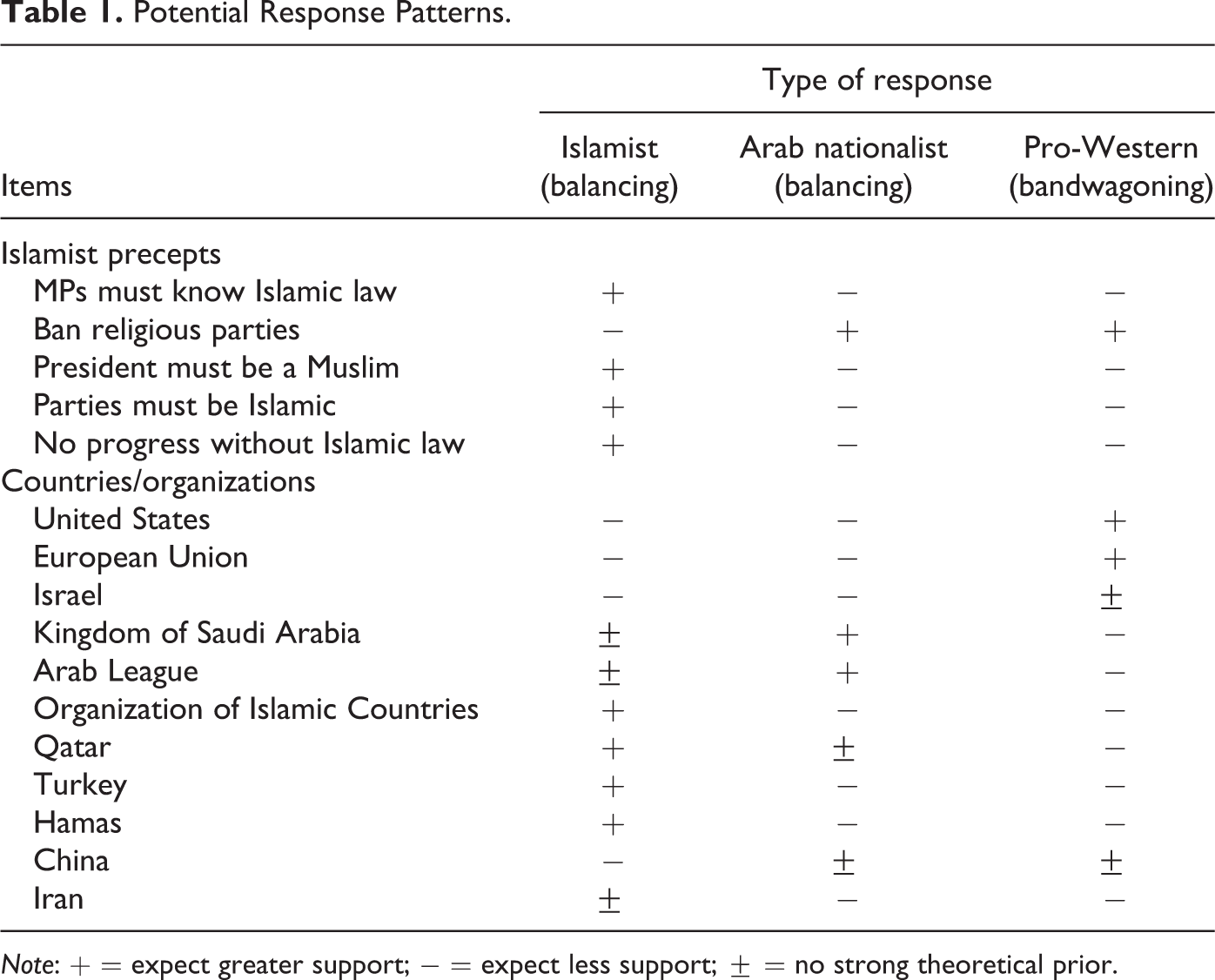
Note: + = expect greater support; − = expect less support; ± = no strong theoretical prior.
Baseline Responses
Before turning to our results, we report the baseline responses to each of the questions in the control group. 13 As is evident from Figure 1, which plots the 95 percent confidence intervals (CIs) of control group responses to the battery of questions regarding Islamist ideological precepts, citizens on average are hospitable to the idea of a large role for Islam in politics. Approximately 78.6 percent “agreed” or “strongly agreed” that parliamentarians should know Islamic law. A narrow majority of 51.7 percent agreed or strongly agreed with the notion of banning religious parties (an idea that was, at the time of the fielding of this survey, floated by opponents of the newly outlawed Muslim Brotherhood). Strikingly, 78.61 percent strongly agreed and another 14.64 percent agreed with the proposition that Egypt’s president must be a Muslim. More surprisingly, 62.7 percent of respondents agreed or strongly agreed with the statement that all political parties must have an Islamic frame of reference (marjaʿiyya Islāmiyya). Given that the Muslim Brotherhood, then highly unpopular, introduced this term into the Egyptian lexicon as a description of itself (Hamzawy and Brown 2010), the fact that a near supermajority believe that it is a positive attribute of parties testifies to the extent to which Islamist ideology, if not the Muslim Brotherhood, remains congenial to most Egyptians. Finally, in further support of this observation, we found that approximately 61 percent of respondents in the control group agreed or strongly agreed with the statement that Egypt would not progress until it applied Islamic law.
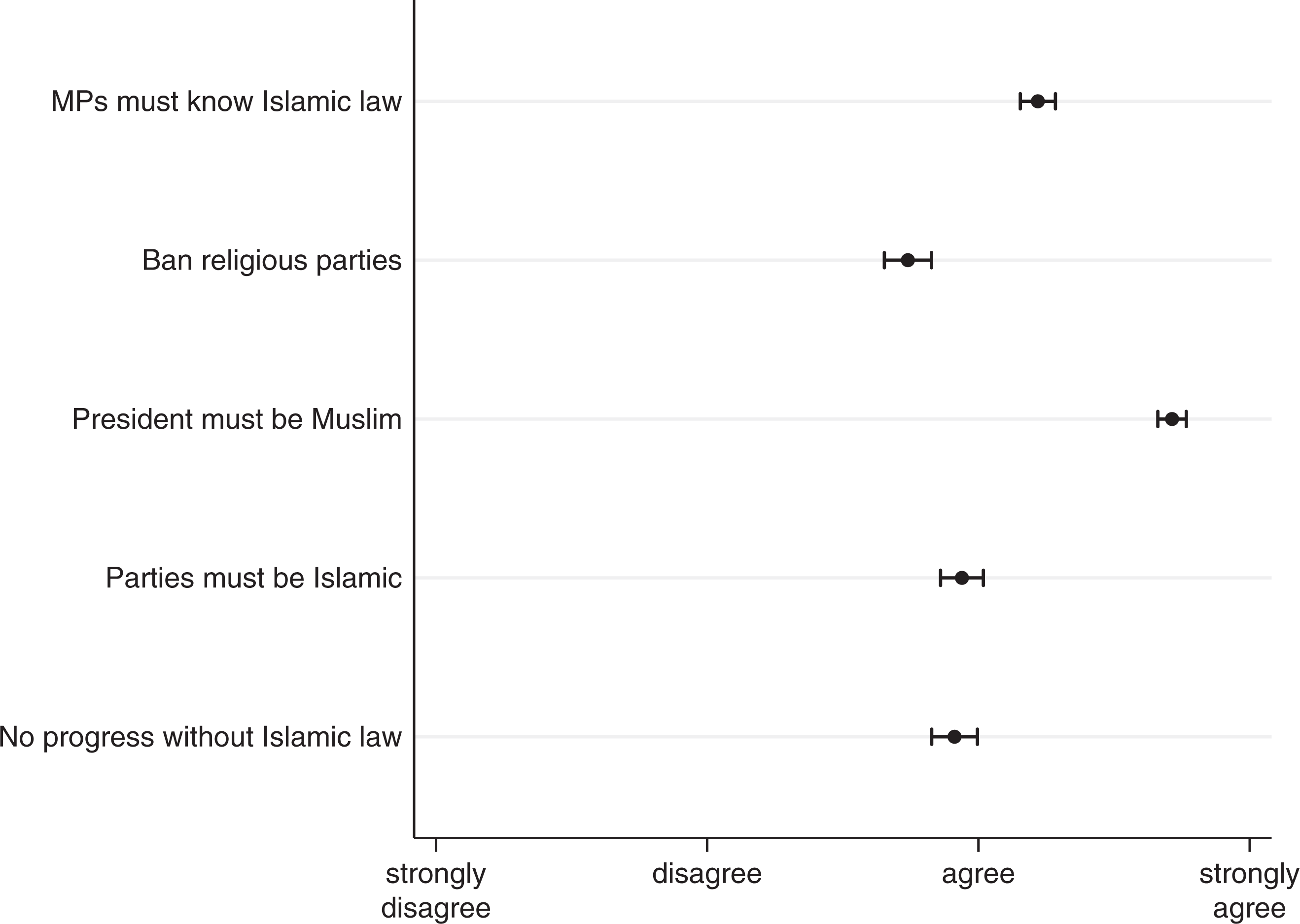
Control group responses: Attitudes toward Islamist ideological precepts.
Finally, Figure 2 plots average baseline responses to the battery of questions regarding Egypt’s relations with key foreign countries and entities. 14 We divide these into three groups for ease of interpretation. The first are countries typically thought of by Egyptians as “Western”: the United States, the EU, and the State of Israel. As expected, estimations of these countries are largely negative. Approximately 40.35 percent of Egyptians in the control group want their country to have weaker ties to the United States in the coming period, 31.35 percent want weaker ties to the EU, and 72.27 percent of respondents in the control group want their county to have weaker relations with the State of Israel. By contrast, Saudi Arabia enjoys generally positive feelings, with 90.16 percent of respondents in the control group wanting stronger relations with it in the future. This likely reflects that country’s economic patronage of Egypt and the large number of Egyptian guest workers in that oil-rich country (Kapiszewski 2003). The Arab League and the Organization of Islamic Cooperation are similarly well regarded with, respectively, 72.6 percent and 64.86 percent of respondents in the control group desirous of deeper ties with those two countries. These warm feelings do not extend, however, to other Arab and Muslim countries in our sample. Qatar, Turkey, and Hamas (the Muslim Brotherhood offshoot that controls the Gaza strip) are all viewed negatively by respondents in the control group, posting some of the lowest numbers in the poll. Only 24.77 percent of control group respondents reported wanting closer ties with Qatar, only 22.14 percent wanted closer ties with Turkey, and only 16.55 percent desired closer ties with Hamas. This is not surprising, as those three entities were widely considered allies of the unpopular Muslim Brotherhood government that was ousted in a July 3, 2013, military coup. Similarly unpopular is Iran: 58.98 percent of control group respondents want weaker ties with that country. This makes sense, given that Iran is the traditional rival of Saudi Arabia, the country Egyptians view most favorably. Finally, 61.75 percent of respondents want closer ties with China, perhaps reflecting that country’s status as a global economic and military power that presents an alternative to Western dominance.

Control group responses: Desired relations with Arab, Muslim, and Western powers.
The overall portrait of Egyptian public opinion provided by the baseline control group responses is a complex one. First, Egyptians exhibit a high degree of hospitality to Islamist ideological precepts but take a dim view of governments and entities (Qatar, Turkey, and Hamas) deemed to support the Egyptian political movement most associated with those precepts (i.e., the Muslim Brotherhood). Indeed, these Islamist-supporting actors appear to be even more unpopular among average Egyptians than the United States. Second, Egyptians reserve their warmest feelings for conservative authoritarian regimes: Saudi Arabia, China, and the countries of the Arab League. One interpretation of this overall pattern, which is also consistent with Egypt’s political trajectory after its 2011 revolution, is that Egyptians believe that strong, authoritarian regimes such as Saudi Arabia or China offer better models of progress than the nations of the West or the exponents of political Islam.
In the following section, we turn to our results. How, if at all, will views toward these countries, and toward the fundamental precepts of political Islam, change in response to reminders of Western dominance? Will Egyptians come to evaluate Islamists more favorably? Will they bandwagon with the West? Or will they seek a deepening of their Arab identity? And will their propensity to do any of these things vary with the precise nature of Western dominance to which they are exposed?
Results and Interpretation
For each of our outcome variables, the average treatment effect is the difference in means between the treatment and the control group. Following Grimmer, Messing, and Westwood (2013, 4–6), we express the average treatment effect as follows:

where Y(T) is the average value of our dependent variable in the treatment group and Y(C) is the average value of the dependent variable in the control group. Figures 3 and 4 plot the 95 percent CIs for the effects of each treatment on our dependent variables, expressed as the percentage difference in average responses in the treatment and control groups. The significant treatment effects are presented in Table 2.
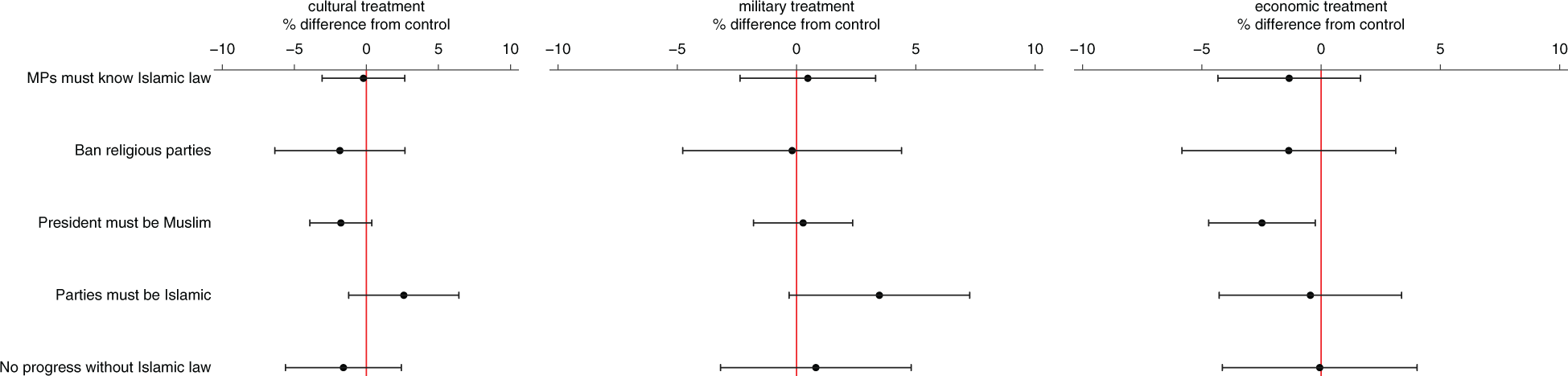
Average treatment effects: Support Islamist ideological precepts.
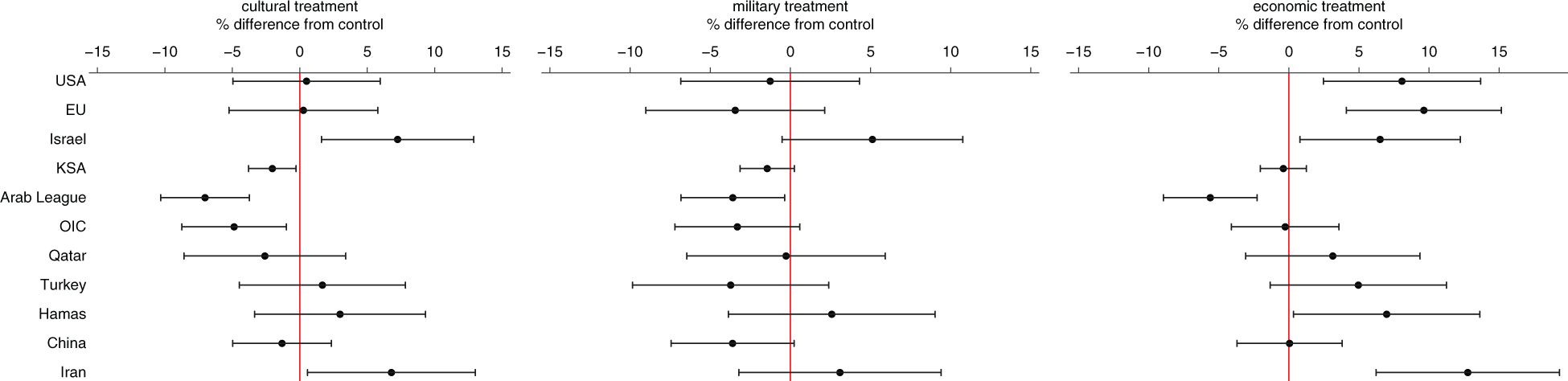
Average treatment effects: Relations with selected countries.
Summary of Significant Treatment Effects.

Note: Variables with bolded titles are significant after the application of the appropriate Bonferroni adjustments for multiple comparisons. KSA = Kingdom of Saudi Arabia; EU = European Union.
Starting with Figure 3, which shows the extent to which respondents became more or less supportive of Islamist precepts in response to the three treatments, we see that neither the reminders of the West’s cultural nor the military dominance had a significant effect on a respondent’s support for Islamist precepts. Respondents who received a reminder of the West’s economic superiority were, however, slightly less supportive of the notion that Egypt’s president must be a Muslim: the average response to this item in the treatment group was approximately 2.5 percent (± 1.13) smaller than in the control (p = .015).
Not only is this result substantively small, it is also of questionable statistical significance. Recall that, for each treatment group, we conducted five comparisons with the control group (one for each Islamist precept). Whenever multiple comparisons are conducted, the possibility arises that results that appear statistically significant are in fact the product of chance. And given the large number of dependent variables in this analysis—respondents’ scores on five Islamist precepts—the risk of false positives is particularly high. We therefore apply the Bonferroni adjustment to our estimates of standard errors, which attempts to ensure that the family-wise error rate is constrained to be below a given threshold of statistical significance (Bland and Altman 1995). Thus, at a level of 95 percent confidence (p < .05), for any of our fifteen comparisons (three treatment groups × five Islamist precepts) to be deemed significant, it must achieve a p value of less than .05 divided by 15, or .003. Although the economic treatment appeared to render respondents less likely to believe that Egypt’s president must be a Muslim, the p value (.015) exceeds the Bonferroni-adjusted threshold and therefore we cannot dismiss the null hypothesis that this treatment had no effect.
Here, prior to the application of the necessary Bonferroni adjustment for thirty-three comparisons (three treatment groups × eleven countries), we see multiple significant differences between treatments and control. Support for the United States is unaffected by the cultural and military treatments but is increased by the economic treatment. Specifically, feelings toward the United States are approximately 8.1 percent more favorable (±2.8 percent, two-tailed, p = .0049) in the economic treatment group than in the control group. Support for the EU is similarly unmoved by either the cultural or military treatment, but it is also increased by the economic treatment (9.6 ± 2.8 percent, p = .0007). Support for Israel, on the other hand, is increased by both the cultural (7.23 ± 2.82 percent, p = .012) and economic (6.545 ± 2.89 percent, p = .0259) treatments. Moreover, when we apply the Bonferroni correction for multiple comparisons (for a 95 percent confidence threshold of p = .05/33 = .0015), the effect of the economic treatment on support for the EU remains significant at the 95 percent level, although the effect of the treatment on support for the United States misses significance. What this result suggests is that reminders of the West’s economic hegemony (whether we include Israel in that group or not) may ameliorate Egyptians’ low baseline estimations of the West in our survey.
Turning to the non-Western countries, one striking finding is the decrease in support for the Arab League among respondents in all three treatment groups. Support for closer relations with the Arab League among respondents in the cultural treatment group is approximately 7 percent lower (±1.66 percent, p = .000) than that of respondents in the control group. Respondents in the military treatment group were similarly less favorable to the Arab League (−3.583 ± 1.66 percent, p = .0297) than those in the control condition. And finally, respondents who were exposed to a reminder of the West’s economic hegemony were 5.621 percent (±1.7 percent) less favorable to the Arab League than their control group counterparts (p = .0011). Although this decline in support for the Arab League is substantively small, it remains significant for the cultural and economic treatments even after the application of the Bonferroni adjustment (which, again, requires p < .0045 to meet significance at the 95 percent level). Support for Saudi Arabia and the Organization of Islamic Cooperation is also reduced, when compared to the control, among respondents in the cultural treatment group, but these differences are not significant after the Bonferroni adjustment (see Table 2).
Both the increase in support for the EU, and the decrease in support for the Arab League, are consistent with the pro-Western bandwagoning pattern described in Outcome Variables section. However, we also observe treatment effects that are inconsistent with this pattern. Specifically, among respondents in the cultural treatment group, we see increased support (compared to the control) for closer relations with Iran (6.82 ± 3.15 percent, p = .0325). However, this effect is not significant at the 95 percent level after adjusting the significance threshold for multiple comparisons. More notably, among respondents exposed to the economic treatment, we see that support for Iran is also increased relative to the control (12.795 ± 3.35 percent, p = .0001), and that this effect remains significant after the Bonferroni adjustment. The pro-Iranian response to the economic treatment is puzzling, especially as it coincides with the pro-Western response described above. Lest we interpret this as constituting an Islamist response, however, it is important to note that support for the Organization of Islamic Cooperation (OIC), Turkey, and Qatar was unaffected by this treatment. And although support for Hamas did experience a slight increase (6.96 ± 3.39 percent), the p value of the difference of means test (p = .0398) exceeds the Bonferroni-adjusted 95 percent significance threshold of p < .0015.
In the following section, we dive more deeply into the data. Our particular concern is probing the effect of the economic reminder of Western hegemony, which seemed to render respondents more pro-Western, less pro-Arab, and, somewhat counterintuitively, more pro-Iranian. Are these average treatment effects driven by different segments of the population?
Heterogeneous Treatment Effects
So far, we have observed that reminders of Western hegemony failed to elicit Islamist or Arab Nationalist responses. Instead, we found a small but significant increase support for the European Union when experimental subjects were exposed to the West’s economic dominance. We found also that this treatment tended to cause subjects to become slightly less supportive of the Arab League. We also found, somewhat counter to our expectations, that support for Iran increased among those exposed to the economic treatment, raising the possibility of heterogeneous treatment effects. In other words, the results hint at the possibility that responses to the economic treatment might be conditional on respondent characteristics, with some respondents reacting to the West’s economic ascendance by bandwagoning with the West (reflected in increased support for closer relations with the EU), and others reacting by balancing against it (i.e., by increasing support for closer relations with Iran).
In this section, we explore this possibility by examining the effects of the treatment conditional on one factor that the literature leads us to expect will exert a strong effect on respondents’ reactions to Western hegemony: specifically, the extent of individual religiosity. Are more religious respondents more likely to increase support for Iran when reminded of Western economic hegemony with less religious ones turning to the United States and Europe?
The Effect of Religiosity
As outlined in the Hypotheses subsection, there are two conflicting expectations for how religiosity might interact with Western economic hegemony: on one account, more religious people might find the West’s economic dominance to be a positive attribute of the West, inasmuch as it is a function of free market values many orthodox Muslims are hypothesized to share; on another account, the West’s economic ascendance might serve to remind conservative Muslims of the West’s radical individualism, thus awakening negative perceptions. We have similarly conflicting expectations for how Western economic hegemony should influence religious respondents’ views of Iran. On the one hand, more religious people might respond to a reminder of the West’s economic dominance by seeking closer ties with a fellow Muslim nation. On the other hand, there is considerable hostility among the most conservative Muslims in Egypt to the Shiʿī sect of Islam that predominates in Iran, which might lead us to expect that the respondents who evince pro-Iranian views are those of lesser religiosity.
In order to determine whether the effect of the economic treatment is moderated by religiosity, we must first measure that concept. We do so by using six questions about respondents’ religious practice. Specifically, respondents were asked how often they (a) pray each day, (b) fast during Ramadan, (c) watch or listen to religious programs on television or radio, (d) attend religious lessons in the mosque, (e) attend Friday prayers, and (f) listen to the Qurʾān. For each item, respondents could indicate that they “never,” “sometimes,” “often,” or “always” engaged in the activity (coded as 1, 2, 3, and 4, respectively, on a four-point scale). 15 We added the responses on each of these items to generate a twenty-four-point religiosity scale (Cronbach’s α = .6032). The resulting variable is unimodally distributed with mean of 17.99, standard deviation of 3.26, and values ranging from 6 to 24. To simplify our analysis, we then divided this continuous variable into four quartiles.
Figure 5 plots the average responses of individuals in the control group by level of religiosity for each of the four entities: the United States, EU, Arab League, and Iran (lower scores reflect a desire for weaker future relations and higher scores reflect a desire for stronger ones). These constitute the baselines against which the conditional treatment effects will be estimated. As is evident from the figure, there are no significant differences between respondents of different levels of religiosity in their baseline attitudes toward these entities (the red vertical line in each subfigure represents the control group average for that country or entity). The question for us is whether the effect of the economic treatment varies with respondent religiosity. In other words, are respondents of lower religiosity affected differently from those of high religiosity?

Baseline attitudes toward the US, European Union, Arab League, and Iran by religiosity (control group).
We plot the effects of the economic treatment on support for the United States, EU, Arab League, and Iran—conditional on a respondent’s level of religiosity—in Figure 6. 16 Each subfigure represents respondents’ support for one of the four entities: the United States, EU, the Arab League, and Iran. Within each subfigure, each CI represents the percentage difference in support for that country between respondents at a given level of religiosity in the treatment and control groups. 17 As is evident from the figure, the least religious respondents were disproportionately likely to exhibit greater support for the United States when exposed to a reminder of Western economic ascendance (compared to their counterparts in the control). Support for Iran increased at both the high and low levels of religiosity (relative to the support for Iran evinced by those groups in the control) and support for the EU increased among respondents of highest religiosity (relative to the most religious respondents in the control condition). The overall pattern suggests that those who respond to Western hegemony by aligning with the United States are on average less religious than those who do so by balancing with Iran.
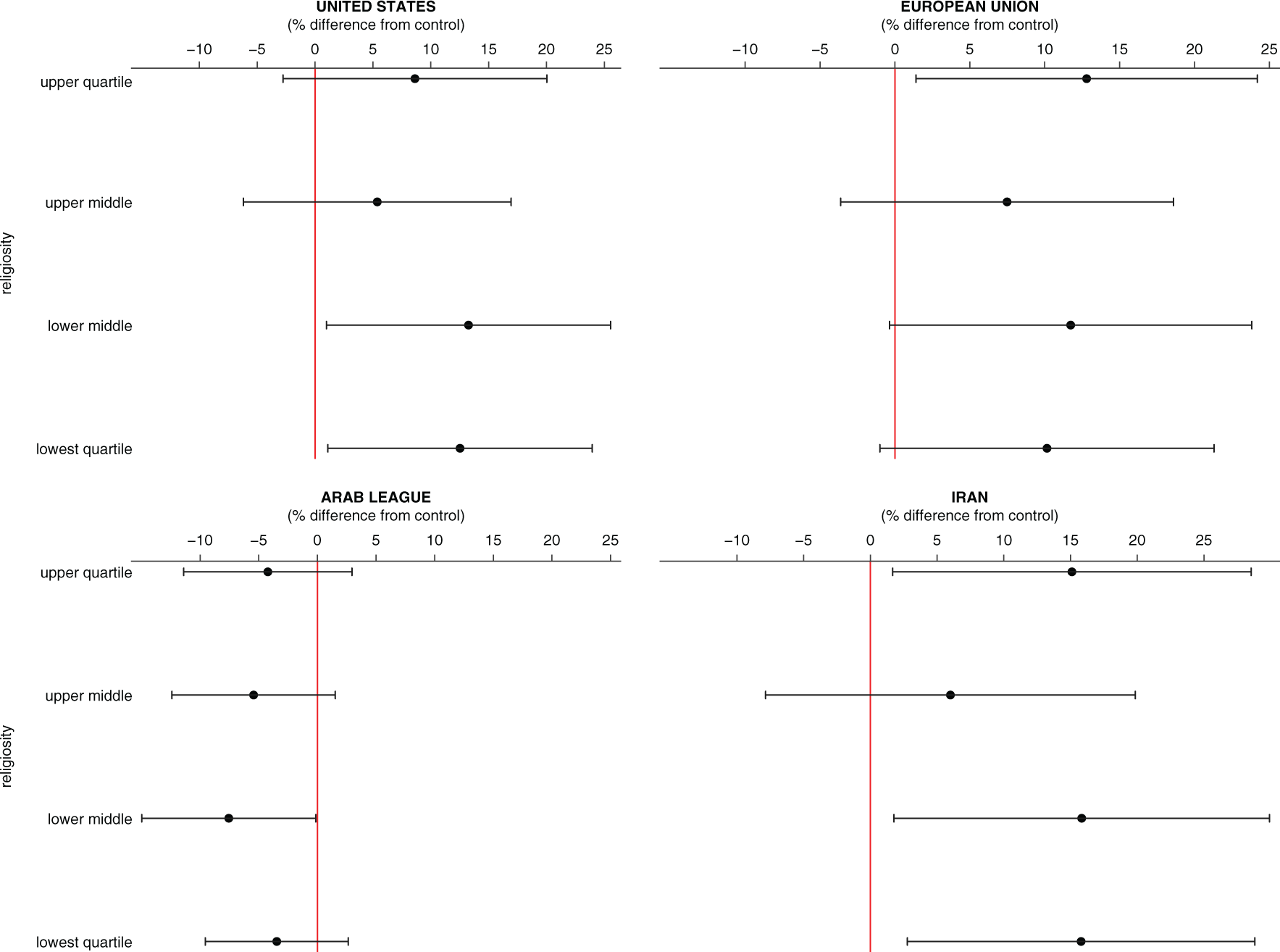
Effect of economic treatment on support for the US, European Union, Arab League, and Iran, conditional on religiosity.
We wish to be careful with this interpretation, however. We note that we are dealing with thirty-six comparisons here—three treatments × four countries × four religiosity quartiles. The Bonferroni-adjusted threshold for significance at the 95 percent level is thus .05/36, or .001. None of the treatment effects visualized in Figure 6 are significant at this level. That said, the unadjusted findings presented here suggest, at the very least, that the manner in which individual religiosity moderates responses to Western economic dominance merits further investigation.
Conclusion
In this article, we have argued for a richer conception of the hypothesized relationship between Western hegemony and support for political Islam. Where the literature has tended to view Western hegemony as a singular phenomenon that produces a singular reaction among Muslims, we have suggested that the West’s ascent, and Muslim responses to it, must be disaggregated. Islamism is only one of a range of potential responses to the Muslim world’s political, cultural, and economic subordination to Western powers. An equally important, and we believe, understudied, reaction to Western ascendance is a desire to emulate Western countries and to strengthen ties with them. We have argued that this reaction is most likely to emerge in response to the West’s economic dominance, which, in contrast to its military and cultural ascendance, is not as implicated in perceived Muslim oppression and therefore less likely to be viewed threateningly.
Our experimental results support this conjecture and raise questions about established theories of Islamism and its relationship to the West. We found little support for the hypothesis that Western military and cultural dominance generate sympathy for Islamism, although the subtlety of our treatments prevents us from concluding that this result disproves the long-standing view of Islamism as a reaction to Western hegemony. We did find support, however, for the argument that Western economic dominance is more likely than other forms of hegemony to cause Muslims to seek closer relations with Western countries. Reminders of Western economic hegemony led participants in the experiment to exhibit a desire to “bandwagon” with the EU and, to a lesser extent, the United States, although in the latter case, this appeared driven by less religious citizens, with more religious ones apparently turning toward Iran. If these results stand up to replication by other scholars in other settings, they will constitute evidence that a deepening of economic ties between the Muslim world and the West may actually help to avoid, or at least ameliorate, the oft-cited and much-feared clash of civilizations.
We emphasize, however, that Islamism’s popularity, and the role of Western hegemony in generating it, requires further research. Moreover, it remains to be determined whether the relationships we have uncovered hold outside of the Egyptian context. After all, although we believe that Egypt is representative of the broader Muslim experience with Western power, there are no doubt important differences among Muslim countries in how they relate to the West politically, militarily, and economically. Egypt, after all, is a significant recipient of Western (and specifically, American) military and economic assistance, something that is true of many other, but not all, Arab and Muslim countries. What our experiments have demonstrated, however, is that animus cannot be assumed, and that theories of individual ideological responses to external challenge should incorporate the conditions under which bandwagoning is favored over balancing, and by whom. As the Western encounter with the Muslim world enters its fifteenth century, and at a time in which violent Islamism threatens to plunge both sides of this alleged civilizational divide into further conflict, uncovering the ways in each side perceives and processes the other will continue to be of critical importance both to those who study the Middle East and those who steer policies toward it.
Footnotes
Declaration of Conflicting Interests
The author(s) declared no potential conflicts of interest with respect to the research, authorship, and/or publication of this article.
Funding
The author(s) disclosed receipt of the following financial support for the research, authorship, and/or publication of this article: The authors gratefully acknowledge funding support from Princeton and Harvard Universities.
Notes

References
Supplementary Material
Please find the following supplemental material available below.
For Open Access articles published under a Creative Commons License, all supplemental material carries the same license as the article it is associated with.
For non-Open Access articles published, all supplemental material carries a non-exclusive license, and permission requests for re-use of supplemental material or any part of supplemental material shall be sent directly to the copyright owner as specified in the copyright notice associated with the article.
