




Abstract
Recent scholarship has found evidence that refugee flows may inadvertently contribute to the spread of conflict across borders. Little is known, however, about the spatial diffusion of conflict within a state’s borders and what role internal displacement plays in such a dynamic. This question is of relevance because of the particular marginalization of internally displaced persons, which make them at risk of predation and militarization by armed groups. Drawing on a novel global data set on internal displacement, we evaluate this question and find evidence for a similar mechanism leading to conflict spread operating at the domestic level.
Recent scholarship has investigated how refugee flows may increase, directly or indirectly, the risk of conflict as well as the locus and clustering of violence (Lischer 2005; Rüegger 2013; Salehyan and Gleditsch 2006). The evidence suggests that refugees may inadvertently contribute to conflict spread. Refugees are, however, hardly the only ones to be forced to leave their homes due to conflict and persecution, as a substantial number of displaced persons remain stranded within the borders of their home state. In fact, at the end of 2014, the number of internally displaced persons (IDPs)
1
worldwide stood at nearly twice the number of refugees, or in other words a staggering 38.2 million compared to some 19.2 million refugees (Internal Displacement Monitoring Centre [IDMC] 2015; United Nations High Commissioner for Refugees [UNHCR] 2015b).
2
For example, while the number of Syrian refugees has passed 4 million, the UN estimates that a further 7.6 million have been displaced within Syria, unable or unwilling to leave the country (UNHCR 2015a). Furthermore, although examples like Darfur and Uganda have shown that IDPs can play a significant role in the spread of conflict, internal displacement has been largely ignored by conflict scholars. Apart from occasional case studies (see, for instance, Lischer 2008; Muggah 2006), no quantitative analysis has focused more systematically on the effects of conflict-induced internal displacement on the spread of domestic conflict until now. In this article, we propose to fill this gap by investigating the following research question:
We conceive of conflict spread as diffusion of conflict incidences from one region A in a country to another region B in the same country. This can result in an extension or a shift of the conflict zone. We rely here partly on Lake and Rothchild’s (1998, 4) definition which states that diffusion occurs “when conflict in one area alters the likelihood of conflict elsewhere,” focusing in particular on the process of disruption of ethnic balance (Lake and Rothchild 1998, 25). 3 In the empirical part of this article, we employ this simple definition of diffusion but also use a more stringent definition that should alleviate possible endogeneity concerns.
Analyzing diffusion patterns at the domestic level is important since domestic conflict might eventually spread over international borders, as seen currently in the case of Syria. Refugees have once been IDPs and, therefore, studying IDPs and their role in the conflict dynamic is essential to be able to prevent the spread of domestic and international conflict. It should be stressed, however, that we consider only internal displacement caused by conflict and persecution and exclude from our analysis forced displacement due to natural or man-made disasters or any form of voluntary migration.
We argue that IDPs can change the ethnic composition in an area and provide ethnic support to rebel groups, in a pattern similar to that of refugee flows (see, for instance, Rüegger 2013; Salehyan and Gleditsch 2006) and, thus lead to conflict spread. To evaluate this claim, we rely on a newly created spatial data set on internal displacement, which we refer to as the Global Internal Displacement Patterns (G-IDP) data set and, in doing so, contribute to overcome the lack of quantitative and spatial data in this area of research. Our analysis focuses on conflict diffusion in Africa from 2008 to 2010. We find that internal displacement may contribute to the spread of ethnic conflict.
This result, however, should not be viewed as casting a negative light on IDPs. There is no denying that IDPs live in particularly squalid conditions, are vulnerable to armed groups, and therefore rightfully deserve support and assistance by the international community, as well as local actors.
Our article is structured as follows. We first review the current literature on IDPs and refugees. Next, we present our theoretical arguments on how IDPs might relate to processes of conflict diffusion through opportunity and motivation mechanisms and derive our main hypothesis. In subsequent sections, we introduce our newly collected G-IDP data set and present the methodology we employ to test whether internal displacement indeed increases the risk of conflict spread. Our results suggest that the presence of IDPs does heighten the risk of ethnic violence diffusion. 4 We conclude with a summary of our results and a discussion of their policy implications.
Literature Review
The lack of scholarly attention paid until now to the possible linkage between internal displacement and conflict stems, first, from a scarcity of data on IDPs due to the inherent difficulty in obtaining accurate information on the location and scale of internal displacement. Second, the usefulness of distinguishing IDPs from the local population has been the subject of theoretical debate, as both categories are affected by violence (Cohen and Deng 1998; Mooney 2005, 26-29). 5 There are, nonetheless, conceptual reasons that argue in favor of separating IDPs from the otherwise more general civilian population. Compared to the general population, IDPs often live in markedly squalid and insecure conditions (Cohen and Deng 1998, 27; Muggah 2006, 113). As O’Neill (2009, 153) points out, in contrast to refugees, “IDPs remain close to the zones of conflict and thus [are] more vulnerable to violence.” Moreover, IDPs “have specific needs not [necessarily] encountered by the rest of the population and face particular vulnerabilities. For example, they are in need of shelter, unable to replace or receive identity [papers] and other official documents, and often encounter serious problems in regaining property left behind” (O’Neill 2009, 153), exposing them to additional risks and making them more susceptible to new conflict situations.
We therefore argue that the role of IDPs in conflict needs to be investigated in more detail. Indeed, there is scant published work on the security implications of IDPs to date. This is surprising, as cases of IDP militarization have been recorded as frequently as refugee militarization, if not even more (Ferris 2007, 5).
Muggah (2010, 167) is one of the few who suggests that IDPs can become militarized, creating the potential for conflict to spread “into otherwise ‘peaceful’ areas” (see also Muggah 2006). He writes about outward and inward militarization, referring to the fact that IDPs can directly or indirectly be involved in the conflict diffusion process, thus being both victims and agents. IDPs can take up arms themselves or their settlements can provide strategic advantages, for example, as buffer zones to rebel groups. This was the case in northern and eastern Sri Lanka, where IDP camps were located in the so-called High Security Zones (Muggah 2010, 185). Muggah (2010) further underlines that IDP militarization is particularly likely were IDP settlements serve as arms storage for rebel groups. In the case of Uganda, Muggah (2006, 103) illustrates how perilous the security situation of IDPs can be. In 2004, IDPs made up between 60 and 93 percent of the total population in the northern and eastern districts of Uganda. The Lord’s Resistance Army attacked IDPs, while the Uganda People’s Defence Force recruited among IDPs. Nonetheless, although Muggah (2006) points out the significant role of IDPs in the conflict dynamic, he does not clearly differentiate between IDP and refugee militarization. It is not clear, however, if the mechanisms behind these militarization processes are indeed the same.
Focusing on Iraq, Lischer (2008) states that because IDPs have encountered increased resentment and restrictions on their activities, they have become susceptible to political manipulation. IDPs are also easy targets, as they are concentrated and vulnerable (Lischer 2008, 96) and, thus, contribute to conflict diffusion. Moreover, “an influx of IDPs may upset ethnic balances within a region and incite conflict,” and militants may move among forcibly displaced persons and be involved in violence within hosting areas (Lischer 2008, 101-2). Drawing also on Iraq, Ferris (2007) suggests that internal displacement can have major consequences for security, and, hence, the spread of conflict. Kahn (2008, 26), on the other hand, emphasizes that IDP settlements may not be apolitical and, thus, could play a significant role in the diffusion process. In particular, she points out that in the case of Darfur, where the majority of IDPs are located in government-controlled areas but are no supporters of the government, state-based conflict is very likely (Kahn 2008, 17). In addition, as IDP camps are relatively open, rebel groups have easy access to and, thus, can recruit in them (Kahn 2008, 35).
In general, Ruaudel (2013) claims that the relationship between IDPs and insurgent groups is complex and dynamic. Nonstate armed actors might trigger displacement, try to control, protect IDPs, or create a support base from them (Ruaudel 2013, 8-12). Their relation can range from “exploitative and predatory through more nuanced ones of tolerance and acceptance to ones of mutual support, solidarity and protection” (Ruaudel 2013, 13). In particular, shared ethnicity or common ideology could make IDPs susceptible to rebel groups (Ruaudel 2013, 15).
Large-N research on the influence of internal displacement on conflict dynamics has, however, addressed the issue of conflict spread only peripherally. Achvarina and Reich (2006), for instance, find that the militarization of IDP camps in Africa is an important determinant of child soldiers’ recruitment. In a recent study of terrorism, Choi and Piazza (2016) show that the presence of large internally displaced populations is associated with a higher likelihood of suicide attacks. A finding that, they suggest (Choi and Piazza 2016, 8, 17), is related to grievances held by IDPs resulting from marginalization and abuse by state authorities and host communities (for a related study focusing on the effect of refugees on terrorist attacks, see Choi and Salehyan 2013). Finally, Van der Windt and Humphrey (2016) also suggest that local conflict diffusion of violence in the Democratic Republic of Congo’s province of South Kivu may be related to sizable population movements as a consequence of the First and Second Congo Wars.
In sum, the literature on IDPs, especially in regard to their effects on conflict spread, has been very rudimentary until now. The case studies that have been put forward suggest that IDPs play a significant role in conflict dynamics. However, the general effects of IDPs on conflict diffusion have yet to be analyzed. In the following, we examine more closely the relationship between IDPs and the spread of conflict, focusing particularly on ethnic and state-based conflict.
Theory
The literature on IDPs and their role in conflict spread is scarce—no current theory exists that addresses this issue. However, as IDPs are often found in similar situations as refugees, it is possible that similar mechanisms linking their presence to conflict spread may play a role. Thus, our theoretical argument draws in part on the literature on the refugee–security nexus. Muggah (2006, 2010) and Lischer (2008) both argue that similar mechanisms are at work. Moreover, as IDPs are mainly regarded as part of the civilian population, the general conflict literature also provides a basis for our arguments here.
In general, two mechanisms prevail in the conflict literature that attempt to explain why conflict breaks out: one related to motivational and the other to opportunity factors (see, for instance, Collier and Hoeffler 2004). We argue that both may contribute to IDPs’ role in conflict spread. First, we outline our motivational argument, which contends that IDPs are particularly likely to provide support to rebels from the same ethnic groups, as IDPs may harbor strong grievances and, therefore, incentives for engaging in violence to change their situation. Moreover, shared ethnicity among IDPs and rebels will make promises of recruits by the IDPs to the rebels more credible and increases the value of future commitments between the two (Weinstein 2005). Cederman, Wimmer, and Min (2010, 98) define ethnicity here “as any subjectively experienced sense of commonality based on the belief in common ancestry and shared culture” and consider a rebel group to have strong ties with an ethnic group if it articulates ethno-nationalist objectives and recruits on the “basis of ethnic affiliation” (p. 102).
The experience and traumatism of flight of IDPs are likely to increase the salience of ethnic identities (Lischer 2005, 22; Rüegger 2013). For Fearon (2004, 405) stresses that Azeri IDPs resulting from the Nagorno-Karabakh War hold particularly strong grievances and “are actively developing a political ideology of revenge and return.” In addition, IDPs are often the most vulnerable population of concern in a conflict. IDPs face major challenges in getting access to assistance from humanitarian agencies (Choi and Piazza 2016, 5). They are also often excluded from any meaningful participation in the political process due to the lack of proper documentation (Mooney 2005, 18). As a consequence of both flight and political, as well as socioeconomic, marginalization, IDPs are likely to collectively hold strong grievances against the state. Therefore, they may share the same political objectives as rebels from the same ethnic groups. In such circumstances, IDPs may be particularly receptive to discourses of security dilemma and propaganda from rebel entrepreneurs (Lischer 2008, 99-100).
The recent literature on refugees dealing with the nexus between displacement and security has also stressed the significance of ethnic kinship between the displaced and the host population (Lischer 2005, 2008; Rüegger 2013; Salehyan and Gleditsch 2006). More precisely, scholars have corroborated the hypothesis that refugees sharing ethnic kinship with a politically marginalized group in their host country makes conflict spread more likely, particularly if the refugee influx is large. The risk of diffusion, moreover, is especially heightened if rebel organizations share ethnic kinship with the refugees (Rüegger 2013; Salehyan 2007). We assume the same to be true for IDPs. As Ruaudel (2013, 17) points out, shared kinship between IDPs and armed groups can explain infiltration into the camps. Armed groups may use IDP camps as “a kind of ‘family strategy’ for collective survival” and support. 6 Recruitment along ethnic linkages should indeed be particularly likely in the case of IDPs as, in contrast to refugees, IDPs have not crossed an international border and, thus, might be more inclined to engage in fighting. Refugees find themselves in very new surroundings, namely, a different country, while IDPs, although also displaced, stay in their home country that is known to them. Therefore, the cost for refugees for engaging in conflict is much higher than for IDPs, as refugees have a status comparable to that of guests in their host country and face significantly higher costs when engaging in fighting against the state that hosts them. In addition, IDPs might be more willing to fight for a cause concerning their region and also be more willing to engage with rebels as they share a common history. Consequently, they might more easily identify with rebel groups trying to recruit them than refugees and, thus, their motivation to engage in violence is heightened. An overview of the motivational factors of IDPs to be involved in violence is shown in Figure 1.

Motivational factors of internally displaced persons.
Besides motivational factors, opportunity factors may also play a role in conflict spread. In general, we assume that rebel groups are critically dependent on co-ethnics to carry out violent attacks against the state. As Sambanis (2008, 9) shows, ethnicity facilitates the mobilization process of rebel groups by generating “shared loyalties and obligations” among co-ethnics. As an illustration of this dynamic, Lischer (2008, 106) reported that rebels around Muqtada Al-Sadr and its Mahdi Army had been recruiting in Iraqi IDP camps. Aspa (2011, 17) also underscores that rebel groups are heavily dependent on external support. IDPs, particularly if they have the same ethnicity as members of rebel groups, can provide this support. They can be a source of supply and recruitment and function as logistical bases as well (see also Ruaudel 2013, 10). By fleeing to other areas, possibly outside their common ethnic group boundary, IDPs may contribute to the diffusion of ethnic conflict as they can provide support to a rebel group in a region, where the rebel group had no prior support. The ability to mobilize is thus heightened. Toft (2003) and Weidmann (2009) have previously argued that the settlement pattern of ethnic groups is crucial for the probability of ethnic conflict because it provides the context in which group members can interact. These authors found that the geographic concentration of an ethnic group increases the risk of conflict. Although we do not have information available on the exact concentration levels of IDPs, we assume that the general influx of IDPs into a region where no co-ethnics had been present before increases the concentration of the ethnic group in that region, creating opportunity structures for mobilization.
Moreover, scholars have argued that weak rebel groups only challenge the state in areas of the country where they are comparatively stronger (Buhaug 2010). Consequently, rebel groups should generally be deterred from launching attacks in areas in which they are deprived of support from the local population. Violence would be unlikely in such areas, as these operations may carry particularly high risks of detection and failure and therefore entail high costs.
In this regard, we postulate that the spread of ethnic violence is especially likely in cases where internal displacement would spill over ethnic boundaries. In such contexts, the ethnic composition of previously peaceful regions may be modified as a result of an influx of IDPs. Mechanisms linked to both grievances and opportunity would then suggest that diffusion of violence may ensue. In such circumstances, rebel groups could have the capacity to carry out military operations in areas from which they had been previously denied access to due to a lack of either a “sympathetic population” or social rebel networks. Figure 2 depicts an overview of the opportunity factors.

Opportunity structures for rebel groups provided by internally displaced persons presence.
Consequently, IDP-affected areas can provide both opportunity structures and motivational factors. Therefore, we hypothesize that:
It should be stressed that the argument does not necessarily imply that the relationship between ethnic rebel groups and their co-ethnics stems from common interest. Rather, the opportunity argument suggests that the relationship may well be of a predatory nature: Rebel networks inherently follow kinship lines, thus enabling armed groups to exert control over co-ethnics. For example, Aspa (2011, 17) underlines that in Darfur IDPs have been recruited voluntarily as well as forcibly. As IDPs are often unorganized, weak, and unarmed, they can become easily recruited by force (Aspa 2011). Moreover, as IDP settlements are also often not formally recognized and, thus, often do not receive protection, rebels can easily access and recruit inside them.
G-IDP Data Set
Several factors concur to make it difficult to collect data on IDPs. First, definitional issues, pertaining to the status of IDPs, linger on. In contrast to refugees, who must necessarily have crossed an international border, the moment when internal displacement starts remains unclear. In addition, IDPs are generally more dispersed within urban or rural areas than refugees. Although IDP camps exist as well, IDPs are more frequently housed by relatives and may in some contexts also avoid contact with the state and humanitarian agencies (Cohen and Deng 1998, 6). Moreover, states have been often loath to admit the existence of IDPs, especially if their counterinsurgency policies have been the root cause of displacement (Cohen and Deng 1998, 6-7). Data collection has been further hindered, as no international agency has the mandate to provide assistance to IDPs, which has prevented any systematic collection of data. In a few cases, for example, in Colombia and South Sudan, The United Nations High Commissioner for Refugees (UNHCR) has been tasked by states to provide assistance to IDPs but not on a global scale. The US Committee for Refugees and Immigrants, in contrast, has collected data on IDPs at a larger scale. Its statistics suffer, however, from a lack of reliability, and it does not provide any spatial information. 7 Founded in 1998 by the Norwegian Refugee Council at the request of the UN, the IDMC is the only agency that has collected systematic data on internal displacement on an annual basis for all countries affected by conflict-induced displacement throughout the world. From 2009 onward, it has supplemented its data by releasing country-specific maps identifying IDPs sending and receiving areas within a country. To our knowledge, these maps represent the first-ever attempt at providing spatial information on IDPs in a systematic way. Although recent attempts have been made by the Joint IDP Profiling Service (JIPS 2013) to gather and provide data on IDPs in a more detailed and systematic way, these data remain restricted to a few countries. The same is true for the Displacement Tracking Matrix by the International Organization for Migration (2015).
As the IDMC IDPs maps are loosely based on first-order administrative units, we proceeded by georeferencing each of these maps with the Global Administrative Unit Layers (GAUL) using the first-order administrative unit (v2008; Food and Agriculture Organization [FAO] 2008). 8 The administrative units were then coded according to whether they had been affected by internal displacement. 9
The resulting G-IDP data set includes 12,968 first-order administrative unit-years, structured around 194 countries, of which 4,348 administrative unit-years are located within 57 countries affected by internal displacement. The time frame covered extends from 2008 to 2011, with 2008 being the first year IDMC provides spatial information on IDPs.
The G-IDP data set is the first-ever created spatial data set on conflict-induced IDPs. The data set is structured around two principal dummy variables. The first records for any given year if IDPs have originated from an administrative unit, while the second records if IDPs have been forcefully displaced to this unit. For administrative units in which IDPs have been forced to flee as well as have found shelter, both variables are assigned the value of one. All in all, 1,124 administrative unit-years are coded as having experienced an outflow of IDPs, while 1,180 as having experienced an inflow of IDPs. Among these, the vast majority (1,029) obtain the value of one for both variables. Since the areas affected by internal displacement according to IDMC do not systematically correspond to the GAUL first-order administrative unit, we assess the quality of the coverage with two variables. First, we investigate whether the overlap between a GAUL administrative unit and the IDMC was complete or not. For those cases with an incomplete coverage, the second variable describes the extent of the inaccuracy. 10 The data set also includes a dummy variable for countries for which no spatially disaggregated information was provided, that is, the whole area of a country is affected by displacement.
Figure 3 depicts a visual representation of our data set for Africa in 2010, overlaid with the Uppsala Conflict Data Program Georeferenced Event Dataset (UCDP GED) state-based events for internal armed conflict (Melander and Sundberg 2011; Sundberg, Lindgren, and Padskocimaite 2012). As previously reported, the vast majority of administrative units affected by displacement in one way or another have experienced both outward and inward internal displacement. Also worth noting is the fact that the bulk of UCDP GED events are located within administrative units affected by displacement. A fact that does not come as a surprise since mass displacement has often been the consequence of conflict (Cohen and Deng 1998). In addition, the larger spatial extent of displacement affected area relative to the administrative units affected by violence also underscores the fact that internal displacement is a lasting situation for which remedies are difficult to implement (Cohen and Deng 1998).

Internal displacement in Africa.
Methodology and Operationalization
We restrict our analysis to Africa due to the high frequency of cases of IDP militarization observed and because data on conflict events provided by the UCDP GED (v1.5-2011) had been limited to the African continent when the study was conducted. In line with the G-IDP data set, the unit of analysis is the first-order administrative unit-year. The analysis covers the period from 2008 to 2010. Although we can only focus here on a short time frame and one region, we assume that results will be generalizable to other periods and regions. For example, in the case of Sudan, IDP militarization has occurred from 2003 and continues today. Examples of IDPs’ involvement in conflict spread have also been observed in other parts of the world, for instance, as currently seen in Syria. Our analysis should give first indications of how and if IDPs contribute to the spread of conflict.
Dependent variables
We operationalize the spread of ethnic conflict with two distinct variables, onset of ethnic conflict and onset of ethnic conflict spread. The first variable is dichotomous and takes the value of one if an administrative unit has experienced the onset of violence involving government forces against a rebel group fighting in the name of an ethnic group during a given year. As we are exclusively interested in the spread of conflict, we drop all administrative unit-years consecutive to a case of ethnic conflict onset. If internal displacement is effectively a cause of conflict diffusion, we would expect to observe an increased likelihood that previously peaceful administrative units become affected by ethnic violence as a result of population movement. To code this variable, we draw on the UCDP GED point data set (v1.5-2011), which provides the location of any internal state-based conflict event involving a dyad included in the UCDP Armed Conflict Dataset resulting in at least one fatality (Melander and Sundberg 2011; Sundberg, Lindgren, and Padskocimaite 2012). By joining the UCDP GED data set with the ACD2EPR v1.2 docking (Wucherpfennig et al. 2012), 11 incidents linked to an ethnic conflict may then be identified. In accordance with the EPR coding rule for ethnic conflict, we only consider a rebel group as sharing strong ties with an ethnic groups if it “recruit[s] fighters among their leaders’ own ethnic group and […] forge[s] alliances on the basis of ethnic affiliation” and “explicitly pursue[s] ethnonationalist aims” (Cederman, Wimmer, and Min 2010, 101). 12
Our second dependent variable is designed to address a possible problem of reverse causality and endogeneity that may affect our analyses. This variable, onset of ethnic conflict spread, measures the diffusion of ethnic conflict beyond the territorial boundaries of an ethnic group’s settlement. By exploiting information on rebel groups and ethnic settlements, we expect to isolate the effects of displacement on violence from the reverse impact of violence on internal displacement.
To that end, we consider as instance of conflict spread only those cases of state-based ethnic violence which satisfy the following condition: any incidence of ethnic violence must have taken place outside of the territorial settlement (understood in spatial terms) of the ethnic group for which the rebel group claims to fight. Proceeding along those lines should arguably reduce concerns about endogeneity and reverse causality. While ethnic violence occurring outside of an ethnic group’s settlement is generally unlikely because of lack of support from the local population, internal displacement may cause the spread of conflict by altering the ethnic balance in hosting areas. 13 It is also a conservative test of our hypothesis, as evidence shows that displaced persons tend to seek refuge among communities sharing the same ethnic identity (Ferris 2008; Rüegger and Bohnet 2015).
To code our second dependent variable, we rely again on the UCDP GED 14 and join it, as discussed above, with the ACD2EPR v1.2 docking. Combining both UCDP GED and a geocoded version of the Ethnic Power Relations (GeoEPR) 2.0 (Wucherpfennig et al. 2011) data sets, we then identify the acts of violence involving a rebel group which occurred outside of the group’s settlement area. 15 The resulting dummy variable takes the value of one for each of the administrative unit-year included in the sample if there was any incidence of ethnic violence opposing a state to a rebel group, which occurred outside of the ethnic group’s settlement area, in the name of which the rebel organization claims to fight. In all other cases, it is coded as zero. Similar to our approach regarding the first dependent variable, we focus only on the onset of ethnic conflict spread and therefore drop all administrative unit-years subsequent to an instance of ethnic conflict diffusion from the empirical analysis. 16 , 17
Independent Variables
The independent variable is drawn from the G-IDP data set and codes a first-order administrative unit as affected by internal displacement if IDPs have settled within its border during the same year, even if only temporarily. Thus, we created a dummy variable indicating through the value of one that the administrative unit is affected by displacement. For the analysis, we take a conservative operationalization rule and consider administrative units as hosting IDPs only if they display a complete overlap with the maps provided by IDMC. In all other cases—including those displaying a partial coverage with the IMDC maps—the variable takes the value zero. 18
Control Variables
To control for confounding factors, we first add to our models the size of the population per first-order administrative unit, as prior theory would lead us to expect that conflict is more likely in demographically larger administrative units (Fearon and Laitin 2003). We derive this information from the Gridded Population of the World (v3) which provides population estimates at a 2.5 arcminutes raster resolution for the world (Center for International Earth Science Information Network [CIESIN] 2005). 19 In order to compute our variable, we use the population estimate for 2000. We add this variable to our models based on a logarithmic transformation. In addition, we control for the level of economic development of the administrative unit. Prior expectations are twofold. On the one hand, a comparatively richer administrative unit may be more exposed to violence, as rebels would more likely fight over wealthier areas and those where resources are most abundant to be able to sustain their rebellion. Therefore, we would expect a richer area to be more prone to conflict and the diffusion of ethnic violence. On the other hand, one could also expect richer areas to be less likely to experience violence, either due to stronger and more efficient state institutions or because of a rebel labor mechanism, whereas in poorer areas, rebellion is less costly and therefore more attractive (Collier and Hoeffler 2004; Fearon and Laitin 2003). We obtain spatial data on economic output from the G-Econ dataset, v4.0 (Nordhaus et al. 2006a; Nordhaus 2006b). However, the resolution of the data set, 1 degree cell, 20 is problematic as the grid cells frequently overlap the boundaries of administrative units. Following the method used by Cederman, Weidmann, and Gleditsch (2011, 485), we compute a population-weighted grid with a 2.5 arcminutes resolution. This allows for a more precise measurement of the level of economic development within an administrative unit. We then obtain a measure of the economic development per capita by dividing the economic output of the unit by its population. In our analysis, we use the logarithm of the variable. As for the population variable, this indicator is time invariant and is based on estimates for 2005.
Limited resources in hosting areas may lead to tensions between IDPs and the local population and, thereby, to conflict diffusion. Bereft of indicators on food shortage at the administrative level, we measure food shortage indirectly by including a control for rainfall patterns. Precipitations have a large influence on crop yields and local food prices, as the agricultural sector in developing countries remain often critically dependent on rainfall patterns (Hendrix and Salehyan 2012, 37-38). We therefore include a variable that measures the deviation from the standardized long-term mean (1979–2012) precipitation (Fjelde and von Uexkull 2012; Hendrix and Salehyan 2012). The data are provided by the Global Precipitation Climatology Project at 2.5 degree resolution (Adler 2003; GPCP 2012). Since both drought periods and excess rainfalls may damage crop yields and lead to food shortage, the variable is included with its absolute value.
Next, we add a control for the type of regime, as democracies should be less likely to witness violence due to mechanisms, which allow groups to address their grievances at the political level (Fearon and Laitin 2003). We rely on Vreeland’s recoding suggestion of the Polity IV data set, as he shows that a country’s score on the original scale is affected by the presence of violence (Gurr, Jaggers, and Moore 1989; Marshall, Jaggers, and Gurr 2011; Vreeland 2008a). The recoded version codes countries on a regime scale, which varies between −6 and +7. We also add a control variable for institutionally incoherent regimes, which exhibit both democratic and authoritarian features. Indeed, evidence suggests that anocracies are more likely to experience violence, as inherent institutional contradictions generate grievances in society, while depriving the state of the ability to effectively repress any opposition (Fearon and Laitin 2003; Hegre et al. 2001). The anocracy variable is a dummy variable, which takes the value of 1 if the country is coded between −2 and 3 inclusive on the xpolity scale (Vreeland 2008b). Both variables are lagged, as conflict events might affect the coding of the regime variables.
In addition, we control for the level of economic development at the country level, as it has been found to be positively associated with a lower likelihood of political violence (Collier and Hoeffler 2004; Fearon and Laitin 2003). We operationalize economic development as the Gross Domestic Product (GDP) per capita at constant Purchasing Power Parity (PPP). Data are obtained from the World Bank’s World Development Indicators (2012). The variable is lagged by one year as well as being logged.
Furthermore, since the spread of ethnic conflict may be dependent on the incidence of conflict in neighboring administrative units, we include dummies to control for such diffusion effects. As several mechanisms may explain spatial diffusion (i.e., localized breakdown in state control, access to war resources, proximity to rebel groups), we control for the incidence of general state-based conflict and not ethnic conflict exclusively. We further split the control for spatial diffusion into two variables: a territorial and a governmental dummy. 21 Governmental conflict should be more likely to lead to the diffusion of conflict in general and the spread of ethnic conflict outside of an ethnic group’s settlement in particular, since the ultimate goal of rebels is to overthrow government-controlled areas that most likely are located outside the ethnic group’s settlement. By opposition, territorial conflict should remain on average confined within an ethnic group’s settlement boundaries. 22 We also account for temporal diffusion by controlling for state-based conflict having occurred the year prior in the same administrative unit. Likewise, we generate two dummy variables for prior conflict, one recording the incidence of governmental conflict, and the other the incidence of territorial conflict. To generate these variables, we rely on state-based conflict events from the UCDP GED point data set that we link with the UCDP dyadic data set (v1-2013) to establish the type of incompatibility (Harbom, Melander, and Wallensteen 2008; Themner and Wallensteen 2013).
Analysis
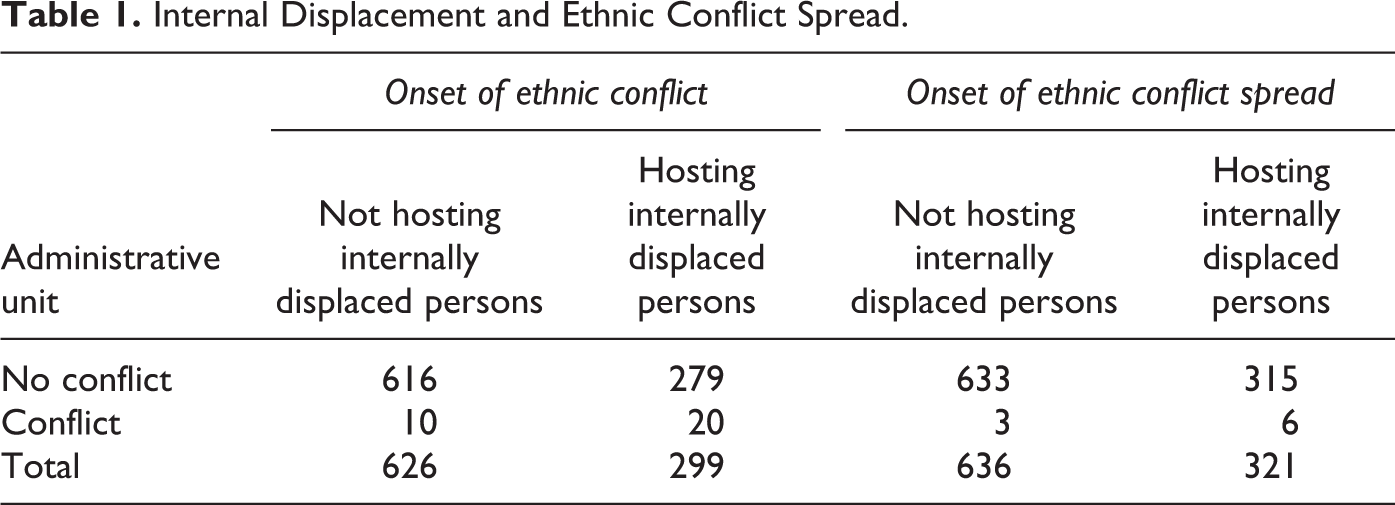
We carried out our analysis on a restricted sample of seventeen African states, which incorporates only those countries affected by displacement from 2008 to 2010, 23 and included in the GeoEPR data set. 24 The unit of analysis is the first-order administrative unit-year. A total of 957 administrative unit-years are included in the empirical analysis. 25 Table 1 presents the frequency distribution of the variables onset of ethnic conflict and onset of ethnic conflict spread per administrative unit-year according to whether or not they host IDPs. Within the sample, there is a total of thirty administrative unit-years newly affected by ethnic conflict. By contrast, only nine cases of onset of ethnic conflict spread are recorded. 26 Clearly, ethnic conflict pitting a rebel group against government forces rarely occurs outside of the boundaries of the ethnic group’s settlement to which a rebel group is related to. As Table 1 shows, however, whether or not IDPs are present within an administrative unit increases the onset likelihood of ethnic conflict and ethnic conflict spread. A Fisher’s exact test rejects the null hypothesis of no association for both dependent variables (p < .01 for onset of ethnic conflict; p ≈ .07 for ethnic conflict spread).
Internal Displacement and Ethnic Conflict Spread.
Results
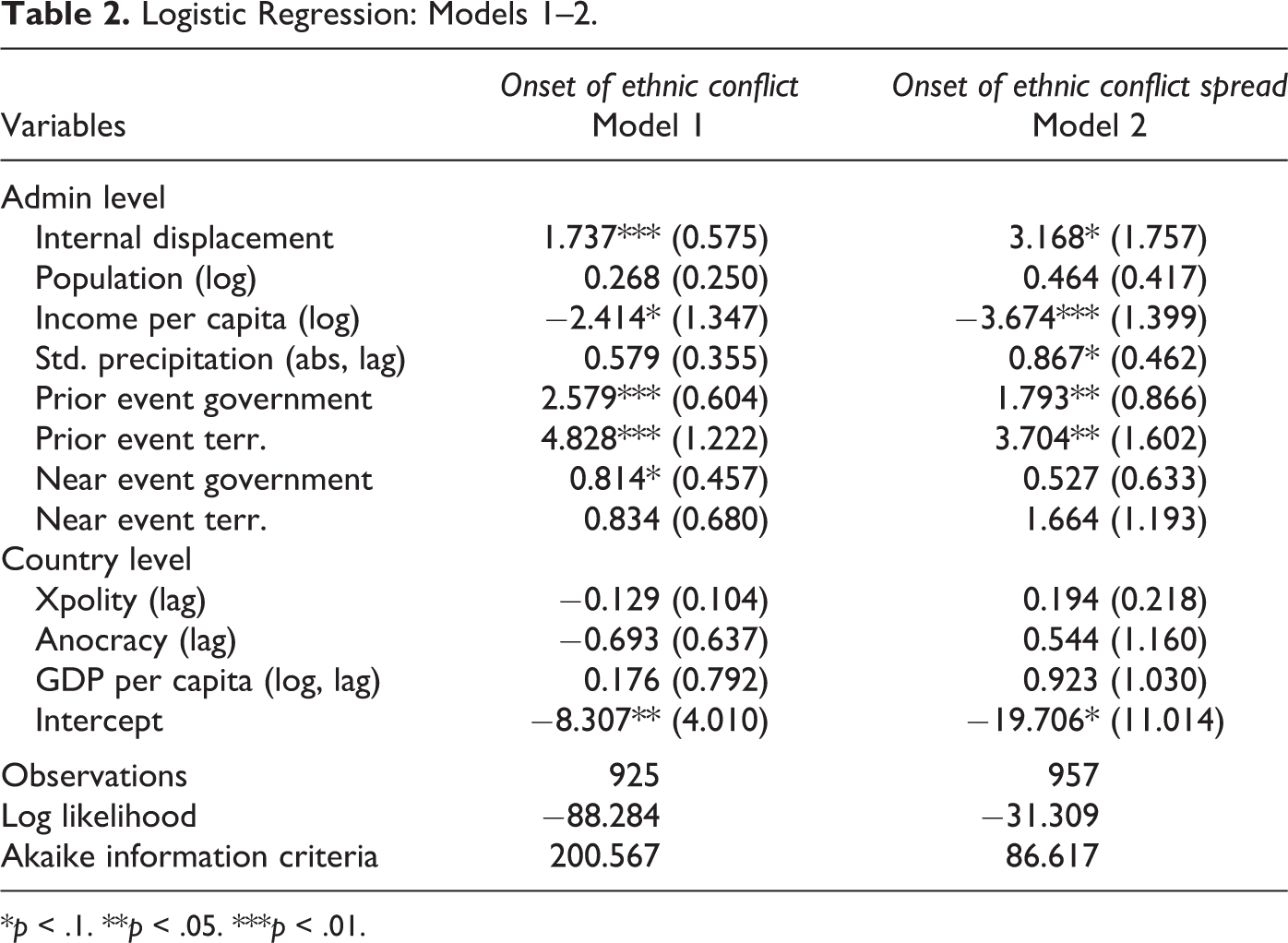
To test our hypothesis, we carry out binary cross-sectional time series logistic regressions with robust standard errors. 27 Model 1 in Table 2 reports the results for our analysis of the variable onset of ethnic conflict. Our theory leads us to expect that areas hosting IDPs should experience a higher risk of onset of ethnic conflict. The empirical findings lend support to our theoretical argument: administrative units where IDPs are present are more likely to experience conflict.
Logistic Regression: Models 1–2.
*p < .1. **p < .05. ***p < .01.
With regard to the control variables, we do not find evidence that the demographic size of an administrative is associated with a higher risk of onset of ethnic conflict, despite the fact that the direction of the coefficient is consistent with our expectations. By contrast, poorer administrative units are associated with an increased risk of new spells of ethnic violence. Standardized deviation from the long-term mean precipitation value, however, does not appear to increase the risk of ethnic conflict. Lastly, the estimated coefficients for prior conflict events suggest that ethnic conflict onset is more likely if conflict (either of a territorial or governmental nature) has occurred previously in the same administrative unit. On the other hand, neighboring conflict is only associated with a higher risk of onset if part of governmental conflict.
For the variables at the country level, we find mixed results, with the coefficient for democracy not reaching statistical significance, even though the negative sign is consistent with other findings in the literature. The data do not support the idea that incoherent polities face a higher risk of onset of conflict incidence. Finally, we find a positive, albeit not significant, coefficient for the GDP per capita at the national level. The failure to find evidence for the level of economic development at the country level is probably the consequence of the truncation of our sample, which contains a high number of poverty-stricken sub-Saharan states while incorporating only few relatively richer countries. Within this latter group, Ethiopia may be an influential outlier due to the number of active insurgencies in the periphery of this country.
For model 2, we employ our second dependent variable which should reduce concerns of endogeneity. To this end, we focus our analysis exclusively on the onset of ethnic conflict spread, that is the diffusion of ethnic conflict beyond the boundaries of an ethnic group settlement. The estimated coefficient is, as expected, positive and thus lends support to our hypothesis (p ≈ .071). Administrative units affected by internal displacement appear to face a higher risk of ethnic conflict spread than those administrative units which did not experience any inflows of IDPs. In terms of substance, we depict in Figure 4 the average predictive difference in the likelihood of conflict due to the presence of IDPs in an administrative unit (Gelman and Hill 2006; see also Hanmer and Kalkan 2013). To do so, we simulate 1,000 values for the estimated coefficients of model 2 and generate two sets of predicted probabilities. The first set of probabilities of conflict diffusion corresponds to those implied by our estimated model and the original data set, while for the second we assumed that all administrative units had IDPs. The distribution of this average predictive difference clearly suggests that the presence of IDPs increases the probability of conflict diffusion on average by 1.8 percentage point.

Average predictive difference for internally displaced persons presence.
As for the control variables, it appears that the demographic size of an administrative unit has no impact on the likelihood of ethnic conflict spread. On the other hand, the level of economic development in an administrative unit is negatively and significantly associated with the spread of ethnic conflict. This result would lend support to both a state strength and rebel labor market mechanism, while being in contradiction with the idea that richer administrative units are more at risk of conflict due to their strategic importance. The results also suggest that areas confronted to droughts or excess precipitations face an increased risk of conflict spread. In addition, the incidence of state-based conflict in the previous year increases the likelihood of conflict diffusion, as shown by the coefficients for the two dummies for prior conflict. This suggests that administrative units in which state control has already been weakened are more prone to the spread of ethnic conflict, as rebels may more easily carry out attacks. Interestingly, the coefficient for prior territorial violence is larger than the one for governmental conflict, while we would have expected the opposite. This, however, may be an artifact of the data. Our sample contains only a small number of insurgencies that advocate separatist goals, and two such conflicts are active in countries in which incidences of ethnic conflict spread have been recorded. By contrast, the estimated coefficients for the dummy variables for conflict in nearby provinces suggest that spatial proximity does not lead to a higher onset probability of ethnic conflict spread.
For our variables at the country level, we again find that democracies appear to as likely to experience the diffusion of ethnic conflict than authoritarian regimes. Similarly, the estimate for anocracies suggests that the latter do not significantly affect the spread of ethnic conflict. The failure to find an association between the level of democracy and the dependent variable, however, may be due to the fact that the distribution of the xpolity variable in our sample is heavily concentrated on values between −2 and +3, while there are very few strong democracies and no pure autocracies. Finally, economic development at the country level is also not associated with the likelihood of ethnic conflict spread. 28 We present the results of the sensitivity analysis in Online Appendix (See Tables A2 and A3 for model 2 and model 1, respectively).
Conclusion
Recent literature has so far largely focused on refugees and mechanisms linking the latter to conflict while leaving aside IDPs. The reason being that differentiating IDPs from the general local civilian population is debated and that data on internal displacement have been arduous to collect. Yet, we show with novel disaggregated data that IDPs can alter the ethnic composition of administrative regions and provide means to convey arms and, thus, have the potential to significantly impact the conflict dynamic. We argue therefore that IDPs should be considered as a separate category, distinct from the broader population of a state affected by civil war. Although we acknowledge that categories sometimes can be blurred, as population movement is fluid, we want to underline that ensuring effective protection and assistance to IDPs is a crucial step for reducing the risk of IDP militarization and conflict spread. Particularly due to their unique needs and vulnerabilities, they are more susceptible to security risks in general. Thus, similar mechanisms for linking conflict to refugees seem to apply to IDPs, not the least as IDPs find themselves in particular precarious situations, especially when displacement results from the policies of the government, which may lead to substantial grievances, such as can be currently seen in Syria and in Darfur. Moreover, the lack of international aid organization mandated with the protection of IDPs has led to a situation where IDPs often face severe protection gaps and a dearth of economic and political opportunities. Confronted to this adverse context, IDPs are therefore likely to engage in violence to seek to change their livelihood, which then may inadvertently reinforce the spiral of conflict.
We urge thus international and domestic actors to ensure that IDPs have access to livelihood opportunities, as well as durable solutions, in order to reduce IDPs motivation to engage in violence. In providing assistance to IDPs, host communities should however not be neglected, as conflict between both populations may result from competition of over resources. In addition, the effects of internal displacement on the opportunity structures for rebel groups should not be ignored. This also means that belligerents, including nonstate armed groups, should be effectively engaged in order to enhance the protection of IDPs’ rights as outlined in the UN Guiding Principles on Internal Displacement (United Nations [UN] 2004). Finally, international instruments have to be developed and extended to address internal displacement. A way forward is in this regard the Kampala Convention that has the aim to protect the rights and well-being of internally displaced people (see African Union 2009).
Despite missing information on the ethnic composition of IDPs as well as on the total concentration level of IDPs per administrative region, our analysis has nevertheless shown that IDPs should receive more attention by conflict researchers and policy makers alike, as they have a distinct effect on dynamics of conflict spread. Our case discussion of the Darfur conflict (see Online Appendix) also supports our theoretical claim. Although our study has been restricted to the African continent and only to a couple of years, we assume that our results are generalizable to other world regions, such as the Middle East, and to other periods of time. Indeed, the G-IDP data set reveals that internal displacement is also prevalent outside Africa: nearly half the administrative units hosting IDPs are to be found in Asia, while significant populations of IDPs exist in Latin America (foremost in Colombia). Furthermore, case studies (e.g., Iraq, Pakistan, Syria, and Sri Lanka) in the literature suggest that internal displacement, if not adequately addressed, may lead to IDP militarization and influence conflict spread (Lischer 2008; Ferris 2007; Integrated Regional Information Networks [IRIN] 2012; Muggah 2010; Tavernise 2009).
More fine-grained analysis and data on IDPs are needed, however, in order to better understand the linkage between IDPs and conflict and, thereby, provide further advice to both local and international humanitarian actors to mitigate potential negative externalities that internal displacement may have on the spiral of conflict.
Supplemental Material
Supplemental Material, cidpsc_appendix_final - Conflict-induced IDPs and the Spread of Conflict
Supplemental Material, cidpsc_appendix_final for Conflict-induced IDPs and the Spread of Conflict by Heidrun Bohnet, Fabien Cottier, and Simon Hug in Journal of Conflict Resolution
Supplemental Material
Supplemental Material, cidpsc_replication - Conflict-induced IDPs and the Spread of Conflict
Supplemental Material, cidpsc_replication for Conflict-induced IDPs and the Spread of Conflict by Heidrun Bohnet, Fabien Cottier, and Simon Hug in Journal of Conflict Resolution
Footnotes
Authors’ note
Earlier versions of this article have been presented at the PSS-ISA Joint Conference in Budapest, June 27–29, 2013, at the European Political Science Association (EPSA) in Barcelona, June 20–22, 2013, at the European Network for Conflict Research (ENCoRe) workshop in Amsterdam, April 24–26, 2013, and at the University of Geneva. The G-IDP data set and codebook may be found at  .
.
Acknowledgments
We would like to thank Ravi Bhavnani, Kristian Gleditsch, Zaryab Iqbal, Nils Metternich, and Nina von Uexkull, as well as two anonymous reviewers, for helpful comments. Furthermore, we are grateful to Serge Mukiele for research assistance.
Declaration of Conflicting Interests
The author(s) declared no potential conflicts of interest with respect to the research, authorship, and/or publication of this article.
Funding
The author(s) disclosed receipt of the following financial support for the research, authorship, and/or publication of this article: Funding by the AXA Research Fund for the project “Forced migration, environmental risks, and conflict” is gratefully acknowledged.
Supplemental Material
Supplementary material for this article is available online.
Notes
References
Supplementary Material
Please find the following supplemental material available below.
For Open Access articles published under a Creative Commons License, all supplemental material carries the same license as the article it is associated with.
For non-Open Access articles published, all supplemental material carries a non-exclusive license, and permission requests for re-use of supplemental material or any part of supplemental material shall be sent directly to the copyright owner as specified in the copyright notice associated with the article.
