



Abstract
Why do gangs proliferate during democratization and decline in number during authoritarian consolidation? I utilize primary evidence of two Indonesian gangs to inform a model of protection gangs under varying states of political development. Modeling gangs as territorial firms under different regulatory conditions, I attribute their number and political affiliation to the interaction between state capacity and political fragmentation. In weak states, gangs will lack political affiliations and their number will be determined by the scalability of their coercive capacities. In countries where states have the capacity to significantly constrain gangs, but lack significant costs for politicians to associate with them, gangs will seek political affiliation, trading coercive services for lax law enforcement. In such contexts, their number will be determined by state factionalization. Thus, gangs proliferate during democratization due to more political actors sharing state control. I assess the theory examining Indonesia’s history of statebuilding and political transition.
Since the ouster of Suharto’s authoritarian regime in 1998, Indonesia’s democratic transition has seen the emergence of new parties to compete with the three officially sanctioned parties of the late Suharto period. 1 While the democratic transition has ushered in competitive elections and other hallmarks of a liberal democracy, such as a vibrant civil society and critical press, it has also been accompanied by the proliferation of politically affiliated protection gangs involved in both political mobilization and illicit activities. 2 Here, I define protection gangs as nonstate organizations that employ coercion to provide physical protection and have some significant involvement in illicit activities. 3 As such, protection gangs can include mafias as well as party youth wings that are involved in protection rackets or other illicit activities. In exchange for sheltering illicit activities from law enforcement, politically affiliated protection gangs in Indonesia have been found to mobilize voters, intimidate rivals, and provide security on behalf of parties and politicians (Lindsey 2001).
Cross-national studies have established that countries with greater political rights are strongly associated with greater levels of organized crime (Sung 2004) and relatedly that democratization is strongly correlated with increased violent crime (Lafree and Tseloni 2006). Single country studies show that political liberalization has been associated with the proliferation of organized crime groups. In a study on the rise of the Russian mafia, Federico Varese (1994) cited Soviet crime statistics to show that the number of organized criminal groups began with only a handful of regime-connected groups prior to 1986 and exploded into the thousands by 1990 during the liberalizing reforms of Perestroika. In Mexico, as the Institutional Revolutionary Party’s (Partido Revolucionario Institucional) dominance of the state gave way to opposition parties in the late 1990s, a concomitant upsurge in organized crime groups emerged (Pimentel 1999; Snyder and Duran-Martinez 2009; Rios 2015). These cases also reveal that many of the emergent gangs have been affiliated with politicians.
Why does the number of protection gangs often proliferate during democratic transitions? More generally, what is the relationship between regime characteristics and the number and political affiliation of gangs in a protection market? Understanding the fragmentation of protection markets is of policy interest since more fractionalized protection markets lead to greater competition among gangs and are therefore associated with greater levels of gang violence. Moreover, more consolidated protection markets are more readily regulated by states so that certain socially costly outcomes (e.g., civilian victims or the local sale of narcotics) can be more effectively prevented (Snyder and Duran-Martinez 2009; Rios 2015; Varese 1994). Furthermore, understanding the connections between politicians and gangs is important since such linkages erode the rule of law, while providing politicians with violent, nonelectoral means of political competition.
This article provides a theoretical account linking various states of political development to the number of gangs operating in local markets and their affiliation with political actors. Based on primary fieldwork, I begin by distilling key insights from the organization of two protection gangs in Indonesia to inform the assumptions of a formal model of protection gangs. Modeling gangs as territorial firms operating under different conditions of state capacity and political control, I derive predictions about local protection markets under different characteristics of political development and briefly assess them on different periods of Indonesia’s history.
Here, it is important to highlight what is meant by local protection market. The local protection market is delimited to an area where a gang leader can feasibly have daily access to and contact with a local population. As I will demonstrate in the cases, providing protection requires local knowledge and locally based coercive capacity. In Indonesia, a local protection market can range from a rural district to a city and its vicinity as long as a gang leader can feasibly maintain daily contact with the population within those areas. To the extent that gangs grow to have operations in multiple markets, as in Indonesia, they will rely on local franchises specific to each market. 4
To circumscribe the scope of the theory, my argument applies to contexts in which it is not prohibitively costly for politicians to affiliate with gangs as to prevent any such affiliation. Thus, the theory does not apply to countries that have established the rule of law (e.g., The United States or Western Europe), where affiliation with gangs can disqualify politicians, de jure or de facto, from office. Given that many developing countries lack norms and law enforcement institutions that would make it costly for politicians to affiliate with gangs, the theory is salient for a large number of cases. The assumptions of the model further circumscribe the theory to contexts of asymmetric state-gang capacities in which states are either ineffective in constraining gangs at all or where they dominate gangs, imposing heavy constraints on gangs. Contexts where states and gangs can impose costs on each other (e.g., Mexico after the entrance of high-capacity Colombian drug traffickers in the 1980s and 1990s) are beyond the scope of this theory, as they require a different modeling framework. 5
I argue that the number and political affiliation of protection gangs are a function of both state enforcement capacity and the degree to which control of the state is fragmented. In particular, where states lack the coercive capacity to limit or destroy gangs, the protection market will be characterized by politically unaffiliated gangs whose total number is determined by the degree to which gangs can extend their coercive capacity over territory. Where states possess the ability to constrain or destroy gangs, they will be politically affiliated and their number will be a function of the number of political actors or factions that can provide protection from law enforcement. This theory, therefore, attributes the proliferation of gangs in democratizing countries to the increased number of political actors that gain influence over the instruments of law enforcement.
In the remainder of this article, I briefly examine the related literature on protection gangs. I then present primary evidence of the internal organization and external regulation of two politically affiliated protection gangs in Indonesia, which inform a model of protection gangs as territorial firms under varying states of regulation by state actors. I use this framework to make predictions about the number and political affiliations of gangs supported by local markets. I assess the plausibility of the theory through a brief historical examination of Indonesia’s protection market and conclude with a discussion of the implications of the theory.
Related Literature
According to the existing literature, protection gangs emerge under the following conditions: political transition, isolation from the state (both geographic and social), and the prohibition of high-demand goods and services (Skaperdas 2001). In explaining why protection gangs thrive under these conditions, the prevailing literature points to three primary causes: (1) weak state capacity, (2) rent-seeking opportunities accompanying changes in economic institutions, and (3) fragmentation in state control. Applied to democratic transitions, these factors provide potential explanations for the proliferation of gangs during political liberalization.
According to state capacity explanations, gangs emerge during political transitions in response to weakened state enforcement capacity. 6 Skaperdas (2001) argues that political transitions can lead to a temporary “power vacuum” when new institutions are not yet viable sources of enforcement. Similarly, Volkov (2002) argues that the rise of organized crime in the former Soviet Union was due to de facto stateless conditions in these new countries. Without state enforcement, violent entrepreneurs emerged to provide security, enforce contracts and property rights, and stake claims to rents. The explanatory power of these state capacity theories is limited to democratic transitions that are accompanied by weakened state coercive capacity. However, democratic transitions do not necessarily entail a weakening of state coercive capacities, per se, since security forces often retain the institutional capacity to coerce, but may be politically constrained from deploying it. Moreover, democratization can actually occur at the same time that state capacity is strengthened, as in the case of the rise of the Sicilian mafia during Italy’s period of statebuilding (Gambetta 1993).
Theories attributing gang origins to changes in economic institutions point to increased rent-seeking opportunities that raise the demand for private enforcers. In order to stake claims to rents, actors that are well positioned to control the distribution of economic resources can exploit their position via private enforcers. Skaperdas (2001) explains this logic, arguing that the size of the protection market is a function of the economic rents available. However, he does not explain the number of mafia organizations. Economic explanations generally focus on the fact that political liberalization is often accompanied by economic liberalization, which in turn provides rent-seeking opportunities that gangs are able to exploit (Allum and Siebert 2004). In explaining the emergence of the Sicilian mafia, Gambetta (1993) has argued that the redistribution of land from large to small holdings in the transition from feudal rule in 19th-century Italy created the need for private enforcers where the state still lacked the institutions to enforce economic exchange with more distributed landholdings. Along a similar vein, Federico Varese (2001) has argued that mafias emerged in the former Soviet Union when privatization and incomplete or poorly defined property rights created incentives for rent-seeking and private protection. Although the rent-seeking opportunities from economic transformation may plausibly contribute to the rise of gangs during democratization, such explanations cannot explain the rise of protection gangs when economic institutions do not change markedly. Indeed, the democratization processes in Mexico, Brazil, and Indonesia, among others, entailed political liberalization without significant changes in their existing market-based economies.
A third mechanism identified by Snyder and Duran-Martinez (2009) and Rios (2015) is the fragmentation of state control. They argue that greater fragmentation of protection markets can be explained by fragmentation in the control of the state, which can reflect the structure of law enforcement jurisdictions (i.e., centralized vs. federal state structures) and the number of factions or parties that share control of the state. In their argument, control over the law enforcement apparatus is important since politicians can selectively ease law enforcement in exchange for benefits from gangs. They conclude that with more actors able to ease law enforcement on preferred gangs, the number of gangs should increase and that politicians, even those with a monopoly of control over law enforcement, should prefer fragmented protection markets to monopolies since intergang competition would raise gangs’ demand for protection from law enforcement and, therefore, the payments politicians can extract from them. In their model, gangs and states are assumed to be able to inflict significant costs on each other so that they are mutually constrained. This assumption, which may be applicable for explaining their cases of Mexico and Burma, limits their ability to explain more asymmetric contexts where either gangs have far less capacity than states or states are unable to significantly constrain gangs.
An examination of more asymmetric state–gang relations would help to expand our understanding of protection markets in weak states where the government has little capacity to impose constraints on gangs (e.g., Somalia) and cases that lack the rule of law, where state actors can selectively place severe constraints on gang activity (e.g., the former Soviet Union). Building on the existing literature, I examine how state capacity interacts with state fragmentation to explain variation in protection markets where it is not prohibitively costly for politicians to affiliate with gangs, but vary in the degree of state capacity and political fragmentation. With this in mind, Indonesia is an ideal case to examine because it has transitioned from a weak postcolonial state after its independence to a state that could selectively place severe constraints on gang activity. At the same time, state fragmentation has fluctuated, as Indonesia has shifted between democracy and authoritarianism and even during its authoritarian periods with factional changes within the regime.
The Industrial Organization of Protection Gangs: Two Gangs in Indonesia
The study of protection gangs has been limited by poor access to data. A fruitful line of inquiry has examined limited evidence to inform deductive models that can be used to explain the behavior of such organizations that commonly prize secrecy (Gambetta 1993; Skarbek 2014; Skaperdas 2001). Here, I follow this tradition by utilizing direct observation and interviews of the leaders of two politically affiliated gangs in Indonesia to inform the assumptions of a deductive model on their internal organization and external regulation.
Gerakan Pemuda Kabah (GPK; Yogyakarta) and Paku Banten (Lampung Province)
Through my fieldwork, I aimed to capture a detailed and reasonably representative picture of protection markets in Indonesia, while facing reluctance among gangsters to provide information about their organizations. I began by selecting two provinces (Yogyakarta and Lampung) varying in their political centrality to ensure that the politician–gang relations were not specific to provinces that are more central to national politics. Located on Java Island, where a majority of Indonesia’s population resides, Yogyakarta is known as a center of education political activism and Javanese culture and served as the provisional capital during the revolution. More marginal to national politics is Lampung, which, located at the Southern tip of Sumatra, is known most prominently as the transit point linking Sumatra to Java. In each province, I queried locals to identify the gangs with the greatest share of local protection markets and approached their leaders to determine their willingness to be interviewed.
In Yogyakarta, control over the protection market in 2006 was largely split between GPK, the youth wing of the United Development Party and, to a lesser extent, Barisan Shirotol Mustaqim (BSM), a youth wing of the rival Indonesian Democratic Party of Struggle. Although I was unable to gain access to BSM, I was granted access to GPK, which was led by a mafioso named Agus Joko Lukito, more commonly known by his street name Gun Jack. Beginning as a small-time gangster in the late 1970s, Gun Jack became leader of GPK’s Yogyakarta chapter in 1999 upon its establishment following Suharto’s ouster (Kristiansen 2003). Through GPK, Gun Jack came to dominate the Yogyakarta underworld until his death in 2011, earning revenue from protection rackets, prostitution, gambling, and private security businesses. At the same time, he mobilized voters, coerced rival parties and voters, and provided protection on behalf of United Development Party officials (Kristiansen 2003; Rudiana 2013). Over the course of four days in March 2006, I interviewed and shadowed Gun Jack in his daily activities to gain an understanding of his decision-making process and his gang’s organization.
In Lampung, I obtained access to Paku Banten, the province’s most prominent gang, its rival Lampung Sai, and a smaller gang that I will refer to with the pseudonym gang X. 7 Paku Banten has been affiliated with governors and other politicians in the province, rather than with political parties. The gang was established just after Suharto’s ouster in 1998 when its founder and leader, a man reputed to be a potent practitioner of black magic, was hired by the incumbent governor to disperse protesters. Paku Banten’s core activities were countermobilization services to Lampung politicians and a vast protection racket based in the city of Bandar Lampung that extended throughout the province.
Each interview was open-ended focusing on the gangs’ decision-making, internal organization, and external interactions. Where available, I supplemented my primary accounts with secondary sources. Although the small sample size and uneven access limit the representativeness of my data, these primary accounts provide rare empirical insights that ground my model’s assumptions.
Internal Organization
In characterizing the internal organization of these protection gangs, I will examine their (1) motivation, (2) reputation and capacity for coercion, and (3) means of generating income from coercion.
Profit Motivation
The activities and statements of the leaders of both GPK Yogyakarta and Paku Banten indicate that profit, not ideology, was their primary motivation. Political involvement was simply instrumental to this end. With Gun Jack’s businesses centered on prostitution, gambling, and protection rackets, his activities contradict the Islamist ideological commitments of his affiliated party, the United Development Party (Amri 2011). This point was made explicitly by Gun Jack himself when I asked him about the importance of ideology to gangs during a parley with the local leader of the rival BSM gang: These gangs don’t care about politics. They only care about money. We (referring to the rival leader) had a problem before, not because we had ideological differences, but because we were both trying to get money.
8
Reputation and Capacity for Coercion
The capacity and reputation to coerce is vital to protection gangs. As Gambetta has argued, “Firms enjoying a good reputation are exempt from shouldering the burden of proof in every new transaction and are relatively sheltered from the competitive threats posed by new entrants” (Gambetta 1993, 43). Gun Jack’s reputation allowed him to collect protection fees from many businesses in downtown Yogyakarta and ensure that his gambling and prostitution businesses could operate without competition in the neighborhoods he controlled. Likewise, Paku Banten also traded on its leader’s reputation by selling photos of him to businesses and bus operators throughout downtown Bandar Lampung to indicate that their businesses were under his protection.
Acquiring a reputation is a costly and often lengthy process. An aspiring strongman must demonstrate the ability to use violence, which could come at great personal risk. Gun Jack’s reputation for violence began as a teenager after he was imprisoned twice for separate killings and subsequently gained a following among fellow inmates. Having established this reputation, he was reportedly provided firearms after his release from prison by members of the military for whom he would carry out clandestine operations. This reputation as a formidable enforcer eventually led to his appointment as leader of the local chapter of GPK (Amri 2011).
Similarly, prior to founding Paku Banten, its eventual leader began his career in the 1970s when he established a local protection racket in a commercial area of Bandar Lampung. His organization consisted of only a handful of toughs until 1998, the year of Suharto’s ouster. It was then that Governor Oemarsono, who had been appointed by the incumbent legislature held over from the Suharto period, faced demonstrations that sought to oust him as a remnant of the authoritarian regime. Unable to summon the military to disperse the protesters as his predecessors could have done, Oemarsono called upon Paku Banten’s eventual founder for his purported ability to use black magic. Accompanied by his toughs, he performed a demonstration of his black magic in front of the protesters, causing them to promptly disperse (Interviews with Paku Banten’s leader, July 28, 2003 and November 11, 2009).
While waiting to interview Paku Banten’s leader at his headquarters, some of his subordinates described him to me as a potent black magician. During the interview, he demonstrated the magic trick that he used on the protesters by rubbing his fingers together in front of my face and blowing into my eyes. Afterward, I experienced pain in my eyes, which then teared up uncontrollably so that I was unable to see for approximately ten minutes. 9 After my eyesight had recovered, one of his subordinates informed me that each of them had also shared the same experience upon their initiation into the gang. Each year, Paku Banten’s leader performs a demonstration of various “magical” abilities at public celebrations of Paku Banten’s anniversary. 10 In this way, the organization has sought to cultivate his reputation as a powerful black magician both internally for their membership and externally for clients and potential rivals.
Based on the case evidence of the costly and lengthy process of establishing a reputation and capacity for coercion, I adopt the following assumption:
Generating Income from Territorially Specific Coercive Capacities
A key insight from these cases is the notion that a protection gang’s coercive capacity is specific to particular areas (i.e., their home turf), where protection gangs enjoy advantages over rivals as also highlighted by Gambetta (1993, 37) and Snyder and Duran-Martinez (2009). Gun Jack’s headquarters was in the red light district of Pasar Kembang near the commercial center of Yogyakarta. As a reflection of GPK’s coercive capacity, the United Development Party could at times expect to garner as much as 90 percent of the vote in some GPK-controlled neighborhoods (Kristiansen 2003, 129). The degree of control that GPK exercised diminished away from these neighborhoods. In the areas of GPK control, Gun Jack and GPK members would regularly collect protection fees, but were unable to do so in the territories of the rival BSM gang, where support for the Indonesian Democratic Party of Struggle was much higher (Hasani 2002).
The case of Paku Banten provides a further illustration of the territorial specificity of coercive capacity. A few weeks before meeting Paku Banten’s leader in 2003, a pickpocket had stolen my eyeglasses in a crowded market in Bandar Lampung. When I later described the incident to Paku Banten’s leader, he claimed that he could have retrieved my glasses from the gangsters that operated in the market, which was under his control at the time. Indeed, Indonesians often turn to gangsters to retrieve lost property for a fee, rather than rely on the police (Wilson 2015, 34). This kind of protection business requires not just the capacity to coerce, but also information about the identities of the thieves that operate in specific areas that is opaque to anyone but locals.
The importance of local knowledge is further illustrated by Paku Banten’s own fraught attempts at expanding beyond its home turf of Bandar Lampung into rural Lampung. In 2003, I visited a set of villages notorious among truck drivers and residents of Lampung for frequent robberies along the main country road. At the time, Paku Banten had established a small operation with an office in the area and was contracted by a local company to protect trucks that were transporting their goods. When I revisited the area in 2009, Paku Banten had ceased operating in the area due to its inability to prevent trucks from being robbed there. The boss of gang X, the local gang that was subsequently contracted to protect the trucks, explained: “The important thing is to have [indigenous] Lampungese people protecting them” (Interview with local gang boss, November 10, 2009). The reason for this relates to how highway robbery was organized in the area. Each stretch of the highway was controlled by local bandits living in the nearby villages whose identity is generally known to locals. 11 As outsiders to the area, Paku Banten lacked the information about the identities of local bandits. The local boss, however, combined his knowledge of local bandits and the ability to coerce them to guarantee that trucks under his protection would not be targeted (Interview with local resident, November 9, 2009).
As both cases show, the capacity to provide protection is specific to particular geographies. For this reason, I make the following assumption:
External Regulation
During Indonesia’s authoritarian period, the security forces were dominated by Suharto and his Golkar party, which allowed his regime to use the security forces as coercive instruments of the regime. At the same time, the Suharto regime utilized affiliated gangsters for their ability to use violence against the opposition, while plausibly denying direct linkages to the regime. 12 In order to expand their operations beyond small-time protection rackets, gangs required backing from politicians for immunity from law enforcement. Indeed, as Paku Banten’s leader stated, “Before 1998, we would get arrested if we would have tried to get more organized” (Interview with Paku Banten’s leader, November 11, 2009). He was only able to expand his protection businesses after obtaining the political backing of Governor Oemarsono in 1998 (Interview with Paku Banten’s leader, July 28, 2003). When I interviewed him in 2003, the organization had just lost its patron in Governor Oemarsono and was desperate to regain a political patron, leading to their aforementioned switching of allegiances to the incoming governor, highlighting the importance of political patrons. Similarly, Gun Jack also cited the threat of the security forces, notably the military’s Petrus campaign (Novan 1998), a nationwide anti-gang campaign in the early 1980s that saw the assassination of between 5,000 and 10,000 suspected gangsters (Bourchier 1990). After Suharto’s resignation, Golkar lost its political dominance in Yogyakarta to the United Development Party and the Indonesian Democratic Party of Struggle, which caused gangsters in Golkar-affiliated gangs to switch allegiances to these parties’ affiliated gangs (Hasani 2002).
As Indonesia transitioned to democracy, control over the security forces and their budgets also became more diffuse, as executive and legislative control at the national and local levels exchanged hands among a number of parties. Thus, a more diverse group of political actors gained influence over law enforcement, while politicians have also been less able to deploy violence by the security forces for fear of human rights criticism (Tajima 2014). Just as the Suharto regime turned to gangs for regime maintenance tasks, politicians in the post-Suharto period have turned to gangs for coercion, protection, mobilization, and countermobilization services. In some cases, the use of gangs and youth wings has been a reaction to existing Suharto-affiliated gangs. Gun Jack explained that GPK’s branch in Yogyakarta was established at the end of Suharto’s rule “to balance against Pemuda Pancasila [a Suharto-affiliated gang] so that the United Development Party could have a voice without intimidation” (Interview with Gun Jack, March 12, 2006).
In exchange for physically protecting the United Development Party, GPK members were protected from law enforcement in a well-known arrangement known in Indonesia as “beking,” taken from the English word for (political) backing (Wilson 2015, 53). Gun Jack described the arrangement as follows: “If the police arrest one of our members, we just call the politician who calls the police and they say ‘Sorry, I didn’t know and we’ll release them” (Interview with Gun Jack, March 15, 2006).
Paku Banten has a similar transactional relationship with politicians in Lampung. Having joined the Indonesian Democratic Party of Struggle after Suharto’s resignation, Governor Oemarsono lacked his own gang and was unable to use the security forces to disperse protesters. According to its leader, Paku Banten is less constrained in using coercive force than the police and military, stating “they are afraid of human rights, so they didn’t want to show their guns. We also cooperate with the military to ensure security during demonstrations” (Interview with Paku Banten’s leader, July 28, 2003). This relationship extends beyond the governor’s office to other lower level politicians from opposing sides that routinely seek the support of Paku Banten during elections (Tribun Lampung 2009). In this way, where the use of state security forces for political activities is not an option, politicians can benefit from the use of protection gangs. In exchange for these services, Paku Banten’s political patrons have provided shelter from legal entanglements for its members.
These cases show that, consistent with the scope conditions of my argument, gangs can be shut down by the security forces and are dependent on politicians to operate effectively in Indonesia. This phenomenon of politically affiliated gangs sheltered from law enforcement by their political patrons is found more broadly in countries that lack prohibitively high costs to politicians for gang affiliations but where states can impose significant costs on gangs.
13
Thus, in such contexts, we can view the market for protection as having mercantilistic characteristics. Based on this evidence, I make the following assumption:
A Model of Local Protection Markets
To summarize the insights from the two cases above, I assume that protection gangs are motivated primarily by profit (Assumption 1), derive income from their territorially specific capacity to coerce (Assumption 3), and face fixed costs of establishing a reputation and capacity for coercion (Assumption 2) and marginal costs of operating in each unit of territory (Assumption 4). I also assume that politicians can selectively relax law enforcement against illicit activities in their jurisdictions in exchange for rents or coercive services from affiliated protection gangs (Assumption 5). Based on these assumptions, I extend Salop’s (1979) model, which was used to explain the number of firms supported in a territorial market such as convenience stores, to explain the number of gangs selling protection. 14
Using this framework, I examine the implications of having (1) no regulator, (2) a single regulator, and (3) multiple regulators. The no regulator case corresponds to a weak state that lacks the ability to severely limit or exclude gangs from the market. In states with the capacity to significantly constrain gangs, but lacking the rule of law, the single regulator case approximates conditions in a consolidated authoritarian regime under the control of a single actor or political faction and the multiple regulators case corresponds to a fragmented polity as under a multiparty democracy or factionalized authoritarian state.
Modeling local protection markets formally allows us to weigh politicians’ trade-offs of collecting higher rents from fewer gangs against lower rents from more gangs. In addition, this model clarifies the logic of how state capacity and the fixed costs of establishing a reputation for coercive capacity create an incentive for politicians to establish local protection monopolies.
Unregulated Protection Market
I begin with a uniform set of consumers of protection services that are distributed uniformly on a circle
15
with a circumference of 1 (see Figure 1), whose location is given by

Circular protection market with n = 6 gangs.
Following Salop, gangs will be automatically located equidistant to each other. The assumption of equidistance allows us to put aside the question of the location of the gangs in order to focus on the number of gangs in the market. Furthermore, it maximizes the locational differences between the two gangs and, therefore, the number of customers. There is substantial evidence to support this assumption of nonoverlapping and distributed territories in equilibrium with numerous accounts of mafias and gangs establishing local territorial monopolies. Gambetta (1993, 68-71) argues that, in equilibrium, protection gangs have an incentive to establish exclusive territories since encroaching on rival territories risks costly retaliation. Protection gangs predominantly operate territorially and converge in equilibrium on a division of territories or local monopolies (Gambetta, 198-200). Thus, if there are n gangs, the distance between each one will therefore be 1/n.
Gangs’ Technologies of Coercion
Consumers along the circle can purchase protection contracts from gangs, which can offer them protection from other armed actors or, in the case of extortion, from the gangs themselves. A consumer located at x will derive a utility, v(x), from purchasing a protection contract from a given gang. The utility the consumer derives from such a protection contract is the utility relative to not having the contract. In this way, the consumer may be protected from another gang or also from the gang that is itself providing the protection extortively. Following Assumption 3, I model the utility of protection provided by a gang as a linear function of the distance to the protection gang such that the closer the consumer is to the gang’s home turf, the greater the utility of the protection contract vis-à-vis the absence of a contract:

Here
There are three stages to this game:
Entrance: Potential gangs simultaneously choose whether to enter or not.
Contract Prices: Gangs that have entered will set the price of protection contracts, pi
.
Purchase Protection: Consumers will choose whether to buy a protection contract or not.
Each gang i must decide whether to enter the protection market, which carries fixed operational entry costs o, referring to the costs of establishing the capacity and reputation for coercion (Assumption 2). A protection gang i charges consumers pi for its protection contracts, which also carry marginal cost c to enforce each unit of territory (Assumption 4). If gang i enters the market, its profit is:

where Di is the demand for its protection contracts.
Turf Competition
Using backward induction, we begin by determining the demand for protection contracts, taking the number of gangs in the market, n, as given. Each gang i will only have to compete over consumers with its neighboring gang i − 1 and i + 1. In order for consumers to enter into a contract with a gang, the net utility of the contract,
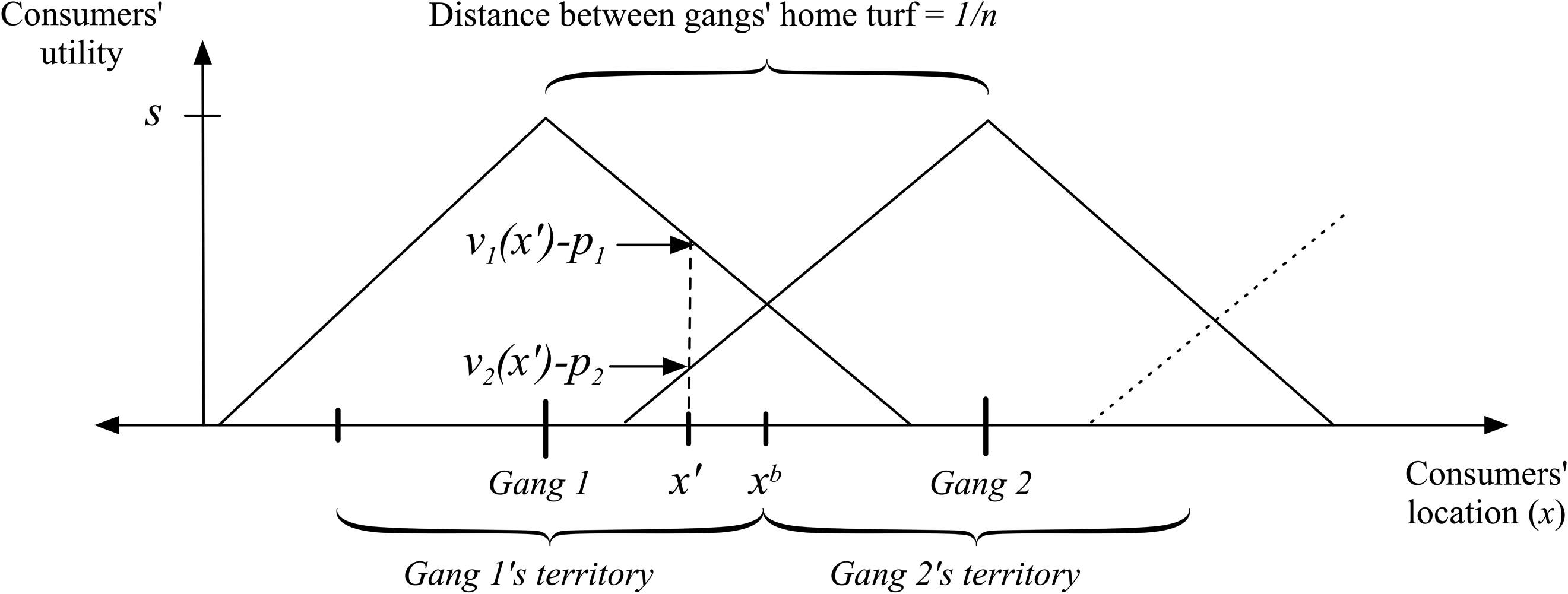
Consumers’ utilities from protection contracts with gangs 1 and 2.
Whether turf competition is through violence or efficacy, the winner is determined by the relative coercive capacities of adjacent gangs at each location. 16 If the competition is through violence, territory will be claimed by the gang whose net coercive capacity (as reflected by the consumer’s net utility at that location) is greater than that of the adjacent gang. Likewise, where competition is over efficacy in providing protection, the relative capacity of the gangs is decisive. The boundary between the two gangs’ territories is located at the consumer that is indifferent between contracting with gang 1 and gang 2 as at xb in the figure. Gang 1 will capture consumers to the left of xb and gang 2 will capture consumers to the right of xb .
More formally, a consumer located at

where p is the prevailing price of a contract offered by the other gangs. Gang i will capture every consumer within that point and the origin. Given symmetry, the total demand for gang i’s protection will therefore be:

Contract Prices
To determine the price of a gang’s protection contract, we solve the following maximization problem: 17

Solving for the first-order conditions and setting pi = p, the Nash equilibrium price of the protection contracts will be:

The gangs’ equilibrium profits will be:

Entrance
If markets are competitive, gangs will enter the market until the profit for entering the market is zero. Thus from equation (7), the equilibrium number of gangs will be given by:

And the equilibrium price of contracts will be:

This implies the following:
When the technology of violence is more scalable, allowing gangs to coerce farther afield (i.e., lower t), or the costs of establishing a reputation for coercion (o) are greater, the market will be characterized by a smaller number of gangs.
Single Government Patron
To model where the state’s law enforcement capacity is strong enough to severely constrain gangs and is controlled by a single government patron, I introduce a patron with the ability to charge an entry fee in exchange for license to operate in the protection market (Assumption 5).
There are four stages to the game in the case of a single patron within the government:
Entry Fee: Government patron G sets the entry fee, g
Entrance: Potential gangs simultaneously choose whether to enter or not.
Contract Prices: Gangs that have entered will set the price of protection contracts, pi
Purchase Protection: Consumers will choose whether to buy a protection contract or not.
Unlike unregulated markets, there is a politician or government patron, G, that can impose an entry fee g on protection gangs for permission to operate in the protection market. Each protection gang i must then decide whether to enter the protection market, which now carries entry costs, o + g, associated with operating a protection business o and the fee, g, paid to government patron G for permission to operate in the protection market. Patrons can be paid g in money or in kind in the form of political services such as voter mobilization or coercion of political rivals and their supporters. Politician G receives utility u(g) from the political and security services it receives. For tractability, I assume the following utility function: u(g) = g. When a politician allows a gang to operate, it also entails a cost associated with regulating the gang, e. The fixed nature of this cost stems from the generally highly hierarchical nature of gangs since politicians can regulate the behavior of the entire gang by working with its leader who, in turn, can ensure that the rest of the gang is in step (Skaperdas 2001).
The politician G receives the following net utility:

Note that the number of gangs in the market, n, is endogenous of g.
Contract Prices
Consumers will face the same problem as before, so the gang will have the same demand function as in equation (4). Gangs will therefore face the following maximization problem:

Again, the Nash equilibrium price of the protection contracts will be:

The gangs’ profits will be:

The equilibrium number of gangs will now be given by:

And the equilibrium price of contracts will be:

Entry Fees
The government patron will then seek to maximize its profits based on the behavior of the market:
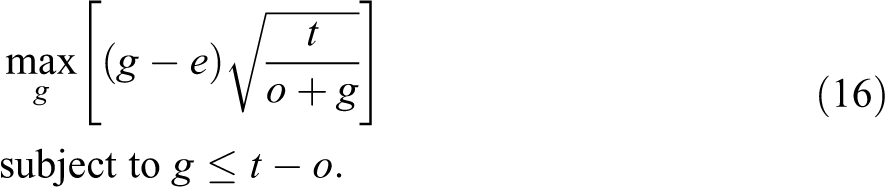
The constraint follows from equation (14) and the fact that n must be an integer greater than 0 since at n = 0, the government receives no revenue. Solving for the first-order conditions reveals that the constraint binds, implying the following equilibrium entry fee:

Combining equations (14) and (17) yields the following proposition:
That is, the government will set the entry fee at a level that renders the market for protection a monopoly, extracting all of the rent from its affiliated gang. Thus, the amount that government patrons can gain from extracting high rents from a single gang is greater than the amount they can obtain from lower rents from multiple gangs. Surplus rents that the patron could collect would be lost to the fixed costs of establishing a reputation o for multiple gangs rather than just one gang. In this way, government patrons have an incentive to create monopolies in the protection market rather than multiple competing gangs.
Multiple Government Patrons
Under conditions of democracy or authoritarianism with multiple factions, control over the state security apparatus is not monopolized and multiple patrons can provide gangs entrée into the protection market.
There are four stages to this game:
Entry Fees: Government patrons Gj
set entry fees, gj
for each
Entrance: Potential gangs i simultaneously choose whether to enter or not. They will be automatically located equidistant to each other.
Contract Prices: Gangs that have entered will set the price of protection contracts, pi
Purchase Protection: Consumers will choose whether to buy a protection contract or not.
I assume that government patrons are identical in their ability to provide and enforce entry permits into the local protection market. For tractability, I assume patrons do not compete over gangs since competition would only affect how gangs are matched with patrons, not the number of gangs in the market.
The gangs’ problem determining the entrance and prices charged remains the same, while the patrons’ problem becomes:

Here, the constraint and objective function both change since the number of gangs from which patron j receives entry fees gj is n/J. Solving for the first-order conditions, the constraint binds so that the equilibrium fee for the multiple patron scenario gm = gj is:

As before, we can use the zero-profit condition to derive the following proposition:
Here each patron will choose an entry fee so that the number of gangs affiliated with them is 1. The equilibrium price of a protection contract will be:

The theoretical predictions of this simple model are summarized in the matrix in Table 1, which specifies the state’s capacity vis-à-vis gangs and the fragmentation of the polity. When a state is too weak to dominate gangs, the polity is essentially fragmented. In such contexts, there will be multiple gangs that lack political affiliations and their number will be determined by their ability to extend protection over territory and the costs of establishing a capacity and reputation for coercion. When states have the capacity to dominate gangs, the protection market becomes mercantilistic and the number of gangs is determined by the number of political patrons capable of providing shelter from law enforcement, rather than gangs’ technology of coercion. Thus, the number of gangs in a local market can be small or large, depending on whether control over law enforcement is consolidated under a single actor or fragmented among multiple politicians.
Predictions of Protection Markets in States without the Rule of Law.

The Protection Market through Indonesia’s Political Development
Indonesia has transitioned from a weak postcolonial state in the early independence period to an increasingly powerful state that has fluctuated between authoritarianism and democracy. As such, an examination of the theory’s predictions under three conditions of political development is possible. Here, I briefly describe broad characteristics of the protection market in different periods of independent Indonesia.
The Sukarno Period (1948-1965): A Weak, Postcolonial State
Under Sukarno, Indonesia’s first president, the early Indonesian state faced the challenges of statebuilding amid multiple regional rebellions 18 and highly constrained finances from an economy recovering from the war for independence against the Dutch. Unable to afford converting the entire revolutionary forces into a standing army, the state demobilized a large segment of its soldiers. Some of the demobilized joined regional rebellions, while others went into the underworld from which many soldiers had originally been recruited (Cribb 1991, 183). With the state preoccupied with suppressing the regional rebellions, the police were extremely weak relative to the army. Consistent with the theory, protection markets were highly fragmented with competitive turf battles among highly localized gangs that lacked the close political affiliation that would become endemic in later periods (Ryter 2002).
In 1957, after failing to quell ongoing regional rebellions and facing several years of unstable government coalitions in parliament, Sukarno declared martial law and consolidated control over the government by establishing a corporatist body with representatives from the three largest political factions (nationalists, Islamists, and communists) (Ricklefs 2001, 314). Observers of this period have argued that Sukarno’s consolidation of power pushed each of these political factions toward mass mobilization (Cribb 1991, 28) and, consistent with the theory, “accelerated the expansion of the party youth wings, the party organ most capable of mobilizing bodies” (Ryter 2002, 47). The army, suspicious of Sukarno’s relationship with the Indonesian Communist Party (PKI), established a paramilitary group called the Military Youth Cooperation Board (Badan Kerja Sama Pemuda-Militer; Ryter 2002, 77-83). Meanwhile, the communist party established Pemuda Rakyat 19 and Pemuda Patriotik and the Islamic organization Nahdlatul Ulama further developed its existing youth wing Ansor.
The Suharto Period (1965–1998): Authoritarianism with Gangs Dominated by the State
In late September 1965, tensions between the army and Sukarno culminated when six army generals were assassinated by unknown perpetrators, leading to the eventual seizure of the presidency by Major General Suharto in 1966. The Suharto era began with a nationwide massacre of at least a half million suspected communists and other rivals to the military (Ricklefs 2001, 347). Having credibly demonstrated the military’s willingness and ability to use overwhelming violence, the Suharto regime built the military and domestic intelligence agency into a feared apparatus with a presence at every level from Jakarta down to the village level in order to detect and deter any potential sources of instability. Having crushed the PKI, Suharto’s Golkar party established a dominant position with only token opposition in the Indonesian Democratic Party and the United Development Party (Ricklefs, 361, 373-74). Consistent with the theory, the protection market became consolidated under the control of Golkar-affiliated gangs, most notably with members of Suharto’s family and his top military official, General Ali Murtopo. As one former gangster active in Yogyakarta in the early 1980s stated, “When Golkar was in power, gambling business owners took shelter behind Golkar officials among the management or bosses of their youth gangs” (translated from Novan 1998). With Golkar’s backing, gambling businesses had a guarantee for their operations since politicians and gangs had close ties to the police so that “Even raids [by the police] were just for show” (translated from Novan 1998).
By the early 1980s, Suharto had become wary of Murtopo’s influence and his initiative to unite the major Golkar-affiliated gangs under the banner of his gang, Youth Force for the Renewal of Indonesia (Angkatan Muda Pembaharuan Indonesia [AMPI]). Meanwhile, soaring crime rates also created a political impetus to address the gang issue. Suharto replaced Murtopo with a general named Benny Murdani, effectively eliminating the only other faction within Golkar (Ryter 2002). Shortly after, the military launched a nationwide anticrime campaign that became known as Petrus (an abbreviation for pembunuhan misterius or mysterious killings) in which between 5,000 and 10,000 suspected gangsters were assassinated throughout the country (Barker 2001; Bourchier 1990). Consistent with the theory, Suharto’s consolidation of Golkar led to further consolidation in the protection market. Murtopo’s AMPI receded while Suharto’s Pemuda Pancasila expanded from a gang operating in Medan and Jakarta into a nationwide gang with chapters throughout the country at the district level (Ryter 2002, 57).
Now impunity for gangs required affiliation with not just with Golkar, but more specifically with Suharto and his family. While consolidation reduced the number of gangs in the protection market, it did not eliminate competition in the market entirely since there were multiple patrons within the Suharto family besides Suharto himself. For example, Pemuda Pancasila competed for projects and territory with Pemuda Panca Marga, a gang under the patronage of Suharto’s then son-in-law Prabowo Subianto, as well as Communication Forum for Sons and Daughters of Veterans (Forum Komunikasi Putra Putri Purnawirawan ABRI
Testing the theory’s claim that g should be larger under one gang than multiple gangs is difficult since gang activities and their costs are difficult to observe. An imperfect test is to examine whether affiliated gangs were willing to pay with high-cost activities. Amid the increasingly likely possibility of Suharto’s resignation in mid-May 1998, Suharto’s Pemuda Pancasila gang remained resolutely loyal to their patron, providing countermobilization services until the literal last day of his regime. This highlights the willingness of his privileged gang to pay the high political costs of defending a soon-to-be defunct and unpopular regime—a role they were desperate to downplay after Suharto’s ouster (Ryter 2001).
The Reformasi Period (1998–Present): Democracy with Gangs Dominated by the State
The cases of Paku Banten and GPK Yogyakarta provide anecdotal evidence of how the expansion of political actors sharing control of the state provided more opportunities for new protection gangs. Indeed, both Gun Jack and Paku Banten’s leader cited the specter of the Petrus campaigns that had previously prevented their expansion (Novan 1999; Interview with Paku Banten’s leader, July 28, 2003). More generally, the post-Suharto transition to democracy (known as Reformasi) saw the expansion of political parties from three at the end of the Suharto period to a peak of 48 in 1999 and eventually 12 in the 2014 elections. Whereas large gangs were all affiliated with Suharto’s regime during the previous period, now each of the 12 current parties has a youth wing used for mobilizing mass political support. Consistent with the theory, a review of available academic and online sources reveals that at least nine of the twelve parties have affiliated youth wings that operate private protection businesses. 20
A specific example of the linkage between emergent parties and gang proliferation can be found in the case of Rozario “Hercules” Marcal, who headed a powerful gang in Jakarta under the protection of Suharto’s son-in-law, General Prabowo Subianto. However, after he became a political liability, Prabowo disavowed Hercules in 1997, precipitating his gang’s rapid demise. Prabowo himself soon went into self-imposed exile due to allegations of the torture of student demonstrators. When Prabowo returned from exile and established his Great Indonesia Movement Party (Gerindra), Hercules regained his patron and rapidly reestablished a new protection empire with his gang known as People’s Movement for a New Indonesia, the unofficial youth wing for Gerindra. In 2013, Hercules was arrested by police on a number of racketeering charges but, following appeals by Gerindra officials, was able to escape with a four-month sentence for the minor crime of resisting arrest (Wilson 2015, 63-72, 161-63). 21
Conclusion
I have argued that under weak states, protection gangs do not have an incentive to seek political patrons and that their number is determined by their technologies of coercion, particularly their scalability and the costs of developing a reputation for coercion. In states that are strong enough to constrain gangs but lack significant costs for politicians to maintain gang affiliations, gangs have an incentive to seek political affiliation, which shelters them from law enforcement. In these contexts, the degree of fragmentation in protection markets is a function of fragmentation of control over local law enforcement. Using primary evidence from Indonesian gangs to build the theory and historical sources to assess its plausibility, I have argued that changes in state capacity interacted with fragmentation in the polity to explain the degree of fragmentation in Indonesia’s protection market. The characteristics that allow the model to apply to other cases beyond Indonesia are (1) the lack of significant costs of gang affiliations to politicians, (2) asymmetric state-gang capacities in which either states lack the ability to significantly constrain gangs or gangs are unable to impose significant costs on politicians. Thus, the model does not apply to strong states where gang affiliations are disqualifying for politicians or contexts where gangs and politicians can sanction each other.
Contrary to expectations of state capacity theories, the strengthening of the state may not necessarily lead to a reduction in the number of gangs if polities are highly fragmented. Thus, while the strengthening of state capacity can shrink the overall size of the protection market and number of protection specialists (Skaperdas 2001), I have argued that it is necessary to look to the fragmentation of the polity to explain the number of organizations, similar to Snyder and Duran-Martinez (2009). However, in contrast to their argument that political actors with exclusive control over their jurisdictions will prefer multiple competing gangs, I argue that such patrons will prefer to grant local monopolies to their gangs. This difference arises from their assumption that gangs and politicians mutually constrain each other, while my model assumes more asymmetric politician–gang capacities. In their model, politicians can shut down gangs, but gangs can retaliate against politicians. Because politicians cannot dominate gangs without incurring retaliation, politicians seek leverage over gangs to extract greater rents by allowing more gangs to compete for politicians’ legal protection. In my model, because gangs cannot retaliate, politicians do not need to exploit intergang competition to maximize their rents.
For policy makers, the theory implies that, in addition to strengthening state capacity and disincentives for politician–gang affiliation, the fragmentation of control over the state may have important impacts on fragmentation and competition in the protection market. For emerging democracies assessing the relative merits of different electoral systems, the number of gangs and competition in the protection market should be greater under proportional representation than in majoritarian systems, ceteris paribus. Thus, new democracies that adopt proportional representation for their more inclusive attributes may come with the unintended consequence of increasing the number of gangs since there will be more political actors that can protect gangs from law enforcement.
Footnotes
Author’s Note
All errors are the author’s own.
Acknowledgments
The author gratefully acknowledges support from Scott Guggenheim, Arianto Sangaji, and Kamel as well as helpful comments from Stathis Kalyvas, Jan Pierskalla, Amanda Robinson, Irfan Nooruddin, Marko Klasnja, Francesca Grandi, and participants of Yale University’s Order, Conflict, and Violence Workshop and the Ohio State Comparative Politics Workshop.
Declaration of Conflicting Interests
The author(s) declared no potential conflicts of interest with respect to the research, authorship, and/or publication of this article.
Funding
The author(s) disclosed receipt of the following financial support for the research, authorship, and/or publication of this article: Financial support was received from the World Bank Social Development Department and Harvard University’s Sinclair Kennedy Traveling Fellowship.