




Abstract
We collect experimental evidence on a modified version of the standard ultimatum game in which the responder states an acceptance threshold below which the offer is rejected and both players, proposer and responder, are allowed several attempts to reach an agreement by conceding. Proposers concede by increasing offers and responders concede by decreasing acceptance thresholds. Treatments differ in whether a further attempt requires that at least one party should have conceded. A further condition varies the number of possible negotiating attempts, namely, 3 versus 5. Behavior in the lab diverges significantly from the theoretical solution in which the proposer is expected to get nearly the whole pie in each treatment. Proposers (responders) initially offer less (ask more) and concede more across negotiation attempts in the treatment in which concessions are required. Moreover, compulsory concessions weaken the bargaining position of the proposer, who eventually gets significantly less. Finally, although concessions significantly improve the likelihood of an agreement compared to standard ultimatum game experiments, the longer negotiation horizon (five attempts instead of three) delays the agreement without enhancing it, even when no concessions are needed.
Introduction
In his classic book on The Art and Science of Negotiation, Raiffa (1982) argues that “…Bargainers are continually asked during negotiations whether they prefer one constellation of outcomes to another…. Not only must they decide what they ultimately want, but they also must determine what they would be willing to give up in order to achieve their goal….” (p. 148). In this respect, concession is the hidden side of bargaining since parties must try to conceal how much they would yield to reach an agreement.
Sometimes these concession dynamics unravel through the sequence of offers and counteroffers that characterizes sequential bargaining whether it takes place in wage settlements (Becker 1987) or in Moroccan bazars (Lamieri and Bertacchini 2006). However, dynamic bargaining can only give a partial description of the concession dynamics: when the responder accepts (or rejects) an offer, the proposer cannot know how much (in either direction) his or her offer differs from the reservation price of the responder, whose response (whether acceptance or rejection) is just a proxy of his or her true intentions. Put differently, concession dynamics are based on counterfactuals, which cannot be fully inferred by merely observing bargaining outcomes. The advantage of our study is that our experimental data go beyond what is revealed by the actual play: subjects reveal to us (and to us only) their true intentions to play.
Alberti et al. (2013) partly apply the same methodology to the Nash demand game by asking subjects explicitly to reveal ex ante their concession dynamics. Here we implement the ultimatum game in its normal form, in which a strategy for the proposer is an offer and a (monotonic) strategy for the responder is an acceptance threshold below which all offers are rejected. In addition, we ask subjects to specify, at the beginning of each negotiation round, a sequence of offers/acceptance thresholds in case of failed prior negotiation attempts. More precisely, we ask subjects to state their full profiles consisting of T offers/thresholds, where T defines a negotiation time horizon, that is, the maximum number of negotiation trials.
In the event of agreement failure in trial, t < T, two protocols are investigated. Treatment N—Bargaining continues to trial, t + 1. Treatment C—Bargaining continues to trial, t + 1, only if at least one party’s proposal in round t has improved over their proposal in trial, t − 1. Otherwise, we say that the negotiation has ended with an early conflict, that is, with zero payoff for both parties, exactly as in the event of disagreement.
A further condition varies the number of negotiation trials, T, namely 3 versus 5.
In spite of many real-life bargaining situations in which players do not necessarily commit up front to a specific bargaining profile (normal form) game theory, when applied to sequential games, requires players to choose a strategy, that is, a “full contingent plan” that prescribes a specific behavior in every circumstance. In view of sequential rationality, players are asked to anticipate every possible future history and decide ex ante on an optimal course of action. Such contingent plans cannot be fully inferred from observing the mere dynamic interaction due to counterfactual choices that can be crucial when trying to understand bargaining behavior. In this respect, our experiment can be considered as an attempt to enrich the dimensionality of the choice set and, thereby, the possibility to infer motives in ultimatum-like bargaining situations (see Güth and Kocher 2014, for a recent survey). 1
Moreover, eliciting concession dynamics by way of the strategy method does not only provide more informative choice data but may also be a realistic representation of some actual bargaining situations in the field, for instance, when the parties themselves do not negotiate with each other but only indirectly via delegates whom they instruct on whether and how much to concede. Especially in the global economy, direct negotiation by the parties is often avoided. Of course, modern communication technologies offer alternatives to negotiate without meeting but, as demonstrated by our setup, this also offers possibilities for concession bargaining without the use of delegates and direct meetings of the parties involved. Take, for instance, algorithmic and high-frequency financial trading protocols, which are based on algorithms that execute preprogrammed trading instructions taking into consideration timing, price, and volume of trades (Aldridge 2009). In nearly every financial market, parties do not negotiate with each other directly. Instead, they entrust computer algorithms with “full contingent” bargaining protocols, much like the participants in our experiment are asked to do.
A stylized lab bargaining experiment cannot possibly capture all relevant characteristics of real-world scenarios. Nonetheless, it can highlight the crucial role of qualitative aspects of concession making, namely, that concessions may be needed to avoid early breakups and that, typically, there are only few chances to reach an agreement. In collective wage bargaining, a round with no concession by any party usually implies a strike, what might be captured by a decreasing pie size. However, most bargaining protocols assume alternating offers bargaining (e.g., Stahl 1972; Rubinstein 1982). 2 If the pie size shrinks to 0 after no concessions have been made, this would resemble our C condition. The International negotiations parties do not meet very often (the first Kyoto Protocol was signed in 1992, the second in 1997), rendering the available number of concession trials limited as in our experiment. Furthermore, in bargaining situations such as legally regulated disputes, a refusal to concede by all parties may induce the judge/arbitrator to force a costly settlement for all parties involved. Similarly, in our condition C, a new attempt is only granted when at least one party has conceded.
Our variables of interest are indicative of how participants perform in the experiment, both at the aggregate and at the individual level. We look at (i) agreement rates (i.e., relative frequencies of agreement), (ii) induced inequality in case of agreement (i.e., relative shares of the surplus between proposers and responders), and (iii) individual strategic behavior (i.e., how bargainers set up their profiles of offers/thresholds). Explanatory variables in our empirical analysis are (i) treatment controls (i.e., need of concession and the bargaining trial horizon) and (ii) indicators of individual heterogeneity (i.e., sociodemographics and cognitive/psychological traits distilled from the debriefing questionnaire administered to all subjects at the end of the experiment).
The second section introduces the concession ultimatum game (hereafter CUG). The third section describes the experimental design and lists our testable conjectures. The fourth section looks at aggregate and individual behavior in the experiment. We show, among others, that (i) when concessions are needed (C condition) agreement rates decrease, (ii) the longer horizon does not render agreement more likely, (iii) proposers ask for more and concede less than responders across all conditions, and (iv) proposers get a higher share of the pie than responders across all conditions, but if concessions are required, their agreement payoff is reduced. 3
The fifth section concludes followed by three appendices containing supplementary material. For comparison’s sake, Appendix A looks at the microdata of a standard ultimatum game experiment, reported in Binmore et al. (2002), as well as the microdata of Alberti et al. (2013) who explore concession dynamics in the context of the Nash demand game. Compared to the former, we detect a significantly lower agreement rate and more inequality in case of agreement in favor of the proposer. Both these features are common across many experimental studies on the ultimatum game. Regarding the latter, there are no substantial differences in outcomes or behavior, robustly confirming that allowing concessions enhances the chance of agreement, whether one implements the more symmetric Nash demand game or the crucially asymmetric ultimatum game. Appendix B details the debriefing questionnaire while Appendix C contains the experimental instructions translated from German into English.
The CUG
As in usual ultimatum experiments, proposer X suggests how to share the “pie,” that is, the monetary surplus to be allocated between X and responder Y, who can either accept or reject the payoff distribution suggested by X. What is different in the CUG is that there can be more than one allocation proposal and responder reaction. Specifically, if the first proposal is rejected, X can repeat it or offer more to Y, allowing Y to decide again between acceptance and rejection. How often this can be repeated depends (i) on the bargaining horizon, T, that is, the finite number of possible trials t = 1,…, T, and (ii) on the bargaining protocol. In our baseline protocol, N, the sequence of consecutive offers continues until an agreement or the deadline, T, is reached. The alternative protocol, C, introduces a further condition for the bargaining process to continue from one trial to the next: if neither party has conceded, the game terminates immediately with zero payoff for both players, an outcome we refer to as early conflict. As explained in the Introduction section, condition C varies the CUG rules from the viewpoint of mechanism design: would introducing incentives for conceding increase the likelihood of an agreement?
Let us now describe the CUG rules more formally. The monetary surplus, p, is the pie that proposer X and responder Y can share. The proposer chooses a nondecreasing offer profile, x = (x
1, x
2,…, xT
), and the responder chooses a nonincreasing acceptance profile, y = (y
1, y
2,…, yT
). The latter simply means that, in trial t, responder Y would accept an offer xt
only if xt
≥ yt
, that is, the components of y are acceptance thresholds. As offer (acceptance) profiles have to be nondecreasing (nonincreasing), we avoid by design that players become more demanding along the sequence of negotiating trials. In the event of agreement failure in trial, t < T, two protocols are investigated. Treatment N—Bargaining continues to trail, t + 1. Treatment C—Bargaining continues to trail, t + 1, only if at least one party’s proposal in trial t improves over their proposal in trial, t − 1. The last attempt, T, is made (applied) when no earlier attempt has led to an agreement and—only in the concession condition treatment, C—when (in case of failed trials) conceding has prevented early conflict. There are three possible outcomes of a bargaining round: If, for some trial, t = 1,…, T, the offer xt
is (equal or) above the threshold yt
, we say that the bargaining round has ended with an agreement with Y getting xt
and X getting the remainder, p − xt
. If, for all, t = 1,…, T, the offer xt
is below the threshold yt
, we say that the bargaining round has ended in disagreement with both Y and X getting 0. If (only for condition C), for some, 1 < t < T, without agreement in trial, t − 1 and, possibly, before, no party’s proposal improves over their proposal in trial, t −1, we say that the bargaining round has ended in early conflict, with both X and Y receiving 0, exactly as in disagreement.
The iterated deletion of weakly dominated strategies for our two CUGs yields an equilibrium solution that coincides with the standard one, in which X gets nearly the whole pie in every treatment. To see why, we look at the N protocol first. Since offers must be nondecreasing (by design), Y may postpone agreement by choosing the highest threshold in all trials but the last one when Y has an incentive to accept any positive offer to avoid the disagreement payoff. On the other hand, since Y (as in the standard ultimatum game) is (weakly) better off by accepting any positive last proposal, X would have to exploit his or her bargaining advantage from the start by offering the least possible amount in all bargaining trials. Thus, in the N treatment condition and in view of standard game-theoretic reasoning, introducing further concession trials is inessential for the final outcome.
If concessions are required, as in our C condition, both parties have an incentive to coordinate so that at least one party concedes in order to avoid early conflict. This consideration notwithstanding, no equilibrium solution of the CUG under the C condition that is robust to the iterated deletion of weakly dominated strategies yields an outcome in which Y receives more than the minimum positive offer (€1 in our case).
All the above conclusions rely on standard game-theoretic arguments, namely, the iterated deletion of weakly dominated strategies, and predict that allowing for concessions does not question the game-theoretically predicted outcome. Note, however, that a concession by X means a loss since the offer to Y increases, whereas a concession by Y only renders more offers by X acceptable. Thus, a concession by Y implies to substitute an acceptance threshold by one weakly dominating it. It is this crucial feature of CUG that differs from Alberti et al. (2013).
From a behavioral perspective, this game-theoretic reasoning neglects some common sense intuition from bargaining practice. For instance, allowing for concessions often enables parties to agree on something mutually profitable, which, in turn, would imply that allowing for more concession attempts may facilitate agreement. As just explained, this intuition relies only on behavioral arguments, which we discuss in more detail in the Testable Conjectures section.
Experimental Design and Conjectures
Sessions and Treatments
We ran nine sessions at the Laboratory of the Max Planck Institute, Jena. A total of 280 participants (177 female, 63.2 percent; mean age ± SD = 24.3 ± 3 years; age range 19–35 years) were recruited among the undergraduate population of the Friedrich Schiller University Jena (26 percent from natural sciences, 50 percent from social sciences, and 23 percent from humanities) using the Orsee recruiting platform (Greiner 2004). We found no specific correlation between sociodemographic characteristics and treatment assignment.
4
Subjects were provided with a hardcopy of the instructions, which were read aloud by the experimenter, who was the same for all sessions.
5
Some control questions and a trial run preceded the “real” experiment, in which subjects played thirty rounds of two variants of the CUG. Subjects played fifteen bargaining rounds with T = 3 and another fifteen rounds with T = 5. We varied the between-subject sequence: some participants either played with T = 3 first, then with T = 5, the 3 → 5 sequence or the reverse, the 5 → 3 sequence. The other treatment condition refers to the concession protocol: no concessions needed to prevent early conflict, the N condition, or no concession by either party after a failed attempt yields negotiation breakdown, the C condition.
This condition was also implemented between subjects (152 vs. 128 subjects, respectively). Table 1 represents the 2 × 2 factorial design.
The 2 × 2 Factorial Between-subject Design.

Note: Number of sessions and subjects per treatment are given within parentheses.
When facing a given time horizon, T, either three or five participants played fifteen rounds with randomly changing partners after each round. Varying T only within subjects was based on the conjecture—and confirmed by our evidence—that it hardly matters whether one first encounters the longer or the shorter horizon. 6 The second phase of fifteen rounds was announced afresh after the end of the first phase. Only then were subjects given the instructions for the second phase. 7
Matching
At the beginning of a session, the software partitioned the subject pool into matching groups of eight subjects, four X and four Y, with participants interacting only with members of the same matching group. Role and matching group assignment was kept constant throughout the session. Across rounds, participants were randomly rematched within the same matching group to form pairs of X and Y participants. They were not told that random rematching was restricted to smaller matching groups to discourage repeated-game effects.
Feedback
Feedback information after each round is restricted to outcomes. Specifically, participants were told the following: If any, the attempt, t = 1,…, T, that was decisive for yielding an agreement and, in this case, the corresponding agreement payoffs. If any, the attempt, t = 2,…, T − 1, that was decisive for an early conflict (condition C) and, in this case, the corresponding (0) disagreement payoffs. In case of disagreement at trial T, that the negotiation round had ended without agreement with the corresponding (0) disagreement payoffs.
Note that, due to the limited feedback information, proposer participants could only partially infer their responder’s acceptance thresholds, specifically, whether they did not exceed the accepted offer (case 1), respectively, were below the offer (cases 2 and 3). This information feedback resembles that of sequentially playing the CUG.
Payment
The monetary pie, p, was worth €11 throughout. Proposers’ and responders’ admissible offers/acceptance thresholds were restricted to integer numbers, thus excluding by design the equal split and imposing a minimum size for concessions (€1). In addition to the show-up fee of €4, participants were paid for two randomly selected rounds for each of the two phases. Subjects were paid in cash privately at the end of the session. An experimental session, including the debriefing questionnaire and the payment phase, lasted approximately two hours. On average, participants earned €28 (minimum €14, maximum €37).
Debriefing
To collect information about heterogeneity in our subject pool, participants answered a debriefing questionnaire at the end of the session. In addition to standard sociodemographics (gender, age, field of study, parents’ education, family wealth, and subjects’ available income, etc.), the questionnaire included two classic psychological tests: (i) Frederick’s (2005) Cognitive Reflection Test (CRT) and (ii) a 25-item reduced version of the Big Five personality inventory (John and Srivastava 1999), which is designed to elicit five stereotypical psychological traits (see Appendix B for details).
The CRT is a three-item task designed to measure the tendency to override the first, apparently intuitive, response alternative that is incorrect and to engage in further reflection that leads to the correct answer. This test has been shown to be positively related to numerical literacy, mathematical skills, and psychological dimensions related to impulsiveness (Morsanyi, Busdraghi, and Primi 2014; Toplak, West, and Stanovich 2011). As for the Big 5, recent studies (Borghans et al. 2008; Daly, Delaney, and Harmon 2009) have shown that these measures of personality traits are a reliable predictor of labor market performance and academic achievement (Barrick and Mount 1991; Judge et al. 1999; Heckman and Rubinstein 2001; Zhao and Seibert 2006; Heckman and LaFontaine 2010).
Recent experimental evidence (e.g., Cueva et al. 2016 or Ferrara et al. 2015) has shown how both CRT and Big 5 are good predictors of individual heterogeneity in fundamental behavioral traits such as risk and social preferences.
Testable Conjectures
Compared with the usual theoretical and experimental studies on ultimatum games, our experimental design offers a clear-cut testable conjecture, namely,
Therefore, we expect a higher frequency of agreement in our experiment (and, a fortiori, even more agreement when T = 5) compared to that prevailing in standard ultimatum game experiments where T = 1. The comparison between our concession protocols, N versus C, also provides a testable conjecture with a clear null.
Here it is more problematic to formulate an alternative hypothesis: if, on one hand, we expect more concessions—and, therefore, more agreement—in treatment C, strategic uncertainty—both parties not conceding due to coordination failure—may trigger early conflict.
Compared to the usual theoretical and experimental studies on concession bargaining in the tradition of Zeuthen (1930), our main innovative aspect is the asymmetric ultimatum framework. More specifically, the rules in our experiment impose that X is a residual claimant, namely, he or she collects the surplus minus what he or she gives to Y. This rules out the possibility of wasting resources through “anticonflict,” that is, a situation in which both parties agree to share less than the available amount, as it may occur in the Nash demand game.
8
Additionally, Y has “veto power” only: if an agreement is reached, he or she receives xt
, the offer from X, and not yt
, his or her acceptance threshold. This renders concessions from Y, so to speak, “cheaper”: X makes binding offers while Y can only increase or decrease the probability of an agreement by choosing lower or higher acceptance thresholds. These considerations lead to another clear-cut testable conjecture.
It seems intuitive that the burden of conceding should be significantly greater on the shoulders of Y, what, however, does not necessarily imply to accept less than an equal share. This leads to another set of testable conjectures related to the impact of concession dynamics on the bargaining process between proposer and responder and, in turn, related to the impact of concession dynamics on proposers’ and responders’ initial demands. Here our main behavioral conjectures are that
As explained in the second section, such conjectures cannot be justified on the ground of standard game-theoretic arguments, even though they appear rather natural when we consider real-life bargaining contexts. Experimentally controlling and observing the strategic opportunities of the bargaining parties should provide insights indicative of actual field behavior.
How do concession dynamics affect the final payoff distribution between proposer and responder? Here it is difficult to state a sound null hypothesis. The theoretical benchmark (nearly all the surplus should go to the proposer) has been consistently rejected by the substantial evidence on ultimatum experiments, what we also expect to be confirmed by our data. As for a within-protocol comparison, the C concession rule should mitigate the strong asymmetry between proposer and responder: either player can avoid early conflict by conceding. In this respect, we expect
Finally, information on individual characteristics distilled from the debriefing questionnaire may better characterize heterogeneity in individual behavior and how this relates to subjects’ observable characteristics, such as gender, sociodemographics, or cognitive/psychological traits. For example, consistent with some recent literature (see, e.g., Ben-Ner, Kong, and Putterman 2004; Ponti and Rodriguez-Lara 2015), we expect that more “reflective” proposers and responders (i.e., higher in their CRT score) better understand the subtle differences between the incentive structures induced by our two concession protocols and how these differences translate into different initial demands to pursue final distributional objectives.
Results
Agreement Ratios and Dynamics
We begin by looking at outcome distributions (Conjectures 1 and 2). Outcomes depend on whether an agreement is reached and, if not, whether the trial horizon, T, has been reached without an agreement, or whether, in the C condition, neither party concedes across trials. Figure 1 replicates figure 1 in Alberti et al. (2013), Panel A, by reporting the “box plots,” representing the distributions of acceptance rates across matching groups in the four conditions. 9

Box plots of agreement ratios by condition.
We first notice that agreement rates are significantly higher (around 90 percent on average) compared to the standard evidence on ultimatum games. Agreements are more frequent in N treatments, with negligible differences across horizons, T. Mann–Whitney nonparametric tests on the differences of matching group agreement rate averages confirm.
Our evidence supports Conjecture 1 in that allowing for concessions facilitates agreement, compared to a standard ultimatum game. However, a direct link between the number of concessions, T, and the likelihood of agreement is not supported experimentally.
As Figure 1 shows, the null hypothesis Conjecture 2 is clearly rejected by the data. In this respect, introducing a penalty associated to no concession is detrimental to efficiency by inducing additional strategic uncertainty (early conflict provoked by coordination failure).
Figure 2 details the disagreement patterns by condition. Across all conditions, agreement is by far the most common outcome, that is, over 90 percent of all observations. Also notice that (i) the agreement rate is higher for N treatments while, conditional on a given concession rule and (ii) the time horizon, T, does not affect the likelihood of an agreement.

Agreement shares by condition.
In line with intuition and bearing in mind that there are twice as many opportunities for early conflicts when T = 5—we find that, in case of C treatments, early conflict for T = 3 is less frequent. Table 2 reports results of testing mean differences in conflict type, evaluated at matching group level, across time horizons and concession requirements using Mann–Whitney tests, which support
Testing Mean Differences in Conflict Types (Mann–Whitney Test, Two Tailed).
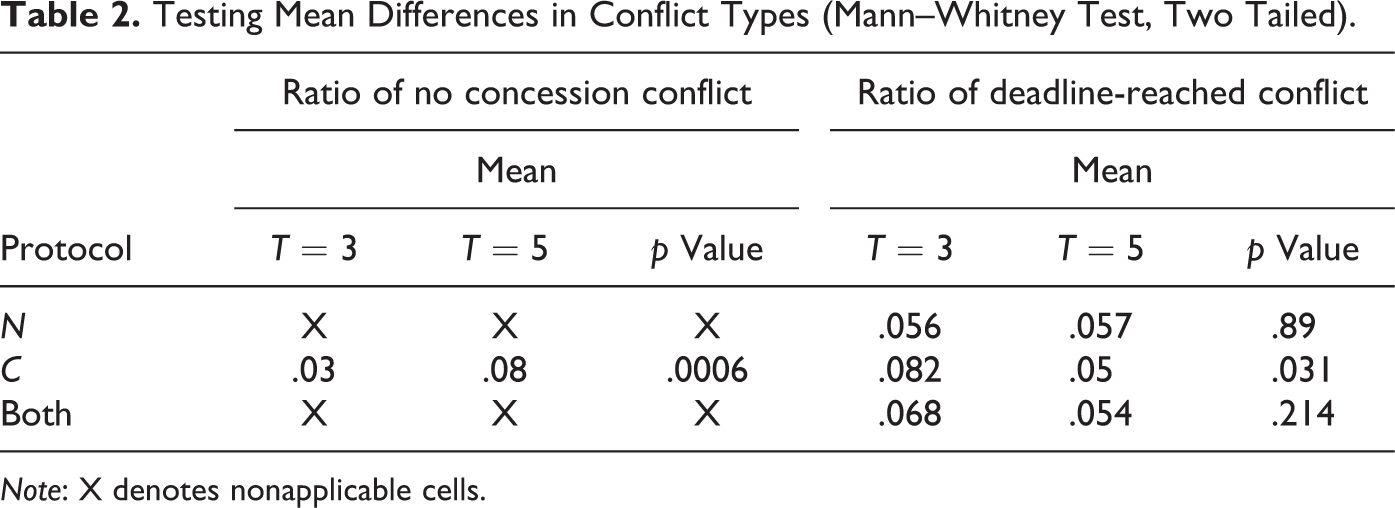
Note: X denotes nonapplicable cells.
Let us consider now the agreement dynamics across trials, that is, within a single round. Figure 3 summarizes the within-trial agreement dynamics by reporting relative frequencies of agreements disaggregated by trials.

Agreement dynamics across trials.
Figure 3 shows that for both T-games condition C yields a smaller relative frequency of agreements in the first trial. Conditional on an agreement being reached (i.e., excluding observations ending in disagreement/early conflict), average agreement trials, t* = 1,…, T, are significantly higher in condition C (Mann–Whitney tests reject the null at less than 1 percent confidence for both T = 3 and T = 5). Apparently, players anticipate that under condition C, they will have to concede more often and start off more aggressively. This evidence supports Conjecture 4.
As for Conjecture 1, comparing the agreement rates in our experiment with the evidence of standard ultimatum games (where T = 1), Figure A1 (in Appendix A) confirms our conjecture that concessions facilitate agreements. As a representative experiment, we use the microdata of Binomre et al. (1992). However, we do not observe significantly different agreement rates from Alberti et al. (2013), who implemented our concession protocols in the case of the Nash demand game. In this respect, our evidence is consistent with Conjecture 1: allowing players to concede enhances the likelihood of an agreement, whereas (see Result 1) the effect of increasing the negotiation horizon is negligible.
Inequality
We now analyze the distributional consequences of our concession protocols (Conjectures 3–5). Figure 4 replicates figure 1 in Alberti et al. (2013), Panel B, by reporting the box plots of the distributions of the relative share of the pie allocated to X, conditional on an agreement being reached, in the four conditions.
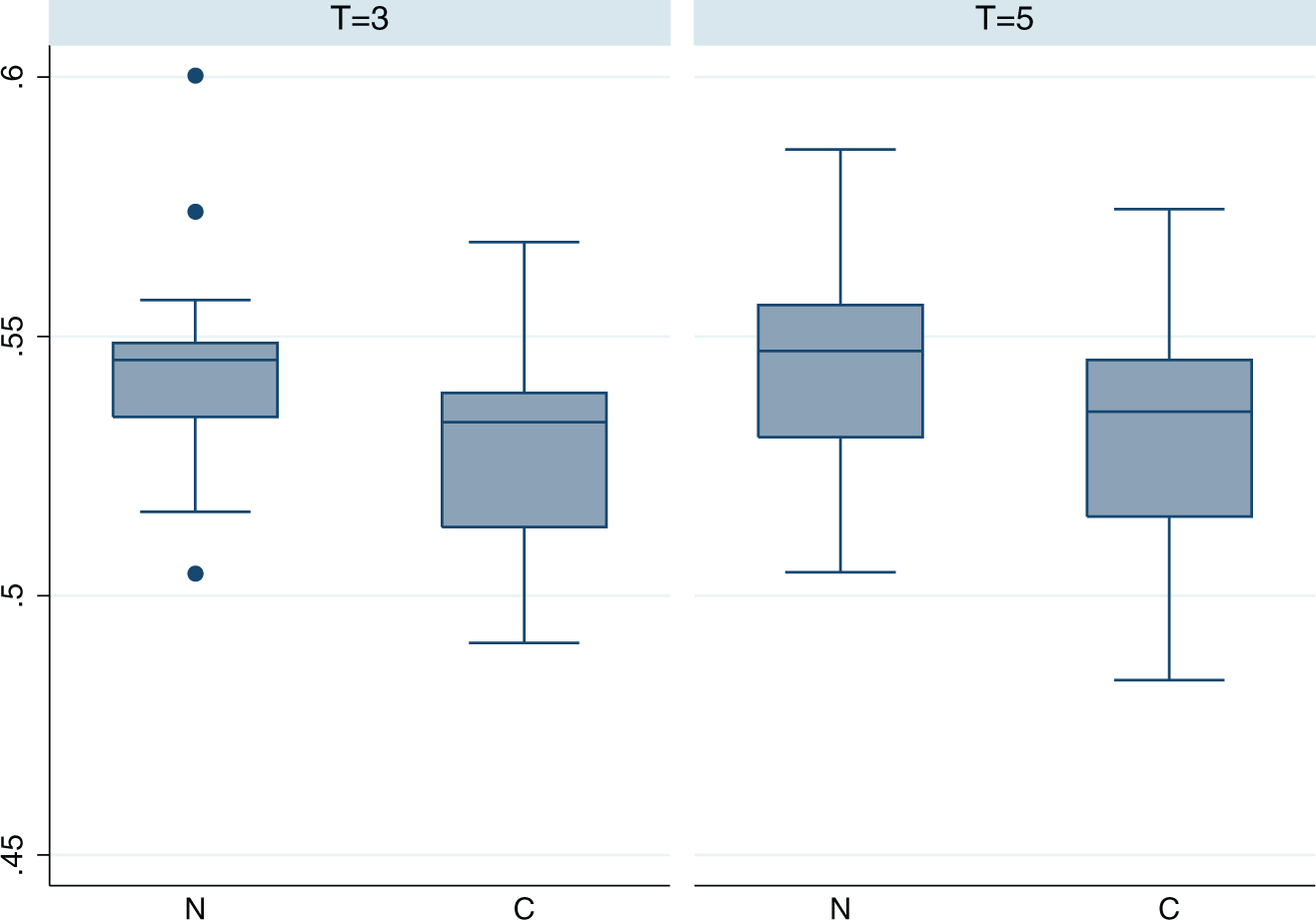
Distributions of X’s relative share, conditional of agreement being reached.
Proposers exploit their bargaining power: their relative pie shares usually exceed half of the pie in all conditions. Thus, ultimatum bargaining power pays also in our CUG. Nonetheless, compared with standard ultimatum games, first-mover advantages are limited and never yield more than 60 percent of the pie. Across concession conditions, the ultimatum power advantage of X is more pronounced in condition N: the need to concede mitigates the ultimatum power of X and, thereby, raises the relative share of Y. In this respect, our experimental evidence supports Conjectures 4 and 5.
For the sake of robustness, Table A1 (in Appendix A) reports the estimated coefficients of some random-effect tobit regressions in which the dependent variable, Xshare, is the pie share of X given an agreement, as a function of the negotiation round, r, and condition dummies. According to Table A1, only the C treatment dummy is negative and highly significant. The joint evidence of Figure 4 and Table A1 justifies
Individual Behavior
We now focus on individual behavior along two complementary dimensions: initial demands and willingness to concede. Figure 5 reports mean offers/acceptance thresholds across trials, disaggregated by condition, showing that participants in C treatments start off with more aggressive claims and concede more across trials.

Mean offers/minimum acceptable offers across trials disaggregated by treatment.
Furthermore, in condition C, mean offers/thresholds follow a nearly linear trend (remember that choices were restricted to integer numbers), whereas in condition N the already smaller gap between claims is more rapidly reduced in the last trial than in previous trials. Mann–Whitney tests always reject the null (always at less than 1 percent confidence) that (i) first/last demands do not differ across player roles, (ii) first and last demands are equal, and (iii) across trials, proposers concede as much as responders. Proposers are more aggressive in their claims, both in first and later trials, and conceding is a consistent pattern, also in N, with responders expectedly conceding more than proposers. Although the concession lines in Figure 5 seem rather symmetric when looking at them in all conditions, differences are always statistically significant at 5 percent confidence level with the exception of condition C and T = 5. To summarize, our evidence supports Conjecture 3 in that
After discovering that heterogeneity in first demands and concession rates has clear treatment and player role components, we are also interested in identifying (if any) an individual component, once treatment conditions have been controlled for. Figure 6 plots, for each participant, subject averages of initial demands (Dem1) and concessions rates (ΔDem), the latter being defined as the difference between demands at trial T minus initial demands, by concession protocol and T-game.

First demands (Dem1) against concession rates (ΔDem) averaged by subject.
As Figure 6 clearly shows, on average proposers demand more (and concede less) than responders. Moreover, it also shows that initial demands and concession rates are highly correlated: those initially demanding more are also those who concede more. Beyond that, Figure 6 also shows individual behavior is highly heterogeneous, even after controlling for treatment conditions and player roles.
Prompted by the evidence of Figure 6, we evaluate, for each subject, mean first demand and concessions across the entire experiment and evaluate the median of such individual mean values by player roles and C condition. We then partition our subject pool into four groups, depending on whether their initial demand (concession rate) is above the median of their reference group (i.e., among subjects in the same role and condition). Since initial demands and concession rates are highly correlated, we jointly estimate, in Table 3, the probability of belonging to each of four subgroups (hiDem1/loDem1, hiΔDem/loΔDem) using a bivariate probit regression where the regressors include proxies of subjects’ observed heterogeneity distilled from the questionnaire.
Bivariate Probit Regressions.
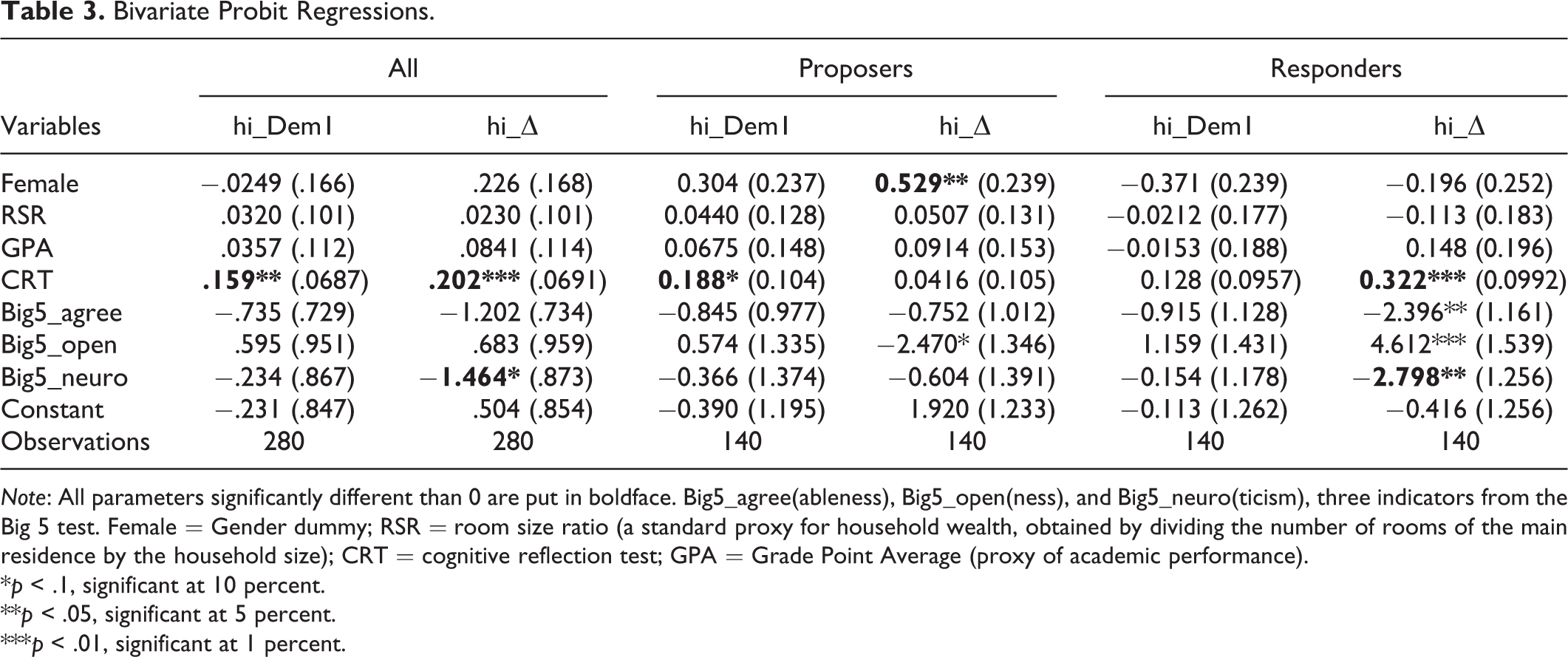
Note: All parameters significantly different than 0 are put in boldface. Big5_agree(ableness), Big5_open(ness), and Big5_neuro(ticism), three indicators from the Big 5 test. Female = Gender dummy; RSR = room size ratio (a standard proxy for household wealth, obtained by dividing the number of rooms of the main residence by the household size); CRT = cognitive reflection test; GPA = Grade Point Average (proxy of academic performance).
*p < .1, significant at 10 percent.
**p < .05, significant at 5 percent.
***p < .01, significant at 1 percent.
In addition to standard sociodemographics (gender, age, field of study, parents’ education, family wealth, available income, etc.), we include two classic psychological tests: (i) Frederick’s (2005) CRT and (ii) a 25-item reduced version of the Big Five personality inventory (John and Srivastava 1999), designed to elicit five stereotypical psychological traits (see Appendix B for more details). Using only three suitable terms of (ii), the set of covariates consists of:
Female: Gender dummy.
RoomSizeRatio: A standard proxy for household wealth, obtained by dividing the number of rooms of the main residence by the household size.
GradePointAverage: Proxy of academic performance.
CRT score
Big5_agreeableness, Big5_openness, and Big5_neuroticism, as three indicators from the Big 5 test.
The estimates in Table 3 show that high CRT proposers (responders) are characterized by higher initial demands (higher concessions), respectively. They also indicate that larger concessions are positively correlated with some personality traits such as agreeableness and conscientiousness and gender (more concessions by female participants), with the latter effect being more prominent for proposers. The joint evidence of Figure 6 and Table 3 yields
Result 6 confirms Conjecture 6 and nicely illustrates that heterogeneity in strategic interaction does not only depend on heterogeneity in preferences and beliefs only but is also due to heterogeneity in cognitive skills or psychological traits. Specifically, it seems that more reflective proposers (responders) also demand (concede) more. By contrast, other standard sociodemographics, such as household wealth, appear to have no explanatory power. In addition to the CRT data, other personality characteristics, for example, the so-called Big 5, help in accounting for heterogeneity in behavior, for instance, that responders concede more and more often.
Conclusion
In terms of mechanism design, we learn from our experiment that allowing for concessions (i) favors agreement, irrespective of horizon T, and (ii) mitigates substantially the first-mover advantage of the proposer, in favor of more equal payoffs. Both stylized facts can be considered as good news since both, efficiency and fairness, are desirable properties in many economic contexts of interest. Whether conceding is possible at all seems to matter more than the number of possible attempts. On the other hand, modifying the benchmark concession protocol by a stopping rule, implying early conflict in case of no concession, does not foster agreement, but only delays it, somewhat eroding a bit more the ultimatum advantage of the proposer. Within rounds, the most outstanding agreement trial has proved to be the last one, in line with the so-called deadline effect (see Figure 3).
Regarding the fairness of agreements, the usual moderately lower share of responder participants is confirmed. The pie share of the responder is, however, significantly higher in C treatments. One reason could be that proposers concede more often to prevent early conflict, a situation in which they would lose more than responders. In our view, responder participants concede more often across conditions since this substitutes one (monotonic response) strategy by one weakly dominating it, that is, conceding is no real sacrifice for them.
Regarding the negotiation patterns, initial demands are far more distant when concessions are needed (C treatment), and concessions are larger in C than in N treatments. Since, compared to usual concession bargaining, the ultimatum game rules out anticonflict (parties share less than is available), concessions for the last trial t = T reveal systematic overshooting (see Figure 6), that is, on average slightly smaller last concessions would also have led to an agreement. Note that there is no such systematic overshooting before the last trial, T, irrespective of horizon T, 3 versus 5, and conditions, N versus C.
Finally, we have demonstrated that heterogeneity in individual concession behavior in both roles, proposer and responder, is partly accounted for by psychological characteristics, especially the postexperimentally elicited index of the CRT. These preliminary findings on heterogeneous response modes call for further research and the possibility of introducing delay costs in our baseline protocol as in sequential bargaining games, for example, in multistage alternating offers bargaining (Roth 1995).
Footnotes
Appendix A
Appendix B
Appendix C
Authors’ Note
The revision of this article has been carried out while Giovanni Ponti was visiting the Center for Experimental Social Science at New York University.
Acknowledgments
We thank two anonymous referees and the editor in charge, whose detailed comments helped us to greatly improve the quality of this article. We are also greatly indebted to Hande Çitler, Sara Elsermann, Rocío Fernandez, Albrecht Noll, Megan Sierz, and Claudia Zellmann for their precious research assistance. Giovanni Ponti would like to thank Alberto Bisin, Guillaume Fréchette, Alessandro Lizzeri, Caroline Madden, Andrew Schotter, and all people at Center for Experimental Social Science and Econ New York University for their kind hospitality. The usual disclaimers apply.
Declaration of Conflicting Interests
The author(s) declared no potential conflicts of interest with respect to the research, authorship, and/or publication of this article.
Funding
The author(s) disclosed receipt of the following financial support for the research, authorship, and/or publication of this article: The main funding was provided by the Max Planck Institute of Jena. Giovanni Ponti acknowledges additional financial support from the Spanish Ministry of Economics and Competitiveness (ECO2015-65820-P), MIUR (PRIN 20103S5RN3_002), and Generalitat Valenciana (Research Projects Gruposo3/086 and PROMETEO/2013/037).