



Abstract
In this article, we investigate how threat perceptions and emotions can jointly impact individuals’ attitudes toward drone strikes. We argue that conditions of threat can increase public support for the use of drone strikes. We further contend that the effect of threat perceptions on support for drone strikes is mediated by negative, emotional reactions, particularly anger. We test our arguments in France, the United States, and Turkey using data generated from nationally representative online surveys, in which individuals were randomly assigned to a control group, a condition in which they read about terrorist threat (with or without a reminder of democratic values), or a condition in which they read about economic threats. Our findings have implications for long-standing notions about the roles of rational calculations and psychological processes in influencing support for aggressive foreign policy.
Since 9/11, the US government has adopted a wide range of controversial tactics to address the transnational terrorism threat from Al-Qaeda and its affiliates as well as the Islamic State in Iraq and Syria (ISIS). Given that these are nonstate actors with diffuse networks spread across many countries, one tactic has included the targeted killing of suspected terrorists in undeclared war zones (in Pakistan, Yemen, Somalia, and Libya). Rapid advances in unmanned aerial vehicle (or “drone”) 1 technology have facilitated much of the targeted killing deemed necessary to the US security strategy—allowing more limited use of force missions without a corresponding risk to US personnel. As such, drone strikes have become a cornerstone of US security strategy in fighting the war on terrorism.
By most indications, members of Congress on both sides of the aisle approve of this policy (Mazetti and Apuzzo 2015), given that the strikes are seen as fairly “precise” and do not require boots on the ground. We see similar levels of support among the US public: the majority of Americans, regardless of partisanship, continue to say they support drone strikes that target extremists abroad (Pew, May 2015). Citizens of other countries, in contrast, are much less supportive of US drone strikes. This includes Turkey and France, where an overwhelming majority, 83 percent and 72 percent, disapprove of such drone strikes, respectively (Pew Research Center 2014).
Despite the expansion of drone strikes as a counterterrorism tactic, only a handful of academic studies have explored the factors that drive public support for this strategy (Fair, Kaltenthaler, and Miller 2014; Kreps 2014; Walsh 2015; Williams 2010). We contribute to this literature in two primary ways. First, we investigate public support for drone strikes across three country contexts rather than the typical US-only focus. Second, whereas much of the public opinion and foreign policy literature centers on rationality and cognitive processes, we focus on the role of emotions, which has received less attention in the literature (exceptions include Huddy et al. 2005; Huddy, Feldman, and Cassese 2007). Of the studies that have incorporated emotions, none have examined support for drone strikes.
Our main argument is that when individuals are exposed to information about the threat of international terrorism, they experience negative emotions that, in turn, affect their support for drone strikes. However, the way in which emotions affect support depends on the particular type of negative emotion evoked. Drawing from appraisal theories, we theorize that when an individual reacts with anger to the threat of terrorism, she/he will become more supportive of drone strikes, since angry individuals are prone to respond in an aggressive and punitive manner. Individuals who respond with fear to the threat of terrorism may have a more mixed reaction. While they may be less supportive of risky military engagement (Huddy, Feldman, and Cassese 2007; Huddy et al. 2005), drone strikes may provide a means of lowering perceived risk while still addressing the threat, such that fearful individuals are less opposed. We expect the emotional processes that underlie support for drone strikes to work similarly across country settings; however, the extent to which terrorist threats trigger comparatively more anger or anxiety may vary, which could help explain differences in public support levels across contexts.
While drone strikes have become an important component of US counterterrorism strategy, they are not without controversy. Citizens of other countries generally disapprove of the tactic. Critics highlight the drone program’s ill-transparency, evidenced by the Central Intelligence Agency's (CIA) involvement in “signature strikes” against suspected militants whose identities are not always confirmed before they are killed, and point to international and domestic outcry regarding the seemingly large number of innocent civilians killed. This contributes to what some consider a lapse in democratic principles and accountability that diminish democratic constraints on the use of force (e.g., Boyle 2013; Kaag and Kreps 2013). In light of these circumstances, understanding what makes citizens less supportive of these strikes is also important. Although it is secondary to our main research question, we therefore also consider whether reminding people of democratic values can override any tendency to become more supportive of drone strikes when terrorism is salient.
We test these relationships using original survey experiments conducted in the United States, France, and Turkey in 2012, with samples drawn to be nationally representative. Individuals were randomly assigned to a control group, a condition in which they read about the threat of international terrorism, the same condition but with a reminder of democratic values, or a nonterrorism condition. We find support for our main expectations across all three countries: reading about terrorism increases anger, and this in turn increases support for drone strikes, while the effects for fear are generally small to null and are less consistent.
Priming Threat and Support for the Use of Force
A wide range of scholarship examines the individual-level dispositions that contribute to support for the use of force such as Republican partisanship, a conservative ideology, having more negative attitudes toward certain outgroups, and being male (e.g., Nincic and Nincic 2002; Holsti 2004; Wittkopf 1990). Another important disposition is the tendency to see the world as a dangerous place: individuals high in this disposition are more attuned to threats in their everyday environments and are less tolerant of others (Marcus et al. 1995), which may make them more likely to support the use of military force abroad.
Other research shows that context affects support for military engagement. Information on casualty totals reduces support for the use of force (Gartner 2008; Mueller 1973), while perceptions of victory (Eichenberg 2005) or likely success (Gelpi, Feaver, and Reifler 2009), and high levels of elite agreement that the war is a worthwhile effort (Baum and Groeling 2009; Larson 1996) increase support. If we turn to the context of drone strikes and counterterrorism policies more generally, another important factor that can fluctuate over time and influence support for the use of force is threat perception.
Security threats, like terrorism, increase concerns about one’s physical safety (Landau et al. 2004). In order to reestablish feelings of control when terrorism is salient, individuals become more supportive of protecting the home front through tougher security policies and engaging the enemy abroad (Merolla and Zechmeister 2009). Although scholars have not examined connections between perceptions of terrorist threat and support for drone strikes specifically, prior work on other security policies suggests such linkages. Perceptions of terrorist threat increase support for domestic counterterrorism measures including enhanced airport security and a willingness to trade civil liberties for more security (e.g., Brooks and Manza 2013; Davis 2007; Huddy et al. 2005; Merolla and Zechmeister 2009), as well as aggressive foreign policies such as military action in Afghanistan (Huddy et al. 2005). While we anticipate that greater perceptions of threat increase support for drone strikes based on this earlier work, we also seek to uncover the mechanisms driving these relationships.
Emotions as Mediators
Factoring in emotions can help illuminate the circumstances under which individuals will be more or less supportive of drone strikes when terrorism is salient in the information environment. Conditions of terrorist threat have been shown to heighten a host of negative emotions including anger and fear (Huddy et al. 2005; Gadarian 2010; Merolla and Zechmeister 2009). How might these two different emotions condition public support for drone strikes? Appraisal theories propose that different emotions are associated with different cognitive evaluations and behaviors (Lerner and Keltner 2000; Lazarus 1991), and this should have implications for the policy preferences individuals hold when threat is salient.
While anger and fear share an appraisal of a situation associated with (un)pleasantness, they differ on a host of other dimensions (Lerner and Tiedens 2006). Individuals are more inclined to experience fear when they are uncertain of the source of a negative situation, while they are more likely to experience anger when they know the origin (e.g., an intentional attack by a known individual; Lerner and Keltner 2000). Because of this, angry individuals generally are more inclined to believe that someone or something else is to blame for a negative event than are fearful individuals (Lazarus 1991; Lerner and Tiedens 2006).
These appraisals of events have important implications for behavior. Given higher levels of certainty and a greater sense of control, anger induces lower risk evaluations, a greater tolerance for risk, and hence a greater behavioral tendency toward taking action (Lerner and Tiedens 2006). In contrast, fear induces the opposite: higher risk perceptions, an aversion to risk, and a lower likelihood of action (Lerner and Keltner 2000, 2001; Lerner et al. 2003). The greater tendency to blame others for a negative event (Keltner, Ellsworth, and Edwards 1993; Small, Lerner, and Fischhoff 2006) leads angry individuals to also be more punitive and supportive of vengeful policies (Lerner and Tiedens 2006). For example, in a study of emotions and the 9/11 terrorist attack, individuals experimentally manipulated to feel anger or fear held distinct policy preferences, with those in the anger condition being more supportive of deporting foreign nationals in the United States who lacked a visa (Lerner et al. 2003). The implications are that anger fuels not just anti-immigrant attitudes but also support for other military actions, while fear may lead to reduced support.
If we turn to the domain of security policies, some research supports a link between feelings of anger and support for more militant foreign policies and the reverse for feelings of anxiety. Using survey data, Huddy et al. (2005) find that individuals who were anxious about their own or families’ personal security in the face of a terrorist threat were less supportive of military action in Afghanistan. In a later survey, Huddy, Feldman, and Cassese (2007) find that angry individuals were more supportive of the Iraq War, while fearful individuals were less supportive.
One limitation of this scholarship is that it has mostly looked at anger and fear in the context of foreign policy that requires boots on the ground, but it is questionable whether these findings should apply to drones, particularly among those who react to the threat with anxiety. A distinguishing characteristic of drones is that they are unmanned, removing the attacker’s personnel from harm’s way. While drone strikes certainly carry some risks, they are less risky than more direct military engagement (Fisk and Ramos 2016). Drones also enable operators to monitor a target for long periods and wait until an area is clear of civilians before carrying out a strike, which can reduce collateral damage on the ground. Drone strikes may therefore be perceived as less risky on a number of dimensions, so fearful individuals may not view them the same as direct military engagement.
Based on this discussion, we expect individuals who react with anger to the threat of terrorism to be more supportive of drone strikes, as they will want to take punitive action against a terrorist target, and they are inclined to take risks. The expectations for anger are therefore consistent with past scholarship on direct military engagement. However, it is less clear whether those who react with fear to terrorism will be less supportive of drone strikes. Since the use of drones is a mixed bag with respect to being an aggressive, yet less risky tactic, those experiencing fear may become less supportive of drones, more supportive, or may have a mixed reaction. If fearful individuals think that some strategies are needed for protection and drone strikes are the least risky option, they may become more supportive of the policy. If, however, they worry that the strikes may lead to even more terrorist attacks in the future, making the future even more uncertain, they may become less supportive of the policy. If they have these worries simultaneously, it may lead to null effects.
We state our main hypotheses more formally as:
Given the lack of clear expectations for the mediating effects through fear, we do not specify a hypothesis. Furthermore, while our focus is on the mediating effects of emotions, this is not the only mechanism through which priming terrorism may increase support for drone strikes. Not all individuals will necessarily have a negative emotional reaction when terrorism is primed, but they could be affected in other ways. For example, priming terrorism might affect strategic calculations that also increase support for drone strikes. In our study design, we are unable to explore these other mechanisms, but we would expect some direct effect of priming terrorism on support for drone strikes to remain even after we account for emotions.
Additional Considerations: Democratic Reminders and Threat Contexts
While secondary to our main argument, we also explore whether the link between terrorist threats and increased support for drone strikes is conditioned by signals sent from elites. Actors often rely on particular narratives, or “frames,” to promote their policy preferences, which prove especially persuasive when cultural values or emotional appeals are invoked (e.g., Callaghan and Schnell 2001; Entman 2004; Zaller 1992). As citizens often defer to elites, especially in matters of foreign policy, their opinions are likely to be influenced by elite cues (Berinsky 2009).
We explore whether reminders of democratic values from elites mitigate the effect of terrorist threat on support for drone strikes. Reminders of democratic values have been found to reduce intolerance in the face of threat (Marcus et al. 1995). Research in the field of terror management theory also demonstrates that the presence of a prime that references democratic values might be able to counteract certain negative tendencies associated with reminding individuals of their own mortality (Pyszczynski, Solomon, and Greenberg 2002). It could be the case that these reminders also serve to condition the negative effects of terrorist threat, such that individuals do not become as supportive of drone strikes. Such a prime might cause individuals to reassess whether governments should be operating drones in other countries’ territories, directing attention to more cognitive considerations, which could serve to limit the direct effect of priming terrorism on support for drone strikes.
2
Thus, in addition to our main hypotheses, we explore the following hypothesis:
There is, of course, the possibility that reminding citizens about core democratic values (defined in this study as ideals associated with democracy such as liberty, tolerance, freedom of speech, free and fair elections, and an independent judiciary) has no effect on diminishing support for drone strikes. Because drone policy typically concerns the rights of citizens of other countries, it may not have the same effect as has been found for other measures like tolerance. Democratic reminders might even increase support for drone strikes, particularly if the strikes are considered a means of distinguishing and protecting democratic values and ways of life from foreign threats.
Data and Experimental Design
Much of the research on terrorism, emotions, and support for militant foreign policy has centered on the United States. However, the threat terrorism poses is global in scope, so it is also important to understand how individuals in other polities respond to the threat. We chose to analyze these relationships in France, the United States, and Turkey, countries that vary with respect to experiences with terrorist attacks and the use of drone strikes. At the time of our study, the United States and Turkey had experienced international terrorist attacks on their soil, but only the former had employed drone strikes. Turkey has faced the most terrorist attacks, stemming from both domestic (Kurdistan Worker’s Party) and international sources of terrorism (Syria and Iraq). 3 On the one hand, we might expect stronger effects in Turkey because terror attacks are more frequent and likely more salient in the minds of its citizens. Additionally, democracy is less firmly established in the context of Turkey, relative to the United States or France, so the public may be more open to aggressive counterterrorism policies. At the same time, however, Americans and Turks exhibit vastly different levels of public support for US drone strikes. 4 Furthermore, drone strikes may be viewed as a US policy, 5 which could further dampen the effects of threat and emotion in the Turkish context, given higher levels of anti-US sentiment in the country. 6
We also wanted to include a country that had not yet experienced an international terrorist attack on its soil and chose France. However, after we had selected this case, the country experienced a domestic terrorist incident inspired by Al-Qaeda. In 2012 (several months prior to our study), a French gunman of Algerian descent killed seven people in Southern France in a series of three attacks (Magnay and Vandoorne 2012). These attacks came amid a presidential campaign that was already heavily laden with anti-immigrant sentiment. For instance, in his reelection campaign and just after the attacks, President Sarkozy remarked that “We have too many foreigners on our territory” (Borrud 2012). While there are critiques of US drone policy among the French public and there are established democratic norms in the country, it is possible that these recent events could have heightened emotions and sensitivities to threat, so that the public would be more willing to support drone strikes when primed with terrorism news. Several years after our study was fielded, France experienced additional terrorist attacks on its soil including attacks by ISIS in November 2015 and by Al-Qaeda in Yemen operatives at the offices of Charlie Hebdo in January 2015.
Our data come from original survey experiments conducted between August and September 2012. We implemented the study via the Internet to near-nationally representative samples of voting age adults in each country. 7 Participants first responded to a pretreatment survey that asked about their demographic and socioeconomic characteristics and political predispositions. Subjects were randomly assigned to a control condition, a terrorism threat condition, a terrorism threat condition with a reminder of democratic values, or an economic threat condition. 8 The goal of the threat conditions was to increase negative emotions of anger and fear on the part of participants. Participants in the treated conditions were asked to read a news story. 9 All participants then responded to a set of questions asking about their emotional state. And, finally, all subjects responded to a survey asking about their policy preferences including support for drone strikes.
With respect to demographics (for more details, see Table A1 in Online Appendix), our samples are generally representative of the national populations of the countries on age, gender, and education. However, the average years of education is slightly higher compared to the national population in Turkey and France, and the median age of the sample is slightly younger than the national population for France and the United States. 10
The core feature of the experimental design is the set of short (400–500 words) threat news stories that were randomly assigned to treated subjects, while those in the control group did not read an article. We modeled the news articles after prior research on terrorism and economic threat, which has found news articles to be successful in increasing negative emotions of fear and anger (Merolla and Zechmeister 2009). The information presented to participants was drawn from actual sources but edited together by the authors (see Appendix for full treatments).
In the terror threat condition, the first paragraph referenced warnings that the country is “on the brink of experiencing a major terrorist attack” and placed this in the context of increased vulnerability to terrorism around the world. The next paragraph discussed the increased danger posed by terrorism and the 2008 Mumbai, India, attack by Al-Qaeda. The third paragraph referenced Al-Qaeda’s intentions to continue to mount attacks on citizens in various public areas, while the next discussed the risk of biological and chemical weapons. The final paragraph referenced a statement by a public official about the lethal intentions of terrorists. In general, we expect that individuals in the terrorism condition will have higher levels of anger and fear relative to those in the control group (Hypotheses 1 and 2). We also expect to find a direct effect of priming terrorism on support for drone strikes and an indirect effect through anger (Hypothesis 3).
The treatment for the terrorist threat with a reminder of democratic values was the same but had an additional paragraph. For the United States, we included two alternative versions of this paragraph. The first version included a “partisan” reminder of democratic values that referenced that all parties in the political system are urging citizens “to protect democracy” by adhering to “core democratic values, such as liberty and tolerance, and respect for fundamental democratic practices, such as free and fair elections and an independent judiciary.” Version 2 was the same, but the message came from a fictional “Center for Democracy.” In France and Turkey, only version 1 was included. This treatment was included to test whether reminders of democratic values might mitigate the effects of terrorist threat on support for drone strikes (Hypothesis 4).
One might argue that it is not terrorism per se that drives support for drone strikes. Rather, it could be that highlighting any threat would lead to negative emotional responses like anger, which in turn increase support for a range of punitive policies. Past work indicates that primed emotion (anger) leads to a greater preference for punitive public policies in general (e.g., Lerner et al. 2003). In order to explore whether the effects of threat and anger on support for drones are specific to the domain of terrorism, we include an economic threat condition.
The economic threat treatment followed a similar format to the terrorism treatment but highlighted the risk of a major economic recession, discussed the global economic downturn in 2008 and the recent debt crisis, and highlighted the problem of unemployment in the country.
Measures and Methodological Approach
To measure support for drone strikes, respondents were asked: Some countries have been engaging in drone (unmanned aerial vehicle) strikes that target leaders of extremist groups in other countries. To what extent do you support or oppose these strikes?
To measure emotions, respondents were presented with a series of emotions and asked, for each one, to “indicate to what extent you are feeling this way right now” on a 1 to 5 scale. Given space constraints, we use the battery recommended by Marcus et al. (2006) to capture anxiety/fear and anger/aversion. We created an additive scale for fear out of feeling afraid, anxious, and worried and an additive scale for anger out of feeling hatred, contempt, bitterness, and resentful. The α statistic is high for the additive scales across each country—.820 and .829 for fear and anger, respectively, in the United States, .896 (fear) and .827 (anger) in Turkey, and .842 (fear) and .771 (anger) in France. 12
In order to explore support for our expected relationships, we follow Baron and Kenney’s (1986) method for mediation effects, since this presentation is clear and intuitive. We test the robustness of these findings using Sobel tests and causal mediation analysis (Imai et al. 2011). Corresponding to Hypotheses 1 and 2, we first look at whether the terror threat conditions had the intended effects in increasing fear and anger. To do so, we regress each additive scale on dummy variables for each experimental condition, with the control group serving as the baseline. This is important to show that the treatments affect the proposed mediating variables. Next, we look at the direct effects of the treatment conditions on support for drone strikes by regressing the drones measure on dummy variables for each experimental condition and should find that the terror threat condition has a significant effect on support for drones. This second equation also enables us to test Hypothesis 4 that reminders of democratic values will diminish the effect of threat on support for drone strikes. In the last set of analyses, we regress support for drone strikes on the proposed mediators, along with dummy variables for the treatment conditions. We should find that the anger measure has a significant and positive effect on support for drones, while the effect for the terrorism variable (and potentially the other threat conditions) diminishes or becomes insignificant (Hypothesis 3). Recall that we do not have clear expectations for fear. While the literature finds that fear leads to less support for direct military engagement, the lower risk associated with drone strikes may either wash away such a negative effect or even make individuals more supportive of the tactic.
Threat and Its Links to Anger and Fear
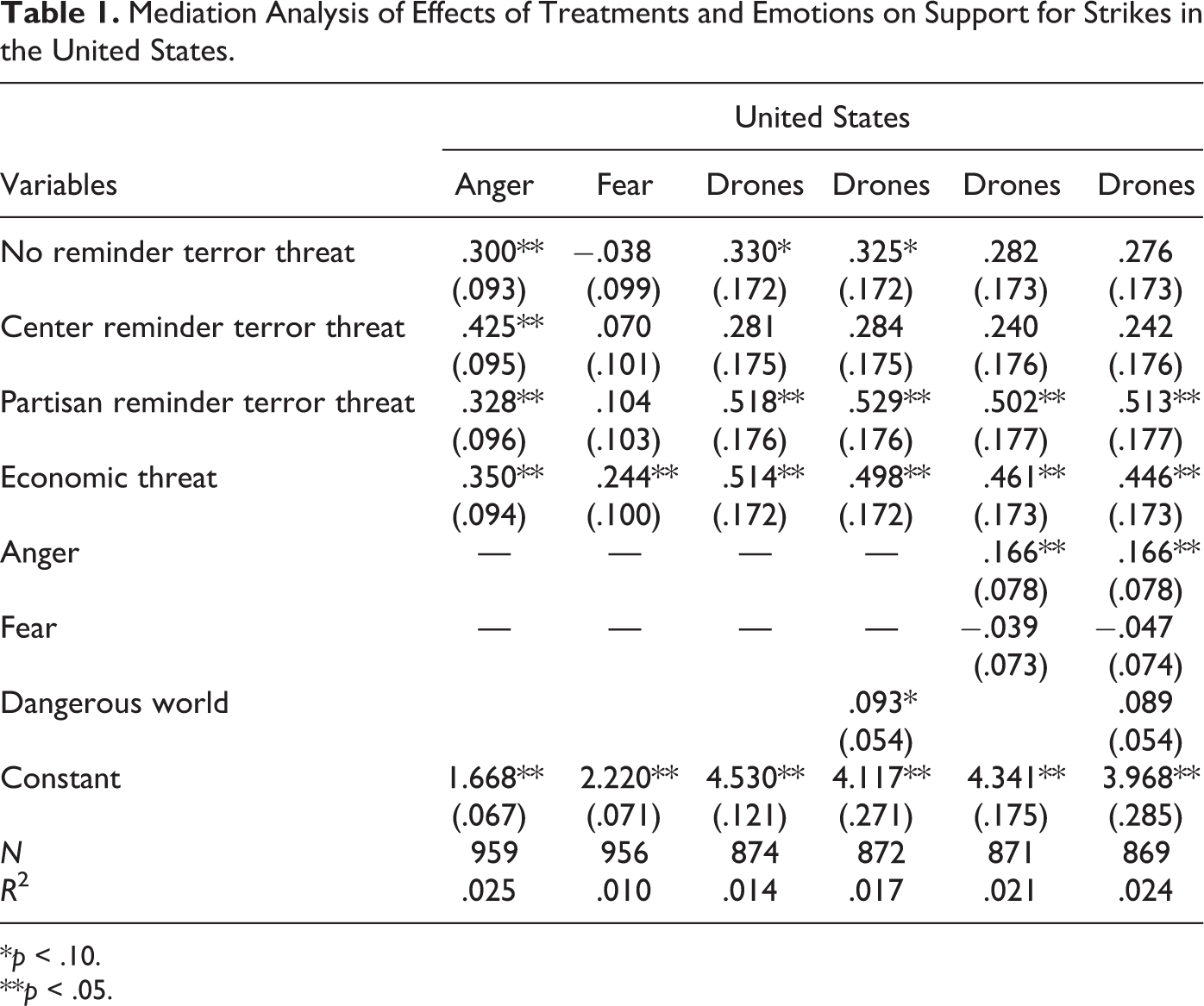
We present the results for the United States in Table 1, for Turkey in Table 2, and for France in Table 3. We begin by looking at whether exposure to terror threat increases feelings of anger across each country (Hypothesis 1). In line with our first hypothesis, we find that the terror threat conditions significantly increase feelings of anger (p < .05) in the United States (see column 1). Those in the terrorism threat condition without a democratic reminder are .30 units higher on the anger scale than those in the control group. The comparable effects for those in the reminder conditions are .425 units for those who received a reminder from the Center for Democracy and .328 units for those who received the bipartisan reminder. Individuals became similarly angry, .350, given exposure to the economic threat condition.
Mediation Analysis of Effects of Treatments and Emotions on Support for Strikes in the United States.
*p < .10.
**p < .05.
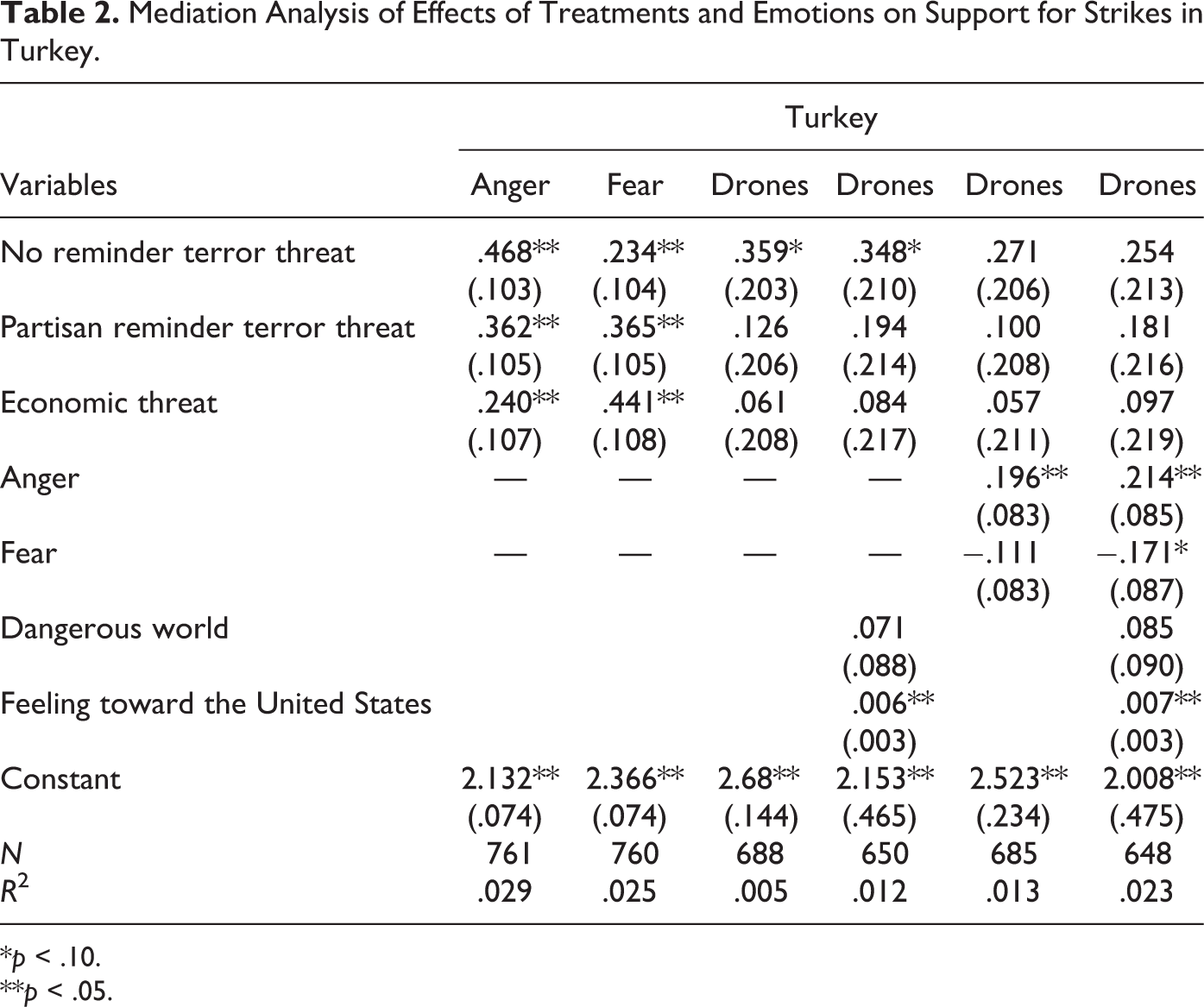
Mediation Analysis of Effects of Treatments and Emotions on Support for Strikes in Turkey.
*p < .10.
**p < .05.
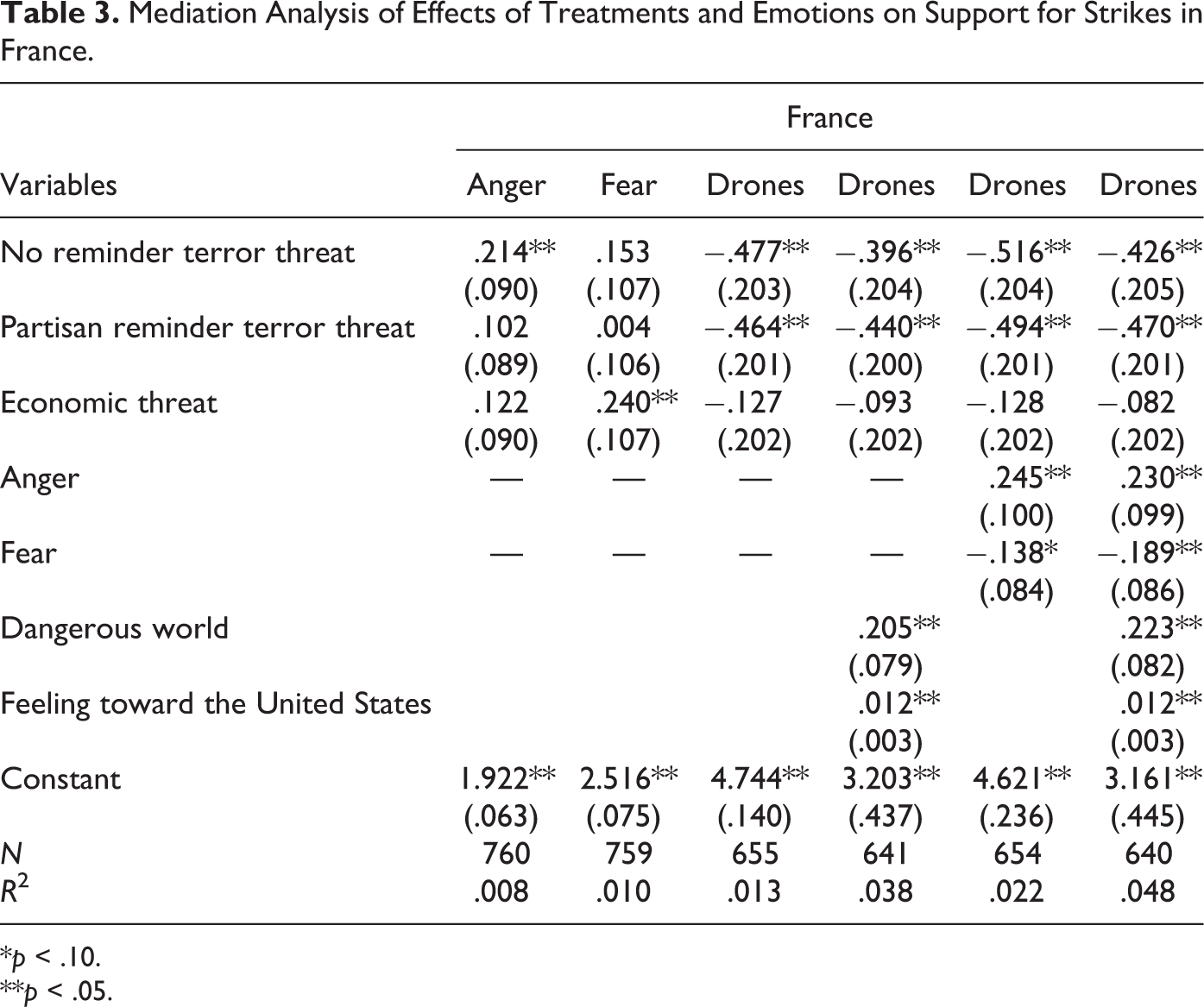
Mediation Analysis of Effects of Treatments and Emotions on Support for Strikes in France.
*p < .10.
**p < .05.
We see a similar pattern emerge in Turkey and France. In Turkey (first column of Table 2), all three threat conditions significantly increase feelings of anger (p < .05). The effects are strongest for those in the terror threat with no reminder condition (.468), followed by those in the terror with a partisan reminder condition (.362), and lastly, those in the economic threat condition (.240). Finally, in France (see column 1, Table 3), only the terror no reminder condition (.214) significantly increases anger.
We next turn to column 2 in each table to look at the effects of the treatments on feelings of fear. In the United States, only the economic threat significantly increases fear, with individuals in this condition .244 units higher in fear compared to the control group (p < .05). Therefore, the results in the United States do not support Hypothesis 2. In Turkey, all three of the threat conditions significantly increase feelings of fear (p < .05), which is more supportive of Hypothesis 2, and the effects are strongest for the economic threat condition (.441). In France, as in the United States, only the economic threat condition increases feelings of fear (.240). Across all three countries, the threat of terrorism is more likely to elicit anger, whereas the economic threat is more likely to elicit fear.
In sum, we find strong support for Hypothesis 1. In all cases but one, reading news about terrorism made participants more likely to feel angry. This is the first important step to showing a potential mediating relationship for anger. For Hypothesis 2, we find no support in the United States or France, but support in Turkey. One potential reason for these mixed findings may be the very different vulnerabilities each country faces with respect to international terrorism. Turkey is in closer geographic proximity to states that are likely to export terrorism (Syria and Iraq). France had not experienced a major attack at the time of our study. For the United States, the study was done many years out from 9/11, and the lack of another major attack on US soil may explain the limited effect on feelings of fear. Given the weaker effects of the terrorism treatments on inducing fear, we may only find a mediating effect in Turkey.
Finally, while not the main focus of our hypotheses, economic threat leads to elevated anger and fear in the United States and Turkey and elevated fear in France. In the US case, the economic threat resulted in more anger than fear, while in France and Turkey, it resulted in higher fear than anger. The differences across countries may reflect differences in the economic context, with many in the United States being angry with Wall Street after the 2008 economic recession.
Effect of the Treatments on Support for Drones
We now look at the direct effects of the treatment conditions on support for drone strikes in column 3 of Tables 1 to 3. We should find that the terror threat condition has a significant effect on support for drones. These analyses also enable us to test our additional argument; reminders of democratic values will diminish the effect of threat on support for drone strikes (Hypothesis 4).
As expected, in the United States, individuals exposed to the terror threat no reminder condition are about a third of a unit more supportive of drone strikes than those in the control group (p < .10). We find mixed effects for the two different reminders of democratic values. Individuals exposed to the bipartisan reminder condition are half a unit more supportive of drone strikes compared to those in the control group (coefficient = .518, p < .05). The reminder from the Center for Democratic Values is also positively related to support for drone strikes (.281); however, the effect is not statistically significant. The conditions needed for a mediating effect are therefore met for the terror no reminder condition and the terror bipartisan reminder condition.
These results provide mixed support for whether reminding people of democratic values reduces the negative effect of terror threat (Hypothesis 4), in that only one of the reminders renders the terrorism news ineffective in impacting support for drone strikes (from the Center). One possibility is that in a highly polarized setting like the United States, individuals were less persuaded by a bipartisan reminder and were more affected by a message from a neutral organization. Another possibility is that the bipartisan reminder was stronger but caused respondents to move in the other direction to protect “American” democracy. We can’t distinguish between these possibilities with the data.
In Turkey, individuals in the terror threat no reminder condition are .359 units more supportive of the strikes (p < .10), as expected. However, the terror threat reminder condition has no significant effect. It therefore appears that in the case of Turkey, a reminder of democratic values mitigates the effect of terror threat on support for drone strikes, in support of Hypothesis 4, and this may relate to the more critical stances in general that the public in Turkey has taken toward the use of drones by the United States.
Finally, in France (Table 3), the terror no reminder condition and the terror reminder condition have a significant effect on public support for drone strikes (p < .05); however, both conditions show less support for drone strikes compared to the control group and by just under half a unit on the scale. We had expected a drop in support for drone strikes with the reminder condition (Hypothesis 4), but not for the no reminder condition. Part of this negative effect could be driven by a process whereby making international terrorism salient induces the French to become even more critical of what they view as a US policy.
In order to rule out attitudes toward the United States as a possible confounder in France and Turkey, we next run additional analyses including a control for feeling toward the United States, which is measured on a 100-point feeling thermometer. 13 Second, it’s possible that certain personality traits, in particular the tendency to view the world as a threatening place, lead individuals to be more supportive of drone strikes. To account for this, we add a control for perceptions of a dangerous world. 14 The findings are presented in column 4 of each table. As we would expect, individuals who see the world as a more dangerous place are generally more supportive of drone strikes in the United States and in France, but not in Turkey. Furthermore, individuals with more positive feelings toward the United States are more supportive of drone strikes in Turkey and in France. What is important to note, though, is that the inclusion of these controls does not alter the effects of our primary variables of interest.
To summarize, in two of the three cases, priming terrorism increases support for drone strikes, as expected. The findings are suggestive, but mixed, as to whether a reminder of democratic values can diminish the effects of priming terrorism. This is the case for only one of the reminders in the United States, as well as the reminder in Turkey. In France, people reacted against the terrorism condition, whether or not it had a reminder, so the context was such that a reminder was not necessary. It may be that the prime of the importance of democratic values was too loosely connected to drone strikes. A more direct critique of the strategy may be more effective.
The findings also allow us to look at whether the effects of threat on support for drone strikes are particular to terrorism, and the findings here are mixed. Individuals in the economic threat condition in the United States are significantly more supportive of drone strikes and by half a unit more than those in the control group (.514, p < .05). These results suggest that threats do not need to be domain-specific to impact support for punitive policies. However, this condition does not significantly affect support for drone strikes in Turkey or France. On balance, then, the findings are more specific to terrorism.
Mediating Effects through Anger and Fear
The final equation tests whether the effects of the threat conditions are mediated through emotions by adding the anger and fear variables to the equation (last two columns in each table). We focus on the mediating effects of anger across each country for the baseline model, but the effects are consistent in the models controlling for perceptions of a dangerous world and feelings toward the United States. Recall that, in the United States, we found that all of the conditions, except for the reminder from the Center for Democracy, affected support for drone strikes. We now look at whether some of this effect is mediated through anger. First, we find that anger is related to a significant increase in support for drone strikes (.166, p < .05), as expected. In line with our hypotheses, the coefficient on the terror no reminder condition diminishes (from .330 to .282), and the p value now indicates there is no longer a statistically significant relationship between the terror no reminder condition and support for drone strikes. This suggests that the effect is fully mediated through anger. The size of the terror threat with a bipartisan reminder condition also decreases (from .518 to .502, respectively) but remains significant (p < .05). These effects are partially mediated through anger. We therefore find strong support for Hypothesis 3. We also find that anger partially mediates the effect of economic threat on drone strike support, as the size of the economic threat condition decreases (from .514 to .461) but remains significant (p < .05).
While the Baron and Kenney method is intuitive, there is no significance test provided for mediation. We therefore ran two robustness checks, one using Sobel–Goodman mediation 15 tests and the other using causal mediation analysis (Imai et al. 2011). 16 Both of these tests show significant mediating effects through anger for the terror no reminder, terror bipartisan reminder, and economic threat conditions (see Tables A2 and A3 in Online Appendix). The findings show that the mediation effect of anger accounts for between 8 percent and 15 percent of the total effect of the terrorism conditions on support for drone strikes.
In Turkey (Table 2), only the terror no reminder condition significantly affected support for drone strikes, so we only explore potential mediating effects through anger in this condition. As expected, anger significantly increases support for drone strikes (p < .05). Furthermore, the coefficient on the terror no reminder condition becomes insignificant. These findings demonstrate strong support for a mediating effect through anger for the terror no reminder condition, also in line with our expectations (Hypothesis 3). The results for anger are robust to Sobel–Goodman mediation tests and causal mediation analysis, and the size of the mediation effect is fairly substantial, accounting for 22 percent and 26 percent of the total effect of the condition for each test, respectively (see Tables A4 and A5 in Online Appendix). 17
In France, only the terror no reminder condition increased anger, so we only look at whether the effect is mediated through anger for the terror no reminder condition. Recall that the main effect of this condition was a decrease in support for drone strikes, which was opposite of what we found in the United States and Turkey. As expected, those who report feeling angry are significantly more supportive of drone strikes. Furthermore, once we take into account anger, the direct effect of the terror no reminder condition gets even stronger, −.516, in part because the effects of anger are now being registered in the opposite direction. We therefore also find support for Hypothesis 3 in France. These results are robust to Sobel–Goodman mediation tests and causal mediation analysis, and the size of the mediation effect is similar to what we find in the US context, around 10 percent (see Tables A6 and A7 in Online Appendix). To summarize, across all three countries, we find strong evidence that conditions of terrorist threat increase feelings of anger, which in turn increase support for drone strikes (Hypothesis 3). 18
Finally, we explore possible mediating effects through fear. We did not specify expectations for fear since theory suggests that it may have different effects. In the United States, the sign on fear is negative, but the coefficient is not statistically significant. Furthermore, we did not find that the terrorism conditions increased fear in the United States, so there is no support for a mediating effect (nor is there with the Sobel–Goodman mediation tests or the causal mediation tests; see Tables A2 and A3 in Online Appendix). In Turkey (Table 2), all of the threat conditions increased fear, and fear decreases support for drone strikes, but only in the equation with additional controls. There is also no support for a mediation effect from the baseline model using Sobel–Goodman or causal mediation tests (see Tables A4 and A5 in Online Appendix). In France, those feeling fearful are significantly less supportive of drone strikes; however, there is no support for a mediation effect, given that the terror conditions did not increase fear (there is also no support with the Sobel–Goodman or causal mediation tests (see Tables A6 and A7 in Online Appendix).
Across all three countries, we find largely null effects for fear as a mediator. As we anticipated, this could be due to the more nuanced dimensions of using drones as a strategy, which is often perceived as less risky than other counterterrorism strategies such as boots on the ground. We cannot rule out that the null effects for fear in the United States and France are due to the treatment being unsuccessful in increasing feelings of fear; however, that cannot explain the mixed effects for Turkey.
Further Robustness Tests
We further probe the robustness of the findings by looking at these relationships for related dependent variables. On the posttreatment survey, we also asked individuals their level of agreement (on a seven-point scale) with three statements about drone strikes: they are necessary to defend countries from extremist groups, they kill too many innocent people, and drone strikes should be conducted even without authorization from the country where the extremists are located. These questions get at some of the main considerations discussed in policy debates with respect to justifications for and against drone strikes. For example, some argue that drones are the best option in the US foreign policy toolbox and others argue that drone strikes are damaging to civilians and counterproductive in terms of advancing broader US policy goals. The final question taps into questions of sovereignty. We expect to find that those in conditions of terrorist threat are more likely to agree with the first question, disagree with the second, and agree with the third, and these should be mediated through anger. Further, although we found null effects for fear on the policy support measure, if we are to find a mediating effect through fear, it should be most likely for the question about drones killing too many innocent people—where fear may cause individuals to be more inclined to agree.
To succinctly present these results, we use Imai et al.’s method of causal mediation analysis and report our results in the Online Appendix (Tables A9–A11). For the United States, in line with the results for our general measure of drone strike support, we find that the average causal mediation effects are significant across the terror no reminder and reminder conditions for anger on the statements regarding the necessity of strikes and sovereignty concerns. We once again do not find significant mediating effects for fear. We do find that fear increases perceptions that drone strikes kill too many innocent people (more fearful individuals are more likely to agree), but the effect is not mediated through the terrorism conditions. No mediating effects are registered for anger on this measure.
The findings in France and Turkey mirror those found earlier, specifically for the statements related to the necessity of drone strikes and sovereignty concerns (Q1 and Q3). In France, we find a significant mediating effect of anger through the terrorism no reminder treatment for both questions. In Turkey, we find the same pattern for both terrorism news articles (with and without the reminder), though the effects are only significant at the 10 percent error level for the question related to sovereignty concerns. We do not find any mediating effects through fear for either measure in either country, though in Turkey, we find a mediating effect of fear for the question about drone strikes killing too many innocent people.
Conclusions
By building upon prior scholarship on foreign policy preferences and investigating the role of emotions in meditating public support for the use of force under conditions of threat, our research augments the budding literature on emotions and foreign policy, especially in a comparative context. While scholars (e.g., Moisi 2007) have asserted a “clash of emotions” as an instigator of international conflict, little research has explored the role of individual citizens’ emotions and support for war tactics (exceptions include Huddy et al. 2005; Huddy, Feldman, and Cassese 2007). And even though one might expect emotion to play an explicit role in studies of the average citizen’s patriotism and “rally round the flag” effects, for instance, it goes largely unnoticed by scholars.
Our study contributes to this promising research area by distinguishing the effects of two “negative” emotions, anger and fear, in meditating support for drone strikes under conditions of terrorist threat. Through our analyses of experimental data from France, Turkey, and the United States, we find evidence in support of our hypotheses relating terror threat and feelings of anger to support for drone strikes. This article’s findings thus demonstrate that accounting for the role of emotions can aid our understanding of public support for a controversial foreign policy. One important implication is that while drone strikes are controversial, they are ultimately more palatable to a public that experiences a mixture of anger and fear in reaction to the threat of terrorism than a strategy that would require the use of troops on the ground. The latter strategy would likely elicit a negative response from those made fearful about the threat rather than the null effects we find for fear in the case of drone strikes. In fact, research on the US public has found that fearful individuals were less supportive of the Iraq War (Huddy, Feldman, and Cassese 2007).
Given the design of our studies, we are also able to show that these effects are on average specific to the domain of terrorism. Feeling anger in response to an economic threat did not increase support for drone strikes in France or in Turkey. The public in these countries therefore only apply their anger to the relevant domain. Only in the United States do we find that experiencing anger in reaction to an economic threat also increases support for drone strikes.
Our findings also speak to whether there is any way to temper the inclination to become more supportive of drone strikes when terrorism is salient. Across all three countries, we found that exposure to a reminder of democratic values either decreased support for drone strikes (as in France) or washed away the effect of priming terrorism (as in the case of Turkey and one of the reminders in the United States). This suggests that political actors may be most effective in gaining support for the use of force abroad when there is a united emphasis on security threats, without regard for democratic values. On the other hand, those wary of drones undermining vital democratic restraints on the use of force abroad should note that reminding people of a shared commitment to core democratic principles, including individual liberty and tolerance, may help to mitigate citizens’ willingness to support even comparatively low-cost, low-risk drone strikes.
Supplemental Material
Supplemental Material, JCR-16-0339.R2 - Emotions, Terrorist Threat, and Drones: Anger Drives Support for Drone Strikes
Supplemental Material, JCR-16-0339.R2 for Emotions, Terrorist Threat, and Drones: Anger Drives Support for Drone Strikes by Kerstin Fisk, Jennifer L. Merolla, and Jennifer M. Ramos in Journal of Conflict Resolution
Footnotes
Appendix
Authors’ Note
All replication files are available at the Journal of Conflict Resolution’s website.
Acknowledgments
We would especially like to thank Elizabeth Zechmeister, Paul Huth, and the anonymous reviewers.
Declaration of Conflicting Interests
The author(s) declared no potential conflicts of interest with respect to the research, authorship, and/or publication of this article.
Funding
The author(s) disclosed receipt of the following financial support for the research, authorship, and/or publication of this article: Support for this project was granted from the National Science Foundation (Award ID #s 0850824 and 0851136).
Supplemental Material
Supplemental material for this article is available online.
Notes
References
Supplementary Material
Please find the following supplemental material available below.
For Open Access articles published under a Creative Commons License, all supplemental material carries the same license as the article it is associated with.
For non-Open Access articles published, all supplemental material carries a non-exclusive license, and permission requests for re-use of supplemental material or any part of supplemental material shall be sent directly to the copyright owner as specified in the copyright notice associated with the article.
