



Abstract
As research on leaders matures, a next step is a better understanding of the advisers who surround them. This article explores the often-hidden politics of leader–adviser interactions, focusing on how leaders strategically manage elite cues from within their own circle that could engage otherwise dormant or permissive public opinion. Advisers can serve as cue givers when leaders contemplate the use of force, but leaders can shape which cues reach the public by accommodating advisers. This article explores this argument by combining a survey experiment with a case study of the 2009 escalation in Afghanistan, illustrating how the dynamics identified in the experiment motivate the president to bargain with advisers whose support or opposition would most influence public opinion. An important implication is that in the real world, damaging cues found in survey experiments may be diminished in volume or may not reach the public, whereas helpful cues could be magnified.
Keywords
A wave of scholarship has shown that leaders matter. Thus far, however, most studies—in both the “institutional leadership” and the “leader attribute” schools, as Horowitz and Fuhrmann (2018) describe them in their introductory essay to this special feature—treat individuals either in isolation or within the context of political regimes (see, among others, Byman and Pollack 2001; Wolford 2007; Saunders 2009, 2011; Chiozza and Goemans 2011; Croco 2011; Colgan 2013; Horowitz, Stam, and Ellis 2015). Yet leaders rarely make decisions entirely on their own. An important step in the renewed study of leaders, then, is to better understand how leaders interact with those in their inner circle.
Politics inside the executive branch are generally ignored in favor of the politics of legislatures (Schultz 2001; Howell and Pevehouse 2007; Trager and Vavreck 2011; Levendusky and Horowitz 2012; Baum and Potter 2015). Yet the US context shows that the bargaining inside an administration can be quite political. Prior to the Iraq War, for example, George W. Bush sought the endorsement of Secretary of State Colin Powell, known to be a skeptic. In the Obama administration’s decision to “surge” troops into Afghanistan, generating unity among key administration officials—some of whom initially pushed for more aggressive policies—was an important part of the policy process. In 1979, Jimmy Carter abandoned plans to withdraw troops from South Korea in the face of nearly unified opposition from his advisers (Glad 2009, 36-37). Of course, there is a long tradition of scholarship on group decision-making (e.g., Hermann and Preston 1994) and bureaucratic politics (e.g., Allison and Zelikow 1999). These approaches, however, generally do not engage directly with the politics of advising.
This article argues that advisers are important political actors whose inside knowledge and authoritative position make them credible sources of information, not only for other elites but also for the public, which tends to look to elites for cues when forming opinions about foreign policy (Zaller 1992; Berinsky 2009). Leaders thus have an incentive to take care not only in selecting advisers but also in engaging and bargaining with those advisers in decision-making, in order to strategically manage elite cues from within their own circle that could engage otherwise dormant or permissive public opinion, as well as cue other significant elites such as members of Congress.
This article also advances arguments about elite leadership of mass opinion by theorizing the political origins of elite support for war. Although the importance of elite consensus or dissensus is central to these arguments (e.g., Zaller 1992; Berinsky 2009), how that consensus arises is rarely discussed. I argue that voters delegate foreign policy to elites and wait for a cue to alert them—“fire-alarm” style—that they should pay attention (McCubbins and Schwartz 1984; Zaller 2003). But this delegation provides strategic incentives for the chief executive, who can try to prevent the fire alarm from being pulled by accommodating elites. This process may require concessions to other elite preferences that affect the substance of policy even if the public is not clamoring for a policy shift in the same direction or if the details remain largely out of public view. Leaders may therefore have relative autonomy in whether they initiate or even escalate the use of force, but at the price of political capital or concessions on the nature, strategy, or timing of military operations.
Focusing on the United States, this article addresses the sometimes-hidden politics that go on within an administration. Advisers—which, in the US context, I define to include White House staff such as the National Security Advisor and cabinet members or even deputies as long as they are of sufficiently high rank to influence policy and attract media attention—can serve as potential cue givers when leaders contemplate the use of force and thus are likely to be the target of a leader’s attempt to accommodate them. Leaders are most concerned about cues that reveal information—notably, surprising or costly cues that can credibly inform voters or other elites (Gelpi 2010; Baum and Groeling 2010a, 27-28; Trager and Vavreck 2011, 532). This surprise can arise in two ways: first, from the institutional position of the cue giver (here, cues from inside the administration) or, second, from the substantive nature of the cue (such as information that goes against the speaker’s or president’s perceived “type”). The theory suggests that these imperatives lead Democratic presidents to accommodate hawkish advisers and shift policy accordingly, while Republican presidents are most concerned about their most dovish advisers.
This article combines a survey experiment designed to show which cues from advisers would affect public attitudes toward war and thus would most concern presidents, with a brief case study of Obama’s decision to escalate the war in Afghanistan in December 2009, illustrating how the dynamics identified in the experiment shape presidential behavior. The experiment illuminates political costs that leaders work hard to avoid, that is, that are “off the equilibrium path.” 1 In the real world, we should expect leaders to focus their bargaining energy and political capital on managing those elites whose cues would have the strongest effects on public opinion. The results suggest asymmetric effects: hawkish advisers have the greatest political relevance for presidents of both parties, but Democratic presidents are at greater political risk from these hawkish advisers. Dovish advisers primarily affect Republican presidents.
The elite-level implications address an important point about the external validity of survey experiments. The effects that would be generated among the public if the elite cues in the experiment reached the public’s ears motivate the president to bargain with those elites whose support or opposition would sway public opinion the most. The most damaging cues found in survey experiments may end up diminished in volume or may not reach the public at all, whereas helpful cues could be magnified. This concern thus goes beyond the external validity issues highlighted by behavior scholars (e.g., Barabas and Jerit 2010), who often focus on the public’s exposure to messages. Here, the nature and volume of messages is partly a product of strategic elite politics. The real-world effects that relate to the experiment may thus be found inside the (proverbial) Situation Room.
Leaders, Advisers, and Domestic Politics
The “pulling and hauling” of bureaucratic politics have frequently been invoked in scholarship on the use of force (Allison and Zelikow 1999, 255). But the bureaucratic politics model—which emphasizes the interactions between governmental elites—has been difficult to translate into specific predictions. Critics have argued that the bureaucratic politics approach is both too complex and strangely lacking in politics. Bendor and Hammond (1992, 315) argue that the model assumes, rather than demonstrates, the need for the president to bargain with his subordinates, whom he presumably chose. Other approaches to group decision-making, including theories of “groupthink” (Janis 1982) and “multiple advocacy” (George 1980, chap. 11), likewise sidestep issues of selection and within-group politics. Bendor and Hammond (1992, 315-16) note, however, that political support outside the executive branch could be a reason presidents would need to bargain with appointees they select and over whom they have formal authority (see also Art 1973, 475).
These critiques raise three sets of questions. First, is there likely to be a distribution of preferences within an administration? Second, how and why would advisers make those preferences known if they are presumed to be loyal? Third, assuming advisers’ preferences become known in public debate, how do their statements affect domestic politics and policy?
Distribution of Advisers’ Views
At first glance, it may seem odd for the president to consider the political implications of taking advice from those he chose to put in his own inner circle. But there are often significant debates within an administration over whether and how the United States should use military power. The divisions within the George W. Bush administration in the lead-up to the Iraq War are well known. During the Cold War, tension roiled the administrations of Jimmy Carter (Cyrus Vance vs. Zbigniew Brzezinski) and Ronald Reagan (George Shultz vs. Caspar Weinberger). Furthermore, presidents also tout the advice or endorsement of particular advisers, including those who disagree with them. In the Iraq case, the Bush administration exploited Powell’s known skepticism, choosing Powell to make the now-infamous presentation to the United Nations to enhance the administration’s “credibility” by going “counter to type” since “everyone knew that Powell was soft on Iraq, that he was the one who didn’t want to go” (Woodward 2004, 291).
Why might divisions arise within administrations? Although advisers and cabinet officials are chosen by the president, usually from the foreign policy “bench” of the president’s party, their views cannot be known on every issue, and some disagreement is natural. Indeed, the dispositional characteristic of “military assertiveness” identified by Yarhi-Milo et al. (2018) in this special feature is independent of political ideology. Both parties have different foreign policy “wings,” such as neoconservatives and realists in the Republican Party and liberal hawks versus anti-interventionists in the Democratic Party. Leaders also engage with advisers to gather information, seek advice, and deliberate policy options. Thus, they may actively seek a distribution of views to improve decision-making, along the lines of “multiple advocacy” (George 1980, chap. 11) or research showing that consulting even biased advisers is beneficial to decision-making (Calvert 1985), especially if there are multiple advisers with different views (Krishna and Morgan 2001). Advisers are also chosen for their competence, their suitability for a particular organization, or their ability to balance another adviser, which may, in turn, lead to differences in policy views. Donald Rumsfeld’s appointment as Secretary of Defense, for example, was partly designed to balance Powell (Mann 2004, 264-69).
Advisers may also be appointed to manage intraparty politics or diffuse a political rivalry (Goodwin 2006). Notably, however, Goodwin’s account of Lincoln’s “team of rivals” specifically focused on Lincoln’s direct political rivals, rather than all advisers who might have different preferences. Appointing an adviser with political aspirations or from the opposite party is politically dangerous for the president because it gives a prominent figure with a separate political base and potentially conflicting motives access to insider information and a platform to air dissent—as the examples of General George McClellan, fired by Lincoln only to run for president against him in 1864, and General Douglas MacArthur, also fired by Truman and briefly a presidential hopeful, illustrate. Such high-profile appointments of true political rivals are thus empirically rare in the modern media age. But even within a given administration dominated by players from one party or the other, it is usually possible to array advisers on a spectrum that approximates a hawk–dove or activist–restraint divide, although the very political risks highlighted by this article put limits on how wide this distribution is likely to be.
Adviser Views in the Public Domain
Of course, if advisers’ positions never become publicly known, the distribution of views inside an administration would not be politically relevant. But advisers’ views often enter the public domain, both because there is likely to be demand in the media for these statements and because advisers are likely to want to supply information (Kydd 1997, 137-38). On the demand side, the media is strategic and seeks surprising or newsworthy information from the “most authoritative and high-ranking sources” (Baum and Groeling 2010a, 22; see also Hayes and Guardino 2013, 28). The media oversamples “surprising” cues, notably criticism of the president by members of his own party, or support from the opposition party in Congress (Baum and Groeling 2010a; Hayes and Guardino 2013). Although work in this vein has emphasized Congress, the logic could also be extended to actors who operate within the president’s administration, whose dissent would be particularly juicy and potentially damaging.
On the supply side, however, speaking out against a presidential policy—even one still under consideration—carries substantial risk and cost for advisers. These costs include potential personal or professional costs—most dramatically, getting fired, or short of that, loss of standing—as well as the desire to avoid undermining the president or the national interest. Why might advisers make such statements? Airing views may help officials advance a policy agenda. Adviser statements can send signals not only to the public but also to other elite decision makers or Congress, raising the domestic political stakes and generating leverage in debates. Bureaucratic actors might also speak out for the sake of organizational prestige or budgets or to counter other views in the public domain. For advisers with political aspirations, there may be personal or professional benefits to being able to say later that they favored or opposed a policy, but as discussed, such cases are relatively rare.
The form that adviser statements take can range from a publicly stated dissent to an anonymous leak. On one end of the spectrum are public statements. Of course, administrations regularly tap advisers for media appearances or Congressional testimony to generate support for the president’s policies (one reason why an adviser’s public support is often unsurprising). Given the costs, advisers publicly speaking out in a direct way to oppose a presidential policy, or even a policy proposal under discussion, is much rarer. But such costs also give credibility to advisers’ public opposition. The costs of speaking out may also vary depending on a variety of factors, such as timing: expressing a policy view before a decision is announced is likely less risky than dissenting publicly after the fact, although advisers still take the risk of staking a position and being overruled or angering the president, which may cost the adviser standing and power. Regardless, the resulting costs advisers could impose on a president are a reason why despite their rarity, presidents may try to prevent public dissent or opposition, perhaps by making policy concessions to dissenters. Alternatively, as discussed below, if the president can get an adviser with known misgivings or an apparent bias in the opposite direction to endorse a policy—as in the case of Powell and the Iraq War—such a signal would also be credible because of its surprising or costly nature.
Adviser dissent can reach the public’s ears in other, more indirect ways. Policy debates, particularly those that are protracted, can generate news stories in which officials’ views are attributed to or associated with them. 2 Administration officials may also express views to other elites that may in turn report them, either publicly, as Congressional testimony, or privately, in briefings. At the far end of the spectrum are leaks, a perennial issue for administrations, which expend significant effort preventing or tracking them down. Leakers still face the risk of detection and subsequent mistrust, if not firing.
Given that the costs and risks of dissent will vary, the survey experiment aims to test the effect of a public statement and to provide evidence for the effect of attributed adviser views should they reach the public (and thus the microfoundations of the argument). To the extent advisers make statements via indirect channels that affect either public opinion or other elites, and those elites in turn also potentially affect the public or impose costs on the president directly (Saunders 2015), presidents may have even more reason to want to manage such statements ex ante.
How Adviser Cues Matter: The Political Origins of Elite Consensus
Assuming that adviser statements reach the public, would their words have any effect? Elite cues provide the public with a shortcut to information-gathering, and such cues trigger, activate, or even shape public preferences even in wartime (Zaller 1992, chap. 6; Berinsky 2009, chap. 5). I argue that administration officials can provide cues that can shape public attitudes about the use of force. Advisers have credibility and information advantages arising from their position, which makes them likely to be perceived as effective cue givers (Lupia and McCubbins 1998, 64). These cues could influence not only the public but also members of Congress, who may rely on elites from the administration or the military to provide information through testimony or classified briefings. Given that members of Congress are themselves important sources of elite cues for the public (Howell and Pevehouse 2007; Baum and Groeling 2010a; Trager and Vavreck 2011), an adviser’s cue may be amplified. Advisers thus influence whether there is an overall elite consensus or dissensus, which in turn shapes public opinion and ultimately the political incentives and constraints on democratic leaders.
Still, observationally, major incidents of adviser disputes spilling into the public domain are relatively rare. I argue that these advisory politics are hidden because presidents work to keep key advisers happy, so that damaging cues are muted or helpful cues can be promoted, and major events like firings or resignations are rare precisely because presidents work to avoid them. Although advisers serve at the president’s pleasure, firing an adviser may be more costly to the president than making policy concessions. Thus, the footprint of presidential management is likely to be seen in private, strategic behavior. This strategic behavior, in turn, helps explains the origins of elite cues. Presidents can build support for a policy or insulate themselves from political damage by keeping elites on board or at least preventing elite dissent. This arrangement also suits the public, which can use elite cues as a monitoring device (Zaller 2003). Leaders “remain wary of the ‘dog that could bark,’” if elite debate triggers public concern (Powlick and Katz 1998, 31).
Which Cues Matter? Theoretical Expectations
All elite cues are not created equal. As mentioned, it is usually unsurprising, for example, when an adviser supports a decision the president makes about the use of force. But it may be difficult to disentangle the effects of an adviser’s statement from other features of the situation. Does the public take other cues, such as the president’s partisanship, into account? Many scholars have identified “party brand” effects, in which Democratic presidents, expected to embrace more dovish policies, are punished or mistrusted when they make peace or stay out of conflicts, while Republicans can face political headwinds when they fight (Schultz 2005; Trager and Vavreck 2011; Kreps, Saunders, and Schultz 2018; Mattes and Weeks Forthcoming). Furthermore, adviser statements may have countervailing effects themselves. If an adviser speaks out against a war the president is contemplating, is the effect on public opinion driven by the mere fact that a member of the president’s own team spoke out, by the adviser’s hawkish or dovish reputation, or by the president’s partisanship, such that the adviser’s statement reinforces or confounds a party stereotype?
The literature on elite cues helps disentangle these effects. The literature highlights two ways that cues can credibly convey information, though they are rarely discussed jointly. First, a cue can be institutionally informative if it comes from an elite with a credible or surprising position. The backing of elites who are not expected to support the president (such as members of the opposition party) or the criticism of those within his own party will be more informative to voters and will attract more media attention (Baum and Groeling 2010a, 28). Second, cues can be substantively informative if they convey information that runs contrary to expectations. One form of substantively surprising or costly cue-giving arises when partisan elites—particularly members of Congress—give cues that run counter to expectations of the party’s brand. Trager and Vavreck (2011), for example, find that out-party cues affect approval depending on the president’s policy choice: for Democratic presidents, opposition support from Republicans in Congress is more beneficial when these presidents contemplate staying out of a crisis than when they fight, because Republican opposition support helps counter the image of dovish Democrats who may be staying out for ideological reasons. Similarly, Republican presidents who fight benefit from Democratic opposition support that mitigates the image of an overly hawkish Republican leader.
Extending these arguments, we can derive three mechanisms through which advisers could send informative signals. The first is based on their institutional status as advisers, and the second two are based on the substance of the cue. Many decisions to use force unfold after a process of debate, at least part of which often airs publicly (perhaps deliberately, to gauge public or Congressional support). We can thus consider how adviser cues affect support for war ex ante as well as approval of the president once he or she announces whether force will be used.
First, advisers have institutional credibility from their position on the president’s team. When the president considers a proposal for the use of force, a supportive statement from an adviser should have relatively little effect on public opinion, however, because advisers are expected to support the president (just as support from members of the president’s party in Congress is expected and unsurprising, e.g., Baum and Groeling 2010a, 25). But if an adviser opposes the proposal, support for force is likely to decrease even before a decision is announced, since as discussed, opposing a proposal under discussion is surprising and can be costly to advisers. If the president ultimately acts against the recommendation of advisers, either for or against force, presidential approval should be lower than if the president had made the same decision with full support or at least no dissent.
The effect of adviser cues may also depend on the adviser’s own reputation or the substance of what the adviser says. If an adviser makes a statement that is counter to his or her own type—an adviser from the hawkish end of the spectrum coming out in opposition to a war or a dovish adviser coming out in favor—then, the statement will be surprising and more likely to generate movement in public opinion. There is some evidence that these countertype signals can be informative even when the cue givers are not legislators with clear political motives. For example, Golby, Feaver, and Dropp (2018) show that the impact of military endorsements of the use of force is greater when the cue is surprising, as when the military opposes force. Such countertype statements by advisers should move opinion about the use of force more than true-to-type signals, which are more expected. Furthermore, presidents who act against countertype signals may risk a greater hit to their approval than if they buck advice from advisers who are conforming to type.
The third mechanism, which draws on party brand effects, relates to how the adviser’s statement reinforces or counters the partisanship of the president. Advisers with a hawkish reputation who support the use of force may make it harder for a Democratic president to stay out of a conflict, for example, because the hawkish adviser’s support for war may signal that the war is necessary and reinforce the stereotype of a Democrat as overly dovish if the president decides not to fight. Similarly, a relatively dovish adviser who opposes a Republican president’s decision to fight could confirm the image of a Republican as too eager to use force (Trager and Vavreck 2011).
These latter two mechanisms can interact, leading to hypotheses about how a particular adviser’s endorsement (or criticism) would matter, given the president’s partisanship. When presidents wish to act according to type—that is, when a Democratic president wants to avoid the use of force or a Republican president wishes to fight—the most beneficial endorsement would be from a countertype adviser: an adviser known to be hawkish endorsing a Democratic president’s decision to stay out (or to choose a lower-level military option) or a dovish adviser endorsing a Republican president for escalating. Even when presidents act counter to type, a hawk endorsing a Republican president’s decision to stay out or a dove endorsing a Democratic president who uses force would also be somewhat surprising. The costliest criticism would be from a like-minded adviser—an adviser known to be dovish criticizing a Democratic president, particularly for staying out, or a hawkish adviser criticizing a Republican president, especially for escalating. These scenarios, however, are rarer, since if a dovish adviser advocates that a Democratic president should use force, for example, presumably other elites have already agreed that force is necessary. But the risk of such scenarios has concerned presidents, as in the Iraq “surge,” which many military commanders and top Bush advisers opposed (Feaver 2011).
3
Research Design
I focus on testing the effects of adviser cues on opinion and then briefly discuss how these cues translate into strategic presidential bargaining with advisers. To test the effects of cues, I employ a survey experiment that offers internal validity, avoids problems of selection, and accounts for presidential expectations about approval (see Trager and Vavreck 2011, 532-33, for a useful discussion). The experiment illustrates the strategic incentives leaders have to bargain with the most effective cue givers.
I first describe the results of an online survey experiment, fielded in March 2016, on a large national American sample of approximately 3,000 respondents through the survey firm Survey Sampling International (SSI). 4 The experiment employs a vignette whose basic outlines mirror a standard vignette on crisis bargaining (e.g., Herrmann, Tetlock and Visser 1999; Tomz 2007; Trager and Vavreck 2011; Kertzer and Brutger 2016). The vignette focuses on a cross-border attack by a foreign state against a smaller neighbor; the US president must decide whether to send troops to repel the invaders.
Experimental Design
The experiment unfolds in two stages. In the first stage, the president considers whether to use force; in the baseline condition, there is no statement from an adviser, but in the other four adviser treatment conditions, a key adviser, who can be either hawkish or dovish, makes a statement supporting or opposing force; respondents are then asked whether they support or oppose sending troops. The first stage is thus a 2 × 5 design, reflecting two conditions for the president’s party (Democratic or Republican) and five adviser speech conditions (a baseline with no speech, a hawk supporting a troop deployment, a hawk opposing troops, a dove supporting troops, and a dove opposing troops). In the second stage, respondents learn whether the president sent troops or stayed out of the conflict, potentially with the support of or over the objection of an adviser; they also learn the outcome. Respondents are then asked whether they approve of the president’s handling of the situation. The second stage is thus a 2 × 5 × 2 design. While most experiments provide all the information in a single stage, the two-stage approach allows the initial step to unfold under some uncertainty, which more closely resembles real-world cases in which the decision plays out amid debate and ambiguity. Figure 1 depicts the two-stage structure. The large sample (N = 3,000) allows me to have approximately 300 respondents per condition in the first stage and 150 respondents per condition in the second stage.

Structure of the experiment.
The structure of the vignette is as follows (Figure 2 summarizes all conditions; vignette text is available in Online Appendix 1). First, respondents read an introductory prompt (similar to those in other experiments, e.g., Tomz 2007; Trager and Vavreck 2011), with an additional admonition that the scenario is hypothetical—a choice designed to avoid priming opinions about ongoing wars. Next, respondents read that “A country sent its military to take over a smaller neighboring country. The country that has been attacked is important to US economic and security interests.” Respondents are then told that the “The US president, who is a [Democrat|Republican], debated extensively with his advisers about whether to send the military to push back the invaders or stay out of the conflict.” In all conditions, respondents are also told that “Best estimates suggest that if the United States intervened, most of the territory could be secured, but the US would face significant armed resistance.” These statements are intended to hold constant expectations about the likelihood of success and expected costs, given arguments that these factors affect support for war (e.g., Gelpi, Feaver, and Reifler 2009). Setting an expectation of significant armed resistance helps test whether adviser cues can move public opinion even in the face of potentially significant costs.

Summary of experimental conditions.
Respondents are then randomly assigned to an “adviser speech” condition that tests the effect of a hawkish or dovish adviser’s support or opposition to the use of force (plus a control “no speech” condition). In all conditions, the vignette mentions that the president “debated extensively with his advisers” to hold the possibility of debate constant. In the condition where a hawkish adviser opposes using force, respondents are told that “One of the president’s key advisers, who usually takes a hawkish approach to foreign policy and has advocated the use of force in the past when many other advisers did not, opposed the use of force in this case.” In the condition in which a usually dovish adviser supports force, respondents are told, “One of the president’s key advisers, who usually takes a dovish approach to foreign policy and has opposed the use of force in the past when other advisers did not, supported the use of force in this case.” These two conditions—in which a usually hawkish adviser opposes force and a usually dovish adviser supports it—also comprise surprising or costly conditions. In the remaining two conditions, a usually hawkish adviser supports force and a usually dovish adviser opposes. Although these adviser statements are more in line with expectations about the adviser’s preferences, they still may be somewhat credible, given the institutional source of the speech and the effects of the party brands. At the end of the first stage, summary bullet points appear, and respondents are asked, “If the attacker cannot be talked into withdrawing, would you support or oppose sending US troops to push back the invaders?” It is important to note that all the combinations of support and opposition—including the ones less likely to occur in the real world—are necessary to calculate the effects of interest (as discussed below).
In the second stage, respondents learn the president’s decision to either send troops or stay out of the conflict; the vignette notes whether this decision came “with the support of” or “over the objection of” the hawkish or dovish adviser. Respondents also learn the outcome of the conflict, which in all conditions ends with “the attacking country taking control of 20 percent of the contested territory” (see Kertzer and Brutger 2016, for a similar design). If the president sent troops, the vignette specifies that “The US suffered just under 100 casualties in the effort.” 5 With summary bullet points visible, respondents are then asked if they approve or disapprove of the president’s handling of the situation, with responses on a 7-point scale.
Results
The primary focus of this article is on how advisers matter, and thus Hypothesis 1 examines whether adviser support or opposition affects support for war in the first stage (Hypothesis 1a) and approval once the president announces a decision (Hypothesis 1b), regardless of the president’s partisanship or the adviser’s reputation. I therefore aggregate the conditions in which the adviser supports force or opposes force. For stage 1, I report the percentage of respondents who support a troop deployment (including those who lean toward support), and for stage 2, I report the percentage who approve of the president’s handling of the situation, with those who strongly, somewhat, or lean approve coded as approving (results are similar using a three-point scale: support, neither support/oppose, oppose for Stage 1; approve, neither approve/disapprove, disapprove for Stage 2).
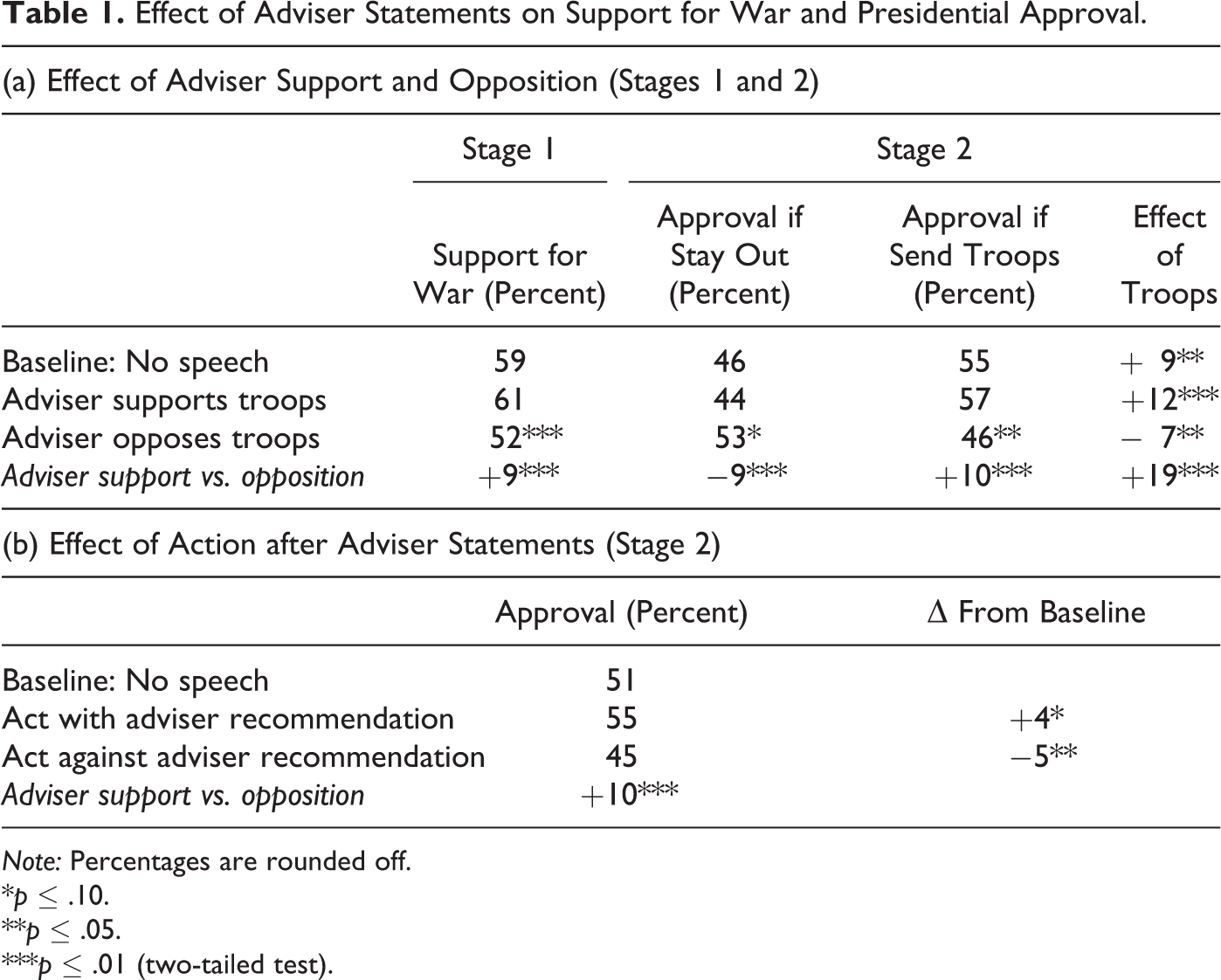
The left side of Table 1a shows the effect of adviser statements on support for war in stage 1, before the decision. An adviser’s opposition to sending troops (n = 1,185) results in a 9 percentage point decrease in support for the use of force, compared to the condition in which advisers support sending troops (n = 1,222), a highly statistically significant difference, given the aggregated cell size. Notably, an adviser’s explicit statement of support is substantively and statistically indistinguishable from the baseline condition in which advisers say nothing (n = 598). This result holds consistently across the analysis: adviser support does not boost support for war or approval compared to silence, suggesting that advisers are expected to support the president most of the time.
Effect of Adviser Statements on Support for War and Presidential Approval.
Note: Percentages are rounded off.
*p ≤ .10.
**p ≤ .05.
***p ≤ .01 (two-tailed test).
On the right side of Table 1a, once the president has announced his decision (Hypothesis 1b), approval depends on whether he acted with the support of or over the opposition of his advisers. We cannot simply examine the effect of adviser support or opposition for a particular action, however, because differences in approval could arise from either the adviser statement or views about the choice to use force. Rather, assessing the effect of adviser support requires the difference in approval between sending troops and staying out across both adviser support and opposition. 6 Mathematically, this difference in differences can be expressed as:

As the right side of Table 1a shows, this difference in differences, that is, the effect of sending troops versus staying out with adviser support versus without, is a highly significant 19 percentage point gain in approval. Presidents who decide to stay out of the conflict when their advisers opposed sending troops see 9 percentage points higher approval (and over the 50 percent mark) compared to those who stay out when an adviser supported sending troops. When presidents send troops, nearly the mirror image occurs in approval, with 10 percentage point higher approval for those who send troops with their adviser’s support compared to opposition (both results are again highly statistically significant). Table 1b presents another view by aggregating the conditions in which the president acted according to his adviser’s recommendation (sending troops when the adviser supported troops or staying out when the adviser opposed troops) and those in which the president acts against the adviser’s statement. Acting against advisers results in a 10 percentage point drop in approval compared to the condition in which the adviser explicitly supports the action. 7 Overall, Table 1 illustrates that advisers matter for domestic politics, but that most of the effect is the downside risk from opposition.
What about the content of the advisers’ statements and how it interacts with the president’s partisanship and the adviser’s hawkishness or dovishness? Direct tests of Hypotheses 2a and 2b for the effects of countertype adviser statements, aggregating across the president’s party and the costly or expected nature of the adviser’s statement, do not show significant differences in the effect of advisers making expected statements versus countertype statements. But these results could mask differences across the nature of the adviser’s statement and the president’s party.
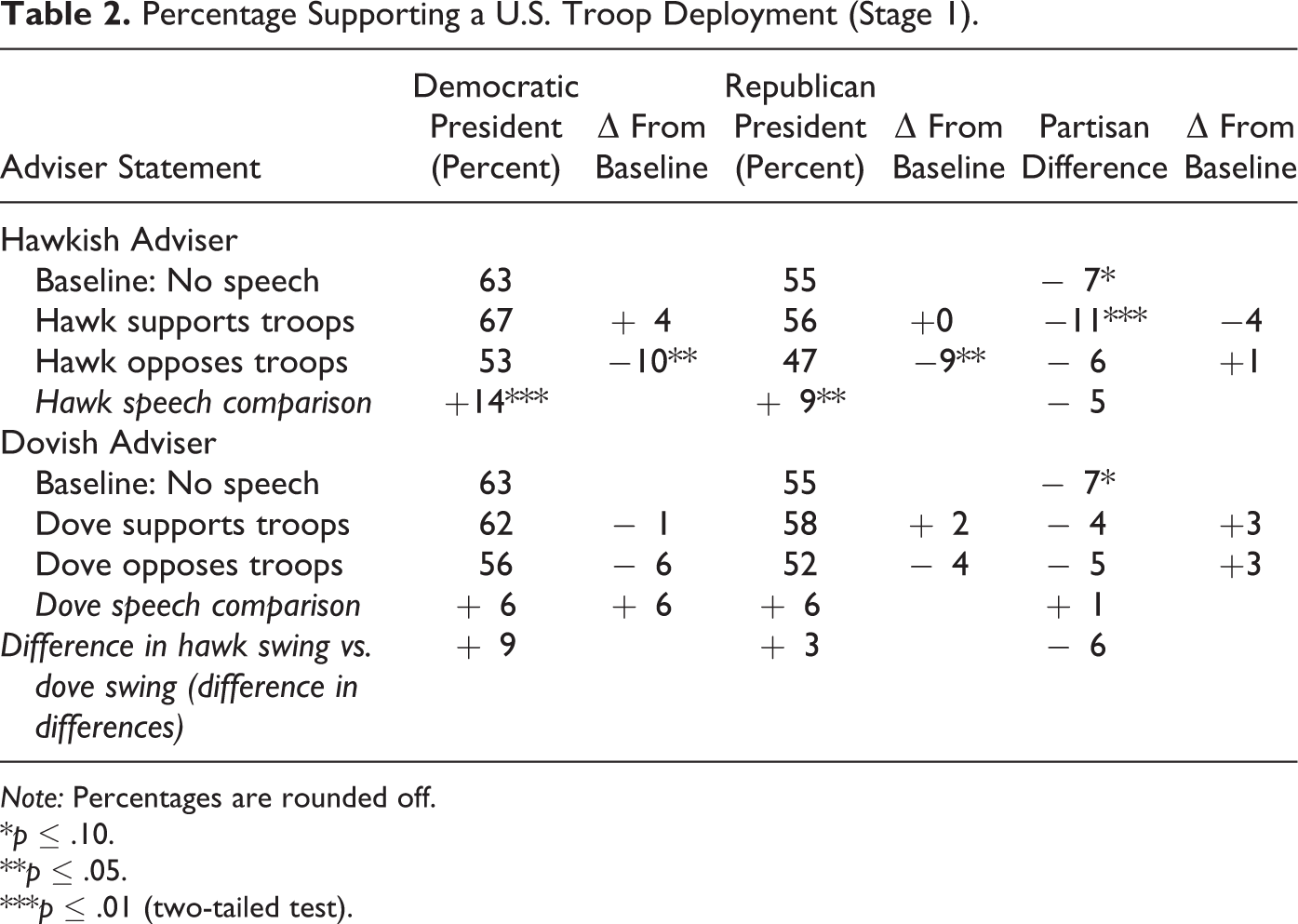
Consider first the stage 1 results, broken down by party and adviser reputation in Table 2 (with approximately 300 respondents per condition) and depicted graphically in Figure 3. The first feature of interest is that in the baseline condition, with no adviser speech, there is more support for sending US troops when the president is a Democrat (63 percent) rather than a Republican (55 percent, p = .07, two-tailed). This partisan difference in support for using force also appears in the full sample (60 percent support for a Democratic president, 53 percent for a Republican) and is highly statistically significant (p = .0001), given the large sample size. Another consistent feature of the results is the overall similarity in support levels for the baseline and supportive conditions across party and adviser types.

Predicted probability of support for war (stage 1) by president’s party.
Percentage Supporting a U.S. Troop Deployment (Stage 1).
Note: Percentages are rounded off.
*p ≤ .10.
**p ≤ .05.
***p ≤ .01 (two-tailed test).
The next two conditions explore the effect of a hawkish adviser’s speech. Again, however, we cannot simply compare supportive statements from two different types of advisers (hawkish vs. dovish) because this comparison would not disentangle respondents’ views of hawkish or dovish elites or the fact of support. The most relevant comparison is the difference between a given adviser’s support for the use of force versus opposition. We can think of this difference or “swing” as the “price” of obtaining the support of that adviser or the upside to preventing that adviser from making a statement opposing the use of force. We can then compare these differences across adviser types to assess whether ensuring a hawkish or dovish adviser’s support is more valuable.
In the upper half of Table 2, if a usually hawkish adviser supports using force, the effect as compared to baseline is neither large nor statistically significant for either a Democratic or a Republican president, but the 4 percentage point increase in support for sending troops under a Democratic president widens the gap between support for a deployment under a Democratic versus a Republican president to 11 percentage points, a gap which is now highly statistically significant (p = .004). Per Hypothesis 2a, if a usually hawkish adviser opposes using force in this case, however, support for sending troops drops to 53 percent for a Democratic president, a drop of 10 percentage points from baseline (p = .02). The “swing” in support for sending troops from a hawkish adviser who opposes a deployment to a hawkish adviser who supports is 14 percentage points (p = .0004). Put differently, a president who wants to avoid sending troops can substantially reduce support for using force by convincing a hawkish adviser to oppose a deployment. The effect of a hawkish adviser who comes out against using force is expected to be large, especially for a Democrat, because all three mechanisms are in place: the hawk is engaging in surprising speech; opposing a potential presidential initiative from within the inner circle (even if the president has not announced a decision); and counteracting the president’s party brand, giving a Democratic president cover should he decide not to use force. Interestingly, and in contrast to Hypothesis 3a, under a Republican president, a hawkish adviser who opposes using force in this case also has a negative, statistically significant effect (−9 percentage points, p = .03) on support for sending troops, which helps account for the fact that the partisan gap when a hawk opposes war remains 6 percentage points, although it is no longer statistically significant. Hawks who oppose using force can still affect support for war under a Republican president.
The lower half of Table 2 reports similar comparisons when dovish advisers support or oppose the use of force. Even against-type statements from dovish advisers, however, do not appear to have large effects on support for war. A usually dovish adviser does not appreciably affect support for war even when he favors using force in this case, although the baseline partisan gap does fall below statistical significance. A dovish adviser who opposes war has slightly larger, negative effects on support, illustrating that any opposition from an adviser can depress support (per Hypothesis 1a). The swing from dovish support to dovish opposition does not result in a statistically significant change in support for a president of either party. In the very bottom row of Table 2, the difference in differences between the hawk swing (support–oppose) and the dove swing (support–oppose) is 9 percentage points for a Democratic president and just misses the threshold of statistical significance at the p = .1 level. The difference in differences in adviser swings for a Republican president is a (nonsignificant) 3 percentage points.
Overall, the first-stage results suggest that advisers matter even when taking partisanship into account, that hawkish advisers have a larger effect than dovish advisers for presidents of both parties, and that hawkish advisers are particularly important under Democratic presidents (in line with Hypothesis 3a). If a Democratic president wants to avoid sending troops—that is, play to type—convincing a hawk to move from supporting to opposing a deployment results in a larger reduction in public support for using force, a swing from two-thirds support to just over half supporting, than a similar shift in a dovish adviser’s stance.
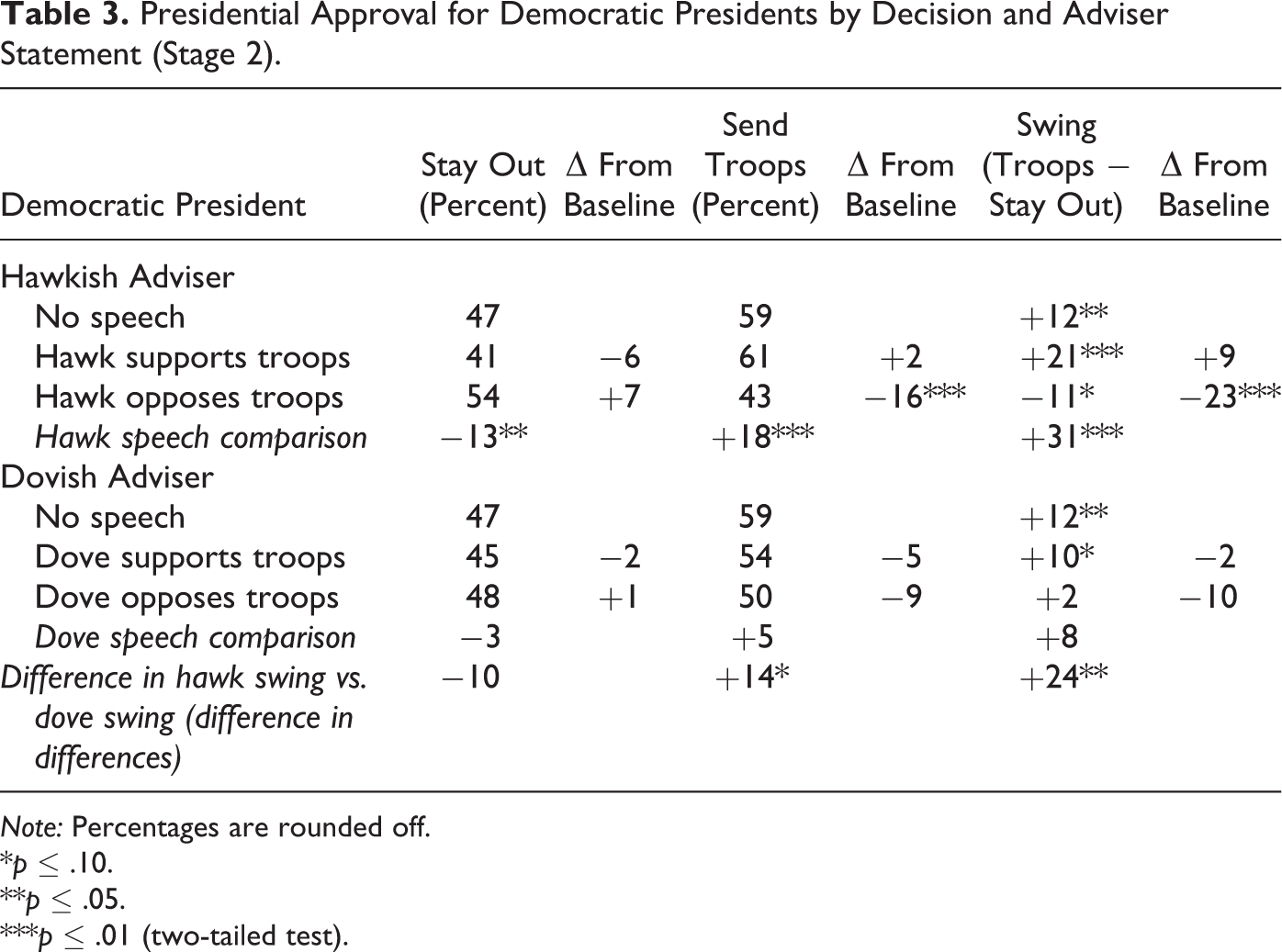
The importance of advisers persists in the second stage, once the president’s decision and the conflict’s outcome are announced. Tables 3 and 4 present the results in terms of approval; Figure 4 presents the results graphically by the president’s party and troop decision. Looking across the tables, from the “stay out” decision to the “send troops” decision, illustrates how adviser speech affects the political incentives to send troops; looking down the columns shows the effect of adviser speech for each decision. Results for Democratic presidents, in Table 3, again reflect a baseline gap between sending troops and staying out. Approval for Democratic presidents who send troops is 59 percent, whereas Democrats who stay out get 47 percent, a statistically significant gap (p = .04). This gap also holds in the full sample: across all conditions for Democrats, there is a smaller gap (53 percent approval for sending troops vs. 46 percent for staying out, p = .007). As shown in the table’s top set of results, which report the effects of hawkish adviser speech, when a hawkish adviser explicitly supports sending troops, the gap in approval between staying out and sending troops for a Democratic president widens to 21 percentage points, with 41 percent approval at the stay out decision and 61 percent if there is an intervention. In contrast, if a hawkish adviser opposes sending troops, the gap is reversed: 54 percent approve of a Democratic president who stays out if a hawkish adviser opposed sending troops, while 43 percent approve if the president sends troops over the hawkish adviser’s objection. The gap between staying out and sending troops swings to 11 percentage points in favor of staying out in the hawkish adviser opposing force scenario (and a significant and negative 23 percentage point reduction in the gap favoring a troop deployment as compared to the no-speech baseline). The difference in differences in the stay out versus send troops gap when the hawk supports versus opposes force is a highly significant 31 percentage points. A hawkish adviser who comes out against a deployment can provide cover for a Democratic president in terms of approval per Hypothesis 3b.
Presidential Approval for Democratic Presidents by Decision and Adviser Statement (Stage 2).
Note: Percentages are rounded off.
*p ≤ .10.
**p ≤ .05.
***p ≤ .01 (two-tailed test).
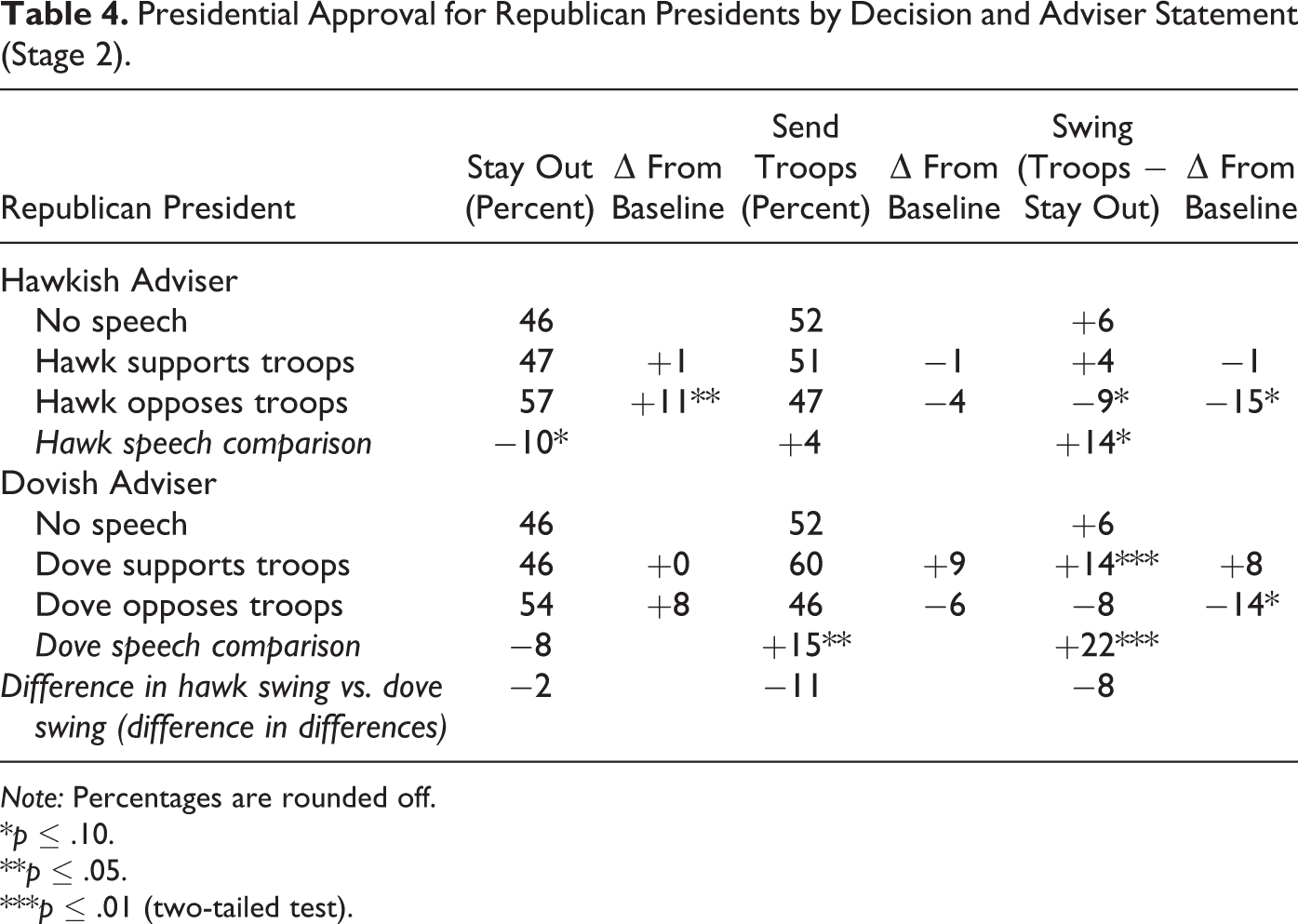
Presidential Approval for Republican Presidents by Decision and Adviser Statement (Stage 2).
Note: Percentages are rounded off.
*p ≤ .10.
**p ≤ .05.
***p ≤ .01 (two-tailed test).
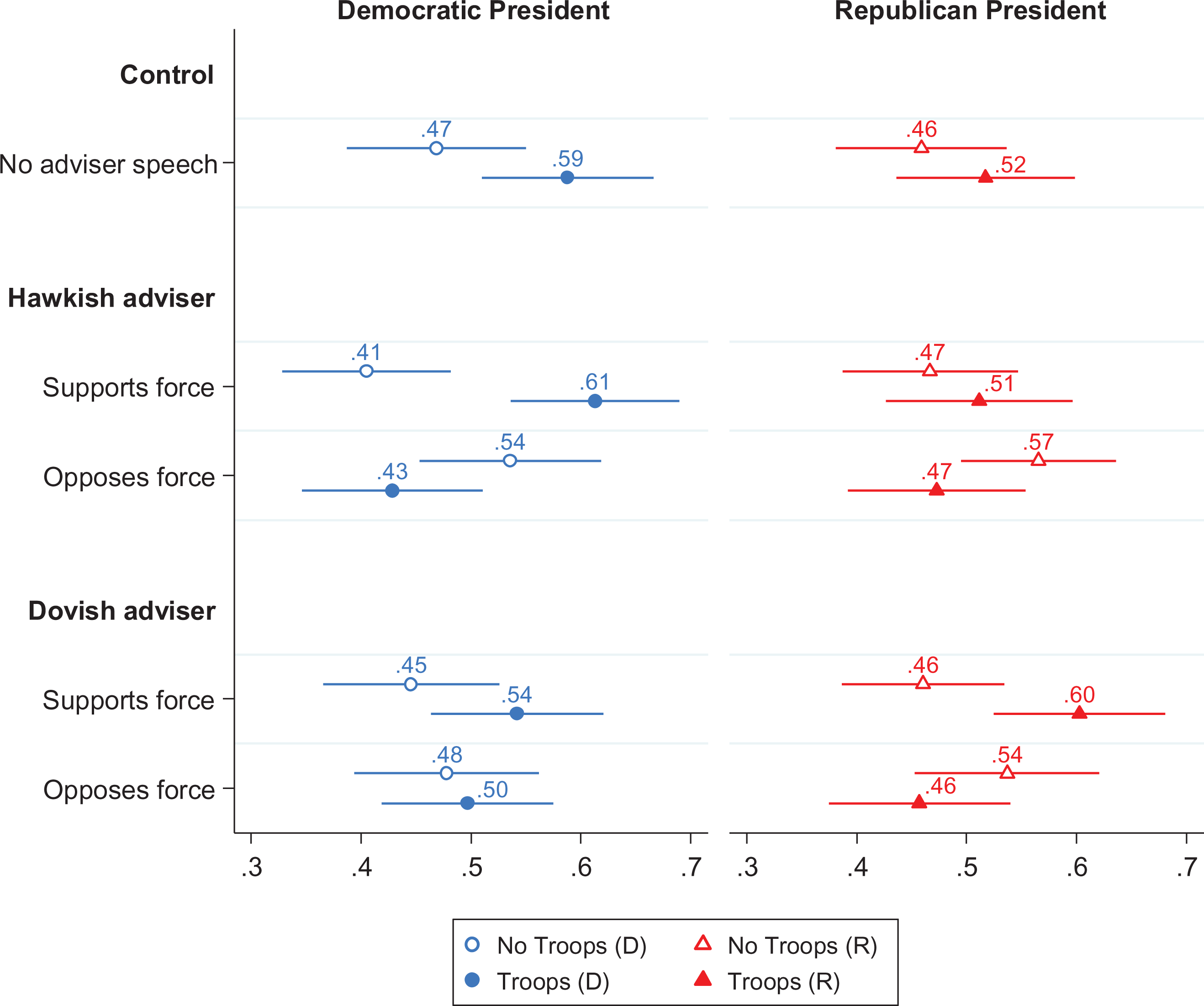
Predicted probability of approval of president’s decision (stage 2) by president’s party and troop decision.
Similar comparisons for dovish advisers do not yield effects nearly as large or significant for Democratic presidents. The right-hand side of the very bottom row of the table reports the difference in differences between the effect of a hawk shift in support for using force versus opposition and a similar dove shift in support versus opposition on the overall approval gap between staying out and sending troops. The hawkish adviser’s swing to supporting force has a much larger effect on the approval gap (31 percentage point increase in the approval gap, favoring sending troops) than the dove’s swing (8 percentage point increase in the approval gap); the difference in differences is 24 percentage points in the effect on the approval gap favoring force (p = .04).
Looking down the columns of Table 3, at the stay out decision—where a Democratic president acts according to type—there is, as mentioned, a statistically significant swing of 13 percentage points in approval when the hawk shifts from support to opposition, but no similar effect for a dovish swing (though the difference in differences at the stay out decision, in bottom row on the left-hand side, is not statistically significant). Interestingly, hawkish advisers also significantly affect approval if a Democratic president sends troops. If a Democratic president sends troops over the objection of a hawkish adviser, approval dips to the low 40s, almost indistinguishable from staying out over the objection of a hawkish adviser. 8 At the send troops decision (middle column, very bottom row), the difference in differences for the effect of a shift from support to opposition for a hawkish versus dovish adviser is 14 percentage points (p = .08). A hawkish adviser can affect approval of Democratic presidents for any decision.
The pattern for Republican presidents, in Table 4, is somewhat different. Approval for Republican presidents exhibits a smaller baseline gap of 6 percentage points in approval between the stay out and send troops decisions (the gap is not significant in the baseline, no-speech condition, or the full sample). For a Republican president with a hawkish adviser who opposed the use of force in this case, the gap flips to 9 percentage points (p = .09) in favor of staying out, with 57 percent approval for staying out and 47 percent for sending troops. The effect of a hawk swing (support vs. opposition) on the overall approval gap across decisions is 14 percentage points (p = .09). A hawkish adviser appears to help a Republican president who wants to stay out, but the explicit support of a hawkish adviser does little to influence approval for Republicans who intervene. Republican presidents see larger effects, however, from a dovish adviser (Hypothesis 3b). A dovish adviser who supports war widens the approval gap in favor of war to 60 percent approval for a Republican president who sends troops versus 46 percent for staying out (p = .01). The swing in a dovish adviser’s position (support–oppose) results in a 22 percentage point difference in the approval gap when the dovish adviser supports force versus opposes force (p = .006). The difference in differences in the bottom row of Table 4 does not show a significant difference in the effect of a hawkish adviser swing versus a dovish adviser swing (partly because hawkish advisers also matter for Republicans). But looking at the send troops decision column, a dovish adviser can significantly influence approval for a Republican president who intervenes (supporting Hypothesis 3b). If a Republican president sends troops, approval is 60 percent if a dovish adviser supports it, but 46 percent if the decision to send troops was over the dovish adviser’s objection (p = .013). In contrast, a change in a hawkish adviser’s position does not result in a significant change in approval for Republicans who intervene. It is notable that the effect of a dovish adviser’s swing from support to opposition to intervention for a Republican president who fights is substantively similar to the effect of a hawkish adviser’s swing from support to opposition for a Democratic president who makes the same decision. Figure 5 plots the differences in predicted probability of approval for sending troops versus staying out (a measure of political incentives) for presidents of both parties in the four conditions where advisers speak. The graph illustrates that changes in hawks’ statements have a larger effect on the political incentives for Democratic presidents to fight, while the swing in a dovish adviser’s statements is most important for Republican presidents.

Differences in probability of approval (send troops − stay out; stage 2) by president’s party.
The results overall suggest, first, that advisers can significantly affect public support for war and approval of the president (Hypothesis 1), even in the presence of casualties. The institutional credibility of adviser cues does significant work in explaining why adviser cues are effective. Second, presidents who wish to play to their party’s type would do well to persuade an adviser of the opposite stripe to support their position (Hypothesis 3). Third, the effects of different types of advisers are asymmetric. When sending troops is under consideration, cues from hawkish advisers are the most important for presidents of either party, suggesting that hawks are the most trusted to send a clear signal about the wisdom of intervening. In the second stage, there are asymmetric effects for Democratic and Republican presidents. For Democratic presidents, acting in accordance with a hawkish adviser’s view is beneficial and acting over the objection of a hawkish adviser is damaging, for either decision. The effects of advisers on the Democratic side are concentrated among hawks, while for Republican presidents, advisers of both types can have significant effects, although dovish advisers have the largest effects on approval. Finally, the similarities between the no-speech and support conditions imply that respondents assume advisers support the president (even before an initiative is announced), suggesting that the silence of an adviser whose opposition would be damaging is almost as good as that adviser’s explicit support.
Presidents, Advisers, and “Pulling and Hauling” Revisited
The importance of adviser cues provides presidents with a strategic incentive to manage statements from within their own inner circle. But the theory goes a step beyond the implications of many survey experiments that suggest leaders anticipate the most effective cues that will move public opinion and recruit messengers, tailor messages, or choose policies accordingly. Here, bargaining with elites—an “elite coalition game”—serves as an intermediate step between leaders’ interactions with other states and with the public, allowing leaders to make policy concessions or side payments to particular elites in order to shape the configuration of elite cues that reaches the public. The survey experiment identifies those whose support will be most worthwhile to bargain for, and the “price” leaders must pay, since presumably a larger opinion “swing” is more costly to obtain.
This bargaining often occurs behind the scenes, however, so that the effects turned up by the experiment are observed not in public but rather inside the proverbial Situation Room or Oval Office. These effects suggest an important methodological point about survey experiments: their real-world effects may manifest in elite bargaining and strategic behavior by leaders. The utility of the experiment is not necessarily reflected, then, in how often we see adviser cues or major events involving advisers, such as resignations. Observed adviser opposition will be rare, but “pulling and hauling” among advisers will be frequent (Allison and Zelikow 1999, 255). Observing these effects can be challenging, precisely because they are usually meant to be hidden. Case studies are a useful way to find the imprint of such strategic behavior.
The theory and findings also make arguments about “pulling and hauling” more predictive, by generating hypotheses about how leaders manage advisers in order to ensure the most favorable constellation of cues. Democratic presidents who want to stay out of a conflict or pursue a lower level of escalation are likely to seek buy-in from their most hawkish adviser and thus to pursue military strategies that move in the direction of their most hawkish adviser. Republicans who wish to fight are likely to placate their most dovish adviser (in the sense of being least favorably disposed toward using force, even if they are not traditional “doves”). In addition to the effect on public opinion, these cues will provide information to members of Congress. Presidents who hope to obtain the endorsement of the opposition party (or prevent elite dissensus) would benefit from the signal sent by the sign-on of surprising administration insiders (Baum and Groeling 2010a). 9
Elites can impose costs on the president in exchange for their support (or for refraining from criticism) by forcing the president to either spend political capital or make more direct concessions that affect the final form of the policy or its implementation. 10 One might argue that a president from a particular party would not be willing to bargain, given his or her own preferences. But the argument assumes that the choice to use force is left up to the president, and side payments are on related but significant aspects of the decision, such as deployment size, timing, or strategy, or even nonmilitary payments in the case of a decision to stay out, that a president may be willing to concede. Elite bargaining is likely to pull the president away from his ideal point, but bargaining successfully can allow him to pursue a version of his desired policy with relative autonomy. If the president chooses to fight, military strategy will likely be the result of compromises among elites with divergent preferences.
To illustrate these elite-level mechanisms, consider a brief illustrative case: Barack Obama’s decision to “surge” troops into Afghanistan in December 2009, when the public displayed war weariness, and yet Obama forged a fragile elite coalition that allowed him to escalate. 11 Escalation decisions are useful for isolating the potential cuing effects of elite advisers because the president’s information advantage shrinks once a conflict is under way. Indeed, Baum and Groeling (2010b) argue that the public’s susceptibility to elite rhetoric about a war diminishes over time. There is also likely a secular downward trend in public opinion as the conflict drags on (Gartner and Segura 1998). A decision about escalating an already-lengthy war thus presents a difficult test for an argument that the president can manage elite opinion.
One might object that adviser concerns might be less likely to constrain a president who is considering whether and how much to escalate a lengthy, decreasingly popular war, or that domestic political concerns in the context of escalation do not match those presidents might have about initiating a conflict. 12 Although the experiment identifies significant political risk for Democrats if they act against the recommendation of their hawkish advisers (and especially compared to their dovish advisers), the effects of the experiment are likely larger than they would be in any real-world case, even for war initiation, given the sparse and hypothetical nature of the experiment, as well as the direct exposure all respondents in the survey receive compared to the real world. 13 Furthermore, as noted, the years of war leading up to the escalation decision also allow the public time to form beliefs, diminishing the scope for elite cues to subsequently move public attitudes. 14
But although these features suggest that the constraining effects, particularly of hawkish advisers, are expected to be less than they would have been at the start of the war, they also make the case particularly useful precisely because they stack the deck against observing such constraints. The Afghanistan debate featured prominent advocates on both sides, with Obama sympathetic to the side advocating more restraint, represented by Vice President Joseph Biden. Yet if Obama still felt politically constrained by hawks even as public support for the Afghanistan war had already declined, it suggests the influence of elites is likely that much greater for other cases, including war initiation. The case is thus a useful complement to the experiment, which abstracts away from real world conflicts to show the off-the-equilibrium-path behavior I identify, while in a real-world case where we would expect a diminished effect of elite cues, we still see presidents concerned with their advisers’ statements and certain advisers more than others.
In considering the case evidence, it is important to note that even in private, presidents rarely articulate the role that domestic politics, and especially public opinion, plays in national security decisions. But apart from direct public approval concerns, other domestic political consequences, including elite costs and more indirect public opinion concerns, likely loomed over Obama, who was still early in his presidency at the time of the Afghanistan debate. With his health-care initiative a top priority in his first term and his general reputation for handling foreign policy still forming, criticism from within his own team that he was weak on national security, particularly from the military and from well-known advisers, carried other potential domestic costs, especially from Congress.
Obama’s surge suggests that the president can generate leeway in the face of public war-weariness as long as he keeps elites on board, and that as a Democrat, he was most concerned with his hawkish advisers. The military publicly pushed for more troops than Obama wanted to send and to use them in a counterinsurgency strategy about which he was ambivalent. There were also divisions within Obama’s national security team, which contained two unusually prominent officials with more hawkish preferences than Obama: Secretary of State Hillary Clinton, and Defense Secretary Robert Gates, a respected Republican holdover. A debate ensued in the fall of 2009 over whether Obama should dispatch additional troops, perhaps as many as 40,000, as the military ultimately requested (for overviews, see Baker 2009; Woodward 2010; Mann 2012, chaps. 9-10). Public support for the war dipped under 50 percent in early 2009 (Jacobson 2010). While there was certainly a political dimension to the fall 2009 debate, there was also a significant deliberation component, as Obama grappled with his own position and sought to draw on a variety of expert views. Available accounts make clear, however, that the debate contained both political and deliberative aspects.
In September 2009, to Obama’s consternation, both David Petraeus, Commander of U.S. Central Command, and Mike Mullen, Chairman of the Joint Chiefs of Staff, publicly endorsed a counterinsurgency strategy with more troops (Woodward 2010, 157-58). The public pressure on Obama increased when the classified assessment of the commander of U.S. forces in Afghanistan, General Stanley McChrystal, which suggested the war might fail without more troops, was leaked to Bob Woodward of the Washington Post. Soon after, McChrystal publicly called a more limited counterterrorism strategy in Afghanistan “shortsighted” (Woodward 2010, chaps. 15-16). Obama met with Gates and Mullen in the Oval Office in early October and expressed displeasure with the military’s pronouncements (Mann 2012, 135).
In the ensuing internal debate, one side adhered to the counterinsurgency approach favored by McChrystal and Petraeus as well as Mullen; Gates and Clinton generally supported the military’s approach. The other view, held prominently by Vice President Biden, favored a limited counterterrorism approach. On the day before Thanksgiving Day, with most of the debate behind him, Obama noted that it would be politically much easier to say no to a surge of 30,000. The military, however, “would be upset about it,” he noted. When Deputy National Security Advisor Thomas Donilon suggested that Gates might resign if Obama chose an option to send only 10,000 trainers, Obama said, “That would be the difficult part, because Bob Gates is…there’s no stronger member of my national security team” (quoted in Woodward 2010, 304). While Gates influenced Obama’s substantive views of the debate, the need to maintain Gates’s support, and that of the Pentagon more generally, was also a significant concern.
Ultimately, Obama decided to send 30,000 troops—not as high as the 40,000 McChrystal originally requested, but enough to make the military feel it had gotten a significant portion of what it wanted. Most accounts suggest Obama was reluctant to send a substantial new contingent of troops (e.g., Woodward 2010, 304). Obama also compromised on military strategy. He seemed to favor a limited approach, and made clear his approach was a departure from the previous emphasis on counterinsurgency, but he had nodded just enough to “elements of a counterinsurgency strategy” to mollify the military. Petraeus said he would support the president and “shifted into cheerleading mode” (Woodward 2010, 325-27).
Thus, the need to keep the military and his most hawkish advisers on board led Obama to shift off his ideal point, without going all the way toward the military’s preference. As Feaver (2011, 123) summarizes, Obama “worried about…[a] military revolt, decided against imposing what he seemed to indicate was his most preferred solution, and instead went to extraordinary lengths to hem in the military and bring it along to a compromise that was markedly less than what it wanted.” Obama obtained the buy-in of hawks for a lower-level military effort—even as he shifted that effort in a somewhat more aggressive direction—just as in the experimental results, the support of a hawk for a Democratic president’s decision to stay out was beneficial. Obama publicly demonstrated the unified support of his team, which appeared together at West Point for the prime time announcement of the policy on December 1, 2009; officials also testified before Congress on the new plan. Among the public, more than half of Republicans and about half of Democrats supported the troop increase (Jacobson 2010, 603).
Conclusion
Tensions often roil administrations, particularly during decisions to use force. This article has shown that internal administration debates can have political consequences, but that presidents can manage these consequences strategically. As insiders who are close to the president, advisers can raise political stakes, provide political cover, or inflict political damage on the president in systematic ways.
These effects may also influence interstate interactions. If adviser statements affect political incentives for leaders to fight, then they may affect the credibility of threats to use force, perhaps depending on the leader’s background experience, as Horowitz et al. (2018) suggest in this special feature. Signals from different types of advisers may also help leaders form reputations, especially when they are new, as Wu and Wolford (2018) highlight (in this special feature) in the context of leadership turnover as an important source of informational problems. If adversaries engage in “Kremlinology” to follow internal administration dynamics, then substantively surprising cues from advisers (hawks who oppose force or doves who support force) may also affect the credibility of a leader’s threat, similar to the argument of Schultz (2001) in the context of opposition party support. 15 Exploring how other states perceive not only leaders but also their inner circle would make for fruitful future research.
This article also highlights the political origins of the elite consensus and dissensus long shown to be important drivers of public opinion (e.g., Zaller 1992; Berinsky 2009). Intraelite bargaining can shape the nature and volume of the cues the public ultimately hears, both directly and by influencing other cues emanating from Congress. This bargaining can affect the details of policy that escape even the attentive public’s notice but can significantly influence the costs, duration, and likelihood of success for military operations. The often-opaque nature of debate within a leader’s inner circle—and the united front that frequently results—can mask important domestic political bargaining over the use of force.
Supplemental Material
Supplemental Material, 05Appendix1InstrumentAug2017 - Leaders, Advisers, and the Political Origins of Elite Support for War
Supplemental Material, 05Appendix1InstrumentAug2017 for Leaders, Advisers, and the Political Origins of Elite Support for War by Michael C. Horowitz, Matthew Fuhrmann, and Elizabeth N. Saunders in Journal of Conflict Resolution
Supplemental Material
Supplemental Material, 06Appendix2MTurkwithTablesAug2017Landscape - Leaders, Advisers, and the Political Origins of Elite Support for War
Supplemental Material, 06Appendix2MTurkwithTablesAug2017Landscape for Leaders, Advisers, and the Political Origins of Elite Support for War by Michael C. Horowitz, Matthew Fuhrmann, and Elizabeth N. Saunders in Journal of Conflict Resolution
Supplemental Material
Supplemental Material, LeadersAdvisersJCRReplication - Leaders, Advisers, and the Political Origins of Elite Support for War
Supplemental Material, LeadersAdvisersJCRReplication for Leaders, Advisers, and the Political Origins of Elite Support for War by Michael C. Horowitz, Matthew Fuhrmann, and Elizabeth N. Saunders in Journal of Conflict Resolution
Supplemental Material
Supplemental Material, LeadersAdvisersJCRReplication - Leaders, Advisers, and the Political Origins of Elite Support for War
Supplemental Material, LeadersAdvisersJCRReplication for Leaders, Advisers, and the Political Origins of Elite Support for War by Michael C. Horowitz, Matthew Fuhrmann, and Elizabeth N. Saunders in Journal of Conflict Resolution
Footnotes
Acknowledgments
For helpful comments and advice, I thank Michael Horowitz and Matthew Fuhrmann as editors of this special feature; Robert Adcock, Matt Baum, Adam Berinsky, Stephen Biddle, Ryan Brutger, Jonathan Caverley, Jeff Colgan, Sarah Croco, Alexander Downes, Songying Fang, Henry Farrell, Tanisha Fazal, Christopher Gelpi, Mauro Gilli, Charles Glaser, James Goldgeier, Alexandra Guisinger, Eric Grynaviski, Danny Hayes, Ole Holtsi, Dan Hopkins, Susan Hyde, Miles Kahler, Joshua Kertzer, Yanna Krupnikov, David Lake, Eric Lawrence, James Lebovic, Ashley Leeds, Yon Lupu, Cliff Morgan, David Nickerson, Kathleen Powers, Jonathan Renshon, John Sides, Rachel Stein, Caitlin Talmadge, Robert Trager, Alex Weisiger, Jessica Weeks, and Keren Yarhi-Milo; and seminar participants at George Washington University; Georgetown University; the University of California, Berkeley; the University of California, San Diego; Rice University; the University of Texas at Austin; Ohio State University; Temple University; the University of Chicago; the University of Wisconsin, Madison; the University of Notre Dame; the University of Maryland; Harvard University; Northwestern University; the University of Pennsylvania; Yale University; the Woodrow Wilson Center; and the Leaders and Military Conflict workshop at the Peace Science Society meeting. I thank the Elliott School of International Affairs at George Washington University for research support and Jack Hasler and Bridget Smith for their excellent research assistance.
Declaration of Conflicting Interests
The author(s) declared no potential conflicts of interest with respect to the research, authorship, and/or publication of this article.
Funding
The author(s) received no financial support for the research, authorship, and/or publication of this article.
Supplemental Material

Notes
References
Supplementary Material
Please find the following supplemental material available below.
For Open Access articles published under a Creative Commons License, all supplemental material carries the same license as the article it is associated with.
For non-Open Access articles published, all supplemental material carries a non-exclusive license, and permission requests for re-use of supplemental material or any part of supplemental material shall be sent directly to the copyright owner as specified in the copyright notice associated with the article.
