




Abstract
Under what conditions do nations give up parts of their national homeland? This article answers this question using novel data that traces systematically the inclusion of lost homeland territory in discursive definitions of the homeland for all ethnic nationalist homelands truncated between 1945 and 1996. A survival analysis of the continued homeland status of lost lands shows that longer-lasting democracies are significantly less likely to continue to include lost lands within the homeland’s scope, even after controlling for other factors thought to shape the inclusion of territory in the homeland. Since the desire for the control of territory is at the heart of much international conflict, understanding the conditions under which the scope of that territory is redefined contributes to addressing an especially refractory aspect of international politics.
Under what conditions do nations give up parts of their homeland? Answering this question matters because nationalist attachment to the homeland is associated with significant international conflict (Toft 2003; Miller 2007; Shelef 2016; Kelle 2017). Understanding the conditions under which areas once seen as part of the homeland—and therefore worthy of disproportionate, even irrational, sacrifice—no longer merit such devotion could thus help address an especially refractory aspect of international conflict.
There is surprising variation in whether nations give up lost parts of the homeland and in how long it takes them to do so. Some, like Chinese claims of Taiwan and Syrian claims to the Golan Heights, appear to persist indefinitely. Others, like Pakistani claims to Bangladesh, German claims to lands east of the Oder-Neisse Line, and Italian claims to Istria and Dalmatia, have waned (though at different paces).
This article argues that an underappreciated part of this variation stems from whether homelands are subject to evolutionary dynamics. Rendered abstractly, evolutionary processes hold that change will occur whenever there is variation between units, differential success among these variants (sometimes called “selection”), and time for successful variants to displace less successful ones (Dennett 1995; Lustick 2011; Ma 2016). Homelands are no exception. Where there is variation in whether lost lands are flagged as part of the homeland between domestic political movements, the differential success of a movement articulating a particular variant, and time for the more successful variant to displace less successful ones from the range of public articulations, the homeland’s scope will also change. In other words, over time, sustained internal political competition contributes toward countries leaving aside irredentist claims.
This theoretical argument is supported by a survival analysis of the continued homeland status of lost territory in all cases of ethnic nationalist homelands truncated between 1945 and 1996. This, first, large-N exploration of the withdrawal of homeland status from lost lands shows that contexts likely to be characterized by variation, differential success, and time are systematically associated with excluding lost lands from the rhetorical delineation of the homeland’s extent. This result persists when controlling for other factors that shape the withdrawal of homeland status from lost lands.
This analysis also contributes to scholarship on territorial conflict in a second way. Despite the consistent finding that homelands can change (e.g., Lustick 1993; Winichakul 1994; Paasi 1996; Herb 1997; Shelef 2010; Goddard 2010), quantitative studies of territory and conflict still tend to operationalize homelands as a time-invariant indicator (e.g., Hensel 2001; Minorities at Risk Project 2009 (2003 release); Toft 2003; Walter 2009; Shelef 2016; Kelle 2017). The implicit assumption that the homeland’s scope is static has hamstrung attempts to explain how territory loses its homeland status and the impact of such changes on other outcomes of interest. This article provides a systematic, time-series, cross-national measure of the homeland status of lost lands that enables a deeper integration of the empirical and theoretical insights that homelands can change into quantitative scholarship on territory and conflict.
Homelands and Evolutionary Dynamics
All nationalisms require a geographical space in which the nation can control its political destiny. The designation of some land as the “homeland” delimits the boundaries of this space. These delimitations are a nationalist form of territoriality; like all forms of territoriality, they are a strategy “to affect, influence, or control people, phenomena, and relationships, by delimiting and asserting control over a geographic area” (Sack 1986, 19). Transforming land into “homeland” by applying homeland territoriality to it generates an “instantly recognizable, everywhere visible” (Anderson 1991, 175) map image of the homeland’s extent. Since it is the application of homeland territoriality that transforms land into homeland, the withdrawal of homeland territoriality from land and its exclusion from this map image relegates homeland back into mere land.
The article’s main argument is that such withdrawals of homeland territoriality can be the product of evolutionary dynamics. Evolutionary change occurs when changes observed among units produce subsequent patterns of change in the population to which those units belong (Lustick 2011, 187). While usually applied to the natural world, evolutionary change also frequently characterizes social and political phenomena (see, e.g., Dennett 1995; Blackmore 2000; Lustick 2011; Lewis and Steinmo 2012; Ma 2016). This is the case because evolution occurs whenever and wherever phenomena are characterized by variation among units, the differential success of one unit at the expense of others, and time for relatively more successful variants to displace less successful ones. Homelands are no exception. Changes in the definition of the homeland articulated by domestic political movements introduce variation that, subject to selection by political success, over time produces change in the pattern of articulation of the homeland’s scope in the society at large.
Scholarship on nationalism, state contraction, and irredentism has identified important aspects of how the withdrawal of homeland territoriality occurs that are consistent with the presence of all three elements required for the operation of evolutionary dynamics in this context. First, there are good reasons to expect domestic variation in the map image of the homeland. Homelands are a foundational part of nationalism and, like all its aspects, subject to internal disagreement and contestation (Abdelal et al. 2006). Consistent with this expectation, the empirical existence of domestic variation in perceptions of the homeland’s extent has been documented in case studies from around the world (e.g., Lustick 1993; Winichakul 1994; O’Leary, Lustick, and Callaghy 2001; Shelef 2010; Goddard 2010; Paasi 1996; Herb 1997).
The second element required for evolutionary dynamics, differential success, builds on findings that identify a role for domestic political competition in shaping changes to the homeland’s scope. For example, Lustick’s (1993) pioneering theory of state contraction as a product of a battle for hegemony and subsequent work on “right-sizing the state” (O’Leary, Lustick, and Callaghy 2001) show that the domestic political fight to define the appropriate bounds of the state shapes whether excluding territory becomes legitimate. Coming from a different direction, Saideman and Ayers (2008) showed that domestic political competition shapes leaders’ willingness to pursue irredentist projects. They find that political leaders may abandon expansive territorial claims if they have easier ways of establishing their nationalist credentials or in a “trade” for other nationalist goals (such as an ethnically homogenous state). In yet another setting, Goddard (2010) demonstrated that the construction of territory as part of the homeland can be the product of a movement’s political dependence on a hawkish constituency rather than being inherent in either the land or the movement. Shelef (2010) showed that short-term modulations in territorial claims can generate analogous political “lock-in” effects that explain change in the opposite direction (see also Mylonas and Shelef 2014).
Viewed through the lens of evolutionary theory, these findings suggest that domestic political competition provides the rubric for determining which variants succeed. Domestic political success yields positive returns. As a result, variants associated with political success will be repeated more often than others. Increased repetition of one variant at the expense of alternatives reinforces the belief that others also adhere to this variant and can even lead to the new variant becoming reframed as the new ideological orthodoxy (Kuran 1995; Shelef 2010). Indeed, similar dynamics emphasizing the importance of differential success and positive political returns have been observed to shape change in norms about the appropriateness of colonialism, slavery, humanitarian intervention, as well as to institutional development more broadly (Pierson 2000; Finnemore and Sikkink 2001; Crawford 2002, 37, 104–05). Domestic politics, in other words, serves as the mechanism for “selecting” which variant of the homeland will spread though the population. 1
The third element of evolutionary dynamics, time, is needed because new variants of the homeland’s map image do not instantaneously replace pre-existing variants. Rather, successful variants need to be sustained for long enough to gradually displace alternative visions of the homeland’s extent from the public pattern of articulation.
The West German acceptance of the loss of lands east of the Oder-Neisse rivers followed a path consistent with the expectations of an evolutionary dynamic. For more than two decades after losing them, nearly all West German political parties were unified in applying homeland territoriality to these lands. In the early 1960s, the German Social Democrats (SPD) introduced a new variant of the homeland’s extent that excluded the lands east of the Oder-Neisse Line (variation). Eventually incorporated into its “New Ostpolitik,” this variant was intended to overcome their 35 percent threshold in national elections by signaling their political realism, a commitment to Western integration, and the abandonment of a policy that subordinated all other goals to German unification “in all its parts.” It was also promoted as part of a wider gambit intended to enable eventual unification with East Germany by reducing tensions with the Soviet Union. Championed by the charismatic Willy Brandt, the New Ostpolitik ultimately underpinned the SPD’s political victory (differential success), enabling them not just to overcome their “permanent minority” status but to gain the chancellery in 1969 and hold it for more than a decade. The appeal of the new variant was reinforced by its policy success. It promoted détente by reducing tensions with the East and enabled the German government to undertake small-bore but popular policies that ameliorated the daily consequences of partition for everyday Germans. The positive returns associated with these policy successes increased the cost for political movements across the spectrum of adhering to a notion of the German homeland that included these lost lands. As a result, to compete with the SPD, the conservative Christian Democratic Union increasingly adopted similar policies and, by 1990, explicitly gave up the claim to these once integral parts of the homeland (Ash 1993; Atzili and Kantel 2015). 2
There are good reasons to think that, like West Germany, longer-lived democracies are likely to be characterized by all three elements required for evolutionary processes to shape homelands. To begin with, democracies, because they allow for a more robust “marketplace of ideas” in which variants of any political issue can be articulated, are consistently likely to be characterized by openly articulated variation about the homeland’s appropriate extent. Such variation is perhaps especially likely in democracies that lose homeland territory because it is reasonable to expect disagreements over the perceived costs and benefits of continuing to claim lost territory and in politicians’ perceptions of the benefits of accepting the loss or of using it to mobilize popular support (Lustick 1993; O’Leary, Lustick, and Callaghy 2001; Saideman and Ayers 2008; Snyder 2000).
While authoritarian regimes can also introduce new variants of the homeland after losing homeland territory, they may be less likely to do so. For instance, the logic of “diversionary peace,” in which autocrats seek to eliminate domestic sources of instability by resolving territorial disputes, and which is a key reason authoritarian regimes frequently settle these disputes (Fravel 2005), does not hold when it comes to homeland territory. Homelands’ emotive power means that concessions over them are likely to exacerbate domestic instability by legitimating regime opponents’ attacks on the regime on nationalist grounds. This may be why even China, which tends to cede territory in frontier disputes, has never compromised over homeland territory (Fravel 2005, Table 1).
The Risk of Continuing to Apply Homeland Territoriality to Lost Lands.

Note: Exponentiated coefficients. Standard errors are in parentheses. Cox conditional shared frailty proportional hazards model. Coefficients with a ∧ symbol are corrected for non-proportional hazards. Strata dummies and their non-proportional hazard corrections are also included (not shown).
*p < .10.
**p < .05.
***p < .01.
The differential political success of variants that exclude lost lands from the homeland’s scope is also especially likely in democracies. Ceteris paribus, variants that withdraw homeland territoriality from lost lands are more congruent with lived reality and therefore relatively more likely to be associated with policy success. Since, over time, policy success and political success are correlated in democracies (Gerber and Green 1998), we can expect the spread of these variants at the expense of more expansive notions of the homeland. Authoritarian regimes, in contrast, can stop the spread of alternative variants more easily.
Finally, the longer states are democratic, the more time there is for the institutionalization of democratic norms (Maoz and Russett 1993), which also reinforces both the openness to variation and the ability of politically more successful variants to displace alternatives. New (and newly reconstituted) democracies, even if characterized by variation and the differential success of some variants, still lack the time needed for the returns to more modest versions of the homeland to displace alternatives. Precisely how much time needs to pass for this to happen is an empirical question that is likely to vary across cases depending on the pace of politics, the level of positive returns accruing to successful variants, and the extent of negative returns to political failure.
The likely presence of variation, differential success, and time in longer-lived democracies, combined with the insight that evolutionary change occurs wherever these three elements jointly exist, leads to the article’s main hypothesis:
Importantly, using longer-lived democracies as a proxy for the likely presence of evolutionary dynamics imposes the conservative assumption that any withdrawal of homeland territoriality that takes place in authoritarian regimes is caused by something else. Any impact of evolutionary dynamics found using this proxy is thus a lower-bound estimate of the role they play in shaping homelands.
This hypothesis’s plausibility also requires showing that longer-lived democracies have an impact even when accounting for other factors that shape the withdrawal of homeland territoriality from lost lands. Perhaps the most prominent of these factors builds on the importance of ethnic geography in shaping the homeland’s borders in the first place (e.g., Gellner 1992; Smith 1996; Toft 2003). From this perspective, demographic change could also shape whether territory continues to have homeland status. Ethnic geography can also affect whether homeland territoriality is withdrawn by influencing the domestic and international political environments. For example, the agitation for independence, autonomy, or collective minority rights by coethnics in lost lands (such as the mobilization of the “Russian Bloc” party in Crimea) could pressure the society that lost the territory to apply homeland territoriality to it in an effort to support the struggle of their coethnics (Jenne 2007). Conversely, the absence of such mobilization may facilitate the withdrawal of homeland territoriality. The presence of shared coethnics in other neighboring states may also trigger a competition for regional power or for the right to speak for the ethnic group as a whole that may make claiming the lost territory as part of the homeland more likely (Brubaker 1996). The absence of regional competition arising from ethnic geography could make it easier to withdraw homeland territoriality from lost lands.
Significant historical experience suggests that ethnic geography matters. However, as an explanation for the withdrawal of homeland territoriality from lost lands, this explanation faces at least two hurdles. First, there are nontrivial questions about which concentrations of coethnics consecrate land as part of the homeland and how many need to be present for land to retain this status (Shelef 2016). In the West German case, for example, homeland territoriality was eventually withdrawn from the lands east of the Oder-Neisse boundary despite the continued presence of anywhere from 400,000 to one million ethnic Germans there (Ash 1993, 237). Second, since the ethnic composition of a territory is generally common knowledge, we would expect a uniform response within a society that lost territory rather than the domestic variation in the map-images of the homeland’s scope noted above.
The expectation that homeland territoriality may be deployed instrumentally (e.g., Waterman 1987; Wiegand 2011) provides another set of factors that could account for its transformation. From this perspective, new information about the economic or military value of territory, as well as strategic interactions, could shape the continued application of homeland territoriality to lost lands. The loss of materially worthless land, a state’s relative weakness, or information about an opponent’s resolve could thus aid the withdrawal of homeland territoriality from lost lands (Bell 2017).
Instrumental considerations certainly play a role, especially in incentivizing leaders to articulate new variants of the homeland’s map image. However, on their own, attributing change to these considerations lacks a way of linking these elite machinations to wider societal beliefs. In contrast, the emphasis evolutionary dynamics place on differential success in the political arena provides evolutionary dynamics with a way of doing so. At least in democracies, the political success of movements articulating new variants provides suggestive evidence that people “buy” new variants, whatever their origins.
The secular decline in the value of territory in an era of growing economic globalization could also account for the withdrawal of homeland territoriality from lost lands. The delinking of power and territorial control in a globalized world implies that states that are highly integrated into the global economy would be relatively less concerned with territory and therefore less likely to continue applying homeland territoriality to lost lands (e.g., Wang 2016).
A final set of alternative factors rely on time shaping the withdrawal of homeland territoriality in ways other than through the gradual replacement of one view of the homeland by another. For example, new borders or norms of border fixity might become accepted through a process of physical generational change (Atzili and Kantel 2015). Another argument points to the reduced need of mature regimes to make nationalist, including territorial, appeals in order to solidify their social basis of support (Snyder 2000; Mansfield and Snyder 2007). Such explanations expect time to have a monotonic effect. The more time passes after the loss of homeland territory or the establishment of the regime, the less likely are lost lands to be claimed. Evolutionary dynamics, because they are rooted in gradual replacement as a result of differential success, do not make this assumption. Time marches on, but if either variation or differential success is absent, lost lands can maintain (or even regain) their homeland status. The next section describes the data and empirical approach used to evaluate the article’s main argument.
Data and Empirical Approach
The outcome of interest in this study is whether a society continues to apply homeland territoriality to parts of the homeland newly located on the other side of an international border. The universe of lost homeland territory is defined in terms of all new international borders drawn between 1945 and 1996 that truncated an ethnic group. To alleviate concerns about endogeneity to the drawing of the border, the presence of coethnics on both sides of (what would later become) the border was determined according to ethnographic maps compiled before the border was drawn (see Online Appendix for sources and details). Of the 525 lines drawn on the global map during the period of observation, 313 bisected ethnic groups and created truncated ethnic nationalist homelands. The Alternative Explanations section shows that the main results are robust to alternative ways of defining the universe of cases.
As noted above, it is the application of homeland territoriality that transforms mere land into “homeland.” Nations apply homeland territoriality in a variety of ways. When they control the land in question, concrete acts such as the erection of border controls, the settlement of co-nationals, and the extension of the nation-state’s institutional infrastructure are used to designate territory as belonging to the nation. Rhetorical means, including the deployment of maps, place names, and history lessons, are also critical components of designating land as part of the homeland (e.g., Harley 1988; Wood and Fels 1992; Newman 2001). Where part of the national homeland lies under someone else’s sovereignty and concrete means are unavailable, such discursive acts are the primary means of applying homeland territoriality to these lost lands. Recurring conflicts over the depiction of borders in textbooks and official maps as well as persistent fights over place names (as in the recent dispute over Macedonia’s name) suggest that actors in the real world take such discursive applications of homeland territoriality seriously. As a result, tracing the ways in which homeland territoriality is withdrawn requires examining whether lost lands continue to be discursively labeled as part of the homeland.
The discursive application of homeland territoriality is readily detectable in the banal rhetoric nationalists use. As Connor (1994) noted, nationalists consistently use familial metaphors to “mystically convert what the outsider sees as merely the territory populated by a nation into a motherland or fatherland, the ancestral land, land of our fathers, this sacred soil…the cradle of the nation,…and most commonly, the home—the homeland of our particular people” (p. 205, original emphasis). The demotion of territory from “homeland” to “non-homeland” status occurs when these familial metaphors are no longer used, when the publicly articulated map image excludes the lost lands, or when societies no longer care enough about territory to explicitly lament its loss. Mirroring the internalization of norms in other contexts, the persistent absence of the categorization of lost lands as part of the homeland marks the acceptance of their loss (Lustick 1993; Finnemore and Sikkink 1998, 895).
The main source for detecting changes in the public pattern of articulation about lost homeland territory was the US government’s Foreign Broadcast Information Service’s (FBIS) systematic transcription of domestic news broadcasts between 1945 and 1996. 3 As a source, FBIS has three main advantages: (1) its scope is nearly global; (2) its records are searchable; and (3) it translates all domestic news broadcasts from around the world into English. 4 The latter is especially important for systematic cross-national analysis because it overcomes the practical challenge posed by the fact that nationalist discourse is everywhere articulated in the vernacular.
Homeland territoriality was coded as being applied to lost lands by a society in a particular year if states, state executives, or political organizations (including opposition movements) in the state newly excluded from that territory flagged it as part of their homeland at least once in that year. This provides time-series data tracing the application of homeland territoriality to lost parts of the homeland. The use of public articulations of the homeland’s map image builds on the well-established use of both official and unofficial discourse as data about nationalism in general and about territory in particular (see, e.g., Billig 1995; Greenfeld 1992; Lustick 1993; Goddard 2010; Shelef 2010; Paasi 1996; Hensel 2001).
This wide lens is theoretically appropriate because the main question concerns the continued social resonance of lost territory rather than what the state believes, per se. The benefits of this wider measure can be illustrated with the case of Russian views of Crimea. For a variety of reasons, Yeltsin’s government was careful not to explicitly claim Crimea as part of the Russian homeland (distinct from the argument over the Black Sea Fleet). As a result, a state executive–level lens would have concluded that Crimea was no longer seen as part of the Russian homeland during the period of observation. However, Crimea was routinely flagged as part of the Russian homeland during this period by the Liberal Democratic Party (which in 1993 was the largest Russian political party) and by Duma members, including some from Yeltsin’s party, who were not part of the executive branch (Saideman and Ayers 2008, 180). Including non-state-executive articulations in the data captures such applications of homeland territoriality to lost lands that would otherwise be missed.
While theoretically appropriate, including these articulations increases the possibility of detecting claims by socially marginal groups. As discussed in greater detail in the Alternative Explanation section, there are at least three reasons to believe that this possibility does not account for the results. First, any homeland claim would have had to be judged significant enough locally to both be reported on by domestic media and translated by FBIS. Second, even if some claims by marginal groups are included, any bias thus introduced works against the finding of systematic withdrawal of homeland territoriality in longer-lived democracies where smaller groups have more freedom to promote their views. Third, restricting the analysis to applications of homeland territoriality deployed by states and state-level executives does not substantively affect the impact of longer-lived democracies (see column 4 of Table 2).
Robustness to Alternative Universes of Cases.

Note: Exponentiated coefficients. Standard errors are in parentheses. Cox conditional shared frailty proportional hazards model. Coefficients with a ∧ symbol are corrected for non-proportional hazards. Strata dummies and their non-proportional hazard corrections are also included (not shown).
**p < .01.
***p < .001.
I code lost territory as continuing to be included in the homeland’s scope if domestic media in each case reported domestic political actors applying homeland territoriality to lost lands by lamenting its loss as a loss of part of the “homeland,” “fatherland,” or “motherland,” calling for its “unification” or “reunification” with the metropole, describing the territorial division in invidious terms as a “partition” or an “amputation,” or describing the presence of another state on that territory as an “occupation.” Where the pattern of articulation in a society’s domestic media does not include land on the other side of the border as part of the homeland in a particular year, a society is coded as not applying homeland territoriality to the lost land in that year. In each case, I conducted a search for the name (often names, along with alternative transliterations) of the territory in question as well as for major cities or significant historical sites in those territories, and of the border itself, to capture as much discourse about that territory as possible. The Online Appendix contains additional coding details.
The decision to count any application of homeland territoriality to lost lands in a particular year as reflecting their continued homeland status is a high bar for detecting the withdrawal of homeland territoriality. It would certainly be reasonable to describe the withdrawal of homeland territoriality from lost lands as taking place if a lower, but significant, proportion of the population no longer articulates a claim to that territory. Unfortunately, the fine-grained data about the percent of the population that adheres to a particular view of the homeland over time and across all relevant cases (or even a significant subset of them) needed to carry out cross-national analysis at that level do not currently exist. However, if anything, the high bar for detecting change biases the study against the finding that the withdrawal of homeland territoriality is more likely in longer-lived democracies, since their more open marketplace of ideas makes it more likely that any particular idea would be articulated.
By providing a way of accessing the pattern of articulation about lost lands in ways that are equivalent across cases and over time, the resulting data enable the cross-national time-series investigation of the conditions under which homeland territoriality is withdrawn. I address potential limitations in the Alternative Explanations section.
These data reveal substantial variation in how long lost homeland territory maintains its status as part of the homeland. Figure 1 shows the distribution of the cases according to the proportion of years under observation in which they applied homeland territoriality to lost lands. A significant proportion (18 percent) apply homeland territoriality to lost lands in every year they are observed (a “1” in Figure 1), conforming to the popular stereotype that homelands are static. However, a similar proportion (21 percent) never apply homeland territoriality to lost lands (a “0” in Figure 1). This bimodal distribution challenges both essentialist arguments that expect homelands to be static and deterministic arguments that expect all cases to eventually accommodate themselves to reality and give up lost lands.

Proportion of years under observation homeland territoriality was applied to lost lands.
The intervening cases reflect the existence of substantial variation in the frequency and duration of the application of homeland territoriality to lost lands. To explain this variation, the study employs a Cox conditional shared frailty model (also known as duration, survival, or event history models) in which an event, or “failure,” is the continued application of homeland territoriality to land on the other side of a new international border in a particular year. Since we are interested in what accounts for the time until the last observable application of homeland territoriality to lost lands, the data are structured as a conditional risk set using time elapsed since the drawing of the international border (see Online Appendix for details). The dependent variable is the time until the last failure, and the unit of analysis is the state-border-year. 5 A Cox conditional shared frailty model is especially appropriate in this context because it accounts for the right- and left-censored nature of the data, the observation of cases for different lengths of time, and for the presence of both unobserved heterogeneity and event dependence (Box-Steffensmeier, De Boef, and Joyce 2007). 6
Since longer-lasting democracies are likely to be characterized by the three elements—variation, differential success, and time—required for evolutionary dynamics to drive change, the model uses the interaction of regime age and democracy as a proxy for the presence of evolutionary dynamics. Both regime type and age are based on V-Dem’s “electoral democracy index ordinal” measure (Coppedge et al. 2017). Regime age is a counter of the number of years a state is either democratic or not, starting in 1940. 7
The model also includes proxies for the alternative factors identified above as controls. The impact of ethnic geography is captured by the coethnics beyond border variable, which identifies whether states share ethnic groups using the Transborder Ethnic Kin (EPR-TEK) data set (Vogt et al. 2015; see Online Appendix for coding details). Capability ratio captures the relative strength of the states on either side of the border. 8 Economically valuable territory (econ. valuable) is coded based on the presence of oil or gas reserves, water resources, diamonds, or ports in the territory in question or within fifty kilometers of the border. 9 Current conflict accounts for the existence of a dyadic MID across the new border in the year in which homeland territoriality was applied, and prior conflict accounts for any dyadic MID before the border was drawn. 10 The impact of globalization is captured by the extent to which states are integrated into the global economy (measured as quartile of trade to gross domestic product). 11 Finally, capital distance (log) captures the impact of the distance between the border and the capital. Other things being equal, state capitals tend to be situated in the core region that a group sees as belonging to it, and it may be easier to withdraw homeland territoriality from land that is farther away from this core region. This measure also captures a territory’s strategic significance to the extent that the further away the international border, the less vulnerable a state feels if that border changes.
Table A.1 in the Online Supplement provides summary statistics. Since the observation in conditional risk sets is the failure event, and some cases have multiple failures, the 313 cases of truncated homelands yield 1,079 observations.
Results
Table 1 presents the results of the Cox conditional shared frailty model analyzing the continued application of homeland territoriality to lost parts of the homeland. Coefficients greater than one indicate an increase in the risk of continuing to designate lost homeland territory as part of the homeland, conditional on being in a particular risk stratum. Coefficients smaller than one indicate a decrease in the likelihood that homeland territoriality continues to be applied to lost lands.
These results are consistent with the main hypothesis. The finding that the coefficient of the interaction between the democracy and regime age is less than one indicates that longer-lived democracies, that is, contexts likely characterized by the conditions required the operation of evolutionary dynamics, are less likely to continue applying homeland territoriality to lost lands. The risk of continuing to apply homeland territoriality declines by about 13 percent for every year a state is democratic. Following Braumoeller (2004), Figure 2 verifies that this interaction effect holds over the entire span of regime ages.
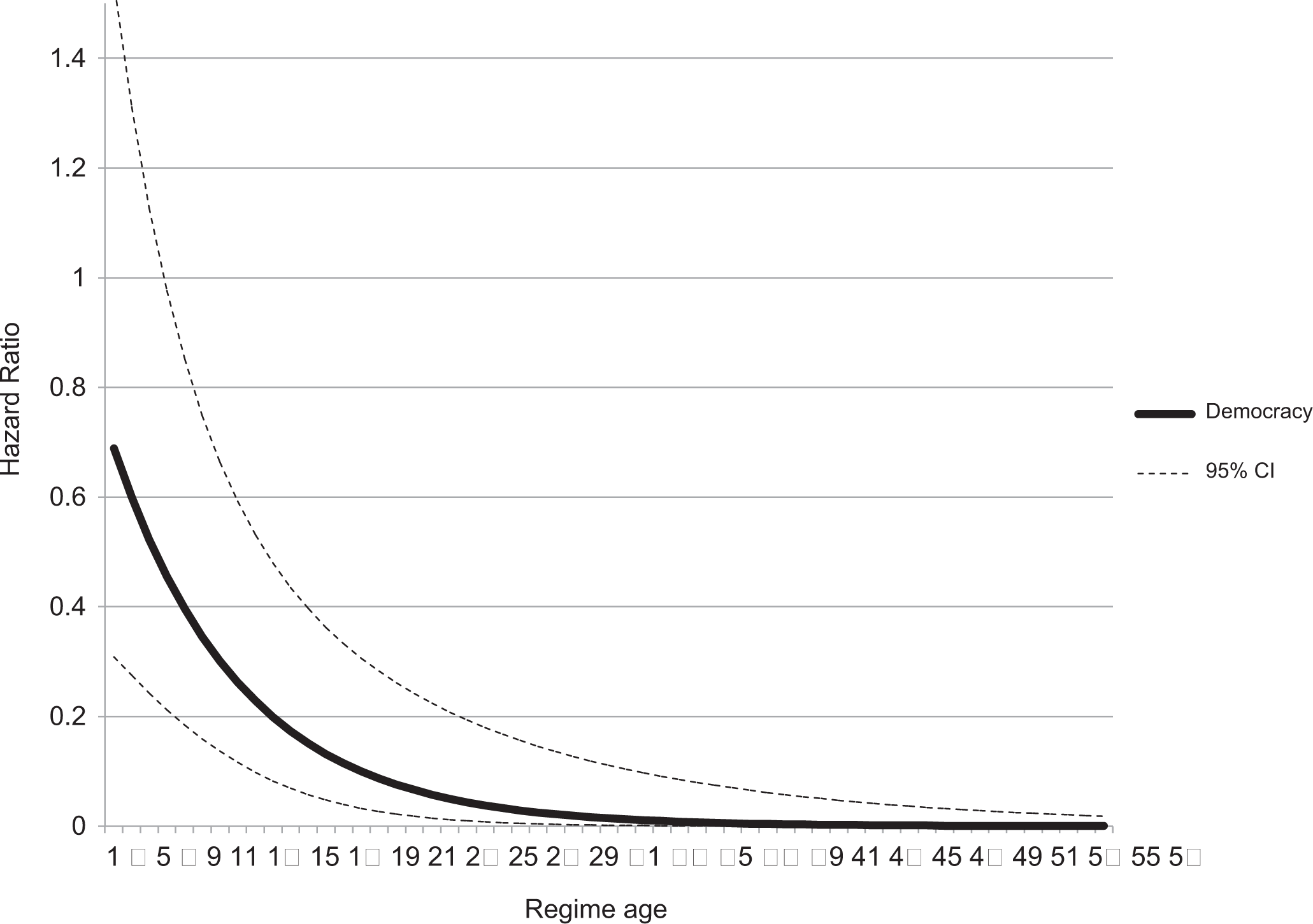
Effect of being a democracy on the hazard of applying homeland territoriality to lost ethnic nationalist homelands over regime age.
Figure 2 also shows that being a democracy begins to reduce the risk of continuing to apply homeland territoriality to lost lands relatively quickly. The impact of being a democracy is uncertain only for the first three years (at the 95 percent threshold). After that, being a democracy is associated with an increasingly smaller risk of continuing to claim lost homeland territory the longer a state is continuously democratic. Moreover, while there is no sharp threshold effect, after a certain point, the probability that a democracy would apply homeland territoriality to lost lands becomes extremely small. If the risk of a democracy continuing applying homeland territoriality is approximately 46 percent after four years of being continuously democratic, this risk declines to about 3 percent after twenty-five years, and to only 0.3 percent after forty years. Thus, while this analysis does not identify a clear threshold at which democratic longevity begins to operate, it does suggest that there are meaningful “dosage” effects, albeit ones with decreasing marginal returns.
Table 1 shows that longer-lived democracies are associated with a lower risk of continuing to claim lost homeland territories even when controlling for the main factors also expected to shape the outcome. Consistent with an important role for ethnic geography, the contemporary presence of coethnics across the border greatly increases the risk that homeland territoriality would be applied to lost lands. 12 As the supplementary analysis in the Online Appendix shows, consistent with the importance of the triadic relationship between states, ethnic groups, and coethnics abroad, both sharing coethnics with neighboring states and the political mobilization of coethnics in the lost lands also increase the risk of continuing to apply homeland territoriality to lost lands (columns 5–6 in Table A.7 in the Online Appendix). However, the impact of longer-lived democracies persists even against these headwinds.
Consistent with the notion that territory sanctified by blood is harder to abandon, prior militarized disputes are associated with a greater risk of continuing to claim lost homeland territory. 13 Consistent with the argument that globalization reduces the salience of territory, greater integration into the global economy is associated with a lower likelihood of applying homeland territoriality to lost lands. In any case, longer-lived democracies remain less likely to claim lost lands as part of the homeland after controlling for the impact of economic globalization.
Other factors receive less support in this analysis. Neither relative strength nor a territory’s economic or strategic value have a consistently significant impact. The main finding is also robust to controlling for other aspects shaping the balance of power such as the possession of nuclear weapons, defense pacts with nuclear powers, status as a Superpower client, and being under foreign occupation (see Table A.8 in the Online Appendix). The finding that current conflict is not consistently associated with applying homeland territoriality to lost lands despite being a context in which instrumental applications of homeland territoriality are expected also suggests that there may be important constraints on the instrumental use of homeland claims to lost lands.
The data are also inconsistent with the notion that the passage of time on its own accounts for the withdrawal of homeland territoriality from lost lands. The impact of time on its own can be evaluated by examining the baseline hazard rate over time. The baseline hazard rate reflects the probability of applying homeland territoriality to lost lands at a particular time, given that a subject was under observation for that length of time, with no other variables taken into consideration. A steadily declining baseline hazard rate would be consistent with the expectation that the withdrawal of homeland territoriality is simply the product of time passing or generational replacement.
However, as Figure 3 shows, the baseline hazard rate does not steadily decline. While there is an initial decrease, it is followed by a significant rise about a quarter century after the drawing of the border. 14 The baseline hazard rate’s significant variation over time is inconsistent with expectations of a monotonic withdrawal of homeland territoriality from lost lands.
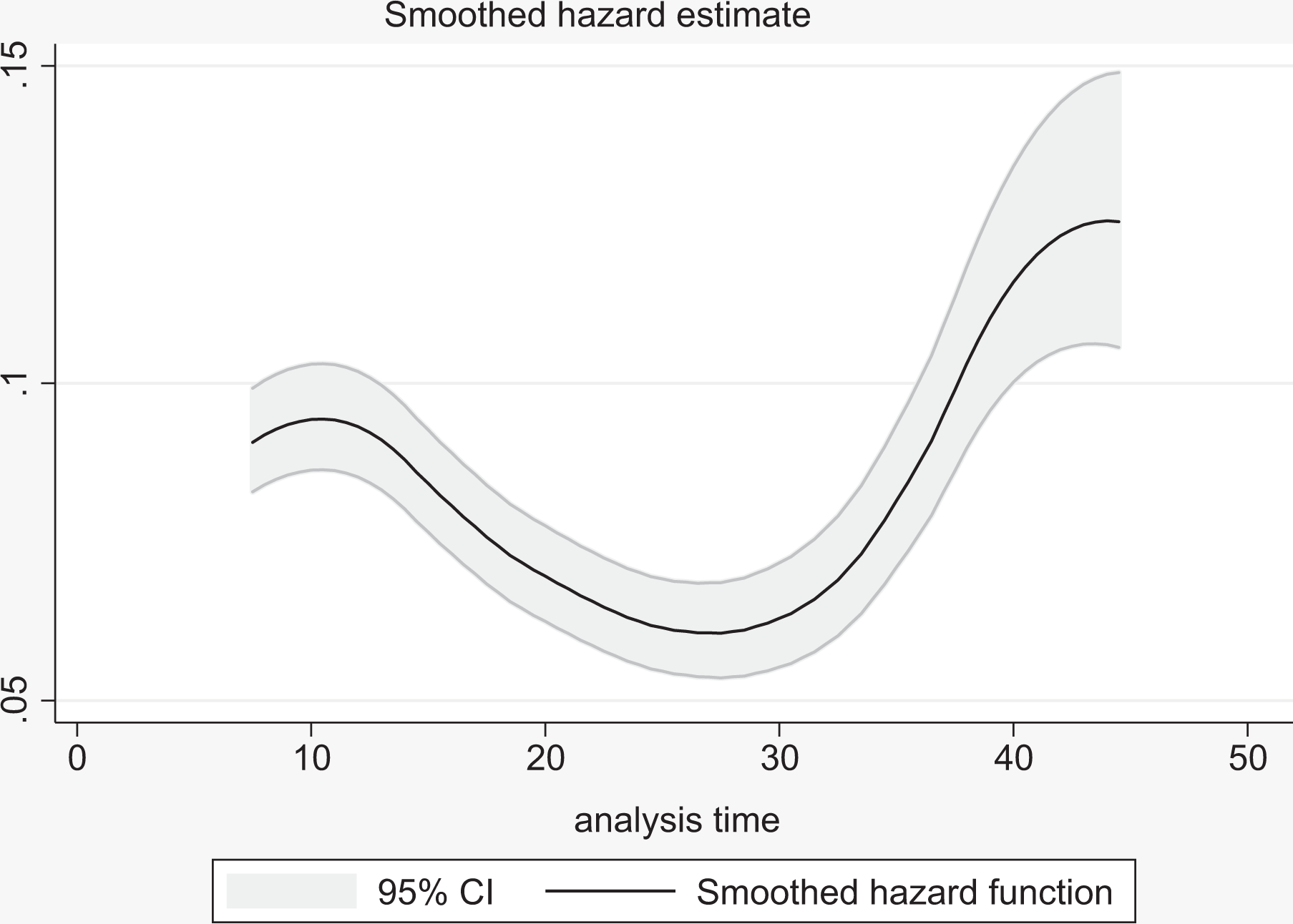
Baseline hazard rate of claiming lost territory as part of the homeland in ethnic homelands.
In summary, contexts likely characterized by the elements needed for evolutionary dynamics to drive change are consistently associated with a lower risk of continuing to claim lost land as part of the homeland. This result holds even after accounting for the countervailing impact of ethnic geography and other factors that could influence whether land is claimed as part of the homeland.
Alternative Explanations
The main finding is potentially subject to three primary concerns arising, respectively, from the possibility that the results are an artifact of the definition of the universe of cases or biases in the data, the possibility that the main results are the product of an omitted variable or of some other attribute of democracy rather than the operation of evolutionary dynamics, and reverse causality. This section addresses each in turn.
One potential concern stems from the use of the prior existence of coethnics to delimit the universe of cases. While relatively less prone to concerns about endogeneity than the alternatives, it still possess theoretical downsides (Shelef 2016). For instance, the use of the truncating of any ethnic group as the delimiter of truncated ethnic homelands could conceivably bias the sample by including irrelevant cases (such as the truncating of the Roma in Europe). Alternatively, this delimitation may be too restrictive if lost lands possessed significant religious or historical locations and thus remained part of the homeland even if the new border did not divide an ethnic group. Table 2 addresses these concerns by showing that the main result holds when the universe of cases is defined in ways that account for these possibilities. 15 Column 1 of Table 2 shows the results hold when the universe of cases is defined by the truncating of ethnic groups that are part of a ruling coalition at the level of junior partner or higher (Vogt et al. 2015) and thus unlikely to include “irrelevant” groups. 16 Column 2 repeats the analysis in a universe of cases that uses discursive criteria to identify truncated homelands. It includes all new borders where lost land was claimed as part of the homeland in the post-1945 period, regardless of whether it truncated an ethnic group. Column 3 shows that the results are also robust to defining the universe of cases as all new borders drawn between 1945 and 1995 regardless of the presence of claims or of truncated ethnic groups.
As noted above, another potential concern may stem from the inclusion of homeland discourse by a range of social actors rather than the conventional focus on the articulations of state executives. While this wider lens is theoretically appropriate, it does potentially increase the possibility of detecting applications of homeland territoriality to lost lands by socially marginal groups.
While impossible to discount completely, the potential impact of this concern on the findings is mitigated by a number of factors. First, the data do not count homeland claims by individuals (e.g., op-eds) or generic sentiments that could not be attributed to a particular political organization as applications of homeland territoriality to lost lands. This coding rule provides a minimal threshold (the presence of an identifiable political organization) below which a homeland claim might not be a viable indicator of collective belief. 17
Second, FBIS’s bias toward ruling groups and US interests (see below) means that a group’s application of homeland territoriality to lost lands needed to be significant enough to merit coverage by domestic media, and then significant enough to be selected for translation by US analysts. These constraints provide reasonable confidence that the applications of homeland territoriality to lost lands captured by FBIS are not completely marginal. Third, even if some claims by marginal groups are included, any bias thus introduced works against the finding of systematic withdrawal of homeland territoriality in longer-lived democracies where relatively smaller groups have more freedom to promote their views. Finally, column 4 of Table 2 shows that restricting the analysis to applications of homeland territoriality deployed by states and state-level executives does not substantively affect the impact of longer-lived democracies.
Another potential concern is that biases built into FBIS could be shaping the results. While enabling systematic cross-national analysis, FBIS’s coverage reflects its origins as an open-source intelligence gathering tool. As such, it likely pays more attention to states seen as relevant to US interests. Moreover, because the media outlets covered by FBIS have historically been controlled by states, FBIS likely also overrepresents the views of ruling governments and state leaders. Even though this bias increases our confidence that detected claims are socially resonant rather than belonging to insignificant minorities, the overreliance on official media sources means that FBIS may not capture the full range of domestic variation about the homeland status of a particular territory, even where such variation exists. This may be especially likely if such homeland claims are made by opposition movements or in areas deemed less vital to US interests.
There are, however, at least two reasons to believe that these potential sources of bias do not account for the results. First, the impact of the US-centric bias is at least partially ameliorated by the fact that homeland claims have long been seen as a trigger for international conflict. As a result, FBIS had an incentive to be relatively inclusive as it sought to aid the forecasting of developments that might affect US interests. This was especially important during the Cold War, when even far-flung disputes were potential foci for superpower conflict. Second, because the impact of exclusion from power (and therefore from access to media) on the range of articulated map images of the homeland is especially significant in authoritarian regimes, we would expect democracies to be characterized by less frequent withdrawals of homeland territoriality. The finding that the opposite is the case reinforces the argument that the main result is a lower-bound estimate of the likelihood that homeland territoriality would be withdrawn from lost lands.
The concerns that FBIS’s built-in biases might affect the results can also be addressed empirically. For instance, it is reasonable to assume that the United States was more concerned about authoritarian regimes than about democracies and that, as a result, FBIS paid less attention to gathering open-source intelligence in democracies. If this were the case, the detection of fewer applications of homeland territoriality to lost lands in longer-lasting democracies could simply reflect the lower likelihood that FBIS would pick up such claims in the first place. To be sure, FBIS does not pay equal attention to all states. Although FBIS averages 664 articles per state annually between 1945 and 1996, the Soviet Union is an extreme outlier, averaging 9,372 articles annually. Once this outlier is excluded, however, there is nearly no difference between the average number of annual FBIS articles from democracies and nondemocracies (t = −.0760, df = 6,223, p = .9394). This increases our confidence that the less frequent nationalist claims in longer-lasting democracies are not a product of a systematic bias against democracies in FBIS. Excluding Soviet cases from the analysis does not substantively change the results (see column 1 of Table A.7 in the Online Appendix).
A related concern is that the findings are an artifact of the US’s interests in Europe during the Cold War. FBIS does have a significant European bias (see the Online Appendix for details). To ensure that this is not shaping the results, column 1 of Table 3 excludes all European states that lost homeland territory. Doing so increases the impact of ethnic geography and of current conflict but does not eliminate the impact of longer-lived democracies (see Table A.3 in the Online Appendix for the full table). The impact of longer-lived democracies cannot, therefore, be dismissed as a European phenomenon or as a product of the same factors that led to democratic peace in post-WWII Europe (Kornprobst 2008).
Accounting for Alternative Explanations for the Impact of Longer-lived Democracies.

Note: Exponentiated coefficients. Standard errors are in parentheses. Cox conditional shared frailty proportional hazards model. Coefficients with a ∧ symbol are corrected for non-proportional hazards. Strata dummies and their non-proportional hazard corrections are also included (not shown).
*p < .10.
**p < .05.
***p < .01.
A second group of challenges centers on the interpretation of the findings as supporting a role for evolutionary dynamics rather than reflecting something else about democracies. On the one hand, since longer-lived democratic contexts are likely to be characterized by variation in understandings of the homeland’s extent, the differential success of some variants, and time for successful variants to displace less successful ones, evolutionary dynamics are likely to operate there. At the same time, since evolutionary dynamics are hard to observe directly in such a macro setting, it is impossible to rule out completely the possibility that the outcome is the product of something else about democracy.
I address this concern in two ways. First, Table 4 shows that four other ways of operationalizing the likely presence of variation, differential success, and time, that fall short of characterizing fully fledged democratic regimes yield similar results. (The full table is available as Table A.9 in the Online Appendix.) Column 1 operationalizes the likely presence of the conditions for evolutionary dynamics in terms of the interaction of Polity IV's competitive and factional systems (thereby suggesting both variation and the possibility of differential success), and regime age. Column 2 uses the interaction of the presence of multiple legislative parties and the continuous time this was the case. Column 3 uses an interaction of minimally competitive elections (in which elections are sufficiently free to (theoretically) enable the opposition to gain power) and the length of time a polity was characterized by minimally competitive elections. Finally, column 4 uses the three-way interaction of having more than one party run for office, minimally competitive elections, and the length of time both continually characterize a society (see Online Appendix for additional discussion of sources and coding of these measures). The results are consistent with the main finding. This increases our confidence that the main results reflect the operation of evolutionary dynamics rather than something about full-fledged democracy, per se.
Robustness to Other Proxies for Evolutionary Dynamics.
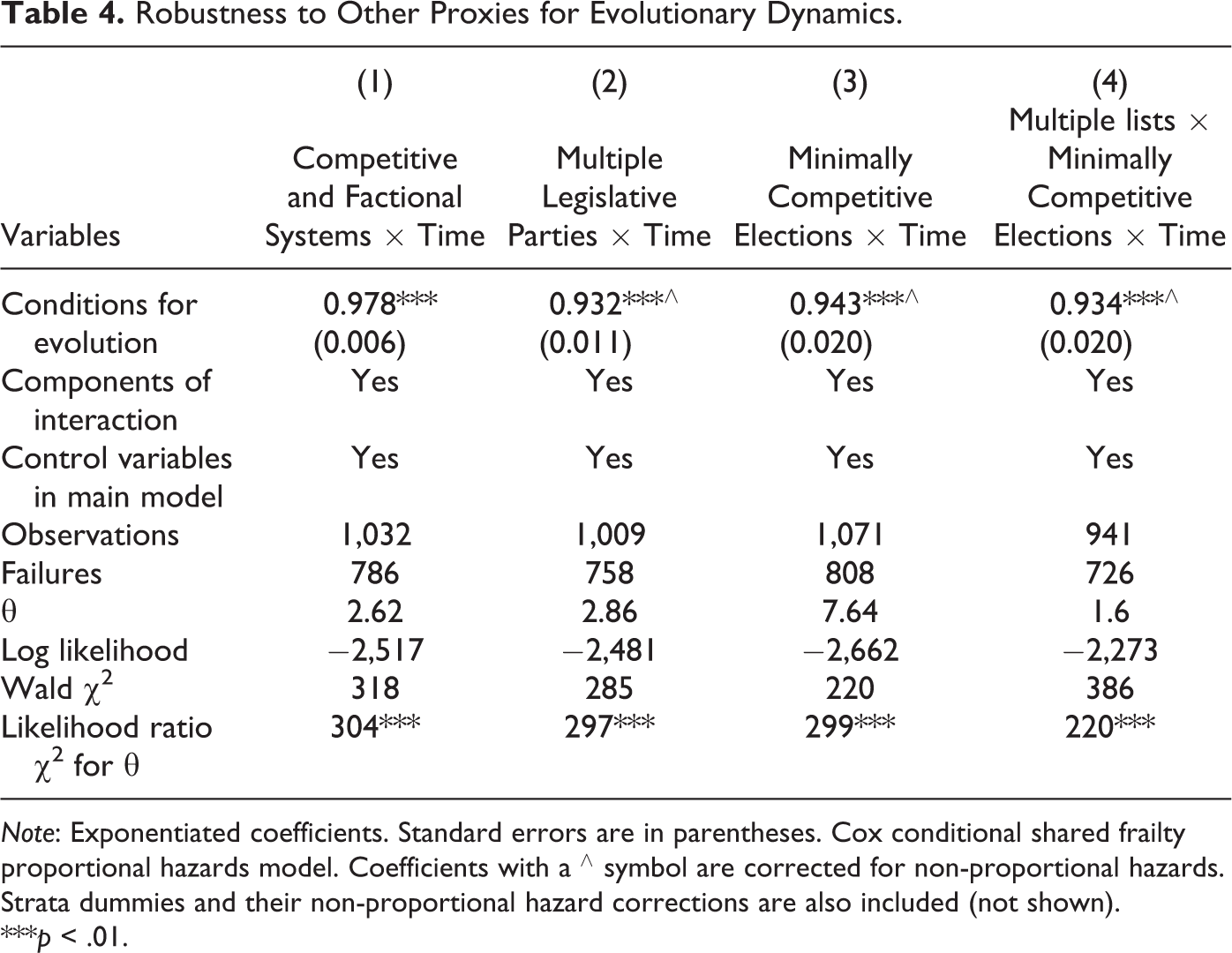
Note: Exponentiated coefficients. Standard errors are in parentheses. Cox conditional shared frailty proportional hazards model. Coefficients with a ∧ symbol are corrected for non-proportional hazards. Strata dummies and their non-proportional hazard corrections are also included (not shown).
***p < .01.
Second, I control for other theoretically derived ways that democracy could shape the outcomes. For instance, the declining marginal impact of being a democracy over time and the uncertainty (at the 95 percent level) about the direction of the impact in the first three years shown in Figure 2 are also potentially consistent with the possibility that it is the maturing of regimes and not evolutionary dynamics that accounts for the main finding. However, controlling for a state’s status as a new regime (column 2 of Table 3) shows that longer-lasting democracies continue to be less likely to apply homeland territoriality to lost lands even once this factor is accounted for. 18
The main finding also remains substantively unchanged when controlling for other circumstances in which nationalist outbidding could be especially salient, including election years and the first year of a leaders’ tenure regardless of regime type (see columns 2 to 4 of Table A.7 in the Online Appendix). The demonstration that, on balance, over time, political competition is associated with a reduced risk of claiming lost lands as part of the homeland renders the main empirical finding significant on its own. Despite strong theoretical expectations that leaders in competitive environments would need to burnish their nationalist credentials and that the resulting outbidding would make it difficult for homeland territoriality to be withdrawn (Rabushka and Shepsle 1972; Snyder 2000; Mansfield and Snyder 2007), consistent, institutionalized, domestic political competition is more often associated with the moderation of territorial claims.
It is also possible that the results reflect the consequences of conflict resolution or the impact of democratic peace rather than evolution. Indeed, the resolution of conflict in the form of a peace treaty makes it less likely that homeland territoriality would be applied to land across the border, but it does not eliminate the main result (see column 5 of Tables 3 and A.3; see Online Appendix for coding details). Democratic peace could account for the outcome if, expecting the return of lost territory to require costly conflict, populations in democracies prefer to give it up rather than fight. This effect would be strongest when democracies lose homeland territory to other democracies since this is where the democratic peace theory is most likely to hold (Dafoe, Oneal, and Russett 2013). However, controlling for the presence of democratic dyads does not meaningfully shape the main results (see column 3 of Table 3). 19
Democratic longevity could also interact with some other factor to reduce the risk of claiming lost homeland territory. For example, ethnic geography could have different effects in younger versus older democracies. Likewise, it is possible that powerful mature democracies behave differently than young weak ones. To investigate the possibility of an omitted interaction between ethnic geography, democracy, and regime age, column 4 of Table 3 repeats the analysis in a subsample in which all of the cases contain coethnics on the other side of the border. If the effect of the interaction of democracy and regime age was conditional on an additional interaction with ethnic geography, this effect should dissipate in this subsample. However, as this model shows, the effect of the interaction of democracy and regime age holds even under this condition. 20
A final potential challenge to the finding could focus on the possibility of reverse causality. A strong version of this argument builds on the important finding that territorial disputes create fundamental insecurities for a state’s population and that these insecurities facilitate the centralization of power that is inimical to democracy (Gibler 2012). From this perspective, it could be the resolution of these disputes and the elision of homeland claims which alleviate these insecurities and therefore lead to both democracy and democratic longevity.
While an observational study such as this one cannot completely account for the possibility of endogeneity arising from reverse causality, I explore the possibility that nationalist claims either help authoritarian regime survive or destabilize democratic regimes by incorporating the applications of homeland territoriality into Gibler’s (2012) model. Both the application of homeland territoriality to lost lands and being a target of such claims plausibly indicate the persistence of unresolved territorial disputes. If it was the case that these undermined or inhibited democracy, we would expect them to be negatively correlated with democracy. Table A.12 in the Online Appendix, however, shows that this is not the case. 21 This suggests that this, most plausible, pathway of reverse causality is unlikely to be shaping the results.
Conclusion
This article argued that evolutionary dynamics are an important factor in understanding the variation in whether nations give up lost parts of their homeland. It demonstrated that states likely characterized by the conditions required for evolutionary dynamics to operate (variation, differential success, and time) are systematically associated with a lower likelihood of continuing to claim lost lands as part of the homeland even when controlling for the other factors that shape this outcome. This provides evidence consistent with argument that evolutionary dynamics shape the homeland’s scope.
This systematic analysis of the factors shaping the withdrawal of homeland territoriality from lost lands reinforces the conclusion that the changes in the definition of the homeland identified by case studies are a systematic feature of our world. This provides substantial support to constructivist theories of nationalism that expect such change to occur. Critically, it also implies that studies of international conflict should take seriously the theoretical claim that homelands can change by treating the homeland status of territory as a variable rather than a constant. The data developed for this study provide a way of doing so.
The investigation of how long it takes nations to give up lost parts of their homeland in this article is only the first step in integrating the insight that homelands can change into quantitative scholarship on territory and conflict. Future work could validate empirically the intuition that the withdrawal of homeland territoriality leads to less international conflict. Likewise, the finding that longer-lived democracies are more likely to withdraw homeland territoriality suggests that democratic peace may arise because democracies are less likely to continue claiming lost homeland territory as they age. Future research can continue to unpack this possibility.
Further research could also build on the measure of homeland status of territory offered here in ways that capture the impact of the intensity and frequency of claims to lost homeland territory, the presence of variation in ideas about the homeland more directly, and that extend the data beyond 1996. The first two extensions would provide ways of evaluating the impact of evolutionary dynamics more directly. The temporal extension of the data would enable the evaluation of whether the relative impact of different factors shaping whether lost homelands lose their status is different in the post-Cold War world. For instance, we might expect integration into the global economy to be even more important today than in the second half of the twentieth century and superpower influence to be less relevant. At the same time, since evolutionary dynamics are expected to drive change whenever and wherever phenomena are characterized by variation, differential success, and time for successful variants to displace less successful ones, we would expect its influence to continue. Future research can develop the data needed to evaluate these possibilities empirically. All of these further steps would contribute to integrating homelands in a more nuanced way into studies of the role of territory in conflict.
Supplemental Material
Supplemental Material, Data-_How_homelands_change_JCR - How Homelands Change
Supplemental Material, Data-_How_homelands_change_JCR for How Homelands Change by Nadav G. Shelef in Journal of Conflict Resolution
Supplemental Material
Supplemental Material, Online_Supplementary - How Homelands Change
Supplemental Material, Online_Supplementary for How Homelands Change by Nadav G. Shelef in Journal of Conflict Resolution
Supplemental Material
Supplemental Material, Replication_file - How Homelands Change
Supplemental Material, Replication_file for How Homelands Change by Nadav G. Shelef in Journal of Conflict Resolution
Footnotes

Acknowledgments
I would like to thank Mark Copelovitch, Jack Goldstone, Simon Haeder, Lisa Martin, Jon Pevehouse, Stephen Saideman, Ken Schultz, Alex Tahk, Jessica Weeks, Krista Weigand, and the anonymous reviewers for their comments and suggestions. Shaan Amin, Susanne Mueller, Clarence Moore, and Brad Jones provided invaluable research assistance.
Declaration of Conflicting Interests
The author(s) declared no potential conflicts of interest with respect to the research, authorship, and/or publication of this article.
Funding
The author(s) received no financial support for the research, authorship, and/or publication of this article.
Supplemental Material
Supplemental material for this article is available online.
Notes
References
Supplementary Material
Please find the following supplemental material available below.
For Open Access articles published under a Creative Commons License, all supplemental material carries the same license as the article it is associated with.
For non-Open Access articles published, all supplemental material carries a non-exclusive license, and permission requests for re-use of supplemental material or any part of supplemental material shall be sent directly to the copyright owner as specified in the copyright notice associated with the article.
