



Abstract
Under what conditions do nonviolent demonstrations escalate to violence? I answer this question using a novel theory of individual impatience in protests that begin peacefully. Rather than considering protest groups as unitary actors, I present a theory of collective action in which a group’s decision over whether or not to engage in anti-government violence is the product of individual preferences. Individuals involved in a nonviolent demonstration use the immediacy of their needs and the sustainability of collective action to decide whether or not to initiate violence against the state. Specifically, I hypothesize that the likelihood of violent escalation will increase when the food price increases and unemployment rate is high or when the event is spontaneous. Analysis of a Bayesian multilevel model of 2,405 nonviolent demonstrations from 1991 to 2017 in Africa and Latin America supports my expectations.
Venezuela has been gripped by political and social unrest since 2010. The socioeconomic crisis began during the end of Hugo Chávez’s tenure and continued to grow under President Nicolás Maduro with citizens calling for his removal from office and resulting in a presidential crisis. The primary grievance for Venezuelan citizens is a lack of access to necessary goods including food, water, medicine, and hygienic supplies. Indeed, in 2016 alone, consumer prices rose by 800 percent (Pons 2017), and roughly 75 percent of the population lost an average of 19 lb. due to lack of nutrition (Pestano 2017). Throughout this period, political grievance has manifested itself in the form of massive demonstrations. While these events have mostly originated as peaceful protests, a large portion have escalated to violent encounters with Venezuelan security forces (Casey 2017). Scholars have developed countless theories to explain the evolution of civil conflicts but very few that relate to why individual events become violent. This type of escalation from nonviolence to violence during events is relatively common. For example, in my sample of 2,405 peaceful protests, roughly 15 percent escalated to violence. Why do some nonviolent demonstrations remain peaceful while others escalate to violence?
Rather than considering protest groups as unitary actors, I present a theory of collective action in which a group’s decision is the product of individual preferences. During periods of civil opposition, nonviolent demonstrations are more likely to become violent when individual members are impatient, desperate, or fear that collective action will fall apart. Individuals involved in a nonviolent demonstration use the immediacy of their needs and the sustainability of collective action to decide whether or not to begin behaving violently. This theoretical approach is an improvement over the unitary framework because it allows me to consider factors that affect individuals rather than only group attributes. Exploring the things that shape individual decisions is necessary since violent escalation is driven by demonstrators themselves.
Specifically, I consider three factors that influence demonstrations’ likelihood of escalation: food price increases, unemployment rate, and whether the protest was organized or spontaneous. First, food price stability or decreases in a country should allow nonviolent demonstrators to continue using peaceful tactics to attempt to force concessions. Higher food prices may necessitate a switch to violent tactics because the need for nutrition must be immediately resolved. Second, when the unemployment rate within a country is high, individuals will face increased difficulties in providing for themselves and their families. As a result, they will be more likely to try any possible tactic, including violent ones, to coerce change. Beyond these two factors’ individual impacts, the confluence of high food prices and a high unemployment rate creates an environment in which violent escalation is most likely. Finally, organized demonstrations indicate that leaders have borne the costs of collective action, signaling the sustainability of nonviolent action. Conversely, the duration of spontaneous protests is highly uncertain and may cause demonstrators to consider a switch to violent tactics before collective action collapses.
This project furthers the violent and nonviolent civil conflict research agenda in three key ways. First, while countless studies investigate why protests and anti-government violence occurs, few analyze the dynamics of individual events. By exploring the factors that encourage nonviolent protests to escalate to violence, I push forward our understanding of the processes of violent and nonviolent civil unrest. Second, this project contributes to the long history of collective action research. Rather than show how groups are able to solve the collective action problem to begin anti-government demonstrations, I consider how the risk of collective action breakdown leads individuals involved in protests to behave violently. Finally, this study adds to the growing number of projects that use Bayesian methodology in conflict studies. By using a Bayesian approach to account for common problems in my data, I am able to estimate a model that improves upon conventional maximum likelihood methods.
In this study, I briefly consider the extant literature on civil contention and tactical choices. Next, I present my theory of individual preferences, grievance time horizons, and violent escalation. I follow my argument with a research design to empirically test my hypotheses, and I present the results of my statistical analysis of 2,405 nonviolent events in Africa and Latin America from 1991 to 2017. I find support for my hypotheses relating to the impact of food price increases, unemployment rate, and demonstration organization on violent escalation. I close this project with a discussion of my findings and suggestions for future work.
Civil Opposition and Tactical Choices
There is a long research tradition that examines the relationship between grievance formation and contentious political action, but scholars rarely explicitly focus on the dynamics of individual events. Conventionally, studies of contentious politics have classified substate actors into two categories—those who use violence as a tactic and those who do not. Scholars often implicitly assume this dichotomous distinction because they conceptualize nonviolent and violent groups as fundamentally different. A growing vein of scholarship challenges this assumption (Chenoweth and Lewis 2013; Krause 2017; Pearlman 2011). Indeed, Asal et al. (2013) reject this false dichotomy and suggest that groups may choose from a full “menu” of tactics including solely violent, solely nonviolent, or mixed strategies. Cunningham (2013) finds that there are several factors that positively affect the likelihood that a group uses violence or nonviolence and concludes that it is possible that the same causal mechanism may drive a group to take organized action, and the environment in which the group finds itself may determine the most appropriate tactical approach. Another common assumption in much of the conflict literature lies in the idea that violent tactics are necessarily more effective in achieving a desired outcome than nonviolence (Pape 2005). 1 Some scholars, however, have presented evidence that nonviolent groups may be more successful than violent groups (Asal, Gustafson, and Krause 2019; Celestino and Gleditsch 2013; Chenoweth and Stephan 2011; Karatnycky and Ackerman 2005).
The extant literature suggests that two common sets of nonviolent tactics exist. First, a group may opt to use traditional political means—such as voting or lobbying—to try to redress its grievances. These routine activities, however, are often insufficient because the group may be too weak to meaningfully influence domestic politics (Celestino and Gleditsch 2013; Chenoweth and Stephan 2011). In autocracies or politically underdeveloped regimes, there is usually very little space for traditional political opposition, so groups must act extra-institutionally (Tarrow 1994). Second, a group can use nonviolent “direct action” in the form of demonstrations or boycotts to reach negotiations or coerce concessions (Celestino and Gleditsch 2013, 389). Direct action is more common in turbulent political environments and is often a natural second choice for groups excluded from the standard political process. This study focuses on direct action rather than institutional contention.
A growing body of literature suggests that food insecurity is a key cause of grievance formation that leads to direct action. While scholars have explored this topic in the past (Gailus 1994; Tilly 1971), protests and riots have been an incredibly common manifestation of political opposition in recent history, and scholars have taken notice (Brinkman and Hendrix 2011; Salehyan et al. 2012). Indeed, studies have shown that food prices and food price shocks are significant predictors of spontaneous riots (Bellemare 2015; Smith 2014), anti-government demonstrations (Arezki and Bruckner 2011), and urban unrest in democratic countries (Hendrix and Haggard 2015).
Additionally, scholars commonly cite relative deprivation as another root cause of contentious behavior. Beginning with Gurr (1970), scholars have explored how relative deprivation encourages individuals to engage in anti-government acts (Cederman, Gleditsch, and Buhaug 2013; Regan and Norton 2005). In this framework, individuals become motivated to participate in opposition action when they are unsatisfied with their relative socioeconomic standing and political opportunities (Gurr 1993). The relative deprivation research agenda fits into the broader collection of grievance-based explanations for conflict (Sambanis 2001). Although the majority of scholarly work on relative deprivation has explored rebellion and other large-scale violent tactics, similar mechanisms generate all sorts of contentious political action, including nonviolent demonstrations (McAdam, Tarrow, and Tilly 2003).
A large body of literature examines the conditions under which violent riots emerge. Early theorists argued that riots were the product of emotionally charged outbursts by irrational individuals (Le Bon 1897). More recent scholarship, however, suggests that riots can result from a rational tactical selection process in which they are thoughtfully deployed and their targets carefully chosen (Horowitz 2001; Rudé 1981; Wilkinson 2009). Most analyses of riots have emphasized the importance of structural conditions or situations that encourage violence rather than individual rioters’ characteristics (Gailus 1994; Olzak 2005). In light of this evidence, I focus largely on the situations in which protests are most likely to become violent (Collins 2009).
While a group may begin by using only violence or nonviolence, it may vary its tactics over time (Cunningham 2014). Several scholars show that when nonviolent tactics recur during protest cycles, the dominant form of contention may eventually turn violent either as a function of political opportunities opened by nonviolent direct action or in response to threats from the state (Beissinger 2002; Tarrow 1989, 2011). Although studies of violent and nonviolent movements answer important questions relating to conflict dynamics, relatively little work has explored the reasons that groups change their broad strategies of opposition (Sambanis and Zinn 2005). 2 Fewer studies focus on event-level dynamics that lead to violent escalation. In his monograph on nonviolent discipline, Pinckney (2016) focuses on how peaceful campaigns avoid the violent escalation from which riots emerge. Using statistical analysis and careful case studies, he concludes that repression is most consistently associated in the breakdown of nonviolent discipline, but the effects of other theorized causes are less straightforward.
The current literature does not provide a clear picture of why single events change from peaceful demonstrations to anti-government violence. This project applies a rationalist theory with similar expectations to classical theories of grievance formation and relative deprivation to single opposition events to understand why nonviolent demonstrations escalate to violence. Additionally, it frames a protest group’s attempt to remain nonviolent using the dynamics of collective action.
Impatience and the Sustainability of Collective Action
Consider the strategic interaction between a state and opponent as an opposition group tries to extract concessions from the state while the government seeks an end to opposition. I assume that an opposition group cannot redress its grievances through traditional political institutions. Additionally, I assume that the root grievances are salient enough to discourage de-escalation for some portion of demonstrators. Politically excluded groups try to express opposition opinions and bargain for concessions by acting unconventionally—through protest (Tarrow 1994) or armed conflict (Wagner 2000). Empirically, some groups begin as violent entities. However, I assume that all else equal, individuals would prefer to reach their goals nonviolently. The opposition group’s primary goal is to coerce concessions from the government while remaining nonviolent. The costs of participating in violence are high and often entail risking one’s life, creating a significant collective action problem (Lichbach 1995). For that reason, individuals prefer to use violence only as a last resort. Therefore, I consider individuals’ decisions over whether or not to use violence once a protest has begun.
Traditionally, conflict scholars have treated such strategic interactions between actors engaged in conflict as a bargaining process. These models have produced invaluable insights, but they often require two simplifying assumptions that are problematic for modeling the interaction between a government and a domestic opposition group. First, scholars would likely assume that negotiations occur between two homogeneous units. In a civil conflict setting, a bargaining model would likely treat the process as a series of decisions made by a government and the leaders of an opposition group. Empirically, leaders often negotiate with governments over concessions, but they do not necessarily make decisions that produce observable behavior. For example, if leaders agree to cease violence in exchange for concessions, they may not be able to enforce this agreement. Some leaders certainly can exert strong influence over their members, but I would argue that this is sort of cohesion is rare. In fact, scholars have found that divergent preferences lead most contentious campaigns to fragment over time (Christia 2012; Cunningham 2011). Thus, I consider a situation in which decisions are driven by individual members’ preferences but can be constrained by the extent to which leaders organize demonstrations.
Second, bargaining models may be subject to an exogenous risk of negotiation breakdown (Muthoo 1999). Under this risk, actors may be compelled to reach a deal due to fear that talks will fall apart, and the terms of the agreement may be altered. While bargaining partners may genuinely worry about exogenous breakdown, it is inappropriate to apply this constraint to the interaction between a government and nonviolent opposition group. Here, perhaps the most common form of breakdown occurs when the nonviolent group turns violent. Therefore, the risk of bargaining breakdown is endogenous because demonstrators themselves may force negotiations to fall apart. I explore a situation in which individual members of a nonviolent opposition group drive bargaining breakdown by deciding to escalate from peaceful demonstrations to violence.
While a contentious event is ongoing, protesters choose whether or not to escalate to violence by rationally weighing the costs and benefits associated with remaining peaceful and beginning to use violence. The costs of contention are minimized by continuing to use nonviolent tactics, but individuals may be willing to switch to violence if the gains of doing so are sufficiently high. 3 This simple formulation captures the decision of individuals deciding whether or not to use violence once a protest has started, but we must also consider two complicating factors: how individuals’ actions affect others’ decisions and the time horizons of protesters’ grievances. Groups of protesters are not unitary actors, meaning that I must consider a collection of individuals who have diverse preferences over oppositional tactics (Chwe 2000; Siegel 2009). The aggregation of these demonstrators’ preferences produces the observed behavior of the group in a probabilistic manner. For example, if a majority of individuals in a demonstration prefer to receive the payoff from continuing to act nonviolently, the group will likely remain nonviolent. However, individuals’ payoffs are affected by other protestors’ actions. When one individual switches to violence, other group members’ expected costs of violence decrease and the effectiveness of violence increases. As the number of individuals who prefer switching to violence increases, a cascade effect can cause the group to become increasingly likely to use violence. Psychological and historical accounts provide evidence in support of this cascade dynamic. First, psychologists have shown that for some aggressive individuals, observing others committing violence triggers activity in regions of the brain associated with reward and pleasure (Decety et al. 2009). Second, Buckley and Kenney (1995) use the case of the Troubles in Northern Ireland to show that protesters derived pleasure from the group identity that violent rioters experience. This suggests that for some portion of individuals, observing violence can lead them to experience joy, and the group dynamic that violence creates can lead others to join in. Therefore, even one individual’s violent escalation can lead to a much larger violent turn during a protest. Because of this, it is important to consider the conditions under which constituent group members are likely to prefer changing tactics.
The time horizon of collective action is an important factor in determining whether or not protesters will change tactics. Demonstrators’ grievances have varying degrees of immediacy. Some grievances are fundamentally concerned with long-term aspirations such as those relating to autonomy, self-determination, or other future policy changes. In protests over these long-term issues, the value of the policy change is relatively unchanged in the short term. For example, when self-determination movements strive for increased autonomy, the gains they make will be valued similarly whether they occur one week or the next. The benefit of long-term policy change is largely independent of short-term fluctuations in the timing of that policy change. Conversely, some short-term aspirations such as achieving the cessation of violence or a remedy to economic downturn require immediate rectification to be satisfactory to demonstrators. In these cases, the timing of concessions is essential to the grievance solution. Whether the government stops using violence on citizens one day versus the next has important consequences. The variation in grievance immediacy informs protesters’ patience, which in turn affects the likelihood of escalation.
I refer to demonstrators whose grievances require long-term policy change as patient. These individuals aspire to affect policies with potentially large payoffs, but the value of that payoff does not depend upon when it is secured. Therefore, given that individuals have initiated nonviolent contention, they will be unlikely to switch tactics to be violent because of the higher costs associated with anti-government violence. Conversely, individuals with more immediate grievances will be less patient because of their desire to achieve short-term concessions. For protestors, immediate grievances require quick solutions. Therefore, once they are engaged in coordinated nonviolence, they have a greater incentive to switch tactics to coerce quick concessions. If nonviolence does not work quickly, demonstrators may switch to violence to redress their immediate grievances. Thus, patience is crucially important for the nonviolent discipline described by Pinckney (2016), and impatience drives escalation.
To summarize, individuals decide rationally whether to use violence or remain nonviolent once a protest begins. Two factors complicate the strategic interaction between a group of demonstrators and the government. First, individuals’ actions affect other protesters’ decision-making processes. Because of this, violence by an individual or small group of demonstrators can cause cascades of escalation. Thus, I prioritize factors that affect individuals’ willingness to use anti-government violence. Second, the time horizons of protesters’ grievances—or the degree to which the value of concessions changes as a function of time—affect how patient demonstrators are. When protesters are impatient, they are more inclined to use violence to coerce quick concessions. As a result, to determine when protests are likely to escalate to anti-government violence, I focus on factors that make individual demonstrators increasingly impatient.
If individuals believe that the state will redress their grievances quickly, they will be more likely to remain peaceful. If, however, they believe that nonviolent demonstration is proving ineffective or that collective action is unsustainable, they will be more apt to engage in violence. Thus, violence is a result of the perceived failure of nonviolent collective action. This may seem counterintuitive given the wealth of scholarly work that argues that violent opposition is a result of solving the collective action problem. It is important to note, however, that my argument applies to a limited set of violent activities like riots rather than coordinated, sustained armed conflict.
Individuals within a nonviolent demonstration reach their patience thresholds more quickly when they are increasingly unwilling to wait and see whether nonviolent tactics will coerce change. Economic downturns comprise some of the most prevalent forms of short-term grievances that can lead to impatient protesters.
4
The price of food is one fundamentally important factor in determining a nonviolent demonstrator’s patience. Food unavailability represents an immediate need as individuals comprising demonstrations must be able to feed themselves and their families. Especially in developing countries, hunger or starvation is an issue that requires rapid rectification. If nonviolence does not quickly produce concessions in cases of high food price and low food availability, group members will be more apt to embrace violent tactics out of desperation. The immediacy of the need for food drives individuals to become impatient with nonviolent tactics, leading to an increased chance of violent escalation.
Another structural economic factor that affects individuals’ impatience is the unemployment rate within a country. Scholars have suggested that unemployment increases the likelihood of observing unrest by lowering the barriers to collective action (Lichbach 1995), but it has a secondary effect. On average, higher unemployment leads to more unemployed people who will be impatient with current tactics. As unemployment rises within a society, an increasing number of individuals are unable to provide for themselves and their families. As a result, individuals engaged in peaceful demonstrations will become more impatient if nonviolence does not appear to be effective in forcing concessions. Thus, when the unemployment rate within a country is high, nonviolent demonstrations will have a higher baseline likelihood of escalating to violence.
Additionally, a high level of societal unemployment lowers consumers’ abilities to procure necessary goods such as food. Since hunger and unemployment reinforce one another, the effects of the relative food price and unemployment rate should be conditional upon one another. Citizens’ abilities to provide for the basic needs of themselves and their families decrease when either the relative food price or the unemployment rate is high. However, when both of these stress factors combine, the effect is more than the sum of the parts. When food prices in a country are high, the portion of the population that is able to comfortably provide for their families is limited. The same is true when the unemployment rate is high. The pool of demonstrators who become desperate when both of these factors are at play grows, but the confluence of a high relative food price and unemployment rate intensifies the desperation in those affected by both stress factors.
A high unemployment rate within a country can also dampen one tactic that a government may use to combat high food prices. In an attempt to mitigate the effects of high food prices, leaders may increase wages in the public sector to allow more consumers to purchase food. For example, the Venezuelan government has increased the minimum wage several times over the course of its current unrest to try to quell the economic crisis. This strategy may work in theory because fewer potential demonstrators will be willing to take part in contentious acts if rising wages solve their grievance with the state. However, when unemployment rates are high, the government’s responsive policy becomes less effective, and more individuals remain aggrieved. Because of this, the likelihood of violent escalation will be largest when the relative food price and unemployment rate within a country are high.
Two potential mechanisms could lead individuals to embrace a tactical shift from peaceful protest to violence when stress factors—such as high food prices and low unemployment rates—are present. First, individuals may be characterized as having a lower discount rate. In this case, demonstrators place less weight on future payoffs and value immediate benefits more. The shrinking discount rate matches my theory of individual impatience. However, it is empirically difficult to isolate this mechanism. It is also possible that individuals would switch tactics because of a sharp decrease in utility when they are unable to procure basic necessities. This account would also produce an association between high food prices and unemployment rates and the likelihood of escalation. To distinguish between these two mechanisms, I explore the sustainability of collective action. The degree to which individuals believe a demonstration will continue or collapse will certainly affect their discount rate and patience, but it will not necessarily be related to a sharp disutility in a way that stress factors are.
If a group member believes that nonviolent demonstrations are likely temporary and at risk of falling apart, she will be more likely to support a tactical switch to coerce concessions. Conversely, if an individual believes that protests or other nonviolent tactics are likely to continue, she will be more patient and will continue to remain peaceful. Under these assumptions, an individual’s participation in nonviolent demonstration is defined by strategic complementarity, meaning that the more people participate, the more likely each individual is to contribute (Chwe 2000; Siegel 2009). Therefore, a protester will believe that nonviolent opposition is sustainable as the probable number of participants grows.
Leaders of demonstrations or protest groups can greatly affect how nonviolent opposition unfolds. The primary objective of protest leaders is to coordinate a crowd of demonstrators to pressure the government into providing concessions over a policy goal. In doing so, they may gather individuals with diverse interests to bolster the number of participants, leading to a variety of messages. In this setup, protest leaders with alternative motivations may encourage some faction of demonstrators to escalate to violence to differentiate themselves from other sects of protestors. While this may be true for the most cohesive groups with the strongest leadership, the role of leaders may be overstated. Indeed, “although we may assume that all members of a crowd are motivated by the stated goals of the so-called leaders, this may not be the case at all” (Wilkinson 2009, 331).
However, one of the main ways that leaders of a nonviolent demonstrations can affect the decisions made by individual group members is by carefully coordinating demonstrations. The degree to which protests are organized or spontaneous can have a large effect on individuals’ perceptions of sustainability. Organized demonstrations suggest that members planned the opposition in advance, indicating a high level of sophistication and dedication to the cause. In order for this to occur, groups must generally have a leadership structure that bears the costs of coordination. Here, leaders send a signal to group members that collective action is sustainable as a result of their commitment. Out of this, individuals face a lower risk of group disintegration and can expect demonstrations to continue. Additionally, organized protests may signal strength to the potential participants, leading to a longer leash on nonviolent action by group members.
Spontaneous collective action, however, does not have a guaranteed duration or frequency. As a result of the uncertain qualities of unplanned demonstrations, individuals are more likely to perceive that the collective action is unsustainable. Spontaneous nonviolent demonstrations also face a higher risk of group collapse because no leaders exist to bear significant collective action costs. Thus, in the face of a seemingly temporary window of influence, individuals are more apt escalate to violence as a last resort.
The characterization of events as spontaneous or organized potentially contains additional information beyond how protesters perceive the sustainability of collective action. Indeed, this classification could signal leader strength, group cohesion, or intentional divisions created by protest leaders. While these additional explanations would also be consistent with support for H4, they would not necessarily be consistent with the larger theory about impatience. Therefore, I interpret findings in support of or against the hypothesis about spontaneous demonstrations as evidence toward the larger argument.
Research Design
To test my hypotheses about the conditions under which a nonviolent demonstration escalates to violence, I primarily use the Social Conflict Analysis Dataset (SCAD; Salehyan et al. 2012). SCAD contains event-level information on social disturbances such as protests and riots for Africa and Latin America from 1990 to 2017. While most conflict data sets only contain information on large-scale events such as wars or attacks, SCAD captures different sources of political and social contention. For this study, my sample contains all nonviolent anti-government events from 1991 to 2017. 5 All observations are measured at the event level. 6 Table 1 shows descriptive statistics for all variables that I include in this analysis. In my sample, about 15 percent of peaceful protests escalate to violence.
Descriptive Statistics for All Variables in the Analysis.

Note:
The dependent variable for this analysis is a binary measure of whether the nonviolent event escalated to anti-government violence. SCAD defines escalation as occurring if the “nature of the event changes during its duration.” To create this variable, I code whether or not each individual event began nonviolently and escalated to violence. This includes all cases that began as peaceful demonstrations—both organized and spontaneous—and escalate to violent riots or anti-government violence such as small-scale terrorism. 7
The primary independent variable used to assess H1 is the lagged food price change from the International Labour Organization’s (ILO) consumer price indices for food and nonalcoholic beverages. This monthly measure captures the percentage change in the food price from the previous month by country. I standardize the price changes by dividing the difference between a state’s monthly food price and the state’s long-term mean food price by the long-term standard deviation of that state’s food price. 8 I lag this measure by one month to ensure that anti-government events are not affecting the food price. 9
I test H2 using the unemployment rate measure from the World Bank. The unemployment rate is reported as the percentage of the total labor force that is unemployed but seeking work in a given country-year. Rather than using the national estimates, I use the modeled ILO estimate from the World Bank. Using this estimate alleviates the missing data problem and bias in self-reporting of typical unemployment data. I use a multiplicative interaction between lagged food price change and unemployment rate to address H3.
To test H4 on the effect of the spontaneity of demonstrations, I create a binary measure of demonstration organization from the Etype variable in SCAD. Here, if the event type is coded as an organized demonstration, I assign it a value of 1. If it is coded as a spontaneous demonstration, I assign it a value of 0. One potential fear with this measure could result from observers potentially mistakenly categorizing events as organized or spontaneous based upon whether or not the leaders claim responsibility for the event. While leaders may have incentives to deny responsibility for protests that escalate, these events are largely publicly organized, meaning that the leaders advertise their organization before the event. It is important to note that there may be a reporting bias pertaining to which events are deemed organized or spontaneous. This could occur if events that become violent may be more likely to be labelled spontaneous by journalists. While this potential bias may be present, the journalistic account of whether a protest is spontaneous or organized is the best available measure for protest organization. I expect the organization of a demonstration to be negatively associated with the probability of escalation.
Given the important role government repression plays in shaping group strategies (Ritter and Conrad 2016), I control for how frequently the government has used violent repression in the recent past. While SCAD includes a measure of repression by event, this variable is potentially problematic given that it could indicate that repression occurred either before or after a protest has escalated. Therefore, I measure repression using the share of events within the past year that each country’s government violently repressed. This method is similar to previous attempts to measure repression in the recent past (Cunningham and Beaulieu 2010; Pinckney 2016).
Additionally, I condition my analysis on the location of the demonstration. The location of an event could be an important covariate because it could systematically affect the likelihood that a demonstration escalates to violence. The setting of a demonstration influences the number of likely and possible protestors. Because of this, location affects how threatening the government finds the demonstration and can alter its responsive strategy. To control for the location of a demonstration, I include a binary indicator that indicates whether the event is rural versus urban or national. 10
I control for four other factors that influence whether or not a nonviolent demonstration escalates to violence. First, I use a dummy variable to capture whether a country is a democracy using the Polity2 measure from the Polity IV data set (Marshall and Jaggers 2002). Regime type in a country could effect the potential response to a demonstration as well as the constraints on opposition groups’ decisions. I code all countries with Polity2
To evaluate my hypotheses, I estimate a Bayesian multilevel logistic regression. I fit this model for two key reasons. First, a Bayesian approach presents a natural way to fit and interpret multilevel models. Defining prior distributions over multilevel parameters allows me to properly characterize the uncertainty at all levels of the data generating process. This is especially important given that I analyze an event-level response variable with predictors at the event level and country-year level. In estimating this multilevel model, protests are nested within countries and years, with each level having its own baseline propensity of violent escalation. Second, fitting these models using maximum likelihood estimation leads to particularly unstable results because of the separation issue in my data set. Separation issues occur when a combination of predictors perfectly predict an outcome and commonly arise in logistic regression “even when the sample size is large and the number of predictors is small” (Gelman et al. 2008, 1370). Estimating this model using Bayesian inference solves this separation issue (Rainey 2016). Therefore, the model that I have chosen represents my best choice to obtain parameter estimates to assess the impact of my variables of interest on the likelihood of escalation. 12
The predictive model is:








for event i in country j and year k. X is a matrix of predictor variables. The coefficient parameters β are drawn from Cauchy distributions centered at 0 with their scale parameters equal to 2.5, and the intercept α is distributed Cauchy with mean 0 and scale parameter 10 (Gelman et al. 2008). The country and year random intercepts uj
an d wk
are drawn from separate normal distributions with standard deviations
Results
I estimate the model using Hamiltonian Monte Carlo sampling implemented through RStan version 2.18.1 (Carpenter et al. 2017). I run four parallel chains for 10,000 iterations with a warm-up period of 5,000 samples. This leaves me with 20,000 samples for my analysis. All parameters have an
Summary of β Posterior Distributions.

Note: N = 2,405. GDP = gross domestic product.
*0 outside the 95 percent credible interval.
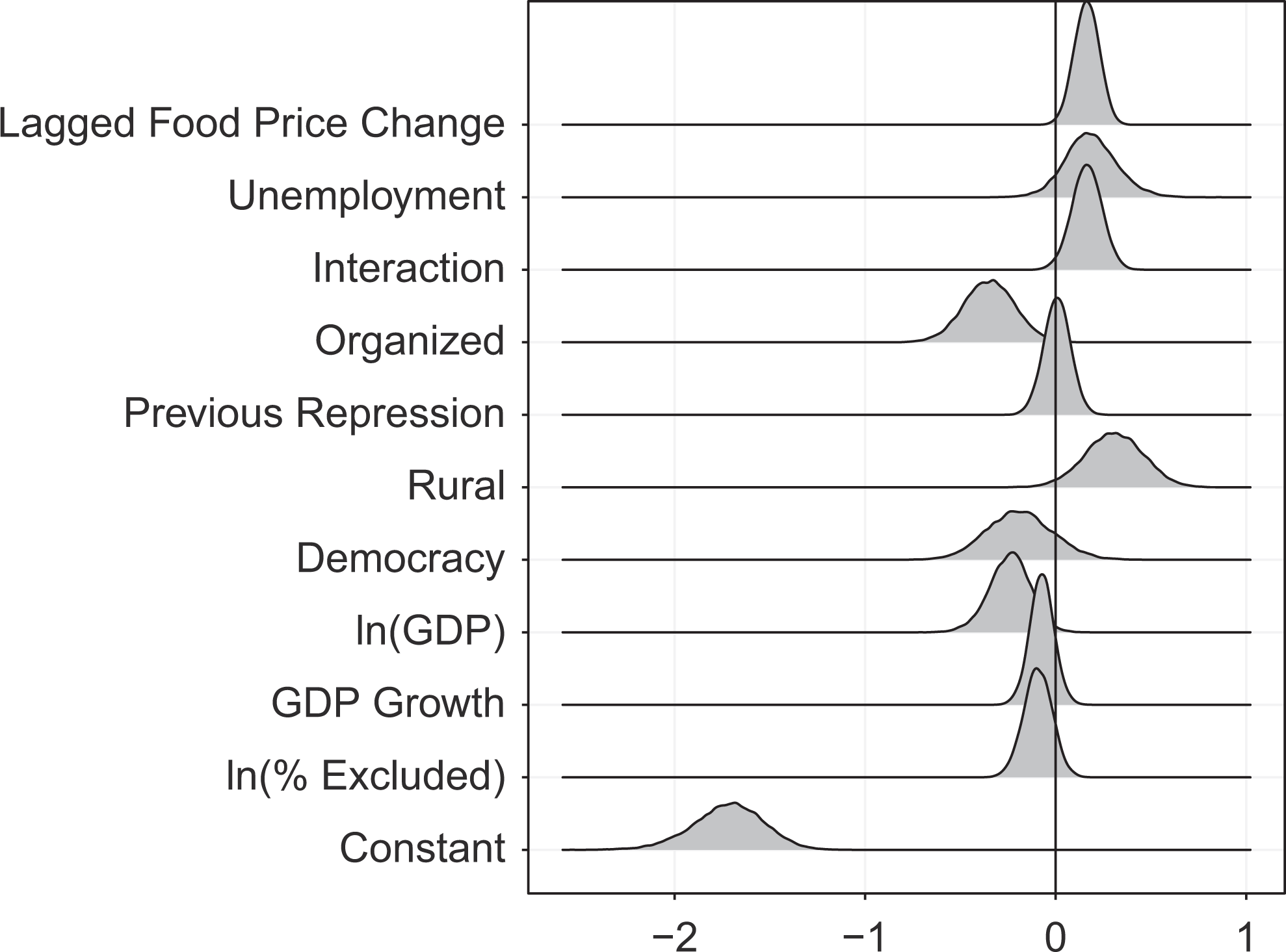
This figure shows the posterior density for each coefficient parameter in the model with the thick vertical line marking 0. A parameter distribution that does not noticeably overlap 0 suggests that the effect of the variable associated with the parameter is different from 0.
Leading up to H1, I argued that as the food price in a state increases, so should the likelihood of a nonviolent demonstration escalating to violence. I find strong support for this hypothesis as the point estimate for the coefficient on relative food price is positive, and the 95 percent credible interval lies well above 0. The left panel of Figure 2 shows the conditional distribution of the effect of lagged food price change with the point estimate indicated by the dashed line and the solid lines showing the upper and lower bounds of the 95 percent credible interval. The plot contains four light gray densities for all chains in the Markov chain Monte Carlo process, and the dark gray area indicates overlapped density. Since the distribution is almost entirely dark gray, we have strong evidence of convergence. Since the bulk of the density of the distribution lies above 0, the effect of lagged food price change is positive.

The left panel shows the distribution of the β coefficient on lagged food price change conditional on an average value of unemployment rate. The dashed vertical line shows the point estimate, and the solid vertical lines mark the upper and lower bounds of the 95 percent credible interval. The right panel displays the marginal effect of lagged food price change across values of unemployment rate along with a 95 percent credible interval.
Because of the multiplicative interaction term in the model, the reported point estimate for the coefficient on lagged food price change is accurate when unemployment rate takes on a value of 0. Since I have rescaled all variables to have mean 0, this is the effect of the lagged food price change at the mean level of unemployment rate. In the right panel of Figure 2, I plot the marginal effect and 95 percent credible interval of lagged food price change over observed values of unemployment rate. The estimate for the marginal effect of lagged food price change is positive and sufficiently distinct from 0 for all but the lowest values of unemployment rate. Overall, the model estimates support the claim in H1; as the lagged food price change increases, the likelihood that a demonstration escalates violently increases as well. It is also important to note that the effect of lagged food price change increases along with unemployment rate.
In H2, I suggested that unemployment rate would also be a positive predictor of the likelihood of violent escalation. The model estimates support H2 as the estimate of the marginal effect of unemployment rate is positive and the 95 percent credible interval lies completely above 0 when lagged food price change is above its average. The left panel of Figure 3 shows the posterior distribution of unemployment rate with the point estimate and 95 percent credible interval bounds. The point estimate when lagged food price change takes on its mean value is indistinguishable from no effect. The right panel of Figure 3 shows the conditional distribution of the effect of unemployment rate over observed values of lagged food price. The marginal effect of unemployment rate behaves similarly to the marginal effect of relative food price in that it is positive and distinguishable from 0 when lagged food price change is above its mean value. This allows me to conclude that unemployment rate is indeed a positive predictor of violent escalation. Additionally, the marginal effect of unemployment rate increases along with lagged food price change, indicating that the effect is strongest at high values of lagged food price change.
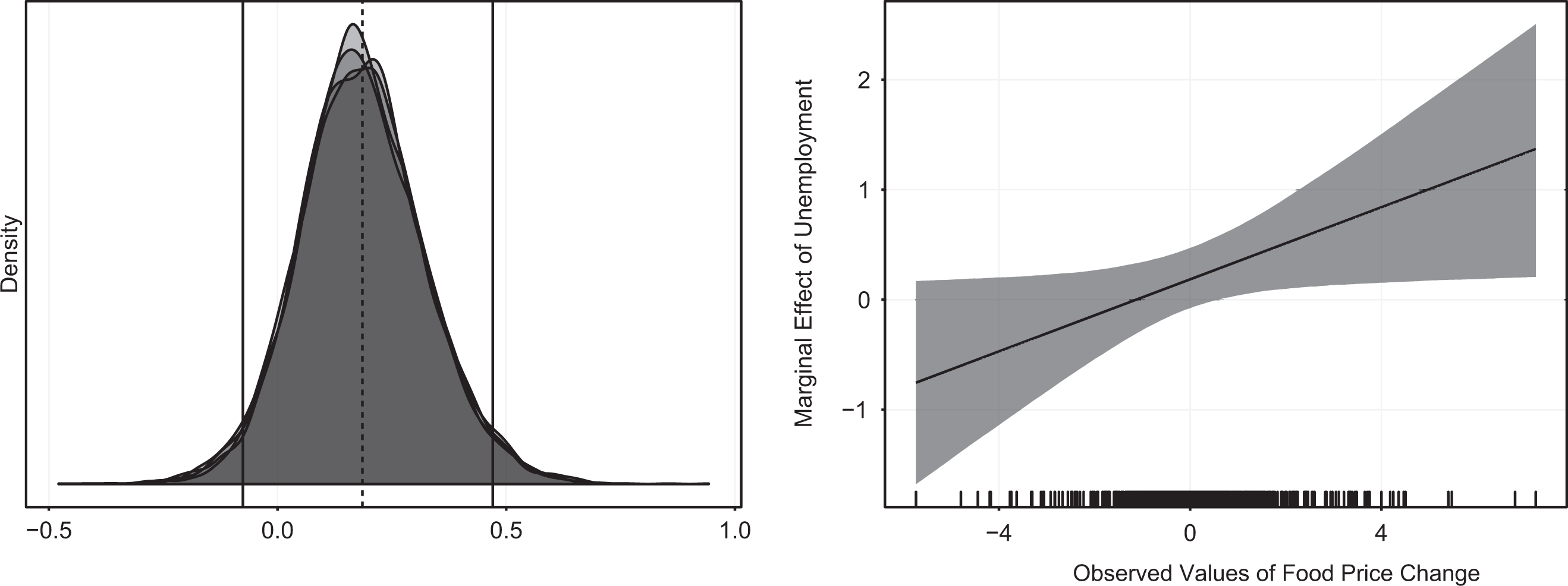
The left panel shows the conditional distribution of the β coefficient on unemployment rate conditional on an average value of lagged food price change. The dashed vertical line shows the point estimate, and the solid vertical lines mark the upper and lower bounds of the 95 percent credible interval. The right panel displays the marginal effect of unemployment rate across values of lagged food price change along with a 95 percent credible interval.
H3 suggests an interactive effect between lagged food price and unemployment rate in which violent escalation will be especially likely when these variables both take on high values. The results of my analysis support the claim in H3. To explore this relationship further, I consider the substantive impact of each variable by examining their effect on the predicted probability of violent escalation. In Figure 4, I plot the probability of escalation across values of relative food price (left) and unemployment rate (right). For each panel, I plot three predicted probabilities with the interacted variable held at its mean, fifth quantile, and ninety-fifth quantile along with 95 percent credible intervals.
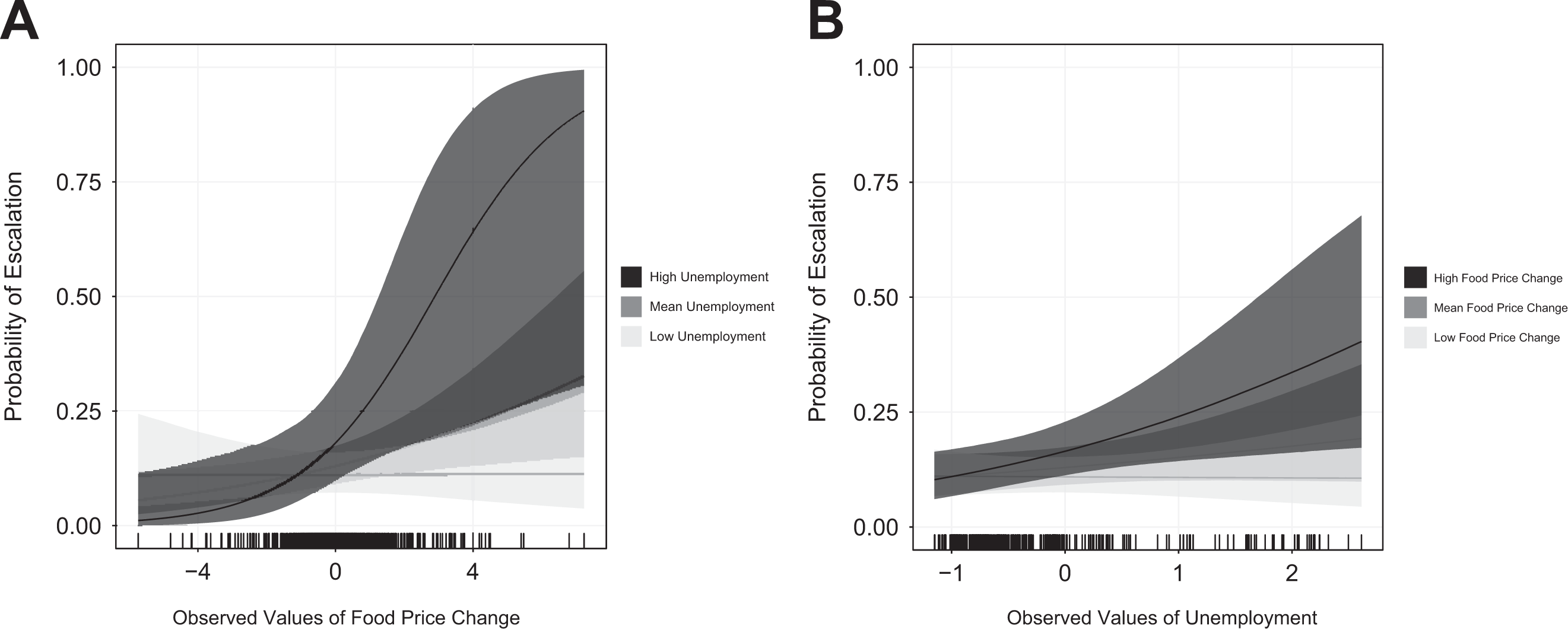
This figure shows the predicted probability of escalation across values of lagged food price change in panel (A) and across values of unemployment rate in panel (B). For each panel, I plot the point estimate and 95 percent credible interval conditional on low, medium, and high levels of unemployment rate and lagged food price change, respectively.
When unemployment rate is fixed at its mean, the predicted probability of escalation increases from 6 percent to 33 percent as lagged food price change moves from its minimum to its maximum. However, when unemployment rate is fixed at its ninety-fifth quantile, the probability of escalation moves from 1 percent at the minimum value of lagged food price change to 90 percent at the maximum value of lagged food price change. A similar relationship holds when fixing lagged food price change and looking at changes in the predicted probability of escalation across values of unemployment rate. When fixing lagged food price change at its mean, the predicted probability of escalation increases from 11 percent to 19 percent as unemployment rate moves from its minimum to its maximum. When lagged food price change takes on the value of its ninety-fifth quantile, however, the probability moves from 10 percent to 40 percent as unemployment rate increases from its minimum to its maximum. These results suggest that there is indeed a strong interactive effect in which escalation becomes especially likely when both lagged food price change and unemployment rate are high.
For H4, I argued that spontaneous demonstrations are more likely to result in violent escalation than organized demonstrations. The coefficient on organized has a point estimate and 95 percent credible interval that is entirely negative, lending support for this hypothesis. The left panel of Figure 5 shows the posterior density of organized protests with its point estimate and 95 percent credible interval marked. The right panel of Figure 5 displays boxplots of the predicted probability of violent escalation for spontaneous and organized protests. The thick horizontal bar shows the median predicted probability, and the thin bars represent the first and third quartiles of the predicted probabilities. The whiskers approximate a 95 percent credible interval, and the points beyond the whiskers are outlying observations. When a demonstration is spontaneous, my model predicts roughly a 13 percent probability of escalation. When an event is organized, however, this probability drops to about 9.6 percent. Thus, I am confident that organized demonstrations have a negative impact of the likelihood of escalation.
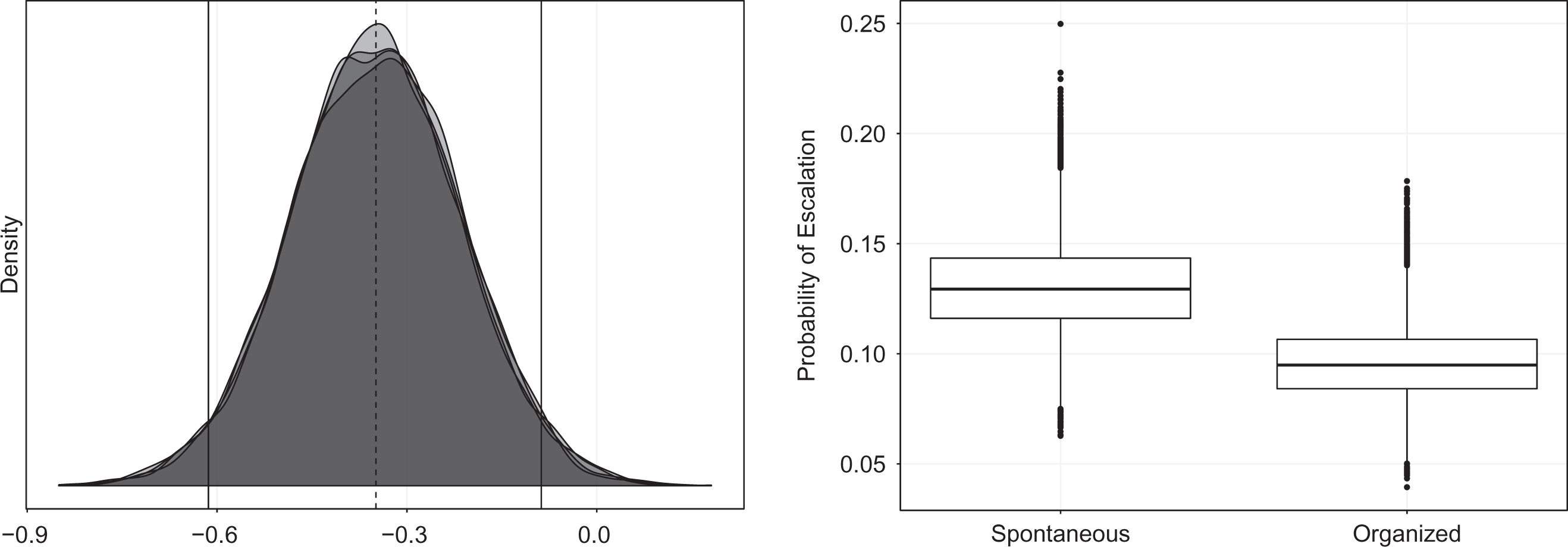
The left panel shows the marginal posterior distribution of the β coefficient on organized along with the point estimate and 95 percent credible interval. The right panel shows the predicted probability of escalation for spontaneous and organized demonstrations. The thick horizontal line in each box shows the median predicted probability. The thin bars are the first and third quartiles of the predicted probabilities, and the whiskers approximate a 95 percent credible interval.
I find that two of the regression coefficients on my control variables are statistically different from 0. First, I find that a binary indicator of rural events are positively related to the likelihood of violent escalation. This is likely because events in less populated locations are at a greater risk of collapse, leading protesters to be less patient. Second, a country’s GDP per capita is associated with a decreased likelihood of violent escalation. This finding is consistent with the idea that more developed states will experience less violence in general. Interestingly, variables that are theoretically important such as the previous occurrence of repression and the state of the economy as measured by GDP growth are statistically indistinguishable from no effect.
Conclusion
Aggrieved actors often form nonviolent opposition groups in an attempt to gain concessions from the government, but they do not always remain peaceful. Rather than considering the strategic interaction between an opposition group and a government, I conceptualize a group’s observed behavior as an aggregation of individual preferences. I argue that the diverse preferences of individuals and nature of cascade dynamics in protests necessitate a focus on factors that predict individual violent escalation. Furthermore, the time horizons of grievances lead protesters to be more of less impatient. Peaceful demonstrations are more likely to escalate to violence when individual members are impatient, meaning that they are unsatisfied with the effectiveness of nonviolent direct action or believe that collective action is unsustainable. Specifically, I identify the food price increases, unemployment rate, and whether a demonstration is organized or spontaneous as factors that affect individuals’ decisions of whether or not to engage in violence. I find support for my hypotheses that violent escalation is more likely when the food price increases, unemployment rate is high, and events are spontaneous. Additionally, I find a strong interactive effect between food price changes and the unemployment rate which suggests that violent escalation is especially likely when both of these values are high. While my study cannot rule out all alternative explanations for violent escalation, the findings of my analysis provide evidence consistent with my expectations.
These findings stem from a novel rational theory of escalation with similar predictions of classic theories of grievance formation and relative deprivation. While most studies consider the effects of relative deprivation on large-scale actions such as rebellion, this study extends the theory to individual events. In addition, this research builds upon theories of collective action by showing that, for single events, the failure of collective action can result in isolated incidents of violence. Rather than always inhibiting rebellion, collective action problems can sometimes spark short-term violent escalation. This project also continues the trend of using Bayesian methods to estimate the relationships between explanatory variables and outcomes when traditional maximum likelihood methods fail.
Additionally, this study opens several future avenues of research. The most important next step in this process is to develop and test an argument for the government’s decisions. It will be essential to study the conditions under which governments choose to delay, initiate repression, or concede. One other potentially important question involves studying whether there is an intervening step between economic stress factors and violent escalation. Specifically, it is possible that economic stress factors increase participation rates in nonviolent protest, and the greater number of participants leads to violent escalation. Additionally, future studies should attempt to better incorporate the role of leadership in tactical decision-making. A leader’s control of a group could have a large impact on outcomes, but the variation in types of leaders and the power that they wield makes data collection on nonstate leaders difficult. Finally, it would be useful to relax the assumption that opposition groups prefer to use nonviolent tactics originally. Future work should investigate the causes of initial tactical decisions.
Beyond academic interests, this project has broad policy implications. Policy makers should be concerned with factors that influence the onset of violent conflict, and this study has outlined several characteristics of nonviolent demonstrations that have the potential to turn violent. My results suggest that food security and employment assurance are essential components in mitigating the risk of violent escalation. Interestingly, food prices seem to affect the probability of escalation more than the unemployment rate. Therefore, policy makers may prioritize policies that better assure food security and, to a lesser extent, employment availability in an attempt at conflict prevention.
Supplemental Material
Supplemental Material, sj-pdf-1-jcr-10.1177_0022002719890669 - Hunger to Violence: Explaining the Violent Escalation of Nonviolent Demonstrations
Supplemental Material, sj-pdf-1-jcr-10.1177_0022002719890669 for Hunger to Violence: Explaining the Violent Escalation of Nonviolent Demonstrations by Daniel Gustafson in Journal of Conflict Resolution
Footnotes
Author Note

Acknowledgments
The author would like to thank Brice Acree, Navin Bapat, Mark Crescenzi, Stephen Gent, Elizabeth Menninga, Santiago Olivella, Lindsay Reid, and the anonymous reviewers for their helpful comments.
Declaration of Conflicting Interests
The author(s) declared no potential conflicts of interest with respect to the research, authorship, and/or publication of this article.
Funding
The author(s) received no financial support for the research, authorship, and/or publication of this article.
Supplemental Material
Supplementary material is available for this article online.
Notes
References
Supplementary Material
Please find the following supplemental material available below.
For Open Access articles published under a Creative Commons License, all supplemental material carries the same license as the article it is associated with.
For non-Open Access articles published, all supplemental material carries a non-exclusive license, and permission requests for re-use of supplemental material or any part of supplemental material shall be sent directly to the copyright owner as specified in the copyright notice associated with the article.
