



Abstract
The explosion of cities and megacities has increased scholars’ and policy markers’ attention to the effects such changes might have on conflict: increasingly, urban environments may alter the nature of warfare but not necessarily the incidence of intrastate war. We argue that high levels of urban concentration—the concentration of populations in one or relatively few urban centers—increases both the likelihood of civil wars and their intensity. Urban concentration limits the ability of the state to project power across space, exacerbating grievances in rural areas, easing rebel control of territory, and enhancing their military strength. At the same time, cities become high-value loci of contestation even as urban warfare constrains conventional state military strength. The result is more symmetrical fighting producing more battle deaths. Cross-national regressions show that urban concentration exerts a crucial effect on the likelihood, nature, and intensity of intrastate warfare.
The global rise of cities has not only heightened skylines but also fears of future instability and turmoil (§2-3 Fie 2007; Kilcullen 2013). The future of warfare, scholars and analysts argue, can be found in cities (Peters 1996; Hahn and Jezior 1999; S. Graham 2004; Adamson 2015; Gentile et al. 2017; Konaev and Spencer 2018). To prepare, the US military has invested hundreds of millions of dollars in Military Operations in Urban Terrain, including the construction and expansion of state-of-the-art training facilities and the development of new training systems (Loc 2011; Watson 2011). 1 Ongoing and protracted interventions in Iraq and Afghanistan have particularly predisposed the armed forces of the United States and its allies to assume that future challenges for counterinsurgents will be closely tied to the dynamics of fighting in tight physical spaces, in densely populated areas, and among enemies connected both physically and informatically to one another.
While urban centers may play an increasingly important role in the nature of warfare (Brathwaite and Konaev 2017), we argue that the relationship between cities and high-intensity civil war is profoundly conditioned by urban geography, most notably the degree of concentration (or, conversely, dispersion) of urban populations across a country’s cities. We contend that higher levels of Urban Concentration—meaning that a majority of a country’s population reside in few major urban centers or even just one—increases the probability of experiencing high-intensity civil war. When a country has a high level of urban concentration, the central government typically retains complete control of only the capital and perhaps a few other key cities, leaving peripheral communities largely untouched by state institutions. The lack of state control over villages in the periphery, and its failure to deliver resources to such areas, exacerbates local grievances among rural communities and allows rebels to harness this resentment to mobilize (Bates 1981; Wallace 2013; Thomson 2016). Not only can rebels mobilize more easily in countries with high levels of urban concentration, but the lack of state presence in these rural spaces allows rebels to more easily gain control of territory where they can train, prepare, stock weapons, and seek foreign aid without hindrance (McColl 1969), resulting in better trained and better equipped rebels. Urban concentration, in short, enhances rebels’ military strength.
Yet unlike urbanization—which could mean urban population growth spread across numerous cities—high urban concentration means that rebels need only capture one or a few high-value cities to gain complete control of the vast majority of the country’s urban population and wealth, as well as state power and resources. Because the control of one or a few cities is essential to both rebel success and state perseverance, the two forces frequently confront each other in urban centers (Brathwaite and Konaev 2017; Konaev and Spencer 2018; Landau-Wells 2018).
Warfare in urban areas, however, is a hindrance to the state’s conventional military forces, which must abandon heavy artillery, heavy armored infantry, and other technological advantages in favor of the lighter and more mobile units more suited to the complex and multidimensional landscape of urban warfare (Vautravers 2010; Brathwaite and Konaev 2017; Desch 2001; US Joint Chiefs of Staff 2013). Moreover, access to medical care is frequently limited, and heavy-handed state responses to rebel attacks may drive urban civilians to support rebel groups (Vautravers 2010; US Joint Chiefs of Staff 2013). These tactical and operational challenges inherent to urban combat have the effect of limiting the total power of a conventional state military. The result is two more evenly matched foes: governments constrained by urban environments and rebels strengthened by state absence in the peripheries. The symmetry of opposing forces raises the probability of high-casualty conflicts and battle deaths in states that have high levels of urban concentration (Balcells and Kalyvas 2014).
Empirically we show that urban concentration and high-intensity civil war onset—defined as civil wars that result in total casualties of at least 1,000 people in a given country-year—are highly correlated with one another, even after controlling for a rich set of factors that might confound that relationship. We also assess how urban concentration affects civil war battle deaths once conflict is already underway. Our cross-national regressions support our hypothesis that urban concentration is positively associated with high-intensity civil war onset and civil war battle deaths, with results that are robust to the addition of a battery of control variables, multiple estimators, and additional robustness checks that include a test of our proposed mechanisms.
We make a number of theoretical and empirical contributions to the literature on state breakdown, political order, and civil war. First, we provide a set of theoretical mechanisms through which certain configurations of spatially distributed populations—urban concentration—can undermine or create challenges for political order. Second, we provide a set of mechanisms for how this spatial distribution of populations affects the onset and intensity of civil war. Third, we then test our hypothesized relationship and show that urban concentration has a profound and robust effect upon the likelihood of civil war onset and the intensity of lethal civil war violence. Our work ultimately aims to contextualize some microlevel processes within slower-moving, structural factors that influence intrastate conflict and its nature. Taken together, these contributions provide both scholarly insights into the determinants of political disorder while also offering policy makers lessons for how to avoid the potentially pernicious effects of urban concentration.
Urban Concentration and State Institutions
As megacities and urban centers have become increasingly prominent, especially in the global South, scholars have sought to understand how cities shape violence and internal threats to regime stability. Here, we look to one factor that is likely to shape (in)stability: urban concentration. Urban concentration refers to how people are distributed across cities in a given territory. When the majority of a country’s population resides in few major urban centers, typically one or two, urban concentration is high. When people reside in a country with a constellation of multiple urban centers, urban concentration is low.
The concentration or dispersion of people in cities tends to be directly related to the concentration or dispersion of state power, either as a mere consequence of the concurrent concentration of wealth and power or as a conscious policy meant to mollify those in urban centers. 2 In the modern era, cities are responsible for a disproportionate share of economic activity, tax revenue, and are the main locus for political organization and mobilization (Jacobs 1984). State power tends to accumulate around these focal points, from which it emanates out into the peripheries (Tollefsen and Buhaug 2015). Even in many European countries, where the coercive apparatus of the state was often positioned in the hinterland to defend against external aggression (Tilly 1992), other elements of state presence remained concentrated in core cities. In other regions, where interstate warfare played a smaller role in the formation of the modern state, the concentration of state institutions in urban centers tends to be even more pronounced (Herbst 2000b). In countries with low levels of urban concentration—with multiple urban centers dispersed throughout its territory—state power is more evenly distributed, increasing the state’s ability to project power across space and into more rural areas. In countries with high levels of urban concentration—with only one or a few cities housing most of the urban population—state power and resources tend to be similarly concentrated. Rural areas are less accessible, and resources are increasingly channeled to urban populations at the expense of rural inhabitants.
As a result of this distribution of power and people arising from the dispersion or concentration of cities, we argue that higher levels of urban concentration makes conflict onset more likely and particularly more intense. Specifically, we identify two conditions that tend to foster high-intensity civil conflict: first, urban concentration produces stronger and more powerful insurgents who take advantage of peripheries to train and organize while mobilizing along local grievances, and second, these stronger insurgents tend to fight state militaries in highly prized urban centers. Because urban warfare constrains the strength of conventional armies (Vautravers 2010), what results is a confrontation between two relatively symmetric forces, producing high casualties and battle deaths (Balcells and Kalyvas 2014), frequently exacerbated by a lack of medical care (Vautravers 2010, 442). 3 We describe below each dimension of our theoretical account in greater detail.
First, in countries with high levels of urban concentration, the central government typically only retains complete control of the capital and potentially a few urban centers and overwhelmingly allocates resources to these places. Governments with concentrated populations usually continue investing in already established urban centers, and regimes tend to rely on public policies that benefit urban cores while pushing the costs of those policies onto peripheral cities and rural populations (Bates 1981; Wallace 2013). The neglected peripheries are therefore relatively deprived of good governance and social service provision, which tend to produce an increased propensity for civil conflict (Tollefsen and Buhaug 2015; Taydas and Peksen 2012; Henderson 2002). In that sense, urban concentration contributes to the “social inaccessibility” of a state, where rulers “may decide to leave backward [peripheral] zones alone: not investing in infrastructure or bureaucratic and socioeconomic institutions, and refraining from providing costly public goods that serve no greater political purpose” (Tollefsen and Buhaug 2015, 10).
As a result, rural peripheries are ideal spaces for insurgents to accumulate strength (Weidmann 2016). Drawing on preexisting social and political grievances in these areas allows rebels to harness discontent with neglected local demands or active government repression of political movements. The uneven distribution of resources results in rural resentment, giving those cut off from state power a set of reasons upon which rebels may use to mobilize the countryside (Thomson 2016). Rebel groups can more easily draw upon these grievances to form sizable movements capable of frontally contesting the state.
At the same time, in rural areas where state power is relatively limited, insurgents can take advantage of less densely populated geographical spaces necessary to establish bases, train recruits, and mobilize the peasantry (Galula 1964; Mao 1937; Guevara 2002). From these peripheral bases, insurgencies organize and strategize with comparatively fewer concerns about targeted, disruptive state repression; initiate propaganda, indoctrination, and education campaigns; and seek external support from foreign countries (McColl 1969; Fearon 2004; Lischer 2005; Salehyan 2007). If militants do have allies abroad, rural areas and small towns—particularly in border regions—make it easier for foreign states to deliver logistical support and materiel.
Therefore, at higher levels of urban concentration, we expect that rebel groups that emerge to contest the state are more militarily capable. Persistent rural grievances facilitate rebel mobilization and recruitment, while the absence of the state allows rebels to more easily capture territory where they can train, prepare, propagandize, and liaise with supportive foreign governments unimpeded. In the rural spaces of highly concentrated states, rebels gain considerable strength and emerge as a serious fighting foe.
Second, high levels of urban concentration make principal urban centers clear, valuable targets for both the state and the rebels, and contestation between rebels and states is more likely in these places. Rebels know that state power and resources are concentrated in a relatively few, specific locations: urban centers. Defeating the state means capturing the urban core, so rebels must move from rural bases where they’ve gained in strength to contest the state: rebels who have had space to accumulate strength bring their forces to bear on one or a few key targets.
At the same time, states recognize that they must maintain control over the spaces that are most strategically valuable to them and where their greatest strength rests: cities. State militaries send their counterinsurgent forces to fight against stronger rebel groups in these urban centers (Brathwaite and Konaev 2017; Konaev and Spencer 2018; Desch 2001) in order to entrench themselves in these highly valuable places. For states, survival means protecting its most valuable asset, the urban core. This means that both rebel and state forces move to fight one another in urban centers.
The Angolan Civil War represents how urban concentration and the symbolic value of cities structure the nature of war. In June 1975, US Secretary of State Henry Kissinger accurately predicted that if the People’s Movement for the Liberation of Angola (MPLA) were successful in controlling the capital and by far largest city, Luanda, they would have the upper hand against rebel challengers. 4 In the decades of civil war that followed, the MPLA’s continued control of Luanda, despite its primary rebel foe’s control of extensive swaths of Angola’s hinterland and smaller towns throughout the country, 5 translated into continued control of the state apparatus and international recognition as the legitimate representative of Angola.
Contestation in urban centers, however, is frequently challenging for a government’s conventional forces. In densely populated, highly urbanized locales, the government’s conventional forces confront trade-offs (US Joint Chiefs of Staff 2013, vii-viii). On the one hand, governments could unleash the full potential of their military arsenal and all conventional weapons at their disposal but frequently at the cost of catastrophic financial and infrastructural damage, alongside mass casualties and loss of human life. On the other hand, governments could choose to restrain their use of conventional weapons and forego aerial assaults and heavy artillery to prevent widespread destruction, but in ways that essentially reduce the differences in capabilities between rebels and governments.
During urban warfare, governments can still deploy their full range of weapons, but only at great cost: urban centers will suffer devastating damage, potentially razing one of if not the only city in a country. If states unleashed their full conventional arsenal, they could cause significant civilian casualties and weaken their critical support infrastructure (Vautravers 2010, 442; US Joint Chiefs of Staff 2013). Together, these two consequences of unmitigated urban warfare could simultaneously weaken the state while strengthening insurgents. Infrastructural damage, such as the loss of power or clean water and plumbing and reduced medical services, not only hinders the government’s ability to deliver care to its own soldiers (thereby increasing fatalities), further increasing government casualties, but also provokes resentment among wounded civilians or civilians still trapped in the city (Vautravers 2010, 442). At the same time, violence in cities draws media attention to the cause and helps signal insurgent strength (Zhukov 2012), while the publicity arising from and the grievances spurred by urban warfare could together improve the ability of rebels to recruit new members from the urban core. 6 States could of course avoid further trouble by undertaking an aerial bombing campaign, but this would mean killing both civilians and government forces alongside the rebels. Finally, the long-term economic consequences of total war in urban centers could be devastating: in states with high levels of urban concentration, there are only one or a few cities. The destruction one of these few economic and political centers could inhibit economic growth for years. Because of the potential problems associated with total war in urban areas, governments are more likely to choose to limit the full range of their capabilities.
The 1996 battle of Grozny during the Chechen Civil War illustrates the trade-offs that states face during urban warfare. Despite a numerically superior force, the Russian government succumbed to rebel attacks (Evangelista 2004, 44). With Grozny slipping from their grasp, the Russian military considered completely destroying the city and all people (including many civilians and government forces) inside but ultimately decided against it because “the destruction of Grozny in August 1996 was hardly a reasonable option: Thousands of MVD troops were trapped in the city and most likely would have perished together with the Chechens” (Felgenhauer 2000, 1-2). Conventional state militaries are therefore constrained in their ability to rely on certain weaponry and must respond to threats in a limited way, lest they provoke urban grievances or otherwise destroy the sources of their own power. Urban concentration therefore limits state militaries’ use of force.
Given that (1) governments are more likely to constrain their use of conventional weapons in urban areas and, (2) in countries with high urban concentration rebel groups are typically stronger, when states and rebels confront one another in cities, they will be more evenly matched. This symmetry in capabilities increases battlefield casualties (Balcells and Kalyvas 2014). The urban environment also exacerbates casualty rates as critical infrastructure and medical care become limited as a result of urban warfare (Vautravers 2010, 442; US Joint Chiefs of Staff 2013).
The Liberian and Lebanese conflicts reflect well the dynamics outlined above. Lebanon and Liberia both had above-average urban concentration at the start of their civil wars. In 1975, civil war emerged in Lebanon, pitting Christians, Sunnis, Shi’ite, leftists, and nationalists against each other. Militias on all sides of the conflict were supported and sponsored by foreign governments, including Israel, Syria, and Iran, while many rebel groups enjoyed balkanized control of urban and rural slices of Lebanon. Yet symmetric, conventional warfare (Kalyvas and Balcells 2010: see appendix) largely took place between factions, with frequent conflicts in Beirut, Lebanon’s primary major city and capital (O’Ballance 1998). From 1975 until the war’s end in 1989, best estimates of battle deaths confirm that approximately 144,000 battle-related fatalities occurred (Lacina and Gleditsch 2005). Even today, bullet holes can still be observed on the walls of Beirut’s buildings. 7 In Liberia, Charles Taylor and his National Patriotic Front of Liberia (NPFL), supported and strengthened by the Ivory Coast (Salehyan 2009, 15), charged through rural Liberia, capturing territory and establishing a local administration (Reno 2001, 202-3). From this base, the NPFL laid siege to the capital city, Monrovia, matching the albeit limited fighting capabilities of the Liberian state in a symmetric, nonconventional conflict (Kalyvas and Balcells 2010: see appendix). All told, some 22,500 people died in battle-related deaths in Liberia from 1989 to 1995 (Lacina and Gleditsch 2005).
In both cases, countries with above-average urban concentration fostered conditions ideally suited for rebel groups to mobilize and hold territory in the peripheries, where they trained and organized while receiving support from foreign patrons. As our theory would predict, these rebels—facing high levels of urban concentration—were stronger and better equipped. Also consistent with expectations, fighting predominantly occurred in the capital city. Furthermore, as our theory contends, the nature of warfare between the groups was symmetrical: relatively evenly matched forces fought in both nonconventional and conventional ways (Kalyvas and Balcells 2010: see appendix), resulting in high-intensity civil war with annual average battle deaths of approximately 4,000 in Liberia and 10,000 in Lebanon (Lacina and Gleditsch 2005).
To summarize, higher levels of urban concentration mean state power typically rests in one or a few urban centers but does not penetrate peripheral regions. As a result, states tend to tailor policies to the benefit of urbanites at the expense of those in rural locales. Rebels harness both state absence in the rural area and in the rural grievances to recruit, train, and gain in strength. At the same time, in countries with high levels of urban concentration, both states and rebels recognize that survival on the one hand or victory on the other can be found in the cities and both the state and rebel forces move to these urban spaces. Because of the nature of urban warfare, however, state militaries have strong incentives to constrain their conventional arsenal and limit their range of capabilities. The fighting therefore unfolds between two relatively evenly matched forces: relatively strong rebels who have cultivated power in the countryside pitted against a constrained state military. The two more evenly matched foes produce greater battle deaths against one another (Balcells and Kalyvas 2014), with casualty counts frequently exacerbated by the challenges of the urban environment. High levels of urban concentration explain the onset of high-intensity civil war (Vautravers 2010, 442; US Joint Chiefs of Staff 2013).
Importantly, the consequences of urban concentration on high-intensity civil conflict contrast sharply with the consequences of urbanization, a related but distinct factor sometimes speculated to cause domestic instability (Brennan-Galvin 2002; Klare 2002; Homer-Dixon and Blitt 1998; Goldstone 2002; Petraeus et al. 2007; Huntington 1968). Urbanization refers to a shift in the demographic composition of countries away from rural to urban, either due to population growth in cities or rural–urban migration (Fox 2017). Yet this growth in population centers may be either concentrated or dispersed over space. Indeed, greater urbanization may be more likely to occur if there are more cities in which populations are able to grow. Stated differently, urban population growth may occur across many dispersed cities and is not directly related to the conditions we identify under which high-intensity civil conflict emerges. As a result, urbanization is not inherently related to the conditions of urban concentration that produce high-intensity civil wars: countries with more dispersed urban concentration could have high levels of urbanization, which would not produce civil war or violent conflict, while urbanization may contribute to, but not cause, the conditions of high urban concentration that favor high-intensity civil conflict. Furthermore, urbanization in itself has been found to be negatively associated with prolonged and organized civil war (Urdal 2005, 2008).
In the next section, we use cross-national data to test the existence and strength of the hypothesized relationship between urban concentration and high-intensity conflict and battle deaths. We supplement our analysis with a broad set of robustness tests.
Empirics
Data
To examine the connection between urban geography and civil war, we begin with the Uppsala Conflict Data Program/Peace Research Institute Oslo (UCDP/PRIO) Armed Conflict data set (N. P. Gleditsch et al. 2002). We argue that urban concentration affects both the onset and intensity of conflict. As such, we rely on two dependent variables. First, we use UCDP/PRIO’s binary coding of the onset of high-intensity conflicts at the country-year. For these models, the dependent variable takes a value of 1 if there is a new high-intensity conflict that kills at least 1,000 people in a given country-year, and 0 otherwise. Data are available for all country-years from 1950 to 2010. Second, to capture variation in intensity during conflict, we use PRIO battle death estimates, a commonly used measure of conflict intensity (Lacina and Gleditsch 2005). Battle death data are available for all countries for the years 1950 to 2008. As such, we are able to measure not only the beginning of high-intensity conflicts but also variation in the intensity of conflict across countries and over time. 8
For our key independent variable, Urban Concentration, we draw on data from the UN World Urbanization Prospects for population figures in major cities from 1950 through 2010, with major cities defined here as those with more than 750,000 inhabitants (United Nations 2012). For countries that have no cities that meet that threshold, we count the largest city. Using a much lower cut point, such as 300,000, yields very similar results, as we demonstrate in the Online Appendix.
Operationalizing urban concentration is complex, as there is no consensus, even among geographers, on how to conceptualize and measure it. Some measure urban concentration as the share of a country’s total population living in the largest city, or even in the capital city, while others rely on the share of the urban population (Wallace 2013). Still others measure population dispersion as a Gini coefficient of the population as distributed over arbitrarily sized polygons across the country (e.g., Collier and Hoeffler 2004). A focus on the largest city alone, however, can obscure the degree to which the population is concentrated or dispersed beyond that one city. Using such a measure, a country (A) with only one major city that accounts for 40 percent of its urban population, while the rest is dispersed in various small cities would look exactly like a country (B) with five major cities that account for nearly 100 percent of the urban population yet in which the largest city has the same 40 percent of the urban population with the other 60 percdent dispersed throughout the other four in equal shares of 15 percent. Following the discussion in the preceding sections, however, we would expect these two countries would confront substantially different incentives for both insurgent mobilization and government repression, therefore changing the probability of experiencing civil war. 9
To address this conceptual distinction, we use a Herfindahl–Hirschman Index of urban concentration (henceforth HHI-U). The HHI-U consists of the sum of the squared shares of a country’s urban population living in each major city. This produces an index ranging from (approaching) 0 (less concentrated) to 1 (more concentrated) that places greater weight on skewed distributions. An HHI-U of 1 represents total concentration in one city. This level is usually found only in city-states like Singapore which by virtue of their particular geography—no territory outside the city—fall outside the scope of our theory. Flatter distributions approach (but never reach) 0. The US today, for example, has a HHI-U of approximately 0.016, which is significantly higher than Germany’s 0.005, but still much lower than the Congo’s 0.45 or Kuwait’s 0.75. Returning to our hypothetical countries mentioned above, A and B, they would rate 0.16 and 0.25, respectively. While this might not seem like much of a difference, they are approximately one standard deviation apart in our real-world data. The map below, in Figure 1, shows the geographic distribution of the Urban Concentration variable in 2010.

Urban concentration in 2010.
Because the UN population data used to calculate the HHI-U are reported in five-year increments and interpolated, we lag our measure of urban concentration by five years to ensure that the level of urban concentration as measured on any given year precedes the onset of conflict.
We also control for a number of potential confounders. One set of potential confounds includes population and sociodemographic factors present in a country-year. The first, urbanization, refers to the percent of persons living in urban areas in a country. Because of its theoretical importance, we review the distinction between urban concentration and urbanization, and why we include the latter as a control. We expect urban concentration—the distribution of urbanites across one or many cities—to affect the probability of civil conflict. Yet degree of urbanization—the percentage of people living in urban as opposed to rural areas writ large—is highly and positively correlated with overall economic and social development and state capacity and thus likely to be negatively correlated with civil war onset, if at all. As previously discussed, while urban concentration and urbanization are conceptually related, the degree of correlation between urbanization and urban concentration is fairly low and indirect: while urban concentration tends to be higher in highly rural countries, this correlation is not very strong. 10 Countries can be highly urbanized and dispersed (the United States and Germany), mostly rural and highly concentrated (Rwanda and Uganda), both highly urbanized and highly concentrated (South Korea and Uruguay), or mostly rural and dispersed (India). Moreover, we expect the effects of urban concentration to be largely independent of a country’s overall level of urbanization. 11
The second sociodemographic control variable we include is the size of the country’s total Population (logged; United Nations 2015), as larger populations are thought to allow rebels to better hide from superior regime forces, and more populous countries tend to be less concentrated. Third, we include the variable Discrimination that captures the size of the largest discriminated minority as a percent of other ethnic groups in the country (from Buhaug, Cederman, and Gleditsch 2014), which may help capture intergroup grievances that could cause intense civil conflict. It is important to account for this because urban concentration and other forms of geographic inequality—and the policies that cause them—may stem from particular geographic distributions of ethnic or political groups within a country and inequalities between them. Fourth, we add a variable for Youth, measured as the percentage of a country’s population aged 0 to 24: this variable has been shown to affect society’s mobilizational capacity and potential for violence, especially in urban settings Urdal (2006). While Urdal (2006) focuses on share of population aged 15 to 24, we expand the age-group to include younger children, many of whom are used in combat and support functions in armed conflict around the world. 12 We expect that youth bulges would be particularly dangerous in countries with high levels of urban concentration.
A second set of confounding factors also include a state’s geographic features. As such, we control for a country’s Area (in millions of square kilometers; Lake and O’Mahoney 2004), as larger-sized territories are both harder for governments to project power over and urban concentration tends to be less acute in larger countries. We also include a measure for Mountainous Terrain (logged, from Fearon and Laitin 2003), which relates to rebel opportunity for rebellion and may affect urban concentration by creating physical obstacles to intercity communication or limiting urban sprawl.
Economic and political factors may also confound estimates as these may be related to the onset of bloody civil wars and have been argued to correlate with urban concentration. We add GDP per capita (logged) to account for the country’s level of economic development and state capacity (K. S. Gleditsch 2002). 13, 14 Greater levels of development have been shown to correlate negatively with both conflict and urban concentration. Regime type also affects the likelihood of conflict and potentially correlates with urban concentration. In particular, democratic regimes are less likely to experience civil conflict and tend to have lower levels of urban concentration (though see Gaviria and Stein 2000). We include the XPOLITY measure of regime type (Vreeland 2008), which we update through 2010 given that the data run through 2004. We follow the same procedure using the component indicators (Constraint on Chief Executive, Competitiveness of Executive Recruitment, Openness of Executive Recruitment), in the latest release of Polity IV. We include XPOLITY because components of the Polity IV scores include features of political unrest and political violence; to use Polity IV to predict civil unrest would bias our estimates. XPOLITY corrects for this. In robustness tests reported in the Online Appendix, Table A5, we also include alternative measures, such as the dichotomous measure of democracy from Cheibub, Gandhi, and Vreeland (2012), as well as their six-way typology of regimes.
For models that estimate the effect of urban concentration on high-intensity conflict onset, we use a logistic regression estimator because of the binary construction of our first dependent variable. For models that estimate the effect of urban concentration on civil war battle deaths (the second set of models), we use both a log-linear and a random-effects negative binomial estimators, as described below. To account for temporal dependence in the data, in most of the first set of models, we include a variable measuring years since the last conflict, as well as the squared and cubic terms for this variable (Carter and Signorino 2010).
Because we are using time-series cross-sectional data, it is possible that the significance of the relationship is overstated since observations from the same country in different years are treated as independent. We correct for this by clustering standard errors by country. 15 All time-varying controls are lagged by one year. In the Online Appendix, we also report results from a two-stage hurdle model, in which the first stage (the hurdle equation) models the occurrence of a conflict and the second models civil war battle deaths conditional on having experienced a conflict (the outcome equation).
These model specifications form the foundation of our analysis. In the robustness checks section and in the Online Appendix, we discuss a series of additional tests we conduct and controls we include to address concerns of endogeneity or omitted variable bias.
Results
Conflict Onset Results
Model 1 in Table 1 presents the bivariate relationship between urban concentration and the onset of conflicts, demonstrating that the likelihood of conflict onset increases with urban concentration. We also report results using decade and region fixed effects. 16 Model 2 in Table 1 reports results including clustered standard errors and a variety of controls described above. The coefficient on urban concentration remains largely unaffected. As expected, youth population, total population, size of discriminated group, and mountainous terrain have positive and significant coefficients, while urbanization and territory size have the expected negative signs but are not statistically significant in most models. 17
Urban Concentration and Civil War Onset 1950–2010.

Note: Standard errors in parentheses. Models 2–5 include controls for Urbanization, Discrimination, Population, Percent Youth, Area, Terrain, GDP Per Capita, X-Polity, Peace years, and their cubic polynomials.
*p < .10. **p < .05. ***p < .01.
To facilitate the interpretation of the substantive effect of urban concentration, Figure 2 shows the predicted probability of onset from model 2 at varying levels of urban concentration. It shows that although the probability of civil war outbreak in any given year is always small, the probability of onset is approximately twice as high for states in the 90th percentile of Urban Concentration, 18 compared to states in the 10th percentile. 19 This difference is statistically significant at a 0.005 level. In fact, despite the overlapping confidence intervals in Figure 2, postestimation tests reveal that the differences are statistically significant across virtually the entire range of the independent variable (covering more than 98 percent of the country-year observations), though differences become less significant as the observations become scarcer at extremely high levels of urban concentration.
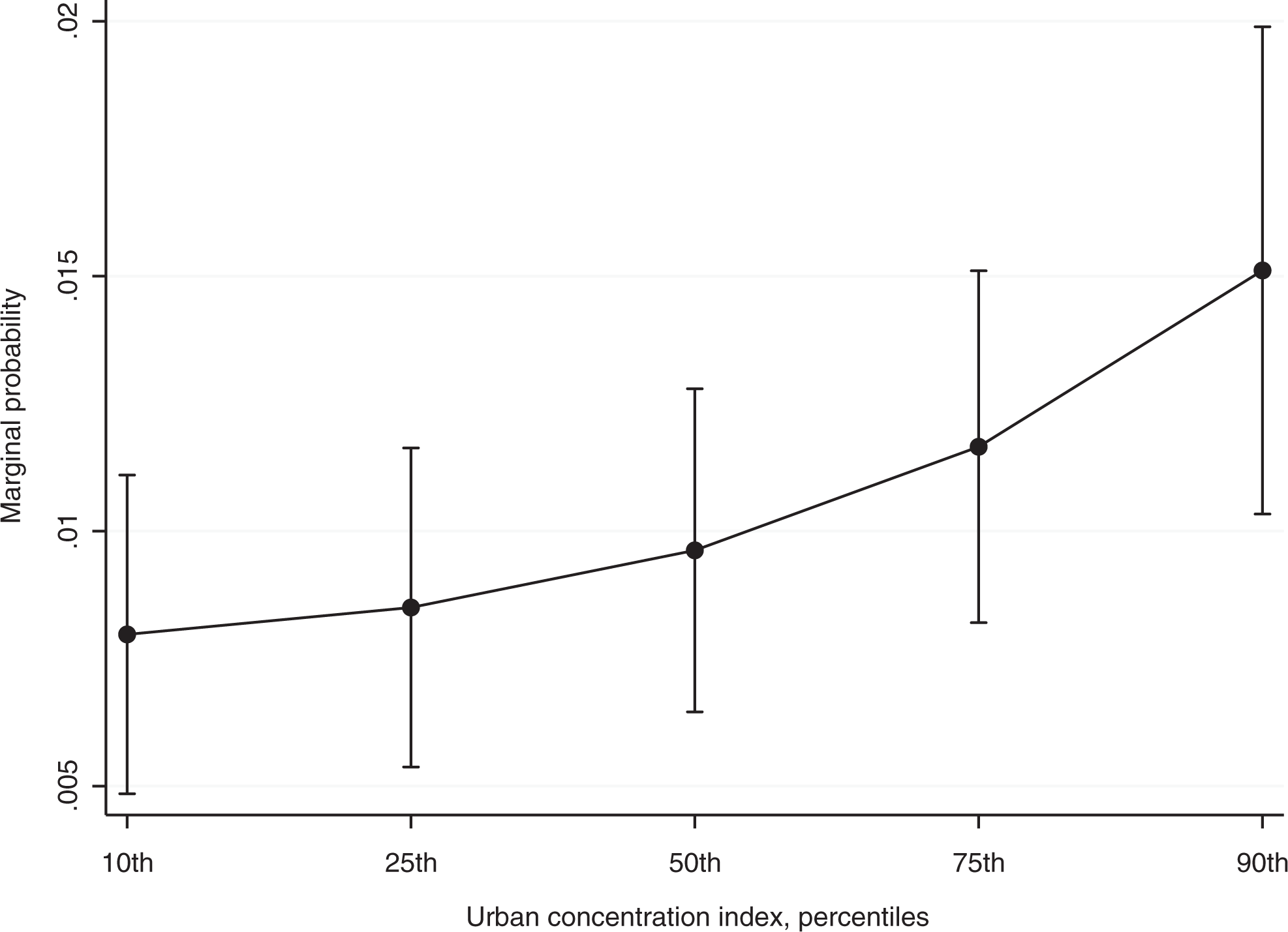
Predicted probability of civil war onset given urban concentration. All differences are significant at p < .01.
In model 3, we do not lag the urban concentration variable: the results become more significant, possibly because of the increase in the number of observations. In models 4 and 5 of Table 1, we present results using the same controls as model 2 but with fixed effects for decade and region, 20 respectively. The coefficient for Urban Concentration is robust to these changes in model specification.
To examine model fit, the separation plot in Figure 3 (Greenhill et al. 2011) matches high-probability predictions from our base model in Table 1, model 2, to actual occurrences of the event of interest and low-probability predictions to nonoccurrences of the event of interest. Dark and light panels correspond to actual instances of events and nonevents, respectively, and are ordered with corresponding
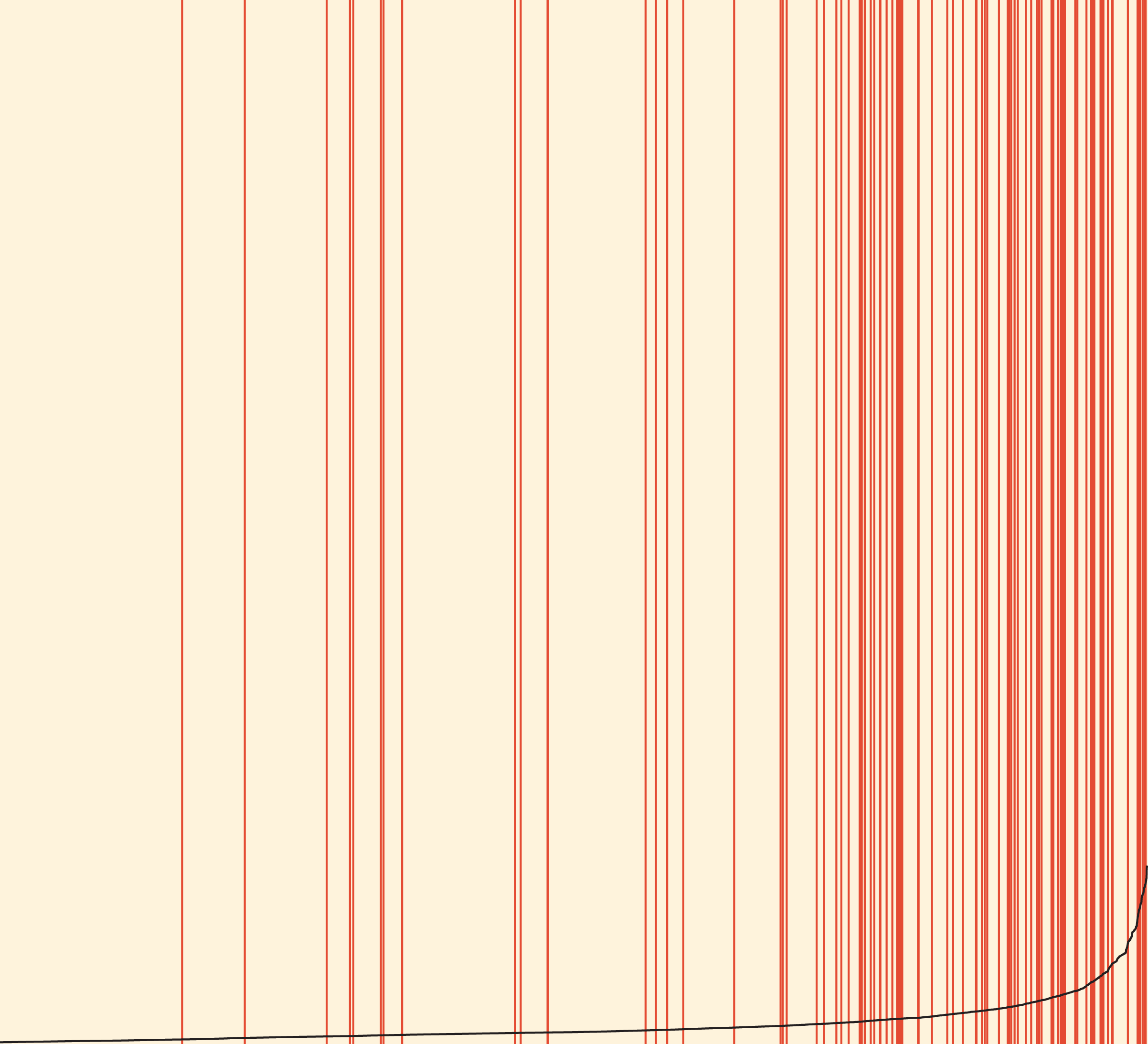
Separation plot, model 2. Lines concentrated on right-hand side indicate good model fit.
Battle Deaths Results
For a more granular picture of conflict intensity, Table 2 examines the determinants of battle deaths during conflicts, using both a log-linear and a random-effects negative binomial estimator. The battle deaths variable is taken from the PRIO data set, using their lower, more conservative estimate of annual battle deaths (Lacina and Gleditsch 2005). 21 The same controls are included as in Table 1. 22 The large, statistically significant and positive coefficient for Urban Concentration in both bivariate and multivariate models, using log-linear and negative binomial models, indicates that urban concentration prompts more intense civil wars and that this variation holds across countries and within countries over time. Figure 4 reports predicted battle deaths at different levels of Urban Concentration, demonstrating that a shift from the 10th percentile of Urban Concentration to the 90th percentile is associated with a 80 percent increase in predicted battle deaths for a given conflict-year, when all other variables are held at their means. This translates to an additional 160 deaths per year. Despite overlapping confidence intervals in the figure, all differences between point estimates are statistically significantly different from each other.
Urban Concentration and Civil War Battle Deaths, 1950-2008.
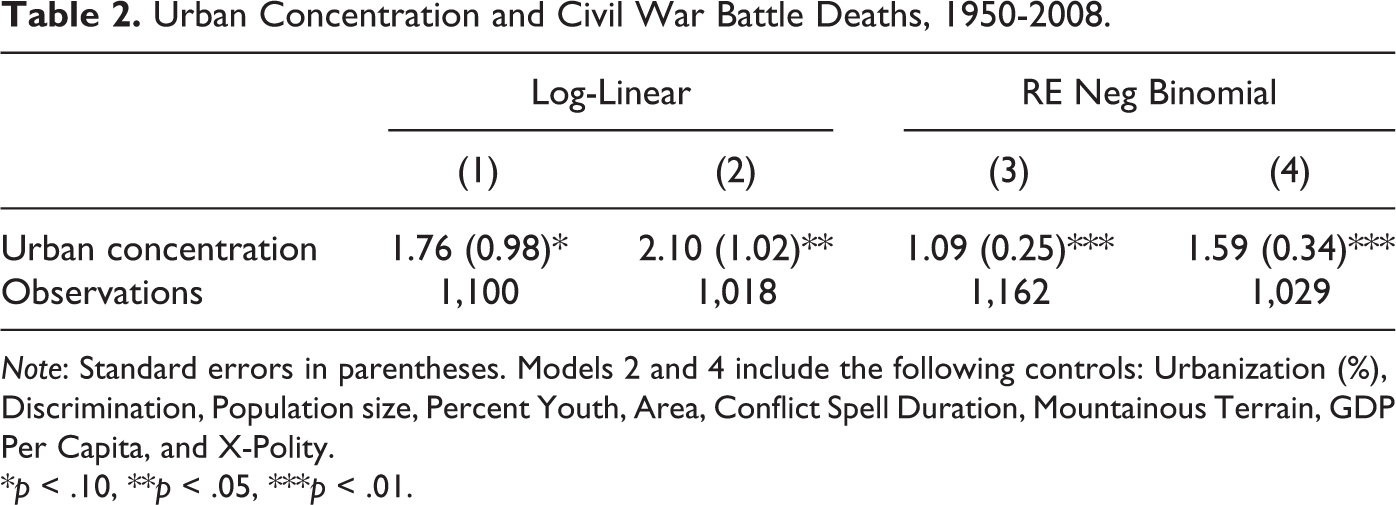
Note: Standard errors in parentheses. Models 2 and 4 include the following controls: Urbanization (%), Discrimination, Population size, Percent Youth, Area, Conflict Spell Duration, Mountainous Terrain, GDP Per Capita, and X-Polity.
*p < .10, **p < .05, ***p < .01.
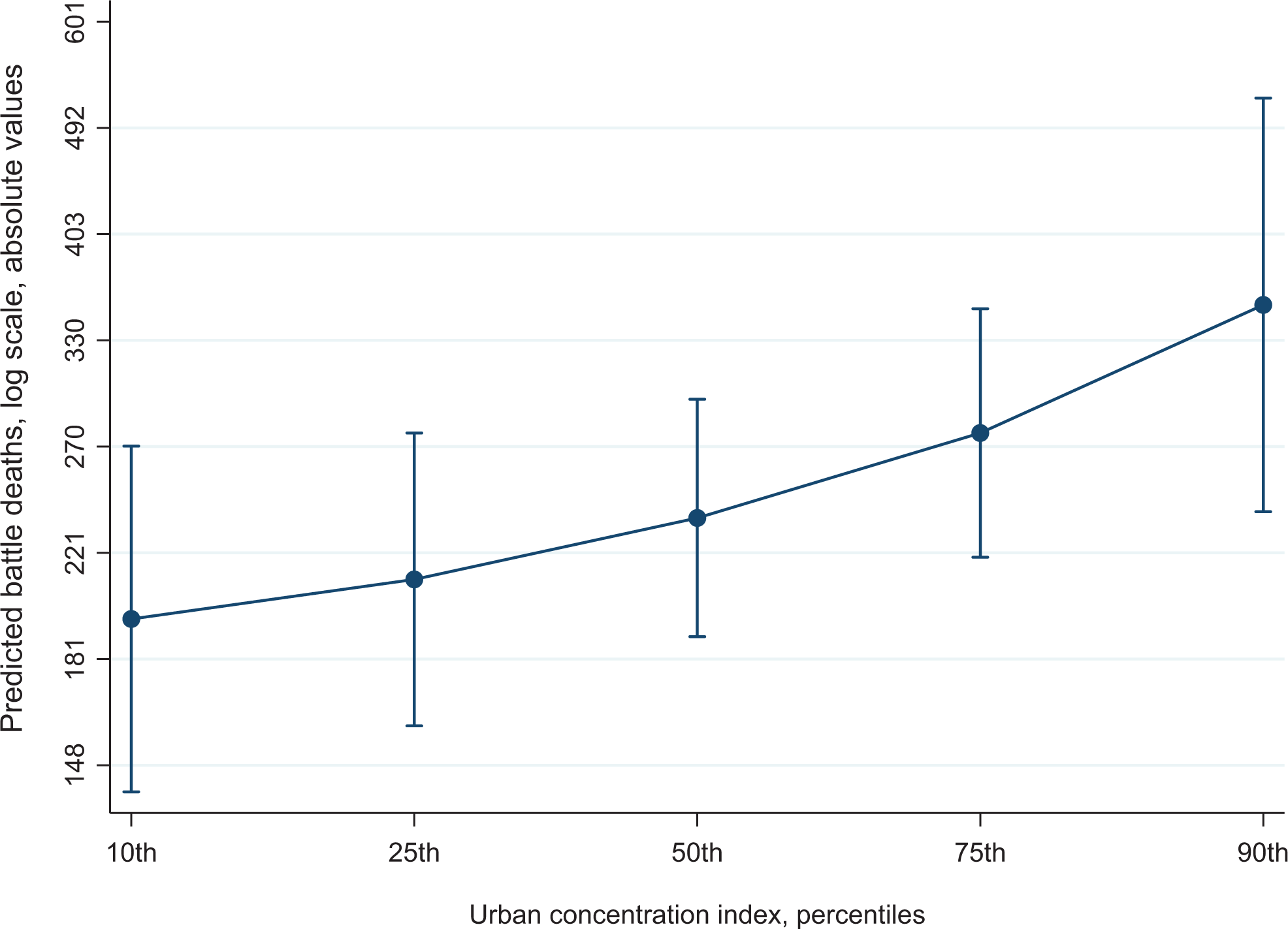
Predicted battle deaths (logged), log-linear. All differences are significant at p < .05.
Robustness and a Test of Mechanisms
Our results are robust to a number of important robustness checks, more clearly detailed in the Online Appendix but summarized here. Importantly, across almost all specifications, results remain robust. We describe each in turn.
The first major concern we address is endogeneity, in particular the possibility of reverse causation, whereby prior conflict drives urban concentration as well as subsequent conflict. We have substantive reasons to believe this is not the case. While conflicts certainly shape a country’s demography and urban geography, the effects are not homogeneous. In some cases, individuals seek safety and stability in major cities as conflict ravages other parts of the country (e.g., Afghanistan during the 1980s and again in the 2000s, when Kabul was much safer than other parts of the country). Such a dynamic would only make urban concentration higher if individuals all moved to the same city but not if populations dispersed across multiple cities. In cases where people fled to multiple cities, urbanization might increase, but not urban concentration. It is also common for a major city or major cities to become battlegrounds themselves, leading to mass displacement into rural areas or other countries, or leading individuals to seek refuge in secondary cities spared the brunt of the conflict. During the civil war in Peru (1980-2000), for example, much of the urban growth happened not in Lima but outside of it, in secondary cities like Chiclayo, Trujillo, Huancayo, and Iquitos, owing in part to the fact that these were not as ravaged by the twenty-year conflict, while Lima became a major target for both the Shining Path and the Tupac Amaru (see, e.g., Kent 1993; McCormick 1992). These patterns temporarily slowed and even slightly reversed the growing concentration in the capital city, which has since resumed. Importantly, these two dynamics can be observed in the same country during different conflicts or different stages of the same conflict, as in Afghanistan during the 1990s when Kabul became the key battleground for parties competing to replace the Soviet-backed regime (Khalilzad 1995).
Rather than make assumptions about how conflict affects urban concentration, we run a simple test comparing the mean rate of change in urban concentration during years in which there is civil conflict and years of peace. We find a small but statistically significant difference between the two groups: decreases in urban concentration are more common during conflict, thereby alleviating concerns about endogeneity. 23 Nonetheless, in the Online Appendix, we run additional robustness tests increasing the lag on the independent variable, controlling for time since any level of conflict, and dropping from the sample all countries that have experienced any prior conflict within the time period studied here (Online Appendix Table A2, model 2).
We also run models excluding individual observations through jackknifing (Table A3), removing influential outliers (Table A3), and not excluding Singapore (Table A4). 24 We also use alternative measures for regime type (Table A5); include measures for different kinds of natural resources (Table A6), account for military personnel (Table A7); include GDP growth; and include the pace of urbanization (Table A8).
Furthermore, we use two alternative measures of urban concentration. In Table A9, we use a 300,000-person threshold to identify major cities (United Nations 2015). In Table A10, we use the variable Degree of Primacy to measure the relative size of the population in the largest city. Our results are robust to these tests.
It is also possible that historical factors act as deep causes of both high levels of urban concentration and civil conflict. In Table A11, additional models control for elements of colonial history and other historical political institutions, including colonial past, whether a country was a British colony, settler mortality, among other factors. Table A12 provides pairwise correlations between urban concentration and these (and other) variables, showing that concerns with collinearity or endogeneity are likely unfounded.
We also rely on alternative estimators for our models. In Table A13, we estimate a log-linear model of civil war battle deaths; in Table A14, we estimate a negative binomial model of civil war battle deaths; and in Table A15, we use a hurdle model to estimate civil war battle deaths. Again, our results are robust to these specifications.
To further test our mechanisms, in Tables A16 and A17, we use data from the Technologies of Rebellion data set (Kalyvas and Balcells 2010). We compare conflicts with symmetric forces (conventional and symmetric nonconventional conflicts) to conflicts with asymmetric forces (irregular war) in places with above average urban concentration and below average urban concentration. The results of the cross-tabulation support expectations: of all symmetric conflicts, nearly 67 percent occur in places with above-average urban concentration. So-called Symmetric Nonconventional conflicts occur almost exclusively in countries with high levels of urban concentration. Yet of all asymmetric conflicts, only 35 percent occur in countries with above-average levels of urban concentration. These differences are statistically significant and support our theory and hypothesized mechanisms.
Conclusion
Urban geography is a fundamental determinant of political order. The evidence in this article has shown the large and positive effect urban concentration has on high-intensity civil war onset and the number of battle-deaths once conflict begins. These cross-national results are robust to a variety of model specifications and estimators, as well as the inclusion of a battery of confounders. Future research could examine the precise mechanisms connecting urban geography to patterns of armed group recruitment (as opposed to the use of violence) and could use geolocated conflict data to assess whether political violence predominantly occurs in or around urban centers or in the hinterlands.
One implication of our theory and empirical results is that some insurgencies simultaneously operate in urban centers and the hinterlands, while capitalizing on the resources of both. This dynamic has consequences for the prediction of future instances of high-intensity civil war and should not be overlooked by counterinsurgent forces when assessing rebel strengths and weaknesses.
A second implication is that while some argue that increasing urbanization makes the mobilization of urban insurgencies more likely (Kilcullen 2013), and while current US counterinsurgency policy seems to bet heavily on that scenario, our results suggest that the effect of urbanization will largely depend upon the distribution of those urban populations across national space. If populations are contained within one or a small number of cities, we may well see more high-intensity civil wars. Our argument and findings also have consequences for state-led economic development policies and the deployment of the state’s military assets across space. Governments would do well to intentionally help shape patterns of urban geography. While attempts to favor urban and financial development in the capital at the cost of the rural poor may unwittingly incentivize movement to the cities (Bates 1981; Wallace 2013), investing in multiple urban centers—as opposed to just the capital city, as is often done—could placate urban elites, deter insurgents from organizing for rebellion, and extend the geographic reach of the state. This is a useful corrective to many policy recommendations to undertake either rural or capital city development projects: the former might increase the opportunity costs of rebellion in the countryside but leave resources open for capture by armed groups, while the latter could exacerbate existing patterns of the distribution of state power and resources.
Mao (1937, 67) wrote that it is not to the government’s advantage “to wage war over a vast area…she cannot disperse her strength and fight in a number of places, and her greatest fears are these eruptions in her rear and disruption of her lines of communication.” Where incumbent governments are unable to extend their reach beyond a few key cities, reflecting an inability to develop multiple loci of power and administration across space, the threat of civil war looms. Given current demographic and geographic trends, increasing urbanization appears likely. What remains unknown is how those urban populations within a state will be distributed across space and how state institutions will conform to these geographic patterns. Governments with high degrees of urban concentration and limited administrative and military outposts in their far-flung territories will be unlikely to credibly deter rebellion and prevent the escalation of high-intensity violent conflict.
Supplemental Material
Supplemental Material, sj-bib-1-jcr-10.1177_0022002719892054 - Urban Concentration and Civil War
Supplemental Material, sj-bib-1-jcr-10.1177_0022002719892054 for Urban Concentration and Civil War by Dani Nedal, Megan Stewart and Michael Weintraub in Journal of Conflict Resolution
Supplemental Material
Supplemental Material, sj-bib-2-jcr-10.1177_0022002719892054 - Urban Concentration and Civil War
Supplemental Material, sj-bib-2-jcr-10.1177_0022002719892054 for Urban Concentration and Civil War by Dani Nedal, Megan Stewart and Michael Weintraub in Journal of Conflict Resolution
Supplemental Material
Supplemental Material, sj-bib-3-jcr-10.1177_0022002719892054 - Urban Concentration and Civil War
Supplemental Material, sj-bib-3-jcr-10.1177_0022002719892054 for Urban Concentration and Civil War by Dani Nedal, Megan Stewart and Michael Weintraub in Journal of Conflict Resolution
Supplemental Material
Supplemental Material, sj-bib-4-jcr-10.1177_0022002719892054 - Urban Concentration and Civil War
Supplemental Material, sj-bib-4-jcr-10.1177_0022002719892054 for Urban Concentration and Civil War by Dani Nedal, Megan Stewart and Michael Weintraub in Journal of Conflict Resolution
Supplemental Material
Supplemental Material, sj-tex-1-jcr-10.1177_0022002719892054 - Urban Concentration and Civil War
Supplemental Material, sj-tex-1-jcr-10.1177_0022002719892054 for Urban Concentration and Civil War by Dani Nedal, Megan Stewart and Michael Weintraub in Journal of Conflict Resolution
Footnotes
Acknowledgment
Author order chosen at random. The authors wish to thank Jeff Checkel, participants at the Georgetown University Political Science Graduate Working Group, participants at the 2015 International Studies Association Annual Meeting, Rita Konaev and, for helpful research assistance, Christine Sylvester.
Declaration of Conflicting Interests
The author(s) declared no potential conflicts of interest with respect to the research, authorship, and/or publication of this article.
Funding
The author(s) received no financial support for the research, authorship, and/or publication of this article.

Supplemental Material
Supplementary material is available for this article online.
Notes
References
Supplementary Material
Please find the following supplemental material available below.
For Open Access articles published under a Creative Commons License, all supplemental material carries the same license as the article it is associated with.
For non-Open Access articles published, all supplemental material carries a non-exclusive license, and permission requests for re-use of supplemental material or any part of supplemental material shall be sent directly to the copyright owner as specified in the copyright notice associated with the article.
