



Abstract
When rebel groups with state-building ambitions capture territory, who stays and why? Through semi-structured interviews and an original household survey in the Iraqi city of Mosul, which was controlled by the Islamic State for more than three years, I conduct a multi-method descriptive comparison of the characteristics of “stayers” against “leavers.” I test and find some quantitative and qualitative support for a theory of competitive governance: Civilians who perceived improvements in the quality of governance under IS rule—relative to the Iraqi state—were more likely to stay under IS rule than those who perceived no change or a deterioration, but displacement decisions are multi-causal, influenced by many factors including economic resources, social networks and family structures, information, threat perceptions, and ideology. These findings suggest that historical experiences with weak rule of law and bad governance by states may affect the attitudes and actions of civilians living under rebel governance.
Introduction
When rebel groups with state-building ambitions capture territory, who stays and why? This article presents data from an original door-to-door survey of 1,458 residents of Mosul and 61 semi-structured interviews conducted during fieldwork in Iraq in 2017-2018, shortly after the end of the Islamic State’s three-year rule over the city, to explore a variety of factors—social, political, economic, and psychological—that influence individual decisions to stay or leave territory captured by a rebel group with state-building aspirations. The Islamic State (hereafter “IS” but also known by its Arabic acronym, “Daesh”) is a Sunni Islamist group that claimed to be building a new caliphate based on the earliest model of Islamic governance (March and Revkin 2015). At the height of its expansion in late 2014, IS controlled and governed 20 major Iraqi cities including Mosul with an estimated population greater than 5 million (Robinson et al. 2017, 192-94). When IS first captured Mosul in June 2014, the group initially allowed civilians to enter and exit the city freely for several months. Given the choice between living in a city governed by a violent group with uncertain intentions and fleeing to areas still under the control of the Iraqi government, existing theories of conflict-related displacement would have predicted out-migration on a massive scale. Contrary to this expectation, however, an estimated 75% of Mosul’s pre-IS population of 1.2 million was still living in the city eight months after the group’s arrival (Robinson et al. 2017, 86).
Rebel groups rely heavily on civilians to obtain food, water, shelter, labor, and information (Wood 2003; Kalyvas 2006; Weinstein 2006; Lyall, Shiraito, and Imai 2015), and IS could not have captured and governed Mosul for as long as it did without the compliance and active support of some of the city’s population. Those who stayed (“stayers”) provided human and economic resources—whether voluntarily or involuntarily—that enabled IS to hold and govern territory. In some cases, staying may have been an indicator of civilian preferences for IS’s system of governance over that of the Iraqi state. As one doctor from Mosul explained in a 2014 interview why many residents of the city were accepting or at least tolerating IS rule, “As the people say, it is better than [the Iraqi] government” (Williams 2014). Another “stayer” who viewed IS favorably in comparison with the Iraqi government stated, “I have not in 30 years seen Mosul this clean, its streets and markets this orderly” (Moradi 2015).
Previous research on displacement decisions has established that decisions to stay or leave territory captured by a rebel group are multi-factorial, influenced by numerous variables including: (1) economic resources, (2) social networks and family structures, (3) information, misinformation, or lack of information, (4) threat perceptions, and (5) ideology. One factor that has been overlooked in the literature is “competitive governance,” referring to the process through which rebel groups attempt to build local support by providing services and institutions that aspire to be perceived as more legitimate, fair, and effective than those offered by the incumbent state (Kalyvas 2006; Berman, Shapiro, and Felter 2011). Out of the 1,458 survey participants, 16% reported that during the first six months of IS rule, they believed that “IS was doing a better job of governing Mosul than the Iraqi government did previously” and higher percentages perceived improvements in specific indicators of the quality of governance: 38% reported cleaner streets and 35% reported a decrease in crime. Given IS’s harsh rule and the likelihood of social desirability bias 1 discouraging respondents from expressing any support for IS in 2018 Mosul, it is surprising that a significant minority approved of IS governance. A second finding is that a descriptive comparison of the characteristics of “stayers” (those who remained in Mosul for the duration of IS rule) and “leavers” (those who fled) indicates that civilians who perceived improvements in the quality of governance under IS rule—in comparison with the Iraqi state—were more likely to stay in IS-controlled Mosul by up to 8.6 percentage points than those who perceived no change or a deterioration. Together, these findings suggest that historical experiences with weak rule of law and bad governance by states affect the attitudes and actions of civilians living under rebel governance.
The article is one of the first attempts to describe and understand the experiences and attitudes of a population that experienced IS rule since the group’s military defeat in 2017. IS is an important case of rebel governance that has affected the lives of millions. However, previous research on the group has been—for the most part—limited by the impossibility of collecting data in territory controlled by the group. Most studies of IS governance have been based on surveys or interviews with “leavers”—those displaced inside Syria and Iraq as well as refugees who have fled to other countries (Baczko et al. 2016)—or on proxy variables that can be measured from a distance such as nighttime lighting (Robinson et al. 2017) and internet-based propaganda (Winter 2018). Such data is susceptible to particular biases. For example, the testimonies of refugees tend to be prejudiced against the regime that they are fleeing (Jung and Dalton 2006). Additionally, a rebel group’s outward-facing propaganda does not necessarily reflect realities in the ground. IS’s loss of nearly all of the territory that it once controlled in Iraq and Syria presents new opportunities for data collection in places that were previously inaccessible to researchers. This article departs from previous work on IS by presenting original data on the attitudes of those who stayed. Furthermore, this data was collected in a place—Mosul—that was actually controlled and governed by IS.
Another contribution of this article is to challenge an assumption underlying the Iraqi government’s current approach to areas that have been recaptured from IS. Many civilian residents of IS-controlled territory disagreed with the group’s ideology, were victims of its violence, and only complied with its policies in order to stay alive. However, there is currently a widespread belief—among Iraqi policy makers and many other Iraqis—that anyone who lived for years under IS rule is a collaborator and therefore complicit in IS’s crimes (Revkin 2018a; Kao and Revkin 2020). As one interviewee from Mosul explained, “People assume that everyone who stayed in Mosul is an IS supporter or member, but many of us were victims.” 2 This problematic assumption has resulted in the mass incarceration of at least 19,000 people on IS-related charges since 2014 and of these, more than 3,000 have been sentenced to death (Abdul-Zahra and George 2018). By identifying a variety of social, political, economic, and psychological factors that influenced displacement decisions under IS rule—many of which are unrelated to support for IS—this article attempts to humanize a population that has been stigmatized and collectively punished.
This study also contributes to a growing literature on the “micro-politics” of rebellion by scholars including Schlichte (2009), Kasfir (2005, 2009, 2015), Mampilly (2011, 2015) and on the dynamics of civilian agency, collaboration with and resistance against rebel governance (Wood 2003; Arjona 2017; Kaplan 2017; Krause 2018) by illustrating the complexity of decision-making under conditions of fear and uncertainty. Finally, by shedding light on the drivers of and constraints on mobility during conflict, this research also has important policy implications for governments and humanitarian organizations that are trying to understand and respond to migration crises.
A Theory of Competitive Governance and Displacement Decisions
Existing theories of conflict-related displacement do not fully explain why so many Moslawis stayed in the city after IS’s arrival. Previous work has found that high levels of violence increase the likelihood of movement (Bohra-Mishra and Massey 2011). Given IS’s extreme violence—including public beheadings and beatings of civilians—as well as airstrikes by the U.S.-led Coalition starting in 2014, this research would predict significant out-migration to areas with lower levels of violence. Other work has looked at socioeconomic incentives, finding that people tend to flee to countries where they expect to find better economic and security conditions (Adhikari 2013; Davenport, Moore, and Poe 2003). In a study of conflict-related displacement in Colombia, individuals who lacked economic opportunities more likely to leave than those who possessed land and other assets (Engel and Ibáñez 2007).
Researchers have also studied how social networks and information-sharing can reduce barriers to exit (Moore and Shellman 2007; Edwards 2009; Adhikari 2013; Schon 2019) and how lack of information or misinformation can distort migration decisions (Roseman 1971). One survey of Syrians and Iraqis found that conditions of violence and poverty motivate individuals to invest in learning about migration opportunities in receiving countries (Holland and Peters 2020). Other work has explored how geography and infrastructure—such as the presence of bus stations—may either constrain or facilitate flight (Schmeidl 1997; Czaika and Kis-Katos 2009). Another line of research examines the relationship between identity and internal displacement, finding that “people tend to relocate to places where they can find others who share their political and/or ethnic identity” (Balcells 2018) and that displaced persons who share ascriptive traits “have incentives to cluster together for safety” (Steele 2018).
Although these studies have advanced our understanding of the determinants of conflict-related movement, two areas remain under-studied. First, previous work has focused primarily on “leavers.” In contrast, this article focuses on “stayers”—those who remain in rebel-controlled areas. Second, previous work has overlooked the role of civilians’ past experiences with the state in their decisions to stay or leave territory captured by a rebel group with state-building aspirations. Therefore, this article links previous research on conflict-related displacement with a growing literature on rebel governance (Kasfir 2015; Arjona 2016; Mampilly 2011; Huang 2016; Stewart 2018) that has explored the ways in which pre-existing state institutions may either constrain or facilitate efforts by rebel groups to create new political orders. For example, in Colombia, civilian resistance to rebel governance was less likely in areas where pre-existing institutions were both legitimate and effective (Arjona 2016, 71). Additionally, new research in this special issue has found that rebel governance is shaped by the legacy of pre-existing political institutions (Mampilly and Stewart 2021), that some rebel groups have created parallel judicial systems in contexts where state legal systems are viewed as corrupt (Loyle 2021), and that some rebel groups conduct elections as a strategy to differentiate themselves from incumbent states (Cunningham, Huang, and Sawwyer 2021). I build upon these findings to argue that civilian perceptions of the quality of governance provided by an incumbent state affects the displacement decisions of civilians living in territory captured by a rebel group that offers them a competing political order.
Previous research on rebel governance has explored “processes of legitimation” (Duyvesteyn 2017) through which rebel groups attempt to win the cooperation of civilians in contexts of “multi-layered governance” where multiple state and non-state actors compete for local support within the same civil war (Kasfir, Frerks, and Terpstra 2017, 263). Scholars have found that rebel groups engage in “competitive state-building” processes through which they attempt to build local support by providing institutions and services that are perceived as higher quality—in terms of effectiveness and fairness—than those offered by the incumbent state (Kalyvas 2006; Berman, Shapiro, and Felter 2011). I build upon this work to develop a theory of how competitive governance influences displacement decisions under rebel rule. I argue that mobile individuals with a choice between two or more political communities are likely to prefer the one whose quality of governance they perceive as better—or simply less bad—than the other. In the context of rebel governance, I measure quality of governance through two of its observable implications: (1) the effectiveness of governing institutions and (2) the fairness of governing institutions. Understanding perceptions of the quality of rebel governance in relative rather than absolute terms—through the perspective of civilians who observe competitive governance between a rebel group and a state—is consistent with previous work advocating a “relational” approach to the study of rebel governance (Kasfir, Frerks, and Terpstra 2017, 259) and helps to explain why a person might perceive a government as illegitimate, corrupt, or untrustworthy in absolute terms but nonetheless prefer it to an alternative that is even worse. Importantly, I acknowledge that civilian perceptions of competitive governance are not the sole determinant of displacement decisions but interact with several other factors that may either constrain or facilitate movement: (1) economic resources, (2) social and family structures, (3) information, (4) threat perceptions, and (5) ideology. My governance-based explanation is intended to supplement rather than challenge these well-established determinants of conflict-related displacement.
Primary Hypotheses
If competitive governance between rebels and states does influence displacement decisions, we should expect to find the following differences between survey respondents who fled Mosul at a relatively early stage in IS’s rule (“leavers”) and those who stayed in Mosul for the duration of IS rule (“stayers”). Due to sampling and hypothesis-testing needs discussed more fully in section “Defining “Stayers” and “Leavers,”” I defined “leavers,” as those who left Mosul before March 10, 2015 and “stayers” as people who were still living in Mosul on that date.
I test this hypothesis with survey questions that measure perceptions of crime, cleanliness of streets, electricity provision, and the overall quality of governance before and after IS’s arrival in Mosul as in the following example: “During the first six months of IS rule, were Mosul’s streets cleaner, less, clean, or the same as they were in comparison with the period immediately before IS’s arrival in Mosul?” Online Appendix 5 contains all of the questions used to operationalize this and the other primary hypotheses.
These questions focus on the first six months of IS rule because this was the period during which Moslawis were initially faced with a choice between staying or leaving, and because the effectiveness of IS governance deteriorated as airstrikes intensified after that point, making it difficult to differentiate between bad governance and the destruction of institutions and infrastructure. Conducting such a survey during IS rule, even by phone, would have been impossible for ethical reasons. For this reason, the survey questions ask respondents to recall their experiences with IS governance three years earlier. One potential concern is that such retrospective questions may yield inaccurate or biased data because memories can fade or change over time, particularly memories of traumatic events. However, several quantitative and qualitative studies have concluded that people tend to retain more accurate and vivid memories of violent events—such as those that occur during conflict—than nonviolent events (Wood 2003, 33-34). Another potential concern is that these questions may be sensitive and a common concern in post-conflict settings is that social desirability bias tends to suppress the true level of support for a rebel group due to respondents’ fears of punishment or stigmatization (Blair, Imai, and Lyall 2014). To address this concern, I designed a list experiment to assess whether a higher percentage of respondents might answer “yes” to sensitive questions if asked indirectly, and the results suggest that social desirability bias did not significantly affect the survey (Online Appendix 9).
If my theory of perceptions of competitive governance is correct, I would also expect to find support for the following hypothesis:
I test this hypothesis with data from two survey questions about the fairness of taxation in exchange for services provided in Mosul by (1) IS and (2) the Iraqi government. The design of these questions was informed by the literature on “tax bargaining” between state and society, which finds that effective taxation—without resistance or evasion by the taxable population—generally requires either representation through democratic institutions or the provision of public goods and services (Levi 1988; Moore 2008; Prichard 2015).
A third expectation of my theory is that past experiences with state-perpetrated injustice influence displacement decisions as follows:
To quantify the independent variable,
Alternative Explanations
In addition to my primary theory of competitive governance, I also expect to find some support for the following alternative explanations drawn from previous research on displacement and migration: (1) economic resources, (2) social and family structures, (3) information, (4) threat perceptions, and (5) ideology.
A first alternative explanation is that the economic resources of Moslawis may have either facilitated or impeded their departure. Those with higher levels of mobile assets would have been more likely to leave due to their greater ability to afford the costs of travel and resettlement elsewhere, consistent with research finding that socioeconomic status is an important determinant of evacuation decisions during natural disasters (Elliott and Pais 2006). On the other hand, fixed assets may have been a constraint on exit given IS’s systematic expropriation of houses and other property abandoned by “leavers.” “Stayers” may have been motivated by the desire to protect their property. In addition to the economic value of houses and land, legal scholars have argued that the ownership of private property confers important non-economic benefits including “personhood” (Radin 1981), community belonging (Cooper 2007), and dignity (Atuahene 2016). These non-economic benefits of property ownership may have created additional barriers to exit.
A second alternative explanation is the role of social and family structures. Migration and displacement decisions are often made collectively by a family unit rather than individually (Boyd 1989). Individual “migration decisions depend heavily on those of others” (Granovetter 1978, 1424) and previous research has found evidence of “peer effects” (Hiwatari 2016).
A third alternative explanation is lack of information or misinformation about IS’s reputation and plans. Since IS’s treatment of civilians started out relatively lenient and became increasingly harsh over time, Moslawis may have underestimated IS’s repressive intentions until it was too late to leave. Relatedly, some may have stayed because they had inaccurate expectations about the duration of IS rule, believing or hoping that the group would be defeated much sooner than it actually was.
A fourth alternative explanation is perceptions of the relative levels of danger both inside and outside of Mosul. Residents of Mosul faced with the decision to stay or leave when IS arrived may have weighed the risk of airstrikes targeting Mosul against the risk of roadside bombs or other hazards that they might encounter on the roads leading out of the city.
A fifth alternative explanation—agreement with IS’s ideology—might also explain the behavior of some “stayers.” Research on internal migration in other contexts has found that individuals choose to live in communities with ideologies similar to their own and are more likely to move out of “ideologically incongruent” communities (Motyl et al. 2014). In a study of the Spanish Civil War, Balcells found that “people tend to relocate to places where they can find others who share their political and/or ethnic identity” (Balcells 2018, 236). Therefore, we might expect that Moslawis who agreed with IS’s theocratic ideology would have been more likely to stay than those who did not.
Context: Iraq
Mosul Before the Islamic State
In the years prior to IS’s arrival, the predominately Sunni residents of Mosul had grown increasingly frustrated with Iraq’s Shia-controlled central government, which they perceived as corrupt, discriminatory, and ineffective. Iraq’s government is ranked as one of the most corrupt and ineffective in the world. 4 Since Iraq is a religiously and ethnically divided society, corruption and sectarianism go hand-in-hand. After the U.S. invasion of Iraq in 2003 and removal of former President Saddam Hussein from power, a “de-Baathification” policy resulted in the permanent exclusion of most Iraqi government and military personnel from public-sector employment. This policy was widely perceived as collectively punishing Sunnis, and the Iraqi government has since been dominated by Shia political parties. It has been argued that Sunni grievances with sectarian discrimination fueled the emergence of IS, which promised to re-empower those who had been marginalized by de-Baathification (Recknagel 2014).
At the beginning of the Arab Spring in February 2011, protesters in several Iraqi provinces demanded the resignation of governors and local councils, the elimination of corruption, job creation, and improvements in basic services. The protests in Mosul were described as the “most violent” seen anywhere in the country after security forces intervened on one occasion, resulting in five casualties and 20 injuries. 5 Additional protests in Mosul in 2012 and 2013 called for amending counter-terrorism legislation that was criticized for targeting Sunnis (Azzaman 2012) and replacing paramilitary federal police with local police (Al Arabiya 2013). Videos of protests from Mosul during these years show signs bearing slogans including: “No to the government of chaos and blood” (Herak 2013), “No to sectarianism,” 6 “We demand the withdrawal of the Iraqi Federal Police from the city,” 7 and “Stop insulting human rights” (Ali Mundi 2013). One prominent activist stated in 2012 that Ninewa Province (in which Mosul is located) was the most corrupt of Iraq’s 19 provinces (Shamdeen 2012).
After 2003, IS’s precursor—al-Qaeda in Iraq (AQI)—became increasingly powerful in Mosul. In 2004, AQI temporarily occupied more than 30 police stations in Mosul and began to establish a “shadow government” that would exert growing influence over security and service-providing institutions in subsequent years (UN Habitat 2016). As early as 2008, AQI was operating courts and collecting taxes in Mosul (Shamdeen 2012). By November 2013, a local journalist reported that “Mosul has two governments. By day, it’s the local government, but at night, it’s al-Qaeda” (Human Rights Watch 2013).
The Islamic State’s Capture and Governance of Mosul
IS captured Mosul in only six days starting June 6, 2014, with little resistance from the Iraqi Army. Given the history of anti-government activism and insurgency in Mosul prior to 2014, it is unsurprising that many residents of the city cooperated with IS fighters and some even welcomed them as “liberators” from a government that they perceived as an “occupying force.” 8 Videos taken in the early days of IS’s occupation of Mosul show residents dancing (YouTube. 2013) and parading in celebration (YouTube 2014). According to one man interviewed at the time, the demonstrators were “not coming out on behalf of the Islamic State but out of happiness for their salvation from the Iraqi Army, which had perpetrated gross human rights violations in the city for sectarian reasons” (Zaid al-Anzi 2017).
IS quickly became known for its extreme violence including public executions by fire, beheading, and stoning (Revkin 2016, 5). However, in the early stages of IS’s territorial expansion, the group capitalized on the history of bad governance described in the previous section by campaigning for the support of Iraqis and Syrians with promises of good governance and rule of law in a utopian Islamic society based on the model of the caliphate. For example, an official IS publication asserted, “The people are as equal as the teeth of a comb. There is no difference between the rich and the poor and the strong and the weak. The holder of a right has redress, and the grievance of an injured party will be answered” (Islamic State 2014a). 9 Another official IS text emphasized the purported neutrality of the group’s police who “must be selected from among god-fearing men who show no favoritism, such that he who has committed a crime will receive the full punishment without any mitigation (Islamic State 2017, 68). Other official IS texts stressed the importance of public goods provision, stating that the caliph “bears responsibility for spending [public] funds in the maslaha [interest] of the Muslims” (Islamic State 2015a). IS also distributed charity and food to the poor and opened orphanages (Revkin 2020).
IS’s method of statecraft relied upon co-opting and repurposing pre-existing government institutions, rather than fundamentally transforming or replacing these institutions. Although IS assassinated or banished the senior management of pre-existing state institutions, the group generally allowed lower-level bureaucrats and public-sector employees to keep their jobs, sometimes conditional on swearing an oath of allegiance or completing a course in IS’s ideology (Revkin 2018b, 128). Civilians described the first few months of IS rule as a kind of “honeymoon” (Niqash 2014) in which IS “did not show its true colors” 10 while it attempted to earn trust and support by implementing popular policies. These included the removal of government checkpoints where Sunnis were regularly interrogated and detained by Iraqi police on the basis of sectarian profiling, subsidized bread and fuel, and improvements in the availability of electricity and clean water (Sherlock and Malouf 2014). During the first few weeks of IS rule, tens of thousands 11 of those who had fled Mosul along with the retreating Iraqi Army decided to return after hearing from friends and relatives that the city was “calm” (Zangana 2014) and life was returning to “normal” (Collard 2014). One taxi driver who was driving these returnees back to Mosul said of IS, “We see that they have made Mosul better. The water is back. The electricity is back. The prices are lower” (Associated Press 2014).
Although IS quickly announced its intent to implement a strict and selective interpretation of Sharia with a constitution-like “Charter of the City” that banned alcohol, cigarettes, and immodest clothing, among other restrictions, enforcement was initially lax while the population adjusted to the new rules (Islamic State 2015a). At first, sellers of prohibited products such as tobacco were asked “politely” to close their businesses, while owners of clothing stores were asked to cover the hair of their female mannequins. 12 Over time, however, IS became increasingly repressive, violent, and unforgiving in its strict enforcement of the rules. By March 2015, cigarette sellers who would have been let off with a warning in the early days of IS rule were being thrown into prison (Ali al-Husseini 2017) and publicly beaten. 13
While IS was ratcheting up the enforcement of its rules within Mosul, the group also began to limit travel and migration out of its territory with a series of policies that became increasingly restrictive over time. Figure 1 constructs a timeline of these policy changes based on official IS statements and reporting by Iraqi newspapers. The first travel restriction was introduced on November 30, 2014, when IS issued a decree requiring residents to obtain official permission from an IS court for travel to other Iraqi provinces (Ayn al-Iraq News 2014). On December 20, 2014, IS issued a fatwa clarifying that travel to the “lands of disbelief” was permissible only “for the purpose of a temporary undertaking out of necessity” and “conditional on the [traveler’s] ability to show disavowal of the disbelievers” (Islamic State 2014b). During the same month, IS instituted a “sponsorship” (kaf

Timeline of IS’s travel and migration policies in Mosul.
Although exit eventually became almost impossible without the help of smugglers, for the first nine months of IS rule (June 2014 until March 10, 2015), civilians were allowed some degree of freedom of movement into and out of Mosul. As one resident of the city said of this period, “There was freedom to move anywhere, no identity cards, no checkpoints” (Atran, Waziri, and Davis 2017).
According to satellite data, Mosul’s estimated pre-IS population of 1.2 million had fallen to 900,000 by February 2015 (Robinson et al. 2017, 86). Although these numbers are difficult to interpret given evidence of in-migration by IS supporters and foreign fighters, 15 it appears that a significant percentage of the population stayed, prompting the question that motivates this article: Who stayed and why?
Empirical Design
The survey of 1,458 Moslawis was administered from March 3—April 20, 2018 in partnership with an Iraqi research firm 16 and 10 Iraqi enumerators from Mosul. I conducted fieldwork in Mosul over the course of three research trips in February, April and December 2017 to inform the design of the survey. In Mosul, I visited and interviewed employees of public institutions—a hospital, several schools, and a municipal services office—that had been captured and administered by IS in order to gain insight into the group’s system of governance, and I also observed trials of alleged IS members. During this fieldwork, I conducted semi-structured interviews with a non-random convenience sample of 61 “stayers” and “leavers” from Mosul and nearby areas of northern Iraq that were all captured by IS in June 2014 (Online Appendix Table 1). Given space constraints and the relatively small number of in-depth interviews—61 in comparison with the quantitative survey of 1,458 respondents—I selected quotes from interviews to help illustrate and validate the quantitative findings, but a comprehensive analysis of these interviews is beyond the scope of the present article. Online Appendix 2 discusses the ethical and security implications of this research. 17
Case Selection and Survey Sampling Strategy
Mosul is an ideal site in which to study displacement decisions under conditions of rebel governance because it is the city that served as IS’s de facto capital, where the group’s territorial control was most consolidated and its institutions were strongest. The choice between living under IS rule or leaving was therefore more stark for residents of Mosul than in other areas where IS’s control was weaker.
The sample of 1,458 respondents was drawn from 47 Primary Sampling Units (PSUs), corresponding to census blocks, that were randomly selected from a sampling frame of all 209 of the city’s PSUs. Eight PSUs in West Mosul were excluded from the sampling frame because these areas experienced severe collateral damage during the recent military operation and remain largely uninhabited (Figure 2). 18 Within each PSU, streets were randomly selected, and from these streets, enumerators selected households using a random-walk procedure. 19 Each PSU was allocated 30 interviews. 20 The tablets were programmed with a Kish grid (Kish 1949) that randomly selected a respondent from the pool of adult household members (at least 18 years old).

Map of sampling frame.
The sample was intentionally restricted to adult Sunni Arab Iraqis who were living in Mosul in June 2014—when IS arrived—and therefore faced a choice between staying or leaving. Given massive out-migration from Mosul by non-Sunnis and non-Arabs due to their persecution by IS, the numbers of respondents belonging to other religious and ethnic groups would have been too small to draw any conclusions about the larger populations to which they belong. Additionally, the limitation of the sample to Sunni Arabs was important for theoretical reasons because IS is a Sunni Islamist organization that aspires to govern Sunnis. Given this scope condition, I do not expect the findings to generalize to other groups in Iraq such as Shia, Christians, Shabak, and Yazidis, who were victimized by IS to a much greater extent than Sunnis and had very different experiences with IS governance. However, I do expect that some of the findings will generalize to other Sunni-majority cities governed by IS in Iraq and Syria.
Defining “Stayers” and “Leavers”
In order to understand the characteristics of people who stayed in Mosul, I compare and contrast this population with “leavers.” It is important to acknowledge that staying and leaving are not binary opposites. The survey sample is most accurately characterized as a spectrum that includes people who never left Mosul on one end and a range of “leavers” who left earlier or later during the three-year period of IS rule. For purposes of sampling and hypothesis-testing, however, it was necessary to impose a temporal definition on these two sub-groups. Since freedom of movement was severely restricted after March 10, 2015, which is the day on which IS imposed a de facto travel ban, I defined “leavers” as those who left Mosul before March 10, 2015 and “stayers” as people who were still living in Mosul on that date.
Filter questions at the beginning of the survey determined whether the respondent was a “stayer” or a “leaver.” Since “stayers” significantly outnumbered “leavers” in Mosul at the time of the survey implementation, it was necessary to oversample the latter in order to be able to make statistically significant comparisons between the two groups. A power analysis indicated that a sample of 1,000 “stayers” and 400 “leavers” would be sufficient to detect moderately sized differences between these two groups (Online Appendix 10). Therefore, the survey was conducted in two phases: (1) an initial random sample of 1,055 “stayers” and 25 “leavers” followed by (2) a booster sample of an additional 378 “leavers.” Oversampling of “leavers” was conducted randomly, skipping “stayer” households, in the remaining 13 PSUs not surveyed during the random-sampling phase. This two-phase sampling procedure resulted in a total sample of 1,055 “stayers” and 403 “leavers.”
The survey recorded the complete displacement history of every respondent, enabling analysis of potential differences between “leavers” who left at different times before March 10, 2015 (Figure 3). A small number of “stayers” (41) left Mosul after March 10, 2015 and therefore might alternatively be characterized as “late-leavers” (Online Appendix 4.1). However, the vast majority of departures were clustered over a three-month period from January—March 2015. By March 2015, the number of departures was still high but had dropped off from the previous month, consistent with evidence that IS imposed a de facto travel ban in mid-March (Figure 1). Therefore, the vast majority of “leavers” in the sample experienced seven or more months of IS rule (93%). This finding should assuage a potential concern—that “leavers” left too soon to have formed opinions about the quality of IS governance.

When did “leavers” leave Mosul?
There are several possible explanations for the uneven distribution of departures. First, as explained in the introduction, many residents of Mosul have described the first several months of IS rule as a “honeymoon” period in which the quality of governance improved and they were treated relatively well. It appears that many residents of Mosul felt safe enough to stay during this period (Zangana 2014). Over time, however, as IS became increasingly violent and repressive, residents of Mosul probably became increasingly motivated to leave. An additional possible explanation for the spike of departures after January 2015 is the intensification of airstrikes. Although the U.S.-led Coalition began to target Mosul in October 2014, the frequency and intensity of the airstrikes increased in January 2015 (Airwars 2015). Third, civilians were aware of the tightening restrictions on travel and migration out of Mosul and many probably anticipated that IS would eventually impose a full travel ban, which it did in March 2015. As exit became more difficult and residents of Mosul became increasingly anxious about the possibility of being trapped in the besieged city, departures probably accelerated.
A limitation of this study is the restriction of the sample to “stayers” (those who never left Mosul, or left after March 10, 2015) and “leavers” (those who left before March 10, 2015 and have since returned to Mosul). Therefore, the “leavers” in the sample are most accurately characterized as “leaver-returnees.” A third group of people decided to leave Mosul and have not returned. These “still-displaced-leavers” may be living in IDP camps, other Iraqi cities, or even in other countries. The characteristics of “still-displaced-leavers” may differ systematically from those of “leaver-returnees.” It is possible that “leaver-returnees” are, on average, wealthier, more likely to own property, or have strong social networks and political connections in Mosul that make it easier for them to return than “still-displaced-leavers.” The geographical dispersion of “still-displaced-leavers” makes them very difficult and costly to locate and therefore justifies their exclusion from this study, however, future research should attempt to shed light on this population.
Validating the Freedom of Movement Assumption
My research design assumes that people who were living in Mosul when IS arrived in June 2014 perceived a discrete choice between two options: to stay or to leave. On the survey, I tested this assumption of freedom of movement by asking “stayers”: “Please think back to the period of time from June 2014 until March 10, 2015. Did you feel that leaving IS-controlled territory was an option during that time?” A clear majority of those who responded to the question (67%) said, “yes.” Additionally, the survey asked respondents: “Between June 2014 and March 10, 2015, did you travel back and forth between Mosul and Iraqi government-controlled territory at least once?” 22% of respondents answered “yes” to this question, providing additional validation of the assumption that IS did in fact have an open-border policy during this period of time.
Demographics
The sample is evenly balanced between men and women and relatively young (38% are between 18 and 34). More than 50% have only an elementary school education or less, 31% were unemployed at the time of the survey (nearly three times the national unemployment rate of 11%) (UNDP 2014), and 70% reported facing significant difficulties in meeting their household’s needs with their current income. 99% of respondents identified with a tribe. When asked which of several identities best describes them, 48% of respondents identified primarily as “Iraqi,” 39% as “Muslim,” and 7% as “a resident of Mosul.” 85% have lived in Mosul since birth. Unsurprisingly, the sample was exposed to very high levels of violence both during IS rule and the subsequent military operation. For example, 17% of respondents were arrested by IS, and 35% of respondents reported that at least one member of their household was injured or killed during the battle for Mosul (Online Appendix Table 4). There is considerable variation in religiosity and support for Sharia. 49% of respondents said that they “never” attend Friday prayer and 22% “always” attend. 55% are in favor of reforming Iraqi law to include “more Sharia,” 39% want the law to “stay the same,” and 6% want “less Sharia” (Online Appendix Figure 2).
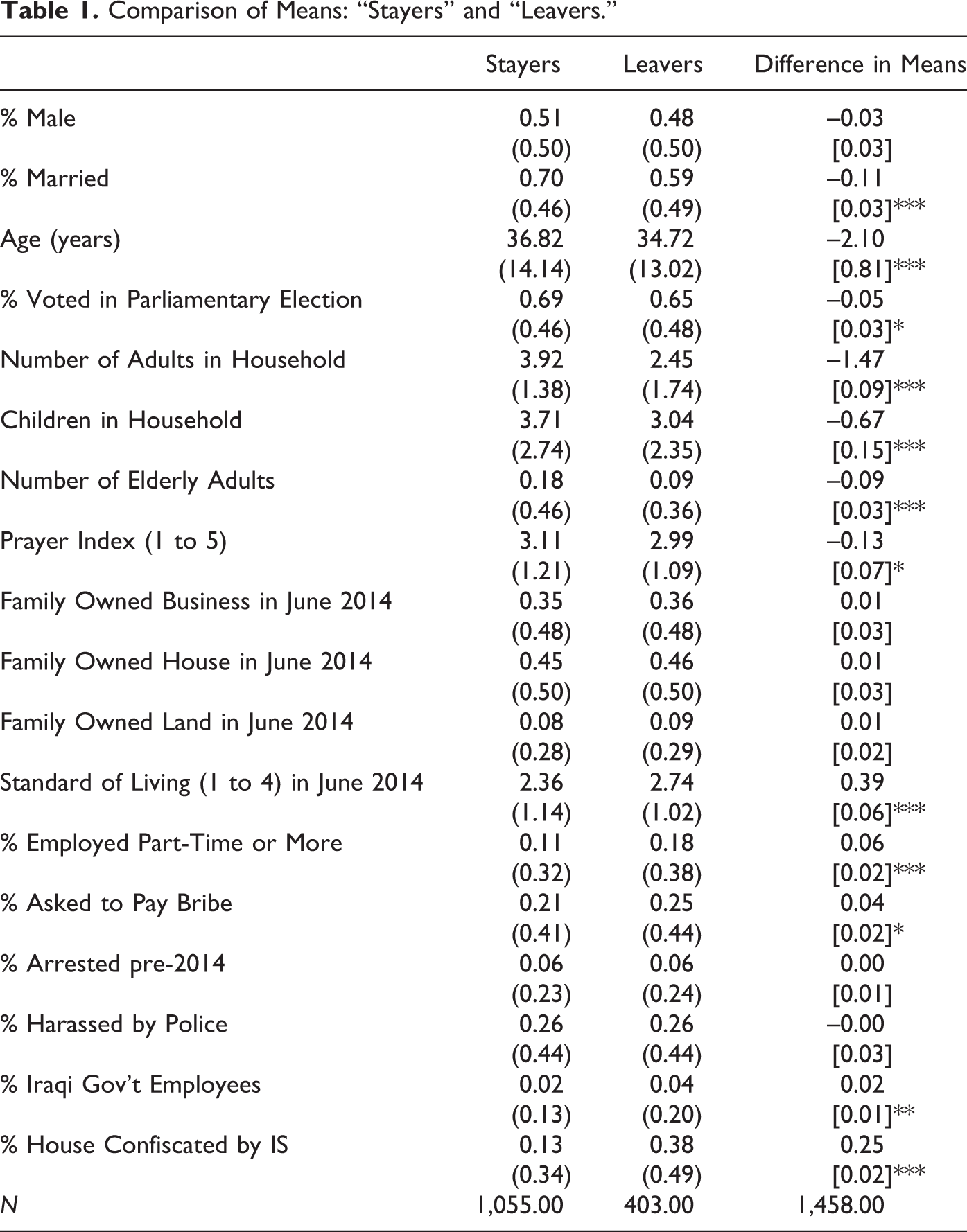
Turning to the differences between “stayers” and “leavers,” a comparison of the means of key variables indicates that “stayers” are 11% more likely to be married and have slightly larger households (an average of 3.92 adult members for “stayers” in comparison with 2.45 for “leavers”). “Stayers” are somewhat more religious than “leavers”—based on a five-point index of prayer frequency—by 0.13 points. “Stayers” were also 25% less likely to report that their house was confiscated by IS, which is unsurprising given IS’s systematic expropriation of properties abandoned by “leavers” (Table 1). The survey data indicates that displacement decisions are multi-factorial. When asked why they stayed, the vast majority of “stayers” identified multiple factors as “somewhat important” or “very important” from among the following: (1) the costs of leaving, (2) the dangers associated with travel, (3) fear of property loss, (4) lack of another place to go, (5) family members who cannot travel easily, (6) fear of being questioned or arrested by IS on the way out of Mosul, and (7) fear of being questioned or arrested by the Iraqi government after leaving Mosul. Similarly, most “leavers” identified multiple factors as “somewhat important” or “very important” from among the following: (1) the bad economic situation in Mosul, (2) poor quality of services, (3) fear of harm by IS, (4) pressure to join IS, and (5) fear of airstrikes and other military operations targeting the city (Online Appendix Figures 3 and 4).
Comparison of Means: “Stayers” and “Leavers.”
Results
To estimate the determinants of displacement decisions, I conducted logistic regressions in which “staying” is a binary variable. Online Appendix 1.2 describes the estimating equations and empirical strategy in greater detail. Overall, the quantitative results establish a correlation between perceptions of quality of governance and displacement decisions, consistent with my theory of competitive governance. 21 Respondents who perceived improvements in the effectiveness of governance under IS rule were more likely to be “stayers” than those who perceived no change or a deterioration (H1). Respondents who perceived improvements in the fairness of governance under IS rule were also more likely to be “stayers,” consistent with H2. However, the results for H3 are mixed. Although there is no statistically significant relationship between exposure to state-perpetrated injustice prior to June 2014 and the likelihood of staying in Mosul, among the small subset of respondents who brought a dispute to Iraqi courts or police prior to June 2014, those who felt that their case was decided unfairly were more likely to stay. Despite the mixed quantitative results, qualitative data from interviews provides additional support for all three of these hypotheses. Additionally, the survey data provides some support for four of the alternative explanations—economic resources, family structures, threat perceptions, and ideology—but not for the informational explanation.
Perceptions of Governance: Full Sample
Across the sample as a whole (“stayers” and “leavers”), a significant minority perceived relative improvements in the effectiveness of governance during the first sixth months of IS rule in comparison with the preceding period of Iraqi government rule. 39% perceived an improvement in the cleanliness of Mosul’s streets and 38% perceived a decrease in the amount of crime (Figure 4). Additionally, 16.1% of respondents said that they believed, during the first six months of IS rule, that “IS was doing a better job of governing Mosul than the Iraqi government did previously” (Online Appendix Figure 5), suggesting that a significant minority of the Mosul population viewed IS’s system of governance favorably in comparison with that of the Iraqi state.

Comparisons of Governance: IS vs. Iraqi Government.
Tests of Primary Hypotheses
Effectiveness of governance
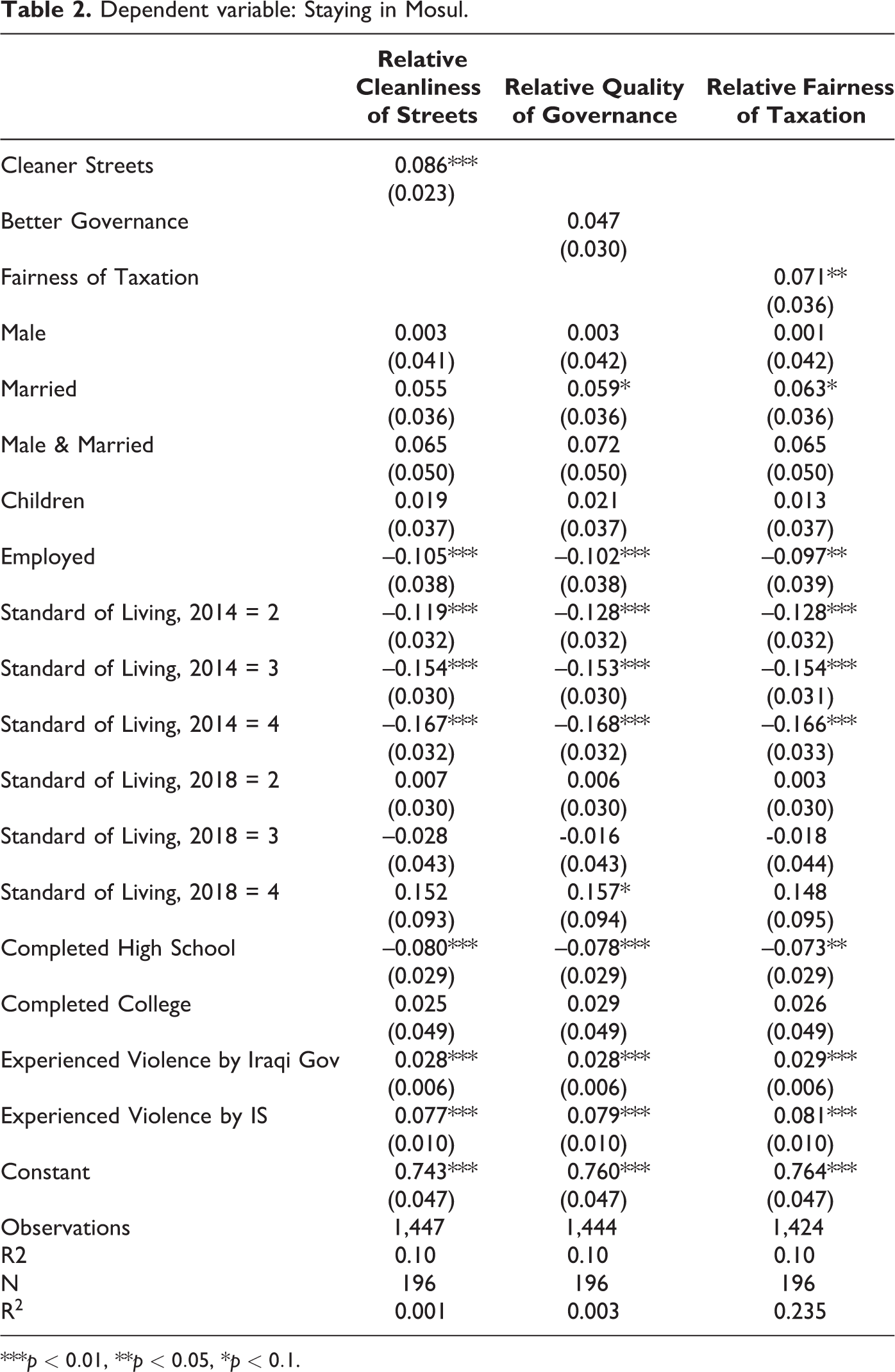
Comparing perceptions of governance between “stayers” and “leavers,” I find support for H1—that respondents who perceived relative improvements in the effectiveness of governance under IS rule in comparison with the preceding period of Iraqi government rule were more likely to be “stayers” than those who perceived no change or a deterioration in governance. In Ordinary Least Squares Regression (OLS) with robust standard errors, “Stayers” were 8.6 percentage points more likely than “leavers” to report that the streets of Mosul were cleaner during the first six months of IS rule than they had been previously and the result is highly significant (Table 2). In all regressions, I control for gender, marital status, number of children, employment status (whether the respondent was employed at the time of the survey), educational level, current and pre-2014 standard of living (a four-point scale measuring the extent to which the respondent’s household income is sufficient to meet the household’s needs), as well as exposure to violence perpetrated by IS and the Iraqi government both during during IS rule and the subsequent battle for Mosul. 22
Dependent variable: Staying in Mosul.
***
For two other indicators of improvements in the quality of governance—a decrease in the amount of crime and an increase in the number of hours of daily electricity provided under IS rule—“stayers” are slightly more likely than “leavers” to report improvements, but neither the crime result (a 2.5 percentage point difference) nor the electricity result (a 4.5 percentage point difference) are statistically significant (Online Appendix Tables 5–6). Additionally, “stayers” were 4.7 percentage points more likely than “leavers” to agree with the statement that IS “was doing a better job of governing Mosul than the Iraqi government did previously” although this result is not statistically significant (p = .116) (Table 2). These findings, although weak, are nonetheless consistent in establishing a correlation between staying in Mosul and perceived improvements in the quality of governance.
Furthermore, qualitative evidence from interviews is consistent with H1. Many “stayers” described improvements in the effectiveness of IS governance in comparison with the previous period of Iraqi government rule, consistent with H1. Tamir, a butcher in Mosul, said that his industry had been lobbying the Iraqi government for years to improve the regulation and sanitation of slaughterhouses in order to prevent dishonest butchers from selling diseased animals to unsuspecting buyers. He said, “When Daesh [IS] came, they required all butchers to bring their animals to a central slaughterhouse where animals were inspected for illness and the whole process was safer and better organized.” 23 Bassem, a school administrator, said, “They [IS] distributed garbage cans throughout the city and started collecting the trash twice per week—much more often than the Iraqi government did previously. Then they started to impose fines for littering, so the streets stayed very clean. To be honest, Mosul was the cleanest I had ever seen it.” 24
Fairness of governance
The results also provide support for H2—that “stayers” were more likely to perceive improvements in the fairness of governance under IS rule. “Stayers” expressed higher levels of agreement than “leavers” (by 8.1 percentage points) with the statement that “the taxes and fees collected by IS were fair in exchange for the services that IS was providing in Mosul” in comparison with a parallel statement about the fairness of the taxes and fees collected by the Iraqi government during the years 2006-2014, and this result is significant (Table 2). Qualitative evidence from interviews also provides some support for this hypothesis. Latif, a restaurant manager, described several instances in which IS police or courts punished the group’s own members for breaking rules or mistreating civilians, sending the message that no one was above the law. He recalled one altercation between the owner of a bakery and an IS fighter who cut to the front of the line, claiming that he was in too much of a hurry to wait his turn: “When the owner asked the fighter to go to the back of the line, the fighter kicked him in the face and ran away with a bag full of bread.” The owner complained to IS’s Sharia court, which sent police to the bakery to interview witnesses. The court ruled in favor of the owner and ordered the fighter to apologize publicly. 25
State-perpetrated injustice
The results for H3—predicting that respondents who experienced higher levels of injustice in their personal interactions with Iraqi state authorities and institutions prior to June 2014 were more likely to be “stayers” than those with fewer or no such grievances—are mixed and inconclusive. Contrary to expectations, a comparison of means indicates that “leavers” are more likely than “stayers” to have experienced bribery (by 4%) prior to IS’s arrival in Mosul in June 2014 in a comparison of means, and this difference is significant (Table 1). “Stayers” are no more likely than “leavers” to have experienced police harassment prior to June 2014 nor were they more likely to have been arrested by Iraqi authorities, contrary to expectations, although neither of these two results are statistically significant.
OLS regression analysis on an index of exposure to state-perpetrated injustice prior to 2014 indicates, contrary to H3, that exposure to injustice is slightly correlated with leaving (by around 1%), although again, this result is not statistically significant (Online Appendix Table 8). The puzzling inconsistency between this null result and the findings for H1 and H2 could be attributable to response bias. For example, since “leavers” tend to be more affluent than “stayers,” it is possible that wealth has some effect on the likelihood of reporting experiences with injustice. Perhaps wealthier respondents have a greater sense of entitlement to justice and are therefore more sensitive to injustice. It is also possible that, since “stayers” are widely stigmatized for their perceived collaboration with IS and therefore may fear running afoul of Iraqi authorities, they are systematically more reluctant than “leavers” to express grievances with the Iraqi government on a survey, even under conditions of anonymity.
Analysis of perceptions of the fairness of dispute-resolving institutions, although under-powered, provides weak support for H3. Twenty-four “stayers” and 18 “leavers”—a very small subset of the total sample—reported bringing a dispute to Iraqi government courts or police during the years 2006-2014 (Online Appendix 6.3.1). When asked to what extent their case was decided fairly (on a four-point scale where 1 is “very unfairly” and 4 is “very fairly”), “leavers” believed that they were treated more fairly than “stayers.” The average response of “leavers” was 3.11, 24% higher than the average response of “stayers,” (2.50) and this difference approaches statistical significance (p = .087).
Despite the mixed quantitative results, interviews with residents of Mosul and other formerly IS-controlled areas of Iraq provide some support for the hypothesis that past experiences with state-perpetrated injustice contributed to civilians’ willingness to live under IS rule passively, and in some cases to support the group actively (H3). For example, Taiba said that her husband, a former truck driver for a gas company, was wrongfully imprisoned for eight months by Iraqi security forces in Mosul without ever being charged with a crime. “He joined to avenge the violation of his rights and dignity,” she said. 26 Even when interviewees did not provide support for a causal link between state-perpetrated injustice and support or cooperation with IS, as Taiba did, many complained about corruption and injustice in Iraqi state institutions, suggesting that such grievances might have played a role in their decision to stay in Mosul. For example, “stayers” described political corruption as a “disease” 27 and “the primary problem in Iraq.” 28 Others criticized the Iraqi judiciary for its willingness to turn a blind eye to the crimes of the rich and politically powerful. According to Faisal, “Iraqi courts are politicized and the judiciary only convicts poor people who don’t have the means to buy their way out of trouble.” 29 The Iraqi police and other security forces were described as “untrustworthy because they can easily be bribed.” 30 Interviewees also complained that Sunnis were frequently subjected to sectarian profiling and arbitrary detention at checkpoints. Lama said, “Before IS came, all of the men in my family had been harassed and interrogated at checkpoints many times simply because they were Sunni.” 31
These testimonies are consistent with statements by other Mosul residents who have described their experiences with government checkpoints to reporters as “insulting” (Adel Kefal 2020) and “humiliating” (Erica Solomon 2017). One Mosul resident interviewed just days after IS’s arrival in June 2014 said: “We were hoping to get rid of the army by any means. They [Iraqi soldiers] always provoked us with trivial questions. Sometimes the bad mood of an officer or soldier in the army or federal police was reasonable cause for arrest on terrorism charges” (Zaid al-Anzi 2017). This qualitative data suggests that Mosul’s population had grown increasingly resentful of the repressive and discriminatory policies of Iraqi security forces and that some people viewed IS as a better alternative to the Iraqi government—or at least, a lesser evil—consistent with the theory of competitive governance developed in this article.
Alternative Explanations
This section summarizes the results for the alternative explanations, which are operationalized and analyzed—both quantitatively and qualitatively—in Online Appendix 7–8.
Economic Resources
The survey data provides some support for the alternative explanation of economic resources. In some cases, resources were a barrier to exit, but in other cases facilitated flight. Compared to respondents with the lowest standard of living on a four-point scale measuring ability to cover household living expenses with the household’s income when IS captured Mosul in June 2014, those with the highest standard of living are almost 17 percentage points more likely to be “leavers” in OLS regression, and this result is highly significant (Online Appendix Table 10). A related finding is that respondents who were employed at the time of the survey (compared with those who were unemployed) were approximately 6 percentage points more likely to be “leavers” and this result is again highly significant (Table 1).
However, for some Moslawis, fixed assets appear to have been a constraint on mobility: 66% of “stayers” cited fear of property expropriation by IS as a “very important” factor in their decision to stay (Online Appendix Figure 3). The finding that “leavers” were 25% more likely than “stayers” to report that their house was confiscated by IS (Table 1) establishes that property expropriation was a credible threat.
Social and Family Structures
I find some support for the expectation that respondents with mobility-constraining family structures (those who are married and have larger families with more children and elderly) were more likely to stay than those with fewer constraints. OLS regression indicates that each additional adult member of the respondent’s household was associated with an 10.7 percentage point increase in the likelihood of staying and married respondents were 4.7 percentage points more likely to stay in Mosul than unmarried respondents, although the latter result is not statistically significant (Online Appendix Table 11). 73% of “stayers” identified “having family members who cannot travel easily” as a “very important” factor in their decision to stay (Online Appendix Figure 3). These findings are consistent with qualitative evidence from interviewees with large families and elderly or sick relatives for whom travel was difficult or impossible (Online Appendix 8.2). As “Khaled” said, “I had a six-month old baby who was receiving treatment for a heart defect at the hospital in Mosul and was too ill to travel.” 32
Information
The data indicates that many residents of Mosul knew very little about IS in June 2014 and had unrealistic expectations about how long the group would remain in control of the city. The vast majority of respondents—85%—said they “knew nothing” about IS when the group arrived in Mosul. 34% said that they did not expect IS to last for more than “a few weeks” and 28% thought that IS would be gone in “a few months” (Online Appendix Figure 8). However, OLS regression indicates that respondents with higher levels of information about IS and those who expected IS to remain in control of Mosul for a long time were not significantly more likely to leave, casting doubt on this alternative explanation (Online Appendix Tables 12–13).
Threat Perceptions
The data suggest that perceptions of danger both inside and outside of Mosul were a factor in displacement decisions. OLS regression indicates that respondents who believed in June 2014 that staying in Mosul was more dangerous than leaving Mosul were significantly more likely to leave (by 7.5 percentage points, Online Appendix Table 14). 97% of “leavers” said that fear of being harmed by IS was a “very important” factor in their decision to leave, and 92% of “leavers” said that airstrikes and other military operations targeting Mosul were a “very important” factor (Online Appendix Figure 4). Threat perceptions also influenced decisions to stay. 92% of “stayers” identified fear of being questioned or detained at an IS checkpoint on the way out of Mosul as a “very important” reason for staying and 64% identified the dangers associated with travel as “very important” (Online Appendix Figure 3).
Ideology
The data suggests that ideology may have been a factor in displacement decisions. It was not possible to directly ask respondents about the extent of their agreement with IS’s ideology given concerns about social desirability bias. However, given IS’s theocratic system of governance, measuring respondents’ support for Sharia may indirectly shed light on the relationship between ideology and decisions to stay or leave. In OLS regression, respondents who want Iraqi law to be reformed to include “more Sharia” were 5 percentage points more likely to stay than those in favor of “less Sharia” (Online Appendix Table 15). Although “stayers” have slightly higher scores on an index of prayer frequency than “leavers” in a comparison of means (Table 1), this difference is no longer statistically significant after adding controls in regression analysis (Online Appendix Table 16). These results are difficult to interpret in light of research indicating that “Sharia” means different things to different people (Fair, Littman, and Nugent 2018, 4). It is possible that Moslawis who expressed support for “more Sharia” are not necessarily more religious and simply interpreted this option as an alternative to a political and legal status quo with which they are dissatisfied.
Conclusion
Displacement decisions during rebel governance are multi-factorial and almost all of the Mosul residents surveyed and interviewed for this article cited several factors that influenced their decisions to stay or leave. Overall, the survey results provide some support for my theory of the relationship between civilian perceptions of competitive governance and displacement decisions. Consistent with H1, respondents who perceived relative improvements in the effectiveness of governance under IS rule in comparison with the preceding period of Iraqi government rule were more likely to be “stayers” than those who perceived no change or a deterioration, although not all of these results are statistically significant. I also find support for H2: respondents who perceived relative improvements in the fairness of governance under IS rule were more likely to be “stayers.” Although the quantitative survey data does not support H3—that respondents who experienced higher levels of state-perpetrated injustice prior to June 2014 were more likely to be “stayers” than those with fewer or no such grievances—I do find support for this hypothesis in interviews and in a small subset of the survey sample that utilized state dispute-resolving institutions prior to June 2014.
Overall, these quantitative and qualitative findings suggest that historical experiences with weak rule of law and bad governance by states affect the attitudes and actions of civilians living under rebel governance. The fact that some of the quantitative findings are contradicted by qualitative data reinforces the need for triangulation between different methods and sources of data on rebel governance. Quantitative household surveys conducted in conflict areas are susceptible to particular forms of bias (Ghosn and Parkinson 2019). For example, it is possible that survey respondents were traumatized or ashamed by past experiences with injustice in ways that discouraged them from reporting these personal experiences to an enumerator whom they had never met before. Another possibility is that Moslawis who experienced the highest levels of injustice were systematically less likely to be included in the random sample—for example, if they declined to participate in the survey or were displaced during the conflict (and therefore outside of the sampling frame) at above-average rates. The questions raised by this discrepancy between the qualitative and quantitative data from Mosul can only be answered by additional multi-method research.
This study suggests several questions for future research. First, there is a need for greater understanding of the long-term consequences of variation in exposure to rebel governance for social cohesion and peace-building. How do “stayers” and “leavers” perceive one another? Do “leavers” suspect “stayers” of sympathizing with or supporting a rebel group as a result of their prolonged exposure to the group’s ideology and institutions? Do “stayers” resent “leavers” because they perceive them as having abandoned the community and begrudge them for escaping the violence endured by residents of rebel-held territory? Relatedly, why do some “leavers” return to their communities after the end of conflict while others remain displaced or permanently relocate elsewhere?
Second, this study suggests the need for more research on how perceptions of rebel and state governance may affect variation in the timing and duration of displacement. Since the vast majority of “leavers” in this study fled Mosul during a relatively narrow three-month window (out of 36 months of IS control) and 95% of these returned to Mosul in 2017, as the city was being recaptured from IS, there was insufficient variation in this sample to examine the link between perceptions of rebel and state governance and the timing of decisions to leave and return, but future work should explore this potential relationship.
Third, my findings raise new questions about how experiences during displacement may affect whether individuals decide to return to their communities of origin or relocate elsewhere. Previous research suggests that refugees who live in camps maintain a strong sense of exile and desire to return to their “homeland,” while those who settle in cities are more likely to pursue strategies of assimilation and naturalization (Malkki 2012, 170). Understanding the long-term consequences of the physical, social, and psychological experience of displacement is particularly important in the Iraqi context, where the government has confined thousands of suspected IS collaborators to de facto internment camps that may become semi-permanent settlements (Revkin 2018a, 21). In contexts where rebel groups such as IS have successfully exploited civilian grievances with bad governance to build support for their alternative political models, the state’s failure to effectively reintegrate and provide services to IDPs and other victims of conflict could potentially ignite a new insurgency, as appears to be the case in Iraq, where a so-called “IS 2.0” is already rising (Revkin 2018a, 3).
Supplemental Material
Supplemental Material, sj-pdf-1-jcr-10.1177_0022002720951864 - Competitive Governance and Displacement Decisions Under Rebel Rule: Evidence from the Islamic State in Iraq
Supplemental Material, sj-pdf-1-jcr-10.1177_0022002720951864 for Competitive Governance and Displacement Decisions Under Rebel Rule: Evidence from the Islamic State in Iraq by Mara Redlich Revkin in Journal of Conflict Resolution
Supplemental Material
Supplemental Material, sj-zip-1-jcr-10.1177_0022002720951864 - Competitive Governance and Displacement Decisions Under Rebel Rule: Evidence from the Islamic State in Iraq
Supplemental Material, sj-zip-1-jcr-10.1177_0022002720951864 for Competitive Governance and Displacement Decisions Under Rebel Rule: Evidence from the Islamic State in Iraq by Mara Redlich Revkin in Journal of Conflict Resolution
Footnotes
Acknowledgments
This research would not have been possible without the generosity of my Iraqi interlocutors who shared their experiences and insights to help me understand a conflict that upended their lives. Funding was provided by the United States Institute of Peace, the MacMillan Center for International and Area Studies at Yale University, United Nations University, the Program on Governance and Local Development at the University of Gothenburg, the Project on Middle East Political Science, and the Yale Fox Fellowship Program. Data and supporting materials necessary to reproduce the results in the article are available at TK. I am very grateful for thoughtful comments and suggestions on earlier drafts by Marsin Alshamary, Olga Aymerich, Belgin Şan Akça, Carolyn Barnett, Jessica Maves Braithwaite, Bridget Coggins, Kathleen Gallagher Cunningham, Amelia Hoover Green, Diana Greenwald, Allison Hartnett, Reyko Huang, Danielle Jung, Kristen Kao (who also provided invaluable guidance on the survey questionnaire and administration), Cyanne Loyle, Marc Lynch, Zachariah Mampilly, Sarah Parkinson, Jonathan Petkun, Katherine Sawyer, Lee J. M. Seymour, Alexandra Siegel, Megan Stewart, Stacey Philbrick Yadav, the two anonymous reviewers, and the Journal of Conflict Resolution editorial team. I also thank my committee (Elisabeth Wood, Robert Blair, Oona Hathaway, Ellen Lust, Jason Lyall, and Elizabeth Nugent) for excellent advising on the dissertation of which this article was a part.
Declaration of Conflicting Interests
The author(s) declared no potential conflicts of interest with respect to the research, authorship, and/or publication of this article.
Funding
The author(s) received no financial support for the research, authorship, and/or publication of this article.

Supplemental Material
Supplemental material for this article is available online.
Notes
References
Supplementary Material
Please find the following supplemental material available below.
For Open Access articles published under a Creative Commons License, all supplemental material carries the same license as the article it is associated with.
For non-Open Access articles published, all supplemental material carries a non-exclusive license, and permission requests for re-use of supplemental material or any part of supplemental material shall be sent directly to the copyright owner as specified in the copyright notice associated with the article.
