




Abstract
From 2001 to 2005, over a quarter of all countries in the world cooperated in a secret rendition network that enabled the transfer of CIA terrorist suspects to secret detention sites. While governments in some states have not been punished for participating, others have incurred political costs, including electoral defeats. What explains variation in the political costs of participation in the post-9/11 extraordinary rendition program? I argue that left of center governments, particularly those in democracies, suffered greater political costs from being caught because of the perception that they are better at protecting civil liberties in the name of national security. I test the effect of party orientation on electoral defeat at the election following the revelation of participation in extraordinary rendition using a matched sample where the party in office at the time of participation remained the same. The analysis provides empirical support for my theoretical argument.
From 2001 to 2005, over a quarter of all countries in the world helped the United States of America (U.S.) run a post-9/11 global rendition network that enabled the transfer of Central Intelligence Agency (CIA) terrorist suspects to secret detention sites across the world (Open Society Foundations 2013). In response, several intergovernmental and governmental institutions launched high-profile investigations on the issue of rendition, detention and interrogation (RDI). They described how foreign governments had assisted with the arrests, detention and interrogation of CIA terrorist suspects and enabled extraordinary rendition aircrafts to fly in their airspace and land at their airports (Council of Europe 2006b; European Parliament 2006a). The reports elicited mainstream media coverage, public debates and condemnation from the international community. 1 International relations and conflict scholars continue to debate the political costs of committing human rights violations (HRVs) and the conditions under which governments are more or less likely to be punished (Moore 2000; Davenport 2007a; Pierskalla 2010; Shadmehr 2014; Esarey and Bryant 2019). The study of this topic is further hindered by data availability given the routine attempt by governments to cover up HRVs (Hafner-Burton 2014). Unlike many instances of HRVs, international cooperation in RDI has the advantage of being observable (ex-post) using detainee testimony and suspected extraordinary rendition flight data. It also provides a unique opportunity to study the political costs of abusing human rights in different domestic political environments across the world for a group of states that engaged in the same network of HRVs. 2
While the issue of RDI has received widespread media coverage and public interest across the world, there has been substantial variation in the political costs for those countries that were caught cooperating. For example, while governments in some states have not been punished for participating, others have incurred political costs, including electoral defeats. What explains variation in the political costs of participation in RDI? First, I argue that states with left of center governments suffered greater political costs from being caught because of the perception that they are better at protecting civil liberties in the context of national security (Welch and Schuster 2005; Moeckli 2008; Neumayer, Plümper, and Epifanio 2014). 3 Left of center voters are less likely to consider trading off civil liberties in the name of national security and are more likely to perceive the revelation that their government was complicit in HRVs as a grievance (McClosky and Brill 1983; Davis and Silver 2003). Second, I argue that the political costs of participation in RDI should be greater for left of center governments in democracies than those in non-democracies. Democratic institutions provide voters with the opportunity to express their discontent and punish the government for committing HRVs (Van Belle 2000; Davenport 2007b; Davenport, Armstrong, and Moore 2008). Moreover, the revelation that a left of center government participated in RDI is more likely to lead to public outcry in a democracy because of the perception that democratic actors are better at protecting human rights and respecting the rule of law (Kelley 2007). Left of center voters disillusioned by the government’s behavior could respond by voting for another party whose preferences they perceive are closer aligned to their own or withdraw from voting altogether; leading to a decline in political engagement (Downs 1957; Converse 1966; Davis, Hinich, and Ordeshook 1970; Citrin et al. 1975; Fieschi and Heywood 2004; Jessee 2009).
To test my hypotheses, I interact data on party orientation with a variable that codes whether a country was caught cooperating in RDI. I test the effect of the revelation of participation in RDI, on electoral defeat, conditional on party orientation, at the election following the revelation of participation in RDI using a matched sample where the party in office at the time of participation remained the same. Matching methods help account for model bias introduced by the non-random assignment of the treatment (revelation of participation in RDI) and observable confounding factors. The results from the empirical analysis indicate support for my theoretical argument and are robust to a series of different model specifications. As expected, the political costs of participation in RDI were greater for left of center parties relative to parties ideologically to the right. Moreover, the results indicate that the political costs of participation in RDI were greater for left of center parties in democracies than left of center parties non-democracies.
The Political Costs of Abusing Human Rights
Previous research on human rights has established a cost-benefit analysis for explaining why we observe violations being implemented by states in some political contexts and less in others. On the one hand, HRVs can successfully deter collective action and enhance political survival (Moore 1998, 2000; Pierskalla 2010; Gupta, Singh, and Sprague 1993; Rasler 1996). On the other hand, abuses can increase people’s relative sense of deprivation, make escalation and open conflict more likely, and be met with sanctions from the international community (Gurr 1970; Lichbach 1987; Rasler 1996; Hafner-Burton 2005; Hathaway 2007; Vreeland 2008; Pierskalla 2010; Hafner-Burton 2014).
However, HRVs do not generate the same magnitude of costs for all governments that engage in it. For example, the costs of HRVs are far greater for democracies than non-democracies as their behavior is constrained by institutions designed to hold governments accountable for their actions and facilitate their removal from office (Van Belle 2000; Davenport 2007b; Davenport, Armstrong, and Moore 2008). Moreover, keeping citizen’s grievances to a minimum is of central importance in a democracy because the size of the groups in society that choose the leadership (the selectorate) and determine whether the leadership can remain in office (the winning coalition) are large (B. Bueno De Mesquita et al. 2005). If a democratic government commits HRVs, their supporters can defect to a rivaling party that promises better protection of human rights.
While many scholars agree that HRVs can be costly for governments, the extent to which the public truly cares about human rights continues to be debated. On the one hand, global public opinion polls suggest that there is strong international consensus on human rights including international rules against torture (Council on Foreign Relations 2009). Additionally, many studies on the allocation of foreign aid and economic sanctions show that voters are concerned about the human rights behavior of states and the well-being of others. On the other hand, this concern is conditional on several factors including a country’s national security, political relationships and media spotlight on the human rights issue (McFarland and Mathews 2005; Cingranelli and Filippov 2010; Nielsen 2013; Esarey and DeMeritt 2017; Putnam and Shapiro 2017; Heinrich and Kobayashi 2020; Heinrich, Kobayashi, and Long 2020). Lupu and Wallace (2019) also find that public disapproval of HRVs is more likely when repression is used to respond to a non-violent opposition than a violent opposition. Previous research has also found that people with leftist and internationalist views are more likely to be concerned with human rights (than their rightist and nationalistic counterparts) because of the values that are expressed by these political ideologies (C. J. Anderson, Paskeviciute, and Sandovici 2005; McFarland and Mathews 2005). Additionally, Heinrich and Kobayashi (2020) find that individuals are more likely to disprove of severe HRVs (e.g. torture) than less severe HRVs (e.g. restrictions on freedom of assembly and the media). This finding is in line with a BBC World Service (2006) poll of 27,000 people in 25 countries that found that most people rejected torture including the torture of terrorist suspects. However, Esarey and Bryant (2019)’s survey which ask U.S. survey respondents whether they will continue to vote for a presidential candidate that supports abusing physical integrity rights find that HRVs have (on average) no significant effect on voter decisions.
In the context of political survival literature, the revelation that a government has committed HRVs can be framed as a critical event for domestic voting conditions. Even when the domestic conditions for surviving in office seem positive, a critical event can unexpectedly take place that disrupts a stable political environment and threatens the tenure of a politician or government (Browne, Frendreis, and Gleiber 1984, 1986). These events can be fatal for politicians and governments. However, their timing, magnitude and intensity can have disproportional effects (Browne, Frendreis, and Gleiber 1984). For example, if an event takes place close to an election, we should expect the impact to be more severe than events that take place in the middle of an election cycle as they are more likely to be forgotten over time (Diermeier and Stevensen 1999). A government’s initial response can also counter some of the negative effects of an external event; such as firing the individual(s) associated with the scandal or calling for their resignation (Dewan and Myatt 2007).
An example that demonstrates the political costs of HRVs is the American public’s reaction to the release of photographs in 2004 documenting the abuse of prisoners in Abu Ghraib prison, Iraq by the U.S. military. A U.S. poll taken immediately after the release of the photographs indicated widespread disapproval regarding the mistreatment of detainees and led to a number of protests at political events. Following the revelation, the overall performance rating of former U.S. President, George W. Bush, fell to the lowest during his presidency. 4 Another example is the Georgian public’s reaction to the release of video footage in 2012 documenting the abuse of prisoners in Prison No. 8, Tbilisi by prison guards. Members of the public responded to the revelation with large protests calling for the resignation of former Prison Minister, Khatuna Kalmakhelidze, and former head of the Justice Ministry’s department for overseeing prisons, Bacho Akhalaia. 5
Foreign Complicity in Extraordinary Rendition
International cooperation in RDI provides a unique opportunity to study the causes and dynamics of the political costs of HRVs. Such costs include perpetuating grievances, triggering negative public opinion among the electorate, and gaining a disingenuous reputation that could hinder international relations (Guisinger and Smith 2002; E. Bueno de Mesquita 2005; Satori 2005). While these costs are all worth consideration, I focus on the ultimate cost of being caught for participation in RDI—losing office.
Investigative reports and media spotlight on foreign complicity in RDI generated substantial attention both domestically and internationally for those countries allegedly involved (Benjamin 2007). Online Appendix Table A1 lists the diverse group of states alleged to have collaborated with the U.S. in response to domestic pressure, a number of accused countries established independent inquiries to investigate their alleged participation in RDI (Council of Europe 2006a; European Parliament 2006b). 6 In many states, the revelations provided ammunition to opposition parties and caused rifts within the accused parties and other government departments. 7 During this time, public opinion polls in a number of countries revealed that majorities “oppose cooperating with the U.S. government in extraordinary renditions” (World Public Opinion 2006) and reject torture “even in the case of terrorists who have information that could save innocent lives” (BBC World Service 2006).
However, not every government that was caught cooperating in RDI has been punished for participating. For example, my research indicates that only 34 percent of countries that participated in RDI experienced electoral defeat following the revelation of participation in RDI. Why did governments in Sweden and Macedonia lose office following the revelation of cooperation in the arrest and detention of CIA detainees, but not ruling parties in Albania and Georgia, that were also involved in the capture and transfer of individuals to U.S. custody (Open Society Foundations 2013)? What explains variation in the political costs of participation in RDI? I argue that left of center governments were hurt more by the revelation of participation in RDI because of the perception that they are better at protecting civil liberties in the context of national security. Previous research has demonstrated strong ideological differences between left and right voters regarding the importance of protecting civil liberties versus maintaining social order (Welch and Schuster 2005; Moeckli 2008; Neumayer, Plümper, and Epifanio 2014). Left of center voters are less likely to consider trading off civil liberties than right of center voters and accordingly would be more likely to perceive the revelation that their government was complicit in HRVs as a grievance (McClosky and Brill 1983; Davis and Silver 2003). Moreover, political scandals that reveal greater differences in a party’s public and private type threaten their survival in office as it causes voters to question their credibility as a government (Guisinger and Smith 2002; Tomz 2007). 8 The consequences of a voter discovering that the party they are affiliated with no longer shares the same interests on security and human rights trade-offs are two-fold.
First, this event could generate disillusion among left of center voters and drive them to vote for another party whose preferences they perceive are closer aligned to their own (Downs 1957; Davis, Hinich, and Ordeshook 1970; Jessee 2009). 9 Conflicting preferences on HRVs between voters and governments can be costly as the domestic backers of parties must be satisfied in order to prevent voters from defecting to a challenger (B. Bueno de Mesquita et al. 2003). Second, this event could foster distrust in politicians and democratic institutions among left of center voters and lead to a decline in political engagement and a withdrawal from voting altogether (Downs 1957; Converse 1966; Citrin et al. 1975; Fieschi and Heywood 2004; Trubowitz and Mellow 2005). 10 These steps can also be pursued by voters to send a signal to future leaders regarding their tolerance and preferences on such issues and deter the party from behaving in a similar manner in the future (Downs and Rocke 1994).
Whereas, the revelation that a right of center party participated in RDI is less likely to generate political costs for right of center governments as right of center voters are more likely to favor trading off national security for human rights (Welch and Schuster 2005; Moeckli 2008; Neumayer, Plümper, and Epifanio 2014).
11
For example, M. R. Anderson and Richards (2018) found that survey respondents in the U.S. that identified as Democrat were more likely to oppose torture than Republicans. Similarly, a Pew Research Center (2009) survey conducted in the U.S. found that twice as many Republicans as Democrats think torture is sometimes justified and almost three times as many Democrats believe that torture of a suspected terrorist is never justified. Moreover, the revelation that a right of center government participated in RDI should not cause voters to question their credibility as a government as right of center parties are known to pursue a more hawkish public approach to counter-terrorism than left of center governments (Nanes 2017). This discussion leads to the article’s first hypothesis:
Additionally, previous research on the relationship between democracy and human rights suggests that the political costs of participation in RDI should be greater for left of center parties in democracies than left of center parties in non-democracies. First, democratic institutions provide voters with the opportunity to express their discontent and punish the government for committing HRVs during elections (Van Belle 2000; Davenport 2007b; Davenport, Armstrong, and Moore 2008). Second, the revelation of participation in RDI is more likely to lead to public outcry in a democracy because of the perception that democratic actors are better at protecting human rights and respecting the rule of law. The revelation that a left of center party in a democracy engaged in HRVs could lead voters to question the credibility of the government. This event could drive left of center voters to defect to a rivaling party that seems more trustworthy or withdraw from voting altogether; leading to a decline in voter turnout.
Whereas, the revelation of participation in RDI for a left of center party in a non-democratic country is less likely to generate political costs for non-democratic governments as individuals in non-democratic countries lack the ability to hold their governments account via free and fair elections (Downs and Rocke 1994; B. Bueno de Mesquita and Smith 2009). Additionally, the revelation that a left of center party participated in RDI is less likely to be perceived as a political scandal in non-democracies as HRVs are more commonplace in non-democratic countries; revealing less of a difference in a party’s public and private type (Guisinger and Smith 2002; Tomz 2007). Moreover, citizens living in non-democratic countries should be more likely to develop a “scandal fatigue” concerning HRVs perpetuated by their government as citizens have been shown to ascribe less importance to scandals that become more common and cumulate over time (Kumlin and Esaiasson 2011). This discussion leads to the article’s second hypothesis:
Research Design
To evaluate this article’s hypotheses, I estimate a probit model that tests the effect of participation in RDI on electoral defeat, conditional on party orientation. I conduct my analysis on a cross-sectional matched sample of cases to address selection bias, with the incumbent’s party as the unit of analysis. 12 The data used for estimation has information on 133 countries where the party in office from 2001 to 2005 (the period that RDI operations took place) was still in office at the time of the election. 13 Figures 1 and 2 display the timeline of revelations and elections and identifies those countries included in the matched sample. The x-axis displays the revelation year and the y-axis displays the country names, with triangles for the revelation, circles for the following election, and squares for revelations and elections in the same year. Countries included in the matched sample are shaded black, and gray otherwise.
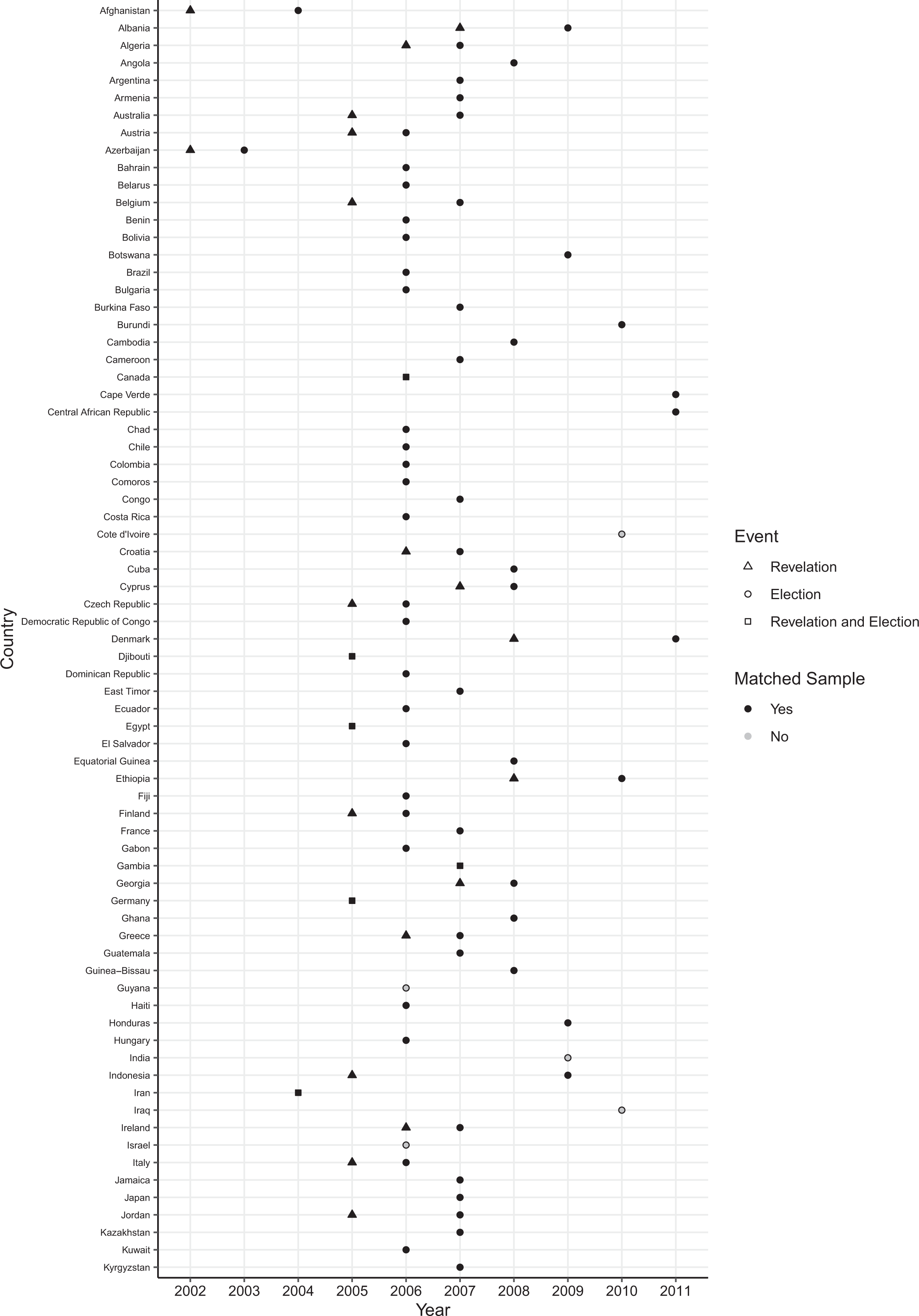
Timeline of Revelation of Participation in RDI and Elections (cont’d on next page). Timeline of Revelation of Participation in RDI and Following Election, with triangles for the revelation, circles for the following election, and squares for revelations and elections in the same year. Countries included in the matched sample are shaded black, and gray otherwise. Source: Hyde and Marinov (2012); Open Society Foundations (2013).
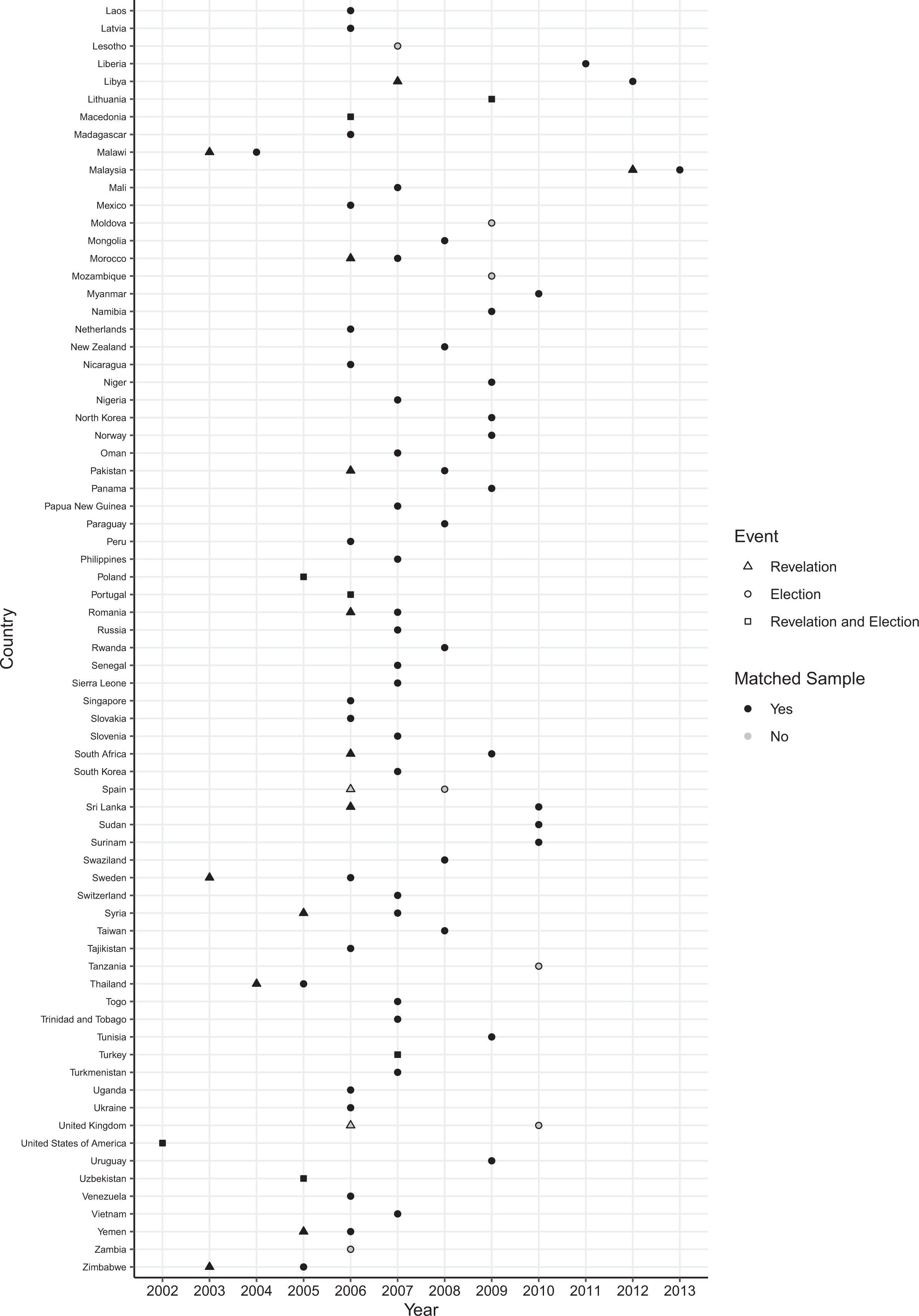
Timeline of Revelation of Participation in RDI and Elections (cont’d from previous page). Timeline of Revelation of Participation in RDI and Following Election, with triangles for the revelation, circles for the following election, and squares for revelations and elections in the same year. Countries included in the matched sample are shaded black, and gray otherwise. Source: Hyde and Marinov (2012); Open Society Foundations (2013).
Dependent Variable (Electoral Defeat)
The dependent variable captures Electoral Defeat. I use Hyde and Marinov (2012)’s National Elections Across Democracy and Autocracy (NELDA) 4.0 data to measure whether the incumbent’s party lost during the national election that followed the revelation of participation in RDI (NELDA24). For countries that participated in RDI, I select the election that followed the first revelation of a country’s involvement in RDI. For countries that did not participate in RDI, I select the national election following 2006 (median revelation year for countries that cooperated in RDI). 14 I construct a dummy variable that codes the incumbent’s party 1 if they lost, and 0 otherwise. This is the case for 27 percent of the observations, but not for the remaining 73 percent.
Independent Variable (Revelation × Left Orientation)
To test my hypotheses, I interact the dummy variable Revelation with the dummy variable Left Orientation. A value of 1 indicates that the party participated in RDI and was left of center, and 0 otherwise.
Revelation
For the first component of the interaction term, I construct a dummy variable that measures whether a country was described as cooperating in RDI by the Open Society Foundations’ (2013) Globalizing Torture: CIA Secret Detention and Extraordinary Rendition report. This report represents the most “comprehensive catalog” of foreign participation in RDI using carefully reviewed credible public sources and information from reputable human rights organizations (Open Society Foundations 2013, 6). 15 Parties are coded 1 if the country was named in the report (e.g. Sweden), and 0 otherwise (e.g. Mexico). This is the case for 34 percent of the observations, but not for the remaining 66 percent.
Left Orientation
For the second element of the interaction term, I use data from Beck et al. (2015)’s Database of Political Institutions to measure whether the party orientation of the government was left of center at the election that followed the revelation of participation in RDI (EXECRLC). I construct a dummy variable for this measure that codes parties 1 if they are left of center (e.g. Canada), and 0 otherwise (e.g. Denmark). This is the case for 25 percent of the observations, but not for the remaining 75 percent. These scores specifically relate to a party’s economic policy, but are likely to be highly correlated with a more general ideological positioning that applies to other political domains.
Controls
To reduce the possibility that other factors affecting the likelihood of Electoral Defeat may be correlated with Revelation × Left Orientation, I control for a number of confounders.
Regime Type
I use Coppedge et al. (2019)’s Varieties of Democracy V9 data to measure a country’s electoral democracy at the time of the election that followed the revelation of participation in RDI (v2x_polyarchy). A higher value (e.g. U.S.) indicates that a state has greater electoral democracy and a lower value (e.g. Jordan) indicates that a state has lower electoral democracy. This variable is also highly correlated with freedom of the press, which makes it more likely that citizens will be aware that their government cooperated in RDI.
Election Proximity
I control for time since the revelation of participation in RDI by creating a dummy variable that measures whether the party’s revelation of participation in RDI took place within close proximity to an election. First, I count the number of years between a country’s first revelation of participation in RDI (using the Open Society Foundations [2013]’s original sources) and the year of the election that followed (Hyde and Marinov 2012). Second, I code parties 1 if the election following the revelation of participation in RDI takes place during the same year or the following year (e.g. Germany), and 0 otherwise (e.g. Cyprus). This is the case for 23 percent of the observations, but not for the remaining 77 percent. Parties whose participation in RDI was revealed closer to an election should experience greater political costs as the issue will be fresh in voters’ minds (Browne, Frendreis, and Gleiber 1984; Diermeier and Stevensen 1999; Kumlin and Esaiasson 2011).
Casualties (Log)
I control for the number of casualties incurred by a country during the War on Terror (WoT) using Marinov, Nomikos, and Robbins (2015) data on troop casualties in Afghanistan for Operation Enduring Freedom and the International Security Assistance Forces. I create a continuous variable that takes the natural logarithm of troop casualties at the time of the election that followed the revelation of participation in RDI since the incumbent’s party has been in office. A high value (e.g. Italy) indicates that a country experienced a greater number of casualties, and a lower value (e.g. Ireland) indicates a lower number of casualties. Parties in office that incurred a greater number of causalities should be more likely to lose at the election that followed the revelation of participation in RDI as it highlights the human costs of the war effort and foreign policy failure (Marinov, Nomikos, and Robbins 2015). This measure also captures WoT alliance membership (excluding countries that did not incur casualties).
Terrorism (Log)
I control for terrorism threat using the National Consortium for the Study of Terrorism and Responses to Terrorism (START 2018)'s Global Terrorism Database. Given the international nature of the WoT, I exclude domestic terrorist incidents from the data and count the number of transnational terrorist incidents in a given year. I create a continuous variable that takes the natural logarithm of post-9/11 transnational terrorist incidents at the time of the election that followed the revelation of participation in RDI since the incumbent’s party has been in office. A higher value (e.g. France) indicates that a state has a greater terrorism threat and a lower value (e.g. Romania) indicates that a state has a lower terrorism threat. States with a higher number of terrorist events should be less likely to be punished by voters for participation in RDI as the public understands that leaders face a pragmatic trade-off between security and human rights in exceptional circumstances (Colaresi 2014).
Economic Crisis
I control for the state of the economy using Hyde and Marinov (2012)’s NELDA 4.0 data that measures whether the media reported that a country had an economic crisis at the election following the revelation of participation in RDI (NELDA18). 16 I construct a dummy variable for this measure that codes parties 1 if there was said to be an economic crisis in the country (e.g. Croatia), and 0 otherwise (e.g. Poland). This is the case for 17 percent of the observations, but not for the remaining 83 percent. Parties experiencing an economic crisis should be more likely to lose at the election following the revelation of participation in RDI as the economy is a highly salient issue during elections (Schultz 1995; Aidt, José Veiga, and Gonçalves Veiga 2011).
Term Limit
I control for whether the incumbent’s party had reached their term limit at the election following the revelation of participation in RDI using Hyde and Marinov (2012)’s NELDA 4.0 data (NELDA8). I construct a dummy variable that codes parties 1 if the incumbent executive had reached the end of their legal term in office (e.g. Portugal), and 0 otherwise (e.g. Belgium). This is the case for 14 percent of the observations, but not for the remaining 86 percent. Parties who have not reached the end of their term limit are less likely to be removed from office because of an incumbency advantage over challengers (Alford and Brady 1989). Online Appendix Table A2 displays descriptive statistics of this article’s independent and control variables.
Method
Given that the dependent variable capturing Electoral Defeat is binary, I use a probit model. To overcome the limitations of estimating causal effects using observational data and ensure that the counterfactual statements drawn from the estimates reflect the data used to generate them, I estimate the effect of Revelation × Left Orientation on Electoral Defeat using a matched sample of 133 countries with balanced values on all relevant covariates from the full model. I assign countries that were caught cooperating in RDI to the treatment group and countries that were not caught cooperating to the control group (see Online Appendix Table A3). I use Coarsened Exact Matching to create a matched sample with balanced values on covariates from the full model associated with the treatment (Revelation), as recommended by Iacus, King, and Porro (2011) and King and Nielsen (2019). 17 This pre-processing step ensures that those countries that did not cooperate in RDI are more comparable to those that cooperated in RDI. Online Appendix Table A4 displays the percent improvement in balance across the treatment and control group. On average, the difference in means decreases by 21 percent across all variables from the full model.
To test whether the political costs of the revelation of participation in RDI was greater for left of center parties in democracies than non-democracies, I test the effect of Revelation × Left Orientation on a sub-sample of democracies and non-democracies. I assign countries to the democracy sub-sample with a value for Regime Type above the 75 percent quantile for the matched sample and assign countries to the non-democracy sub-sample with a value for Regime Type below the 75 percent quantile. To account for the small sample size of the democracy and non-democracy sub-samples, I employ Bayesian logistic regression using a prior Cauchy distribution with a center of 0 and a scale of 2.5, as recommended by Gelman et al. (2008). Following the primary analysis, I systematically test the robustness of my results in a Robustness section.
Results
The theoretical argument predicts that the political costs of participation in RDI operations were greater for left of center parties, particularly those in democracies. Table 1 tests the effect of Revelation × Left Orientation on Electoral Defeat at the election that followed the revelation of participation in RDI (hypothesis 1). Model 1 shows the results for the Revelation × Left Orientation interaction term and component terms only. Model 2 excludes the interaction term and shows the effect of the component variables and control variables only. Model 3 (full model) adds the control variables to the model with the interaction term and component terms.
Probit Regression, Electoral Defeat, Matched Sample.

Significant codes: *p < 0.1; **p < 0.05; ***p < 0.01 with Standard Errors in parentheses.
The results in Table 1 provide empirical support for the first hypothesis. The political costs of participation in RDI were greater for left of center parties relative to parties ideologically to the right. As expected, the direction of the relationship between Revelation × Left Orientation and Electoral Defeat is positive: Left of center governments who participated in RDI were more likely to lose office at the election following the revelation. The effect of Revelation × Left Orientation in the full model (model 3) has a positive and significant effect on Electoral Defeat at the 95 percent confidence level. The constitutive terms, Revelation and Left Orientation, have opposing effects on Electoral Defeat. The effect of Left Orientation is negative and significant at the 95 percent confidence level. Whereas, the effect of Revelation is positive but not significant. To appropriately assess the effect of Revelation × Left Orientation on Electoral Defeat, I compute the average marginal effects. Specifically, the average marginal effect of Revelation on Electoral Defeat is 0.106 when Left Orientation is 0 (0.111 standard error) and 0.360 when it is 1 (0.099 standard error).
First, the findings demonstrates that the political costs of being caught for participation in RDI was not equal across all countries. Second, the results in Table 1 show that left of center governments performed generally well during the period following the revelation of participation in RDI. However, this changes when the left of center government was caught participating in RDI. The extent to which a party behaves consistently in public and in private plays an important part in this narrative. Left of center governments are expected to be better at protecting civil liberties in the context of national security. The revelation that they participated in RDI brought their credibility as a government into question. This revelation could have caused left of center voters to vote for another party whose preferences they perceive are closer aligned to their own or dissuaded them from voting in the election altogether. Beyond the interaction term and component variables, Regime Type, Economic Crisis and Term Limit have a significant and positive effect on Electoral Defeat between the 90 and 99 percent confidence level across all models (models 2 and 3). These results suggest that democratic governments, those experiencing an economic crisis and those at the end of their term limit were more likely to lose at the election following the revelation of participation in RDI.
Figure 3 shows the different predicted probabilities of Revelation × Left Orientation on Electoral Defeat for the unique combinations of the interaction term’s constitutive terms, with 95 percent confidence intervals. The predicted probabilities of Revelation × Left Orientation are computed with the corresponding values of Revelation and Left Orientation, while holding all control variables at their means. The x-axis displays the range of possible values for Revelation × Left Orientation. The y-axis displays the probability of Electoral Defeat, ranging from 0 (remained in office) to 1 (was replaced by another party).
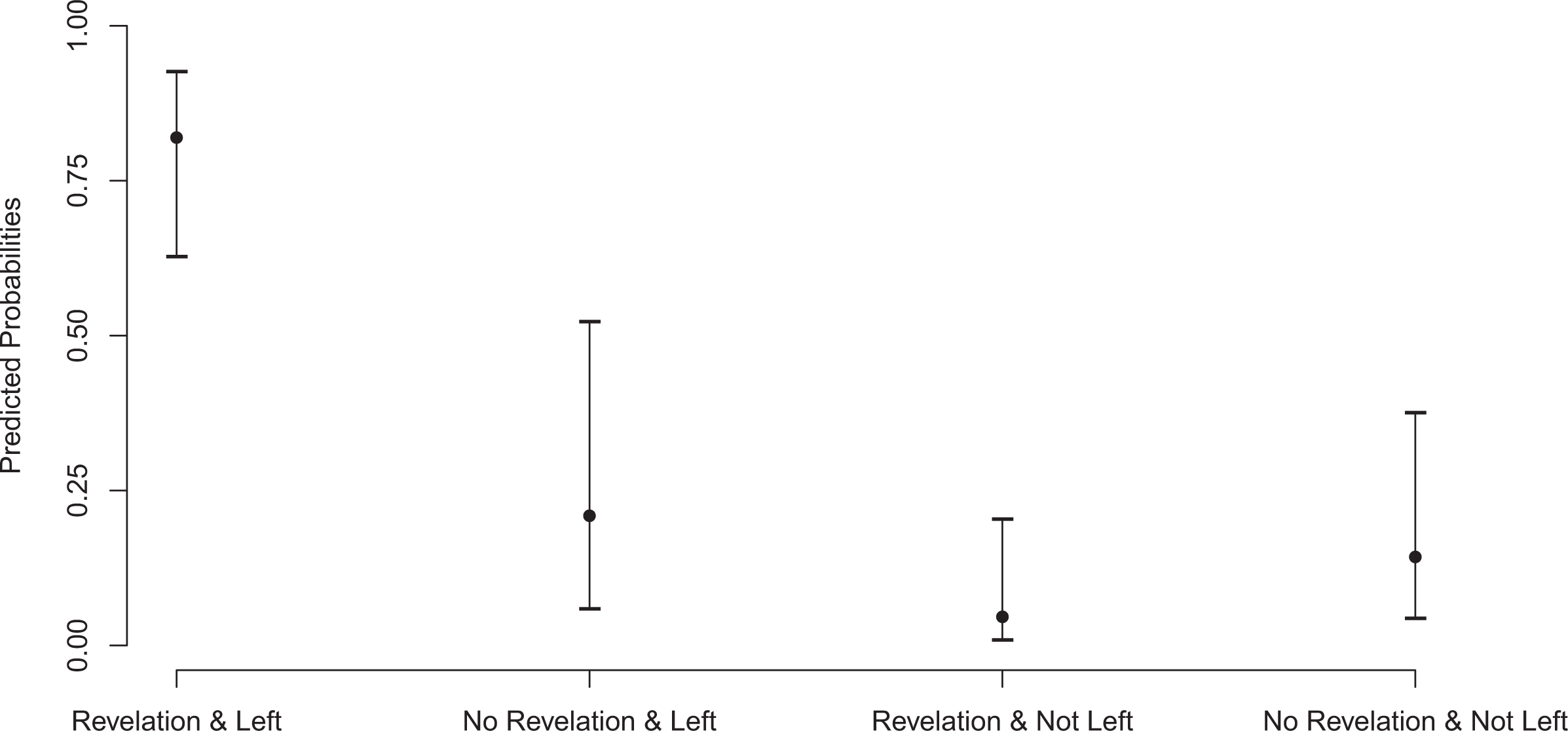
Predicted Probabilities with 95 percent Confidence Intervals, Electoral Defeat, Matched Sample. Predicted probabilities of electoral defeat based on the unique combinations of the revelation variable and the party orientation variable from model 3. The error bars represent the lower and upper bounds of the estimation with 95 percent confidence intervals.
As expected, left of center governments that were caught participating in RDI were most likely to be removed from office, with a predicted probability of Electoral Defeat at 82 percent. In comparison, the predicted probability of Electoral Defeat for a left of center government that was not caught participating in RDI is only 21 percent. This finding is striking as left of center governments were 61 percentage points more likely to lose at the election if they were caught cooperating in RDI. On the other hand, non-left of center governments were only 10 percent more likely to experience electoral defeat if they were caught participating in RDI than those that did not participate (with a predicted probability of 5 percent for the former and 14 percent for the latter). These empirical findings provide support for the first hypothesis that left of center governments were more likely to incur political costs for cooperating in RDI relative to right of center parties.
Figure 4 tests the effect of Revelation X Left Orientation on Electoral Defeat using a sub-sample of democracies and non-democracies (hypothesis 2). The results provide empirical support for the second hypothesis. Figure 4 displays the Bayesian logistic regression coefficients for the interaction term and component variables from the full model (model 3). The full regression results are included in Online Appendix Tables A5 and A6. As expected, the political costs of participation in RDI were greater for left of center parties in democracies relative to left of center parties in non-democracies. The effect of Revelation × Left Orientation on Electoral Defeat is positive and significant at the 90 percent confidence level for the democracy sub-sample (with a p value of 0.519). Whereas, the effect is positive but not significant for the non-democracy sub-sample. To appropriately assess the effect of Revelation × Left Orientation on Electoral Defeat, I compare the average marginal effects for the democracy and non-democracy sub-samples. The effect of Revelation on Electoral Defeat for left of center parties is six times greater for democracies than non-democracies. For the democracy sub-sample, the average marginal effect of Revelation on Electoral Defeat is 0.331 when Left Orientation is 0 (0.244 standard error) and 0.658 when it is 1 (0.154 standard error). For the non-democracy sub-sample, the average marginal effect of Revelation on Electoral Defeat is −0.033 when Left Orientation is 0 (0.111 standard error) and 0.131 when it is 1 (0.179 standard error). I also compute the predicted probabilities of Revelation × Left Orientation with the corresponding values of Revelation and Left Orientation for the democracy and non-democracy sample, while holding all control variables at their means. Specifically, the difference in predicted probabilities of Electoral Defeat for left of center governments that participated in RDI is 46 percent higher in democracies than in non-democracies (with a predicted probability of 89 percent for the former and 43 percent for the latter). In sum, left of center governments in democracies that participated in RDI were more likely to lose office at the election following the revelation. HRVs are more costly for left of center governments in democracies because of the perception that they are better at protecting civil liberties and respecting the rule of law and the presence of democratic institutions that enable voters to punish their government for engaging in HRVs.

Bayesian Logistic Regression Coefficients, Electoral Defeat, Matched Sample, Democracies and Non-Democracies. Coefficient estimates from Bayesian logistic regression models using matched sample. Error bars represent the 90 percent confidence intervals around the coefficient estimates from Model 3. See Table A5 and A6 in the Online Appendix for the full regression results.
Robustness
I systematically test the robustness of my results using a variety of different model specifications. First, I test the robustness of my results using Mattes, Leeds, and Matsumura (2016)’s Change in Source of Leadership Support (CHISOLS) data as an alternative data source for the dependent dummy variable Source of Leader Support Change. In line with my theoretical argument, I expect governments to be more likely to experience a change in source of leader support when the government that was caught participating in RDI was left of center. Online Appendix Table A7 displays the results from model 1 to 3 and Online Appendix Figure A1 shows the different predicted probabilities of Revelation × Left Orientation on Source of Leader Support Change—and the results replicate.
Second, to ensure that no single country is driving the results, I test the effect of Revelation × Left Orientation on Electoral Defeat using samples that consecutively exclude left of center governments that were caught cooperating in RDI. 18 Online Appendix Table A8 and Table A9 display the results from the full model (model 3) using all eleven samples—and the results still hold. Online Appendix Figure A2 and A3 shows the different predicted probabilities of Revelation × Left Orientation on Electoral Defeat.
Third, I test whether right of center governments were punished less severely than their left of center counterparts by testing the effect of Revelation × Right Orientation on Electoral Defeat. Online Appendix Table A10 displays the results from model 1 to 3. The effect of Revelation × Right Orientation on Electoral Defeat is negative and not significant. These results provide further support for my argument—the political costs of participation in RDI were less for right of center parties relative to parties ideologically to the left.
Fourth, I test an alternative explanation that focuses on anti-U.S. sentiment rather than HRVs to explain why left of center governments (which tend to have anti-American publics) were punished for participating in RDI (Tai, Peterson, and Gurr 1973; Rubin and Rubin 2004; Lawson and Hudson 2015). I create three proxies for anti-Americanism identified by the literature: (i) a dummy variable that measures whether a country has a majority Muslim population (Pew Research Center 2017) (ii) a continuous variable for the number of U.S. Bases in a country (U.S. Department of Defense 2006) iii) a continuous variable U.S. Trade percent GDPPC that divides a country’s GDPPC by their U.S. exports and imports (The World Bank 2019; International Monetary Fund 2020). To ensure that those countries most likely to have anti-American populations are not driving the results, I remove left of center governments that were caught participating in RDI from the sample that had a majority Islamic population, 19 a high number of U.S. military bases (above the sample’s mean), 20 and higher value of U.S. Trade percent GDPPC (above the sample’s mean). 21 Online Appendix Table A11 to A13 displays the results from the full model (model 3) using these three samples—and the results remain the same. Online Appendix Figure A4 to A6 shows the different predicted probabilities of Revelation × Left Orientation on Electoral Defeat.
Finally, I perform two placebo tests to ensure that the results capture the effect of Revelation × Left Orientation on Electoral Defeat for the relevant time period as well as the effect of the revelation itself. Online Appendix Table A14 displays the results from model 1 to 3 using election data from 1996 (a decade before the median year of revelation in RDI). Online Appendix Table A15 displays the results from model 1 to 3 using election data from 2001–2005 (from the period where participation in RDI was ongoing but had not yet been revealed). 22 The effect of Revelation × Left Orientation on Electoral Defeat for the election prior to 1996 is positive but not significant. The effect of Revelation × Left Orientation on Electoral Defeat for the election before the revelation of participation in RDI in 2005 is negative and significant at the 90 percent confidence level. These results provide further support for the hypotheses.
Conclusion
What explains variation in the political costs of participation in RDI? I have argued that states with left of center governments suffered greater political costs from being caught because of the perception that they are better at protecting civil liberties in the context of national security, especially those in democracies. Left of center voters are less likely to consider trading off civil liberties in the name of national security and would be more likely to perceive the revelation that their government was complicit in HRVs as a grievance. Moreover, political scandals that reveal greater differences in a party’s public and private type threaten their survival in office as it causes voters to question their credibility as a government. Consequently, left of center parties, particularly those in democracies, are more likely to be hurt by a contentious human rights scandal as their supporters can defect to another party whose preferences they perceive are closer aligned to their own or withdraw from voting altogether. To test the article’s hypotheses, I used data on party orientation to analyze the political costs of being caught cooperating in RDI (losing office). The results from the empirical analysis indicate support for my theoretical argument and are robust to a series of different model specifications.
An issue that requires some discussion concerns the possibility that a third group of countries exist beyond the treatment group (countries that participated in RDI and were caught) and the control group (countries that did not cooperate and thus were not caught)—namely, countries that participated in RDI and were not caught. While this is plausible, there has been no evidence to suggest that this other group of countries exist. Moreover, given the prevalence of naming and shaming countries for engaging in HRVs it would be surprising if detainees, expert witnesses and countries in the treatment group neglected to reveal the identity of those countries that they knew participated in RDI. If anything, this possibility presents a bias in the results that make it less likely to find support for the hypotheses given the small the number of left of center governments that were caught participating in RDI.
Additionally, there is a possibility that selection into participation in RDI was itself based on party orientation. One might expect right of center governments to be more willing to participate in RDI as they are more likely to implement policies that prioritize national security over civil liberties—and could benefit electorally from right of center voters discovering that they pursued a harsh response to terrorism. According to the same logic, left of center governments might have participated in RDI in order to demonstrate a hawkish approach to counter-terrorism and gain support from voters ideologically to the right (Nanes 2017). Alternatively, one might expect only incompetent left of center governments that miscalculated the likelihood and negative consequences of being caught participating in RDI. While these scenarios are plausible, previous research on this topic has found that party orientation is not a predictor of participation in RDI (Cordell 2019). There is also no evidence to suggest that governments participated in RDI in order to secure domestic political support. Moreover, secrecy was a crucial aspect of the RDI program as it was paramount that the U.S. could continue to obtain support from the international community during the WoT, maintain counterterrorism cooperation, and avoid the legal consequences of being caught. Leaking the U.S.’ contentious counterterrorism plans would have been costly for states as doing so would have hindered counterterrorism progress, threatened their national security and likely led to punishment from the U.S. in other areas of international politics.
To add to this discussion, the article’s findings have some important policy implications. First, the results show that right of center governments were punished less severely for engaging in RDI than their left of center counter-parts. This finding suggests that civil society actors should pay closer attention to right of center governments that engage in HRVs and ensure that they are held accountable for their actions. Moreover, if right of center voters are less likely to punish right of center governments for engaging in HRVs, then increasing the political costs of HRVs through alternative mechanisms is of greater importance. For example, given the salience of the economy and national security, NGO campaigns on HRVs could establish stronger links between HRVs, the cost of compensating victims of HRVs, and negative consequences that HRVs can have on national security (e.g. increasing grievances and terrorism threat). Second, the results indicate that disingenuous behavior from left of center governments (in the form of HRVs) may have contributed to the decline in left of center parties in government over the last decade, particularly in Europe where a number of countries participated in RDI. This finding implies that left of center governments should refrain from engaging in disingenuous behavior that is at odds with their public commitments and preferences of left of center voters. Future research on this topic could examine the external generalizability of this argument beyond this case of HRVs to see whether left of center governments are punished more harshly for renegading on their commitments in general than right of center governments.
This article provides a unique insight into the political consequences of participation in RDI during the post-9/11 period. More generally, it contributes to a wider discussion in the field of international relations on the factors that make HRVs costlier for states. Future research on this topic may seek to disaggregate participation in RDI into frequency and type of participation using information on known renditions. However, the clandestine nature of counterterrorism cooperation makes it difficult to estimate exactly when and to what extent countries participated in RDI. Binary data on participation in RDI is more reliable and less likely to contain false positives as it pools categories and intensity of participation into one measure that provides an overall picture of involvement. Thus, we can be more confident that this group of countries cooperated and that members of the public were aware of these allegations.
Supplemental Material
Supplemental Material, sj-pdf-1-jcr-10.1177_0022002720967434 - The Political Costs of Abusing Human Rights: International Cooperation in Extraordinary Rendition
Supplemental Material, sj-pdf-1-jcr-10.1177_0022002720967434 for The Political Costs of Abusing Human Rights: International Cooperation in Extraordinary Rendition by Rebecca Cordell in Journal of Conflict Resolution
Supplemental Material
Supplemental Material, sj-zip-1-jcr-10.1177_0022002720967434 - The Political Costs of Abusing Human Rights: International Cooperation in Extraordinary Rendition
Supplemental Material, sj-zip-1-jcr-10.1177_0022002720967434 for The Political Costs of Abusing Human Rights: International Cooperation in Extraordinary Rendition by Rebecca Cordell in Journal of Conflict Resolution
Footnotes
Acknowledgments
The author thanks Barış Arı, Daina Chiba, Eric Dunford, Chelsea Estancona, Lucrecia Garcia Iommi, Erik Gartzke, Anna Getmansky, Kristian Skrede Gleditsch, Nadiya Kostyuk, Todd Landman, James Lo, Fabian Neuner, Alejandro Quiroz Flores, Henry Thomson, Reed Wood, Thorin Wright, the Editor of the Journal of Conflict Resolution, Paul Huth, several anonymous reviewers, and participants at the University of Southern California Department of Political Science Workshop 2018, International Studies Association Annual Meeting 2018, Arizona State University School of Politics and Global Studies Workshop 2018, American Political Science Association Annual Meeting 2017, Network of European Peace Scientists Annual Conference 2017 and University of Essex Political Science Graduate Seminar 2017 for helpful comments. Any remaining errors are my own.
Declaration of Conflicting Interests
The author(s) declared no potential conflicts of interest with respect to the research, authorship, and/or publication of this article.
Funding
The author(s) received no financial support for the research, authorship, and/or publication of this article.

Supplemental Material
Supplemental material for this article is available online.
Notes
References
Supplementary Material
Please find the following supplemental material available below.
For Open Access articles published under a Creative Commons License, all supplemental material carries the same license as the article it is associated with.
For non-Open Access articles published, all supplemental material carries a non-exclusive license, and permission requests for re-use of supplemental material or any part of supplemental material shall be sent directly to the copyright owner as specified in the copyright notice associated with the article.
