



Abstract
What is the relationship between natural resources and rebel governance? Previous studies have argued that resource rich groups have fewer incentives to provide social services. We argue, however, that even well-funded rebels may have incentives to provide some social services to civilians. Specifically, rebel groups profiting from the extraction of natural resources should be more likely to offer health care services as a means of ensuring a dependable civilian workforce than groups who do not profit from natural resources. Using data on both the extraction of natural resources and social service provision by rebel groups, we find strong empirical evidence to support our argument. We conclude with implications for scholars and policymakers.
Keywords
What is the relationship between natural resources and rebel governance? 1 Scholars have argued that rebels who fund themselves through the exploitation of natural resources have fewer incentives to build governance structures and treat civilians well (Weinstein 2006). 2 As a result, rebels with access to natural resources are unlikely to form governance institutions; instead, they are more likely to use violent coercion or economic incentives to ensure civilian support and collaboration. This theoretical framework, however, contrasts with observed empirical realities. For instance, during the Colombian civil war the Fuerzas Armadas Revolucionarias de Colombia-Ejército del Pueblo (FARC) derived significant revenue from the extraction of gold and coca (Masse and Munevar 2016; Leech 2011; Jimeno 2016; Wagner 2016). Counter to the conventional wisdom, the group also provided services to civilians (Jimeno 2016). Likewise, during the Burundian civil war, the Conseil National Pour la Défense de la Démocratie—Forces pour la Défense de la Démocratie (CNDD-FDD) gained direct control of coffee production and offered limited social services to civilians (Oketch and Polzer 2002; Nindorera 2012). It appears that even well-funded, resource-rich rebels may therefore have incentives to provide such services. 3
In contrast to existing works, we argue that rebel groups profiting from the extraction of natural resources are more likely to provide health care services relative to other rebel groups. When rebels gain access to natural resources, the resources are not always readily available, they can be difficult to extract, and they may require significant manual labor that the rebel group alone cannot provide. At the same time, rebel groups may not fully understand how to convert raw natural resources to marketable and profitable goods without the help of civilians who already have local or practical insights into this process. For example, by controlling a field of poppies, rebels do not immediately gain economic endowments from the sale of opiates. The production of these narcotics requires local knowledge of the land, manpower to cultivate and harvest poppies, and a general understanding of how to manufacture, store, and sell refined opiates.
To unleash the economic potential of natural resources, rebels need civilians for information and labor. We argue that rebels provide health care to civilians as a means of facilitating civilian collaboration to profitable ends. The reason for this is that the provision of health care offers a practical means of maintaining the pool of actual and potential laborers in the conversion of natural resources to rents. Rather than freeing a rebel group from reliance on the local civilian population, natural resource extraction can actually deepen that reliance.
To examine our argument, we analyze data on rebel contraband (Walsh et al. 2018) and social service provision (Stewart 2018). With information on more than fifty rebel groups across every region of the world between 1990 and 2003, we find empirical evidence to support our argument. In fact, the odds that a rebel group will provide health care services are more than four times higher if it extracts resources than if it does not. The results of these analyses offer a new understanding of the conditions under which rebels govern and provide social services.
In the following section, we contextualize our research within the relevant literature on rebel governance and civil wars. Then, we discuss our theoretical argument explaining how natural resource extraction incentivizes rebels to provide health care. After detailing the argument, we discuss our data and research design. We offer empirical evidence for our theoretical argument and conclude with both scholarly and policy implications.
Governance during Civil War
Over the course of a civil war, rebel groups endeavor to amass a broad portfolio of financial, military and/or social assets to not only sustain their organizations, but also to achieve their political goals. These assets may include territory (Kalyvas 2008), foreign bases (Byman 2005), recruits and personnel (Weinstein 2006), intelligence and information (Berman, Shapiro, and Felter 2011; Kalyvas 2006), and foreign military or financial aid (Salehyan, Siroky, and Wood 2014; Byman 2005). To gain access to these resources, scholars argue that rebels typically rely on one of two strategies: coercion or quasi-voluntary compliance (Levi 1989; Wood 2010; Stewart and Liou 2017).
Quasi-voluntary compliance involves the establishment of “cooperative bargains with noncombatant populations” (Weinstein 2006, 10), to mean the formation of governance institutions of varying degrees of formality. Such governance institutions are thought to generate legitimacy and trust among civilians (Wickham-Crowley 1987; Grynkewich 2008; Mampilly 2011). This trust and perceived legitimacy facilitates the transfer of resources from non-combatants to combatants, 4 as well as recruitment into the rebel movement: civilians under insurgent control generally relinquish their possessions and resources to rebel groups in exchange for order and the traditional state-like services rebels provide. Although establishing governmental institutions within a territory and cultivating trust and legitimacy among civilians takes time and organization, once established, insurgents should be able to extract goods from civilians more efficiently (Levi 1989; Olson 1993; Arjona 2016).
Existing works suggest that rebel groups often decide to govern and govern more broadly as a result of local-structural factors (Ahmad 2017), long-term goals, such as wanting to establish a new state (Mampilly 2011; Stewart 2018), ideological commitments (Revkin 2017), their reliance on civilians for taxation (Huang 2016), or because they have satisfied their short-term survival needs and are therefore able to pursue the creation of new social orders in locations where state institutions are weak (Arjona 2016). When rebels decide to govern, they make a number of decisions about the types of institutions they will provide and who can benefit from rebel services.
For instance, rebel governance institutions have included municipal utilities like electricity and roads, health and education services, and food aid (Mampilly 2011; Arjona 2016). In some cases, rebel groups may create these institutions and services from nothing, going so far as to destroy existing state institutions to form new ones. A strategy of the Nepalese Maoists, for instance, was “destruction before construction” (Medicins Sans Frontiers 2003). Other groups, however, co-opt, reinforce, claim credit, or work with the services provided by a pre-existing state, NGO, or civilian group (see, e.g., Stokke 2006; Devkota and van Teijlingen 2010; Mampilly 2011; Lyall 2016).
By contrast, rather than provide governance to cultivate civilian loyalties, some insurgencies may rely on coercion. As opposed to developing mutually reciprocal cooperative relationships, rebels may simply wield force or threaten civilians to secure resources or recruits needed to outfit the rebel movements. One of the chief reasons for some rebels forego governance and rely heavily on coercion is because they have access to significant economic endowments (Weinstein 2006, 7, 171). When rebels have significant economic endowments, they need not rely on the civilian population for financial support and resources, and as a result, they need not establish governance institutions (Huang 2016, 73). 5 Because rebels do not rely on the civilian population for economic endowments, they are less constrained in their behavior toward them and can simply rely on coercion or predation. Rebels can also use economic endowments to buy off potential recruits, using individual financial incentives to secure the loyalty of fighters.
One of the primary mechanisms through which rebels secure high levels of economic endowments is by accessing natural resources (Weinstein 2006). Natural resources serve as an alternative source of funding to civilian taxation. As a result, rebels are significantly less reliant on the civilian population, and thus are less likely to provide goods and services to facilitate taxation or cooperation. Indeed, even research on the relationship between states and natural resource rents typically find that resource extraction weakens state responsiveness to its citizens (See Ross 1999, 2001; Auty 2002; Mehlum, Moene, and Torvik 2006; Robinson, Torvik, and Verdier 2006; Ross 2012). 6
While the conventional wisdom predicts that rebel groups will not engage in taxation and other state-building activities when natural resources are available, anecdotal evidence and recent work utilizing subnational analysis indicate otherwise. For instance, Revkin (2020) notes that while greed-based theories predict rebel groups will only engage in governance in areas where they lack exploitable resources, this prediction is contradicted by the Islamic State’s pattern of taxation across time and space. After mapping seven types of revenue-extracting policies imposed by the Islamic State in nineteen Syrian districts that it governed between 2013 and 2017, Revkin (2020) finds that these policies were just as prevalent in resource-rich as in resource-poor districts.
In the next section, we build on these works and argue that natural resources are an overlooked factor that incentivize rebel groups to provide a specific form of governance: health care provision. While there may be several reasons why rebels decide to govern, we argue that rather than incentivize coercion against civilians, natural resources incentivize health care provision. Health care provision is a form of governance that can facilitate the extraction of natural resources, which in turn provides a direct material benefit to the rebel group.
Natural Resource Extraction and Governance: A Complex Relationship
Before rebels provide any form of governance, we assume that certain scope conditions must be met. First, rebels must be able to operate openly and unencumbered (Jackson 2018). Operational unencumberment differs from territorial control, as the latter typically implies that rebels are able to defend a space from state attacks and incursions, whereas the former suggests that rebels can simply interact with civilians openly (McColl 1969; Kalyvas 2006), even co-opting or working alongside state institutions (see, e.g. Mampilly 2011, 112-13). As an example, the Taliban is able to provide governance and services without necessarily controlling territory (Jackson 2018). Rubin (2018, 159-63, 173) reports a similar pattern in the Philippines: states may have a temporary physical presence (e.g., stationing troops in villages during the day and then leaving during the evening) which provides other actors an opportunity to take their place when they depart. What is essential, however, is that rebels can undertake their activities openly in a given area, irrespective of whether they can defend that area from state incursions (see also, Mampilly and Stewart 2021).
Second, beyond the ability to operate unencumbered in a territory, rebels must be cohesive enough to at least be unconcerned with day-to-day survival (Arjona 2016). Service provision, including health care, requires groups to overcome coordination problems involved with collecting, distributing, and consuming resources in some fashion.
Once these conditions are met, we expect rebels to make decisions about if, how, and to whom they will provide governance and services. In particular we argue that in contrast to some existing works, rebels’ access to natural resources incentivizes the provision of a particular form of governance: health care.
The process of converting natural resources to fungible resource rents is not always straightforward or easy: it often requires significant labor as well as practical, local knowledge (Rigterink 2020). As examples, primary diamonds are frequently extracted from a mine, thereby requiring a significant degree of labor (Lujala, Gleditsch, and Gilmore 2005; Rigterink 2020, 543). As stated earlier, the exploitation of poppy requires a number of steps, hands, precursor chemicals, and knowledge to extract opium and refine it into opiates like morphine or heroin. In Sierra Leone, the Revolutionary United Front (RUF) utilized thousands of civilian miners who were expelled by the government to assist in the extraction of diamonds (Rigterink 2020). In terms of technical expertise, after the Islamic State conquered oil fields in Iraq and Syria, they used local civilians—many of whom worked for Iraqi oil companies—to complete the refinement process prior to selling (Reuters 2014). The Islamic State fighters lacked the technical or institutional knowledge to refine the oil themselves, thereby relying on the civilian population’s experience to receive the resource rents (Solomon, Kwong, and Bernard 2016). Thus, obtaining rents from resources requires a labor force, experiential knowledge or some combination of both, depending on the resource to be extracted.
Because rebels often need labor and/or specific knowledge about how to convert natural resources for sale, civilian laborers are as much an asset as the natural resources themselves. Rebels cannot reap the full economic benefits without civilians who have experiential knowledge of how to refine natural resources for sale, or laborers who can physically extract the resources. Furthermore, in many cases, resource extraction must take place in a specific location. What results is that the pool of potential civilians upon whose labor or knowledge a rebel group can draw is relatively consistent, if not dwindling: rebels might work with civilians proximate to extraction locations, and unless rebels can consistently replenish their labor force, if civilians are injured while working, are overworked, are killed due to rebels’ coercive behavior or occasionally even flee, then rebels shrink their pool of laborers and support personnel working to extract natural resources. While recent research by Revkin (2021) finds that many people decide to stay in an area under rebel control, it is unlikely we will observe individuals migrating into conflict areas. Therefore, the pool is likely to be relatively fixed (at best), and more likely, shrinking. This would make the provision of health care even more urgent as rebels need laborers to extract resources. Thus, once rebels control a territory and enforce some degree of control over who can enter and who can exit a territory, the labor pool is more likely to be depleted than increased. A shrinking labor pool, in turn, diminishes rebels’ ability to fully exploit natural resources and maximize profits. Rebels therefore have an economic incentive to maintain their labor pool in order to maintain access to rents from natural resources.
Given that rebel groups need civilians’ labor and knowledge to extract resources and because this labor pool is relatively consistent (if not potentially shrinking in size due to flight or violence), rebel groups with access to natural resources are incentivized to provide a particular form of governance—health care—to those who directly assist in the extraction and refinement of natural resources as well as those who fulfill support roles. We define health care broadly, including everything from treating routine ailments (e.g., stitches or pain) to major surgeries. Rebels are incentivized to provide health care because it offers a number of practical advantages.
First, and most importantly, health care provision serves a very practical purpose by maintaining the health and well-being of civilian workers. Civilian laborers can only extract resources for the rebel group when they are fit enough to work. Smugglers cannot transport resources unless they are healthy enough to move through potentially dangerous or rugged terrain. Health care is a form of governance that directly addresses rebels’ need to maintain a pool of labor which, in turn, maintains rebels’ access to natural resources.
Second, while the benefits to rebels of health care provision are relatively high, the costs of health care provision are relatively low: if an insurgency has at least one trained medic or health care professional as well as some medical supplies, this person can be made available to help civilians. The provision of health care is therefore not limited to high-capacity organizations: even weak rebel groups can provide health care to civilians in the hopes that the investment will result in long-term benefits. 7 For instance, as an efficient and popular way to address civilian ailments, rebel groups like the People’s Liberation Army in China and the Ethiopian People’s Revolutionary Party (EPRP) provided acupuncture (on China, see Taylor 2005, 17-18 and on the EPRP see Tadesse 1998, 368). The Eritrean People’s Liberation Front (EPLF) even created a unit of mobile health care providers who moved from village to village offering health services in places that lacked state presence, but rebels themselves could not fully control (Pool 2001, 101-02).
Third, internally provided health care provision might be a cheaper and more secure option than paying someone else to look after and maintain the health of rebels’ labor pool. As noted above, some non-lootable resources require a large number of workers to extract. Paying for a large number of laborers to be treated by others could be more expensive than providing it internally, especially if rebels already have the capacity to provide health care services. Furthermore, civil wars are more likely to emerge in states where the distribution of health and welfare services are inconsistent and patchy (see, e.g. Devkota and van Teijlingen 2010; Taydas and Peksen 2012; Fearon and Laitin 2003). If rebels themselves did not provide health care, civilians might move away from where resources are extracted to receive treatment. This provides opportunities for civilians to interact with government forces and provide information to authorities that may be critical to counterinsurgency campaigns. Rebel provision of health care may therefore reduce costs while also mitigating the likelihood of civilian reporting, which could threaten the security of the group, or flight, which could reduce rebels’ labor pool.
Importantly, health care provision is a more attractive option than coercion to secure civilian compliance with respect to labor. Physical violence can exacerbate the rate of civilian health degradation and flight. Gratuitous physical abuse, for instance, weakens civilians and may make them unable and/or unwilling to serve their various functions (Estancona 2019). Moreover, compliance gained from violent coercion may be fleeting or not as durable as compliance gained through non-violent tactics or legitimacy (Tyler 2006a, 2006b). As a result, unless rebels can consistently replenish their labor pool, 8 rebels who physically coerce civilians could lose one essential asset (labor or specific extraction-related know-how), and in turn, lose access to a second essential asset (the natural resource).
Of course, while access to natural resources incentivizes groups to provide health care to civilian laborers (broadly defined) in some areas, this does not preclude them from using more violent approaches in other areas where their labor force does not reside. Scholars have demonstrated heterogeneity in the distribution of violence against civilians in civil war, and rebels’ interactions with civilians can therefore vary by location (Brown Forthcoming; Estancona 2019; Polo and Gonzalez 2020): although the Islamic State provided health care and extracted and sold oil, it also engaged in spectacular violence. Indeed, Estancona (2019) finds that unless there is a negative price shock to the cost of narcotics, civilians in narcotics-producing areas will be less likely to face violence by rebel groups than civilians in non-narcotics producing areas, 9 while Wimmer and Miner (2019) find that in places where there are lootable natural resources, civilians are not more likely to be killed.
Because health care facilitates the extraction process and enables rebel organizations to profit, rebels with access to natural resources are particularly highly incentivized to provide health care. When rebels do not profit from the extraction of natural resources, however, their incentives to provide health care specifically are less intense. These non-extracting rebels may nevertheless encounter incentives to provide other forms of governance, such as institutional reform (Kasfir 2005; Huang 2016), justice processes (Loyle and Binningsbø 2018; Barter 2015), market reforms (Pool 2001, 123), land redistribution (Wood 2003), and education (Mampilly 2011; Huang 2016), but they lack the same strong incentives as extracting rebels to provide health care specifically. For instance, some insurgencies seek independence or autonomy for a marginalized national or ethnic group, and these organizations provide education to propagate an interpretation of history that focuses on their particular nationality or ethnic group in ways that might facilitate recruitment and mobilization (see, e.g. South 2013, 193-94).
Thus, a lack of natural resources does not obviate all incentives for any form of governance. Rather, our central insight is that resource-rich rebels should be especially inclined to provide a practical service—health care—which directly furthers their business interests and organizational survival in comparison to rebels that do not profit from the extraction of resources. Although rebels without access to natural resources have incentives to provide a variety of services and governance institutions, these institutions need not involve health care services specifically. We therefore hypothesize that:
An illustrative anecdote highlights the relationship we have posited. Since the mid 1960s, the FARC has engaged in a civil war with the Colombian government. In the 1990s, the group made military advances that allowed it to maintain a presence in resource-rich areas. As time went on, the FARC established multiple camps where it trained, extracted lucrative resources, and provided goods and services such as health care. These areas generally lacked the reach of the Colombian state either by agreement or due to a lack of capacity (McDougall 2009). The first particularly lucrative commodity the FARC exploited was cocaine. But as the decade moved forward, the group included gold mining in its business repertoire. The FARC required manpower, equipment, and information from external sources. Nearby campesinos, or local peasants that were not members of the group, would assist with cultivating coca and synthesizing the paste to its final product, cocaine hyrdrochloride (Masse and Munevar 2016). This involved multiple stages that spanned a six-month period and hours of physical labor to refine the product. Within the gold mining industry, the group initially taxed/extorted artisanal miners. It should be noted that while artisanal gold mining requires minimal technical expertise, it does require labor for it to be profitable. The FARC eventually provided the equipment necessary to extract larger quantities of gold in nearby territories including those within the Peruvian and Ecuadorian borders. The need for labor persisted and grew alongside the FARC’s connections with local communities.
While it is difficult to pinpoint exactly when medical services were made available to the local population, particularly those involved in the extraction of resources for the FARC, the FARC nevertheless provided such services in resource-rich areas. As the FARC continued to expand through Colombia and engage in resource extraction, it also acquired medical equipment and constructed mobile hospitals (Leech 2011; Jimeno 2016). In El Diamante, Conejo, and parts of Antioquia, where extracting cocaine was the predominant business, hospitals and medics were made readily available (McDermott 2013). In Caqueta, an area where mining occured alongside the river, the FARC provided medical treatment to locals by utilizing FARC medics that previously serviced combatants and received training on the battlefield (Jimeno 2016; Wagner 2016). While other factors could have compelled the FARC to provide governance (e.g., goals or ideology), the placement and location of these services, as well as studies identifying their connection to gold mining and cocoa production, also implies rational economic concerns (McDougall 2009).
To summarize, contrary to the conventional wisdom, we argue that natural resources do not always disincentivize rebels to provide governance. Rather, natural resources incentivize a certain form of governance: health care. Many natural resources require a high degree of labor to extract, and in some cases, experiential knowledge about how to refine, process and sell the resources. To access natural resource rents, rebels need a consistent labor pool. Given certain war-time conditions—displacement and possible flight, violence, etc.—this labor pool is often relatively consistent in size, if not dwindling. The provision of health care by rebel groups is a cost effective and secure option that maintains the size and well-being of this labor pool such that civilians are able to continue to extract, refine and process the natural resources and rebels are able to gain economic benefits from these resources (especially in contrast to physical violence against civilians). While non-extracting rebel groups may have other incentives to provide varying forms of governance, they lack the same specific incentives as resource-extracting groups to provide health care.
Data and Methods
To evaluate the relationship between social service provision and resource extraction, we leverage two recent datasets on the extent and nature of service provision by rebel groups as well as their exploitation of natural resources. In this section, we first discuss data for our dependent variable, health care. We then turn to the natural resource extraction dataset to discuss the independent variables created from it, followed by a detailed discussion of other relevant variables used in our study.
Social Service Provision Dataset
Our main dependent variable is drawn from Stewart (2018), and captures information on annual health care services provided by rebel groups. For each year with available data, the rebel health care variable is coded as “0” if rebels provided no health care and “1” if rebels provided any health care.
In the dataset, health care refers to the provision of goods and medical services believed to benefit the health of the recipient. In these cases, health care may represent hospitals, clinics, or barefoot doctors (Tadesse 1998, 368). In almost all cases, insurgent health care falls far short of health care typically found in advanced economies, such as trauma centers and state-of-the-art facilities. Instead, rebel health services are frequently rudimentary and simple. The fluid nature of war makes it challenging to complete complex surgical operations in rebel-held or contested areas. The Eritrean People’s Liberation Front (EPLF), for instance, used a small stone enclosure as a hospital where civilians and fighters could be treated in more rural locales (Firebrace and Holland 1985), and rebel groups like the Front for an Independent East Timor (FRETILIN) worked with civilians to grow their own medicinal herbs (Da Silva 2012, 209). In other words, though there is variation in the quality of health care services a rebel group might provide, most rebel health care is not overly complex.
To code the dependent variable across rebel groups, Stewart (2018) relied on numerous qualitative texts including books, journal articles, newspapers, archival documents, magazines, testimonies and memoirs in English, French, and Spanish. As an original and hand-coded dataset that is relatively new, it may be subject to questions of reliability. To address this concern, Stewart (2018) compared the data to that of existing datasets (Florea 2014; Kalyvas and Balcells 2010) and performed a number of analytic checks. 10
Rebel Contraband Dataset
In the case of resource extraction, the Rebel Contraband Dataset compiles information on rebel group exploitation of natural resources for the period 1990 to 2012 (Walsh et al. 2018). Key advantages of the Rebel Contraband Dataset are that the data are collected at the level of the rebel group, group activity varies by year and covers a large portion of the post-Cold War period, and the data are disaggregated by resource. Previous research typically featured natural resource data at the country or regional level, often inferring that rebel groups profited from natural resources simply because those resources existed in the same country or region as the group. Additionally, previous studies often focused on only a few (or even a single) category of resources. The Rebel Contraband Dataset resolves these issues by directly measuring the extent to which groups profit from a wide range of natural resources. The multi-year development of the dataset involved faculty members, doctoral students, and undergraduates. Information was derived from a variety of open-source materials, including United Nations reports, trade publications, research bulletins, and scholarly books and articles.
We consider extraction as those cases where “a group employs violence or the threat of violence to earn money from the production of natural resources” (Walsh et al. 2018). This is distinct from smuggling operations where the group profits solely from the transportation of the resources to distant markets. It is important to note that the extraction of natural resources does not necessarily mean that violence is employed against the civilian population. On the contrary, much of this activity often involves the protection of civilian workers, with only an implicit threat of violence (Walsh et al. 2018). As non-state actors challenging the state with violence, rebel groups are engaged in illegal activities by default. The economic activities of such groups therefore involve some level of implicit coercion. Examples provided in the project codebook include cases where an “armed group coerces workers to extract resources” and where an “armed group protects illegal miners or farmers of illicit goods from the police or military.” Even in the latter case, which appears to be cooperative activity, a threat of violence still exists. Additionally, the data only indicate that a group extracted a natural resource if “there was reasonably strong evidence that the group earned a significant fraction of funding” from such activity (Walsh et al. 2018, 701). Ad-hoc revenue generation is therefore not included in the data, as the project focuses exclusively on the systematic exploitation of resources that generate meaningful funding for groups. In total, the project includes data on the exploitation of twenty-six different categories of natural resources, including timber, drugs and a variety of minerals. We code a rebel group as extracting natural resources in a given year if they earn significant funding from any of these resources. The independent variable, Natural Resources, is therefore coded as “1” if the group extracted any natural resources, and “0” if it did not.
Combined Data
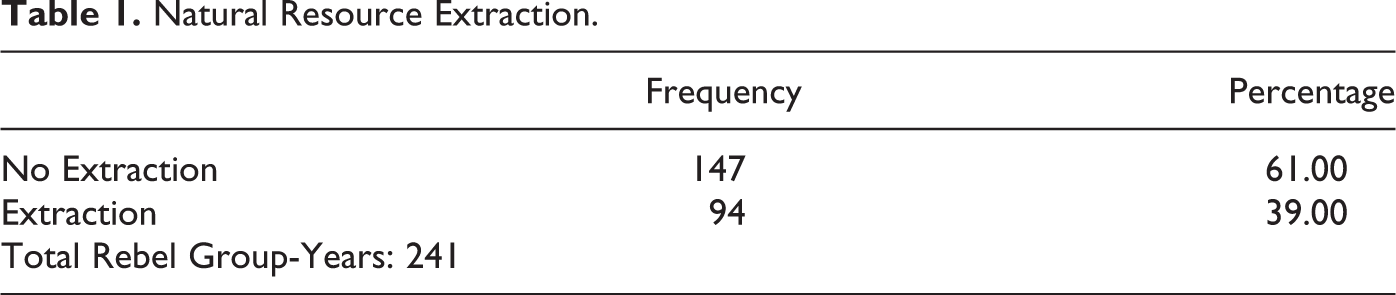
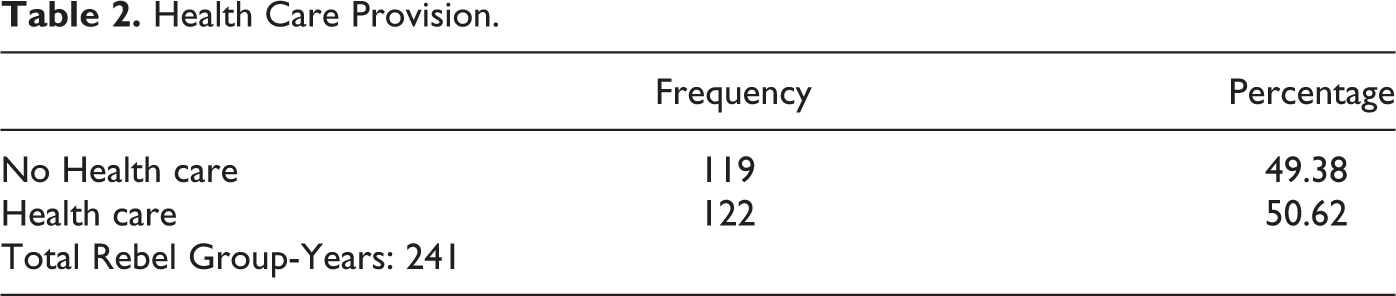
The unit of analysis in our statistical models is the rebel group-year. Combining the data on social service provision with the data on natural resource extraction, we have information on fifty-two different rebel groups in thirty-three countries across every region of the world for the period 1990 to 2003. Tables 1 and 2 show the frequency distributions for the independent and dependent variables.
Natural Resource Extraction.
Health Care Provision.
Our largest multivariate model includes 241 rebel group years, of which, 39 percent involve extraction of natural resources. 11 To this basic framework we add several variables that have been linked to either natural resource extraction or social service provision by rebel groups.
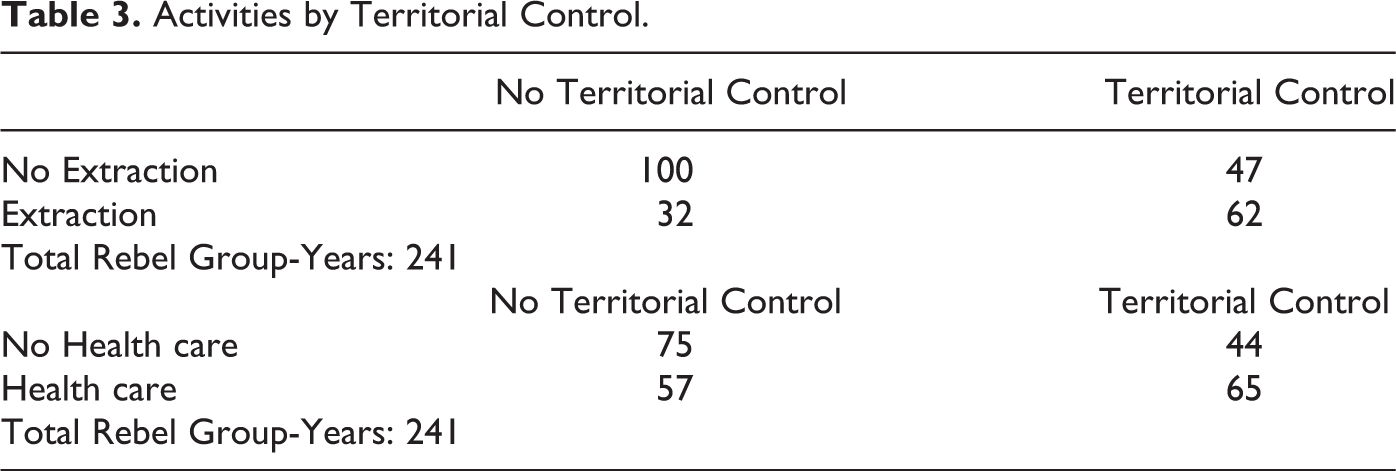
First, we include a measure of whether the rebel group controlled territory in a given year. This variable is drawn from the Nonstate Actor Dataset (Cunningham, Gleditsch, and Salehyan 2013). The variable Territorial Control equals “1” if the group controlled any territory at all and ‘0’ if it did not. Territorial control can help facilitate the exploitation of natural resources. Additionally, territorial control may facilitate the provision of social services, since groups can more easily establish even rudimentary medical facilities (McColl 1969; Olson 1993). As stated above, although territorial control facilitates and eases governance, it is neither necessary nor sufficient to control natural resources and/or provide social services (Jackson 2018). Indeed, some rebel groups designed health care institutions to move throughout certain areas of the country not yet controlled by the rebel group (Pool 2001, 101-02). Table 3 illustrates the breakdown of activities according to whether groups control territory or not. Clearly, both natural resource extraction and the provision of health care occur in cases of territorial control. But they also occur widely in cases where the rebel group does not control territory. The correlation between Territorial Control and natural resource extraction is relatively low at 0.33. It is important to account for territorial control in our models, but there is sufficient variation in how and when these activities occur to conclude that our key independent and dependent variables are not simply proxying for territorial control. 12
Activities by Territorial Control.
We also include a series of variables that capture elements of organizational strength and resources. Such factors can reasonably be expected to influence a group’s ability to extract resources and provide social services. Membership Size is the best estimate of a group’s total membership. Mobilization Capacity indicates the ability of the group leadership to command and mobilize its own personnel. The ordinal variable ranges from “1” to “3,” with a “3” indicating the highest leadership capacity. Finally, Foreign State Sponsorship is coded as “1” if the group was allegedly or explicitly supported by a foreign state actor, and “0” otherwise. These variables are also drawn from the Nonstate Actor Dataset (Cunningham, Gleditsch, and Salehyan 2013).
Additionally, we include a variable that indicates the long-term goals of a rebel group, specifically, whether a group is Secessionist. This variable is available in the social service provision dataset and equals “1” if the group espouses secessionist goals, and “0” otherwise. Upon gaining territory, secessionist rebels may have incentives to provide social services, and to provide these services extensively (Mampilly 2011; Stewart 2018). Though our sample is not limited to groups that control territory, the incentives to provide governance may nonetheless remain.
Finally, we include measures capturing economic and political characteristics of the country where the rebel group primarily operates. The level of Democracy comes from the Polity IV project, and is measured as an ordinal variable ranging in value from −10 to 10 (Gurr, Marshall, and Jaggers 2010). Higher values indicate more democratic political institutions, while lower values indicate more autocratic institutions. We also include the natural log of a country’s Gross Domestic Product (Heston, Summers, and Aten 2012).
We use a logistic regression approach, and we calculate robust standard errors clustered on the rebel group.
Quantitative Analysis and Findings
Our first step is to examine the preliminary empirical evidence for our contention that rebel groups that extract natural resources are more likely to provide health services. Table 4 provides initial support in favor of our hypothesis. The first column lists the results of a bivariate logistic regression where the dependent variable is health care provision by the group in a given year. We see that Natural Resources is positively and significantly related to the provision of health care. In other words, on average, groups that extract natural resources are also more likely to provide health services, compared to groups that do not extract natural resources. In the second column, we add year fixed effects to the model to account for temporal variance. The results are nearly identical to the baseline bivariate model.
Natural Resource Extraction and Health Care Provision.
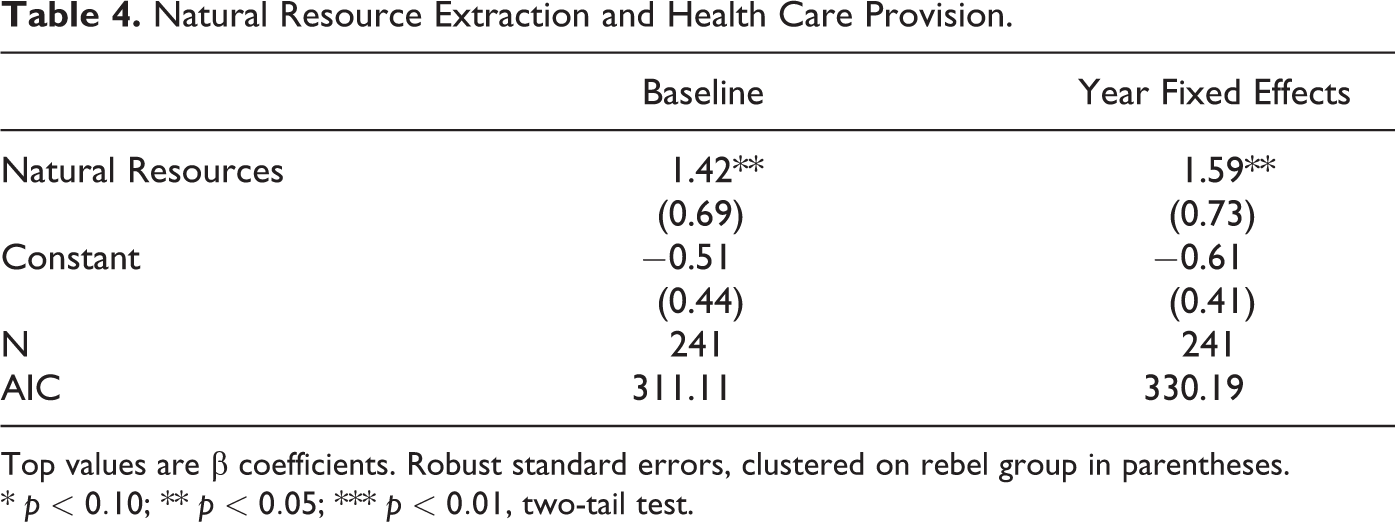
Top values are β coefficients. Robust standard errors, clustered on rebel group in parentheses.
*
In Table 5, we examine the relationship in more detail by accounting for a series of additional factors. In the first column, we see that Natural Resources continues to significantly and positively impact the provision of health care, even after the inclusion of control variables. Figure 1 depicts the substantive effects of natural resource exploitation, holding all covariates constant at their means. If a group does not extract resources, the probability that it will provide health services is 0.37. If that same group, however, begins to profit from the extraction of natural resources, the probability of health provision jumps to 0.71. Although the confidence intervals appear to overlap in the graph, the difference between the two predicted probabilities is statistically significant at the
Relationship between Social Service Provision and Exploitation of Natural Resources.
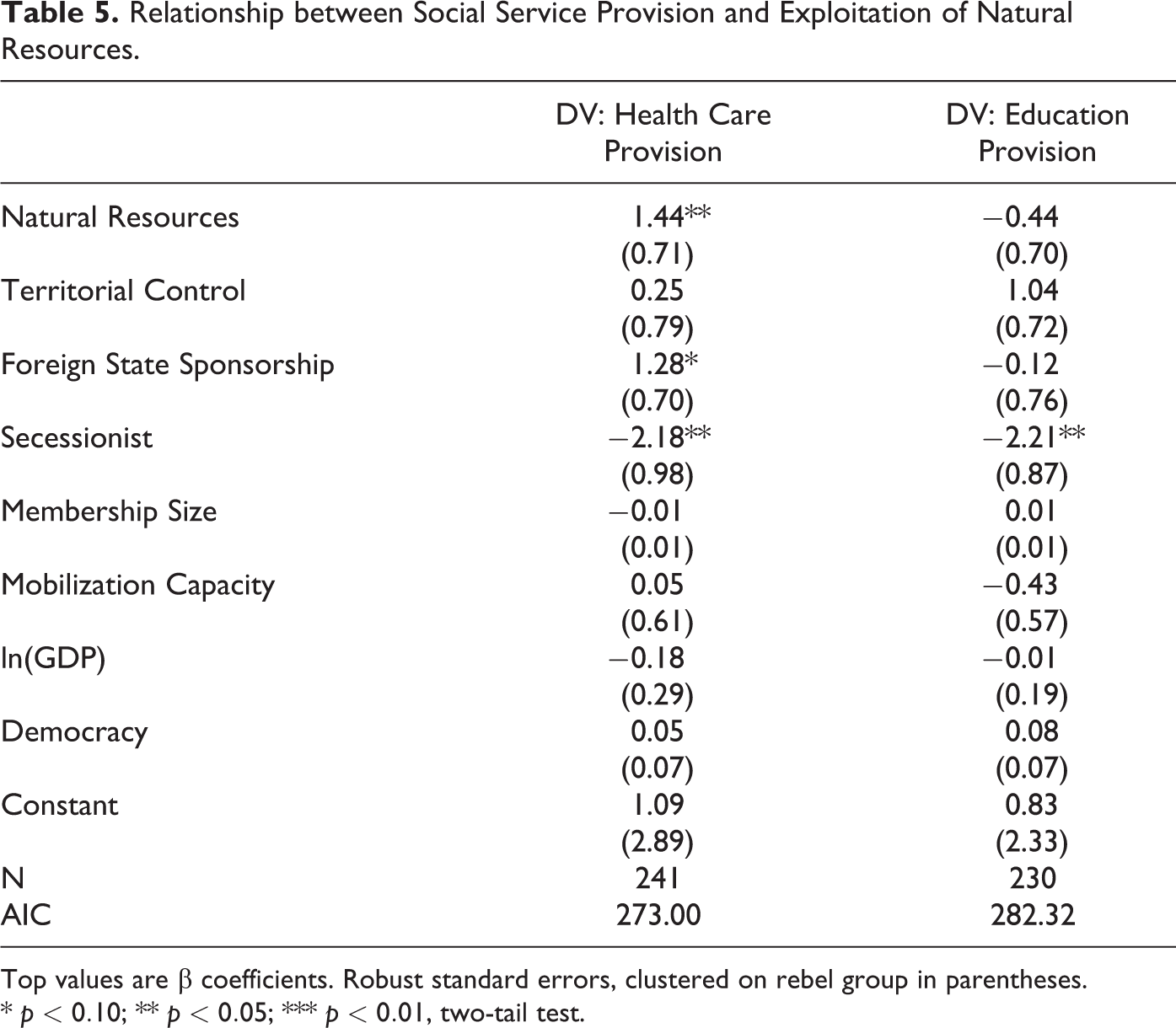
Top values are β coefficients. Robust standard errors, clustered on rebel group in parentheses.
*
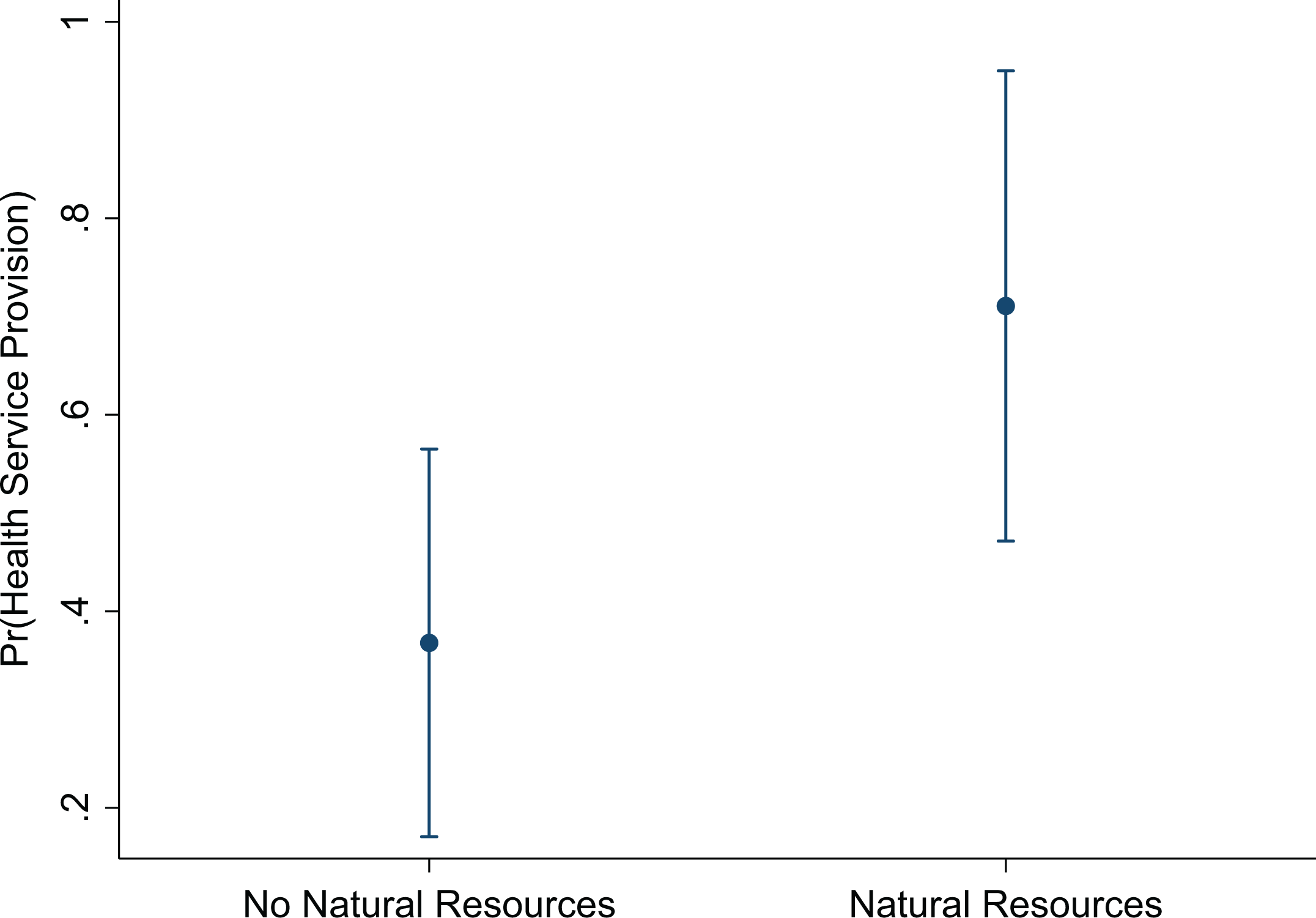
Effect of Natural Resource Extraction on Health Service Provision. Estimates include 95 percent confidence intervals. Difference in estimates is statistically significant at 95 percent level.
Among the covariates, Foreign State Sponsorship is also positively and significantly related (though only at the
In the second column, we test another implication of our theory by exploring whether there is evidence of a relationship between education service provision and the extraction of natural resources. If rebel groups that earn revenues from natural resource exploitation are subsequently more likely to provide educational services, this might undermine our theory. Providing both health and educational services may indicate that rebel groups provide such services for reasons other than to support their labor pool. It may also indicate that natural resources are merely a proxy for rebel coffers leading to any social service provision. To test this, we use a measure of the level of insurgent education provision (also drawn from Stewart 2018) as our dependent variable, instead of the annual level of insurgent health care provision. The level of insurgent education provision is measured in the same way as insurgent health care provision with groups providing any education services coded as a “1,” and “0” otherwise. 14
The results from the second model, however, cast doubt on this possibility. We find no significant relationship between extraction of natural resources and educational service provision. 15 This lends additional support to our argument that the decision to provide health services is largely a decision about preserving and enhancing human resource inputs in the extraction of natural resources.
Robustness Checks
To further explore the sensitivity of our main results, we conduct a series of robustness checks. This additional analysis is available in the Online Appendix, and in all cases, the conclusions are comparable to those reported in this manuscript. First, we include year and country fixed effects in our full multivariate models.
Second, as an alternative to our time-series analysis, we also include in the online appendix the results from a purely cross-sectional approach. We replicate one of the key cross-sectional models presented by Stewart (2018), which uses an ordinal health services provision measure as a dependent variable. 16 In addition to controlling for many of the factors identified in our study, Stewart’s model includes covariates such as the infant mortality rate, the duration of conflict and the type of terrain. Even with this more limited cross-sectional sample, our conclusions hold.
Third, we explore the directionality of our causal mechanism by lagging all independent variables in our models. In other words, we are arguing that extraction of natural resources, and the demands for manpower that it brings, leads to greater health service provisions, rather than vice versa. Lagging of independent variables, however, may also lead to inferential problems (Bellemare, Masaki, and Pepinsky 2017). As a more extensive check, we use a recursive bivariate probit approach. The recursive bivariate probit allows us to incorporate the possibility that the error terms in each of our models are correlated, which would mean the resulting probabilities would be jointly distributed. The recursive bivariate model further allows us to distinguish the effect of extraction on health service provisions—and vice versa—by sequencing the dependent variables. The results support our initial conclusion: natural resource extraction is a key determinant of health care provision.
Fourth, our theory rests on the idea that the labor required to extract natural resources incentivizes health care provision. When rebels have access to natural resources that are more labor intensive to extract, they should therefore be especially inclined to provide health care. To test this implication, we use the Rebel Contraband Dataset to disaggregate the type of resources extracted. We create a measure of Non-Lootable resources, which equals “1” if the group exploits a resource that does not meet the definition of lootable resources used by Snyder (2006) (“high value goods with low economic barriers to entry”), and “0” otherwise. As expected, rebel groups are significantly more likely to provide health services when the resource extraction process is particularly demanding. Additionally, we use an alternative measure to proxy for the intensity of natural resource extraction: we count the number of different resources exploited by each group in a given year. 17 The number of resources positively and significantly influences the level of service provision, as expected.
Fifth, we test our models on a sample where every group controls territory as well as a sample where no groups control territory. Although this process dramatically reduces the sample size in both cases to around 100 observations, natural resource extraction is statistically significant in the “no terriorial control” sample and just outside conventional levels of significance in the “territorial control” sample. These results support the argument that natural resource extraction is not simply a proxy for territorial control.
Finally, as an additional test of the reliability of our data, we use data from Huang (2016) which includes a measure for rebel dependence on natural resource, and a measure for rebel health care. Consistent with our data, a simple cross-tabulation of these two measures finds that rebels dependent on natural resources are more likely to provide health care (over 38 percent) compared to rebels without access to natural resources (27 percent).
Taken together, the evidence from our empirical analysis supports our conclusion that rebel groups who exploit natural resources are more likely to provide health services than rebel groups that do not exploit natural resources.
Conclusion
While previous studies have argued that resource rich groups have fewer incentives to provide social services, we argue that even well-funded rebels may have incentives to provide social services to civilians. Specifically, rebel groups profiting from the extraction of natural resources should be more likely to offer health care services to civilians as a means of ensuring a dependable civilian workforce, than groups who do not profit from natural resources. Relative to rebels, civilians serve as a labor force that may possess considerable knowledge and insights of the extraction process and trade. More specifically, like natural resources, civilians are an asset. And to protect this asset and ensure a dependable workforce, insurgents may provide health care.
Using relatively new data on both natural resource exploitation and social service provision by rebel groups, we find strong empirical support for our argument. More specifically, this study finds that groups extracting natural resources are significantly more likely to provide health care services. The odds that a rebel group will provide health care services are more than four times higher if it extracts resources than if it does not. But this form of service provision should not be confused with signifying a political, ideological or humanitarian end only: rather, this governance should be viewed as an investment for deeper financial rewards.
The implications of this study are two-fold. First, while scholars are increasingly examining rebel civilian interactions (Arjona 2016; Mampilly 2015; Rubin 2018; Huang 2016) and it is clear that a relationship exists between natural resource extraction and rebel governance, future research should consider elaborating upon the causal mechanism (Sánchez de la Sierra 2020). Moreover, scholars should consider how civilian victimization is conditioned by resource extraction and the provision of health care. It may also be worthwhile to allow for an examination of how the state’s behavior conditions rebel-civilian interaction in terms of social service provision. In some cases, delegating or sharing service provision with the insurgent group can maintain a link between the incumbent and the population (Mampilly 2011). Similarly, Wagstaf and Jung (2020) examine whether competition between armed nonstate actors and the state results in varying types of service provision by terrorist groups. It can be argued that the more health care available in resource extraction sites the less likely rebels will utilize critical resources to compete with the state. Such rebels may simply co-opt state services. Finally, scholars should consider how natural resource extraction impacts other forms of governance such as taxation (cross-nationally) and dispute resolution—two services that are likely to be necessary in any industry that requires self-enforcing agreements, labor, trade, and contraband.
Second, policymakers wishing to engage rebels who rely on the civilian population should continue to acknowledge the economic relationship between them. Reintegrating rebels, for instance, will require severing their financial ties to the informal extraction of resources. This may require legitimizing their industry within the community or supplementing the loss of their economic resources with some other sustainable funding source. Additionally, such post-conflict transition policies may be problematic if civilians are not provided with their own supplements for loss of income and services. Thinking through the full strategic relationship between rebels and civilians, particularly the financial ties that bind them, is necessary for designing effective policies. This is especially important if policy-makers seek to transition the informal economy into a formal one, or, at the very least, the actors that participate/depend on it.
Ultimately, the relationship between natural resource extraction and governance is far more complex than previously supposed. We emphasize, along with works by Mampilly (2011, 2015) and Arjona (2016), that governance represents a strategic interaction between civilians and rebels. However, we specifically argue that health service provision represents an investment in a source of financing that might subsequently help rebels achieve their strategic objectives. Because the extraction of natural resources often requires a large base of fit and healthy workers, rebels must invest in some social services to gain the financial and military benefits associated with resource rents. The fighters who seek resource rents may be opportunistic and intent on maximizing profits, but this does not preclude them from providing services as an investment in future resource extraction. This means that health care is particularly important as it sustains a work force and ensures the continuity of labor.
Supplemental Material
Supplemental Material, sj-do-1-jcr-10.1177_00220027211025597 - Revisiting Opportunism in Civil Conflict: Natural Resource Extraction and Health Care Provision
Supplemental Material, sj-do-1-jcr-10.1177_00220027211025597 for Revisiting Opportunism in Civil Conflict: Natural Resource Extraction and Health Care Provision by Justin Conrad, Liana Eustacia Reyes and Megan A. Stewart in Journal of Conflict Resolution
Supplemental Material
Supplemental Material, sj-docx-1-jcr-10.1177_00220027211025597 - Revisiting Opportunism in Civil Conflict: Natural Resource Extraction and Health Care Provision
Supplemental Material, sj-docx-1-jcr-10.1177_00220027211025597 for Revisiting Opportunism in Civil Conflict: Natural Resource Extraction and Health Care Provision by Justin Conrad, Liana Eustacia Reyes and Megan A. Stewart in Journal of Conflict Resolution
Supplemental Material
Supplemental Material, sj-dta-1-jcr-10.1177_00220027211025597 - Revisiting Opportunism in Civil Conflict: Natural Resource Extraction and Health Care Provision
Supplemental Material, sj-dta-1-jcr-10.1177_00220027211025597 for Revisiting Opportunism in Civil Conflict: Natural Resource Extraction and Health Care Provision by Justin Conrad, Liana Eustacia Reyes and Megan A. Stewart in Journal of Conflict Resolution
Supplemental Material
Supplemental Material, sj-pdf-1-jcr-10.1177_00220027211025597 - Revisiting Opportunism in Civil Conflict: Natural Resource Extraction and Health Care Provision
Supplemental Material, sj-pdf-1-jcr-10.1177_00220027211025597 for Revisiting Opportunism in Civil Conflict: Natural Resource Extraction and Health Care Provision by Justin Conrad, Liana Eustacia Reyes and Megan A. Stewart in Journal of Conflict Resolution
Supplemental Material
Supplemental Material, sj-pdf-2-jcr-10.1177_00220027211025597 - Revisiting Opportunism in Civil Conflict: Natural Resource Extraction and Health Care Provision
Supplemental Material, sj-pdf-2-jcr-10.1177_00220027211025597 for Revisiting Opportunism in Civil Conflict: Natural Resource Extraction and Health Care Provision by Justin Conrad, Liana Eustacia Reyes and Megan A. Stewart in Journal of Conflict Resolution
Footnotes
Declaration of Conflicting Interests
The author(s) declared no potential conflicts of interest with respect to the research, authorship, and/or publication of this article.
Funding
The author(s) disclosed receipt of the following financial support for the research, authorship, and/or publication of this article: This material is based upon work supported by the US Army Research Office through the Minerva Initiative undergrant number W911NF-13-0332.

Supplemental Material
Supplemental material for this article is available online.
Notes
References
Supplementary Material
Please find the following supplemental material available below.
For Open Access articles published under a Creative Commons License, all supplemental material carries the same license as the article it is associated with.
For non-Open Access articles published, all supplemental material carries a non-exclusive license, and permission requests for re-use of supplemental material or any part of supplemental material shall be sent directly to the copyright owner as specified in the copyright notice associated with the article.
