




Abstract
Stochastic uncertainty can cause coordination problems that may hinder mutually beneficial cooperation. We propose a mechanism of ex-post voluntary transfers designed to circumvent these coordination problems and ask whether it can increase efficiency. To test this transfer mechanism, we implement a controlled laboratory experiment based on a repeated Ultimatum Game with a stochastic endowment. Contrary to our hypothesis, we find that allowing voluntary transfers does not lead to an efficiency increase. We suggest and analyze two major reasons for this failure: first, stochastic uncertainty forces proposers intending to cooperate to accept high strategic uncertainty, which many proposers avoid; second, many responders behave only incompletely conditionally cooperatively, which hinders cooperation in future periods.
JEL-Classification: C78, C92, D74
Introduction
Bargaining under uncertainty is difficult for many reasons. First, stochastic uncertainty—uncertainty about the realization of an environmental variable—creates coordination problems. These problems are solvable as long as the bargaining parties can condition bargaining outcomes on the realized state of nature (Riddell, 1981), 1 but efficient solutions become harder when stochastic uncertainty coincides with other uncertainties. See, for example, Cramton (1984, 1992) who shows theoretically that uncertainty about others’ preferences leads to inefficiencies in bargaining outcomes. Often, stochastic uncertainty goes along with strategic uncertainty—uncertainty about the behavior of others—because an increase in stochastic uncertainty for an agent makes this agent’s behavior less predictable or forces agents into a mutual dependency. 2 Finally, both stochastic uncertainty and strategic uncertainty are often one-sided or asymmetric among bargaining parties, for example, due to information advantages or because of the sequential timing of decisions as in Grossman and Perry (1986).
To fix ideas, let us introduce a specific example of such bargaining under stochastic uncertainty. Suppose a union and a firm meet for annual wage negotiations. There may be conflicting interests, but both could benefit from a cooperative outcome where each party receives a fair share of the surplus and no strike is necessary. These negotiations take place in a stochastic environment with information asymmetries: many external factors like shocks to the business cycle can affect the wage-increase leeway (Oderanti et al., 2012) and firms are better informed about the generated surplus than unions. It might be beneficial if unions and firms could arrange an additional voluntary ex-post compensation from the firms to the union members if the year goes better than initially expected. Such bonuses are common and sizable, especially in the industrial sector (Hashimoto, 1979; Byungnamlee and Rhee, 1996), for example, in car manufacturing (Isidore, 2017).
There are many other examples: stochastic uncertainty may challenge the collusion of firms with uncertain demand (Green and Porter, 1984). In international relations, external shocks such as election outcomes can influence trade negotiations (Milner and Rosendorff, 1997), and uncertainty about a temperature threshold can impede successful climate negotiations (Milinski et al., 2011; Barrett and Dannenberg, 2012, 2014, 2017). Some aspects of a country’s decision to join a supranational organization such as the European Union can also be understood as bargaining under stochastic uncertainty. 3
Our study contributes to a better understanding of the mechanisms potentially affecting efficient cooperation in situations like negotiations between unions and firms. 4 We replicate the main features of bargaining under uncertainty in a model based on the Ultimatum Game (Güth et al., 1982) with a stochastic endowment (see also the related study by Güth et al. 2020). Then, we test whether a mechanism of voluntary ex-post transfers can mitigate the problem. In our version of the Ultimatum Game, a proposer (i.e., a union) makes a claim in absolute units without knowing the endowment’s eventual size (i.e., the surplus). Then, the responder (i.e., a firm), after learning the size of the endowment, can either accept or reject the resulting offer. The responder is the residual claimant: If the claim is larger than the endowment, the responder will get a negative offer, which they will most likely reject. As in the standard Ultimatum Game, the claim and offer are only received if the responder accepts. Otherwise, both parties get nothing. Thus, the stochastic uncertainty of the endowment size renders coordination (on a claim smaller than the endowment) more difficult. The treatments in our experiment vary whether the responder can make a voluntary transfer to the proposer after the acceptance decision (i.e., a year-end bonus). The voluntary transfer can increase efficiency because proposers may lower their claim when they expect the responder to even out inequalities in the surplus division via the transfer (thus, proposer and responder can cooperate using the transfer).
We find that the transfer mechanism fails to increase efficiency in our experiment. This is surprising since previous literature, for example, Fehr and Gächter (2000) and Bruttel and Güth (2018), has shown that ex-post voluntary transfers can increase efficiency in the provision of public goods. Given our result, we continue with an analysis of the reasons for this failure. In a nutshell, we find evidence for an interaction of two main forces: First, strategic uncertainty is too high to let the proposers trust that responders will send appropriate compensation via the ex-post transfer. Second, we find that this lack of trust is justified because, on average, responders behave only incompletely conditionally cooperatively: they transfer less than would be required to even out profits.
The remainder of the paper is structured as follows: The next section discusses the related literature. The section Experimental Design and Procedures explains the experiment. In the section Model and Behavioral Predictions, we present our behavioral predictions together with our model, and in the section Results, we show our results and discuss why we reject the hypotheses. The last section concludes.
Related Literature
This paper is motivated by the difficulties that stochastic uncertainty can cause for cooperation and by the question of whether voluntary transfers can mitigate these difficulties. For our answer to this question, two strands of the literature are relevant. First, we will review the literature examining the effect of stochastic uncertainty on cooperation in Ultimatum Games and Public Goods Games. Second, we will discuss the effect of voluntary transfers on cooperation.
Stochastic Uncertainty
For ease of understanding of our design, let us briefly describe the Ultimatum Game and its main findings: In the standard Ultimatum Game, two players interact sequentially. The first mover, the proposer, receives a commonly known monetary endowment and may offer a certain amount of this endowment to the second mover, the responder, while keeping the difference. Then, the responder either accepts or rejects this offer. If she accepts, the proposal is implemented. If she rejects, both players get nothing, and the endowment is lost. Two of the main findings in this literature are that the modal offer is a 50:50 split which responders almost always accept, and that acceptance rates go down with increasingly unequal offers to the advantage of the proposer (Camerer, 2003; Güth and Kocher, 2014).
Güth et al. (2020) use a game similar to the underlying game in the present study, but avoid repeated interaction effects—which we study explicitly—via random strangers rematching and experimentally vary the verbal framing of the game between a market-exchange and a bargaining environment. They find that stochastic uncertainty crowds out altruistic punishment, which they link to earlier studies by Bazerman and Samuelson (1983) and Samuelson and Bazerman (1985) on the “winner’s curse”: in bilateral bargaining under uncertainty, first movers may struggle to accurately assess the value of a good, bidding too much (Samuelson and Bazerman, 1985). We turn the focus to analyzing a possible mechanism to circumvent the cooperation problems of stochastic uncertainty by introducing the ex-post transfer. Kagel et al. (1996) introduce information asymmetries to ultimatum bargaining, finding that responders accept an unequal proposal more often if it results from a lack of information on the proposer’s side, whereas Srivastava et al. (2000) find that information asymmetries lead to inefficient bargaining results. This underscores that uncertainty may decrease the probability of successful, efficient cooperation. Stochastic uncertainty has also been studied via a stochastic endowment whose value is only known to the proposer, varying the information that responders receive (Mitzkewitz and Nagel, 1993; Rapoport and Sundali, 1996; Rapoport et al., 1996; Croson, 1996). However, these studies focused on the responders’ acceptance behavior, rather than efficiency in an uncertain environment.
With our modifications, the stochastic endowment and the transfer stage, we change the nature of the Ultimatum Game. The backward-induction solution to the standard Ultimatum Game is quite simple: the proposer only has to offer the responder an amount that is slightly larger than zero in order to make the responder accept. However, in experiments, responders do not accept all positive amounts, so the proposer has to anticipate the lowest amount the responder is going to accept. In the stochastic Ultimatum Game, the proposer faces a tradeoff between increasing the size of the claim and decreasing the probability of rejection, which increases with the size of the claim. To compare our findings from the baseline treatment with the stylized facts from standard Ultimatum Game experiments, we preview some results. When we consider only the data from our treatment without a transfer, we observe that the average claim is below the profit-maximizing prediction and is very close to the claim for which the proposer’s expected profit is equal to the responder’s expected profit. We also observe that responders accept almost any positive offer. Thus, compared to the standard Ultimatum Game, proposers adapt their behavior to the stochastic environment but still behave similarly: they claim much less than what would be profit-maximizing for them. However, responders change their behavior strongly by accepting almost every offer that is positive instead of insisting on even splits. 5
Most of the literature we discuss from here on uses some version of a Public Goods Game. This is because our stochastic Ultimatum Game shares more features with a stochastic version of a Public Goods Game than with a normal Ultimatum Game. Our question on efficient cooperation is also closely related to questions usually asked within a public goods context, such as questions on achieving efficient contributions.
A wide body of literature used uncertainty in Public Goods Games to study its effects on efficiency. There, uncertainty has been introduced as, for example, stochastic uncertainty about the threshold in Threshold Public Goods Games (Suleiman, 1997; McBride, 2006, 2010), stochastic and strategic uncertainty about implementing a public good, where the probability of implementation is endogenous to the size of the public good (Dickinson, 1998), or stochastic uncertainty about a potential loss that players can reduce by contributing to a public insurance (Blanco et al., 2020a).
The stochastic endowment in our design resembles a threshold that players must undercut to reach the desired outcome: claiming less in the stochastic Ultimatum Game is like contributing more to a public good. Thus, Threshold Public Goods Games with uncertainty share an important feature with our design. In Threshold Public Goods Games, the cooperation-facilitating or the impeding effect of threshold uncertainty increases with the degree to which a player perceives a successful provision of the public good as depending on her own contribution, the perceived pivotalness (McBride, 2010). On the one hand, this finding suggests higher chances of success in our experiment, where both players are pivotal. On the other hand, the two-player setting could also be harmful because it leaves players with high strategic uncertainty, which has been shown to decrease contributions to a public good (Gangadharan and Nemes, 2009).
Efficiency-Enhancing Rewards
We would expect that voluntary transfers have a similar effect on cooperation as rewards in Public Goods Game experiments in that they allow the responder to costly reward the proposer for cooperative behavior. In general, implementations of punishments or rewards in Public Goods Games decrease free-riding and increase contributions (Fehr and Gächter, 2000; Sefton et al., 2007; Choi and Ahn, 2013; Blanco et al., 2018, 2020b), at least in repeated games (Walker and Halloran, 2004). With several players, rewards—as ex-post transfers by players who benefit from a public good but could not contribute to it—seem to be more effective if players can target them directly toward players who behaved cooperatively themselves (Blanco et al., 2020b) rather than indiscriminately toward all players, independently of their contribution (Blanco et al., 2018, 2020b). Transfers to other players also seem to be larger if players belong to the same community (Gobien and Vollan, 2016). In our experiment, only two players interact. Thus, the transfer from the responder to the proposer is direct and immediate, leading us to believe that it should be effective in increasing cooperation levels.
Common Pool Resource Games under stochastic uncertainty (Walker and Gardner, 1992; Rapoport and Au, 2001; Aflaki, 2013) also relate to the present study. If the size of the common pool is uncertain, both automated sanctions for taking too much and rewards for taking little are effective in preventing over-exploitation of the common pool resource (Rapoport and Au, 2001). We expected our transfer mechanism to work similarly. However, we substantially vary the context of uncertainty compared to these previous studies in that the Ultimatum Game includes sequential decision-making with asymmetry in the agents’ roles, knowledge, and possible actions. By emulating negotiations where agents can handle rewards and punishments endogenously, the Ultimatum Game also describes the actual process of facilitating cooperation (or failing to do so) more closely.
With our paper, we contribute to the literature on rewards by extending voluntary transfers to a game with a private good: both proposer and responder enjoy their allocation of the endowment without having to share it with someone else; there is no free-riding. Most Public Goods Game experiments implement groups with four or five group members. Our design, based on the Ultimatum Game with only two players, allows us to isolate the transfer from several effects specific to Public Goods Games: there is no group-wide reputation-building (Semmann et al., 2005) and no necessity for complex higher-order beliefs, that is, beliefs about what others believe about others’ beliefs. Additionally, transfers in Public Goods Games from one party to another have positive externalities toward third parties in the group, possibly distorting the individually optimal decisions.
There is further experimental evidence for the effectiveness of direct ex-post transfer payments. In Battle of the Sexes Games with experimentally induced economic status of group members, different redistribution schemes—either direct voluntary transfers, voluntary transfers to a “pool” that is divided equally among all group members, or a randomly determined direct transfer—increase efficiency in contrast to a baseline treatment without redistribution (Chatziathanasiou et al., 2020). In two-player best-shot Public Goods Games, where only the highest contribution affects the level of the public good, compensating through the use of a voluntary transfer is very frequent and increases efficiency compared to a treatment where no voluntary transfer is possible (Bruttel and Güth, 2018). By focusing on stochastic uncertainty, we challenge the transfer in a novel setting using the Ultimatum Game, instead of a Public Goods Game, because of the reasons discussed above.
Experimental Design and Procedures
The experiment uses a modified stochastic Ultimatum Game, where we make two changes regarding the standard Ultimatum Game: First, the amount of money players can distribute between each other (the pie) is not fixed but drawn randomly from a uniform distribution. The size of the pie is only revealed to the players after the proposer has decided. Second, we extend the game by an additional stage, in which the responder can transfer money to the proposer. The between-subject treatment difference is whether we include the transfer stage. In the
Figure 1 illustrates the procedures. At the beginning of a session, we randomly assigned all 152 participants to the role of either proposer or responder, which they kept throughout the experiment.
6
For the first phase of the experiment, we randomly matched each participant to one participant of the other role with whom they repeatedly interacted for the entire ten periods of that phase. To maximize the number of statistically independent observations, we organized the rematching for the second phase across two proposer–responder pairs: for every two pairs from the first phase, we matched the proposer with the responder of the other pair in the second phase. The rematched pairs then, again, interacted for the following ten periods of the second phase. This resulted in 38 groups of two pairs in total, 19 per treatment. Experimental procedures.
We determined 19 sequences of pie sizes randomly ahead of the sessions and used the same set of sequences of pie sizes in both treatments. We assigned each sequence to two pairs per session, where the four participants of one of the above-described groups went through the same sequence of pie sizes.
One period represents one repetition of the game: 1. The proposer states a claim ∈ [0 euros; 20 euros] (in 10-cent increments), ignorant of the eventual size of the pie but knowing the interval of the pie: [0 euros; 20 euros] and its discrete uniform distribution (again, in 10-cent increments). 2. Then the responder is informed about the randomly drawn size of the pie ∈ [0 euros; 20 euros] and the remaining residual = pie − claim. The responder can then accept or reject the proposal. The responder may accept a negative proposal but is prompted to confirm such a decision. If the responder accepts the proposal, the proposer’s profit in this period is the claim, and the responder’s profit in this period is the residual. 3. In the
At the end of each period, participants received feedback on their decision(s), their partner’s decision(s), the pie size in this period, and both profits. At the end of each phase, they received the full history of the respective phase. At the end of the first phase, a question that asked participants to explain their strategy in a text box accompanied the history because we intended to increase between-supergames learning effects by letting the participants reflect on what they did in the first phase. There was no time limit on writing the answer. However, the participants could not leave this stage before at least 2 minutes had passed.
Before the participants received their eventual payoff information, they were asked to fill in a questionnaire that included questions on four variables for which we control in our analysis: gender, whether a participant knows game theory, whether a participant knows people who have previously taken part in this experiment, and the number of other participants in the session whom the participant knows personally. 7 This questionnaire also contained a short game we call the “Empathy Game,” which was designed to elicit a proposer’s ability to change perspective. However, we find that its results cannot predict the proposer’s behavior. Please see the section Empathy Game in the Online Appendix for further details and a discussion of the results.
All profits were expressed in euros throughout the experiment. Each participant’s final payoff was determined by one randomly chosen period from each of the two phases of the main part of the experiment (which periods was only revealed at the very end of the experiment) plus the profit in the Empathy Game plus a show-up fee of 5 euros. 8 We ensured that a participant’s final payoff could not fall below zero, which was only possible by accepting a negative proposal in the responder’s role. These negative proposals would have been deducted from the other profits and the show-up fee. At the beginning of a session, all participants received the same set of detailed on-screen instructions covering the main part of the experiment. We also informed them that there would be a second part and that neither the second part nor the main part would have any influence on the other part’s profits. (This “second part” referred to the Empathy Game, which plays the role of a questionnaire item to us.) Before starting the experiment, all participants had to answer some control questions correctly to ensure comprehension. Participants were prompted with an additional explanation if they answered a question incorrectly. The experimental instructions and quiz questions can be found in Section A.1 in the Appendix.
We recruited 152 participants, 76 in each of the two treatments. These numbers were previously determined by a power calculation based on Bruttel and Güth (2018). Their laboratory experiment on efficiency-enhancing transfers in a best-shot Public Goods Game is the closest match to our design of which we are aware. It implements a finitely repeated sequential interaction between two players with high strategic uncertainty between the players and a direct treatment comparison, varying the availability of transfers. Based on their findings, we estimated the sample size and the number of participants we needed to test our main hypothesis H1, using G*Power by Faul et al. (2009), assuming that we would find a similar effect. Please see the preregistration for more details.
We invited participants from an existing subject pool based on ORSEE (Greiner, 2015). This subject pool consists only of students of different disciplines at the University of Potsdam, FU Berlin, Film University Babelsberg, and the University of Applied Sciences Potsdam. Except for one pretest of the
Model and Behavioral Predictions
We start our analysis of the game with the benchmark behavior of players maximizing their own payoff—the expected payoff in case of the proposer—in the game without the transfer option. As only one randomly drawn period per phase was relevant for payoffs in the experiment, we limit our attention to the one-shot game.
With normalized payoffs, the game follows this sequence: 1. The proposer chooses a claim x ∈ [0, 1] she wants to keep from the pie π ∈ [0, 1] but without knowledge of the eventual size of the pie. Only afterward is the size of the pie drawn randomly from a uniform distribution with support [0, 1], yielding the residual y = π − x. This claim is an absolute amount, not a percentage of the eventual size of the pie. 2. The responder is informed about π, x, and y and decides whether to accept or reject. If the responder rejects, both players get a profit of zero: πProposer = πResponder = 0. If the responder accepts, the proposer’s profit is πProposer = x and the responder’s profit is πResponder = π − x = y. 3. Depending on the treatment, a transfer stage follows. Only if the responder accepted does she have the option to make a transfer z ∈ [0, y] to the proposer, so that πProposer = x + z and πResponder = y − z.
The proposer faces a tradeoff between increasing her expected profit by choosing a large x and increasing the probability of acceptance P(acceptance|x) by choosing a small x: because of the uniform distribution, the probability of acceptance is P(acceptance|x) = 1 − x if we assume the responder accepts every positive offer, y > 0. Technically, in the experiment, the responder may accept negative offers, resulting in the respective negative payoff for the responder. The proposer’s profit is zero if the responder declines the offer. Thus, in expectation, a risk-neutral
9
payoff-maximizing proposer earns

In expectation, the payoff-maximizing responder earns
Expected profits as functions of the claim.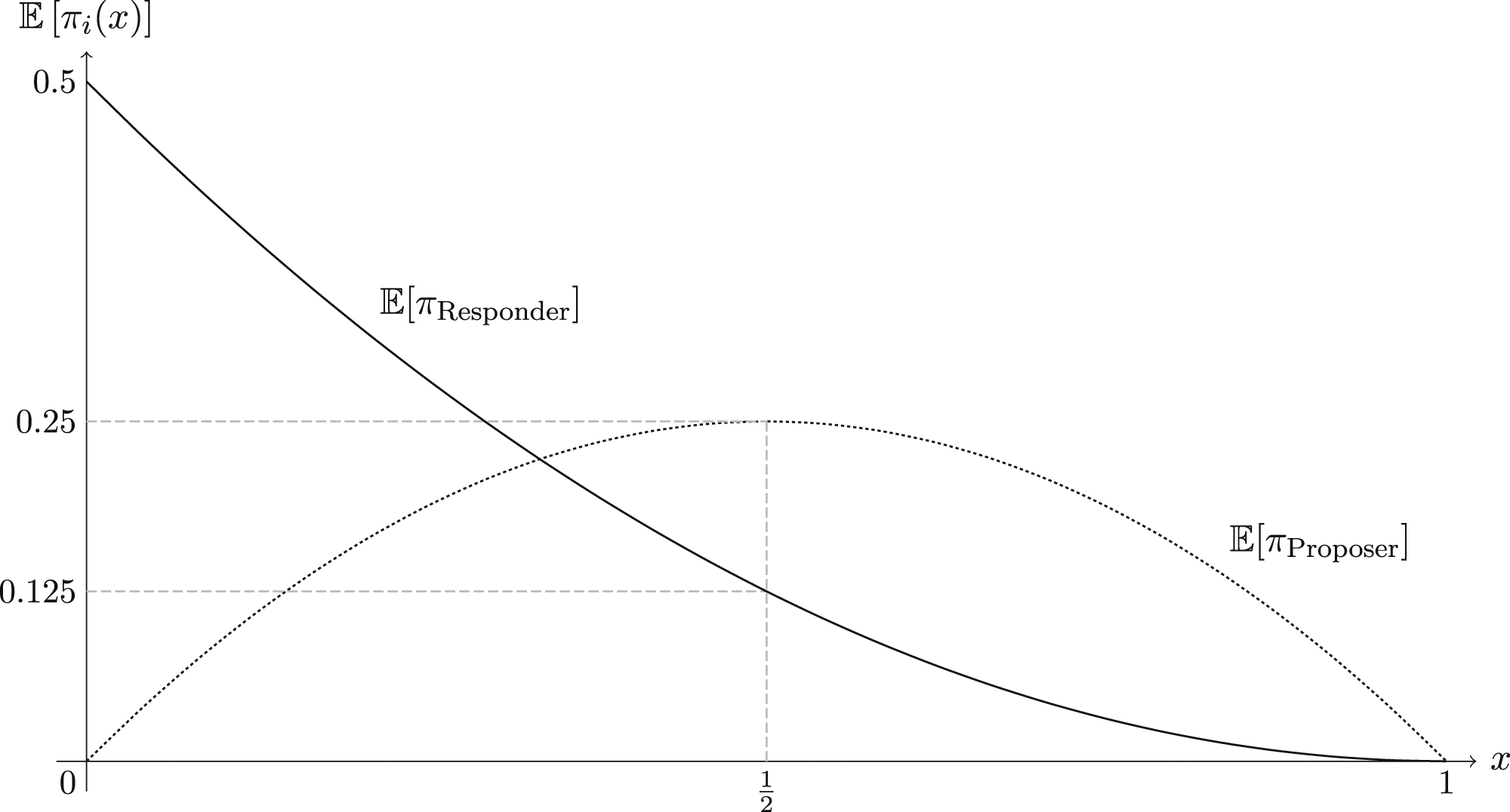

Introducing the transfer option does not alter the behavioral predictions for selfish players because a purely selfish responder will not transfer any positive amount, leaving our above considerations unchanged. However, a conditionally cooperative responder may use the transfer to even out profits—conditional on a cooperative offer by the proposer. To fix ideas, let us assume the responder transfers an amount that leads to an equal split of the pie. If this is anticipated by the proposer, she can maximize the acceptance rate (and thus, efficiency) at 100% by claiming x = 0 since P(acceptance|x) = 1 − x. The expected total profit of both players is then 50% of the expected pie, which is
Note that the proposer’s expected profit is 0.25 in both cases: with and without the transfer option. So why would she claim less than x* = 0.5 if the transfer option is available? Should she not be indifferent? We believe there are several reasons that make a difference: First, some level of inequality aversion or preferences for efficiency. Second, the difference in how this expected value is derived: with x* = 0.5, the proposer expects to get 0.5 with 50% probability and nothing with 50% probability, which averages to 0.25. With a claim of zero and the expectation of a transfer that evens out profits, the proposer gets half of the pie, which is 0.25, on average. Third, in repeated interactions: the fear of punishment of clearly uncooperative behavior. Stable cooperation is in the interest of both players, even if they are motivated by their own payoff only. Finally, claiming x = 0 also leads to the socially optimal outcome, that is, the efficient outcome.
Whether the mechanism of voluntary transfers indeed increases cooperation and thus efficiency depends on both players. Three conditions form the coordination mechanism: First, the responder will accept an offer if and only if she makes a non-negative profit. The proposer can linearly increase her chance of meeting this condition by lowering the claim, where she meets the condition with certainty if the claim is zero. Second, the responder will only pay a transfer to the proposer if she, before the transfer, earns more than the proposer. This condition rests on the common assumption that the responder would not reduce her own profit to increase disadvantageous inequality (see Fehr and Schmidt 1999). Again, the proposer can guarantee this with certainty if she claims zero. Finally, the proposer has to hold a sufficiently optimistic belief about the amount transferred by the responder. By reducing her claim to zero, she faces a large strategic uncertainty because her payoff entirely depends on the responder’s conditional cooperation. Thus, strategic uncertainty is larger than in the standard Ultimatum Game, where the proposer can get half of the pie with near certainty because fair offers are almost never rejected (Camerer 2003; Trautmann and van de Kuilen, 2015).
If the two players meet these conditions fully, the transfer would allow maximal efficiency in the stochastic Ultimatum Game because no proposals are rejected and thus no pies are lost. In the experiment, we rather expect that the participants will meet the condition to some extent so that their profits will be larger in
H1: Compared to
H2: Compared to
H3: Compared to
Results
In this section, we present our main results and conduct further analyses of our experimental data. We base the analyses only on data from the second phase of the experiment because we expected learning effects after rematching and tried to foster these effects by asking participants about their strategy after they had completed the first phase. We expected that understanding how to use and anticipate the transfer as a means of reaching efficient cooperation would need some time and could be made easier by explicitly asking players to reflect on their behavior. We included this procedure in the preregistration of our study. However, such learning effects seem to have taken place early in the first phase and not between supergames (compare Figure 1 in the Online Appendix, which shows average claims in the two treatments over time). In the Online Appendix, we replicate the main results with data from the first phase (Introduction) and conduct additional data analyses which are interesting in themselves but do not add to the understanding of the primary mechanisms at play.
Main Results
Summary statistics of main variables in the second phase.
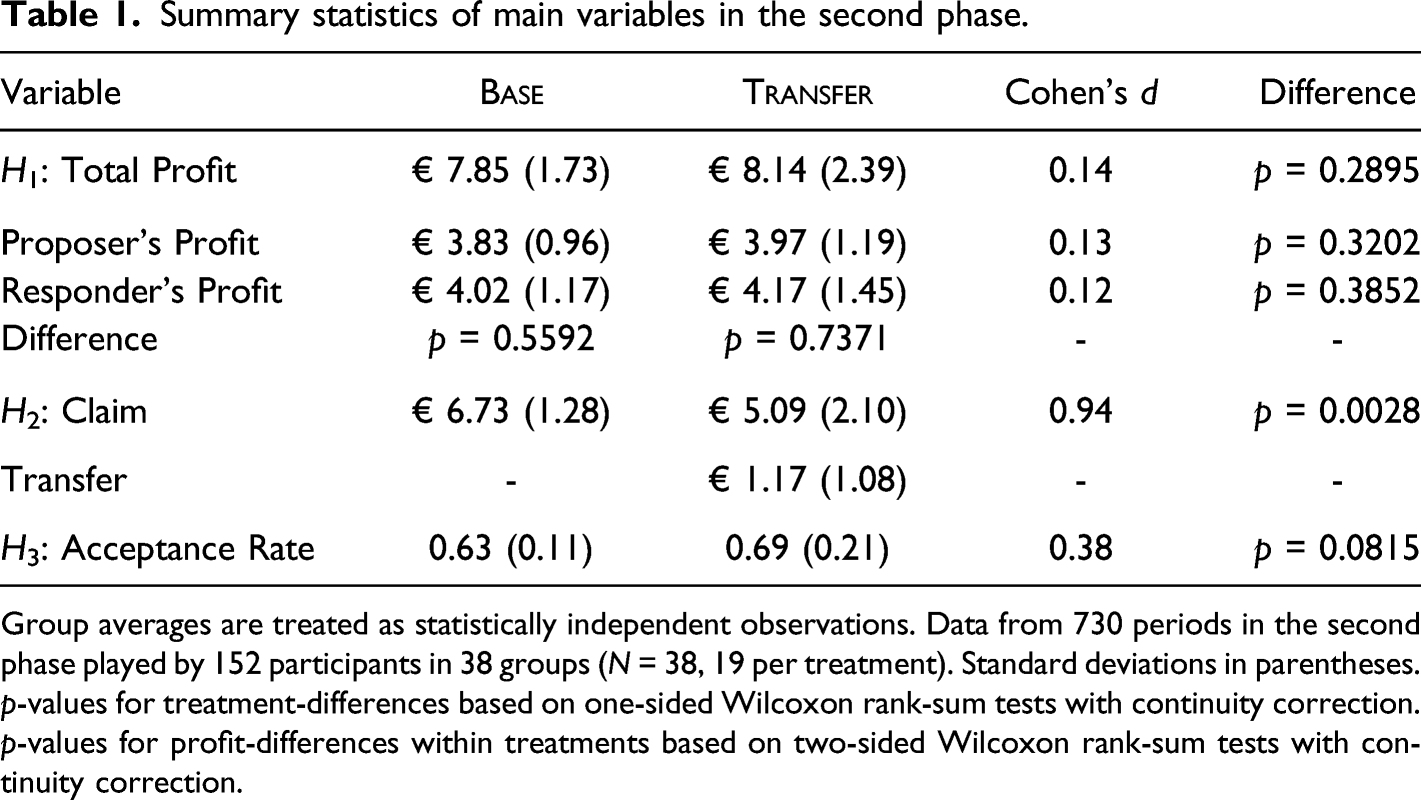
Group averages are treated as statistically independent observations. Data from 730 periods in the second phase played by 152 participants in 38 groups (N = 38, 19 per treatment). Standard deviations in parentheses. p-values for treatment-differences based on one-sided Wilcoxon rank-sum tests with continuity correction. p-values for profit-differences within treatments based on two-sided Wilcoxon rank-sum tests with continuity correction.
We reject our main hypothesis H1. There is no substantial or statistically significant treatment effect on either the average total profit or the average of the individual profits. However, there is a large and statistically significant treatment effect on the average claim (H2) and a small effect on the average acceptance rate (H3). In
Panel regression: Proposer’s decision.
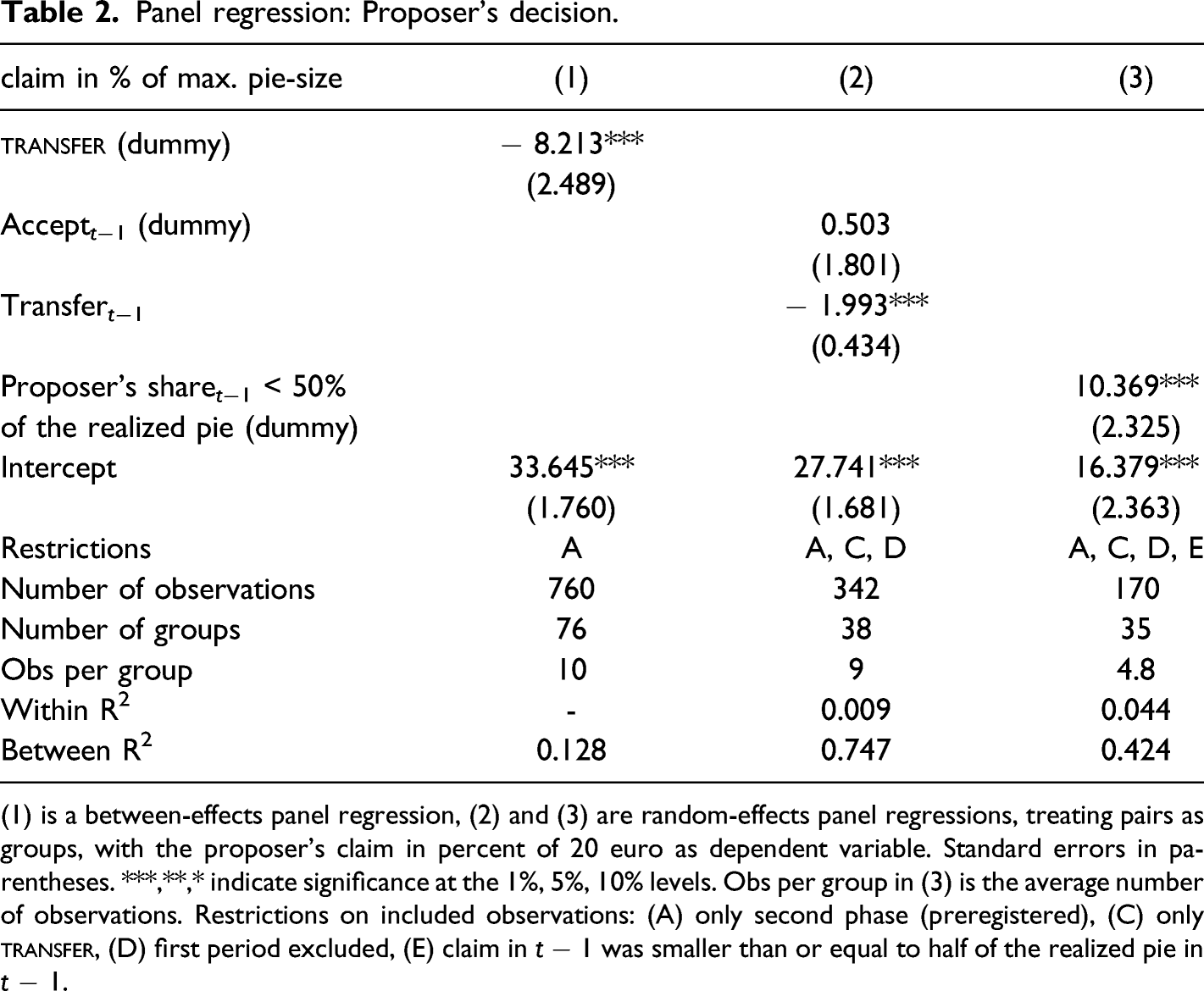
(1) is a between-effects panel regression, (2) and (3) are random-effects panel regressions, treating pairs as groups, with the proposer’s claim in percent of 20 euro as dependent variable. Standard errors in parentheses. ***,**,* indicate significance at the 1%, 5%, 10% levels. Obs per group in (3) is the average number of observations. Restrictions on included observations: (A) only second phase (preregistered), (C) only
Exploratory Analysis
To summarize, as we had expected, average claims in
Strategic Uncertainty
For the transfer to maximize efficiency gains, the proposer makes a claim of zero. 12 However, this is a very restrictive definition of cooperation since it leaves the proposer with no profit in case the responder does not make a transfer. A less restrictive definition would include claims that were made with the clear intention of receiving less than the responder. This would meet the responder’s necessary condition for paying a transfer. Thus, we will also define an attempt to initialize cooperation as claiming ≤ 5 euros (or ≤ 25% of the maximal pie-size) as this causes the proposer’s profit to be less than or equal to the responder’s profit if the expected value of the pie is realized.
First, we observe that the overwhelming majority of claims in
We suggest that the main reason for the reluctance to initialize cooperation is the high level of strategic uncertainty that the proposer faces. For an indirect test of this idea, we consider how proposers respond to past transfers, assuming that high past transfers are predictive of future transfers and thus possibly reduce strategic uncertainty. In Table 2, we regress the claim on the responder’s decision in t − 1: Model (2) shows that proposers lower their claim after receiving a higher transfer in the previous period. Proposers seem to react to updated information about responders’ behavior. Thus, higher transfers seem to reduce strategic uncertainty and lead to a higher willingness to cooperate by proposers. However, this cannot affect the decision in the first period because then the two players do not have a shared history. Thus, high strategic uncertainty in the first period renders it difficult to initialize cooperation.
Incomplete Conditional Cooperation
Let us relate our findings on response behavior to the evidence of conditional cooperation, namely, that “are willing to contribute more to a public good the more others contribute” (Fischbacher et al., 2001, p. 397) in the Public Goods Games literature (Fischbacher et al., 2001; Croson et al., 2005; Chaudhuri, 2011; Thöni and Volk, 2018).
We define the level of cooperative behavior by the responder in our experiment by how much of the amount which the responder can allocate to herself and the proposer, the residual, is transferred, given that the proposer made a cooperative offer. We measure this by the share of the amount that the responder should have transferred to even out profits. For example, if the pie was 5 euros and the claim was zero, then a transfer of 2.5 euros would equalize profits. If she only transfers 2 euros, this is 2/2.5 · 100 = 80% of the amount she should have transferred. We find that the responders, on average, transfer 72.4% of this profit-equalizing amount when proposers claim nothing and 61.1% when claiming 25% or less. This observation shows that, on average, responders behave only incompletely conditionally cooperatively by transferring substantially less than what would be necessary to even out profits.
This is a problem for efficiency because proposers react to incomplete conditional cooperation: if a proposer’s eventual share of the realized pie after the transfer, that is, the share of the total profit, was strictly smaller than 50%, given that she made a cooperative offer, she increases her claim by about 10 percentage points (on average; see model (3) in Table 2). So proposers learn and adjust their behavior by claiming more, which lowers the acceptance rate. This adjustment could also be interpreted as punishing incomplete conditional cooperation by the responder, an effect rendering efficient cooperation very difficult to maintain, in line with findings of Neugebauer et al. (2009) that incomplete conditional cooperation can be the driving force for declining cooperation in repeated Public Goods experiments.
Cooperation and Defection by Both Players
We are now at a point where we can classify the data into categories of cooperation and defection by both, proposers and responders, and quantify the weight of the respective reasons for the failure discussed above. Figure 3 displays the proposer’s share of the realized pie (on the y-axis) depending on the proposer’s claim as a share of the realized pie (on the x-axis). Anatomy of failure. Note: Summary graph with raw data from the second phase in transfer. Data points are jittered randomly with a maximal displacement of 0.6 units on both axes. The x-axis is cut off at 150% to improve readability but the cut off data points are included in the percentages. The percentages referring to the three shaded areas are conditional on claims ≤ 5 euro and 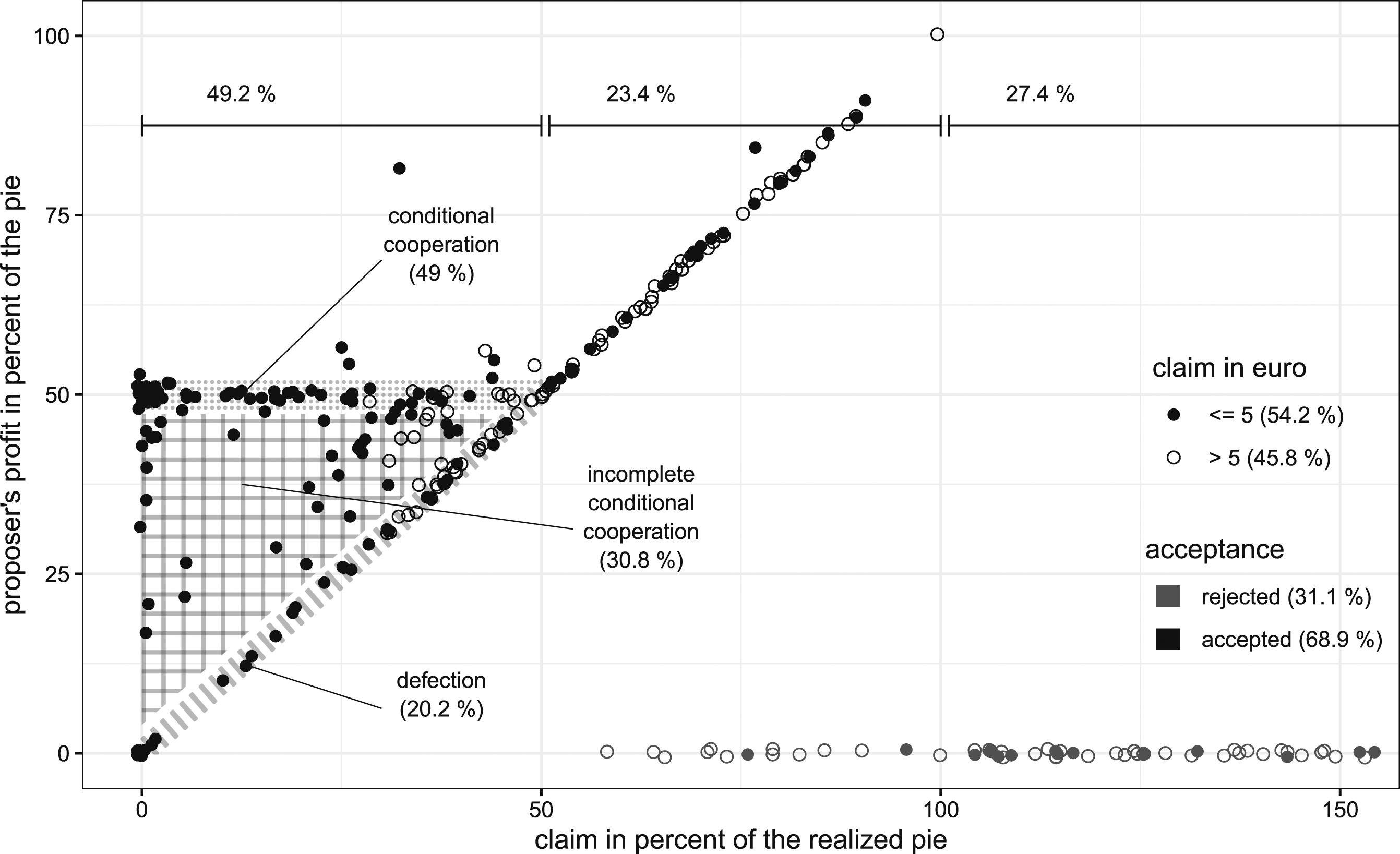
We can distinguish three broad categories of claims: (i) the proposers earn as much as they have claimed (the observations on the 45-degree line), (ii) they earn nothing if the responder rejects the claim (the gray observations on the x-axis), or (iii) they earn more than their claim if the responder uses the transfer (the observations above the 45-degree line).
The criterion for the proposer’s behavior is the absolute size of her claim (see the shape of the observations). We consider a claim of ≤ 5 euros (25% of the maximal possible pie size) as cooperative (54.2% of claims) and a claim above 5 euros as defective (45.8% of claims).
The criterion for the responder’s cooperation behavior is the transfer, after the proposer has made a cooperative offer—a claim ≤ 5 euros—and the claim was smaller than 50% of the realized pie. We consider a transfer of zero as defective (shaded area on the 45-degree line, 20.2%). A non-zero transfer is incompletely conditionally cooperative if it is not used to completely equalize profits (crosshatched area, 30.8%). Finally, it is conditionally cooperative if the transfer leads to an equal profit split (dotted area on the horizontal line, 49%).
Which party can we blame for the failure of the transfer mechanism? On the one hand, about half of the proposers claim too much, resulting in many rejections. On the other hand, about half of the responders behave only incompletely conditionally cooperatively or defect fully. Thus, their behavior validates the hesitance of proposers.
Conclusions
In this paper, we examined cooperation under stochastic and strategic uncertainty via the stochastic Ultimatum Game, whose endowment is determined randomly. We conducted an experimental comparison of the repeated game with and without voluntary ex-post transfers. Our main result is that, on average, participants fail to coordinate their behavior in an efficient and profit-maximizing manner.
Previous research has shown that voluntary transfers can increase efficiency in different games without stochastic uncertainty, such as a best-shot Public Goods Game (Bruttel and Güth, 2018), a linear Public Goods Game (Blanco et al., 2020b), and a Battle of the Sexes Game (Chatziathanasiou et al., 2020). We contribute to this literature by showing that the effect of transfers seems to be highly dependent on the environment in a specific way: with uncertain surroundings and particularly high strategic uncertainty between players, the availability of voluntary transfers does not increase efficiency. We also extend the analysis of a voluntary-transfer mechanism to a different strategic setting, the Ultimatum Game.
We further show that this failure is caused by both sides—proposer and responder—via two distinct mechanisms. First, the transfer option can only unfold its cooperation-enhancing effect if the proposer trusts that the responder will react with a fair transfer when the proposer demands a small share of the original pie. The stochastic uncertainty in our setup increases this strategic uncertainty faced by the proposer because the strategic incentives of the responder are unknown to the proposer. Only when strategic uncertainty has been reduced by the responder’s previous cooperative behavior do we observe that proposers will make cooperative offers in the future. This is consistent with findings in the Public Goods literature: Wit and Wilke (1998) and Gangadharan and Nemes (2009) report that stochastic uncertainty decreases contributions to a public good if strategic uncertainty is high. Second, responders in our experiment behave on average only incompletely conditionally cooperatively, consistent with Fehr and Fischbacher (2004) and Neugebauer et al. (2009), who conclude that incomplete conditional cooperation is the main reason for inefficient contributions in Public Goods experiments. With our setup, we extend this finding to an asymmetric bargaining situation, which directly applies to private goods but may also apply to negotiations on public goods that are shaped by asymmetry between players and sequential decision-making. Our results show that efficient cooperation under stochastic uncertainty is hard to achieve.
The Ultimatum Game analyzes negotiations between two parties. We believe that negotiations, including bilateral negotiations, tend to become more important, due to, for example, increasing globalization, problems of uncertainty tend to grow in importance too: think of climate change and pandemics. Under growing uncertainty, negotiations—next to, for example, common pool resource dilemmas—also become more difficult. With this in mind, our study stresses the importance of accounting for stochastic uncertainty in testing also the efficacy of other institutions, like binding agreements, communication, or third-party impartial arbitrators.
Footnotes
Acknowledgment
We thank Max Andres, John Duffy, Christin Hoffmann, Kai Konrad, and Christian Traxler and three anonymous referees for helpful comments and Luis Koch, Fenja Meinecke, Cosima Obst, Max Padubrin, and Sarah Skladny for excellent research assistance.
Declaration of Conflicting Interests
The author(s) declared no potential conflicts of interest with respect to the research, authorship, and/or publication of this article.
Funding
The author(s) received no financial support for the research, authorship, and/or publication of this article.
