




Abstract
In intractable conflicts, what factors lead populations to accept negotiated outcomes? To examine these issues, we conduct a survey experiment on a representative sample of the Jewish Israeli population and a companion experiment on a representative sample of Palestinians in the West Bank and Gaza. We find that holding the negotiated settlement outcome constant, approval of the settlement is strongly influenced by whether it is framed as a negotiating defeat for one side—if and only if respondents are primed to be indignant—and that these effects are strongly mediated by perceptions of the fairness of the settlement outcome. Moral indignation produces a desire for concessions for concession’s sake. Such conflicts over political framing violate assumptions of the rationalist literature on conflict processes and suggest important new directions for conflict theorizing.
The persistence of some conflicts is inconsistent with rationalist models. Long-running conflicts often seem to center on issues of control of material resources that can be divided. The issues negotiated may not significantly influence the balance of power. Over time, uncertainties about capabilities and levels of resolve seem to be clarified. What factors, then, makes some disputes intractable, where other conflicts over similar issues are resolved? We believe that understanding the nature of publics’ automatic, affective response to compromise is key to understanding the development of political preferences over settlement outcomes.
In this article, we focus on the emotion of indignation—triggered by actual leader rhetoric—and its influence on public willingness to compromise in the Palestinian-Israeli conflict. We do so because indignation, despite seldom being the object of research, is pervasive in conflict situations and significantly influences publics’ judgments of what outcomes are fair as well as their willingness to compromise. Indignation triggered by rhetoric or an adversary’s reprehensible past actions can warp public appraisals and, accordingly, the dynamic of negotiations. In such cases, material compromises by an opponent, even substantial ones, may not be sufficient to garner public acceptance of political settlements. We demonstrate that rhetoric that triggers public indignation makes populations prefer punitive impositions on rivals, even in the absence of any material gains.
To do so, we conducted a survey experiment on a representative sample of the Jewish-Israeli population. Holding the negotiated outcome constant, approval of the peace settlement that we proposed is strongly influenced by whether it is framed as a negotiating defeat for the Israeli or Palestinian side. This effect is conditional on whether we induce indignation by recalling Palestinian elites celebrating violent attacks on Israeli civilians. We show through mediation analysis that these effects are likely the result of intuitive, moral responses rather than economic or security judgments. Thus, elite rhetoric, diplomatic framing and the emotional response of societal actors appear to play a principal role in the settlement of disputes.
Our study builds on existing research on emotions in international politics. While scholars have focused on the role of framing and emotions in shaping public opinion, and some studies look at the effect of anger on willingness to compromise, few if any studies have looked at the role of indignation in particular—though it is a core moral response that deeply affects political judgment (Sunstein 2008; Moll et al. 2005). Nor have other studies measured how actual leader rhetoric influences conflicts and bargaining ranges by triggering indignation in a population. We therefore measure the extent to which indignation triggered by actual elite rhetoric molds instinctive assessments of what constitutes fair outcomes and, as a result, public willingness to compromise. It is important to note that, in this study, when we make use of the terms fair or fairness, we do not intend the popular understanding of “fair” as meaning equitable or not marked by bias or favoritism. Instead, we use the term fair as per the Merriam Webster Dictionary definition, as fitting the expected normative order, that is, “conforming with the established rules.” 1
As a second step, we argue that, because political rhetoric and framing shape automatic, collective emotional appraisal of settlements, conventional representations of conflicts are inappropriate. To illustrate, we also present the results of a smaller companion experiment on a representative sample of Palestinians in the West Bank and Gaza. Holding the negotiated settlement outcome constant in that experiment, too, approval of the settlement is again strongly influenced by whether it is framed as a negotiating defeat for the Israeli or the Palestinian side. Our findings contribute to the study of conflict by illustrating that actor preferences are not characterized by risk aversion, as the rationalist literature assumes. A mutually preferred, negotiated solution may not exist. Conflict also cannot be modeled as a lottery over the extremes of a bargaining space because framings that influence preferences ex ante are not available ex post. Thus, representations of conflict processes will better fit political realities when these assumptions are relaxed.
We believe that any study of conflict should take into consideration the automatic and non-rational psychological processes that shape perception and, accordingly, preferences.
Political Preferences, Emotions, and Elite Rhetoric
Scholars have shown that public opinion is affected by foreign policy and also shapes leader decisions regarding conflict (Shapiro 2011; Tomz et al. 2017; Foyle 1999). Our paper relies on this research and accordingly assumes that popular opinion does affect leader preferences regarding conflict.
States act for security reasons, material gain, or due to some public understanding of what constitutes fairness, among other motivations. Voting publics may view the disputed territory as historically theirs or believe that unjust actions by their adversaries merit punishment (R. Stein 2015), thereby exacerbating conflict. Actors may be convinced they are acting on strategic grounds even when their automatic affective response to events better explains their behavior (Haidt 2001). Conversely, self-interest sometimes influences actors’ affective responses and understandings of what constitutes a fair outcome (Messick and Sentis 1979; Dawes and Thaler 1988, 195; Rabin 1998, 16).
In this article, we show experimentally that public preferences derive in important ways from automatic, affective responses to elite cues. Shifts in preferences occur as a result not of strategic calculations but rather individuals’ intuitive assessments of what constitutes an acceptable outcome, including but not exclusively for the group with which they identify. Elite rhetoric, both domestic and foreign, heavily influences understandings of what is a fair outcome. In particular, rhetoric that triggers indignation in a population produces a desire to impose punitive concessions on its opponents, regardless of the material gains or lack thereof associated with those concessions.
The Role of Emotions in Political Judgment
The influence of emotions on politics is the subject of growing interest. Scholars have argued that emotion can be wielded strategically as part of diplomatic signaling (Hall 2011, 2015; Hall and Ross 2015; Wong 2015) and that, for example, signaling remorse for past actions might help build trust between nations (Lind 2011). Emotions also play a role in establishing deterrence, and in influence, peacebuilding, and adherence to international norms (Petersen 2011; Kaufman 2006; Crawford 2000). 2
Political scientists are increasingly identifying the substantial influences that pre-conscious, automatic emotional responses exert on all stages of political cognition, including strategic analysis (Mercer 2010; Marcus 2000; Barrett 2006; Ross 2013, Brader and Valentino 2007). Emotions are part of the processes through which people manage uncertainty and navigate change (Angie et al. 2011; Druckman and McDermott 2008). Much of the political appraisals that we perform occur first outside of consciousness until the result is felt as an emotion (Spezio and Adolphs 2007; J. C. Stein 2008; Moll and de Oliveira-Souza 2007). Initial emotions triggered in response to a stimulus then bound later cognitive or strategic evaluation of that stimulus, for example, by heightening the saliency of certain concerns (Petersen and Zukerman 2010), promoting attention to facts congruent with those emotions or in determining the depth of our cognitive processing (Renshon and Lerner 2012; Brader and Marcus 2013). Moreover, people tend to adjust their attitudes as a result of their emotional state (Petty, DeSteno, and Rucker 2001; Haidt 2001; Haidt and Joseph 2004). In a word, emotions operate as a means of automatic political appraisal that shapes later deliberative processes.
Manipulating the emotions around political events therefore has an impact on how those events are rationally evaluated (Petty, DeSteno, and Rucker 2001). By triggering specific emotions via rhetorical cues, then, one might be able to change the way populations respond to political proposals (Brader 2006, 18). Researchers have started to map the specific effects of various discrete emotions on political cognition (Nabi, Dillard, and Pfau 2002; Nabi 2010).
A growing literature employs this research to explore how using political communication to regulate emotions may serve as a means to help resolve intractable conflicts. Experimentally, appeals to pre-conscious, emotional judgment have been achieved via survey treatments that alter the emotional priming associated with political facts (Lecheler, Schuck, and de Vreese 2013; DeSteno et al. 2004). In one study, subjects’ willingness to have direct contact with members of a rival group increased when anxiety with respect to the conflict was reduced by informing subjects that the other group’s behavior was malleable and liable to be improved with time (Halperin, Cohen-Chen, and Goldenberg 2014). Other research suggests that hope induced in subjects via the manipulation of beliefs regarding the conflict leads to a higher willingness to make concessions (Cohen-Chen et al. 2014). Scholars have also shown that emotions influence decision making under risk: enthusiasm, inter alia, correlates with risk-seeking behavior while anxiety correlates with risk aversion (Druckman and McDermott 2008).
Emotion, Moral Appraisal, and Perceptions of Fairness
Emotions mediate perceptions of fairness or of the moral acceptability of material outcomes. 3 Perceptions of whether an outcome is fair in turn shape foreign policy attitudes by serving as an evaluation heuristic (Albin 2001; Zartman and Kremenyuk 2005). For example, survey respondents who reported prioritizing fairness as one of their moral foundations were more likely to support cooperative internationalist policies as well as internationalism involving the use of force (Kertzer et al. 2014; Kertzer and Rathbun 2015). Fairness perceptions have been found to influence international economic (Kapstein 2006, 2008) and legal (Franck 1995) relations. In addition, more equitable agreements—that is, agreements that meet moral expectations—are more durable (Druckman and Albin 2011) and procedurally fair processes make compromise easier (Albin and Druckman 2012).
As a corollary, across a wide range of contexts, actors are willing to pay costs to punish those who have done them harm or who violate moral norms (Giacalone and Greenberg 1997; Rabin 1998; Blount 1995; Dufwenberg and Kirchsteiger 1999; Levine 1998). If negotiating adversaries are perceived as acting fairly or morally, actors are more willing to compromise (Tyler 1988; Casper, Tyler, and Fisher 1988; Landls and Goodstein 1986). Overall, automatic, emotional evaluations of what constitutes a fair or acceptable outcome heavily shape how proposed political settlements are received.
History is indeed full of cases of group violence carried out as revenge for perceived immoral treatment. Ethnic violence is usually accompanied by a narrative of righting past wrongs committed by the opposing group (see, e.g., Kaufman 2001, 2006). Following brutal treatment by Serb forces, Kosovo Albanian groups executed ethnic Serbs and suspected collaborators in the years after the Kosovo War. Revenge motivations may have contributed to the German decision to fight the Second World War following the humiliating settlement imposed after the first (Keynes 2013; Barnhart 2016) and the need for vengeance is a contributing factor in many other cases of international conflict (R. Stein 2015; Matanock and Garbiras-Daz 2018). In the Palestinian-Israeli context itself, a study of Israeli attitudes demonstrates that perceptions of Palestinian blameworthiness correlate with preferences for punitive policies (Pickett et al. 2014). In the sections below, we elucidate the relationship between indignation, perceived blameworthiness, and public desire to see transgressors punished, inter alia, by forcing them to make concessions.
Indignation, Fairness, and Concessions for Concession’s Sake
Indignation is an emotional state related to anger but quite distinct from it and, importantly, that also involves elements of disgust (Sunstein 2008; Moll et al. 2005). The experience of indignation triggers in its subjects a desire to punish the cause of that indignation, including through imposed concessions.
Indignation, Anger, and Disgust
Indignation materially differs from anger in both its causes and effects. Anger, importantly, is understood by scholars to be triggered by “first-order harm to oneself (or somebody one identifies with)” (Miceli and Castelfranchi 2019). This is not necessary for indignation. In contrast to anger, for indignation to occur, there must be a violation of an important moral or social norm, or the attempt to violate it—that is, a perceived wrong and not merely harm. As such, indignation may occur quite frequently between publics of different cultures, whose moral norms may not align and where the behavior of one side may very often run afoul of the moral expectations of the other. Moreover, while anger results generally from harm to oneself or to those one closely identifies with, indignation is triggered by a wrong whose effects may be suffered by others, even distant third parties (id.). Some scholars further specify that indignation is a higher-order moral emotion, triggered in response to an act perceived as morally reprehensible, one that “intentionally and without provocation or adequate reason, [causes] a victim to suffer harm” (Sunstein 2008; Kahneman and Sunstein 2007; Moll et al. 2005, 10; Rozin et al. 1999).
Anger and indignation also differ in their effects. Anger leads to a tendency to aggression or to attack, in order to change or eliminate the harm suffered (Miceli and Castelfranchi 2019). The violation of important norms, which also triggers the revulsion or disgust element of indignation, however, leads those feeling indignant to desire to penalize the offender (Berkowitz 2010; Petersen and Zukerman 2010; Spielberger and Reheiser 2010). 4
Moreover, indignation causes a desire not to exact revenge (i.e., inflicting harm on the offender proportional to that which he or she committed, which often results from anger) or to restore justice (i.e., restore balance in light of merits). Instead, indignation causes an intuitive desire to punish offenders primarily in order to restore the violated norm, possibly by subduing and/or humiliating the offender (Miceli and Castelfranchi 2019; Andrighetto et al. 2013). Indeed, according to recent neuro- and cognitive science research, automatic and deliberative human reactions to offenses can be rooted in either an aversion to inequity or, separately, a drive for third party altruistic punishment (as opposed to victims punishing aggressors), which we believe is the main action tendency resulting from indignation (Decety and Yoder 2017). Indignation, like its relatives anger and disgust, is also liable to cause increased reliance on heuristics and reflexive processing, including resort to negative stereotypes of opponents (Griskevicius, Shiota, and Neufeld 2010).
Said otherwise, indignation is caused by the violation of taboos—not merely the harming of ingroup members—and leads to an instinctive desire to punish and likely diminish the offender so as to restore the taboo. 5
Indignation and Negotiations
In the context of negotiating agreements, we therefore expect indignant publics will seek to force concessions on offending opponents, regardless of the material gain those may produce for the indignant public—that is, concessions for concessions’ sake.
Indignant individuals do not necessarily resist compromise; they resist compromises that do not, in their eyes, fit the moral order. Because of the nature of indignation, they will favor outcomes that appear to be imposed upon adversaries. Thus, approval of a negotiated solution is the product of an interaction between indignation and other cues about whether fairness has been achieved or, more precisely, whether the moral order has been restored. The preferences of individuals primed to be indignant will be strongly influenced by the need to see that the offending party is punished, and this will be evaluated in large part through emotional cues rather than objective measures.
This implies that the emotional responses to perceived injustice go well beyond a desire to recover what was lost (Levy 1992). Actors often seek to punish or humiliate as ends per se and this seems to have a relationship regulating function in humans and other social animals. This response relates to an immediate emotional reaction, to further analysis or rationalization of the rightness of the action (Haidt 2001), and to means-ends analysis of the most effective method. In fact, most violence committed across levels of social aggregation may be “moral” in the sense of done to right an aberration in the eyes of the perpetrator of violence (Fiske and Rai 2014). In the Palestinian-Israeli context itself, Ginges et al. (2007), Ginges et al. (2011), and Ginges and Atran (2009) show that moral motives and convictions, rather than the effectiveness of violent actions, predict support for violence.
Emotions may exert a particularly weighty influence on long-running, ethnic conflict by, inter alia, interacting with collective narratives and symbols that define opponents and shape public perception (Kaufman 2001). Moreover, when warring publics straddle cultural divides, as the Palestinians and the Israelis do, they adhere to at times differing moral assumptions, and the probability that indignation will be felt by one of the publics in response to actions by the other is significant.
Accordingly, elite rhetoric that either highlights an opponent’s past perceived moral offenses can, by influencing levels of indignation, have a significant impact on public approval for those settlements. Highlighting morally reprehensible actions (and, often, lack of remorse) by an opponent may trigger a need to see opponents suffer a form of punishment to re-establish the moral order. Such rhetoric can serve leaders who have an incentive to perpetuate conflicts, or publicly place blame on opponents for their failure to compromise. When it originates from an adversary, rhetoric that triggers public indignation and perceptions of unfairness in an opposing public indeed represents a challenge to leaders seeking reconciliation (Gottfried and Trager 2016). Thus, while aggressive elite rhetoric can be used strategically to signal resolve (Fearon 1994; Tomz 2007), such rhetoric also presents considerable obstacles to elites selling concessions to their people.
Empirically distinguishing between preferences that derive from material factors and those that derive from psychological and emotional dynamics is not simple, however. Emotions can cause actors to develop stronger attachments to the material goods in dispute, and then rationalize those attachments. Thus, the simple desire for more may appear to be at the heart of disputes when in fact affective processes—that can be managed by elites—have created the situation in which more is preferred to peaceful compromise.
We address these issues in several ways. First, and in contrast to many similar studies, we hold the material outcome of proposed deals constant while demonstrating that framings that influence perceptions of fairness or morality have substantial effects on approval of a dispute settlement. We expect approval to be lower when primes for indignation about the behavior of an adversary in the past interact with the framing of a settlement as a concession or an imposition. We refer to this as the Norm Restoration Hypothesis. In evaluating it, we show that moral considerations are the principle mediators of this effect. Next, we test whether the changes in approval that result from changes in material conditions of a settlement are also strongly mediated by evaluations of fairness or moral acceptability. We refer to this as the Fairness Mediation of Material Change Hypothesis. More favorable individual outcomes are judged to have been arrived through more fair processes. This constitutes a form of bias in individual evaluations of fairness (Messick and Sentis 1979; Dawes and Thaler 1988, 195; Rabin 1998, 16).
The Norm Restoration Hypothesis contrasts with the argument in Hassner (2009) that the indivisibility of Jerusalem’s Temple Mount is an inherent quality of that space, the fruit of “fundamental social facts”—such as competing religious attachments—that leaders “cannot easily define and redefine” (Hassner 2009, 10–11). Hassner argues that tensions over Jerusalem will “erupt as soon as one party perceives changes in the balance of power” over its holy spaces (Hassner 2009, 24), leaving little hope that a negotiated settlement over the Temple Mount in Jerusalem can ever be reached. 6 Our hypothesis is more consistent with the argument in Goddard (2009, 18, 39), which views indivisibility as generated through political rhetoric. Goddard asks whether Jerusalem’s indivisibility can be undone by rhetoric from leaders centrally located in salient “social and cultural networks” (p. 19). We ask how the induced perception of an adversary as acting reprehensibly, which is related to the elite framing of events (Berinsky 2009), influences population preferences over the forms of an acceptable settlement.
Our study expands on previous work regarding the role of psychology in influencing public support for concessions. Gayer et al. (2009), for example, looked at heuristics and cognitive biases—not emotions—to show how highlighting losses associated with continuing a conflict induces more willingness on the part of participants to reassess their previous positions and support compromises. The authors therefore focused on the threat of actual losses and not on emotions driven by elite rhetoric. Similarly, Maoz and McCauley (2009) explored to what extent certain popular Israeli beliefs regarding Palestinians affected support for compromise among Israeli Jewish respondents. They found that high threat perception and zero sum thinking significantly reduced support for compromise. Zellman (2015) gauged the effect of Israeli elite-driven narratives in priming Israeli survey respondents to mobilize behind nationalist positions, thus affecting leader maneuverability. This study, based on opinion polls, found that different narratives increase nationalist sentiments and perception of indivisibility in some territories with high symbolic value but that these narratives “are hardly decisive when considering disputed territory as a whole.” Sheafer and Dvir-Gvirsman (2010) also couched their theory in prospect theory and found that the public response to negative framings touching upon security matters is much stronger than the reaction to positive framings. Specifically, the authors sought a correlation between monthly polled attitudes toward the peace process and the tone and content of contemporaneous, representative news articles. They found that “the effect of casualties on attitudes toward peace is negative and significant” and further that “while media presentation of peace and security conditions as deteriorating has a significant negative influence on the public’s expectations, a presentation of an improving situation has an insignificant effect.” Our study focuses on the obstacle to negotiations represented by the perception (created by rhetoric) that the opposing party behaves in morally reprehensible ways. Lee Ross has long studied the effect of psychology on intractable conflict, including the Palestinian-Israeli conflict. Ross’ work, like some of the studies cited above, focuses mainly on the role of particular beliefs regarding adversaries, particularly those that induce zero-sum thinking, and thereby make dispute resolution harder to achieve (Ross and Ward 1995). Ross notes the importance of a perceived, intuitive sense of fairness in publics’ assessments of any deal—but does not elaborate on which emotions influence intuitive assessments of fairness or on when those emotions might be molded by elite rhetoric.
In contrast to the above, Ginges et al. (2007) did look at moral responses and found that when considering compromises over sacred sites or values, many Israelis and Palestinians use moral judgment and not instrumental calculations. Further, the more sacred an issue was perceived to be by a respondent, the more likely that respondent was to evaluate compromise in moral terms or to favor compromise if the opposing side was seen as compromising on its own sacred values. The stimuli in Ginges’ experiment, however, were quid pro quos of the proposed deals themselves and thus the experiment did not isolate the role of emotions and leader rhetoric independent of the ingredients comprising a proposed deal (Ginges et al. 2007), an important methodological and substantive distinction, in our assessment. We show that, despite being a sacred site of extremely high symbolic value, Jerusalem’s division can be made more palatable to the rival publics if framed so as to address emotional dynamics and, crucially, independent of the material details of the political arrangement providing for the division.
Scholars have looked at the influence of anger on political appraisal and found that anger is mediated by a moral response—but have not distinguished anger from indignation though, as elaborated above, the two vary in important ways as to their causes and effects. Eran Halperin has extensively studied the role of collective emotions in fueling—and potentially resolving—conflicts. His studies, including numerous survey experiments (e.g., Halperin 2011), have often focused on the usefulness of inducing hope and other positive emotions and beliefs to changing attitudes regarding compromise. Similarly, Halperin has looked repeatedly at hatred, fear and anger and their effect on peacemaking. He has not much focused on indignation, despite its status as a core moral emotion (Sunstein 2008; Moll et al. 2005), or on how real-world Palestinian or Israeli rhetoric triggers indignation such that compromises become less palatable to either public. Others have similarly investigated whether anger correlates with specific responses to political events (e.g., Sabucedo et al. 2011; Halperin and Gross 2011; Cheung-Blunden and Blunden 2008). They have not, however, looked specifically at indignation (though may have unwittingly touched upon it or its effects) or investigated by which mechanism publics desire to impose concessions for concessions’ sake, thus thwarting negotiations.
We believe that many of these studies in their look at the effects of anger may have partially foreshadowed our own analysis into the effects of indignation, but their analyses failed to properly distinguish between the two or to focus on the desire to see offenders punished, for moral offenses, through negotiations.
Our study also shows that actions by one side can generate preferences for punishment in the other in the course of an interaction, thus changing the distribution of preferences by introducing the need to see one side punished. We also in our experiment hold the outcome constant in order to isolate the role of priming. That said, we assume the differences between anger and indignation both in terms of causes and effects, described above, and do not prove them through our experiment.
Separately, the present study further expands the research on emotions’ impact on conflicts and leader bargaining ranges by looking at how recurring themes in actual elite speech, in one highly intractable conflict, are triggering indignation, thereby influencing perceptions of what is fair or just, and thus presenting an impediment to resolution. It does so while controlling for the nature of the deal proposed as well as for a variety of conflict-related beliefs that have been shown to influence attitudes. It contributes to the growing body of work on emotional priming and conflict, and we hope it encourages further study of how automaticity might be driving conflicts.
Experimental Design
We conducted a large-scale experiment on a representative sample of Israeli Jews (N = 1,960). The experiment, which was embedded in an opinion poll, presented respondents with hypothetical negotiations between the Palestinian Authority and Israel whereby the sides agreed to a two state solution that would divide Jerusalem, including the Old City, and determine sovereignty over the Temple Mount or Haram esh-Sharif, a site holy to both Jews and Muslims. Where sacred symbolism is involved, so too are reminders of moral norms frequent. In our experiment, we therefore chose to focus our vignettes on Jerusalem as it is where so many moral norms, assumptions and expectations are centered, for both sides. And where certain moral norms are violated, indignation often occurs.
Our treatments randomized (1) whether Israel or the Palestinian Authority were described as forced to concede to divided sovereignty over the Temple Mount, although the divided-sovereignty outcome was constant in both treatments and (2) whether indignation was induced in respondents by reporting statements by Palestinian leaders praising violent attacks on Israeli civilians. We also included a control condition (12 percent of respondents), which does not frame either side as having imposed a concession and does not include the indignation treatment, and a treatment with an objectively better outcome from the standpoint of Israeli negotiators (8 percent of respondents). In the latter condition, Israel keeps full sovereignty over the Temple Mount. After describing the negotiations and their outcomes, we asked whether participants in the survey approved, disapproved or felt indifferent about the outcome, on a 5-point scale. In order to control for the influence of the treatments on perceptions that the sides would faithfully execute the deal, we informed respondents that monitors from Egypt, Jordan and the United States would guarantee and enforce the agreement. 7
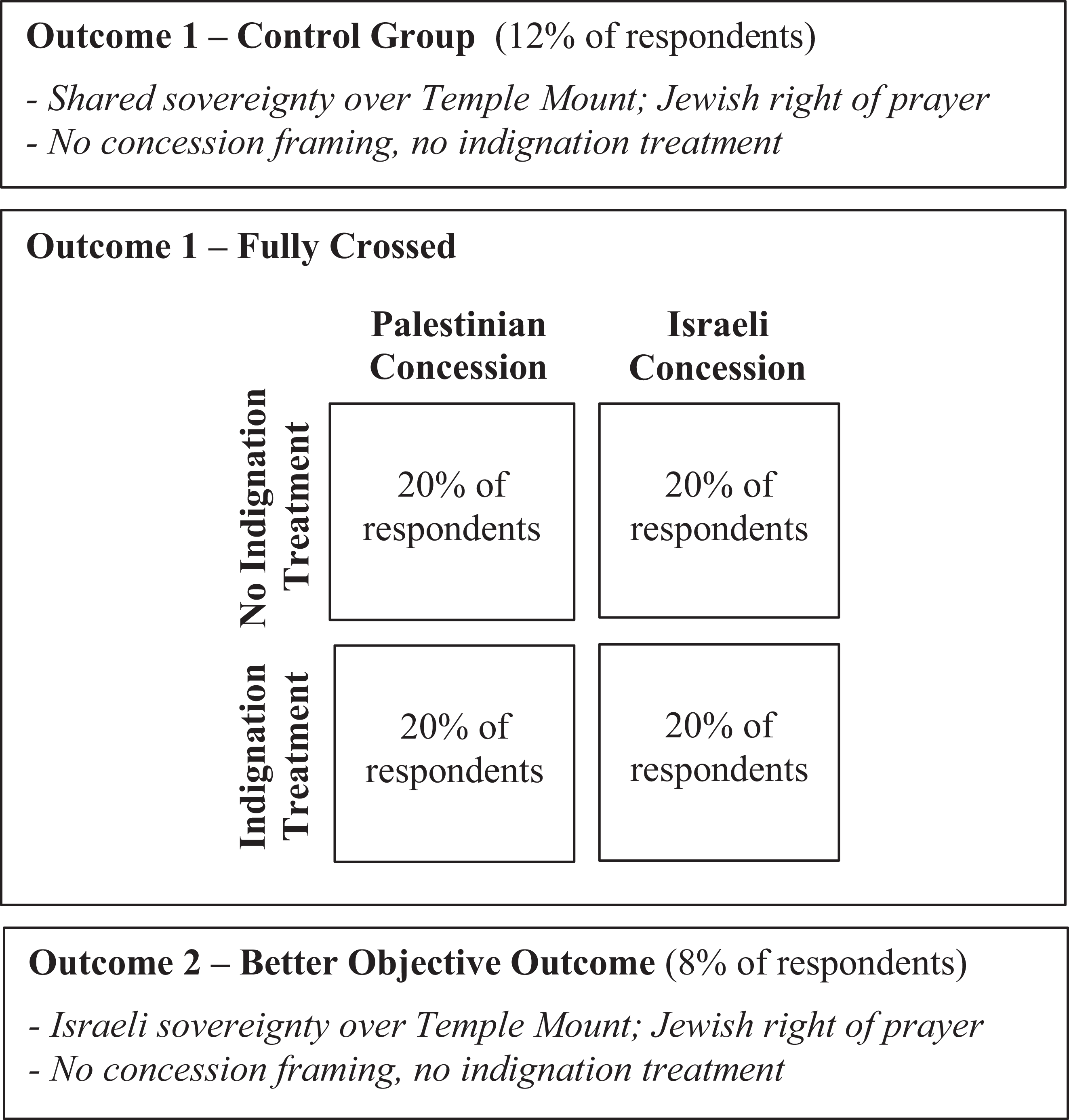
Distribution of treatments among respondents.
We also asked a series of other questions following the vignettes. These were designed to measure the factors that mediate the effects of the treatments and to more precisely establish the theoretical mechanisms at work. Here we focused in particular on whether the treatments influenced perceptions of fairness or perceptions of the side’s prospects in negotiations. Thus, we asked whether respondents viewed the settlement as fair, whether it should be considered for economic reasons, and whether it was the best deal available. We asked in addition whether respondents believed the deal would be faithfully executed due to the presence of international monitors. These mediators are discussed further below.
The experiment was fielded by the Sarid Institute for Research Services, of Haifa, Israel, in October and November of 2015, a period of heightened violence, including stabbings and car ramming attacks against Israelis, as well as other violence triggered by tensions over the Temple Mount. Thus, our survey examined Israeli attitudes regarding Jerusalem as a live issue in the midst of a volatile, emotionally raw moment. We avoid the problem of non-attitudes and other pitfalls of posing hypothetical scenarios in survey research by asking respondents about matters that deeply concern them, sticking closely to plausible scenarios of which participants are well aware. 8
The experiment, conducted in Hebrew, began by emphasizing that the researchers were not associated with either of the parties. We then presented respondents with a scenario whereby during recent secret talks, the US, Israel and the Palestinian Authority discussed a division of Jerusalem as part of a permanent peace agreement between Israel and a new, sovereign State of Palestine. We described the division of Jerusalem envisaged by the deal: Israel would get Jewish neighborhoods and Palestine would get Arab neighborhoods; the Old City would be divided in half, with the Christian and Muslim quarters going to Palestine, and the Jewish and Armenian Quarters going to Israel; Israel would retain control of the Western Wall. The full text of the experiment appears in the Online Appendix.
To investigate the effects of indignation on willingness to make concessions for peace, we randomized whether we informed respondents of actual, recent statements by Palestinian leaders associating the national Palestinian cause with acts of violence against Israeli civilians. This approach is consistent with psychology studies that ask study participants to read news articles to prime emotional states (Johnson and Tversky 1983; DeSteno et al. 2000; Wegener and Petty 1994), and with studies of indignation or outrage in particular (Grobe, Douthitt, and Zepeda 1999; Sandman et al. 1993; Wiedemann, Clauberg, and Schutz 2003). In our experiment, two treatment groups (of 425 respondents each) read that
Critics of negotiations point out that the Palestinian leadership has used violence against civilians as a political tool. Palestinian President Mahmood Abbas has said that terrorists in Israeli jails “did what we, we, ordered them.” In the wake of recent terror attacks in Jerusalem, he said that Palestinian leaders “welcome every drop of blood spilled in Jerusalem…blood on its way to Allah. With the help of Allah, every martyr will be in heaven.” Fatah leader and former Palestinian security chief, Jibril Rajoub has called recent stabbing attacks and murders, such as that of the Henkin couple, “heroic.” Rajoub echoed other Palestinian leaders, such as former General Intelligence director in the West Bank Tawfik Tirawi, in saying that stabbing attacks should be turned “into a national strategy.”
Among those being presented with this information, half were told that Israel was forced by Palestinian negotiators to concede to divided sovereignty over the Temple Mount, while the other half were told that the Israeli government forced the Palestinian Authority to concede to the same. Thus, we varied only the framing of one provision of a larger agreement whose other provisions were also listed in the vignette. In all of these cases, the facts of agreement were held constant and were described in precisely the same way. Those who did not receive the indignation prime also received the concession framing treatments. The concession and indignation treatments were thus fully crossed. The experiment was designed to detect a difference in the effects of the concession framing treatments when indignation was primed and when it was not. Distinguishing this difference in differences required that 80 percent of respondents be assigned to these four treatments shown in the central box of Figure 1.
To investigate the mechanisms involved, we also considered several potential confounders of our theory that evaluations of the fairness of the outcome were influenced by the treatments and in turn influenced popular approval. Framing the settlement as a defeat for one side may create the impression that the other side has received an objectively better deal. This is an alternative explanation of the impact of the treatments on approval if the effect of the treatment is therefore to cause respondents to believe that material and economic aspects of the agreement are more favorable to one side. 9 If this mechanism were the key driver of an effect of the concession framing, we would expect it to be equally strong following both indignation framings. The design of the experiment therefore addresses this issue directly. If the concession framing has a larger impact contingent upon the indignation prime, as we predict, this speaks strongly against this alternative explanation. To investigate this possibility further, in the questions following the survey vignette, participants were asked whether the agreement “should be considered for economic reasons, whether or not it is fair.” We also asked if participants believed that “it is NOT possible for Israel to negotiate a better deal.” If the treatments are affecting participant’s evaluations of material aspects of the deal, this will be reflected in the answers to these questions.
Another potential confounding factor is the impressions the treatments create about whether the deal will be lasting. A forced concession by a negotiating adversary may appear less likely to be carried out. Alternatively, a forced concession by one’s own side may be believed to invite an adversary to demand more in spite of the current settlement. To account for these possibilities, we checked whether participants believed that the deal would be enforced or lead to further violence against Israel. Participants were asked whether the monitors from Egypt, Jordan and the United States would ensure that “the new Palestinian state is indeed peaceful and does not become a base of terrorism against Israel.” Alongside the question about the fairness of the agreement, these questions were treated as four potential mediators of treatment effects.
Results
The Norm Restoration Hypothesis receives strong support, both in the effect of the treatments on the approval of the settlement, and in the mediation analysis. Approval of a settlement is dependent upon the interaction of the indignation and concession treatments, as Figure 2 shows. Under the indignation treatment, when shared sovereignty over the Temple Mount is described as having been forced upon Palestinian negotiators rather than forced upon Israeli negotiators, approval of the settlement is 9 percentage points higher (
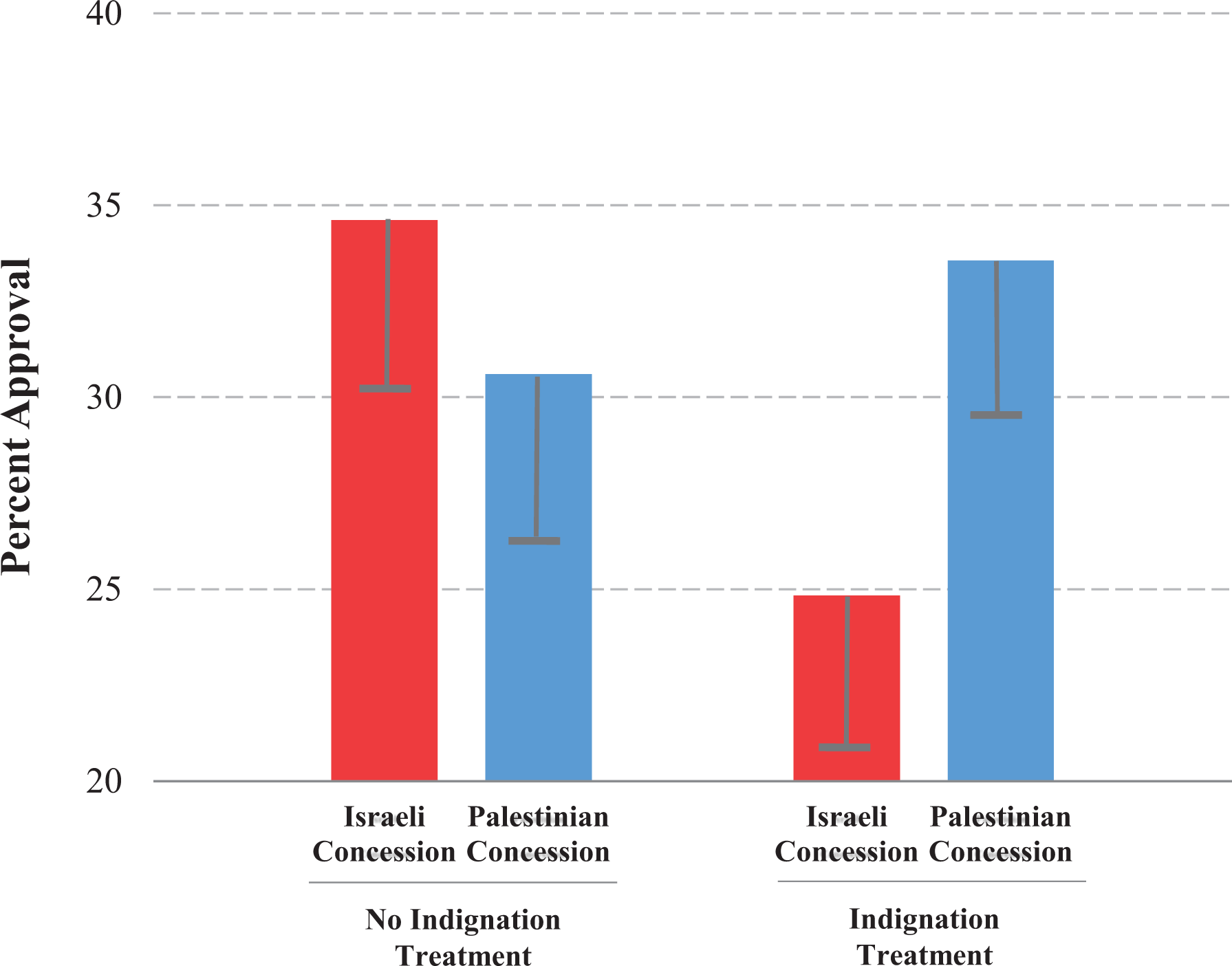
Effect of forcing a concession.
Changes in the objective provisions of the settlement also influenced approval. When Israel retains sovereignty over the Temple Mount, settlement approval increases by 10 percentage points over the control condition. This tells us that Israelis are sensitive to this aspect of negotiations, but not why they are so.
To deepen the analysis, we investigated four mechanisms through which the framing and provisions of a settlement might drive public support. Recall that the first proposed mechanism concerns what respondents perceive to be fair. We used the responses to construct a scale with five levels: totally unfair (0), somewhat unfair (25), neither fair nor unfair (50), somewhat fair (75), or totally fair (100). The next two mechanisms concern the economics and bargaining logic of making a deal. We asked participants both whether the deal should be considered for economic reasons, whether or not it is fair, and whether the deal is the best attainable. The final mechanism investigates whether participants trust the agreement would be successfully enforced. We used the answers to these last three questions to construct scales with five levels: strongly disagree (0), somewhat disagree (25), neither agree nor disagree (50), somewhat agree (75), or strongly agree (100).
As Figure 3 illustrates, under the indignation prime, the concession framing treatment influences all of the mediators. The largest effect is on the perception that the deal is fair. This effect is significant at the .01 level, and all of the other effects are significant at the .05 level. Thus, our expectations about the factors that would mediate the effect on approval are borne out.
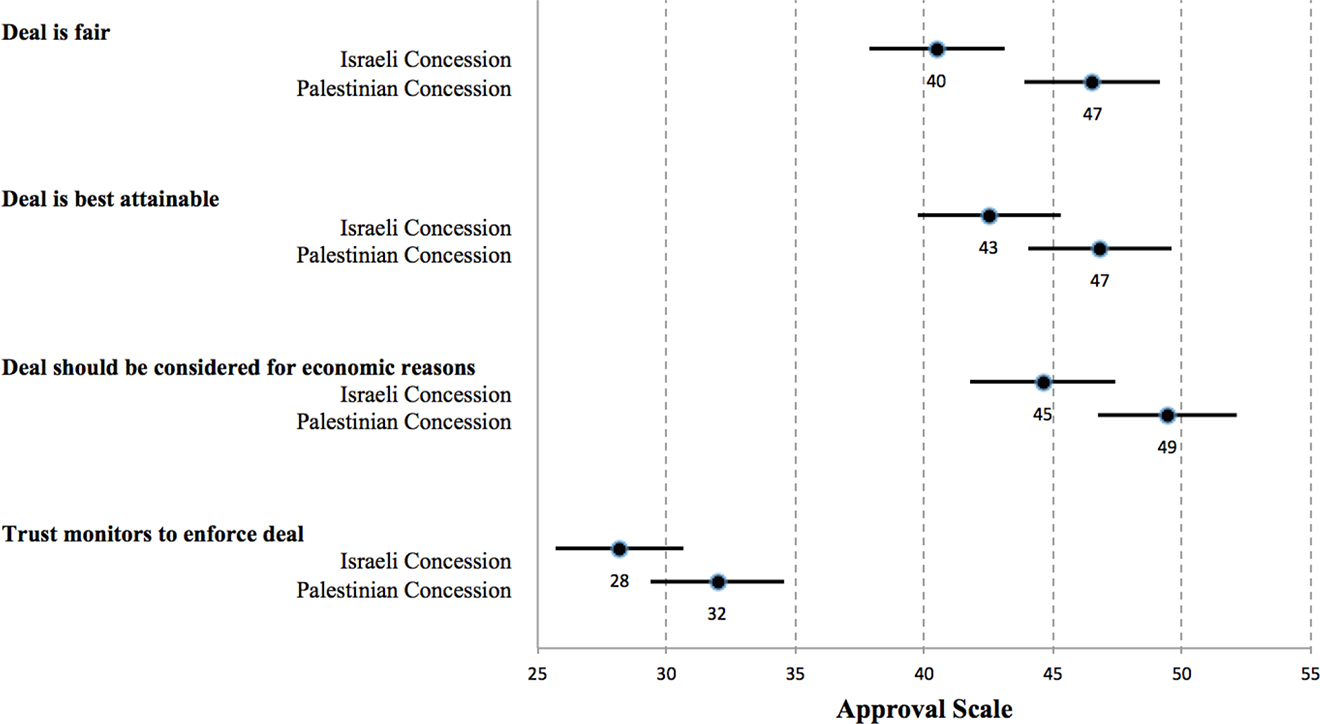
Effect of forcing a concession on mediators, indignation framing.
How did the mediators affect support for the proposed political deal? To find out, we performed a linear regression of approval for the deal on the four mediators. The regression model included demographic controls, including for gender, age bracket, level of education, family situation and income. We also controlled for one attitudinal variable, right-wing political views. Finally, we included indicators for the treatments. Thus, the regression was designed to isolate how beliefs about fairness, economic motivators, trust, quality of the deal and resolvability of the conflict itself affect approval of the proposed deal, as outlined.
As Table 1 shows, all four mediators substantially affected support for the proposed deal (with all related coefficients being highly significant). Perceptions of fairness outweighed other considerations, however. The other mediators, which can be described as material and instrumental considerations (i.e., economic benefits, reliability and quality of the deal) had important but far less significant influences on approval levels of the proposed settlement.
Effect of the Mediators on Settlement Approval.
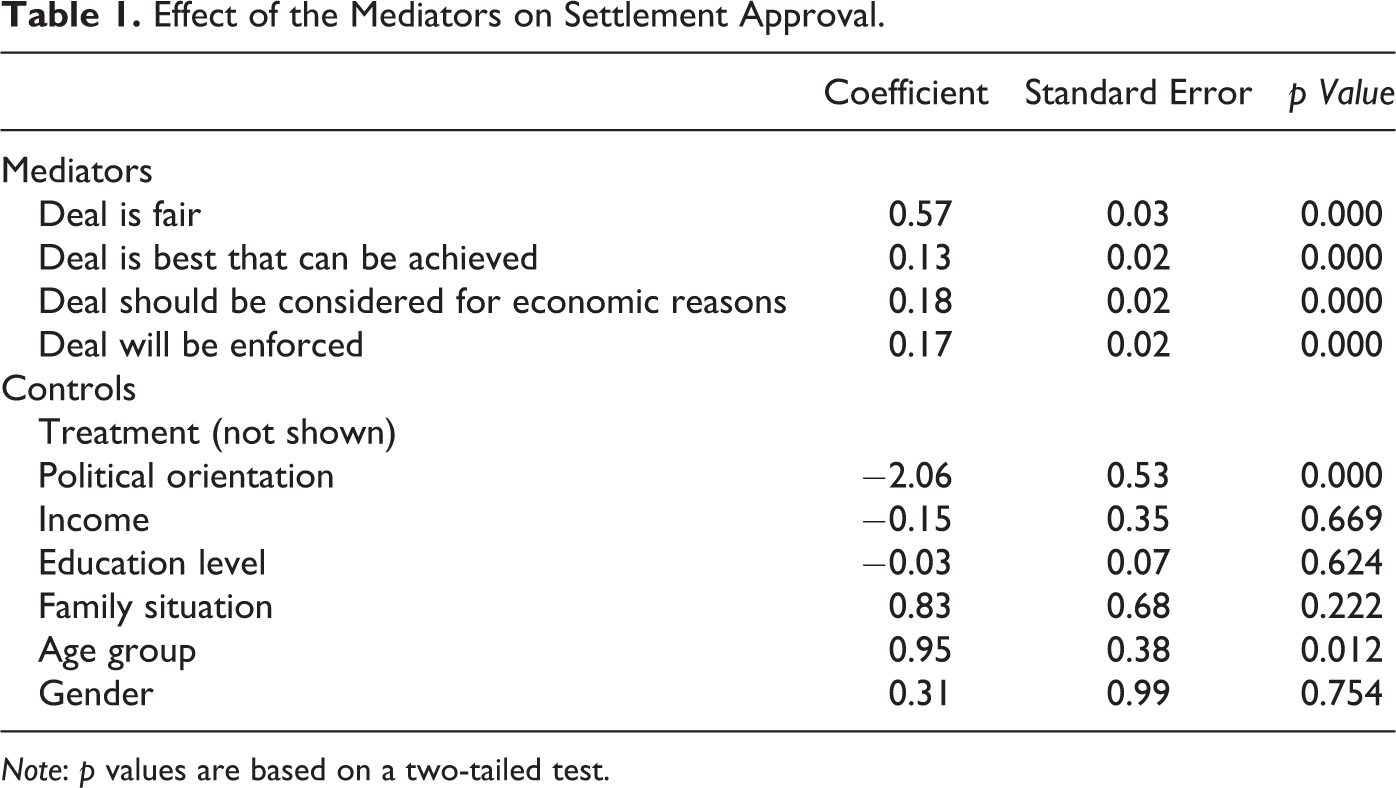
Note: p values are based on a two-tailed test.
We also checked to see where on the political spectrum the effects of the indignation and concession treatments were felt. 11 Among the 90 percent of respondents who identify as in the political center, right or far right, we find similar effects. We find no statistically significant effects of the treatments among the 10 percent of respondents who identify as being on the left. 12 This difference between left and right is an interesting potential finding that merits further investigation. It may be that the cognitive response to attacks is a defining feature of what it means to occupy the political left. These differences are discussed further in Online Appendix D. 13
We use the results from Figure 3 and Table 1 to evaluate the relative importance of the four mediators. We find that the fairness mediator accounts for about 54 percent of the total effect of the framing treatment on approval when subjects receive the indignation prime. This result is obtained by first noting that the fairness scale for Jewish Israeli respondents increases 7 points when joint sovereignty over the Temple Mount is framed as having been forced on the Palestinian side over when it is framed as forced on the Israeli side. Second, note from Table 1 that a change from considering the deal totally unfair to considering the deal totally fair is associated with a 57 percent increase in the likelihood of supporting the deal. Thus, multiplying
Mediator Effects as Percent of Total Effect.
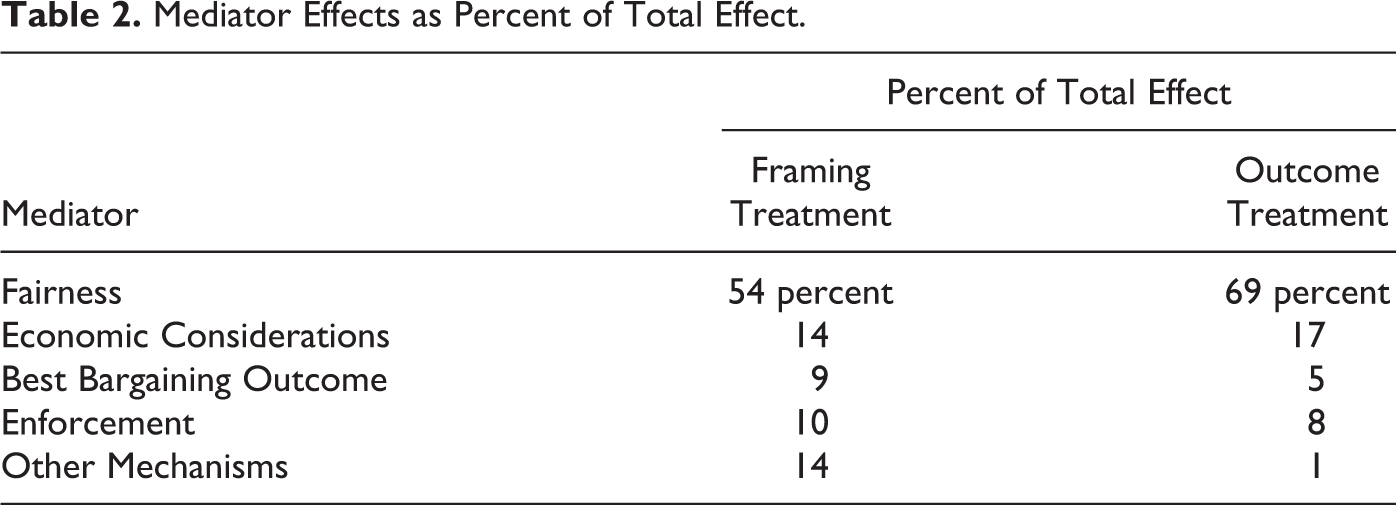
We performed a similar mediation analysis on changes in the actual negotiated outcome from shared sovereignty to full Israeli sovereignty over the Temple Mount. As the right hand column of Table 2 demonstrates, we find strong support for the Fairness Mediation of Material Change Hypothesis. In particular, fairness considerations drive an even greater proportion of the result, over two thirds. This provides additional evidence that even when tangible issues of control are directly at stake in negotiations, an automatic moral calculus, and emotional cues about what constitutes a fair outcome given past history, may drive conflict dynamics.
Discussion
The results demonstrate that the framing of a settlement as a compromise forced on one side or the other can have a substantial impact on whether the compromise is accepted. This effect occurs when a perception of past injustice committed by a negotiating adversary triggers indignation and thus a desire to see the opponent suffer punishment as a requirement of fairness. This effect is primarily the result of moral considerations rather than inferences drawn about the attainability, quality or sustainability of the negotiated outcome.
As our experiment has shown, rhetoric or action by opponents that triggers indignation can therefore shape the public’s political preferences in powerful ways, and rather quickly. By creating a marked desire to punish adversaries and a strong—though possibly sudden—reticence or opposition to compromise, indignation can make conflict more popular. In other words, indignation can shift a public’s preferences—and therefore, leaders’ range of action—away from compromise and in favor of war. As a corollary, perceived punishment of an opponent could perhaps serve to assuage public feelings of indignation and desire for punishment, and help pacify indignant publics by making compromise more palatable to them.
Anecdotal evidence suggests that the effects of indignation, if not alleviated, can have prolonged influence. Coll (2009) argues that, on the question of Kashmir, an agreed settlement between India and Pakistan was abandoned because leaders believed it would be unpopular following perceived Pakistani government complicity in the 2008 Mumbai terrorist attacks. Similarly, in late 2014, near complete peace talks between the Colombian government and F.A.R.C. rebels were suspended by Colombia after Marxist rebels kidnapped a Colombian general, causing widespread public indignation. To the extent that negotiating partners are seen as in control of actions that are perceived to be unjust, emotional reactions require settlements in which the moral order is seen as respected or restored.
One implication is that in conflicts that are framed by narratives of indignation, the appearance of negotiating defeat can serve the cause of peace. Political leaders must weigh a tradeoff, however. The appearance of negotiating defeat makes a settlement more palatable to an adversary, but it may also demonstrate weakness or a willingness to compromise and thereby embolden publics to make additional demands in the future. In fact, the appearance of weakness will be blamed for the spoiler attacks that often accompany attempts at settlements (Kydd and Walter 2002), creating a post-settlement narrative against making further concessions. Thus, although we do not directly examine these effects here, we believe peacemakers will often need to balance the short-term benefits of the appearance of negotiating defeat against potential longer-term costs, particularly when a full settlement of the ongoing dispute has not been reached. Of course, actors seeking settlements and who wish to exact concessions from their opponents should also understand that carrying out acts that will be framed as morally reprehensible will impede the political viability of those settlements. The experiment shows that in some cultural contexts, attacking civilians is one such act.
Since publics take cues about fairness in political contexts from elites (Gottfried and Trager 2016), the elite framing of the behavior of adversaries as illegitimate will have a substantial impact on what is politically possible. Constructing the behavior of an adversary as immoral may be an important tool of popular mobilization for elites in conflictual situations. But once undertaken, the range of possible settlements may also be restricted to those that appear as imposition.
How long indignation framings have these effects and how amenable they are to being placated by perceived punishment of adversaries is a topic for future research. A public that has long experienced indignation with respect to a certain adversary is likely to interpret new events in light of that collective memory and to experience indignation again (Bar Tal 2013, 141–49; Kaufman 2009). In the case of our experiment, respondents’ indignation was triggered by Palestinian leaders’ recent statements but drew on a longstanding perception among the Israeli public (Kaufman 2009). The evidence suggests that elite cues can facilitate public acceptances of changes to the status quo, even in long-running conflicts. Have peace-making efforts sufficiently concerned themselves with elite rhetoric and its effects on publics’ emotionally-appraised sense of fairness? Have leaders sought to defuse indignation in non harmful ways? A wide-ranging look at the different ways in which elite rhetoric can manage publics’ emotions is overdue.
Future research should also probe other limits of the findings described here. We examine responses to compromise over issues associated with sacred values (Ginges et al. 2007). It remains an open question whether indignation can play a similar role in other contexts. It will also be useful to probe the extent to which the specific characteristics of indignation are necessary as well as sufficient, or whether, for instance, statements that induce only anger apart from moral sanction also induce a desire for concessions for concession’s sake.
We now turn to the implications these findings have regarding rationalist explanations for war and whether negotiated solutions exist that both sides would prefer to war. Today, opposing publics are easily made aware of rivals’ public rhetoric. Palestinian officials’ statements in support of violence have often been cited by Israeli opponents of peace talks to argue that Palestinian leaders cannot be trusted. After signing the Cairo Accord of 1994, while speaking in a mosque in South Africa, Yasser Arafat called on Muslims to join a “Jihad” to liberate Jerusalem and compared the accords he had just signed to Mohammed’s temporary, tactical pact with the Quraysh Jewish tribe. 15 This speech was later replayed on Israeli radio and led to much public criticism of Israel’s government for engaging in talks with Arafat at all. 16 Yitzhak Rabin, Israel’s Prime Minister, said Arafat had caused a “crisis of trust” between Israel and the Palestinian leadership and demanded that Arafat publicly affirm his commitment to peace. 17 Similar episodes have recurred, and the present Israeli government has made Palestinian “incitement” of violence a central focus. It appears that partly for this reason, in recent polls, a strong majority of Israelis indicate that, despite wanting peace talks to resume, they do not trust Palestinian Prime Minister Mahmoud Abbas. 18
Thus, it is important in the modern world to consider the bargaining dynamics when leaders speak. To facilitate these considerations, we present results from a companion experiment conducted in October 2014, in Arabic, on a representative sample of Palestinians in the West Bank and Gaza. Due to the controversial nature of the topic, a mere few weeks after the 2014 conflagration between Israel and Hamas when emotions were still intensely felt, a large number of households either declined to be interviewed at all or refused to listen to the survey vignette. This left us with a sample of 384 households that answered the survey and passed checks demonstrating that they had followed the survey vignette. This population of respondents does not differ substantially on demographic measures from the total Palestinian population. When Palestinian negotiators are framed as having forced Israel to concede to the terms of a two state solution, 48 percent of respondents supported the settlement. Holding the actual described outcome of the settlement constant, when Israel is framed as having forced Palestinian negotiators to concede to those terms, only 24 percent of respondents approved of the settlement. This difference is significant at the 0.01 error level. Further information about this experiment can be found in Online Appendix A.
The West Bank and Gaza experiment used the same vignettes and treatments, but we did not specifically prime for indignation in the Palestinian context because we assumed indignation would be present in the fallout from the recent fighting in Gaza and did not want to make it harder or more dangerous for respondents to participate. Both experiments also included one treatment not discussed above, which informed participants that the settlement had been supported by Palestinian religious authorities. The results of this treatment in both populations form part of the discussion below.
To see how the political framing of a settlement relates to rationalist explanations for conflict, consider Figure 4. Here, we represent leader incentives to compromise as corresponding to popular approval of a settlement (Tomz 2007; Trager and Vavreck 2011; Kertzer and Brutger 2015; Gottfried and Trager 2016). If the Israeli population is primed by elites with the indignation treatment, what leader incentives are implied? The solid line in the Figure represents Israeli approval of a settlement under different treatment conditions with outcomes ordered such that approval is increasing. First, notice that as it is drawn, the mapping from outcomes to approval is not characterized by global risk aversion.
19
This violates the traditional assumption guarantying the existence of a negotiated solution that both sides prefer to war (Fearon 1995). In fact, when conflicts center on political framing and categorical outcomes, the concept of risk aversion is incoherent because negotiations are not over amounts of a commodity, which means there is no natural understanding of a “distance” between outcomes—as there may be in the case of territorial outcomes (O’Neill 2001). We also have no reason to expect, however, that the traditional assumption of risk neutrality or risk aversion would hold in an approximated or altered fashion.
20
To see why, consider two goods that two players could posses or not posses and suppose utilities are additive and separable. Assuming adjacent points are equidistant, it is then impossible for both monotonicity and concavity to hold. To see this, suppose the first player cares more about good A than good B, so
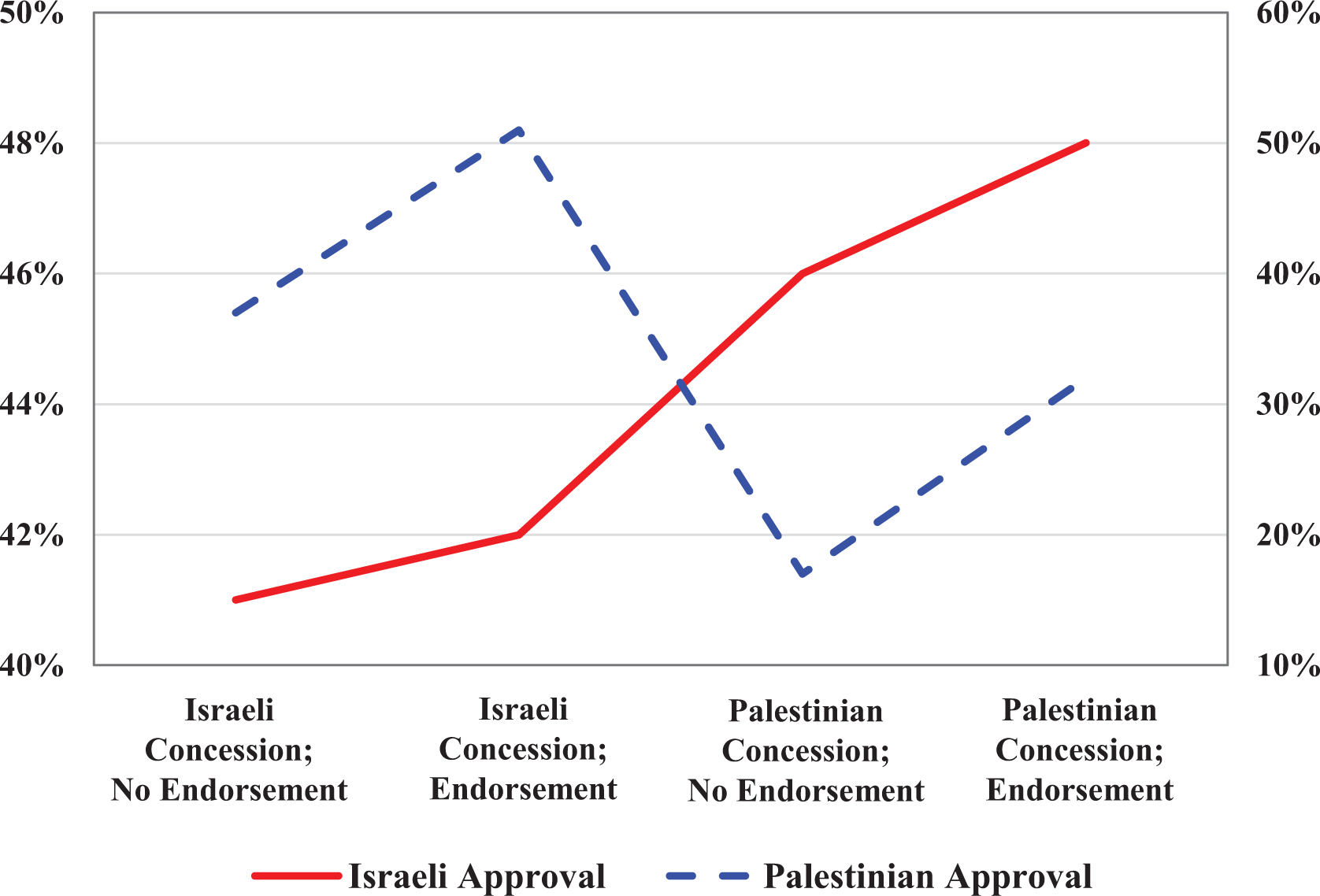
Implied leader preferences.
The dashed line in Figure 4 represents Palestinian approval at the same settlement outcomes. Notice that Palestinian approval is non-monotonic. This form of violation of the traditional assumptions guaranteeing a mutually preferred negotiated solution will also be the norm, not the exception, in contests over framing and categorical outcomes. Loosely speaking, monotonicity will be violated (in every ordering of categorical outcomes) whenever one side cares much more about one aspect of an outcome than the other side does. This implies that the sides’ preference orderings over outcomes are not mirror images.
Following Fearon (1995), most formal international relations scholarship models conflict as a costly lottery over extreme points in a bargaining space. The side that wins, in other words, can choose its most preferred bargaining outcome. 21 This assumption appears reasonable when material goods are at issue, but it too may not make sense when the framing of potential settlements is a primary object of negotiations. The principal reason is that the same set of settlement options that is available to the parties before the conflict is not available, or may not be relevant, after the conflict is fought. Beforehand, a settlement may be acceptable to both sides if it is endorsed by certain political or cultural elites; afterward, those endorsements have a different meaning. As Figure 4 illustrates, the settlement that maximizes Israeli approval involves the endorsement of Palestinian religious figures, but this does not correspond to the low-point of Palestinian approval. If the Palestinian side loses a conflict, it would not make sense to view Palestinian leadership preferences over the outcome as comparable to a peaceful settlement endorsed by Palestinian religious authorities, discounted by some fixed cost of conflict. Rather, defeat involves its own set of elite framings and material conditions influencing elite preferences. If conflict is conceived of as a lottery over an expanded set of material outcomes, rather than only the extremes, the same critique applies.
Thus, traditional rationalist assumptions should only be expected to hold when the sides are disputing amounts of goods that both sides want. When preferences are significantly affected by political framings, there is no reason to expect opposite preferences over this expanded set of outcomes, much less risk aversion. 22 Conceiving of a conflict as a lottery over outcomes in the bargaining space may also misrepresent what political actors care about—and what drives the conflict—ex ante.
The implication of these observations is not that rationalist theory has no role to play when non-material framings of settlements are an important aspect of negotiations. On the contrary, elites may be clear-eyed about what framings would be acceptable, and thus elite bargaining may be well described by rationalist theories. But it may be that in models of conflict processes, relaxing the three common assumptions of monotonicity, risk aversion, and conflict as a lottery over material bargaining outcomes would more closely track political processes. It is likely that tacitly or explicitly, leaders will negotiate the political framings of agreements; such negotiations may be characterized by different dynamics from negotiations over amounts territory and other material goods.
A new set of models could take seriously the idea that if conflicts can only be framed once for all sides, there may not be negotiated solutions that all prefer. In fact, the true, underlying bargaining space for political elites may not be the material outcomes at all, but a contest over framing. This may have been what Russian President Vladimir Putin meant when he discussed the possibility of finding a solution to the seven decades old Kuril Islands dispute with Japan. “We’re not talking about some exchange or some sale,” he said in 2016, “We are talking about finding a solution where neither of the parties would feel defeated or a loser.” 23 Rather than merely demonstrating degrees of credibility, or willingness to bear costs, hostile actions could be seen as engendering a desire for punishment that could become the real sticking point in negotiations.
Conclusion
Constructivists emphasize aspects of identity that are malleable as a result of social processes that occur over long time scales. Socialization of one sort is thought to lead to an identity that implies one set of policy preferences, while socialization of another sort produces leaders and publics of a different stripe. The results presented here demonstrate that the construction of the political context of peace settlements also happens on abbreviated time-scales. In moments when a negotiated solution to a conflict appears possible, what elites say about the past actions of opposing leaders has a significant effect on what settlements the public will accept. The construction of the adversary rather than the self is important. Not just one’s own identity, but one’s image of one’s adversary, determines foreign policy preferences.
Framings of a dispute that engender indignation are constituent elements of issue indivisibility. Like the staking of a bargaining reputation or a public statement that engenders audience costs, these narratives of the past can be used for bargaining leverage. They influence the sorts of settlements that are acceptable. Beyond their influence on the material facts of the settlement, however, they influence the political forms that it can take. Indignation creates an emotional need to punish perceived offenders, and this need promotes behavior that may be contrary to direct material self-interest. As a result, those who want peace should resist the demonization of an adversary. Those who want a better objective outcome for their side should understand that in contests where the emotions and narratives of indignation have been engaged, the political framing of a settlement can be traded for material concessions. Peace may require the appearance of negotiating defeat.
The fact that political and societal actors create these narratives and choose how and when to engage them for political purposes provides hope that political agency may overcome apparent indivisibilities. In these processes, the emotional states of the moment create a receptivity to settlements or a lack thereof, even in populations that are already embedded in conflict narratives. As revolutions are said to appear impossible beforehand and inevitable afterward, solving long-running conflicts may appear impossible until actors alter taken-for-granted social facts for the long-run through the emotional appeals of the moment.
Supplemental Material
Supplemental Material, sj-do-1-jcr-10.1177_0022002721997543 - Concessions for Concession’s Sake: Injustice, Indignation, and the Construction of Intractable Conflict in Israel–Palestine
Supplemental Material, sj-do-1-jcr-10.1177_0022002721997543 for Concessions for Concession’s Sake: Injustice, Indignation, and the Construction of Intractable Conflict in Israel–Palestine by Philippe Assouline and Robert Trager in Journal of Conflict Resolution
Supplemental Material
Supplemental Material, sj-dta-1-jcr-10.1177_0022002721997543 - Concessions for Concession’s Sake: Injustice, Indignation, and the Construction of Intractable Conflict in Israel–Palestine
Supplemental Material, sj-dta-1-jcr-10.1177_0022002721997543 for Concessions for Concession’s Sake: Injustice, Indignation, and the Construction of Intractable Conflict in Israel–Palestine by Philippe Assouline and Robert Trager in Journal of Conflict Resolution
Supplemental Material
Supplemental Material, sj-xlsx-1-jcr-10.1177_0022002721997543 - Concessions for Concession’s Sake: Injustice, Indignation, and the Construction of Intractable Conflict in Israel–Palestine
Supplemental Material, sj-xlsx-1-jcr-10.1177_0022002721997543 for Concessions for Concession’s Sake: Injustice, Indignation, and the Construction of Intractable Conflict in Israel–Palestine by Philippe Assouline and Robert Trager in Journal of Conflict Resolution
Footnotes
Acknowledgments
We are grateful to Andrew Coe, Songying Fang, Susan Hyde, Andrew Kydd, Jason Lyall, Bruce Russett, Kenneth Schultz, Dustin Tingley, Alex Weisiger, Aila Matanock and seminar participants at USC and Yale for insightful comments.
Declaration of Conflicting Interests
The author(s) declared no potential conflicts of interest with respect to the research, authorship, and/or publication of this article.
Funding
The author(s) disclosed receipt of the following financial support for the research, authorship, and/or publication of this article: Research support provided by the UC Office of the President through its UC National Laboratory Fees Research Program (Award #LFR-18-547591) and the Gerda Henkel Stiftung.

Supplemental Material
Supplemental material for this article is available online.
Notes
References
Supplementary Material
Please find the following supplemental material available below.
For Open Access articles published under a Creative Commons License, all supplemental material carries the same license as the article it is associated with.
For non-Open Access articles published, all supplemental material carries a non-exclusive license, and permission requests for re-use of supplemental material or any part of supplemental material shall be sent directly to the copyright owner as specified in the copyright notice associated with the article.
