



Abstract
Surveying civil war in the world today is striking in terms of how often religious cleavages and grievances have become central to armed conflict. How are the causes and outcomes of religious civil wars different than other civil wars, if at all? Is Islam implicated for the contemporary surge in religious civil war? The first section reviews the literature and addresses the importance of religion for civil war. I then introduce a dataset and describe key trends in religious civil war in the third section, while in the fourth section I present tests of whether Muslim or Arab Muslim societies in particular are more prone to religious strife. The paper concludes with a discussion of the implications of the main findings.
Surveying contemporary civil wars, it is striking how often religious cleavages and grievances become central to armed conflict. The new religious civil war (RCW) dataset employed here documents 28 civil wars ongoing as of the end of 2014, 1 with twenty conflicts, making up 71 percent of the sample, featuring religion as a central or peripheral factor. By contrast, only eight ongoing civil wars in 2014 had no religious dimension, of which only five were classic ethnic wars involving identity politics but not involving a significant religious dimension As a result, religious civil wars today pose some of the biggest strategic challenges to the global order, from the intractable conflicts over Kashmir and Palestine, to the Sunni insurgencies in Afghanistan and Iraq, to the sectarian Syrian bloodbath that has claimed an estimated 300 to 400,000 lives since 2011.
How are the causes and outcomes of religious civil wars different than other civil wars, if at all? Is Islam implicated for the contemporary surge in religious civil war? Does the rise of religious civil war indicate a “clash of civilizations?” The next five sections take up these questions. The first section contains a review of the literature, noting that although there have been some advances made, there is much work to be done. I then introduce the RCW dataset and describe several key trends in religious civil war in the third section, while in the fourth I present tests of whether Muslim societies in general or Arab Muslim societies in particular are more prone to religious civil war. The final section summarizes the major findings and relates the implications of those findings.
The Literature
The literature on religion and civil war is not much more developed than the literature on ethnic civil war when van Evera (1994) codified hypotheses on nationalism and war or Sambanis (2001) asked whether ethnic and non-ethnic civil wars have the same causes. It has also been much less studied than modern religious terrorism. 2 Just over a decade ago Toft (2007) made an early contribution to the study of religion and civil war by theorizing how bidding dynamics among religious elites contribute to the rise of religious civil war. That article also proposed an explanation for why Islam in particular appeared to account for so many contemporary religious civil wars. Since then, both the phenomenon of religious civil wars and the literature on religion and civil war has grown quickly. However, heated debate on the most basic questions persists. This article investigates several major claims often made about religion and civil war. This empirical “brush-clearing” exercise seeks to move the literature forward both theoretically and empirically, and to point to a more progressive research paradigm in this area.
Literature on the topic of religion and conflict can be methodologically broken down into two broad categories. The relevance of religion can be measured as an issue or as an identity (Pearce 2005; Isaacs 2016). Toft (2007) defines a religious civil war “as a war in which religious belief or practice is either a central or peripheral issue in the conflict,” therefore falling in the issue-based methodological group (p. 97).
Further studies have analyzed the relationship between religion and violence looking at both issue and identity definitions of religion. Generally, identity was not found to have a significant effect on the onset or characteristics of civil war, while issue-based definitions of religious conflict are found to have a significant relationship. Isak Svensson (2007) found that civil conflict where at least one side made overt religious claims—an issue-based definition—were less likely to be resolved by negotiated settlements. However, when looking at identity-based definitions, neither religious nor ethnic demographic dissimilarities were shown to impact the likelihood of termination via negotiated settlement. Similarly, Maoz and Henderson (2020) found that civil wars coded as religious are more severe, lengthy, and less likely to be terminated through negotiated settlements compared to nonreligious civil conflicts (similar to findings presented in Toft [2007]). They further concluded that the demographic dominance of a particular religious group in a state does not impact that states propensity for intrastate violence (Maoz and Henderson 2020). 3
Some authors have criticized the measurement validity inherent in issue-based classification of religious conflict because religious classification could be limited to conflicts in which major actors express religious demands while conflicts with less prominent religious influence are left out. Isaacs specifically points to the Serbian–Bosnian war as an example of a conflict that lacks religious demands and therefore could be coded as non-religious despite the influence of religious mythology (2016). It should be noted that this study aims to remedy this concern by classifying civil conflicts as featuring religion as either a central or peripheral factor. In fact, the RCW dataset classifies the Serbian–Bosnian conflict as a religious civil war where religion is a peripheral issue.
The grievance-based theory first put forth by Gurr (1970) asserts that discontent due to relative deprivation is a condition for political violence and that the level of violence will increase as the level of relative deprivation increases. This theory has been tested quantitatively using the Minorities at Risk (MAR) dataset which contains information about politically active ethnic minorities. Fox built on Gurr’s theory as well as mobilization theory to study the role of religion in ethnoreligious violence in his 2002 book. The study found that if a minority group is seeking autonomy or independence, then religious grievances increase the likelihood of rebellion significantly (Fox 2002). Further studies found that the level of religious discrimination against an ethnoreligious group is a predictor of civil war (Akbaba and Taydas 2011). Due to a perception selection bias of the MAR data, other researchers have studied the grievance theory using ethno-linguistic fractionalization and polarization indices (ELF/ELP).
Many studies using a demographic or identity-based definition of religion rely on ELF/ELP. Some of these studies failed to find a robust effect of ethnic heterogeneity on civil war onset and further found that neither the percentage of Muslims or Middle East affected civil war onset (e.g. Fearon and Laitin 2003). But subsequent studies indicated that ethnic grievances—rooted in horizontal ethnic inequality and specific patterns of political and economic privilege and exclusion—help explain the outbreak of ethnic civil wars (e.g. Cederman, Wimmer, and Min 2010; Cederman, Gleditsch, and Buhaug 2013). 4 When investigating the relationship between ethnic and religious identities, Basedau et al. (2015) found that the presence of overlapping religious and ethnic identities increase the likelihood of the onset of civil violence.
The view that ethnic groups are the most likely to be aggrieved and the easiest to mobilize and cohere as rebels has become a dominant view in the field (e.g. Blattman and Miguel 2010). The importance of ethnicity for many civil wars begs the question of what it is about ethnicity and ethnic groups that is important for the frequency, severity, and duration of identity-based civil wars. Are some dimensions of ethnicity more important than others?
It is precisely this question that Bormann, Cederman, and Vogt (2017) recently took up by compiling data on the linguistic and religious composition of ethnic groups. Bormann and colleagues argue that the presence of linguistic cleavages between potential ethnic challengers and the dominant ethnic group in a state are more likely to lead to the outbreak of armed ethnic conflict than the presence of religious cleavages between these ethnic groups. However, there are several limitations in their data for testing the importance of religious cleavages on civil war onset. First, they “do not identify the political meaning of religion and language” (p. 13). Second, their study excludes all intra-ethnic religious civil wars—which comprise a majority of civil wars in which religion was central—involving religious conflicts within linguistically or culturally defined ethnic groups or inter-ethnic civil wars between ethnic groups that share the same religion, but have competing ideas about religion in public life. 5 Finally, the Bormann et al. findings are biased against even inter-ethnic religious cleavages because they rely on a permissive definition of “civil war,” including all cases of armed conflict with at least 25 battle deaths. In fact, their main result—that linguistic cleavages dominate religious cleavages as a determinant of ethnic civil war onset—is much weaker when using a more traditional definition of civil war with at least 1,000 deaths. 6
Additional analyses aim to uncover potential causal mechanisms in the relationship between religion and violent conflict. Isaacs found that organizations that have previously used violence are more likely to use religious rhetoric, and that such rhetoric may help organizations mobilize resources and discourage defection (2016). Conversely, organizations that have recently used religious rhetoric are no more likely to use violence than organizations who have not (Isaacs 2016). An additional study found that cultural affinity, including religious identity, between a group and an external actor leads the group to anticipate external support. This anticipation increases the likelihood the organization will rebel and that the rebellion will resort to violent methods (Jackson, San-Akca, and Maoz 2020). Looking at state determination conflict more specifically, Breslawski and Ives (2019) found that religious factions were more likely to use violence than non-religious ones, theorizing that violence is used to visibly outbid for the support of transnational religious supporters (also see, Toft 2007).
Scholarship on the association between Islam and violence has also been mixed. In his influential The Clash of Civilizations, Huntington put forth that Islam has bloody borders and bloody innards (1996). Following this claim, scholars have conducted quantitative assessments to uncover the relationship between Islam and civil conflict. Toft found that Muslim combatants were present in 81 percent of religious civil wars and hypothesized this was due to a lack of historical internecine religious wars, the geographic proximity of Muslim majority countries to petroleum reserves, and jihad (2007). When assessing all intrastate conflict, Karakaya (2015) found that while Muslim-plurality countries are disproportionately involved, after controlling for other factors such as GDP, repression, oil dependency, and youth populations, Islam was no longer a statistically significant predictor of the onset of civil conflict. Gleditsch and Rudolfsen (2016) found that nearly all civil wars in the past years have taken place in Muslim majority countries and that the majority of those involve Islamist insurgencies. Yet, Fish, Jensenius, and Michel (2010) did not find any correlation between Muslim population and episodes of large-scale political violence.
In addition to the association between Islam and violence, it is also worth investigating the causes of civil conflict specifically in Arab countries. In a report on civil conflict in the Middle East and North Africa, Gause (2014) encourages readers to look beyond the unnuanced narrative of a Sunni versus Shia sectarian fight and instead understand that conflicts arise from the weakening of Arab states and intra-Sunni disputes. Additionally, Hägerdal (2021) notes that non-separatist ethnic wars have clustered in the Arab world due to identity cleavages, often religious ones. Using the Ethnic Power Relations (EPR) dataset, Vogt et al. finds that ethnic discrimination in the MENA region is significantly higher than other regions since the 1980s and that excluded ethnic groups are more likely to start ethnic rebellions.
In short, quantitative studies on both issue and identity-based definitions of religion and civil wars have provided mixed results. This article aims to further develop the literature forward both theoretically and empirically.
The Religious Civil War Data Set
Designed to help arbitrate the core ongoing debates on religion and civil war, this article employs the new civil war (RCW) dataset. 7 An earlier version of a dataset employed by Toft included 133 civil wars over the 1940 to 2000 period, of which 42 (32 percent) were religious civil wars. Based on that data set, this newer dataset covers a longer period from 1945 to 2014, the last year for which we have data on battle deaths and definitive conflict outcomes and more significant analyses of the dynamics of the cases. 8
Over this 1945 to 2014 period, there were 208 civil wars, which were defined as armed conflicts between an independent state’s 9 central government (or a loyal military faction 10 ) and one or more organized non-state combatants 11 (or dissident military factions) over either territory or who governs the state, in which there were (a) at least 1,000 war-related total deaths, (b) at least an average of 100 war-related total deaths per year, 12 and (c) in which at least 5 percent of the total war-related deaths were suffered by each side. 13
An identity-based civil war is a civil war in which there are ethnic, linguistic, or religious cleavages in the conflict. A religious civil war is a subset of such civil wars in which religious belief or practice is an issue in the conflict. A non-religious civil war may be one of two types: (a) a non-identity-based civil war or (b) non-religious identity-based civil war. Religious centrality in civil war is the degree to which religious belief or practice is a cleavage in the conflict. Religion is central to civil war if the rebels fight over whether the state or a rebel-dominated region will be ruled according to a specific religious tradition. For example, civil wars where rebel groups have a main stated goal to institute Sharia law (even if the government was led by Muslims) are included in this category. Other possibilities include the managing of religious institutions, privileging certain religious institutions with resources and legal monopolies, controlling dress and education, apostasy and marriage laws, and laws restricting minorities. An example of a non-Muslim group that took up arms against a government in order to govern a region according to a religious tradition is the Holy Spirit Movement insurgency in Uganda that started in 1986.
Religion is peripheral to a civil war if the rebels identify with a specific religious tradition and group themselves accordingly, but the rule of this specific religious tradition is not a major reason why they have rebelled. Peripheral wars thus often pertain to those wars in which the conflict parties adopt religious rhetoric to mobilize resources and recruitment and retention of members (Isaacs 2016). Because religion is not a central issue in these wars, peripherally coded civil wars can often be understood as an identity-based classification of religion.
Religion is irrelevant for all other civil wars. In categorizing religious civil war this way, religion is not epiphenomenal to civil war when religion is central as opposed to peripheral to civil war. 14 Of the 208 wars, 90 (43 percent) were religious civil wars. 15 Of these 90 religious civil wars, religion was a peripheral issue in 49 wars and was a central issue in 41 wars.
The updated RCW dataset improves on the original version created by the author in “Getting Religion?” (2007) in three central ways. First, a more comprehensive definition of civil war leads to the inclusion of more conflict cases. The 2007 version of the dataset was limited to conflicts with more than 1,000 average annual battle fatalities, however, the current RCW includes conflicts with an average of 100 deaths per year as long as 1,000 fatalities are recorded over the duration of the conflict. Second, the dataset is extended temporally to include civil conflicts through the year 2014. Finally, while the original dataset only provided summaries of civil conflicts coded as religious, the updated RCW provides case narratives, multiple references, and coding justifications for every conflict in the dataset.
The RCW also provides unique value in comparison to existing datasets on armed conflict. Integral to the RCW is an issue based coding of religion in each conflict. Two of the most prominent civil conflict datasets, the UCDP/PRIO armed conflict dataset and Correlates of War intra-state war dataset, lack variables coding either an identity or issue based classification of religion in civil conflicts. 16 The COW dataset is accompanied by a book titled A Guide to Intra-state Wars which provides cases and coding justification, but the armed conflict dataset provides no such appendices (Dixon and Sarkees 2015). The RCW provides a 600-page appendix containing original case summaries, coding justifications, potential definitional issues, and comparisons with other key datasets for every included conflict. Additionally, the RCW provides summaries and explicit justification for civil wars that appear in other datasets but are excluded from RCW based on its own definition of civil conflict.
The RCW dataset also improves upon religious-specific civil conflict databases. Four of the prominent religious conflict classification datasets include the Religion and Armed Conflict dataset (RELAC) created by Svensson and Nilsson (2018), the Religion and Conflict in Developing Countries dataset (RCDC) created by Vüllers, Pfeiffer, and Basedau (2015), the supplemented Political Instability Task Force dataset (PITF) created by Fox (2012), and the Running on Faith dataset created by Lindberg (2008). The RCW dataset is uniquely valuable compared to these datasets in three primary ways. First, the RCW provides the broadest geographic and temporal coverage of religious civil conflicts. 17 Second, the RCW bases the inclusion of cases and coding of variables on a broad survey of historiography of each civil war and the literature. By contrast, Fox (2004, 2014) relies solely on conflict descriptions by the Political Instability Taskforce, the RCDC dataset relies solely on country reports of the Economist Intelligence Unit and US government (Vüllers, Pfeiffer, and Basedau 2015), the RELAC dataset relies heavily on the UCDP Encyclopedia (Svensson and Nilsson 2018), while only the Running on Faith dataset utilizes a wider variety of sources (Lindberg 2008). Finally, the RCW includes extensive documentation in an appendix providing both original case summaries and detailed coding justifications. Saliently, none of the preceding datasets offer either.
The RCW further differentiates itself from certain existing datasets in other significant ways. Although scholars may dispute RCW’s classification of certain civil wars, its coding is more reliable and substantively meaningful than a pure demographic coding of religious cleavage, such as that of Lindberg (2008). If no evidence that a religious cleavage was used to recruit or mobilize combatants, that civil war was coded as non-religious even if there were differences in the religions of the combatants. For example, even though Kurds are primarily Sunni and Iran’s government is dominated by Shia, the 1946 Iranian Kurdish rebellion is coded as non-religious because it was sponsored by the Soviet Union and the separatist Kurdish Mahabad Republic was led by secular elites who did not engage in religious bidding (Toft 2007). Additionally, the coding of religious centrality does not arbitrarily partition religious civil wars between inter-religious and intra-religious conflicts. For example, religion is coded as central to the Caucasus Emirates insurgency in Russia since 2007, because jihadists sought imposition of Sharia law. By contrast, Fox (2014) codes this case as a “religious identity conflict” and not a “religious war” since it pits Muslims against Christians.
The Significance of Religious Civil War
This section revisits claims that religion in civil war matters. 18 The data first show that religious civil wars are becoming more frequent over time. Worldwide, all kinds of civil wars—non-ethnic, ethnic, and religious—display a general upward trend in the number of ongoing wars from the 1950s through the end of the Cold War. In the late 1980s, there was a brief spike in both ethnic and religious civil wars (both peripheral and central) whereas non-identity based civil wars began to decline. However, whereas all other kinds of civil war declined since the early 1990s, after 2001 the number of civil wars in which religion featured centrally has nearly tripled (See Figure 1). Other studies of religious civil war fail to capture this twenty-first century upsurge. 19
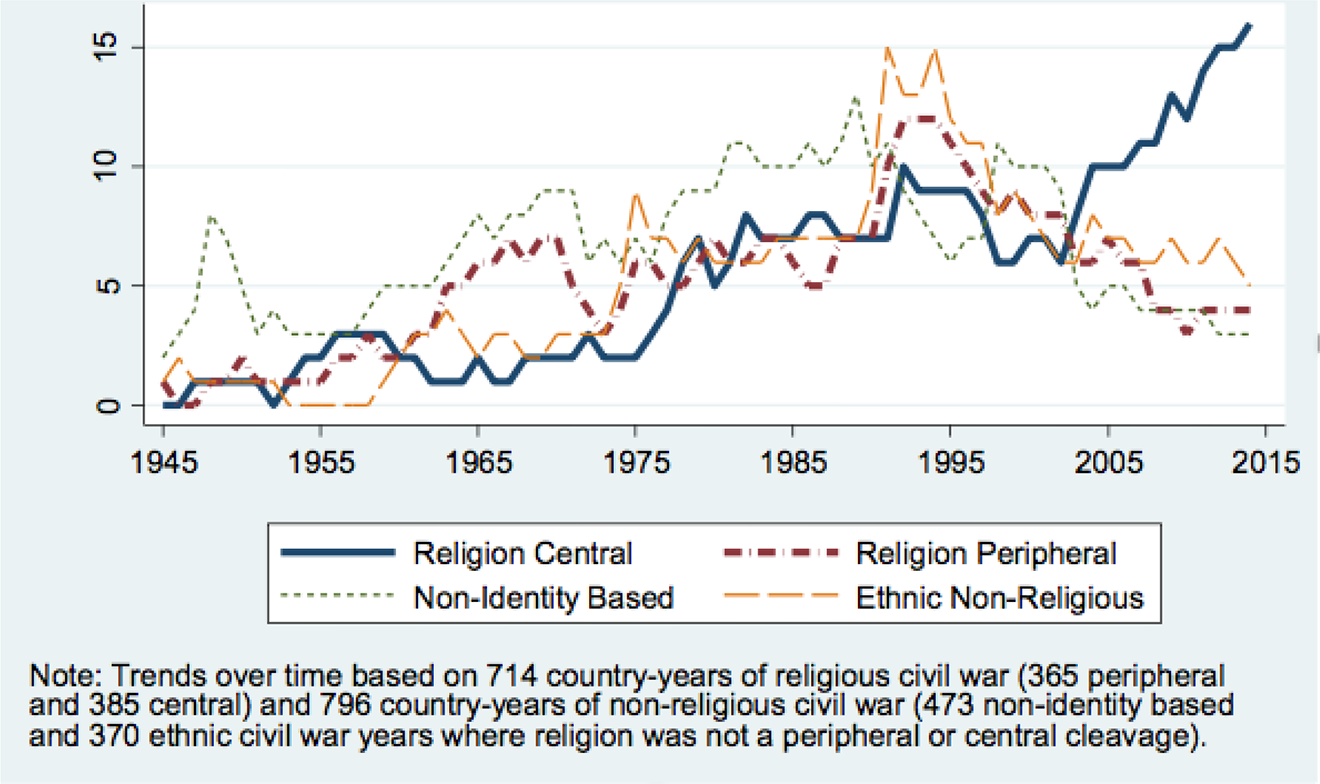
Religious and Nonreligious civil wars, 1945–2014.
Second, centrally religious civil wars are increasingly concentrated within the Muslim world. Although the Middle East and North Africa (MENA) is home to only 5 percent of the world’s population (and 20 percent of the world’s Muslims), this region accounts for about 40 percent (sixteen of forty-one) of centrally religious civil wars since 1945 (see Table 1).
Geographic Regions and Religious Centrality in Civil War since 1945.
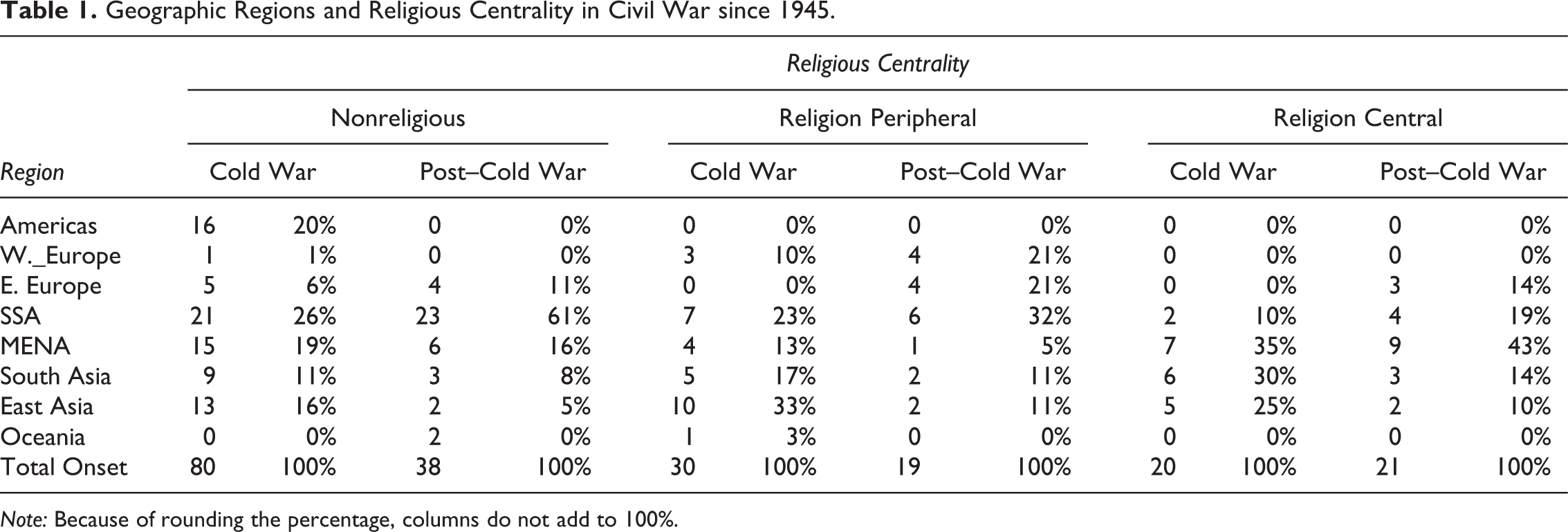
Note: Because of rounding the percentage, columns do not add to 100%.
By contrast, centrally religious civil wars are entirely absent in Western Europe, the Americas, and Oceania, with other regions in between. In addition, no more than 5 percent of non-Muslim ruled countries have ever experienced a centrally religious civil war in any given year. By contrast, by 2014, there was a centrally religious civil war ongoing in almost a quarter of Muslim-ruled countries (see Figure 2).
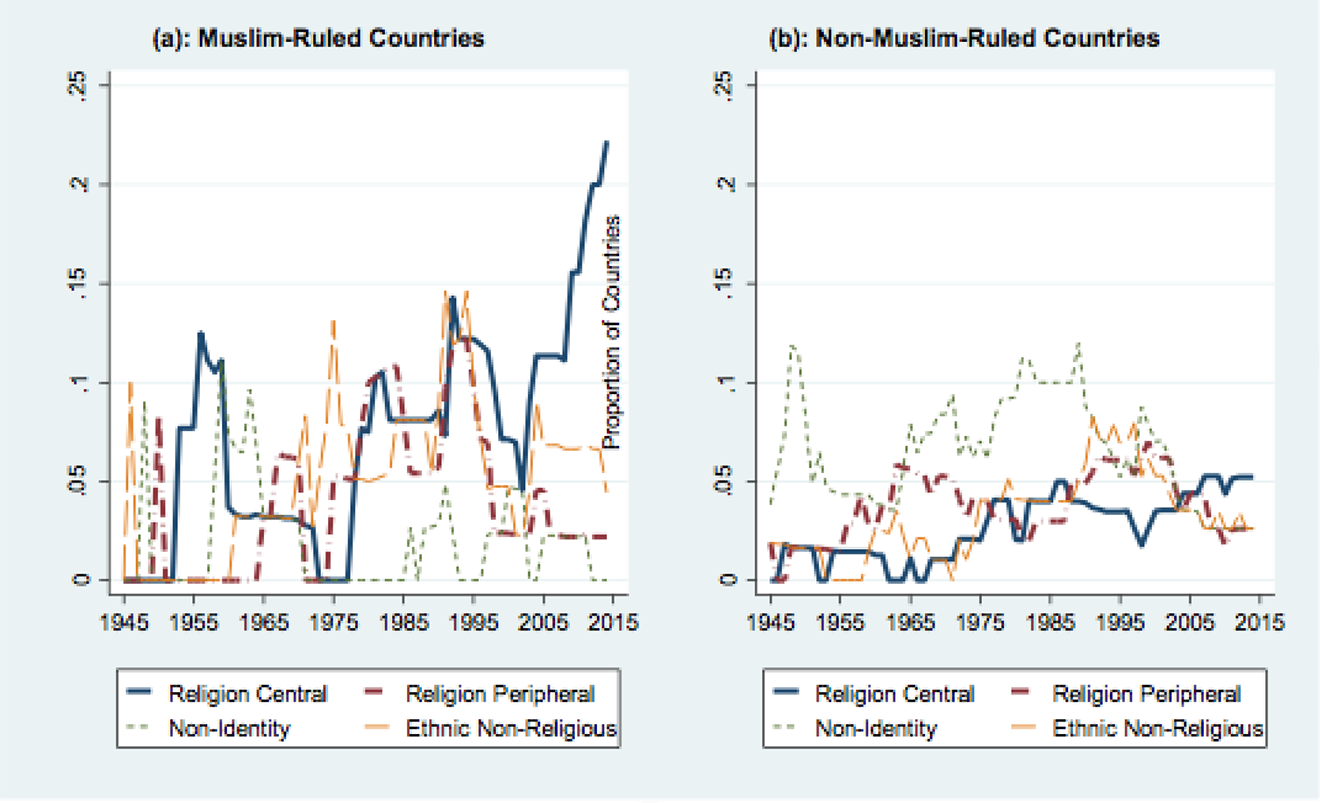
Trends and data on Muslim rulership and Civil War incidence since 1945. (a) Muslim-ruled countries. (b) Non-Muslim-ruled countries.
Thus, although only 25 percent (five of twenty) of centrally religious civil wars involved both a Muslim-dominated government and predominantly Muslim rebel groups during the Cold War, that figure has shot up to 71 percent (fifteen of twenty-one) after the Cold War.
In total, some three-quarters of all religious civil wars involve a Muslim government or Muslim rebel group. In the post-Cold War era, the Islamic world has had a monopoly on religious civil war, when 95 percent (twenty of twenty-one) of centrally religious civil wars involve at least one Muslim combatant (see Table 2).
Arab versus Muslim Identity and Religious Centrality in Civil War since 1945.
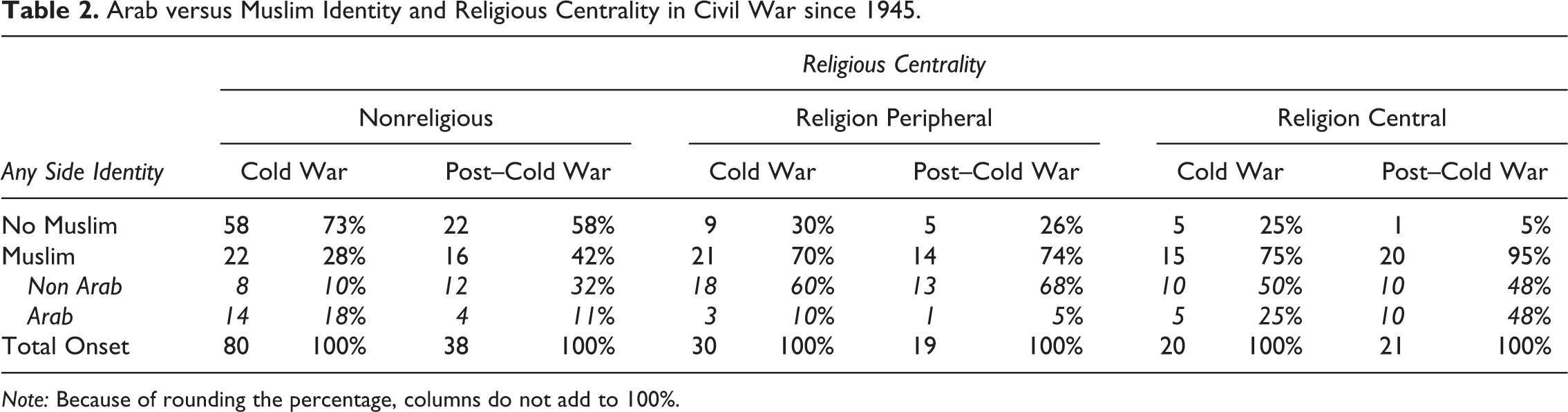
Note: Because of rounding the percentage, columns do not add to 100%.
In contrast, non-Muslims account for the majority of non-religious civil wars after the Cold War, with nearly 40 percent alone involving both a Christian-led government and rebel group (see Table 2). Civil wars in which religion is peripheral are distinctive, with a majority of all such wars pitting Muslims against Christians. Islamist rebel groups are implicated in all 14 centrally religious civil wars that have broken out since 2000; non-Muslim rebel groups are now implicated in none.
Third, there is a “ratchet effect” in the centrality of religion when civil wars in countries recur, implying that conflict actors have found increasing returns to making religious bids over time. Of 43 civil wars that recur, there are 10 cases of either non-religious civil wars becoming religious civil wars or religion shifting from peripheral to central, but only one clear example of a religious civil war recurring without religion being just as central as it was previously. 20 Thus, in 2014, there is not a single region of the world where there are more non-religious ethnic civil wars ongoing than religious civil wars. In MENA, religious civil wars now outnumber non-religious civil war by a ratio of four-to-one. In Sub-Saharan Africa, the ratio is five-to-zero; in East Asia, three-to-one. Such data undermine the conclusion of Bormann, Cederman, and Vogt (2017) that “civil wars are more likely to be fought along linguistic cleavages than religious ones.”
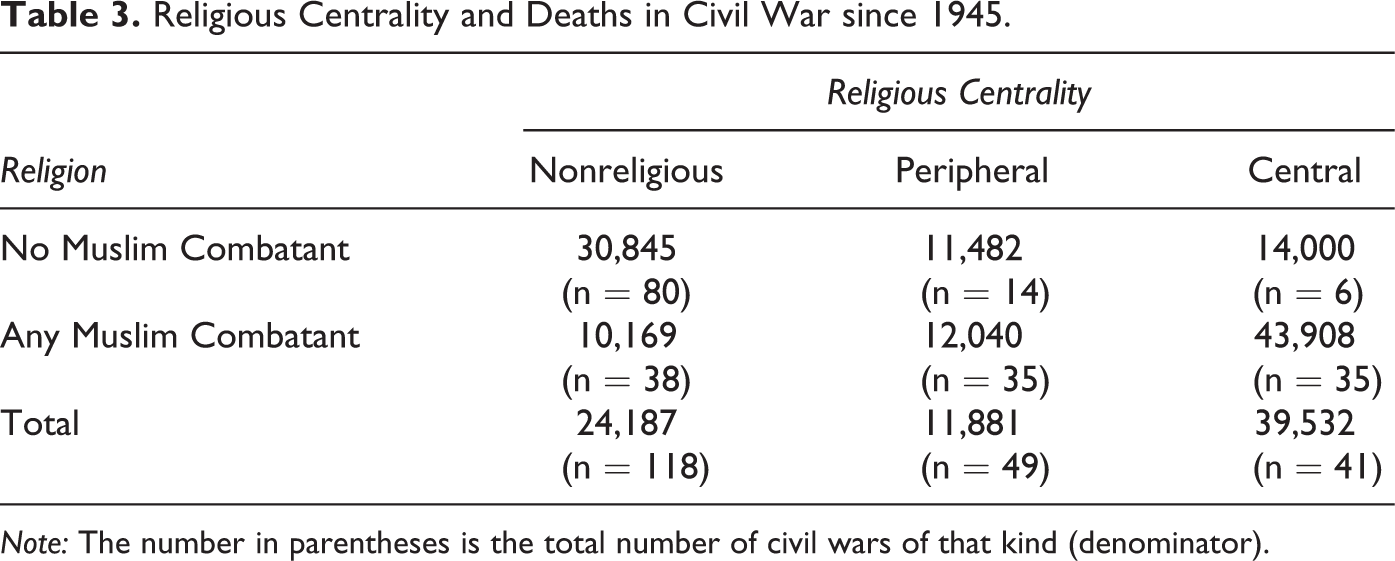
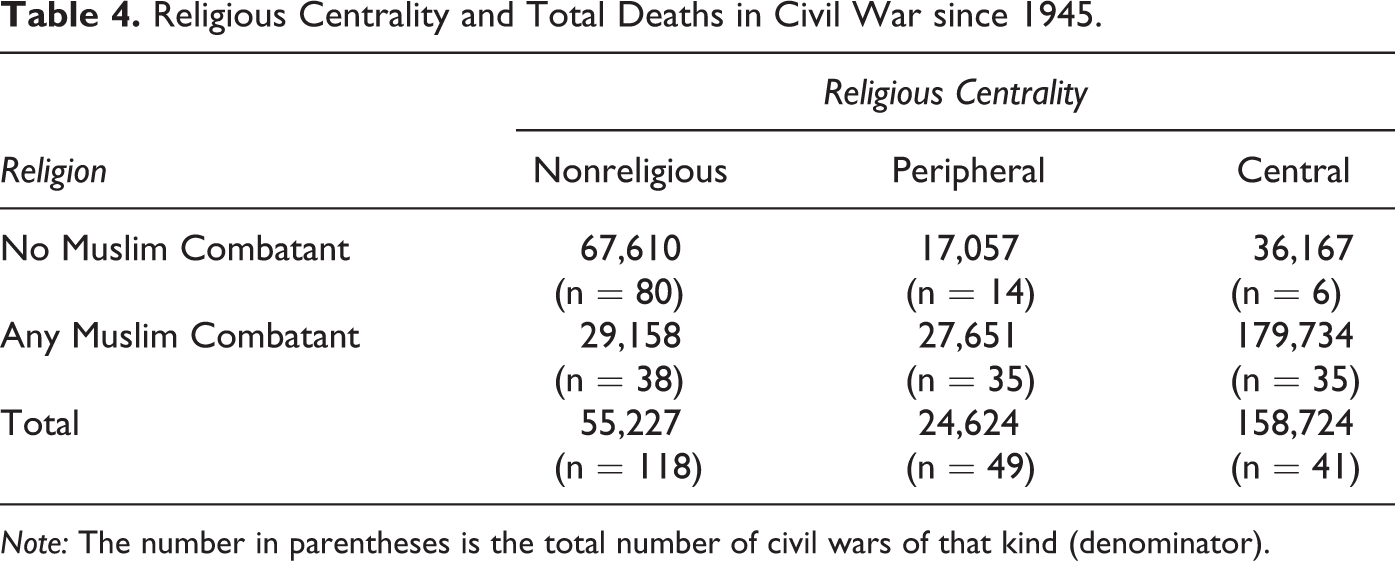
Fourth, centrally religious civil wars are bloodier than other civil wars. The average number of total civil war-related deaths is about 55,000 for when religion is irrelevant, 25,000 when peripheral, and 160,000 when central (see Table 3).
Religious Centrality and Deaths in Civil War since 1945.
Note: The number in parentheses is the total number of civil wars of that kind (denominator).
Similarly, the mean battle deaths in civil war total is about 24,000 when religion is irrelevant, 12,000 when peripheral, and 40,000 when central (see Table 3). 21
These findings contrast with Pearce (2005), who also found that conflict intensity was higher for religious than non-religious conflict in the UCDP dataset from 1946 to 2001, but who found that intensity was actually lower when religion had “high” rather than “low” relevance. 22 After the Cold War, centrally religious civil wars have become less deadly in absolute terms (66,000 average total deaths) than those waged during the Cold War, but remain more deadly than other civil wars (25,000 average total deaths) in relative terms.
Fifth, the deadliest religious civil wars involve Muslim combatants. Civil wars with religion as central and involving Muslims result in an average of 180,000 total deaths (43,000 battle deaths), three times (50 percent) more than any other type of civil war including Muslims or not (see Table 3). 23 By contrast, Fish, Jensenius, and Michel (2010) attempted to argue that Islamic states have not suffered disproportionate deaths from “Major Episodes of Political Violence” from 1946 to 2007 compared to non-Islamic states. The RCW data indicate that Fish, Jensenius, and Michel’s (2010) finding is only half-true: civil wars involving Muslims are indeed no more deadly than those without Muslim combatants, but only when religion is irrelevant or peripheral. These data also echo Gleditsch and Rudolfsen (2016), who observed that 94 percent of all civil war battle deaths since 2011 are in Muslim states.
Sixth, centrally religious civil wars, but not other civil wars, have become significantly more intractable after the Cold War. Religious civil wars did not differ much from non-religious civil wars in terms of outcome, duration, or recurrence during the Cold War. In fact, if anything a larger share of religious central wars initiated during the Cold War ended in a negotiated settlement than non-religious civil wars. The post-Cold War story, however, is entirely different: whereas only 5 percent of civil wars where religion was irrelevant remain ongoing as of 2014, 71 percent of civil wars where religion was central remain ongoing. By contrast, whereas a third to a quarter of post-Cold War civil wars where religion was irrelevant or peripheral have reached a negotiated settlement, only a single (5 percent) of post-Cold War civil war where religion was central has reached a negotiated settlement (see Table 4).
Religious Centrality and Total Deaths in Civil War since 1945.
Note: The number in parentheses is the total number of civil wars of that kind (denominator).
The data therefore partially confirm findings on the intractability of religious conflict by Svensson (2007, 2012), but only for the post-Cold War period.
Reexamining Islamic Exceptionalism in Religious Civil War
In summary, the RCW data show that after the Cold War civil wars in which religion is central have been on the rise, have been particularly bloody and intractable, and over the last several decades have clustered in the Muslim world. What drives this conflict pattern: Islam, Arab culture, or something else? 24 Toft (2007) explained the over-representation of religious civil wars in Islamic countries by arguing that religious bids have a higher utility for Islamic elites than non-Islamic elites. Why? Islam has yet had no equivalent to the separation of religion and state and the decline of Christian religious-political authority as seen in the West after the Thirty Years War and Treaty of Westphalia. 25 The Islamic doctrine of Salafist jihad may make Muslims, whether locally or as transnational jihadists, more likely to fight in the name of Islam out of a sense of religious obligation. 26 Toft (2007) further argued that Arab states are more prone to religious conflict since 1948 since Islam’s holy sites are located in the region, there is a concentration of oil reserves, and the Arab-Israel conflict has festered Arab grievance.
The relationship between religion and civil wars can be explained by a series of grievances that are mobilized among group dynamics. If a group is feeling discriminated against or is repressed by the state, it may turn to protest or violence. Despite the promotion of a secularization thesis, the political influence on religion has dramatically increased over the past forty years (Toft, Philpott, and Shah 2011). While this phenomenon has been observed worldwide, Toft et al. found that the post-colonial Arab Regimes have largely seen a conflictual consensus between religious and political authority as well as a low degree of independence between religious and political authority (2011). This general relationship between the state and religion in the Arab world may explain the propensity for religiously-based grievances.
Islam’s correlation with autocracy
27
and terrorism
28
has long been debated. Ignited by Toft (2007), a similar debate on Islam and civil war has arisen (cf. Fish, Jensenius, and Michel 2010; Sørli, Gleditsch, and Strand 2005; Karakaya 2015). After reviewing this literature, Gleditsch and Rudolfsen (2016) concluded that “More sophisticated causal models are needed to assess whether religion itself plays a role in armed conflict.” This section is a first step to fill this void through the testing of three alternative hypotheses:
Populations are coded as Arab Muslim if >50 percent of the population is Muslim and >50 percent of the population is ethnically Arab. The RCW dataset indicates that out of 118 non-religious civil wars, non-Arab Muslims are involved in twenty (17 percent), Arab Muslims in eighteen (15 percent), and non-Muslims in eighty (68 percent). By contrast, out of forty-nine peripheral religious wars, thirty-one (63 percent) involve non-Arab Muslims, whereas only four (8 percent) involve Arab Muslims and fourteen (29 percent) involve non-Muslims. Finally, out of forty-one central religious wars, only six (15 percent) involve non-Muslims, whereas the remaining are split more evenly with twenty (49 percent) involving non-Arab Muslims and fifteen (37 percent) involving Arab Muslims (see Table 2).
Of course, descriptive statistics fail to provide baseline conflict propensities for Muslims, Arab Muslims, or other groups. For this, we can rely on our global version of the EPR-ED data. 29 Out of 853 different ethnic groups in the world since 1945, some 247 are predominantly Muslim. Of those 247 Muslim ethnic groups, about 80 percent (200) are non-Arab whereas only 20 percent (forty-seven) are Arab. Hence, Arabs comprise only about 5 percent of all ethnic groups. Yet fifteen of forty-one (36 percent) central religious wars involve Arab Muslim groups, almost as many (twenty; 49 percent) as involve non-Arab Muslim groups. This fact would lead us to suspect that Arab Muslims are particularly prone to religious conflict onset more than any other non-Arab Muslim groups in the world. To assess whether this correlation is spurious, I employ a cross-country regression model.
Dependent Variables
For each kind of civil war—non-identity based, identity-based but non-religious, peripherally religious, and centrally religious—the dependent variable is equal to “1” if a civil war of that type was initiated in that country-year, and is “0” otherwise.
Independent Variables
Earlier studies measured the relationship between Islam and civil conflict using a measure of the total Islamic share of the population or a dummy variable for Muslim-plurality countries (e.g. Fish, Jensenius, and Michel 2010; Karakaya 2015). 30 However, such aggregate measures by themselves do not enable us to distinguish potential independent effects that Arab and Non-Arab Muslim populations have on conflict propensities. To include these disaggregated demographic measures, the RCW dataset updates and derived data on the relative size of ethnic groups as found in the Ethnic Power Relations (EPR) Ethnic Dimensions (EPR-ED) dataset. This enables us to measure the total number of ethnic groups (and percentage of the population) that is included or excluded from power in the central government that is non-Muslim, Arab Muslim, and non-Arab Muslim. The percent of a population that is excluded from power affords a more specific measure of grievance.
Control Variables
In the base model, the following correlates of civil war onset identified in the literature that could confound the Islam-conflict relationship are employed: the level and annual change in the log of GDP per capita, 31 logged population, democracy (polity2) score 32 and its square, a dummy measure of political instability, 33 a dummy for the Cold War (1945–1990), a cubic polynomial of peace years (Carter and Signorino 2010), and a series of region dummy variables. 34
Results
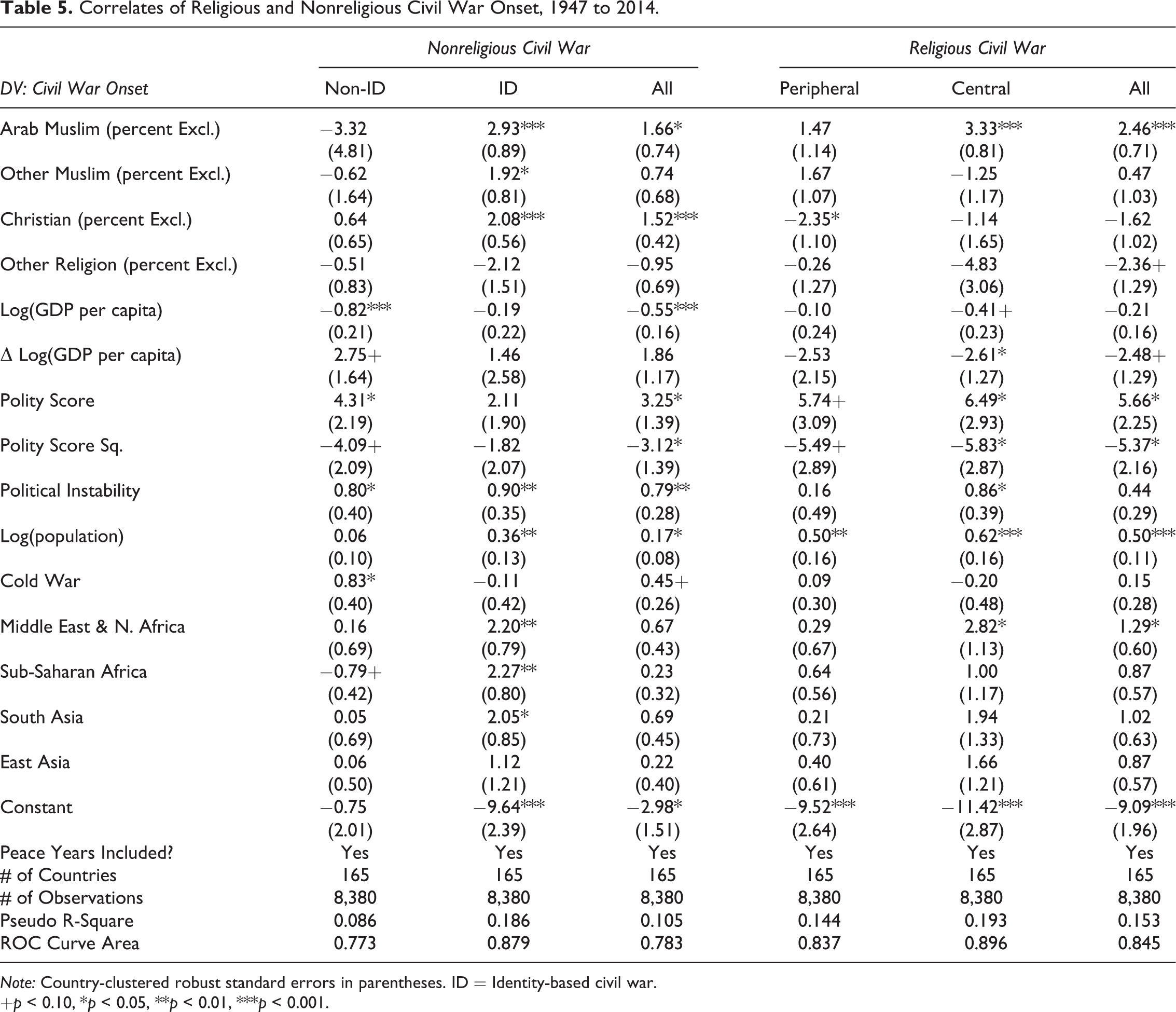
Table 5 shows the base model logit regressions of civil war onset for the 1947 to 2014 period for both types of non-religious and religious civil war.
Correlates of Religious and Nonreligious Civil War Onset, 1947 to 2014.
Note: Country-clustered robust standard errors in parentheses. ID = Identity-based civil war.
+p < 0.10, *p < 0.05, **p < 0.01, ***p < 0.001.
These models provide support for Hypothesis 1b: centrally religious civil wars are disproportionately an Arab Muslim phenomenon, even when controlling for standard variables and potential confounders. Exclusion of other religious groups has no effect on the probability of the onset of central religious civil war. There is no evidence of Arab Muslim exceptionalism for other kinds of civil wars. The presence or absence of particular religious groups has no effect for non-identity based civil wars. The exclusion of Christian ethnic groups has just as much of an impact on the onset of identity-based but non-religious civil wars as Muslim ethnic groups. By contrast, the exclusion of Christian ethnic groups is negatively related to the onset of peripherally religious civil wars.
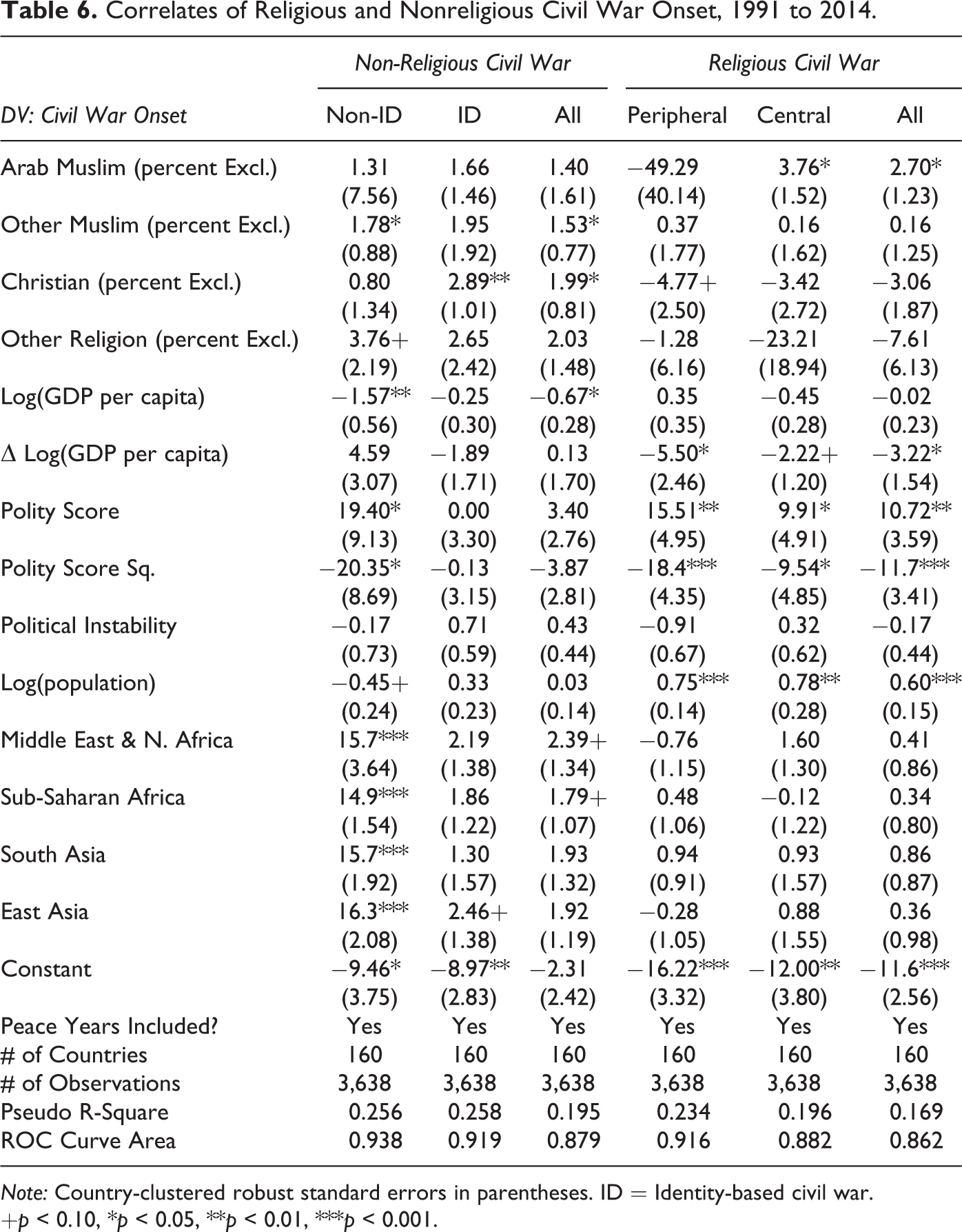
Results using the same base specifications but for the post-Cold War period are presented in Table 6.
Correlates of Religious and Nonreligious Civil War Onset, 1991 to 2014.
Note: Country-clustered robust standard errors in parentheses. ID = Identity-based civil war.
+p < 0.10, *p < 0.05, **p < 0.01, ***p < 0.001.
After the Cold War, the size of excluded Arab Muslim ethnic groups is positively and significantly related to the onset of centrally religious civil wars, but no other types. By contrast, the size of excluded Christian populations is related to the onset of identity-based but non-religious civil wars, but no other kinds of civil war. Together, the results indicate that Arab Muslims are more likely to rebel for religious reasons, whereas Christians are more likely to rebel for secular reasons after 1990. So there is an Arab Muslim difference, but only where religion is central. Table 6 also indicates that some correlates of civil war differ depending on religious centrality. High incomes are negatively associated with the onset of non-religious civil war but not religious civil war after the Cold War.
Robustness Checks
A host of potential confounders to the baseline model that other studies indicate may cause religious civil war are also included in the analysis. 35 None was consistently significant across the specifications and their addition singly or together does not change the main results on Arab exclusion. These variables include mean years of school, 36 gender inequality in educational attainment, the mean and variability in terrain ruggedness, 37 youth bulge, 38 the log of oil and gas income per capita, 39 state age, year of independence, or linguistic or religious fractionalization. 40 The results remain if we restrict the sample to the Middle East and North Africa region only: the size of the excluded Arab population, but not non-Arab Muslim population, remains positive and statistically significant. There is no support for the result of Karakaya (2015) that other socio-economic and political variables—particularly youth bulges—account for the onset of religious civil war; nor is centrally religious civil war driven by ethnic or linguistic heterogeneity in general. Instead, the results point to religious civil war as a distinctively Arab Muslim phenomenon after the Cold War. This is not a result that is accounted for by any of the measures heretofore tested. Thus, Toft (2007) should be corrected slightly: the puzzle is not one of Islam and religious civil war so much as a puzzle of Arab Muslims and religious civil war. 41 This is a particularly worrisome finding in that it is the Arab world that is seen as the heartland for Islam and it from this region of the world that we see more fundamentalist and extremist interpretations of Islam emanating.
So why should we expect more religious outbidding among Arab Muslims than non-Arab Muslims? The answer to this question can be found in Toft’s theory on religious outbidding (Toft 2007), which built on Jack Snyder’s (2000) argument that democratization can actually exacerbate nationalist fervor and ethnic conflict because the democratization processes increases competition between rival groups. 42 Toft extended Snyder’s argument by pointing out that elites within governments or opposition movements can also outbid each other in order to enhance their religious credentials both domestically and transnationally. Elites that establish themselves as the most credible defender of the faith will then gain the support and resources needed to maintain their tenure or defeat the existing government. The practice of religious outbidding is particularly likely to unfold in the Arab World given that the Arab world has been experiencing more transitions to democracy than other regions of the world (Toft 2007). 43 This makes the Arab world particularly susceptible to practices of religious outbidding, a practice the resonates with supporters at home and abroad. 44
One only has to look at the events unfolding in the wake of the Arab Spring to see these dynamics at play. For instance, strong domestic and international pressure to democratize following the ousting of Muammar Gaddafi in Libya in 2011 paved the way for a process of religious outbidding in which various Salafist Jihadist groups emerged in a civil war that started in 2014, including the Islamic State (Wehrey 2014). Similarly, when Saddam Hussein was removed from power in Iraq in 2003, the armed opposition initially consisted mainly of former members of the Ba’ath party. Yet, Salafist Jihadist groups soon “hijacked” the insurgency in Iraq (Gerges 2017). In short, the religious civil wars in the Arab World stem from a process of democratization that increases competition and ultimately instability.
Conclusion
This paper has revisited the trends, causes, and dynamics of religious civil war using new data that are current to the end of 2014. Overall, the findings confirm earlier indications that religious identity and belief matters for the incidence and dynamics of religious civil war, and that the politics of the Arab Muslim world lead to religious civil wars in a way that they do not for non-religious civil war. All else equal, Islam has bloody innards, if not bloody borders, in reference to Samuel Huntington’s astute observation some two decades ago, although the findings reported here are more nuanced. Furthermore, the puzzle that emerges more clearly is one about Arab Muslims and not one of Islam and religious civil war. The results are clear that religion is a motivator for rebellion among Arab Muslims while their Christian counterparts are more likely to be motivated along secular lines after 1990. There is indeed an Arab Muslim difference, but it arises only where religion is a central feature in a civil war. Finally, the negative relationships of high income with the onset of non-religious civil war but not religious civil war after the Cold War provides further evidence that religion needs to be considered an important factor in its own right in motivating people to violence (Hassner 2009, 2016).
These findings contrast starkly with the classic “opportunity” and “greed”-based models of civil war, as well as with the view that linguistic rather than religious cleavages are most important for civil war onset. Religion matters for conflict and is likely to do so into the future.
Supplemental Material
Supplemental Material, sj-docx-1-jcr-10.1177_0022002721997895 - Getting Religion Right in Civil Wars
Supplemental Material, sj-docx-1-jcr-10.1177_0022002721997895 for Getting Religion Right in Civil Wars by Monica Duffy Toft in Journal of Conflict Resolution
Supplemental Material
Supplemental Material, sj-docx-2-jcr-10.1177_0022002721997895 - Getting Religion Right in Civil Wars
Supplemental Material, sj-docx-2-jcr-10.1177_0022002721997895 for Getting Religion Right in Civil Wars by Monica Duffy Toft in Journal of Conflict Resolution
Supplemental Material
Supplemental Material, sj-docx-3-jcr-10.1177_0022002721997895 - Getting Religion Right in Civil Wars
Supplemental Material, sj-docx-3-jcr-10.1177_0022002721997895 for Getting Religion Right in Civil Wars by Monica Duffy Toft in Journal of Conflict Resolution
Supplemental Material
Supplemental Material, sj-dta-1-jcr-10.1177_0022002721997895 - Getting Religion Right in Civil Wars
Supplemental Material, sj-dta-1-jcr-10.1177_0022002721997895 for Getting Religion Right in Civil Wars by Monica Duffy Toft in Journal of Conflict Resolution
Footnotes
Author’s Note
Replication material will be made available on the author’s website at the time of publication. All errors are mine.
Acknowledgments
This manuscript benefited immensely from the research and statistical assistance of John Chin, additional research support from Jackie Faselt, fellowship support from Princeton University, where I was the World Politics Fellows (2015–2016), insights from participants at the 2018 International Studies Association Annual Meeting and two anonymous reviewers.
Declaration of Conflicting Interests
The author(s) declared no potential conflicts of interest with respect to the research, authorship, and/or publication of this article.
Funding
The author(s) received no financial support for the research, authorship, and/or publication of this article.

Supplemental Material
Supplemental material for this article is available online.
Notes
References
Supplementary Material
Please find the following supplemental material available below.
For Open Access articles published under a Creative Commons License, all supplemental material carries the same license as the article it is associated with.
For non-Open Access articles published, all supplemental material carries a non-exclusive license, and permission requests for re-use of supplemental material or any part of supplemental material shall be sent directly to the copyright owner as specified in the copyright notice associated with the article.
