



Abstract
When do agricultural transformations impact social stability? Cash crops are typically associated with economic prosperity and social peace. I argue agricultural booms may spur violent conflict over resource allocation by pitting would-be producers against incumbent landowners when the gains from production are concentrated and the negative externalities are diffuse. I study the rapid expansion of oil palm in Indonesia, a growingly important crop in the global economy. I find when oil palm grows more valuable and expands within producing districts, violent resource conflicts increase. The positive relationship does not exist for other cash crops, nor other types of conflict, and is moderated by the presence of sustainability certified processing mills. The results connect commodity shocks to non-state violence over resources, and suggest land use change is an important mechanism connecting agricultural booms to social conflict.
Introduction
Commercial agriculture is increasingly considered a tool for poverty alleviation and peace building in developing states (Calì, 2014; Dudwick and Srinivasan, 2013; Grossmann, 2009). 1 Despite the economic promise of cash crop industries, new agricultural markets have also been linked to a host of negative environmental externalities, including deforestation and biodiversity loss, and have been linked to violent competition for land ownership (Tellez, 2021). 2
When does commercial agriculture intensify social conflicts? Labor intensive agricultural growth tends to be negatively associated with armed conflict (Blair, Christensen and Rudkin, 2020; Dube and Vargas, 2013), however, the relationship between crops and social conflict between non-state actors outside of ongoing civil conflict is less well-known. To the extent scholars and policymakers conceive of cash crops as a means of providing opportunity to the rural poor, unpacking the link between cash crops and social violence is critical to understanding low-level violence between neighbors and forging effective development policies in post-conflict or fragile states.
I argue emerging commercial agricultural markets can disrupt social stability, producing social conflict over the distribution of resources. The growth of commercial crops can crowd out sustenance farmers, damage forests resources which support forest-based communities, and may only slowly bring economic benefits to a locality. Since sectoral growth creates tensions over the distributional consequences of the industry in the short-term, and only brings profits that may offset grievances in the long-term, the incentive for contention wins out over incentives for peaceful production.
I study the case of oil palm in Indonesia. Indonesia is at the center of the recent oil crop boom, the largest agricultural transformation since the green revolution (Byerlee, Falcon and Naylor, 2017, 1). Given the expectation that palm production will continue to expand across Latin America, Southeast Asia, and Sub-Saharan Africa, understanding the link between oil palm and stability is critical to fostering inclusive development.
I argue the palm oil boom generates incentives for violent resource conflict between producers and non-producers more quickly than the opportunity cost of conflict increases. Profits from oil palm production do not immediately bring prosperity to surrounding communities: low-skilled and forest-dependent communities lose out from palm oil plantations (Obidzinski et al., 2012; Santika et al., 2019), and the poverty-reducing benefits of oil palm are both slow-moving and come at the expense of the local environment (Edwards, 2019). Since transitory oil palm shocks generate up-front social costs along with delayed income gains, I expect higher prices of oil palm to correspond with increased levels of distributional conflict.
I find the palm oil boom is positively associated with resource conflicts between non-state actors in Indonesia. Resource conflicts involve violent disputes over land, access to markets, and environmental or economic grievances emerging from production, and occur between citizens, communities, and firms. Resource conflicts between non-state actors are multifaceted. Individuals who claim exclusive rights to produce may attack one another to seize and destroy property, producers hire private security outfits who may forcibly remove tenure insecure landholders, or communities collectively protest, rob, or sabotage plantations to disrupt the production process. I do not find a relationship between the boom and other types of political violence unrelated to resources, such as popular justice, election, governance, law enforcement, and separatist violence, nor do I find a relationship between resource conflict and crops which pose more acute land-use tradeoffs.
I find evidence for two mechanisms. First, I illustrate the importance of socially responsible production practices as a moderator of price shocks. The relationship between palm and conflict is decreasing in areas with more sustainability certified mills licensed by an important non-governmental organization, the Roundtable on Sustainable Palm Oil (RSPO). The finding suggests firms and communities can avoid costly conflicts without legal intervention. Given the institutional weakness in developing states, identifying peaceful extra-legal mechanisms is crucial to understanding the sources of violence and possible solutions (Christensen, 2019).
Second, I show the increase in oil palm production at the extensive margin is associated with an increase in resource conflict in the medium term. Districts that saw a larger increase in land area devoted to oil palm overtime experienced a larger increase in resource conflict from the baseline. The finding underscores how land use change impacts distributional conflicts.
My study provides a caveat to existing theoretical and empirical work on commodity shocks and conflict. I argue a commodity that would generally be negatively associated with armed conflict increases social conflict. Palm largely fits the scope conditions for a peaceful commodity: it is labor intensive in an absolute sense, and it is not sequestered by illicit or armed actors (Angrist and Kugler, 2008; Crost and Felter, 2016; Kronick, 2020), Indeed, in a highly influential study, Dube and Vargas (2013) consider oil palm a labor intensive good, and find positive shocks tend to suppress armed conflict.
While the empirical literature has largely focused on armed conflict (Blair, Christensen and Rudkin, 2020; Dube and Vargas, 2013), social conflict has been relatively under examined. According to extant theory, all else equal, sectoral shocks ought to impact social conflict in similar ways conditional on factor intensities: when the demand for formal employment increases, individuals should be drawn to working in shocked sectors to earn higher wages instead of risking life and limb on contentious behavior (Dal Bó and Dal Bó, 2011).
Palm oil, however, has different effects on social conflict because of the nature of the commodity boom. The emergence of palm oil in response to higher prices has led to increased production at the intensive and extensive margin in Indonesia: producers have expanded operations into forested areas, creating tensions between sustenance farmers, forest-dependent communities, and commercial interests. The negative externalities associated with palm production generate community grievances, and the sharing of benefits between producers and non-producers does not always perfectly offset the social and environmental harms from increased production in response to greater profits. As a result, communities not producing palm are resistant to industry expansion and resentful of its growth, and producers use coercion to obtain land and resources to expand production.
The findings do not wholly contradict the broader theory regarding the role of factor intensities in conflict. Instead, the findings are fairly consistent: a commodity that increases the incentive to predate more quickly than the opportunity cost effect can take hold results in violence. The key contribution of this paper is highlighting the conditions where the growth of a labor intensive sector (in the absolute sense) can counterintuitively increase social conflict. My study spotlights the importance of considering local economic context surrounding commodity booms when theorizing about the effect of price shocks on stability, and shows the conditions where the pacifying effects of agriculture do not hold.
My final contribution is connecting the large literature on commodity shocks and conflict to research on land and political violence (Albertus, Brambor and Ceneviva, 2018; Boone, 2014; Hidalgo et al., 2010). Using a long differences design, I show that as more land is dedicated to palm production over time, changes in resource conflict are larger. The expansion of production at the extensive margin can pit would-be producers of crops against incumbent landholders who may lose out from increased commercial production, including those with customary claims, forest-dependent communities, or sustenance farmers. I show production booms can spur land related violence, at least due to the competition for land that emerges when crops become more profitable (Boone, 2014). The mechanism suggests commercial crops can upset stability when land is contestable, which is salient in fragile states.
The article proceeds with an outline of the theoretical framework linking resources to violence. I then contextualize this general discussion to the palm oil sector and Indonesia. Next, I describe the data sources, research design, and conclude with the results and discussion.
Theoretical Framework
Commodity shocks have countervailing effects on conflict incentives. While the prize of looting a resource increases when commodity value rises, a mechanism called the rapacity effect, the reward for seeking formal employment in the sector increases too, called the opportunity cost effect. A meta-analysis of the commodity shocks and armed conflict literature shows the empirical relationship between prices and armed conflict depends on factor intensities (Blair, Christensen and Rudkin, 2020). Scholars argue the opportunity cost effect will dominate the rapacity effect when the commodity is labor intensive, since the sector’s growth will generate more demand for employment and higher wages, pulling individuals away from predatory activity (Blair, Christensen and Rudkin, 2020; Dal Bó and Dal Bó, 2011; Dube and Vargas, 2013).
However, even if emerging agricultural sectors are labor intensive, a surge in profitable commercial cash crops may fuel violent conflict between citizens and/or between producing firms and incumbent landowners. Conflict between community members can emerge when land holders seek more exclusive claims to ownership in response to improving commercial value, leading to competing claims that are not easily resolved legally (Boone, 2014). Violence may also occur across classes; Scott (1977) argues peasants historically protest the growth of commercial agriculture, since it disrupts land use for sustenance farming and upsets the traditional balance between locals and the elite.
When property rights are imperfect, increasing resource value increases the incentive for predation, which leads agents to invest in tools of coercion to defend their assets. Firms may hire private security outfits or partner with armed actors to guard plantations, and civilians may invest in weapons to protect their small farms for land grabs (Grossman and Kim, 1995; Hirshleifer, 1995; Skaperdas, 1992). While conflict is costly, the risk becomes more worthwhile when the returns to predation increase, creating a positive association between prices and conflict.
If surging agricultural markets increased the opportunity cost of social conflict faster than incentives for predation, an emerging commercial cash crop would not lead to more violence. But, profitable commercial agriculture does not guarantee balanced growth (Easterly, 2007). When commercial value improves without evenly benefiting producing and non-producing groups, growth will leave community members behind, meaning the opportunity cost of conflict does not increase for excluded segments of society during boom periods. Generically, commercial crop price surges lead to violence over resources when the return from predation increases faster than the return for production (Dal Bó and Dal Bó, 2011).
Labor intensive crops increase the return to predation more quickly than the opportunity cost of violence based on two conditions. First, conflict may increase if the negative externalities of production create an incentive for non-producers to take action to stop commercial expansion. If commercial growth harms the local environment, crowds-out sustenance farmers, or undermines forest resources, a price surge pits commercial interests against community members. With the knowledge that locals will oppose commercial expansion, producers may partner with coercive actors, such as private security guards or local criminals, to violently crush opposition to expansions. Likewise, locals may use force to raise the cost of production to deter commercial interests.
Second, if the growth from commercial agriculture does not trickle down quickly, grievances from inequitable sharing of costs and benefits may fuel conflict. The opportunity cost effect cannot be activated unless transitory shocks increase demand for labor and wages. For example, if a commercial crop produces employment opportunities, but only for those with a particular set of skills and capital, the set of workers without those skills or capital will not be absorbed by the new labor market. If the excluded workers must also bear some cost to commercial production, such as changes in land use which undermine tenure security or degradation of the local environment, negative externalities will fuel conflict.
A critical crop that is growingly important for the global economy fits the scope conditions: oil palm.
Institutional Background: Indonesian Palm Oil
Oil palm has played a crucial role in the development of rural economies in Indonesia, but has also contributed to social problems stemming from environmental and land related disputes. In this section, I describe the features of palm oil which lead the sector to be more conflictual compared to other export crops.
Background on Oil Palm
Palm oil is a labor intensive commodity planted for commercial trade, typically grown as a monocrop (Byerlee, Falcon and Naylor, 2017, 20). Growing demand for flexible crops that can serve as food, biofuel, and industrial products has led to a substantial increase in vegetable oil prices and palm oil production, particularly in Southeast Asia (Sayer et al., 2012; Byerlee, Falcon and Naylor, 2017, 8–9). Since 1990, global palm oil production has tripled (Byerlee, Falcon and Naylor, 2017, 1). However, growth in the oil palm sector tends to be uneven and the social and economic consequences of the crop growing more profitable can lead to unrest. 3
While the palm boom has generated windfalls, the gains in income may not translate into immediate living standard improvements or better prospects for laborers for three reasons.
First, trees take three years to yield fruit after planting—farmers wait up to six years to earn a profit (Byerlee, Falcon and Naylor, 2017, 17). Second, the growing dominance of the palm sector can crowd out alternative livelihoods. Due to barriers to entry, the gains from production tend to be concentrated “above a certain threshold of agricultural skill and income” (Obidzinski et al., 2012). The process led farmers to remark “[w]hen oil palm is developed, other people get jobs not us. The jobs are not for us” (Cooke, 2002). Rapid development of palm leaves sustenance farmers and forest-dependent communities in a worse economic position (Santika et al., 2019).
Third, fruit requires immediate processing by mills to be sold as oil, within 24 hours, therefore smallholders often contract to exclusively grow oil palm and sell fruit to a plantation company mill. Larger processing mills have a comparative efficiency advantage over smaller mills, creating “de facto local monopolies” for centralized mills, constraining producers choice over where to sell fruit (Sheil et al., 2009, 11). Debt obligations from start up costs and constrained choice to sell fruit may chip away at profits (Marti, 2008; Sheil et al., 2009). As noted by Sheil et al. (2009): “[s]ocial conflict between oil palm companies and smallholders is also common because smallholders enter into price contracts with companies and are not able to benefit from any marked price rises for CPO.”
The pressure to expand production in response to growing demand and higher prices creates three negative externalities. First, oil palm plantation development is mutually exclusive with natural forestry (Li, 2018). An estimated 56% of oil palm expansion that occurred in Indonesia from 1990 to 2005 supplanted forest land (Koh and Wilcove, 2008), leading to deforestation and biodiversity loss (Carlson et al., 2018; Vijay et al., 2016; Wilcove and Koh, 2010). Compared to other tree crops, palm oil performs worse in terms of supporting local ecosystems after it supplants forest land (Fitzherbert et al., 2008) degrading the local environment. Land clearing may occur via fire, leading to further damage.
Next, oil palm has a tendency to be monocropped, unlike other tree crops, which further fuels land use tradeoffs. Forest-dependent communities rely on rotational farming and abundant forest land for sustenance-both of which are disrupted by mono-cropped plantations which remove naturally forested area (Sheil et al., 2009).
Third, the rapid expansion of oil palm is facilitated by a porous legal structure, meaning the changes in land use are contestable. Rent seeking political elites enable the expansion of commercial activity in forested areas (Burgess et al., 2012; Macdonald and Toth, 2017). Corrupt officials and poor protection of customary land rights enables “a race to the bottom”, wherein competing national and local regulations are exploited to allow the palm sector’s expansion into forested and protected areas which are tenure insecure (Byerlee, Falcon and Naylor, 2017, p.43–44). Therefore, when the crop becomes more profitable and the benefits to expanding production increase, the competition for finite land intensifies, pitting commercial interests against incumbent landholders.
How Oil Palm Enflames Social Conflict
Qualitatively, the rapacity effect appears to dominate the opportunity cost effect in the oil palm sector in Indonesia. Scholars have noted that the expansion of the palm oil sector has “raised the stakes” in resource related disputes, coinciding with an increase in resource violence in Indonesia over time (Barron, Jaffrey and Varshney, 2014). A recent oil palm price surge was accompanies by an increase in fruit theft and companies hiring additional security. 4
My theoretical argument suggests the reason conflict incentives dominate the opportunity cost channel is because the oil palm sector creates upfront negative externalities during boom periods, but does not generate income gains in the short-run which raise the opportunity cost of violence.
Two main mechanisms explain why oil palm generates social conflict.
Firm-Community Relations
First, price shocks may enflame tensions between communities and firms, which can escalate to violent conflict. Surging prices can cause this for two reasons. First, communities may resent that palm producers are earning more while investing little into local improvements after environmental damages (Christensen, 2019). Indonesia increasingly experiences land related conflicts surrounding industrial tree plantations, with broken promises between firms and communities after land deals, pollution, and uneven or unequal sharing of benefits typically cited as the underlying cause (Persch-Orth and Mwangi, 2016).
Conflicts between communities and palm oil companies are typically fueled by poor compensation after conversion of forest to plantation land, accusations of illegal production, and environmental damage (Abram et al., 2017). Plantation company’s preferences for hiring outsiders over locals can lead community members to feel deceived, which can “easily lead to conflict” (Levang, Riva and Orth, 2016). When firms with hostile relationships with host communities face pressure to expand during a boom period, growth creates incentives for local predation of oil palm, and incentives for producers to grab locals land, causing violent conflict.
Negative Externalities from Land Use Pressure
Second, higher prices increase the incentive to expand operations, which locals may wish to resist due to negative externalities (Sexton, 2020). Palm oil producers have been accused of violating land and labor rights, and undermining biodiversity through monocropping, deforestation, and water pollution from transforming fruit to oil (Marti, 2008; Sheil et al., 2009). Communities may respond to deforestation or fresh water pollution resulting from pesticides with conflict as a way to halt production (Rulli et al., 2019).
The negative externalities and short-run gains can lead to conflict initiated either by producers or non-producers. For instance, reports of palm producers preemptively using violence against communities opposed to plantation expansion suggests members of the industry can be the first to use violence to crush opposition to commercial expansion. On the other hand, community members may initiate conflict as a means of raising the costs of production to deter producers from entering or expanding in the market.
Tension between oil palm producers and communities has escalated to violence across Indonesia, either initiated by the community or firms. In Sambas district in 2008, the chair-person of the Peaceful Allied Peasant Union and a village head were attacked, allegedly due to their rejection of palm oil plantation expansion. Similarly, in Langkat district in 2013, villagers homes were burned when they protested the expansion of a palm oil plantation (Barron, Jaffrey and Varshney, 2014). Shootings and beatings of farmers resistant to plantation expansion in South Sulawesi, along with the reported deaths of thirty-two villagers in Lampung over plantation disputes, evinces plantation companies and commercial producers may resort to violence to settle disputes (Lucas and Warren, 2013, 297). Community resistance can escalate to violence as well. In North Sumatra, a protest in 2007 over an irrigation canal for a palm plantation led to a large clash between citizens, police, and private security forces hired by the plantation company (Marti, 2008, 47). 5
Data
To measure social conflict, I use the National Violence Monitoring System (NVMS) dataset (Barron, Jaffrey and Varshney, 2014). The database is highly detailed, coding several types of social conflicts reported from local newspapers across Indonesia, including the district (second administrative unit, equivalent to a U.S. country) 6 where violence occurred. The use of local papers mitigates reporting bias that may arise from using national or English language sources when covering local acts of violence. Given the expansive scope of the collection effort, the data do not cover all provinces. Instead, “high” violence provinces are covered from 1998 to 2014, with “low violence” provinces receiving coverage from 2005 to 2014. I use data from 2005 to 2014 to construct a panel, allowing for provinces of different types to be included in the sample.
The main outcome variable I use from the National Violence Monitoring System is resource conflict. NVMS defines resource conflict as: “violence triggered by resource disputes (land, mining, access to employment, salary, pollution, etc.).” A translated example of resource violence from the database is as follows:
In the Village of Perbangunan and Bangun Baru, Kec. Sei Kapayang, Kab. Asahan, North Sumatra, the destruction of 800 hectares of oil palm plantations belonging to members of the Independent Farmers Cooperative was carried out by an unknown person. As a result of the robbery and destruction, members of the cooperative suffered losses of up to Rp 1,039,000,000. The destruction using a tractor was allegedly carried out by one of the palm oil procurement companies. It is suspected that the motive for this destruction was related to the struggle over 800 hectares of land. (09/30/2011)
The panel includes 5586 resource conflicts, occurring in 1097 of the 1560 district-years. Conditional on having a resource conflict, the average number of conflicts is 5.01, with a maximum of 53. I use other conflict and crime outcomes as placebo checks. Nearly all districts (151 out of 156) experienced at least one resource conflict. 7
One must account for changes in administrative boundaries to construct a panel. Indonesia has underwent massive district proliferation since democratization (pemekaran) with several units changing names, statistical codes, and borders. I use the 1995 administrative boundaries—the latest period before the democratic transition—as an exogenous point of reference, and use information regarding new district’s “parents” as well as the “children” of older districts to construct a balanced panel of 156 districts over 10 years with constant borders.
To measure district exposure to oil palm, I use data from the Indonesian Database for Policy and Economic Research (INDO-DAPOER, 2014) regarding the land area devoted to palm oil production per district. Since palm crops can take years to mature and produce, a simple measure of the fruit yield may not accurately measure sectoral concentration, whereas the land used to grow palm reflects how invested farmers are in using land for oil crops. 8
Empirical Strategy
I exploit cross-sectional variation in palm oil production and overtime variation in crude palm oil price shocks (Dube and Vargas, 2013). As local production levels and conflict may be simultaneously determined, I rely on a pre-sample measure of the palm oil intensity. I use the average hectares of land dedicated to palm oil production across 1996–2004. I choose 1996 as it is the first year the data is available annually at the district level, and stop in 2004 as it is the year prior to the beginning of the conflict data. This approach alleviates the concern that some districts may arbitrarily be coded as heavy producers from an uptick in land used in a single year.
Next, I divide this quantity by the sum of average area devoted to palm oil production across all districts

I use the global price of oil palm to measure overtime variation in palm oil value per district (IMF, 2016). I standardize the measure by subtracting the mean of palm oil prices over time from each year and dividing by the standard deviation
I interact these variables to construct an exogenous measure of palm oil shocks per district Palm Shock it = Production Share i × Price Shockt−1. The measure represents the intensity of exposure to shocks.
The baseline model is

District fixed effects µ i account for time-invariant heterogeneity that may simultaneously determine levels of resource conflict and shares of palm oil production, for example, district location, factor endowments, local experience during the autocratic regime, or informal institutions born from historical colonization. λ t is a year fixed effect, which accounts for aggregate shocks to all districts, such as national elections, the global recession, and national policy changes like district splits. The inclusion of two way fixed effects accounts for time invariant production share variable and time series price shock variable with unit and year controls, respectively (Dube and Vargas, 2013).
I include controls X i that are time-invariant interacted with year fixed effects λ t to account for the fact that some district traits may have time-varying effects causing different trends. These variables include district terrain features, including ruggedness (Shaver, Carter and Shawa, 2019) and forest density in 2000 (IIASA, 2012), the share of district GDP from agriculture in 2000, and logged district area. The approach adjusts for the possibility that districts that rely more on farming, are larger, more forested, and with less difficult terrain may be more likely to produce palm but may follow different conflict cycles.
I include province by year fixed effects in some specifications. This compares districts within the same province and the same year experiencing different shocks. Doing so allows different provinces, such as ones belonging to the outer and inner islands, to experience different trends, accounting for the possibility that more remote areas have more palm production and follow different conflict trajectories. I cluster standard errors by the district. 10
A key assumption is price shocks are exogenous E[ε it |µ i , λ t , Palm Shock it ] = 0. This means that conditional on time-invariant district traits and period effects, the shock to global prices weighed by the salience of palm to the district economy is not controlled by district i and is mean independent from unobserved transitory shocks ε it .
The lag of prices and use of a pre-sample shares alleviates the concerns of simultaneity. The use of a global measure of prices makes the exogeneity assumption more reasonable. Indonesia has been characterized as a “price taker” of the global crude palm oil price (Hafizah, 2011). Due to the rapid processing requirements of fruit, farmers are unable to set prices, making oil palm a buyers market (Sheil et al., 2009, 11). Although Indonesia produces large volumes of crude palm oil, it contributes a smaller share to the international vegetable oil market. Vegetable oils are highly substitutable, which makes it unlikely that Indonesia can swing the global price itself (Byerlee, Falcon and Naylor, 2017, 166).
I test this assumption in Figure 1. Shocks are uncorrelated with a battery of district economic outcomes, including the employment rate, GDP per capita (log), population (log), revenue (ihs), and the poverty rate. Non-Relationship Between Palm Oil Shocks and Local Economic Welfare. Note: Data from Indonesian Database for Policy and Economic Research (INDO-DAPOER, 2014). Confidence intervals from robust errors clustered at district, all regressions include two way fixed effects. Outcomes standardized for interpretability.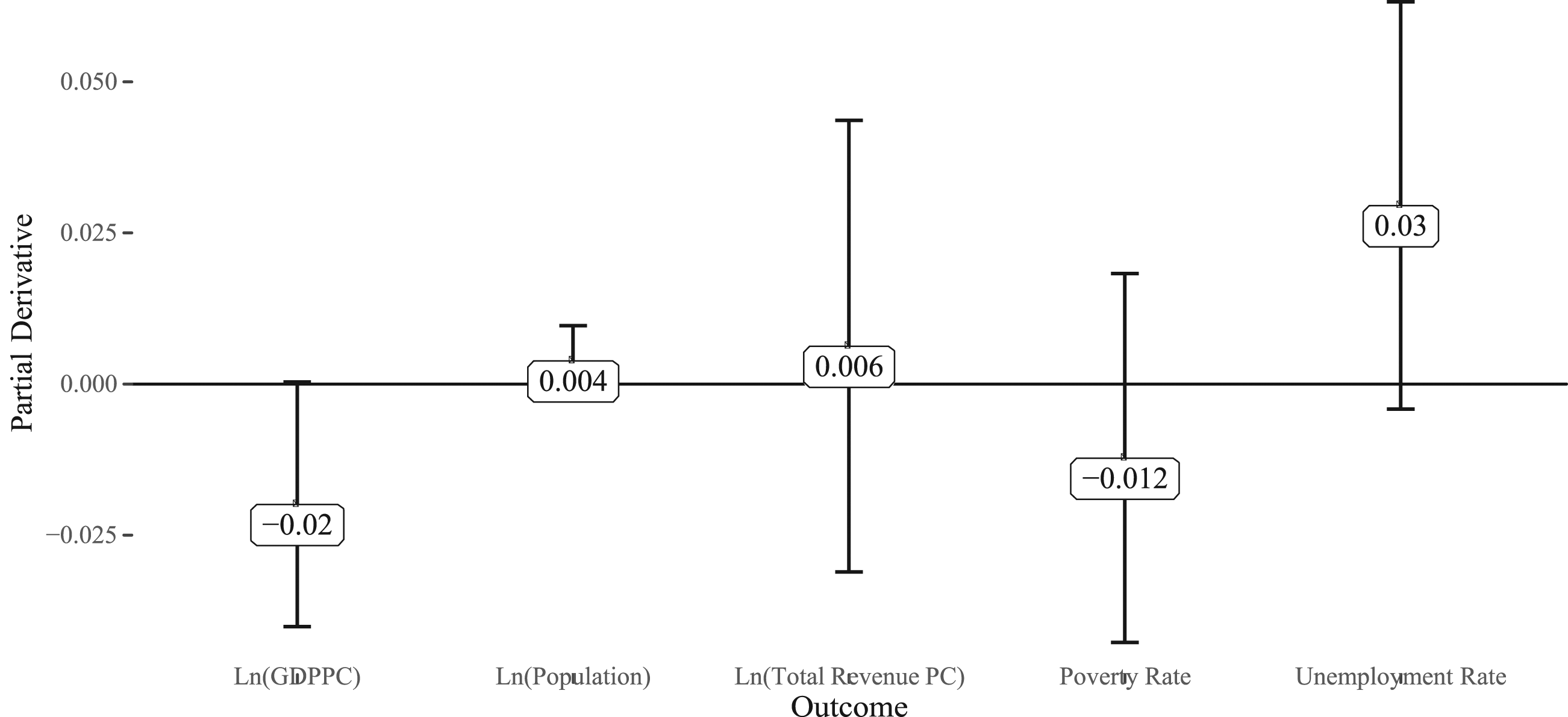
The results support the argument that price shocks increase the prize of predation faster than economic benefits can reverberate. The estimates are consistent with the argument that oil palm does not bring economic benefits on average for affected communities (Obidzinski et al., 2012; Cooke, 2002; Santika et al., 2019), and with the argument that oil palm brings economic benefits slowly (Edwards, 2019).
Results
Conflict on Price Shocks: Results.

∗∗∗p < 0.001, ∗∗p < 0.01, ∗p < 0.05
Note: Robust standard errors clustered at district reported in parenthesis. Outcome is the inverse hyperbolic sine of resource conflicts.
The magnitude of the effect size is on par with meta-analytic benchmarks, although signed in the opposite direction. Meta-analysis from Blair, Christensen and Rudkin (2020) find agricultural commodity have an average effect size of −0.02 on armed conflict. The standardized effect size in this study is 0.0995 in the baseline model (residualized standard deviation of shocks divided by the residualized standard deviation of conflict, multiplied by the estimate in Model (1)). The larger effect size may be attributed to the frequency of social conflict compared to armed conflict. Nonetheless, the size suggests oil palm had an important impact on sub-state conflict in Indonesia.
Consider Aceh Utara, Aceh province, which averaged around 1% production share (13,074 hectares), relative to nearby Aceh Tengah, Aceh province, which had near zero production pre-sample. A standard deviation increase in prices corresponds with roughly a 9% increase in resource conflicts in Aceh Utara versus Aceh Tengah. The results suggest when prices increased a standard deviation from 2011–2012, resource conflicts increased by .09 in IHS terms, 7% of the non-producer mean. Figure 2 illustrates the effect by plotting the time series for two pairs of districts in Aceh and Lampung province with different production levels. Time Series for Pairs of Low and High Producers. Note: Panel A shows the time series for two districts in Aceh (Aceh Utara (High Producer) and Aceh Tengah), and Panel B shows the time series for two districts in Lampung (Lampung Utara (High Producer), Lampung Selatan. High producers experience more conflict relative to nearby districts with less production.
Figure 3 provides more visual support for the relationship. Panel A shows the time series of resource conflict, demeaned by year and district, among districts that produce palm oil, while Panel B shows the time series of standardized global palm oil prices. Panel C plots an event study, regressing resource conflicts on the interaction of year dummies with the cross-sectional measure of palm production shares using the year where price shocks are nearest to zero (2008) as the reference. The coefficients are larger and statistically different from zero after 2008, where prices began surging to their highest level, but attenuate in 2014 when prices began to fall. SI C.1 shows the nonparemetric relationship between the price-conflict correlation and production intensity. Conflict and Shocks. Note: Panel A shows resource conflicts in palm producing districts (inverse hyperbolic sine, demeaned by district and year). Panel B is standardized crude palm oil (CPO) prices normalized in 2001 dollars. Panel C plots event study coefficients interacting time dummies with the cross-sectional measure palm oil production, using 2008 (the year shocks are closest to zero) as the reference category.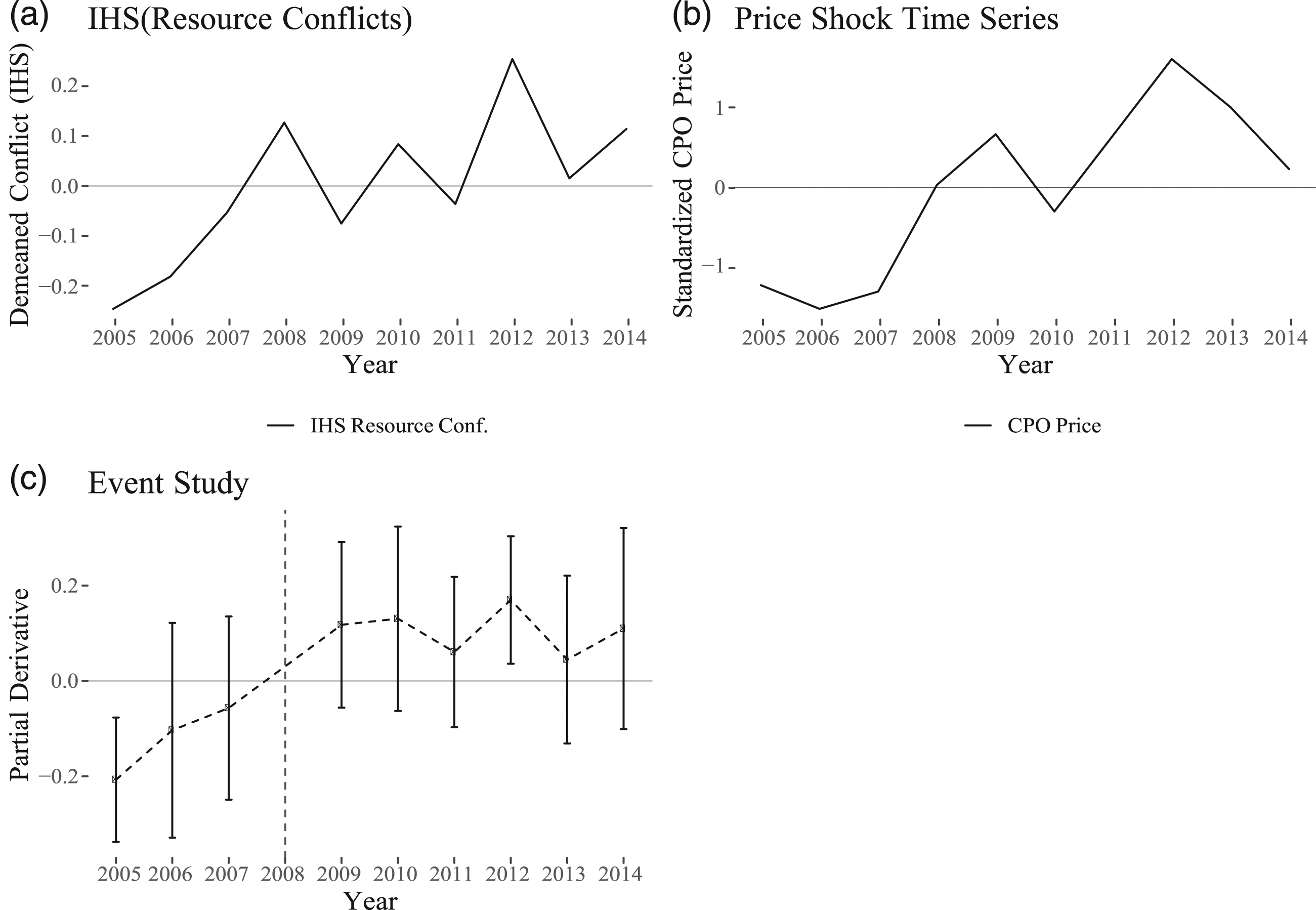
To understand mechanism and test for time-varying confounders, I use other conflict outcome in NVMS to conduct a series of falsification tests. If palm producing districts generally followed different conflict cycles versus non-producing districts, one would detect a non-zero relationship between other forms of political violence and palm shocks.
Figure 4 shows the relationship between palm shocks and other conflict outcomes in NVMS—criminal violence, election violence, violence during law enforcement, governance conflict, identity-based conflict, popular justice, and separatist violence.
11
I find a near zero and statistically insignificant relationship between shocks and these conflict outcomes. Failing to reject the null suggests the increase in violence in response to oil palm is not simply an underlying generic conflict trend; price shocks have an intrinsic relationship to resource use and access violence. Non-Resource Based Social Conflict and Crime. Note: Horizontal axis refers to conflict outcome on the left hand side of regression, vertical axis is the point estimate, and bands represent 95% confidence intervals. Models include year, district, and province-year fixed effects. SI A includes full descriptions of these outcomes.
Oil palm conflicts may involve state security forces and corrupt local officials, who are typically involved in extending oil palm production into protected forest areas. 12 If resource conflicts were driven by clashes between communities and the state, one would expect violence during law enforcement or violence related to governance to increase. The nonrelationship suggests the positive association between palm shocks and resource conflict is not driven by violent interactions between citizens and state officials.
Finally, I find no evidence that separatist conflicts decrease during boom periods. The non-relationship contrasts with prior literature on rebel conflict (Dube and Vargas, 2013). However, note the conflict in Aceh had begun deescalating by 2005, therefore separatist conflicts are largely observed in Papua and Maluku provinces at a lower intensity than Colombian civil war.
Threats to Inference
Anticipatory Effects
One concern is conflict predicts prices, rather than the other way around. If this was the case, future price shocks should predict resource conflict, and past price shocks should have a zero relationship with conflict. If my argument is correct, past price shocks ought to be positively associated with resource conflict, and future price shocks should not. In SI C.8, I show price shock lags are positive associated with conflict, whereas price shock leads are not.
Endogenous Exposure
A second concern is the shares of production are not randomly assigned—it could be the case an unobserved spatial process generated the distribution of palm oil production, and the observed positive relationship between shocks and conflict is the artifact of endogenous exposure.
I generate an expected distribution of production shares by averaging 1000 simulations of placebo production weights following the same spatial correlation structure as the observed data. By removing the average of the expected spatial distribution from palm oil production from simulations, the share variable is recentered, and the new measure represents deviations from the expected distribution, purging omitted variable bias (Borusyak and Hull, 2020). The estimates are again similar to the baseline (SI C.6.). Results are also robust to including spatially lagged shocks (SI C.5).
Other Cash Crops
To isolate whether the oil palm boom in particular is related to resource conflicts, I use FAO-GAEZ data (IIASA, 2012) on district suitability for Indonesia’s other primary cash crops, tea, coffee, and cacao for a placebo exercise. 13 These cash crops are quite different from palm oil: palm oil is monocropped, but intercropping is more common with cacao and coffee (Byerlee, Falcon and Naylor, 2017) and these crops pose lest of a threat to forest ecosystems (Fitzherbert et al., 2008), which mitigates the social costs of production. Theoretically, shocks to these commodities should not be positively related to resource conflicts.
Figure 5 shows the results of event study regressions of resource conflicts on the interaction of crop suitability and year dummies (2008 reference). Panel A shows oil palm suitable districts experienced more conflict as global prices rose. Meanwhile, Panels B–D show coffee, tea, and cacao suitability does not predict a divergent resource conflict trend. The finding suggests the positive association between agriculture and resource conflict is intrinsic to palm oil. In SI C.7, I show price shocks to other commodities are uncorrelated with resource conflict, and that results are robust to crop-specific trends. Cash Crop Suitability and Resource Conflict Trends. Note: Plots show coefficients of fully saturated models interacting period fixed effects with measures of oil palm, coffee, cacao, and tea suitability from FAO-GAEZ. The conflict trends for other cash crop producers do not appear to follow the same trend as palm producers, whose conflict patterns closely follow prices.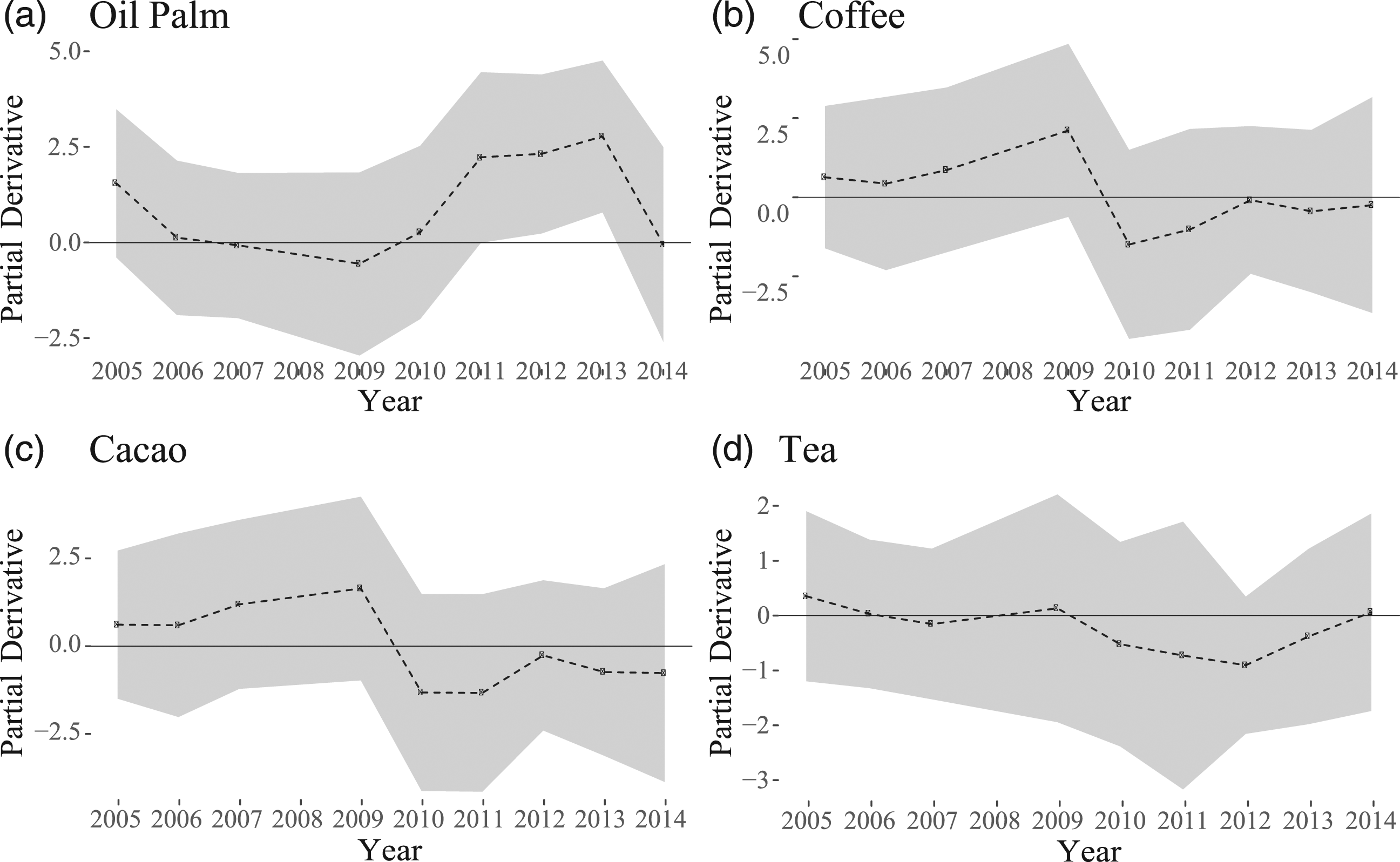
Mechanisms
I investigate two channels linking palm oil to conflict. First, I study the differential impact of price shocks on conflict in areas where supply bases are sustainability certified, which may moderate the effect of shocks if grievances fueled by inequitable sharing of benefits drives the effect. Second, I examine whether the geographic expansion of crop production influences conflict.
Firm-Community Relations
If firm and community tensions led to social conflict after price shocks, credible commitments to responsible behavior from producers ought to moderate the effect. Producers that can promise to not grab land and expand operations without consultation, violate worker or community land rights, and carry out operations without ecological harm may not unilaterally use force against locals to expand production. Likewise, communities may be less hostile to producers when their behavior is sustainable.
A mechanism that may enable credible firm commitment to responsible behavior is certification from the Roundtable on Sustainable Palm Oil (RSPO)—a non-governmental organization that sets standards for environmental and social sustainability of palm production, including communities rights to land, soliciting free prior informed consent from surrounding communities, and abstaining from violence to acquire land (Abram et al., 2017). Accredited third party certification bodies verify whether palm oil producers are RSPO certified, and are annually assessed to ensure continued compliance after certification. 14 Palm oil production relies on processing mills to turn fruit into oil. Certified mills must pledge to show all of its fruit suppliers will comply with RSPO guidelines within three years, 15 creating the incentive for mill owners to only accept fruit from socially responsible suppliers who follow RSPO guidelines. 16
Compliance with RSPO standards and criteria for production can rein in negative externalities of production in two ways. Membership requires producers to publicly declare any plans to expand operations and engage community members before changing production plans; for this reason, activists report working with RSPO certified planters results in more mediation and peaceful resolution of social conflicts (Persch-Orth and Mwangi, 2016). Next, roundtable members typically mediate disputes more often than their counterparts, resulting in negotiation instead of violent conflict (Persch-Orth and Mwangi, 2016).
To measure the density of RSPO certification in the local value chain, I use data on the location of RSPO certified supply bases from Global Forest Watch (2019) to construct the following measure of certification intensity
I estimate an interactive model that includes certification intensity times palm oil prices, palm oil production times palm oil prices, and palm oil production times certification intensity times palm oil prices
Interacting prices with RSPO certification intensity allows areas with more access to certified mills to follow their own trend net of production shares. Since companies typically own different facilities across the supply chain throughout Indonesia, it is plausible that corporate commitment to certify is orthogonal to local conditions after adjusting district invariant traits.
Heterogenous Effects.
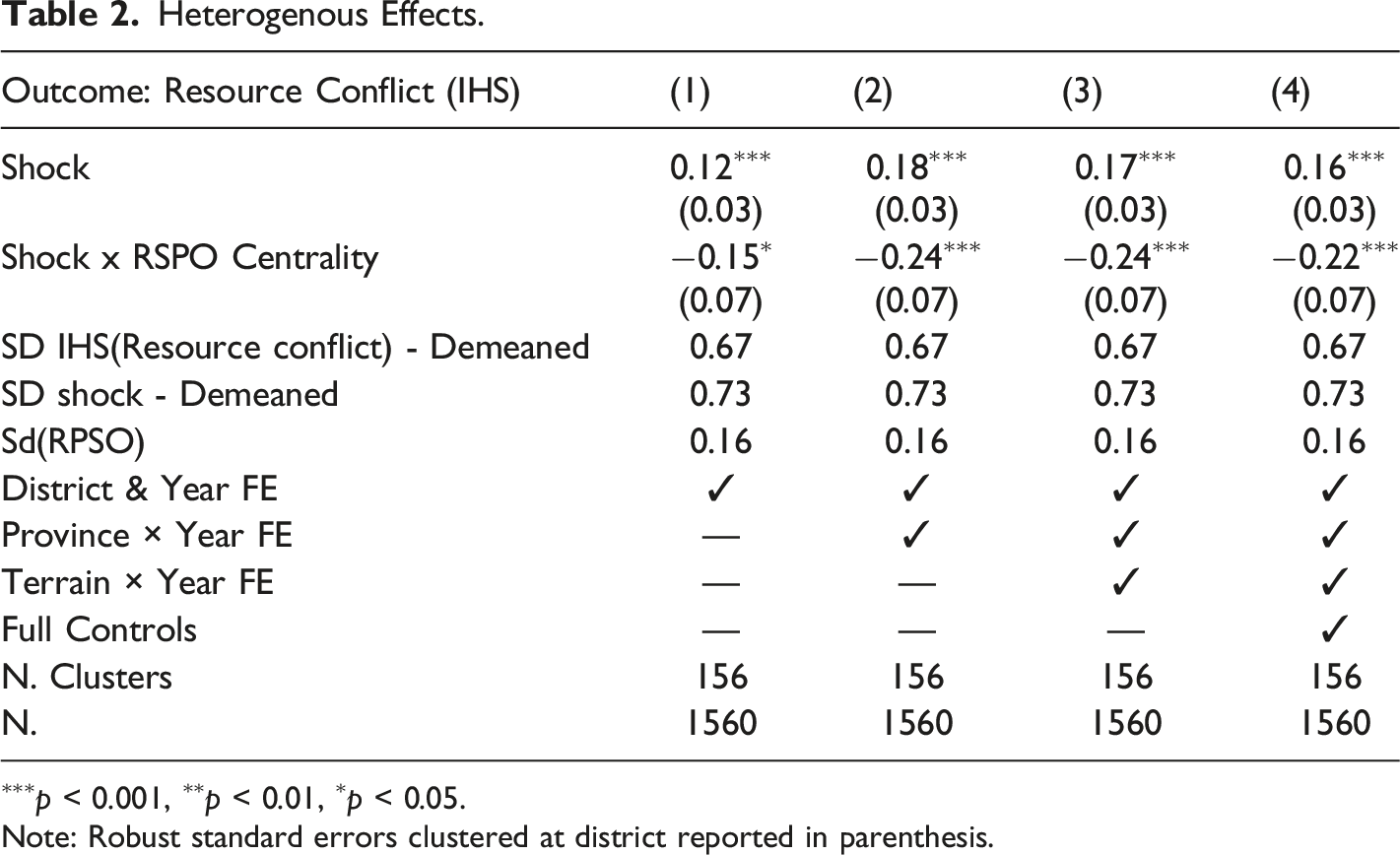
∗∗∗p < 0.001, ∗∗p < 0.01, ∗p < 0.05.
Note: Robust standard errors clustered at district reported in parenthesis.
The moderating effect of RSPO mills suggests firm-community relations play a role in conflict dynamics as prices increase. The result is consistent with Christensen (2019), who shows firm transparency mitigates the impact of mineral price shocks on contention. However, RSPO may also change producer behavior, which can mitigate conflict via negative externalities. While the available evidence cannot enable a judgment between an information or commitment pathway, it does suggest the producer practices influence resource violence.
In SI D.3, I show the result is robust to censoring the data to only analyzing heterogeneity among palm oil producers and analyzing the relationship within districts exposed to RSPO certification or not separately. Moreover, to guard against the possibility that the measure of certification density is solely capturing the concentration of the value chain, I include a placebo test which shows the same measure of non-certified mills does not have the same effect (SI D.4). The null result for non-certified mills implies the result is not driven by processing access.
Land Use Change
A second mechanism is the expansion of oil palm at the extensive margin. The increase in land area dedicated to palm oil production risks displacement, deforestation, and tension over land use.
I borrow from Edwards (2019) and use a long differences design to examine how the increase in land area dedicated to oil palm relates to resource conflict. Unlike a cross-sectional test, the approach flexibly purges time-invariant confounds that may cause palm production and resource conflict to be correlated. By taking differences between periods, district invariant factors such as land tenure system, historical traits, cultural factors, and climate are removed from the estimates. Unlike a panel, the effect of palm production increases is allowed to be more slow moving (Edwards, 2019). First differencing also accounts for aggregate shocks that effect all districts equally overtime.
The long difference equation is
To measure the boom in district palm oil, I follow Edwards (2019) and rely on data regarding the amount of area devoted to oil palm in each district in 2010 and 2000, before and after the large global shock to palm oil demand. I divide the total area of land devoted to palm oil by district area in each year, and compute the difference between the proportion of land devoted to palm oil in 2010 and 2000. This captures the relative increase in production intensity of palm oil within a district overtime. Shares capture the use of land for palm oil relative to alternatives (Edwards, 2019).
I exploit cross-sectional variation in palm oil suitability from FAO-GAEZ (IIASA, 2012) to instrument the change in production intensity. FAO-GAEZ collects data on the climatic and soil features of land to estimate how well crops may be expected to perform. A concern with regressing changes in conflict on changes in production is strategic producer responses to resource conflict. Production may expand more in areas that are expected to be less hostile to the industry, generating a downward biased OLS estimate. I average of high and intermediate suitability for rain-fed palm oil and divide this average by the mean of the sample to captures the relative advantage of choosing to invest in palm production in one district versus another. The 2SLS estimates represent the marginal effect of palm oil production changes induced by better growing conditions on changes in resource conflict.
Instrument relevance and excludability are satisfied if suitability (1) impacts changes in production and (2) only impacts violence through changes in production. As producers choose to grow palm in places where it is more likely to be productive (1) ought to be satisfied. The exclusion restriction (2) is an untestable assumption, however, I include a set of covariates X i to block backdoor paths, including terrain ruggedness, size, location (latitude and longitude), landlocked status,18 and the baseline conflict level. Conditional on covariates, it is unlikely fixed climatic and soil attributes determine changes in conflict outside of their influence on changing palm production.
Although one cannot prove the exclusion restriction, I include three tests to assess its reasonability. First, I regress conflict on suitability within a subset without a production shock. If suitability caused conflict through a channel other increased production, one would detect a significant non-zero estimate. Second, I regress conflict changes from their baseline in 2005 from 2006 to 2014 individually (the left hand side in these regressions is Conflict it − Conflicti2005 for t = {2006, 2007, …2014}). I do so using the reduced form and 2SLS specification. If suitability caused conflict outside of the change in production intensity, one would observe a non-zero estimate before changes were completed in 2010. Third, I show suitability is unrelated to changes in conflict and economic fundamentals (SI E.1).
Long Differences Results.

∗∗∗p < 0.001, ∗∗p < 0.01, ∗p < 0.05, †p < 0.1
I find a positive reduced form relationship in Column (3), but the estimate attenuates and becomes statistically indistinguishable from zero when subsetting to non-shock cases (Column (4)), providing evidence against an exclusion restriction violation. Column (5) shows increases in palm oil production intensity within districts induced by favorable agro-climatic conditions significantly increases the average level of resource conflict from its baseline—suggesting a standard deviation increase in production intensity is related to a 30% increase in resource conflicts.
Next, I regress conflict changes from their baseline in 2005 from 2006 to 2014 (the left hand side in these regressions is Conflict it − Conflicti2005 for t = {2006, 2007, …2014}). I do so with the reduced form equation to check for a correlation between conflict and palm oil suitability before the boom finished as a falsification test, and then do so with the 2SLS approach. I display the results in Figure 6. Panel A shows no discernible correlation between palm oil suitability and conflict before the production boom subsided (prior to 2010), which is encouraging evidence that more suitable areas were not simply following a trend of higher conflict. Panel B shows production changes increased violence in 2011–2013 from the 2005 baseline, which corresponds with the years price shocks were at their highest. This is consistent with the theoretical argument that conflict over oil palm is most intense when it is valuable.
Discussion and Conclusion
I document a notable exception to the empirical regularity that positive agricultural commodity shocks result in social peace. Oil palm enflames tension rather than pacifying conflict due to the concentrated income gains and negative externalities associated with boom periods. The relationship is intrinsic to palm in this setting, as crops which do not share its features do not result in conflict when prices boom. The effect of price shocks on social conflict is decreasing as socially responsible processing mills become more concentrated. The results connect commodity price shocks to conflicts over land: the spatial expansion of the palm crop spurs conflicts within districts as well. Long Differences: Conflict Change on Palm Production Change. Outcome is the first difference of resource conflicts across different reference years from 2005 (for example, 2012 refers to Conflicti,2012 Conflicti,2005). Panel A shows the reduced form where palm oil suitability is the regressor of interest. Panel B shows the 2SLS regression where change in production from 2010-2004 measured as the proportion of district area devoted to palm oil production is the endogenous variable. Points represent estimates of the partial derivative and bands represent 95% confidence intervals.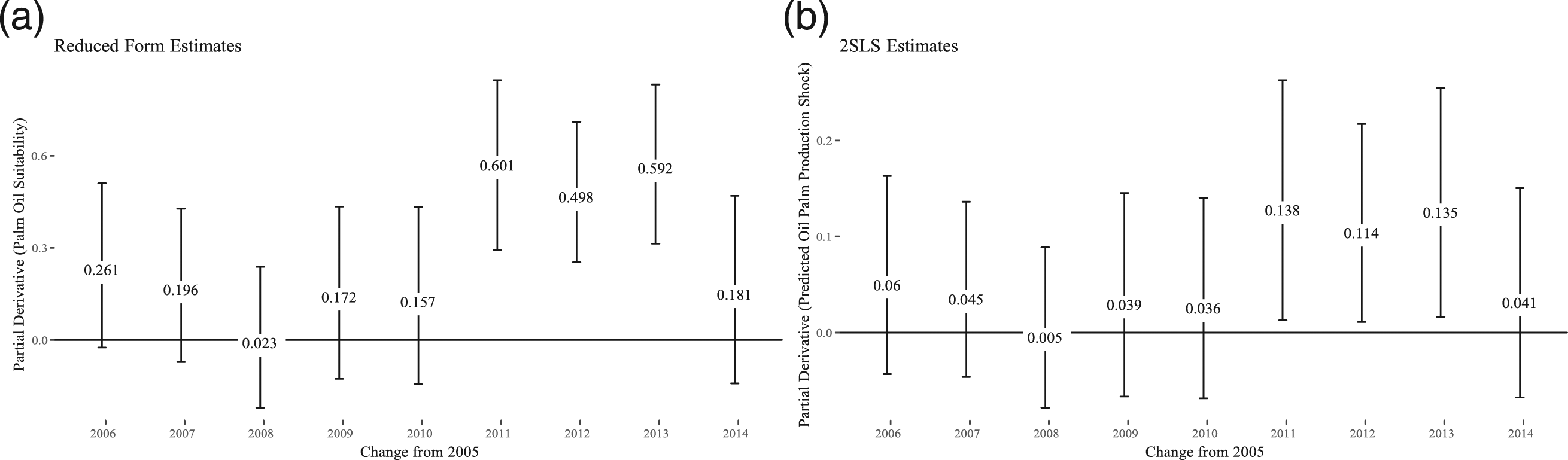
The finding highlights particular agricultural commodities may not increase the opportunity cost of violence. Since oil palm does not increase the opportunity cost of conflict immediately due to slow maturation of the crop, barriers to entry, and price contracts, positive shocks do not counteract the rapacity effect by immediately increasing wages or employment prospects. Therefore, despite its labor intensity, oil palm surges create incentives for predatory conflict in the short-run.
Understanding when agriculture will not result in social peace informs theoretical and policy debates on conflict prevention. As noted by Crost and Felter (2016), development experts and states alike have thought of export crops as a powerful tool to improve social peace; yet, as they highlight, agriculture can instead fuel violence in fragile states when rebels can prey on value chains. I show the conditions where agriculture can fuel social conflict are broader: a country need not have its value chain exposed to rebel expropriation for price shocks to fuel conflict. Instead, crop booms can lead to violent conflict between commercial and labor interests under the right scope conditions.
Several avenues for further research exist. First, the theory and evidence outline how tropical oil crop expansion can result in conflict, however, it has only shown one path by which conflict can be moderated (mill certification). Future work can clarify the potential role political institutions, social insurance, or labor protection could play in reducing violence in the wake of positive shocks. Such interventions may balance growth during boom periods, removing the grievances related to conflict.
This may clarify causal mechanisms-RSPO certification provides both credible commitment and transparency about firm activity, meaning this paper cannot isolate whether private governance dampens conflict by solving information or commitment problems between competing groups. Future work that unpacks which moderator has the largest influence can guide future aid and development policy.
Second, the theory has outlined how transitory oil crop price shocks may fuel conflict, largely due to changes in land use and the inaccessibility of the sector. Yet, as the industry matures, the local economy may restructure and positive cash flows may deter conflict in line with the opportunity cost expectation. Since the oil palm boom is relatively young, studying the persistence and decay of oil crop boom over the long term is difficult. Researchers could instead leverage historical agricultural changes to estimate the persistence of dislocation as a cause of conflict to begin understanding whether or how society moves away from violence after large local economic changes.
Third, studies may explore other oil crops, such as soybeans, in other countries, like Brazil (Acebes, Wilkinson and Téllez-Chávez, 2019). The absence of an effect for non-oil cash crops which do not pose pressure on land use oil based—coffee, cacao, and tea—suggests oil crops in particular are conflictual. Although evidence on the Indonesian case is intrinsically valuable, understanding whether and if oil crop expansion is related to social conflict in other developing nations may provide important evidence for policymakers as the oil crop sector continues to grow cross-nationally.
Supplemental Material
sj-pdf-1-jcr-10.1177_00220027221084826 - Supplemental Material for Oil Crops and Social Conflict: Evidence From Indonesia
Supplemental Material, sj-pdf-1-jcr-10.1177_00220027221084826 for Oil Crops and Social Conflict: Evidence From Indonesia by Donald Grasse in Journal of Conflict Resolution
Footnotes
Acknowledgments
I am grateful to Jennifer Gandhi, Natalia Bueno, Renard Sexton, Tom Pepinsky, Danielle Jung, Zac Peskowitz, Alex Bolton, Connor Huff, Marcel Roman, The Comparative Politics Working group at Emory University, and participants at the 2019 SoWEPS for helpful comments and feedback on earlier drafts. All errors are my own.
Declaration of Conflicting Interests
The author(s) declared no potential conflicts of interest with respect to the research, authorship, and/or publication of this article.
Funding
The author(s) received no financial support for the research, authorship, and/or publication of this article.

Supplemental Material
Supplemental material for this article is available online.
Notes
References
Supplementary Material
Please find the following supplemental material available below.
For Open Access articles published under a Creative Commons License, all supplemental material carries the same license as the article it is associated with.
For non-Open Access articles published, all supplemental material carries a non-exclusive license, and permission requests for re-use of supplemental material or any part of supplemental material shall be sent directly to the copyright owner as specified in the copyright notice associated with the article.
