A two-stage game investigates how counterterrorism measures affect within-country competition between two rival terrorist groups. Although such competition is commonplace (e.g., al-Nusra Front and Free Syria Army; Revolutionary Armed Forces of Colombia and the National Liberation Army; and al-Fatah and Hamas), there is no theoretical treatment of how proactive and defensive measures influence this interaction. Previous studies on rival terrorist groups are solely empirical concerning group survival, outbidding, and terrorism level, while ignoring the role that government countermeasures exert on the rival groups’ terrorism. In a theoretical framework, alternative counterterrorism actions have diverse impacts on the level of terrorism depending on relative group sizes and government-targeting decisions. In the two-stage game, optimal counterterrorism policy rules are displayed in terms of how governments target symmetric and asymmetric terrorist groups. Comparative statics show how parameter changes affect Nash or subgame perfect equilibrium outcomes.
Multiple rival terrorist groups may operate in the same country such as the Liberation Tigers of Tamil Eelam (LTTE) and the People’s Liberation Army of Tamil Eelam (PLATE) in Sri Lanka (Bloom 2005), the Revolutionary Armed Forces of Colombia (FARC) and the National Liberation Army (ELN) (Phillips 2015), al-Fatah and Palestinian Islamic Jihad (PIJ) (Bloom 2004), and Shining Path and the Tupac Amaru Revolutionary Movement in Peru (Phillips 2015). Other notable rivalries include Moro National Liberation Front and the New People’s Army in the Philippines, Provisional Irish Republican Army (PIRA) and Ulster Volunteer Force (UVF) in Northern Ireland, Hezbollah and Amal Movement in Lebanon, al-Qaida and Islamic State (IS) in Afghanistan (Congressional Research Service 2022), al-Shabaab and Hizbul Islam in Somalia, and Lashkar-e-Islam and Tehrik-i-Taliban in Pakistan. Such rivalries may characterize some years and not others if groups come to an accommodation, merge, end operations, or are annihilated. Moreover, rival terrorist groups in the same country may be similar or quite different in size – e.g., Aum Shinrikyo was many magnitudes larger in size than the Japanese Red Army (Hou, Gaibulloev, and Sandler 2020). Even allied groups may pursue different policy outcomes (e.g., social revolution, policy change, or territorial change), resulting in rivalry. Despite these ubiquitous rivalries, there is no theoretical treatment of how a government should interface with such groups when choosing its counterterrorism policies.1 For instance, should the government rely on defensive policies that protect vulnerable targets from all terrorist groups, or should the government resort to proactive or offensive measures to weaken a targeted group? In the latter case, should the government attack the stronger or weaker terrorist group? Those and many other related questions are addressed here.
In its most elementary form, a theoretical model must have three players – the government and two rival terrorist groups. This basic representation not only makes for a tractable analysis, but also provides a framework that can be extended to more rival groups and other considerations. In past theoretical work, one or more targeted governments confront a single terrorist group, whose objective is to create maximal damage with limited resources (Bandyopadhyay and Sandler 2011, 2014; Bandyopadhyay, Sandler, and Younas 2020; Mirza and Verdier 2014; Rosendorff and Sandler 2004; Rossi de Oliveira, Faria, and Silva 2018; Siqueira and Sandler 2006). When, however, there are two or more terrorist organizations operating in the same country, their objectives are to create terror and to bolster their reputation as a relatively stronger group. This latter aim may derive from the prospects of improved recruitment,2 better external funding, and enhanced political influence. Those desires relate to the notion of outbidding for which competitive terrorist groups within a nation seek, through their attacks, to outshine their rivals (Bloom 2004, 2005; Nemeth 2014). If a rival terror group upstages its competitors, then the group may take the lead in pushing its political agenda on the government. Terrorist groups drawn from the same ideological base may possess vastly different aims – e.g., one group may be less hard-line than another in terms of acceptable concessions. In particular, many of the splinter groups from the Palestine Liberation Organization (PLO) – e.g., the Abu Nidal Organization, the Popular Front for the Liberation of Palestine (PFLP), and Black September – were more hard-line than the parent PLO.
In the current paper, the model augments the standard objective function for the terror group to include an outbidding goal that captures intergroup competition. A two-stage game is eventually formulated in which the government chooses its defensive and proactive measures against the two resident terrorist groups in the first stage, conditioned on the groups’ terrorism choices in the ensuing stage. In the second stage, each terrorist group decides its effort or terrorism based on defensive and proactive policy levels of the government. The government’s defense limits both groups’ probability of successful attacks. In contrast, the government’s proactive measures are individually directed at increasing the targeted terrorist group’s cost of attacks. By being group-specific, proactive responses create greater asymmetry among rival groups.
The full game is solved through backward induction starting with the second stage in order to achieve a subgame perfect equilibrium. We are interested in the equilibrium changes stemming from altered key parameters – the attack success probability and the rival groups’ marginal attack costs – that are affected by the governments’ choices of defensive and proactive policies. The asymmetry/symmetry and the “selfishness” of the rival terror organizations are essential determinants of the comparative statics associated with altered counterterrorism parameters in the two-stage game involving the government and its adversarial terrorist groups. A selfish terror group places more weight on the damage that it inflicts as compared to the total losses arising from the joint terror campaigns of the two groups.
During the analysis, the paper defines and interprets optimal policy rules for defensive and proactive measures, leveled by the government at the rival terrorist groups. For instance, defensive counterterrorism reduces both groups’ level of terrorism. With asymmetric rival groups, proactive policies are directed more aggressively at the more efficient (larger) of the terror groups when diminishing returns characterize such actions. Generally, a proactive campaign directed at one of the two groups reduces the overall level of terrorism. We also consider policies for symmetry-preserving identical changes in rival groups’ marginal costs of attacks arising from circumstances that, say, favor terrorist groups’ recruitment and attacks. A rise in terrorist group efficiency from reduced cost encourages a defensive response but only raises proactive measures when there are sufficient diminishing returns to defense. That is, the government choice between defensive and proactive responses hinge on how increased use of the respective countermeasures diminishes their effectiveness. An essential message is that how rival terror groups interact cannot be divorced from the mix and level of the government’s defensive and proactive policies. This implies that the level of terrorism tied to within-country terror group rivalry is not necessarily positively related to the outbidding scenario. The resulting level of terrorism for rival groups depends on the interaction of the three agents so that outbidding may not always mean more terrorism as assumed by the empirical literature (Chenoweth 2010; Conrad and Greene 2015; Cunningham, Bakke, and Seymour 2012; Findley and Young 2012; Nemeth 2014).
The body of the paper consists of six additional primary sections. The ensuing section reviews the empirical literature on rival groups. In the following section, the terrorist groups’ campaign choice is isolated for given levels of defensive and proactive policies. As such, this denotes a one-shot game that later forms the second stage of the two-stage game model of the government and the rival groups. For this full-blown model in the third ensuing section, the subgame perfect equilibrium and some policy-related comparative statics are presented. The next section is then devoted to an analysis of policy in light of cost reduction for the terrorist groups. In the next-to-last section, some modeling extensions are presented, followed by a conclusion.
Based on these data sets, researchers analyze the determinants of terror group longevity and survival (Blomberg, Engel, and Sawyer 2010; Carter 2012; Cronin 2006, 2009; Jones and Libicki 2008; Gaibulloev and Sandler 2013, 2014, 2019). The pioneering study by Blomberg, Engel, and Sawyer (2010) is particularly noteworthy because it applies survival analysis to identify key influences on terrorist group longevity. An important independent variable in some subsequent group survival studies includes the presence of within-country rival terrorist groups. For instance, Phillips (2015) argues that violent rivalries among such groups can augment their longevity as civilian supporters take sides, encourage innovations, and provide resource support.3 An opposite view is put forward by Young and Dugan (2014) that terrorist groups’ rivalry and outbidding limit longevity as warring groups work at cross purposes. More recently, Gaibulloev, Hou, and Sandler (2020) find that group competition promotes longevity but inhibits success as the government is confronted with conflicting demands. Thus, outbidding actions by rival terror groups have mixed effects on terrorist groups’ prospects of longevity and success.
In the literature, outbidding by rival terrorist groups is often associated with the level of terrorism (Bloom 2004, 2005; Chenoweth 2010; Jaeger et al. 2015; Nemeth 2014). For instance, Cunningham, Bakke, and Seymour (2012) suggest that this increased violence stems from “dual contests” – one between rival terrorist or rebel groups, and another between the terrorist groups and the government. Like our theoretical model, those authors recognize that terrorist groups’ violence has private and public components. The group’s own violence contributes to its reputation and size, resulting in group-specific or private benefits, while the group’s violence also augments government-directed violence, thereby increasing pressures on the besieged government. The latter is a nonrivalrous and nonexcludable public benefit for all terrorist groups, because a more stressed government is more apt to concede to the rival groups’ shared demands. At other times, outbidding is linked to the intensity of attacks in which there are more suicide attacks, reflective of the “quality” of violence (Bloom 2004, 2005; Conrad and Greene 2015; Findley and Young 2012). Empirical tests of outbidding provide mixed results for large n samples of countries – e.g., for 1970–2004, Findley and Young (2012) uncover scant evidence of outbidding affecting suicide terrorism and even less evidence of outbidding influencing total terrorism. In contrast, Cunningham, Bakke, and Seymour (2012) find that enhanced intergroup competition ratchets up the number of terrorist or rebel attacks. Nemeth (2014) also displays some evidence of competition-induced enhanced terrorist violence during 1970–1997, but his evidence is not particularly strong in terms of statistical significance. In a micro-level study of the Palestinian territory, Jaeger et al. (2015) show that outbidding occurred in a very modest fashion within religious group rivalry (Hamas and PIJ) and within secular group rivalry (al-Fatah and PFLP), but not between religious and secular rivalries. For specific case studies (i.e., Sri Lanka and the Palestinian territory), Bloom (2004, 2005) offers support that intergroup rivalry results in more suicide attacks.
This varied empirical evidence suggests that the relationship between outbidding and the level of violence may hinge on factors not necessarily captured by theoretical discussion of the empirical analysis. This intervening or additional determinant is suggested to be the actions of the state in Cunningham, Bakke, and Seymour (2012). In fact, Bloom (2005) states that outbidding consequences are affected by the state’s counterterrorism strategies in response to terrorist violence. At the theoretical level, our two-stage game representation shows that intergroup competition may or may not lead to more violence depending on the government’s mix of defensive and proactive policies. This then suggests that empirical models of outbidding must incorporate such policies. The myriad empirical outcomes involving the level of terrorism, associated with intergroup competition, is completely consistent with our theoretical model, where government counterterrorism actions exert a large influence on the resulting level of terrorism.
Terrorist Groups’ Optimal Effort for Given Counterterrorism Levels
We first focus on the interactions of the rival terrorist groups for exogenously given counterterrorism actions by the government. Terrorist organizations A and B operate in the same country. Each organization wants to weaken the government by subjecting it to greater aggregate terror attacks, while caring about its own share of the total terrorism produced (i.e., the outbidding effect). Accordingly, we propose a reduced-form objective function, , of terrorist organization , where both its share of attacks and total attacks enter positively in the group’s objective function
for which is the terrorism created by organization i and is the total terrorism created by the two groups. In equation (1), is the relative weight that the terrorist group places on its own share of terror attacks (constituting the group-specific private benefit) relative to the aggregate damage inflicted on the government (constituting the groups’ public benefit). In the group’s objective, reflects that the terrorist organization cares more for its share of terrorism than for the aggregate damages inflicted on the country. This assumption is in keeping with how the splintered PLO or Tamil groups put their attacks above the aggregate campaign waged by all within-country groups (see, e.g., Bloom 2004). In a later section, we consider the alternative case where , which would be more conducive to group cooperation and even merger. The Cobb-Douglas form is used in equation (1) for the sake of analytical tractability.
The counterterrorism defensive level (e.g., hardening of targets), chosen by the besieged government, is e, where represents the fraction of successful terror attacks derived from a given terrorist group’s effort level, . In the absence of any defensive measures, all terror attacks are successful so that . Greater defensive safeguards reduce terrorist success at a diminishing rate, such that Terrorism produced by terrorist organization i equals:
where aggregate terror is
We next consider the terrorist groups’ costs associated with their attacks. We let be the per-unit input cost for of terrorist organization i. This cost may be the same for the two terrorist organizations (the symmetric case) or it may differ between them. Such differences may stem from various exogenous factors including disparities in their recruitment capabilities or their supporter base. The government targets its proactive effort, , against terrorist organization i by attacking the group’s infrastructure and resources. Such directed proactive effort makes it harder for the targeted terrorist organization to recruit and operate in the country, leading to input cost rising with . In addition, we assume that the government is more effective at low levels of proactive measures in raising the cost of the terrorist organizations’ operations, but this proactive effectiveness falls at higher levels of these measures. Such diminishing returns apply to situations where the government’s proactive campaign first depletes the most vulnerable and visible terrorist assets. At greater proactive levels, the government must take on the more battle-hardened terrorists or find them in their most secured havens, thus reducing proactive effectiveness at the margin. Following the initial post-9/11 attacks against al-Qaida’s assets in Afghanistan, the group retreated deeper into their caves and mountain hide-outs. Denoting group i’s input cost at zero proactive effort as , we define . When is suppressed from the cost function, group i’s input cost is , where and reflecting our assumptions that targeted proactive effort raises group i’s cost but at a diminishing rate of rise.
Substituting equation (2a) in equation (1), and suppressing the counterterrorism effort levels from the functional forms for now, we have that the net payoff of terrorist organization i is
In equation (3), exogenously given resources from supporters finance the groups’ cost of operations and lie outside of our analysis. The terrorist organizations are assumed to move simultaneously and choose their respective effort levels to maximize their respective payoffs, assuming the other organization’s effort level as given (i.e., standard Nash assumption). When the two terrorist groups choose their effort levels to maximize their net payoffs, the first-order conditions of the two organizations are4
and
Equations (4a) and (4b) implicitly define the Nash reaction functions of the two terrorist organizations, respectively, as
and
in terms of the other group’s effort, the probability of success, and the group’s own effort cost. Equations (5a) and (5b) jointly determine a Nash equilibrium, N, in the effort levels of the two terrorist organizations as
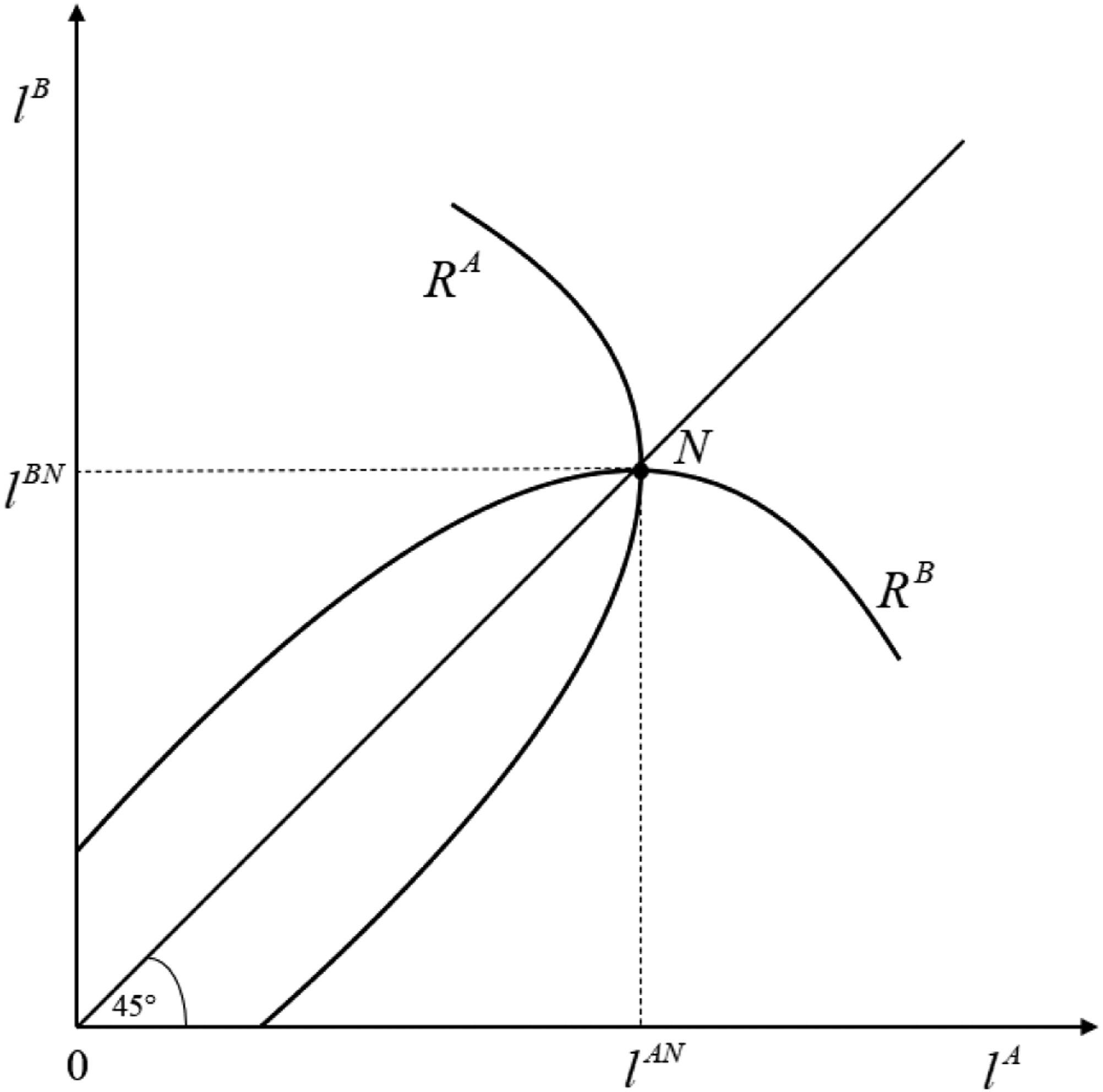
From equations (4a) and (4b), we can easily show that group i chooses a positive effort level when its rival chooses a zero-effort level. Given the second-order condition , the slope of A’s reaction function, based on the implicit function rule applied to equation (4a), is:
Partially differentiating the expression given in equation (4a) with respect to , we get:
Similarly, the slope of B’s reaction function is obtained from equation (4b) as:
Equations (7), (8), (9), and (10) allow us to depict the two groups’ reaction functions, and , respectively, and the Nash equilibrium for the symmetric case in Figure 1, where group B’s effort is measured on the vertical axis and group A’s effort is measure on the horizontal axis. In Figure 1, the 45-degree line ray from the origin indicates when the two groups exert the same terrorism effort. Equations (7) and (8) imply that A’s reaction function is positively sloped below the 45-degree line in space where , is vertical on the 45-degree line where , and is backward bending above the 45-degree line where . Analogously based on equations (9) and (10), B’s reaction function is positively sloped above the 45-degree line in space, achieves zero slope on the 45-degree line, and is negatively sloped below the 45-degree line. The Nash equilibrium is at point N on the 45-degree line where the two reaction paths intersect. Each terrorist group exhibits strategic complementarity (strategic substitutability) (Bulow, Geanakoplos, and Klemperer 1985) when its effort level exceeds (is smaller than) its rival’s effort level. However, at the Nash equilibrium, the slope of each organization’s reaction function vis-à-vis its rival’s effort level is zero.
Nash equilibrium for two symmetric terrorist groups and fixed counterterrorism levels.
We next turn our attention to the central parameters that determine the pattern of asymmetry in our model. Using equations (4a) and (4b), we can obtain the relationship between the relative effort levels of the two terrorist organizations, , and the relative input cost of the two organizations, , as
Applying the implicit function rule to equation (11), we find that . When , symmetry ensures that implies Therefore, we have
For , is less than unity so that requires that and . Hence, equation (12) means that the relative sizes of the terrorist groups are entirely determined by the relative cost , in which the lower-cost group must be the larger. Based on Equations. (8), (10), and (12), we have that:
Figure 2 presents an asymmetric Nash reaction function diagram for , where equations (13) and (7) indicate that A’s reaction function is positively sloped at the Nash equilibrium . Similarly, equations (13) and (9) imply that B’s reaction function is negatively sloped at . In Figure 2, the total terrorist effort of the two groups is found by dropping a line with slope –1 to the horizontal axis. Along this sum-preserving line, total terrorist effort at is . For the rest of the paper, we assume without loss of generality that terrorist group A is at least as efficient as group B, such that .
Nash equilibriums for two asymmetric terrorist groups and changing counterterrorism levels.
Comparative Statics of Counterterrorism Policy Changes
Here, we consider the effect of changes in on the effort levels of the two terrorist groups and, thus, on aggregate terrorism. A change in stems from a change in the counterterrorism defense, whereas changes in the groups’ costs could be driven both by changes in proactive measures and exogenous changes in input costs (i.e., changes in ). The latter issue is considered later in the context of optimal counterterrorism policy. Totally differentiating equations (4a) and (4b), we get, respectively,
which are solved simultaneously to obtain the effects of changes in the input costs and on the changes of each terrorist group’s effort level (i.e., ).
when we set and solve using Cramer’s rule. In (15), , , , and equations (8) and (10) indicate that . Thus, an increase in group A’s cost must reduce its terror effort. Turning to B’s terror effort and using equation (13), we find
which means that B’s effort will rise or remain unchanged in response to a small increase in depending on whether at the initial equilibrium or , respectively. With equations (2a), (15), and (16), we derive the effect of a rise in A’s cost on aggregate terrorism and groups’ effort:
where . Equation (17) establishes that an increase in must reduce aggregate terrorist effort and total terrorism. Note that can be written as , where is the slope of B’s reaction function. Given that , we have that implies . The last inequality ensures that group B’s reaction function must be flatter than a negatively sloped 45-degree line (i.e., ) at the Nash equilibrium, displayed in Figure 2 at . A small increase in shifts A’s reaction curve to the left (not drawn), while leaving B’s reaction curve unaffected. Therefore, the new Nash equilibrium is at on B’s reaction curve to the northwest of the initial equilibrium , showing a fall in and a rise in . We can also see the effect on aggregate terrorism from Figure 2. The new and lower aggregate effort at the Nash equilibrium is given by the point on the horizontal axis, which is less than . Our analysis shows that any increase in group B’s effort is overwhelmed by group A’s decreased terror effort, therefore validating proactive measures or other actions to raise A’s terror cost.
Increase in Group B’s Cost,
Considering the effect of an increase in , we see that equations (14a) and (14b) yield
and
when solved for . Thus, a rise in must reduce group B’s effort. A small increase in will reduce group A’s effort or leave it unaffected depending on whether or , at the initial equilibrium. Aggregate terrorist effort must fall as rises because B’s effort falls and A’s effort either falls or remains unchanged. Because aggregate terrorist effort falls, we have from equation (2b) that aggregate terrorism must fall. In terms of Figure 2, a rise in group B’s cost shifts its reaction curve down (not drawn), moving the Nash equilibrium down A’s positively sloped reaction curve to point , reducing both . At the new equilibrium, the smaller aggregate terrorist effort is .
Increase in
The effect of an increase in , arising from reduced defensive measures, on A’s effort level is obtained from equations (14a) and (14b) (with ) as
where equations (4a), (4b), and (13) yield . Thus, an increase in must increase . Recall from equation (11) that the groups’ relative effort level, , is independent of . Thus, as an increase in raises , it must also increase in the same direction and by the same proportion. The above findings lead to Proposition 1.
Proposition 1: An increase in defensive countermeasures reduces attacks by both terrorist organizations. Proactive counterterrorism policy against a terrorist group reduces that group’s attacks and raises (reduces) the attacks of the smaller (larger) rival group. If, however, the groups are of the same size, then proactive measures against one group does not affect the rival group’s terror effort. Proactive effort against any group must reduce aggregate terrorism.
Proof: The proofs of the propositions are gathered in the Appendix.
Increased defensive action reduces the marginal terrorism gains for both terrorist organizations by degrading the efficacy of their efforts. The resulting terrorist attack reductions are proportional because equation (11) ensures that the terrorists’ effort ratio is independent of the government’s defensive response. In a country besieged by many terrorist groups (e.g., Pakistan, India, and the Philippines), defensive measures have large payoffs. Proactive measures directed at a specific terrorist group raises its input cost and lowers its attacks, but the response of the other terrorist group depends on the pattern of strategic complementarity/substitutability at the Nash equilibrium. Recall from equation (12) that the lower-cost terrorist group is the larger group; but if , then the terrorist groups are of the same size (i.e., symmetric). Under symmetry, there is no effect on the rival groups’ efforts because of a zero or an infinite slope at the Nash equilibrium on the 45-degree ray out of the origin. However, under asymmetry, Figure 2 applies where a greater proactive response against A (the larger group) shifts A’s reaction curve leftward and moves the equilibrium from to raising B’s terrorism effort. In contrast, when proactive measures against B increase, the Nash equilibrium moves from N0 to , reducing A’s effort along A’s positively sloped reaction curve. Data on terrorist groups indicate that resident terrorist groups are unequal in size, usually markedly so (e.g., the Taliban and al-Qaida in Afghanistan; Boko Haram and Niger Delta Vigilante in Nigeria) (Hou, Gaibulloev, and Sandler 2020).
There is an interesting and novel public-private distinction that arises from our modelling of defensive and proactive measures in the presence of rival terrorist groups. Enhanced defensive measures limit both groups’ effort-effectiveness parameter, , equally as these terror groups attack fortified targets. From the groups’ and citizens’ viewpoints, there is a publicness aspect to defensive measures. In contrast, proactive measures are group-specific and, thus, private between terrorist groups, which induces the non-targeted group to increase its efforts. The latter increase can be forecast by the government. The publicness of defensive measures should favor them over proactive measures from the government’s perspective. In the literature, however, this favoring stems from an entirely different rationale as a targeted country hardens targets at home in order to transfer attacks abroad in a multi-country and single group scenario (Gaibulloev and Sandler 2019). By contrast, the favoring of defense uncovered here arises from defense countermeasures limiting both groups’ terrorism unlike proactive measures. As such, the bias to use defensive rather than proactive policy arises in a multi-group and in a multi-country setting. Only the latter is acknowledged in the literature.
Optimal Counterterrorism Policy
This section extends the analysis to consider optimal counterterrorism policy5 in terms of a two-stage game where the government moves in stage 1 to minimize terrorism losses inclusive of counterterrorism costs. In stage 2, terrorist groups choose their respective effort or campaign levels. The subgame perfect equilibrium of this game is obtained by solving through backward induction, such that the Nash equilibrium of the previous section now serves as the second-stage solution. Accordingly, for stage-1 optimization, the government uses the terrorist groups’ equilibrium effort functions previously derived. For simplicity, we assume that a unit of defensive or proactive counterterror effort has a constant marginal cost of unity. Using equation (2b) for aggregate terrorism, denoting the government’s loss by , and recalling that (see the Appendix), we have that the government’s loss function is
The first-order condition for the government’s choice of the loss-minimizing defensive level is6
At the optimal defensive level, equation (22a) indicates that the marginal gains from aggregate terrorism reduction equals the associated marginal cost of defensive actions. Moreover, we note that the first term on the left-hand side of the second equality in equation (22a) is the marginal benefit of reduced terrorism due to better defensive protection at given levels of terrorist effort. The second left-hand term is the marginal benefit of reduced terrorism due to the dampening effect of defense on the terrorists’ aggregate effort. There are several factors, which are ex ante endogenous, that affect the desirability of defense in equation (22a). First, we note that aggregate terror is . At any defense level e, this implies that greater terrorism is associated with a larger aggregate terrorist effort level, . Since the aggregate terrorist effort level scales in equations (22a), a greater terror level amplifies the marginal benefit from greater defense. Second, as shown in the proof of Proposition 1 (see Appendix), the influence of defensive action on reducing groups’ aggregate effort, captured by , depends on several factors that affect the equilibrium effort levels of the terrorist groups. To summarize, if aggregate terror effort is highly elastic or responsive to defense increases and if the terrorism level is large, then the desirability of using defense increases.
The first-order conditions for the government’s proactive policy choices and are, respectively,
From Proposition 1 and its proof in the Appendix, aggregate terrorist effort must fall when either or is raised . Thus, the left-hand sides of equations (22b) and (22c) represent aggregate terrorism reduction for an increase in and , respectively. At the optimum, the marginal benefit from proactive measures against a terrorist group must equal the unit marginal cost of such measures. The marginal benefit from proactive counterterrorism is easier to interpret in the symmetric case. Recall that, at a symmetric equilibrium, equal cost for the two groups is consistent with equal terror efforts (i.e., ). Moreover, . In this case, equations. (A5) and (A6) of the Appendix yield:
Equation (23) indicates that marginal terror reduction must increase for a larger terror effort level. This effect, ceteris paribus, suggests that in an environment of larger aggregate terrorism, there is a greater incentive for proactive measures. Under asymmetry, Proposition 2 throws light on the relative targeting of such measures between the two asymmetric terrorist groups.
Proposition 2: If the terrorist groups share a common cost function that is separable in proactive effort and exhibits diminishing effectiveness at larger proactive levels (i.e., the cost function is strictly concave in proactive measures), then the optimal proactive response against the larger group exceeds the optimal proactive response against the smaller group.
In view of Proposition 1, we know that a greater proactive response against the smaller terrorist group will reduce both groups’ terrorism, while more proactive effort against the larger group lowers its terrorism but raises that of the smaller group. This outcome might suggest that the government may want to go more aggressively against the smaller group. However, Proposition 2 establishes that this conclusion is generally false. Indeed, for separable cost functions, the government is shown in Proposition 2 to favor more aggression against the larger group. This follows because the own contractionary terror effect on the larger group is sufficiently strong to overwhelm the cross-effect expansionary terror response of the smaller group for optimal proactive policy.
For some context, consider the Colombian government actions against the far-left rival FARC and ELN terrorist groups during the 1990s and more recent years prior to the peace agreement between the government and FARC in 2016. FARC was the much larger of the two rival groups – FARC was over a magnitude larger than ELN (Hou, Gaibulloev, and Sandler 2020). The government focused its proactive campaign on FARC, which eventually brought them to the negotiation table. Following the end of FARC’s operations, ELN still remains active but presents a less formidable threat that the Colombian government could then address. Our model suggests that the Colombian government’s initial focus on FARC was an optimal strategy. A similar situation involved the US-backed Afghan government’s confrontation of the Taliban instead of the much smaller Haqqani Network (an ally of al-Qaida) before the fall of the Afghan government in August 2021.
An interesting question is whether relatively aggressive proactive measures against the initially efficient group A can raise its marginal cost to a level that makes it equally or less efficient compared to group B in a policy equilibrium. Consider the case where offense against A is such that it allows group B to overcome its initial cost disadvantage, such that the marginal costs of the two groups are equalized, i.e., . Because of diminishing returns, greater proactive measures directed against A reduce the marginal-cost-increasing effect of such actions on A below that of B. However, as shown in equation (A7) of the Appendix, when , optimality requires that the marginal-cost-increasing effect of proaction against the two groups be equalized. These contradictions rule out the possibility of a proactive-engineered symmetric outcome. Similar arguments rule out an equilibrium where B becomes the larger group. Strict diminishing returns eliminate the incentive of the government to go after group A beyond a certain level that falls short of symmetry. In other words, although group A is targeted more aggressively, it remains the more efficient group in a policy equilibrium.
Counterterrorism Response to Lower Terror Production Costs: The Symmetric Case
This section considers the effects of symmetry-preserving exogenous and simultaneous cost decreases of the two terrorist groups. The exercise applies to scenarios where similar size terrorist groups experience an improvement in their input procurement process. If, e.g., some in the population become radicalized by an external event that they sympathize with, this may raise the terrorist groups’ volunteer pools and drive down input or recruitment cost. According to Hoffman (2012), many young Palestinians volunteered for PLO-affiliated terrorist groups following the 1972 Munich Olympics kidnapping and murder of Israeli athletes by Black September. This enhanced allegiance occurred even though the kidnapping did not obtain any concessions and ended in the eventual capture or killing of the perpetrators. Another example is the increase in terrorism support for within-country rival groups after the US retaliatory bombing raid on Libya on April 15, 1986, in retribution for Libya’s role in the La Belle discotheque bombing in West Berlin on April 5, 1986 (Enders and Sandler 1993). The retaliatory raid induced a wave of attacks aimed at the United States and the United Kingdom, which conducted or aided the raid, respectively. The current exercise is also relevant in a cross-sectional sense to two different venues of multi-group terrorism where input cost in one venue is lower than in another. Since the late 1990s, the appearance of terrorist networks – e.g., al-Qaida and Islamic State – with affiliated, but rival, groups in more than one venue is an example. The civil war in Syria following the Arab Spring in 2011 reduced the cost of recruitment to al-Qaida and Islamic State in that venue relative to elsewhere. Stresses on the Syrian government bolstered this cost reduction. In so doing, foreign fighters were attracted to the groups. The questions addressed here are how optimal counterterrorism policy adjusts to terror groups’ cost decreases, and what is the net effect of such adjustments on the level of terrorism and, hence, on national welfare (negative of the loss function)?
Recall from the analysis of stage 2 that the input cost function of terror group i takes the form , where is the input cost at a zero proactive level. Equations (11) and (12) established earlier that the groups are symmetric if . Additionally, we assume now that so that the groups remain symmetric when proactive measures are zero. If proactive effort is positive and if the rival terror groups abide by a common input cost function, then . Symmetry of the two terror groups requires that implies . Thus, the two terror groups can be represented by a common cost function . Furthermore, to represent explicitly in the cost function, we denote and of the previous sections by and , respectively. A larger is reasonably associated with a greater input cost at any given proactive level, such that . Under symmetry, such that equation (4a) yields:
In the symmetric case, the government’s loss function, equation (21), reduces to
The first-order conditions for the government’s stage-1 choices of to minimize its loss are, respectively,
where an increase in the proactive measure, , represents a symmetry-preserving equal increase in and , which is reflected in a marginal cost of 2 on the right-hand-side of equation (26b). The second-order conditions, associated with the partials of , of this stage-1 optimization play an important role in restricting the possible comparative-static outcomes, later captured by Proposition 3. Thus, we start with evaluating the second-order partials of the government’s loss function
where is a measure of the strength of diminishing returns to defensive effort. Similarly,
where is a measure of diminishing returns to proactive effort. Finally, we have:
Notice that because . Thus, is a sufficient but not necessary condition for . We assume that there are sufficient diminishing returns in defense such that equation (27c) is satisfied. The above findings with respect to the government’s loss partials satisfy the second-order condition for a loss minimum, allowing us to prove Proposition 3 in the Appendix. In essence, the comparative statics follow the same procedure as earlier where we proceed after totally differentiating equations (26a) and (26b) and solving via Cramer’s rule.
Proposition 3: A sufficient condition for cost reduction of the terrorist groups (i.e., fall in ) to increase optimal defensive effort is that the marginal effect of proactive measures on the input cost () is non-decreasing in (i.e., ) and that there is strict diminishing returns to proactive measures (i.e., ). The optimal proactive response, however, may rise or fall. This optimal response must rise if there are sufficiently strong diminishing returns to defense. When optimal defense rises, terrorism will rise only if there are sufficient diminishing returns to defense (when ). National welfare loss must always rise with a fall in terrorists’ costs.
Consider first the effects of the decrease in terror groups’ costs on aggregate terror and national welfare loss (i.e., the last part of Proposition 3). If optimal defense rises and if diminishing returns to defensive measures are not sufficiently strong , the counterterrorism response is strong enough to either neutralize any terror increase (when ) or even reduce terror (when ). However, under sufficiently strong diminishing returns, the government succeeds only in dampening but not eliminating the rise in terrorism. Regardless of the direction of change in terrorism, national welfare loss must rise when terrorists’ costs fall. Even if total terrorism falls or remains constant, national welfare loss increases because of the rise in counterterrorism outlays. To understand the rest of Proposition 3 with respect to proactive and defensive responses, we offer two specific cost function examples.
, and , . Moreover, for this additively separable cost function, the following holds: , , , and . Since , the fall in reduces the terrorists’ input cost, which raises terrorists’ effort in equation (24) and the marginal benefit of defensive measures in equation (26a). As a consequence, defensive efforts will tend to increase. However, equation (26b) suggests two opposing effects on the marginal benefit of proactive measures. With greater defense, the marginal benefit of proactive effort in equation (26b) is dampened, but a lower input cost of terrorism drives up the marginal benefit from the proactive response. In general, the effect on proactive effort is ambiguous. Using equation (A9) of the Appendix, we have that if . Thus, with sufficient diminishing returns to defense , the government finds it profitable to balance its counterterrorism increase between proactive and defensive measures. Furthermore, based on equation (A11) of the Appendix, we conclude that terrorism will rise when given that . To summarize, under sufficient diminishing returns to defense, the proactive responses and terrorism all rise when terrorists’ input costs fall.
, , and .
For this multiplicatively separable cost function, , , , and . A drop in reduces and raises the marginal benefit of defense in equation (26a), tending to raise defense. Equation (A8) of the Appendix establishes that defense must increase if , valid in this example. For proactive measures, a fall in reduces because . This effect dampens the marginal benefit of the proactive response in equation (26b). If this effect is large, then the government may prefer to reduce proactive effort while augmenting defense to combat the effects of reduced terrorism production costs. For this example, we note that , defined around equation (A9), equals unity. Using equation (A9), we get if and only if . In turn, this means that for all , which satisfy the second-order condition outlined in equation (27c), proactive effort must decline with a fall in .
The above examples illustrate that the choice between proactive and defensive measures in response to changes in terrorist groups’ costs are interdependent in this two-stage model involving staged responses of the governments and the rival groups. Although this is a complicated comparative-statics problem, we see that how each counterterrorism measure’s effectiveness reacts as its deployment is increased (i.e., diminishing returns to the measure) is a crucial consideration in the ideal mixture of such measures used by the government. The complexity of the comparative statics applied to a two-stage game necessitates some structure to the cost function of the terrorist antagonists.
Two Extensions
Terrorism and Counterterrorism for
For the base model in the third section, we assumed that the terrorist organizations care more for their share of attacks than for the aggregate terrorism inflicted. We now allow the terrorist group to attach a greater weight on the aggregate terrorism created so that .7 This case would involve groups that do not consider themselves as rivals – e.g., Haqqani Network and al-Qaida in Afghanistan. In some of these situations, groups may eventually merge as identified by Hou, Gaibulloev, and Sandler (2020) – e.g., Salafist Group for Preaching and Fighting merged with al-Qaida to form al-Qaida in the Islamic Maghreb (AQIM) in January 2007. Other mergers occurred among ally groups, but merger is rather rare compared to splintering and rivalry (Hou, Gaibulloev, and Sandler 2020).
Compared to the base model, the first qualitative difference occurs in equation (8), which now implies that when given . Accordingly, the slope of group A’s reaction function is the opposite concavity (i.e., C-shaped) of that in Figure 1. The reaction path’s slope is negative below the 45-degree ray, vertical on the 45-degree ray, and positive above the 45-degree ray. Similarly, equation (10) indicates that B’s reaction function is negatively sloped above the 45-degree ray, horizontal on the 45-degree ray, and is positively sloped below the 45-degree ray.
Next, we consider the effects of changes in the input costs and (the terrorism effort-effectiveness parameter) on the Nash-equilibrium levels of groups’ terror efforts, and for . Starting with the effect of a change in A’s input cost, we have that equation (15) still indicates that a rise in reduces . However, because the reaction functions’ slopes are reversed compared to base case with , equation (16) states that as . The effect on total terrorism, captured in equation (17), is unchanged compared to the base case. Similarly, the effect of a rise in on both and total terrorism are unchanged from the base case, but now equation (19) implies that . Finally, using equations (14a) and (14b), we have that , because from equation (10) we have when and , and also because , , and . Equations (11) and (12) are unaltered implying that the ratio of terrorist effort is still independent of . Thus, implies that .
Summarizing the above findings, we note that Proposition 1 is partially altered when . The effect of defense on terrorist effort is qualitatively the same. The effect of proactive measures against a specific terror group is also qualitatively unaltered vis-à vis terror effort of the targeted group and the aggregate terrorism effort. However, the cross effect is qualitatively different. Greater proactive effort directed against the larger (smaller) group will now reduce (raise) its rival group’s effort, indicating the desirability of going after the larger group. Since the analysis of the two-stage game given in the fourth and fifth sections is independent of the range of permissible (), our earlier results hold for .
Multiple Terror Groups
We next explore the nature of terrorism and counterterrorism policy equilibrium when there are terror groups. For some terrorism-plagued countries (e.g., Afghanistan, India, Iraq, Nepal, Nigeria, Pakistan, the Philippines, Sri Lanka, Sudan, Syria, and Yemen), more than two rival groups have co-existed at times (Hou, Gaibulloev, and Sandler 2020). As before, we assume that . For notational simplicity, we denote a terror group as , where . Terrorist group i’s objective function is the same as equation (1), and the terror production function is the same as equation (2a). However, with multiple terror groups, equation (2b) is
where is the groups’ aggregate terrorism effort. Group i’s payoff function is
Defining as the vector of all terrorist organizations’ effort levels that excludes group i (i.e., , ), we get the first-order condition of organization i as8
The first-order conditions, contained in equation (30) for , jointly determine the Nash equilibrium for the terrorist groups’ effort levels. Given that the second-order condition for a terrorist group’s optimization requires that , the slope of group i’s reaction function vis-à-vis a change in any other group j’s () effort level is:
such that if and only if , where group i exerts no more effort than the aggregate of the other groups. When the terrorist organizations face the same input cost , equation (30) defines a symmetric Nash equilibrium where . Thus, in this case , and . The condition reduces to being equivalent to . For , the analysis reduces to the base case, such that at the symmetric Nash equilibrium. However, for , we have , such that equation (31) implies that at a symmetric Nash equilibrium.9
The first-order conditions in equation (30) can be expressed in relative terms by dividing each group’s first-order condition with respect to the nth group’s first-order condition to obtain relative effort levels purely as functions of relative costs, independent of . Thus, defensive countermeasures affect all terrorist groups’ effort levels in the same direction. Using this observation and equation (30), we can show that, starting from a symmetric equilibrium, an increase in defensive measures reduces all groups’ effort levels.
Proactive measures can be shown to reduce a targeted group’s effort level, and, under initial symmetry, such targeted measures raise all rival groups’ terror effort levels. Accordingly, Proposition 1 is unchanged vis-à-vis defensive and group-specific proactive measures. However, proactive measures’ influence on the rival, under initial symmetry, is different for , with negatively sloped reaction functions suggesting an increase in the rivals’ efforts. Aggregate terrorism falls just as in Proposition 1. Based on symmetry, we can substitute and in equation (30), and rely on to obtain:
By noting that aggregate terror , we have the government’s payoff function,
from which we can obtain the optimal defensive and proactive levels as in the fifth section. The qualitative nature of the optimal choices remains similar to the case in that earlier section.
Differentiating the counterterrorism policy first-order conditions with respect to the number of groups, we find that an increase in the number of groups will tend to raise the optimal defensive effort while reducing optimal proactive effort levels.10 This follows because of the public good nature of defensive action for which an enhanced hardening of a given number of targets deters all terrorist groups. By contrast, with an increased number of symmetric terrorist groups, optimal policy requires a proportional increase in targeted proactive efforts against all terror groups, so that cost considerations likely induce the government to rely more on defense. The rise in the number of terror groups is apt to raise aggregate terrorism if there are sufficient diminishing returns to defense . If diminishing returns is weak (for ), defensive measures can increase sufficiently to keep aggregate terrorism constant (when ) or reduce it (when ). Regardless of whether terrorism rises or falls, the government’s loss inclusive of counterterrorism costs must increase as the number of symmetric terror groups increases. Exogenous factors that cause terrorist groups to splinter and multiply is not good from the targeted government’s viewpoint. By contrast, if negotiation or military action results in the demise of a terrorist group as in Colombia or Sri Lanka, then this may be a favorable development because the government can resort to proactive measures to eliminate the remaining groups and not have to balance defensive and proactive policies.
Concluding Remarks
The current paper contains a two-stage game in which a targeted government chooses its defensive and proactive responses in the first stage against two rival terrorist groups that then decide their attacks in the second stage. In the base model, the rival groups’ cost-constrained choice captures outbidding because they place more weight on their share of attacks relative to total terrorism produced by the two groups. Our theoretical framework provides the first formal analysis of outbidding where the influence of counterterrorism measures on rival terrorist groups’ level of terrorism is considered. A number of messages derive from our study. First, the two-stage game is intricate and may contradict simple intuition that outbidding invariably results in more terrorism or that proactive measures should be necessarily directed at the smaller of rival groups. The latter might seem advisable because such measures aimed at the larger of two groups results in increased terrorism by the smaller group; however, the direct decrease in terror coming from targeting the larger group overwhelms the smaller groups’ increased terrorism. Second, the effects of outbidding on the level of terrorism cannot ignore government counterterrorism action. Third, in the face of exogenous cost-reducing events that favor rival groups’ efficiency, defensive responses by the government are generally favored over proactive measures unless defensive actions experience sufficient diminishing returns. Thus, the government’s optimal mix between defensive and proactive measures hinge on how these measures lose their effectiveness through deployment. Fourth, empirical analyses of outbidding between rival groups must possess some counterterrorism measures. Fifth, the necessary structure needed to derive clear-cut results indicate that outbidding is a much more complex relationship than pre-supposed in the literature. Sixth, by potentially decreasing the number of terror groups, outbidding may simplify the choice between defensive and proactive countermeasures while lowering the targeted government’s loss.
Supplemental Material
Supplemental Material - Effects of Defensive and Proactive Measures on Competition Between Terrorist Groups
Supplemental Material for Effects of Defensive and Proactive Measures on Competition Between Terrorist Groups by Subhayu Bandyopadhyay, Todd Sandler in Journal of Conflict Resolution
Footnotes
Acknowledgement
We have profited from the comments of two anonymous referees.
Declaration of conflicting interests
The author(s) declared no potential conflicts of interest with respect to the research, authorship, and/or publication of this article.
Funding
The author(s) received no financial support for the research, authorship, and/or publication of this article.
Disclaimer
The views expressed are those of the authors and do not necessarily represent the official positions of the Federal Reserve Bank of St Louis or the Federal Reserve System.
ORCID iD
Todd Sandler
Supplemental Material
Supplemental material for this article is available online.
Notes
Appendix
References
1.
AsalVictorKarl RethemeyerR.. 2008. “The Nature of the Beast: Organizational Structures and the Lethality of Terrorist Attacks.” The Journal of Politics70 (2): 437-449.
2.
BandyopadhyaySubhayuSandlerTodd. 2011. “The Interplay between Preemptive and Defensive Counterterrorism Measures: A Two-Stage Game.” Economica78 (3): 546-564.
3.
BandyopadhyaySubhayuSandlerTodd. 2014. “Immigration Policy and Counterterrorism.” Journal of Public Economics110: 112-123.
BlombergS. BrockEngelRozlyn C.SawyerReid. 2010. “On the Duration and Sustainability of Transnational Terrorist Organizations.” Journal of Conflict Resolution54 (2): 303-330.
6.
BloomMia. 2004. “Palestinian Suicide Bombing: Public Support, Market Sharing, and Outbidding.” Political Science Quarterly119 (1): 61-88.
7.
BloomMia. 2005. Dying to Kill: The Allure of Suicide Terror. New York: Columbia University Press.
8.
BulowJeremy I.GeanakoplosJohn D.KlempererPaul D.. 1985. “Mulitmarket Oligopoly: Strategic Substitutes and Complements.” Journal of Political Economy93 (2): 488-511.
9.
CarterDavid B.2012. “A Blessing or a Curse? State Support for Terrorist Groups.” International Organization66 (1): 129-151.
10.
ChenowethErica. 2010. “Democratic Competition and Terrorist Activity.” The Journal of Politics72 (1): 16-30.
ConradJustinGreeneKevin. 2015. “Competition, Differentiation and the Severity of Terrorist Attacks.” The Journal of Politics77 (2): 546-571.
13.
CroninAudrey K.2006. “How al-Qaida Ends: The Decline and Demise of Terrorist Groups.” International Security31 (1): 7-48.
14.
CroninAudrey K.2009. How Terrorism Ends: Understanding the Decline and Demise of Terrorist Campaigns. Princeton, NJ: Princeton University Press.
15.
CunninghamKathleen GallagherBakkeKristin M.SeymourLee J. M.. 2012. “Shirts Today, Skins Tomorrow: Dual Contests and the Effects of Fragmentation in Self-Determination Disputes.” Journal of Conflict Resolution56 (1): 67-93.
16.
EndersWalterSandlerTodd. 1993. “The Effectiveness of Anti-Terrorism Policies: A Vector-Autoregression-Intervention Analysis.” American Political Science Review87 (4): 829-844.
17.
FindleyMichael G.YoungJoseph K.. 2012. “More Combatant Groups, More Terror? Empirical Tests of an Outbidding Logic.” Terrorism and Political Violence24 (5): 706-721.
18.
GaibulloevKhusravHouDongfangSandlerTodd. 2020. “How Do the Factors Determining Terrorist Groups’ Longevity Differ from Those Affecting Their Success?” European Journal of Political Economy65, Article 101935.
19.
GaibulloevKhusravSandlerTodd. 2013. “Determinants of the Demise of Terrorist Organizations.” Southern Economic Journal79 (4): 774-792.
20.
GaibulloevKhusravSandlerTodd. 2014. “An Empirical Analysis of Alternative Ways That Terrorist Groups End.” Public Choice160 (1–2): 25-44.
21.
GaibulloevKhusravSandlerTodd. 2019. “What We Have Learned about Terrorism since 9/11.” Journal of Economic Literature57 (2): 275-328.
22.
HoffmanBruce. 2012. Inside Terrorism, 3rd Edition. New York: Columbia University Press.
23.
HorowitzMichael C.PotterPhilip B. K.. 2014. “Allying to Kill: Terrorist Intergroup Cooperation and the Consequence for Lethality.” Journal of Conflict Resolution58 (2): 199-225.
24.
HouDongfangGaibulloevKhusravSandlerTodd. 2020. “Introducing the Extended Data on Terrorist Groups (EDTG), 1970 to 2016.” Journal of Conflict Resolution64 (1): 199-225.
25.
JaegerDavid A.KlorEsteban F.MiaariSami H.Daniele PasermanM.. 2015. “Can Militants Use Violence to Win Public Support? Evidence from the Second Intifada.” Journal of Conflict Resolution59 (3): 528-549.
26.
JonesSeth G.LibickiMartin C.. 2008. How Terrorist Groups End: Lessons for Countering al Qa'ida. Santa Monica, CA: Rand Corporation.
27.
MirzaDanielVerdierThierry. 2014. “Are Lives a Substitute for Livelihoods? Terrorism, Security, and U.S. Bilateral Imports.” Journal of Conflict Resolution58 (6): 943-975.
28.
National Consortium for the Study of Terrorism and Responses to Terrorism. 2018. “Global Terrorism Database.” Accessed August 20, 2018.https://www.start.umd.edu/gtd
29.
NemethStephen. 2014. “The Effect of Competition on Terrorist Group Operations.” Journal of Conflict Resolution58 (2): 336-362.
30.
PhillipsBrian J. 2014. “Terrorist Group Cooperation and Longevity.” International Studies Quarterly58 (2): 336-347.
31.
PhillipsBrian J. 2015. “What Is a Terrorist Group? Conceptual Issues and Empirical Implications.” Terrorism and Political Violence27 (2): 225-242.
32.
RosendorffB. PeterSandlerTodd. 2004. “Too Much of a Good Thing? The Proactive Response Dilemma.” Journal of Conflict Resolution48 (5): 657-671.
33.
Rossi de OliveiraAndreFariaJoão R.SilvaEmilson C. D.2018. “Transnational Terrorism: Externalities and Coalition Formation.” Journal of Conflict Resolution62 (3): 496-528.
34.
SiqueiraKevin. 2005. “Political and Militant Wings within Dissident Movements and Organizations.” Journal of Conflict Resolution49 (2): 218-236.
35.
SiqueiraKevinSandlerTodd. 2006. “Terrorists versus the Government: Strategic Interaction, Support, and Sponsorship.” Journal of Conflict Resolution50 (6): 878-898.
36.
YoungJoseph KDuganLaura. 2014. “Survival of the Fittest: Why Terrorist Groups Endure.” Perspectives on Terrorism8 (2): 2–23.
Supplementary Material
Please find the following supplemental material available below.
For Open Access articles published under a Creative Commons License, all supplemental material carries the same license as the article it is associated with.
For non-Open Access articles published, all supplemental material carries a non-exclusive license, and permission requests for re-use of supplemental material or any part of supplemental material shall be sent directly to the copyright owner as specified in the copyright notice associated with the article.