



Abstract
Smart weapons represent a key element of military power for countries around the world, and nothing symbolizes them more than smart bombs—the guided aerial bombs that the United States debuted in the Vietnam War. Yet, international relations scholars know little about these weapons and what explains their proliferation. In this paper, we theorize about the key drivers of smart bomb proliferation, including an interaction between the security environment, regime type, and the interest of states in precision to help them follow the law of war. We then introduce a new dataset on smart bombs from 1960-2017. The results show that internal and external security threats make countries more likely to acquire smart bombs. These effects interact with regime type and whether countries are more likely to ratify treaties related to the law of war. GDP per capita and economic capacity also appears fundamental to explaining smart bomb adoption.
Introduction
The politics of how countries design their militaries is a critical question for international politics. The United States has led the world in the adoption of precision strike weapons for decades, with their prominent use in the Persian Gulf War raising global recognition of their capabilities. Using precision munitions requires both weapons capable of being guided and the intelligence and information systems to guide them. Precision-guided munitions (PGMs) are more than simple force multipliers that states can employ to get more ‘bang for their buck.’ By design, they capitalize on advances in global information and communications technology (Kreuzer 2014). Accuracy not only improves military effectiveness but also helps reduce collateral damage, aiding the ability of states to use force in ways that comply with the law of war.
However, there is only limited social science research on precision strike capabilities and little theoretical or empirical work on the factors that explain the likelihood that a state will acquire PGMs (Horowitz and Schwartz 2021). Broadly, precision weapons have spread more slowly than analysts initially believed following the Persian Gulf War (Watts 2013). Why? There is even less work on the best-known element of the precision strike complex, so-called smart bombs, defined as guided bombs launched from the air to strike ground targets.
Studying why smart weapons spread is an important question for international politics. First, smart bombs are a crucial element of modern military power, given the way they enable strikes that enhance military effectiveness and allow countries to reduce collateral damage. 1 As states make choices about whether to use drones or fighters, for example, to deliver munitions, increasingly the munitions they use are smart bombs regardless of the platform launching them. Second, enhancing our understanding of how states design their militaries advances knowledge on several topics relevant for international relations scholars, including the initiation and escalation of armed conflict and civil-military relations. Third, most theories about proliferation focus on the unique case of nuclear weapons. But most wars are conventional wars, and increasingly involve smart bombs, so extending our theories to test what explains the spread of other, conventional weapons can improve the ability of international relations scholars to understand weapons proliferation and states’ acquisition decisions more broadly.
To advance the literature, this article explains when states acquire smart bombs, testing theories related to the security environment, economic capacity, regime type, and international law. When facing external threats, all states should have incentives to acquire smart bombs, as they increase military effectiveness. However, smart bombs also states to limit collateral damage because of their precision—an additional incentive for building or buying them. In particular, more democratic states and states more committed to following the law of war should have special incentives to acquire smart bombs when they face external threats or internal security threats. Democracies and treaty-ratifiers fighting internal conflicts should want to acquire smart bombs, because smart bombs help them use force in ways consistent with their normative commitments, and make domestic and international opposition less likely. Essentially, the specific characteristics of weapons systems may interact with the domestic and international political context to shape proliferation and use patterns. If correct, this has consequences for the intersection of international politics, international law, and military power.
We test our hypotheses using a new dataset of all smart bombs acquired by all countries from 1960-2017. While observational, the statistical results are robust to a number of specifications including country and year fixed effects. The models, along with detailed examples, show—as predicted—a clear interactive relationship between security threats, domestic incentives, and smart bomb acquisition. More democratic countries and countries that have ratified large numbers of treaties related to the law of war become more likely to acquire smart bombs—and larger numbers of smart bombs—as security threats increase. Our findings suggest that many countries acquire smart weapons not only for their improved military effectiveness but because they enable uses of force that are more likely to comply with the law of war, even internally. The results also show that factors like GDP per capita, and more specific measures of information technology capacity, play a key role in explaining the ability of countries to acquire smart bombs. We also demonstrate that our results are robust to a number of specifications and cannot be explained by patterns related to alliances and arms exports. The dataset in itself also represents a new contribution to knowledge.
The rest of this article is structured as follows. First, we describe what smart bombs are, and explain why their proliferation matters for the study of politics. Second, we theorize about what explains the spread of precision weapons in general and smart bombs in particular. The research design follows and introduces our new dataset on smart bomb proliferation. We then use regression analysis and illustrative examples to explain smart bomb diffusion over time. In addition to drawing out the theoretical impact of this study, the conclusion addresses limitations and consequences for public policy.
What Are Smart Bombs?
Precision-guided munitions are defined as munitions that have active guidance, whether from lasers, satellites, surveillance aircraft, or other means. While the broader history of PGMs dates back to the German development of the WREN torpedo, the current weapons described as smart bombs date back to the Vietnam War. Driven by an operational need to destroy bridges with greater precision, the United States began developing a more accurate bomb that would require fewer sorties to accomplish missions (Gillespie 2006; Rip and Hasik 2002). In April 1968, the U.S. Air Force deployed the BOLT-117, the first Laser-Guided Bomb (LGB), marking the operational beginning of the Paveway munition series (Mandel 2004, 177). 2
Precision—and the pursuit of an ever-shrinking circular error probability—has been an increasingly important goal for militaries, and one that has dramatically altered the tactics and strategies they are adopting, as well as the information and technologies needed to leverage them. More precise munitions mean fewer are required to destroy a target, and, in turn, fewer sorties and aircraft are needed. They can permit delivery platforms to stand off from the battlefield, relaxing the maneuverability and overall performance requirements of the aircraft and allowing for simpler, cheaper delivery systems to carry out the same missions. The combined effect shifts the burden of performance, as well as the responsibilities of targeting, to focus on the munition more than the delivery system. Countries can use platforms from drones to fighters to bombers to deliver smart bombs—the platform acts as a complement to the choice of munitions. Precision-guided munitions have impacted the character of combat, specifically shaping agility, lethality, and ‘informatization.’ Agility refers to putting a premium on speed and maneuverability, reinforcing a trend towards lighter forces as opposed to set-piece battles. Finally, informatization refers to the need for an information advantage on the battlefield, increasing the dependence of militaries on command and control and C4ISR (Command, Control, Communications, Computers, Intelligence, Surveillance, and Reconnaissance) capabilities. As Kreuzer (2014, 92) notes, PGMs “upended the system for air warfare against traditional states.”
The highly visible success of PGMs in the early 1990s led to increased dependence on these capabilities. Whereas in Operation Desert Storm in 1991, only 7.5% of the total munitions used were precision-guided (as opposed to unguided), by Operation Allied Force in 1999, 60.6% of U.S. munitions were precision-guided. Four years later, in Operation Iraqi Freedom, 67.8% of munitions were PGMs (Gunzinger and Clark 2015, 9).
In spite of this, even with countries like China investing heavily in PGMs, “no other nation has yet come close to approaching the capacity of the American military to mount high-volume reconnaissance-strike operations in distant or overseas theaters” (Watts 2013, 11). Just as important as these technologies being operationally effective—and what made the Second Offset so successful—was that other states were slow to integrate the capabilities necessary to fully leverage precision munitions. As Watts (2013, 2) notes, “not widely foreseen in the mid-1990s was that nearly two decades later long-range precision strike would still be a virtual monopoly of the U.S. military.”
Guided, conventional aerial bombs—smart bombs—are at the core of the broader precision strike complex. Furthermore, aerial bombs most closely reflect the original nomenclature used to describe PGMs when they first started becoming widely developed and used in the 70s: ‘smart bombs’ (Newbery 1987). Therefore, we use ‘PGM’ to refer to the broader definition outlined above that includes missiles, anti-tank guided weapons, etc., and ‘smart bomb’ to reference the specific subset of PGMs we focus on in this paper. The definition of PGMs lacks clarity, with key characteristics of systems characterized as PGMs ranging widely. Existing studies use many different definitions of PGMs, making it challenging to compare results. Scholars use the term as a catchall for anything that utilizes “internal guidance systems that receive precision navigation information from satellites, datalinks, and multi-spectral terminal seekers” (Gunzinger and Clark 2015, 5). Under the broadest definition, anything from artillery shells, anti-tank guided weapons, portable surface-to-air missiles, torpedoes, and even rockets can constitute a PGM. For example, “some historians mark the Royal Air Force’s use of air-delivered acoustic homing torpedoes in May 1943 as the dawn of the guided weapons era” (Gunzinger and Clark 2015, 5). 3 These varying definitions make generalizable research with external validity more difficult. Focusing on smart bombs presents a clearer, more narrowly-defined, and consistent scope of technologies, as well as one that is the most representative and true to the essence of PGMs writ large.
Studying smart bombs in particular is an important analytical task. The broader precision strike complex is important—encompassing platforms and enablers in addition to munitions—but difficult to measure, requiring the use of proxy variables that may or may not capture the entirety of the precision strike complex (Horowitz and Schwartz 2021). Moreover, the lack of standardized data at present limits existing academic work. Fluid and vague definitions of PGMs further limit existing research. 4 Measuring smart bombs is a cleaner way to evaluate a key element of modern military capabilities. Additionally, there are persistent disagreements about the extent to which precision strike may or may not represent a Revolution in Military Affairs (RMA) (Watts 2013). Focusing on smart bombs avoids the baggage of the RMA debate. Finally, evaluating only smart bombs is consistent with previously published work on missile proliferation (Mettler and Reiter 2013).
Figure 1 below shows the distribution of smart bombs over time, highlighting cross-national smart bomb acquisition in 1990, 2000, 2010, and 2017. Smart bomb possession by state, 1990-2017. Impact of internal and external threats on smart bomb acquisition.

Theory
Given the unique features of these weapons and their status as a core pillar of the information and precision revolutions, explaining why states invest in smart bombs is a critical task for international relations literature. As described above, smart bombs alter how states conduct military operations, build up their security apparatuses, and project power. Mapping proliferation and establishing a base understanding of what qualities of these new capabilities make them particularly useful or desirable in a given national context is essential to how conventional weapons can shape a state’s strategies of coercion and deterrence. As Fuhrmann and Horowitz (2017, 398) note, “State investments in particular military technologies—ranging from tanks and other mechanized vehicles to missile defense systems—have long been seen as consequential for the international security environment.” Smart bombs are no exception (Biddle 2004; Keaney and Cohen 1995; Krepinevich 1994; O’Hanlon 2000; Vickers and Martinage 2004; Walker 1981). 5
However, the vast majority of academic research on weapons proliferation focuses on a subset of ‘special-cases’, specifically weapons of mass destruction: nuclear, chemical, and biological. Research on nuclear weapons drives most of the theory surrounding weapons proliferation (Braut-Hegghammer 2016; Gartzke et al. 2013; Jo and Gartzke 2007; Paul 2000; Rublee 2009; Sagan 1996; Solingen 2009; Thayer 1995; Way and Weeks 2014). There is a relatively small but growing body of literature that examines the proliferation of newer conventional military technologies such as drones, as well as others that cover the proliferation of air and naval power (Andersson 2015; Bas and Coe 2012; Boyle et al. 2017; Crisher and Souva 2014; Horowitz et al. 2016; Milan 2020; Moltz 2012; Saunders and Souva 2020).
In addition to the definitional issues referenced above, existing research on PGMs is mostly characterized by technical and descriptive studies outlining the raw military and tactical benefits to precision weapons, barriers, and challenges to deploying them, or discussions of the norms surrounding increasingly precise munitions. Given this, we theorize the main factors that influence the interest and ability of states to acquire smart bombs.
The Security Environment
Security threats and the desire to build a more capable military play a key role in international politics (Jervis 1978; Resende-Santos 2007). The security dilemma, in particular, could generate incentives to acquire PGMs, due to concerns about the capabilities of other states. In the specific case of PGMs, Mearsheimer (1979, 71) argues that there is no reason a state “cannot employ highly mobile forces armed to the teeth with PGM. In a crisis, the deterrent value of such a force would be very high” (Mearsheimer 1979, 75, 1980, 21). Furthermore, first-mover advantages in areas such as nuclear weapons or long-range missiles are often fleeting, demonstrating that there is “a powerful incentive for states to emulate the military practices of the more successful states” (Goldman and Eliason 2003, 5). The visible operational success of PGMs, therefore, suggests other countries should demonstrate interest and intent to acquire these technologies. According to Hallion (1995, 15), “the ability to field precision systems into a conflict region rapidly and to good effect...has already emerged as a key characteristic and signal of whether or not a nation is, in fact, a modern military power.” Moreover, decisions to acquire smart bombs complement other arsenal choices. 6 Whether countries plan to launch weapons from the air with bombs, fighters, or (increasingly) drones, those munitions are either unguided (dumb bombs) or guided (smart bombs). So smart bombs have utility regardless of national choices about specific airpower platforms. From a security perspective, therefore, states are incentivized to acquire smart bombs to complement other systems, as well as replace lower-tech, less efficient munitions.
In sum, if a weapon demonstrates operational effectiveness, states facing challenging threat environments with the material capability to adopt the specific system typically do so. Therefore, threat level is a critical factor in determining whether a state will invest in smart bombs. Fiott (2016, 27) stressed that the investment of states in precision-guided systems to move towards parity with the United States in this area, “appears to reflect what the academic literature argues is the propensity for states participating in a technological race to seek to increase their relative power by prioritizing weapons systems ‘that are critical for the distribution of power’.”
Moreover, as former U.S. Secretary of Defenses Donald Rumsfeld infamously said before the Iraq War, countries go to war with the armies they have (Schmitt 2004). There are incentives for states to capability match prior to wars, especially if a major adversary is obtaining PGMs. Gunzinger and Clark (2015, 14) implicitly recognize this concern, stating, “benign threat environments have allowed U.S. strike aircraft to stage their operations close to an enemy and strike targets with direct attack PGMs without significant challenge. This is unlikely to be the case for all future operations. China, Russia, Iran, North Korea, and other potential adversaries are developing active and passive capabilities to disrupt the U.S. military’s precision strike kill chain” (Gunzinger and Clark 2015, 14).
States that face higher levels of external threats will be more likely to acquire smart bombs. Internal security threats could also lead to the desire to acquire smart bombs. Countries that face internal military conflicts, such as insurgencies, have incentives to acquire key military capabilities that will help them prevail (Fearon and Laitin 2003). Research on military mechanization suggests, alternatively, that shifts in regime type from year to year do not substantially impact the extent to which militaries acquire tanks and fighters (Sechser and Saunders 2010). This is related to insights about how terrain shapes military capabilities, given that countries with rough terrain are less likely to pursue mechanized forces because they are less helpful in fighting insurgencies (Sechser and Saunders 2010). Prior research also suggests that mechanization can influence civil conflict duration (Caverley and Sechser 2017). Smart bombs, however, could prove useful to countries with internal security threats regardless of terrain. In open terrain, smart bombs could enable the destruction of adversary military forces. In rough terrain, smart bombs allow for more precise targeting in smaller conflict zones. More broadly, to the extent that greater accuracy improves military effectiveness, countries may view smart bombs as valuable for internal security conflicts, particularly as those conflicts become more intense and governments are more likely to be facing groups with access to heavy weaponry. The ability of smart bombs, through greater accuracy, to limit collateral damage should also have value for countries facing intense internal disputes. If a state is engaging in an area where its own population resides, reducing collateral damage could be especially important for maintaining domestic popular support and legitimacy.
States that face higher levels of internal threats will be more likely to acquire smart bombs.
Domestic and Normative Incentives
Issues surrounding domestic politics and the desire of states to follow norms and laws that may govern appropriate behavior and improve their international reputation could also influence smart bomb proliferation. Symbolism and state identity have the ability to shape and influence state acquisition decisions (Eyre and Suchman 1992, 1996). As Sagan (1996, 73) argues, in some cases, it is not individual or national interests that determine the specific development of a weapon, but rather “by deeper norms and shared beliefs about what actions are legitimate and appropriate in international relations.”
Therefore, the perception of a specific weapon, and whether it aligns with the norms and conventions espoused by a particular state, can impact state investments in weapon systems. For example, the international community has committed to refrain from developing and using chemical weapons since they are perceived as unethical and inhumane (Price 1995; Walker 2010). 7 The Chemical Weapons Convention, ratified by 165 countries, prohibits the acquisition and use of chemical weapons. 8
As weapons that can increase the accuracy of military strikes, and thus decrease collateral damage, norms based on international humanitarian law (IHL) could shape the likelihood that countries, especially democracies, acquire PGMs, as substitutes for other—unguided—weapons (Caverley 2014). According to Mandel (2004, 181), “growing worries about adverse domestic and global public opinion and adherence (at least cosmetically) to global humanitarian norms, accelerated through the spread of democracy, have served to underscore the quest for precision.” Related, Johnson (2003, 20-21) argues that “PGMs give the American military (and at this point, only the American military) the ability to fight in the way moralists have long been saying they should fight: in a way that avoids harm to noncombatants and minimizes overall destruction to the society which, after the war is over, must be brought back to a state of peace.”
For politicians in democracies that expect their militaries will use force (i.e. conditional on the security environment), smart weapons may look attractive because they are perceived to reduce the collateral damage and casualties often caused by the use of unguided bombs, garnering them more political legitimacy as weapons (Mandel 2004, 181). It also helps democracies attempt to comply more clearly with their international humanitarian legal commitments (Morrow 2007). With the increase in precision comes the ability to discriminate between targets. Some argue that smart bomb use in combat represents a show of “political sensitivity and sophistication that is appreciated around the world” (Mandel 2004, 180). This is especially useful in overcoming domestic resistance to—and discontent with—military operations that require destroying targets in close proximity to sensitive locations such as hospitals or cultural sites. Where public worry over collateral damage is present, the ability to use PGMs can boost confidence for policymakers “confronted with having to contemplate using force” (Mandel 2004, 181). In terms of the impact on civilians and non-combatants, PGMs, in comparison to unguided munitions—much like targeted versus comprehensive economic sanctions—may stand out “as an increasingly efficient, effective, and humane tool of foreign policy” (Meilinger 2009).
This further suggests that democracies and/or states committed to international law should be eager to adopt PGMs if they are able, especially if they face a security environment where they think they are likely to use force (Diehl et al. 2003; Hafner-Burton 2012; Hathaway and Shapiro 2017; Morrow 2007; Simmons 2009). As Hansel and Ruhnke (2017, 357) explain, “decision-makers and defense-planners, facing the challenge of casualty-averse publics, will develop strong preferences for risk-minimizing stand-off and precision weaponry.” At lower threat levels, where the need to use weapons, in general, is lower, democracies and/or states committed to international law should then be even less likely to acquire than the average state.
Therefore, in addition to having a security-driven need for smart bombs, the additional layer of the casualty-averse and high-tech perceptions of these weapons, in particular, may lead to an interaction between the type of security environment a state is facing, and its participation in international human rights regimes. This is especially true for countries that have to balance a precarious security environment with commitments to international law and public opinion.
Conditional on a threatening security environment, states that are party to IHL conventions are more likely to acquire smart bombs.
Conditional on a threatening security environment, democracies should be more likely to acquire smart bombs than non-democracies.
Economic Capacity
Capacity also influences whether states acquire weapons because it drives their ability to obtain and operate them (Fuhrmann 2012). Domestic, economic, and technical incentives and barriers can impact a state’s decision to acquire smart bombs, particularly, whether the state possesses (or lacks) the appropriate infrastructure and organizations in place to develop and leverage these technologies (Fuhrmann 2009; Jo and Gartzke 2007; Singh and Way 2004). This has become increasingly evident over the past few years, as states compete to acquire more advanced weapons that rely heavily on information architecture and huge swaths of data.
Precision weapons only work if a country has the necessary information to target accurately, and the ability to interpret that information. Given the guidance systems used in PGMs, effectively using these systems requires operational planning and execution that not only gathers relevant target information but distributes it in a time-sensitive fashion relevant for a military strike. A high level of information, communications, cyber, and space technology capabilities is a prerequisite to fully exploiting PGMs and IT-enabled weapons. While accurate and timely intelligence in warfare has always been important, “minimally destructive PGMs...depend on high-quality intelligence for wartime effectiveness far more than does maximally destructive imprecise weaponry” (Mandel 2004, 181). Mandel (2004) notes that high levels of informatization are a primary factor in whether a state can adopt PGMs. For him, the central “limitation on the utility of PGMs is the high level of target intelligence required to exploit their capabilities” (Mandel 2004, 181).
Moreover, although PGMs “undoubtedly offer a degree of leverage in warfare previously unknown,” like all military equipment, acquiring them requires resources, and may simply not be feasible for less wealthy states (Hallion 1995, 15). Even if a state was to import a PGM rather than attempt to produce one itself, beyond the actual munitions, there are increased costs associated with the various complementary platforms, training, and infrastructure needed to use these weapons. As Hallion (1995, 15) explains, “cost trends in precision weaponry are likely to force an evolutionary ‘survival of the most capable for the least cost’, particularly for those military services with scarce acquisition funding.” This leads to the final hypothesis:
States with higher economic capacity are more likely to acquire PGMs.
Research Design
Given broader definitional questions referenced above, and the prominence of so-called ‘smart bombs’, we focus here on conventional, aerial, guided bombs. Technically speaking, an aerial bomb denotes a “container dropped from an aircraft and designed to cause destruction by the detonation of a high-explosive bursting charge or incendiary or other material” (Encyclopedia Britannica Online). The term ‘bomb’ does not apply to artillery shells, missiles, rockets, or torpedoes, as the latter are all propelled through air or water by some human-made mechanism, whereas bombs travel to their targets primarily through force of gravity. In addition, we focus on conventional weaponry. 9 We also include specialized ‘bolt-on’ guidance kits that can be retrofitted to existing ‘dumb bombs,’ converting them into PGMs, as well as bombs that are designed and built with guidance systems already intact. 10
To measure the spread of smart bombs, we introduce here a new, cross-national, time-series dataset of smart bomb acquisition. The data comes from a wide array of open sources such as The Military Balance, Jane’s Defense Weekly, Stockholm International Peace Research Institute (SIPRI) Arms Transfer Database, official military and munitions manufacturers webpages, and Foreign Military Sales announcements to identify, categorize and map the acquisition of smart bombs since the post-WWII period for most currently existing nation-states (countries without active militaries, for example, are excluded). The data identifies the acquisition date for each variant of smart bombs that entered operational service, for 159 states between 1960 and 2017. The data focuses on when the weapon type first entered operational service, not on when an order was placed.
Dependent Variables
The first dependent variable—smart bomb possession—is a dichotomous variable Smart Bomb Acquisition (Binary) coded 0 if a country does not have smart bombs in a given year, 1 the first year it has smart bombs, and missing after the first year. 11 We also generate a second dependent variable, Logged Smart Bomb Count, the natural log of the count of the number of smart weapons a country has in a given year. Logging the count of smart bombs creates a more normal distribution, which makes the analysis clearer, and we show in the online appendix that the results are consistent if we estimate count models using the original count data. The results are also robust to using survival models with failure defined as the first year a country acquired smart bombs.
Independent Variables
Given the way changes in the dependent variable in a given year occur due to actions in the previous year, we lag our independent variables by 1 year. In the online appendix, we show that our main results are consistent whether or not we employ lagged independent variables.
We operationalize the external threat level a state faced in a given year with a 5-year rolling average index of the hostility level of all militarized interstate disputes (MIDs) a country participated in over the period Average MID Hostility Level. 12 For internal threat level, we created a 5-year rolling average of the highest intensity level reached by an internal conflict a country faced in a given country-year, UCDP Internal Conflict Intensity. 13
We measure IHL commitment through a count of state parties, by year, International Committee of the Red Cross (ICRC) Treaties Signed, from the ICRC IHL and Other Related Treaties database (International Committee Of The Red Cross 2020). This captures state adherence to what the ICRC views as key rules surrounding the law of war. The ICRC treaty database includes 27 different treaties, conventions, and protocols pertaining to the protection of victims, cultural property, and the environment during armed conflicts, as well as weapons usage and the international criminal court. We measure regime type with two different variables drawn from the Polity5 dataset (Center for Systemic Peace 2020). For the Polity2 Score, a country’s regime type was coded on a scale from strongly autocratic (−10) to strongly democratic (+10) as per the Polity2 indicator. We also generated a dummy variable, Democracy (Binary), coded 1 if a country had a Polity2 of a score of 6-10 inclusive, in a given year, and 0 otherwise. The results are robust to alternative specifications of the democracy dummy variable, and using the Varieties of Democracy Project’s VDem coding scheme, as the online appendix shows (Coppedge et al. 2020). Finally, to operationalize economic capacity, we use GDP per capita Log GDP Per Capita. 14
Summary Statistics.

Note: MID: militarized interstate disputes; ICRC: International Committee of the Red Cross.
Results
Analysis of Smart Bomb Proliferation.

Note: MID: militarized interstate disputes; ICRC: International Committee of the Red Cross.
Notes: Standard errors clustered by country in parentheses. *p < 0.10; **p < 0.05; ***p < 0.01.
The Influence of the Security Environment
The results provide strong support to both the internal and external threat hypotheses. 16 Figure 2 below shows the predicted probability of smart bomb acquisition as internal and external threat level increase. Internal threats, represented by UCDP Internal Conflict Intensity are positively correlated with smart bomb acquisition and statistically significant at the 0.05 level and above for all but one model, where p = 0.066. External threats are significant whether including the Average MID Hostility Level variable or a Total Borders variable employed for robustness. Nearly all external and internal threat variables have endogeneity issues because they could influence other independent variables of interest, such as regime type or material capabilities, in addition to the dependent variable. The Total Borders variable provides a cleaner look at the role of external threats. This provides us some initial confidence that the potential endogeneity of external threats to other variables is not biasing our results.
Figure 2 shows that our model accurately fits many of the most prominent countries to acquire and/or use smart bombs, like the United States, China, and Russia. All face significant external security challenges and have acquired smart bombs, though there is variation in their actual use of these weapons. 17 For example, the United States has a mean Average MID Hostility Level of 3.182 and was the first state to acquire smart bombs in 1968. It is the most pronounced user of smart bombs around the world, having employed them in conflicts since its first use, referenced above, during the Vietnam War. Moreover, the percentage of smart bombs (and precision weapons overall) as a total of weapons used has increased in each conflict.
The findings are consistent with our theoretical prediction that, in part, the military value of smart weapons may drive their proliferation. After all, being able to more accurately hit targets makes military success more likely. The relative impact of a growing threat environment is also clear from these charts, as countries become more than 300% more likely to acquire smart bombs as they move from experiencing low to higher levels of both internal and external threats. Interestingly, the absolute effect of threats is fairly constrained, which we explore more below in our interactive models.
Interaction Between the Security Environment, Domestic Politics, and IHL Regime Membership
The results for the variables measuring treaties signed and regime type are not strong in these initial models. International Committee of the Red Cross Treaties Signed is only positive and significant in the regression models, while Polity2 Score is insignificant across all specifications. However, given that we hypothesize an interactive relationship between these variables and the security environment, we now turn to models designed to measure this directly. Overall, each of the models has a predictive accuracy rate well over 95%, illustrating that these are appropriate variables for measuring smart bomb acquisition.
Analysis of Smart Bomb Proliferation.
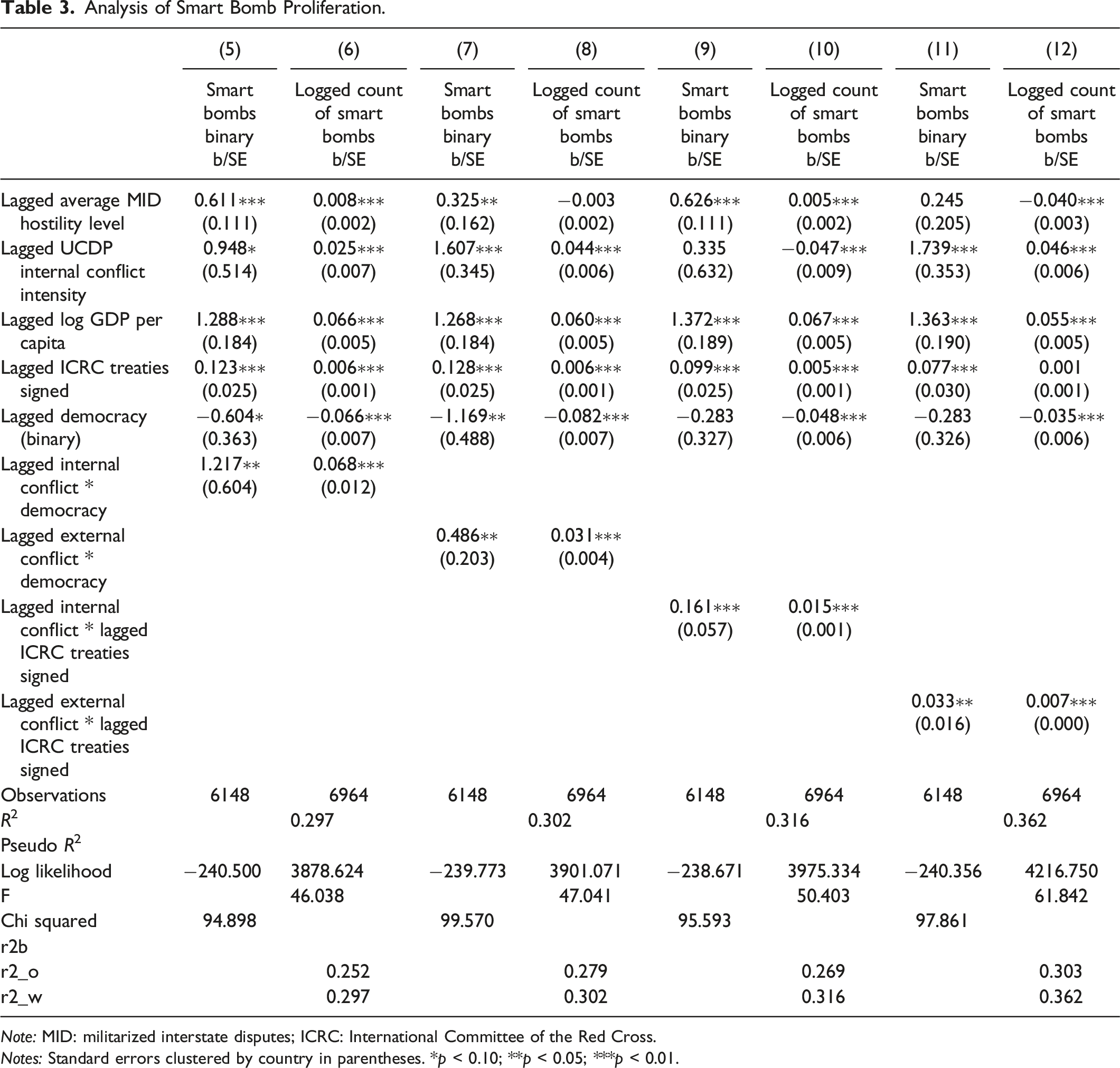
Note: MID: militarized interstate disputes; ICRC: International Committee of the Red Cross.
Notes: Standard errors clustered by country in parentheses. *p < 0.10; **p < 0.05; ***p < 0.01.
Models 9-12 evaluate the interactions between the security environment and ICRC treaty membership. Following the pattern for Models 5-8, Models 9 and 11 are random effects logits using the binary Smart Bomb Acquisition variable, focused on internal and external threats, respectively. Models 10 and 12 are fixed effects regression models using the Logged Smart Bomb Acquisition Count dependent variable. The interactive results again provide strong initial support for our interactive hypotheses. Both democracies and countries that sign treaties focused on the law of war become more likely to acquire smart weapons when facing external threats.
Though the relevant interactions are statistically significant, the coefficients of interaction terms can be misleading, especially when thinking about the lower-order terms. We shift to graphically representing the average marginal effects (AME) of these interactive relationships below. 20 Average marginal effects figures for any models not displayed below are available in the online appendix as Supplementary Figure A2. Additionally, given the interest in understanding between-country and within-country variation, in the appendix we estimate models following Bartels (2008) method of jointly testing for between-country and within-country effects in the same models (see Supplementary Table A20). We also follow a related suggestion and utilize random intercept models that combine fixed effects and random effects approaches in Supplementary Table A21 (Bartels 2008; Bell and Jones 2015; Zorn 2001). The results are robust to this approach, increasing our confidence in the overall findings.
Threat Environment and Regime Type
Based on models 6 (left panel) and 8 (right panel) in Table 3, the interaction between the threat environment and democracy in Figure 3 shows a significant correlation between regime type and both internal and external threats regarding the average marginal effect of acquiring smart bombs. Smart bomb acquisition is substantively and statistically least likely for democracies that do not face substantial internal or external threats. Additionally, as Supplementary Figure A1 in the online appendix shows, the average marginal effect for internal threats is close to 0.1 for democracies, meaning there is about a 10% increase in the probability of a country acquiring smart weapons for a one-unit increase in internal threats by a democracy. The average marginal effect for external threats is statistically significant across a wider span of threat levels, but the relative effect is smaller—closer to 0.025. Average marginal effect of regime type across external and internal threats.
One country that illustrates these interactions is Israel. 21 Israel domestically produces 11 different smart bomb variants, many of which feature hybrid GPS targeting and navigation systems with small warheads, optimized for missions where minimum collateral damage is of high importance. In addition, Israel imports another six different types from the United States and started doing so as early as 1976. 22 At a count of 17 different variants, in 2017 Israel boasted the second-highest number of smart bombs in its arsenal in the world after the United States.
The high number of intense, militarized, interstate disputes between Israel and its neighbors means it has a strong external threat perception. Additionally, its participation in the Israeli-Palestinian conflict, and the territorial disputes intrinsic to that conflict, contributes both to its external and internal threat perceptions. 23 In the year that Israel first acquired PGMs its average external hostility level, Average MID Hostility Level, was 3.81 and internal conflict intensity, UCDP Internal Conflict Intensity was 1—both well above the mean. 24 Weapons that emphasize precision, therefore, make tactical and operational sense given the nature of the conflicts Israel is involved in, and its proximity with its adversaries—which require stealth, fewer sorties, and limiting collateral damage as much as possible. For example, Israel used the GBU-39 Small Diameter Smart Bomb in 2008 and 2009 against targets located in the more densely-populated, urban Gaza strip (Frantzman 2020; Hodge 2008).
Within the same regions, the non-democracies of Kuwait and Qatar are instructive. In 2011 and 2013, respectively, Kuwait and Qatar acquired smart bombs. Using predicted values from our models, however, we can estimate the probability they would have acquired smart bombs earlier had they been democracies. For example, in 2008, Kuwait had a Polity2 Score of −7 and Qatar, − 10. If both were democracies (a Polity2 Score of 7 or higher), Kuwait would have had a 12% increase in the chance of acquiring in that year, while the probability of Qatar’s acquisition would have increased by 25%.
Threat Environment and ICRC Treaty Participation
The relationship between the threat environment and ICRC treaty participation also shows clear evidence of an interaction effect. Based on models 10 and 12 in Table 3, Figure 4 demonstrates a consistent, positive relationship between a more challenging threat environment and smart bomb acquisition as the number of ICRC treaties a country is a party to increases. While the absolute AME totals are not extremely large, they still suggest that, as threat levels increase, a one-unit increase in ICRC treaties ratified generates a 4% increase in smart bomb acquisition. Average marginal effect of International Committee of the Red Cross treaty membership across external and internal threats.
Colombia provides a clear illustration of the interaction between internal threats, regime type, and treaty membership. Colombia’s average Polity2 Score from 1960-2017 was 7.431 and never dipped below 7. By 2017, Colombia had signed 23 ICRC treaties. In the year Colombia acquired PGMs, 2002, it was a member of 17 treaty regimes, placing it above the 75th percentile for countries in 2002 in terms of ICRC treaty membership.
Since the 1960s, Colombia’s internal security landscape has largely been characterized by continuous, low-intensity asymmetric warfare between the government and a variety of sub- and non-state actors. This is reflected in it having an UCDP Internal Conflict Intensity score of 1.144, above the mean for all country years. As a result, Colombia’s weapons ”procurement focus has generally rested on counter-insurgency rather than conventional capabilities” (IHS Jane’s Defence Weekly 2019). Given that PGMs are optimal weapons for contexts that require high levels of maneuverability and agility, and, as noted above, therefore better primed for insurgent-like warfare, it is unsurprising that since first acquiring PGMs in 2002, Colombia has been a regular purchaser of Israeli, U.S., and Brazilian smart bombs, including the Paveway II LGB (Priest 2013). It is worth noting that it was during 2002—the year Colombia acquired PGMs—that the conflict peaked in intensity, with a UCDP Internal Conflict Intensity score of 1.8. President Àlvaro Uribe had just been elected based on a platform of cracking down on the guerilla movements. From 2002-2017, Colombia’s mean UCDP Internal Conflict Intensity was 1.253. More recent reports, including one by IHS Jane’s Defence Weekly (2019), have noted that Colombian arms producers have been working to develop more indigenous capabilities, including a laser-guidance kit.
Turning to the relationship between external security challenges and treaty membership, one example is the United Kingdom. It has a mean Average MID Hostility Level of 2.264 and by 2017 had signed 25 out of 27 possible ICRC treaties. The United Kingdom acquired its first smart bomb—the United State’s Paveway II LGB—relatively early on, in 1978. Since then, as our dataset shows, the United Kingdom has imported over 7, 053 Paveway munitions as of 2020.
Consistently involved in external conflicts, often alongside the United States, the United Kingdom has utilized its smart bomb capabilities. In 2012, it placed three separate orders, including one, for ******60 million GBP, specifically identified as replacements for smart bombs the United Kingdom used in Libya in 2011. 25 The United Kingdom has used Paveways multiple times, including in Afghanistan, Libya, and most recently, in Iraq and Syria. Data released by the Royal Air Force to the British Parliament in 2017 showed that “strikes against ISIS using the precision-guided bomb far outweigh other weapons used by the RAF,” including other PGMs (Chuter 2017). “In the 12 months from 2 December 2015, the figures show 1, 036 Paveway IV bombs were dropped, almost 10 times the number of dual-mode Brimstone missiles fired, and approaching four times the number of Hellfire strikes carried out by RAF Reaper remotely piloted vehicles” (Chuter 2017).
On the other hand, democratic countries facing a very pacific threat environment and which have not ratified a majority of the ICRC law of war treaties are therefore less likely to want PGMs. Examples of states that fit this model include New Zealand and Portugal in the late 1980s and early 1990s.
Three-Way Interaction Between Security Environment, Regime Type, and ICRC Treaty Participation
A limit of these interaction models is that they may not effectively incorporate the potentially endogenous relationship that exists between regime type and the likelihood that countries join the key treaty regimes noted by the ICRC. More democratic countries might be more likely, after all, to sign these types of treaties due to a normative commitment to the rule of law (Hafner-Burton 2012; Simmons 2009). The relationship between regime type and law of war compliance makes it necessary to account for this potentially confounding effect ? It raises the question of a three-way interaction between threat level, democracy, and treaties signed. While three-way interactions are difficult to interpret, and we do not directly hypothesize about this interaction, Figure 5 shows the graphical results of such an interaction for internal threats and external threats, respectively. We estimate the statistical model using the Logged Smart Bomb Acquisition Count dependent variable, with fixed effects by country and year, the same independent variables as in the prior models, and all subsidiary interaction terms. The results from the model are available in the online appendix. Figure 5 further illustrates a relationship between the threat environment, regime type, and a commitment to international law, as expressed by signing and ratifying key international treaties. Interaction between external and internal threats, International Committee of the Red Cross treaties, and regime type: Substantive effects.
For countries facing both internal and external threats, they not only become more likely to acquire smart bombs as their commitment to ICRC-noted treaties grows, but that effect is magnified when they are a democracy. This interaction suggests that democratic countries are not simply acquiring smart weapons because of their higher level of military effectiveness, but because of their interest in attempting to comply with the law of war when using military force.
Essentially, smart bomb acquisition may become more likely due to a combination of a normative commitment to the rule of law, a domestic political requirement to buy off criticism from the opposition, and an international political requirement to buy off criticism about the use of force. The statistical significance of the interaction, combined with the graphical results, shows that the relationship is not just additive. At higher levels of external threats, the marginal effect for democratic countries that have signed most of the ICRC treaties is 0.13, and it is even higher—0.275—for democratic treaty-signers facing extensive internal threats. Both of those differences are statistically distinct from non-democracies, as Figure 5 shows.
Economic and Information Technology Capacity in an Age of Informatized Warfare
As we hypothesize, GDP per capita is positive and significant in all models, as seen in both Tables 2 and 3. This follows logically, given the role that not just pure wealth, but a more sophisticated economy, can play in driving the capacity side of smart bomb acquisition. For example, the average GDP per capita for smart bomb acquirers in the year of acquisition is in the 80th percentile for GDP per capita across the entire dataset.
Adopting smart bombs, whether indigenously produced or imported, requires a baseline level of knowledge about how PGMs work. This is plausibly related to broader national expertise in information technology, given the systems integration required for smart bombs to function effectively, and overall, how informatized a country is. As described above, we use GDP per capita as a proxy for overall economic capacity and wealth. Figure 6 below shows how greater GDP per capita makes smart bomb acquisitions more likely. Impact of GDP per capita on smart bomb acquisition.
One might argue that this approach does not include the role that alliances play in the economics of the weapons acquisition process (Blanton 2000; Caverley 2007). Alliances and defense cooperation agreements certainly play a role as a key mechanism through which countries acquire weapons, including smart bombs. However, we focus in this paper on drivers—the why—of the proliferation of smart bombs, and what characteristics make acquisition and production attractive. In this context, alliance-driven exports are a means for smart bomb adoption, rather than a cause of proliferation. 26
An in-depth analysis in the online appendix shows that the type or method of acquisition—whether smart bombs were domestically produced, imported, or obtained from other states or allies via defense cooperation agreements—did not impact our results or significantly alter the likelihood a state would acquire smart bombs.
Yet, one limit to the models is that they capture economic capacity solely through measuring national GDP per capita. While GDP per capita is a validated measure of overall national economic capacity, the measure is much broader than the capacity of a country to adopt smart bombs in particular. Unfortunately, data on more precise measures of the information technology capacity of a country exhibit a high level of missingness, or the available information does not date back far enough to capture our full time series. 27 Despite these limitations, here we estimate models using more detailed measures of national information technology capacity, providing an additional approach to test hypothesis five.
We employ several approaches to account for the missingness and limits to the time series in them. First, since 2009, the International Telecommunication Union (ITU) has published an information and communication technology (ICT) Development Index (IDI), a composite index of 11 different information and computer technology indicators (International Telecommunications Union 2019; International Telecommunications Union). To extend the dataset further back in time, we recreated the IDI using the component measure and aggregation approach outlined on the ITU Web site. 28
Second, we test measures drawn from the World Bank Databank’s Science and Technology indicators, including national high technology exports, patents filed, and science and technical journal articles published. The high technology exports data begins in 1986 and comes from the United Nations Comtrade database, the patent data begins in 1980 and comes from the World Intellectual Property Organization, and the data on science and technical journal articles comes from the U.S. National Science Foundation and begins in 2000 (The World Bank). We take the natural log of each of the distributions to normalize them.
Using Model 2 from Table 2 as a baseline, we then re-estimate that model with these new indicators. Each model includes GDP per capita and one of the four measures described above. Supplementary Table A15 in the online appendix displays the statistical results, which are reassuring in demonstrating the role of information capacity in explaining smart bomb acquisition. Figure 7 below shows how predicted smart bomb acquisition varies across these IT capacity and informatization indicators. Probability of smart bomb acquisition for key information technology indicators.
The consistency of the results illustrates that, despite the missing data and limited time series, information technology capacity, in addition to economic capacity, likely plays an important role in shaping whether countries acquire smart bombs—and the number of types of smart bombs they acquire.
Robustness
While we cannot make a claim to causality, due to the observational character of this analysis, the combination of strong regression results and illustrative examples above makes us secure in the results. We also validate the results above with a number of models designed to test the robustness of the correlation between our key independent variables and smart bomb acquisition, as well as created alternative independent variables to test our measures of the security environment, economic capacity, and domestic and normative incentives. These robustness tests are in addition to those already described above in the paper.
These results are available in the accompanying online appendix (including figures to illustrate substantive effects, where relevant), and summary statistics for variables used for robustness tests are available in Supplementary Table A1. The additional tests include: • Potentially confounding independent variables such as material power CINC Score, defense spending—Correlates of War Military Expenditure
29
and SIPRI Military Expenditure
30
—membership in international organizations, Total IGO Membership,
31
and whether a country is a major power, Major Power. • Alternative measures of external threats: lagged interstate rivals Total Rivals,
32
lagged average MID participation, Average MID Yearly Count, and UCDP external conflict intensity, UCDP Interstate Conflict Intensity. • Alternative measures of internal threats: Total UCDP internal conflicts, UCDP Total Internal Conflicts. • Operationalizing the count of smart bomb acquisitions as a count variable, instead of logging it and using OLS, as we do in the main models. Given the overdispersion of zeroes, we use negative binomial models, though the results are robust to Poisson specifications. • Survival models and curves that operationalize smart bomb acquisition in a single failure context. • Replicating the key results in Table 3 without year fixed effects, and only with year fixed effects. • Replicating the key results starting the analysis in 1980, closer to when proliferation began, instead of using the full data series.
Conclusion
As smart bombs continue to spread around the world and play a prominent role in conflicts both within and between states, grasping what drives their spread is an important task. Most proliferation research focuses on nuclear weapons, for good reason, given their prominence in global politics. But since the use of force, fortunately, does not normally involve nuclear weapons, explaining how key conventional capabilities—such as smart bombs—spread can build new knowledge and insights for scholarship on international conflict, including on how states organize and employ their militaries.
This paper provides the first detailed empirical tests of the proliferation of smart bombs, drawing on a novel dataset that, in itself, can provide value for further research. The data highlights that while smart bombs have spread more slowly than analysts initially predicted after the Persian Gulf War in 1990-1991, proliferation has accelerated in recent years.
The statistical results show that states think about both the pure military utility of smart weapons and their ability to reduce collateral damage on the battlefield. There is an interaction between the security environment, regime type, and demonstrated commitment to the law of war, measured through ratifying treaties the ICRC views as important for IHL. For states such as Israel and Colombia that use force outside the interstate military context, precision weapons such as smart bombs help them use force in ways that they view as complying with the law of war and reducing international backlash. Economic capacity also plays a role, though. A higher GDP per capita and a more informatized economy make countries more likely to acquire smart bombs and to continue obtaining them even after the first acquisition.
These results have limits, of course. The observational character of the research design makes it difficult to tease out how regime type, international legal commitments, and smart bomb acquisition relate to each other in a causal manner. It is possible that some unknown additional factors could be influencing the relationships presented in the paper between these variables. Moreover, the dataset only captures one pillar of the precision strike complex writ large. Moreover, limits in the granularity and completeness of data on the informatization of economies around the world make effective testing of economic capacity arguments challenging. But the consistency of the results across time and space, as well as the illustrative examples, demonstrate a consistent trend that can serve as the foundation for future research.
These results not only have academic relevance but policy importance. Precision weapons play a vital role on the modern battlefield, whether the question is potential great power conflict in the Indo-Pacific or targeted strikes as part of confrontations between nation-states and militant groups. Modeling their proliferation can therefore help the policy world better grasp how military capabilities spread in general, and the way precision weapons may spread moving forward.
Supplemental Material
Supplemental Material - Who Gets Smart? Explaining How Precision Bombs Proliferate
Supplemental Material for Who Gets Smart? Explaining How Precision Bombs Proliferate by Lauren Kahn and Michael C. Horowitz in Journal of Conflict Resolution
Footnotes
Acknowledgements
We thank Daniel Brennan, Kai Burgmann, Camila Celi, Alexis Ciambotti, Julia Ciocca, Jordan Dewar, Kathryn Dura, Catherine Harrity, Ali Khambati, Casey Mahoney, Andro Mathewson, Jackson Min, Elizabeth Peartree, Shira Pindyck, Alexander Rabin, Julie Sonhen, Alex Sun, Noah Sylvia, Joshua Weiner, Karen Whisler, Maxim Yulis, and Jacob Ziemba for invaluable research assistance.
Declaration of Conflicting Interests
The author(s) declared no potential conflicts of interest with respect to the research, authorship, and/or publication of this article.
Funding
The author(s) disclosed receipt of the following financial support for the research, authorship, and/or publication of this article: This research was supported by the Minerva Research Initiative under Grant #FA9550-18-1-0194. The research reported here should solely be attributed to the authors; all errors are the responsibilities of the authors.

Supplemental Material
Supplemental material for this article is available online.
Notes
References
Supplementary Material
Please find the following supplemental material available below.
For Open Access articles published under a Creative Commons License, all supplemental material carries the same license as the article it is associated with.
For non-Open Access articles published, all supplemental material carries a non-exclusive license, and permission requests for re-use of supplemental material or any part of supplemental material shall be sent directly to the copyright owner as specified in the copyright notice associated with the article.
