




Abstract
Foreign electoral interventions have attracted greater attention since the Russian intervention in the 2016 U.S. elections. Even though the United States has a long history of intervening in other countries’ elections, evidence about what drives public support for U.S. foreign electoral intervention is scarce. This paper uses a new set of surveys and experiments to test hypotheses about what drives the American public’s views of U.S. electoral interventions abroad. We find that there is no taboo against such U.S. interference in the American public. However, public support for U.S. election interference is not automatic. Respondents do not support interventions solely to advance U.S. interests or to protect democracy, although they prove more supportive of interventions on behalf of democratic parties that also favor U.S. interests or to protect longstanding democracies. Finally, support for an intervention rises when it is framed as responding to the actions of a great-power rival such as Russia.
Keywords
Introduction
As the 1968 elections in Guyana approached, U.S. officials debated whether to intervene to block the election of the opposition People’s Progressive Party (PPP) led by Cheddi Jagan, whom Washington viewed as a dyed-in-the-wool Communist and a secret client of the Soviet Union. The United States was no stranger to meddling in Guyanese politics. A few years earlier, when Guyana was still British Guiana, the Kennedy and Johnson administrations had intervened to remove Jagan. They had instead installed his rival, Forbes Burnham of the People’s National Congress (PNC) party, as prime minister (Rabe 2006). Burnham was a less than perfect client who displayed pronounced authoritarian tendencies. In 1968, U.S. intelligence agencies discovered that Burnham planned to maintain power regardless of the forthcoming election’s outcome (Rabe 2006, 154–61). U.S. officials believed they faced a dilemma: respect democracy but potentially suffer a blow to U.S. interests, or promote U.S. interests by supporting Burnham and thereby risk sacrificing Guyanese democracy. The Johnson administration decided in favor of promoting U.S. interests. The United States intervened to support Burnham in various ways, including giving the PNC campaign funding and announcing a substantial loan for Guyana’s rice industry three weeks before election day. 1 The U.S. intervention appeared to succeed in the short term, as Burnham won (Rabe 2006, 162–66).
The U.S. intervention in Guyana exemplifies important aspects of partisan electoral interventions. First, electoral interventions were a routine foreign policy tool for the United States (and the Soviet Union) during the Cold War (Levin 2020a). Second, although Guyana’s strategic importance was marginal, the Cold War context of great power competition shaped the U.S. decision to intervene (O’Rourke 2018; Westad 2005). Third, foreign electoral interventions can take many different forms, not just the infamous methods used in some recent high-profile meddling cases. Fourth, electoral interventions can “succeed”, under certain definitions of success, even if they come at a cost in other ways. Fifth, policymakers may see the national interest and national values as opposing forces. Finally, the decision occurred without debate or input from the U.S. public, with the intervention as hidden as much from voters in the United States as from those in Guyana.
U.S. foreign election interference presents a puzzle: why would a country that proclaims itself “leader of the Free World” undermine democracy through electoral interventions? Cynics might argue that this puzzle is illusory. One scholar has asserted that she “cannot think of a case in which America’s democracy concerns superseded its national-security concerns” (Beinart 2018). Yet such assertions neglect variation in the empirical record. U.S. leaders have employed electoral interventions routinely but not universally, raising the prospect that ideals may carry the day at least occasionally. Further, revelations of U.S. electoral interventions conducted by CIA and other agencies in the 1970s sparked a public and congressional outcry because such interventions were seen as violating U.S. values. That episode also suggests that public opinion can be relevant to the conduct of even covert interventions, given that the revelations led to a pause in covert meddling and forced reforms to intelligence agencies’ practices. Yet condemnation is also not universal. As we discuss below, some other interventions enjoyed significant U.S. public support. We thus restate this general puzzle in a way more amenable to testing: Why does the U.S. public sometimes appear to support—and sometimes oppose—foreign electoral interventions conducted by the U.S. government?
Questions about electoral interventions do not belong to the past. Like other powers, the United States has intervened in foreign elections throughout the post-Cold War era (Levin 2020a). If the coming decades will feature renewed great-power competition, understanding whether such rivalries will lead to a resurgence in such interventions would be correspondingly important. Some commentators have already called for such measures to advance the U.S. national interest (Brands 2020). Others profess to find unthinkable the idea that the United States could interfere in others’ elections. Speaking after his 2021 summit in Geneva with Russian Federation President Vladimir Putin, U.S. President Joseph Biden rhetorically asked: “How would it be if the United States were viewed by the rest of the world as interfering with the elections directly of other countries, and everybody knew it? … It diminishes the standing of a country that is desperately trying to make sure it maintains its standing as a major world power.” 2
Russia’s intervention in the 2016 U.S. presidential election led to a new interest in foreign electoral interference. Yet the study of public opinion and partisan electoral interventions has so far focused on how targeted publics react to foreign interventions (Bush and Prather 2020; Tomz and Weeks 2020). Consequently, the field knows little about how the publics of intervening states view interventions carried out by their own government, a topic of theoretical, empirical, and practical interest.
In this paper, we report on several experiments designed to identify the sources for public support for U.S. interventions into other countries’ elections. These experiments include manipulations testing normative, interest-based, and great power competition-based hypotheses regarding support for intervening in foreign elections. Our findings depict a U.S. public skeptical of interventions for raisons d’etat alone but willing to contemplate interventions for other reasons. In particular, our evidence suggests the U.S. public will more likely support interventions to protect established democracies, undermine electoral authoritarian regimes, and counter Russian influence. We also find that respondents surveyed after Election Day 2020 were less likely to approve of interventions to defend democracy compared to respondents contacted before the elections, suggesting that contextual U.S. domestic political factors sometimes influence support for foreign interventions.
Theorizing U.S. Public Opinion and Electoral Interventions
We begin by reviewing academic findings regarding American public opinion toward U.S. foreign policy and, separately, the public justifications of U.S. electoral interventions given by U.S. decisionmakers, former operatives, and supportive commentators. From our review of these sources, we distill hypotheses for testing, which we discuss in the subsequent section.
Electoral Interventions
A growing literature investigates partisan electoral interventions. Scholars have researched the causes of such interference (Bubeck and Marinov 2019; Levin 2020a) as well as interventions’ immediate effects on the target’s electoral results (Levin 2016), their medium-term effects on the target’s democratic regime and welfare (Corstange and Marinov 2012; Levin 2020b; Tomz and Weeks 2020), and their longer-term effects on the target’s cooperation with the intervener (Levin 2021). Other research has investigated how interventions affect the targeted state’s public’s evaluations of the intervener and support for cooperation with it (Bush and Prather 2020; Shulman and Bloom 2012) and the views of third-party publics of the target’s reliability as an alliance partner (Goldsmith and Horiuchi 2020). Few researchers, however, have investigated the factors that determine U.S. public support for U.S. partisan electoral interventions abroad. Nevertheless, we find this literature useful in specifying scenarios and potential hypotheses regarding the sorts of interventions that could take place and what justifications could be offered.
U.S. Public Opinion and Foreign Policy
Debates regarding the relationship between U.S. foreign policy and public opinion have raged for decades. Some hold that the public is guided by elites, with little room for public input (Berinsky 2009; Jacobs and Page 2005). Yet there are reasons to believe that public opinion influences foreign policy. First, if elected officials and other policymakers act according to a logic of “anticipated representation”, making policies congruent with their expectations of what the public would desire if the public were informed about policy, then policy will be responsive even without overt public participation (Arnold 1990). Such a model fits with observations about how policymakers track even minute shifts in public opinion (Druckman and Jacobs 2006). Second, although elites may influence public opinion in the short term (Guisinger and Saunders 2017), in the long run reality will reassert itself (Baum and Groeling 2010) and thus potentially allow the public to check longstanding elite excesses. Third, recent research suggests that reports of public opinion influence policymakers and other officials in democracies. In experiments, members of the Israeli Knesset (Tomz, Weeks, and Yarhi-Milo 2020) and the British Parliament (Chu and Recchia 2022) became more willing to use military force when informed the public favored it, while military officers became less likely to recommend the use of force when informed that the public opposes such measures (Lin-Greenberg 2021).
A related debate concerns what factors affect popular approval of foreign policy strategies. As the Guyanese example demonstrates, partisan electoral interventions may pit normative and interest-based movitations against each other. Recent work has investigated what arguments best persuade the public to support foreign policy interventions, including arguments that compare interest-based and values-based rationales. Such work has not yet reached a consensus, however. Different experimental studies yield contrasting conclusions even in adjacent substantive areas. Research regarding U.S. foreign aid finds public opinion to be malleable by both interest and values-based arguments (Hurst, Tidwell, and Hawkins 2017; Heinrich and Kobayashi 2020; Allendoerfer 2017; Heinrich, Kobayashi, and Long 2018; Christiansen, Heinrich, and Peterson 2019). Some research regarding U.S. opinion toward humanitarian intervention find that moral arguments predominate (Wu and Knuppe 2016; Kreps and Maxey 2018), while a study of U.S. opinion toward the International Criminal Court posits that interest-based attitudes prevail (Zvobgo 2019). Others find a relationship between local interests and preferences regarding foreign aid: Americans are more likely to oppose cuts to aid that also benefit their interests (Christiansen, Heinrich, and Peterson 2019; Heinrich and Peterson 2020). It thus appears reasonable that empirical assessments would be necessary to determine what arguments regarding electoral interventions would be most persuasive to the public.
Some might object that public opinion is unimportant regarding electoral interventions because they are covert. This objection does not withstand scrutiny. First, 34.6 percent of U.S. electoral interventions since the Second World War have been overt (Levin 2020a). Second, states might favor covert operations to avoid the escalatory force of public opinion (Carson 2020). The decision of whether to make an operation covert could thus be endogenous on public opinion. Policymakers have weighed the risks of disclosure when considering whether to undertake covert meddling. During the 1970s, the U.S. ambassador to Italy objected to proposed meddling in Italian elections because the possible revelations of such covert CIA activities could embarrass the Ford administration (Hersh 1976). (Lending credence to fears about disclosure, those deliberations leaked in almost real time.) If policymakers believe the public would disapprove of interventions, then such an anticipated reaction could guide the conduct of even covert interference. 3 Thus, both general and specific observations point to possible pathways by which the public may affect the conduct of electoral interventions.
Public Justifications Regarding U.S. Electoral Interventions
A separate stream of material relevant for theorizing comes from a review of the public justifications offered by policymakers (serving or retired) and friendly commentators for previous U.S. electoral interventions. These hold value because they are strategically deployed to sway the public (or at least parts of the public) to support interventions. In that sense, they represent policymakers’ best guesses about what the public would find to be persuasive justifications.
We do not rely on these sources naively. Public justifications may not disclose the fundamental reasons for why the United States intervened in a particular foreign election, nor does the repetition of a justification mean that it should be taken with greater weight (Tilly 2008). Research on such meddling demonstrates that stated justifications should be taken with a pinch—or a cellar—of salt. Nevertheless, they reflect an implicit elite theory how the public forms opinions (O’Mahoney 2015), and thus deserve testing.
Hypotheses
We derive five categories of hypotheses from the foregoing review.
Normative Motivations for Intervention
The first set of hypotheses concerns whether an intervention would support democracy. Americans have long prided themselves as exponents of democracy as a putatively superior and universally attractive regime type. Accordingly, the public has long, if not universally, supported foreign policies to protect and promote democracies (Smith 2012).
That longstanding disposition may be changing. On the one hand, the contemporary crisis of liberal democracy has alarmed pro-democratic elites in the United States, which may have activated support for defending existing democracies and for promoting democracy in authoritarian regimes (Levitsky and Ziblatt 2018). On the other hand, recent polls suggests that Americans may place a low priority on democracy promotion relative to other goals, such as protecting jobs, stopping the spread of infectious disease, and promoting national security. Recent survey experiments also find that few Americans are interested in democracy promotion regardless of the exact justification given for such policies (Brancati 2014; Drake 2021). 4 Evidence from Europe similarly suggests that more intense policy demanders may place their policy priorities ahead of democracy promotion (Faust and Garcia 2014). 5
It is hard to deduce from first principles whether events such as the 2016 Russian interference in U.S. elections and a more general retreat of democracy have made democracy promotion and protection more or less attractive as a reason to support electoral intervention. Still, it remains possible that democracy promotion and protection could prove important in shaping attitudes toward electoral intervention. Framing an intervention as supporting a democratic regime may mitigate normative objections to interventions (Poznansky 2015). Policymakers frequently use such justifications, as when a former senior CIA official defended U.S. electoral interventions in Chile by claiming that they were meant “to preserve the democratic constitutional order” (Meyer 1982, 198). Former CIA head James Woolsey claimed that the United States “support[ed] democratic parties” in the 1948 Italian elections “in order to ensure that the election was conducted democratically” (The Guardian 1993).
Extending those arguments, the “quality” of the regime in which intervention takes place could matter as well. Given the widespread American tendency to emphasize the longstanding nature of the American democratic tradition, Americans may judge that another country’s democracy, like wine, becomes more valuable (and “worth saving”) with age. Alternatively, Americans may judge a democracy’s age to serve as a measure of robustness and “good health” and thus be more likely to benefit from an American intervention than a younger and potentially “sicklier” democratic regime. Indeed, one common criticism of the covert U.S. actions against Chile in the 1970s highlighted that Chilean democracy was venerable. Recent experimental evidence suggests that Americans favor more aggressive forms of democracy promotion (including military interventions and economic sanctions) against older authoritarian regimes compared to younger ones (Escribà-Folch, Muradova, and Rodon 2021), supporting this intuition that regime age may matter.
Alternatively, if the incumbent party manages a competitive or electoral authoritarian regime, public support for an intervention may increase if the intervention is framed as supporting a democratically minded challenger against entrenched authoritarian-minded incumbents. Challengers in competitive authoritarian states frequently face rigged elections in which the incumbents mobilize significant structural or resource advantages to remain in power (Levitsky and Way 2002). Research has found heightened U.S. public support for democracy promotion in competitive authoritarian regimes (Escribà-Folch, Muradova, and Rodon 2021). Representatives of the U.S. government have often justified their democracy promotion actions in such contexts in terms of working to “level the playing field” (e.g. Carothers 2013, 103–4). Such disparities may also increase support for intervention out of a desire for fairness (Gottfried and Trager 2016).
From this literature, we derive the following hypothesis and sub-hypotheses:
H1: The more democracy is perceived to be supported by the possible results of an intervention, the more that respondents will support U.S. intervention, all else equal
H1.1: Respondents will support interventions more strongly when the intervention is occurring in an established democratic regime than in newly democratic governments
H1.2: Respondents will support an electoral intervention more strongly when such interventions would be perceived as promoting democracy in a competitive authoritarian regime
H1.3: Respondents will support an electoral intervention in an existing democracy more strongly when it is perceived as being in danger (as seen by whether the authoritarian-inclined party is ahead or behind)
The null hypotheses would be that the quality and age of democracy do not matter—that regime types altogether are irrelevant or that the relevant distinction is only between democracies and non-democracies.
National Interest
Another possible motivation for supporting electoral interventions concerns perceptions of the “national interest”. The U.S. government, and even the U.S. public, has occasionally supported larger, costlier operations than electoral meddling (including violent regime change) to influence or change the leadership of other countries when such leaders are believed to pose a national security threat to the United States. Similar views could a fortiori produce support for electoral interventions.
The logic that shaped many historical electoral interventions adds a further twist. At times, the existence of a democratic regime in the target can itself harm U.S. interests by enabling policies contrary to U.S. goals, such as raising the possibility of changing foreign policy alignments or stiffening the resolve of the target’s leaders against making concessions due to pressure by the target public (for a similar logic, see De Mesquita and Downs 2006; Berger, Corvalan et al. 2013). In a memorandum to President Lyndon Johnson, Secretary of State Dean Rusk described the principal U.S. strategic objective regarding Guyana in the 1960s as preventing “[the] emergence of another Communist state” and warned that “there is grave risk of Jagan’s establishing a Castro-type regime should he attain independence”. 6 Similarly, U.S. officials saw the German Social Democratic Party as a threat before the 1953 West German elections because it opposed creating the European Defense Community (EDC), intended to help defend Western Europe from Soviet attack (Levin 2020a, Chapter 3). 7 Some electoral interventions have been openly justified in these terms. The influential U.S. columnist Walter Lippman (Milne 2015) supported the U.S. intervention in Argentina by claiming that Perón “waged an undeclared war” against the United States and “gave active aid and comfort to our mortal enemies” such as Nazi Germany. Those actions, Lippmann argued, made the question of whether Perón was a “dictator or democrat…altogether irrelevant”. 8 In such cases, U.S. leaders have sometimes proven willing to support advancing U.S. interests at the expense of democracy using other intervention methods (De Mesquita and Downs 2006; Berger, Corvalan et al. 2013). Some research asserts that the pursuit of national interest rather than democracy promotion better explains the record of Western interventions (Grigoryan 2020). 9
It is theoretically plausible that interest-based arguments could generate support for electoral interventions, justifying empirical testing. To that end, we derive the following hypotheses from this literature:
H2: The more U.S. interests are perceived to be threatened by the possible results of a foreign election, the more that respondents will support U.S. intervention, all else equal
H2.2: When interests and norm-based considerations conflict, the public will favor interventions in the U.S. interest more than interventions that would support democracy in the target
H3: The more the U.S. national interest is perceived to be at stake, the more likely respondents will be to support U.S. intervention.
The null hypothesis would be that interests do not matter, suggesting that only normative factors shape evaluations.
National Interest and Great Power Rivalries
The behavior of rival powers could also affect the American public’s support for electoral intervention. A longstanding liberal exception to the principle of non-intervention holds that when illiberal states intervene in other countries, especially for illiberal purposes, it may be morally permissible for a liberal country to intervene “to redress that balance when it is already unfairly and violently disturbed” (Mill 1984; original 1859). Given a common American view of the United States as a liberal world power and of its adversaries as illiberal (Oren 2003), we would expect this reasoning to strike a chord in situations (such as protecting free elections in other democracies) where the nonintervention norm might otherwise be inviolable.
A different reason to expect support for an intervention might come from the zero-sum nature and strategic pressures produced by great-power rivalry itself. Foreign electoral interventions may generate public support through a concern for the balance of power in a certain region or in general. Such effects may be context-specific. Australians and New Zealanders become less supportive of foreign aid when framed as a tool of geostrategy against rivals (Wood, Hoy, and Pryke 2021). Still, the frequency with which U.S. officials have employed that rhetorical justification suggests that Americans may be more receptive. Former CIA director William Colby defended U.S. intervention in the 1958 Italian elections by claiming the Italian communist party was receiving “massive support” from the Soviet Union (Colby 1978), while former president Richard Nixon defended his intervention in Chilean elections by claiming that it would have been “the height of immorality” for the U.S. to “stay its hand” when the Soviets were “interfere[ing] with impunity” (Nixon 1978).
Applying that logic to U.S. interventions, Americans may be more willing to support meddling in foreign elections when they believe that one of the sides is already receiving assistance from a rival foreign power, particularly an illiberal one. From this literature, we derive the following hypothesis:
H4: Interference by a hostile foreign power in an election occurring in another country will increase support for an intervention by the U.S. in that election.
The null hypothesis would be that monadic considerations alone drive U.S. foreign policy evaluations.
Projection of Domestic Election Experiences
A fifth hypothesis concerns the salience of domestic election experiences for Americans as they weigh interventions in other countries’ elections. For Americans, elections involve extreme levels of partisan emotions and election outcomes affect perceptions of electoral integrity (Pierce, Rogers, and Snyder 2016; Daniller and Mutz 2019). Taking these observations together, it seems likely that the context of a domestic election, which activates different identities as well as beliefs about zero-sum rivalries and what might be acceptable to help one’s in-group win, will temporarily affect perceptions of the efficacy and acceptability of foreign electoral interventions.
Recent events may have affected Americans' views toward election meddling. Although the 2016 Russian interference was not the first time that foreign powers had intervened in a U.S. election (Levin 2020a), it was unusually public. Many Americans viewed the experience negatively and feared a reprise in 2020. 10 In a February 2020 survey, more than 70 percent of Americans expected Russian or other foreign interference in the presidential elections (Gilberstadt 2020)—and not without justification, as U.S. intelligence services widely publicized the evidence for attempted Russian meddling in the 2020 elections. 11
Such experiences could shape Americans’ attitudes toward their own government’s interventions in two ways. Just as Vietnam War-era American men likely to be drafted became more dovish in general for decades (Erikson and Stoker 2011), they could have become less likely to support interventions. Alternatively, having witnessed a seemingly effective intervention may have boosted support for U.S. meddling elsewhere. Much of U.S. counter-terrorism efforts since 9/11, and more recently its cyber activities, have been openly and repeatedly defended by various administrations as a way of preventing threats abroad from affecting Americans at home. A similar logic could prove appealing regarding electoral interventions. 12
We test these expectations with a final hypothesis:
H5: Respondents will be more supportive of election interference by the U.S. after the 2020 U.S. election than before the election.
Methodology
Many studies of foreign electoral interventions have employed observational data (Bubeck et al. 2022; Levin 2019b, 2019a, 2020b; Shulman and Bloom 2012). The field has recently turned toward experimental methods (Bush and Prather 2020; Tomz and Weeks 2020), a turn we follow. We chose to explore American voters’ opinions regarding foreign electoral interventions with several vignettes rather than alternative approaches, such as the conjoint experimental approaches that other scholars have recently employed in the foreign policy literature (Escribà-Folch, Muradova, and Rodon 2021; Leal and Musgrave 2022). Given the indeterminacy of the literature, the resources that conjoint experiments require, and the fact that a conjoint can only explore one type of scenario at a time (even though they can explore many different aspects within that scenario), we believed that a series of related but distinct scenarios would be more productive at this stage of the literature’s development. Furthermore, using multiple experiments may increase external validity (McDermott 2011, 37–38).
We recruited subjects in two ways. First, we fielded two experiments (denoted here as Experiments 2 and 5) on a 1,000-respondent module of the 2020 Cooperative Election Study (CES, formerly the Cooperative Congressional Election Study or CCES). The questionnaire was administered in two waves: one during late September to late October, before the 2020 U.S. election day (November 2), and the second later in November, after the election. Second, we used Lucid’s online respondent marketplace to recruit subjects for Experiments 1, 3, and 4 during October and November 2020. Recent research suggests that Lucid compares favorably to MTurk and provides more representative samples of the U.S. population (Coppock and McClellan 2019). Further, concerns about experiments’ external validity may have been exaggerated as causal effects recovered from convenience-sample experiments frequently approximate findings from representative samples (Coppock 2019). Pandemic conditions have not substantially affected the validity of this method (Peyton, Huber, and Coppock 2021). In the first wave of this second survey (approximately 2,000 respondents), we included mostly questions about respondents' attitudes on various topics. Then, we recruited respondents who had completed the first wave to take a followup survey containing several experiments whose order was randomized; this yielded approximately 930 respondents. This panel structure allowed us to recruit subjects from a wider pool and ensure diversity with respect to age, educational attainment, partisanship, and gender. We employed quotas to ensure that no group (for instance, white men) was substantially overrepresented.
Pursuing both sample recruitment methods enabled us to benefit from the advantages of both the high-quality CES sample and the efficiency of online convenience recruitment. Furthermore, given that both surveys were in the field at approximately the same time, we believe it is reasonable to assume that variance in outside events that could shift beliefs about election intervention has been minimized. The panel structure of our Lucid experiments offered further advantages, notably allowing us to measure respondents’ baseline views while minimizing pretreatment bias for the experiments themselves.
We analyzed the experiments according to a pre-analysis plan filed in early 2021, before we received the data. For all experiments, our key dependent variable measured respondents’ support for a U.S. electoral intervention. To prevent such a binary choice from artificially inflating public support for either option, we also permitted respondents to mark whether they are not sure. As part of our pre-analysis plan, we specified that we would analyze questions with more than five percent of respondents selecting “don’t know” with multinomial logistic regressions. To our surprise, all our experiments featured this level or higher of such responses.
The political atmosphere associated with the Trump administration led us to take an additional pre-analysis step. To establish whether respondents’ evaluation of the president was affected by how we identified the president in our experiments, we conducted a pre-test using similar scenarios in summer 2020 that varied whether Trump was identified as president or not (including whether the scenario was specified as happening after both potential consecutive Trump terms had ended). We found no variation across those treatment conditions (see Appendix), in line with other findings (Evers, Fisher, and Schaaf 2019).
Experiments
We present each experimental design and results grouped thematically.
Testing Normative Arguments for Interventions
We test Hypothesis 1 with two experiments. Experiment 1 tests whether respondents support interventions for democratic considerations when only the magnitude of gain is great. Experiment 2 tests two additional contextual variables, including treatments regarding the possible effectiveness of intervention (as measured by hypothetical pre-election polling) and the context of the decision (as measured by whether the experiment was conducted before or after the November 2020 elections).
Experiment 1
In Experiment 1, conducted on Lucid, we presented respondents with a scenario testing common normative arguments in favor of electoral interventions to save democracy from an authoritarian challenger or promote democracy in a competitive authoritarian regime:
Next year, a foreign country will hold national elections between its two leading parties.
The
• If “fully democratic”: They expect the upcoming elections to be free and fair, favoring no party. • If “a dictatorship that occasionally conducts elections”: They expect the upcoming elections to be heavily rigged in the [Incumbent] Party’s favor.
By contrast, independent observers believe the opposition
Treatment 1 was evenly randomized. In the democratic condition, respondents were informed that the incumbent party ruled “a fully democratic government.” In the dictatorial condition, respondents were informed that the incumbent regime was “a dictatorship that occasionally conducts elections.” 13
Treatment 2 was also evenly randomized. If the incumbent regime was fully democratic, the challenger could be described as: • “is strongly committed to turning the country into a full dictatorship” (strongly dictatorial) • “might turn the country into a full dictatorship” (weakly dictatorial)
If the incumbent regime was a competitive authoritarian regime, the challenger could be described as: • “is strongly committed to turning the country into a full democracy” (strongly democratic) • “might turn the country into a full democracy” (weakly democratic)
Respondents were asked “Would you approve of the U.S. taking actions to support the [Pro-Democracy] Party in the upcoming elections?” Overall, 23 percent of respondents chose “No”, 49 percent chose “Yes”, and 28 percent chose “Not sure”.
This experiment was designed to allow us to test H1, particularly H1.2 and H1.3, regarding Americans’ willingness to support interventions that protect and promote democracy. It offered no information about the likelihood of which side would win absent an intervention, nor did it provide any information about other U.S. interests that could be in play.
Our key independent variable is the position of the challenger, which we code as a four-point variable from 0 (“strongly dictatorial”) to 3 (“strongly democratic”). We model the responses across all scenarios. We also, per H1.2 and H1.3, split our samples across conditions in which the incumbent is democratic and those in which the incumbent is authoritarian. We model this using only the specified treatment variables, a variation that includes measures for technical experimental factors (such as randomized experimental order) and attentiveness, and a full version that adjusts for demographics, including partisanship, and for respondents’ attentiveness to following instructions and consistency in answering basic questions about their demographics across the two waves, as well as support for democracy promotion and democracy protection from the first wave. Regression tables with the full results of all models, and the subsequent, experiments can be seen in the online appendix.
As Figure 1 demonstrates, our experimental manipulations fail to reach statistical significance at conventional levels, implying that we fail to reject the null hypothesis of no effect. The appendix demonstrates that this lack of significance holds across different subgroups of interest, including gender and party identification. Results of multinomial logistic regression for Experiment 1.
Experiment 2
In Experiment 2, conducted on CES, we tested H1.1 and H1.3 as well as H5 regarding the timing of U.S. elections and the contextual effect on respondents’ willingness to intervene. Respondents were presented with a vignette:
Next year, a foreign country will hold national elections. Independent observers agree that the Orange Party candidate strongly supports the country’s
The first treatment evenly and randomly varied how established the country’s democracy is, while the second treatment evenly and randomly varied the risk posed by the Turquoise Party (the anti-democratic party) to the target’s democracy. Compared to Experiment 1, this experiment manipulated the risk to the target’s democracy by providing election polling showing the anti-democratic party leading or trailing. It also focused on protecting democracy from an authoritarian challenger. To test H5, half of respondents received the survey before the 2020 general elections and half afterward (minus attrition).
Respondents were asked “Overall, would you approve of the U.S. government taking actions to support the Orange Party, which supports democracy, in the upcoming elections?” Twenty-four percent of respondents answered “No”, 36 percent answered “Yes”, and 40 percent answered “Not sure”. The level of aggregate approval is higher among respondents who received this experiment in the pre-election period. 14
We again present different models, one including only treatment variables and another including demographics (such as age, race, and gender) and partisanship. A third, broader model also included adjustments for political knowledge and attitudes. To measure political knowledge, we used a scale defined from the extensive CES questions about knowledge of U.S. political officials and partisan control of federal and state legislatures. To measure political attitudes, we used two sets of measures. CES asked several questions regarding executive actions taken on foreign policy issues during the Trump administration, which we combined using factor analysis into a foreign policy attitude scale. We also included a question in the pre-election wave asking about respondents’ views regarding the “long-range foreign policy goals of the United States”, including whether they believed that “Protecting existing democracy in other nations” should be a top priority, somewhat of a priority, or not a priority for the United States.
We find that our key treatments are statistically and substantively significant in shifting respondents between the “No” and “Yes” categories (but not “Not sure”). Specifically, the coefficient for “longstanding” democracies is positive and statistically significant; the coefficient for the anti-democratic Turquoise Party “leading” the democratic Orange Party in the polls is positive and statistically significant; and the coefficient for the experiment being administered after the election is negative and statistically significant.
Figure 2 presents coefficient estimates and substantive effects. When the anti-democratic Turquoise Party is described as leading the pro-democratic Orange Party, opposition to intervention drops by 6.7 percentage points compared to when it is described as trailing. Similarly, opposition to the intervention rises by 6.2 percentage points for respondents surveyed after the election compared to those surveyed before; support falls by 9.8 percentage points for the same comparison. Changing from a new to a longstanding democracy boosts support for an intervention by 8.7 percentage points, while also lowering opposition to an intervention by 6.6 percentage points. As the appendix demonstrates, these results are robust to alternative specifications. Results from Experiment 2, including multinomial logistic regression coefficient estimates and predicted probabilities.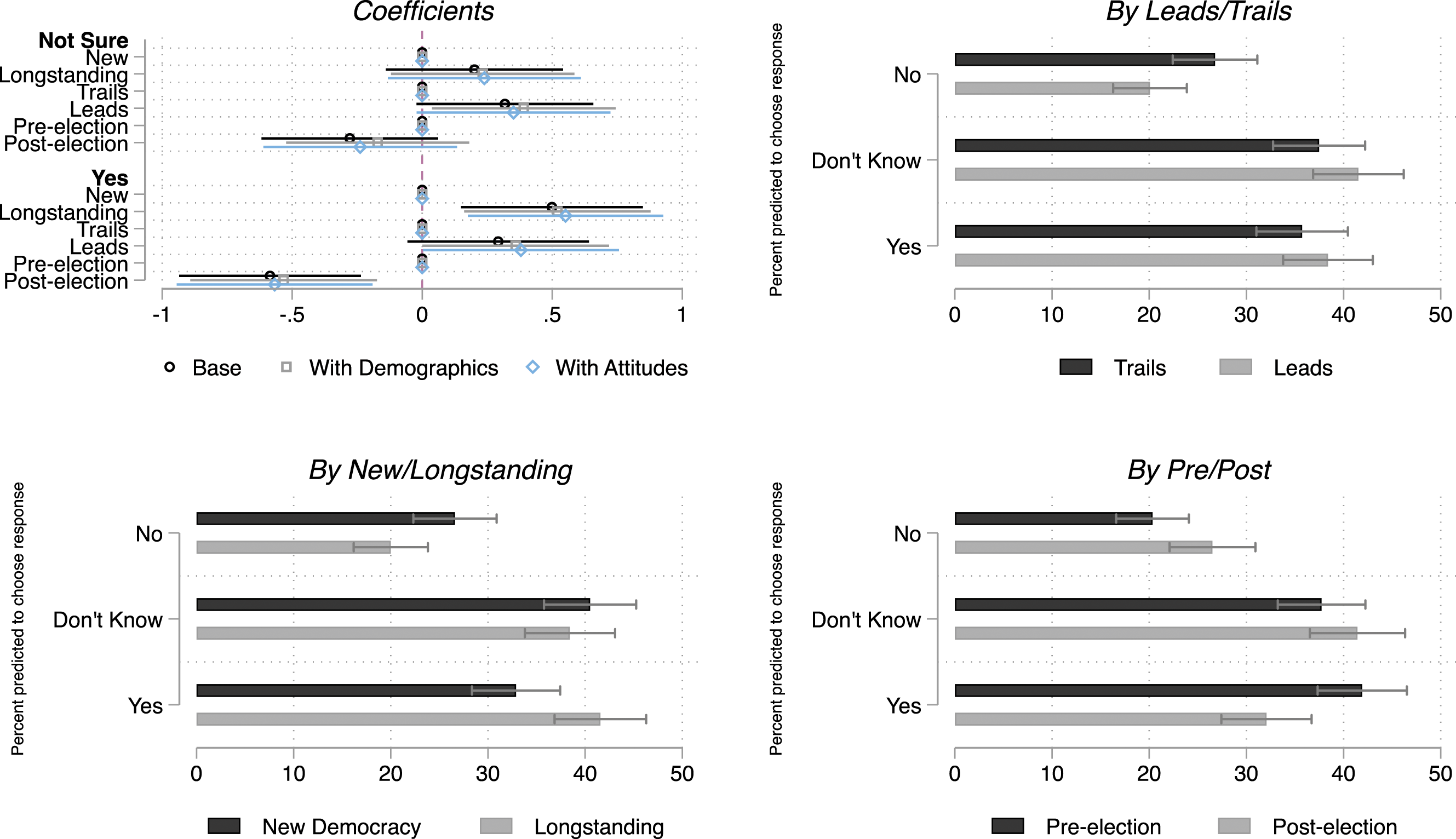
These findings represent a rejection of the null for H1.1, the hypothesis that respondents will support interventions to protect older democratic regimes, and for H1.3, the hypothesis that respondents will support an electoral intervention when the pro-democratic side is perceived as being in danger of losing. They also represent a rejection of H5, the hypothesis that respondents would support an intervention after the U.S. election compared to beforehand, but with findings pointing to the idea that the true relationship was exactly backward from what we had expected.
The appendix includes additional results, including additional specifications and segmented results for groups including gender and party ID. Although analyzing subgroups should be done with great care, the effect of the post-election treatment is strongest for Democrats, for Independents and for women, with Republicans, and men, apparently unaffected by the timing of the survey. Women and Republicans are more sensitive to the treatment condition involving whether a democracy is longstanding or not, both groups being more likely than the relevant comparisons to support protecting a longstanding rather than a new democracy. Multinomial logistic regression coefficient estimates for Experiment 3.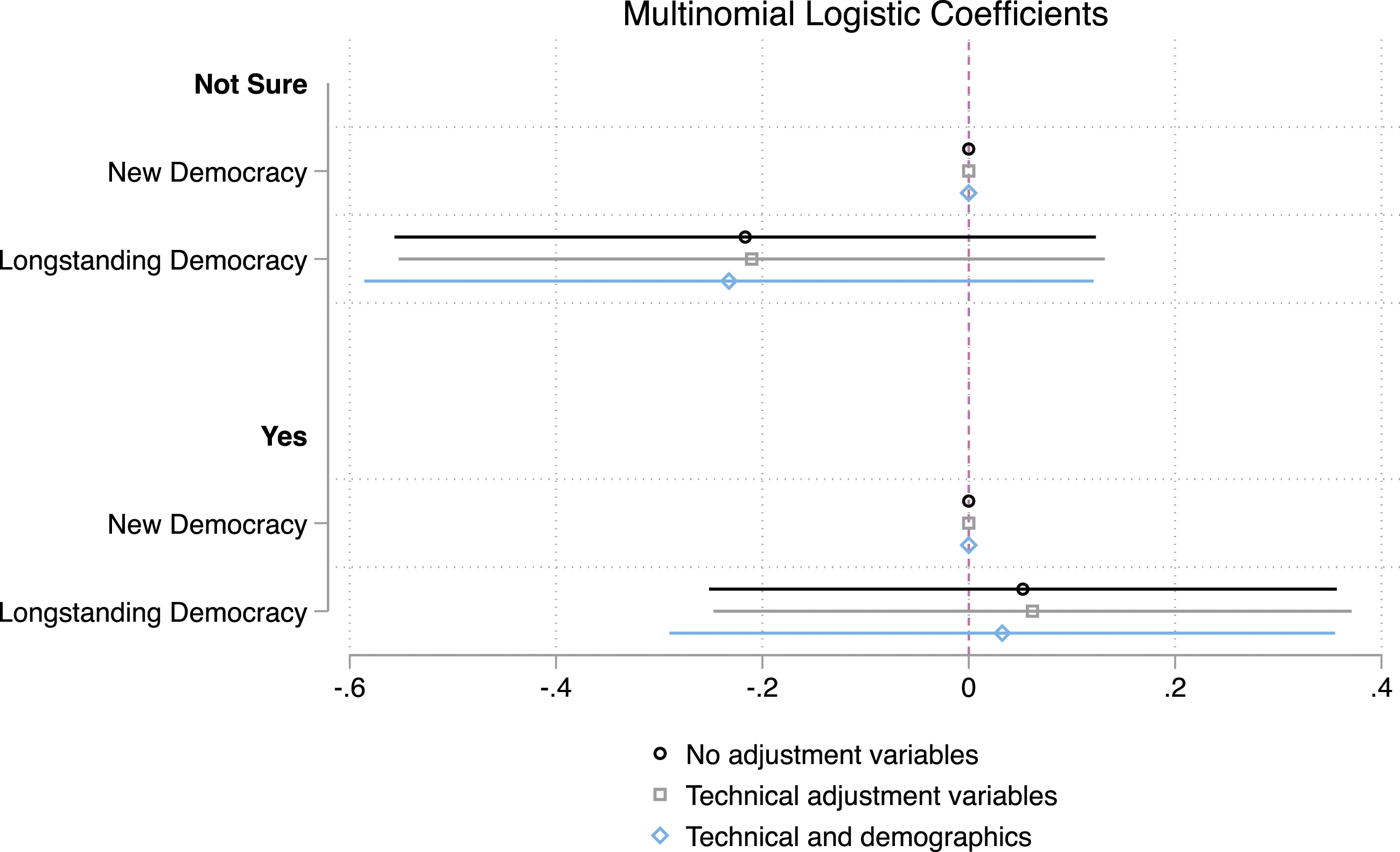
Discussion of the Normative-Only Experiments
These experiments suggest several relevant factors. Overall, respondents were willing to contemplate intervention, as the raw frequencies of responses show. There is some evidence that normative justifications for interventions are grounded in some version of how Americans think about partisan electoral interventions abroad. We find evidence consistent with our hypothesis that respondents will more strongly support interventions to protect longstanding democracies, although only in Experiment 2. Similarly, respondents’ increased support for interventions against an anti-democratic party that is likely to win suggests that the normative injunction against interventions is far from absolute. Finally, respondents being more likely to reject intervention after the U.S. election compared to beforehand suggests that the domestic context within which respondents are making up their minds shapes how they view an external action that is seemingly unrelated.
Testing Normative and Interest-Based Arguments Head-to Head
Experiments 1 and 2 provide evidence about the ability—and the limits—of normative justifications rooted in democracy promotion and democracy protection to sway public opinion to support electoral interventions. By design, however, those experiments can say little about the role of interest-based arguments or how the effects of normative preferences interact with those of realpolitik preferences. Accordingly, in this section we consider two additional experiments that include both normative and interest-based arguments.
Experiment 3
In Experiment 3, respondents read a vignette in which the U.S. government was said to be contemplating intervening on behalf of a pro-U.S. but anti-democratic Turquoise Party against a pro-democratic but anti-U.S. Orange Party.
15
As with Experiment 2, we varied how long the target country’s democracy had been established and whether the Turquoise Party led or trailed the Orange Party in the polls. Note that this design (inspired in part by the Guyana case) constrains interest and ideals to be opposed.
A foreign country will hold national elections next year.
Independent observers agree that the Orange Party candidate strongly supports the country's
In foreign policy, the Orange Party strongly opposes U.S. policies. The Turquoise Party staunchly favors U.S. policies. A victory for the Turquoise Party would lead to a more favorable outlook for certain American interests.
Recent polls show that the Turquoise Party
The U.S. government is debating whether to intervene in the election on behalf of the Turquoise Party.
This allowed us to test H1 (reformulated according to whether respondents would oppose interventions on behalf of an anti-democratic party), H1.1, and H2, the degree to which the U.S. interest was threatened by an election. Respondents were asked, “Would you approve of the U.S. taking actions to support the pro-U.S. Turquoise Party in the upcoming elections?” Thirty-one percent of respondents responded “No”; 42 percent responded “Yes”; and another 27 percent responded “Not sure”. We used similar models as in Experiment 1.
The results (see Figure 3) indicate that when Americans are asked to sacrifice their democratic preferences to install, via elections, a pro-U.S. client in a foreign country, there is limited to no support for that proposition. The coefficient of the treatment varying the threat of an anti-U.S. yet democratically-minded Orange Party winning the elections approaches (but does not achieve) significance at conventional levels. Likewise, the coefficient estimates for the treatment varying the age of the democratic regime approaches neither statistical nor substantive significance, indicating that this preference does not vary with the age of the regime in question. The appendix demonstrates that these results hold for subgroups in general, with the principal exception that men and Republicans are more likely to support an intervention in favor of the pro-American authoritarian party if that party already leads in the polls.
Experiment 4
The results of Experiment 3 may reflect its design that pitted interests and normative factors against each other. Experiment 4 relaxes that constraint by allowing either the pro- or anti-democratic party to support or oppose U.S. interests. We also vary whether independent observers describe the incumbent regime as democratic or authoritarian and whether the challengers strongly or weakly seek to overturn the incumbent regime type.
Respondents were informed that “Next year, a foreign country will hold national elections between its two leading parties. Officials in the U.S. government are considering what policy to adopt regarding these elections.” Respondents were shown a table summarizing the differences between two parties regarding their incumbency, independent observers’ evaluations of their stances toward democracy or autocracy, and the parties’ stance toward the United States.
The vignette therefore allows for four combinations regarding the parties’ position vis-à-vis democracy: • Incumbent “runs a dictatorship that occasionally conducts elections” and is “likely to rig upcoming elections in its own favor”, while the challenger has “some chance they might turn the country into a full democracy if they win” • Incumbent “runs a dictatorship that occasionally conducts elections” and is “likely to rig upcoming elections in its own favor”, while the challenger is “strongly committed to turning the country into a full democracy if they win” • Incumbent is “strongly committed to maintaining the country’s fully democratic government” and “will run a free and fair election, favoring no party” while the challenger has “some chance they might turn the country into a full dictatorship if they win” • Incumbent is “strongly committed to maintaining the country’s fully democratic government” and “will run a free and fair election, favoring no party” while the challenger is “strongly committed to turning the country into a full dictatorship if they win”
As mentioned previously, the parties’ stance toward U.S. interests was separate from these political combinations.
We code the challenger’s stance as a 4-point variable, ranging from 0 (“Strongly dictatorial”) to 3 (“Strongly democratic”). Separately, we record a dummy variable for whether the pro-U.S. party is also the pro-democratic party. Overall, 29 percent of respondents chose “No”, 46 percent answered “Yes”, and 26 percent answered “Not sure”.
We again employ multinomial logistic regression. The results show that the strongest manipulation is not whether the incumbent or challenger is pro-democracy or how strongly they adhere to this view, but whether the pro-U.S. party is democratic or not. When the pro-U.S. party is also democratically minded, respondents are much more likely to support an intervention to help them.
Figure 4 illustrates these effects graphically, making it clear that these results are both statistically and substantively significant (Gross 2015). Shifting from a pro-U.S. authoritarian party to a pro-U.S. democratic party results in a 13 percentage point increase in favoring an intervention, while the opposition falls by 10.1 percentage points. Subgroup analysis in the appendix suggests that the effect of the pro-U.S. party being democratic is strongest for Democrats and women. Results from Experiment 4, including multinomial logistic regression coefficient estimates and predicted probabilities.
Discussion of Norms Versus Interests Experiments
In Experiments 3 and 4, we broadened our approach to pit norms and interests against each other (and to allow normative and interest-based arguments to push in the same direction). The pattern of evidence in Experiments 3 and 4 suggest that respondents’ preference for intervening to support established democracies (as seen in experiment 2) is not large enough to overwhelm their distaste for harming U.S. interests. Instead, the evidence suggests that respondents are more likely to support interventions that support democracy and U.S. interests. These experiments lead us to reject claims that Americans either reject all meddling as immoral or are cynical practitioners of realpolitik eager to intervene to advance their interests. Our results in these four experiments also suggest that there is no strong normative injunction that renders electoral intervention unthinkable, but that the motivation and context matters substantially. Specifically, our results show that interests and ideals on their own or working at cross-purposes may lead to tepid or low variation in support for intervention, but when interest and ideals push in the same direction support will be substantial.
Testing Great-Power Rivalry Arguments
Finally, we consider whether great-power rivalry affects support for interventions. Experiment 5, conducted on CES, varies whether a foreign rival is presented as pursuing meddling. To test whether this effect could be conditional on the importance of the state holding elections, or whether it is the actions of a rival itself that spurs support for intervention, we also vary the strategic importance of the country. We vary whether the experiment was administered before or after the 2020 U.S. elections, allowing us to test H5 again. Note that, unlike previous experiments, there is no normative rationale for intervention—this scenario involves only varieties of interest-based justifications.
Next year, a foreign country of
Respondents are once again asked whether they support an intervention on behalf of the pro-U.S. party. Twenty-five percent responded “No”, 31 percent responded “Yes” and 44 percent responded “Not sure”.
We analyze responses using models similar to those employed in Experiment 2. Our statistical analysis finds that neither the strategic importance nor the pre/post-election treatment are significant. The coefficient estimates for evidence of Russian involvement, by contrast, are statistically and substantively significant. Figure 5 illustrates these effects. Being informed that there is overwhelming evidence of Russian involvement shifts respondents to be 8.8 percentage points more likely to respond “Yes” and 7.4 percentage points less likely to respond “No”. Results from Experiment 5, including multinomial logistic regression coefficient estimates and predicted probabilities.
In the appendix, we present additional analyses and specifications. Democrats appear more sensitive to the evidence of rivals’ manipulation than do Republicans or Independents. The impact of the manipulation also appears to be different based upon preexisting dispositions toward Russia. Both those who said that containing Russia should be a top priority and those who said it should not be a priority displayed substantively and statistically significant shifts toward supporting intervention in the overwhelming evidence condition compared to the no-evidence condition, while those in the middle saw a substantively smaller, statistically insignificant shift. It also seems reasonable to us that the lower aggregate support for intervention in this scenario compared to others relates to the weaker normative justification for intervention.
Discussion of Great-Power Rivalry Arguments
Summary of Results by Hypothesis.

Discussion
Our survey experiments yield important insights into how Americans view their government’s potential conduct of partisan electoral interventions abroad (Table 1). First, we find that there is no electoral intervention taboo. This fits with the few post-Cold War public opinion polls related to instances of foreign electoral intervention. After the U.S. intervention in the 2000 Yugoslav presidential election against Slobodan Milosevic, for example, a large majority of Americans (52 percent to 18 percent) approved of President Clinton’s handling of Yugoslavia. Similarly, during the U.S. intervention in the 1996 Russian presidential election for Yeltsin, a large majority of Americans (54 percent to 21 percent) agreed that it was in the best interests of the United States that then president Boris Yeltsin remain in power. 16 Second, normative factors, especially a concern for democracy, nevertheless matter. Third, despite what may be the conventional wisdom, a concern for U.S. interests is insufficient to motivate support for intervention on its own. However, when pro-U.S. parties are also pro-democratic, the U.S. public becomes more likely to support those parties against anti-democratic and anti-American rivals. Fourth, great-power rivalry appears to constitute an interest all its own: support for intervention rises in reaction to the meddling of other countries whom they see as a great-power rival.
Although the CES and Lucid experiments contain different levels of aggregate support for intervention, this finding seems likely to be unrelated to survey mode. It is more likely that these divergent findings reflect differences in the treatments and vignettes, as well as the fact that the CES experiments, unlike those conducted in Lucid, have a pre/post-election design in order to study hypothesis 5. Another observation, however, may bear further investigation. The CES experiments had higher overall levels of levels of “Don’t know/not sure” responses than the Lucid experiments. Variation in respondents’ willingness to offer a response versus preferring ambiguity could prove an interesting avenue for future research in this area. In the appendix, we present evidence that there is no variation by experimental condition in the propensity of respondents to offer an opinion (“Yes” or “No”), compared to stating “Don’t Know”, in both the Lucid and CES experiments. 17 Understanding what influences respondents to take a middle position between support and oppose thus requires further theorizing.
Conclusion
Our findings have important implications for theories about public support for electoral interventions. All interventions are not created equal. The public weighs the context of electoral interventions. Support for at least some interventions varies with domestic political time rather than the characteristics of the case. Different forms of interests and motivations need to be carefully considered, rather than lumped together. Finally, our findings also suggest evidence about when a public would support its government conducting non-violent yet coercive foreign policy acts. Such knowledge could be more relevant to understanding how democracies could engage in “hassling” (Schram 2021) or other aggressive, but not overtly violent, strategies employed in great power competition. These findings also carry policy implications. These findings make it more plausible that, had the Johnson Administration framed its intervention in Guyana to the U.S. public in terms of blocking Soviet moves and promoting democracy, it might have found support. On the other hand, if Burnham’s anti-democratic tendencies had been common knowledge, the public might have resisted supporting him even if he was pro-American.
These findings might explain why prominent American policymakers have occasionally spoken as though they see partisan electoral interventions as a legitimate policy tool, even after the 2016 Russian intervention. In December 2019, then-presidential candidate Biden complained about Turkish president Recep Tayyip Erdogan’s authoritarianism and growing ties with Russia. Biden raised the possibility of an intervention: “we can support those elements of the Turkish leadership that still exist and get more from them and embolden them to be able to take on and defeat Erdogan”. 18 Our research suggests that much of the U.S. public might agree with this assessment in many plausible circumstances.
Much research remains to be conducted, especially regarding topics such as the role of election contexts in shaping U.S. public opinion, disaggregating U.S. interests and normative considerations, and the role of judgments about the moral acceptability and the instrumental effectiveness of such interventions in shaping public approval. One promising avenue could investigate how Americans evaluate interventions given their sometimes baleful longer-term effects. U.S. interventions in Guyanese politics, for example, proved to be a debacle. Not only did Burnham turn Guyana into an authoritarian state, he broke with his U.S. patrons over his nationalization of a U.S.-owned bauxite facility and soon switched Guyana’s allegiance to Communist patrons. 19 Ironically, Jagan, who returned to power in 1992, appears to have posed no real threat to U.S. interests (Rabe 2006). Had the United States refrained from intervening in 1968, the outcome might have been better for democracy and U.S. interests. It seems plausible that taking a longer, more empirically informed view of interventions’ effects could dissuade the public—and elites—from pursuing such interventions.
Supplemental Material
Supplemental Material - The Meddling American Voter? How Norms, Interests, and Great Power Rivalries Affect U.S. Public Support for Partisan Electoral Interventions Abroad
Supplemental Material for The Meddling American Voter? How Norms, Interests, and Great Power Rivalries Affect U.S. Public Support for Partisan Electoral Interventions Abroad by Paul Musgrave and Dov H. Levin in Journal of Conflict Resolution
Footnotes
Acknowledgements
All replication materials for this article are available at the Journal of Conflict Resolution website. For valuable comments and advice on our survey experiments, the authors wish to thank Tatishe Nteta and Steve Utych. The authors would also like to thank Ryan Griffifths, Kyungwon Suh, the participants of panels at the 2021 APSA meeting and the 2021 EPSinHK meeting and a seminar at Syracuse University in which earlier versions of this article were presented, as well as the Editors of the Journal of Conflict Resolution and the three anonymous reviewers, for very helpful comments.
Declaration of Conflicting Interests
The author(s) declared no potential conflicts of interest with respect to the research, authorship, and/or publication of this article.
Funding
The author(s) received no financial support for the research, authorship, and/or publication of this article.

Supplemental Material
Supplemental material for this article is available online.
Notes
References
Supplementary Material
Please find the following supplemental material available below.
For Open Access articles published under a Creative Commons License, all supplemental material carries the same license as the article it is associated with.
For non-Open Access articles published, all supplemental material carries a non-exclusive license, and permission requests for re-use of supplemental material or any part of supplemental material shall be sent directly to the copyright owner as specified in the copyright notice associated with the article.
