



Abstract
States form defensive alliances hoping to deter adversaries and avoid war. However, scholars and policy analysts often worry that if an alliance fails to deter the promise of military support will encourage escalation, pushing disputants closer to war. We show that in many cases this concern is unwarranted. We use a game-theoretic model of alliance reliability and crisis bargaining to show that the same factors that indicate unreliability and provoke disputes also encourage alliance members to make concessions rather than risk war. We test this hypothesis using a sample of militarized disputes initiated against members of defensive alliances, where recent shifts in military capabilities represent changes in challengers’ estimates of alliance reliability. Less-reliable alliances are less likely than reliable allies to deter disputes, but they also decrease the probability of escalation relative to reliable alliances. Unreliable alliances need not encourage war; rather, they can discourage it.
Keywords
Signing defensive alliances entails an apparent tradeoff. By providing members with promises of military support in the event of war, an alliance can bolster general deterrence, discouraging opponents from trying to change the status quo with force (Johnson and Leeds 2011; Leeds 2003; Wright and Rider 2014). When alliances fail to deter, however, promises of military support may embolden allies and encourage them to escalate the dispute, pushing disputants closer to war (Senese and Vasquez 2004, 2008; Smith 1995). It seems that defensive alliances might help states avoid some disputes, but the ones that emerge may be particularly severe. 1
This deterrence-escalation tradeoff may seem intuitive, but the argument rests on an assumption that only challengers—not their targets—condition their behavior on an ally’s expected reliability. One of the main reasons an alliance can fail to deter is if an ally is perceived to be unreliable (Clare 2013; Johnson, Leeds, and Wu 2015; Johnson and Joiner 2019; Quackenbush 2006). If an opponent doubts the reliability of an alliance, it will be more confident in its chances of military victory against its target and, thus, more willing to rely on military power to challenge the status quo. But beliefs about alliance reliability should also affect allies’ decisions to escalate disputes (see Smith 1996, 1998), discouraging states with unreliable allies from escalation precisely because they believe those allies might abandon them and alleviating the tradeoff.
We explore this possibility in a game-theoretic model that isolates the effect of beliefs about alliance reliability on dispute onset and escalation (cf. Kenwick and Vasquez 2017). We show that, if (a) challengers initiate disputes against targets with allies believed to be unreliable and (b) targets know at least as much as challengers about their own allies’ reliability, then (c) the same factor that encourages the initiation of disputes also discourages their escalation. Challengers are more likely to initiate disputes against targets with unreliable allies than reliable ones, yet targets with unreliable allies are also driven to moderate their bargaining postures, reducing the chances of a war in which allies abandon them. In other words, any factor that causes both challenger and target to doubt an ally’s reliability should correlate positively with dispute initiation—that is, deterrence failure—and negatively with dispute escalation.
We test our hypotheses with a unified empirical model of dispute initiation and escalation among directed dyad-years involving state members of the international system from 1816-2000 (COW 2017). Our key theoretical variable measures changes in ally military capabilities, an observable, commonly known shock to the strategic environment that reduces observers’ estimates of an alliance’s reliability. States that grow substantially stronger or weaker may revise downward their valuation of a given commitment, rendering their allies’ enemies optimistic that the alliance is no longer credible. Indeed, changes in military capabilities, positive and negative, are one of the strongest predictors of alliance violations in time of war (Leeds 2003). We uncover patterns in the data consistent with our hypotheses. First, unreliable alliances are uniquely likely to be targeted in disputes (Johnson, Leeds, and Wu 2015; Johnson and Joiner 2019). Second, unreliable alliances are also the least likely to see their disputes escalate. We provide evidence that arguments linking alliances to a deterrence-escalation tradeoff (e.g. Vasquez 1993, 2009) omit a key variable—an alliance’s expected reliability—that explains why the alliances least likely to deter are also those whose disputes are least likely to escalate.
Alliance Reliability and Shifting Power
Military alliances are a common tool states use to enhance their security. By agreeing to aid one another in conflict, alliance members become less attractive targets for other states’ military threats. Partners pay for these benefits by coordinating foreign policies with the rest of the alliance and sometimes making explicit policy concessions (Johnson 2015; Morrow 1991). They may also pay by accepting certain risks. For example, an alliance partner may be unreliable; if war breaks out, one or more members may not uphold their commitment and abandon the attacked state. The empirical record suggests many alliances are reliable, though a significant number are not. Leeds et al. (2000) find that alliance commitments from 1816 to 1944 were honored around 75% of the time. Berkemeier and Fuhrmann (2018), extending the data to 2003, find that only 50% of alliances were upheld. This begs the question of why states would enter into alliances with unreliable partners.
Alliances tend to be reliable when they are formed, but changing circumstances can render them unreliable (Leeds 2003). Alliance relationships can last years and sometimes even decades. But changes can, for example, increase a member’s costs for war or decrease the value of maintaining the alliance. One such factor is a significant post-ratification change in military power. 2 Leeds (2003) shows that significant decreases and increases in capabilities can both erode a member’s willingness to honor its commitment. Decreases can reduce a member’s ability to help win the war, making intervening less worthwhile. The loss of power can also make a state less focused on international affairs and less willing to enter a war. France, for example, knew that Japan’s victory over Russia in 1905 rendered the latter’s commitment to the Franco-Russian Alliance questionable (see Wolford 2019b, 75). Increases in power can also undermine a member’s willingness to honor its commitment, because newly-powerful states may no longer need the security provided by the alliance. Serbia, fresh off an increase in territory and prestige after the First Balkan War, had few qualms about fighting its nominal Bulgarian ally in 1913. If an alliance is invoked, a newly strengthened state will be less inclined to pay the costs to enter the war and maintain the alliance. In fact, a significant change in power, positive or negative, increases the probability of violation in Leeds’ (2003) analysis by 700%.
Research on alliance reliability suggests that significant changes in power can reduce the reliability of an alliance. These changes should also influence the crisis bargaining strategies of both the allies and their adversaries. They are observable and signal information about the relative strength of each side of the dispute. Moreover, any assessment of the overall impact of alliances on war and peace must consider the role of these types of changes. Therefore, we explore how an alliance member experiencing a significant change in power affects a challenger’s decision to initiate a dispute against an alliance and the targeted member’s willingness to escalate the dispute.
Theory
Assessing how alliance reliability affects the onset and escalation of international disputes requires a theoretical model with (a) endogenous distinctions between the onset of disputes and their escalation to war and (b) the opportunity for an ally to come to its partner’s defense should war break out. We achieve this by combining a model of extended deterrence with a standard model of crisis bargaining under asymmetric information. Uncertainty over an ally’s willingness to honor its commitments ensures that both initiation and escalation can occur on the equilibrium path as a function of beliefs over alliance reliability. Explicit bargaining allows us to generalize similar models that abstract away from negotiations in the shadow of war (e.g. Quackenbush 2006; Smith 1998). The key moving part is the uncertain credibility of an ally’s commitment to come to its partner’s defense, i.e. its reliability, which we represent as the costs the ally pays for violating the alliance commitment.
Several other models abstract away from reliability. Benson, Meirowitz and, Ramsay (2014) show that alliances can deter by making target states more aggressive, assuming the alliance is reliable. Morrow (2017) examines how the signing of an alliance affects both the military balance and a challenger’s beliefs about conflicting interests with a potential target, but he assumes the alliance to be reliable. 3 Some models problematize reliability but (a) assume the existence of a dispute or (b) locate asymmetric information in different places. An ally’s costs of intervention are private information in Yuen’s (2009) model, but she assumes the existence of a dispute. Quackenbush (2006) renders the challenger uncertain over both target and ally’s war payoffs, while Langlois (2012) treats the ally as the uninformed player. Fang, Johnson, and Leeds (2014) show that fears of public breach can allow allies to restrain partners when challengers are uncertain over targets’ costs for fighting. Wolford’s (2014) model sees a state trying to signal resolve to an enemy without undermining its partner’s willingness to fight, but the latter’s preferences are known. Our question requires a model in which an ally’s reliability is both endogenous and uncertain. We also part ways with other models by allowing for explicit bargaining and a cause of war located directly in alliance politics itself. Smith (1998, 319), for example, gives players private information over the attractiveness of war yet allows for conflict to occur even under complete information (see also Smith 1995). But we wish to ensure that uncertain alliance reliability is the sole cause of inefficiency in our model, hence our choice of crisis bargaining under asymmetric information as our theory of war.
Finally, we assume that an alliance already exists (cf. Benson, Meirowitz, and Ramsay 2014; Morrow 2017; Smith 1995), ratified in the past to make it harder for an ally to abandon its partner during wartime. This is useful for two reasons. First, we are concerned with the effect of uncertain reliability on disputes involving allies. Second, the relevant interactions occur over a long timespan, when it is reasonable to view a state’s leadership as having inherited rather than negotiated alliance commitments. Alliances are incomplete contracts (Benson 2012), signed under a veil of ignorance over what wars will occur in the future, implying that their commitments may be invoked under different political circumstances than those under which they were ratified (Leeds 2003). 4 Observed alliances should exhibit variation in their reliability, and thus variation in opponent beliefs about the same, even if the associated commitments were known to be credible at ratification (Leeds 2003; Morrow 2000; Smith 1998). As such, our model assumes that two states, a target/protégé and its ally/defender, inherit a commitment designed in the past to tie the hands of today’s leaders against violating its terms. This allows us to focus our empirical analysis on shocks to military capabilities, which introduce uncertainty over states’ willingness to honor their commitments once those shocks are incorporated into expectations about the distribution of power—and which are difficult to factor into the initial treaty.
Model
Suppose that a challenger (C) and a target (T) disagree over how to divide a unit prize in the shadow of both war and intervention by T’s ally (A). A begins the game formally committed to T’s defense, which entails joining a war against C should T reject demands to change the status quo. Before play begins, circumstances have changed since ratification—e.g., military power has shifted—that might make the ally unreliable. Beginning the game at this point allows us to (a) treat the distribution of power as static and (b) focus on the change’s consequences for the information environment. Some leaders (Wolford 2007), domestic coalitions (Leeds, Mattes, and Vogel 2009), and governments (Wu and Wolford 2018) may be less willing than others to honor prior commitments after changes in the distribution of power, and this renders C uncertain over A’s willingness to join a war T’s behalf. We also assume that T has a better idea than C of A’s reliability. When the challenger chooses whether to initiate a dispute, it can only guess whether escalation entails a localized war against T or an expanded war against both T and A.
Figure 1 shows that the game begins as Nature chooses A’s costs k > 0 for violating the treaty that binds it to T, low Crisis bargaining in the shadow of uncertain alliance credibility.
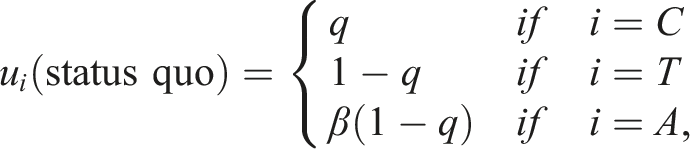
Nature then reveals this information to A and T, while C knows only the probability distribution from which Nature draws A’s type. C then chooses whether to tolerate the status quo (“sq” in Figure 1), which allocates q ∈ (0, 1) to C and 1 − q to T, or to demand a revision, which we equate with the initiation of a militarized dispute because it entails the outside option of war (see Palmer et al. 2015). If C initiates a dispute, it proposes a division that allocates x ∈ (0, 1) to itself and leaves 1 − x to T, which T can then accept or reject. If T accepts, the proposal is implemented, but if T rejects, the dispute escalates to war. A then chooses whether or not to join a war that follows T’s rejection; if A joins, the war expands such that C fights both T and A, but if A does not join, T fights only C. Finally, war is a costly lottery that allocates the whole prize to the winner (C or T) and none to the loser.
The game can end in four ways: (a) the status quo, (b) a dispute that ends in T’s acceptance, (c) a coalition war in which A honors the alliance treaty, and (d) a bilateral war in which A violates the treaty. Payoffs for the primary disputants (C and T) mirror the standard crisis bargaining model (see Fearon 1995), in that they have opposed preferences over the distribution of the disputed good but a shared aversion to the costs of war. War entails a policy externality for A, like the placement of a border, who governs a territory, or the treatment of local minorities, such A it values T’s share of the prize at β ∈ [0, 1], but it receives a payoff for the outcome whether or not it joins a war. A’s preferences are fully aligned with T’s when β = 1, and A is indifferent over the disposition of the prize when β = 0. 5
If C tolerates the status quo, then

If T rejects C’s proposal to change the status quo, then how the game ends depends on whether A joins the war. If A joins the war, then all parties i pay a cost d > 0 that represents the political, financial, and military costs of fighting, T wins the prize with probability p
A
∈ (0, 1), and C wins with the complimentary probability 1 − p
A
.
6
Thus

Finally, if A does not join the war, it saves the costs of fighting, though it pays k > 0 for violating the alliance treaty and receives a payoff for the final distributive outcome of the war. T is also less likely to prevail than it is with A’s support, winning with probability p∅ < p
A
; as such, C enjoys a higher probability of victory than it would against a coalition. Payoffs for a bilateral war, then, are

The model captures the strategic tension of war expansion in which potential joiners weigh the costs of fighting against their ability to influence the conflict’s outcome (Morrow 2000; Yuen 2009), modified by the costs of violating treaties of alliance (Gibler 2008; Langlois 2012). 7 As discussed above, we abstract away from alliance formation (cf. Morrow 2017; Smith 1995, 1998), allowing us to focus on the long-term hands-tying effect of treaties. We also assume that A’s reliability is known to both A and T, on the substantive grounds that allies will often have a better idea of each other’s intentions than their enemies (cf. Smith 2021). The equilibrium relationships of interest between demand, rejection (escalation), and joining carry over to a model in which T is also uncertain over A’s reliability—initiation is more likely when A is believed unreliable, but escalation is unlikely given those beliefs—but escalation does not occur on the equilibrium path given C’s and A’s shared beliefs over A’s reliability. Therefore, we focus on the model with an informed T because it provides a closer match with the data we analyze below, where escalation and conflict expansion both occur with positive probability, but the empirical implications apply as long as targets know at least as much as—i.e., are weakly more informed than—potential enemies about allied intentions. 8
Equilibrium
Our solution concept is Perfect Bayesian Equilibrium (PBE, or just “equilibrium”), which stipulates that strategies are sequentially rational and consistent with beliefs updated according to Bayes’ Rule wherever possible. To rule out degenerate cases, we restrict our attention to the case in which A joins the war when its costs for violation are high and abandons T when its costs are low, or

When
• A joins iff • When • When
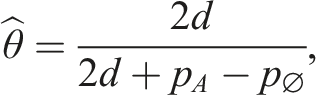
C initiates iff q < 1 − p
A
+ d = q
A
and proposes x* = 1 − p
A
+ d; when
At this equilibrium, C initiates a dispute only when it expects to improve its payoff relative to the status quo. This depends on what bargains it expects T to accept in lieu of war, which depend on A’s willingness to join the war in support of its partner. The reliability of A’s commitment shapes other players’ strategies. First, though T accepts any proposal that leaves it at least as much as it expects to gain from war, its war payoff depends on whether A is reliable. When A joins, T accepts proposals that satisfy x ≤ 1 − p
A
+ d, but when A will not join, T’s diminished military prospects mean that it accepts less generous proposals, x ≤ 1 − p∅ + d. This poses a risk-return tradeoff for C, who makes one of two proposals in equilibrium: (a) a generous proposal, x* = 1 − p
A
+ d, that reflects T’s expected war payoff when A will intervene and ensures acceptance regardless of A’s type, or (b) a less generous proposal, x* = 1 − p∅ + d, that T accepts only when A is unreliable. Uncertain over A’s reliability, C weighs the risk of coalition war associated with the more aggressive proposal against the sure thing of a less favorable deal that guarantees peace.
9
Proposition 1 states that C makes a risky proposal when
The probability of dispute initiation increases in θ, and the probability of dispute escalation decreases in θ. See Appendix for proof.
Proposition 2 also characterizes how C’s beliefs over A’s reliability influence the decision to initiate a crisis in the first place. When C believes the alliance to be reliable
Hypotheses
Proposition 2 allows us to derive hypotheses over the link between uncertain alliance reliability and the initiation and escalation of disputes. We begin with the assumption that when states sign treaties of alliance, they expect them to be reliable as long as the strategic environment does not change too drastically (Leeds 2003; Smith 1995; Morrow 2000). Therefore, in our baseline case all players know that
Figure 2 shows how our outcomes of interest change from the baseline (θ = 0) after both small Challenger’s Initiation Constraints qA, ∅ and the Probability of War by Belief that Alliance is Unreliable θ.
Our first hypothesis considers the effects of changing estimates of unreliability on the initiation of disputes, which occur when q falls below qA,∅ on the vertical axis. Recall that C may challenge even under the complete-information baseline when it believes that it can gain from revising the status quo. But after Nature’s move it is more willing to do so after a big shock, which makes C more confident that A has become unreliable. Figure 2 shows this graphically: q∅ rises above q
A
when
Now consider dispute escalation, which entails T’s rejection of C’s demands—the terms of which are observable to T but not to the analyst—once a dispute has been initiated. Recall that for the extreme cases in which the alliance is known to be reliable or unreliable, the probability of war is zero, because C knows just what it can demand to maximize its gains without provoking a war. But war becomes possible when
Figure 2 highlights the countervailing effects of increasing estimates that T’s ally is unreliable: large shocks
These results help flesh out some important conjectures in other models. Smith (1998), for example, discusses similar equilibrium relationships in a model without bargaining, though his goal is to compare outcomes across cases with and without alliances. Smith (1996) also finds that the average predicted probability of alliance reliability is higher in cases of war than in cases of acquiescence, arguing that this is due to targets retaliating (or escalating, in our model’s terms) when allies are reliable. He does not, however, conduct an explicit test of the relationship between alliance reliability and the onset and escalation stages of the conflict process. A more satisfying empirical model of the relationship between alliance reliability and dispute onset and escalation would analyze both outcomes simultaneously, using an observable indicator of the conditions under which states become uncertain over the reliability of each others’ allies. To that end, our research design uses Leeds’s (2003) measure of alliance unreliability based on observed changes in the distribution of military capabilities.
Research Design
Sample
The empirical analysis utilizes a sample of directed dyad-years between state members of the international system (COW 2017) in which the target has at least one ally committed to its defense against the challenger. As noted above, our wager is that the data contain a sufficient number of cases in which targets are weakly more informed than challengers about their allies’ reliability, relative to cases in which challengers know more than targets about the latter’s allies. To identify these observations we utilize the coding of Johnson and Leeds (2011), which is based on the Alliance Treaty Obligations and Provisions (ATOP) dataset (Leeds et al. 2002). These data allow us to identify targets (T in our theoretical model) with allies committed to defend them (A) and whether the contents of their alliance commitments require defense against the particular challenger (C) in the dyad. These data are available for the years 1816 to 2000. After the sample criteria are applied and the variables discussed below are accounted for, 559,111 observations are left for analysis.
Dependent Variables
We use two dependent variables in the empirical analysis, one each for Hypotheses 1 (initiation) and 2 (escalation). Testing Hypothesis 1 requires identification of observations where the challenger rejects the status quo and initiates a dispute against the target. We identify these observations using Maoz’s (2005) dyadic dispute data based on the Correlates of War (COW) Militarized Interstate Dispute (MID) data (Palmer et al. 2015). Thus, we identify dispute onset when the challenger threatens, displays, or uses force against the target of the dyad in the observation year. This occurs in 997 observations. This aspect of the empirical analysis closely follows previous studies that examine the varying effects of defensive alliances on dispute initiation (Bak 2018; Johnson, Leeds, and Wu 2015; Johnson and Joiner 2019).
Testing Hypothesis 2 requires knowing how targets of disputes responded. Therefore, the second dependent variable is coded only for those observations where the challenger initiated a dispute. In the theoretical model, escalation occurs when the target rejects the challenger’s demand. To capture this empirically we distinguish between those targets that chose to continue the dispute by taking militarized action against the challenger and those that did not. 11 Targets of disputes that choose to respond with a display or use force are taking clear steps to escalate the dispute and push the disputants closer to war—paying costs that states unwilling to escalate would not pay—while those that do not are clearly taking steps to reduce the risks of war. 12 This is also based on information from the COW MID data. The target responds militarily in 472 (44% of disputes) observations.
Explanatory Variable
The key explanatory variable for both hypotheses is the challenger’s estimate of the probability that a target’s ally is unreliable, represented by θ in the theoretical model. As discussed above, increasing values of θ are tied to changes in the target’s allies military capabilities. Significant changes in power from the time of alliance formation can change the value of the alliance for a member and, thus, reduce their reliability.
Our focus on significant power changes has several advantages. First, the logic of the measure is supported empirically by Leeds’ (2003) study of alliance reliability. She finds that significant changes in power make it less likely for a state to honor its alliance commitment. In fact, she finds that it has a bigger effect on alliance violation than any other variable in her models. Her findings provide confidence that the measure captures an important aspect of alliance reliability. Second, there are certainly other factors that influence an ally’s willingness to intervene but only those that are observable to the disputants will affect their behavior. Significant power changes are observable to both challengers and targets—as well as to the analyst. A publicly known measure like capabilities can be used by the challengers and targets in our data to inform their beliefs about ally types. In other words, power changes are observable factors that contribute to the disputants’ estimate of θ.
Finally, as discussed above, the measure should capture an aspect of alliance credibility that was unanticipated at the time of alliance formation. A measure that is observable at the time of alliance formation is likely to be problematic because the alliances that are coded as less credible may be credible for other reasons. If not, this set of alliances would have been unlikely to be formed in the first place. Significant power changes are hard to anticipate. A state’s power can change due to a variety of capricious factors such as economic changes, technological changes, or leadership changes. Thus, it is unlikely that states forming an alliance know whether a potential partner will experience a significant change in power later in the alliance relationship. This is even more likely to be the case if one considers the fact that many alliances last decades.
A notable disadvantage to focusing on significant power changes is that some states may value an alliance for reasons unrelated to the security benefits it provides. For example, a state that becomes significantly stronger may still value the alliance due to the policy concessions it obtains from its partner(s). This would be consistent with the logic of alliance formation advanced by Morrow’s (1991) security-autonomy tradeoff model. In this case, the measure would suggest the alliance is not credible when it actually is. This works to bias against finding support for the hypotheses, making ours a conservative test.
To measure a significant change in power we utilize Leeds’ (2003) coding of significant changes in power. We consider a target’s ally to have experienced a significant change in power if in a given year it is 10% stronger or 10% weaker than when it was when the alliance was formed. Composite Index of National Capabilities (CINC) scores from the COW project are used to measure military capabilities (Singer et al. 1972). For observations where the target has multiple allies, we follow the coding procedure of Johnson and Joiner (2019) and code the variable as a power change if any of the target’s allies are 10% stronger or 10% weaker since the year of alliance formation. Hypotheses 1 and 2 predict that the coefficient associated with this variable to be positive in the dispute initiation equation and negative in the dispute escalation equation.
Estimation and Control Variables
We test both hypotheses simultaneously in the same statistical model, because whether escalation can be observed depends on whether general deterrence fails—that is, whether the challenger initiates a dispute. Therefore, we estimate the relationship between these two outcomes in a Heckman-style censored probit model, where the selection equation tests Hypothesis 1 and the outcome equation tests Hypothesis 2. This model accounts for correlation in the errors across stages caused by any unmeasured factors that influence both selection into the dispute sample and escalation. Not taking these factors into account risks introducing omitted variable bias.
The key to employing this model is incorporating variables that influence the dependent variable of the selection equation but do not influence the dependent variable for the outcome equation. In other words, the model requires variables that influence dispute onset but not dispute escalation. Following Johnson and Leeds (2011), we argue that two variables help satisfy this requirement. First, increases in the distance between the target and challenger make dispute initiation less likely. This is because as distance increases conflict becomes more costly and the states will have fewer issues to dispute. However, given that the conflict will likely to be fought on the target’s territory, it should not influence the target’s decision to escalate. Second, increases in the the target and challenger’s S-Score, which capture the two states’ similarity of interests, will make dispute initiation less likely because there will be fewer disagreements that invoke challenges to the status-quo (Signorino and Ritter 1999). Once a dispute is initiated, however, a disagreement has emerged and this variable will not influence dispute escalation. Both of these variables were generated using the EUGene data generation program (Bennett and Stam 2000).
In addition to these two identifying variables, we control for several other observable factors in both equations. Most notably, we control for the probability of the challenger winning in a war. This variable follows directly from the theoretical model. As this probability increases the challenger will be more likely to initiate a dispute and the target will be less likely to escalate. We capture this concept using the ratio of the challenger’s capabilities to the target and challenger’s capabilities. We also take into account the capabilities of any relevant allies the potential disputants have. Composite Index of National Capabilities scores from the COW project are used to measure the actors’ capabilities (Singer et al. 1972).
Another important variable controlled for is the number of years since the target’s alliance was formed. The key explanatory variable captures power changes that may undermine the credibility of the alliance but other factors may change too that have a similar effect. For example, as time passes an ally’s interests change and it may come to value the alliance less. This variable attempts to capture some of the other relevant unmeasured changes. It is coded based on formation dates in the ATOP data (Leeds et al. 2002). We also control for other alliance relationships that may influence behavior in the dyad. More specifically, we control for whether the challenger had any relevant offense or neutrality pacts. These types of alliance commitments encourage aggression in the challenger because they improve the challenger’s chances of victory in war. However, they also encourage the target to back down, making escalation less likely. We use the coding of Johnson and Leeds (2011) discussed above to generate these variables. Finally, we account for temporal dependence by using Carter and Signorino’s (2010) strategy of including a variable that measures the number of years since the last dispute in the dyad as well as the square and cube of this variable.
Empirical Results
Probit Models of Dispute Initiation and Escalation.

Standard errors in parentheses.
*p < 0.05, **p < 0.01.
Hypothesis 1 is tested with our dispute initiation analysis. The results suggest that when any of the target’s allies experience a significant power change, the challenger is more likely to initiate a dispute. This is indicated by the statistically significant positive coefficient associated with the ally power change variable in the dispute initiation equation of the censored probit model, Model 3. The simpler probit model, Model 1, uncovers a similar relationship. Thus, both models support the hypothesis. The result is also consistent with the findings of Johnson and Joiner (2019). When the challenger suspects an alliance may not be credible, deterrence will be more likely to fail. This serves to push the disputants towards war. Figure 3, which presents predicted probabilities of dispute initiation based on the censored probit model, Model 3, illustrates this effect more clearly. The figure demonstrates that the predicted probability of dispute initiation increases by approximately 38% when the target has an ally that has experienced a significant power change.
13
Hypothesis 1. Note: Predicted probabilities are based on Model 3. Thin lines represent 95% confidence intervals for the point estimates. Thick lines assess the statistical significance of the difference between the point estimates where a lack of overlap between the thick lines indicate the predicted probabilities are statistically different at p < 0.05.
Support for Hypothesis 1 demonstrates an aspect of defensive alliances that can encourage aggression by a challenger. However, Hypothesis 2 suggests that the same aspect of alliances that encourages aggression in challengers encourages targets to concede. This hypothesis is supported by the statistically significant negative coefficient associated with the ally power change variable in the escalation equation of the censored probit model, Model 3. It is also supported using the simpler probit model, Model 2. When a target’s ally experiences a significant power change, the target is less likely to escalate. In other words, if the target has reason to doubt the reliability of an ally, they are less willing to take actions that bring the disputants closer to war. Figure 4 illustrates this more clearly by showing that the predicted probability of escalation decreases by approximately 29% when the target has an ally that has experienced a significant power change.
14
Hypothesis 2. Note: Predicted probabilities are based on Model 3. Thin lines represent 95% confidence intervals for the point estimates. Thick lines assess the statistical significance of the difference between the point estimates where a lack of overlap between the thick lines indicate the predicted probabilities are statistically different at p < 0.05.
The empirical analysis recovers the patterns predicted by both hypotheses. However, these findings beg the question of how dyads involving defensive alliances, with and without power changes, compare to dyads without any defensive alliances. To make this comparison we add in the set of observations where the target had no alliance. This analysis contains two key explanatory variables, one capturing when the target’s ally experienced a significant change in power and another capturing when the target’s ally did not experience a significant change in power. The case where the potential target did not have any defensive allies is the baseline category. We also control for all of the same variables employed in the previous analysis, except alliance age since it is undefined for the non-alliance cases and the target’s probability of winning excludes allied capabilities, and estimate a censored probit model.
Censored Probit Model Including Non-Allied Cases.

Standard errors in parentheses.
*p < 0.05, **p < 0.01.
The empirical analyses provide new insights into how alliance reliability affects interstate dispute initiation and escalation. Nonetheless, measuring states’ assessments of alliance reliability is inherently difficult. For example, as discussed above, some states may still value an alliance even after experiencing a significant change in power. Another limitation is that the analyses focus on a single dimension of alliance reliability. Significant changes in power have been found to be the most important predictor of alliance reliability (Leeds 2003), but certainly other changes affect alliance reliability. In general, our argument should apply to any change since alliance formation that increases the chances a member will violate the alliance and is observable to potential challengers and the other alliance members. Excluding these factors from our analysis most likely biases against finding support for our hypotheses since we are coding some alliances that experienced relevant changes as reliable, but future research should consider how other changes that occur over the course of an alliance partnership might shape dispute initiation and escalation.
Conclusion
Alliances deter challengers by providing members with promises of military support in the event of war. However, promises of military support may also encourage members to escalate disputes that are not deterred, raising the prospect of failures of alliance deterrence being associated with bloodier, costlier conflicts. We show that this concern is unfounded; deterrence failures are often the result of waning alliance reliability, and when both challenger and target anticipate that an ally will prove unreliable, the latter moderates its bargaining posture accordingly, reducing the chances of war. While threats to escalate conflicts deter challenges on average, the most credible threats to escalate remain off the equilibrium path, censored out of observational data because they deter challengers from initiating disputes in the first place. If challengers initiate disputes at random, then the deterrence-escalation tradeoff carries weight; but if challengers and targets condition their strategies on the reliability of the latter’s allies, then they avert this apparent tradeoff by censoring it out of the historical record. Unreliable alliances encourage dispute initiation, but they discourage escalation, even making disputes less likely on average to escalate than they would be if the target had no allies, perhaps due to intra-allied restraint (Fang, Johnson, and Leeds 2014).
Our results suggest that alliances do not pose a strong deterrence-escalation tradeoff, because challengers and targets both adjust their strategies in light of changing reliability. Defensive alliances can thus limit the number of disputes without increasing the severity of those disputes that occur. This suggests that, as alliances weaken and their commitments fall into question, the consequences need not be violent. As alliances fracture, the status quo in our model erodes, but it does so without war, as states react to a changing strategic environment that limits wartime access to allies’ military capabilities. Thus, the uncertainty that Kenwick and Vasquez (2017) associate with increased risks of escalation actually pushes disputants towards settlement, because (a) both challenger and target respond to the same information (even if one has more than the other) and (b) both have an incentive to avoid war if similar terms can be had on the cheap. In other words, once deterrence breaks down states can still work to limit the consequences.
Finally, the model has implications for the literature on entrapment, by which states might be drawn by their allies into wars they would prefer not to fight (Snyder 1997). An ally can become entrapped when it has high violation costs (k) relative to its value for the target’s issue (β), but our model suggests that the alliances that are most likely to experience entrapment are also more likely to deter, keeping that particular scenario off the equilibrium path and explaining why the risk of entrapment can be critical for sustaining deterrence (see also Benson et al. 2014). Key to understanding these patterns is understanding how both challengers and targets respond to changing beliefs about allies’ likely responses to the outbreak of war.
Footnotes
Acknowledgements
Thanks to Betul Demirkaya, Ashley Leeds, and Amy Yuen for helpful comments and feedback.
Declaration of Conflicting Interests
The author(s) declared no potential conflicts of interest with respect to the research, authorship, and/or publication of this article.
Funding
The author(s) received no financial support for the research, authorship, and/or publication of this article.

Notes
Appendix
Proof of Proposition 1. Begin with a generic type of A, who intervenes iff
Such that only the high-cost type intervenes when
Moving back up the tree, the target’s acceptance rule depends on its private information. T accepts for some generic probability of victory p, which is defined solely by whether A joins, iff 1 − x ≥ p − d. Therefore, when
C will never under-propose, so it has three possible proposals in equilibrium. First, proposing x = 1 − p
A
+ d ensures acceptance. Second, proposing x = 1 − p∅ + d ensures that T rejects if A will join. Third, proposing some x > 1 − p∅ + d ensures that T always rejects. It is trivial to show that the latter offer is never made; the risky proposal x = 1 − p∅ + d, which offers a chance to secure the whole bargaining surplus from an abandoned T, is more attractive than provoking war with both types. And C makes the risky proposal rather than the sure thing of x = 1 − p
A
+ d when
C’s proposal strategy defines two cases for the initiation decision: when
Strategies are sequentially rational and consistent with Bayes’ Rule on the equilibrium path, so the proposed PBE exists under the stipulated conditions.
Proof of Proposition 2. To establish the claim about initiation, we set q∅ > q
A
, or
Such that C is more willing to initiate when it will make the risky proposal than when it will make the safe proposal. Solving for θ shows that this inequality is satisfied when
And to establish the claim about escalation, note that T rejects only when A will join, which from the perspective of the challenger and the analyst is 1 − θ. Therefore, the probability of escalation decreases in θ.