




Abstract
Longstanding intergroup conflict is one of the most perilous issues on the global stage, leading to violence, displacement, and loss of life. Finding strategies to bring parties to the negotiation table is therefore of utmost importance for conflict resolution. Here we address a common problem in intergroup conflict - the lack of a shared, native tongue - which is typically solved by using a lingua franca. Three experimental studies revealed that a peace-building proposal presented in a lingua franca is perceived as less favorable to one’s own side than a proposal presented in one’s native tongue. Specifically, our studies demonstrated that the use of a lingua franca elicits higher levels of hatred and lower levels of sympathy, thereby reducing the perceived favorability of the proposal. Broadly, these findings indicate that the seemingly innocuous choice of the language could have serious implications for conflict resolution as well as for international diplomacy.
Intergroup conflict has been a pernicious issue for centuries. While conflict between groups is often ignited over resources or values, a number of psychological barriers fuel the continuation of conflict even when mutually beneficial alternatives are brought to the table (Bar-Tal & Halperin 2011; Halperin 2011, Moran & Ritov 2002; Ritov & Moran 2008; Ross 2013, 2014; Ross & Ward 1995; Shalvi, Moran & Ritov 2010). Here, we aim to study how the choice of language used during peace negotiations may inadvertently act as another barrier to conflict resolution.
In international conflict, parties often must first negotiate a means of communication. A common solution that has been employed for thousands of years is to use a lingua franca, typically defined as a common language between parties who do not share a native tongue. Throughout history numerous languages have served as a lingua franca such as Aramaic and Acadian in ancient times, Swahili, German, and French in Africa, as well as Russian in Asia and Eastern Europe. In recent history English has become the dominant lingua franca across the world for business, commerce, diplomacy and tourism. Today, English as a nonnative language has become widely used across the world by billions of people (Crystal 2003).
During conflict, communication between parties is an essential step in working towards resolution. For the purposes of this paper, we will primarily examine one form of communication that has direct implications for the resolution of conflict: the response to peace building proposals aimed at the de-escalation of conflict. Our studies will focus on the ongoing Israeli-Palestinian Conflict, which is one of many current examples of an intractable conflict, defined as a longstanding, violent conflict that is resistant to mediation or efforts to work towards resolution. Such a conflict is an important context to examine whether choices of language may either help or hinder the peace building process.
Peace negotiations often involve a long and arduous process of de-escalation. This is in part due to the significant psychological barriers that develop throughout the course of longstanding conflict, which both justify the continuation of conflict and prevent its de-escalation and resolution. Specifically, parties in conflict tend to develop societal beliefs that elevate their own goals and interests in the conflict while devaluing the other party and its’ goals and interests (see Bar-Tal 2000; Bar-Tal & Halperin 2011 for a review). From this biased perspective, parties will often view issues pertaining to the conflict as zero-sum in nature in which any gain for one side necessitates a loss for the other (Kelman 1987).
While these psychological barriers can make a resolution seem unattainable, subtle changes in phrasing when communicating conflict-relevant peace building measures have already been found to increase the acceptance of peace building measures during conflict (Idan et al. 2018). Furthermore, avoiding aggressive language, communicating differences constructively, and communicating in a manner that is as humanizing as possible when engaging in diplomatic communication improves the chances of conflict resolution (Gomes de Matos 2000, 2001, 2006). Here, we examine how changing the language of communication, rather than its content and phrasing, influences the peace building process.
Lingua Franca Use
There are good reasons to believe that using a lingua franca may impact conflict resolution. On the one hand, a lingua franca might facilitate the process because it allows the parties to communicate directly with each other rather than through an interpreter. This reduces the number of steps in the communication process and avoids complications that might arise from the involvement of a third party such as concerns about the accuracy and reliability of the translation (Edwards, Temple & Alexander 2005). It might also put the parties on “equal footing” when the language is native to neither side. In addition, information communicated through a foreign language lacks the emotional resonance of a native tongue, as bilinguals show reduced affective reactions towards emotional content in a foreign language (Dewaele 2004; Harris, Ayçiçegi & Gleason 2003; Pavlenko 2005; Putoni, de Langhe & van Osselaer 2009). This might grant negotiators with emotional distance and enable them to approach the negotiation process with “cooler heads”.
Extended conflicts often lead to a ‘culture of conflict’ which include collective emotions held by each group regarding the conflict (Bar-Tal 2007). Among these collective emotions, feelings such as heightened fear or hatred can act as a barrier to peace building and conflict resolution by biasing how individuals evaluate conflict-relevant information (Bar-Tal & Halperin 2013; Halperin 2008; Halperin et al. 2008; Halperin, Sharvit, & Gross 2011). If communicating through a lingua franca reduces negative emotional responses to conflict-relevant information, it could increase support for peace.
On the other hand, utilizing the native language of the recipients may be more effective in promoting peace. For one, language and identity are closely intertwined (Giles & Johnson 1987), and communicating information through the native language of the recipients may make the source seem more closely aligned with recipients’ own group. Also, offering a peace building proposal in the native language of the recipients may be seen as a goodwill gesture, as language use is often politicized in the Middle East (Suleiman 2004).
As mentioned, one of the societal beliefs that fuels the continuation of conflict is negative characterizations of the adversaries and delegitimization of their values, intentions, and interests in the conflict (Bar-Tal 2000; Bar-Tal & Halperin 2011). In turn, this can shape how individuals judge and respond to information presented by their adversaries. For instance, when evaluating peace building measures, parties tend to “reactively devalue” a proposal when it is presented as offered by the opposing side (Maoz, Ward, Katz, & Ross 2002; Ross & Ward 1995). When individuals harbor negative views of the opposing side, they project their negative evaluations onto the proposal, leading them to assume the worst of the proposed measures. Hence, when opponents offering a peace proposal use the native language of the recipients this might improve the evaluation of the opponents, and thus also lead to more favorable evaluations of the proposal itself.
While emotional distance may lead to “cooler heads”, emotional distance may also have negative implications if it inhibits positive emotional responses to a peace proposal. While heightened negative emotional responses such as hatred can make parties less willing to work together (Halperin 2008), heightened positive emotional responses can be beneficial when negotiating during conflict. Indeed, positive feelings towards the opponent during conflict are associated with more favorable attitudes towards proposed solutions (David, Rosler & Maoz 2017; Halperin et al. 2014; Leshem & Halperin 2020; Maoz & McCauley 2008, 2009). Furthermore, the extent to which individuals have positive sentiments such as hope or sympathy when evaluating peace building measures predicts their willingness to make concessions (Cohen-Chen et al. 2014; Jarymowicz & Bar-Tal 2006; Maoz & McCauley 2008, 2009; Rosler, Cohen-Chen, & Halperin 2017). Therefore, using a lingua franca could either help or hinder the resolution of conflict.
Current Research
To examine if using a lingua franca helps or hinders conflict resolution, we presented Jewish-Israelis from across the political spectrum with a ‘trust building and security cooperation’ proposal from a Palestinian delegation. The proposal was aimed at deescalating the ongoing tensions and conflict with Palestinians and was presented either in a lingua franca (English) or their native tongue (Hebrew). Through this design, we evaluated how language influences the evaluation of peace building measures, specifically by examining whether language impacts how favorably the proposal is evaluated when offered through a lingua franca as compared to a native tongue.
We also examined whether the effect of language is specific to the evaluation of peace building measures or extends to conflict-relevant information more broadly. Specifically, in our final study we examined whether language influences how individuals evaluate historical narratives of the conflict that are presented from the perspective of the other side. Collective and personal narratives regarding the nature and trajectory of the conflict, as well as specific events in it, play a central role in how each side in a conflict perceives and experiences it, and can crucially influence readiness for peace building (Bar-On, 2008, Bar-Tal 2007, 2013; Bar-On & Kassem 2004).
Dialogue-based peace-building projects have increasingly come to focus on the narrative or storytelling approach (Bar-On & Kassem 2004; Maoz 2011, 2018; Ron & Maoz 2013; Zigenlaub & Sagy 2020) which aims at reducing moral exclusion and dehumanization through exposure to the narratives and sufferings of the other side in conflict. The narrative model of reconciliation-aimed encounters, most prominently identified by the Israeli psychologist Dan Bar-On, brings participants from both groups to engage in “storytelling” their lives and to share their personal and collective narratives, experiences, and suffering in the conflict (Bar-On 2008). Encountering the experiences of the other through storytelling is thought to enable conflicting groups to create intergroup trust and compassion by humanizing the other and constructing more complex images of one another, increasing recognition of and empathy towards each other’s pain and suffering in conflict (Bar-On & Kassem 2004).
If language broadly shapes how individuals respond to conflict-relevant information, then it should impact the evaluation of both narratives and proposals in conflict. This is plausible, given that both proposals and narratives are central constructs in conflict, as they communicate the intentions, agendas, and perspectives of the sides in conflict. However, historical narratives differ from peace building measures in important ways. Peace-building proposals offer possible future benefits that could de-escalate the conflict. Historical narratives, on the other hand, communicate information regarding past events from the perspective of one side, in the hope of improving intergroup understanding, recognition, and sympathy. If a native language primarily improves how individuals respond to the content of information by highlighting its benefits to one’s own side, then the use of native language (versus lingua franca) may be more effective in eliciting favorable responses to peace building measures and would have a smaller or no effect on the favorability of responses to historical narratives.
Study 1. Finding that a Lingua Franca Reduces Favorability of a Peace Proposal
Method
Participants
Demographic Characteristics of Participants from Study 1.

Participants were randomly assigned to one of four conditions: Proposal in Hebrew, with the source being the Palestinian delegation (N = 84) or the Israeli delegation (N = 77); Proposal in English with the source being the Palestinian delegation (N = 75) or the Israeli delegation (N = 71). To ensure randomization was effective, we examined whether overall English proficiency was similar across language conditions. Participants assigned to English had a comparable proficiency in English (M = 5.56, SD = 0.99) as those assigned to Hebrew (M = 5.61, SD = 0.90; 95% CI [-0.27, 0.16], t (288.77) = 0.47, p = 0.64, d = 0.05). Due to the specific language proficiency requirements that were central to our studies, the participants in all the studies are not a representative sample of the general Jewish-Israeli population. The sample shows an over-representation of left-wing, secular, educated Israeli-Jews. This should be taken into account when interpreting the results.
Materials
An Israeli-Palestinian peace-building proposal was generated, focusing on five major issues currently relevant to the ongoing Israeli-Palestinian conflict. The focus of the proposal was on building trust between parties, including both parties ending any overt acts of violence against each other as well as working together to rebuild a coordinated security effort. The proposal was first piloted to ensure that it was perceived as realistic in the existing political climate and that the proposal could plausibly be offered by either an Israeli or Palestinian delegation.
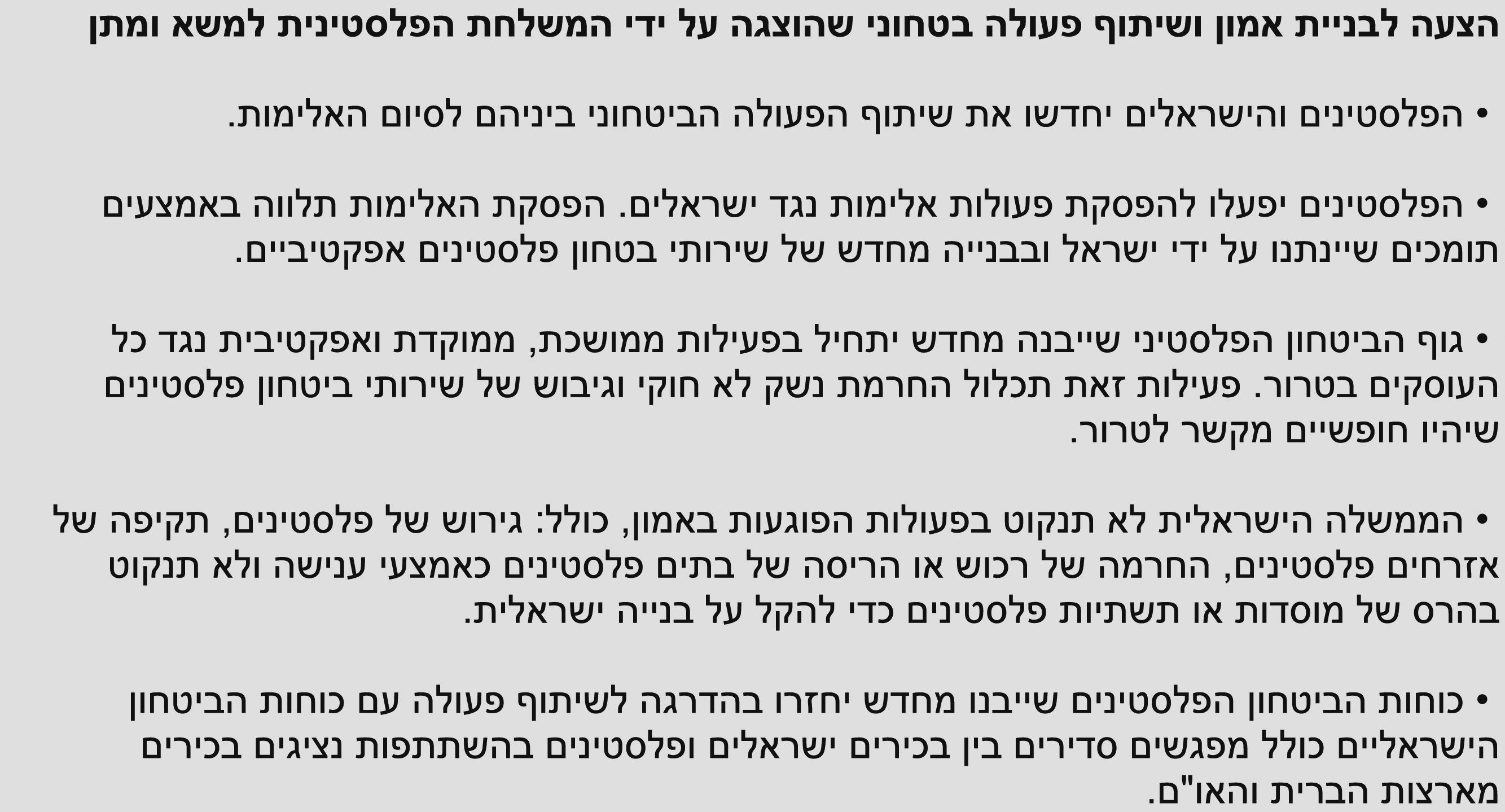
The research materials were initially written in English, translated to Hebrew by the second and third authors who are both fluent Hebrew-English bilinguals, and then back translated to English by two bilingual Hebrew-English research assistants (Brislin 1970). Once translated, the second and third authors reviewed and finalized the materials. Figure 1 presents the proposal in English. The Hebrew version can be found in the Appendix (Figure A1). The proposal (English version) used in Studies 1–3. In Study 1, for half of participants, the proposal included in the title “by the Israeli” delegation instead of “by the Palestinian” delegation. The proposal (Hebrew version) used in Studies 1–3. In Study 1 for half of participants the proposal included in the title “by the Israeli” delegation instead of “by the Palestinian” delegation.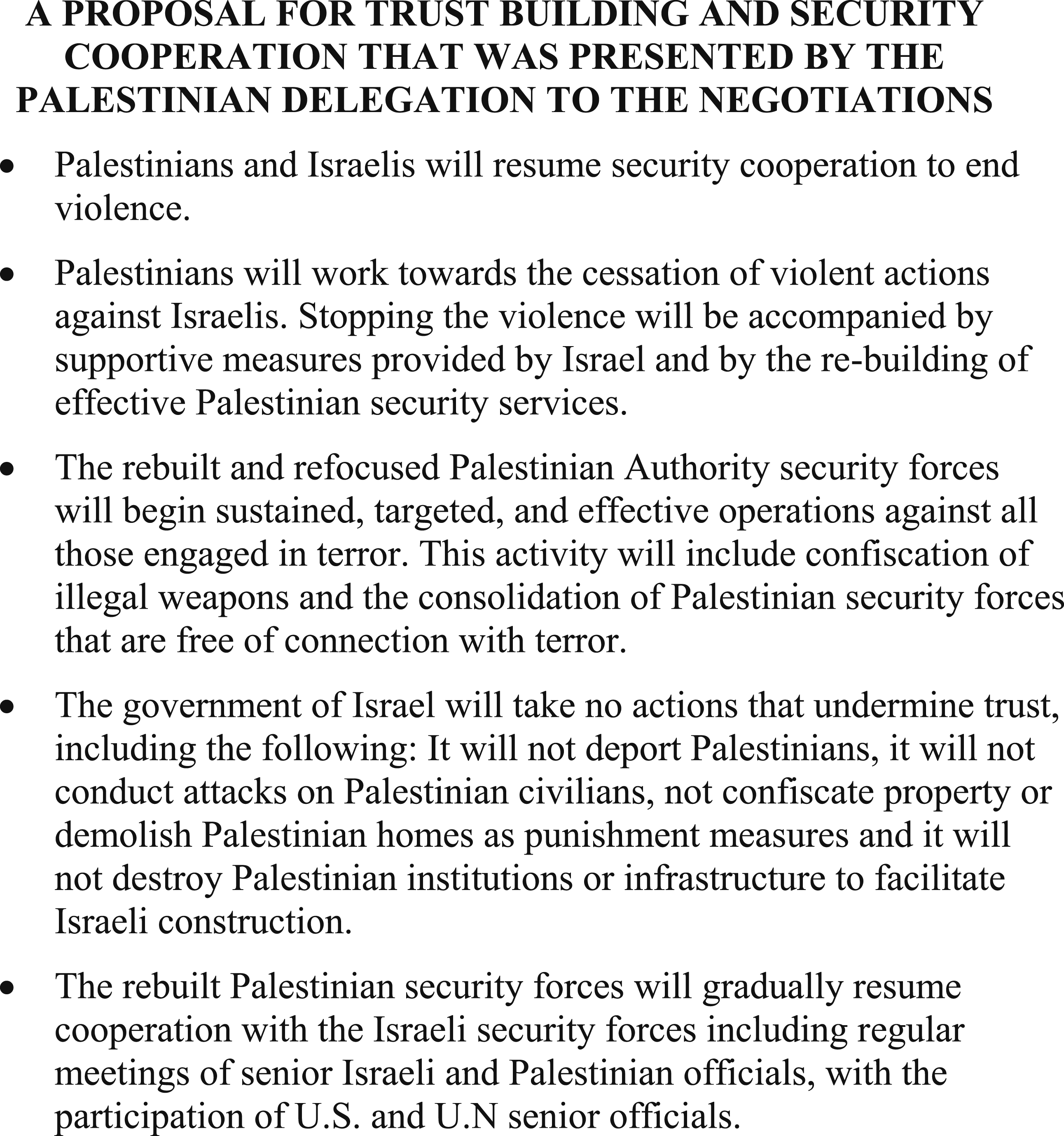
Procedure
Participants received all study materials including instructions, questionnaires, and the proposal in the assigned language. Participants first read the outline for the peace-building proposal. While they could spend as long as they needed to review the materials, participants could not advance to the next page for 30 seconds to prevent intentional or unintentional skipping of the proposal. In order to make sure that participants understood the key points from the proposal, while the proposal was still on the screen participants answered two multiple-choice questions in which they indicated the topic and source of the proposal. Subjects who failed this check were removed from the study (N = 12).
Participants then completed a series of measures reporting how favorably they judged the proposal as being for each side. Specifically, to examine how favorable they perceived the proposal for Israel, participants were asked to report the extent to which they perceived the proposal as “pro-Israeli”, “fair to Israelis”, as well as the extent to which they agreed with the proposal. To examine how favorable they perceived the proposal as being for Palestinians, they reported the extent to which they perceived the proposal as pro-Palestinian. This was followed by a series of measures in which participants then reported how they felt about the delegation that offered the proposal. These questions about the delegation included rating to what extent they perceived the delegation offering the proposal as trustworthy, honest, reliable, warm, threatening, and considerate. Participants indicated their rating for each measure by using a scale ranging from 1 (not at all) to 9 (to a very high extent).
At the end of the study, additional demographic information was collected on the language background and political attitudes of participants. For language background, all participants reported when they first began learning English and their own estimate of their proficiency in reading, writing, speaking, and listening in both Hebrew and English. For the proficiency measures, self-reported proficiency was rated on a scale of 1 (low) to 7 (high). Additionally, we included a measure to capture their political attitudes regarding the Israeli-Palestinian conflict. For this measure, participants were asked to provide their political identification on a scale from 1 (left-wing attitudes) to 7 (right-wing attitudes) with the center point of 4 representing centrist attitudes.
Results
All analyses were conducted using a two-way ANOVA examining the main effects and interaction between Language (Native | Lingua Franca) and Source (Israeli Delegation | Palestinian Delegation). Because political attitudes influence how individuals respond to conflict-relevant information, we first included the main effect and interaction of political attitudes with Language and Source to see if political attitudes may moderate the effects. However, because political attitudes did not interact with either language or source in how the proposal was evaluated (Fs < 1), subsequent models were simplified to control for political attitudes as a covariate.
Proposal evaluation
We created a Pro-Israeli index by collapsing responses to the “pro-Israeli", “fair to Israelis”, and agreement with the proposal measures (Cronbach’s α = 0.92) to examine the effect of the proposal language on the extent to which the proposal is viewed as beneficial for Israel. While each of these measures taps into a different aspect of how favorably the proposal is viewed, these measures were collapsed for the purposes of analyses because of their high internal consistency. These measures do not yield different findings when analyzed separately.
As Figure 2 (Top Panel) shows, participants viewed the proposal as less favorable for Israel when it was in a lingua franca (M = 4.86, SD = 1.97) than when it was in Hebrew (M = 5.93, SD = 2.01; F (1,304) = 25.51, p < .001, ηp2 = 0.07). This was the case when the proposal was from a Palestinian source (English: M = 4.55, SD = 2.01; Hebrew: M = 5.57, SD = 2.09; F (1,157) = 9.90, p < .01, ηp2 = 0.06) and from an Israeli source (English: M = 5.19, SD = 1.88; Hebrew: M = 6.32, SD = 1.86; F (1,146) = 13.53, p < .01, ηp2 = 0.09). Furthermore, these results replicate the reactive devaluation effect (Maoz et al. 2002; Ross & Ward 1995) in which proposals are devalued when they are made by the other side. In general, the proposal was viewed as less favorable for Israelis when it was offered by a Palestinian source (M = 5.09, SD = 2.11) than by an Israeli source (M = 5.78, SD = 1.95; F (1,304) = 10.71, p < .001, ηp2 = 0.03), but language and source did not interact (F < 1).
The effect of language on the perception of how favorable the proposal is for your own side could be interpreted in two ways. It could suggest that a proposal in a lingua franca is perceived less positively specifically for your side or that it is perceived more negatively in general. If a lingua franca makes a proposal seem more negative in general, then it should also be seen as more negative for the Palestinians. If, however, the use of a lingua franca renders the proposal more negative specifically for your side, then it should not affect how it is perceived for the Palestinian side. Therefore, to test this we examined the effect of language and source on the extent to which the proposal was evaluated as pro-Palestinian. Figure 2 (Bottom Panel) shows that the proposal was perceived as equally favorable for Palestinians in English (M = 6.01, SD = 1.96) and in Hebrew (M = 6.34, SD = 2.01; F (1,304) = 2.35, p = 0.13, ηp2 = 0.01). This was true when the source was the Israel delegation (English: M = 5.27, SD = 1.86; Hebrew: M = 5.88, SD = 2.21) and when it was the Palestinian delegation (English: M = 6.72, SD = 1.78; Hebrew: M = 6.76, SD = 1.71), hence language and source did not interact (F (1,303) = 1.86, p = .17, ηp2 = 0.01). Once again, consistent with the reactive devaluation effect, we found a main effect of source on the evaluation of the proposal with participants viewing the proposal as more favorable to the Palestinians when it was presented as offered by the Palestinian delegation (M = 6.74, SD = 1.74) than by the Israeli delegation (M = 5.59, SD = 2.06; F (1,304) = 29.02, p < .001, ηp2 = 0.09).
Source evaluation
One possible reason that language may impact proposal evaluations is that language may make the source of the proposal seem more or less favorable. For instance, and specifically relevant to this study, Jewish-Israeli respondents may perceive a Palestinian delegation that offers a proposal in Hebrew - their own in-group language - more favorably than a delegation that offers the proposal in a lingua franca (English). To examine this, we collapsed the measures of perceived trustworthiness, honesty, reliability, warmth, consideration, and threat (reverse coded) for each delegation into a Source Evaluation Index (Cronbach’s α = 0.91). Overall, respondents perceived the delegation more favorably when they made the proposal in Hebrew than in English. This was the case for both the Israeli delegation (Hebrew: M = 6.65, SD = 1.47; English: M = 5.83, SD = 1.53) and the Palestinian delegation (Hebrew: M = 4.78, SD = 1.97; English: M = 4.18, SD = 1.69). Hence, our findings indicate a main effect of language (F (1,304) = 13.67, p < .001, ηp2 = 0.04) and source (F (1,304) = 89.15, p < .001, ηp2 = 0.23) on the evaluation of the delegation with no significant interaction between the two (F < 1).
Discussion
Participants consistently perceived a peace proposal as less favorable to them when it was made in English, a lingua franca, than in Hebrew, their native tongue. This is inconsistent with the idea that a lingua franca is beneficial for negotiations aimed at conflict resolution. Study 2 and Study 3 replicate the findings from Study 1 and Study 3 also provides an explanation for the phenomenon.
Study 2. Replicating the Phenomenon with a PreregisteredStudy
This study focused on replicating the new phenomenon. Specifically, we preregistered a replication of the finding that people perceive a peace proposal as more favorable to their side when it is made in their native tongue compared to a lingua franca. Since language and source did not interact in Study 1, we simplified the design and included only the Palestinian delegation source. Our reason for focusing on this source is that evaluating peace building measures presented by an opponent in conflict is important in the context of international peace negotiation, particularly since individuals are more likely to favorably view peace building measures from their own side as Study 1 demonstrated.
This study was preregistered on Open Science Framework (see the link at the end of the paper).
Method
Participants
Demographic Characteristics of Participants from Study 2.
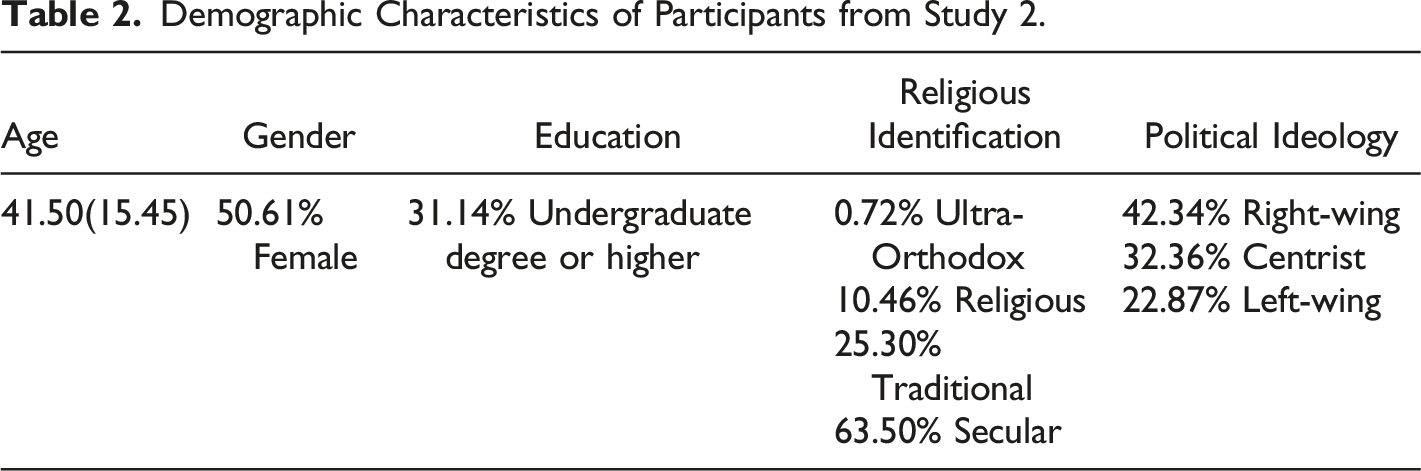
All participants were randomly assigned to complete the task either in their native Hebrew (N = 215) or in a lingua franca, English (N = 196). Like Study 1, participants assigned to English had a comparable proficiency in English as those assigned to Hebrew (English: M = 5.76, SD = 0.98; Hebrew: M = 5.62, SD = 0.98; 95% CI [-0.05, 0.34], t (405.28) = 1.50, p = .14, d = 0.15).
Materials and Procedure
The methods and materials were the same from Study 1 except for two changes. Study 2 included an additional question to capture how favorably individuals viewed the Palestinian proposal as being for Palestinians, specifically asking how fair the proposal is to Palestinians. Additionally, two new items probed whether participants thought the source was offering the proposal out of their own self-interest or out of the shared interest of the two parties. All additional questions were reported on a scale of 1 (not at all) to 9 (to a very high extent).
Results
Analyses were conducted using the same model as Study 1 minus the main effect and interaction of Source. Hence, all analyses were conducted using an ANOVA examining the main effect of Language (Native | Lingua Franca) with prior political attitudes as a covariate.
Proposal evaluation
We created a Pro-Israeli index (Cronbach’s α = 0.90) like in Study 1 to examine the extent to which language impacts the perceived favorability of the proposal for the participants’ own side. As Figure 3 shows, participants viewed the proposal as less favorable to Israelis when it was presented in a lingua franca, English (M = 4.33, SD = 2.13) than in their native Hebrew (M = 4.82, SD = 2.10; F (1,408) = 8.25, p < .001, ηp2 = 0.03). Then, to examine the extent to which the proposal was seen as favorable to Palestinians, we created a Pro-Palestinian index by collapsing the “pro-Palestinian” and “fair to Palestinians” measures (Cronbach’s α = 0.78). Similar to the Pro-Israeli index, while these two measures assess different aspects of how beneficial the proposal is viewed as being for Palestinians, because the internal consistency is sufficiently high and analyzing each measure separately does not yield a different result, we collapsed these two items into a single index. Average index of the ratings of the extent to which the proposal is perceived as pro-Israeli (left) and the extent to which the proposal is perceived as pro-Palestinian (right) as a function of the language of the proposal.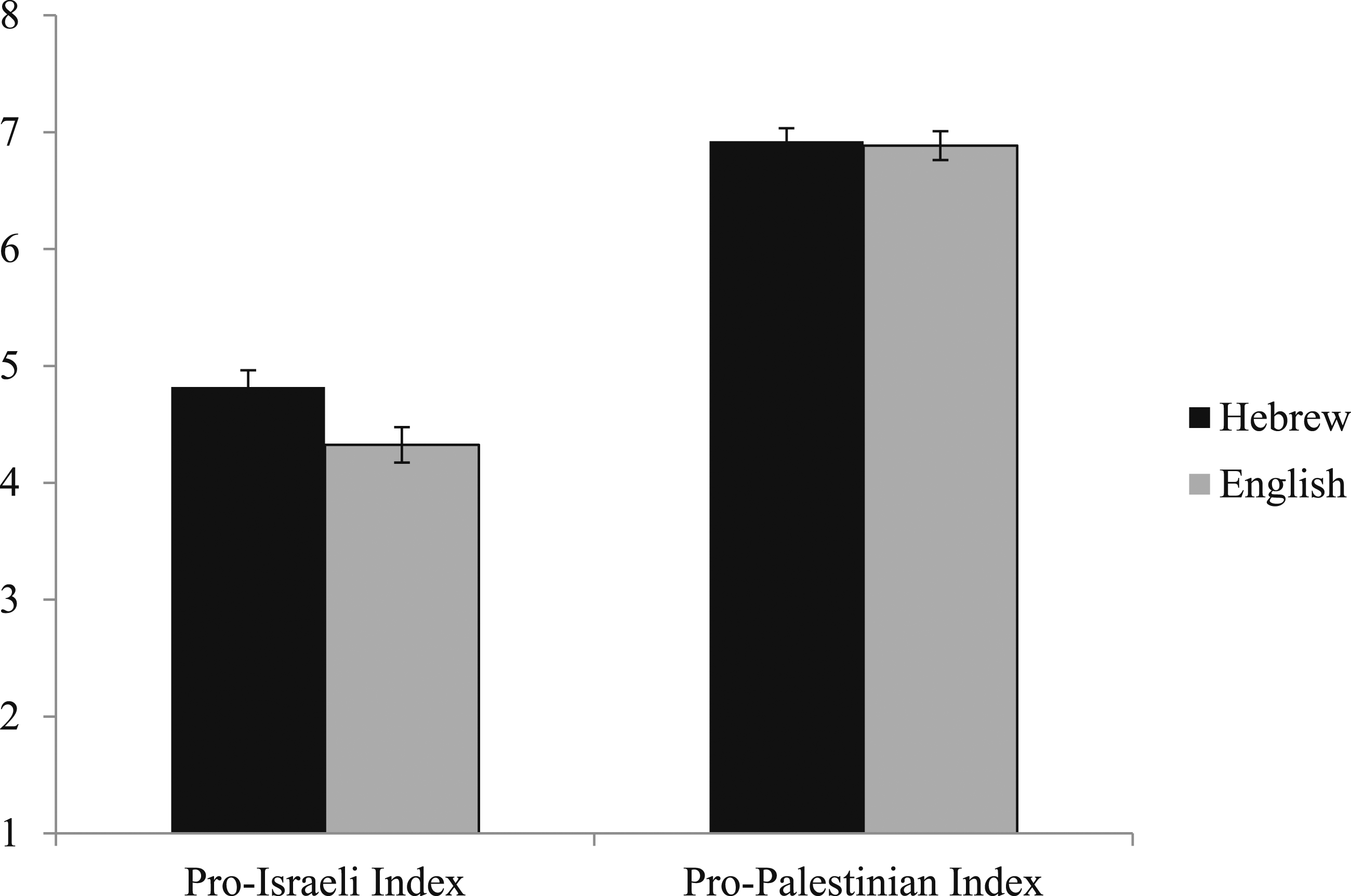
This index showed that the use of a lingua franca did not impact the perceived favorability of the proposal for Palestinians. Specifically, the proposal was rated just as favorable for Palestinians in English (M = 6.89, SD = 1.72) as in Hebrew (M = 6.92, SD = 1.61; F < 1). These results replicate our findings from Study 1, showing that a lingua franca reduces the perceived favorability of the proposal for one’s own side but not for the other side.
Source evaluation
We created a Source Evaluation index by collapsing across the same six source evaluation items that were included in this measure in Study 1 (Cronbach’s α = 0.91). Unlike in Study 1, language did not affect the favorability ratings of the members of the Palestinian delegation that offered the proposal (English: M = 4.24, SD = 1.74; Hebrew: M = 4.26, SD = 1.97; F < 1). Because there was no effect of language on source evaluations, no mediation analysis was conducted (Baron & Kenny, 1986).
Participants also evaluated the degree to which the members of the Palestinian delegation were acting in the shared interest of Israelis and Palestinians and the degree to which they were acting in their own self-interest. Language had no effect on ratings of the delegation acting in the shared Israeli and Palestinian interests (English: M = 4.30, SD = 2.22; Hebrew: M = 4.48, SD = 2.30; F < 1). However, participants rated the Palestinian delegation as acting less in their own self-interest when receiving the proposal in a lingua franca (M = 5.87, SD = 2.44) than in Hebrew (M = 6.46, SD = 2.16; F (1,408) = 8.40, p < .001, ηp2 = 0.02).
Discussion
Study 2 replicated the phenomenon demonstrated in Study 1. Participants perceived the proposal as less favorable for Israel when it was presented in a lingua franca than in their native Hebrew. Again, language did not impact the evaluation of the proposal as pro-Palestinian. Hence, language has consistently impacted the perception of a peace proposal precisely in terms of what is beneficial to one’s own side. Importantly, unlike in Study 1, language did not influence the perception of the delegation that offered the proposal nor did it influence the perception that the delegation was acting more or less in the shared interests of Palestinians and Israelis. Surprisingly, participants believed that the Palestinian delegation was acting less in their own self-interest when the proposal was offered in a lingua franca as compared to their native language. These findings are inconsistent with the idea that language affected proposal favorability by affecting the evaluation of the delegation. To better understand how language impacts source evaluations, in Study 3 we included additional measures of source evaluation. We also included new measures to address an alternate mechanism of how language influences proposal favorability.
Study 3. Explaining the Phenomenon
In Study 3, we examined whether the language of the proposal influences the extent to which the proposal evokes more positive or negative feelings. As mentioned, how people feel when they evaluate conflict-relevant information can influence their willingness to negotiate as well as their perceptions of proposed peace building measures. Therefore, we examined whether people had a less positive emotional response to the proposal when using their lingua franca, and whether this mediated the effect of language on their evaluations of the favorability of the proposed measures.
Furthermore, to examine whether the effect of language on the evaluation of conflict-relevant communication is specific to peace building proposals or possibly extends to other types of conflict-relevant information, we also included a historical narrative condition. In this condition, respondents evaluated a historical narrative of a major event in the Israeli-Palestinian conflict, namely a narrative of the First Intifada (Palestinian uprising), presented from the perspective of a Palestinian source.
Method
Participants
Demographic Characteristics of Participants from Study 3.
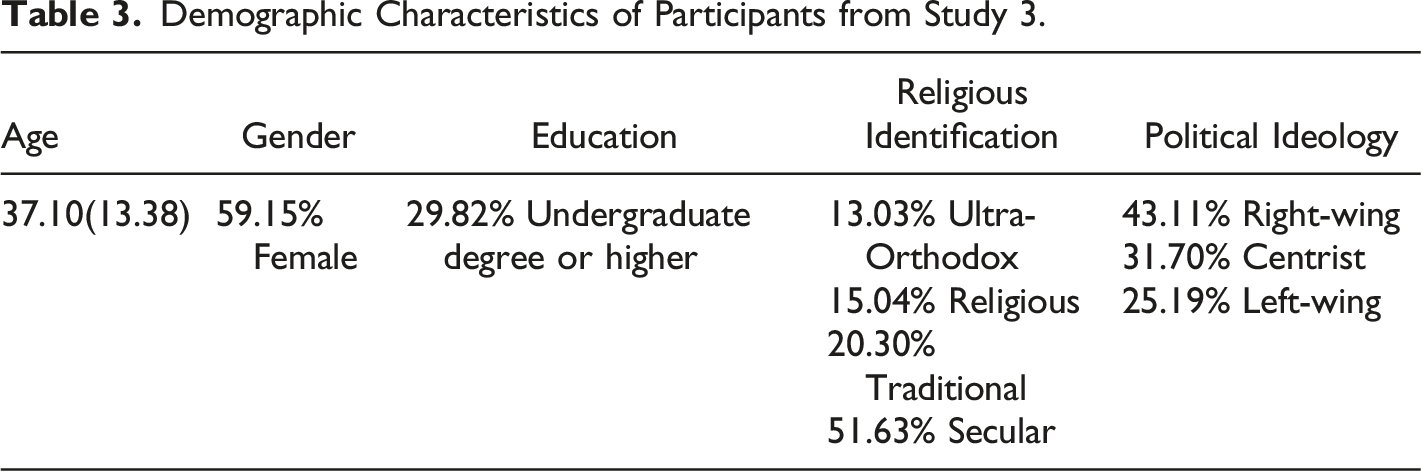
Participants were recruited and prescreened using the same procedure from Study 1 and 2, and were randomly assigned to four conditions: they read the Palestinian proposal in a lingua franca (N = 202) or their native Hebrew (N = 202), or they read the narrative in lingua franca (N = 200) or in Hebrew (N = 194). Similar to Studies 1 and 2, participants assigned to English had a comparable proficiency in English as those assigned to Hebrew (English: M = 5.79, SD = 0.90; Hebrew: M = 5.74, SD = 1.00; 95% CI [-0.08, 0.19], t (785.26) = 0.82, p = .41, d = 0.06).
Materials
The proposal conditions used the same materials from Study 1 and Study 2. For the narrative conditions, a brief historical narrative about the Israeli-Palestinian conflict was adapted from the book Learning Each Other’s Historical Narrative: Palestinians and Israelis (Adwan & Bar-On 2004; Adwan, Bar-On & Naveh 2012). We selected a narrative that represented the perspective of Palestinians on the events of the First Intifada, the Palestinian uprising that erupted in 1987, and edited it to approximately match the proposal in length. Participants were informed that the narrative was generated by Palestinian academics as part of an effort to share stories between both sides of the Israeli-Palestinian conflict. Figure 4 presents the narrative in English and the Hebrew version can be found in the Appendix (Figure A2). Historical narrative of the First Intifada (English version) used in Study 3. This was adapted from a Palestinian narrative of this historical event. Historical narrative of the First Intifada (Hebrew version) used in Study 3. This was adapted from a Palestinian narrative of this historical event.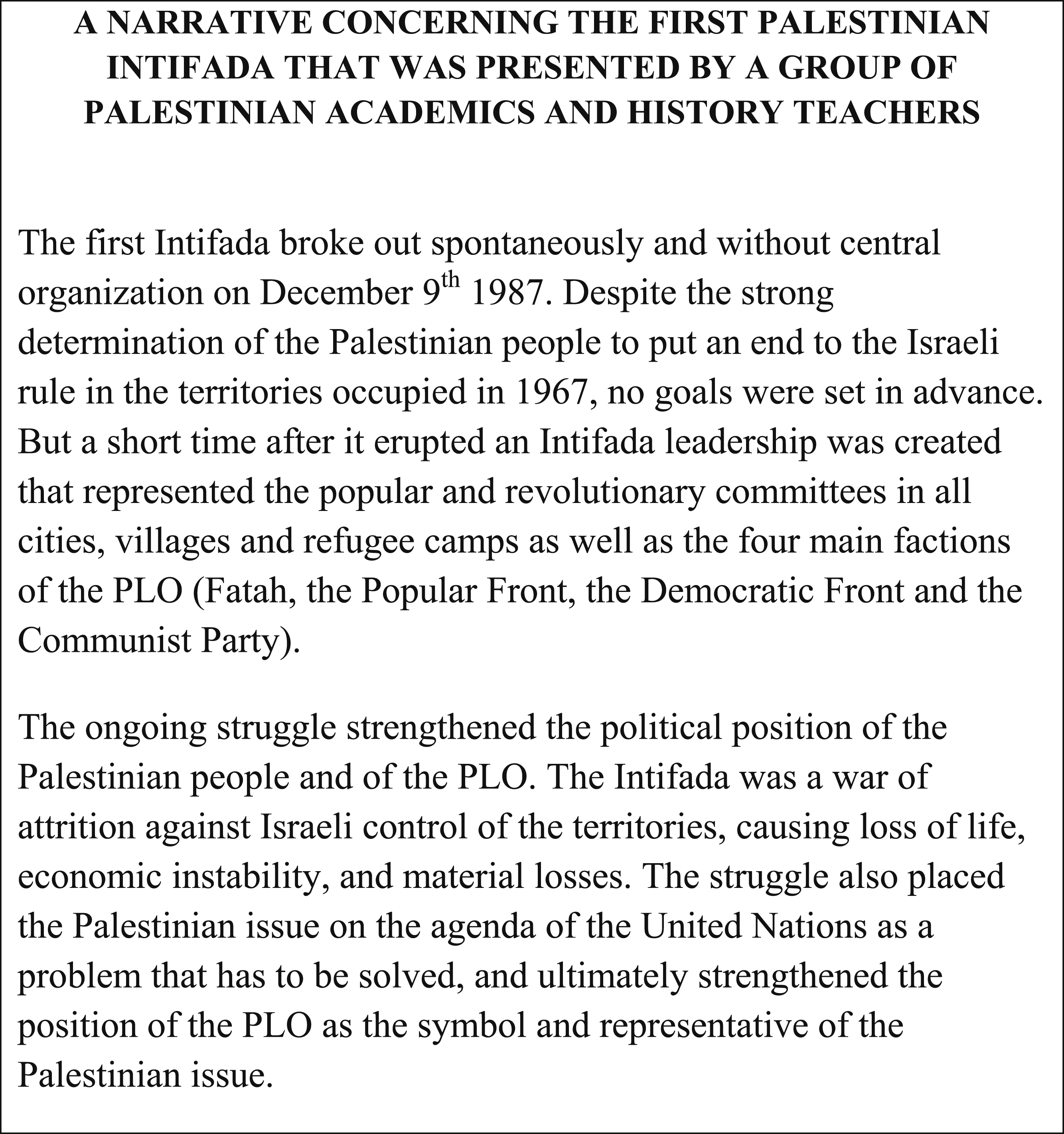
After reading the proposal or the narrative, participants responded to the same questions in all four conditions. When evaluating the source of the proposal, we included four additional measures assessing the extent to which participants viewed the source of the proposal or narrative as aggressive, cooperative, manipulative, and fair.
To evaluate whether participants’ feelings after reading the materials mediated perceived favorability, we included new questions evaluating the extent to which the proposal or narrative evoked different feelings or sentiments. To examine this, participants reported the extent to which they felt the following after reading the proposal or the narrative: fear, sympathy, disgust, empathy, hatred, anger, understanding, and identification. Consistent with the other questions, all new items were reported on a 1 (not at all) to 9 (to a very high extent) scale.
Procedure
Study 3 followed the same procedure from Studies 1 and 2, with the only difference being the inclusion of the new set of emotion measures detailed above.
Results
All analyses were conducted using a two-way ANOVA examining the main effects and interaction between Language (Native | Lingua Franca) and Materials (Proposal | Narrative) with political attitudes as a covariate.
Proposal and narrative evaluation
As in Studies 1 and 2, we created a pro-Israeli Index (Cronbach’s α = 0.87). However, because the pro-Palestinian index had a low Cronbach’s α of 0.57, we analyzed the pro-Palestinian and fair to Palestinian measures separately. If the use of a lingua franca makes conflict-relevant texts in general seem less favorable to your side, there should be a main effect of language with no significant interaction. However, if the use of a lingua franca affects the evaluation of the proposal but not the narrative, then there should be an interaction between language and type of text.
Language affected only the evaluation of the proposal. We replicated the phenomenon that participants viewed the proposal less favorably for their own side when it was written in a lingua franca (M = 4.20, SD = 2.20) than in their native language (M = 4.85, SD = 2.19; F (1,401) = 12.97, p < .001, np2 = 0.04). In contrast, there were no differences in how the narrative was viewed across language conditions (English: M = 3.35, SD = 1.66; Hebrew: M = 3.14, SD = 1.66; F (1,391) = 1.92, p = .17, np2 < 0.01). This resulted in a significant interaction between language and type of text (F (1,793) = 11.12, p < .001, ηp2 = 0.01). This finding suggests that the impact of using a lingua franca is unique to the evaluation of a proposal for future terms of cooperation and does not extend to conflict-relevant information more generally such as narratives of the past events (see Figure 5). Ratings of the extent to which the proposal and narrative were perceived as pro-Israeli as a function of type of text and the language of the text.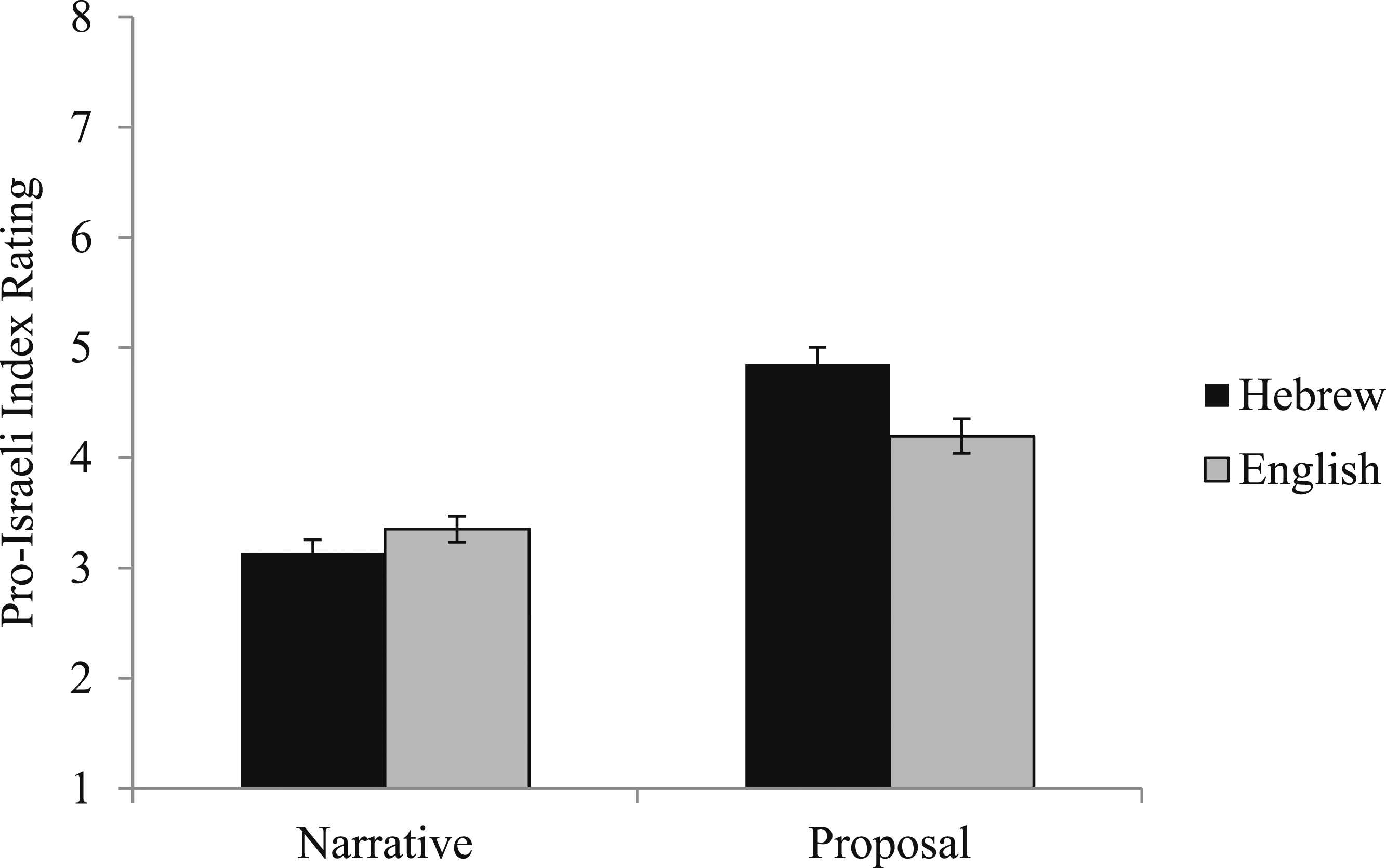
Next, we assessed the extent to which language influenced the perceived favorability of the proposal or narrative for Palestinians. Beginning with the pro-Palestinian measure, language did not significantly influence how pro-Palestinian the proposal was perceived as being (English: M = 6.90, SD = 1.82; Hebrew: M = 6.78, SD = 1.80; F < 1) or how pro-Palestinian the narrative was perceived as being (English: M = 6.89, SD = 2.23; Hebrew: M = 7.27, SD = 1.96; F (1,391) = 3.29, p = .08; ηp2 = 0.01). This resulted in neither a significant main effect of language (F<1) nor a significant interaction between language and type of text (F (1,793) = 3.11, p = 0.08, ηp2 < 0.01). For the fair to Palestinians measure, language did not influence proposal evaluations (English: M = 7.27, SD = 1.67; Hebrew: M = 7.30, SD = 1.56; F < 1) or fair to Palestinians (English: M = 6.25, SD = 2.28; Hebrew: M = 6.43, SD = 2.14; F < 1) the narrative was perceived as being. This resulted in neither a significant main effect of language (F < 1) nor an interaction between language and type of text (F < 1). Therefore, language did not impact evaluations of either the proposal or narrative as being any more or less favorable to the opposing side. This replicates findings from Studies 1 and 2 for the proposal and extends this result to a historical narrative presented by a Palestinian source.
Source evaluations
As in Studies 1 and 2, we created a Source Evaluation index (Cronbach’s α = 0.92). There was no effect of language on source evaluations in the proposal condition (English: M = 4.39, SD = 1.86; Hebrew: M = 4.40, SD = 2.01) nor in the narrative condition (English: M = 3.62, SD = 1.43; Hebrew: M = 3.53, SD = 1.70; F < 1). Furthermore, language and type of text did not interact, (F < 1). Because there was no effect of language on source evaluations, no mediation analysis was conducted (Baron & Kelly, 1986).
This replicates the results from Study 2. Given that we found an effect of language on source evaluation only in Study 1 and did not replicate it twice, this suggests that this effect is not reliable and we do not discuss it further.
Evoked feelings
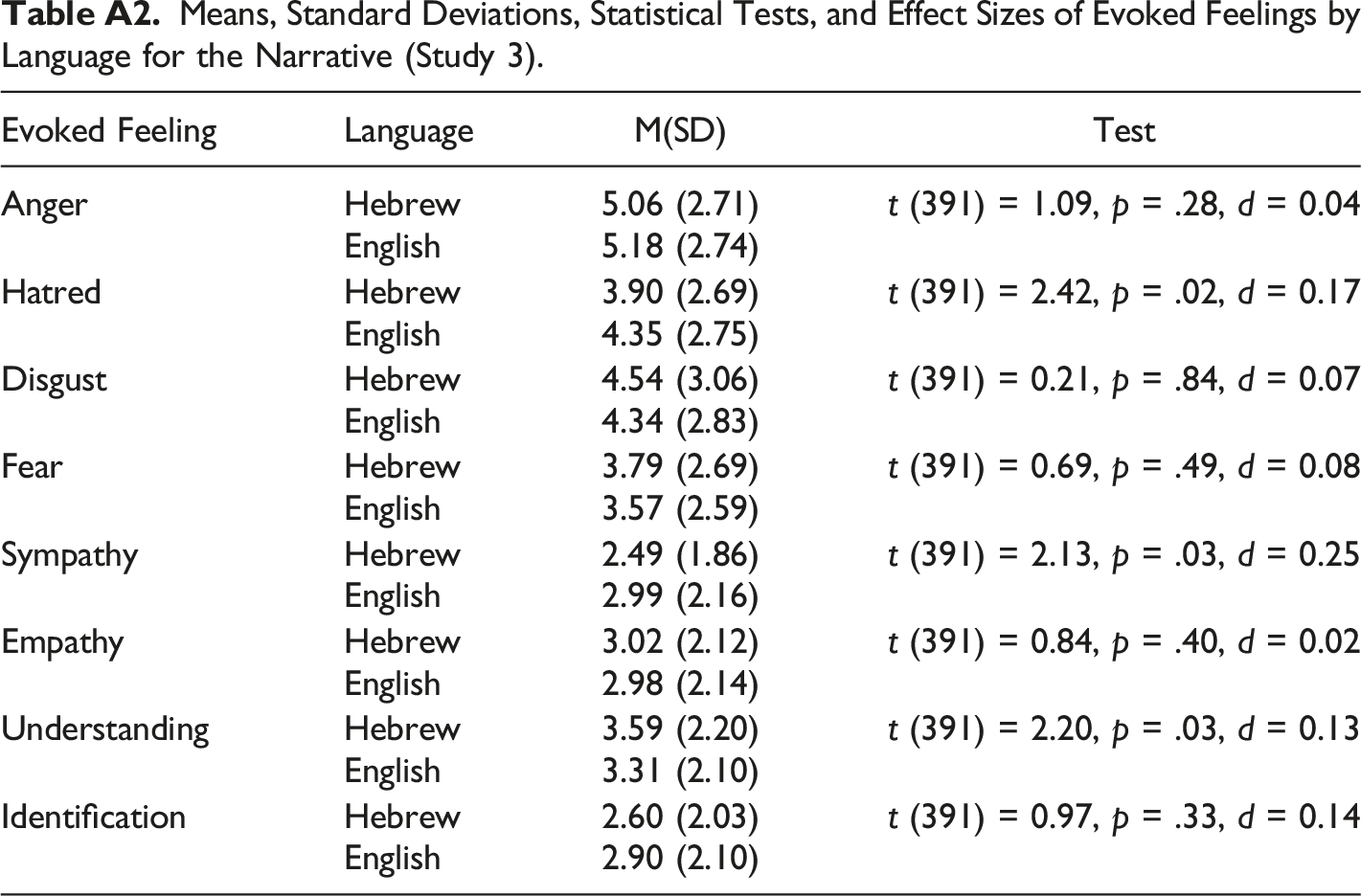
While a number of different emotional states have been discussed as important in the context of intractable conflict (for reviews, see Halperin 2014, Halperin & Tagar 2017, and Klimecki 2019), for the purposes of our current analyses we focus specifically on the impact of language on feelings of hatred and of sympathy (for full analysis of each feeling by language, see Appendix Table A1 for the proposal condition and Appendix Table A2 for the narrative condition).
Our rationale for the selection of these particular emotions is as follows. Previous studies identify hatred as constituting one of the most powerful emotional barriers to conflict de-escalation and, unlike other negative emotions, as having a strictly negative impact on peace building processes (Halperin et al. 2011; Shuman, Halperin, & Tagar 2018). Specifically, increased feelings of hatred have been found to have destructive effects such as leading to the desire to harm or even eliminate the outgroup (Halperin 2008) as well as significantly decrease support for conciliatory action in conflict (Halperin 2008, 2011). Additionally, sympathy has been found to be strongly linked to the support of peace building in conflict (Maoz & McCauley 2009). Here, sympathy is defined as an emotional reaction of concern or compassion for the other (Klimecki 2019), and feelings of sympathy have long been discussed as essential to preventing future conflict (Kelman 1999). Moreover, research demonstrates that increased sympathy leads to increased humanization (Gubler, Halperin, & Hirschberger 2015), willingness to help members of the outgroup (Hasson et al. 2018), as well as increased support for compromise in conflict (Maoz & McCauley 2005, 2009) 1 .
Indeed, participants reported higher levels of hatred after reading the Palestinian proposal in a lingua franca (M = 3.17, SD = 2.35) than in their native Hebrew (M = 2.63, SD = 2.39; F (1, 401) = 6.45, p = .01, ηp2 = 0.02). Additionally, they reported feeling significantly more sympathy when reading the Palestinian proposal in their native Hebrew (M = 4.37, SD = 2.58) than in English (M = 3.91, SD = 2.38; F (1, 401) = 5.03, p = .03, ηp2 = 0.02). In the narrative condition, participants reported marginally stronger feelings of hatred when reading the Palestinian narrative in English (M = 4.35, SD = 2.75) as compared to Hebrew (M = 3.90, SD = 2.69; F (1, 391) = 3.26, p = .07, ηp2 = 0.02) but lower levels of sympathy when reading the narrative in Hebrew (M = 2.49, SD = 1.86) than in English (M = 2.99, SD = 2.16; F (1, 391) = 7.45, p = .01, ηp2 = 0.01).
Because there was a significant effect of language on the evaluation of the Palestinian proposal as beneficial for Israelis and on the extent to which the Palestinian proposal elicited both hatred and sympathy in participants, we evaluated the extent to which these emotions mediated the effect of language on the evaluation of proposal favorability. A mediation analysis was conducted using the bootstrapping method with 10,000 simulations to assess the separate indirect effects of hatred and sympathy on the ratings of the Palestinian proposal as beneficial for Israelis across language conditions. Like with the prior analyses, political attitudes were included as a covariate.
The effect of language on the evaluation of the Palestinian proposal favorability was reduced, but still significant (from b = 0.74, 95% CI [0.55, 0.91] to b = 0.34, 95% CI [0.21, 0.47]) when controlling for hatred and sympathy, consistent with partial mediation. Furthermore, feelings of hatred had an estimated indirect effect of 0.10 [0.03, 0.19], while feelings of sympathy had an estimated indirect effect of 0.30 [0.08, 0.54]. These findings suggest that when participants read the Palestinian proposal in their native Hebrew as compared to a lingua franca, they felt less hatred and more sympathy, which in turn was associated with their evaluation of the proposal as being more favorable to Israel (see Figure 6). Mediation analysis of the indirect effects of sympathy and hatred on the direct effect of language on pro-Israeli index scores (with political attitudes as a covariate) for Study 3. Mediation coefficients above refer to unstandardized coefficients. ** p < .01, *** p < .001.
General Discussion
We have demonstrated that a lingua franca can pose a barrier to conflict resolution. Recipients of a proposal viewed it less favorably for their own side when it was made in a lingua franca compared to their native tongue. These findings were consistent across three studies and were specific to peace-building measures rather than conflict-relevant texts more broadly, as they did not generalize to a narrative of past events. This work has important implications for the management and resolution of ethnopolitical conflicts as well as peace negotiations. Specifically, if individuals view peace building measures in cross-national conflict more favorably when presented in their native language, even when coming from the other side, one could leverage this information to increase the chances of a proposal being favorably received thereby facilitating conflict resolution.
From a broader perspective, our study highlights the role of an ever-present actor that has been mostly overlooked in previous research. Namely, the language through which we communicate during conflict plays an important role by influencing how individuals feel when communicating. Given that this ‘silent actor’ can influence our openness to conflict resolution, it would be important to examine how language interacts with other barriers that arise during conflict.
Finally, our research could be extended in the future in a variety of ways to investigate the generalizability of our findings. For example, one could investigate whether the same language effect holds if Palestinians are the receivers of a proposal. More generally, one could investigate this effect in other conflicts around the world, and whether the effect of utilizing a lingua franca extends to other peace building platforms. For example, in face-to-face negotiations using a lingua franca might be beneficial because it avoids the need for an interpreter. Another disadvantage of using the native language of the other side in face-to-face negotiations is it may imply a power dynamic as one side is using the native language of the other (Suleiman 2004). Further research might examine these issues more directly and explore the role of language in different types and formats of negotiation more broadly.
Explanation and Alternative Explanations
The results of Study 3 provide an explanation for the impact of using a lingua franca. These findings indicate that using a lingua franca resulted in a worse emotional response than when the same proposal was read in their native Hebrew. Specifically, our findings show that reading the Palestinian proposal in English elicited higher levels of hatred and lower levels of sympathy, which in turn resulted in the proposal being evaluated less favorably.
One might suggest a much simpler account for our results. It could be that the use of a lingua franca depresses ratings overall, thereby reducing favorability ratings for the proposal when it is presented in English. This implies that the proposal is not actually perceived differently across the two languages but that the elicitation of the ratings makes it seem like it is. This would be consistent with findings that show that using a nonnative language can change how individuals interact with scales (De Langhe, Puntoni, Fernandes & Van Osselaer 2011). Yet, this account is inconsistent with our overall results. Recall that a lingua franca only reduced favorability ratings of the proposal for Israel, the participants’ own side. Language did not affect the ratings of the proposal’s favorability for the other side. Had this account been correct, ratings should have been reduced in a lingua franca across the board and not just when evaluating the favorability of the proposal for Israel.
Another potential account is based on social inferences. It is possible that the very choice of language “communicates” intentions, in which offering a peace-building measure in the native language of the recipient could be seen as a goodwill gesture by the proposers. This may be particularly true due to the politicization of language in this region of the world (Suleiman 2004). If participants viewed the use of their language as a goodwill gesture by the opponent, it could explain why they viewed the proposal more favorably when presented in Hebrew than when presented in English. Yet, our results are not consistent with this account either. If it were true, then language should have impacted proposal evaluations only when they originated from a Palestinian delegation. When the proposal originated from an Israeli delegation, it does not follow that language would be perceived as a good will gesture. But the results of Study 1 clearly show that the use of a lingua franca reduced ratings of favorability for Israel regardless of the source of the proposal, which is inconsistent with the good will gesture account.
As mentioned, our experiments show that a lingua franca increased hatred and decreased sympathy, thereby reducing the perceived favorability of the proposal itself. One might ask why a lingua franca results in a worse emotional response than when the same information is communicated in their native language. This might relate to the difficulty of processing a non-native language. It may be that the relative ease of processing when using a native language as compared to foreign, lingua franca, leads to a less negative emotional response and higher favorability ratings. In other words, high processing fluency, defined here as the ease in which information is processed, may increase positive affect thereby leading to more favorable judgments (Schwarz et al. 2021). Because a native language tends to be processed more automatically and requires less cognitive resources than processing a foreign language (Clahsen & Felser 2006), this might have led to the more positive affective response, which in turn yielded more favorable proposal evaluations. While this is a possibility, our experiments were not designed to directly evaluate this idea.
Conclusion
Using a lingua franca in conflict resolution removes a communication barrier but creates a hidden barrier: a lingua franca renders a proposal less palatable to the other side. The late Nelson Mandela reflected this sentiment when he said “If you talk to a man in a language he understands, that goes to his head. If you talk to him in his language, that goes to his heart.” He followed through with this idea when he learned Afrikaans during his imprisonment on Robben Island and then used it to negotiate with the Apartheid representatives. Perhaps addressing them in their native tongue helped him reach their hearts and negotiate a better future.
Footnotes
Declaration of Conflicting Interests
The author(s) declared no potential conflicts of interest with respect to the research, authorship, and/or publication of this article.
Funding
The author(s) disclosed receipt of the following financial support for the research, authorship, and/or publication of this article: This research was supported by funding from the Center for International Social Science Research at the University of Chicago (CISSR) and the National Science Foundation (NSF #1520074).
Open Practices Statement
Experiments 1 and 2 were preregistered via Open Science Framework; the preregistration for Experiment 1 can be accessed at https://osf.io/2evfz and the preregistration for Experiment 2 can be accessed at https://osf.io/7amkd. De identified data along with an annotated codebook and the data analysis scripts will be posted on Open Science Framework upon publication at 
Note
Appendix
Means, Standard Deviations, Statistical Tests, and Effect Sizes of Evoked Feelings by Language for the Proposal (Study 3). Means, Standard Deviations, Statistical Tests, and Effect Sizes of Evoked Feelings by Language for the Narrative (Study 3).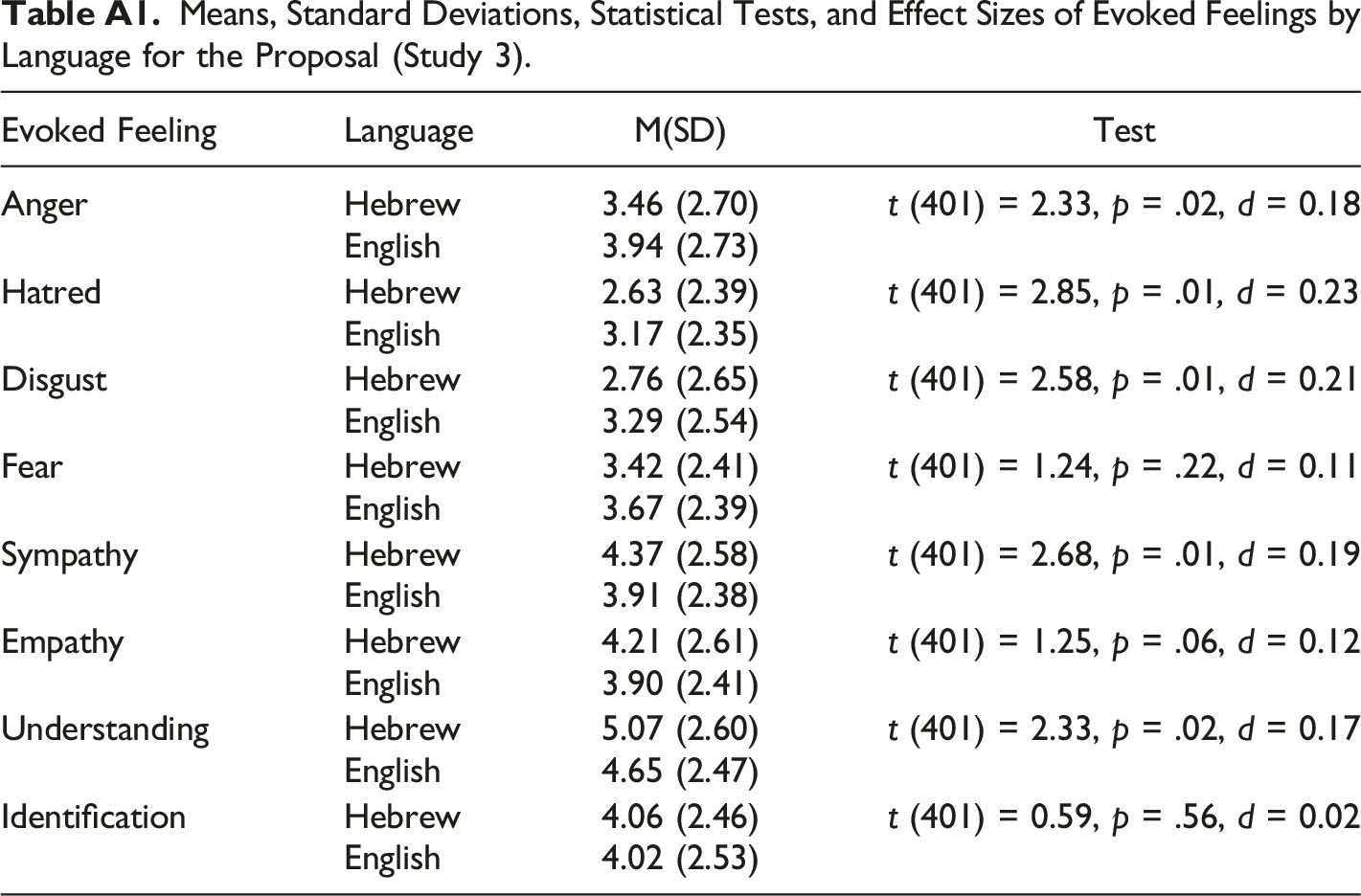
Evoked Feeling
Language
M(SD)
Test
Anger
Hebrew
3.46 (2.70)
t (401) = 2.33, p = .02, d = 0.18
English
3.94 (2.73)
Hatred
Hebrew
2.63 (2.39)
t (401) = 2.85, p = .01, d = 0.23
English
3.17 (2.35)
Disgust
Hebrew
2.76 (2.65)
t (401) = 2.58, p = .01, d = 0.21
English
3.29 (2.54)
Fear
Hebrew
3.42 (2.41)
t (401) = 1.24, p = .22, d = 0.11
English
3.67 (2.39)
Sympathy
Hebrew
4.37 (2.58)
t (401) = 2.68, p = .01, d = 0.19
English
3.91 (2.38)
Empathy
Hebrew
4.21 (2.61)
t (401) = 1.25, p = .06, d = 0.12
English
3.90 (2.41)
Understanding
Hebrew
5.07 (2.60)
t (401) = 2.33, p = .02, d = 0.17
English
4.65 (2.47)
Identification
Hebrew
4.06 (2.46)
t (401) = 0.59, p = .56, d = 0.02
English
4.02 (2.53)
Evoked Feeling
Language
M(SD)
Test
Anger
Hebrew
5.06 (2.71)
t (391) = 1.09, p = .28, d = 0.04
English
5.18 (2.74)
Hatred
Hebrew
3.90 (2.69)
t (391) = 2.42, p = .02, d = 0.17
English
4.35 (2.75)
Disgust
Hebrew
4.54 (3.06)
t (391) = 0.21, p = .84, d = 0.07
English
4.34 (2.83)
Fear
Hebrew
3.79 (2.69)
t (391) = 0.69, p = .49, d = 0.08
English
3.57 (2.59)
Sympathy
Hebrew
2.49 (1.86)
t (391) = 2.13, p = .03, d = 0.25
English
2.99 (2.16)
Empathy
Hebrew
3.02 (2.12)
t (391) = 0.84, p = .40, d = 0.02
English
2.98 (2.14)
Understanding
Hebrew
3.59 (2.20)
t (391) = 2.20, p = .03, d = 0.13
English
3.31 (2.10)
Identification
Hebrew
2.60 (2.03)
t (391) = 0.97, p = .33, d = 0.14
English
2.90 (2.10)