




Abstract
Extant evidence suggests that power-sharing reduces the participation of minorities in civil conflict by alleviating their grievances. Yet, it remains unclear how and to what degree power-sharing should be institutionalized. Moreover, direct attitudinal evidence for the grievance mechanism remains rare. Addressing these gaps, I argue that corporate power-sharing which is constitutionally-enshrined and explicitly recognizes minorities most strongly alleviates their grievances. However, it simultaneously accentuates the importance of relative inter-group comparisons. This means that minorities with a lower relative degree of corporate power-sharing than their 'peers' in the same country and transnational kin population should have higher grievances, irrespective of its absolute level. Using an extensive combination of mass survey data, I test my expectations in a series of hierarchical multi-level models. By highlighting the importance of institutional design, my results have significant implications for policy in multi-ethnic societies and for the scholarly literature on accommodation and grievances more generally.
Introduction
In 2007, Nepal adopted an interim power-sharing constitution which formally ended its decade-long civil war. Yet, the very day after its inception, it faced an increasingly violent protest movement. This was spearheaded by aggrieved activists of the Madhesi minority who remained dissatisfied with the constitution’s inclusive guarantees. Specifically, they demanded explicit ‘recognition and not just representation’ (Sijapati 2013, 155). A particular cause of frustration was their continuing exclusion from top-level government posts and absence of autonomy, while other groups, in contrast, enjoyed increasing rights (ibid.; Tamang 2011). Another issue was the marginalized status of the Hindi language, which many Madhesi share with their more privileged transnational kin in India (Nayak 2011).
This example illustrates two key gaps in the literature on power-sharing and grievances that I address in this article. First, most studies focus on a group’s absolute political outcomes, such as whether its representatives are included in government or not. While certainly important, this may miss the relational nature of grievances and thereby a key step in the grievance formation process more generally (cf. Siroky et al. 2020). As the above example suggests, groups do not evaluate their own political status ‘in a vacuum’. Instead, grievances are influenced by evaluations of their relative status, as compared to other groups. Second, extant research indicates that including ethnic minorities into government alleviates their grievances. However, it remains less clear how inclusion should be ‘institutionally engineered’ (Lijphart 2004), especially in places that lack inclusive norms in the first place. This characterized Nepal after the end of its long-standing, exclusionary Hindu monarchy. Indeed, Madhesi protesters did not question the principle of power-sharing per se. Instead, they were aggrieved over its specific institutional form and their low relative attainments under it, as compared to their domestic and transnational ‘peers’.
Addressing these gaps, I explain how the institutional form of power-sharing affects ethnic grievances. I argue that corporate power-sharing, which is based on constitutionally-enshrined and ethnically-based guarantees, has the potential to alleviate grievances most strongly. This is because its rigid, ethnically-based guarantees are comparably enforceable and provide the strongest guarantee for both a group’s current and future political representation. Moreover, it also entails a costly signal whereby governing elites symbolically recognize group rights. However, by relying on explicitly group-differentiated criteria, corporate power-sharing also accentuates the importance of relative inter-group comparisons. Thereby, groups may form grievances even where they attain substantial corporate power-sharing, but where its degree remains below that attained by their domestic 'peers' and transnational kin.
To test these expectations, I rely on the most extensive, global collection of mass surveys used in the study of inclusive institutions so far. To capture grievances, I construct two dependent variables based on question items that tap into respondents’ attitudes towards government and their perception of being discriminated. I connect these with group-wise, time-varying information on ethnically-based power-sharing practices and institutions. The resulting data comprise 726′925 respondents, nested in 606 ethnic groups settling in 93 multi-ethnic countries between 1992 and 2018. Thereby, this article also provides much-needed, direct attitudinal evidence for the grievance approach more generally.
My results offer support for my arguments. First, using hierarchical multi-level models, I find that corporate power-sharing reduces grievances more substantially than its informal and liberal alternatives. In additional group-level analyses, including a causal mediation analysis, I examine the mechanisms driving this finding. These indicate that corporate power-sharing institutions not only constitute a strong guarantee that ethnic groups attain de-facto government representation, but also that these gains remain durable, which in turn substantially alleviates grievances. Second, however, my multi-level models also indicate that groups are more likely to form grievances where they attain relatively lower degrees of corporate power-sharing than either their domestic ‘peers’ or their transnational ethnic kin. These findings are robust to alterations in the dependent variable, changes in sample composition, and a large battery of controls. They are also reflected in a group level measurement model approach, which combines my underlying question items into a latent variable tapping into group grievances.
This article proceeds as follows. First, I review the existing literature on power-sharing and grievances, focusing on the gaps outlined above. Second, I lay out my theoretical expectations in more detail. Third, I present my data collection and operationalize my key variables. Fourth, I conduct my empirical analysis. I conclude by discussing the implications of my findings for ‘engineering’ inclusion in multi-ethnic states and for the grievance approach more broadly.
Literature Review
Grievances form the basis of one of the most prominent explanatory strands in the conflict literature. A whole range of influential studies theorize on how grievances motivate anti-government mobilization and conflict (e.g., Gurr 1970; Hechter 1975; Horowitz 1985; Lijphart 1977; Petersen 2002). In the last two decades, evidence has accumulated that socioeconomic (e.g., Cederman et al. 2011; Østby 2008; Stewart 2008) and political (e.g., Buhaug et al. 2014; Cederman et al. 2013) inequalities along ethnic lines—which make the formation of grievances more likely—indeed increase the risk of violent conflict. Moreover, the same studies indicate that including minorities into government—which can be expected to alleviate their grievances— reduces the risks of conflict (cf. also Bormann et al. 2019; Germann and Sambanis 2021; Gurr 2002).
Most recently, scholars have started to complement these behavioral findings with direct attitudinal evidence. Mostly focusing on economic inequalities, they find that inequalities are indeed associated with perceptions of unfair government treatment (Detges 2017; Dowd 2015) and, in turn, with higher willingness to protest or riot (Dyrstad and Hillesund 2020; Miodownik and Nir 2016; Must and Rustad 2019; Rustad 2016).
In this article, I address three key gaps in this sprawling literature. First, most fundamentally, many afore-mentioned studies focus on ‘absolute’ status attainments, such as whether a group is included into government or not. However, this may miss the relational nature of grievances, which are based on inter-group comparisons (Cederman et al. 2013; Stewart 2008). Crucially, such comparisons underlie evaluations of injustice in the first place (Theuerkauf 2010; Siroky et al. 2020). For example, for the Madhesi, the government inclusion of their domestic 'peers' and the more favorable situation of their transnational kin exacerbated their grievances (Sijapati 2013; Tamang 2011). Hence, for the formation of grievances, it should not only matter whether a group is included in government, but also how its attainments compare to those of its reference categories. In spite of this, appraisals of how reference categories affect grievances have so far been limited to expert surveys (Siroky et al. 2020) or to individual power-sharing countries (Stojanović 2018; Tamang 2011).
Second, as regards the literature on ethnic conflict and power-sharing specifically, most studies rely on a concept of power-sharing that is agnostic to its institutional basis (cf. Bogaards 2019a, 29). Thereby, they make a powerful case for power-sharing practices more broadly, such as the representation of minority representatives in government and their influence over policy areas that are of vital interest to them, such as their group’s cultural rights. Conversely, they are less informative on how to ‘engineer’ them in divided places which lack inclusive norms in the first place. However, the institutional form of power-sharing should critically condition the degree to which it reduces grievances. For instance, similar to Nepal’s Madhesi, many groups demand explicit recognition of their group identity. Moreover, they may demand rights and a degree of power-sharing that is commensurate with the attainments of their domestic and international reference categories (Lijphart 1995; McCulloch 2014). In spite of this, there is little systematic discussion of and cross-national evidence for how different institutional types of power-sharing alleviate grievances.
Third, despite the central role of the grievance mechanism for their findings, most studies on power-sharing do not test its attitudinal implications directly. Some consider the effects of inclusive institutions on satisfaction with the political system. Yet, they typically focus on isolated components of power-sharing, such as proportional electoral systems (Aarts and Thomassen 2008; Kittilson and Schwindt-Bayer 2010). Conversely, they do not consider a group’s inclusion into the executive, which is the sine qua non of power-sharing (Lijphart 2004). Other attitudinal studies consider consensus democratic institutions (Anderson and Guillory 1997; Christensen 2015). Yet, these are a broader regime type with only partial overlaps with power-sharing (Bogaards 2000).
In sum, existing studies provide convincing arguments and evidence that power-sharing reduces grievances. However, despite the theoretical importance of inter-group comparisons, they do not typically consider the construction of grievances against specific reference categories. Moreover, little is known about how the institutional form of power-sharing affects these processes. Finally, direct attitudinal evidence on how power-sharing affects grievances is still very limited.
Theory
In this section, I address the first and second of these gaps by formulating a new theoretical argument. I explain why constitutionally-enshrined, ethnically-based forms of power-sharing have the potential to alleviate grievances most strongly. However, I highlight that they simultaneously render relative inter-group comparisons more pertinent. Thereby, ethnic groups may form grievances even if they attain substantial corporate power-sharing, but where its degree remains below the attainments of their ‘peers’ in the same country or their transnational kin.
Grievances and Relative Status Comparisons With Reference Categories
Before laying out these arguments in detail, it is useful to discuss the grievance formation process more systematically. My point of departure are widely-used definitions of ethnic grievances as directed evaluations of injustice. They arise when individuals compare their group’s status with their reference categories, evaluate their status as unequal and unjust, and assign blame for this perceived injustice to an outgroup (Cederman et al. 2013; Stewart 2008; cf. Benford and Snow 2000; Gamson 2013). For example, individuals might form grievances over their group’s comparable lack of political representation, which they evaluate as unjust and blame upon their government.
While groups value their ‘absolute’ status attainments, such as political representation, they do not evaluate these outcomes in a ‘vacuum’. Rather, they will also assess them in relative terms, with respect to their ‘reference categories'. Such reference categories exert important influences in two steps of the inequality-to-grievance mechanism. First, its initial step of intergroup comparison is inherently relational. The perception of horizontal inequalities requires ‘contrast’, that is, the assessment that a group falls short ‘relative to a specific comparison or “reference” group’ (Siroky et al. 2020, 697; cf. Gurr 1970; Must & Rustad 2019). For example, there is ample evidence that groups with a low socio-economic status do not always perceive their situation as lacking. Rather, they will do so when their marginalization stands in marked contrast to other groups they interact with (Cederman et al. 2011; cf. Theuerkauf 2010).
Second, a group’s reference categories also affect its subsequent evaluation of injustice. Perceptions of injustice covary with the ‘difference between what a group believes it should receive and what it believes it will receive’ (Dudley and Miller 1998, 80; cf. Benford & Snow 2000; Desrosiers 2012; Gamson 2013). By establishing norms of what constitute appropriate attainments, the status of reference categories substantially affects the first term in this equation. For example, the global spread of inclusive norms has made exclusionary policies progressively more difficult to justify (Wimmer 2015).
Mechanisms Connecting Power-Sharing Institutions and Grievances
Having described the grievance formation process more generally, I now discuss the mechanisms through which this process is affected by power-sharing institutions. To set up this discussion, I rely on the useful distinction between ethnic core and non-core groups, following Mylonas (2012). By virtue of their demographic, military or bureaucratic dominance, core groups hold the predominant share of political power. This often refers to demographic majorities, sometimes to minorities with a disproportionate share of power. In contrast, all other politically subordinate groups whose status can reasonably be improved by power-sharing institutions, I term ‘non-core groups’. I expect that non-core groups will be more likely to form grievances, as they may unfavorably compare their political status with the core group and evaluate it as unjust.
I conceive of power-sharing institutions as constitutional arrangements that encourage the representation of non-core groups at the central state level. This comprises the three horizontal pillars underlying Lijphart’s (1977) concept of consociationalism, which has influenced much of the power-sharing literature (Binningsbø 2013): proportional representation of non-core groups in parliament, grand coalitions, and veto rights (Lijphart 1977). 1 These inclusive principles are often advocated to foster democratization and safeguard peace (Binningsbø 2013). For these purposes, they have been employed both in heterogeneous democracies, such as Belgium, Bosnia, and Switzerland, and non-democracies, such as Ethiopia and Yugoslavia. I further conceive of the degree of power-sharing as a continuum: at its minimum end are comparably ‘shallow’ forms, which provide non-core groups with limited guarantees. An example is North Macedonia, whose constitution does not provide for mandatory executive power-sharing. Conversely, at its maximum end are fully-fledged power-sharing systems, which encompass incisive grand coalition and veto provisions, such as Bosnia and Lebanon (cf. McCulloch 2014).
I expect power-sharing institutions to reduce the ‘grievance gap’ between core and non-core groups through three mechanisms (see Figure 1). First, power-sharing institutions indirectly alleviate grievances by encouraging simultaneous power-sharing practices. Most importantly, they increase the chance that non-core groups are actually represented in government (Bormann et al. 2019; Cederman et al. 2013; Stewart 2008) and that policies are congruent with their preferences (Anderson and Guillory 1997; Hänni 2017). Second, power-sharing institutions also directly reassure non-core groups that their rights will be protected in the future. Their formal enshrinement in state constitutions makes it more difficult for governments to roll back these political gains and ‘downgrade’ non-core groups in the future (cf. Cederman et al. 2013). Finally, power-sharing institutions also symbolically signal the government’s future accommodative intent, including its commitment to abstain from discrimination against non-core groups. Thereby, they reduce perceptions of injustice directly (cf. Benford and Snow 2000; Gamson 2013), even if de-facto power-sharing practices are yet to take hold (cf. Bormann et al. 2019, 87). In sum, power-sharing institutions alleviate the grievances of non-core groups by improving their current political status, their perception that these gains are persistent, and their evaluation that their identity is appropriately recognized and will not be subject to future discrimination. Power-sharing institutions, power-sharing practices, and grievances: theoretical framework.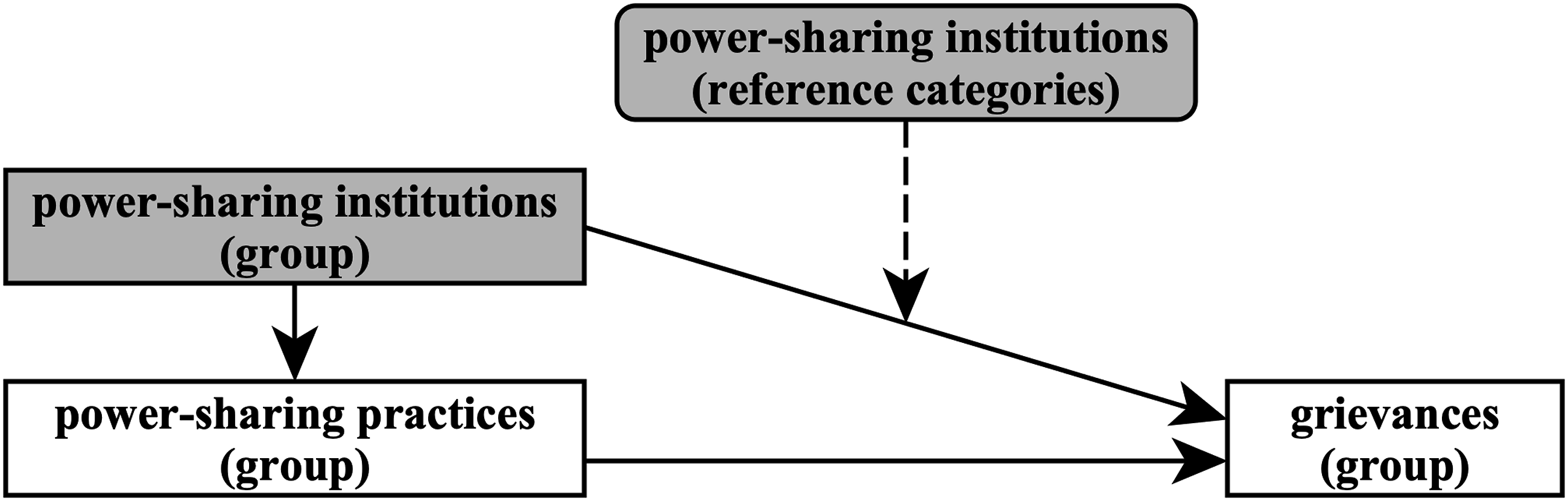
As I have argued, the grievance formation process is inherently relational and influenced by group-wise comparisons with reference categories. This applies to how non-core groups assess their status under power-sharing as well. In principle, the relevant reference categories might differ between various groups and contexts (Theuerkauf 2010, 132). Nevertheless, it is possible to theorize on the types of reference categories that most likely matter to non-core groups when they assess their status under power-sharing. A first reference category are other groups in the same state. Most obviously, this refers to the politically more influential core group itself. However, domestic reference categories also include other non-core groups in the same country. In this vein, if some non-core groups attain relatively higher degrees of power-sharing, this may lead their less privileged counterparts to evaluate their own status as unjust, similar to the Madhesi in this article’s opening example.
Beyond their domestic ‘peers’, I also expect non-core groups to evaluate their degree of power-sharing relative to reference categories at the international level. Most fundamentally, inclusiveness in ‘other states may inspire excluded groups to make similar demands’ (Cederman et al. 2018, 1284). Thereby, it contributes to the formation of grievances through invidious comparisons with more strongly accommodated groups abroad. In particular, this makes them ‘aware of their situation through comparison with others abroad’, which facilitates the articulation of injustice frames (Weidmann 2015, 288). Of particular importance should be comparisons with groups that form part of the same, wider transnational kin population. As there is considerable heterogeneity across different parts of the world, transnational kin groups should lend themselves particularly well to becoming reference categories, as the example of the Arab Spring has shown (cf. Cederman et al. 2018). Most importantly, such comparisons are facilitated by shared channels of communication, which are more likely to exist among kin groups that share the same language or culture (Weidmann 2015).
In sum, when assessing their political status, non-core groups will not only evaluate the power-sharing institutions available to them in absolute terms, but also compare them in relative terms with the attainments of other groups in the same country and their transnational kin. Thereby, the direct effects of power-sharing institutions on non-core group grievances—whereby power-sharing institutions reassure them of their future inclusion and symbolically signal the government’s accommodative intent—should be moderated by the corresponding degree of power-sharing attained by a group’s reference categories (Figure 1). In this vein, where the degree of power-sharing attained by a group remains below the 'benchmarks' set by their domestic and transnational reference categories, this will make the formation of grievances more likely.
The Institutional Form of Power-Sharing and Grievances
In a final step, I discuss how the institutional form of power-sharing affects these mechanisms. Most fundamentally, some power-sharing practices arise from long-standing informal norms or ad-hoc decisions, whereas others are enshrined in formal institutions. Within the latter category, there are important differences between corporate and liberal forms of power-sharing (Lijphart 1995). Corporate power-sharing ‘entails the constitutional entrenchment of group representation’ (McCulloch 2014, 503). It mandates power-sharing through ethnically-differentiated institutions, such as government quotas and group-based veto rights. In contrast, liberal power-sharing leaves open the question of group determination and rewards ‘whatever salient identities emerge in democratic elections’ (McGarry and O’Leary 2007, 675). Most frequently, it relies on low electoral hurdles for cabinet inclusion, proportional electoral systems, and supermajority requirements in the legislative process.
Among these alternatives, corporate power-sharing has the potential to most strongly alleviate non-core group grievances through the three mechanisms in my framework. First, its rigid, explicitly ethnic guarantees substantially increase the chance that constitutional provisions are mirrored by simultaneous power-sharing practices. For instance, its ethnic government quotas offer non-core groups enforceable guarantees for their descriptive representation. Second, corporate power-sharing institutions also provide stronger reassurances that targeted groups will retain their improved status in the future. Their enforceable provisions not only increase the chance that power-sharing practices come about in the first place, but that they persist over time (cf. Bogaards 2019b). Third, corporate power-sharing institutions establish inclusion through highly perceptible, group-differentiated criteria. By explicitly recognizing non-core groups’ identities, they most credibly and symbolically signal the government’s accommodative intent and its willingness to abstain from future discrimination against them. Through this, corporate power-sharing should be most apt at reducing the power of injustice frames (Gamson 2013), whereby continuing status differentials would be blamed on the government. Together, these advantages of corporate power-sharing explain why non-core group representatives frequently demand precisely such guarantees, as in Bosnia following its devastating civil war (Lijphart 1995; McCulloch 2014).
In contrast, power-sharing based on ad-hoc practices, informal norms, or liberal institutions should not alleviate grievances to a similar degree. First, lacking formalized, group-based criteria, these alternatives are more difficult to enforce. For example, requiring the cooperation of multiple groups to ‘bear fruit’, liberal power-sharing is by design less effective in guaranteeing the inclusion of specific non-core groups, as in post-apartheid South Africa (Lijphart 1995). Second, even if they do include a group at a given point in time, informal or liberal types of power-sharing might not affect expectations about future inclusion to a similar degree. Instead, they might raise fears over the gradual erosion of inclusion, whereby increasingly ‘voluntary’ power-sharing practices are administered in a ‘homeopathic dose’, as in post-Hussein Iraq (Bogaards 2019b, 11). Finally, they also lack the government’s costly signal of accommodative intent entailed by corporate power-sharing. Absent formal ethnic recognition, informal and liberal forms of power-sharing may fail to alleviate wide-spread perceptions of continuing discriminatory treatment (Lijphart 1995; McCulloch 2014).
In sum, these arguments suggest that, compared to its informal and liberal alternatives, corporate power-sharing has the strongest grievance-alleviating potential. I formulate these considerations into a first hypothesis:
Non-core groups with corporate power-sharing are less likely to form grievances, compared to non-core groups that are excluded or included on an informal or liberal basis. However, corporate power-sharing ostensibly differentiates on a group-to-group basis. Thereby, it also renders relative status comparisons over the degree of power-sharing enjoyed by each group more pertinent. In contrast to its informal and liberal alternatives (Lijphart 1995), corporate power-sharing only rarely provides the same degree of inclusion to all groups (Juon 2020; McGarry and O’Leary 2007; Stojanović 2018). As numerous examples testify, this may foster invidious comparisons. For example, in Bosnia and Herzegovina, the exclusion of the Jewish and Roma population from offices reserved for its ‘constituent peoples’ has spawned protest and a human rights lawsuit (Stojanović 2018). Moreover, there is discontent even among the Croats, who themselves profit from substantial power-sharing. In particular, there are grievances over the lack of a separate Croat federal entity and lower Croat influence in Presidential elections (Basta 2014), as compared to Bosnia’s other constituent peoples and to their titular ethnic kin in Croatia. In this vein, I expect non-core groups to be more likely to form grievances if they are relatively disadvantaged in the degree of corporate power-sharing, as compared to their domestic and transnational reference categories. First, finding themselves in an environment that includes their reference categories, they are now also de-jure in a diminished position (Juon 2020; Stojanović 2018). In this way, corporate power-sharing privileging their reference categories over them accentuates the ‘objectively’ lower political status of disadvantaged non-core groups. Second, unequal treatment under corporate power-sharing also lends itself to the activation of injustice frames. Both domestically and internationally, corporate power-sharing legitimizes views of a group-based entitlement to political inclusion, by boosting norms of group inclusion and recognition (cf. Gurr 2002; Wimmer 2015). This should make a non-core group’s lower degree of power-sharing all the more jarring. Third, a group’s formal and visible disadvantage vis-à-vis its domestic and transnational reference categories gives activists the means to diagnose a clearly-identifiable problem, a concrete target (the government), and convincing means to redress it (altering the power-sharing formula) (cf. Desrosiers 2012; Gamson 2013). These elements critically increase their ability to articulate injustice frames, which further boosts the grievance mechanism. In sum, this discussion suggests that corporate power-sharing renders relative inter-group comparisons more important to the grievance formation process. In particular, where non-core groups are disadvantaged relative to their domestic and transnational reference categories, they should be more likely to evaluate their own situation as unjust and form grievances. I formulate these considerations into two further hypotheses:
Non-core groups are more likely to form grievances if they have lower degrees of corporate power-sharing relative to other groups in the same country.
Non-core groups are more likely to form grievances if they have lower degrees of corporate power-sharing relative to other groups in the same transnational kin population.
Data
A formal test of these expectations entails stringent data requirements. Most importantly, the comparable rarity of incisive corporate power-sharing demands attitudinal information on grievances across an extensive set of cases. Hence, it would not suffice to rely on individual global surveys or multiple waves of one regional survey, as is commonly done in other applications (e.g., Aarts and Thomassen 2008; Bühlmann and Hänni 2012; Christensen 2015; Hänni 2017; Kittilson and Schwindt-Bayer 2010; Miodownik and Nir 2016). Going beyond existing research as regards spatial and temporal coverage, I therefore rely on a broad combination of mass surveys. Thereby, I am also able to provide much-needed, direct evidence on how power-sharing affects group-wise attitudes for an extensive, global sample.
To collect this information, I considered all conventionally-used, freely available cross-national mass surveys and screened them for measures pertaining to grievances. I included two types of surveys in the resulting collection of attitudinal data. First, large global mass surveys, including the World Values Surveys (Inglehart et al. 2014), the International Social Survey Programme (ISSP) National Identity modules (ISSP Research Group 2010–2015), and the Comparative National Elections Project (CNEP). 2 Second, a series of barometer surveys covering specific regions, including Africa (Afrobarometer Data 1999–2016), the MENA region (the Arab Barometer), 3 Asia (the Asia Barometer (Inoguchi and Fujii 2008), the Asian Barometer, and the South Asia Barometer) 4 Europe (the European Social Survey (Norwegian Centre for Research Data, Norway 2002) and the New Europe, New Russia and New Baltics Barometer series (Rose 2010a, 2010b, 2010c)), and Latin America (the Latinobarometro). 5
Using these surveys, I construct two dependent variables. First, I combine question items that tap into respondents’ satisfaction with and trust in central government institutions, including the cabinet, head of state, and legislature. 6 To combine these items, I re-coded their answer categories into a binary variable: Dissatisfaction with government. This takes the value of 1 if respondents indicated that they are (very) dissatisfied with the government or do not trust it (at all). It takes the value 0 otherwise. This first dependent variable has the important advantage of extensive coverage, which is central to testing my hypotheses. 7 Moreover, it captures the central implication of grievances, whereby blame is attributed onto the central government, which should lower satisfaction with governing institutions more generally (Aarts and Thomassen 2008; Anderson and Guillory 1997). However, an important disadvantage of this variable is that it may tap into variable short-term support for specific individuals holding political office, rather than only long-term, diffuse support for the political regime and its institutions, which is more central for my expectations (cf. Bühlmann and Hänni 2012; Claassen 2019; Dyrstad, Bakke and Binningsbø 2021).
To address these shortcomings, I also construct a second, alternative variable that has more limited coverage but captures grievances more directly. For this purpose, I combine survey items that tap into respondents’ perception of belonging to a group that is discriminated or treated unfairly by the government. To combine these items across different surveys, I re-code their answer categories into a binary variable: Feeling discriminated. This takes the value of 1 if respondents indicated that their ethnic group is (often) discriminated against or if they asserted that their government doesn’t treat all groups equally. It takes the value 0 otherwise. Mirroring my concept of grievances as evaluations of injustice directed against the government, this measure most directly captures the outcome of interest. Similar measures have also been employed to proxy for grievances before (Dowd 2015; Miodownik and Nir 2016). However, it is only available for a limited subset of survey waves and is hence not as well suited to test all my hypotheses cross-nationally as my first measure.
To analyze the relationship between power-sharing institutions and individual attitudes, survey respondents had to be attributed to their respective ethnic groups. For this purpose, I relied on the list of ethnic groups used by the Constitutional Power-Sharing Dataset (CPSD, Juon 2020), which is itself based on the widely-used Ethnic Power Relations Dataset (Vogt et al. 2015). 8 To do so, I combined explicit self-identification questions asked in some of the surveys with information on respondents' settlement area, religion, language, and phenotype provided in others. In my main models, I only include individuals that could be attributed to an ethnic group with reasonably high demographic probability (≥80%). 9
To construct my independent variables, I again turn to information provided by the CPSD and EPR. To distinguish core from non-core groups, I identify the former analogously to Bormann et al. (2017) as the group with the highest level of de-facto government access in a given year. 10 To capture each group’s power-sharing practices, regardless of whether this is informal or based on formal institutions, I construct a dichotomous variable for their de-facto government inclusion, based on EPR (Vogt et al. 2015). To capture each group’s attained degree of corporate and liberal power-sharing institutions, I use the CPSD’s corporate and liberal power-sharing indices (both ranging from 0 to 1, cf. Juon 2020). These are based on Lijphart’s (1977) concept of consociational power-sharing and capture the degree to which each group is targeted by grand coalition and proportional representation clauses (such ethnic government quotas) and to which its representatives are awarded veto rights in the legislative process. 11 Importantly, for my purpose, these indices distinguish between arrangements where this is realized through ethnically-targeted provisions (for corporate power-sharing) and provisions predominantly based on electoral proportionality and parliamentary supermajority requirements (for liberal power-sharing).
Finally, to capture each group’s relative status under corporate power-sharing, central for hypotheses 2 and 3, I calculate two ‘difference’ measures by comparing the corporate power-sharing index values of the group with the ones of its reference categories. For each group g, these are given by the formula

Research Design
Using this data, I quantitatively examine my expectations. My sample includes all multi-ethnic countries where at least 5% of the population belongs to non-core groups. I exclude a small number of country years where no recent election was held that provided a choice of candidates on the ballot.
13
This excludes the most heavy-handed autocracies, such as China. In these countries, constitutional power-sharing is less likely to be implemented in the first place and respondents’ sensitive statements on how they assess the central government and their group rights are more likely to be biased. I also exclude country survey waves where my ethnic attribution procedure enables me to identify fewer than 80% of respondents with reasonable probability and ethnic groups with fewer than 50 sampled individuals, to avoid a potentially biased sample composition. The resulting coverage is extensive and in total includes 726′925 respondents, nested in 93 multi-ethnic countries, 574 country years, and 606 groups. Figure 2 maps the grand average of non-core group respondents that are dissatisfied with central government and feel discriminated across survey waves in each sampled country. Grand average fraction of non-core respondents that are dissatisfied with government and that feel discriminated across survey waves, per country.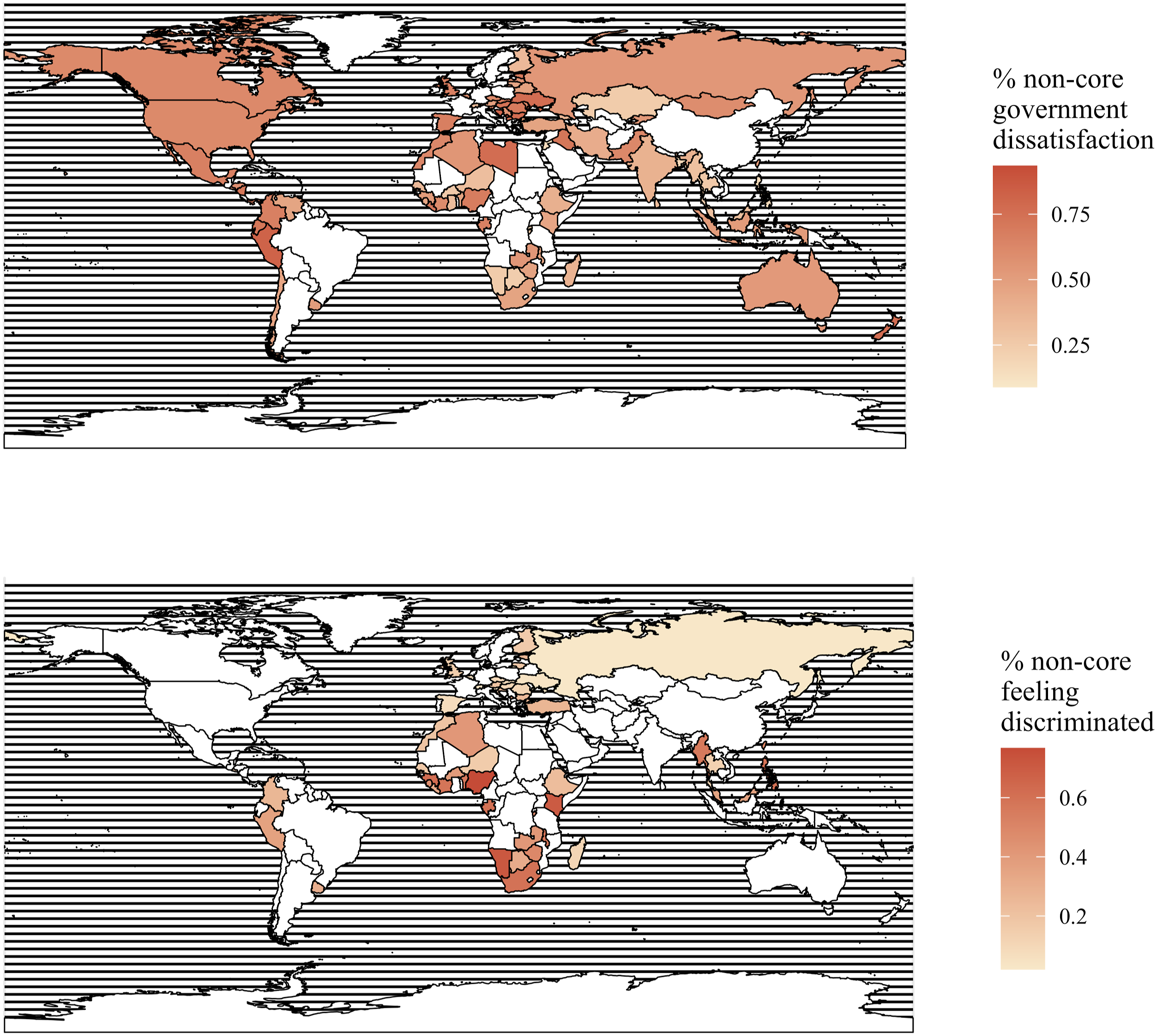
I conduct my analysis with a set of logistic multilevel models. These are suitable, as respondents are clustered into subgroups and therefore similar to a degree (Steenbergen and Jones 2002). Most evidently, respondents’ grievances will be influenced by their common context as members of a group and citizens of a country. The following equation specifies the full model for a non-core group individual i in group year g, country year y, and country c

Across my models, I further control for the most important factors that influence grievances independently of power-sharing or that might affect both its initial provision and group-wise grievances. The most important concern is that groups frequently attain power-sharing, especially of the corporate type, in the wake of conflicts (Binningsbø 2013; McCulloch 2014), which might themselves increase grievances (Theuerkauf 2010; Weidmann 2015). Due to an empirical pattern whereby potential, current, and past belligerents are included into government (Wucherpfennig et al. 2016), my models are likely to systematically underestimate both the grievance-alleviating effect of power-sharing and the grievance-inducing effect of its relative difference, especially at a domestic level. To somewhat alleviate these concerns,
At the group-year level,
To account for the hierarchical clustering of respondents, I follow recommendations by Barr et al. (2013) and Schmidt-Catran and Fairbrother (2016) by including random effect terms at the key levels: country (
Analysis
Effect of Power-Sharing Practices and Institutions on Government Dissatisfaction and Feeling Discriminated.
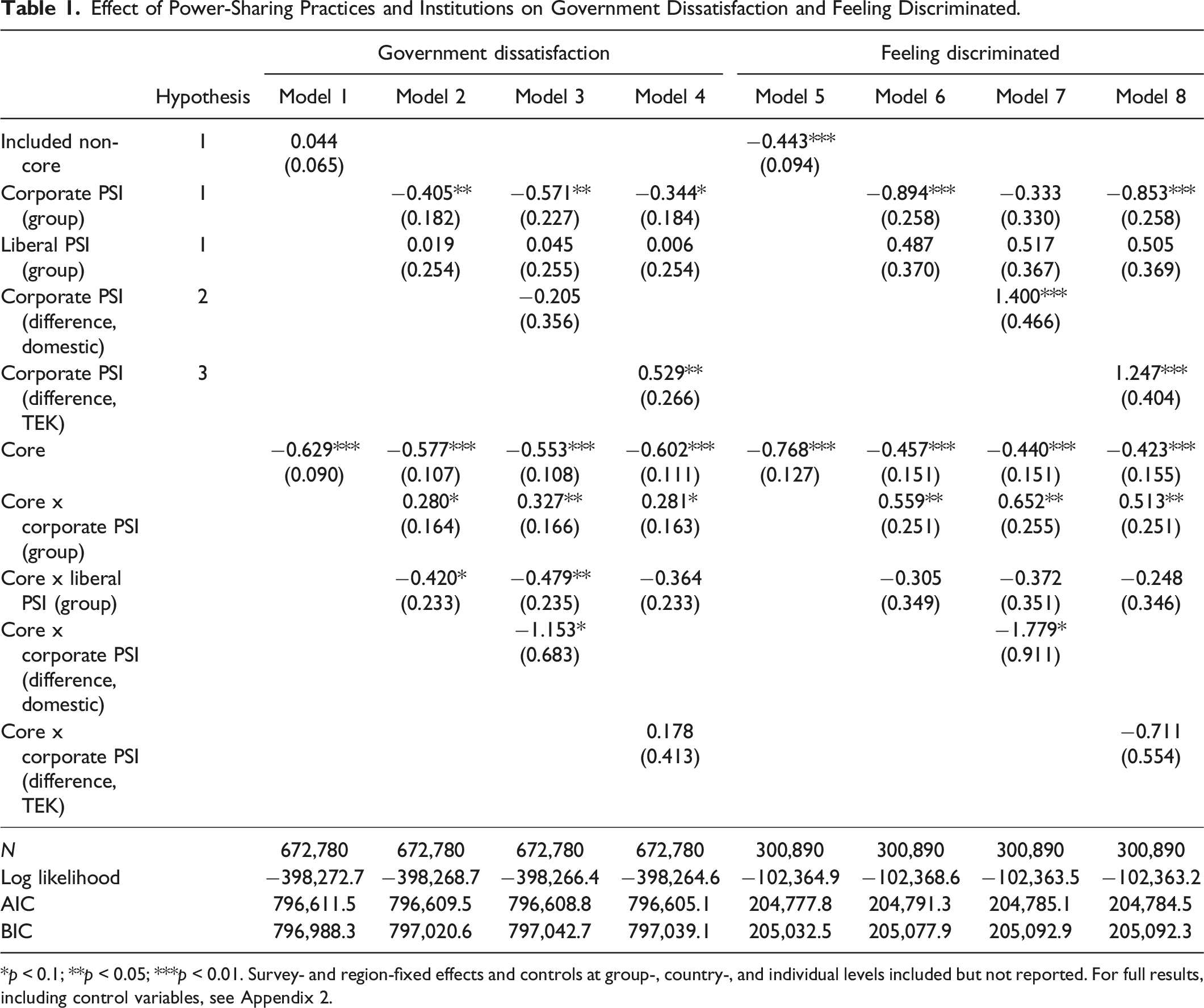
*p < 0.1; **p < 0.05; ***p < 0.01. Survey- and region-fixed effects and controls at group-, country-, and individual levels included but not reported. For full results, including control variables, see Appendix 2.
I start by discussing evidence for hypothesis 1. This postulates stronger grievance-alleviating effects of corporate power-sharing, as compared to its informal and liberal alternatives. In my models, the observable implication of this hypothesis would be a stronger negative association of corporate power-sharing institutions with non-core group grievances, as compared to my measures for power-sharing practices of any type (included non-core) and liberal power-sharing institutions.
Overall, my findings are in accordance with this expectation. First, I note that my measure for included non-core groups—which encompasses power-sharing practices of any type, be they informal, corporate, or liberal—is associated with a decrease in the probability that non-core group members feel discriminated from 59% (excluded non-core) to 48% (included non-core). Yet, I attain no corresponding reduction in the probability that non-core group members are dissatisfied with government (models 1 and 5; Figure 3). Second, the coefficient of corporate power-sharing is negative with greater magnitude and statistically significant at the 0.05-level for both outcomes (models 2 and 6). Moreover, its relationship with grievances is also more pronounced in substantial terms: Where non-core groups profit from the highest degree of corporate power-sharing, this reduces the probability that their members are dissatisfied with government to 29% and that they feel discriminated to 31% (Figure 3). Third, I do not attain a statistically significant association of liberal power-sharing institutions with either dependent variable (models 2 and 6; Figure 3). In sum, in line with hypothesis 1, I find that my measure for corporate power-sharing institutions has the most pronounced negative association with non-core group grievances. Predicted probability of non-core group respondent grievances, depending on de-facto power-sharing practices and de-jure corporate and liberal power-sharing institutions (PSI) (models 1, 2, 5, 6).
Of course, these results have to be read with reverse causation in mind and likely underestimate the negative effects of both power-sharing practices and institutions on grievances. However, two considerations point to a cautious endorsement of hypothesis 1. First, the negative association of corporate power-sharing with non-core group grievances is more pronounced in relative terms, as compared to my measures for power-sharing practices of any type (included non-core) and liberal power-sharing. And, second, corporate power-sharing institutions are often adopted in particularly difficult contexts (McCulloch 2014). This means that I am especially likely to underestimate their grievance-alleviating effects, as compared to those of power-sharing practices and liberal power-sharing institutions.
In Appendix 3, I probe the mechanisms underlying this finding further. I do so with a causal mediation analysis that covers the same sample as my main models, analogously to the procedure employed by Bormann et al. (2019). Additionally, I conduct group-level analyses of my argument’s intermediate implications for the full sample of non-core groups in the time period studied (1992–2018). These procedures serve two purposes. First, they offer additional evidence that corroborates my arguments. As implied by my three hypothesized mechanisms, I find that corporate power-sharing substantively increases the probability that non-core groups are included in government, that their status attainments persist over time, and that they are not subject to political discrimination (Vogt et al. 2015). Conversely, I attain no similar relationships for its liberal alternative.
Second, these procedures also help me disentangle the relative importance of my hypothesized mechanisms. My mediation analyses indicate that the grievance-alleviating effects of corporate power-sharing attained in my main models predominantly run through direct, institutional channels, rather than indirect ones mediated by simultaneous power-sharing practices. I find that the higher time persistence of non-core groups’ political gains mediates a notable proportion (∼1/3) of the grievance-alleviating effects of corporate power-sharing. Additionally, an even larger fraction of this effect is due to pathways not captured by my behavioral mediating variables. Thereby, these findings highlight the important role that corporate power-sharing plays not only in guaranteeing a non-core groups’ current government inclusion, but also in safeguarding these gains and reassuring non-core groups' of their fair treatment in the future. 18
Next, I discuss evidence for hypotheses 2–3, which posit that corporate power-sharing accentuates the importance of relative status comparisons and that these influence the subsequent formation of grievances. In my models, the observable implication of these hypotheses would be a positive impact of my relative difference measures—which increase from 0 to 1, as a non-core group obtains lower degrees of corporate power-sharing than its domestic and transnational reference groups—on non-core group grievances.
I find the clearest support for these arguments as regards transnational comparisons, which I highlighted in hypothesis 3. This is indicated by the positive and statistically significant coefficients of my kin-based difference measure (corporate power-sharing (difference, TEK), see Table 1, models 4 and 8). I attain more limited evidence that domestic comparisons matter for grievances, highlighted in hypothesis 2. This is indicated by the positive and statistically significant coefficient of my domestic difference measure (corporate power-sharing (difference, domestic)) on feeling discriminated (model 7). However, I do not attain a similar result for my first dependent variable, government dissatisfaction (model 3).
In Figure 4, I depict the influence of domestic and transnational reference categories graphically to facilitate the interpretation of their effects. For this purpose, I vary the degree of corporate power-sharing enjoyed by a non-core group from its minimum (0) to its maximum (1). I do so for three separate scenarios, whereby the respective reference category variably enjoys average degrees of corporate power-sharing taking the value 0, 0.5, and 1. This visualizes two important implications of my results. First, where non-core groups enjoy lower degrees of corporate power-sharing relative to other groups in the same country (for feeling discriminated) or their transnational kin (for both dependent variables), they are substantially more likely to form grievances. For example, where a non-core group enjoys no corporate power-sharing, while other groups in the same country enjoy ‘full’ corporate power-sharing, this increases the probability that a non-core group member will feel discriminated from 51% to 81% (Figure 4B). Second, corporate power-sharing has the strongest grievance-alleviating potential where non-core groups are relatively disadvantaged to begin with. This is indicated by the steeper slope of the prediction lines in Figure 4 in contexts where a non-core group’s degree of corporate power-sharing does not match the one of its reference categories. Under such circumstances, concessions of corporate power-sharing not only improve the ‘absolute’ status of non-core groups, but also enable them to gradually ‘catch-up’ in relative terms to the institutional ‘benchmarks’ set by their reference categories. Predicted probability of non-core group respondent grievances, depending on the degree of corporate power-sharing institutions of the given non-core group and the degree of corporate power-sharing institutions of its domestic (panels a and b) and transnational (panels c and d) reference groups (models 3, 4, 7, 8).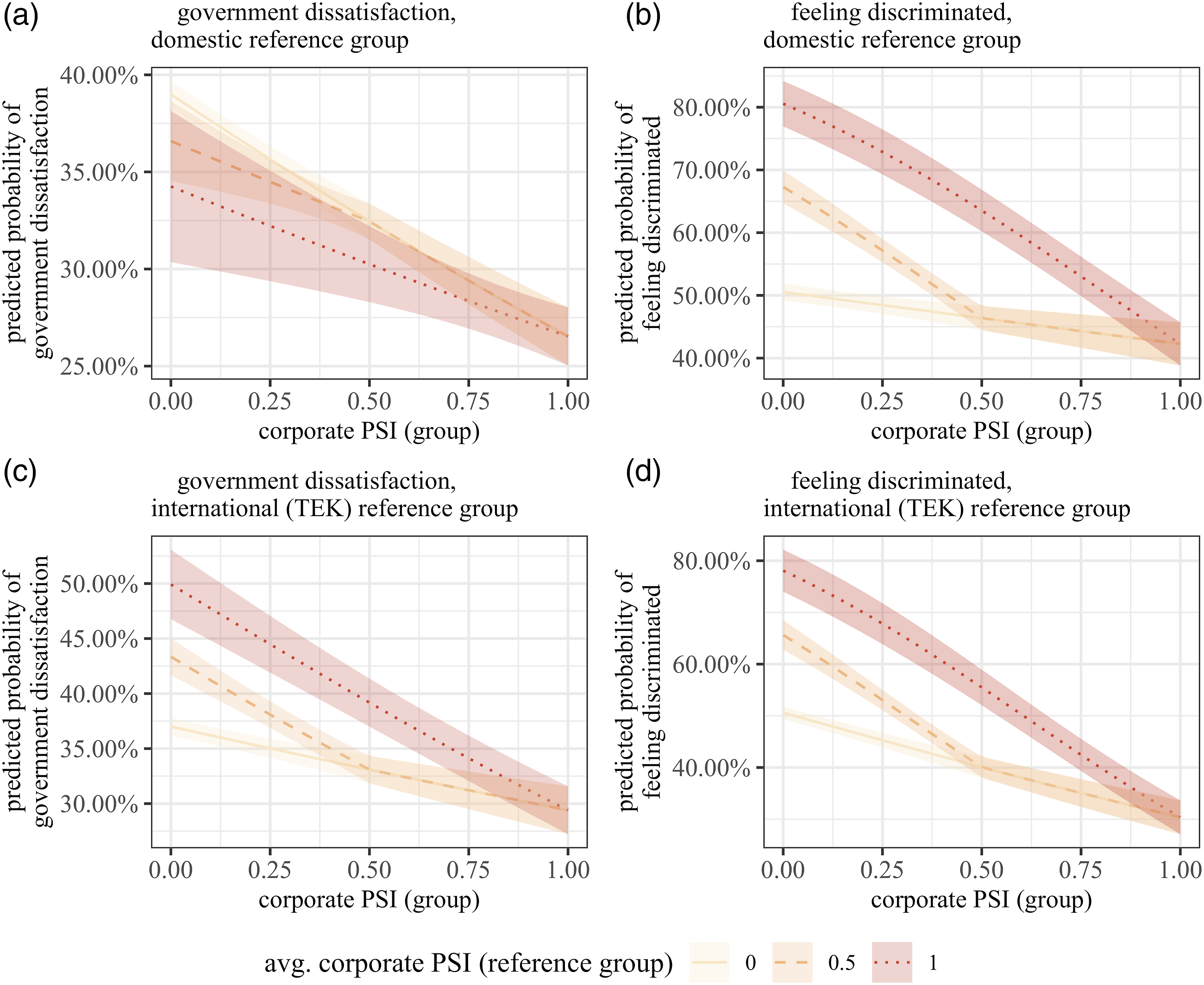
Robustness Checks
I test the robustness of my findings to several analytical decisions and assumptions. First (Appendix 4.1), I examine whether my combination of heterogeneous question items affects my findings. This is especially acute for my first measure, government dissatisfaction, which is based on question items that measure respondents’ dissatisfaction with both executive and legislative institutions. I hence re-estimate my models while only including the former, to which my arguments apply more closely. Moreover, for both dependent variables, I conduct a jacknife estimation, which sequentially excludes each unique survey wave with different question wordings from the analysis. Reassuringly, while the magnitude of coefficients varies, their signs remain stable. Additionally, I construct a group-level latent variable for grievances by relying on the Bayesian dynamic latent trait modeling framework developed by Claassen (2019). This enables me to make use of all available question items in a unified analytical framework, while remaining sensitive to the different degree to which they capture grievances. The findings of this procedure remain mostly in accordance with my hypotheses, although they yield no statistically significant coefficient for domestic comparisons (Appendix 5).
Second (Appendix 4.2), I probe the robustness of my findings to the demographic thresholds at which I include respondents, country survey years, and survey groups in my sample. I variably change the respective thresholds from 80% to 60%, 70%, and 90%, and include all groups irrespective of the surveyed number of respondents, respectively. Moreover, I re-run my analyses for a sub-sample that only includes non-core groups, while excluding core group members. Reassuringly, my findings remain comparable.
Third (Appendix 4.3), I probe the applicability of my findings to two sample subsets, corresponding to the two settings where power-sharing is predominantly advocated: democracies and post-conflict contexts (Binningsbø 2013). I find stronger effects in the democratic sub-sample (Polity index ≥ 6), in which the grievance-alleviation mechanism appears to play out most strongly. However, my findings remain similar even in post-conflict contexts, although they are less pronounced and exhibit lower statistical significance for my first dependent variable, government dissatisfaction.
Fourth (Appendix 4.4), I include additional control variables. First, I control for regional autonomy (Vogt et al. 2015), economic inequality (Cederman et al. 2011), and cultural cleavages (Bormann et al. 2017), all of which might shape both the grievance formation process and a group’s probability of attaining power-sharing. Their incorporation does not affect my findings. Second, I investigate whether reference categories affect group-wise grievances through alternative mechanisms. Most importantly, both domestic and transnational reference groups’ power-sharing levels might themselves be the result of contestations with their respective governments. These might indirectly affect grievances through spillover or demonstration effects (Kuran 1998; Weidmann 2015). Hence, I control for recent contestations (Germann and Sambanis 2021; Vogt et al. 2015) among other groups in the same country and among transnational (kin) reference groups. I additionally include a dummy for states where only one non-core group is politically relevant, according to the EPR dataset (Vogt et al. 2015). In these cases, comparisons with domestic reference categories are less likely by definition. Reassuringly, these alterations do not affect my substantial findings.
Fifth (Appendix 4.5), I probe for the possibility that power-sharing practices and institutions might have gradually accumulating effects. Most importantly, power-sharing might induce gradual moderation processes (Lijphart 1977) and alleviate grievances especially strongly after long time periods. For this purpose, I employ measures for gradually-accumulating power-sharing stocks. However, the results from this procedure only yield inconsistent findings. I attain evidence that corporate power-sharing might decrease grievances more strongly over time, if these are measured by my second dependent variable, feeling discriminated. Conversely, I attain no similar result for my government dissatisfaction measure.
Finally (Appendix 4.6), I probe whether the importance of reference categories might differ between individuals, depending on their political interest. As recent survey research shows, individuals may not be familiar with specific power-sharing provisions (Dyrstad, Bakke and Binningsbø 2021). To probe whether this affects my findings, I interact my relative difference measures with my dichotomous indicator for individuals’ political interest. I find no consistent differences between politically interested and non-interested individuals. This indicates that, while they may be unable to assess each specific power-sharing institution in technical terms, they may be able to interpret them in a heuristic manner to gauge their status in relative terms.
Conclusion
This article’s findings hold two key implications for efforts to institutionally ‘engineer inclusion’ (Lijphart 2004) in multi-ethnic states. First, they indicate that corporate power-sharing institutions, which are based on constitutionally-enshrined and ethnically-differentiated provisions, have the strongest potential to alleviate grievances. My results indicate that this is because corporate power-sharing not only improves a group’s political status at any given point of time, but also makes it more likely that these gains are protected in the future. In contrast, informal power-sharing appears to reduce grievances less substantially, while liberal power-sharing does not appear to be associated with grievances, at least as given by my measures. These findings echo arguments that ethnic groups frequently demand rigid, enforceable reassurances of their future inclusion and explicit ethnic recognition (Lijphart 1995; McCulloch 2014), and support them with systematic attitudinal evidence.
Second, however, my findings also indicate that corporate power-sharing accentuates the importance of comparisons over relative group status. In particular, groups may form grievances even where they attain substantial corporate power-sharing, but where its degree remains below the corporate power-sharing obtained by their 'peers' in the same country and transnational ethnic kin. For the design of corporate power-sharing, this highlights the importance of offering similar guarantees to all groups, rather than restricting them to a select set of ‘constituent groups' (Juon 2020; Stojanović 2018). Moreover, it underlines the importance of offering a degree of corporate power-sharing commensurate with the 'benchmarks' set by their transnational kin.
My findings also have implications for future scholarly work in the grievance approach more generally. First, beyond political power-sharing, my arguments are equally applicable to other dimensions of accommodative policy as well, for example economic redistribution or cultural recognition (cf. Hartzell & Hoddie 2008). Future research might hence probe whether similar relationships exist for other accommodative dimensions as well.
Second, my findings echo wider arguments on the role of reference categories for the inequality-to-grievance mechanism (e.g., Must and Rustad 2019; Siroky et al. 2020). Future research might try to identify group-specific reference categories in a more nuanced and context-sensitive way than has been possible in this study (cf. Theuerkauf 2010). Relatedly, it might investigate changes in status attainments over time in a more dynamic manner. For instance, group members might evaluate their current status attainments with respect to their past ones. Thereby, they might form their ‘own’ reference category in the past. Given the demonstrated conflict-inducing role of recent losses of government inclusion (Cederman et al. 2013) or autonomy (Germann and Sambanis 2021), such an extension seems especially crucial.
Third, my findings on the importance of kin-based comparisons indicate that transnational diffusion processes not only affect the distribution of political opportunities (Gleditsch and Rivera 2017). Instead, they may also affect non-core groups' motivation, by shaping their aspirations and grievances. Beyond the theoretical relevance of this finding for the diffusion of inclusive norms (Cederman et al. 2018), this finding might also have problematic implications for studies that seek to identify exogenous sources of accommodative policies at the international level.
For now, I conclude with the observation that the institutional form and relative degree of power-sharing appear to critically moderate its impact on minority grievances. Most importantly, its beneficial effects are magnified where it relies on explicit, constitutionally-embedded recognition and where its degree meets the standards set by reference categories at both the domestic and international levels.
Supplemental Material
Supplemental Material - Inclusion, Recognition, and Inter-Group Comparisons: The Effects of Power-Sharing Institutions on Grievances
Supplemental Material for Inclusion, Recognition, and Inter-Group Comparisons: The Effects of Power-Sharing Institutions on Grievances by Andreas Juon in Journal of Conflict Resolution
Supplemental Material
Supplemental Material - Inclusion, Recognition, and Inter-Group Comparisons: The Effects of Power-Sharing Institutions on Grievances
Supplemental Material for Inclusion, Recognition, and Inter-Group Comparisons: The Effects of Power-Sharing Institutions on Grievances by Andreas Juon in Journal of Conflict Resolution
Footnotes
Declaration of Conflicting Interests
The author(s) declared no potential conflicts of interest with respect to the research, authorship, and/or publication of this article.
Funding
The author(s) disclosed receipt of the following financial support for the research, authorship, and/or publication of this article: This work was supported by the ETH Zurich Postdoctoral Fellowship (20-1 FEL-27).

Supplemental Material
Supplemental material for this article is available online.
Notes
References
Supplementary Material
Please find the following supplemental material available below.
For Open Access articles published under a Creative Commons License, all supplemental material carries the same license as the article it is associated with.
For non-Open Access articles published, all supplemental material carries a non-exclusive license, and permission requests for re-use of supplemental material or any part of supplemental material shall be sent directly to the copyright owner as specified in the copyright notice associated with the article.
