



Abstract
This present research explores a progressive repurposing of Virtual Reality technology, Virtual Immersive Contact (VIC), in a real-world setting to; explore viability to reduce prejudice and investigate the role of empathy in motivating prosocial behavior. The study employed a between-subjects repeated-measures experimental design of a randomized sample (n = 113) split into two conditions to reduce prejudice and discrimination in the active conflict area of the Central African Republic (CAR). In line with the study’s hypotheses, VIC produced a significant increase in empathic concern for the Muslim outgroup and intentions to donate to a Muslim family, while also showing that the relationship between empathy and helping behaviours was mostly explained by confounding variables. This research provides both the first evidence of its kind that VIC could be a new form of fostering positive intergroup contact in an active conflict setting, crating a new facet of intergroup contact theory, and further evolving the literature on the empathy, prosocial behaviour relationship.
Keywords
Introduction
The study of prejudice is said to be a uniquely contemporary concept, rising to prominence first in the 1920s (Duckitt 2010). Current research is moving beyond understanding prejudice in predominantly cognitive terms and instead interprets it as multidimensional, affective in nature, and an expression of certain situational, social and intergroup conditions (Duckitt 2010). Positive intergroup contact is considered to be one of the most effective ways to reduce prejudice and intergroup discrimination (Brown and Hewstone 2005). Recently, indirect contact strategies—including extended, vicarious, and imagined contact—have yielded promising results (Husnu & Crisp 2015; Turner, Crisp, & Lambert 2007). Yet contact theory has been primarily tested in peaceful contexts and developed countries (Wagner & Hewstone 2012).
Prejudice and conflict reduction interventions tested in field settings and with methods that can suggest causal impact are vital in order to enhance understanding of what works in the real world. Further, a Lewinian perspective that accounts for both the individual and the environment, including the political, social and cultural conditions, matters not just for theory but for the study and replication of these interventions. Since 2009, only 11% of published and unpublished studies experimentally tested the effects of prejudice-reduction interventions in real-world settings (Paluck 2016). Integrated theoretical frameworks are necessary for such a complex phenomenon, and developing interventions that are tailored to the specific social and motivational bases of prejudice are essential (Duckitt 2010).
One such setting is the Central African Republic (CAR), where an identity-based sectarian conflict has deteriorated into a crisis, resulting in the displacement of more than 600,000 people and the deaths of estimated thousands (Carayannis & Fowlis 2017). Since 2013, violence has specifically targeted the Muslim minority (USCIRF 2017). This is a context in which it is too dangerous or risky to facilitate direct contact between groups, and interventions designed specifically for this context are needed.
The research presented here is the first theory-driven field experiment to test the efficacy of Virtual Immersive Contact (VIC) as a novel, evidence-based form of contact to reduce prejudice and discrimination towards the Muslim minority in the active conflict setting of CAR. 1 VR is an immersive multi-sensory media experience; the VIC design merges both indirect forms of vicarious contact with the proximal, immersive nature of virtual reality to create a new facet of intergroup contact and a new safeguarding form of intervention science. Virtual Immersive Contact is a unique method in that it both capitalizes on the cognitive and affective processes of individuals, while providing an experience that roots the individual in the environmental sources of prejudice as well as its remedies, including cultural and religious contextualization.
There have been studies exploring mass media’s influence on prejudice reduction (Mutz & Goldman 2010), and studies that investigate the impact of VR on constructs like empathy and pro-environmental behaviours in a lab-setting (Ahn, Le, & Bailenson 2013), but this is the first study that tests VR’s efficacy to both reduce prejudice and increase prosocial behavioural intentions in a protracted conflict during a violence phase, addressing a gap in the existing literature. This research hypothesizes that parasocially contacting an outgroup member through a VIC experience will induce a process that will lead to a host of intrapersonal affective and behavioural outcomes. Further, this research disentangles the motivational mechanism driving that process, specifically parsing out the role of empathy in driving prosocial behavior.
Intergroup Contact
The working assumption is that when members of different groups come together, intergroup relations can improve (Wagner & Hewstone 2012). Gordon Allport’s seminal work The Nature of Prejudice (1954) first presented the intergroup contact theory, which has led to much exploration and empirical testing, including a range of resulting theories (Dovidio, Gaertner, & Pearson 2017; Tafjel and Turner 1979). Positive contact has been well established as an effective means to reduce prejudice. Pettigrew and Tropp’s (2006) meta-analysis of over 700 independent samples illustrated that intergroup contact is negatively associated with prejudice (r = −0.21, N > 250,000, p < 0.0001) (Pettigrew and Tropp 2006).
Extended, Imagined and Parasocial Contact
Direct contact is not without risk; negative potential outcomes include increasing anxiety during interactions between groups, priming negative reactions to other group members, and even strengthening stereotyping that leads to intergroup distrust (Dovidio, Gaertner, & Kawakami 2003). Further, meta-analyses have provided strong evidence that overall positive contact often improves attitudes of advantaged groups towards disadvantaged groups but not the other way around (Dovidio et al. 2017).
Recent research has revealed that extended contact (Tropp, Mazziotta, & Wright 2016), knowing an ingroup member has a friend in the outgroup, imagined contact, simply imagining a positive contact experience with an outgroup member (Husnu & Crisp 2015), and parasocial contact (Schiappa, Gregg, & Hewes 2005), such as creating contact through characters in the media, can all contribute to reductions in prejudice.
Cameron and colleagues conducted one of the first studies to test the extended contact hypothesis. They examined British children’s attitudes towards refugees by having them read friendship stories featuring ingroup and outgroup members (Cameron et.al. 2006). Their study demonstrated the effectiveness of extended contact to reduce children’s negative outgroup attitudes, and it was the first study that provided evidence that extended contact leads to prejudice reduction amongst children. However, the study did not find extended contact particularly effective in changing children’s outgroup intended behaviour, supporting past research that suggests attitudes and behaviour are distinct (Cameron et al. 2006).
Schiappa and colleagues proposed a mass communication equivalent to Allport’s contact hypothesis, the Parasocial Contact Hypothesis (PCH) (Schiappa et al. 2005). Their hypothesis hinged on the presupposition that people process mass-mediated communication similarly to interpersonal interaction, and sought to explore if the benefits of intergroup contact could be replicated by parasocial contact (Schiappa et al. 2005). Their findings suggest that people relate to characters in the media in a similar manner to interpersonal interaction, and that this same media can offer an important source of information about the outgroup with whom ingroup members would otherwise have limited or no face-to-face contact (Mutz & Goldman 2010, 248; Schiappa et al. 2005).
Prejudice and Discrimination
Prejudice is defined as: “an individual-level attitude (whether subjectively positive or negative) towards groups and their members that creates or maintains hierarchical status relations between groups” (Dovidio et al. 2010, 7). There are competing theories about which dimension of bias (prejudice, stereotypes or discrimination) drives behaviour (Dovidio et al. 2010). When referring to prejudice in this study, these three expressions of social biases are understood to be interdigitated.
Historically, little attention has been given to affect in prejudice research, or the expression of feeling and emotions (Dovidio et al. 2010). Intergroup contact has been found to typically have its effects by increasing positive emotions and decreasing negative emotions towards the outgroup instead of trying to change the stereotypic beliefs (Dovidio et al. 2010, 137). Further, positive feelings associated with an outgroup member leads to a reduction in prejudice (Vezzali 2017). The present research explores how VIC can influence and incite these emotions due to both its immersive nature and its’ potent narrative, taking the participant on a journey through variable emotional stages.
Measuring prejudice-reduction is a contested area, and although a recent meta-analysis by Paluck et al. notes that over 76% of all prejudice research are considered “light touch” interventions that contain troubling publication bias, the authors still maintain that there are interventions that work, and that it will require increasingly interdisciplinary approaches to address such a vast problem (Paluck et al. 2021).
Paluck et al. note that these light touch interventions often report large effect sizes done in a lab. This present research does something unique, testing a theory built on the contact literature in a real-world setting, partnering with an organization to deliver meaningful information that could inform programming and policy, which is what the authors suggest as the future of prejudice reduction research.
In this same meta-analysis, Paluck et al. identified only 12 prejudice-reduction studies in the past decade that used entertainment interventions, and that of these, the effect size is quite strong (Paluck et al. 2021).
There is a gap in the literature for more studies that utilize the power of narrative transportation to “overcome natural human tendencies to counterargue messages or resist persuasion attempts.” Narrative transportation is definitely a key component of what makes this present research’s VIC intervention viable, as it assists this transportation process of being “carried away by story,” further causing participants to let down their tendency to critique (Green & Brock 2000).
Additionally, this present research builds on the theory of imagined or extended contact. Paluck et al. noted that although imagined contact is intended for conflict zones where direct contact is impossible, it is almost never tested in that context. This present research does exactly that, and thus is a value to the existing literature. Whereas the majority of research reports findings from college campuses, this present research reports findings from within an active conflict area.
In terms of potential problems in prejudice measurement, Paluck et al. raises the critique of demand characteristics of priming participants to imagine positive interactions with a member of the outgroup and therefore questions validity. However, in this present study, participants were not primed in anyway whatsoever to experience the VIC condition as positive and therefore increases validity of results taken immediately after the VIC treatment condition completed. Furthermore, prejudice is most commonly studied as an attitude, yet has historically only been a moderate predictor of intergroup discrimination (Dovidio, Johnson, et al. 2010).
This present research adds to the literature on prejudice, as it tests religious prejudice, which accounts for less than 10% of prejudice-reduction studies in the meta-analysis of prejudice reduction studies, is a community-based intervention, which accounts for less than 5% of interventions, and measures multiple-dimensions to capture prejudice and the connection to behavioral intentions, which again, puts this study in the less than 10% bracket. Lastly, this study used an entertainment/media intervention design, again, an approach that accounts for less than 5% of interventions.
This present research builds on the contact literature by exploring not just the affective or attitudinal nature of prejudice, but if affect and prosocial behavioural intentions can improve simultaneously towards the outgroup, and further, what the motivating mechanisms are driving that process.
Empathy-Altruism Hypothesis
There is an active debate about the definition of empathy. Some focus on biological bases, others on more socially developed aspects of personality, and others characterize it as part of emotion (Dovidio et al. 2006). The word empathy originally comes from the German word einfühlung, or “feeling into” and was first used by the German philosopher Robert Vischer in his 1873 doctoral thesis On the Optical Sense of Form: A Contribution to Aesthetics (Bloom 2016). The current concept of empathy has roots in Adam Smith’s work on sympathy, which he called “a shared feeling,” or a “fellow-feeling” (Davis 1996, 2).
Researchers have since divided the concept of empathy into multiple dimensions, with Batson (2011) arguing that there are up to seven. This research will focus on the dimension Batson defines as empathic concern. Empathic concern is, “an other-oriented emotion elicited by and congruent with the perceived welfare of someone in need” (Batson 2011, 11). This other-oriented emotion does not refer to feeling as others feel but rather feeling for the other (Batson 2017, 28).
The unique nature of empathic concern is its role in Batson’s empathy-altruism hypothesis (Batson 2011). Batson argues that altruism is a motivational state; the goal of this altruism being a beneficial behaviour towards the person for whom the empathy is felt (Batson & Shaw 1991). Empathic concern is not a discrete emotion, but “includes a whole constellation of emotions” (Batson 2017, 28), and it is the “other-oriented” direction of this constellation that sets it apart from the range of phenomena others call empathy. This research is interested in the empathy-altruism hypothesis since it provides a unique framework for exploring the motivation of prosocial behaviour.
There have been many studies that link increased empathy to improved attitudes towards outgroup members, including improving attitudes towards people with HIV/AIDS, and toward racial and ethnic minorities (Batson et al. 1997; Finlay & Stephan 2000; Stephan & Finlay 1999). However, similarly to the lack of evidence linking intergroup contact to behavior, there is limited evidence to suggest a direct correlation between attitudes and behaviour (Ajzen 2005). Most research on the use of empathy to reduce prejudice towards a stigmatized group focuses on attitudes (Batson et al. 2002). However, one study did reveal this empathy-altruism link: Batson and colleagues conducted a study in which students were given a chance to recommend allocation of Student Senate funds to an agency to help drug addicts after listening to an interview with a heroin addict. Results revealed initial evidence between empathy and altruistic behaviour (Batson et al. 2002). The increase in helping is said to be due to the increase of empathic concern (Stephan & Finlay 1999). However, not all empathy-motivated altruism is moral. Researchers have pointed out that inducing empathy can lead to immoral action, what Bloom calls a biased spotlight (Bloom 2016).
Virtual Reality
Representations via various media have long been seen as a way to reduce prejudice; public service announcements, radio and television programs, print and internet publications and edutainment, used by non-profit organizations, target social change and conflict reduction (Rosin 2006). Understanding which component of prejudice is most effectively reduced by these mediums is challenging to dissect in a mass media environment. Virtual Reality, a form of media technology, is not necessarily new; yet its availability to mainstream consumers, ease of use in both experience and creation, is. Oculus VR was acquired by Meta, formerly named Facebook, for over $2 billion in 2014, and they are now pushing consumer-range headsets on the market, hoping this technology becomes mainstream (Bailenson 2018). Although Meta reported $13.7 billion in operating losses for its VR division Reality Labs in 2022, there are plans of a next-generation consumer headset for 2023 (Hatmaker 2023). VR has been hailed as the “ultimate empathy machine,” claiming that the induced sense of proximity has a unique power to induce empathy (Milk 2015). In response, companies like Google Daydream Impact and Oculus VR for Good have invested significant funds into stories in VR, believing that viewers experiencing narratives in this form will develop empathy for the subjects more than by other media mediums, and that most importantly, that this empathy will lead to prosocial behaviour (Durbin 2017).
However, there is little empirical evidence proving that VR is a more effective method of eliciting empathy than traditional perspective-taking approaches (Herrera et al. n.d.). While one study at Stanford University looking at the connection between VR and long-term empathy suggests that VR may encourage prosocial behaviours, it does not provide evidence that empathy is a mediator of that behaviour (Herrera et al. n.d.). Further, these studies make no effort to untangle the different dimensions of empathy, which as previously discussed, must be tested appropriately (Bloom 2016). This present research explores what exactly connects the contact experience with an outgroup member in a virtual reality headset with prosocial action towards that outgroup, and if empathic concern or another variable mediates that relationship. VR was chosen as the medium to utilize instead of traditional film, print or radio since there are unique aspects to VR that set it apart from these other forms.
Immersion and Presence
VR is a 360° completely immersive multi-sensory media experience. VR pioneer Noni De la Peña argues that VR’s ability to elicit presence allows viewers to more deeply understand perspectives other than their own (de la Peña et al. 2010). Presence, as an increasing function of immersion, is the central goal of VR (Virtual Reality); that sense of really “being there,” considering the environment as “places visited” rather than “images seen” (Slater & Wilbur 1997). This dissolution of the barriers to presence and embodiment is a defining feature of VR. Researcher Ahn explains immersion as follows: “Vivid, multilayer perceptual information simulated by digital devices enable individuals to see, hear, and feel as if they were undergoing the sensory experiences in the physical world—what we call ‘embodied experiences’” (Ahn, Le, & Bailenson 2013, 8). Since VR is so immersive, it might increase the intensity of emotional reactions, giving rise to certain behavioural tendencies (Frijda, Kuipers, & ter Schure 1989).
People watching VR experiences have been seen ducking or moving their bodies in response to the visuals as if they were physically present in the scene. This is reminiscent of how spectators famously rushed out of their seats when they first saw the train coming at them in Lumière’s l’Entrée d’un train en gare at the Salon Indien in 1895. Film theorist Noel Burch wrote about the mild sensorial confusion of the early moving picture spectators. Perhaps VR taps the same confusion. Film theorist Christian Metz argued that belief in the cinematic image as an analogue of real phenomena is a willing suspension of disbelief (Burch 1976). Yet VR evangelists like Chris Milk claim that VR can diminish one’s awareness that they are “just watching a film,” and therefore can slip seamlessly from awareness to surrender, perhaps evading a conscious suspension of disbelief. Yet it’s most likely only a matter of time until the novelty of the technology becomes habituated.
The immersive nature of VR could lead to increased absorption and transportation in the story. Transportation has been linked to changes in real-world beliefs (Green & Brock 2000). Green claims transportation is a distinct mental process, and that it is “an integrative melding of attention, imagery, and feelings” (Green & Brock 2000). VR may be a more effective vehicle of transportation than other media since it demands complete attention.
Narrative
The unique power of narrative media rests in its ability to encourage people to both consider difficult issues as well as to experience intergroup contact in a less threatening manner (Paluck 2009). Involvement in a narrative story can also disrupt the process of counterargument against new messages (Petty & Cacioppo 1986). In one study, extended contact through reading the Harry Potter series improved attitudes towards stigmatized groups, including refugees and immigrants (Vezzali et al. 2015). The study discovered that identification with the fictional main character Harry Potter moderated the effect, and that perspective taking was the process allowing for attitude improvement. If a narrative in VR could induce this kind of perspective-taking for the outgroup character, perhaps this could generalize to the outgroup as a whole.
Prosocial Behaviour
There are promising indications that VR provides an experiential way to learn about another’s perspective, emotions, and reality, which could motivate more prosocial behaviours towards that outgroup versus simply being provided with the same information in a non-experiential manner (Gehlbach et al. 2015). One study investigated the influence of VR on the impact of environmental behaviour compared to other forms of media by testing the effects of cutting down a virtual tree versus reading or watching a film about tree-cutting, and found that participants who went through the VR treatment demonstrated more prosocial behaviour exhibited by consuming 20% less paper (Joo et al. 2014). A recent study suggests that allowing users to embody and customize an avatar within a VR experience can increase prosocial behaviours (Herrera & Bailenson 2021) and another study with VR and young children found it effective to promoting helping behaviours (Shoshani 2023).
In order to improve outcomes for communities in conflict, forecasting or even predicting prosocial behaviour is critical (Ajzen & Fishbein 1980, 4). Furthermore, to influence or change behaviour, some understanding of the factors that cause it are necessary (Ajzen & Fishbein 1980). This study has a specific interest in prosocial behaviour since merely focusing on attitudes would be redundant. Further, this study seeks to understand prosocial behaviour’s relationship with both affect and empathy, so as to develop a model that specifies the functional interdependence of these components.
Intergroup Conflict in CAR
Eastern CAR is a patchwork of diverse demographic groups, in which civilians embody complex identities interwoven with ethnic, religious, and livelihood affiliations. Muslim groups include traders and Peuhl pastoralists from CAR, Chad, Sudan and South Sudan. Most farmers are predominantly Christian. The region’s history of marginalization by the central government in Bangui, combined with the proliferation of armed groups in the region and a history of violent conflict, has laid the groundwork for sectarian tensions in the area to devolve into violence and mass atrocities.
Since the start of the crisis in 2013, over 1.2 million people have been displaced from their homes (UNHCR). The Human Development Index ranks CAR 188 out of 188 nations (UNDP), and killings and violence have occurred at a massive scale (Lombard 2016). Today, CAR continues to experience sporadic surges of violence.
Sociopolitical Ideologies Driving Violence
The various governments ruling CAR have failed to protect its civilians. They have relied on the manipulation of identity politics to maintain power. Leaders have used these sentiments to evoke images of unity and blood connections to incite hostilities towards the outgroup and the “other”. The result is that individuals and groups may allege loyalty to one of the identities available—ethnic, religious or national—primarily because these identity markers are seen as potentially beneficial (Eriksen 1996).
While characterizing the violence as Islam versus Christianity fails to capture the full scope of the conflict, the Muslim minority has been indiscriminately targeted by the Christian majority along religious lines, causing a “Muslim exodus of historic proportions” (Isaacs-Martin 2016; Jones 2014). In Bangui and elsewhere, highly segregated neighbourhoods and the general sentiment that Islam codes as threatening and dangerous, leaves Muslim Central Africans particularly vulnerable to retributive tit-for-tat violence (Lombard 2016). Communities continue to be divided where there was once no record of ethnic conflict (Isaacs-Martin 2016).
The United Nations reported that 99% of the Muslims in the capital of Bangui fled, 80% of CAR’s Muslim population nation-wide fled to Cameroon or Chad, and 417 out of 437 mosques were destroyed (USCIRF 2017). Violence towards the Muslim minority must be mitigated.
Research Gaps and Justification
Despite the myriad studies investigating intergroup conflict, media and its impact, there remains a critically low number of field-based studies that demonstrate a causal pathway between either an intervention and a reduction in prejudice or between empathy and behaviour (Paluck & Donald 2009). Of these field experiment studies, the vast majority were conducted in schools, and the research relies heavily on student populations from western countries (Henry 2008). Although one study looked at VR to reduce stigma towards people with schizophrenia (Stelzman et al. 2021), and another that used VR to reduce social distance towards women (Peña et al. 2021), there are no studies that investigate VIC as a form of intergroup contact in an active conflict. As Paluck wrote so emphatically: “The literature provides little empirical guidance to policymakers seeking to intervene with populations living in conflict or post-conflict environments” (Paluck & Donald 2009). This study may offer helpful policy guidance for violence reduction.
While cost-effective, evidence-based interventions are needed to counter the rising harmful ideologies and exploitation of minority groups in areas of violent conflict, this study could offer preliminary evidence of one such intervention.
Virtual Immersive Contact Field Experiment
This study investigates if VIC can reduce prejudice and discrimination towards the Muslim minority in the CAR. The study employed a between-subjects repeated-measures experimental design with two conditions: Condition 1: VIC, and Condition 2: Placebo VR, or control. This design was chosen to isolate the influence of the intergroup contact story from the VR medium.
Study Hypotheses
Hypothesis 1: Influence affect
By portraying a compelling story about an outgroup member in a situation relevant to the participant’s own lives, the first hypothesis is that the VIC will reduce prejudice towards the outgroup, operationalized as an increase in positive feelings towards the outgroup, measured with the Feeling Thermometer.
Hypothesis 2: Influence empathic concern
By featuring a member of the Muslim outgroup in the film who exhibits altruistic, forgiving and admirable qualities, the second hypothesis is that the VIC will increase participants’ empathic concern, generalized to the Muslim outgroup, measured with the Interpersonal Reactivity Index (IRI). It is further hypothesized that empathy will not significantly predict prosocial behaviour, explained by a confounding variable.
Hypothesis 3: Influence prosocial behavioural intentions
The explicit goal of the VIC was to influence prosocial behavioural intentions towards the outgroup, which will be quantitatively measured as an intended monetary donation to a Muslim family. This behavioural change will be observed in concurrence with affect and empathy change.
Ethical Considerations
This research was undertaken with approval from the University of Cambridge ethics committee. Participation in the study was voluntary and withdrawal was allowed to occur at any time without explanation or consequence. Informed consent was discussed and signed consent was obtained. All participants were assigned an anonymous numerical ID number that appeared on the top of all survey data. A master list with names and anonymous codes was always kept separate from the pre and post-tests, all documents were kept secure at all times, and the master list was destroyed after completion of research. All data has been de-identified from any information that could link an ID code to an individual.
Participants
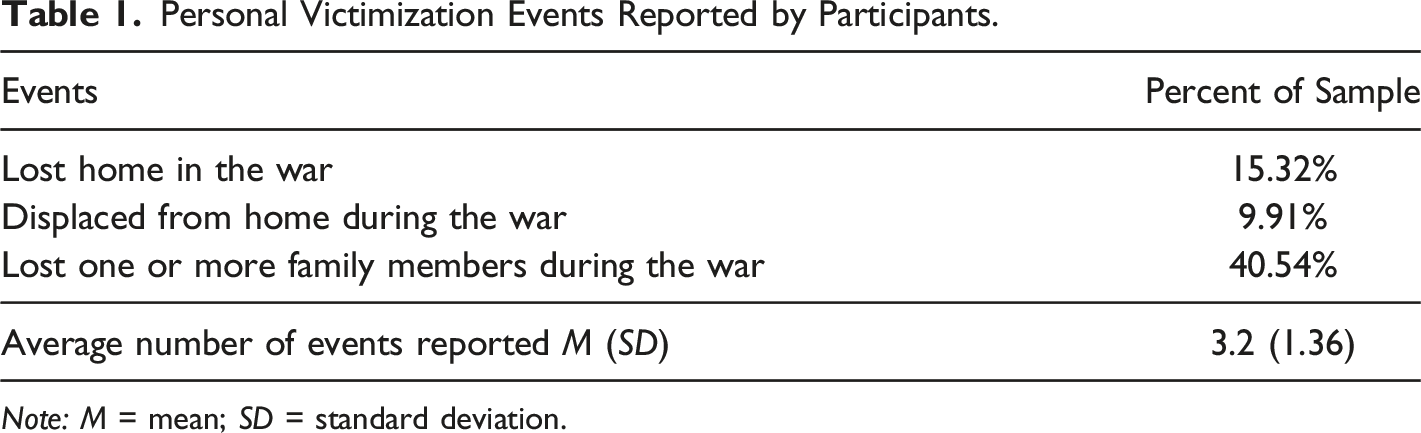
Personal Victimization Events Reported by Participants.
Note: M = mean; SD = standard deviation.
The a priori sample was chosen after running a power test in STATA (v. IC 15.1), using the command power, and taking into account an effect size of at least 0.225 as published in the meta-analysis by Pettigrew & Tropp (2006). This sample size has adequate power (0.07) although it may experience Type 1 error inflation due to the size of the final sample (n = 113). Sample size is a limitation of this study, taking into account the difficulty of recruiting a sample in an active conflict area as well as the constraints of a pathfinding study.
Data Collection Procedure
The study was conducted during two trips to CAR and in three phases. Phase 1 included the VR film production, piloting and sample selection; Phase 2 included initial data collection; and Phase 3 comprised of follow-up data collection. The same battery of measures was used in pre-test, post-test and follow-up.
Phase 1: VR films production, initial piloting and recruitment
In Phase 1, the VIC content and the placebo VR content was shot and edited with the Google Jump camera rig (Figure 1 in Online Supplement). A pilot of the battery of measures was tested to ensure cultural validity, test-retest reliability and level of burden. Additionally, the feeling thermometer measure revealed itself to be culturally confusing as participants tended to associate “warm” with anger or frustration, and not with likeability and happiness, as the measure intended. To counter this limitation, the thermometer image and warm/cold indicators were removed (measures are identified below in Measures section and in detail in Appendix A). Five Central African researchers were recruited to administer the battery of measures. The researchers were interviewed individually, and a training day was held to cover research ethics and protocol, including safeguarding for the participants, for the researchers, and for the context, and to familiarize researchers with the battery of measures through timed exercises of administering the measures to each other. Interviewer conduct was discussed, including how to prevent interviewer effects. Fidelity checks included structured observation by both the lead researcher and research coordinator.
The questionnaire battery, once finalized in English, was professionally translated into French, checked by the study’s research assistant, a fluent French speaker, and then back-translated into English professionally. Several minor mistakes were corrected. At that point, the verified French version was translated professionally into Sangho, the local language in CAR, back-translated into French and checked by the research assistant for any errors. Minor changes were made and implemented into the final Sangho version. The English questionnaire can be found in Appendix A, and French and Sangho are available upon request. The study sample was recruited during Phase 1, led by the local research coordinator, through his network of relationships throughout Bangui. Inclusion criteria detailed earlier was used to select participants and initial informed consent was taken at that time.
Phase 2: Initial data collection
In Phase 2, a second trip to CAR was made with a research assistant from Columbia University. As a first step, an advisory board of three local mental-health experts and advisors were convened once to view and approve of the VIC content for use in the study. For a full list of the advisory board please see Appendix B. Participants were randomized into one of two conditions, using the random number generator in Excel (v.15.28). Randomization was again conducted to ensure an even split between conditions. Participant attendance was scheduled over a 3-day time period according to their randomly allocated condition, to reduce the likelihood of participants from different conditions influencing one another. Participants were invited to the research point at the National Stadium, which was chosen because it is a central, safe, neutral location.
Participants were checked against their pre-registration information, and provided with the formal written consent form (see Appendix C). Upon completion of the form, they were assigned a researcher (one of five) who administered the battery of questionnaires as a pre-test measure, which took approximately 15 min. Researchers and participants were blinded to what group participants were assigned to. All measurements were taken individually and privately as one-on-one interviews with participants, so as to avoid exclusion due to low literacy rates and to minimize social pressure effect. Participants were then invited to a separate room to complete their conditional assignment.
A technical research assistant managed the 10 Google Daydream View (GDV) head-mounted displays (HMD), 10 portable phones that power the VR experience, and headphones. Prior to beginning the film, each participant received a short briefing about how to use the HMD, what to do if they felt uncomfortable at any time, and how to adjust the volume. Both film conditions lasted between 13-15 min. The technical research assistant was trained to look for any signs of distress and to invite participants to sit down, drink water and take deep breaths if they felt dizzy or nauseated at any point during the VR exposure. After watching the VR films, 8% of participants reported a mild headache after viewing that lasted no longer than 5 min. No other physical distress was expressed by participants.
Upon completion, participants returned to the same researcher who conducted their pre-test measures and were administered the post-test measures. All questionnaires were checked for missing values by a research assistant, and if incomplete, the participant returned to the research station to complete any missing items. Once finished, participants received 3000 francs for participation (five USD). This amount was considered comparable to how much NGOs habitually compensate participants for programming activities in Bangui. All participants signed a form verifying the receipt of payment.
Phase 3: Follow-up data collection
Phase 3 occurred 5 days after Phase 2. Participants returned to the study location and were assigned to the same researcher who conducted the first two sets of pre-post measures to ensure consistency. Upon completion of the follow-up measures, participants each received another 3000 francs (five USD), as compensation for participation in the study, bringing their total compensation to $10 USD if all phases were completed. Upon completion, each participant also received printed debriefing forms that explained the objectives of the study (see Appendix D).
Stimuli
The VR films were shot with the Yi Halo, a 17-lens virtual reality camera, loaned by Google (see Figure 1 in Online Supplement). The films were edited with Google Jump and Adobe Premiere software. Participants viewed both films on GDVs, allowing for three-dimensional perception through stereoscopic views of the environment. An orientation sensor in the GDV granted participants control of their field of view using naturalistic head movements, which allowed participants to look around as they would in the physical world. Finally, ambisonic positional audio was delivered through headphones to present realistic sounds. The nature of the 360° completely immersive multi-sensory media experience is markedly different than a video watched on VR equipment. The film had to be shot on the special 360 camera so as to create a 360° watching experience, and surrounds the viewer completely, creating 3D depth perception and total immersion. In contrast, a 2D video placed into a VR headset would be seen in a rectangular box with black surrounding the box, and would not enable full 360° video immersion, replicating the experience of physically being in each shot location and being able to look around an environment as if one is there themselves.
Virtual immersive contact condition
The VIC film is an immersive documentary titled “Even in the Rain” (Branham, 2018) that profiles the life of a Muslim man from Bangui named Guillaume Ngbowesse (see Figure 2 in Online Supplement for a scene-by-scene breakdown of the film). The film was created from interview audio with Guillaume where he explains the most poignant moments of his life. Guillaume was chosen as the main subject for this film because his story exhibits themes that counter the negative stereotypes of the Muslim population, and might influence the ingroup to reconsider their understanding of the outgroup. The lead researcher on this study had previous experience working with Guillaume.
Guillaume is a volunteer with the Red Cross branch in CAR. His home was looted twice during the war and his brother was killed. He knew the man responsible. At the height of the violence in 2013 while he was working at the Red Cross clinic, a man was brought in for care who had been injured from a bullet in the war; it was the very same man who had orchestrated his brother’s death. Guillaume had to choose to treat him or not, take revenge or not. He chose to maintain the value of neutrality upheld by the Red Cross, and treated him as he would have any other patient. To illustrate this narrative, Guillaume re-enacted certain events from his life on camera, as they took place according to his memory. The film production process was a close co-creation with Guillaume, and in collaboration with an international technical team (see Appendix E).
Control condition
The placebo, or control VR film, was created to be as neutral as possible. The film includes a selection of environmental and street shots taken in and around Bangui, with a background of Central African instrumental music. There was no narrative or themes that related to the war or contact with the outgroup (for a scene-by-scene description see Figure 3 in Online Supplement).
Measures
Overview of All Items Used as Outcome Variables, with Descriptive Statistics.
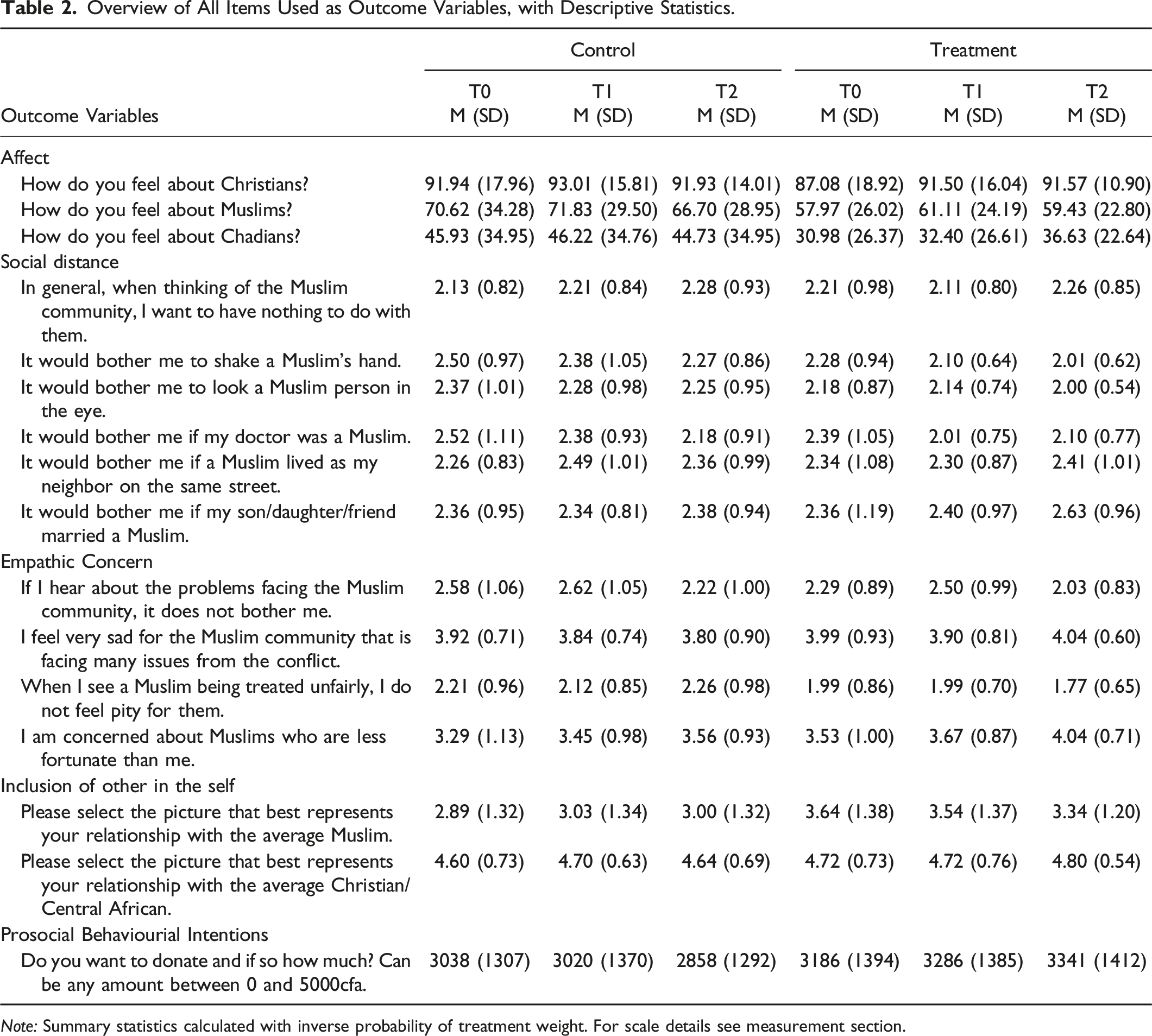
Note: Summary statistics calculated with inverse probability of treatment weight. For scale details see measurement section.
Assessment of experiences with outgroup
A five-item short measure was adapted from previous research, to assess negative experiences with the Muslim outgroup (Lolliot et al. 2015). This inventory of negative experiences measured responses on a 5-point Likert scale ranging from 1 (never) to 5 (very frequently), with higher scores representing more negative contact (M = 1.74, SD = 0.72). The adapted scale consisted of five items (α = 0.70). A single-item measure measured frequency of contact with someone from the Muslim community within the last week on a 4-point Likert scale from 1 (never) to 4 (more than five times), with higher scores representing more frequency of contact (M = 2.47, SD = 1.21). Since an issue cited in intergroup contact research is the failure to include critical variables such as negative contact and the role of segregation, which can distort results, these measures were included in an effort to avoid the single factor fallacy (Pettigrew & Hewstone 2017).
Measurement of positive affect
To measure positive affect, the Feeling Thermometer scale was used, which runs from 0 to 100°, with higher scores indicating more favourable feelings (Wölfer et al. 2017). The Feeling Thermometer has been an integral measure for many studies investigating attitudes and affect towards a variety of social groups (Lolliot et al. 2015). The measure was adapted to be culturally appropriate in CAR, and included questions about how participants feel towards the outgroup (Muslim), ingroup (Christian) and a proxy question about how they feel towards Chadians, which was suggested by Central African researchers during the pilot, as they stressed that the majority of the ingroup population would consider Chadians to be Muslim, and do not discriminate between the categories substantially. Furthermore, this is considered a valid proxy and perhaps a more sensitive test of prejudice towards Muslims because since Chadians are considered Muslims, this measure could be tapping that sentiment indirectly, therefore with more accuracy, similar to findings in racial bias research which stress testing indirect measures may be more accurate than direct measures.
Measurement of empathic concern and perspective taking
The IRI is based on a multi-dimensional approach to treat empathy as a set of constructs which are discriminable from each other (Davis 1983). The IRI is probably the most widely used measure of empathy (Beven, Brien-Malone, & Hall 2004). Two constructs were measured; empathic concern, which assesses “other” oriented feelings of concern, and perspective taking, which assesses the tendency to adopt the view of others (Davis 1983). The questions were adapted to reflect the Central African context. Empathic concern consisted of 4-items (α = 0.82). The Perspective Taking subscale (α = 0.22) was excluded from analysis due to unstable correlation and poor factor loading during confirmatory factor analysis.
Assessment of prosocial behavioural intentions
To measure prosocial behavioural intentions, a single-item donation challenge was presented where participants were told that the local civil society group was collecting donations for displaced Muslim families, and they could choose to express an intention to donate all, part or none of 5000 francs ($20 USD). Participants were explicitly told this was a hypothetical scenario for the purpose of the research and regardless of their choice to specify an intention to donate or not, their participation compensation would remain unaffected.
Three items were adapted from an intergroup contact study by Vezzali and Hewstone to measure behavioural intentions (Vezzali et al. 2014). Ratings reflected more positive intended behaviour towards the outgroup. Unfortunately, there was unstable correlation among items (α = 0.46), reducing confidence this measure was capturing the intended construct, so it was excluded from analysis.
Additional measures
Several demographic variables were assessed: age, gender, neighbourhood, level of education and if participants were currently a student or not. The study also examined level of personal victimization during the conflict by asking participants to respond to a checklist of difficult life-events related to the conflict.
Data Analysis Methods
The potential outcomes framework utilized in this study is known as the Rubin model (Rubin 1974). This framework assumes each individual has a pair of potential outcomes (for either the VIC or control condition), and that the effect of the treatment is the difference between their potential outcomes. However, because one cannot observe a counterfactual, it is impossible to estimate the causal effect. Therefore, the average treatment effect (ATE) was pursued, which moves the entire population from the control to the treatment group in order to estimate what the effect would be if everyone had gone through the treatment. The ATE is thus the average increase or decrease as a result of the VIC condition. The analysis steps taken were as follows: first, propensity scores were estimated from the treatment model and inverse-probability weights were calculated; second, using these weights, a weighted regression was fitted for the outcome for each treatment status and predicted outcomes were calculated for each participant; third, the means of predicted outcomes for treatment and control were calculated. The difference of these averages provides the estimates of the ATEs.
Propensity Score
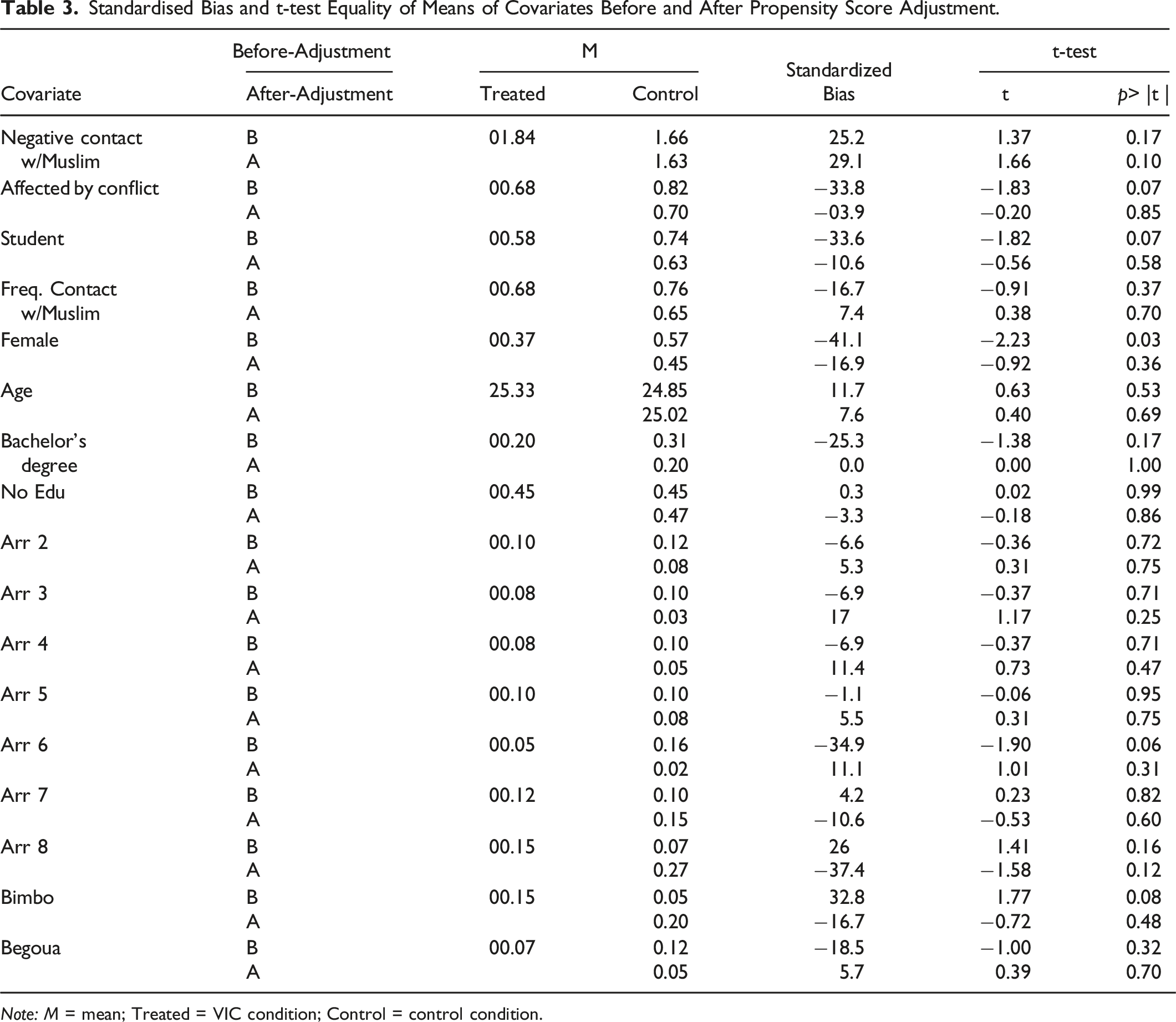
In this study, even though participants were randomly assigned to either the VIC or control condition based on their neighbourhood of residence, randomization did not lead to the complete balancing of observable covariates/confounders. Therefore it would be impossible to accurately estimate an ATE due to confounding bias, which limits the ability to make inferences about the effectiveness of a treatment (Lanza, Moore, & Butera 2014). The propensity score for each participant can be used to adjust for confounding in further analysis so that less biased inferences can be drawn and a more accurate causal inference can be made by balancing non-equivalent groups (Lanza, Moore, & Butera 2014; Rosenbaum & Rubin 1983). By running the command tebalance in STATA, imbalances were discovered. Thus, propensity score weighting was utilized, which has been used to address imbalance between control and treatment groups (Lanza, Moore, & Butera 2014). In this study, the propensity score is the conditional probability of exposure to the VIC condition.
To calculate the propensity scores, logistic regressions were run to predict the probability of watching the VIC film based on 17 theoretically important pre-intervention covariates: demographics (age and gender), socio-economic variables (education), neighbourhood of residence (“Arr” refers to arrondisement in French, or quarter, which are split into numbered neighbourhoods), frequency of contact with Muslims, previous negative contact with Muslims, and various personal experiences of victimization because of the conflict. These covariates were measured before the intervention; therefore, they are exogenous variables unaffected by the intervention.
Inverse probability-weighted regression adjustment estimator
Inverse probability weighted regression (IPWR) was employed by using the teffects ipwra module in STATA. The IPWRA estimator used a logit model to predict treatment status and a regression to predict outcomes. Inverse probability weighted regression reduced bias due to confounding variables in the estimate of the treatment effect by accounting for a vector of covariates that predicted allocation into the treatment group. As mentioned, before inverse probability weighting, participants in the treatment group differed to the control group in terms of observable characteristics.
Standardised Bias and t-test Equality of Means of Covariates Before and After Propensity Score Adjustment.
Note: M = mean; Treated = VIC condition; Control = control condition.
Sensitivity analysis
A sensitivity analysis was conducted to assess how sensitive the results were to the choice of the 17 conditioning variables. Only the significant variables were included in a separate logit equation, and the results were largely insensitive to using only significant predictors in the propensity score equations. Therefore, the selection of the conditioning variables was properly done, as they contained the relevant information about the potential non-treated outcome of an individual at the time the participant was exposed to the VIC condition.
Conditional difference-in-difference estimates
To assess the effect of the VIC condition on outcome measures, the IPWRA estimator was combined with the difference-in-difference estimator (DiD) to make use of the longitudinal data. The DiD is the mean change in outcome in the treatment group compared to the mean change in outcome in the control, or in other words, the estimation of the difference-in-differences. As stated, observations in the control group were weighted by their propensity score. This ensured that individuals unrepresented according to a characteristic were weighted upwards to account for any bias which may have occurred if just simple comparisons were made between groups. The combination of the two estimators permitted the estimation of an unbiased average of treatment effects (ATE).
Mediation analysis
To test hypothesis three to understand the effect of empathy on prosocial behaviour, the KHB-method developed by Karlson, Holm and Breen was utilized (Karlson & Holm 2011). The method decomposed the total effect of a variable into direct and indirect parts, which provided unbiased decompositions of both discrete and continuous variables (Newton et al. 2010). The khb command in STATA was utilized.
Debriefing interviews
In addition, short debriefing interviews were conducted with each participant at the end of Phase 3, using open-ended questions to better understand participants’ views of the film they watched, their reflections on salient themes and their overall experience of the research study. The interviews were conducted in French. It was explained that their honest opinions about the VR experience were welcome, and that this was an opportunity for them to contribute to improving a resource being created for their communities.
Results
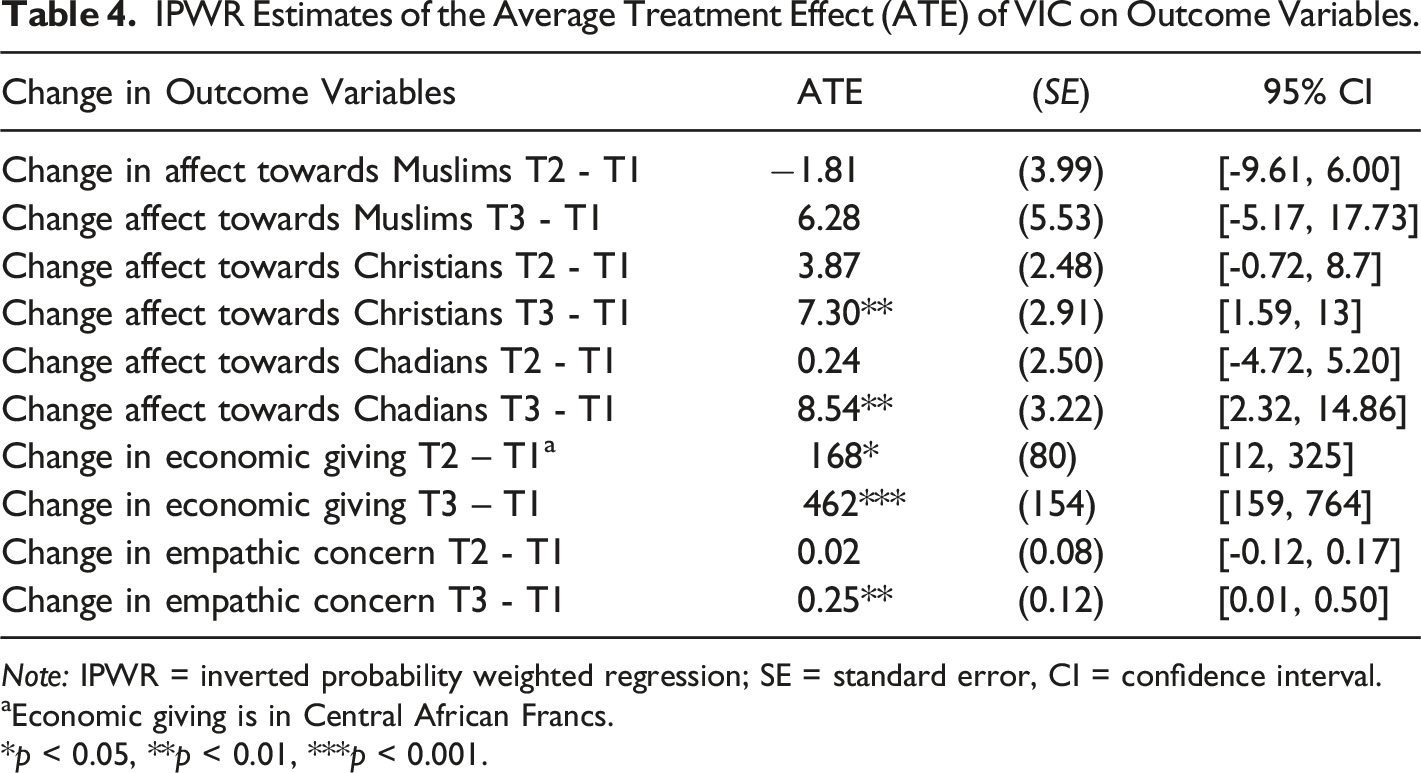
IPWR Estimates of the Average Treatment Effect (ATE) of VIC on Outcome Variables.
Note: IPWR = inverted probability weighted regression; SE = standard error, CI = confidence interval.
aEconomic giving is in Central African Francs.
*p < 0.05, **p < 0.01, ***p < 0.001.
Affect
The VIC condition did not have a significant effect in changing affect towards Muslims between T2 and T1 (b =−1.81, SE = 3.99, p = 0.65, 95% [−9.61, 6.00]) or between T3 and T1 (b = 6.28, SE = 5.53, p = 0.28, 95% [−5.17, 17.73]). Therefore, the null hypothesis must be accepted. However, the VIC condition did significantly increase affect towards Chadians between T3 and T1 compared to the control (b = 8.54, SE = 3.22, p <0 .01, 95% [2.32, 14.86]). This question was included to tease out implicit rather than explicit prejudice towards Muslims as Chadians are also considered predominantly Muslim within the population in CAR. Therefore, there is the possibility that this observed significant increase in affect towards Chadians could suggest a proxy of improved affect towards Muslims. The VIC condition also had a significant effect on increasing affect towards Christians (the ingroup), between T3 and T1 (b = 7.30, SE = 2.91, p <0 .01, 95% [1.59, 13]).
Empathy
In line with the study’s hypothesis, the VIC condition did have a significant effect on increasing empathic concern for Muslims from T1 to T3 compared to the control (b = 0.25, SE =0 .12, p < 0.05, 95% [0.01, 0.50]). Therefore, the null hypothesis is rejected. Immediately following exposure to the VIC condition, there was a slight increase in empathic concern but it did not become significant until T3. This suggests that the film may have needed time to take effect. Unlike most short interventions which may see an effect immediately following the treatment and a drop-off with time, this follows the opposite pattern.
The study further hypothesized that even if the VIC condition did increase empathic concern in participants, that it would not predict prosocial behaviour, explained by a confounding variable. In part contrary to hypothesis three, empathic concern did significantly predict increased prosocial behaviour according to the mediation analysis, measured as increased intention to donate to the Muslim outgroup (b = 384, t(2) = 4.89, p < 0.001, 95% CI [229, 538]). However, in line with the secondary part of hypothesis three, a confounding variable did significantly explain the relationship between empathic concern and intention to donate.
When controlling for frequency of previous contact with the Muslim outgroup, the effect of empathic concern on donating behaviour dropped from 383 to 238 francs, leaving an indirect effect of 146 francs. 38% of the total effect of empathic concern on donating behaviour was due to previous frequency of contact with members of the Muslim outgroup.
A simple interpretation of these findings is that those who had been in more frequent contact with members of the Muslim outgroup within the previous week (as the question was framed), were more likely to donate to the outgroup, explained only partly by their concurrent increased levels of empathic concern. When education level was added to the regression model, empathic concern was still a significant predictor of donating intentions, but the intended donation amount dropped from 384 francs to just 200 francs (b = 200, t (3) = 2.37, p < 0.02, 95% CI [34, 367]). Education level is therefore a negative predictor of donating behaviour, meaning that the higher the education level, the less likely a participant was to donate (b = −239, t (3) = −2.52, p < 0.01, 95% CI [−425, −52]).
48% of the total effect on donating behaviour was due to the combination of frequency of Muslim contact and the individual’s level of education. This nearly reduces by half the direct effect of empathic concern on intended donation behaviour. Therefore, in line with hypothesis three, a confounding variable explained a large proportion of the relationship between empathic concern and prosocial behaviour.
Prosocial behaviour
Those exposed to the VIC condition were statistically significantly more likely to increase their intended donation amount to Muslims; by 168 francs (31 cents) between T1 and T2 (b = 168, SE = 80, p < 0.05, 95% [12, 325]) and 462 francs (69 cents) between T1 and T3 (b = 462, SE = 154, p < 0.01, 95% [159, 764]). According to the World Bank poverty headcount ratio at $1.90 a day, 62% of the population in CAR lives below the poverty line. Therefore, even these relatively small donation amounts could be meaningful to the participants as they made their choices. These changes were concurrent with changes in affect and empathy, in line with hypothesis four.
Although exposure to the VIC condition did decrease social distance more than the control group (b = −0.20, SE = 0.13, p > 0.05, 95% [−0.44, 0.05]), it was not at a significant level.
Correlation Matrix of Significant Outcome Variables.
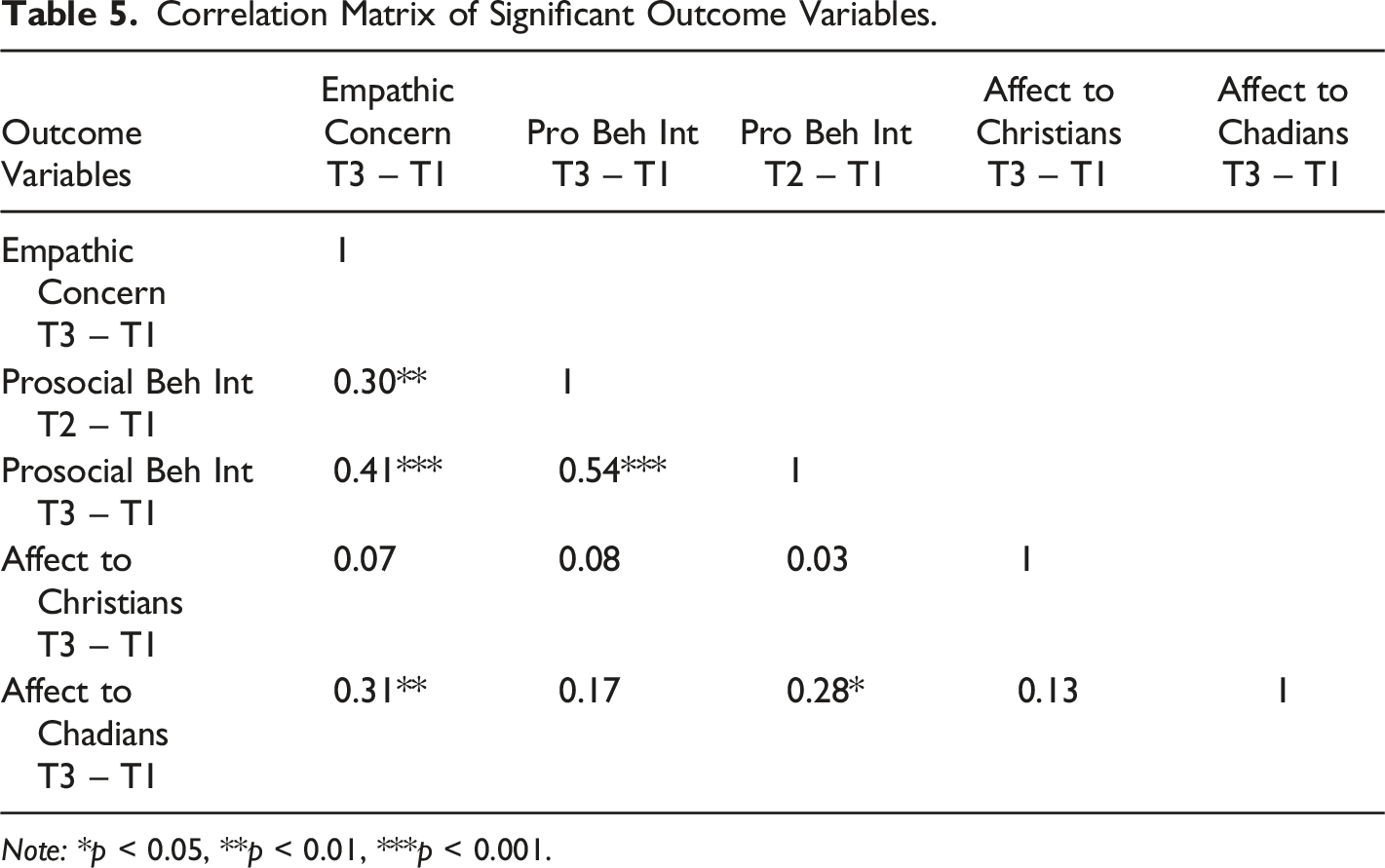
Note: *p < 0.05, **p < 0.01, ***p < 0.001.
Discussion
This study aimed to explore the efficacy of VIC to reduce prejudice and discrimination in CAR. Results suggest that the VIC condition did have a significant effect on multiple outcome variables, and that the positive contact of the VIC condition buffered the impact of previously negative contact with the Muslim outgroup. Yet the directional effects on variables do not create a cohesive picture, which may suggest a conflicting account of the impact of the VIC condition on outcome variables, or may also present an accurately complex picture of the nature of prejudice and the potential influence a single exposure can have.
Although the results do outline the importance of the VIC film on outcomes, they do not provide concrete evidence of the importance of the medium on those results, but rather stress the importance of the narrative, i.e. the virtual contact story, on the results. Further research testing the efficacy of VR by comparing two identical contact narratives in a VR and non-VR format is necessary in order to make a conclusive argument for the effectiveness of VR in and of itself. Results suggest that the immersive element contributed to its lasting effect, but without that comparison, conclusions can only be suggestive at this point.
The VIC condition reduced prejudice
Affect towards both the ingroup and the outgroup increased significantly compared to the control. The parallel increase in affect towards both Chadians (usually identified as Muslim) and Christians, or both ingroup and outgroup, suggests that in order to increase affect towards the outgroup, a reduction in affect towards the ingroup is not necessary; perhaps these can occur concurrently in a positive direction. This reinforces previous research that shows how positive emotions present during and after a contact interaction generally reduce prejudice (Pettigrew & Tropp 2006).
Empathic concern without priming
Empathic concern towards the Muslim outgroup improved significantly compared to the control. An increase in empathic concern without any empathic inducement instructions is a unique contribution to the literature. Often, studies that seek to improve empathy induce participants to consider the point of view of others, or feel what others may feel with an explicit set of instructions read to them before the stimulus is presented. This study did not attempt to induce empathic concern, yet since the film operated as an inducement indirectly, this provides novel evidence that empathic concern can be evoked without priming.
The empathy-prosocial behaviour relationship
This research explored if virtual contact could not only increase empathic concern for the Muslim outgroup as a whole (which it did), but also if prosocial behavioural intentions would follow. This study illustrates that a VIC film can encourage participants to increase their intended prosocial behaviour towards the Muslim outgroup, which is as an exciting finding in a real-world setting, and backs up the empathy-altruism hypothesis (Batson 2011).
Yet it is important to understand what motivates this empathy-induced altruism. This research shows that while empathic concern did predict the prosocial behavioural intentions, half of that relationship was explained by confounding variables. This presents important empirical evidence to support both the multitude of claims that empathic concern increases helping, but also contributes to a noticeable gap in the literature: the motivational connection between the two (Batson 2011, 149). Both frequency of prior contact with a member of the Muslim outgroup within the last week as well as level of education explained nearly half of the relationship between empathic concern and intention to donate. Participants with higher education were less likely to express intention to donate to the outgroup. Although these findings cannot be generalized to the population, it does raise the question within this sample of what the link is between higher levels of education and increased prejudice. Perhaps these educated communities, which are the minority in a country that is ranked last on the human development index, hold more conservative ideologies, or blame the outgroup for the conflict. Therefore, policy recommendations such as reducing segregation in Bangui and examining what elements of the educational curriculum could be contributing to prejudice and discrimination, are practical ways to encourage more prosocial behaviour.
Advantage of contact in a virtual medium
Since both the control and the intervention were exposed to a VR film, this study cannot make concrete conclusions about the role of the medium in isolation from the contact theme narrative of the VIC condition. Since there were non-significant effects of the control condition on outcome variables, it can be concluded that a film that evokes peace and social cohesion is not enough to reduce prejudice, and that the specific element of contact with an outgroup member in this form is what matters. Another advantage of contact in VR is that it can protect the outgroup. By tailoring the VIC to the ingroup, the outgroup was protected from any of the negative consequences of direct contact that can sometimes occur from in-person interactions.
This provides exciting evidence to suggest that even a short (15 min) intervention, can have lasting results 5-days post-exposure. However, it is unclear whether the affective and behavioural changes induced by the VIC film can lead to broader changes in Central African society. There is no systematic evidence to measure long-term change in this research.
Limitations
Unsurprisingly, conducting this study in challenging field conditions ensured that the level of control which could be exerted was far less than would be expected in the laboratory. There was the additional factor that none of the participants had any prior exposure to being a participant in research. There also may have been interviewer effects on the participants since the interviewers were from the same ingroup. An alternative way these measures could have been conducted is using an audio-delivered questionnaire procedure, utilized in similar field contexts (Bilali, Vollhardt, & Rarick 2016). All of these factors led to a degree of variability in the conduct of each trial. However, there would seem to be no grounds for thinking that this variability was systematically related to the conditions and the hypotheses.
Furthermore, the VR film equipment did not work seamlessly in the hot Bangui climate; the cell phones used to power the VR films over-heated occasionally causing an abrupt automatic shutoff of the VR film experiences which may have affected outcomes. Additionally, 3 days after the research was concluded, the worst violence in the capital Bangui broke out since 2015, resulting in dozens of deaths. Tensions were on the rise during the research phase, which may have affected results. However, since this research did produce significant effects, it may be suggestive of how influential it was, despite this increase in intergroup conflict.
As mentioned earlier, sample size is a limitation of this study. Replication of the present findings in different settings will address questions related to the specificity of this study’s context and methods. Although this data and this study was in CAR, the pattern of affect, empathy and behaviour is not new.
Future Directions
The rapid onset of virtual reality technology to the public domain combined with its potential for impact demands further research. Future research could test if the level of immersion predicts empathic concern, or if the narrative is the stronger predictor. This present research only enabled viewers to be more or less passive spectators, but the technology exists to make decisions inside the VR experience, influence outcomes and interact with subjects in the virtual world. Further, exploring multiple VR exposures in a longitudinal study design, or pairing VR exposure with discussion groups or other complementary activities is an important evolution of this research. Better understanding the role of affect by measuring participant’s states of sadness, anxiety and distress after exposure to the VIC condition could also help explain processes of change. In addition, investigating the role of social and moral norms to affect behavioural intentions would be a valuable extension of this research.
Examining the antecedents of empathic concern could shed light on how to structure interventions to take situational and personal capacities and differences into account. A further area of research would be to tailor this experience for the Muslim outgroup, creating a virtual reality film that meets their specific needs, exploring if it could mitigate their tensions with the ingroup. Additionally, as this study illustrates, even if empathic concern increases, that does not guarantee that all prejudiced behaviour will decrease. Further research exploring the link between affect, empathy and behaviour is needed, with a special focus on social distance.
Finally, understanding not just individual reaction to an intervention but how these individuals make up social networks that can reinforce the message to one another, is an important step to further investigate how inter and intra personal factors fit together with the larger, more fluid and dynamic structural forces that influence conflict perpetration or resolution. To change both individuals and environments requires capturing this reciprocal process. Employing social network analysis would allow researchers to watch the effects of the VIC expand and multiply to other members in the network.
Conclusion
This research finds that a virtual reality film with a narrative about an outgroup member had a significant effect to reduce prejudice and discrimination in CAR, contributing to the small amount of evidence-based interventions in real-world settings and going beyond attitudinal measures in research on prejudice. This provides evidence that VIC could be a new form of positive intergroup contact, creating a new facet of intergroup contact theory. Further, this research begins to debunk the hype around VR as the “empathy machine” by showing that empathic concern’s relationship to prosocial behaviors was primarily explained by confounding variables.
Bilali pointed out that, “we know little about prejudice reduction in conflict-affected countries, and in the contexts of ongoing violence or its aftermath” (Bilali and Staub 2015). This research offers new insight to understand how to reduce prejudice in the ongoing violent conflict in CAR and presents a hopeful lens that individual prejudice can change. This research also provides preliminary evidence indicative of applications where VR could reduce prejudice and offers important suggestive findings as to the cost-benefit analysis of investing further in virtual reality as a conflict mitigation tool in other conflict contexts and fragile areas. The results of this study will be shared with both researchers and relevant parties in CAR so that it can contribute to a collective effort in researching, developing and testing approaches to fostering lasting social cohesion.
In closing, below is a quote from a participant: After watching the film, I reflected about what I really want. I want peace to come between Christians and Muslims – I reflected on all that’s happened in the past here in our country, and if a Muslim comes to me, I would be close to them (Participant 1, Debriefing Interview).
Supplemental Material
Supplemental Material - Virtual Immersive Contact: A Field Experiment to Reduce Prejudice and Discrimination in Central African Republic
Supplemental Material for Virtual Immersive Contact: A Field Experiment to Reduce Prejudice and Discrimination in Central African Republic by Lindsay Branham in Journal of Conflict Resolution
Supplemental Material
Supplemental Material - Virtual Immersive Contact: A Field Experiment to Reduce Prejudice and Discrimination in Central African Republic
Supplemental Material for Virtual Immersive Contact: A Field Experiment to Reduce Prejudice and Discrimination in Central African Republic by Lindsay Branham in Journal of Conflict Resolution
Footnotes
Acknowledgements
Thank you to Dr David Good at the University of Cambridge for supervising this research project and to Dr Eolene Boyd-MacMillan for providing co-supervision and invaluable ideas and feedback. Thank you to Guillaume Ngbowesse for co-creating the VR film Even in the Rain about his life. Thank you to Sarah Steele and Google Daydream Impact for funding both the film production and the field research. Thank you to Venice Biennale for premiering Even in the Rain (Branham, 2018) and to Tribeca Film Institute for acquiring the film. Thank you to Amel Benzerga at Columbia University who assisted the field research in CAR, Bachir So who led the research coordination, Karen Mak and Michael Hall for statistical analysis consultation, Patricia Fearon in the IC Thinking Research Group at the University of Cambridge for her sharp insight, Andrew Ellis for assisting the film production, Orphe Bamoy for his VR technical assistance during the study and Margaux Fitoussi for copy editing. Thank you to Invisible Children for hosting the research team in Bangui and Red Cross Central African Republic for permission to film on their premises. Thank you especially to Fernand Ngbokoli, Love Mbilongo, Benedicte Kiandji Grace a Dieu Gomono, and Liliane Tartoudjou for their tireless efforts to conduct every single research interview, and to each participant for sharing their honest views and trusting us with this process. Thank you.
Declaration of Conflicting Interests
The author(s) declared no potential conflicts of interest with respect to the research, authorship, and/or publication of this article.
Funding
The author(s) disclosed receipt of the following financial support for the research, authorship, and/or publication of this article: This work was supported by the Google (Google Daydream Impact Award)

Supplemental Material
Supplemental material for this article is available online
Note
References
Supplementary Material
Please find the following supplemental material available below.
For Open Access articles published under a Creative Commons License, all supplemental material carries the same license as the article it is associated with.
For non-Open Access articles published, all supplemental material carries a non-exclusive license, and permission requests for re-use of supplemental material or any part of supplemental material shall be sent directly to the copyright owner as specified in the copyright notice associated with the article.
