



Abstract
Little is known about civil war settlements' effects on public opinion in countries emerging from conflict, cases in which beliefs in agreement fairness and trust in political authorities may influence acceptance of the peace process. We posit that settlements designed to redistribute power and resources will be perceived as fairer and produce larger improvements in trust in the national government for individuals from marginalized groups than for those from dominant groups. Employing original survey data collected in the Philippines, we test these propositions with reference to the country’s 2014 peace agreement. We find that marginalized Muslim groups perceive a fairer peace agreement and report improved trust in comparison to the dominant Christian community. Using a survey experiment to analyze the influence of power-redistributing settlement measures, we find that trust in the government is not significantly affected by information regarding power sharing, a result that holds for members of both communities.
Introduction
One of the dominant approaches to analyzing conflict termination, the bargaining perspective on war, characterizes settlements as elite-constructed bargains that distribute power and resources among the warring parties based on their fighting capabilities. These bargains are understood to secure the peace as long as the underlying distribution of power between former adversaries remains fixed. Missing from this understanding of war-ending processes are the roles that citizens play. Recent research thus has sought to complement this top-down view of war-ending bargains with a micro-level perspective that accounts for the preferences and roles of civilians. Among other questions, scholars have sought to investigate the effects that different aspects of peace agreements have on individuals’ support for the peace (see, for example, Carlin, McCoy, and Subotic 2016; Matanock and Garbiras-Díaz 2018; Tellez 2019).
We build on the pioneering work that has been done on this subject by considering whether the power-distributing measures that are often included as part of civil war peace agreements affect citizens’ perceptions of the fairness of the settlement and their trust in political authorities. These are important questions not only because perceptions of settlement fairness and trust in the government are likely to influence citizens’ acceptance of the peace that is produced by the settlement, but also because of the ubiquity of power-sharing institutions in peace agreements in the post-Cold War era. 1 The theory we develop begins from the premise that individuals within deeply-divided societies – i.e., “societies with potentially violent vertical cleavages often centered on identity and cognate claims to territory, government, resources and superiority” (Mac Ginty 2017, 5) – will be particularly concerned with the distributive consequences that an agreement has for their respective communities. 2 We contend that individuals’ assessments of these consequences, and thus their evaluation of the fairness of the peace agreement and their trust in political authorities, will differ depending on whether they are members of dominant or marginalized groups. Based on this, the scope conditions of this study include armed intra-state conflict contexts with dominant and marginalized groups seeking a peace settlement, inclusive of cases like Burundi where the balance of power within society may favor a minority identity group (e.g., the country’s Tutsi-dominated government).
We employ observational data from a survey conducted in the Mindanao region of the Philippines in 2016-2017 to analyze individuals’ perceptions of the fairness of the 2014 peace agreement, the Comprehensive Agreement on the Bangsamoro (CAB), as well as their levels of trust in the national government. We then conduct a test of one of our mechanisms using a survey experiment that includes treatments representing different power-sharing provisions to evaluate the impact that inclusion in the CAB of different measures for distributing power and resources has on respondents' levels of trust in the national government. Although our results provide support for our identification of the influence of group identity on individuals’ opinions regarding settlement fairness and their trust in government, our survey experiment yields null results where our effort to discern the impact that power-sharing measures have on trust in political authorities is concerned.
We divide the paper into seven sections. In the first two sections, we discuss the concepts of peace agreement fairness and political trust, considering the relevance of each for individuals in divided societies. Next, we develop an analytical framework linking citizens’ perceptions of the distributive outcomes of peace agreements with their assessments of settlement fairness and political trust, focusing on differences between members of marginalized and dominant groups. This is followed by a rationale for our case selection. We describe our research design and conduct our analyses in the fifth section. In the next section of the paper we discuss our findings and examine potential explanations for the divergent results generated by the observational and experimental components of our empirical strategy. We then conclude by noting potential policy implications that flow from our findings.
Perceptions of Peace Agreement Fairness in Divided Societies
Scholars have advanced a number of explanations regarding citizens' support for peace settlements that center on evaluations of the fairness of the agreement. Such a focus makes intuitive sense given that issues of fairness or justice have been identified as salient sources of civil wars (Druckman and Albin 2011). Researchers have focused on public perceptions of peace agreement fairness based on the process or procedure by which a settlement is reached (e.g., the inclusivity of the negotiation process (Amaral 2018)); on whether or not settlement provisions call for retributive or restorative justice (e.g., the punishment of perpetrators in the first instance and reparations for victims in the latter (Tellez 2019)); and on whether or not a settlement provides for distributive justice or “standards for allocating collective benefits or burdens among the members of a group or community” (Druckman and Albin 2011, 1138). We adopt the latter approach in our assessment of citizens' perceptions of peace agreement fairness. We do so for two reasons. First, this means of conceptualizing peace agreements accords closely with the standard understanding of a settlement as representing a division of resources and obligations between or among the warring parties (Reiter 2003; Werner and Yuen 2005). Ascertaining whether the distributive implications of a settlement are meaningful to individuals, and, if so, which provisions prove most significant, has the potential to provide important insight into how citizens think about peace agreements and the implications that their perceptions have for the peace.
Second, a focus on distributive justice also strikes us as appropriate for analyzing perceptions of peace agreement fairness within divided societies, cases in which the exclusion of one or more groups from the apparatus of the government and/or access to state-controlled resources has been identified as dramatically increasing the risk of civil war onset (Buhaug, Cederman, and Rød 2008; Cederman, Gleditsch, and Buhaug 2013). In such instances, the distribution of power and resources is likely to be an issue of central concern to contending groups. As Lombard and Picco (2021, 809) observe, this concern is also “felt on the level of individuals, families and neighbourhoods” where “questions about who has a right to what in the midst of and after the upheaval of war are not settled facts, about which people feel neutral. They are sources of disagreement, anger and resentment. They are also either the incarnation of justice or injustice, depending on one’s point of view.”
Defining what constitutes a “fair” distribution of obligations and resources is a challenging proposition. Although the concept of fairness, as Welsh observes (2004, 754), “focuses on the criteria that lead people to feel that they have received their fair share of available benefits,” individuals often disagree about the criteria that should be employed to determine whether a particular distribution of benefits should be considered fair or unfair. Reaching agreement on this issue is likely to be even more difficult in the case of violent conflicts. In such instances, individuals' or groups' evaluations of fairness are likely to be linked to questions of identity and survival (Albin 2019). This is a linkage that we expect would be particularly prominent in divided societies, thus heightening the challenge of identifying the perceived “fairness” of war-ending bargains in such cases. However, it does seem reasonable to conclude, as do Schnaudt, Hahn, and Heppner (2021, 6), that in “political systems characterized by an unequal distribution of basic resources and opportunities,” individuals who suffer as a result of these injustices are likely to “evaluate the prevalent conditions as unfair” while the beneficiaries of such injustices are more likely to assess such conditions as fair.
Trust in Political Authorities in Divided Societies
Political trust is commonly defined on the basis of individuals' perceptions of how well governments or institutions perform in delivering a variety of expected policy outcomes (Stokes 1962; Hetherington 1998; Hutchison and Johnson 2011). Conceptualized in this fashion, political trust can be understood as being instrumental in nature, with those governments able to ‘deliver the goods’ to their citizens generating higher levels of political trust than those unable (or unwilling) to do so. 3
Differences in levels of political trust among citizens in divided societies can be seen as reflecting “evaluations of whether or not political authorities and institutions are performing in accordance with the normative expectations held by the public. Citizen expectations of how government should operate include, among other criteria, that it be fair, equitable, honest, efficient and responsive to society’s needs” (Miller and Listhaug 1990, 358; cited in Schnaudt, Hahn, & Heppner 2021). Members of groups that believe themselves to be marginalized, neglected, or perhaps even abused by political authorities can thus be expected to evince lower levels of trust in political authorities. Such sentiments may prevail even in societies in which marginalized groups constitute a majority group within the population. These feelings are likely to be exacerbated in the case of intrastate conflict, particularly if individuals identify as members of groups at war with the government (Kreutz and Nussio 2019).
Analytical Framework: Distributive Outcomes of Peace Agreements and Citizens’ Support for the Peace
Although there is a growing body of work that seeks to elicit citizens’ opinions of peace agreements, the assessments that individuals who are members of marginalized and dominant groups make of the distributional effects of peace settlements has been an understudied topic in public opinion research. If, as we argue, the distributional components of civil war peace agreements shape citizens' perceptions of the fairness of a settlement and their trust in government, two concepts we conceive of as indicators of individuals' support for the peace, it is important to be able to identify distributional consequences and the manner in which individuals react to them. The analytical framework we develop below addresses these issues. First, the framework identifies key distributive components of a civil war peace settlement. Second, it stipulates how the distributive consequences of the agreement can be expected to affect the perceptions of settlement fairness and trust in political authority held by members of dominant and marginalized groups within a divided society.
Distributive Components of Civil War Peace Agreements
Settlements constructed to end armed conflicts “specify who gets what and thereby determine the benefits of the peace and the incentives to return to war” (Werner and Yuen 2005, 262). In the case of civil wars, access to state power and to state-controlled resources are the principal goods that a peace agreement can endeavor to distribute among actors. Civil war settlements often call for the redistribution of such benefits or resources via the use of power-sharing institutions. As Druckman and Albin observe, “peace agreements based on principles of distributive justice frequently stipulate some form of power-sharing” (2011, 1141).
Power-sharing institutions have been defined as “rules that, in addition to defining how decisions will be made by groups within the polity, allocate decision-making rights, including access to state resources, among collectivities competing for power” (Hartzell and Hoddie 2003, 320). Four different types of power-sharing measures have been identified as potential means of distributing access to state power and decision-making rights among groups within the state. Political power-sharing measures call for groups to emphasize proportionality in the distribution of central state authority. This typically occurs through electoral or administrative proportional representation or proportional representation within the national government’s executive branch. Military power-sharing measures distribute authority within the coercive apparatus of the state, most frequently by integrating rebel troops into the military or appointing members of non-state actors’ forces to leadership positions in the national military. Territorial power-sharing provisions generally call for the post-war state to be structured on the basis of federalism or regional autonomy. Economic power-sharing measures identify a set of rules designed to prevent any one group from dominating state-controlled economic resources (Hartzell and Hoddie 2003).
Designed and agreed to by the elite representatives of warring groups, relatively little attention has been focused on citizens' reactions to the distributive aspects of power-sharing measures included in peace agreements. 4 The theory we develop argues that, in the case of deeply divided societies, citizens' reactions to these measures will be shaped by their perceptions of the impacts that they are likely to have on the prospects of the group with which they identify. 5
Power-Sharing Measures and Citizens’ Perceptions of Peace Agreement Fairness
Although power-sharing settlements are constructed by elites, it is reasonable to believe that the redistributive aspects of such agreements will also be of interest to ordinary citizens. As Lombard and Picco (2021, 4) observe, “[t]he redistributive effects of war and what counts as justice are crucial elements of the social experience of war.” Citizens' interest in the distributive elements of settlements is likely to be particularly marked in divided societies, where exclusion and/or neglect of certain groups by the state are sources of grievance (King and Samii 2020).
We contend that individuals in divided societies will have different conceptions of the distributive fairness of a power-sharing settlement depending on their relative power positions. Albin (2019) makes this point, noting that “power inequality between parties contributes to conflicting notions of justice” (56). Following from this observation, she points out that weaker or more marginalized groups within a society often invoke principles of justice in an effort to equalize their position vis-à-vis stronger parties, with the principle of equality frequently invoked in these instances. We expect that settlements that include power-sharing measures will be perceived by the members of marginalized groups as serving to promote equality by effecting a redistribution of power and resources among contending groups and thus have a higher likelihood of being seen as fair by those individuals. Dominant groups, on the other hand, are less likely to perceive as fair those agreements that call for power sharing as they are likely to see them as taking resources or power away from their communities and distributing them to others.
Based on the foregoing, our first hypothesis is:
Individuals from marginalized groups have a higher likelihood than do individuals from dominant groups of perceiving as fair a peace agreement that calls for power sharing.
Power-Sharing Measures and Citizens’ Trust in Government
Based on the definition of political trust discussed earlier in this study, we anticipate that power-sharing measures, when included in a settlement, have the potential to influence citizens' trust in the national government. We expect that members of subordinate groups will express increased levels of trust because they perceive the government as responding to their expectations and needs by agreeing to a settlement that promotes expected benefits for their communities. A power-sharing peace agreement may also be seen by members of marginalized groups as an effort by political authorities to be more inclusive in nature and/or to increase equality of opportunity, thus also enhancing trust (Zmerli and Castillo 2015). Individuals from dominant groups, on the other hand, can be expected to manifest less trust in a government that facilitates a redistribution of power and resources resulting in a reduction of these goods for their communities. Additionally, to the extent that members of dominant groups identify with the authorities in power, they may feel betrayed by the government’s agreement to enter into a settlement with the representatives of opposing forces, with concomitant effects on their trust in government.
Accordingly, we propose an additional hypothesis:
Individuals from marginalized groups have a higher likelihood than do individuals from dominant groups of exhibiting increased levels of trust in a national government that enters into a power-sharing peace agreement.
Rationale for Case Selection
To examine the relationship between membership in marginalized and dominant groups in a divided society and citizens’ perceptions of settlement fairness and trust in the national government, we analyze responses to a survey conducted in the Mindanao region of the Philippines between 2016 and 2017. We center our study on Mindanao as it is a deeply divided society that has seen two power-sharing peace agreements negotiated in efforts to end armed conflict in the region.
Different terms have sometimes been used to refer to the phenomenon of deeply divided societies. These include referring to states with these characteristics as “‘plural,’ ‘vertically segmented’ and ‘communally divided’” (Lustick 1979, 325). Despite the differences in terminology, states for which these labels are employed are all understood to be defined by sharp divisions between groups and a deep sense of antagonism between their divided communities. As Guelke (2012, 14-22) observes, there is no consistent cause of division across these societies. Among the characteristics that he identifies as having formed the basis for deeply divided societies are “class and caste,” “religion and sectarianism,” “language,” and “ethnicity.”
Gisselquist and McDoom (2015, 8) argue that “two dimensions of ethno-religious cleavage have been particularly salient in Mindanao politics.” One dimension, religion, encompasses three religious affiliations: Christian, Muslim, and Other. 6 The second, ethnic, dimension includes three categories: Moro, Lumad, and Settler. 7 These two cleavages, Gisselquist and McDoom note, are reinforcing in the case of Mindanao. While we recognize the nature of these reinforcing cleavages, we use “Christians” to refer to the dominant group and “Muslims” to refer to the marginalized group in Mindanao in our initial analyses, following which we examine power dynamics among different Moro Muslim ethnic groups.
Christians constitute the dominant group in the Philippines, where approximately 92 percent of citizens claim a Catholic identity, while adherents to Islam comprise a minority community of less than 6 percent of the population. Economic inequality further reinforces the divide between Christians and Muslims. Taken as a whole, Muslims tend to have lower incomes and fewer economic opportunities than do Christian citizens (Abanes, Scheepers, and Sterkens 2014, 63-64). This correlation between religious affiliation and economic well-being is indicative of a society in which the divisions between groups prove mutually reinforcing.
Research suggests that these religious divisions have played a role in shaping citizens' perceptions and attitudes. Montiel and Macapagal (2006), for example, report that there are meaningful differences between Muslim and Christian survey respondents concerning their understandings of the sources of the conflict in the region. Based on a survey of 430 students at Mindanao State University, they find that the Muslim students tended to offer explanations for the conflict that focus on the “oppressive political structures” that they perceive as indicators of government hostility towards their community (Montiel and Macagapal 2006, 224). Conversely, Christian respondents attributed the violence to “person-based causes of war” that include “corruption of the mind and moral fiber” (Montiel and Macgapal 2006, 224).
In the context of this deeply divided society, there has been a number of efforts to resolve the violent and ongoing conflict between the Christian and Muslim populations through negotiated settlements. The civil war in Mindanao, in which over 120,000 people have died, has involved different Muslim rebel groups, Philippine Government forces, and local Christian militias. 8 Members of the Muslim population have sought autonomy, and even independence, from the central government in order to end what they perceive as discrimination and a lack of economic opportunities.
The Moro National Liberation Front (MNLF) and the national government negotiated a peace settlement in 1996. The Jakarta Accord that resulted from these negotiations included a number of different forms of power sharing as key components of the settlement. More recently, the Bangsamoro Basic Law/Comprehensive Agreement on Bangsamoro was negotiated by the government of the Philippines and the Moro Islamic Liberation Front (MILF) in 2014. Like the Jakarta Accord, the 2014 peace agreement emphasizes the use of power-sharing measures as a means of managing conflict. Central among the power-sharing provisions included in the Comprehensive Agreement on the Bangsamoro was a territorial power-sharing measure calling for the establishment of a new regional government with expanded powers to be called the Bangsamoro Autonomous Region of Muslim Mindanao (BARMM).
Focus group discussions from our field research in Mindanao serve to highlight how, in this deeply divided society, perceptions of peace agreement fairness and trust in the government varied on the basis of identity. Here we see clear distinctions between the views of those associated with the dominant Christian group in comparison to those who identify with the marginalized Muslim community.
Among Christians, the view that was most frequently articulated concerning the 1996 peace agreement that previously had been reached between the government of the Philippines and the MNLF was that Muslim actors had taken advantage of state concessions to strengthen themselves militarily. Christian respondents worried that the new settlement, the Comprehensive Agreement on the Bangsamoro, would put them in a weakened position in future disputes with Muslims. As one respondent’s comment that “we should not pursue [a] peace agreement, it is useless, the government [is] only making them powerful by giving in to their demands” indicates, there was a sense among some Christian interviewees that their interests had been betrayed by the state.
Among Muslim focus group participants, the most consistent view presented was that there were tangible benefits to the 1996 settlement and that these improvements should be understood as necessary changes that enhanced the well-being of a disadvantaged community. Answering a question concerning the benefits provided by the agreement, respondents offered the following responses: “There were projects from ARMM social funds, and school.” “Also, maybe the roads too.” “Solar Drier.” “Water system in [location removed for anonymity].” “There were a lot of benefits. I got a shovel.” As the sarcastic reference to a shovel suggests, a pervasive sense also existed among Muslim respondents that the benefits provided by the 1996 peace agreement were inadequate to the needs of their community. Yet it is clear that Muslim respondents perceived the agreement as intended to enhance fairness by improving a disadvantaged community’s access to resources.
The Comprehensive Agreement on Bangsamoro, the peace agreement between the Government of the Philippines and the Moro Islamic Liberation Front, was signed in 2014. The peace process suffered a near-fatal blow a year later in what came to be called the Mamasapano Incident, which saw Philippine Special Action Forces (SAF) venture into MILF-held territory in search of two bomb-makers, triggering a firefight that resulted in the death of 44 SAF forces, 18 members of the MILF, and three civilians. In the wake of the incident, “[c]ritics in [the Philippine] Congress used… televised hearings to portray the MILF as an advocate of extremism, comparable to IS [Islamic State]” (International Crisis Group 2016, 9), while then-ARMM Governor Mujiv Hataman called on the national government and the MILF “not to let the case affect the ongoing peace process” (Sambalud 2015, np). The Congress of the Philippines subsequently halted passage of the Bangsamoro Basic Law (BBL).
It was President Rodrigo Duterte, who, following his election in 2016, pushed for passage of the BBL. The first president of the Philippines to hail from Mindanao, Duterte, a vocal supporter of a negotiated peace in Mindanao, had spoken of a “historical injustice” against the region’s Muslims (International Crisis Group 2016, 9). The Bangsamoro Organic Law (BOL) providing for the establishment of the Bangsamoro Autonomous Region of Muslim Mindanao was ratified by the Philippine Congress, and subsequently signed into law by President Duterte, in July 2018, with a two-part plebiscite ratifying the BOL and replacing the ARMM with the BARMM held in Mindanao on 21 January and 6 February 2019.
Although the BOL emerged from almost two decades of negotiations between the government of the Philippines and the MILF, the MILF ex-rebels who headed the interim government known as the Bangsamoro Transition Authority (BTA), pledged that the transition would be inclusive. “BARMM is not for the MILF,” stated a high-ranking rebel commander. “It is for everyone: Muslims, Christians and indigenous peoples” (International Crisis Group 2022, 2). That commitment to inclusivity is not fully reflected in the composition of the BTA, which is dominated by 40 MILF nominees and includes only 9 MNLF nominees and 26 members nominated by the government. Women constitute about 16 percent of the BTA (Ranada and Tomacruz 2019). Despite this imbalance in the BARMM’s governance structures, the interim government is viewed as having made progress in its first 3 years. 9 The BTA undertook COVID-19 relief operations in the region; passed three of the seven legal codes called for by the Organic Law; and allocated funding to municipalities that previously had not received state subsidies (International Crisis Group 2022). 10
Research Design and Analyses
We test our hypotheses based on our original survey of 3036 respondents in Mindanao. 11 Approximately 65% of respondents are Muslim and around 35% are Christian. 12 Our survey includes a greater number of Muslims than are found in the national population as it centers in and around the ARMM 13 – based on the logic that this is the region of the country that has been the center of the conflict and where the issue of the distributional consequences of a peace settlement is likely to have the greatest salience. 14
We measure sense of peace agreement fairness based on responses to the following question: Please indicate your level of agreement with the following statement: The BBL/CAB (the 2014 Bangsamoro Basic Law/Comprehensive Agreement on Bangsamoro) would produce a more fair outcome for my community. (1) Strongly disagree, (2) Disagree, (3) Neither agree nor disagree, (4) Agree, (5) Strongly agree.
15
The modal category of this variable is neither agree nor disagree (35% of respondents), followed by agree (34%) and strongly agree (21%). Approximately nine percent of respondents either strongly disagree or disagree. On a zero to four scale, the mean is 2.6. Taken as a whole, these data suggest that respondents tend to view the BBL/CAB settlement as fair. 16
We ask respondents to indicate whether they agree that their trust in the national government improved as a result of the 2014 agreement. Among respondents, 2.4 percent selected “1,” Strongly disagree, as a response; 6.5 percent chose “2,” Disagree; 31.7 percent picked “3,” Neither agree or disagree; 43.7 percent selected “4,” or Agree; and 15.6 percent chose “5,” Strongly Agree. These data suggest high levels of improved trust in the government. Taken together, these fairness and improved trust variables suggest that the government was part of a peace process that the majority of the public in Bangsamoro generally perceived as credible, even in the face of the much-publicized Mamasapano Incident in 2015.
The 2019 public referendum on the Bangsamoro Organic Law (BOL) serves as external validation of our survey findings regarding agreement fairness. The votes in favor of the peace settlement among Mindanao’s population within the provinces of the ARMM (88.57 percent of 1,738,767 voters) reflect the high levels of support for and apparent perceptions of the fairness of the peace agreement seen in our results. We include a further discussion of the plebiscite in the appendix.
Opinions of fairness and trust with respect to the BBL/CAB may reflect respondents' general feelings of trust so we compare results with respondents' levels of trust in the national and provincial governments (survey questions asked without mention of the peace arrangements). Our data were drawn from the following questions: Using a scale of 1 to 4, where 1 is no trust at all and 4 is a lot of trust, what is your level of trust in the [national government] [provincial government]? (1) No trust at all, (2) Very little trust, (3) Some trust, and (4) A lot of trust. The modal categories for both national and provincial governments is ‘Some trust’ with about 49% and 51% respectively, followed by ‘A lot of trust’ with 35% and 27% respectively. Both of these institutions elicit high levels of trust among respondents. We included both national and provincial governments because they are governed by different officials and parties, which helps us distinguish generalized trust from trust in particular persons.
In our hypothesis tests, we compare Muslim and Christian respondents. We unpack the Muslim categorization by ethnic groups that are both predominantly Muslim and have different stakes in the peace settlement process. The MILF is comprised primarily of individuals from the Maranao and Maguindanao ethnic groups, and the MNLF is associated with the Tausog ethnic group. The MILF was the party that was actively involved in negotiating the 2014 peace agreement with the government; one might thus expect that the ethnic groups most closely associated with the MILF would hold more favorable opinions of the settlement and its terms. Hence, we examine perceptions of fairness and trust in the national government by ethno-political groups.
We report average levels of perceived fairness and average levels of improvements in trust in the government in Figure 1. Muslim respondents (in the three non-Christian groups) tend to exhibit greater improved trust and the belief that the agreement is fair, suggestive of our expectations. As expected, individuals who identified as members of the Maranao and Maguindanao ethnic groups (i.e., the ethnic groups typically associated with the MILF – the second column from the left) perceived the 2014 agreement as producing fairer outcomes for their community than those who identified themselves as Tausog (the third column from the left) or members of other Islamic ethnic groups (the first column from the left). When examining improved trust in the national government as a result of the peace arrangement, we again find distinguishable differences among the MILF in comparison to other groupings of Muslims, and we find that Christians tend to be less trusting, in keeping with the analysis thus far. Beliefs in fairness and governmental trust regarding the BBL/CAB by political-religious groups with 95 percent CIs. Data source: Philippines power-sharing survey.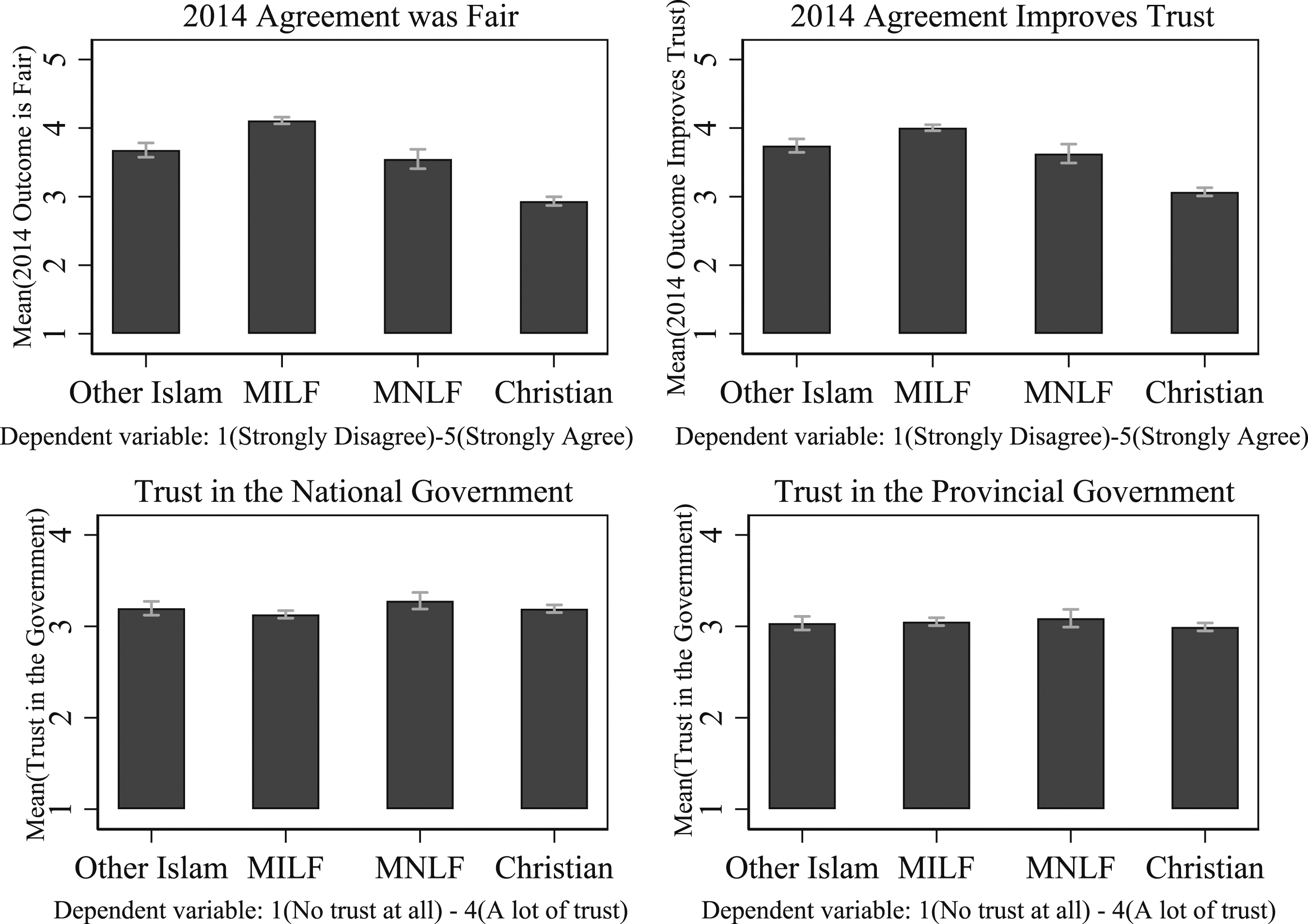
Consistent with H1, we find that the respondents who self-identify with Muslim groups (the marginalized groups) tend to have more strongly held views that the agreement was fair and exhibited improved levels of trust in political authority in comparison to those with a Christian identity (members of the dominant group). Taken as a whole, Muslims tend to have a more positive assessment of the 2014 peace settlement than do Christians.
Effects on Beliefs of Fairness and Trust Regarding the 2014 BBL/CAB Power-Sharing Agreement (Results Based on Observational Data).

Dependent variables: 2014 outcomes fair: 1 (Strongly disagree) – 5 (Strongly agree). 2014 outcomes improved national gov. Trust: 1 (Strongly disagree) – 5 (Strongly agree). National government trust: 1 (No trust at all) - 4 (A lot of trust). Provincial government trust: 1 (No trust at all) - 4 (A lot of trust). Results calculated using linear regression. Robust standard errors in parentheses. **p < 0.01, *p < 0.05.
In terms of the controls, the indicators we include based on the expectation that higher values will be associated with both greater belief in fairness and enhanced trust in the government are the following: income, willingness to vote for the president’s party in the next election, and whether or not the respondent resides in a Peace and Development Community (PDCs). PDCs are areas within Mindanao that have been a focus of development and conflict prevention efforts by the national government and international donors, and we thus expect individuals in these regions to perceive the government in a more positive light. Including votes in favor of the president’s party helps us to account for support for the person in office as opposed to trust in institutions more generally.
We anticipate that an experience with the trauma of evacuation during war will have the effect of decreasing a sense of fairness and making individuals less trusting of a government that has failed to provide for their security in the past. The operationalization of each of these new control variables is identified in the appendix, in Table A1, which lists all indicators and their associated survey questions.
One limitation of our study is the absence of a control for measuring the effect that dissemination of information regarding the peace agreement may have had on the survey respondents. We acknowledge that citizens’ knowledge and perception of the content of peace settlements may be mediated by elite discourses disseminated in the media.
Mechanism Test: Citizens’ Reactions to Specific Power-Sharing Measures
Experimental Design With Five Groups (Roughly 600 Respondents Randomly Assigned to Each group).

(1) It decreases my trust, (2) it has no effect, (3) it increases my trust.
Our analysis of the influence of power-sharing measures on trust in the government is rooted in our argument regarding individuals’ perceptions of their community’s prospects resulting from power sharing. We anticipate that individuals from marginalized groups will respond more favorably to each form of power sharing than will individuals from a dominant group. If, as we anticipate, Muslims see each form of power sharing as providing more power and resources to their historically marginalized group, Muslim respondents should, when asked to consider the inclusion of a power-sharing measure in a peace settlement, respond with larger increases in trust in the national government than will Christian respondents, relative to the control condition. In other words, we argue for a causal pathway where group identity informs reactions to power-sharing measures, which in turn informs trust.
In our experiment, respondents receive information regarding one of five treatments that are presented to them as potential peace agreement provisions. These provisions were presented to the survey respondents as items that the national government of the Philippines and the MILF were considering as means of improving the situation in Mindanao. Our proposal of potential changes to the BBL/CAB can be deemed reasonable in the sense that members of the national Congress of the Philippines were proposing amendments to the agreement at the time of the survey experiment.
Following exposure to a treatment detailing the potential adoption of a form of power sharing or the non-power-sharing treatment, respondents were asked about the effect that the treatment that was being considered had on their trust in the national government. The responses indicate that, following the treatment to which each respondent was randomly assigned, 50% of respondents indicated an enhanced level of trust in the government, while 26% did not experience a change in their level of trust and 24% experienced a decrease in their trust level.
We next turn to the use of more sophisticated statistical analyses. We begin with tests in which trust in the national government serves as the dependent variable. Based on our three-point dependent variable, we estimate an ordered probit model that allows us to calculate the probability that respondents express a change in their trust in the national government. We create interaction terms between the treatments and group identity in our statistical models in order to gauge treatment effects among Muslim and Christian respondents. 18
Our statistical models also include control variables that are intended to capture the influence of demographic characteristics on trust in the national government. We include a continuous variable that reflects the age of the respondent at the time of the survey. We also incorporate an indicator that captures the level of educational attainment of respondents. This variable is a twenty-three-point scale of educational achievement ranging from no education to postgraduate education.
Effects on Increased Trust in the National Government by Treatment Groups and Respondent Religion (Results based on Experimental Data).

Dependent variable: Decreased trust (1), No effect on trust (2), increased trust (3). Results estimated using ordered probit models. Standard errors in parentheses.**p < 0.01, *p < 0.05.
In order to interpret the results, we graph the probabilities of increasing trust in Figure 2, while holding the control variables constant at the mean (for interval level measures) and modal values (for nominal and ordinal level measures). Overall, Muslim respondents tend to increase their trust in the national government in comparison to Christians. In comparison to the earlier survey questions, which ask about trust without consideration of the peace agreement, our experiment produces the expected divisions among Muslims and Christians following Hypothesis 2. This finding holds across treatment conditions, which did not produce substantive treatment effects. Among Christians, economically beneficial power-sharing may allay the lower levels of trust to some extent, but not substantially as evidenced by overlapping confidence intervals. Effects of powersharing arrangement treatments on increasing trust in the national government by religion with 95% CIs. Dependent variable: Changing Trust in Gov.: The arrangement decreases trust(1), no effect(2), Increases trust(3). Data source: Philippines Powersharing Survey.
A concern is that respondents’ evaluations regarding peace agreement fairness that are picked up in the survey may reflect general attitudes regarding the credibility or utility of peace agreements rather than evaluations of the 2014 agreement. Is trust in the government informed by the distributive implications of the 2014 agreement? Or might respondents’ perceptions regarding the fairness of the agreement reflect their attitudes toward and experiences with the 1996 peace agreement that was previously negotiated in Mindanao? To address this point, we compare the results (Figure 1) derived from the evaluations of the 2014 peace agreement to results derived from respondent evaluations of the 1996 peace agreement (see the online appendix, Figure A1). We show that Muslim and Christian divisions are not substantive with respect to fairness when we analyze responses regarding the 1996 agreement. This outcome provides us with greater confidence that the evaluations of the 2014 agreement reflect considerations of the contents of that agreement.
Discussion
Evidence from a survey in Mindanao provides support for our argument that power-sharing peace agreements are likely to generate different perceptions of peace agreement fairness and differing levels of trust in the national government among individuals who are members of dominant and marginalized groups in divided societies. We find that Muslims, who represent the marginalized group in Mindanao, perceive the 2014 peace agreement as fairer than do Christians, who represent the dominant group in the region. Our results also indicate that, in comparison to Christians, Muslim respondents exhibited greater improved trust in the government thanks to the peace agreement. We attribute this result to the fact that the Comprehensive Agreement on the Bangsamoro (CAB) seeks to accommodate Muslims’ desire for increased access to power and resources. Our confidence in the influence that the peace agreement had on the differing perceptions of Christians and Muslims is enhanced by the fact that the two groups' trust in the national government was indistinguishable when Muslim and Christian respondents were not asked to consider the peace agreement.
We further find evidence that Muslim identity groups typically associated with the MILF, the non-state actor involved in negotiations of the CAB with the Philippine government, perceived the settlement to be fairer than did other Muslim identity groups. However, a limitation is that we are unable to distinguish among Christians in a manner that would allow us to explain why some members of this group clearly perceive the settlement as fairer in nature than do others. 19 This suggests that while one can gain significant insight into individuals’ support for the peace by using membership in marginalized and dominant groups as a key explanatory variable, there is a need to delve further in order to identify “within-group” factors that could also influence individuals’ perceptions of a peace settlement.
Seeking to test a mechanism central to our theory, we employed a survey experiment to evaluate the effects that exposure to different power-sharing provisions, which represent the distinctive distributive elements of a settlement, have on individuals’ trust in the national government. While the experiment yielded greater trust among Muslim respondents when compared to Christians, as expected, we find that none of the specific power-sharing measures elicits a substantive reaction from the respondents, whether from the dominant Christian or marginalized Muslim groups.
What accounts for the divergence in the results produced by the observational and experimental components of our empirical strategy? One possible inference one might draw from the null effects produced by the survey experiment is that citizens do not care that much about the distributive implications of peace settlements. However, as Tellez (2019) observes, “asking people to evaluate specific agreement provisions in isolation is unlikely to reflect actual preference formation… given that agreements are complex and imply trade-offs along many different dimensions” (833). Indeed, our results suggest that the distributive implications of specific power-sharing measures looked at in isolation have a limited influence on the opinion formation of citizens. It thus may be the case that citizens’ perceptions of peace agreements are more general, with their assessment based primarily on their conflict-related group identity. The impression that individuals in a divided society form of a settlement’s distributional consequences may be driven by their sense of the overall effect these consequences will have on their community, rather than judgments regarding implications stemming from individual power-sharing measures. This perspective corresponds with evidence indicating that individuals often rely on cognitive shortcuts to assess complex settlements (Matanock and Garbiras-Díaz 2018). Although it is possible that individuals' perceptions of the fairness of a peace agreement are informed by other means of understanding settlement fairness, such as the process by which a settlement was constructed, this explanation would not account for the differences in perceived settlement fairness that we find exist between individuals from dominant and marginalized groups.
Another potential explanation for the divergent results produced by our observational and experimental analyses may be that citizens lack an understanding of the distributive implications associated with power-sharing measures and how these will be allocated across a society. This may particularly be true of political and military forms of power sharing which, unlike territorial and economic forms of power sharing, are not generally framed as involving a direct transfer of economic resources from the state to a community or set of actors. 20 An inability by citizens to link forms of power sharing to distributive outcomes might thus account for the null results of the survey experiment, while a more generalized sense that the peace agreement provides benefits for the members of marginalized communities may explain the results produced by our observational tests.
The absence of elite endorsements of the power-sharing provisions in our survey experiment also may have played a role in producing null results. Although they do not focus on respondents’ opinions regarding power-sharing measures, survey experiments conducted by other scholars have included elite endorsements as a means of evaluating individuals’ support for peace agreements. Based on a survey experiment in South Sudan, Haas and Khadka (2020) conclude that an endorsement by an out-group’s elite tends to increase opposition to a settlement, while public backing by an in-group leader does not appear to enhance enthusiasm for an agreement. Matanock and Garbiras-Díaz’s 2018 study reaches a similar conclusion. In their survey experiment in Colombia, they find that a respondent’s awareness that a settlement is supported by the Revolutionary Armed Forces of Colombia (FARC) increases their opposition to the agreement, a result they suggest is due to the widespread public perception of the FARC as engaged in criminal activity. These studies suggest that the influence of elite endorsements proves most apparent in shaping opposition to settlements, with individuals tending to reject settlements they perceive as supported by the elites associated with a competing out-group. Had our experiment included endorsements of each power-sharing measure by elites associated, respectively, with dominant and marginalized groups, it is possible we might have seen more substantive shifts in trust in the national government, particularly in those instances in which the endorsement was by an elite associated with an “out-group” community. However, we cannot be certain that our null results would have changed given that our experiment focuses on attitudes regarding particular measures of a peace agreement rather than attitudes toward the agreement as a whole.
Finally, we consider the possibility that our survey may have been underpowered. If our sample was too small, we may not have been able to detect important influences from the experimental primes. Table A8 of our online appendix demonstrates that our sample size is sufficiently large. Detectable effect sizes are sufficiently low (measured by Cohen’s delta values that are under 0.2) for us to be confident in our interpretation of the null findings.
Conclusion
This study makes three contributions to scholarship analyzing citizens' reactions to peace agreements and their support for the peace. First, taking the conflict bargaining literature’s emphasis on the distributive consequences of peace agreements seriously, we develop a theory that explains why and how power- and resource-distributing elements of a settlement may matter to ordinary citizens in divided societies. This focus on citizens centers our work squarely within the emerging citizens in peace processes research agenda, which seeks to investigate “how citizens’ political behavior shapes – and is shaped by – peace processes” (Haass, Hartzell, and Ottmann 2022, 1548). Our second contribution is to draw attention to the sociotropic nature of such assessments. Because civil wars take place between or among groups, we analyze individuals’ perceptions of a settlement based on their group membership. 21 This approach complements recent work by Carey, González, and Glassel (2022) focusing on how individuals from opposing majority and minority ethnic groups in the Sri Lankan civil war perceive changes in different elements of the postwar peace and how this influences their outlook on the stability of the peace. Finally, this study is among the first to provide empirical evidence regarding individuals’ perceptions of power-sharing measures, an important constituent element of many peace agreements, and the effects these may have on citizens’ support for the peace. 22
A number of potential policy implications follow from our study. Perceptions of which groups “win” and which “lose” as a result of a peace settlement constitute a political fault line that is salient for the government that negotiates (and presumably implements) a settlement. Although we cannot definitively conclude on what basis it is that citizens form their perceptions of the fairness of a peace agreement and trust in political institutions, evidence from Mindanao suggests that it does map on to the implications that the settlement has for marginalized and dominant groups in a divided society. As the parties to a conflict attempt to construct a settlement that balances power in such a way as to stabilize the peace, they may want to consider the implications that the measures they adopt will have on citizens’ perceptions of their impact on the balance of benefits between dominant and marginalized groups. Additionally, the limited treatment effects suggest that settlement architects seeking to balance power between the parties to a conflict may have some flexibility in choosing among the power-distributing measures they employ, at least in the sense that they need not worry about asymmetric reactions by individuals from either marginalized or dominant groups.
Supplemental Material
Supplemental Material - Civil War Settlements, Perceived Agreement Fairness, and Trust in Political Authorities: Investigating the Influence of Power Sharing on Public Opinion in Divided Societies
Supplemental Material for Civil War Settlements, Perceived Agreement Fairness, and Trust in Political Authorities: Investigating the Influence of Power Sharing on Public Opinion in Divided Societies by Caroline A. Hartzell, Matthew Hoddie, and Douglas Page in Journal of Conflict Resolution
Footnotes
Acknowledgments
We appreciate the helpful feedback and comments we received from individuals at annual meetings of the Peace Science Society (International) and the American Political Science Association, as well as from participants at a workshop in the Political Science Department at the University of North Texas, and from three anonymous reviewers.
Declaration of Conflicting Interests
The author(s) declared no potential conflicts of interest with respect to the research, authorship, and/or publication of this article.
Funding
The author(s) disclosed receipt of the following financial support for the research, authorship, and/or publication of this article: This article is based upon work supported by the National Science Foundation under Grant No. 1552619. Funding for this project was also provided by Gettysburg College in the form of a Research and Professional Development grant.

Data availability statement
The replication files for this study are available on the Harvard Dataverse repository: https://dataverse.harvard.edu/dataset.xhtml?persistentId=doi:10.7910/DVN/0ZXMYU (Hartzell, 2023).
Supplemental Material
Supplemental material for this article is available online.
Notes
References
Supplementary Material
Please find the following supplemental material available below.
For Open Access articles published under a Creative Commons License, all supplemental material carries the same license as the article it is associated with.
For non-Open Access articles published, all supplemental material carries a non-exclusive license, and permission requests for re-use of supplemental material or any part of supplemental material shall be sent directly to the copyright owner as specified in the copyright notice associated with the article.
