



Abstract
Does public support for armed humanitarian intervention depend on the race and religion of those it seeks to save? Social identity theory predicts that people prefer helping strangers with whom they share an identity, but norms of paternalism and cosmopolitanism could moderate such favoritism. We test these propositions via survey experiments administered to a nationally representative sample of Americans that randomized the racial and religious characteristics of foreigners in a hypothetical civil war. The data reveal that Americans, especially Christians, prefer to intervene on behalf of Christians over Muslims. Ingroup affinity rather than outgroup Islamophobia explains this effect. Meanwhile, Americans exhibit less consistent prejudice along racial lines. Finally, while scholars find paternalist norms affect attitudes toward economic assistance, we find no similar effect for military intervention. Cosmopolitan Americans, however, express less identity-based bias. We conclude that people act on their basic socio-psychological instincts, but norms could attenuate these biases.
Keywords
In recent decades, domestic audiences in democracies have increasingly embraced humanitarian considerations as legitimate grounds for waging war. Indeed, opinion polls several decades after the Cold War find consistently high levels of support for armed humanitarian operations (Jentleson 1994; Eichenberg 2005; Jentleson and Britton 1998; Brooks and Valentino, 2011; Kreps and Maxey 2018). At the same time, norms of humanitarian intervention have evolved toward a sense of community responsibility for protecting the lives of strangers, regardless of their identity (Wheeler 2000; Finnemore 2003). Consistent with such trends, politicians regularly invoke humanitarian justifications to raise public approval for their military operations (Kreps and Maxey 2018; Maxey 2020).
Yet, there are important cases in which humanitarian aims did not generate demand for intervention. For example, the U.S. government and people watched while a vicious genocide unfolded in Rwanda, where only 28 percent of Americans supported intervention. In 2013, Syrian President Bashar al-Assad unleashed chemical weapons on his people, violating one of international law’s most deeply entrenched norms (Price, 1997; Blair et al. 2022). However, the global community largely stood still as almost 1,500 civilians died from sarin gas. Despite widespread news coverage of the attack and calls for humanitarian action by key members of the Obama administration, only 33 percent of the U.S. public favored intervening with a military strike. 1
These observations show that, while the public may generally favor using armed force to pursue humanitarian objectives, there is substantial variation across specific cases. This variation remains underexplored, especially regarding how attributes of the humanitarian emergency affect public attitudes. 2 For example, one contributing factor to why Rwanda and Syria produced so little mass support for humanitarian intervention may be the victims’ identity. Observers might contrast the U.S.’s willingness to save white Kosovar Albanians but not black Rwandans. They may similarly wonder if the U.S. would have acted to save the Syrian people if they were predominantly Christian instead of Muslim. Freeman et al. (2022) outline how race has shaped the way that international relations scholars have characterized certain countries; these assumptions about non-white countries being both “deficient” and “inherently aggressive” are likely reflected in public attitudes as well. After all, humanitarian interventions were once described as a phenomenon of “Christians saving Christians.”
To fill this gap, we examine two critical dimensions of victim identity that may condition public support for intervention: race and religion. While at first blush, it may seem intuitive to assume people would prefer humanitarian intervention on behalf of victims sharing their race and religious identity, existing evidence cannot fully verify this conjecture. Beginning with race, research shows that people tend to favor assisting members of their own racial group in domestic economic policies (Gilens 1996; Kinder and Sanders 1996; Mendelberg, 2001; Feldman and Huddy 2005; Winter 2008; Alesina, Glaeser, and Sacerdote 2001; Kinder and Kam 2009; Guisinger 2017), but due to paternalistic attitudes, they could instead favor an outgroup racial group in international policy (Baker 2015). Furthermore, there is relatively less evidence on race and people's opinions on security policy, and what we know about race in economic policies might not directly translate to security policy. Kreps (2018), for example, found that Americans respond less favorably to raising taxes to finance war than to expected casualties, indicating that the public thinks differently about financial versus human costs.
Religious biases are also an intuitive explanation for how victim identity may influence public support, but existing research does not paint a consensus about this variable either. Indeed, the origins of humanitarian intervention as foreign policy trace their roots to 19th-century Christian activists taking advantage of a growing free press (Bass 2008). However, changes in humanitarian norms, the experience of humanitarian intervention on behalf of non-Christian populations, and the secularization of society suggest that a new effort is required to test the role of religion (Finnemore 2003). Existing work on how religion affects public support for using military force is scarce and focuses on the interaction of regime type, threat perception, and religion, rather than religious ingroup identity itself (Johns and Davies 2012; Lacina and Lee 2013). Studies that focus on religious identity do suggest a bias, but they examine small and college student convenience samples, and thus there is still an opportunity to evaluate the broader societal motivations behind such biases (Boettcher 2004; Grillo and Pupcenoks, 2017).
We therefore identify and test three theories in the literature that may explain how a victim’s race or religion affects public attitudes toward humanitarian intervention. We begin with the social identity perspective: people prefer helping those with whom they share an identity. Then, we theorize about whether paternalistic biases impact public attitudes. Finally, we specify how norms of cosmopolitanism may attenuate existing biases. Thus, while existing approaches focus on the distinct roles of identity or norms, we also specify and evaluate their interaction.
We evaluate these theories by fielding experiments embedded into opinion polls of the U.S. public. In the surveys, American citizens answered questions regarding a hypothetical humanitarian crisis in a foreign country and a potential U.S. intervention. In line with previous studies, we used a news vignette and photo-based survey that randomized the racial and religious identities of the foreign citizens to be White-European or Black-African, and Christian or Muslim, while holding constant key contextual factors. From this design, survey-takers saw one of five potential articles: four that randomized identity plus a control group article that did not name the race and religion of the victims. This experimental design isolates the effect of victim identity, which helps us to overcome the inferential difficulties of interpreting historical cases in which identity is only one of many collinear causal factors, such as multilateralism and the scale of humanitarian need. 3
We find that Americans exhibit a significant bias in favor of saving Christians over Muslims, and to a lesser extent, in favor of saving white Europeans over black Africans. We further find that this bias is most substantial among co-identity members: Christian Americans, especially Evangelicals and those who frequently attend religious services, express a much stronger preference for saving Christian lives. Moreover, this religious bias stems more greatly from ingroup affinity rather than outgroup hostility. On the other hand, while racial bias is similarly more substantial among co-identity members, the overall effect of race is less robust than the effect of religion. Finally, social norms may mitigate ingroup attitudes; those who espouse cosmopolitan norms hardly exhibit identity-based bias. In contrast, while research shows that paternalist norms lead white Americans to favor sending economic aid to Africa, we do not similarly find that they prefer humanitarian military intervention in Africa. Overall, we conclude that people, on average, act on their basic socio-psychological instincts, but social norms could attenuate these biases.
This paper significantly advances our understanding of how racial and religious identities affect domestic foreign policy preferences. It fills theoretical and empirical gaps in the literature on public opinion and war, which teaches us much about material factors like casualty sensitivity but has relatively less to say about the effects of identities like race and religion. The study’s robust results about the effects of religion suggest that the Christian-Muslim divide is an increasingly important cleavage in American foreign policy preferences and should be explored further, not just in the context of war and peace. In light of recent trends toward secularization within Western societies during the twentieth century and the long history of racial conflict within the United States, our study suggests that identity politics within national borders may play out quite differently in international affairs. Furthermore, at the macro-level, traditional explanations generally point to material, security, and geopolitical factors that influence decisions to engage in armed intervention, 4 while this study suggests that victim attributes could be non-material, ideational factors that influence the politics of intervention.
Social Foundations of Humanitarian Intervention Preferences: Race, Religion, and Norms
Humans and states organize themselves into groups, and group members favor each other over those who are considered “outsiders” (Tajfel 1978; Tajfel 1982; Abdelal et al. 2009), especially when those distinctions involve salient attributes like race, size, sex, facial features, and religion (particularly if the religious traditions require specific dress or outward appearance). 5 Indeed, scholars have shown that people can create ingroup identities over even minimally entrenched attributes, and that once a sense of “we” among the group has formed, members tend to discriminate in favor of and distribute more resources to each other (Tajfel 1978; Tajfel and Turner 1979; Brewer 1979). Group belonging is so vital to human interaction that moral foundations theory identifies “ingroup and loyalty”—an individual’s obligation to aid and preserve their group’s cohesion—as one of the five core values (Haidt and Graham 2007).
Drawing from this research program, scholarship in political science shows that group belonging helps to explain people’s foreign policy preferences (Kinder and Kam 2009; Kertzer et al. 2014). Much of this literature is framed in terms of how ingroup identification leads to favoritism, where people are more likely to be sympathetic to and therefore prioritize the needs of those who are a part of their ingroup. Recent research on political participation and violence supports this mechanism; Bell-Martin (2019) finds that exposure to drug violence in Mexico increases political participation against the cartels only when it arouses empathy from citizens.
However, outgroup identification can also lead to hostility toward others (Allport [1954] 1979). Rather than a lack of empathy, outgroup hostility predicts that individuals may be more likely to favor policies that explicitly target and disadvantage members of the outgroup. In the United States, observers note how race and outgroup hostility impacts the everyday lives of minority citizens: from micro-aggressions to negative stereotyping to the widespread use of racial epithets. Far from being expressions of ingroup love, outgroup hostility can and does actively make life difficult and less accessible for members of an “other” group.
These two related biases feed into parochialism, or co-identity favoritism, at the expense of outgroup members. The social science literature validating this framework is vast, even when looking exclusively at race and religion as dimensions of identity bias. For example, studies demonstrate how outgroup animosity manifests as racial resentment (Gilliam and Iyengar 2000). White Americans, on average, oppose public welfare spending that supports non-whites (Gilens 1996; Alesina et al. 2001), and oppose race-conscious public programs (Feldman and Huddy 2005). To provide another example, research on immigration in the U.S. and Europe shows how the Christian-Muslim divide, in particular, influences discrimination, integration, and receptivity of new migrants (e.g., Choi, Poertner, and Sambanis 2019; Shaffer et al. 2020). 6 Indeed, religion and religious practice have been shown to be particularly powerful in generating ingroup trust and potentially outgroup mistrust, conflict, and even war (Atran and Ginges, 2012).
Applied to our research question, if people prefer helping those with whom they share identity attributes, the theory implies that co-identification raises public support for humanitarian intervention (Social Identity Hypothesis). E.g., white Americans prefer saving the lives of white victims, Christians prefer saving the lives of Christians, and so on. 7
In addition to predicting a general co-identity bias, we also hypothesize that this bias will be more greatly driven by ingroup affinity as opposed to outgroup animus. Co-identification bias could, in theory, stem from either or both ingroup affinity or outgroup hostility, and the conventional wisdom holds that they are highly correlated (Sherif and Sherif 1953; Tajfel and Turner 1979; Brewer 1999). A closer look, however, reveals that ingroup affinity should be the dominant factor in cases of humanitarian intervention. First, the nature of humanitarian intervention often involves citizens of the intervening country feeling empathy for victims of violence. Statistical studies of US humanitarian interventions find that humanitarian concerns are often genuine and not purely a guise for national interest (Choi 2013). In domestic politics, calls for humanitarian intervention often use language that asks the public to imagine that their children or families are being violated.
Thus, while outgroup hostility may be the larger driver of bias when it comes to threat perception, retribution, and other policies of aggression, 8 the logic of ingroup favoritism is more closely linked to humanitarian intervention as a policy of altruism. Additionally, committing forces in support of humanitarian aims—an extraordinary use of force—is unlikely to be seen as a zero-sum game. As a result, there is little competition between groups in cases of humanitarian intervention, lessening the effect of outgroup hostility. Indeed, recent research suggests that ingroup affinity more robustly explains group bias when it comes to resource redistribution. 9 Finally, cases of humanitarian intervention rarely involve the explicit punishment of the perpetrators—intervention is usually framed in terms of saving innocent victims rather than punishing offenders. We therefore expect that ingroup love will drive increases in public support for some victims rather than others (Ingroup Love Hypothesis). 10
In addition to these main predictions, we also test related hypotheses about heterogeneous effects in the context of religion. Many Americans only nominally call themselves Christians but do not necessarily identify strongly with the tradition, so we expect that devout Christians will hold a stronger co-identity bias than the undevout. Providing another source of heterogeneity, differences in tradition and doctrine between denominations means that comparing Christians as a whole overlooks important differences in American religion today (Steensland et al. 2000). American evangelicals in particular exhibit different foreign policy preferences than other types of American “mainline” Protestants due to their church’s doctrinal focus on evangelism and a worldwide Christian community (Gries 2014). Thus, because they are more inclined to view their religion as encompassing a coherent identity group beyond national boundaries, we expect that ingroup preference will be strongest among Evangelical Christians. 11
Lastly, while we focus on race and religion as distinct identities in theory and in the empirical evidence, we are able to provide some exploratory work on their intersectionality. From the social identity view, more proximate identity should increase ingroup favoritism. This implies that sharing multiple identities could create additive effects, though at some point, there could be “diminishing returns,” to borrow from economics jargon, to sharing identities on multiple dimensions. For example, you may feel affinity with somebody who shares the same race, but the additional affinity gained from sharing gender, religion, and other identities would be less. We do not have a theoretical prior as to exactly when that diminishing effect would nullify the bias of sharing the Nth additional identity, but it is unlikely to be only after the second major identity. Thus, overall, we expect that sharing both race and religious identity will create greater ingroup favoritism than either one of the identities alone.
Paternalistic Biases and Cosmopolitan Norms
We have thus far drawn primarily from the psychological tradition to explain why basic instinct could generate favoritism for one’s ingroup. But instinctual, psychological preferences can also be moderated and even overruled by societal stereotypes, norms, and values. Here, drawing from literatures on humanitarian intervention and aid, we evaluate two norms and values that may counteract or attenuate fundamental identity-based biases: paternalism and cosmopolitanism.
Paternalism
While social identity theories predict ingroup favortism, theories of paternalism predict that under some circumstsances individuals will instead favor helping members of an outgroup. Members of a privileged group, rather than seeing outgroup individuals as competitors, may instead see them as particularly helpless individuals, incapable of self-sufficiency. The dynamic resembles a parent-child relationship in which one group or individual (the “parent”) feels that they have the right to interfere in the life and affairs of another (the “child”) who is seen to lack autonomy (Van deVeer 1986). Foreign policy preferences, therefore, may reflect a new “white man’s burden,” where white Americans favor sending aid to stereotypically “helpless” black Africans over white Europeans, who are assumed to be more self-sufficient (Easterly 2006). Baker (2015) finds support for this argument through a set of survey experiments by showing that white Americans are more enthusiastic about giving foreign aid to citizens living in Cameroon than to those in Moldova. While on the surface, this manifestation of paternalism may seem to bias the “global north” in favor aiding the “global south,” the long term effects can be deleterious to development. 12
The way paternalistic norms interact with social group identity is to create new stereotypes about an outgroup (e.g., black Africans) that generate a policy preference of wanting to “save” such an outgroup. So while social identity biases predict increases in support for ingroup members, paternalistic biases have the opposite effect. If this is true, and the existing findings about economic aid extend to the security realm of armed intervention, then we should expect that white Americans to prefer humanitarian intervention on behalf of black Africans. 13
Cosmopolitanism
In contrast, theories of cosmopolitanism argue that liberal-cosmopolitan norms bring the world closer and lead to a shared sense of humanity that mitigates disparities in people’s perceived value of human life that depend on geography and identity (Beitz 1979, Kant 1795). Thus, we view cosmopolitanism as a norm that can both increase baseline support for international humanitarian activity but also reduce the bias in support for different identity groups.
Indeed, constructivist theories argue that evolving norms of universalism and liberal cosmopolitanism during the nineteenth and twentieth centuries, including the anti-slavery and self-determination movements, have suppressed identity-based biases in the realm of humanitarian intervention (Finnemore 2003). This approach to cosmopolitanism in the IR literature mirrors other treatments of cosmopolitanism that view global citizenship with “the desire to protect and advance the well-being of others…marked by a moral commitment to the welfare of all human beings, regardless of their race, ethnicity, gender, or nationality” (Burcu 2015). Support for international development and other moral acts could therefore be seen in the context of a larger movement toward “human solidarity…international community, and worldwide moral responsibilities” (Lumsdaine 1993, 290), while similarly, military actions with humanitarian aims enjoy broader public support (Jentleson and Britton 1998).
Mirroring the constructivist literature, research from the social and political psychology tradition also helps us to understand how cosmopolitan identification influences individuals’ beliefs about humanitarian action in foreign policy. 14 For these scholars, cosmopolitanism is an individual’s understanding of themselves as a citizen of the world and sense of membership to a global collectivity. As Bayrum (2015, 454) observes, “[w]orld citizenship is an acquired attachment that individuals voluntarily adopt…What underpins this attachment is self-categorization.” This self-categorization has led a variety of researchers to identify cosmopolitans using surveys allowing for self-identification, such as the World Values Survey.
Bayrum (2015) further shows that self-transcendence, self-enhancement, and openness to change motivate cosmopolitan identification. Self-transcendence values combine a commitment to universalism and benevolence, which translate to a concern for pluralistic and inclusive concern for others. Self-enhancement values (a desire for achievement and “hedonism” in particular) motivate cosmopolitans. These values emphasize achievement, status, and enjoying life. Cosmopolitans embrace openness-to-change values, seeking new experiences and a desire to engage with a variety of cultures. On the other hand, Cosmopolitans tend to steer away from conservation values, which refers to values about conformity, tradition, and security, and contrasts with being open to change. These values make cosmopolitans more likely to readily transcend rather than entrench traditional identity fault lines.
This study highlights the multifaceted aspect of cosmopolitanism at the individual level, but the values of self-transcendence and openness to change are especially relevant to understanding why cosmopolitans might express different preferences for humanitarian intervention. Self-transcendence implies a desire to help others in a universalistic way, and openness to change implies an openness to different cultures. First, these values, or norms, could reshape people's sense of identity in a way that blurs ingroup and outgroup distinctions by placing all citizens in a superordinate group—e.g., that people, regardless of racial and religious differences, share a common humanity (Gaertner et al. 1989). This social psychological concept of superordinate groups has helped to explain how promoting national identities might close racial and ethnic fissures (Transue 2007; Flesken 2018). Recategorization of individuals into this larger group could simultaneously expand the definition of ingroup affinity and lessen outgroup hostility. Second, cosmopolitan commitments promote adherence to a norm of helping others regardless of their race and religious identity. So from this perspective, cosmopolitans may still identify with their group but follow a norm of avoiding identity bias for either pragmatic reasons, like avoiding social sanctioning or improving group status by being seen as pro-norm (Johnston 2008), or if they have deeply internalized the norm, for the intrinsic reason that they simply think helping any other human is the right thing to do.
Taken together, we expect that cosmopolitan identification would increase not only baseline support for humanitarian action but also decrease group biases. At one extreme, societal level shifts toward embracing cosmopolitan norms should wholly remove racial or religious biases. However, cosmopolitan views might be expressed in more nuanced ways, as opposed to universally demonstrated, for two reasons. First, there could be countervailing historical developments. The effect of the September 11 terrorist attacks on American attitudes and subsequent global “War on Terror” has resulted in the demonization of Muslim populations, generating anti-Muslim attitudes among Americans (Gillum 2018). We may therefore expect that while racial biases have been evolving toward universality, new inter-religious tensions may encourage biases in American society. Second, while cosmopolitanism may exert an influence at the macro-level, it may not have an equal impact across the population. It would thus be a less stringent but more critical test of the theory to test the hypothesis that, among cosmopolitans, there is no identity-based bias in support for humanitarian intervention (Cosmopolitan Norms Hypothesis).
To summarize, we hypothesize that people will prefer humanitarian intervention on behalf of those with whom they share a racial or religious identity. These instinctual psychological biases may be attenuated by societal norms. A strong version of the cosmopolitanism hypothesis predicts that, to the contrary, mass support for humanitarian intervention should not depend on the victim’s identity. A more nuanced version of the argument predicts that only citizens holding a cosmopolitan worldview will express identity-based biases to a lesser extent.
Research Design
We employ the survey experimental methodology to isolate the effects of victim identity on public support for humanitarian intervention, independent of other factors that might confound inference in the historical record. We designed and fielded a survey experiment in May 2018 to a general population sample of 3,429 American adults via the National Opinion Research Council’s AmeriSpeak Panel. 15 Importantly, this sample and research design generates enough statistical power to explore patterns among smaller subgroups of the U.S. population.
Survey-takers read a short article about foreign civilians facing violence in a civil war and then expressed their support for a U.S. military intervention intended to help those civilians. They were told that the government was killing innocent civilians trying to escape the civil war. Survey takers were also shown two photographs to illustrate the racial and religious identity of the victims. For race, following established research (e.g., Baker 2015), the vignette subtly altered a photograph of an injured child to portray either a black or white skin tone, and the conflict’s location was described to be in either Liberia, Africa or Macedonia, Europe, respectively. 16 These two countries were chosen because they are comparable in key dimensions except for geographic region. They are both small, economically poor countries, have a history of civil conflict, and contain significant Muslim and Christian populations. These characteristics were explicitly reported to the reader in the vignette to enhance the comparability of the two contexts. Similarly, the survey randomized the religion of the victims by varying visual and textual stimuli. It presented a photograph of either a destroyed church or a mosque, and also stated that the victims were either Muslim or Christian.
Lastly, we created a no-information control group, where the victim identity was not specified, and the building that faced a mortar attack was a playground instead of a religious building. 17 The purpose of creating a control group was specifically to test whether biases were the product of ingroup love or outgroup hostility. Significant changes in support between the treatment and control groups help us to capture how the introduction of victim identity affects public support. There was no visual component in the no-information group, as using a visual would make it difficult to avoid priming respondents about skin tone and geographic location. A manipulation check speaks to the treatment’s validity: about 83 percent of respondents correctly identified the victims’ identity consistently across groups.
The experiment randomly assigned the race (White or Black) and religion (Christian or Muslim) of the civilian victims, leading to a 2 × 2 factorial design plus a control group. The randomization was conducted after blocking on the respondents’ race and religion. This design helped to ensure that key demographic attributes amongst survey respondents, such as African American Christians, would be equally distributed across the treatment groups. Next, respondents recorded their support for U.S. intervention by responding to a 7-point scale. 18 Finally, survey takers also answered several additional questions designed to test the various hypotheses above.
Independent from the experimental treatments, the article provided several pieces of contextual information to increase the realism of the vignette and to ensure that key variables were held constant across scenarios. 19 First, it explicitly stated that the foreign country (either Liberia or Macedonia) is poor. This information guards against confounding race with economic need. 20 Second, the survey stated that the foreign government did not invite an intervention, which mirrors the typical humanitarian intervention context. Third, we stated several cost and benefit factors: the intervention was “expected to cost the U.S. $1 billion and lead to [a dozen OR no] American casualties. It would save the lives of about 20,000 people.” We chose the specific values of these variables to mirror the historical record of humanitarian interventions.
The survey also measured background factors, including concepts like cosmopolitanism and respondent religious identity and practice, following procedures from Steensland et al. (2000). The questions are discussed below and appear in full in the Online Appendix.
Results: Identity-Based Bias in American Support for Humanitarian Intervention
The survey reveals four main findings. First, Americans express a significant bias in favor of savings Christian over Muslim lives, and to a lesser extent, a bias in favor of saving white European lives. Second, respondent-victim co-identification increases these biases. Third, the overall co-Christian effect can be explained by ingroup affinity rather than outgroup hostility. Finally, holding cosmopolitan views is associated with holding less identity-based bias.
How do Religious and Racial Identities Affect American Support for Intervention?
Average Treatment Effects: Intervention Support Depends on Victim Religion but Not Victim Race.
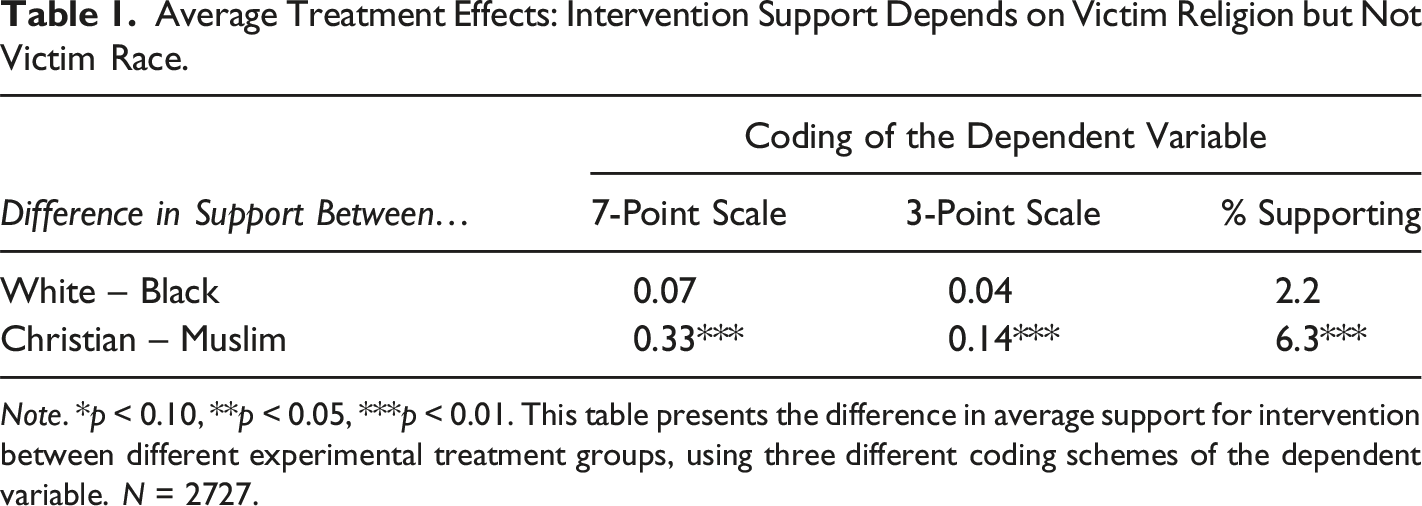
Note. *p < 0.10, **p < 0.05, ***p < 0.01. This table presents the difference in average support for intervention between different experimental treatment groups, using three different coding schemes of the dependent variable. N = 2727.
In contrast, the public’s preference for intervening on behalf of African and European lives appear to be about the same, and the detected difference does not meet conventional levels of statistical significance. Given that the United States is over 60 percent white, this is not consistent with social identity theory, and suggests that racial co-identity bias is weaker in foreign policy scenarios than in domestic policy.
Does Co-identification Affect Support for Intervention?
A comprehensive test of social identity theory, however, requires us to evaluate co-identity affinity by matching treatment identity with respondent identity. Social identity theories expect that people’s willingness to back humanitarian intervention should not only depend on the race or religion of who is being saved, but also on the respondent’s own racial or religious affiliation. To explore this possibility, therefore, we disaggregate the results presented in Table 1, and assess whether the experimental treatments interact with the respondents' race and religion. 21
Figure 1 reports public support for intervention by treatment type, sub-setting the data on respondent identity, where degree of support is measured on a seven-point scale. The coefficient plot on the left therefore displays the effect of changing the victims’ race from Black African to White European, conditional on the respondent’s race. When the data are disaggregated, we now see evidence of a co-identity racial bias among the American public, with Black respondents favoring an intervention to save the lives of African foreigners and White respondents preferring to save European foreigners. If we collapse the dependent variable into a binary scale, this translates to an approximately 7-point increase in support for an intervention that saves African civilians among Black respondents, and an approximately 4-point increase in support for saving European civilians amongst white respondents. While the victims’ racial identity did not appear significant in the aggregate, we discover co-identity bias after distinguishing white and black survey respondents. By contrast, we observe little evidence for the paternalism hypothesis in the realm of humanitarian intervention. The effects of victim race and religion, conditional on respondent identity.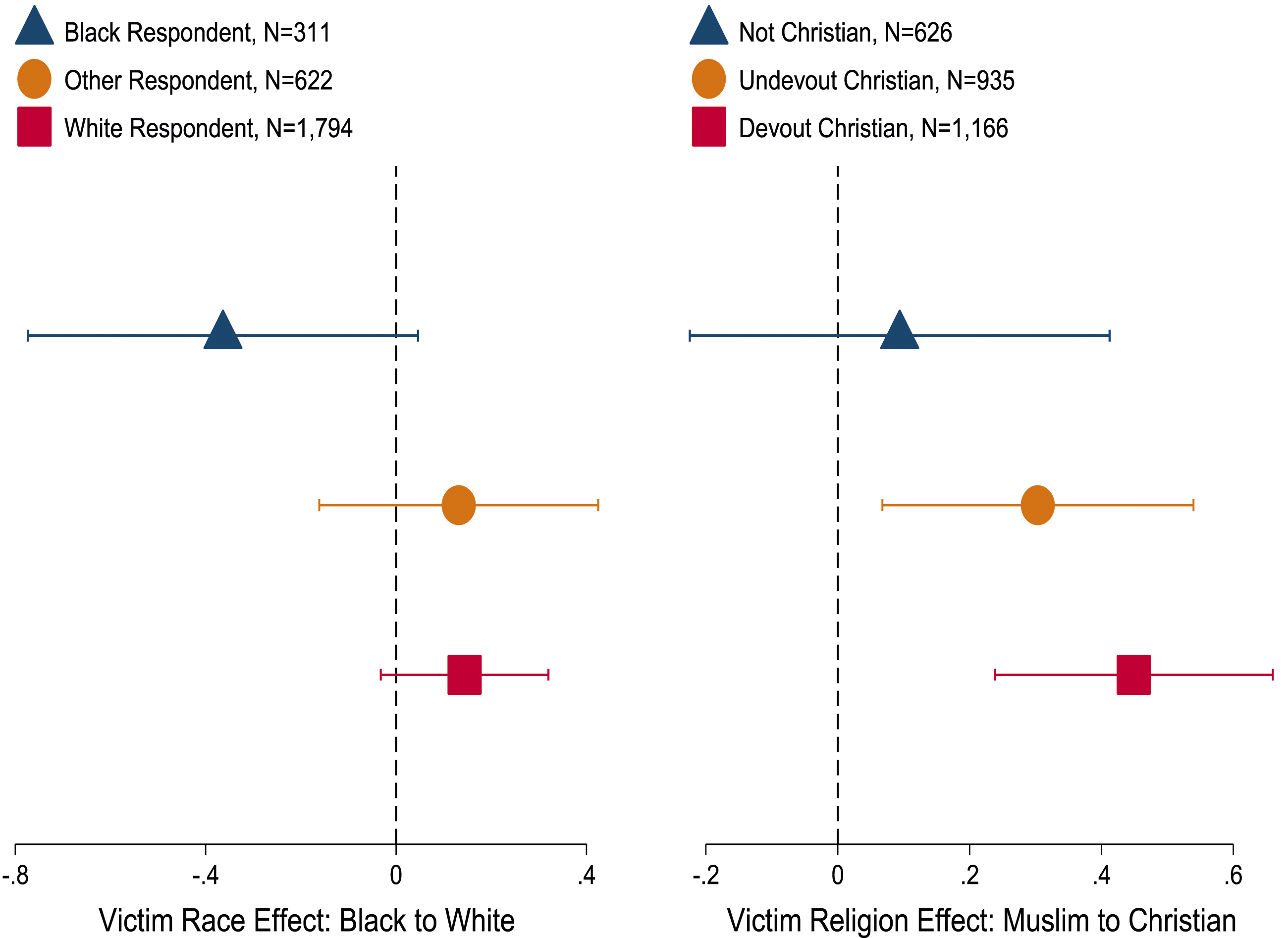
The right-side figure examines respondent religion. It splits apart the sample in a slightly different manner because it was impractical to create a large enough Muslim respondent group: they only make up 1 percent of the American population, and therefore just 31 respondents in our sample. Instead, the analysis examines three levels of Christian identification by separating non-Christians and Christians, then parsing Christians into the devout and undevout. Undevout Christians “never” attend religious services or only attend them “once or twice a year”—those we might colloquially refer to as “Christmas and Easter” Christians. Devout Christians participate in religious service more than twice a year, which indicates at least semi-regular church attendance. Using this coding scheme, we see that the preference to save Christian victims becomes increasingly pronounced among more devout Christians. Substantively, we observe that even among non-devout Christians, an intervention on behalf of other Christians raises support levels by about 6 points. However, amongst devout Christians, we see support increase by another 3 points, making devout Christians almost 9 points more likely to support an intervention if it is being undertaken to save fellow Christians. These results support the social identity hypothesis. 22
Co-identity Raises Support for Intervention.
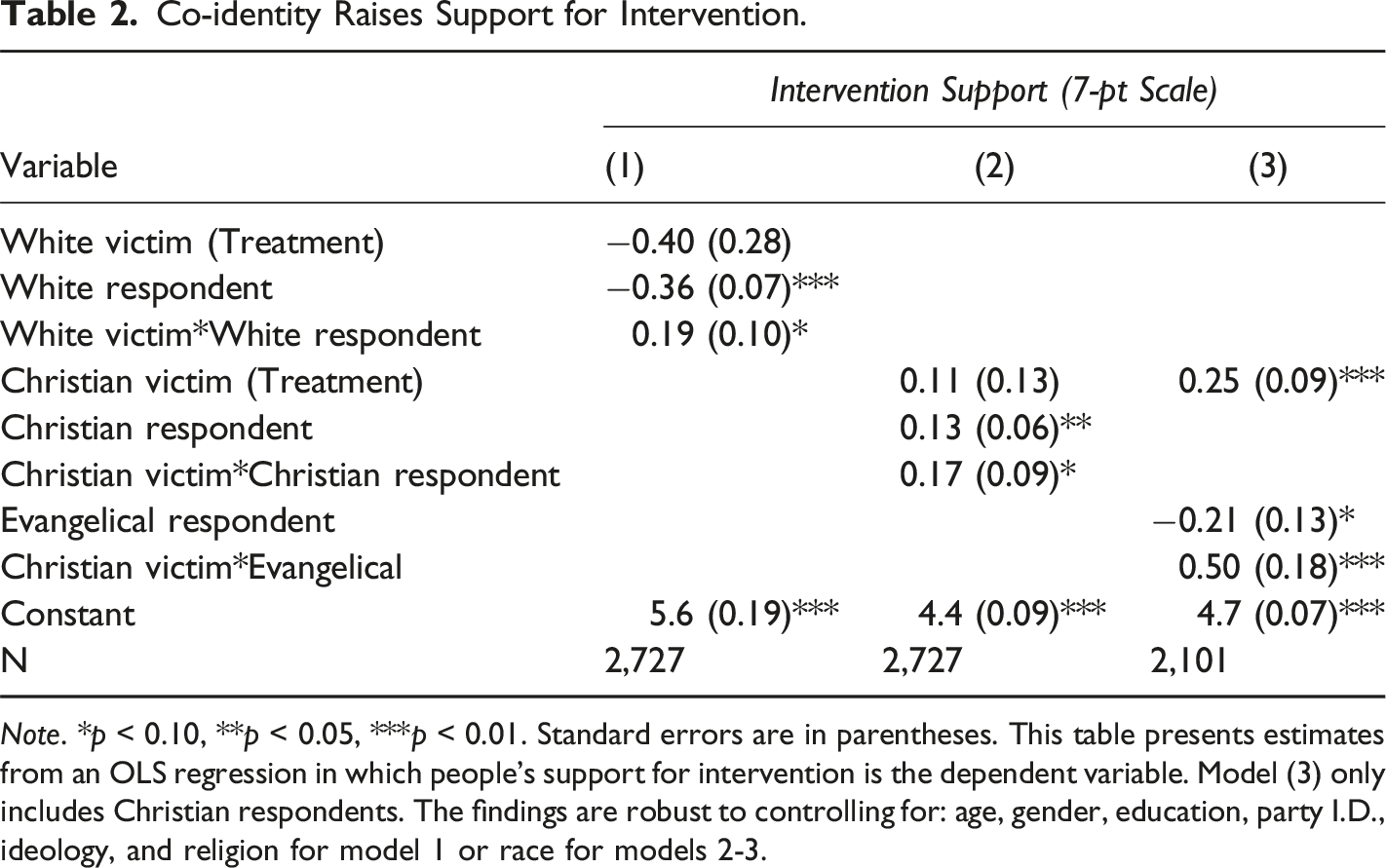
Note. *p < 0.10, **p < 0.05, ***p < 0.01. Standard errors are in parentheses. This table presents estimates from an OLS regression in which people’s support for intervention is the dependent variable. Model (3) only includes Christian respondents. The findings are robust to controlling for: age, gender, education, party I.D., ideology, and religion for model 1 or race for models 2-3.
We begin with race, which is reported in Column (1). The coefficient of White Victim is the race treatment effect among the regression’s baseline category, Black respondents. Mirroring the left triangle plot in Figure 2, the negative coefficient indicates that Black Americans support intervening on behalf of European victims less than African victims, but this difference is statistically insignificant (p = 0.15). White Respondent is significantly negative: they generally hold a weaker preference for intervention than non-white Americans. Lastly, White Victim*Respondent gives the interaction effect: the coefficient is positive, which reveals that White Americans exhibit a greater preference for saving European lives compared to non-white Americans, though the result is insignificant at the 0.05 level. However, when the sample is restricted to just black and white Americans (not shown), the difference is larger and statistically significant. Overall, Column (1) reveals that while Americans are overall less divided about intervention when the race of the victims differ, they still display some significant co-identity biases. Identity biases are closer to zero among Americans with a cosmopolitan worldview.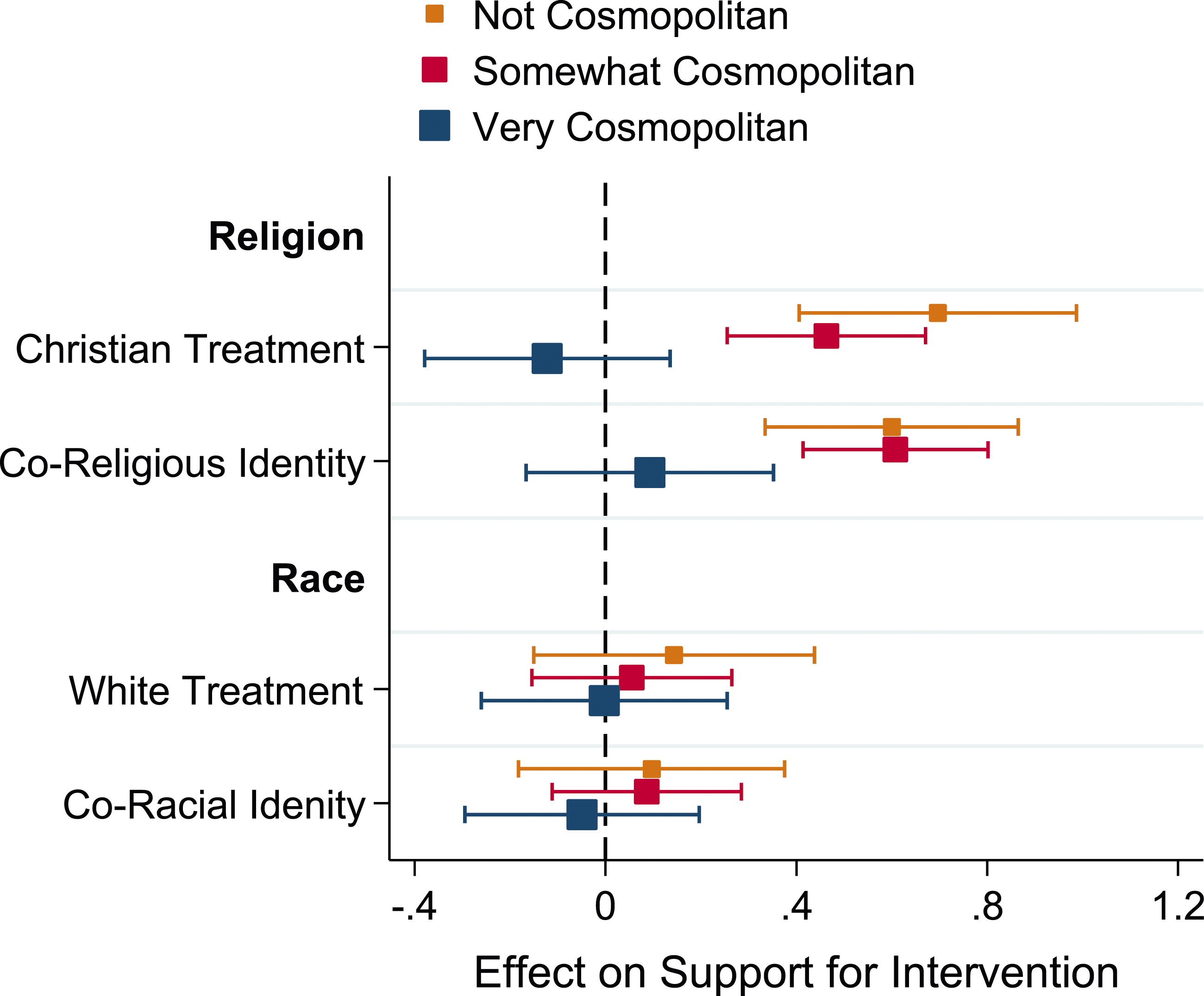
Column (2) turns to religion, and follows the same regression set-up as (1). In this model, the baseline category includes non-Christian respondents who read about Muslim victims in the vignette. Christian Victim shows the religion treatment has an insignificant effect among non-Christian Americans. Next, Christian Respondents have a slightly greater baseline support for humanitarian intervention when the victims are Muslim. 23 Finally, being Christian is also associated with a significantly greater preference for saving Christian victims, as indicated by the positive and statistically significant coefficient on the Christian Victim*Christian Respondent interaction term. There is a strong co-religion effect.
Column (3) evaluates the auxiliary social identity hypothesis that Protestant Evangelical Christians hold a particularly strong global Christian identity. To do so, it conducts the same type of interaction analysis but subsets the sample to only include Christian respondents. Evangelical is a binary variable, so the baseline category includes non-Evangelical Christians who read about Muslim war victims. We see here that among non-Evangelical Christians, there is a positive Christian Victim treatment effect. Next, Evangelical Respondents are generally less supportive of intervention, but lastly, there is a large and significant positive interaction term, which indicates that the co-religious bias among Christians is even stronger among Evangelicals.
The analysis thus far establishes that Americans are more supportive of saving the lives of those with whom they share an identity. These patterns are especially robust for the effects of religion, and to a lesser extent, race. The results thus support the social identity hypothesis, especially for religion, but they contradict the expectation that paternalistic norms lead White Americans to favor saving Black African lives.
Is the Co-identity Bias a Result of Ingroup Affinity or Outgroup Hostility?
We now assess whether respondents’ identity-based preferences for intervention can be explained by ingroup favoritism, outgroup animosity, or both. To do so, we examine data from the experimental control group, which did not specify the identity of the victims. Here, we focus our analysis on explaining the effect of religious bias, as the racial bias effect was not robust. While one may worry that respondents in the control group made assumptions about the victim’s identity, 24 this is unlikely as over 85 percent of the sample in the control group passed the manipulation check. 25 Furthermore, among those who did not pass the check, they guessed the wrong identity at about equal rates. Therefore, respondents were unlikely projecting any particular religion onto the control scenario, allowing us to evaluate ingroup affinity versus hostility.
Ingroup Christian Affinity, Not Outgroup Islamophobia, Drives the Religious Bias.
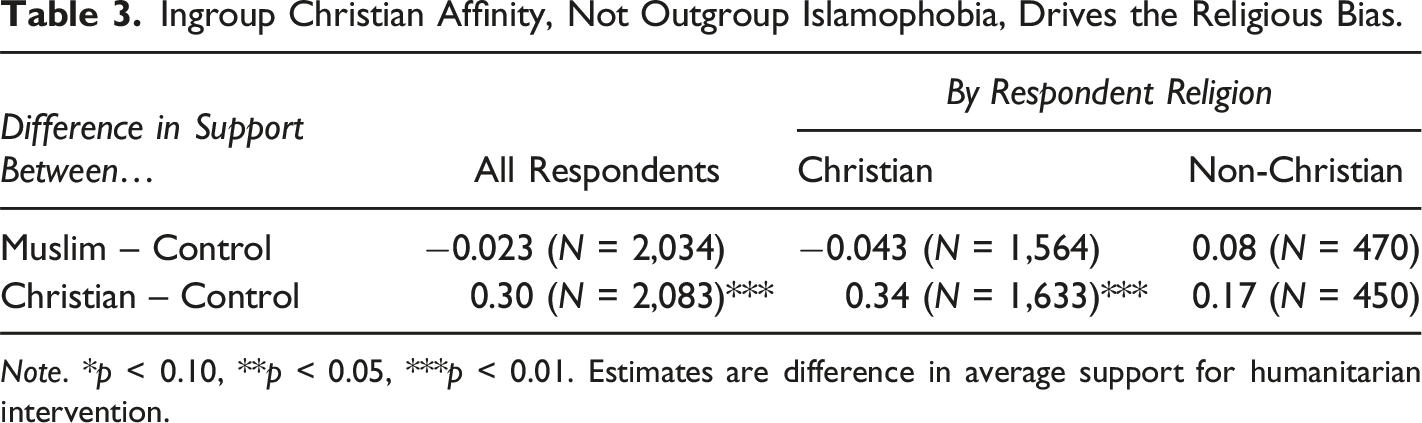
Note. *p < 0.10, **p < 0.05, ***p < 0.01. Estimates are difference in average support for humanitarian intervention.
Do Cosmopolitans Express Less Identity Bias?
We now examine how norms might interact with society identity bias. We can already rule out the effect of paternalism, since the analysis of co-identity effects found co-identity preference, rather than a paternalistic favoritism for outgroup members. Thus, here we examine whether people holding cosmopolitan norms, or those who see themselves as part of a larger global community, will express less of an identity-based bias. To do so, we regress intervention support on the experimental treatments, respondents’ classification as being cosmopolitan, and the interaction of the two (models 1 and 2). In alternative models, instead of the experimental treatments, we also use the co-identification of the respondent and victim (models 3 and 4). Here, the cosmopolitan thesis predicts that the interaction term will be negative: holding globalist views reduces one’s identity biases.
To measure cosmopolitanism, respondents were asked to agree or disagree with the following statements: 26 Q1 I see myself as a citizen of the world; Q2 Lifestyles in other cultures are just as valid as those in my culture; Q3 My culture should be the role model for other cultures (coded in reverse). Q1 is a standard question for cosmopolitanism (e.g., World Values Survey) that is based on the concept of global citizenship. To more reliably measure cosmopolitanism, we also include Q2 and Q3 to capture people’s proclivity for us-versus-them thinking. 27 These questions were asked prior to the vignette as a pre-treatment moderator. The ultimate variable, Cosmopolitan, combines these measures and splits the index into thirds, classifying respondents as being Not/Somewhat/Very Cosmopolitan. 28
Figure 2 shows the results of separating out cosmopolitans from the rest of the sample. We can observe that in the religious treatments, those who are Very Cosmopolitan show no particular religious identity bias. Cosmopolitans, therefore, do not appear to exhibit the same kind of ingroup biases other citizens do when evaluating potential humanitarian intervention. For race, we observe that cosmopolitans’ preferences also do not differ significantly from other groups, though as the previous analysis show, non-cosmopolitans already exhibit very little racial biases in their support for the hypothetical intervention. Even still, we see a similar pattern where holding stronger cosmopolitan views is associated with smaller treatment effects (i.e., less racial bias), even if those effects overall are not statistically significant.
The Online Appendix provides the full regression results behind Figure 2 and formally tests whether the treatment effects are statistically different from one (pg. 13). As Figure 2 indicates, it shows that cosmopolitanism only significantly attenuates the religious bias (p < 0.01), but not the racial bias, though this is likely because the effect of race is insignificant to begin with and thus faces a floor effect. Lastly, the regression results in the Appendix also show that cosmopolitanism is associated with a higher baseline support for humanitarian intervention. Thus, cosmopolitanism both increases general support for intervention and moderates identity bias. These results are robust to including demographic control variables, including age, gender, education, race, religion, party identification, and political ideology.
Additional Factors: Partisan Media and Intersectionality
This final section of the results summarizes exploratory analysis that goes beyond the theory but addresses two other factors that could further shape public views on intervention. First, we analyze whether the treatment effects vary by the respondent’s party identification and media exposure (e.g., Zaller 1992). With regards to religion, recent studies highlight how post-9/11 media depictions of Muslims, particularly among the conservative press, evoke concerns about terrorism (Huff and Kertzer 2018), which may lead people to view Islam as a national security threat. Our anlaysis (Figure A1, Online Appendix) suggest that partisanship and partisan news engagement do not interact to influence people’s susceptibility to racial bias. On the other hand, partisan news attentiveness does systematically correlate with religious bias, though a formal analysis of the triple interaction between the treatment, party identification, and news attentiveness reveals that the religion treatment effect remains.
Second, some may wonder if race and religion interact with one another. As we briefly theorized, we expect that sharing multiple identities with a victim should increase people’s willingness to intervene. When looking at the aggregate sample, there is a consistent support bonus for Christian victims—but that bonus is larger when respondents also share the race of the victim. Similarly, but to a lesser extent, European Muslims are more likely to receive support than African Muslims—particularly amongst White Americans. Thus, the combination of racial and religious co-identities strengthens humanitarian favortism.
Implications
The results above suggest that Americans are more likely to support interventions on behalf of victims that share their religion, and to a lesser extent, victims that share their racial characteristics. We see strong support—particularly amongst evangelical Christians—for interventions on behalf of other Christians. These patterns appear to be driven by ingroup favoritism rather than outgroup animosity, and this “Christians saving Christians” effect contrasts with immigration studies documenting religious bias due to outgroup Islamaphobia. 29 While these identity-based preferences exist, we do find that people holding cosmopolitan views are less prone to expressing identity-based bias. According to our analysis, the most ardent cosmopolitans exhibit virtually no identity bias.
These findings have important implications for political science scholarship. First, they contribute to the literature on public opinion and war. While public opinion before intervention influences how and when leaders decide to go to war (Mueller 1973; Sobel 2001; Holsti 2004; Milner and Tingley 2016), public opinion about an ongoing conflict war can further impact politicians’ electoral fortunes and political capital (Aldrich et al. 2006; Gelpi and Grieco 2015). 30 Research in this area has made much progress in understanding how material factors and psychological dispositions like isolationism or internationalism affect citizen preferences. By building theory in the domain of mass opinion on humanitarian intervention, and by collecting original data from a large-scale study, this project adds to our knowledge about the less well-studied family of causal explanations relating to individual level identity and norms.
Second, we found that while existing research highlights paternalism in Americans' foreign economic aid giving, there is no clear similar effect in the realm of humanitarian intervention. This advances our understanding of the generalizability of paternalism. We have two conjectures as to why the effect does not generalize. First, paternalism involves taking over the agency of the recipient, with support increasing “only when they see the assistance as being delivered with coercive or subtle paternalistic strings attached” (Baker 2015, 97). But in the case of humanitarian intervention, the narrow aims of saving lives is, in a sense, an “unrestricted” act; it is far easier to put strings on how foreign aid is used. Relatedly, because paternalistic norms originally emerged in the context of economic assistance to poor Africans, there was room for white Americans to “underestimate the agentic capacities of foreign blacks” relative to foreign whites (Baker 2015, 96). But in a humanitarian crisis amidst civil war, both white and black victims may already have breached the threshold of lacking agency in their lives because of the severity of the situation.
Third, we hope these findings will encourage future work that examines the role of religion in public preferences beyond the issue of war. In the study of foreign aid preferences, for example, many scholars have assessed the effects of race, but there are still gaps in our knowledge about religion. Finally, this study sheds new light on the norms on humanitarian intervention. While scholars show that global humanitarianism has come a long way from a world of “Christians saving Christians,” we show that, at least in the contemporary post-9/11 period in the United States, identity-based preferences still exist, though cosmopolitan views can mitigate them. Genuine humanitarian, human rights, and democracy concerns can motivate intervention (Choi, 2013; Choi and James, 2016), but there still may be biases in who these concerns apply to. Ultimately, we find that people often express socio-psychological biases, as they prefer helping those with whom they share a racial or religious association; however, norms have the power to attenuate these basic instincts.
More broadly, beyond academic debates, while American society has long been divided domestically by race, it does not appear that these same divisions directly translate into foreign policy preferences. Religion, however, plays a salient role in Americans’ support for humanitarian intervention in ways not previously appreciated. While we have no way of evaluating how these preferences may have changed over time, it seems reasonable to suggest that the terrorist attacks of September 11 likely fundamentally altered Americans’ views of religion as a foreign policy issue, leading to biases in support for intervention overseas. We found that Evangelical Christians, who also have considerable political power in the United States, are particularly likely to favor armed humanitarian intervention on behalf of other Christians around the world. We therefore are likely witnessing a growing cleavage emerge in U.S. foreign policy preferences—that of religious affiliation.
Supplemental Material
Supplemental Material - Race, Religion, and American Support for Humanitarian Intervention
Supplemental Material for Race, Religion, and American Support for Humanitarian Intervention by Jonathan A. Chu and Carrie A. Lee in Journal of Conflict Resolution
Supplemental Material
Supplemental Material - Race, Religion, and American Support for Humanitarian Intervention
Supplemental Material for Race, Religion, and American Support for Humanitarian Intervention by Jonathan A. Chu and Carrie A. Lee in Journal of Conflict Resolution
Footnotes
Acknowledgments
We thank A. Burcu Bayram, Diana Mutz, Scott Sagan, Kenneth Schultz, Nicholas Sambanis, and participants at the APSA general conference for their useful comments. We are especially gracious that this manuscript won the Weber Best Paper Award from APSA’s Religion and Politics Section, and its research design was awarded the Young Investigator’s Award from the Time-Sharing Experiments for the Social Sciences (TESS), which supported our data collection. The analyses reported in this document are the authors’ own and do not reflect the views of the Department of Defense, Air University, or the Army War College.
Declaration of Conflicting Interests
The author(s) declared no potential conflicts of interest with respect to the research, authorship, and/or publication of this article.
Funding
The author(s) received no financial support for the research, authorship, and/or publication of this article.

Supplemental Material
Supplemental material for this article is available online.
Notes
References
Supplementary Material
Please find the following supplemental material available below.
For Open Access articles published under a Creative Commons License, all supplemental material carries the same license as the article it is associated with.
For non-Open Access articles published, all supplemental material carries a non-exclusive license, and permission requests for re-use of supplemental material or any part of supplemental material shall be sent directly to the copyright owner as specified in the copyright notice associated with the article.
