




Abstract
In addition to successive Hungarian governments’ revisionist agenda and the re-education of the population in a Christian and national spirit, the symbolic takeover of Budapest spaces was another priority of Hungarian nationalist policy during the interwar period. From 1920 nationalist and right wing groups in Hungary demonized the capital and attempted to erase its previous associations with communism, cosmopolitanism, liberalism and unbridled consumerism by re-rooting it in the national soil. In order to achieve this effect they limited the autonomy of the municipality of Budapest, erected new monuments and re-wrote the meaning of old ones as well as periodically organizing the spatial takeover of Budapest by Magyar villagers. From the later 1920s on it was the annual celebration of St Stephen in a two-week long festival which became the fulcrum of nationalist efforts to take over the public spaces of the city. However, economic concerns related to the development of urban tourism limited their effectiveness. This article argues that due to the spread of consumerism and tourism propaganda concerns within the festival, by the 1930s it was rather Budapest that was urbanizing nationalism instead of the right wingers nationalizing the city.
On 16 November 1919 – exactly one year after the big popular assembly celebrating in front of the Hungarian Parliament the proclamation of the Republic – rear admiral Miklós Horthy entered Budapest as the leader of the counter-revolutionary forces which took over the capital in the wake of the retreating Romanian army. 1 Mounted on a white horse and surrounded by his troops, Horthy responded in front of the Gellért Hotel to a welcoming delegation led by the Mayor of Budapest (Figure 1) by emphasizing that he and his army were there to exorcize a city that ‘has denied its millennial past, and dragged into mud its crown and national colors by dressing into red rags’. After emphasizing the spite that he and his troops felt toward a city that had ‘collected’ – as he put it – ‘all the garbage of the country’, Horthy hit a conciliatory note by promising to redeem and pardon Budapest, if the capital ‘would return to its country, and would dearly love again the soil in which rot the body of our ancestors, love that soil which our rural brothers toil on, [and] love the crown and the double cross’, 2 the centuries-old symbol of the Hungarian kingdom. 3
Historians often refer to Horthy’s words to describe a right-wing stance toward Budapest that gained more and more ground in the years to come. In their discussion of the conservative and national Christian turn that shaped Hungarian politics during the interwar period, however, Horthy’s stance is only used illustratively
4
without enough attention being given to a more systematic presentation of the attempts made by right-wing circles to nationalize urban space and politics. Claims such as those made in 1929 by Benedek Jancsó, the minority expert of the conservative journal Magyar Szemle, according to which ‘Since Trianon, Hungarian national policy has centered on two points: revision and the question of the Magyar national minorities suffering under foreign domination’,
5
are also often taken at face value by historians, to the extent of forgetting the fact that interwar Magyar nationalists were interested as much in the nationalization of Budapest as on the recovery of Hungary’s lost territories.
Mayor Tivadar Bódy and members of the Budapest Municipality welcome Admiral Miklós Horthy on 16 November 1919. Courtesy of Metropolitan Ervin Szabó Library, Budapest, Budapest Collection.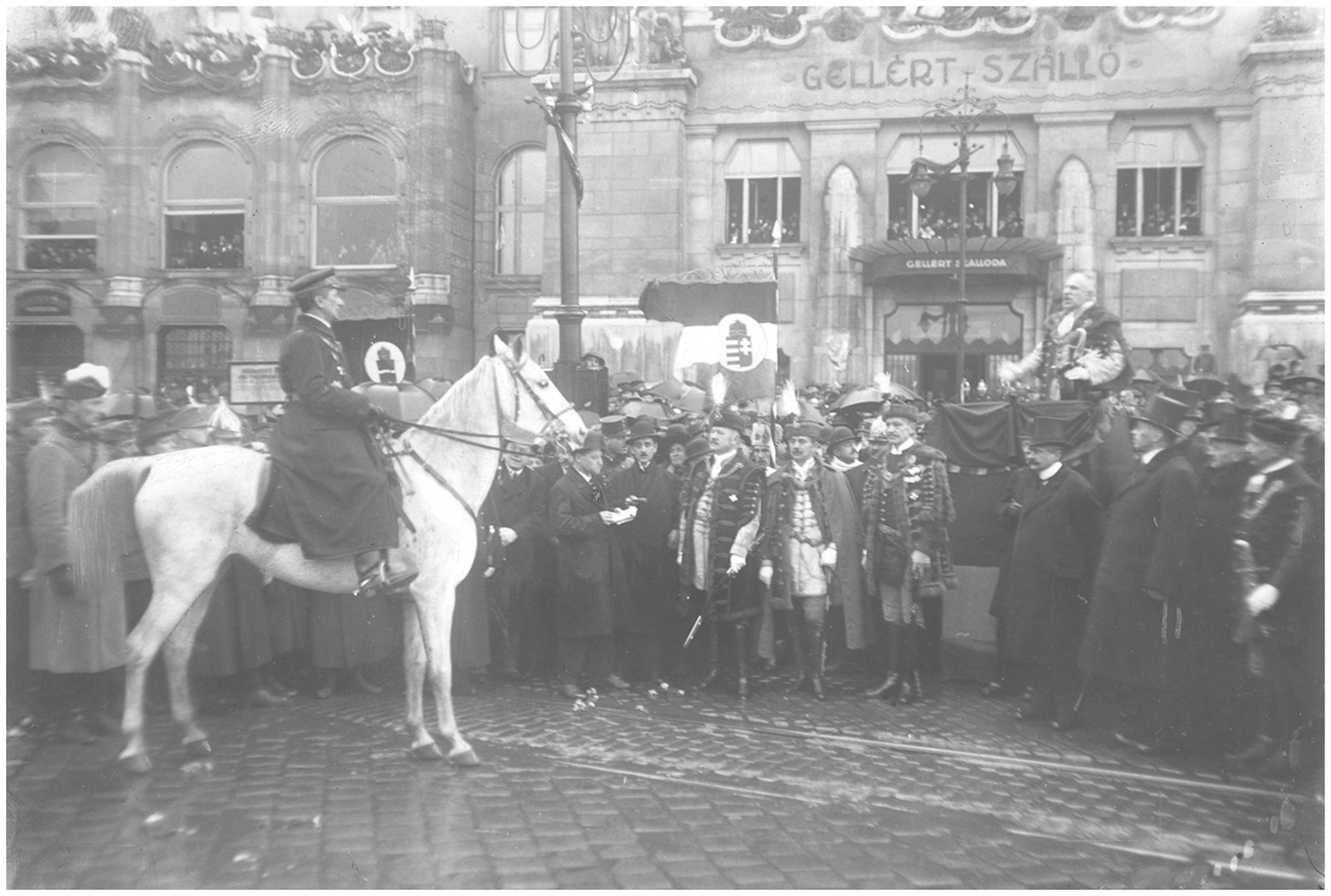
There were many reasons why they were urging the nationalization of the capital. Before the war the population of the city represented 4.8 percent of the total number of people living in the Hungarian half of the Austro-Hungarian Monarchy. As a result of the territorial losses that Hungary suffered at the end of the First World War, in 1920 this percentage rose to 11.63 percent, Budapest becoming thus the oversized capital city of a much smaller country. The urban development of Budapest throughout the last decades of the nineteenth century pointed in a Western direction. The 1873 unification of Pest and Buda into a single city under the name of Budapest set the capital on the path of rapid economic and demographic growth in the decades to come. By the turn of the century, although nationalists mounted several ethnic and linguistic assimilation campaigns to strengthen the Magyar character of Budapest, the capital was also celebrated by many of its inhabitants as a cosmopolitan ‘world city’ (világváros) strongly emulating western and North American metropolises such as Paris, New York and Chicago.
The concentration in Budapest of financial capital and factories, the spread of liberalism, social democratic ideas, socialism, anarchism, trade unionism, modern technologies such as electric lighting, the use of telegraph and telephone, transportation by tramways, subway and steamboats, the embrace of modern arts and literature and other Western trends by a growing Hungarian and Jewish middle class, in tandem with the emergence of urban mass culture, made conservatives and nationalists feel estranged in the modern metropolis. To make up for it they idealized the countryside and the Magyar peasants, while berating the cosmopolitan decadence of the capital. The events that occurred in Hungary at the end of the First World War further strengthened their resolve. The support that Budapest people gave on 31 October 1918 in front of Hotel Astoria to the creation of a democratic government led by Count Mihály Károlyi, which later turned Hungary into a republic, 6 and especially their involvement with the communist dictatorship led by Béla Kun, which succeeded it, turned the capital and the liberal-minded and left-wing constituencies living in it – as we have seen – into a target for retribution and punishment in the eyes of Hungarian conservatives, nationalists, right wing and anti-Semitic groups led by Horthy which entered the city in the fall of 1919. During the following months, many supporters of Kun as well as social democrats, liberals, Habsburg legitimists and Jewish businessmen were executed or imprisoned by Horthy’s forces, while others were forced to flee abroad. 7 In spite of these mass retaliations, interwar Budapest continued to be a city which was cosmopolitan, liberal and left-wing in spirit. This spirit was especially manifested in Budapest’s inner core districts as well as in the capital’s industrial districts, Angyalföld and Csepel. Even more to the point, during the brief Republic of Councils, set up on Soviet model by Béla Kun and his followers, workers took control of the capital’s inner districts, displaying red flags, symbolic hammers and other revolutionary iconography, and covering the major monuments in red draperies to serve as a background for plaster statues of Marx, Engels, Liebknecht and Lenin. 8 Among them, it was especially the Marx statue in front of the Millennium Ensemble (Figure 2) which stood out. Retaking the city, both spatially and symbolically, from these constituencies turned thus into an important goal for Horthy and his supporters. It was the performative function that every capital city has that they wanted to control and infuse with their ideology. 9
In this article, I focus on the discourses, administrative measures and symbolic actions that enabled Magyar nationalist and right-wing groups to claim spatial possession of Budapest in order to point out their importance in re-articulating the conflicting relationship between nationalism, urbanization and modernity which shaped Hungarian politics since the time of the turn of the century. From literary representations of the capital as a sick and alien body and government imposed restrictions on the former autonomy of the Budapest municipal council to the erection of new urban monuments and the rewriting of the meaning of old ones, the gamut of these measures loomed large. In addition, from 1926 on St Stephen’s Day, a Catholic celebration that since the 1890s was pushed to the fore by conservative forces as Hungary’s unofficial national holiday, became the fulcrum of nationalist and right-wing efforts to symbolically retake Budapest. However, economic concerns related to the development of urban tourism limited their effectiveness. By the 1930s St Stephen’s Day was celebrated as part of a two-week festival which included a host of cultural, commercial and sports events whose aim was to promote urban tourism. This article argues that due to the spread of consumerism and tourism propaganda concerns within the festival, by the 1930s it was rather the metropolitan culture of Budapest that was urbanizing nationalism instead of the right wingers nationalizing the city.
The Statue of Karl Marx in front of the Millennium Ensemble on 1 May 1919. Courtesy of Metropolitan Ervin Szabó Library, Budapest, Budapest Collection.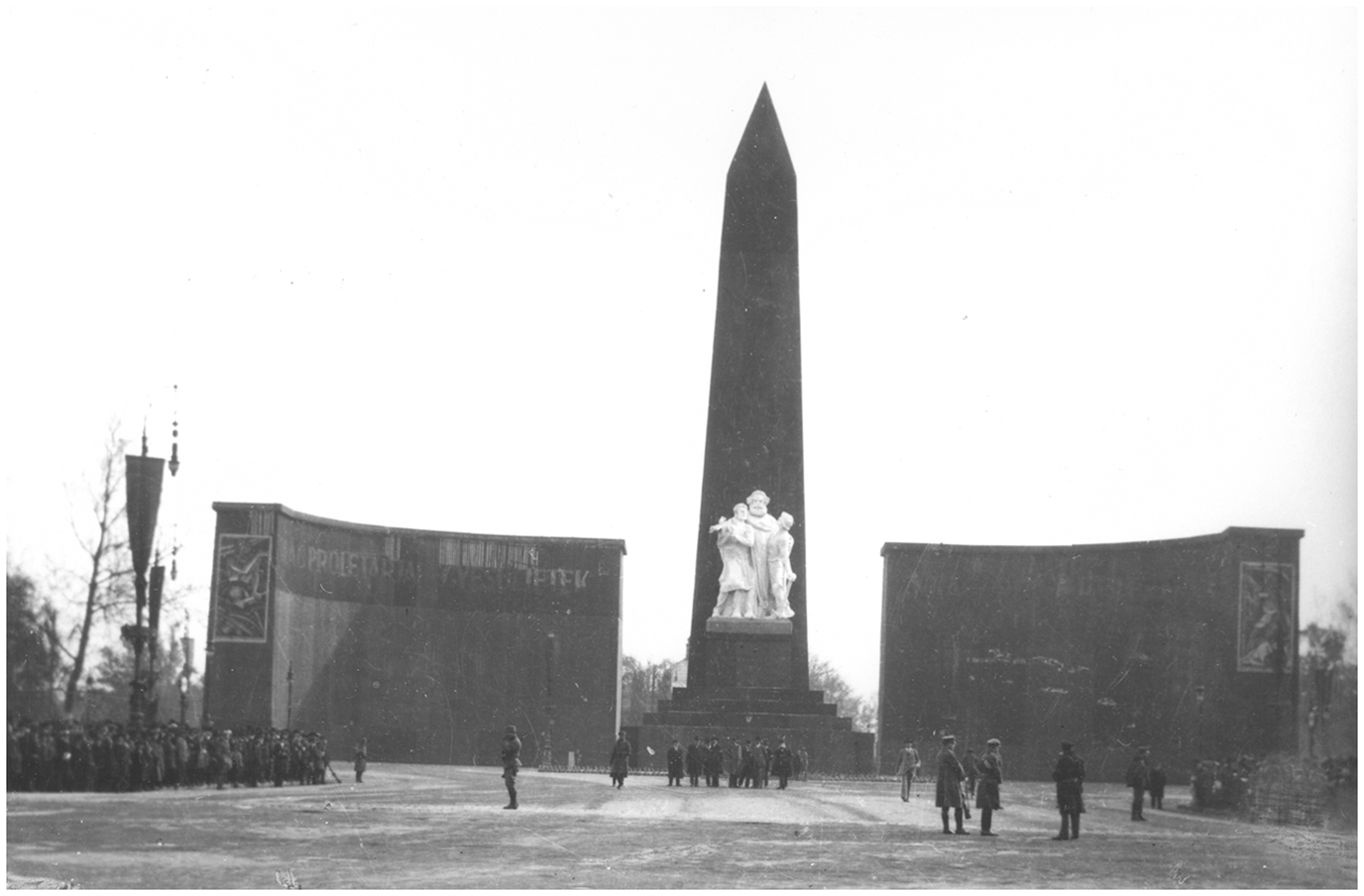
Nationalist and right-wing visions of interwar Budapest’s role as a capital city were fashioned in 1919–20 by three main representations that were all related to previous turning points in modern Hungarian history. They were the Reform Era (1830–48) culminating in the 1848–9 Revolution; the 1867 Dualist Compromise and the post-dualist decades leading up to Budapest’s turning into a modern metropolis; and, finally, as we have seen, the dissolution of Austria-Hungary and the proclamation of the Hungarian Republic on 16 November 1918, the latter replaced on 19 March 1919 by a Bolshevik dictatorship under the leadership of Béla Kun. While the developments which characterized the first period up to 1848 were embraced by nationalists and right-wingers, those that informed the other two were rejected. A legacy of the Reform Era was the emphasis on the necessity to Magyarize the capital. The three cities – Pest, Óbuda and Buda – which later became modern Budapest were inhabited during the first half of the nineteenth century by a majority of German speakers. Therefore the strong emphasis which Reform Era liberal nationalists put on the publication of periodicals and books in Hungarian language, the use of Hungarian in public forums, and the wearing of the Magyar dress. Even pleasurable activities such as dance and club life were enrolled to the service of the national cause. The Magyarization of Pest and Buda reached its apex in the course of the 1848–9 revolutionary events when after the severing of ties with the Habsburg Dynasty in April 1849, the two cities became the de facto capital of an independent Hungary governed by Lajos Kossuth. 10 The defeat of the Hungarian Revolution was followed by a period of absolutist rule of the country by Vienna, which eased up only during the early 1860s, a decade which led to the conclusion of the Austro-Hungarian compromise in 1867, which granted Hungary full autonomy in domestic affairs. Although the magyarization of the city progressed at a fast pace during the period of dualism as well, 11 Budapest’s quick turning into a large metropolis shaped by transnational developments such as quick industrialization, a high concentration of capital, the spread of consumerism, and the rise of commercial and popular cultures, was resisted from the 1890s on by groups loyal to the legacy of 1848 (grouped in a strong political opposition) as well as by newly formed right wing parties because the city’s opening up to the world questioned the feasibility of the nationalist nation-building process. 12 In the same vein, the Bolshevik revolution of 1919 raised the specter of Hungary joining the Soviet Union in support of a class warfare inspired by an internationalist ideology 13 that, by focusing attention elsewhere, also undermined the Magyar nation-building project. 14
The reduction of Hungary’s size to about one-third of the territory that the Hungarian government controlled between 1867 and 1918 added a new element to the nationalist equation. On the one hand, the nationalists, right wingers and the conservatives grouped around Horthy benefited from the decisions taken at Trianon, since they were the ones who – as a result of the fall of the Károlyi and Kun governments, and the retreat of the occupying Romanian forces – inherited the reins of a territorially reduced but nominally independent country. On the other hand, however, as they soon realized, they were not fully in charge in Budapest. This was a problematic issue for many of them since the role of Budapest as the leading city in interwar Hungary (with no serious domestic competitors) was considerably enhanced by the territorial changes that took place at the end of the First World War. Given the mostly provincial support that the new right-wing governments received during the early 1920s, Budapest was initially singled out as a gangrenous piece of the national body that they had to extirpate/redeem/sanitize if they wanted to achieve success in the completion of their right-wing minded nation-building project. Their negative representation of the capital, however, was not much different from what nationalists came up with elsewhere. French nationalists also demonized the modern metropolis as a place of excessive individualism, artificiality, and a den of immorality fostering the loss of traditions. Nationalist writers in turn-of-the-century France, for instance, incriminated Paris for the defeat the country suffered in the Franco-Prussian war and ‘denounced Paris as the source of French “decadence”’. 15 The epithet of the ‘Guilty City’ (Bűnös város) that Magyar nationalists used to describe Budapest was therefore the product both of local (the revolutionary context of 1918 and 1919) and European-wide historical developments that in the wake of the nineteenth-century processes of industrialization, urbanization, modernization and globalization invested the city and the countryside with opposite meanings.
Later, however, Horthy and his supporters changed tactics. Instead of continuously blaming the capital, from the mid-1920s on they paid more and more attention to specific urban spaces in a concerted attempt to relate them to the country as a whole. In the following sections of this article I will discuss the shift from virulent anti-Budapest discourses to concrete measures and practices that enabled Magyar nationalists to control not just municipal politics but the symbolic meaning of Budapest places and spaces with the ultimate goal of bridging the ideological gap between the capital and the countryside.
The Bujdosó Könyv: Feljegyzések 1918–1919-ből (An Outlaw's Diary: 1918–1919), whose first volume was published in December 1920 by Cécile Tormay, a 45 year old Catholic woman coming from a conservative gentry background, represented the first systematic attempt to demonize Budapest. 16 Given its intrinsic anti-liberal, anti-Communist and anti-Semitic stance, Tormay’s book was instantly embraced by those who supported the national-Christian course implemented from 1919 on by Horthy. 17 During the interwar period, The Book of a Fugitive turned into a veritable Bible for middle-class nationalist and right-wing circles. Its author was fêted and covered with decorations, 18 and graced with the editorship of the Napkelet, a new journal started in 1923 by conservatives and nationalists, whose aim was to serve as the counterpoint to Nyugat, the publication of Hungarian modernism that – after the First World War – was perceived as too cosmopolitan. 19
Tormay’s view of Budapest bordered on the paranoid. In the pseudo-diary that she kept in 1918–19
20
Tormay described the events that she witnessed in the Hungarian capital as the giant bowel movements of a degenerate and sick city. According to her, on 31 October 1918, – the day of the great popular upheaval, which led two weeks later to the proclamation of the Hungarian Republic: The city was like a huge stomach that for years had swallowed all the immigrants from Galicia and now was suffering from heartburn. It was a terrible heartburn. Syrian faces and bodies, red placards and red hammers, were whirling in it. The freemasons, feminists, members of the editorial boards [of the progressive journals], members of the Galilei circle, customers of shady coffeehouses, and the rabble of the stock exchange all floated on its surface, while the inhabitants of the Dob Street ghetto had all attached national cockades and white daisies to their lapels.
21
Tormay’s anti-liberal and anti-Semitic views prompted her to compare the supporters of the Republic to products of underground sewers that flowed together to create an uncivilized rabble. 22 It was in this vein that she compared them to the mob that attacked Versailles during the time of the French Revolution. 23 References to historical precedents to be abhorred because of their questioning of authority were constantly used by Tormay. On another occasion, her depiction of the actions of the Budapest mob spilling barrels filled with petroleum on the street and setting them on fire 24 conjures up in the reader’s mind the conservative French Third Republic’s anxiety-ridden image of the pétroleuse setting Paris on fire during the Commune. 25
Her depiction of the Bolshevik takeover in March 1919 was similar. Once again, she metaphorically talked about a city flooded by the dirt and garbage of the sewers. 26 As news of the dissolution of the Károlyi government in favor of one led by communists reached her, she shuddered at the prospect of having Béla Kun, ‘Trotsky’s agent, [and] the robber of worker’s savings’ – as she put it – ‘rule over St Stephen’s Hungary’. 27 From her perspective, Kun was a traitor who had sold out the country to Bolshevik Russia. 28
Tormay saw the events of 31 October 1918 and 19 March 1919 as products of an urban revolution that the rest of the country was against. Rehashing a scapegoating strategy that worked well in contemporary Germany, 29 she described Count Mihály Károlyi and his liberal, Jewish, social-democratic and communist supporters as backstabbers who were responsible for Hungary’s defeat in the war. 30 She continuously emphasized the presence of a strong Jewish element in the Károlyi and Kun governments, 31 and claimed that their ultimate goal was to ostracize and persecute the Magyars in their own country. Given the strong support that the population of Budapest offered to the former, she expected redemption to come only from the countryside. In addition to uttering these claims explicitly, 32 Tormay used several other analogies to describe the opening rift between the capital and the rest of the country. The olden days of Ofen(Buda)/Pesth in the 1840s, and the peaceful provincialism of the then rather small Pest and Buda, which later witnessed a ‘real revolution’ under the leadership of Kossuth and Petőfi, were contrasted by her to the sick ways of doing revolution in a cosmopolitan, internationalist and Jewish dominated Budapest. 33 Tormay used even weather-related analogies to highlight the contrast between the capital and the countryside. As Judit Kádár, a scholar of Tormay’s interwar literary output pointed out, the events of 1918 and 1919 in the Hungarian capital are always depicted as taking place in fog, rain, snow, under overcast weather or in the shadows, while the sun comes out and shines only when the author is physically in a countryside location. 34
Tormay’s insistence on the contrast between a sick capital and healthy provincial cities and countryside was taken even further by one of her contemporaries, Dezső Szabó. Szabó, the author of Az elsodort falu (The Lost Village), a book published in 1919 in which he decried the loss of rural traditions and values in the welter of capitalism and modernity, 35 was another author that nationalist and right-wing circles fervently embraced during the interwar period. 36
Szabó discussed the contrast between Budapest and the rest of the country in two editorials that he wrote in 1921 for Virradat, a prominent right-wing periodical. For Szabó, his native town, Kolozsvár, represented the urban standard for every Hungarian city. He contrasted Kolozsvár, which he described as the epitome of Magyar culture, 37 with Budapest, a city that, according to him, was dominated by Jews. He equated Jewish Budapest with all the ills of urban modernity such as capitalist spirit, conspicuous consumption, and public immorality. He described Jews as dominant not only in the professions but in the literary and artistic life of the capital. Because of this, he claimed that Budapest needed to be retaken by the Magyars. He proposed a number of radical measures such as the expulsion and the expropriation of the property of the Galician Jews, who settled in Budapest after 1910, and the punishment and resettling of Budapest cinema operators, shop and coffeehouse keepers, and factory owners if it could be proven that they had co-operated with the Bolsheviks. He also urged the initiation of penal proceedings against all of the Budapest press, and the closing down and expropriation of Jewish synagogues which would be turned into hospitals and homes for the children of the Hungarian working and impoverished middle classes. Given these priorities, Szabó singled out the conquest of Budapest as the most important domestic task for the Magyars. 38
Literary and journalistic condemnations of Budapest such as those penned by Tormay and Szabó did not represent a completely new phenomenon. They had already been voiced during the 1890s and gained steam during the early 1900s, to the point that many modernist writers of the time such as Ignotus, Endre Ady and Ferenc Molnár felt obliged to take a public stance to defend Budapest against them. 39 For instance, in a festive speech given in the City Hall on 17 November 1913 on the occasion of the 40 year commemoration of the creation of a united Budapest, Molnár extolled the capital by describing it as the most important thing that Hungarians gave to the world, so as to placate its detractors, who already called it ‘the scapegoat of Hungary’, ‘a separate body in the midst of the country’ and an ‘American city’ that Hungarians ‘had nothing to do with’. 40
What changed after the First World War, however, was that what up to then was mostly a discursive battle waged in the press turned afterwards into a matter of governmental policy. Instead of working with the leaders of the capital as they did during Dualism, the successive Hungarian governments that took office during the interwar period actively tried to undermine the power of the Budapest municipality by trying to limit its autonomy. 41 Although with the adoption of Law IX of 1920 by Horthy’s supporters in the new Hungarian Parliament the electoral base of the Budapest municipality was considerably broadened (the law being thus celebrated as a democratic measure), the destruction of the narrow voting system that elections in the Budapest Municipal Council were based on between 1873 and 1919, led to the weakening of the sphere of influence of big industrialists and financiers in municipal affairs. Since many of the latter were Jewish, the measure served well the anti-Semitic and anti-Budapest goals of the new regime. Furthermore, the enlarged electoral constituency allowed for the creation of a national-conservative lobby that won by a large margin the municipal elections held in July 1920. Thus control over the Budapest Municipality fell into the hands of the Christian Municipal Party, created in the aftermath of the elections. Led by Károly Wolff, it was this party that shaped Budapest’s municipal politics from 1920 to 1925. 42
The stabilization of the Horthy regime in the aftermath of the signing of the Trianon Peace Treaty in August 1920, and the lifting of the censorship on liberal and social-democratic publications during the early 1920s led to a serious contestation of the grip of the Christian Municipal Party over municipal politics. The new municipal elections held in 1925 were technically won by a liberal and social-democratic coalition that gained more strength between 1923 and 1925. The Bethlen government (in spite of the normalizing course that it adopted since its coming into power in 1921), 43 however, intervened and nullified the practical result of the 1925 elections by adding 38 government-appointed members to the newly elected Budapest Municipal Council. 44
This governmental coup was symptomatic for the conservatives’ and nationalists’ keen interest in keeping Budapest’s administration under their control. As a result, the municipal opposition failed continuously to overturn the existing balance of power. Thus in spite of considerable political mobilization among the ranks of the municipal left, the elections for Budapest’s mayorship held in 1926 were won not by István Bárczy (the former mayor of the capital between 1906 and 1918) but by Ferenc Ripka, the candidate of the Municipal Party, a new political faction personally supported by István Bethlen. Similarly, the municipal elections held in 1930 and 1935 were won by those who in 1919 as well as during the remainder of the interwar period, continued to look at Budapest as a ‘guilty city’ in need of political and moral reformation. 45
In order to achieve this goal, however, as I would like to argue in this article, Magyar conservatives and nationalists used methods that were more sophisticated than the use of political coercion and governmental fiat against the municipal opposition. Their range stretched from the nationalization of Budapest’s monuments to periodic symbolic takeovers of the city’s public spaces.
During the early 1920s, supporters of the national and Christian course in Hungary were strongly interested in dismantling the Habsburg, liberal and communist system of symbols that have previously shaped the relationship between Budapest and Hungary. 46 They tried to erase from public memory Budapest’s pre-war status as the second capital city of multiethnic Austria-Hungary by depicting Budapest as the capital of only one large ethnic group which in their vision included not only the Magyars living in Hungary but those who after 1920 found themselves legally described as ethnic minorities in the successor states. With their anti-Communist propaganda they also wanted to erase the memory of the transnational and left-wing connections that were made in the spring of 1919 between Munich, Budapest and Moscow, 47 in order to better anchor Budapest in the Magyar soil. Finally, as we have seen, they tried to subdue the power of pre-war liberal urban elites and alter the city’s early twentieth-century perception as a bastion of liberal and left-wing groups by administratively limiting the autonomy of the Budapest Municipality.
The next step of the conservatives and nationalists was to symbolically take over Budapest’s public spaces through displays of historical and rural symbols. This was done in several ways. For instance, a journalist writing for the publication Gondolat (Thought) in February 1921 determinedly voiced the wishes of the nationalists, by urging the municipality to rename most of Budapest’s streets by replacing the existing ones with geographic toponyms and the names of the cities that Hungary lost in the aftermath of the Trianon Treaty. Although such proposals were not accepted in 1921, a set of decrees taken by the Budapest municipality between 1929 and 1930 implemented many of its desiderata by using place names referring to the ceded territories in the naming of new streets and squares in Zugló, a residential neighborhood of Pest developed during the interwar period. 48
Of course, such attempts to symbolically retake the capital city were not limited to Budapest. Right-wing groups competed for the appropriation of the cultural meaning of public spaces, street names and historical figures in Paris and Berlin as well. 49 In neighboring post-World War I Vienna, the social-democratic municipality tried to dismantle the previous grip of the Christian-Socials and the Habsburgs on the city, with a strong emphasis on the creation and promotion of a genuine working-class culture in the city’s public spaces. 50 In Prague and Bratislava (and in several other East-Central European cities) similar goals were pursued by the new Czechoslovak authorities as part of the ethnic takeover of institutions and public places in these two cities. 51
Budapest’s case, however, calls for more comparisons with western European cities. Unlike the case of the ‘Czechoslovakization’ of Prague and Bratislava, the symbolic retaking of the capital by Magyar nationalist and right-wingers was closer in its ideology to the attempts made by similar groups to nationalize Paris, Rome and Berlin. 52 The ideological lines of conflict that shaped these processes were domestic and racial rather than ethnic ones. An important difference, though, was that while in the case of Paris and Berlin, and especially during the 1920s, nationalist and right wing groups were rather marginal and powerless in achieving the symbolic takeover of these cities according to the tenets of their ideological agenda, Magyar conservatives, nationalists and right-wingers (similar to their counterparts in Italy) successfully did so as soon as the first decade of the interwar period. 53
However, the success of the nationalist takeover of Budapest cannot be appropriately gauged if one mostly looks, as many historians have done, at the long-term history of the city’s monuments, architecture and built spaces. 54 Unlike Italy, where Mussolini’s fascists, in Medina D. Lasansky’s words, were engaged in a process of ‘urban editing’ defined by ‘a combination of urban renewal, architectural reconstruction, and civic spectacle’, nationalists in Hungary, in spite of their initial anti-capital city stance, did little to change the face of Budapest. 55 Apart from funding, during the late 1920s, the building of a Catholic Church on Ferdinánd (today Lehel) Square in Pest, dedicated to the revisionist idea, they inherited a city that was architecturally and spatially shaped during the late dualist decades. From that time period they inherited grandiose public buildings such as the Hungarian Parliament, the Royal Palace (that became Horthy’s residence), numerous institutional headquarters and the aristocratic palaces lined up on Andrássy Avenue and the area around the National Museum. 56
Therefore in order to retake the city nationalists focused more on public statuary. For instance, a set of irredentist statues was erected on Szabadság Square, a central area in Pest close to the building of the Hungarian Parliament. They included four allegorical statues erected in 1921 called North, East, South and West, which symbolically referred to the territorial losses suffered by Hungary. For instance, the statue called ‘North’ showed a crucified female figure of Hungaria, defended by an eighteenth century anti-Habsburg (kuruc) warrior. Similarly, ‘East’ showed a male figure representing Transylvania about to be liberated by a Magyar prince. The other two statues, ‘South’ and ‘West’, displayed similar scenes and messages. 57 As Nándor Urmánczy, the leader of the Defenders Association League, an anti-Semitic and chauvinistic organization called to life in the summer of 1920, put it in his speech uttered at their unveiling a year later, their role was to become a ‘place of pilgrimage for the nation’ while also serving as a ‘melting pot of hatred and revenge’ against those who brought Hungary to its knees. 58 The four statues were placed in a semi-circle around a flower-bed-made map of Hungary, positioned horizontally on the ground, surrounded by irredentist slogans. Seven years later to this ensemble was added the Reliquary Flagpole of the Land (Ereklyés Országzászlótartó). 59 The 20-meter flagpole was held by a base replicating a church pulpit. On it, the Hungarian flag was positioned at mast, while a giant hand on top of the flagpole, shown as taking a ceremonial oath, was modeled by the statue’s sculptor directly after Horthy’s right hand. 60 Under its base there were buried small containers holding earth from pre-war Hungary’s 72 counties as well as numerous villages. In addition there was also earth taken from Hungary’s medieval, 1848–9 and First World War battlefields, including the homes of Kossuth and Petőfi. 61 The role of the Reliquary Flagpole of the Land was to represent Budapest both as a fulcrum of national mourning and grief and a place from where the irredentist idea will spread outward. In 1932 the Szabadság square ensemble was enriched with a new statue: that of Magyar fájdalom (Hungarian Grief) represented by a naked female figure, which was supposed to symbolize the Motherland mourning its orphaned children. 62
While erecting new monuments such as these was akin to writing on a blank slate, rewriting the meaning of existing monuments was an ideologically more complex operation. The most important among them was the Millennium Ensemble started in 1896 and finished only shortly before the end of the First World War. It was mostly in the case of the latter that Horthy’s regime attempted a symbolic re-writing of its meaning. The initial purpose of the 1896 Millennium Monument was to celebrate the founding of Hungary by Árpád and the long historical lineage of the Hungarian kingdom. Such a purpose was one that interwar nationalists fully agreed with. Therefore what nationalists wanted to erase by placing in 1929 the World War I Heroes’ Tombstone under the column bearing Archangel Gabriel and surrounded by the seven pagan chieftains who conquered Hungary in 896 – located in the center of the semi-circle formed by the Millennium Monument (Figure 3) – was not the intention of the monuments’ builders but the memory of the time when under the Bolshevik Republic in 1919 the Monument was covered by red draperies and the column had a huge plaster statue of Marx placed in front of it. The fact that the more impressive project of honoring the soldiers who died in the First World War by placing a huge coffin on a catafalque jutting out from the Gellért’s hillside in Buda (as proposed by Count Miklós Bánffy) was rejected in 1927 for the sake of a much more modest tombstone symbolically placed in the center of the Millennium ensemble is highly revealing. 63 Similarly revealing is the renaming in 1932 as Heroes Square of the square formerly known as Millennium Square.
With the location of the Heroes’ Tombstone in the middle of a monumental ensemble centered on a display and celebration of Hungarian history and the renaming of the square, nationalists achieved a double goal. They both symbolically connected the new regime with the Hungarian past, and, at the same time, reinterpreted that past from the perspective of the ideological priorities of post-Trianon Hungary. As historian János Pótó perceptively pointed out, before the placing of the Heroes Tombstone: [I]n the center of the square stood the obelisk, and the emphasis fell on Árpád’s equestrian statue. One had to look up to the monument advertising [the country’s] national glory, not just symbolically but physically as well. Because of the elevated plinths the statues can be looked at only from below. Indeed, since it was assumed that there was plenty to look back with pride, it was the raising of the onlookers heads that was initially supposed to be the statue’s function. The Tomb of the National Heroes, exactly to the contrary, however, turned the place into one where heads bowed down. The Millennium Ensemble with the Tomb of the Unknown Soldier in the foreground. Picture taken after 1929. Courtesy of Metropolitan Ervin Szabó Library, Budapest, Budapest Collection.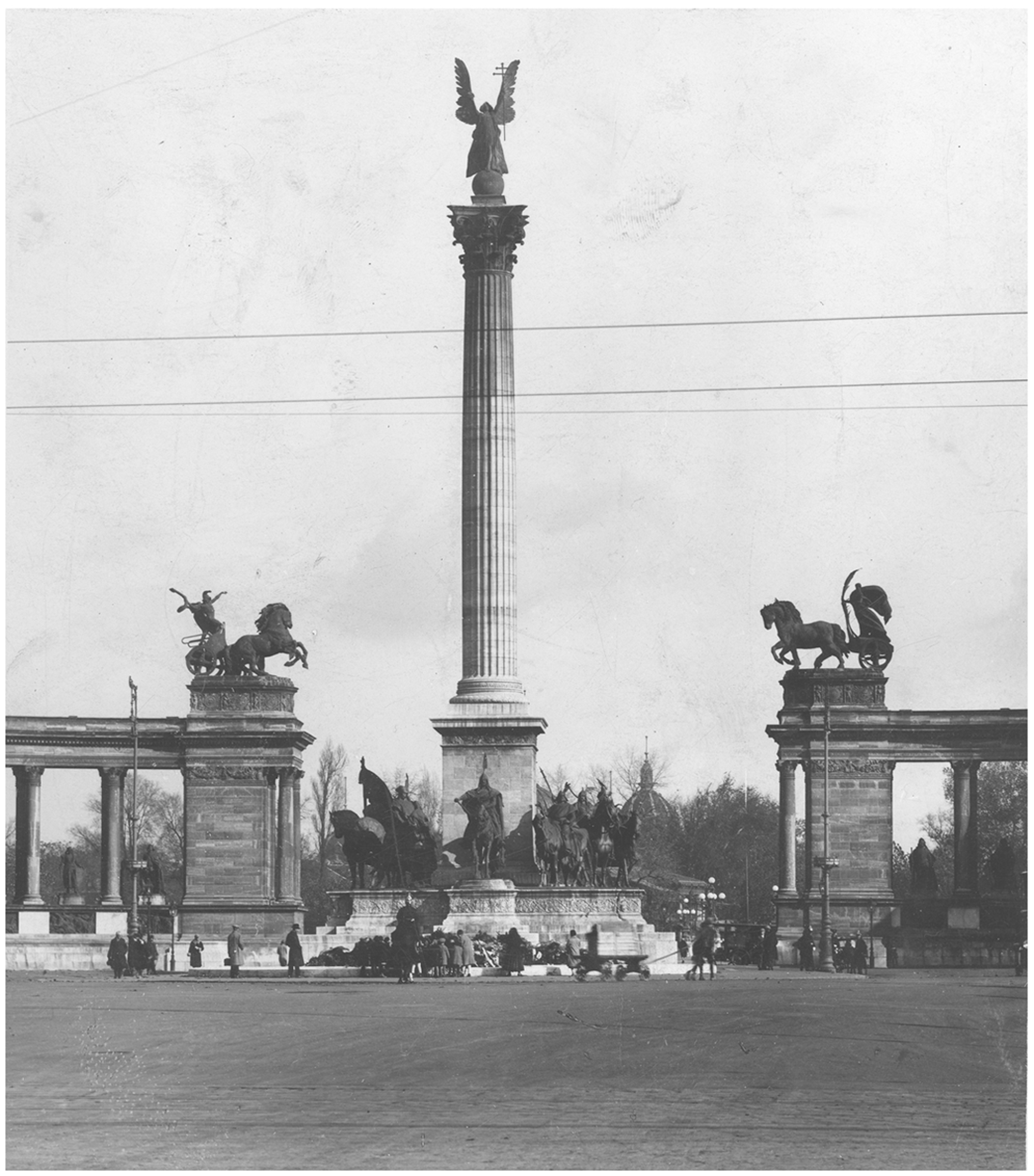
The low tombstone placed under the obelisk, as Pótó has noted, ‘became the focus point of the square, which turned the Millennium Monument into a mere backstage. The Square was now narrating what those millennial borders meant’ to prompt those who made it to the spot to bow their head as an expression of their grief over their loss. 64
The symbolic takeover of Hungary’s recent past through monuments both new and old, however, represented just one of the many ideological priorities of interwar Magyar nationalists. Another priority, much more important from the perspective of Budapest’s symbolic retaking than the former, was the periodic physical takeover of the city’s public places. From 1924 on this was done every summer during the celebration of St Stephen’s Day on 20 August. 65 With the choice of St Stephen (the founder of Christian Hungary) as the symbol of his regime, Horthy validated one more time the Christian and national course that he inaugurated in Hungarian politics after his takeover of the country at the end of 1919.
Until 1924 the parading of St Stephen’s mummified right hand in the city was mostly a Catholic religious celebration. The Saint Right’s procession – as it was also known – was considered by many as not much of an attraction at all. 66 During 1924 and 1925 all this started to change. Moreover, from 1926 on the procession was integrated into a week- and from 1928 on a two week-long municipally sponsored festival with secular and nationalist overtones that included several other attractions. The goal of the organizers was to turn St Stephen’s Day into post-Trianon Hungary’s national holiday. 67 They also used it as a tool to promote the regime’s irredentist propaganda. For instance, the unveiling of the Reliquary Flagpole of the Land in 1928 was scheduled to coincide with the celebration of St Stephen’s Day on 20 August. 68 To raise the event’s significance, Horthy made festive speeches on each occasion. He also timed his public appearances to coincide with the National Harvest festival, that was included in the St Stephen’s week program by the Village Alliance (Falu Szövetség) in order to give the up to then mostly Budapest-related religious event, both rural color and a national scope. According to a document released to the press in 1927 by the Budapest Tourism Office the goal of the National Harvest Festival was to ‘symbolize the thousand-year old unity between the Magyar people, Magyar soil and Magyar agricultural produce’. Furthermore, the festival was expected to provide – as the document emphasized – an occasion ‘to unite the capital and the country’s rural provinces in a strong expression of common emotion’. 69
St Stephen’s Festival allowed interwar nationalists to symbolically and physically retake Budapest’s public spaces by having thousands of peasant boys and girls dressed in folk costumes parade on the city’s streets. For instance, in a photograph published in 1927 in the Kis Ujság, one can see a large procession of villagers exit the Keleti Railway station in order to take in the city. After parading all day long on Budapest’s boulevards, the villagers assembled in Buda in front of the Royal Palace (now occupied by Horthy) to listen to his balcony speech.
70
The reason for the villagers’ presence in Budapest on St Stephen’s Day was spelled out in full. According to the 1927 program of the festival: Budapest and the countryside ought to love each other, they need to understand each other, and the surest way to achieve this is by getting to know each other. Budapest is the pride of the country and the hope of its future. With its beautiful buildings, impressive thoroughfares, vivid traffic, the city makes a pleasant impression on the foreign visitor, an impression that should be even more powerful on the Hungarians from the countryside, who need to feel that Budapest is inhabited by the Magyar soul [and a place] where there beats a Magyar heart.
71
St Stephen’s Day in the Castle Hill district was also attended by selected representatives of all of Hungary’s counties and provincial cities. 72 In addition, the interwar St Stephen’s festivals included the Feast of Hungarian Mothers, a public ceremony organized each year in front of the National Museum in Pest to award money and decorations, and distribute clothes and shoes to needy mothers with more than a dozen children. The event was a highly emotional one. According to contemporary press reports thousands of onlookers among those in the audience shed tears while watching the ceremony. 73 Given the low birth rate among women in Budapest, it is safe to assume that the Feast of Hungarian Mothers rewarded mostly peasant women.
Another festival attraction was the historical pageant that offered a panoramic view of Hungarian history through a colorful parade of pagan chieftains, Christian kings and Transylvanian princes. The procession usually concluded with a funeral procession mourning the loss of Hungary’s pre-Trianon boundaries. 74 According to a proclamation written in 1929 by Ferenc Ripka, the Bethlen government-backed mayor of Budapest and the founder of the St Stephen’s festival, its role was to bring together country and capital, in order to make up for previous misunderstandings. 75
However, the character of St Stephen’s week progressively changed during the 1930s. The event became more spectacular from year to year. The fireworks that concluded the festival attracted hundreds of thousands of onlookers. Although the fireworks also included revisionist slogans projected on the nocturnal sky, it was Budapest’s riverscape panorama which they festively illuminated that captured most of the attention. From 1928 on, with the progress of electrification in Budapest, the illuminated bridges and the monumental buildings along the Danube River also became an attraction. In 1930 and 1938 the river was used as a backstage for an electrically-lit regatta of small boats celebrating two additional festive events: those occasioned by the celebration of St. Imre (the martyred son of St Stephen) and the combined St Stephen Festival and 38th International Eucharist Congress held in Budapest, respectively. Other developments were the inclusion in the program of these and the annual St Stephen week of passion plays, historical reenactments, concerts, industrial exhibitions, arts and crafts fairs, fashion, design and art exhibit openings, theater and film premieres, cabaret sketches, beauty pageants, horse races, air shows, swimming contests and other sporting events and, from 1937 on, of symphonic music broadcast from street megaphones. Several of these events attracted not just locals and countryside visitors but many foreigners.
As the years passed, St Stephen’s week also underwent an increasing commercialization. The first St Stephen’s week organized in 1926 already served as an occasion for the opening of a wine and fruit exhibit in the City Park. 76 Similarly, Budapest business owners had set up festive window displays in their shops as early as the mid-1920s. They had also offered goods at reduced prices for the duration of the festival. In order to promote sales festival organizers went so far as to lift their previous ban on keeping shops open on St Stephen’s Day. Discounted fares were also offered to festival goers in order to boost the revenues of the Hungarian Railway Company. 77 Other state agencies also took note. In 1934, for instance, the Hungarian Tobacco State Monopoly offered interested buyers quality cigars at promotional prices during the duration of the festival so as to encourage a more sustained consumption of cigars. 78 A year later, the opening of St Stephen’s week was used to launch new Hungarian cigarette brands, and sell the already popular Khedive, Memphis, Extra and Mirjám brands in new and sleeker packaging. As Finance Minister, Tihamér Fabinyi emphasized in an interview, the undertaking was influenced both by an increased attention given to fashion, individual taste and a desire for novelty among consumers, an important shift of focus from which the ministry expected an increase of its revenues. 79
In the same vein, as the business of urban tourism took off during the mid-1920s, city marketing concerns came to also bear heavily on the organizers’ minds. 80 Foreign interest in visiting the Hungarian capital during St Stephen’s week was expressed as early as 1929 by the organizers of the Salzburg festival, who soon offered their international clientele the opportunity to spend a few days in Budapest. 81 Many foreign visitors travelling to neighboring Austria, and among them many British and American tourists, also made it to Hungary. By the 1930s as western tourists started to arrive in greater numbers, Budapest’s earlier ideological depiction as a ‘Guilty City’ was overshadowed by its representation as ‘The Queen of the Danube’, a city branding epithet clearly serving tourism marketing goals. 82 A confirmation of this switch in emphasis was made by foreign observers as well. An article published in the Soviet Pravda as early as 1928, for instance, berated Horthy and his regime for advertising Budapest abroad as ‘the capital of beautiful women’ and the ‘city of wine, love and gypsy music’, an advertising strategy which the author of the article equated with the ‘bad taste typical of shady nightclubs’. 83 In a similar vein, an editorial published in July 1932 in Cuvântul, a Bucharest daily claimed that over the past few years Horthy’s Hungary spent large amounts of money and effort to advertise Budapest’s tourist attractions, and in order to achieve this effect it did not refrain from catchy and vulgar advertising. The author of the editorial also expressed his discomfort regarding the fact that it was not just members of the Hungarian minority from Romania who travelled to Budapest to buy cheap goods during the duration of St Stephen’s week but Romanian tourists as well. 84
The slow colonization of former nationalist undertakings by consumerist practices subordinated to urban tourism promotion goals was also noticeable in other contexts. For instance, from 1928 onwards the Gellért Hill housed for three days during the St Stephen’s week a number of popular attractions meant to popularize in the capital the everyday habits and lifestyle of Magyar villagers. They included scenes from life on the Puszta, Hungarian folk music, the reenactment of a peasant wedding, dances and Hungarian gastronomic specialties. In 1929, however, in order to popularize these events the organizers used megaphones installed on automobiles that drove on Budapest’s streets by day. At night the Gellért hillside was illuminated by strong projectors that opened up the night for further consumption. Given the good visibility of the place by night, and in order to attract even more people, organizers hid various cash prizes in the bushes of the hill, which they loudly advertised among visitors. 85
Catchy advertising practices such as these soon paid off. During the 1930s the importance of the domestic market in the promotion of Budapest (together with former attempts to nationalize the city) started to recede in favor of its consumption by foreigners. In 1934 the municipality reported the arrival to Budapest during St Stephen’s week alone of more than a quarter of a million visitors out of which almost 27,000 were foreigners. 86 To promote further sales, during the mid-1930s municipal authorities extended the officially regulated closing time of restaurants and bars, from midnight to 4 a.m. 87 Even the Day of the Journalist which was marginalized as a citywide event by the official embrace of St Stephen’s Day in 1926, was resurrected from oblivion during the late 1930s and advertised again through radio and film as an important metropolitan attraction. 88
Even more important, it was the extension of the tourist season and the multiplication of offerings that led to more and more foreigners coming to the city. During the 1930s Budapest turned into a destination for tourists from Austria, Germany, Britain, France and the US, among other countries, not only due to a successful marketing campaign launched by the municipality but also because, in addition to the spectacles taking place during St Stephen’s week, the city was able to offer its wealthy visitors quality accommodation in first-rate hotels equipped with outdoor pools and Turkish baths, leisurely time in its restaurants and coffeehouses, all coupled with a rich nightlife. Among the many night time locales concentrated around the Nagymező street, the Arizona Dance Hall (Figure 4) certainly stood out, with its Paris and Hollywood inspired musical revues and its technical-props-enhanced productions which attracted such prominent visitors as the Prince of Wales, Lord Astor and the Maharaja of Kapurthala. 89
As the above mentioned commercially minded practices suggest, during the mid-1930s state and municipal interests in making money out of foreign arrivals to Hungary tamed some of the former out-rightly nationalistic rhetoric aiming to nationalize the city. Indeed, the adoption of the consumerist mindset was crucial for the promotion of foreign tourism to Budapest. As a result of its adoption, the number of foreign travelers continued to increase during the mid-1930s, reaching their peak in 1937, when close to 183,000 foreigners visited the city.
90
Nagymező street in Budapest by night (c. 1935). The Arizona Dance Hall is on the left. Courtesy of Metropolitan Ervin Szabó Library, Budapest, Budapest Collection.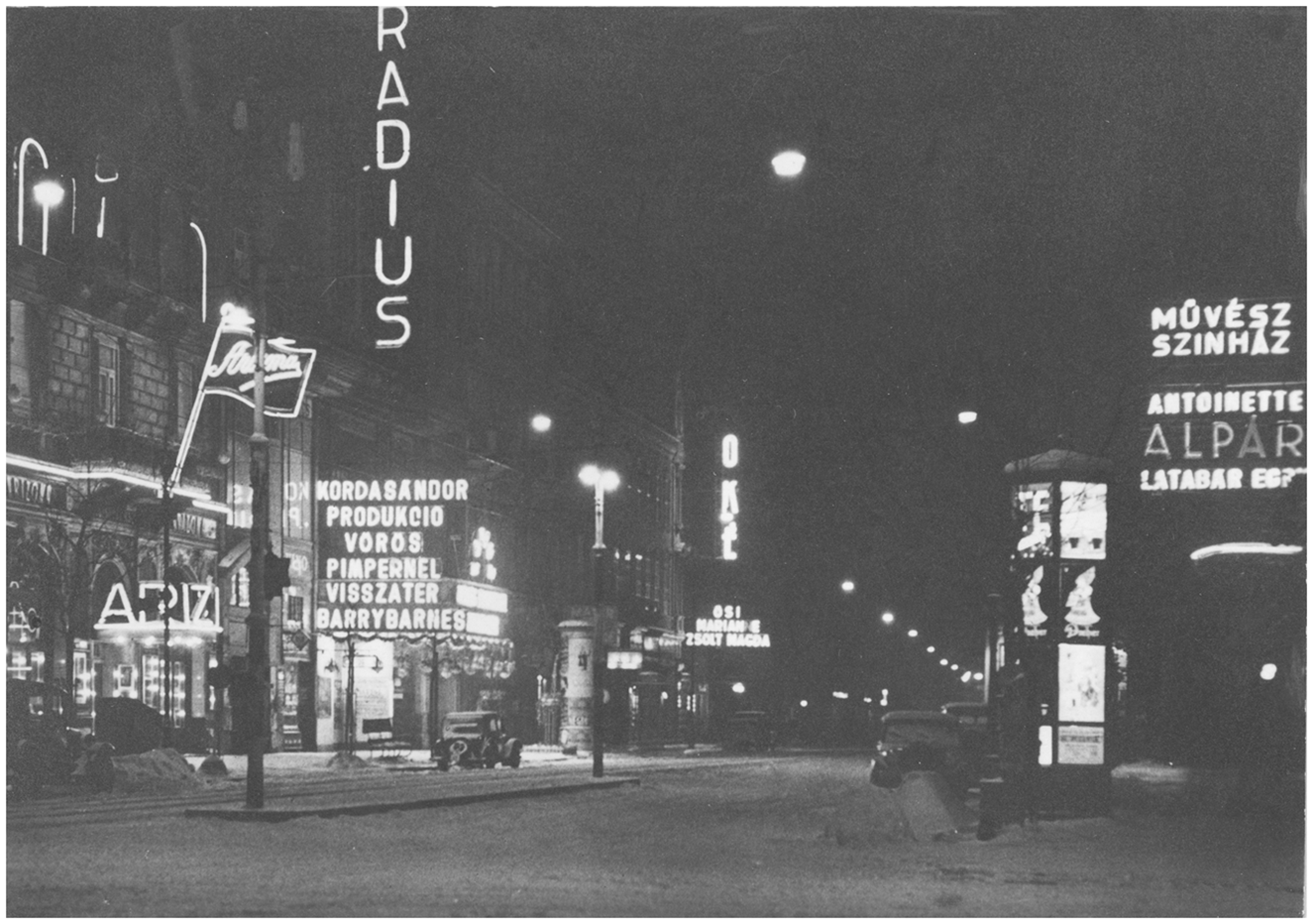
Seen from a European perspective these developments were not exceptional. As part of a conscious municipal and national policy aiming to preserve its top position in international tourism, throughout the interwar period Paris continued to boost the number of its visitors. 91 It is also often forgotten that in spite of Fascist Italy and Nazi Germany’s emphasis on the regimentation and promotion of working class tourism through such institutions as the Italian Dopolovaro and the German Kraft durch Freude associations, 92 the same regimes also paid attention to boosting foreign tourism figures. 93 Indeed, forgetting about the reinvigorating effects of international tourism on the economy was something that the European states, as severely hit as they were by the global depression of the early 1930s, could simply not ignore. Moreover, the presence of many foreigners in Berlin, Rome or Budapest could also internationally strengthen and legitimize the regimes in place, a propaganda effect that each was eager to achieve. 94
But there were also other reasons why attracting foreign tourists to prominent urban centers and beyond mattered. The development of transnational linkages between cities and the spread of a global urban culture were developments that not only constituted important counterparts but also shaped nation-building efforts. As Siegfried Kracauer pointed out in a feuilleton that he wrote for the Frankfurter Zeitung, during the interwar period ‘metropolitan centers were becoming more and more alike and their differences [were] disappearing’. 95 It was the leveling hammer of global capitalism, the transnational mobility of goods and persons, and the spread of consumerism that led to this outcome. From the mid-nineteenth century on ‘metropolitan cities such as London, Paris, Vienna and Berlin became hubs for the production and diffusion of knowledge and information that was instrumental in the creation of markets for all kinds of goods and services, including tourism’. 96 Cities were brought closer together by a variety of other developments, among which the shrinking of time and space made possible by the mass embrace of train travel, telegraphy, automobility and from the late interwar period on, limited air travel, was the most important. This new global awareness ‘operated at local and regional levels as mobility between urban areas increased and cities initiated strategies to improve their public image and promote their own particular economic and political agendas.’ 97
As the spread of consumerism, and the embrace of economic self-interest and international tourism promotion even within such a nationalist undertaking as St Stephen’s festival proves, those in charge of Budapest could not ignore these developments. As they were embracing consumption, spectacular displays and the boosting of Budapest tourism, 98 moderate nationalists were drawing closer to the metropolitan mindset that they had condemned before. Their goal now was to project abroad an image of the Hungarian capital that was both the source of ‘specifically national values, and at the same time, that of a culturally open metropolis which was the natural economic and cultural center of the Central and South-East European region’. 99 It appears thus that in the process of taking over Budapest and nationalizing the city initiated in the aftermath of the First World War by Horthy’s supporters, by the 1930s it was rather the capital city and its inter-regional interests that were urbanizing nationalism. The peril of the latter was noticed by extremist right-wingers who by the 1930s considered the moral reforming and ideological re-territorialization of ‘Guilty Budapest’ as it had been done by Horthy, Bethlen, and Ripka as rather unsatisfactory. They criticized the consumerist and spectacular orientation that the celebration of St Stephen’s Day took. 100 In the same spirit, they called for more radical measures to allow for a more efficient penetration and spread of the life style and visual symbols of the Hungarian village in the capital. 101 Among other measures, they proposed the organization on St Stephen’s Day, in addition to the religious procession held that day, of a grandiose pageant of the ‘united and indivisible nation’ 102 and the physical transplantation of two Magyar villages in Budapest, which they wanted to use in the guise of a Trojan horse for the final takeover of the city by inhabitants of the rural countryside. 103
Indeed, during the late 1930s, the stronger embrace of fascism in Hungary, signaled at a national level by the adoption of the second set of anti-Semitic laws in 1938 and the reorganization on 2 February 1939 of the majority governing bloc in the Hungarian Parliament as The Party of Hungarian Life (Magyar Élet Pártja) as well as the founding during the same period of new extreme right-wing parties such as the Iván Héjjas-led Party of the Defenders of the Magyar Race (Magyar Fajvédő Párt, active between 1938–45) and Ferenc Szálasi’s Arrow Cross Party (Nyilaskeresztes Párt, active between 1939–45) led to extreme right-wingers making progress in taking over several districts of Budapest at the ballot. For instance, the electoral victory of the government party, closely trailed by the Arrow Cross Party in the elections held in May 1939 on the island of Csepel, a traditionally working class and left-wing district of Budapest, 104 was the beginning of a process which culminated in Hungary joining Nazi Germany in its campaign against the Soviet Union in 1941, followed by the Arrow Cross’ takeover of the government and the capital in the aftermath of the German occupation of Hungary in March 1944, which in turn led to the mass deportation of Hungarian Jews in the summer of 1944, the creation of the Budapest ghetto and the mass shootings and atrocities committed by Szálasi’s supporters during the winter of 1944–5. 105
More to the point, however, it is appropriate to conclude that the spatial takeover of Budapest prior to 1938–9 shaped as it was by the ideological tenets held by Horthy and his supporters, political intimidation and pressures at the level of municipal politics, and the symbolic takeover of the city’s public spaces and monuments, was also molded in turn by European and global trends related to the spread of consumerism and the growth of international tourism, 106 with which, even if for a brief period of time, moderate nationalists got accustomed to living with.
Footnotes
1
The years 1918–19 were a tumultuous period in Hungarian history. After the proclamation of a liberal republic led by Count Mihály Károlyi, power fell into the hands of communists led by Béla Kun who set up a Soviet-type dictatorship, which ruled Hungary from March to August 1919. The Hungarian Republic of Councils (as the Kun regime officially called itself) was defeated in the summer of 1919 by the Romanian Army, which – at the urging of the Entente – occupied Budapest and most of eastern Hungary.
2
See ‘Horthy Miklós fővezér válasza Bódy Tivadar polgármesternek a nemzeti hadsereg bevonulása alkalmával a Gellért szálló előtt mondott üdvözlő beszédére’ in J. Szekeres (ed.), Források Budapest múltjából, vol. 3: Források Budapest történetéhez, 1919–1945 (Budapest 1972), 21.
3
For a discussion of the 1918–19 period from the perspective of the ideological emphases of each regime and the significance of spatial takeovers such as the grand popular assembly in front of the Parliament on 16 November 1918, the celebration in 1919 of 1 May (International Workers Day) by the Kun regime, and Horthy’s entry to Budapest which was followed by another popular assembly, with a strong nationalist and Christian message, held in front of the Hungarian Parliament, see B. Vörös, ‘Különböző politikai hatalmak ugyanabban a fővárosban. Szimbolikus térfoglalási akciók Budapesten 1918-1919-ben’ in K. Csúri, M. Orosz and Z. Szendi (eds), Tömegek és ünnepek. A nyilvánosság rítusai a közép-európai modernségben (Budapest 2009), 15–31.
4
I.T. Berend, Decades of Crisis: Central and Eastern Europe before World War II (Berkeley, CA 1998), 139.
5
B. Jancsó, ‘A holnap Magyarországa’, Magyar Szemle July 1929, 218, quoted by M. Caples, ‘Et in Hungaria Ego: Trianon, Revisionism and the Journal Magyar Szemle (1927–1944)’, Hungarian Studies 19, 1 (2005), 51–104.
6
In addition to his liberal supporters, in establishing his government Károlyi also benefited from the strong support of the Hungarian Social Democratic Party. For more on this see I. Deák, ‘Budapest and the Hungarian Revolutions of 1918–1919’, The Slavonic and East European Review 46, 106 (1968), 129–40.
7
See B. Bodó, ‘Paramilitary Violence in Hungary after the First World War’, East European Quarterly XXXVIII, 2 (2004), 129–172. For a discussion of the Hungarian ‘White Terror’ from the perspective of a broader Central European context see R. Gerwarth, ‘The Central European Counter-Revolution: Paramilitary Violence in Germany, Austria and Hungary after the Great War’, Past and Present 200, 1 (2008), 175–209.
8
For more on the symbolic takeover of Budapest during the Hungarian Bolshevik’s brief stay in power see B. Vörös, ‘Térfoglalás Budapesten – Térfoglalás a történelemben?’ in C. Pásztor (ed.), Ünnep –Hétköznap – Emlékezet; Társadalom és kultúrtörtenet határmezsgyéjen (Széchény 2000), 181–6 and ‘Károlyi Mihály tér, Marx-szobrok, fehér ló: Budapest szimbolikus elfoglalásai 1918-1919-ben’ Budapesti Negyed 29–30 (2003), 3–4, 144–172.
9
On this see A.W. Daum, ‘Capitals in Modern History: Inventing Urban Spaces for the Nation’, in A.W. Daum and C. Mauch (eds), Berlin-Washington, 1800–2000. Capital Cities, Cultural Representation, and National Identities (Washington, DC and Cambridge 2005), 3–28, esp. 18.
10
For more on this see R. Nemes, Budapest Once and Then (DeKalb, IL, 2005).
11
Á. von Klimó, Nation, Konfession, Geschichte: Zur nationalen Geschichtskultur Ungarns im europäischen Kontext, 1860–1948 (München 2003), 132–7.
12
See M. Szabó, Az újkonzervatizmus és a jobboldali radikalizmus története, 1867-1918 (Budapest 2003) and G. Gyáni, Budapest – túl jón és rosszon: a nagyvárosi múlt mint tapasztalat (Budapest 2008), 67–73.
13
R. Löwenthal, ‘The Hungarian Soviet and International Communism’, in A.C. Janos and W.B. Slottman (eds), Revolution in Perspective: Essays on the Hungarian Soviet Republic of 1919 (Berkeley, CA 1971), 173–82.
14
For a discussion of important antecedents pointing in this direction, see B. Vörös, ‘A múltat végképp eltörölni?’: Történelmi személyiségek a magyarországi szociáldemokrata és kommunista propagandában, 1890-1919 (Budapest 2004).
15
S. Hazaresingh, Political Traditions in Modern France (Oxford 1994), 39.
16
C. Tormay, Bujdosó Könyv: Feljegyzések 1918–1919-ből, 2 vols. (Budapest 1920–1). Tormay's book was also published in English in London in 1923. Subsequent quotes from this book are referenced to its 1923 republication in Hungary by Pallas Literary and Publishing House.
17
For a recent discussion of the latter see P. Hanebrink, In Defense of Christian Hungary: Religion, Nationalism and Antisemitism, 1890–1944 (Ithaca, NY 2006).
18
J. Kádár, ‘Az antiszemitizmus jutalma: Tormay Cécile és a Horthy korszak’, Kritika 32 (3) (2003), 9–12.
19
See V. Tóth-Barbalics, ‘A Napkelet megalapítása’, Magyar Könyvszemle 120, 3 (2004), 238–56.
20
On the apocryphal character of some of the entries in Tormay’s diary see Kádár, ‘Az antiszemitizmus jutalma’, 9.
21
C. Tormay, Bujdosó Könyv: Feljegyzések 1918–1919-ből, 2 vols. (Budapest 1923), I: 18.
22
Ibid.
23
Ibid., I: 21 and 40.
24
Ibid., I: 32.
25
See the chapter on the pétroleuse in G.L. Gullickson, Unruly Women of Paris: Images of the Commune (Ithaca, NY 1996), 159–90.
26
Tormay, Bujdosó Könyv, II: 8
27
Ibid.
28
Ibid., II: 27–8.
29
For a discussion of the significance of the Dolchstosslegende (or Dagger-stab-in-the-back myth) in rallying German militaristic and conservative forces (and later the Nazis) against the Weimar Republic, see M. Knox, To the Threshold of Power, 1922/1933: Origins and Dynamics of the Fascist and National Socialist Dictatorships (Cambridge 2007), vol. I, 198–200
30
Tormay, Bujdosó Könyv, I: 56. For more on the similarities between the Hungarian and German contexts in 1918–19 and the relevance of the ‘stab-in-the-back’ claim see P. Bihari, ‘Images of Defeat: Hungary after the Lost War, the Revolutions and the Peace Treaty of Trianon’, in R.A.C. Straddling (ed.), Crossroads of European Histories: Multiple Outlooks on Five Key Moments in the History of Europe (Strasbourg 2006), 165–71.
31
Tormay, Bujdosó Könyv, I: 15–16 and II: 15.
32
Ibid., I: 23, II: 38–9
33
Ibid., I: 38 and II: 32–4.
34
Kádár, ‘Az antiszemitizmus jutalma’, 10.
35
D. Szabó, Az elsodort falu (Budapest 1919).
36
Szabó (1879–1945) was a populist nationalist, who in addition to the above mentioned book, quickly achieved domestic fame through his unorthodox views and radical criticism of various interwar Hungarian governments. For more on him see J. Gyurgyák, Ezzé lett magyar hazátok: A magyar nemzeteszme és nacionalizmus története (Budapest 2007).
37
D. Szabó, Kolozsvár, Virradat, 20 March 1921.
38
D. Szabó, ‘Budapest visszafoglalása’, Virradat, 11 February 1921. For more on Szabó and the politics of scapegoating Jews, liberals and communists for the ills of Hungarian history in interwar Hungary see A. Pók, ‘The Politics of Hatred: Scapegoating in Interwar Hungary’, in M. Turda and P.J. Weindling (eds), ‘Blood and Homeland’: Eugenics and Racial Nationalism in Central and Southeast Europe, 1900–1940 (Budapest 2007), 375–88.
39
See Ignotus, ‘A bojkottált Pest (I-III)’, A Hét, 26 August 1904, 11 September 1904 and 25 September 1904, and E. Ady, ‘Francia-e Párizs?’, Vasárnapi Ujság 20 September 1908.
40
See Fővárosi Közlöny, 86 (1913), 2861 quoted by A. Sípos, ‘Reformok és reformtörekvések a fővárosban (1920–1947)’, Budapesti Negyed 1, 2 (1993), 49–67.
41
See Z.L. Nagy, ‘Transformations in the City Politics of Budapest, 1870–1940’, in T. Bender and C.E. Schorske (eds), Budapest and New York: Studies in Metropolitan Transformation (New York, NY 1994), 35–55, and K. Ignácz, ‘A hatalom eszközei a választói akarat ‘korrigálására’: a törvényhatósági választási rendszer elvei és gyakorlata Budapesten a Horthy-korszakban’, Múltunk 1 (2005), 210–37.
42
The material in this paragraph is indebted to Gábor Schweitzer’s discussion of Budapest municipal politics in his essay ‘Budapest, az ország vakbele. A magyar politikai közbeszéd történetéhez’, BUKSZ 4 (Winter 2005), 328–35.
43
For a discussion of the broader outlines of István Bethlen’s policy as head of the Hungarian government between 1921 and 1931, the so-called ‘Bethlen decade’, see M. Ormos, Magyarország a két világháború korában, 1914–1945 (Debrecen 2006), 78–80 and T. Lorman, Counter-Revolutionary Hungary, 1920–1925: István Bethlen and the Politics of Consolidation, East European Monographs (New York, NY 2006).
44
For more on this see Z.L. Nagy, ‘Budapesti városatyák, 1873–1944’, Rubicon 4 (8–9) (1993), 64–5.
45
G. Schweitzer, ‘Budapest, az ország vakbele’, 334.
46
On pre-war Habsburg monuments and symbols in Budapest see V. Heiszler, ‘Birodalmi és nemzeti szimbólumok Bécsben és Budapesten (1867–1918)’, Budapesti Negyed 9, 3 (1995), 173–92.
47
For more on this see E. Ablovatski, ‘Cleansing the Red Nest’: Counterrevolution and White Terror in Munich and Budapest, 1919 (PhD diss., Columbia University, 2005).
48
M. Zeidler, A revíziós gondolat, 2nd ed. (Pozsony 2009), 215–16.
49
See, for instance, the interwar appropriation by French nationalists of the figure and statue of Joan of Arc in Paris as discussed by M. Winock, ‘Joan of Arc’, in P. Nora, Realms of Memory: The Construction of the French Past, trans. Arthur Goldhammer (New York, NY 1998), 433–82. For the German context and the mid-nineteenth century erection of an obelisk on the outskirts of Berlin commemorating the German victory in 1813 in the Battle of the Nations as well as the later building of the Siegessäule celebrating the German victories achieved during the 1860s by Bismarck as well as the Siegesallee commemorating mythical figures of German history unveiled in 1901, see M. Jefferies, ‘National Monuments and the Mythologies of German Nationalism’, in M.A. Perkins and M. Liebscher (eds), Nationalism versus Cosmopolitanism in German Thought and Culture, (1789–1914). Essays on the Emergence of Europe (Lewiston, NY 2006), 215–42, and R. Alings, Monument und Nation: Das Bild vom Nationalstaat im Medium Denkmal - zum Verhältnis von Nation und Staat im deutschen Kaiserreich, 1871–1918 (Berlin 1996), 153–66. For a comparative perspective see H. Rausch, Kultfigur und Nation: Öffentliche Denkmäler in Paris, Berlin und London, 1848–1914 (München 2006), while for a discussion of the war over the meaning of Berlin’s First World War memorials during the interwar period see C. Saehrend, Der Stellungskrieg der Denkmäler: Kriegerdenkmäler im Berlin der Zwischenkriegszeit, 1918–1919 (Bonn 2004).
50
See H. Gruber, Red Vienna: Experiment in Working-Class Culture, 1919–1934 (New York, NY 1991).
51
N. Wingfield, Flag Wars and Stone Saints: How the Bohemian Lands Became Czech (Cambridge, MA 2007), and S. Miháliková, ‘The Making of the Capital of Slovakia’, International Review of Sociology/ Revue internationale de sociologie 16, 2 (2006), 309–27. For a discussion of governmental interventions in the public spaces of Vienna, Prague, Zagreb and Bratislava, among others, during the interwar period, see also the essays in R. Jaworski and P. Stachel (eds), Die Besetzung des öffentliches Raumes: Politische Plätze, Denkmäler und Strassennahmen im europäischen vergleich (Berlin 2007).
52
On right-wing groups’ attempts to nationalize Paris see É. Cohen, Paris dans l’imaginaire national de l’entre-deux-guerres (Paris 1999), 61–74.
53
For a discussion of these processes from an Italian perspective see E. Gentile, The Sacralization of Politics in Fascist Italy, trans. K. Botsford (Cambridge, MA 1996); M. Berezin, Making the Fascist Self: The Political Culture of Interwar Italy (Ithaca, NY 1997), and M.D. Lasanski, The Renaissance Perfected: Architecture, Spectacle and Tourism in Fascist Italy (University Park, PA 2004).
54
See A. Gerő’s Imagined Histories: Chapters from Nineteenth and Twentieth Century Hungarian Symbolic Politics (Boulder, CO 2005) and Public Space in Budapest: The History of the Kossuth Square, East European Monographs (New York, NY 2010), and J. Pótó, Az emlékeztetés helyei: emlékművek és politika (Budapest 2003).
55
Lasanski, The Renaissance Perfected, xxvii.
56
For a description of pre-war and interwar Budapest see the chapter by Robert Nemes in E. Gunzburger Makas and T. Damljanovic Conley (eds) Capital Cities in the Aftermath of Empires: Planning in Central and Southeastern Europe (London 2010), 141–56.
57
L. Prohászka, Szoborhistóriák (Budapest 2004), 83.
58
See ‘A magyar fájdalom négy szobrának felavatása’, Néptanítók Lapja 20 January 1921, quoted by Zeidler, A revíziós gondolat, 201.
59
See J. Pótó, ‘Rendszerváltások és emlékművek’, Budapesti Negyed, 9 (2–3) (2001), 219–44, and B. Kerékgyártó, ‘Identitätskämpfe im öffentlichen Raum: Budapest und seine Denkmalwellen’, International Review of Sociology/Revue internationale de sociologie 16, 2 (2006), 273–308, esp. 282–3.
60
Prohászka, Szoborhistóriák, 84.
61
For a detailed description of the statue see Zeidler, A revíziós gondolat, 204.
62
Ibid., 205.
63
For a description of Miklós Bánffy’s project for the Gellért Hill monument see I. Helgert, ‘Nemzeti Emlékhely: A Hősők tere’, Bolyai Szemle 10, 3 (2001), 7–33.
64
J. Pótó, ‘…állj az időknek végezetéig! Az ezredévi emlékművek története’, História 18 (5–6) (1996), 15–18.
65
See Á. von Klimó, Nation, Konfession, Geschichte, esp. the chapter on ‘Die Stephansfeiern in den zwanziger Jahren’, 251–58.
66
For instance, with its broad array of attractions stretching from gypsy music performed by bands along the Andrássy Avenue to musical variété programs, wrestling and boxing matches, eating and laughing contests, fireworks, and the masked ball, organized in the Angol Park, the Day of the Journalist (Ujságirónap) held on 7 September 1922 and inspired by the one organized four years before, had much more popular appeal than St Stephen’s Day. For more on this see Magyar Távírati Iroda, Napi Hírek/Napi Tudósítások, 4 August 1922 and 16 September 1922.
67
See the opening editorial in the brochure Szent István hete, 1928 in Budapest City Archives IV 1501 F Budapesti Idegenforgalmi Hivatal Vegyes Iratok, Box 5: Szent István heti ünnepségek. See the same document for a list of the names of the festivals’ organizers. Among others, they included Ferenc Ripka, the government imposed mayor of Budapest, István Zsembery, the Director of the National Catholic Alliance, Bálint Hóman, the Director of the National Museum, and Gyula Balogh, the leader of the Village Alliance.
68
Zeidler, A revíziós gondolat, 203.
69
‘Szent István-hét 1927. Budapest nagy előkészületeket tesz az idei Szent István-hétre’, Press release by the Budapest Municipality, Budapest City Archives IV 1501 F Budapesti Idegenforgalmi Hivatal Vegyes Iratok, Box 5: Szent István heti ünnepségek.
70
See the illustration reprinted in Á. Kovács, Játek a tűzzel. Fejezetek a magyarországi tűzijátékok és díszkivilágítások XV-XX. századi történetéből (Budapest 2001), 75.
71
Hogy ünnepli Szent István első apostoli királyunkat Budapest. Az ünnepségek programmja, 1927, augusztus 17–25, 3.
72
‘Szent István hete, 1928’, Budapest City Archives IV 1501 F Budapesti Idegenforgalmi Hivatal Vegyes Iratok, Box 5: Szent István heti ünnepségek.
73
Kis Ujság, 22 August 1928, quoted in Kovács, Játek a tűzzel, 74.
74
See Pesti Hirlap, 22 August 1928, quoted in ibid., 74–5.
75
F. Ripka, ‘Szózat a vidékhez’, 2 July 1929, typescript, Budapest City Archives IV 1501 F Budapesti Idegenforgalmi Hivatal Vegyes Iratok, Box 5: Szent István heti ünnepségek. For more on Ripka see von Klimó, Nation, Konfession, Geschichte, 254.
76
Magyar Távírati Iroda, Napi Hírek/Napi Tudósítások, 24 August 1934.
77
‘Szent István hete, 1928’, Budapest City archives IV 1501 F Budapesti Idegenforgalmi Hivatal Vegyes Iratok, Box 5: Szent István heti ünnepségek.
78
Magyar Távírati Iroda, Napi Hírek/Napi Tudósítások, 14 August 1934.
79
Magyar Távírati Iroda, Napi Hírek/ Napi Tudósítások, 16 August 1934.
80
A. Sípos, ‘Megmaradt országunknank csodás kincse … Törekvések Budapest nemzetközi szerepkörének kiépítésére Trianon elött és után’, Limes 3 (2004), 65–79.
81
Magyar Távírati Iroda, Napi Hírek/Napi Tudósítások, 2 March 1929.
82
See my chapter ‘From “Paris of the East” to “Queen of the Danube”: International Models in the Promotion of Budapest Tourism, 1885-1940’, in E.G.E. Zuelow, Touring Beyond the Nation: A Transnational Approach to European Tourism History (Farnham, 2011), 103–125.
83
Magyar Távírati Iroda, Lapszemle, 23 February 1928.
84
Magyar Távírati Iroda, Házi Tájékoztató, 29 July 1932.
85
Magyar Távírati Iroda, Magyar Országos Tudósító, 10 August 1929.
86
Magyar Távírati Iroda, Magyar Országos Tudósító, 25 August 1934.
87
Magyar Távírati Iroda, Magyar Országos Tudósító, 16 August 1937.
88
See Magyar Távírati Iroda, Magyar Országos Tudósító, 11 August 1934 and Napi Hírek/ Napi Tudósítások, 24 June 1937.
89
See Vari, ‘From “Paris of the East” to “Queen of the Danube”’, 117–21.
90
Á. Halász, Budapest húsz éve: 1920–1939. Fejlődéstörténeti tanulmány (Budapest 1939), 212–6.
91
Cohen, Paris dans l’imaginaire national de l’entre-deux-guerres, 111–2.
92
V. de Grazia, The Culture of Consent: Mass Organization of Leisure in Fascist Italy (Cambridge 2002) and S. Baranowski, Strength through Joy: Consumerism and Mass Tourism in the Third Reich (Cambridge 2004).
93
T. Syrjämaa, Visitez l’Italie: Italian State Tourist Propaganda Abroad, 1919–1943: Administrative Structure and Practical Realization (Turku 1997) and K. Semmens, Seeing Hitler’s Germany: Tourism in the Third Reich (London 2005).
94
On foreign tourism promotion efforts in the Third Reich and their relationship to Nazi propaganda, especially during the Olympic Games held in Berlin in 1936, see R. Koshar, German Travel Cultures (Oxford 2000), 129–34, and ‘On the Road in Germany between the World Wars’, in H. Schulz-Forberg (ed.), Unravelling Civilization: European Travel and Travel Writing (Brussels 2005), 287–304 as well as D. Clay Large, Nazi Games: The Olympics of 1936 (New York, NY 2007), esp.161–2. For the Italian fascists’ interwar rebuilding of Rome and use of provincial towns such as Siena, Arezzo and Florence to achieve a dual purpose: that of enrolling the past to celebrate the regime, while promoting international tourism to these places, see B.W. Painter, Jr. Mussolini’s Rome: Rebuilding the Eternal City (Basingstoke 2005), 21–38, and Lasansky, The Renaissance Perfected: Architecture, Spectacle and Tourism in Fascist Italy.
95
See ‘Analysis of a City Map’, in S. Kracauer, The Mass Ornament, quoted by H.D. Harootunian, History’s Disquiet: Modernity, Cultural Practice and the Question of Everyday Life (New York, NY 2002), 68.
96
See J. Steward, ‘The Attractions of Place: The Making of Urban Tourism, 1860–1914’, in M. Hessler and C. Zimmerman (eds), Creative Urban Milieus: Historical Perspectives on Culture, Economy, and the City (Frankfurt-am-Main 2008), 255–84, quote from 256.
97
Ibid.
98
See the discussion in A. Sípos, ‘A hivatalos várospropaganda Budapest-képe a két világháború között’, in T.N. Kovács, G. Böhm and T. Mester (eds), Terek és szövegek: Újabb perspektívák a városkutatásban (Budapest 2005), 155–64.
99
Sípos, ‘Megmaradt országunknank csodás kincse … Törekvések Budapest nemzetközi szerepkörének kiépítésére Trianon elött és után’, 76.
100
See the critical remarks of Gyula Szöke, expressed in the 17 October 1930 meeting of the Budapest Kereskedelmi és Iparkamara (Budapest Chamber of Commerce). Reproduced in Magyar Távírati Iroda, Magyar Országos Tudósító, 17 October 1930.
101
D. Szabó, ‘Budapest környéke (1937)’ in D. Szabó, Az egész látóhatár, 2 vols (Budapest 1939), I: 410–16.
102
See ‘Márkus László előadása az idegenforgalmi attrakciókról’, Magyar Távírati Iroda, Magyar Országos Tudósító, 15 May 1936.
103
For the proposal see D. Szabó, ‘A falu Budapest (1935)’ in Az egész látóhatár, I: 294–9.
104
See László Kürti’s chapter ‘The Development of Red Csepel: Youth during the Monarchy and under Fascism’, in L. Kürti, Youth and the State in Hungary: Capitalism, Communism and Class (London 2002), 55–81, esp. 74–6.
105
See R.L. Braham, Politics of Genocide: The Destruction of Hungarian Jewry, East European Monographs (Boulder, CO 1994); C. Gerlach and G. Aly, Das Letzte Kapitel: Der Mord an den Ungarischen Juden (Stuttgart 2002); R. Patai, ‘The Hungarian Holocaust: The Beginnings’, in R. Patai, The Jews of Hungary: History, Culture, Psychology (Detroit, MI 1996), 560–7; T. Cole, Holocaust City: The Making of a Jewish Ghetto (London 2003); the chapter ‘Pest, 1944, Ghetto’, in K. Frojimovics, G. Komoróczy, V. Pusztai and A. Strbik, Jewish Budapest: Monuments, Rites, History (Budapest 1999), 359–425; P. Gosztonyi, Budapest lángokban, 1944–1945 (Budapest 1998), and the essays in R.L. Braham and S. Miller (eds), The Nazi’s Last Victims: The Holocaust in Hungary (Detroit, MI 1998).
106
For such developments taking place elsewhere see Harootunian, History’s Disquiet, 53–68, P. Capuzzo, ‘Spectacles of Sociability: European Cities as Sites of Consumption’, in M. Hård and T.J. Misa (eds), Urban Machinery: Inside European Cities (Cambridge, MA 2008), 99–120; T. Syrjämaa, ‘Tourism as a Typical Cultural Phenomenon of Urban Consumer Society’, in P. Borsay, G. Hirschfelder and R. E-Mohrmann (eds), New Directions in Urban History: Aspects of European Art, Health, Tourism and Leisure since the Enlightenment (Münster 2000), 171–202; and P.J. Ethington, ‘The Global Spaces of Los Angeles, 1920s-1930s’, in G. Prakash and K.M. Kruse (eds), The Spaces of the Modern City: Imaginaries, Politics and Everyday Life (Princeton, NJ 2008), 58–98.
Acknowledgements
A first version of this article was presented at the Association for the Study of Nationalities Convention at Columbia University in New York City in April 2009. The author would like to thank his co-panelists Patrice Dabrowski, Cathleen M. Giustino and Bradley Abrams for questions and comments, as well as for the valuable suggestions that he received in the process of revision and rewriting from Robert Nemes, Paul Hanebrink and the Journal's two anonymous reviewers.